Thursday, April 11, 2019

Second that Work

I also wanted to drop a note today to express my liking for the responses that have been made to this week's Workshop.  There is a great deal more focus this time around than there was last week, though I am concerned that many are understandably reticent to step forward and make a suggestion.  That's not at all unusual in any course on any subject, as the class quickly understands that the teacher is serious about the material and is unhesitant in offering criticism.

My opinion of most teachers has not much improved
since 1980-84, when the above was a familiar meme. And
I'm not that fond of the level of education demonstrated
by many of the "students" of that era, either.
I had it pointed out to me last week that I am "not a professional instructor."  To me, this has always been one of these strange, querulous things about human prejudices.  We were most of us, as members of western society, subjected to a magnificent parade of spectacularly poor instructors, by far the balance of teachers and professors whose acquaintance we shared, and every one of these accredited and counted as "professional."  Any honest memory that we have about our experience with the education system tells us that the bar for becoming a professional teacher was very, very low.  And yet, because a few teachers greatly excelled, and gave us a reason to care about some subjects, the whole profession is raised up and put on a pedestal that we are all supposed to pay lip service towards, as though the very fact of being paid somehow transforms these prickly, ill-humored, ill-natured petty classroom tyrants into pillars of society.

As I've written 11 years of material for this blog, most of it in a vicious, iracible tone, and all of it being instructive, reaching a point where I am, in fact, paid to write, I'm unable to specify any difference between myself and a so-called "professional instructor," except that my readers have the agency to stop attending my classes, they have the freedom to stop paying me, or some have the freedom to take part without paying at all, and I'm not actually in charge of helpless, policed children who I am sure would gratefully take part in a classroom with me than they would with any of the Mrs. or Mr. So-and-So's that I was exposed to as a four-foot-tall defenseless boy.  Teachers who, I might add, successfully polluted my subconscious with a considerable number of neuroses and paranoias that I will likely take to my grave.

And so, as a teacher, I will speak this clearly to the participants in the Workshop thus far.  Well Done.

Well done on making some changes in your thinking and well done in taking a new tact with your ideas of dressing the dungeon room.  Well done in stretching yourselves.

Friday is fast approaching and I would encourage readers, including those who are only reading, to step forward and second, or "like," the material that others have presented, if you are inclined to do so.  It is very hard to put something out there and not have it approved of; let's be certain that if something falls short, it is because it deserves to do so, and NOT because a reader hasn't freely expressed their happy approval.

Give these workers some support!  They can use the confidence.

Solving the Half-elf Problem

This will be short. But I want to present it, as I'm writing the overall document for the wiki, as my particular take on how to solve the endless problems of "racism" that arise in the way D&D was conceived. It seems funny to protect ourselves against accusations about fictional species, but ... it's the world we're living in.

Half-elves, then, are born of either a human mother and elvish father, or the reverse. These offspring are most likely to dwell in the culture possessed by their mother (as determined by their place of birth). Elves are not able to breed with other humanoids beyond humans. Contrary to popular belief, there are no sustained half-elven cultures; this is because the mother’s race will prove to be dominant after the first generation, so that the offspring of a half-elf will be either human or elf, with mere peripheral characteristics of the human or elven grandfather.

In the case of two half-elves, where one has an elven mother and the other a human mother, the offspring’s grandmother’s race, through the matrilineal line, will establish itself as the child’s birth race. For example, half-elf Gareth (human father, elven mother) has offspring with half-elf Miri (elven father, human mother); in such a case, the offspring would be human.

Both humans and elves will almost always embrace the offspring as a member of their own natural race. As well, racist abuse of half-elves is rare, since both humans and elves know the consequences will ultimately restore a trueblood offspring in due course. This is true even if the half-elf breeds with yet another race (which is possible). The mother of that race, or the half-elf’s mother (if the half-elf is the female), will always prove to be the dominant race of the offspring.

Why go to this effort? One, I don't want to deal with half-race societies, at least not those between two races that are both player character options. I have a different solution for half-orcs, that I'll be posting on the wiki sometime before the end of the weekend, I'm supposed to be doing some work on burglary (thief sage) for oft-commenting reader Ozymandias, who is taking advantage of my offer to write specific posts on specific subjects for the wiki. All the content about Palaeolithic, Mesolithic, Neolithic, Chalcolithic and two posts about the Bronze Age came about because Vlad asked me to do the same.

It never hurts to ask. I'm open to suggestions from those named on that post, or anyone who wants to make a $12 donation through Patreon or the button on the sidebar. If you don't know my game world and take on things, I suggest you speak with me through the comments field or by email, alexiss1@telus.net, before donating.

Wednesday, April 10, 2019

Bronze Age Europe

A little more history, with surprises thrown in, particularly towards the end.  I've been enjoying exploring a historical rendering of my game world.  Most of this has been in my head for decades, but it's never been thoroughly written out.

By the late Neolithic period in Europe, six dominant cultural regions had formed: a) Danubian cultures, from the Rhine to the Black Sea; b) Mediterranean cultures, from the Adriatic to eastern Iberia, including large portions of the Alps; c) Thessaly and Macedonia; d) the Dneiper and Don valleys; e) a mosaic of local cultures, including halflings, from Iberia to Sweden; and f) the pre-Vepsian culture extending across northern Europe from the Volga to the Greenland Sea.

The construction of megaliths took place mainly in the Neolithic period, continuing into the Chalcolithic and the Bronze Age. Prominent examples include the sites of Brú na Bóinne and Carrowmore in Ireland, Maes Howe in Orkney, and Gavrinis in France, Carnac in Brittany, Stonehenge, Avebury, Ring of Brodgar and Beltany.

The smelting of copper begins along the Danube from 3500 BCE. After 2800 BCE, various peoples, displaced by the Vepsian gnomes, move south and occupy all the lands between the Dneiper and the north shore of the Caspian Sea. The polished battle axe proliferates in these steppe cultures after 2500, possibly due to influence by gnomish metallurgy. Beaker pottery spreads throughout Europe from 2200 to 1900, influencing the manufacture of kilns and ultimately of metallurgy.

The Vepsian Bronze Age begins around 1950 BCE, marking the beginning of that culture’s consolidation into the Vepsian civilization. The arrival of seafaring elves (sometimes called the seafaring peoples) results in settlement along the north shore of Ulthua (circa 1800). These bring a crude Bronze Age culture with them and an advance technology in woodworking.

By 1600, other Bronze Age cultures have taken hold in south-western Iberia, central Europe and initiating the start of Mycenaean Greece.

The Cretan Neolithic culture advances in many ways after 2700 BCE, forming the complex Minoan Civilization. Yet despite many technological feats, the Minoans do not develop arsenical bronze until after 1450; this allows them to be overrun by the Mycenaeans by the next century.

By this time, after 1500 BCE, numerous central European cultures have developed Bronze Age societies. The Celts, Italics and Illyrians expand into Italy, the Rhone, Seine and Rhine Valleys, Iberia, the Balkans and Asia Minor, where they destroy the Hittite Empire, which by this time had developed the secret of founding iron. This knowledge would afterwards spread through Europe, initiating the region’s Iron Age.

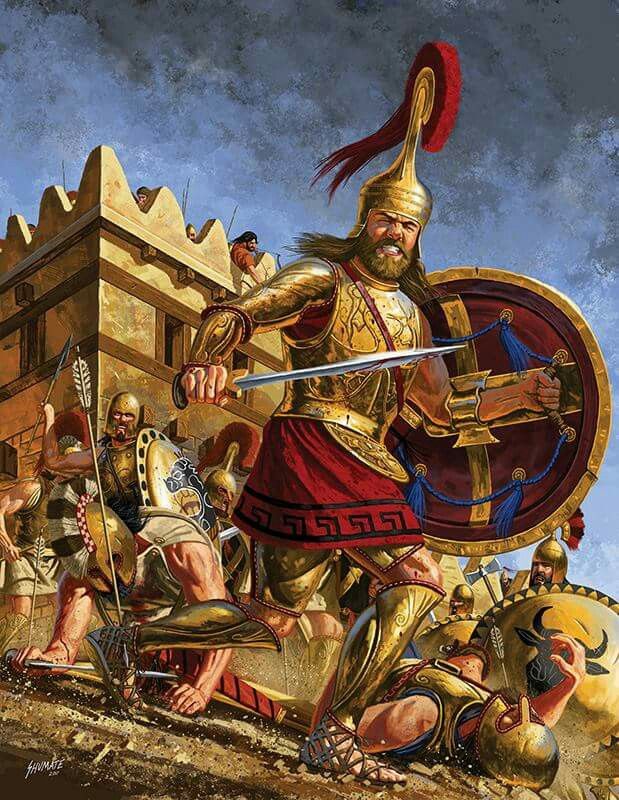
The use of bronze tools and weapons greatly empowered the cultures able to use the technology. Bronze Age swords appeared in the 17th century BCE. These, along with spears, shields and maces, supported by slings and javelins, allowed these cultures to claim lands inhabited since time immemorial by monsters and immense creatures of dreadful form. The Bronze Age initiated an age of heroes, in which warriors who were godlike in stature were able to slaughter these beasts and make the lands clear for settlement. Hydra, Stygian beasts, enormous lions, lesser and greater cyclops, chimera and minotaurs were eradicated or driven back. The Nuragic civilization of Sardinia was built upon the bodies of giants and still has monumental Giant’s graves. The effect of this was to give humanoids untold accumulations of experience that had never been available, providing them with prowess and knowledge that was hitherto unheard of in Earth’s history. These heroes became so powerful that some became demi-gods, possessing names that are instantly familiar to this day.

This led to an expansion of the fighter class, in which training in certain kinds of weapons produced a newer, different breed of combatant, with greater hit points and a greater potential in battle. Not merely limited to three or four experience levels, fighters could accumulate as many as 15 to 20 levels, making certain of their number powerful beyond the comprehension of the time.

Priests of the Bronze Age were able, in certain parts of the world, to communicate and interact directly with Gods, who had grown interested in Earth through tales told to them by Odin. God settled upon Olympus for a time, showing an interest in the Mycenaeans and Minoans, and in Elphyne, sometimes called “Fairyland.”
[take note, the humanoid “elf, elven” is distinct from the faerie “elfin,” which does not refer to a single race but to the collection of all fae-folk].

This association led to the earliest use of clerical magic, expressed as crude spells much reduced in power from the present period. These spells were largely portentous in nature ~ augury, for example, possessed an earlier form than the more familiar spell. Other early spells include create water, purify food & drink, chant and enthrall.

Rumblings of other classes that gave some promise of appearance after the Bronze Age include the druid, ranger and thief. But these would not flower until the Iron Age that followed.

See Also,
Campaign
European History
World History

Fresh Recruits

The following talks about the manner in which armies were raised in the 15-16th centuries, with recruiters riding through the countryside, with a licence to raise men, pay them and sometimes start off commanding them.
"Whoever the recruiting agent was ~ the agent of a regional magnate or of a supplier with a stand-by contract to raise men on demand, a local authority or a roving captain who had petitioned for a recruiting license ~ the approach, save to the few who positively welcomed the chance to enlist, as an identical mixture of cajolement and pressure.  Magnates called on their clientale groups of tenants and retainers to honour obligations, sometimes written, sometimes simply assumed, to serve them in arms along with their own tenants or servants; kinsmen were urged to support them in the same fashion, for the honour of the family and the favour of the king.  Local authorities, in rural parish or urban ward, consulted registers of adult males, selected the number they had been charged to send, and sent the constable to summon them in the name of the monarchs's wage, the justice of his cause and the reputation of a community only too well aware of its vulnerability to punitive taxation.  The captain submitted his patent, had his mission proclaimed by the cryer at church, market and through the streets, set up his standard, had his drummer beat, and waited for custom in an inn or the more supportive house of a justice or alderman; serve the king was his message too: let him pay you, enter that alternative society of warfarers which promises freedom for the humdrum, penurious, hen- and priest-pecked life of everyday."
J.R. Hale, War and Society in Renaissance Europe

That's just marvelous.  There's several pages of this kind of information, talking about how a town had to put up the money for recruits, to get them to staging areas, and hope the monarch would return the fees; and of course how individuals with means and connections would use whatever means they had to ensure they could get out of service, while dumping that burden on the poor, the stupid and the desperate.

The Goblins Want YOU.
I see two interesting starts for campaigns that don't end in the party being recruited.  The first is simply watching the process happen all around them, as people are rousted out of their houses, out of beds, pressed here and there, assembled, arguments on the street, recruits finding the coin to pay off a guard, a landlord asking the party if they want to rent a room cheap, as he's just lost his tenant, other similar opportunities, the town asking for donations and the players having the opportunity to make friends, etc.

And second, the players being assigned as recruiters, with the understanding that they'll get paid for every recruit they raise, and the knowledge they don't have to go to war themselves.  Of course, the more recruits they raise, the more recruits the local town must pay to send to the staging area (recruiters do not travel with cash!  Says so in Hale's book), so there's push-back from the town fathers if the players get too ambitious.  But then, the players can argue the name of some lord, who can bring punitive measures of all kinds, if the town doesn't play ball.  Really gives the players a chance to swagger.  Would make a very different sort of adventure.

Inspiration is fun.

Monday, April 8, 2019

DM Workshop, Week 2

Empty.

Using Gygax's tables as written, there is a 60% chance of this result, once I've rolled that the door leads to a room.  If you follow the generator as written, you end up with miles of empty rooms, like this, one after another, frustratingly filling up map while NOT finding monster to fight and not finding treasure.

I shortened the likelihood for this occurring to only 25% ... and when I got the result I did, of course, I considered just fudging it and producing another result.  Thing is, however, I want you, dear reader, to recognize just how miserable this is for a players ... because right now my method robs you of the normal sense of "control" you have as a DM.  As a DM, you don't have to put up with this crap, if you think an extra room is boring and ought to be filled with half a dozen somethings.  And if you've DM'd for a long time, you're extremely comfortable and familiar with that sense of entitlement.  Sure, the players can deal with this shit, if you the DM think it "builds tension" when you feel like spattering out a series of empty rooms.  But now the shoe is on the other foot.

The problem is the same.  We have a 30 ft. square room, with two doors, one on the left and one on the right.  Once again, I'm asking that you fill it.  Before you do, however, let me explain that your first problem is to explain why this room doesn't have a monster in it.  Unlike a set of caverns, where emptiness is expected, or an underground ruin, where the doors are broken in and we might expect to see a bunch of vermin, these are carefully constructed rooms with working, solid doors.  And a place where anybody might "just walk in."  If this is someone's lair, they're awfully lax about security.  They don't care about interlopers ... or they happen so infrequently that no one worries about them.

No, that isn't easy.  And I apologize.  I'll add to it that continuing the theme of the statue is your second agenda.  The statue is your theme now ~ if you can elaborate on that theme, you can both solve the first problem and provide this room with a deeper sense of place and purpose.

I'd like to try something via comments.  Go ahead and get crazy with the descriptions if you like, it doesn't hurt to throw shit at the wall and see what sticks.  But, to see if it sticks, I'm going to suggest disregarding any item or motif unless someone else specifically seconds ("likes") that particular item.  Then, those items that are liked can be collected together and applied to a vote late this week.

Welcome to hell, ladies and gentlemen.

Exercise: the Space Beyond the Door

Problem the first.

A dungeon generation chart might seem fairly silly to some, but I'd like to pitch its value a moment.  You see on the right a copy of a table that appears on p.170 of the original DM's Guide.  It is plain to see that the table does not attempt to dress the dungeon in any way, but only tries to define the physical space beyond the door ~ whether it is a passage, a room (small space) or a chamber (large space).  The actual nature of the room or chamber, and its contents, is left for another table, which I hope we can discuss another day.

My request for the present is this: can you improve on this table?

Your limits are this: you can't include skins that alter or adjust the walls; you can't add aesthetic features, items or elements that are semi-permanent; you can't add monsters; and you can't create a dead end.  A room/chamber might be a dead end and a hallway might actually turn out to be a dead end, but these things are determined by other tables.  This is strictly about the space behind the door.  The door has to go somewhere.

I've produced my own version.  I built several whole dungeons with the above chart in my first 10 years of D&D, until I felt I'd moved past it ~ and the most annoying thing was always the passage turning back on itself 45 degrees, so I've abandoned that feature.  I've added vertical features.  And I've removed the need for the notes that Gygax had to add for his version.  I prefer to use "ft." instead of a single quote.

I'm certain that Gygax deliberately left stairs out as an option.  His conception was that stairs would always mean the dungeon progressed a level in danger, so his generation made them annoyingly rare, so that a party wouldn't quickly find itself facing monsters out of their capability.  I don't have any problems with a "first-level dungeon" spanning several physical levels.  I feel the cut-off between one level and another ought to be based on something less feature-driven.

My reason for the exercise is merely this: to make the reader think.  We see these massive megadungeons depicted everywhere, but the reader will note they are created of the same functional patterns, like the space beyond the door, again and again.  I'm asking the reader to deal with one small facet of the dungeon creation machine, to see if it can't be improved upon.  Like examining a car's head gasket, to see if it can be made more durable.


Sunday, April 7, 2019

Workshop PCs

Creating this post separately as a convenience, with details relevant to the DM Workshop we spent the last week exploring.  I've rolled up five player characters for moving through the dungeon, with the most basic stats possible.  I want to emphasize the possibility of someone dying, so I don't want anyone to get attached to any of the characters as yet.

I could use a go-between, someone willing to accept a direct email from me at the beginning of each week.  This should be someone who has no plans to take part in the workshop.  Perhaps Justin?  The idea is that I will create the bare features of the dungeon first.  Then declare in a private email the actions of my characters.  THEN the designers can work out the details.  When those are settled, the middle-person will unveil my answers and whatever needs to be resolved can be.

I based the characters on my rolls, being sure to include a cleric, a mage and a fighter.  Rolling the cleric, I got a 4, which I had to put under dexterity.  I got very lucky with one set of rolls and so I made a monk.  Monks are my favorite class.  I got very lucky with hit points, rolling in the upper range for every mass-hit point roll.

I don't know if we're going to have trouble with editions being run.  Combat is going to come up and we will have to deal with that, but the way I have it worked out, it will work just fine if each of you will translate the stats into whatever system works for you.

I'm endeavoring to make this as system-neutral as possible, as the actual worldbuilding is more or less universal.  To some extent, however, I'll need to be able to use the magic I have according to the way the spells are described in the wiki.  If that creates problems, we can resolve them.  I don't care about these characters so I'll be fine with making concessions.

For the present, I will be keeping with my statement as written, but elaborate it some.  My dwarven fighter Draedar will fully load his light crossbow and hold it on the door.  My mage Bergthora will not cast, but she will place herself at the foot of the stairs, with dagger in scabbard but her hand on the handle.   Albertus the druid will ready a dagger.  There's no room in here for a sling, especially with her dexterity, so Eleana will hold her mace.  Caspar moves forward and closes the door; he steps back and we all watch to see if something comes out.

Result of the Votes, 1st Week

The winners, with six and four votes:
"Broad view: Large statue of an orc in center, facing north, holding a broken sword, inscription at base that reads, 'Halls of Bashag the Proud.' "
"The second door to the right stands slightly ajar. You don’t see any light through the crack."

Fairly simple.  I would encourage the readers to consider how very little is actually needed for a party to get interested.  Because the room is closed, I'll give my own take on the description, and why I would go that way.
"The nearest right door is painted red.  The other four doors are normal dungeon doors."

It's not only that less is more; it is that the players are bound to fix their attention on one or two details, however we might try to pack the room full of interesting things.  By keeping it simple, we produce a more memorable experience ... and through the rest of the dungeon, the players are either thinking, "We should have gone through the red door," or, "We absolutely shouldn't have gone through the red door."  It doesn't matter what's behind the door; the red color is flexible, easily explainable, yet just enough to arouse the curiousity and attention of the party.

The orc statue is the same; at one time, it suggests the dungeon will be full of orcs; but the broken sword clearly suggests the orcs were cleaned out and aren't around to fix the statue.  The open door beckons ... human nature is inclined to go right to it, either to snap it closed and then stand on guard, to see if something boils out, or to kick the door in and hope for a surprise.

The bare description gives less impression that the DM has already created some massively complex scenario designed to trap us.  It's hard to see, but great detail is actually comforting; it suggests to the player, "Oh, doesn't matter what I do, the DM's got this all planned out."  Thus, a reduction in tension.  We're just along for the ride.

A bare presentation doesn't make its intention clear.  Are we in control or not?  We feel like we're in control.  We can argue that any door will do (and some players always say this), but the truth is that we're free to listen at each door, examine the first fifty feet beyond each door in turn and ultimately make our decision by steadily gathering more information.  Initially, yes, the doors do seem the same ... but that is a surface impression.

I haven't rolled up any characters yet.  I need to do that today, though I intend initially to create the bare minimum.  My inclination is to close the open door, step back, load missile weapons and see if something comes for us.  If not, we'll enter that room.  So tomorrow, I'll post a map, plus some other planned materials, and we'll go from there.

P.S.,

For those who haven't seen it, the DMG Dungeon Generation system creates spaces, stairs, includes some features and places traps, monsters and treasure.  So going forward, I'll be asking the players to avoid adding traps, monsters (including men and demi-humans), valuables of any kind and excessive features such as chasms, pools and wells at this time.  However, we will be discussing the expansion of these concepts in the weeks ahead, so there will be opportunities to brainstorm these things.

Remember, we're not trying to make the whole dungeon in one room.  We're not looking for a huge dungeon "theme."  We're training ourselves to imaginatively create an organic setting based on what's come before, and not what we expect must come after.  Think past, not future.

Saturday, April 6, 2019

An Encyclopedia of World History

This is my grandmother's book, published in 1952, the front cover is nine inches by six.  It has just over 1350 pages.  My parents inherited it from my grandmother when I was 12; and as I was the only one who ever cracked the binding, it more or less became mine over the years.

The book is written in a spectacular point-form style, with dates of course, in as close to chronological order as possible.  This had its limitations once, but is now a brilliant companion to wikipedia, since it is replete with names, places and moments that can be looked up with such ease.  So, when I was asked by a reader to detail what my world would be like in the stone age, I went straight for this book.  I was glad to have it.  Until I moved in February, it has been in storage.

Because it is from 1952, however, much of the book's explanation of pre-history is way, way out of date.  Consider.  When the book was printed, Olduvai Gorge was nothing but a collection of a few stone tools and handaxes.  Our concept of human evolution has massively changed in just a few decades.  On that subject, I certainly wouldn't rely on this text; though it holds up fairly well, considering.  Given the content, the scholarship must have been first rate.  The book describes the contributor for the prehistoric period as Dr. Lauriston Ward.  Unfortunately, I can't find him on Wikipedia.  Lauriston is mentioned on this page, as the president and founder for the Council of Old World Archeology, apparently still active.  Must have been quite a fellow, before others outshone him.

Another fault of the book is that it is sadly lacking in non-European subjects.  Books did tend to be Eurocentric at the time ... but part of that is also because texts stored in relatively wet climates, made on rice paper, do not tend to survive as long as texts stored in a dry climate, written on parchment or rag paper.  It is extremely difficult to study 15th and 16th century West Africa, when most of the texts were written from the point of view of the Mali people who had a ready supply of papyrus in the Niger valley, and when papyrus is extraordinarily poor if what you want is for people to read your writing four hundred years later.  Mali did not, like Egypt, have a tradition of burying texts in jars in the desert ... so what we know about Mali during the time of Cromwell is annoyingly scant.  What we know about Cromwell, on the other hand ... you can spend a lifetime just reading letters passing between people between the years 1645 and 1660.  And people do.

Still, the image shows what I mean about point form and dates.  I find myself often on the verge of screaming at youtube videos created by amateurs who can't see the value of including dates relating to their material.  What is the good of my watching a breakdown of eight Moghul rulers and their methods, from Akbar on, if I can't relate their reigns to what's going on in other parts of the world?  After 1500, the encroachment of European power in India was just a little important.  But of course, I don't rely on video for my history research.

I do love history.  And I could spend a lot of years rewriting the encyclopedia to give a complete historical background to my world that fit in the presence of non-human races, monsters, the discovery and advancement of magic, etcetera, for the sheer pleasure of it.  I don't know who else would get anything out of it ... but there is something so rewarding in deconstructing history, I'm not certain I would care.


Friday, April 5, 2019

Making a Workshop Decision

The most fun I had today was writing about the Palaeozoic Era, as requested by a reader encouraged by this post.

The problem with any sort of discord or misunderstanding in a comments window, everyone else clamps down rather that being seen as ignoring the drama or participating in it.  That issue is now settled, so let's get back to the agenda at hand.

Several people seem to be getting the jist now, so I'd like to find a way to move forward.  Let's call a moratorium on new descriptions at this point and try and settle what this room looks like.  Monday, I suggested we should vote on someone's description.  That is very obviously not practical.  So let's workshop the problem, and try to settle an answer by Sunday, so I can upgrade the map and create a new situation come Monday.

I suggest the readers participating, and that means everyone, should express their preference for ~ let's say a maximum of two described dungeon facets ~ what they've seen from others so far.  Name one High Preference and one Low Preference; explain briefly why you prefer these, as a way of encouraging others to share your sentiment.  We'll give 2 pts. for your High choice and 1 pt. for your low, and see if we can find a winning motif.

Here's a nice fantasy image, encouraging everyone to feel warm and fuzzy.  Let's have fun.


Writing to Spec

As the DM's Workshop continues, I'm interested in providing an offer to boost my Patreon numbers and to provide some payback to my keenest supporters.  I've seen around many sites that D&D designers will offer hand-drawn maps or that they'll create a one-page dungeon according to specifications.

It's not in my skill-set to do the same, as I don't draw and I don't think in static dungeon set pieces.  But I can offer a write up on my wiki, regarding any subject that relates to the real world (places, moments in history, science, culture, etc.), AD&D (spells, monsters, combat, magic items, artifacts, outer planes, etc.) or rules in D&D that don't exist, that I'd like to create at some point.  Basically, the reader would be pointing me at a subject I could write someday, but I don't plan to do so anytime soon.

No doubt, some negotiation would be involved.  I'm not interested in writing wiki entries about something that will never appear in my world (tieflings, for example), but I'd be willing to put effort towards something I'm probably never going to cover on my own (drow elves, for example).  My take on some popular things won't be canon, of course.  I've never run in, or seen run, or read, the Vault of the Drow or any associated materials (if the reader can believe it).

Before jumping in on it with Patreon, I want to see what sort of a headache it might be.  The requirement would be $12, for a minimum of, say, 400 words (3 cents a word), which would get one such post per month.  Those Patreon supporters who have presently satisfied the criteria for the month of April would be Carl, James, Andrea, Justin, Jack, Vlad, Wandrille, Ken and Walter.  And for the sake of long time past support, I'd like to also make that same offer to Tim T., Jonathon L., Shelby U. and Pat L.  That's 13 posts; I'd like to see how hard that is.

If anyone wants to donate the difference between their support in April and $12 (through Patreon or the donate button for a one time only experiment), I promise to get to everyone, whether or not I can by the 1st of May.  If it is too damn popular, and just out of my reach, I'll consider raising the bar or abandon the idea.  I'm calling April a test.

If we can't agree on a wiki topic, I will certainly refund your money.  Please ask questions if I haven't made myself clear.  Anybody want to give it a go?

Thursday, April 4, 2019

Five Points on Displaying the Dungeon

The fundamental purpose of visual merchandising is to attract customers into the space, engage them, and motivate the customer towards purchasing items ... particularly those items which provide the store with the greatest profit.  The exterior display has, as its goal, to entice customers into the store ~ and therefore suggest that the store is a wonderful, phenomenal play space, where the customers can thrill themselves through shopping and the pursuit of materialism.

We'll talk about some mistakes that are made in setting up an exterior display, from a dungeon point of view.  The first room ~. and indeed, any room that must serve as a utility for beckoning the players forward with zeal and interest ~ IS the store's front window.  It is the first impression.  It falls on the DM to make that impression well.  And lest the reader think I'm speaking from bias, I offer this link, from people who know something about winning over customers.

1.  Too Much
"Displaying products in large quantities and without a defined priority, importance and layout makes the window “dumb”, unable to communicate.
"The truth is that the human eye seeks order, clarity of reading always, even when observing a window display. This doesn’t mean that appreciates monotony but that find it easier to be guided through lines and geometric paths."

As much as I respect the efforts being made to design a dungeon entryway with verve and excitement, right down to putting in the sounds of weapons being used nearby [which breaks the design framework that was set up initially, as we have no idea what's going on any next room], it's too much.  It is too many things.  Having read through a number, my eyes soon began to glaze over as complex descriptions followed one upon the next.  To state the problem bluntly ~ for which I apologize, but we must be clear ~ my thoughts become, "yeah yeah, dead bodies, what else?"  The detail, as a game design feature rather than the front paragraphs of a novel, is wasted.

This is not inviting the player into the dungeon.  Most of these descriptions leave me feeling immediately threatened; I don't feel in control.  Players want to feel like they've got this, so that the room tells them precisely what sort of lair they're in.  Empty vases, complex fountains, wet floors, gushed blood, vibrating hums ... these all say, go away.  A lit fireplace and a wicker basket may be welcoming at the inn, but down here, it says something very powerful lives here that doesn't need to lock the front door or post a guard.

2. Create Space
"Leave no space between the products creates a fast scan effect, very fast, in the minds of your customers who will compare your shop to a thousand others similar to ignore."

These descriptions are, in detail, very different and unique.  But as a body, read in sequence, they are all the same rhythm.  Noise, things, five doors, got it.  The descriptions simply meld into one another.  If you use this same technique to describe every room in your dungeon, the player's heads will quickly fill with non-descript, utterly unimportant details, leading you to say as DM at some point, "Remember?  I told you there were hexagonal tiles in the first room.  How could you miss that?"

There's only so much new, disconnected information that the brain will take in and remember.  As creatures, we're designed to look at a whole forest and miss all the trees, except the one with our dinner sitting on the lowest branch.

3.  Spotlight
"You must define which produces to prioritize time to time in the window.  Putting the window spotlight on a product that you don't sell a lot is the boost it needs."

In presentation and writing, there is a technique.  Pick one thing as the most important thing in the room.  Then relate everything else in the room to that one thing.   The large, faded rug in the center of the room is immediately below the open lantern hanging form the ceiling.  The rug is placed the same distance between the nearer left and right doors.  The weave of the rug includes the damaged image of a finch.  You see the same finch image on the back of the shelves.  A finch has been painted on each door.  The rug looks as though it has been used as a welcome mat.  The rug is brown, unlike the grey floor stones.  And so on.

One thing in this room is actually important.  One.  More than that, and you're over-reaching the player's attention span.

4. Not Dark, Dirty and Disordered
"I think the title says it all but to be clearer: dark, dirty or disordered are sad and useless displays.  In a display window [it] is not enough to take care only of the products; choose the right ones and make them look their best."

It is quite clear that many of you have tried to do this.  You've selected a specific door to draw attention to, or some item that might have potential; but these are not spotlighted and there is so much clutter and extraneous detail in the room that the point is missed.

I feel I should point out that I never said, "Present the room as though I, the player, were in the process of entering it."  I never said, "Run the room."  I said, "Fill it."  "Write your description."  In short, DESIGN the room.  The workshop is about worldbuilding, NOT presentation, and that message was utterly lost.  Forgive me for stressing it now, but I need to make this point now to address the disordered problem.

When designing a room, you should think of it in cold design terms, without the adjectives, the emotions, the extraneous effects of sound.  And without the mystery and "keeping us in the dark."  It would be perfectly acceptable for each of you, who tried to present something as weird and not fully understood, to just say what that thing is.  I presume you know it.  By "designing your game" from the standpoint of all this presentational clutter, you make it harder for you yourself to know precisely what's going on.  The players are not the only people here who will have trouble keeping track of all the darkness.


5.  Have a Plan

I might have said a lot of this Tuesday, but I'll be honest.  I hadn't identified the problem myself on Tuesday.  I said this would be a learning curve.  I was going along with what I was seeing, concentrating on the creativity.  The creativity is great!  But it needs to be washed clear of the sentiment and written out in clear, harsh terms.  If you will each go back and review your descriptions, I think you'll find that much of the fill you've added doesn't actually go anywhere.  It is just dressing.  And as the fellow who wrote the linked post would say, nothing in a well dressed window is put there casually.

Who here had a plan?  If so, let the rest of us know about it, since we will ALSO be designing the dungeon.  That way, we can decide on the best plan, rather than the best descriptive paragraph, and then hone and finesse that plan into a truly interesting dungeon.

Description is Easy