Showing posts with label Arguing. Show all posts

Thursday, July 9, 2026

But...

As a social misanthrope, one of my deepest instincts is the will to speak freely regardless of the consequences. This grew into a compulsion with me at a young age through a repeated behaviour from my grandfather, my father and those bullies whom I went to school with, whose tactic was to silence me by lifting their fist and threatening me with it, and occasionally going the next step. As such, as I got older, and this is a thing that many find, the willingness to take a blow became stronger than the fear of getting it, so that I began in my late teens to respond to threats with, "Oh yeah? Well, go ahead, I'm going to say what I have to say."

The issue is that it requires a tremendous amount of anger and resentment to overcome the fear inherent in being struck, and especially dogpiled by more than one person, something I've also experienced. My friends were mostly those who had learned to speak in soft, controlled voices, whose habit was to look at their shoes when spoken to, who could not get dates with girls because they could not find the courage to overcome the possibility of their saying no. I had their choice as evidence of a solution that did not really work, but I don't think I ever weighed the rationale of being them or being myself. I was simply more volatile, more hot-blooded, more reactionary... and as such, in my teens, I became worrisome, frightening, even evidently irrational. The nature was "baked in," so to speak, in a way that was not only inherent, but extremely rare, as was evidenced in the way that teachers and other authority figures reacted to me, as I intimidated them.

And because I spent a lot of time alone, apart from taking part in sports (where, again, my volatility both served and handicapped me, depending on the situation), I read voraciously. The reading enhanced my vocabulary, the resource of my knowledge, my perspective, my understanding of what others would try to say or how they would say it... which led me into things like debate and public speaking... where, again, that volatility both served and handicapped me. It is one thing to have the will and the fearlessness to stand in front of 500 people at 18 and scream about the injustice of the cruise missile being placed inside Canada, which I did in 1982 during that controversy, but that same fearlessness does not benefit one in small rooms with people who have enough power that they're not intimidated. The sequence of events in play, therefore, put me in places that others have never gone, while not contributing to those things that would have benefitted me: an ability to kowtow when kowtowing was called for. I simply did not have that skill because it had been trained out of me.

Of course, the bullies disappeared... and when I was nineteen and stood in front of my father when he came at me to beat me again that "All right, let's fucking go," in a stance that said, yes, absolutely, I was ready to fucking go, then he backed down and that was the end of that. My grandfather was too old and too far away and I was not visiting him anymore as a boy dragged to Regina by my parents, so I did not have any scary enemies left to fight... and I did not go out looking for them, taking swings at cops and bouncers and anyone I could find, because I had become well-read and I had concepts of social justice and I believed in John Stuart Mills and Thomas Paine with regards to what justice was. So I didn't get a criminal record, I didn't become a social problem, I didn't act out against the state, I didn't break the law.

But the resentment with respect to being silenced has remained. The resentment against any injustice or any unfairness remains. And when I say "resentment," let me be perfectly clear. I may be not quite 62 now, just two months shy, but as I write this I feel a boiling white hot anger that is still recognisable, still there, and still boils up when someone starts talking about the wrongness of foreigners in the country or my province making noise about leaving Canada, or anything to do with persons in an LGBTQ frame, or pretty much anything where I see money and power railroad someone out of office without evidence, on hearsay, for reasons, and voices I trust suddenly start talking as though this is reasonable. My poor partner, who has learned to tolerate my outbursts on these subjects, when I simply cannot keep the lid on them any more, suffers the shouting and then hugs me when she feels I've settled. That's what living with me is like; not a person who is physically violent, but one whose violence remains intellectual, verbose, searing, confrontational and, yes, loud.

Age and maturity have, however, convinced me that all this anger is purposeless. It has no listener. There's no future in stepping into a political sphere to "change things" because I am not oblivious to what a political sphere is, or what it is there for. I quit my street marching days when I realised nothing was being accomplished and when, in private conversations, I learned that the leaders of such movements were doing it so they "could sleep at night." I wanted change, not a good night's sleep, but that wasn't going to happen, so I stopped. I turned to journalism, wrote editorials, made a lot of people mad and felt I was doing what I could. But even that, now, does not sustain me in the least way. I'm far too old a bunny, as I like to say, to indulge in such fantasies any more.

All this is to say, though, why it is so hard for me to let go of a bone when I have it in my teeth. It explains why it is so hard for me to sit and listen to someone spew unsupported, obviously emotionally derived garbage when actual, rational, supported, methodical arguments that demonstrate evidence find no ground to stand on. This blog has demonstrated, with examples and detailed accounts, wrongdoings related to D&D in a hundred different ways — which yes, is a strange hill to choose to die on, but hell, there's no one else here on this hill anyway — but to what purpose? Only to the occasional listener who finds themselves nodding their heads and accepting that someone, somewhere, finally, is going to say that thing. That is the sum total of this blog's value. It occasionally connects with someone.

Yet, it is certain that what's said here is not going to connect with a vastly larger audience, many of whom disagree with every word printed here. Some are going to find that my willingness to die on this hill is so absurd that this in itself demonstrates me to be a deluded, unreasoning, warped and even repulsive individual. And some are going to tell me, in various ways, that I'm wrong, or that I should shut up, or that I have picked the wrong word to make my argument, or any of a thousand what-is-seen-as-legitimate arguments to make, sustained by the fact that many thousands of people out there in the culture believe what they say, while I have merely dozens who can do more than "not agree with everything he says, but he's interesting." That is the sum total of the push-back here. I'm not exactly wrong... I'm just not really in a position to be right.

My tone is excessive, I am bitter, I am unfair, I misunderstand what people mean, I am technically correct but I've missed the spirit of the thing, I'm attacking people who are only trying to have fun, I'm making too much out of things that are trivial.

All of these things are, in essence, true.

It is my childhood, and not my training, not my love of D&D, not my self-interest, that urges me to answer every accusation rashly. Because my mind has embraced this idea that if someone does not actually address the subject at hand, the thing that's being discussed, the point of the article, then in a way it is them lifting a fist at me as if to say, "I've just made a semantic argument, so you'd better shut up now."

Consciously, I know the reader can distinguish between a good answer to my post and a bad one. Consciously, I know that my point is stronger if I don't back it up. I can recall my professor Dr. Barry Baldwin telling me, when people lost their shit at me about the editorials I wrote for the university paper, "Don't answer them; it makes them look weak and desperate, while you look indifferent and superior." I know it does not good to answer. I know it's the wrong approach.

But dammit, I still see that fist in my mind's eye and I still...

In 1971, an independent filmmaker who felt exactly as I do, before I was old enough to feel as I do, made a film about it. I did not see the film until I was fifteen and when I did, for a time, one scene was my bible. Most people remember the scene with the foot. That's the scene that fed the masculine male model... but in that scene, the character is smiling. He's contemptuous and he's silent. It's the scene that came before that spoke to me, because in the scene that came before, the character is speaking rationally through gritted teeth. He's speaking about anger. He's speaking about how overwhelming and unrelenting that anger gets when he sees cruelty and wrongheadedness and abuse. That is the scene I felt when I was in my middle of my adolescent, unrestrained, uneducated mind set. And watching that scene is like putting on a very familiar set of old clothes. It is a time machine.

https://youtu.be/-SlD4KqDDUM?si=TMOk9cBitf8XYnea

The problem is, see, is that the anger only appears irrational. It comes from an irrational place, an unwillingness and inability on the part of those in authority to be rational. But the anger itself, channelled, informed, cultivated, patiently reviewed again and again as I am doing here, without anger, in this post, which has no business being here in a D&D blog, is not, in fact, irrational. It is not irrational to expect people to respond to the context of a blog post as opposed to some frivolous detail that has nothing to do with the point, because they need to feel important enough to oppose something, for the sake of opposing it, in a place that is not theirs, simply for the sake of their ego. It is not irrational to call them to account for that. It is not irrational to say, "All right, aside from that bullshit, what did you think of the post?"

But... okay. Serenity to accept things I cannot change.

Like the man says, I try. I really try.

I've already soured my popularity with this blog in ways that can never be taken back... and it doesn't matter any more. I've come forward and said things about myself that nobody should say publicly. I dunno. Just the lot we get, I guess. We don't get to pick. We don't get to decide if we're rich or poor or volatile or what. I think the only thing any person can do is be honest. Say what they feel and let it be. In the end, it's all ashes anyhow.

Monday, November 30, 2015

Principles Underlying the Relevance in Comments

"This is the part that I think people underestimate.  If you're in the arena and you email me and say something to me, 'Look, I'm really questioning your research because you forgot the entire academic literature on intimacy and you should be thinking about that,' that's feedback.  If you say that, then I'm going to say, 'Wow, I should look into that.'
"If you're in the cheap seats, not contributing, not putting yourself out there, not risking anything, and just criticizing, I can't be open to your feedback, for this reason - and this is something creatives I don't think fully get: it hurts and it changes who we are.  When I hear people say, and its often creatives and leaders and organizations, 'Look, I don't give a shit what anyone thinks,' that is its own kind of hustle."


By 'hustle,' Ms. Brown doesn't mean getting going and getting it done.  She means lying to yourself and to others.  See the video.


I do care what people think.  That's why I'm writing this down.  And it does hurt - though admitting that is hard, because it often gets brutal on this blog - and I know I hurt other people as much or more than they hurt me, since I'm better at cutting with the knife and I'm in control of this space.  Yet it's true.  I get hurt here also.

I do know when I present anything odd or off the wall, when I rant, when I fly smack into the face of preconception, I am going to flush out the critics.  It isn't as bad as it used to be, as most of the hard core critics and trolls have given up on me - in part because I'm more than willing to delete their words, taking away their power, but also because, as JB said most approvingly, "The Work continues."

Hey, JB, sorry we've been butting heads lately.

JB is a good example of someone with his head in the game - but I wouldn't say he's getting his ass kicked.  He is getting the sort of meaningless criticism I discussed in the last post, however; I hunted around for an example and found this on JB's recent assassin post:

While this is overall a good effort, the death attack is extremely overpowered - there needs to be a save or something, because as - is the class is 'I win' after name level.  Also, I don't know how it works in B/X, but you'd never be able to use this kind of assassin against the PCs, particularly at high level - the rate that they'd get their death attack in means the PCs would be cut to ribbons.  
- Jack Phoenix 

I don't know if that hurts JB or if it changes him.  I'm more sensitive about these things and I want some sort of evidence that anything actually being said in the comment is true.  Apart from Phoenix's assertion - based on the DM willy nilly doing thing like throwing high level NPCs against players, apparently randomly - I can't make heads or tails of it.

Jack Phoenix is not in the game.  He has a google+ page.  He's human.  For most people, that's enough of a reason to respect his opinion.  But let's be clear.  Mr. Phoenix is in the cheap seats.

Why?  Well, not to cast aspersions on the man, but because there's very little evidence that I have of his contributing his time to the issue.  Time is the fundamental measure.  The above comment would have taken 60, perhaps 70 seconds to punch out, assuming hunting and pecking, whereas the post it is written on runs about six times longer, has a table and is part of a series that JB has been writing all month.  Contribution-wise, measuring only in time spent, JB has my attention.  Mr. Phoenix does not.

Moreover, JB's written over 1800 posts.  Where it comes to questioning the 'extreme overpowered' aspects of the assassin, I'm more inclined to believe that JB has throught this one through . . . whereas Mr. Phoenix has no posts whatsoever that I can access or use to consider his relevance to the discussion.

This would incline me to delete Mr. Phoenix's comment.  JB, I know, doesn't believe in such practices - and neither do 99.9% of those right now reading this post.

There is a good reason for that.  Most of you aren't getting your asses kicked, either.

Going on the point of the previous post, if you're putting out opinions that aren't being vetted by authorities who spend all their time considering opinions, then you're not really contributing to the conversation.  To date, neither am I.  Many readers have stepped forward and said that I've changed their games, that I've helped them DM better and that they're seeing the game in a new light and I really enjoy that - but I'm just a silly voice in the cheap seats where it comes to any force daily influencing role-playing.  I'm trying to shout as loud as I can.  I'm asking for some vetting and I want it to hurt . . . I want someone to tell me that I'm forgetting the entire academic literature on dungeons, characters and DMing.  Unfortunately for me, I don't think there is any such literature.  I think, rather, that there's a vacuum created by endless modules and splat books that consumes and renders meaningless anything written about role-playing.

A vacuum that encourages every rat bastard DM who imagines that a high level NPC shouldn't cut the PCs to ribbons.  After all, isn't that what a bunch of 13th level PCs are going to do to 5th level NPCs?

Truth be told, I can't even turn Mr. Phoenix's argument against him like that - because he doesn't say what level the PCs being cut to ribbons would be or what 'high level' means.  The comment is so vague that even in its own context it has no relevance.

Let me just add at this point that JB wrote a very long answer to Mr. Phoenix.  If I had written a long answer, I know it would have evolved from feelings of having my carefully designed post used by a commentor as a platform for an irrelevant, obviously prejudiced opinion.  That evolution would have involved me getting angry, since anger is my default, mostly because I'm easily hurt by prejudicial thinking about what I write - a part of me that I'm still working to change.

It really isn't that Mr. Phoenix is wrong to write what he did.  It is just one of millions of similar comments on role-playing that amount to the same sort of measurable contribution.  It isn't wrong that any of those comments were written either (though I don't want them on my blog).  What's wrong is that anyone should think any such comments are worth reading.

Yesterday, someone sent me an entire book to read.  A book that isn't published yet, soliciting my opinion because he values my opinion.  I haven't answered the email yet; I've been considering my answer.  The fellow is a reader of the blog so as he reads this right now his eyebrows are rising.

I value his contribution because, hey, this is an entire book.  I am always impressed and astounded when someone puts more than 5,000 words together on the same subject (because less than 5,000 is just another university paper), even when the writing is bad.  I don't know if that's the case here, as I haven't opened the book yet.  But I will.

First, I want to make a point on anyone's opinion - and a novel is an opinion, whatever people may imagine.  It doesn't count until it demonstrates a level of commitment and time.  It doesn't count until we've demonstrated ourselves to be persons of worth, through the steady, public contributions we choose to make.  And it doesn't count unless it disagrees vigorously with something that someone else is saying.  If it doesn't manage to do that last, whatever we've chosen to say is equivalent to handing in work copied out of someone else's book.

So if you're not getting your ass kicked . . . if you're not visible enough to be found by someone who knows enough to kick your ass and will DO so . . . and if you can't point to consequential evidence of your value as a contributor to the overall discussion, through published work I can go to and read right now . . . then your total achievement is humanity.  Congratulations.  You've joined the ranks of all the rest.

If, however, you ARE ready to get your ass kicked (as the novelist who bravely handed his unpublished book over to me) and you ARE willing to create the sort of consequential work that will prove your right to kick ass . . . then you should know that someone, somewhere, will like what you're doing and approve.  It doesn't matter if I like the man's novel.  Someone will.  Because the novel's existence shows the man cared enough to be vulnerable.  We humans, we like that.  We embrace people who strive and take risks.

There are five billion people on the internet.  There are more than enough out there that any written novel will appeal to enough people to validate that novel.  My validation is meaningless where the book's potential success is concerned.

People in the cheap seats rarely understand that.  Criticism really only matters before the work is done.  After the work is done - when this blog is finished, for example - it's too late.

The 'changing us' that Ms. Brown speaks of is the way that critics - particularly the cheap seat critics - undermine our confidence in getting the work done.  Creatives stop listening from self-defense.  Get the work done first, then face those bastards.  We can't, however, create in a vacuum, as Brown goes on to say:

"When you don't care at all what anyone thinks, you lose your capacity for connection.  When you're defined by what people think, you lose the courage to be vulnerable."

Criticism

"If you're going to go in the arena and spend any time in there, especially if you've committed to creating in your life, you will get your ass kicked.  So you have to decide, at that moment, I think for all of us, if courage is a value that we hold, this is a consequence.  You can't avoid it.

"The third thing, which really set me free - and I think Steve my husband would say has really made me somewhat dangerous - is kind of a new philosophy about criticism, which is this:  if you're not in the arena, also getting your ass kicked, I'm not interested in your feedback."


See.  I'm not alone.

This isn't going to be a rant.  I'm not going to go after my critics.  I am going to try to explain what criticism is and what defines "getting your ass kicked."  Criticism first.  

At some point soon, don't know if I'm up to it today or not, I'll be tackling the tech 14 post.  That post has four 'technologies' or developments that I mean to add to those developments that have gone before:  Nationalism, Divine Right, Paper and the Printing Press.

As I have said before, the introduction of these is not to suggest that peoples living in tech levels 5-13 don't know what a printing press is or wouldn't recognize one if they see it.  It does mean, however, that printing presses aren't available on a daily, regular basis in any region that is tech 13 or less.  To understand this, the reader should consider that in the 1930s many parts of the United States didn't have electrical power.  It isn't that electricity didn't exist in the world - it did, and had for more than 50 years.  It's only that to have electricity requires infrastructure, that parts of America like Tennessee, Arkansas and Oklahoma didn't have.  

It is somewhat like the way we still see theater today.  Virtually every small town has some kind of theater - but when we think of plays being launched for the very first time, we recognize that a new play being put up in Bloomington, Illinois, isn't anything like the sort of standard achieved in New York.  They make films in Macon, Georgia, but they're not the kind of films that get widespread distribution like those made in Hollywood.  The fact that I have to mention the state in regards to Bloomington and Macon, and not in New York and Hollywood, is a clue.

So let me be clear.  I'm saying, yes, some sizeable town in a tech 13 state will have a printing press in a back room somewhere, purchased and set up so that it can be made to reproduce work.  I'm also saying, however, that the content and amount of reproduction going on with that press has as much importance and social effect as an action flick made in Moscow, Idaho, with money raised by Moscow Idaho artists.  In terms of the world of film, none.  Not worth addressing.

Where social relevance is concerned, we are speaking about more than the presence of a given technology - we are speaking about its influence.  When critics bark that presence is enough, it's a clear sign that only half the thinking has been done.

The error is in supposing that any criticism that originates with the critic has merit.  We have a tendency to think that 'opinion' is all that's needed.  "In my opinion, based entirely on my feeling about the principles of technology, this doesn't make sense."  That's because the critic hasn't taken the time to consider examples from the real world where it does make sense and the critic hasn't approached the matter with a concrete, well-referenced example.

Examples are information.  They are matters that have been studied, examined, researched and vetted by other people, beyond those in the room.  Here's a qualifier: if the reader has just come up with an argument that the reader can't remember having read written somewhere by someone else, then that argument is shit.  Note I don't say probably shit.  I mean it is exactly shit.

Yes, I am saying that my entire tech system concept is shit - but don't get bogged down in that just now.  Put it on a shelf.  We'll get to that in a minute.

In a world where hundreds of thousands of people are paid to do nothing but think stuff up and teach it to others, we must accept a few things about ideas.  If we've had that idea, someone else has had it.  More than that, they've told others.  Others who are experts in the field.  Who were smart enough, long before you or I had the idea, to already define it as shit.  We are way, way, way behind the curve here.  It only sounds like a good idea to us because a) we've never heard it before and b) there's no one around to tell us it is shit.

But it is shit, believe it.  Because we haven't heard of it before.  And because we're not an expert in the field.  How much do I really know about printing presses and their distribution in Europe or the rest of the world?  Not that much.  Therefore, how accurate is my depiction of the presence of printing presses in given regions of my world - or the influence and effect of those presses?  Not at all.

Here is the thing, however.  Unless the critic here quotes an expert, or speaks directly about a source I haven't read - and can direct me to that source so that I can read it and form my own opinions - then the critic's opinion is exactly the same level of shit as my own.  Basically, then, I'm being asked to exchange my shit with the critics shit entirely on the argument that the critic thinks his or her shit is better.  Just because.

I'm never going to do that.  Why would I?  The critic isn't going to be building this system, isn't going to be running this system and won't be at the table with the players encounter this system.  The critic's only value to the framework is in pointing out something someone who's not talking shit has said about some particular aspect of the system.

Which, as is usual on the internet, isn't happening.

Here's a very important point about things we think up on our own, when we do that.  Assume it's shit.  Because it is.  This tech idea, for all the wonderful praise it is getting - and thank you - has absolutely no merit whatsoever until it proves itself in a game.  Which it hasn't had a chance to do.  In a few months it may be nothing but shit on the blog, ditched, ignored and not part of my world.  I am very self-aware regarding that likelihood.  I have tried things before that got loads of praise and went nowhere.

I'm not nearly as impressed with the system as others seem to be.

I'll tackle getting your ass kicked on another post.


Thursday, November 19, 2015

A Digression For the Sake of My Sanity

Many things were said today about the tech system I'm writing, some of it critical.  The criticism seems, in my limited ability to read English in a mind-reading fashion, to suggest that my tech system is unrealistic, imperfect, inflexible and - because it provides no room for DM fiat - incapable to representing various cultures in my universe, notably the Mayans.  Who, as it would happen, don't exist in humans in my world and wouldn't exist at all if my world were 'realistically presented,' since in 1650 the Spaniards had wiped them out.

It is worth noting that if I didn't run a game based on the real world, but upon places wholly from my imagination, all this criticism would look pretty stupid.

I don't think I've made any secret of the fact that this is MY world, not THE world - and that should be pretty clear, since the denizens in my example of a tech 5 culture are hobgoblins and that the name, 'Lungos Nad,' is 100% made up.  But never mind.  Please tell me again about the importance of deviating from the results I've obtained from an algorithm in favor of results I'm apparently expected to pull out of my ass.

I did describe Gilkask's existence as unexplained, once the mining of coal could no longer justify its existence.  In no way, however, does this challenge the validity of the algorithm that was meant to determine the tech of the region - except in the imaginations of people who are so short of imagination that they are limited to the equation, a higher population must equal higher tech.  No other explanation can be considered.  Period.  And my failure to accept that, well, that's because I'm ashamed to deviate, within two days of experimentation, of the algorithm I've proposed. 

Sigh.

None of this ranting accomplishes anything.  The thing about various gamers with a grudge to bear, they don't listen.  They don't change their minds.  They're so certain that the issue is that they haven't been perfectly understood in the argument that they're making, they'll just make the same argument all over again in different words.  If only I understood exactly what they're trying to tell me, I would agree immediately.  Because it is so obvious.  To them.

I'm looking at the words above and wondering why I don't just delete them and move onto the next point.  No, no, they can stay.  It's all part of what I'm trying to do here.

I did pretty well with explaining it to JB.  I am not concerned here that the tech levels are realistic or rational.  I am concerned with how the party will experience the adventure when moving through an area of this tech level.  That is it.  The value of the setting exists only in how it serves the party.  There is NO value in the setting presenting a simulation, if that in turn waters down the impact of "Nope, there is no technology here" in favor of the words, "Oh yes, there is one person in town who can get you what you want."

If the party can still get what they want from the place, the tech level is meaningless.  There might just as well not be a tech level.

It baffles me that this isn't obvious.

It suggests to me that many DMs out there are making worlds for their own sake, and NOT for the benefit of players running in those worlds.

That is a very sad revelation.

This is why a totally inflexible structure is the only one that makes sense: because the only culture that matters where it comes to my game is Player Culture.  I can't be concerned with what the hobgoblins or Mayans were 'really like' - I'm concerned that the players are going to be met with a very difficult situation, where the very, very best tech that's available in this huge region is that described under tech 5.  Because it's a long, hard crawl across that land before they finally stumble into a village with tended cattle and plowed fields.  Because that will ensure the players really understand, "Wow, what a dead little backwater that Lungos Nad was!"

Forgive this last attempt at an explanation.  I'm going to start killing comments based primarily around "what if you did this with the algorithm" made by people who actually don't understand what I'm doing with the one I'm using.

On the other hand, kimbo, if you're listening, you are my GOD today.


Monday, August 18, 2014

Acquiring Faith

Going forward, I should try to make it clear why I've said something irascible.  I felt I did a good job on the last post explaining why I had put in the katana reference - and the specific way that I addressed Issara's comments on Greek City democracies seems to have hit a positive nerve also.

There's no question about it.  I do search for universal laws that can never be wrong.  That is my nature.  It emerges from my heroes having been fellows - mostly scientists - who demonstrated something to be true beyond a shadow of a doubt, silencing critics and expanding the envelope of human knowledge.  Unfortunately, I did not pursue science as a career - and thus I entrenched myself in a world where doubt rules.  People do not call for 'proof' in order that they may change their minds; they demand proof as a justification for why they should never change.  In science there is proof.  In rhetoric there is only opinion.

I don't know why I chose the latter.  In the beginning I certainly preferred science.  I read all that I could consume, I set out to collect bugs and study the stars, as well as other aggressive activities, in an effort to apply that science - but in the end, as I got closer to how a career in science would manifest, I withdrew.  I did not want to be a bottle washer.  I did not want to push electrons for a living.  I was in love with the glamour of writing about things . . . and I suppose that is how I wound up doing this.

This matter of 'universal laws' has been preying upon me all weekend.  There are laws that apply to rherotic and presentation, but they're much more squiggly than laws applying to math.  One plus One is never only Two in the soft sciences - because, in fact, 'one' is never just 'one.'  The reader's one and my one are completely different animals, raised in vastly different environments and responding to the present environment very differently.  The fact that I or you ever see eye-to-eye is a mystery; how can we, when I operate upon my abilities and expectations, while you operate on yours?

Suppose I make a proposition - say, that the work done upon the game should be of this nature or towards this purpose.  First, I must begin by justifying the purpose - a justification which may never be accepted.  I must argue that 'my' purpose has relevance for you.  I must somehow elaborate upon the possibility of the purpose I expound having a credible superiority to the purpose you already embrace.  This is already insurmountable, IF the purpose you embrace is one that you've adhered to since the beginning of your experience.  It has perhaps never occurred to you that there will ever be a reason to change - whereupon you encounter someone who is suddenly saying, "you must change if you're to improve."

Why should you improve?

At the beginning, therefore, I am dead in the water.  If change is not needed, not searched for, not even conceived of, how shall I promote the means by which change happens?  I might just as well describe the workings of a sewage plant in answer to someone seeking directions to the theatre.

As a writer, then, I rely upon a certain percentage of the readership feeling 'lost.'  The game is not working for them.  They've tried a set number of tactics, all of which have failed.  They encounter my proposed tactic and try it only because it is the next in a long line of experiments.

I find that praiseworthy.  After all, I did come from science.  I'll respect anyone willing to experiment.  Hell, I like to experiment even when there is no need to experiment.  I never know what I'll stumble across in the process.

This post is an experiment.  I've stopped and started a few times now, worried somewhat that I'm going up my own asshole.  Still, I feel that there's something to be said here.  The habit most have - and I think it is a legitimate habit, based upon the tried and the true - is to lash out against anything different or out of the norm.  The failure, I think, isn't to be found in hating a new idea, it is in finding reasons to hate a new idea.  I can appreciate the reader who simply says, "No, I'm not going to try that."  I feel somewhat less about the reader who feels the idea must be torpedoed - most often with the sort of quibbling that was addressed in the last post.

It may be that the idea deserves derision.  Some ideas are stupid.  I've certainly progressed a long way with ideas, first advanced on this blog, elaborated on and then eventually abandoned.  Invention and innovation includes failure, not just once or a few times, but constantly and discouragingly.  Some ideas really should be slaughtered in the pen before they're allowed outside.

Before this can be done usefully, however, the crux of the idea must be understood - and as a species, we are awful at trying to understand things before finding reasons to hate them.  We would much rather put that cart before that horse.

There is a whole other point to be made, I suppose, for why we continue to love things that were long ago demonstrated to be silly, not of much use or otherwise non-productive.  But that would be the reverse of what I'm speaking - and I don't wish to take it up now.

I don't expect anyone to read this and suddenly find themselves more inclined to consider or embrace the new.  It is not in our nature.  Writing this has been more of an exercise than a prescription.  I'm seeking a better understanding for why I react so aggressively when advancing ideas, which are in turn shot at by angry mobs.  These mobs rarely hit anything - but from my perspective, they fill the air with so much ammunition that they're able, somehow, to convince themselves otherwise.  Whereupon I very stupidly feel compelled to argue that they've missed - while they clap each other on the back and head home.

That really shouldn't piss me off as much as it does.

It comes back to letting people be wrong.  It means having faith that some people saw the same duck-shooting farce that I saw.  That is the lesson I never learned - still haven't learned.  I still think that making an argument depends upon my preaching both to the backs of those walking away and the choir that's waiting to sing.

I have to learn how to have faith in people.

Friday, August 15, 2014

Quibbling

Sadly, I grew up in a house that quibbled.  There are a lot of parents that will correct a child's grammar, but this went way beyond that.  In my home, everything was corrected.  If I said that amethyst were purple, my father would quickly correct me that some were pink, red or blue.  If I called the nearby road Brisebois, "bris-boy," my mother was quick to correct me that it was "bris-bwa."  If I told a friend we were going to the mall and then the grocery, either parent would be quick to point out that we were going to the grocery first.  This sort of thing was constant and unrelenting - not only between my parents and I - they did it between themselves, also.  And as I was youngest in the family, both my sister and brother had picked up the habit long before I'd reached the age of eight.

So, quibbling is a deeply entrenched habit with me.  I carried it forward through school, through university and through my daughter's upraising, and right here onto the internet.  It is one of my worst habits, one that I hardly realize I'm following.  I see something that's, quote, 'wrong,' and I leap to correct it.

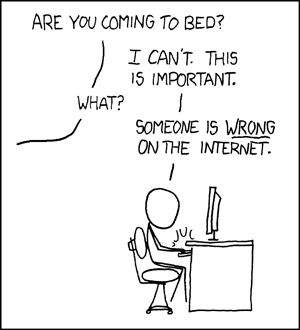
Yeah, yeah, yeah, there are a bunch of gentle readers saying, "I told you so."  But don't pretend that a lot of you don't do exactly the same thing - the internet is full of it, as the cartoon on the left clearly
indicates.  I was not the only one raised with this habit - else I wouldn't have people rushing to point out to me that not every government in ancient Greece was a democracy, or that a video isn't 'skype,' it's a G+ hangout video.  Pointing out that things are wrong is a national sport.

I know I have to give it up.  I know that my resistance against giving it up has nothing whatsoever to do with me, it has to do with my parents and having developed the habit so deeply in my psyche.  The worst thing about habits like this is that for years and years it is possible to hang onto the certainty that things should not be wrong.  They should be right.

See, that is the worst of it.  There is a lot of confusion about wrongness and rightness - particularly in people who don't care about either.  All my life I've had people say of me, "You need to be right; you can't bear to be wrong" - which is, at best, a half-truth.  I don't 'need' to be right - I've done the research and the source material says I am right.  Other source material may indicate something else, but then it's a debate between other people, not me.  The argument that I 'have to be' right would suggest that even when I'm wrong, and I know I'm wrong, I'm still insistent that the listener acknowledge it.  This is flat out something I do not do.  My peculiar attitude towards rightness doesn't allow for deception - either towards others or myself.

In the past few months, several times, I've been wrong.  My response to being wrong has been to admit it.  I find that hard and unpleasant, but I can bear it.  Correct, Greece was not entirely a democratic culture.  Correct, it is a G+ hangout video.  Satisfied?

Since I rarely hear anyone admit they're wrong, I've been able to identify the value of people all my life by their ability to accept their errors and change their minds.  People who do neither have little value for me.  People who do not do the research have even less.  And people who argue resolutely that doing the research is bullshit and unnecessary, for whatever justification . . . well, hell, I don't see people like that as even human.  Deeply, I feel the world would be a much better place without those people.

Firing off a missive about someone's inaccuracy is a way of testing to see what sort of person they are.  At least, that's a lie I've been telling myself for years.

I realize I have to change.  I have to let go.  More and more, I have struggled to just let other people be wrong in more ordinary, daily life, and it has been noticed by friends and family.  They have remarked on it - particularly in situations where they know from their experience that something inaccurate was said, and where I didn't respond.  That is very, very unlike my parents.  That is not the way they raised me.

Here and there, in posts for the next month or longer, I'm going to be talking about a series of military figures, all from the old Civ IV game:  spearman, galley, archer, cavalry, missionary, axeman, swordsman, explorer and so on - and there's going to be a lot of quibbling about those.  There is so much misinformation and half-information manifesting in lies and errors and dogma that no matter what I write about those things, someone will rush forward to say, "No, it's this" or "You've got it wrong about that."  The source material - even that deriving from universities and academia - is so full of bullshit, fostered by children who grew up on bad films and bad documentaries, that what's real and isn't real has completely degraded.  The Katana is just a sword.  And not even that good a sword.

I'm going to write those posts anyway.  I'll do my research and put in the hours and carefully choose every word that's written down, constructing passages and arguments in an effort to get across the more important themes of game-play and design.  Then someone who hasn't done any research, who hasn't read a single book on weaponry, who will take no time whatsoever to think about their language or about themes, will rush - like my parents - to tell me that a Katana was magically folded over ten billion times or whatever the hell else they learned from the great god Tarentino.

Because this is the internet.  This is where we quibble.  This is the arena my parents unwittingly raised me to correct.  This is the battleground between bullshit and blunder.

I'd like to take a step back and just be referee for a while.  I wish - I really wish - my blood wouldn't boil when some idiot says something stupid.  After all, in reality, that idiot is already surrounded by a lot of people who already know the value that person really has - and karma is doing my work better than I ever could.  I have to stop letting it bother me.  I have to accept that people have always gotten it wrong - that this will never, ever change, no matter how much effort I give.  Stupidity flourishes.  It is what stupidity does.

Tuesday, August 5, 2014

What People Hate

Earlier today Dave made an astute observation:  "People hate being wrong."

I certainly do.   Being wrong is embarrassing and from the standpoint of writing a book, ego-crushing.  It is all the more unpleasant when we're talking about something that I've been wrong about for years, even decades, all the while believing that I knew the truth.  Being wrong just plain sucks.

I must hate it more than most, however.  I'll explain why.

Most people who are wrong about something will flat out disbelieve it.  Now, here I don't talk about someone saying the shop is on 17th Avenue when it's on 16th, or making a mistake in thinking that Cheryl's husband is named Brandon when his name is actually Braden.  This sort of thing is usually accepted by people once they've met Braden.  I'm not even talking about people who still sing "wrapped up like a douche when you're rollin’ in the night" even when they know those can't be the lyrics.  Sometimes we get things stuck in our heads that are tough to shove out.  That's how the brain works.

I am talking about people who, for example, absolutely will not accept something like evolution or statistically verifiable climate change.  Things are are, first of all, difficult to understand if someone hasn't sat down patiently with us and explained, and secondly, much more easily misunderstood than song lyrics once we've gotten it into your head that such things work in a way that's completely different from your interpretation.  We're so used to interpreting things based on our gut instincts that once we find ourselves dealing with something really big, it is easier to keep with the gut rather than apply ourselves to a lot of initially incoherent facts.

So we develop prejudices.  And we develop a defense mechanism against anyone who challenges our prejudices, because we're certain that we know and that they don't.

The problem with prejudice - beyond other, obvious reasons - is that they mean we're going to be wrong forever.  Every time we find ourselves in an argument with someone who does have knowledge about that thing, it's going to be an argument where we have to defend our inaccurate 'knowledge' against a person who won't bend because they actually are right.  And they're going to make us feel stupid, because they're going to pull arguments from every quarter that makes us seem stupid while we're stubbornly insisting on our position without any facts to back us up.

That's going to make us angry every time someone mentions the subject.  We're going to be pissed the instant we meet anyone vaguely connected with that whole thing.  Because we don't want to talk about it, we don't want anyone to talk about it.

I said, I hate being wrong.  The best way to stop being wrong is to be informed.  So all my life, when I've found myself in an argument that's over my head, I've tried to change.  Oh, often not right away - initially I can be as stubborn as anyone.  But I am listening while I'm arguing and if good points are made, I'll follow up on those points the next day or the next week.  And I'll find myself looking at the hard data and thinking, "Fuck.  They were right."  It did turn out that that thing's name was Braden after all.

What this means is that I'm wrong about this thing today, but not tomorrow and not any time in the future. Next time I'm in that argument, I'm the asshole that's actually right - because I'm the asshole that did my homework.

Yes, that does make people mad.

It's particularly galling for certain 'smart' people in the world.  'Smart' is relative.  We can seem very smart when we're 20 and surrounded by people who haven't been through college yet and therefore haven't learned how full of shit we are.  We can apply ourselves to a game that has no verifiable truths to it, so that when talking about that game we are able to be louder and more definite and more popular in our opinions than others, so that we are definitely 'smarter' by reputation.  There is no right answer - at least we're free enough in the context to claim there isn't - so we shout 'IMHO' and 'YMMV' because those are terms that codify deliberate will-to-ignorance.  We think in our heart of hearts, "It's a game and its my table and what the hell, everyone does it their way, don't they?"

The less knowledge we have about something, the less certain we should be, nyet?  Yet that is not how humans tackle uncertainty.  Religion, where every tradition-established opinion becomes fact, flourishes where no knowledge exists.  A lack of knowledge enables intimidation, resistance against universality and all the benefits that come with the fragmentation of community - the power to influence those nearest to us by sheer strength of our personality.  We push others around because we are the loudest, the most arcane, the most elaborate in our 'logical constructions' and our innovation.

In the community, I am most justly proud of those things that I've proposed that others have chosen to embrace.  What I do with my world is irrelevant where the game is concerned.  I make nice maps and explore things that others would never explore for my own sake - but where the reader is concerned, those things are at best interesting.  They aren't 'right' because they're not applicable to the reader's framework.

The best things in life are universal.  These are things upon which we all agree - even when we're not certain of the exact details.  Democracy is better than tyranny, however that democracy may manifest locally.  Love is better than hate.  Evolution provides better answers for keeping us alive and staving off death than religion, which is only interested in comforting us.  If you're Braden, you're much more positive about all the people you know who remember your name than about that one dork who still calls you 'Brandon.'

I used to preach that we need role-playing to be more universal, to have rules upon which we can agree.  At the very least, we ought to adopt practices that are of the greatest benefit to 'fun' and 'comaraderie.'  I stopped making those arguments because of the push-back I received.  People shouted that 'fun' did not require their obedience to a group-think model.  The truth is, of course, that they have no idea what that model entails - except that it almost certainly says that what they're doing now is probably the wrong way to do it.

Deep in their hearts, the majority of players are dead-certain they're playing the game wrong.  They don't like it.  They're divided into two groups, however - those actively seeking answers about what to do and those furiously insisting that they're not wrong, there are no right answers, everyone has to do it their own way and fuck off.

Some people would rather be wrong forever than to change.

There are right answers.  We study psychology because it has been proven to us that even though humans are complex, difficult and unique, we still do things that have predictable, verifiable results.  These behaviours apply to the playing of role-playing games just as well as they apply to any other context in which humans interact.  To cry that there are no definable right or wrong approaches to the game is to deny all of human knowledge about ourselves to date.  That's not opinion.  Your mileage cannot vary.  You sit down with your players and you act in a particular way, we have the experts who can watch your behaviour and point out chapter and verse where you're fucking up.  More importantly, we can universally march experts into the room to watch you play, and they'll all come to the same conclusions.

That is damn hard to accept.  People hate being wrong.

Wednesday, August 14, 2013

Arguing On The Internet

I have other things to write about today, but I'm going to spend a little time first talking about last week.

I've held off writing this post because I did not want to rant. My first instinct was to do so; this is my typical reaction to stupidity in great amounts. I hoped with distance I could sound more sincere.

Last week, Zak the porn dude was booted permanently off rpg.net. Now, the internet being what it is, the ban has probably been rescinded. I don't care about rpg.net, but I was made curious by this really stupid post by Roger the GS. And after reading the echo chamber in that comments section (which happily rushed to explain to me why I'm a bad person by daring to disagree), I found myself reading this even stupider post by Noisms, in which he proudly makes the argument that no one ever argues except to show off how big their brain is. This was followed by another tremendous echo chamber of comments.

So finally I had to go look at Zak's inevitable post, which turned out to be an open letter to the owners of rpg.net ... which seriously upped the stupidity standard quite a bit, as well as the profundity of cognative dissonant blog echo chambers.

Well, after all that, I had to go find the rpg thread ... which none of these fuckers linked to, so I had to find it through Google. And found that rpg.net has seriously changed.

I really like the booting policy they've instituted. I respect it. Reminds me of my own.

Now, I don't know if the gentle reader wants to read through all this shit, but I'll tell you the best easter egg in the whole thing is where Noisms gets banned from the thread on page 35. Remember, this is the man who tells us argument is ego masturbation.

Noisms says he can't ever recall changing anyone's mind by arguing with them. The only thing I can say to that is that he must be really, really BAD at arguing. But then I've never seen Noisms change his mind, ever. The same can be said for Zak, for that matter. Roger the GS is somewhat better. I have seen him change his mind. Which makes this follow up post by him even more baffling.

I don't see that its worth my time to explain why these fellows are wrong. I think that's obvious to anyone with a modicrum of scholarship or responsibility in the real world. I make arguments that prove to change minds all the time - it is how companies make up their minds about things, by presenting arguments and then choosing the best course of action. This is also how the justice system works, as well as the political system (in a country like Canada, at least, where the government still passes meaningful legislation), how scientific journals work and just about all scholarship (I'm not too sure about business school, but I'll give them the benefit of the doubt).

The thing about all these arguments is that they rely on the presentation of facts, then upon the presupposition that the individual presenting the facts will attempt to argue how they are relevant. These are not 'internet arguments.' That is, they're not arguments advanced about the wastefulness of arguing by people who are arguing on some other thread - at the same time, as happens in the case of one recent tit who was commenting about NOT arguing on Noisms thread while simultaneously arguing like a complete hysterical prat on MY blog. Check the timestamps. That is really impressive.

I think it really does come down to these people who do not change their minds. Naturally they presume no one else does, because they're so calcified in their own crystalized bullshit. I'm sure Noisms runs the same campaign today he ran twenty years ago, still thinks it's as brilliant today as it was then, and will still be running the same campaign twenty years from now. I'm presenting this as an argument. I'm pointing at Noisms blog as evidence. I'm citing the evidence to back up my own personal experience with him, that ended in banning him from this blog because he was utterly immovable.

Everyone knows I love to argue. And everyone knows that I cheerfully evicerate people, coldly, disconsiderately, often abusively ... and people love to ride horse on that as proof positive that I'm no better than anyone else on the net, and in fact that I am a LOT worse. I'm described as a solipsist, an egoist, a narcissist, as someone deluded by his own myopia and so on. Well, the gentle reader that's here is ready to make up his or her own mind. I'm pretty sure I don't run an echo chamber around here. There are people who like me. These people put up with a lot of shit and don't hesitate to criticize me for posts like this one. They'd rather I got back to the hex generation (and I will). The reason I write these posts, and the reason I do my best to humiliate people in the comments section, is to get them the fuck off this blog. I don't want morons like Noisms here. He pollutes enough of the net with his crap as it is.

Nor do I need Zak “I have porn stars and viewers and therefore I’m always right” around. I don’t know about Zak. He seems to really believe that the opinions of people in the porn industry have pedigree in the world outside the porn industry … he also seems to believe that somehow his success couldn’t be duplicated by anyone else ready to have weekly porn stars on camera playing D&D. They might even do better, if the porn stars could be convinced to wash once in awhile and not slur every line they speak.

Sorry, I’ve been waiting to say that a long time. It’s catty, I know, but if you read the rpg.net thread, you’ll find Zak pounding his chest about all the people he knows who believe this or that, and if you follow the comments thread on Roger the GS’s first post, you’ll find Zak doing it directly to me, clearly disproving that his vouched for opinions of other people couldn’t be made up because, well, porn stars.

Zak opened the door on that one. He gets to cite his connections as a source, I get to kick the shit out of his source. We call that ‘argument.’

One thing that I'm proud of is my willingness to change my mind. In particular, my willingness to improve upon something I invented, understanding that whatever it is, I can make it better if I have more time. All this recent hex generation thing actually disregards ideas and propositions I made on the subject last year, because even if no one else understood that they weren't going to work, I did. This recent stuff? No, this is not the best I can do. In many ways it is inadequate. It is clumsy. It isn't quite right. It needs more effort, more time, more research, a better layout, etc.

See, I know that people THINK I'm full of myself, but in reality I'm the first person to tell you that anything I've done, and everything I've designed, is inadequate. That's how I have felt since the beginning of my life. It's just not good enough. But that's fine. I know it's going to be better, because I'm going to change. I'm going to toss out things I believe today for better things that I will believe tomorrow. All anyone has to do is advance an argument and support that argument, and I'm on board, ready to change my mind.

That's what makes me different from these other failures. And don't question it ... that's what makes YOU different too. You're ready to read this, to doubt it, to question it, to not take it on face value and to NOT echo it back to me like we all have to be on the same fucking page to be friends. For the love of knowledge, don't go that way. That way is stagnation and death and six kinds of internal pathetic masturbation.

Let's all gently applaud rpg.net for finally realizing that the only way to have a discussion is to throw on people after the first ten words of bullshit. It's the only way this whole nonsense is going to be cleaned up ... when people like Zak and Noisms only have a voice with people too stupid to have their own.