Showing posts with label Children. Show all posts

Saturday, July 13, 2024

Age and Ability Stats

There is no Saturday Q&A this week. Twas a heavy time for me with regards to work responsibilities, so I hardly touched the ongoing book, I've not touched the tutorial campaign, and on the whole I've been anxious to set responsibilities aside.

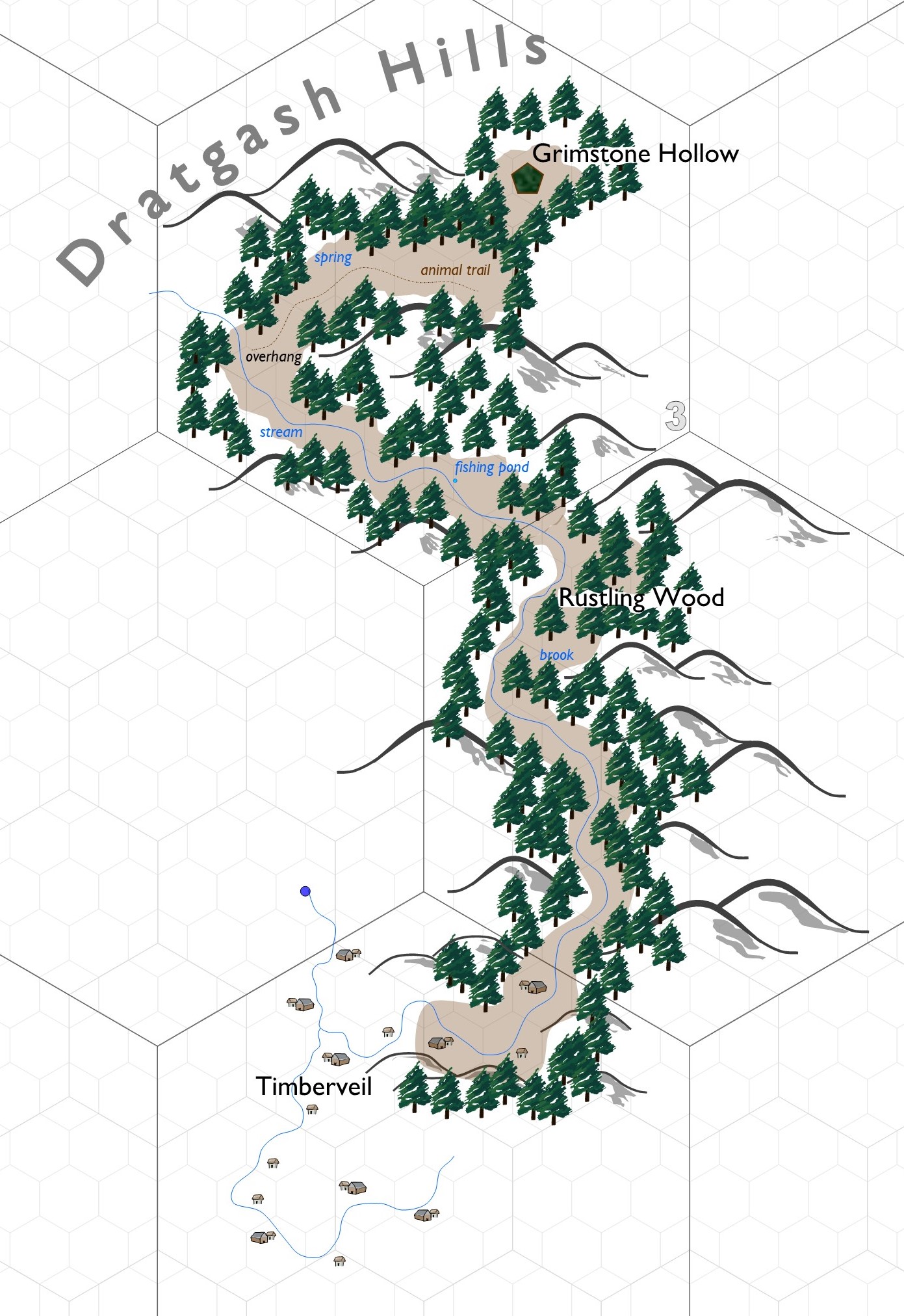
But, to bring us up to date on that campaign, Arliss and Bertrand have just stumbled out of the Rustling Wood, encountering a single peasant hut; I haven't updated the wiki yet, but I expect that they'll seek the good will of the farm to learn more about "Timberveil," as I'm calling this type-7 hex.  And for the record, I can well imagine how overwhelming even this simple start is for those who have never seen my blog before.

Bertrand, who grew up on a farm, will offer his services in exchange for food — there is always work to be done on a farm, particularly in the outback, so this offer will be accepted.  

On the 6th of May, while the paladin works, again not officially, Arliss can explore Timberveil (see here) to see what goes on, and learn something about the next hex down stream (blue dot).  He might also try to find a strapping young soul to perhaps join them; there are 14 chances of 4% of this.

A hardened commoner, should they find one, would add +2 h.p. to a d8 roll for hit points and would be proficient with a club as a weapon.  According to the page linked, he or she would also have a +1 to constitution and strength ... which I'm considering just now.  In fact, all this above has just been to get me to what this post is about.

I've long made the argument that class training would be something that youngster would begin around the age of 10 or 11.  In that post, I proposed that a newborn's ability stats would be equal to zero, and that the child would gain 4-10 (2d4+2) points to their random ability stats the first year, and 1-7 (2d4-1) for each year thereafter ... and that this would end up producing an average of 63 at age 15 — which, as I said then, was the actual average of rolling 3d6 six times for a character's ability stats.

Personally, I think this is a brilliant statistical sleight of hand, but at the time it made little impression.  It deserves it's own page on the wiki, but that's for another day.   In any case, I suggested obliquely with that post that those who did not receive training after age 9, the total added for those last six years would be 2d4-2, producing an average of 57 rather than 63.

This neatly gets us around an untrained commoner having the same number of stats as a trained NPC fighter.  Player characters do better than average, as the average of throwing 4d6 and discarding one die of the lowest amount gives an average of 11.91, or 71.46 for all six stats.  The chance of a PC rolling an 18 for a stat is 3.4992 times better than an NPC.

The problem with that "hardening" given to commoners is if I roll an 18 on 3d6 for the NPC, it gets pushed to an 18/10 strength and a 19 constitution, which doesn't really work for me.  Thus I had to include a note that commoners were prohibited from having their ability stats boosted above 18.

But suppose we use the system I proposed in 2010, and generate the commoner in a manner that an initial 18 of any stat isn't possible ... and so that we may know what the youngster's stats were when that individual was at 8 or 10 years of age.

With a little help from chat, I devised an excel page that will do that generation.  Here's a sample screenshot:


Thus our individual developed a significant dexterity very early in life, so that at the age of 4 he or she had the pre-requisite to be a thief.  Quite believable, as such characters have been a part of fiction since forever.  He or she was quite a beautiful baby (3 pts.), but that faded to just above average.  The other stats are fair.

Point in fact, this is not a levelled character.  It proposes that this person might have been one, if they'd had the necessary training, but that never materialised.  Training would have, according to the 2010 post, improved these numbers by 6 points across the board.  The harden commoner page, which indicates a necessity for being "hardened" in order to enter combat without making a moral check first (and we can therefore assume every levelled person, even a mage or a bard, is "hardened" in this fashion), thus gives an additional +1 strength and a +1 constitution.  That's at least 8 point ability points, on average, that this character could have achieved.

But that's not all.  The original random number per year, up until age 9, the reader will recall, is 2d4-1. And with age 10 to 15, 2d4-2.  The latter is an average of 3, but not a limitation of 3.  Suppose that training does better than restoring that "-2" to a "-1."  Suppose that it, in fact, gives a benefit of 2d4 without subtractions at all, or possibly just 1d4+4, applied to all stats, across the board.

We might even posit that different schools of training offer higher stat bonuses for the individuals who take their training there.  Just in case any player characters want to be sure their children go to the best schools.

Those looking at the excel file I've linked will notice, possibly to their distaste, that I've placed a ceiling of 17 on the ability stats, so that this number cannot be exceeded in the generation.  It's my feeling that the 18 has to result from training; it can't be acquired naturally.  This may go against the grain of many, but the fix is easy enough if the reader understands excel.  It's just how I intend my game to go.

Of course, the whole premise may be disputed by some.  The most likely argument is that ability stats cannot be adjusted and are what they are, and that a character with an 18 strength at the age of 4 simply has a ratio-based 18, which makes him or her stronger than other children of that same age.  Comme si, comme ça.  The original game clearly did not consider ability stats sacrosanct, and there are rules that state they improve or decline with age, so I feel that what's shown here merely fits into those rules.  And anyway, we don't need to know if a 6 year old can beat up other 6 year olds; we want to know, if the 6 year old with an 6 strength tries to help lift up the cart, how much actual help does that provide?

Because, as an aside, my rules for bend bars and lift gates depends on how much combined strength is brought to bear, without a die roll.  If these bars can be lifted with a 17 strength, and you have that or better, then you can lift these bars.  And if you have a 16 strength, and your one y.o. child has a 1 strength and helps, damn it, you can lift those bars.

'Course, you'll think you did it all by yourself.

All this goes to determine what sort of person Arliss and Bertrand might find, and what interesting stats they might have, allowing for the possibility that they could obtain a useful 10 y.o.  Which I think would be most phenomenal.  I'll have to devise some sort of random table that gives an age for any commoner wanting to join the party.

Tuesday, November 7, 2023

A Normal Part of Development

My grandson visited today.  He turned three in September and has discovered the raw, joyful thrill of endorphins for himself ... which is to say that he's learning he can run full-on into things face first without actually hurting himself.  This has built up slowly where it comes to cushy furniture and the 30-inch rubber workout ball that drifts into different parts of the apartment, but today it was my thigh — which I had to turn in his direction lest he, um, "unmanned" me.

Smashing face first into my thigh and bouncing back, then stumbling and falling to the floor, was instantly the best game in the world.  So he jumped up and did it again, with the same spinning, tumbling result.  Laughing, giggling, he rose and ran straight at it time after time, while I stood there, not hurt, letting him slam his whole strength at me over and over, about two dozen times.  I saw no reason to stop him.  He was having so much fun.

Then he backed off way across the room to get a really good run, 20 feet or so, stumbled on the way but absolutely ready to hit me as hard as he could — but I scooped him up and spun him around and let him go, to trip over his feet and fall on the floor, laughing and laughing and laughing ...

As I said, he's three.  It's not the same with every child, but as children's understanding of the world increases, and especially the limitations of their bodies, their sense of self and capability changes.  They want to test their physical limits; and if that's managed and not discouraged, so that actually hurting themselves too soon can be prevented, it potentially leads to a growth in confidence and curiosity.

He climbed up on the ottoman by the sofa today and I watched him tense himself like a cat to make the two foot jump from one to the other.  It was obvious he knew what he was doing and that he grasped the meaning of it.  A year ago, napping on that couch, he rolled over and fell headlong onto the floor, scaring the bejeezus out of himself (though he wasn't really hurt).  Today he leaped, easily made the distance, crashed into the sofa cushions and went wild with laughter.

Then, before I could stop him, he leaped back to the ottoman.  Not good; just beyond the ottoman is the coffee table, and if he'd crashed into that ... well, let us say it's not made of cushions.  Still, he gripped the ottoman like a cat when he landed and saved himself.  He has two cats at home.  He's plainly been watching them.

Now, today's subject is "fear."  Couple days ago I posted a cruel and angry rant about saving throws for death, which perhaps was unkind ... not that I really care.  The metric is essentially designed to assauge a weak sort of person against the severity of having to lose a fictional character in a game, so much that even knowledge of spells that bring back the dead aren't sufficient to ease the terrible suffering of such fragile sops.  These are not people willing to make a leap to a light piece of furniture that might tip over and smash them into something hard enough to give a few bruises.  I explained this consequence to my grandson (who knows if he understood me) and asked that he only leap from the ottoman to the sofa.  This was in no way dangerous, as I was right there, the sofa is deep and has lots of cushions, and anyway, endorphins.

He didn't do it the wrong way a second time; but he might when I'm not there.  When I think of the things I did when my parents weren't there ...

I don't want to applaud him, or even encourage him.  But I definitely don't want to punish him, because part of growing up is learning to judge oneself against one's fear.  He was evidently proud of himself; he shone a look at me that said, "Wow, did you just see that?"  I probably smiled.  What kind of monster would a person have to be not to smile at that moment?  But I didn't say "good boy" or "do it again."

I'll encourage a player to be brave.  They're not three, are they?  And somewhere along the line, they've talked themselves out of daring a consequence, even a very mild one, so that they'll stand back in my game and fear getting in and mixing it up.  I had a case of that happen a month ago, where I encouraged a player who lacked the magic weapon he needed to hit the gargoyle, to run in anyway.  "If nothing else, you'll take damage that someone in the fight with a magic weapon won't have to take."

The reader may doubt this, but the player reasoned this out and took me up on this.  He's new to the game, and although he'd already been in two fights, his character Torvik wasn't getting anywhere because my system is based on taking damage to get experience.  Holding back, not fighting up front, trying to hurl his club or fist-sized rocks and missing (a fist-sized rock does as much as a dagger, but it flies badly), Torvik wasn't getting anywhere.  So he waded in with the gargoyle that he couldn't hit.  Whereupon the gargoyle 20ed him and he took 16 damage.  Which, thanks to negative hit point rules, he survived.

And at the end of this fight, he went up a level.

We might say, he jumped for the ottoman and didn't fall over.

Friday's running, four days ago, Torvik hurried up to get straight into the fight (he rolled maximum for his 2nd level hit points) ... only to get blasted by a 7 damage burning hands spell seconds after he'd arrived.  So he got bruised a bit.  Still, he's got the equation in his head now, so that he's excited about taking damage and getting a chance to actually fight.

Somewhere, that little boy inside Torvik's player is slamming into God's thigh and laughing.

I know it may sound silly to many to make a metaphor out of this, but it's tremendously human for a small boy to act this way ... just as it sets up so many opportunities for scared, fearful parents to stop the boy from running into their thigh, or daring to make that two foot leap, or doing anything really, because something might happen.  I don't need to go down the road of explaining where this "something" leads to.  Certainly not to good D&D players.

Anyone who may happen to enter my D&D world certainly won't be held to some standard of toxic masculine risk-taking.  They'd die pretty quickly that way.  But if the game can provide a basis upon which an adult can engage in an activity involves some level of risk or emotional damage, which might make them a little more daring, and thus able and willing to test their intellectual and psychological limits, then I'd hope they'd acquire an increased confidence3, curiosity and desire for novelty and excitement.

This could only be a good thing.


_____

If you wish to comment, please write questions, ideas or opinions to alexiss1@telus.net and they will be posted on Saturdays.  Feel free to introduce new subjects or present your own work. 

If you wish to make a donation to Patreon, it will be greatly appreciated and help with costs for illustrating the Streetvendor's Guide.