Showing posts with label Alexis' World. Show all posts

Wednesday, April 10, 2019

Bronze Age Europe

A little more history, with surprises thrown in, particularly towards the end.  I've been enjoying exploring a historical rendering of my game world.  Most of this has been in my head for decades, but it's never been thoroughly written out.

By the late Neolithic period in Europe, six dominant cultural regions had formed: a) Danubian cultures, from the Rhine to the Black Sea; b) Mediterranean cultures, from the Adriatic to eastern Iberia, including large portions of the Alps; c) Thessaly and Macedonia; d) the Dneiper and Don valleys; e) a mosaic of local cultures, including halflings, from Iberia to Sweden; and f) the pre-Vepsian culture extending across northern Europe from the Volga to the Greenland Sea.

The construction of megaliths took place mainly in the Neolithic period, continuing into the Chalcolithic and the Bronze Age. Prominent examples include the sites of Brú na Bóinne and Carrowmore in Ireland, Maes Howe in Orkney, and Gavrinis in France, Carnac in Brittany, Stonehenge, Avebury, Ring of Brodgar and Beltany.

The smelting of copper begins along the Danube from 3500 BCE. After 2800 BCE, various peoples, displaced by the Vepsian gnomes, move south and occupy all the lands between the Dneiper and the north shore of the Caspian Sea. The polished battle axe proliferates in these steppe cultures after 2500, possibly due to influence by gnomish metallurgy. Beaker pottery spreads throughout Europe from 2200 to 1900, influencing the manufacture of kilns and ultimately of metallurgy.

The Vepsian Bronze Age begins around 1950 BCE, marking the beginning of that culture’s consolidation into the Vepsian civilization. The arrival of seafaring elves (sometimes called the seafaring peoples) results in settlement along the north shore of Ulthua (circa 1800). These bring a crude Bronze Age culture with them and an advance technology in woodworking.

By 1600, other Bronze Age cultures have taken hold in south-western Iberia, central Europe and initiating the start of Mycenaean Greece.
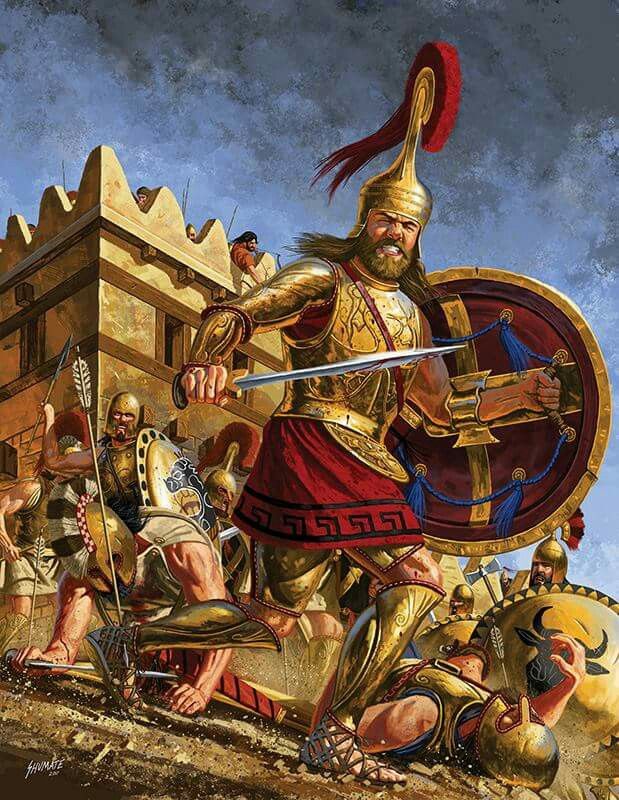
The Cretan Neolithic culture advances in many ways after 2700 BCE, forming the complex Minoan Civilization. Yet despite many technological feats, the Minoans do not develop arsenical bronze until after 1450; this allows them to be overrun by the Mycenaeans by the next century.

By this time, after 1500 BCE, numerous central European cultures have developed Bronze Age societies. The Celts, Italics and Illyrians expand into Italy, the Rhone, Seine and Rhine Valleys, Iberia, the Balkans and Asia Minor, where they destroy the Hittite Empire, which by this time had developed the secret of founding iron. This knowledge would afterwards spread through Europe, initiating the region’s Iron Age.

The use of bronze tools and weapons greatly empowered the cultures able to use the technology. Bronze Age swords appeared in the 17th century BCE. These, along with spears, shields and maces, supported by slings and javelins, allowed these cultures to claim lands inhabited since time immemorial by monsters and immense creatures of dreadful form. The Bronze Age initiated an age of heroes, in which warriors who were godlike in stature were able to slaughter these beasts and make the lands clear for settlement. Hydra, Stygian beasts, enormous lions, lesser and greater cyclops, chimera and minotaurs were eradicated or driven back. The Nuragic civilization of Sardinia was built upon the bodies of giants and still has monumental Giant’s graves. The effect of this was to give humanoids untold accumulations of experience that had never been available, providing them with prowess and knowledge that was hitherto unheard of in Earth’s history. These heroes became so powerful that some became demi-gods, possessing names that are instantly familiar to this day.

This led to an expansion of the fighter class, in which training in certain kinds of weapons produced a newer, different breed of combatant, with greater hit points and a greater potential in battle. Not merely limited to three or four experience levels, fighters could accumulate as many as 15 to 20 levels, making certain of their number powerful beyond the comprehension of the time.

Priests of the Bronze Age were able, in certain parts of the world, to communicate and interact directly with Gods, who had grown interested in Earth through tales told to them by Odin. God settled upon Olympus for a time, showing an interest in the Mycenaeans and Minoans, and in Elphyne, sometimes called “Fairyland.”
[take note, the humanoid “elf, elven” is distinct from the faerie “elfin,” which does not refer to a single race but to the collection of all fae-folk].

This association led to the earliest use of clerical magic, expressed as crude spells much reduced in power from the present period. These spells were largely portentous in nature ~ augury, for example, possessed an earlier form than the more familiar spell. Other early spells include create water, purify food & drink, chant and enthrall.

Rumblings of other classes that gave some promise of appearance after the Bronze Age include the druid, ranger and thief. But these would not flower until the Iron Age that followed.

See Also,
Campaign
European History
World History

Friday, December 2, 2016

Mass Experience

Having put up the markets for the online campaign, we can get that content off this blog.  I know you are all interested, but we can go back to other things and the gentle reader can go to the two campaign blogs to see what's going on.

The old campaign: Senex.
The new campaign: Juvenis.

I thought for a long time about what to call them, without the new people feeling downtrodden.  Latin seemed best.  And so did trying to do it on two blogs, as I have tried two campaigns on one blog and it is confusing.  All previous campaigns to now can be found in the back pages of the Senex blog.

Running a campaign is, I think, a huge help in blogging.  It reminds me of things that need to be done, it pushes me to get them done and it pushes me to address issues that players have a tendency to take for granted.

For example, experience.  For those not familiar with my experience rules, for the purpose of this post I suggest reading them.  The key element here is that I award experience for damage caused, not for kills.  This means that two combatants can slam away at one another, then quit fighting, and both get experience for the conflict.

This is critical, I think, to a philosophy of what experience is and how it is gathered.

In the old system, for example, where monsters or opponents have to be killed, experience is a limited resource.  There are only so many monsters and only so many people to kill them, so any experience I gain is necessarily experience you cannot.  Moreover, it presumes that the ONLY experience that can be gained is accomplished by murderers . . . and since we know that the general population do not go out and kill things, it is reasonable to presume that the general population has zero experience.

In my system, however, two boys punching each other out in a schoolyard are gaining experience.  Which is exactly what happens ~ remember that the Battle of Waterloo was won on the playing fields of Eton.  The grit and passion of the British Soldier at Kandahar, in the Sudan and as they marched into the guns at Concord was founded by a school system that supported a degree of physical violence that gave the Brit "mettle."  A combat system for D&D ought to reflect that ruffians and hooligans in a bar, who may not have killed anyone, must still be capable of putting up a hell of a fight.

I challenge anyone to offer evidence that the strength and power of any army was based on how many soldiers it killed; fighting forces are founded in discipline, resolve, a sense of home and family ~ in short, nothing that is measured in actual deaths but everything that is measured in pounding, bruising and kicking a military force into being fit and trim.

Which brings me to the next point.  How much experience is out there?  If experience is awarded according as I've suggested it ought to be, there is no zero sum game.  The amount of experience in the world is a factorial of every person in existence and how much conflict they engender.

To put this into perspective, take the European War that finishes just before the time my world takes place: the 30 Years War.  From Wikipedia:

"The war ranks with the worst famines and plagues as the greatest medical catastrophe in modern European history.  Lacking good census information, historians have extrapolated the experience of well-studied regions.  John Theibault agrees with the conclusions in Günther Franz's Der Dreissigjährige Krieg und das Deutsche Volk (1940), that population losses were great but varied regionally (ranging as high as 50%) and says his estimates are the best available.  The war killed soldiers and civilians directly, caused famines, destroyed livelihoods, disrupted commerce, postponed marriages and childbirth, and forced large numbers of people to relocate.  The reduction of population in the German states was typically 25% to 40%. Some regions were affected much more than others.  For example, Württemberg lost three-quarters of its population during the war.  In the territory of Brandenburg, the losses had amounted to half, while in some areas, an estimated two-thirds of the population died.  The male population of the German states was reduced by almost half.  The population of the Czech lands declined by a third due to war, disease, famine, and the expulsion of Protestant Czechs.  Much of the destruction of civilian lives and property was caused by the cruelty and greed of mercenary soldiers.  Villages were especially easy prey to the marauding armies.  Those that survived, like the small village of Drais near Mainz, would take almost a hundred years to recover.  The Swedish armies alone may have destroyed up to 2,000 castles, 18,000 villages, and 1,500 towns in Germany, one-third of all German towns."

Sobering stuff.  For our purposes, I'll try to hedge on the conservative side.  The beginning of the article quoted suggests eight million died.  We'll say that's 25% of the total population involved ~ German, French, Slavic, Polish, Swedish and so on.

My experience system awards 20 experience for every point of received damage; it also awards a 20 experience bonus that is divided among the witnesses of received damage, as well as the casualty or victim. Thus, you get experience just from watching another person die, or suffer a great injury, or otherwise come to harm.  Consider the ramifications.  You also get 10 experience from causing a hit point of damage to another person.

The next step would be to estimate the number of hit points involved in the conflict described above. Remember, we're not just talking about the total number of hit points of people actually killed, but also the number of hit points that were caused in damage, healed, then were damaged again.  Over and over.

We can deliberate upon such numbers all day, but I'm going to offer a conservative estimate.  Let's say that among the 32 million people involved, over the space of 30 years, from 1618 to 1648, each person took an average of 2 hit points of damage per year.  Some of that average is in the form of people who died from the damage and some from people who were only wounded . . . and leaves plenty of room for both high level types who have up to 100 hit points to lose and people who lost no hit points at all throughout the entire conflict.  And here we are only counting damage actually done to people deliberately.  We're not talking about people who fell off horses or who died in fires set by soldiers, or those who perished by disease (though arguably, witnessing someone dying from disease is experience, since most of us who have had something like that with close relatives come away from it being changed deeply)

This gives us a total of 64 million hit points times 30 years, or 1.92 billion hit points.  That is 1.92 billion hit points caused, 1.92 billion hit points received and potentially 1.92 billion hit points witnessed.

We will, however, have to remove a quarter of the hit points received ~ those people who received them are dead, so they are not part of the pool of living experience that we're calculating.  So we are speaking only of 1.44 billion hit points received by people who are still alive.

We could quibble about people who died of other causes over the years, age for instance ~ but this is why I am proposing the very conservative 2 hit points per year estimate.  That is pretty conservative.  The town of Manchester accumulates more hit points damage than that when United wins.

Adding it all together, this gives us a total of 72 billion experience . . . shared, of course, among the remaining 24 million population (not 32 ~ 8 million of those died.).  That is an average of 3,000 experience per person.  Per every person who was involved in that struggle.  Peasants too!

This makes 2nd to 3rd level the average level among people who participated.  That includes every mercenary soldier who came home to Sweden, Norway, Spain and Greece, every bartender in the Holy Roman Empire, every wench, every peddler, every child, every grandmother.

When you walk past a person on a road in Hannover, you have no idea what the person has been through!  What they've seen, what they've had to do, what kind of measures they've taken to keep their family alive, what skills they've accumulated and how dark might be the deepest corners of their soul.  When you walk past anyone on the road, worry.  You don't know them.

I wish I could make this clear to players.  They have a tendency to think they're the only people in the world who ever experienced violence.

Wednesday, September 14, 2016

Such a Little Thing

A few numbers, some names, nothing spectacular.  Gawd, it's office work.  And while I know that the general reader will sniff the air after looking at this, for me it is the base measure of the world.  It tells me the names of the dragon "catches," places where the dragons roost, where they have hollowed out hills or - in the case of Airgead - where they have brought into being a magical floating cloud, resting on the surface of the Loch and providing a protective obscurity against enemies.

Negative numbers indicate that Date before the Christian Era.
The number serves for calculating the population.

It tells me, too, that two thirds of the dragons dwell in solitary groups throughout Dric-dachaigh, most likely nesting in isolated places where ten or twenty generations of dragons have roosted.

Oh, and there is the rather boggling idea of 1,813 dragons.

I want to thank everyone for the names.  On the whole, the gaelic-angle sound sold me right off, so I tried to pick names that fit best with that pattern.  The elevations aren't mountains - but then, this is Scotland, where the mountains don't get all that high anyway.

We can easily imagine the dragons dwelling upon the hills above the towns of Argyll; all those included here on are water, something that I find very enticing - and then I remember it rains in this part of Scotland all the time.  I noted that none of the tour pictures feature rain.  The photographers must wait for weeks to get a shot of dry streets.

Well, back to other things.

Tuesday, September 13, 2016

Kingdom Naming

This is the island of Eorsa, in old Argyll county, Scotland:


According to my research, none of the towns that my encyclopedia includes were in existence in Argyll come the time of my world, 1650: Inveraray, Oban, Campbeltown and Dunoon were all founded later on.  Here is a shot of Fraoch Eilean:


When I started mapping the real world, I made a rule regarding the denizens of any region on the globe.  If the number of probable humans in 1650 was equal to less than 1 person per square mile, that region would be under the control of a NON-human race.  This is why most of Russia in my world is inhabited by orcs, goblins, hobgoblins, ogres and bugbears.  It is why northern Sweden is inhabited by gnomes.  And it is why the county of Argyll, in Scotland, needs to be occupied by non-humans as well.

I ask you, what sort of non-human culture do we put in a place that looks like the island of Luing:

We had a discussion among some of my players and agreed that this would be an excellent habitat for a dragon culture.  It is, after all, Briton, where dragons have always played a role.  I would posit that we could have a benevolent dragon population made up of relatively isolationist dragons, mostly adult or younger, living off the sea, vociferously demanding respect for their borders, yet occasionally acting as mediators and the voice of reason in a difficult political landscape.  After some discussion, we have imagined these being silver dragons.

Something like Glencoe might make a suitable home for them:


However, so far, I haven't heard a name for the kingdom/entity that I like.  Anyone have any ideas?

Tuesday, September 6, 2016

The Irish Problem

Those supporting my Patreon know that I haven't done anything in the way of mapmaking for a couple of months (which isn't like me).  The good news is that for six months or so I have been working on England, Wales, Scotland and Ireland.  I haven't done any actual mapmaking, but I have done most of the research necessary.  I have approximately 400 villages, towns and cities that have been looked at and confirmed as existing at the time of my world, the year 1650.  The research also includes what disasters have happened in these places (as I reduce the population of a town if it has had a plague, been destroyed, abandoned or pillaged) and most importantly, who controls the town?

Now, most places in 1650 are relatively stable.  Borders change and shift between kingdoms and empires, but large parts of the world have usually been under one government for centuries or longer.  Iberia, for example, was easy since everything south of the Pyrenees has been Spanish or Portuguese since the ousting of Islam.  There were a few border places in Estremadura (a region that spreads over both those countries), but nothing complicated.

England and Scotland are about the same.  In 1650 Cromwell had consolidated his control over the main island of Britain, so that at the mid-point of his authority, it is easy to identify every center as either England or Scotland.

But those who know history, who have heard me mention Cromwell, know that Ireland is a ghastly, horrendous mess in 1650.  Cromwell's forces landed in early 1649 and the war that followed was an episode in brutality, atrocity, clumsy military policy and strategies marked by unrestrained activity on both sides.  Effectively, the war was an early experience in guerrilla measures, an attempt to win by attrition, both exacerbated by famine and even an outbreak of bubonic plague.  Estimates describing the drop in Irish population range from 15 to 83 percent, depending on the source quoted, with as many as 50,000 people transported as indentured laborers (which, in the 17th century, translates as slave labor).  And therefore, in my world, who controls Ireland?  A party of players could spend three years running there and never be sure.

One thing, it is a hell of a place for adventuring, if massacres, taking a stand on a piece of land and hiring out as a mercenary is the party's thing.  To hell with a dungeon; just crossing the landscape would be living day and night in a free-for-all combat zone, potentially heightened by creating armed troops consisting of everything from brownies and sprites to banshees, headless horsemen and demon kings.  All the party needs is nerve.

But from a DM's perspective, how do I make the map?  Who runs Ireland?

Off hand, it would be easiest to identify Ireland as part of the British Empire.  The Brits are in control of most of the major ports, Dublin, Galway, Wexford, Cork and such; the bigger inland places, Athlone, Limerick, the Shannon valley, is hold-out Irish.  But there's no central Irish government that can be described as controlling those areas not conquered and garrisoned by the Brits; even local government in the "lawless zone" is run by fiat and the despotism of insurrectionists who are themselves barely organized.  The bigger point to be made, however, is what's most "romantic"?  What best fits a D&D game?

I like this:


For clarification, The Pale was a part of Ireland directly under the control of the English government in the late middle ages.  Gallowglasses were a class of elite mercenary warriors primarily of Norse-Gaelic clans of Scotland.  Other Scot colonists (Ulster-Scots) settled in northern Ireland in the early 17th century, led by James Hamilton and Hugh Montgomery.  Vikings settled in Ireland between the 800s until the 12th century, in scattered places, mostly in places that would become abandoned and then later occupied by Irish.  The Normans were, of course, French in origin (and Viking Norse long before that).  All these come together to make Ireland a terrific hodgepodge.

The map is tremendous for making a clear designation for what parts of the island the Brits control (though I am going through a county-by-county historical investigation for better detail); for those parts not Brit, the larger clans can be designated as "controlling" those zones.  It is, however, grittier than what I need; I can be satisfied that the McCarthys and O'Sullivans control the southwest without having to keep track of every O'Hurley, O'Daly and Ferris in the region.  I can plunder the names and make them small groups in the bigger picture for an actual campaign, but the map can just list the major clans.

Sorting this out will take time - and if you have a particular love for a particular name (your own, perhaps), I'm sorry if you're not included.  The map above, though, will tell you what hex your people ought to come from, once I get the map made and posted.

It is reasons like this that I have left England off the world for so long.  I began making my world map in 2005 and here I am, 11 years later, with all of Europe made but without the British Isles (or Iceland, for that matter).  I knew it was going to be a bitch.  I'm going to be glad when it is behind me.


Wednesday, January 27, 2016

Computer Errors Out of My Favour

Well, damn.

Everyone who has worked extensively with a computer knows that sooner or later, one way or another, without intending it and inevitably realizing it has been done after the fact, will destroy an incredible important document.  Forever.

This just happened to me.  Well, actually, I think it happened yesterday.  I only learned about it today.  I destroyed the publisher file that had all the design for the harpy keep that I posted last week.  As of right now, the only copy I have is the one on the blog.

Hurm.

I needed that for this Saturday's game - not just in a picture form, but in an interactive form.  Worse, there were changes that I'd already realized needed to be made to it - but as it's now a picture and not a file, I can't reasonably make those changes.

The only thing to do is to redo the whole image, from the beginning.  I called it five and a half hours of work.  So it will be.  Not because it would take that amount of time to do it again (I have the original as a template, after all), but because I have learned so much in making the rest of the keep that I'll be trying to make it better.

I am so looking forward to showing the party the work I've done - and all my gentle readers next week.  Admittedly, I am stealing images like crazy from a site called Dundjinni, because I am a horrible, nasty thief and because after looking through their demo it turns out that their service is more or less useless for my needs.  Much of what they have is on line, however, a lot of it as transparent pngs, so I am fitting in little images along with things I am drawing and designing from scratch.

It has been a profound week.  It is going to be a great game on Saturday (and only the beginning, since I don't see the keep getting cleaned out in one evening).

Okay, to work.

Saturday, November 14, 2015

Give Up?

I was asked yesterday if I knew of any campaigns, other than mine, that have run continuously for as long as eight or nine years.  That is, campaigns with the same line of characters, more or less the same players, run regularly at least twice a month.

To be honest, I don't.

But then, I've always separated myself from other gamers.  That's something I began in the 80s as I saw people getting more interested in the metagame than in the game itself.  For those not wanting to wade through the link's comments, I'm referring to the fetish for talking about the game, buying the game, debating the game's merits, attending events that celebrate the game and so on, rather than actually working on one's campaign.  I must admit, I grew annoyed at the fetish and year by year began to isolate myself until the only gamers I saw were my own players.

Okay, so I'm unusual.  I'm sure there are others who run singular campaigns that have run as long as mine.  I'm sure someone out there must have a game setting they have been running for 31 years (since 1984, for me).  Suppose that there isn't, however?  What should I think about that?

Should I stop advocating the creation of that game world?  Should I suppose all my readers just can't make that world?  That my world only exists as it does is because I'm crazy?  Should I decide that the only benefits that my world's design offers are in my imagination, that it is all delusion?

If I am so alone in the world that it is pointless to direct others down my path, presumably because my readers are . . . hell, I don't know, sane . . . then what?  Let everyone off the hook?  Cease to astound?  Pack up the blog and return to perfect isolation?

What a waste that would be.

Last question.  Is the reader really that certain they will never make a world as deep as mine?

Saturday, April 18, 2015

Speculation

I am not a fan of revisionist fiction - which perhaps sounds strange for a D&D player.  My reasons probably spring from a distaste for propaganda, essentially the rewriting of history for the purpose of encouraging people to hate.

Revisionist history supposedly has a higher calling - to highlight a given ideology so that the reader will look at it and think thoughts like, "Wow, it really would have been bad if the Nazis had won World War II."  However, I don't believe this is really the writer's motivation.  I believe the writer is using the revision in order to flagrantly masturbate - and encourage masturbation - about a specific fetish while casually side-stepping the responsibility.

Allow an example of the same sort of thing as regards sex.  Television has always used this same principle in order to include soft pornography under the guise of the morality play.  Television movies like Portrait of a Stripper or Portrait of a Centerfold were just the sort of cheesy, obvious efforts to put wank-material on television in a time before even VHS allowed for renting porn.  Poor literature does this sort of thing all the time: introduce the waif, seduce the waif, show the waif getting involved in something nefarious, show the awful effects of the waif's actions on the waif's family and then have the waif discover the 'evils' of indulging in this terrible, terrible behavior.

There was recently a piece of shit film that came out in February this year that followed that plot to the letter.  Nothing has changed.

For a more direct example of revisionist history, I suggest Norman Spinrad's, The Iron Dream.  If you're the sort who likes revisionist history, I recommend it.  There's no reason your education should be lacking.  It's just the sort of book a munchkin would enjoy.

I suppose it's fine to like these sort of things (I'll have to toss in The Man in the High Castle by Dyck, for those who will be thinking of it right off), but I don't.  I think works like this encourage lazy thinking.  The supposition always depends on ignoring key points about reality in order to emphasize other moments - such as supposing that the Germans were ever going to possess the Crimean oil fields.  The Germans never got remotely close to that, while there's no doubt whatsoever that the Russians would have simply set them on fire, as the Iraqis did five decades later.  But that's an inconvenient fact . . . so we ignore it.

The same kind of lazy thinking pops up all the time in speculation about the effects that magic would have, must have, on a fantasy world, if magic existed.  Druids and other spellcasters, for example, would replace the need to even have farmers.  Mages would obviously invent all our present technology in a few hours, if only they were motivated.  Or magic would destroy any desire for ordinary science to continue development.  Or the existence of dragons, elementals and other huge monsters would surely demand huge changes in city lay-out, fortifications and the like.

Undoubtedly.

Let me repeat, because I don't want to be mistaken for being insincere, sarcastic or facetious. Undoubtedly, magic would massively revamp social structure.  If magic existed.

Only, here is the thing.  We don't know how.  We don't.  We can't know.  We have no experience with magic, no experience with what it would do to society or how people would react, or what things we would change about ourselves.  We can speculate like crazy about those things - and Oh My, Oh My, have writers ever speculated.  But we don't know.

Still, we can be SURE that if someone, somewhere, in a blog sets out to decide for themselves what magic would or wouldn't do, that someone will be cherry-picking which magic will affect which cherry-picked parts of society.  We can also be sure that the conclusion will be pulled right out of the speculator's asshole.

I've seen a lot of this sort of thing, taken part in it.  Arguments like this always descend into the other fellow's cherry-picked shit versus my cherry-picked shit.  It isn't possible to be comprehensive; there are too many spells, too much magic, too little factual analysis available to account for ALL possibilities . . . and yet everyone who indulges in this sort of argument will get bloody-minded that they are right and everyone else is wrong.

Lazy thinking.

Let's take a simple, anachronistic example, as I explain why I have castles in my world, despite the magic that exists to blow castles all to hell.  Spoiler: I'm going to talk about my world now.

Players expect castles.  Castles are familiar, representative of the culture the players understand and therefore appropriate.  Illogical?  Maybe.  That doesn't matter to me.

Yesterday I was asked, quite reasonably, "Do fortifiers in your world make any allowance for airborne menaces like flying casters, dragons, etc."  It was part of a well-founded inquiry into the matters of my world.

Here's the thing.  I gave an answer in the comments field that sort of captures some of my thinking, but the straight answer is "No, I don't."

That's not bloody-mindedness.  I'm just not incorporating castles and other fortifications into my world to keep out non-player characters.  Forts are there to keep out players - and if the players decide to gather together and destroy a fortification with magic, monsters and their own forms of armageddon, they're welcome to do that.

My NPCs don't.   For the same reason we don't use nuclear weapons casually.

A castle is more than a fortification.  It is a statement of authority.  It says, "I have money, I have prestige, I have a will to stop you.  Don't bug me."

Magic isn't just a technology; it is an implied stalemate.  Like Robert A. Heinlein's Solution Unsatisfactory, it is a group of armed assailants standing together in a room, each with a loaded .45, pointed at one another, waiting for someone to do something stupid like start firing.  It is mutually assured destruction . . . and as such, everyone in the world, where it comes to using very powerful magic, must consider what they're doing.

In a truly cherry-picked fashion, it is generally assumed that if a druid were to start a wildfire that consumed a significant town, this would be a pity but, oh well, what can you do?

No, no, no.  The status quo has a very strong motivation to not let things like that happen - and to punish those who follow courses of action that change the status quo.  If the players ever get to be big enough to own a .45 of their own, so they can start blasting away with it, everyone in the world will turn around and blast away at the player.  Not just the infringed party.  Not just the person the players wronged.  Everyone.  Because everyone is threatened.

So, leave that castle alone.  Take it by conventional means, sure - that doesn't threaten anyone.  Want to put the gun in your pocket and have a fist fight?  Sure, go at it.  But leave that gun in your pocket.

Do the dragons, elementals and other big monsters understand this?  Oh yes.  They're part of it, too.

I know that this is a strange mindset to have about a D&D world.  Usually, it's assumed that if the players get to a level where they can have wish as a spell, that ability comes along with the indiscriminate right to use it.  Au Contraire!

Use it at your peril.


Wednesday, July 2, 2014

The Bey of Azov

In the 14th century, Genoa would found the exchange port of Tana at the mouth of the Don River, at the eastern extremity of the Sea of Azov.  Not actually a marketing town, it was a transshipment point for goods deriving from the Caspian Sea, lands east of the Urals and trade coming along the Silk Road through Samarkand and Herat, loaded on vessels in Tabiristan and Gilan (the south shore of the Caspian).  Tana then shipped to Kaffa, the Genoese port on the Black Sea, and thence to markets in western Europe.  For a century, despite the Black Plague, the flow of goods from Tana made Genoa rich.

When Constantinople fell to the Ottomans in 1454, however, and the Black Sea became a Turkish lake, Genoese trade collapsed.  As goods to Constantinople came via the overland passes through the Transcaucasus from Baku to Vati, Tana withered.  Only with the rise of Russia in the early 16th century (the time of Ivan the Terrible) was there a resurgence of trade in the Azov.  The Ottomans refounded the town, established diplomatic relations with the Russians and began to transfer goods from the north.

The Bey of Azov is a small enclave bordering the lands of the Don Cossacks and the Kingdom of Cumana. bashi-bazouks, numbering more than a thousand. These are leaderless, irregular soldiers of the Ottoman army, free to do as they will in times of minimal activity.  Armed, given places to live, the bashi-bazouks receive no pay and are thus dependent on plunder and adventure.  Typically, they roam the rural provinces both inside and outside the Bey in gangs of 20 to 30, threatening peasants from Ottoman-controlled Kubanistan or in Cumana. Typically they do not provoke the Don Cossacks, but larger raids have been known to occur.  The bashi-bazouks are also known to have pirated small vessels on the Sea of Azov.  They are primarily interested in drunkenness, lewd activities or the personal trading of opium, furs and caviar, brought from the environs of the Astrakhan pirates.  A raiding party can often be 'bought off' with provisions and spirits.

The unpleasantness of the posting - rife pestilence of the surrounding swamp lands, at the edge of the empire, threatened by raids and suffering cold in the winter - has resulted in the town becoming a military outpost dominated by

There is also a contingent of Janissarries in Azov, number 150, posted in a single fortress.  Highly trained fanatic soldiers, these keep order both among the Azov population and the bashi-bazouks.  The Janissaries are much feared, even by the Cossacks, being the principle reason why raids are not typically carried out in Ottoman lands.  They typically fight with pole-arms and crossbow, and in close order, being deadly in both the attack and defense.  The Devsirme, the practice in which non-Muslim boys are seized and trained to be Janissaries, was discontinued in 1638 (13 years before), but virtually all adult troops in these contingents are still deeply entrenched in their loyalty to the empire.  They are among the most dangerous soldiers in the world.

The rural lands within the Bey, stretching along the Sea of Azov, tend to exploit the 'dry roads' from the Kubanistan hinterland to the sea.  These are routes through the gulleys and sand flats of Azov, where
wanderers and their equipment can easily fall prey to quicksand if they do not know the correct way.  Along the coast, tiny villages collect anise, maize, rice, wheat, coriander, soybeans, tea and tobacco from the interior and ship it along the coast in ketches to Cherzeti.

The rural people drink a tea made of pine and wormwood, boiled all day and sipped from small cups that rest in the palm.  In the winter, holding the cup balanced on the palm of the hand is a means to warm oneself against the bitterly cold winds that sweep from the west.  Much of the poetry that is written among these Azovian peoples concerns itself with the smell of the land, the odor of the sea, the wet, mildewing emanation that rises from the soil.  Poetry is preferable to music, and is spoken nightly in the home.  Young poets are encouraged to apply their efforts, but the meter and precision of the poetry form demands a very rigorous approach to subject material.

As the land will not support many, in times of drought children have been known to be exposed.  Some of these may be found by wandering bashi-bazouks and brought to Azov, where they are sold as slaves - sometimes to orc pirates or brigands from the Jagatai Empire north of the Caspian.  If so, the children are said to be eaten in festivals.  The peoples surrounding Azov have many awful tales they tell of the Jagatai, the remnants of the Golden Horde that once dominated this area and Russia, but a live and let live policy is usually adopted towards Jagatai orc traders that pass through.

There is only one significant produce that derives from the Azov itself, that being fish both from the delta and the sea.  Otherwise, the towns of  Azov and Bataysk (founded by Russians) are occupied by soldiers, a few traders and a significant criminal element.  Smuggling is rife, particularly into Cumana, that goes on unrestrained by any element of Azov.  The Bey of Azov, Andru-sa-Alam, dwells not in the land itself but in the court of the Sultan, in Constantinople.


Tuesday, June 24, 2014

Don Cossacks II

kindjal, 2 inch-wide blade, 24 inches long
As a child among cossacks reaches the age of three, they are put on a horse and trained to ride it. Children as young as five are able to ride easily for five to ten miles a day, and it is on their sixth birthday that they are given their first weapons.  This weapon, the kindjal dagger, is an elaborate, beautiful weapon that is cherished by cossacks until surrendered upon death, or given to another young child.
shashka hilt with tassel

shashka, absent tassel
Children are trained with the weapon and with horses until they reach maturity, by which time they are trained to use the shashka - a very sharp, single-edged, single-handed and guardless sword - that is, possessing no cross-guard.  The pommel, as well, is minimal, though a tassel is added to aid the grip. The point of the shashka was curved and not expressly pointed.  While the weapon would undergo transformation in the centuries to come (the gods have foreseen it), the shashka used by the Don Cossacks would be only slightly curved and a mere 30 inches in length. This would make the 'short scimitar' highly effective from horseback; the weapon was worn 'on the wrong side,' blade up, so that as it was pulled it did not require a sweeping motion to the right of the mount.

The minimal grip of the weapons allows considerable manipulation of the weapon with both hands.  Sword art is a skill gained by cossacks from a very early age.

As well, having been raised upon horses all their lives, many of age cossack warriors are able to ride while standing on the back of a horse, and even shoot from that position.

In their raids, cossacks are nearly always outnumbered considerably by their enemies, particularly in their late summer raids.  Attacks against armed groups were carefully staged ambushes at river fords, against foraging parties and the like.  Cossack tactics are punitive, vindictive and selfish.  They freely burn, raze, murder and pillage, rarely take prisoners and aim to destroy property rather than seizing it.

One great strength is in their considerable mobility of attack, as every cossack is able to ride brilliantly.  More important, however, is that cossack raiding parties tend to be less interested in common peasants.  Their tactic is to demand enough food to enable them to travel lightly to another village upon their route, while viciously destroying small villages that fail to offer food.  When finding an estate, however, they will steal the gold and light valuables, burn everything, then return home by the same route.  As such, they will share some of their bounty with villages that willingly supplied them.

This has encouraged many poor villages to happily give the cossacks food, expecting an eventual return for their loss - they may even greet the arrival of a band of cossacks with good cheer.  It does not mean that a grateful village may go unscathed, as cossacks are known to kill perceived enemies or callously seize members of the village, raping them before murdering them.  There is little the villagers can do in such cases.

The support of villages, however, allows the cossacks to raid very deeply into the surrounding lands, as they receive aid from Russian, Polish or Safavid peasants.  In battle, because they travel very light, they are able to surprise, strike effectively for two or three rounds, then break free.  Choosing their ground, they can drop down into a gulley or into a break of trees, disappearing and rapidly outdistancing their opponents.


Tuesday, June 17, 2014

Don Cossacks I

The land of the Don Cossacks, called 'Dikoloj' by the people themselves, or the Wild Field, is a flat steppe as large as England that extends on both sides of the lower Don River, between the Caspian and Black Seas.  The land was settled by the Khazars early in the 12th century, a trollish race whose descendents dwell in diminishing numbers in an isolated pocket within Ottoman Kubanistan.  The Khazars were overrun in the 1180s by Cumans and Pechenegs, who destroyed many of the trolls before moving west against the lands of Kiyev.

For the next 60 years, the Dikolaj would be largely unoccupied except for scattered remnants of trolls and Cuman orcs, as well as Digorians, minotaur raiders and Turkish adventurers.  In 1238 Batu Khan of the Mongols would subjugate the region, but it would remain largely uninhabited.  This would not meaningfully change until the arrival of two human peoples, the Jassi from the west (Hungarians) and the Kosogi from the south (Circassians from the Caucasus mountains), who settled on the east and west banks of the Don River.  At the time of this settlement the Cumanese Kingdom had been well established, though that entity had little interest in lands to the east.  Digorian orcs occupied the western shore of the Caspian, while Jagatai orcs controlled much of the valley of the Volga. The Ottomans controlled much of the shore of the Black Sea (Kubanistan), but had not settled the hinterland.  The human Jassi and Kosogi were able to fill a power vacuum between these forces.

Both tribes had a long tradition of horse culture, and together formed a bond that would see much interbreeding, as well as a strong sharing of culture and religious tradition.  While the Jassi were of moderate Christian heritage, the Kosogi had retained many of the polytheistic roots that had begun during the early Bronze Age.  Both cultures were influenced by old gods in the region whose worshippers had past, but whose burial tombs were found and investigated, leading to a revival of the Yamna cult.  This manifests chiefly in a strongly held belief in the 'Red Maiden,' who is said to visit with warriors the moment before they die, either taking them with her or empowering them to destroy their foes.  This is said to have happened when Zynovey Chihirin fought the Turks at the battle of Hannah Flat in 1544 - the moment before he died, he was suddenly restored.  He and his small band then wiped out half the Turkish army before putting them to their heels, assuring that the Cossacks would retain ownership of the lands around Tarsk since.

From Spring to mid-Summer, when the Don River is too high to cross, the Kosogi, or south Cossacks, raid the lands of Digoria and the Safavid Empire.  During this time the Jassi, or west Cossacks, commonly raid eastwards into the lands north of the Caspian Sea.  In late Summer and throughout the Autumn, when the Don River grows low and the river is easier to cross, the tribes join together and raid west into Cumana and Poland, and north into Russia.  The tribes are among the best light skirmishers in the world on horseback, ride lightly armored, kill few of their enemies and normally take only enough to make their lives comfortable during the long winters.  By early October the raids end as winter settles in, whereupon the Cossacks return home to their families and a life of quiet contemplation and simple pleasures.