Showing posts with label Demographics. Show all posts

Wednesday, November 4, 2020

Building a Picture

The notion is to begin with a single orc, or any humanoid, and see its place in the world.  The party encounters this one orc while afield in the wilderness; it flees, and before the party can take hold of it, the orc rejoins the war party of which it's a part.  This group of "braves," to borrow the Native American term, is an advanced group that is scouting out an area ahead of their clan, a group of 20-50 orcs living as hunter gatherers or perhaps herders.

It's hard to see numbers larger than this; for example, we might have a vast territory that has comparable numbers to various human kingdoms, say 200,000.  How we get our minds around this relates to how we organize this number.  For example, we can easily grasp the clan described above.  Suppose we imagine 3-6 such clans, which would be somewhere between 60 and 300 people.  That is not such a large number; most of us have gone to school with populations larger than this.  We can give this number a name: let's call it a tribe.  That cognomen is often given to much larger groups, but in lieu of another label, for the present the name is a convenience.

The tribe would be led by a chieftain, who would have several sub-chiefs in his or her counsel.  Each tribe would have a number of war parties, each made of different clans, who would work in unison when the tribe was gathered together -- which might only be a certain times of the year.  Usually, when the tribe did meet, it would stay in one place; perhaps to winter the coldest season or to take advantage of a yearly food supply, like thousands of birds returning to roost near the seashore or a salmon run.  In such cases, there would be so much food that the tribe might spend a month gathering and feasting, before breaking apart into its separate clans again.

More rarely, 3-18 tribes would gather together in "chiefdoms."  This might happen yearly or it might happen only when a new senior chief needed to be chosen from the lesser chiefs of the tribe.  A chiefdom may be tiny -- conceivably only 180 persons -- yet it might be huge, as many as 5,400 persons, enough to launch a small military force out of its combined war parties.  Such meetings would be significant moments in a single orc's memory; they would remember each one and who was named the chieftain; the calendar would be drawn upon such meetings, described as the year when so-and-so fight that guy to become the great chieftain of our 12 tribes.  That sort of thing.  The reader can see how this helps a lone orc find his or her place in the world.

This is still far short of a really vast number of orcs.  For that, we have to imagine each chiefdom occupying a wide territory; the hundreds of miles along a particular river, or a single wide plain around a body of water dozens of miles across.  What we need do is assemble 2-12 chiefdoms together into a "nation" - a group with between 360 and 64,800.  That former number seems far too small; but I rush to point out that the odds against rolling so many 1s to determine the size of a nation is as tiny as the nation itself.  Also, there were many nations like this throughout the Americas before the Europeans; a nation is not necessarily determined by number, but by the land it occupies and how much food that land yields.  9 clans, 6 tribes and 2 chiefdoms might very well comprise a single entity.  Each of the terms used here are mutable, intentionally so.  Just as it is intended that the same title -- "chief" -- can be used to describe the leader of a tribe, a chiefdom or a whole nation.  To such peoples, organized in a culture that is more fundamentally "of the land," the title of the leader is less important than who the leader actually is.

I feel that by dividing up a kingdom of 200,000 this way, we can easily imagine it as "the fourteen nations" comprising one "people."  On a map, we can arbitrarily draw lines along the geographical features of our choosing, deciding that this nation occupies these forests, and that shore, and this river basin.  Then, if we want to go further, we can zoom in to create a map of chiefdoms -- and give each the characteristics we like.  This one is warlike, that is not; this is agricultural, these others are herders; this chiefdom has an arrangement with the nearby humans; this one doesn't.

By parcelling out the organization, we are dealing with much smaller numbers; and yet we are still able to envision a single orc, or a small group, and see how they fit into the much larger picture.


Thursday, May 20, 2010

More Grist For The Mill

Now, this is my fourth post on this subject, and I think it is time for a few ground rules. It should be quite clear by now that I am bent on continuing with this system regardless of my critics, so those who wish only to piss and moan at this point are invited to take their comments on the road, to post them on their own blog, where they can speak to their hearts delight about how I am fucking with the laws of nature or whatever.

Comments criticising the methodology will continue to be entertained, but any comment which disparages the overall system on principle will, henceforth from this post on, be deleted.  This sort of stick-in-the-mud thinking (however dressed up as intelligensia) is destroying the potential for rational discussion.


Very well.

The principle flaw in those numbers for classes given on the last post would be that they represent only the minimum age possible with regards to a candidate successfully mastering their class. In the case of mages, where the age range is from 26 to 40, in actual fact only 1 in 64 candidates would succeed at becoming a mage in that time (the DMG gives the age range as 24 +2d8).

So, if you really want to get ambitious, you can work out the number of mages according to their actual successful completion.  This isn't as easy as it sounds; I thought I would calculate it out by a) multiplying the total that had reached a certain age by the chance on 2d8 (age 26, 1 in 64: age 27, 3 in 64; age 28, 3 in 64; and so on), while continuing to remove 5% of the candidates for failure ... because they could get to age 36, say, and still fail to become magic users.  That's just the way the ball breaks.  Some doctors make it through pre-med and med-school, and they fail their internship.  Life is a bitch.

But I found out that even without any failure rate, with everyone who reaches age 26 eventually becoming a mage at some point, there are virtually no candidates after age 37.  Here's the table I was able to generate (these numbers continue to be per 100,000 population):

Clearly, only a player character has any likely chance of being 40 (rolling on the DMG's table).

Anyway, this is just an exercise to get us warmed up.  I had wanted to answer a question from Jhandar, who asked, "What is to keep a lord from mandating magical training for citizens of prerequisite Intelligence?"  And now I can answer that.  Nothing.  Except that, quite probably, the time it would take for the plan to reach fruition, and the likelihood that most of the candidates would fail before reaching the mark.

But then, some of those would-be mages who failed would still possess some cantrips (though probably not any spells), as well as book larnin' (according to my sage tables) and the general increase in the population's well-being.  It wouldn't do that much, however, to influence a country's economy, or their military prowess.

A different question I haven't been asked, and which I haven't answered, would be what level would all these classed/leveled persons be?

Ah, now this is fun.  And if the last posts riled the credulity of the gentle reader, these are not likely to fare any better.  Mind the warning in the first paragraph.

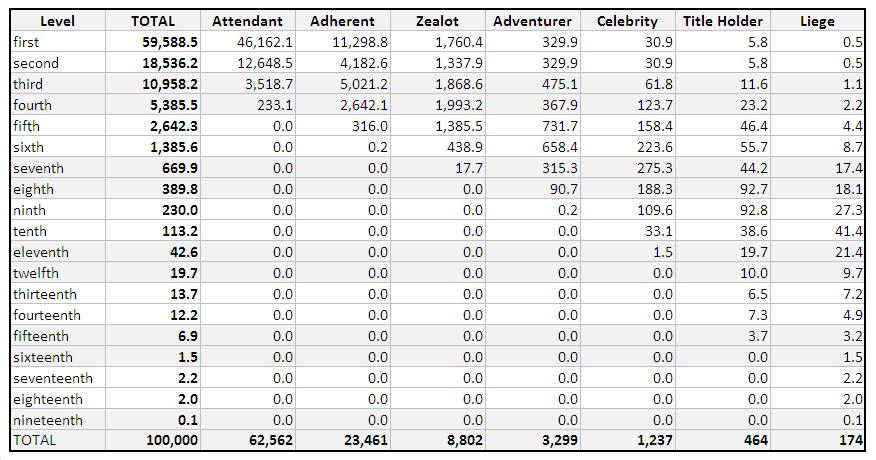
Rather than creating a random table and assigning each level a random chance, I conceived instead of the following table:


This table is fixed on the very simple principle that individuals with higher statistical strengths, and with greater resources on account of their opportunities and wherewithall, are likely to gain more experience than their stay-at-home cousins.  The numbers are not so unlikely - my party members, in the space of a game year, are quite able to go up seven or eight levels ... it really depends upon how ambitious they are.  Where it comes to some social constructs like the nobility, which is free to go hunting daily and have game (and x.p.) scared up for their convenience, it is obviously much easier to reach second level than a poor student who has lucky to find a position at an obscure pastor's country church.  And, of course, there is experience for treasure.  A celebrity (hero) or adventurer may do well in that capacity, but the noble or liege's cut from the treasure trains of a conquered foe would be unmatched.

This table is also based on the total experience earned falling off as the individual tends to settle down and travel less.  No doubt an individual would be at the top of their game in their late 30s, but that would be on account of everything they had done up to that time - not because they are still out razing dragons and such.  Of course, they might be - one quest in two years for the local hero still pulls down a healthy 29,000 x.p.  Not to be sneezed at.

The pleasant thing about this table is that it establishes the NPC's level upon his or her age, and not upon their particular authority.  Thus, a grizzled 47 year old sargeant might actually be higher level than the 26 year old regiment commander ... which fits better with things that I have read on such matters.  Playing this encourages players to think twice when dealing with old NPCs - you don't know where they have been.

The other convenient application is that it does not, as many random tables do, equate a 7th level paladin with a 7th level thief.  It is the x.p. that is indicated, and therefore compared with the class requirements.  A total of 47,000 experience, therefore, does indeed indicate a 7th level thief, but only a 5th level paladin.

It might also be helpful to point out that knowing the NPC's experience points is useful for hirelings and so on, when the party wants to know how tough is their purchased sargeant-at-arms.  The calculation can be made swiftly, starting with whatever age you want to spontaneously assign the sargeant ... now you know his experience, his level AND his stats.

There is much more to this NPC generation thing than rolling up six stats and hoping one of them in strange enough to create a character out of.  Age is relevant ... and how helpful is it to have age, stats and experience all linked together in one system?

One last table.  This is not meant to be anything except a showpiece.  It takes the average x.p. required for all classes, and compares it to an age arc based upon a 3% death rate ... and then calculates the number of individuals who would be at each level, and arranges those numbers according to the individual's status.  This, then, is the general distribution per 100,000 leveled persons:


But of course this table is flawed, for reasons I've already given - it doesn't make the valuable distinction between differing classes needing differing amounts of experience (and the 'average' is not determined according to the distribution of classes as given in the earlier post).  As I said, this is nothing more than a demonstration, to show what sort of table could be calculated, having been given the figures.

It is interesting to note that the higher strata stutus groups jump quickly through the lower levels at a young age, peaking at a certain level before dropping off again.  That, to me, was proof positive that the data produces the sorts of results I need.  If you encounter a liege lord, it would be possible that they would be 1st level, but highly unlikely ... and they would be no older than 15, and would likely have a regent commanding the kingdom.  It wouldn't be possible to have a liege, actually in authority over the kingdom, who was less than 8th level.  And that's as it should be.

Tuesday, May 18, 2010

It's Really Just An Encounter Table

Applying the methodology from two posts ago, where a child grows to age 10, I gave an average of 42 for the six stats gained. It does occur to me that some of earlier’s misconception could be cleared up by pointing out that the distribution of strength and other abilities progressively would allow for any particular stat to be above 12, even for a peasant ... and I said as much on Monday, though I failed to bring this up earlier. C’est la vie.

(As an aside, I’d like to mention at this point that the number 42 resting on the backs of peasants is a rather apropos coincidence – but I digress)

But going over it, we have given the child collectively from 12 to 72 points of abilities (average 42), bringing it to age 10. This is the moment of decision. For most of the population, the child has effectively reached its full, mature potential. Without further training of some sort, the child will not get any more intelligent, or wise, or strong, etc. If a classic peasant, he or she will get about the business of living, tending the cattle, sowing and reaping the field, etc.

On the other hand, the child may have some opportunity to improve – because of its social class, or through familial connections, or through gaining an apprenticeship and so on. The child may run away and take work in a chain gang, as a hawker, collector of materials, a porter, a street harlot or successful beggar. Any one of these would suggest a greater strength (raw labor), intelligence (the hawker), dexterity (prostitution) and so on. It is the progression from youth along some moderate profession that allows the youth to continue to improve his or her ability stat.

At no time did I state emphatically that a peasant was doomed to remain a peasant from the moment of birth. I made no genetic argument. I said clearly that is it the lack of education that limits the peasant to the suggested stat distribution.

And as such, the offspring of any existing person could establish themselves in any given ‘status,’ depending upon how they are treated from the moment of birth. A peasant child could rise to the level of king – given the necessary training and opportunity – as easily as a king’s bastard child tossed into the wood could find itself raised to be a peasant.

There is the typical story of Oedipus and hundreds of others, where blood tells the tale of how abandonment cannot hide the truth of a great being – but these were tales, after all, told to soothe the egos of the upper class. I think it quite likely that Oedipus, his feet nailed together, should have died exactly he was meant to die. Certainly, most abandoned children do die.

That said, I still leave room open for Oedipus to get lucky and climb the social ladder anyway. The system as designed works both ways.

Now, Carl has asked how I distribute the classes, having determined the number of leveled persons, and to that I answer, loosely. I have sat and thought about it, and made calculations, that I will include here, but with this provisal – I don’t use these figures, except in the widest sense. At no time have I felt limited by the numbers in determining what class of NPC a party may run across. I admit, I don’t give very many of those classes which, by these numbers, do not occur often.

In calculating the likelihood of a specific class, I apply two characteristics. The first is the likelihood of an individual possessing the stats necessary to BE a given class. A cleric needs a wisdom of 9, a paladin needs a charisma of 17 (and other minimums), an assassin needs a strength of 12 and so on. All of these minimums are available in the player’s handbook.

When you calculate the likelihood of a particular individual of adherent status (3d6 for all stats) or better having the necessary stats, you get the following table:


The hardest classes to qualify for are the monk, the paladin and the ranger, in that order. The fighter is slightly harder than the cleric, mage or thief because the Player’s Handbook adds that the fighter must have a constitution of 7 or better, while those other three principal classes have no second required characteristic.

Obviously, there would be people who would qualify for more than one class, but I don’t need to calculate that, since I am only working out the pass/fail ratio for those who wish to be each specific class.

Moving onto the second characteristic. This would be the minimum age for the class in question – and for simplicity, I use the human table for ages. Obviously, I could create a separate age system for every kind of race, but I don’t need the headache – one template works well enough for me.

I have modified the starting ages for character classes in my world from the DMG, but they are approximately the figures the gentle reader would expect. The youngest age each class can be are as follows: cleric (21), druid (23), bard (26), fighter (15), paladin (20), ranger (18), mage (26), illusionist (31), thief (19), assassin (20), monk (24). These are slightly higher than p. 12 of the DMG, but not adversely so.

This presumes that our 10-year-old child starts at once, that he or she has the necessary statistical minimums (or will have them by 15 – see Monday’s post) and that they can keep up the level of work. If they don’t develop those minimums, it is assumed they failed.

Taking each class, and presuming a 15% drop out rate per year for the first ten years, and a 5% drop out rate thereafter, I get a series of numbers which limit the likelihood of classes based upon how long it takes to learn the class. Far fewer mages, therefore, make the cut than fighters, because a mage must keep at the training for 16 years, while the fighter is done after 5.

Admittedly, the drop out rate is fairly ad hoc – and I could mess around with it in a number of ways to produce numbers I’d be happy with. But what I say is fuck it – its my world and I will produce the numbers I want. You reading this can go produce the numbers you want. All I really offer here is a methodology.

All right. I’ll try to make this as simple as possible. Monday’s table gave 215 leveled persons out of a total of 29,092. I calculate the remaining ‘graduates’ for each class by starting each class with the same number of persons and reduce them by the above drop-out rate, and then multiply that number against the class minimums table given above.

So now I have a a different figure for each class, allowing me to compare them to each other. Using Monday’s table for the ratio of leveled persons to non-leveled persons, I can calculate out the number of each class per 100,000 persons:


Crazy, huh?

The Specifics of Status

I wish to be very clear that I do not run my D&D campaign according to egalitarianist principles.  No doubt, the many social problems that do arise in the world come from social inequality, but nevertheless a class system does exist and is, for good or for bad, an intrinsic part of a Renaissance world.  I would not fault players who wished to establish a government based upon egalitarianism, but they would be forced to work with the materials they had, just as the founding fathers of every modern country in the world did.  It may be well to wish that all men and women are created equal, but the fact remains that some persons come up through the world as peasants, and some come up through the world as the 'upper classes' - whatever term one may wish to use.

Intrinsically, D&D itself is a system based upon inequality.  Stats and character classes provide exclusionary privileges to some while denying others.  Said classes provide opportunities to some to join guilds or religious organizations, which necessarily are conditionally secretive and manipulative of the general society.  These things do create a great deal of evil - more evil than good, I would argue.  And yet I cannot see a system working any other way.  I do not desire my world to be a utopia.  A utopia would not create conflict and drama.

This may seem all very obvious to the gentle reader, but since I am about to outline just how some persons in the society are technically stronger than others, I feel I need to make myself clear.  To me, a peasant being less than a king is no different than a goblin being less than an ogre.  There is a social hierarchy, and each being has its place within.

That said, consider the following table:

I have given a description of the various status groups before, so I will skip doing it here.  Suffice to say that as you move down the list, the status increases, the relative rarity increases, hit points increase and so on.  I should have created a line on this table between the attendant and the adherent - as this is the point dividing zero-level persons from leveled persons.

Please note that in no way is this list limited to humans, or indeed to any particular race or even hit die.  It would be just as easy to calculate a night hag's stats on this table as anything else - assigning the hag according to what status the reader felt she held in the social system.  Obviously the hag is leveled ... and would have to have a high intelligence.  What is presented here is a gauge for determining the rarity of a night hag Queen vs. a night hag minion.

Also note that more than 99% of the population is NOT leveled.  I have had reason to reconsider that occasionally ... but the reader must be careful in using the table where it comes to a given segment of the population.  The table does not mean to give the suggestion that in a town of 29,000 persons, only 216 would be leveled.  Members of a town would be the elite individuals of any given state - and it is presumed that a town (pop. 5,000 or more) would be surrounded by a great many manors and other centers of industry.  Where a town might have 5,000 persons, the likelihood is that the surrounding environs would have another 25,000, so that within the town itself 1 in 25 persons might be levels (the remaining levels distributed about the hinterland).  I know this is not D&D canon - the Monster Manual in particular seems to suggest that leveled persons, even persons above 6th level, are as common as hay - but I find this system works for my purposes.

Moving along.  The hit points (HP) column I think is fairly clear, but I would point out that the hit points listed for peasant through exemplary are part of my hit points for mass system ... with comparatively sickly peasants having few, and healthier individuals having more.  Attendants and better add hit points according to their skills (with leveled persons adding a lot more hit points), and so it is listed as 'variable.'

Now, the Roll Distribution column may not be clear.  What this gives is the number of dice rolled to determine each ability stat.  As I said yesterday, a peasant rolls 2d6 for their stats.  A laborer does better in that one of their six stats is rolled using 3d6.  The artisan gets two stats rolled with 3d6 and so on, to where the adherent, being leveled, gets a jump over the attendant and has all their stats rolled with 3d6.

The zealot, being somewhat better than a mere adherent, is shown here having 1 die roll for stats being 4d6; this would mean the standard practice of rolling four dice and discarding the lower die.  The adventurer (which should not be confused with the player character) does better than the zealot in having two stats rolled with 4d6.  And so on.  Thus the player character fits into the system as being having the best average statistics in the world ... and this I find quite correct, as players are special.

For comparison, the reader can see how the Average Stats go up as status increases.

This is a fair bit of meat, so I'll leave off here - having answered Carl's question - before moving on.

Extra Credit: Consider how this above might be applied to these figures here.