This is a long post written for the sole benefit of Skoormit, who is busting my ass with questions on the previous post. Good on him.
I am trying to address your questions, Skoormit, but it feels like I am getting nowhere.
Where you say “there’s only so much damage that can be done,” I don’t see how that’s relevant. In any system, there is only so much experience that can be gained, no matter what the encounter.
Your assumption remains that you believe mages will go up slower than fighters; but I have already stated that the mage who runs in my campaign, and my own mage running in another campaign where the system is also used, are both going up levels in tandem with everyone else. This is the straw-man assumption I say you are making, because you haven’t any actual experience that enables you to say it. I have experience with this system, and I say it doesn’t happen. What does happen is that when the mage hits 50,000 xp., the other characters tend to be within 5,000 of it, and that the difference usually occurs because of the division of treasure, for which I give experience, and NOT in the X.P. combat experience. I’ve been making comment after comment about treasure, and hearing nothing.
Regarding ‘neutralizing’ a combat without doing damage: I have never understood why anyone thinks experience should be awarded for this. Experience contributes directly to combat prowess. The game is very obviously built this way. There are some very stubborn souls (not including you here!) who just won’t let go of this idea that they should be able to talk their way past the randomness of the game.
It reminds me of Monopoly players who win the game by preying on the weakest soul and ripping them off in trade after trade. Many players in Monopoly can’t calculate their chances of winning, and get hopelessly duped. The same can be said for DMs, whose good intentions lay at the mercy of people who enjoy getting around having to roll dice to win. I have said once on this blog that I consider this a kind of cheating.
I think there should be a REWARD for neutralizing a combat, and that reward should be not getting dead or damaged. I don’t see it as a justification for increased experience/combat ability.
Yes, as I’ve said, I’m inventing cards – which are really just handy representations of a complicated rule set that can actually be played entirely without any cards at all ... if you can remember what you’ve done and what you haven’t. The cards are a ‘placeholder.’ They are not the system itself.
In the situation that you propose, Skoormit, being the paladin that bravely advances on the Hill Giant not to fight but to talk, there wouldn’t be any cards ‘rewarded’ for doing so. But the system would indicate whether the Hill Giant became afterwards helpful, whether he became violent, whether the hill giant became a friend or even possibly an admirer of the paladin. Thereafter, the paladin and the Hill giant might have adventures together, or the giant might simply become frightened and go away.
There would be no tangible reward because there was no tangible interaction. My interactive system is designed to handle exactly that: to resolve conflicts between individuals. There is a feature of the system where the player can fail and start a combat with a wrong word; and there is a feature that lets the player 'grab' the conversation again after this, and try again. But there is NO feature that magically bestows power, experience or anything other than an emotional response for a good player. And there shouldn't be.
Look, you can enter business and talk the whole long day, blabbering away about this idea or that, talking your way through meeting after meeting, neutralizing person after person ... but if you never actually SELL anything, or actually raise money, or actually improve the hard business itself ... your bullshit will only get you so far. Those jerks who reinvented the system during the boom were befuddling assholes, yes, but they made tons and tons of money for their companies. They made the rain happen.
How, exactly, does talking a hill giant into not killing you 'make the rain happen?' Good. You talked him into not killing you. You're not killed. You succeeded. How in blazes is any other reward logical? If you talk the giant into helping you kill someone else, something bigger than both of you, THAT is a plan. But bafflegabbing your way into a neutral situation? Well, bully for you, the sum gain for both of you is now zip. Feel free to go buy a beer.
Please understand Skoormit, this isn't leveled at you. This is a huge problem in the whole game system, where people who don't want to play the game as written still want the rewards for the game they think they have the right to play. I don't really care if they do that on someone else's turf, but my problem is that they come to ME and my blog and start demanding to know where and how and in what manner I bend myself and the game to suit their peculiar fucked up needs. And I just want this made very, very clear:
I don't. I don't because I don't care about their needs. I don't because I play D&D. I don't know what the fuck game they're playing. I would like it if they would play their game somewhere else.
The experience system I've developed is designed to award experience for combat. I give expereince for treasure because it is a means for the players to bestow their own recognition to each other, and because it works to help everyone feel pleasure and happiness in playing. The interactive system is only being created for issues that arise in the game - such as making friends out of enemies - that the original creators never solved.
Feel free to ask more questions, Skoormit. I'll do my best to be straight with you. Obviously, if every other gentle reader out there wants to have a go, please do. You'll note that I will take a lot of abuse, that I will get prickly but that I will spend a great deal of my personal time in trying to resolve the conflict between us.
Shame life doesn't have cards for it.
Showing posts with label X.P. Rules. Show all posts
Showing posts with label X.P. Rules. Show all posts
Thursday, February 10, 2011

Take A Hit For The Team
I received a new comment in reference to this post about awarding experience from almost two years ago, and thought that since no one would see it, I'd post the answer here. The comment is from Tripper:
"I'd like to hear what progress you've made on it [the experience system], Alexis, since 3 problems immediately reared up in playtesting: 1) XP rewards for successful encounters that didn't devolve into combat 2) How to reward spells like Web and Sleep, and 3) The look on my rogue and wizard's faces when I told them I would not only reward them for stepping in front of the sword, but insist on it. As far as #1, leveling does concern more than just combat ability (primarily combat, perhaps, but not exclusively). For #3, I tack off my usual course and argue for the gamey side - soaking up damage is not part of the mage class and anyone who does is, let's be honest, not playing the mage particularly well."
To begin with, I'd like to say that I am still using this system after twenty-two months and it works excellently. I am so used to it now - as is the party - that there's zero chance of returning to the old, crummy way of doing things. Usually I play my games with two monitors, one that faces me and one that faces the party, and as the combat continues I keep track of everything on Excel, which is visible on the party's monitor. They can see me adding caused or taken damage to their characters as the battle goes on, and so they can catch any errors I make on the fly (or remind me of damage they did or took that I failed to note). It's actually pretty easy if you keep track of what they're hit points are at the start of a fight. I prefer to make notes on the fly, since if someone gets healed in the middle of the fight it is easy to get confused about the damage they've taken. Besides, since I have the excel file set up so that the damage is automatically translated into X.P. that the player can see pile up on the screen as the combat continues, it adds a competitive flair to the game. Everyone can see who's getting the most, who's ahead, how much damage they've caused and so on ... which inspires them to jump in if they're falling behind. It is a strange angle to the game that's never been there before, but both I and my players like it.
Addressing Tripper's questions in reverse order, I addressed the wizard but not the thief with my previous post, linked above. I must point out that wizards - in my world at least - get pretty powerful as they go up and there's a balancing system at work that does tend to slow their progress in the beginning. I have had a 1st level mage that I've played reach 3rd level by this means (don't get to play him often), and a 1st level mage in my world that has now reached 5th since instituting the system. It must be remembered that if the mage hangs back and throws spells, and does nothing else, they still get a share in the bonus X.P. at the end.
It occurs to me that the description of that bonus is not that clear. At the end of the combat, ALL the damage that has been TAKEN (not caused) by the whole party is added together and multiplied by 20. This is then distributed equally to all the players who have taken part, regardless of their actual contribution.
So, lets say we have four characters, Adam, Benjamin, Caleb and Daniel. In the fight, Adam takes 7 damage, Benjamin takes 10, Caleb takes 4 and Daniel takes 0. What's more, Adam, Benjamin and Caleb combined killed the 30 h.p. creature they were facing (we'll say they did 10 damage each), while Daniel threw a dagger and missed.
Here's a copy of how the table would be organized:

As can be seen, although Daniel does practically nothing, just being there earns him a little more than a 3rd of the experience Caleb receives. This is because, in my opinion, Daniel is risking his life by not helping his friends ... as that increases the chance that his friends will be killed, and Daniel will be pursued afterwards by the creature and have to fight it on his own. This and the simple fact that witnessing is its own kind of experiential growth. If the other party members have a problem with Daniel's involvement in combat, that's their problem. There's no reason why the X.P. system has to solve it for them.
The tendency might be to think this bonus X.P. needs to be mucked with and balanced to those who participate. I would encourage the gentle reader not to do so. In fact, it is already balanced - there's no need to over balance.
As Tripper points out, his wizards will do better to step in and as I said in the last post, take a hit for the team. But Tripper also feels that getting damaged is not part of a mage's class mandate, and that a mage who gets hit is not playing the mage well.
That, in my opinion, is bunk. The mage increases their fighting table, however slowly. A mage has combat ability, however weak. The mage is a humanoid like any other humanoid, and therefore bleeds, feels pain, and should feel guilty and responsible for the safety of other persons. Mages are not soulless bastards who are automatically exempt from risk because of their class. If they want to improve at life, they better get into the fucking game. There's nothing to be learned sitting on the sidelines.
A quick word about thieves - they go up very fast, so the X.P. system I play does, in fact, give a good reason for their needing less X.P. A smart thief can backstab their way up and still keep out of the main fights ... which my thieves tend to do. The low experience helps them. It's only that thieves are so used to coasting their way up to 8th level with little or no effort that its natural for them to bitch at having to risk something.
It sounds to me, Tripper, that your thieves and mages are whiny bastards, encouraged to be that by an X.P. system that refused to respect the risk-takers in the game. Poor little namby-pambies. Maybe they need to call their mothers out to dress their widdle wounds.
Second point: how to reward spells like web and sleep.
There are considerations the DM can try with awarding half the damage done to sleep or web victims to the caster, but I don't tend to play that. The extra bonus X.P. does help cover the effort of the mage who is taking no personal risk to cast a spell they already know perfectly and are learning nothing from casting. It has to be understood that nothing new being learned means no experience. I don't get smarter every time I drink a cup of coffee. If the mage helps the fighters slaughter the orcs quickly with a web, it reduces the risk and therefore ought to reduce the experience, not increase it.
But if that doesn't seem fair, consider this. It is SOOOOO easy for a mage to rack up additional X.P. from magic missiles and fireballs that the 9th level mage in my world regularly tops the list (or comes in the top three) after combats, even though the 8th level ranger has caused 80 odd damage and suffered 50. One solid blasting spell will reset the balance in short order ... so whatever my philosophy about experience, you don't want to hand more and more experience to a player who pretty much coasts once they reach a level where they don't run out of spells in the first three encounters.
When that mage does get into combat - with his 33 odd hit points and bad attack table - what usually happens is the mage takes a hit or two at a critical moment when the fighters are down, then staggers back when the fighters reassert themselves with healing (in the case of the paladin) or a potion. Remember that I play a combat system which stuns a player if they suffer a quarter of their present hit points ... so players are dropping back out of combat all the time as things get rough. Things might work differently for me on that account.
Once again, your mage may whine for awhile, but when it becomes obvious they're actually carrying the lead in the experience, that whining will go away. If you need support, turn to the fighters and ask them if they care about the mage's woes.
And finally, about X.P. rewards for successful encounters that don't resolve by combat. Well, I have this system I'm designing ... enough said.
I hope this was helpful. All I can say is that the players have gotten very used to it, and that worries about "experience being limited by the party's available hit points" hasn't been a problem. Combats end, and are followed by healing ... which allows for more X.P. at the next encounter.
My last session, the party tackled a 12-headed pyrohydra. It reduced most of the party into the single-digit or negative hit point range ... and actually killed the 6th level assassin who was brought back with a Death's Door spell. Total X.P. gained was in the 17,000 range - before treasure. More than the books would have given. Was fun.
"I'd like to hear what progress you've made on it [the experience system], Alexis, since 3 problems immediately reared up in playtesting: 1) XP rewards for successful encounters that didn't devolve into combat 2) How to reward spells like Web and Sleep, and 3) The look on my rogue and wizard's faces when I told them I would not only reward them for stepping in front of the sword, but insist on it. As far as #1, leveling does concern more than just combat ability (primarily combat, perhaps, but not exclusively). For #3, I tack off my usual course and argue for the gamey side - soaking up damage is not part of the mage class and anyone who does is, let's be honest, not playing the mage particularly well."
To begin with, I'd like to say that I am still using this system after twenty-two months and it works excellently. I am so used to it now - as is the party - that there's zero chance of returning to the old, crummy way of doing things. Usually I play my games with two monitors, one that faces me and one that faces the party, and as the combat continues I keep track of everything on Excel, which is visible on the party's monitor. They can see me adding caused or taken damage to their characters as the battle goes on, and so they can catch any errors I make on the fly (or remind me of damage they did or took that I failed to note). It's actually pretty easy if you keep track of what they're hit points are at the start of a fight. I prefer to make notes on the fly, since if someone gets healed in the middle of the fight it is easy to get confused about the damage they've taken. Besides, since I have the excel file set up so that the damage is automatically translated into X.P. that the player can see pile up on the screen as the combat continues, it adds a competitive flair to the game. Everyone can see who's getting the most, who's ahead, how much damage they've caused and so on ... which inspires them to jump in if they're falling behind. It is a strange angle to the game that's never been there before, but both I and my players like it.
Addressing Tripper's questions in reverse order, I addressed the wizard but not the thief with my previous post, linked above. I must point out that wizards - in my world at least - get pretty powerful as they go up and there's a balancing system at work that does tend to slow their progress in the beginning. I have had a 1st level mage that I've played reach 3rd level by this means (don't get to play him often), and a 1st level mage in my world that has now reached 5th since instituting the system. It must be remembered that if the mage hangs back and throws spells, and does nothing else, they still get a share in the bonus X.P. at the end.
It occurs to me that the description of that bonus is not that clear. At the end of the combat, ALL the damage that has been TAKEN (not caused) by the whole party is added together and multiplied by 20. This is then distributed equally to all the players who have taken part, regardless of their actual contribution.
So, lets say we have four characters, Adam, Benjamin, Caleb and Daniel. In the fight, Adam takes 7 damage, Benjamin takes 10, Caleb takes 4 and Daniel takes 0. What's more, Adam, Benjamin and Caleb combined killed the 30 h.p. creature they were facing (we'll say they did 10 damage each), while Daniel threw a dagger and missed.
Here's a copy of how the table would be organized:
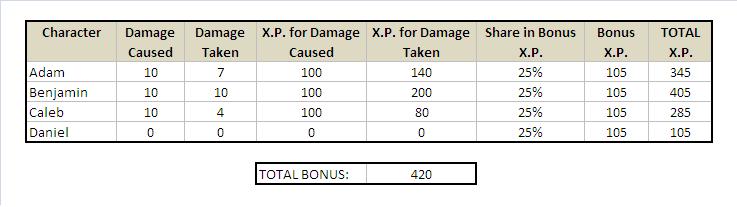
As can be seen, although Daniel does practically nothing, just being there earns him a little more than a 3rd of the experience Caleb receives. This is because, in my opinion, Daniel is risking his life by not helping his friends ... as that increases the chance that his friends will be killed, and Daniel will be pursued afterwards by the creature and have to fight it on his own. This and the simple fact that witnessing is its own kind of experiential growth. If the other party members have a problem with Daniel's involvement in combat, that's their problem. There's no reason why the X.P. system has to solve it for them.
The tendency might be to think this bonus X.P. needs to be mucked with and balanced to those who participate. I would encourage the gentle reader not to do so. In fact, it is already balanced - there's no need to over balance.
As Tripper points out, his wizards will do better to step in and as I said in the last post, take a hit for the team. But Tripper also feels that getting damaged is not part of a mage's class mandate, and that a mage who gets hit is not playing the mage well.
That, in my opinion, is bunk. The mage increases their fighting table, however slowly. A mage has combat ability, however weak. The mage is a humanoid like any other humanoid, and therefore bleeds, feels pain, and should feel guilty and responsible for the safety of other persons. Mages are not soulless bastards who are automatically exempt from risk because of their class. If they want to improve at life, they better get into the fucking game. There's nothing to be learned sitting on the sidelines.
A quick word about thieves - they go up very fast, so the X.P. system I play does, in fact, give a good reason for their needing less X.P. A smart thief can backstab their way up and still keep out of the main fights ... which my thieves tend to do. The low experience helps them. It's only that thieves are so used to coasting their way up to 8th level with little or no effort that its natural for them to bitch at having to risk something.
It sounds to me, Tripper, that your thieves and mages are whiny bastards, encouraged to be that by an X.P. system that refused to respect the risk-takers in the game. Poor little namby-pambies. Maybe they need to call their mothers out to dress their widdle wounds.
Second point: how to reward spells like web and sleep.
There are considerations the DM can try with awarding half the damage done to sleep or web victims to the caster, but I don't tend to play that. The extra bonus X.P. does help cover the effort of the mage who is taking no personal risk to cast a spell they already know perfectly and are learning nothing from casting. It has to be understood that nothing new being learned means no experience. I don't get smarter every time I drink a cup of coffee. If the mage helps the fighters slaughter the orcs quickly with a web, it reduces the risk and therefore ought to reduce the experience, not increase it.
But if that doesn't seem fair, consider this. It is SOOOOO easy for a mage to rack up additional X.P. from magic missiles and fireballs that the 9th level mage in my world regularly tops the list (or comes in the top three) after combats, even though the 8th level ranger has caused 80 odd damage and suffered 50. One solid blasting spell will reset the balance in short order ... so whatever my philosophy about experience, you don't want to hand more and more experience to a player who pretty much coasts once they reach a level where they don't run out of spells in the first three encounters.
When that mage does get into combat - with his 33 odd hit points and bad attack table - what usually happens is the mage takes a hit or two at a critical moment when the fighters are down, then staggers back when the fighters reassert themselves with healing (in the case of the paladin) or a potion. Remember that I play a combat system which stuns a player if they suffer a quarter of their present hit points ... so players are dropping back out of combat all the time as things get rough. Things might work differently for me on that account.
Once again, your mage may whine for awhile, but when it becomes obvious they're actually carrying the lead in the experience, that whining will go away. If you need support, turn to the fighters and ask them if they care about the mage's woes.
And finally, about X.P. rewards for successful encounters that don't resolve by combat. Well, I have this system I'm designing ... enough said.
I hope this was helpful. All I can say is that the players have gotten very used to it, and that worries about "experience being limited by the party's available hit points" hasn't been a problem. Combats end, and are followed by healing ... which allows for more X.P. at the next encounter.
My last session, the party tackled a 12-headed pyrohydra. It reduced most of the party into the single-digit or negative hit point range ... and actually killed the 6th level assassin who was brought back with a Death's Door spell. Total X.P. gained was in the 17,000 range - before treasure. More than the books would have given. Was fun.
Sunday, February 21, 2010
I Was Getting A Beer From The Fridge When ...
Fridge logic hit me.
Many DMs insist that problem-solving and roleplaying should somehow translate into experience points. It makes no sense that a character carefully thinks his way through a problem, solving it without having to fight, only to recieve no tangible reward where it comes to the game. Fighting and treasure, it is argued, shouldn’t drive the game.
Where players hold this tenent dearly, in a sandbox game, they will often avoid fighting whenever possible. Sometimes, players who play this way are punished by more and more monsters, until they have to fight. This can be very frustrating.
Let’s say they’re not forced into fighting ... that fighting occurs, occasionally, but it can be managed and even avoided, in a fair number of cases. And let’s say we have two parties running in this world – one that opts for fighting, one that doesn’t.
According to expectations, the party that fights and fights will rise in level, while the problem-solving party will not. According to argument, the problem-solving party will have more ‘fun’, or at least run in a more interesting and varied campaign, while the fighting party runnings will be repetitious. It is for that reason that many think there’s a flaw in the game, that it rewards mindlessness and punishes creativity. Shouldn’t the creative game be the one that pushes levels?
So experiments are tried ... to cut experience for fighting, to eliminate experience altogether for treasure. And to award experience, on the least ad hoc basis possible, for intelligent planning. In the very least, to make the ‘goal’ the experience, rather than the method. Defeat the enemy, by any means, and go up a level.
Somewhat difficult in a sandbox game. What is the goal? If the game never ends, and several plotlines are running simultaneously, when does the marker come that designates that the party goes up a level? True, there do come ‘natural’ breaks ... but how does one judge – without bias – the value of such a break?
Well, I don’t try. But it is giving a headache to someone.
I’d like to examine the problem-solving method for a moment.
To me, the reward seems a bit more obvious than it might to some. In life, as I solve problem after problem, I gain skill in solving problems. Particularly if I am given to solving problems in a particular field – I will gain greater familiarity with that field, and have a wider cognitive resource upon which to draw, when I wish to solve a problem.
D&D is like that for me. I think of the game a great deal of the time, and have done so for many years ... and when faced with a problem, I tend to leap to a solution fairly quickly. My tactics are not flawless. I make mistakes. But I problem-solve my way out of the mistakes, also, again from experience. And each time I do so, I gain a little wisdom.
Now suppose the field I am experienced with is weapon mechanics – and just for the sake of the game, we’ll define the sort of weapons I know as those that might be made by a blacksmith. Yes, let’s say I’m a blacksmith.
As I work as a blacksmith for year after year, I learn a great deal about problem solving where it comes to weapons. I learn about alloys, and heat, and method – and if I’m very clever, I learn from others, and improve the balance of the weapons I make, and their durability, and their edge. If I set myself goals to achieve, and force myself to solve harder and harder problems, I may one day succeed at becoming a very successful and creative blacksmith.
But if I never pick up one of my weapons and split open someone’s head with it, or use one of my weapons to keep someone from splitting open mine, no matter how much I know about blacksmithing, I’ll never be much of a fighter. Knowing how the weapon is made is not transferable to use.
For those out there who are rewarding experience left and right for avoiding fighting, I’d like you to realize for a moment that the direct effect of going up a level is to make the character a better combat machine. First and foremost, level translates to hit points, weaponry (including spells), a better hit table and a wider range of tactical advantages. Gaining a level does NOT make a player character a better problem solver. It does NOT increase the player’s ability to role-play.
This is not to argue that a player doesn’t get better the more roleplaying he or she does ... I just said, I am a good role-player because I’ve done a lot of it. But I am a good role-player no matter what level I am. I may use my role-playing skill to increase my character’s level, but I simply cannot use my character’s level to increase my role-playing skill.
As such, there’s no logic whatsoever to increasing the player’s level according to how well they played the esoteric game ... since the level has nothing to do with an esoteric reward.
It is a DM’s gut feeling that good play ought to be rewarded, simply because it is felt that the world ought to work that way. It is simply charity ... with the best of intentions, obviously, but by the principles of human nature it is necessarily erratic, inconsistent and – worst of all – selective. If you are a DM who rewards X.P. for good play, you are playing favorites. You’re biologically designed that way.
I can’t stop you, of course. I wouldn’t want to run in your world. I like it when everyone gets to play ... even when I’m the favored bastard.
Going back to, the ‘world ought to work that way.’ We know it doesn’t. Sports teams can play very, very well, and still lose. Goals in sports do not count extra when they are ‘made’ more elegant ... every goal, clumsy goals or sweet goals, even a goal where the team scores on itself, counts the same. Teams that do not score goals do not get special points. The rules of the game makes allowances for strategies to score goals, but not for strategies for having fun.
If a party wants to avoid a fight, I have no trouble with that. Occasionally it won’t be possible, but often it will work as a strategy. I don’t care if the monster is killed or not – I have nothing invested in imaginary creatures.
But I don’t believe a player improves their hit points by avoiding being damaged. I don’t believe a player that won’t fight should somehow go up a level that entitles them to fight better. If they want to fight better, they can fight more often.
It’s okay. Because all the problem solving they’re doing is teaching them to be better problem solvers. I don’t need to award experience for that. Problem solving is its own reward.
Many DMs insist that problem-solving and roleplaying should somehow translate into experience points. It makes no sense that a character carefully thinks his way through a problem, solving it without having to fight, only to recieve no tangible reward where it comes to the game. Fighting and treasure, it is argued, shouldn’t drive the game.
Where players hold this tenent dearly, in a sandbox game, they will often avoid fighting whenever possible. Sometimes, players who play this way are punished by more and more monsters, until they have to fight. This can be very frustrating.
Let’s say they’re not forced into fighting ... that fighting occurs, occasionally, but it can be managed and even avoided, in a fair number of cases. And let’s say we have two parties running in this world – one that opts for fighting, one that doesn’t.
According to expectations, the party that fights and fights will rise in level, while the problem-solving party will not. According to argument, the problem-solving party will have more ‘fun’, or at least run in a more interesting and varied campaign, while the fighting party runnings will be repetitious. It is for that reason that many think there’s a flaw in the game, that it rewards mindlessness and punishes creativity. Shouldn’t the creative game be the one that pushes levels?
So experiments are tried ... to cut experience for fighting, to eliminate experience altogether for treasure. And to award experience, on the least ad hoc basis possible, for intelligent planning. In the very least, to make the ‘goal’ the experience, rather than the method. Defeat the enemy, by any means, and go up a level.
Somewhat difficult in a sandbox game. What is the goal? If the game never ends, and several plotlines are running simultaneously, when does the marker come that designates that the party goes up a level? True, there do come ‘natural’ breaks ... but how does one judge – without bias – the value of such a break?
Well, I don’t try. But it is giving a headache to someone.
I’d like to examine the problem-solving method for a moment.
To me, the reward seems a bit more obvious than it might to some. In life, as I solve problem after problem, I gain skill in solving problems. Particularly if I am given to solving problems in a particular field – I will gain greater familiarity with that field, and have a wider cognitive resource upon which to draw, when I wish to solve a problem.
D&D is like that for me. I think of the game a great deal of the time, and have done so for many years ... and when faced with a problem, I tend to leap to a solution fairly quickly. My tactics are not flawless. I make mistakes. But I problem-solve my way out of the mistakes, also, again from experience. And each time I do so, I gain a little wisdom.
Now suppose the field I am experienced with is weapon mechanics – and just for the sake of the game, we’ll define the sort of weapons I know as those that might be made by a blacksmith. Yes, let’s say I’m a blacksmith.
As I work as a blacksmith for year after year, I learn a great deal about problem solving where it comes to weapons. I learn about alloys, and heat, and method – and if I’m very clever, I learn from others, and improve the balance of the weapons I make, and their durability, and their edge. If I set myself goals to achieve, and force myself to solve harder and harder problems, I may one day succeed at becoming a very successful and creative blacksmith.
But if I never pick up one of my weapons and split open someone’s head with it, or use one of my weapons to keep someone from splitting open mine, no matter how much I know about blacksmithing, I’ll never be much of a fighter. Knowing how the weapon is made is not transferable to use.
For those out there who are rewarding experience left and right for avoiding fighting, I’d like you to realize for a moment that the direct effect of going up a level is to make the character a better combat machine. First and foremost, level translates to hit points, weaponry (including spells), a better hit table and a wider range of tactical advantages. Gaining a level does NOT make a player character a better problem solver. It does NOT increase the player’s ability to role-play.
This is not to argue that a player doesn’t get better the more roleplaying he or she does ... I just said, I am a good role-player because I’ve done a lot of it. But I am a good role-player no matter what level I am. I may use my role-playing skill to increase my character’s level, but I simply cannot use my character’s level to increase my role-playing skill.
As such, there’s no logic whatsoever to increasing the player’s level according to how well they played the esoteric game ... since the level has nothing to do with an esoteric reward.
It is a DM’s gut feeling that good play ought to be rewarded, simply because it is felt that the world ought to work that way. It is simply charity ... with the best of intentions, obviously, but by the principles of human nature it is necessarily erratic, inconsistent and – worst of all – selective. If you are a DM who rewards X.P. for good play, you are playing favorites. You’re biologically designed that way.
I can’t stop you, of course. I wouldn’t want to run in your world. I like it when everyone gets to play ... even when I’m the favored bastard.
Going back to, the ‘world ought to work that way.’ We know it doesn’t. Sports teams can play very, very well, and still lose. Goals in sports do not count extra when they are ‘made’ more elegant ... every goal, clumsy goals or sweet goals, even a goal where the team scores on itself, counts the same. Teams that do not score goals do not get special points. The rules of the game makes allowances for strategies to score goals, but not for strategies for having fun.
If a party wants to avoid a fight, I have no trouble with that. Occasionally it won’t be possible, but often it will work as a strategy. I don’t care if the monster is killed or not – I have nothing invested in imaginary creatures.
But I don’t believe a player improves their hit points by avoiding being damaged. I don’t believe a player that won’t fight should somehow go up a level that entitles them to fight better. If they want to fight better, they can fight more often.
It’s okay. Because all the problem solving they’re doing is teaching them to be better problem solvers. I don’t need to award experience for that. Problem solving is its own reward.
Monday, April 13, 2009
Experience Solved
I am in love with my new experience system.
Just to recap, as that was quite a few posts ago, I have started keeping track of experience according to the following principles:
A) 20 X.P. are awarded for every point of damage a character suffers.
B) 10 X.P. are awarded for every point of damage a character causes. This is subject to a few addendums: a magic spell which affects multiple persons gives experience to the caster only for the damage total of the spell; thus, a fireball which delivered 26 h.p. to four creatures would only award 260 x.p. to the caster, and only if one of the four creatures failed its saving throw. If all four creatures succeeded, the fireball would only give 130 x.p. to the caster. Other spells like burning hands, magic stone, magic missile, call lightning and so on work similarly. I am at the moment unsure of how to deal with certain death dealing spells such as telekinesis or cloudkill, which do not have a specific hit point motif. Thankfully, no member of my party has a spell of this level as of yet.
C) All damage caused against the party is totaled, multiplied by 20 and then distributed to those party members who were witnesses and who specifically took some kind of action in the events, even if that action failed to cause damage or the member was unharmed. This is in lieu of at least attempting to take an action, taking a risk, and thereby gaining experience from it.
The principle of this method is that experience is something that is gained more through suffering and failure than through success, and that it is a much more profound experience to endure damage than to inflict it.
The main problem is keeping track, as I am not used to doing more than saying, “take such and such damage” and then forgetting about it. Now I must keep records.
I have now been running this system for two months, for four runnings for my offline party and for my online party. No one has complained about a decrease in experience because of the change in system, nor has anyone suggested that experience has been higher lately.
Here is why I love it. The old system demanded a highly subjective declaration of the value of a creature’s special ability, which was then assigned a flat number based on the creature’s hit dice. It did not matter that the creature never got to use its particular ability before it died, or that the ability was pretty much useless against a party that were all armed with magic weapons or silver weapons or none of which were spellcasters (thus magic resistance is pretty much meaningless). It did not matter that a creature which surprises 4 in 6 was itself surprised, or that a cave bear never hit with both claws and got the opportunity to mawl. Nor did it matter that a dragon got lucky with its breath weapon or that players on this occasion consistently failed their saving throws against ghouls, whose X.P. bonus is rather paltry as they have only 2 hit dice. It was expected that the DM would make another subjective call in this situation and decide what experience to award in light of these instances.
Well, fuck subjectivity. Suddenly I find myself no longer having to be concerned about any special abilities a creature might have. I can even add or subtract special abilities at will, creating subspecies of each type of monster, without having to concern myself with what experience this might award due to the change. If a 20 hit point monster goes down without a fight (usually because I can’t seem to roll above a 4), the party gains 200 X.P. delivered to whoever gets lucky enough to hit first. If, on the other hand, the creature rolls astoundingly well, causing 20 damage to the party before dying, the party gains 1,000 X.P., with 400 of that distributed to everyone.
Combat experience freed from ad hoc formulas. If the creature doesn’t threaten you, you get squat.
The second thing I’ve noticed about this experience system is that the monster doesn’t have to die! If you do 12 damage to a hill giant, which then does 15 damage to you, and you think to yourself, “Fuck this noise, I’m getting out of here,” you still get 420 X.P., just for standing up to the creature for two rounds of combat. Tell me that doesn’t make sense. Tell me it wouldn’t be an eye-opener to stand toe to toe with a giant for the space of two rounds.
Plus the added bonus that the party doesn’t feel as if running away means it gets nothing, encouraging it to fight things out to the bitter end, however that turns out.
At this point I can’t see myself going back to the old way. The new way will definitely require some fine adjusting, as I discover monsters that don’t quite fit the system as well as spells I’ve already mentioned—but I believe I am on the right track. I should have done this years ago.
UPDATE:
There's something else that occurs to me, that I meant to add to this post. It concerns magic users.
Typically, I have found that mages at low level run out of spells almost at once, but because of their low hit points they are hesitant to get into combat unless absolutely necessary. This is understandable: they have the same to hit table as thieves and zero-levels (poor) and no hit points. Often a mage will take armor as a spell, which will let them fight for a few rounds, but they typically miss and then fall back. I have always advocated that a low level mage should stock up on daggers and get comfortable standing back and throwing.
However, a side effect of this is that by 4th to 6th level, when it still happens that they will run out of spells, they will refuse still to mix it up--even though by now with a standard 15 constitution (hardly anyone running in my offline campaign has less than a 15 constitution) they have an average of 17 to 23 hit points. In other words, they can take a couple of solid hits with a sword, or a round against a vicious tiger, without dropping below zero. Altogether, I'd have to cause 30 damage in a round (given that death in my system occurs at -10 hp) to actually threaten them.
But they won't fight. "What's the point?" they'll ask. "I'm just getting damaged and I'm going to miss anyway"--since at 4th and 5th they're still on the crummy table. Usually, I'll try to explain to them that if they could kindly accept 20 damage from some monster in some round, that's 20 damage I'm not causing one of the fighters or clerics, thus enabling them to do their jobs. Come on, I tell mages, take a hit for the team.
Still they won't. It is inbred in mages to be cowards.
With this new system, however, if the mage insists on hanging around in the back, they might get some experience for getting a few spells off, but they're not going to get any bonuses for being damaged. This works for me in a mental kind of sense--if you as a person were afraid of being hit with a sword, and you perpetually hid from the possibility, then you would be ignorant of how to take the hit, or that the hit was not as bad as you thought (ie., it didn't kill you). The opposite of ignorance is experience.
So if a mage wants to advance in levels, the mage better be ready to get dirty.
Just to recap, as that was quite a few posts ago, I have started keeping track of experience according to the following principles:
A) 20 X.P. are awarded for every point of damage a character suffers.
B) 10 X.P. are awarded for every point of damage a character causes. This is subject to a few addendums: a magic spell which affects multiple persons gives experience to the caster only for the damage total of the spell; thus, a fireball which delivered 26 h.p. to four creatures would only award 260 x.p. to the caster, and only if one of the four creatures failed its saving throw. If all four creatures succeeded, the fireball would only give 130 x.p. to the caster. Other spells like burning hands, magic stone, magic missile, call lightning and so on work similarly. I am at the moment unsure of how to deal with certain death dealing spells such as telekinesis or cloudkill, which do not have a specific hit point motif. Thankfully, no member of my party has a spell of this level as of yet.
C) All damage caused against the party is totaled, multiplied by 20 and then distributed to those party members who were witnesses and who specifically took some kind of action in the events, even if that action failed to cause damage or the member was unharmed. This is in lieu of at least attempting to take an action, taking a risk, and thereby gaining experience from it.
The principle of this method is that experience is something that is gained more through suffering and failure than through success, and that it is a much more profound experience to endure damage than to inflict it.
The main problem is keeping track, as I am not used to doing more than saying, “take such and such damage” and then forgetting about it. Now I must keep records.
I have now been running this system for two months, for four runnings for my offline party and for my online party. No one has complained about a decrease in experience because of the change in system, nor has anyone suggested that experience has been higher lately.
Here is why I love it. The old system demanded a highly subjective declaration of the value of a creature’s special ability, which was then assigned a flat number based on the creature’s hit dice. It did not matter that the creature never got to use its particular ability before it died, or that the ability was pretty much useless against a party that were all armed with magic weapons or silver weapons or none of which were spellcasters (thus magic resistance is pretty much meaningless). It did not matter that a creature which surprises 4 in 6 was itself surprised, or that a cave bear never hit with both claws and got the opportunity to mawl. Nor did it matter that a dragon got lucky with its breath weapon or that players on this occasion consistently failed their saving throws against ghouls, whose X.P. bonus is rather paltry as they have only 2 hit dice. It was expected that the DM would make another subjective call in this situation and decide what experience to award in light of these instances.
Well, fuck subjectivity. Suddenly I find myself no longer having to be concerned about any special abilities a creature might have. I can even add or subtract special abilities at will, creating subspecies of each type of monster, without having to concern myself with what experience this might award due to the change. If a 20 hit point monster goes down without a fight (usually because I can’t seem to roll above a 4), the party gains 200 X.P. delivered to whoever gets lucky enough to hit first. If, on the other hand, the creature rolls astoundingly well, causing 20 damage to the party before dying, the party gains 1,000 X.P., with 400 of that distributed to everyone.
Combat experience freed from ad hoc formulas. If the creature doesn’t threaten you, you get squat.
The second thing I’ve noticed about this experience system is that the monster doesn’t have to die! If you do 12 damage to a hill giant, which then does 15 damage to you, and you think to yourself, “Fuck this noise, I’m getting out of here,” you still get 420 X.P., just for standing up to the creature for two rounds of combat. Tell me that doesn’t make sense. Tell me it wouldn’t be an eye-opener to stand toe to toe with a giant for the space of two rounds.
Plus the added bonus that the party doesn’t feel as if running away means it gets nothing, encouraging it to fight things out to the bitter end, however that turns out.
At this point I can’t see myself going back to the old way. The new way will definitely require some fine adjusting, as I discover monsters that don’t quite fit the system as well as spells I’ve already mentioned—but I believe I am on the right track. I should have done this years ago.
UPDATE:
There's something else that occurs to me, that I meant to add to this post. It concerns magic users.
Typically, I have found that mages at low level run out of spells almost at once, but because of their low hit points they are hesitant to get into combat unless absolutely necessary. This is understandable: they have the same to hit table as thieves and zero-levels (poor) and no hit points. Often a mage will take armor as a spell, which will let them fight for a few rounds, but they typically miss and then fall back. I have always advocated that a low level mage should stock up on daggers and get comfortable standing back and throwing.
However, a side effect of this is that by 4th to 6th level, when it still happens that they will run out of spells, they will refuse still to mix it up--even though by now with a standard 15 constitution (hardly anyone running in my offline campaign has less than a 15 constitution) they have an average of 17 to 23 hit points. In other words, they can take a couple of solid hits with a sword, or a round against a vicious tiger, without dropping below zero. Altogether, I'd have to cause 30 damage in a round (given that death in my system occurs at -10 hp) to actually threaten them.
But they won't fight. "What's the point?" they'll ask. "I'm just getting damaged and I'm going to miss anyway"--since at 4th and 5th they're still on the crummy table. Usually, I'll try to explain to them that if they could kindly accept 20 damage from some monster in some round, that's 20 damage I'm not causing one of the fighters or clerics, thus enabling them to do their jobs. Come on, I tell mages, take a hit for the team.
Still they won't. It is inbred in mages to be cowards.
With this new system, however, if the mage insists on hanging around in the back, they might get some experience for getting a few spells off, but they're not going to get any bonuses for being damaged. This works for me in a mental kind of sense--if you as a person were afraid of being hit with a sword, and you perpetually hid from the possibility, then you would be ignorant of how to take the hit, or that the hit was not as bad as you thought (ie., it didn't kill you). The opposite of ignorance is experience.
So if a mage wants to advance in levels, the mage better be ready to get dirty.
Friday, January 23, 2009
More X.P. Babblings
I estimate that about 60% of my player’s X.P. comes from treasure.
Totals for treasure would normally be 40% coin, 20% gems and jewelry, 10% various luxury items such as expensive clothing, spirits, spices, rare books and so on, and 5% magic. The remaining 25% would be for armor and weapons, which the party usually receives experience for even though they don’t often carry them off, which is fine with me since the party has had to fight against these items (thus earning the X.P. that way).
A typical encounter such as the one I describe in my last post will give about 850 X.P. per main party member, 425 X.P. per henchman and 200 X.P. per secondary henchman. For example, the 2nd level fighter, Hig, is the shieldman for the paladin, Neema, who is the henchwoman for the mage, Garalzapan.
At 850 X.P. per encounter, the mage will have to fight about forty more battles before becoming 9th level. Though of course eventually the mage will have a battle royale with huge treasure that will make this happen much sooner.
It is now January. I would estimate that the mage, who has about 95,000 X.P. right now, will reach 9th level sometime in June. Possibly sooner, if the party gets decimated.
Party decimations are rare events but excellent for the survivors. The party winds up fighting something worth 20,000 X.P., with a total cumulated treasure of 50,000 X.P. Because of the devastating potential of the monsters involved (say, eight stone giants, fought simultaneously). More than half the party gets killed. Two main characters and one henchman survive. 70,000 X.P. divided by 2.5 = 28,000 for the main characters and 14,000 for the hench. Instant next level.
Course, it does depress those who die.
Generally the rule I’ve followed in the past is that if you die, no X.P., even if they raise you…unless the party is able to raise you immediately, while still on the battlefield, by means of death’s door, raise dead or resurrection. In which case you can get X.P. for the treasure, but NOT combat experience. That still gets divided among those who did not die.
The changes I suggested yesterday would mean that X.P. for damage was lost, but the general X.P. would still be distributed to those who were left.
My sense for yesterday’s comments is that as DMs, you fellows are not terribly interested in bestowing a lot of experience. 100 X.P. per hit die is fine, until you consider that there are a lot of special attacks and defenses, differing levels of damage and so on that make that system unworkable. You’ve got to balance your X.P. by the use of breath weapons and magic resistance—and this has always created a problem for me.
What if the purple worm which swallows on a 20 never actually rolls a 20? And should the 4+4 HD spider with poison really get 4 times as much X.P. for that ability as the 1+1 HD spider? Especially if you play that the character dies in any case? And what about a spider like the brown recluse, which clearly isn’t massive enough for even 1 h.p., but which is capable of killing a human being? How many X.P. does that poison give?
But I digress.
I have absolutely no trouble giving an entire party 7,000 X.P. after an encounter (as I did with the one described yesterday), primarily because I know I’m not making life easy for them. They had to fight hard to win that combat. As I play by the rule that a natural 20 is double damage, and a second natural 20 is triple damage, it was pretty fucking freaky that I rolled FOUR natural 20s in a row at one point for quintuple damage. I’d never done that before and sadly it only amounted to a total of 20. That alone was worth giving the victim the experience the victim got.
The treasure included no magic, and was a bit scant since the gnolls killed were a hunting group tracking down the party, but I gave bonuses for the value of a trained mastodon (added to general X.P.) and threw in a few nice pieces of jewelry on the useless cleric and the mastodon’s rider.
Why, I ask, would you feel you ought to cheat the party of such things?
I know that as a player I’d be pretty pissed if I spent most runnings sitting around having pointless Expositional dialogues with NPCs and that, when forced to fight in order to escape the kingdom with my life, the DM decided that wasn’t worth rewarding experience because they don’t give X.P. for combat.
Which of course puts the DM in the position of giving the Kindergarten Gold Star to compensate for these ad hoc restrictions. What do I mean by that? That as a player I somehow have to win the DM’s approval for my actions, rather than being able to count on the GAME DYNAMIC to reward me. I’ve played in campaigns like this. Invariably the DM always rewards their best friends, and often fails to respect brilliant, imaginative tactics which fuck up the DM’s carefully designed campaign.
Want an example? We had a DM once who provided us with enough diminution potion that would allow us to slip into a castle as tiny people without being seen. We literally had 30 quaffs of the stuff. Instead what we did was to feed the potions to 30 cows…which one of the characters then picked up in a blanket, flew 4,000 feet over the castle using wings of flying, and at the appointed moment cast a dispel magic on the lot, effectively SPOT BOMBING the entire facility. We then casually went in and mopped up.
Was the DM happy? Fuck no. He had spent weeks inventing little mazes inside walls and bug monsters which would attack us, none of which ever happened. So we didn't get a gold star. We got a shrill, whining infant who repeatedly had to be pushed forward with, "Give us ONE reason we can't do this."
Some of you might like our creativity. But generally, there’s always some way to make the DM unhappy, and the X.P. delivery system should NOT be dependent on the DMs prejudices.
If I had a player in a bar who decided he wanted to get X.P. for beating up the bartender, what’s wrong with that? It isn’t going to be much experience, and it will bring down the weight of the town guard, followed by the possibility that the bar’s patrons may not be 1st level dweebs. I don’t run a world where being poor means being low of level (as who knows how that person spent their youth), so you don’t pick fights with strangers because bar fights are like a box of chocolates.
But still, what do I care? I continue to argue that as a DM, it is not my job to tell the players how to spend their time.
Nor is it my job to give them gold stars for playing the kind of personalities that I approve of. It is my job to make a world. Period. You want to come to my world and be a BUM and lay in the gutter asking for change, I’m good with that. I will find a way to throw ordinary obstacles at you that will make the game interesting.
Well. This was a rambling post.
Totals for treasure would normally be 40% coin, 20% gems and jewelry, 10% various luxury items such as expensive clothing, spirits, spices, rare books and so on, and 5% magic. The remaining 25% would be for armor and weapons, which the party usually receives experience for even though they don’t often carry them off, which is fine with me since the party has had to fight against these items (thus earning the X.P. that way).
A typical encounter such as the one I describe in my last post will give about 850 X.P. per main party member, 425 X.P. per henchman and 200 X.P. per secondary henchman. For example, the 2nd level fighter, Hig, is the shieldman for the paladin, Neema, who is the henchwoman for the mage, Garalzapan.
At 850 X.P. per encounter, the mage will have to fight about forty more battles before becoming 9th level. Though of course eventually the mage will have a battle royale with huge treasure that will make this happen much sooner.
It is now January. I would estimate that the mage, who has about 95,000 X.P. right now, will reach 9th level sometime in June. Possibly sooner, if the party gets decimated.
Party decimations are rare events but excellent for the survivors. The party winds up fighting something worth 20,000 X.P., with a total cumulated treasure of 50,000 X.P. Because of the devastating potential of the monsters involved (say, eight stone giants, fought simultaneously). More than half the party gets killed. Two main characters and one henchman survive. 70,000 X.P. divided by 2.5 = 28,000 for the main characters and 14,000 for the hench. Instant next level.
Course, it does depress those who die.
Generally the rule I’ve followed in the past is that if you die, no X.P., even if they raise you…unless the party is able to raise you immediately, while still on the battlefield, by means of death’s door, raise dead or resurrection. In which case you can get X.P. for the treasure, but NOT combat experience. That still gets divided among those who did not die.
The changes I suggested yesterday would mean that X.P. for damage was lost, but the general X.P. would still be distributed to those who were left.
My sense for yesterday’s comments is that as DMs, you fellows are not terribly interested in bestowing a lot of experience. 100 X.P. per hit die is fine, until you consider that there are a lot of special attacks and defenses, differing levels of damage and so on that make that system unworkable. You’ve got to balance your X.P. by the use of breath weapons and magic resistance—and this has always created a problem for me.
What if the purple worm which swallows on a 20 never actually rolls a 20? And should the 4+4 HD spider with poison really get 4 times as much X.P. for that ability as the 1+1 HD spider? Especially if you play that the character dies in any case? And what about a spider like the brown recluse, which clearly isn’t massive enough for even 1 h.p., but which is capable of killing a human being? How many X.P. does that poison give?
But I digress.
I have absolutely no trouble giving an entire party 7,000 X.P. after an encounter (as I did with the one described yesterday), primarily because I know I’m not making life easy for them. They had to fight hard to win that combat. As I play by the rule that a natural 20 is double damage, and a second natural 20 is triple damage, it was pretty fucking freaky that I rolled FOUR natural 20s in a row at one point for quintuple damage. I’d never done that before and sadly it only amounted to a total of 20. That alone was worth giving the victim the experience the victim got.
The treasure included no magic, and was a bit scant since the gnolls killed were a hunting group tracking down the party, but I gave bonuses for the value of a trained mastodon (added to general X.P.) and threw in a few nice pieces of jewelry on the useless cleric and the mastodon’s rider.
Why, I ask, would you feel you ought to cheat the party of such things?
I know that as a player I’d be pretty pissed if I spent most runnings sitting around having pointless Expositional dialogues with NPCs and that, when forced to fight in order to escape the kingdom with my life, the DM decided that wasn’t worth rewarding experience because they don’t give X.P. for combat.
Which of course puts the DM in the position of giving the Kindergarten Gold Star to compensate for these ad hoc restrictions. What do I mean by that? That as a player I somehow have to win the DM’s approval for my actions, rather than being able to count on the GAME DYNAMIC to reward me. I’ve played in campaigns like this. Invariably the DM always rewards their best friends, and often fails to respect brilliant, imaginative tactics which fuck up the DM’s carefully designed campaign.
Want an example? We had a DM once who provided us with enough diminution potion that would allow us to slip into a castle as tiny people without being seen. We literally had 30 quaffs of the stuff. Instead what we did was to feed the potions to 30 cows…which one of the characters then picked up in a blanket, flew 4,000 feet over the castle using wings of flying, and at the appointed moment cast a dispel magic on the lot, effectively SPOT BOMBING the entire facility. We then casually went in and mopped up.
Was the DM happy? Fuck no. He had spent weeks inventing little mazes inside walls and bug monsters which would attack us, none of which ever happened. So we didn't get a gold star. We got a shrill, whining infant who repeatedly had to be pushed forward with, "Give us ONE reason we can't do this."
Some of you might like our creativity. But generally, there’s always some way to make the DM unhappy, and the X.P. delivery system should NOT be dependent on the DMs prejudices.
If I had a player in a bar who decided he wanted to get X.P. for beating up the bartender, what’s wrong with that? It isn’t going to be much experience, and it will bring down the weight of the town guard, followed by the possibility that the bar’s patrons may not be 1st level dweebs. I don’t run a world where being poor means being low of level (as who knows how that person spent their youth), so you don’t pick fights with strangers because bar fights are like a box of chocolates.
But still, what do I care? I continue to argue that as a DM, it is not my job to tell the players how to spend their time.
Nor is it my job to give them gold stars for playing the kind of personalities that I approve of. It is my job to make a world. Period. You want to come to my world and be a BUM and lay in the gutter asking for change, I’m good with that. I will find a way to throw ordinary obstacles at you that will make the game interesting.
Well. This was a rambling post.
Subscribe to:
Posts (Atom)