Showing posts with label Edition Wars. Show all posts

Friday, August 19, 2022

Good News!

A few small things, as I'm finding it difficult to type.  Better today than yesterday.

On the subject of maladies, it's a credible argument that something bad might happen to a character at any time, regardless of the character's carefulness or the player's game play.  For example, Wednesday morning I was doing the dishes when the bottom of the glass I was washing fell off, causing the exposed glass edge to do this:


Because that's how it goes.  Was nice though; with our new car, we were able to pop over to my doctor right away and get it stitched up within the hour.  Today it's come a long way, so that typing this is less of a strain, though the progressive key strokes are moderately unpleasant micro-pangs.

Somehow, I feel encouraged by yesterday's announcement of "One D&D", once again expressing the company's wish-fulfillment regarding its naming of things.  As a product-maker of old style D&D, for a while now I've been made uncomfortable by the success of 5e and it's propagandistic, soulless destruction of actual D&D game play, by insidiously teaching young children that it doesn't exist.  Much as I hate to admit it, 5e came in with a depressingly good marketing strategy.  Pretend that "real" game players designed the game, then pump it full of hot garbage spewed by gaming "journalists" ... and cementing the whole with game-store policed adventure clubs.  The combination of these has made a shitty version of a great game extremely popular.

It's enough to make me slash my hands ... er, wrists.

However, with the inevitable sorry release of the WOTC's most recent splatbook, Tasha's Cauldron of the Same Old Crap, the company has decided to piss on it's own marketing by announcing that yes, they really are going forward with dndnext, announcing that they're "dropping editions" and moving forward with the badly named 6th edition ... which makes the game's rules even MORE player friendly.

One nice thing about being a games "journalist" is the happy willingness of merely repeating the company's talking points as "reporting," while I assume getting paid for doing so.  Although the company are a bunch of lying liars, and games are "only games," it's perfectly safe to pretend that the new rules are variously awesome, amazing, terrific, a bold step forward and additional boilerplate-type rhetoric that makes sure the writer keeps his or her job while the online magazine retains it's adbuy from the company being reviewed.  It's all quite incestuous.

"6th" edition will succeed in bursting the bubble of approximately 8 million 5e game players ... which for me, is good news.  By continuously undermining its credibility, the company usefully spreads discontent and yes, anger, with company products, since a new ruleset is always a part of every change.  Such poorly considered amateurish marketing desperation is a sure sign that at least 5-10% of 5e players will be pushed towards adopting earlier game versions, which don't change.  As of today, I have potentially four to eight hundred thousand new customers.

Awesome.

Wednesday, May 27, 2020

Fracturing

Chasing around for information about milestones, I came across this post from DM David.  I withhold my endorsement ... but the post highlights an element in the game's present design that deserves examination.

I cannot appreciate that the writer felt the need to dredge up graceless player opinions to support the clear, scientifically established presence of what dopamine is and how it works.  This has been pointedly established in the games industry since Farmville and Candy Crush.  Is this still in doubt?  I cannot understand why D&D writers will not go directly to scientific sources for evidence.  This clumsily made argument takes up three quarters of the post.

The breakthrough in the piece isn't exploited (though perhaps it might be elsewhere on the blog; I'm not a regular reader:
... adventure writers hate fitting XP in their designs. Organized play campaigns typically required designers to write their adventures around combat encounters that net a specific number of XP.  Some authors met their XP quotas by adding bandit encounters until ambushed by thugs became a cliché of awkward design. Adventure paths pose an even bigger challenge.
"Designers have to jam in the 'correct' number of combat encounters to make sure the PCs level up at the right pace," writes D&D head Mike Mearls. "Adventure design thus becomes a process of matching up the right flow of XP to the correct tempo of the plot." Designers who wanted fewer fights could add XP awards for accomplishing story goals, but these awards lead to the same outcome as just telling players to level up. Just telling players to take a level skips the math and planning.

While the post linked above from DM David comes from January 2020, the quote comes from 2014.  The original page is gone, but you can see more of the post on Tower of Zenopus, five months after the final playtest packet was released for 5e, and more than four months before 5e's basic rules were released for play.  Zenopus makes many of the arguments that DM David's quotables make, and does it better.

Mearls in the longer quote from Zenopus says, "... a much better approach is to allow designers to present both options ..."

I'd like to know: are both options being presented right now?  Are the adventure writers creating milestone versions AND x.p. versions of their stuff?  I would imagine that if they are, they would hate that much more.  I confess I don't know the answer.  I don't buy modules.  I don't even steal them, though that would be easy.

I tend to believe that Mearls is paying lip-service to an established front being disregarded by the first part of the quote, in favor of the company seeking an easier way to do things While supposedly servicing those players who prefer role-play to combat.  I can't imagine any tech company, anywhere, arguing that they are going to give less options on a device because the coders find it much easier to write programs for, say, text recognition rather than sound recognition.  Nor can I imagine users of devices willingly surrendering features because, while we used to make them, we don't now because it is just too hard.

We do give up features, all the time; mostly because there aren't enough users to make the feature worth pursuing.  Is this what Mearls was saying about those using X.P. in 2014?

That would be strange, because the company hadn't released milestones yet.   Right?

There isn't a sentence in Mearls' quote that I couldn't write a post about.  Progressively, in making published adventures, they had ceased to recognize that the game's rewards were inherent in the system these adventures were being written for; but by 2014, Mearls is talking about how "we," the game's designers, felt it was their responsibility to decide, for us, how best to implement rewards.  He makes it sound like he defaulted to experience points because that was the publishing suite's choice, Not because those were the rules.  He describes writing something that the game doesn't actually need, "pre-made adventures," as "troublesome," as though that shouldn't go with the territory.  Writing this post is troublesome.  Making my dinner is troublesome.  Writing my own adventures for my own game is troublesome.  How in the hell does a publisher expect that something being made for a complex game like D&D shouldn't be troublesome, and how does its troublesomeness justify making an ad hoc change for a minority of writers who are unhappy with it?

This is one small corner of thousands of community-fracturing choices that were made by the company, and are still being made by the company, creating problems for me and millions of other D&D players who can't simply find a new player to run in their campaigns.  Every experienced player I enter into my campaign becomes a "troublesome" hodgepodge of necessary clarifications, negotiations, detailing, training, lines in the sand and potential argumentative blow-outs because the company could not agree on the game's fundamentals.

I asked this on twitter the other day:  how many decades can a company have its head up its ass before its clients decide to look away?

I got likes.

Monday, April 29, 2019

The Hater's Game

Compare the following.  First, this description of dungeon mastering from the 5th Edition DM's Guide, p. 4, Introduction:
"The Dungeon Master (DM) is the creative force behind a D&D game.  The DM creates a world for the other players to explore, and also creates and runs adventures that drive that story ... A Dungeon Master gets to wear many hats.  As the architect of a campaign, the DM creates adventures by placing monsters, traps and treasures for the other player's characters (the adventurers) to discover.  As a storyteller, the DM helps the other players visualize what's happening around them, improvising when the adventurers do something or go somewhere unexpected."

And now, another definition, from the 1st Edition DM's Guide, p. 7, Preface:
"When you build your campaign you will tailor it to suit your personal tastes.  In the heat of play it will slowly evolve into a compound of your personality and those of your better participants, a superior alloy.  And as long as your campaign remains viable, it will continue a slow process of change and growth.  In this lies a great danger, however.  The systems and parameters contained in the whole of Advanced Dungeons & Dragons are based on a great deal of knowledge, experience gained through discussion, play, testing, questioning and (hopefully) personal insight."

Interesting.

The replacement of the 2nd-person "you" with the 3rd-person "DM" is telling.  The 1st Edition introduction doesn't talk at all about the DM or the adventure.  It talks about systems, about what the author tried to include, about boundaries to put on the party and what not to allow the party to do.  And again, it talks about "you," not some amorphous "the DM."

I had to find a comparison paragraph in the Preface that I could match up with the 5e DMG, and it still doesn't.  The 5e DMG uses a lot of verbs to describe what the DM does.  The DM creates (used 3 times), runs, gets, places, helps and improvises.  These are all connected directly to the DM and what the DM does is written in every sentence.

The 1e DMG uses two verbs, build and tailor, and only in the first sentence.  The rest is about what happens after the DM acts.  The campaign evolves, continues, changes, grows.

The 5e introduction spends its time talking about what an adventure is, what things are, what the DM gets.  It never talks about cost and it never talks about change.  It is static.  It is these things we are telling you.

Whereas the 1e preface talks about what things require, what they limit and balance, and ultimately where it can all go wrong.  It talks about this on the first page.  Six paragraphs in, Gygax is warning that a mutable system means it can all go wrong and fast.  In the paragraph above, he lays it straight.  This is not going to be easy.

And it wasn't.

Consider the words, "In the heat of play," and how divorced they are from virtually anything you will read in a rule-book nowadays.  Gygax is remembering his wargaming days, his Chainmail days, the sessions where fights broke out and people hurled dice and threats at each other.  He's telling us, the reader, that the forge of play is going to make our game better.  The phrase, "evolve into a compound," is a weaponsmith's, the metallurgist seeking the right mix, so that it can be hammered and beat on the anvil to produce the best metal.  Those elements are our personality and our best participants.  Not players we "help," but players who, along with ourselves, found together to make the best alloy.

It is right there in his 2nd paragraph.  Inferior DMs and Players do not make good games.  A good game is not created, it is forged in fire and anger and hard work.  Nothing is guaranteed.  You've got to work.  You've got to discuss and play.  You've got to test and question.  Hopefully, he says, you have insight.

Why "hopefully"?  Why toss in that possibility that you won't have insight?  Why doesn't he just pat you on the head, like 5e does, and assume you can do it, without ever giving you reason to doubt?

Gygax isn't selling something.  He's saying, "Life is pain.  Anyone who says differently is selling something."

And this, I think, is at the core of everything.

2nd edition and everything afterward ~ no, scratch that, because I think it started even while I was still playing D&D in high school.  The modules and other like role-playing games that were published tried to sell an idea that "anyone could do it."  It is splashed all over the 5e DMG.  This book will help you.  As a DM, you get to wear many hats, like you've won a prize.  Want to invent a world?  This book helps you "nail down a few important details," like it's something you can sluff off in an afternoon, no problem.  Your world is a place where you can escape.  You don't have to memorize this book.  Swear to gawd, it says right here, "Being the DM should be fun."

Why?  Why should it be fun?  Because, as the 5e DMG says, "Focus on the aspects you enjoy and downplay the rest."  See?  This isn't about you and your players working together, this is about you slacking off when you don't give a fuck and just doing what feels like a laugh riot.

This guy made a game.
I want to emphasize something.  Try to imagine I'm writing this in giant letters written on a mountainside, so I don't have to spend the next 14 years carving.  5th Edition was the culmination of player advice being given to the company, which the company dutifully included in the book in order to please the fan base.  5th edition did not invent this perspective on the game.  The disgruntled, unhappy part of the fanbase, those fans who felt dissatisfied with the game as it was, those who had the will and the motivation to complain, built this system.  Those people that Bav called the 10%.  The loud chorus that declared their appreciation for 5e, because they hated old D&D as it was.  Essentially, if you're playing 5e, you're playing the Hater's Game.

Gygax takes time and effort to make it perfectly clear that no, not everyone can be a DM.  You can try, but be warned.  These are dangerous waters.  You're going to fuck up.  You're going to have to work.  There's heat and lots of hammering ahead of you.  And a lot of sweat.  It is going to be a bitch to bring this sucker home.  And you might never do it.  Be warned.

The Hater's Game says, "Hey, woah, slow down there.  DMing should be fun.  You don't have to work that hard, man.  You've got the books, don't you?  If something happens, well, shit, it's your world.  Just ... make something up.  Improvise.  Fuck, dude, what's with all this danger bullshit?"

One is truth and one is evasion.

One is your parents telling you as a child, "You lost.  If you want to win next year, you'll have to keep practicing."

The other is your parents telling you, "You did great!  You tried your best.  You have nothing to be ashamed of!"

It isn't even that there's a black and white line between "yes you can" and "no you can't."  That's a grey, grey line.  With a lot of work needed over here and time spent practicing over there, with things inside us to overcome and books to read, not to mention figuring out just what "insight" is.  But however grey the line is, there is definitely a tipping point that DMs reach where they realize, "No, I was not cut out for this."

In my opinion, that tipping point comes just at the moment when the DM realizes what it is we mean when we say, "this."   Effectively, the actual whole and complete picture of what it really means to be a DM.  It takes time to get there; and a lot of that time is spent wallowing around and scrambling ~ and then the sun comes up and the whole vista of D&D reveals itself as one immense picture.  For a moment, we stare at it, taking it all in.  It's ... it's huge.  It's just so fucking big.  Big and beautiful ... and scary.

And DMs divide themselves into two kinds of people.  One hesitates, blinks, feels a moment of lightheadedness, then picks up a pair of heavier gloves, hefts the forging sledge up on their shoulder and starts down into that enormous valley.

And the other shakes their head and says, "No fucking way," and promptly goes back the way they came.  The sun sets and leaves the familiar way in the dark and for a few years, the backpeddlar furtively pokes around at shit before deciding, "You know, this is kind of a waste of time."

I believe that 5th Edition, the Hater's Edition, deliberately caters to the backpeddler.  And the company went along because they realized that the DM with his hammer wasn't going to need the company anyway, not after they'd seen Shambhala.  So the Company and the Haters made a marriage and 5th Edition is the rough beast offspring that came out.  And we have be vexed to nightmare by the rocking cradle.

Monday, January 19, 2015

New

We say that change sucks.  Yet everyday I see evidence of people seeking out and embracing change - something, anything, to invigorate themselves, knock back the ennui, making this Monday night or that Sunday afternoon less dismal and ordinary.  It is only that we don't think of it as change.  We call it doing something new or having a 'break.'

Yet every time we see a new movie, try a new restaurant, make the tandoori chicken with a dash of curry or end something (usually with relief), we are making a change.  Incrementally, we're attempting to inject something into our experience that we feel is missing or getting rid of something that we have to admit isn't working.  Granted, most of the time the change is a failure.  The movie doesn't meet our expectations.  The service in the restaurant bites.  As it happens, curry and tandoori is a bad idea.  Change is often disappointing.  Yet it is nothing near as bad as not changing.

The reason for change having such a bad reputation comes from change that's forced upon us.  We don't mind taking up a project to rebuild the bathroom as much as we mind having to replace the bathroom floor because the toilet crapped out on us.  When we decide to move across the country to begin that great job, we're happy; when our friends do it, that chokes.

Examine these two experiences and you'll find the two camps on either side of anything.  There are role-players who were waiting for something new, something that would change their lives because they needed the change.  The game as it was left them with a feeling of melancholy.  Even though 4e hadn't been around very long, it was tandoori mixed with curry and for some, playing the game that way produced a edition fatigue that didn't break until 5e was released.

For others, the change has had all the appeal of getting a phone call saying a favourite uncle was hit by a bus.  They didn't want something new and they didn't need it.  Now that it's here and in their face, they have to deal with it and fuck, who wants that?  To make it all worse, every voice proclaiming the new as "great!" and "wonderful!" sounds like a campaign for more pedestrians being hit by more buses.

I go back to the change I made when I started this blog.  Coincidentally, the first post I wrote was May 28, 2008, 9 days before the release of the 4e Player's Handbook, the 6th of June.  So for a breath of time this blog existed in a 3rd Edition world.  Or more to the point, when I started this blog, I was only two editions behind.

Today I am four.

Yet the mindset I had when I began this blog was never to preach the superiority of AD&D.  I remember clearly that discovering other blogs on the general subject of role-playing inspired me to write my own, and in writing my own to pitch my gaming philosophy to the public.  I already knew the strange, certain to be unpopular perspective that was going to be.  I had been preaching my views privately for a long time, whenever I could find a conversation about role-play in a non-internet world. From those first few years it was explained to me by other DMs and by players that I was "out there," asking for and expecting to receive a kind of game that no one was prepared to deliver.  Except, of course, me.

As oddly self-promoting as this anecdote is, I remember a conversation in 1987 (or thereabouts) with a friend, Mike.  This is the same Mike I spoke about in this post back in 2009.

Mike had been running in my world since High School.  I was telling him that I'd decided to quit being part of the community, that attending game cons in the city had begun to depress me and that no, I wasn't going to run any more tournaments.  Mike was concerned about that, concerned about my turning my back on the community because of what that might do to me.  He had experienced some bouts with depression in his own life and he associated separation with denial, despondency and the threat of suicide.  I was 23 at the time and Mike was 21 - it seems to me at that young age that the subject of suicide seemed to come up a lot.

On top of worrying about my separation from the community, he argued with me for several hours about what I was taking away from other people.  Keep in mind that I was still running my campaign and that I hadn't intended to quit doing that - but from Mike's perspective, I could only run my campaign for a few people, whereas the contribution I could give to the community was a lot more.  At the time, Mike was closely connected with one of the organizers of the local city, a fellow named Woody that I knew and been acquaintances with off-and-on since '82.  Woody and I had never seen eye-to-eye, but each year when the convention was set up Woody would call me and ask me to come be one a tournament DM.  I'd do it, but I'd hate it, since it meant running the game in a way I didn't like - a hated way that I have been on about in this blog many times.

In the middle of that heated, lengthy, somewhat ungracious argument between Mike and I, he told me that I ran the best world he had ever known.  This is the self-promoting part of the tale.  I had never been told that before, by anyone, and I respected Mike.  He was never the sort to blow smoke up anyone's ass; there's a reason we were friends, we were straight with each other.  In the way I have that tends to piss off some people.  So I did believe him; but I never considered his opinion to matter much in the bigger scheme of things because Mike was a friend; of course he understood me.  That did not mean very much where it came to the vast majority.

I did turn my back on the community (I already had, months before Mike and I went round and round that afternoon).  I turned my back on the community for 22 years; I didn't step back in until I started this blog.

Where the response has been predictable.  Some of you get me.  Some of you have ranked me on the same scale Mike did.  You were looking for answers, you were ready for a change.  You like a straight talker.  When I trash something you've held dear for years, you nod your heads and admit, yes, that always has bit.  You just couldn't see how to fix it.

And some of you don't get me.  You're not looking for answers and my sort of approach to this makes you feel defensive about things you've adjusted and adapted to, right or wrong.  It isn't so much that I'm forcing a change on you, it is only that I'm arguing vehemently that a change is possible and necessary.  Hearing that makes you unhappy.

I wish I could say I was a miserable asshole because I was out of the community and that made me mean and contentious.  Unfortunately, I left the community because I was mean and contentious and that made relations between me and other people disappointing.  I got sick of throwing content at people who were happy with things as they were - those being the days when I and the existing edition were contemporary.  I wasn't behind at all.  I was a long way ahead, however.

I wanted change, right from the beginning.  I just didn't want the change we got.  And as I grew out of touch with the corporate agenda that spat out 2nd edition and then 3rd, I dug into other communities with other agendas and made their lives unhappy by insisting on other changes that other people did not want to make.  Because that is my nature.  I am always looking for change - even the bad sort, because very often those changes that are forced on us make us better people.

I'm afraid of change just as much as anyone.  I can't praise fear, however.  Fear has to be hated.  And for me, contentment and complacency are just another form of fear, a comfortable form, where time passes and things don't get better for anyone.

I quit the community in '86 because it wasn't making my life better.  Here in '15 I stay and fight with the community because it is making my life better.  That's because thirty years ago I had no control, whereas here I have plenty.  Here it's been given to me in exchange for writing and writing and writing.

Thank you, everyone.  And thank those of you who feel as Mike did - but my quality or your quality doesn't mean shit if it isn't a better quality tomorrow than it is today.  That's my philosophy.  Change is good.  I hate that for most people it has had to come in the form of another edition . . . but really, the more editions out of the company, the better.  Increasing that number can only reduce the value of ANY edition.

That will only increase the value of the worlds we make ourselves.

Friday, January 16, 2015

5th Edition & AD&D

The following is a question for Timothy Brannan, in relation to two comments he made on this post and this post by B/X Blackrazor.  I don't want to further hijack JB's page and I don't want to start a war, I only want to make a point that I feel needs to be made in light of 5th Edition.

Here's part of Brannan's comment from Wednesday's post, Hey, Mike Mearls:

"There isn't a damn thing wrong with 5e. In fact it is a fine game.  I have been playing it now for a while and it's a lot of fun. It is right up there with 1st Ed AD&D and Moldvay Basic."

Then, Brannan again from Thursday's post, I Am Sorely Tempted . . .:

"I have played the game a lot over the last few months. I like it. It is fun. It is right up there with playing AD&D1."

In no way whatsoever do I wish to dispute these statements, nor impugn his sincerity or mock the repetition - indeed, I wish to stress that the repetition proves his sincerity.

Timothy Brannan reads this blog, or enough people he knows do, so I have no doubt that he'll see this question.

Sir,

If the present 5th Edition game is as good as AD&D, that being the measure of a good game, what has the WOTC accomplished in 40 years of remaking D&D that we ought to celebrate?


Wednesday, September 17, 2014

The Door Slammed In Your Face

Yesterday, amid a post that was made by James, was the following:

"In 4E, no level 1 creature could kill any level 1 PC in one hit (there may be a rare exception or two, but it would be exceedingly rare)."

From the whole comment, James seems to suggest that I (or someone, it's not clear) am making assumptions about 4e that are, apparently, wrong.  Let me start by reassuring any of my readers that anything I might ever write about 4e will always be what it appears to be, never what it is.  That is because, from anything I've seen or heard, since first pirating the books (then deleting them) three days after 4e was launched, I have considered the system a total pile of shit.

James comment above does not encourage me to think otherwise.

This is not a post about 4e.  Nor is this a post about whether or not people can or should or would be killed in a rational system.  We have all had that conversation too many effing times and I'm not interested in it.  Please don't go there in the comments.  Surely there's a flame war burning somewhere if you need to unburden yourself on the matter.

This post is about the need for people like James to explain something about the system they play to someone who plainly does not play that system.  Specifically, the cognizant dissonance involved. Obviously, if I cared enough about 4e to have any part of the rules matter to me, I would have already read the rules.  If I had read the rules, I wouldn't need James to tell me what the rules contained.  And finally, if I don't know by now what the rules contain, having had five years to read them, I don't care.

The argument against this is a biological function of the brain, one that goes something like, "If 'blank' only knew that the 4e rules contained this unbelievably amazing point, they would change their minds totally about 4e and immediately embrace the concept."

In English, we have a word for this sort of thinking:  proselytization.  It's the jerky, annoying, immensely rude thing that certain religions have chosen to embrace because it is a means of preying upon weak people in order to increase a religion's capitalization.  If, as a member of the Jehovah's Witnesses, I knock on enough doors, sooner or later I'm going to come across a very sad person who is in a very bad place in their lives, someone desperate enough for any sort of company that I will be able to use the pre-processed words of my spiel to induce that suffering, vulnerable person to give me money.  Thus, I will achieve my quota for the day.  Thus the coffers of the religion will increase, on the backs of people who don't have hope.

It is for this reason that only the crappiest of religions (and certain other low-brow charities) go door-to-door.  If, for example, I am collecting for liver cancer, sooner or later I'll find someone who's recently had a relative suffering from or recently passed away from complications of the liver.  Bang, money in my pocket.

This is not, however, why proselytization started, nor why James felt the need to educate me about 4e.  I only wish to express why many people find it so abusive.  Most people who have given money away in a moment of weakness recognize afterwards why they did it, and are understandably bitter about it.  We are entirely right in giving away money or our time or any other part of ourselves when we are in a good headspace - but that headspace is poisoned by people who feel the need to interject their agenda into our misery.

Proselytization starts because we get SO excited about something we really believe in, we have to tell everyone about it.  "This changed me!" we think; "It will change you too!"  So we set out to educate others about our particular discovery, whether or not we think they want to hear it.

I do it all the time.  I preach on this blog.  I tell you, the reader, about the brilliance of managing your world's economy, about generating content to fill hexes, about a new way to manage experience, about the possible influence of history and other subjects on your game and so on . . . because these things are interesting to me and changed my game.  I want them to change your game.  I fully understand the proselytization game.  I'm excited.  I want you to be excited also.

The difference between me and James is not one of purpose, but of effectiveness.  For me, James has a really shitty message.  It isn't even James' message.  It's a message James is repeating from elsewhere, that isn't new, that was invented for a game system that even the company has chosen to turn its back on.  It's a message that sucks for most of us already - except that it doesn't yet suck for James.  He's still on it.  And he thinks - wrongly - that there's enough validity in the message to still tell it to me, despite the content of this blog.

Why?  Because James has never read the blog.  Or, possibly, he has decided to ignore the content of the blog.  James' co-opted message, in James' mind, is just that good.

Well, I'm smacking James around pretty hard, so let me pull back.  Assuming, that is, he's still reading this.

True proselytization is hard.  It takes resolve and commitment and a ton of hard work.  If I want to convince the player of anything about role-playing, I'm going to have to write tens of thousands of words to compensate for the fact that they're not in my world, they can't see me run, they haven't tried the things I suggest or they just plain don't believe any of it is practical.  The only way I have of getting over that wall of resistance is to write and write and write.  I'd love to have you all around, to play the game with you for a month or two, to help you work out the kinks of your disbelief and demonstrate why my policies work, but sadly, I don't have until the end of eternity.  This blog is what I have.  So I write and write and write.  And, mostly, fail.  But that's how proselytization goes.

Understand.  One sentence is not going to manage the job.  Especially not if that sentence promotes a gaming system as recognizeably bad as 4e.  While I recognize that there are tens of thousands of people who play 4e, I also recognize that there are tens of thousands of Jehovah's Witnesses and hundreds of thousands of Mormons.  I don't recognize the validity of their fucking arguments, either, and believe me they are WAY more resolved in spreading the word than is James or the WOTC (when they cared about 4e).

Thus, if you feel that you must preach, then at least take the time to really do it.  Don't write a spackled sentence on my blog, hoping to fill an imagined hole in my game, and call it done.  Don't preach to ME.  Get on your damned blog and write 109,000 words about the importance of this specific rule in 4e and how it will change the world.

Otherwise, here, writing a sentence in my comments, you're just making noise.  Like a bleating little JW turning up at the door on a Saturday morning before I've had my coffee.


Thursday, September 11, 2014

PPK's

Do later editions of D&D make smaller parties more viable?

I confess, I probably don't have enough experience with later editions (I have none with 5e) to answer this question accurately.  Frankly, however, I don't see how the rule set actually matters where the problem is concerned - since everything that threatens a single character in the party can be increased or decreased in degree at the will of the dungeon master.  What difference does it make that two characters have more hit points in this system rather than that?  Or that those same characters are able to cause more damage in this system, or heal faster?  Isn't it a question of how many monsters the party encounters?  Or how high a height the character falls from?  Isn't the x-factor the decision of the DM to throw this much, this quickly, in these circumstances and with this much determination?

No matter how many hit points a character has or how many surges, I can always stack the deck with another dozen creatures pouring from another doorway, without mercy.  Which means that early editions of the game can be adjust the deadliness of encounters just as easily as any other edition - since the rule set doesn't limit the abundance of deadly possibilities.  Yet I hear every now and then that earlier editions lead to more total party kills.

My guess would be that modules like Tomb of Horrors or The Hidden Shrine of Tamoachan built up a reputation for crunchy death-dealing sessioning, leading a lot of single-minded players into a mind-set that early gaming HAD to be deadly or else it wasn't 'D&D.'  Execution-style dungeons were trash in their day, played mostly by tourists who were in love with the idea of murder, death and killing, the same way that a fascination for these things will roll around in an emo's mind while clothing themselves in another layer of black.  Young boys develop such a fetish for the prospect of death that they'll dodge trains, jump from high bridges and otherwise experiment with chemicals just to prove that blood still flows in their veins.  For a segment of the population, D&D offered a safe, catechistic means of proving one's commitment - "I am willing to throw away a hundred characters to order to finish this dungeon, because that is how much I love this game!"

Unfortunately, this built up a renown for idiocy among certain groups in the population, so that I am still running across non-players in the late forties and fifties who - having not heard a word about Dungeons & Dragons in thirty years - still feel the need to roll their eyes upon hearing the words, remembering as they must the fuckwits screaming about the amount of damage they took in their high school cafeterias.  The impression was rooted and there it remains.

The question will arise, do I tailor the number of creatures to the party's size.  Of course I do.  Not in the sense that most would - if there is a goblin village in the area, then there is a goblin village.  But a party of 18 characters and their henchmen would make enough noise in approaching such a village that the first encounter would probably be a mass attack directed at the party before they knew a village existed.  On the other hand, two characters would make such a small footprint on the environment that they would probably stumble across the village undetected, thus allowing them to decide what to do about it.

The number of enemies is not the relevant issue - but the manner in which those enemies are encountered IS.  The smaller the party, the more likely they will be able to 'cut out' a section of the enemy and deal with them on their own terms.  If, however, two morons insist on openly approaching the enemy without thought given to strategy or tactics, then yes, they're going to die.  Quickly.

My 'tailoring' of my world is based entirely on giving my players the heads up where it comes to danger.  Knowledge is power.  Survival is the wise implementation of that knowledge.  If I as a DM were recalcitrant about delivering up that knowledge - and the possibility of players manipulating their situation into something they can handle - then yes, I probably would create a lot of TPK's.  But I can't see how the rule system I'm using is relevant to the situation.

But then, my small experience with 4e suggests that DM's are unwilling to create truly massive combats in the game.  No doubt, that is due to the ludicrous number of rules and sub-rules and rules of opportunity, all of which encourage situations of one party vs. one enemy, rather than a party fighting, say, 40+ enemies (which occurred in my last running).  Given what I've seen of later editions, 40+ enemies becomes a hassle - but perhaps that is due to my limited experience.  The reader should please correct me if, as a DM, they regularly run combats that feature squad or company sized battles.

For me, those may run half a session - but they're manageable and on the whole it usually means good treasure.  8 times out of 10, however, the players could avoid these fights - only the players like them.  While TPK's will sometimes threaten, they rarely occur.  In fact, I haven't had one in - fifteen years?

True enough, my parties have learned to run away.  Even when half the party dies, the rest usually get a chance to escape.  Partial Party Kill's are definitely the norm.


Thursday, July 3, 2014

Right from Wrong

"It also occurred to me . . . that the characters customization of 4ed that I use in my campaign might feed into this self-centered play. My players characters are too specific and uniquely capable. Maybe from the start, focusing on a group goal would always be secondary to these characters?"
- Barrow 

As I understand it, the purpose of 4e was to solve a specific problem, called 'balance.'  Players bitched and moaned because the other players sitting around the table were more powerful than their fighter or druid or thief or whatever other fool thing they were running in 3.5, an imbecilic selfish childhood tantrum that the makers thought was a perfectly reasonable complaint, so they built an entire system to address it.  Having now played 4e, I can see that the solution was to have every player use functionally the same mechanic in combat, but to use a lot of different words to describe it, so that the player on my right is casting a 'spell' while I am performing a 'slick threat through my butt crack move' with whatever weapon works for that. Damage?  Fairly interchangeable.  Character differences then became engineered to display believable, cosmetically developed marketed identities, sort of the way that 'blackberry' and 'i-phone' are TOTALLY different platforms for taking pictures, playing games, searching the internet, texting and phoning. Completely, utterly different things.

And now DMs are strangely confused when players - preached at to pander and whine about their personal status, insisting that 'me, me, me' operates as a game application, have trouble working together towards group goals.  There is a point where I address this in my book, arguing the case that the DM must make the players understand that what they can accomplish as a group outweighs what they can accomplish as a rabble of self-interested persons.  The weakness there is, of course, that many DMs are rabidly self-interested persons, who then have no idea how to explain to someone else that self-interest is a bad idea. How far does a fish get in teaching birds how to fly?

Admittedly, I don't cover the flaw in the book.  The book seeks to give DMs the benefit of the doubt, and therefore does not assume they are all hopelessly selfish.  Where I say that we should help players see the wisdom of working as a party, I have chosen to assume the reader is not a functioning sociopath who has found that running games offers unrestricted power over pathetic wannabe players.  I've chosen to let the book assume the reader can tell right from wrong.  A reach, I grant you. But the book has a higher standard than this blog.

Well,  I can't wait to see what player complaints 5e has chosen to succor.  Should be interesting.

Thursday, May 22, 2014

Legacy

I find it interesting that readers here who have bought, or are intending to buy, describe themselves as tools, suckers and the opposite of smart.  There's a company legacy for you.

There was a small back and forth in the comment thread yesterday about role-playing losing its appeal and relevance.  I've heard this of and on in the seven years since re-entering the community (I was self-isolated between '88 and '08, and I must admit I am puzzled every time.

There are three gaming clubs here in the city that offer play and space on a weekly basis.  I'm having an event in town in July that is advertising as a gaming burlesque and we expect there to be about 150 in attendance.  There are, right now, three different game stores (only one runs a gaming club that I know of), whereas I remember there only ever being one.  And I know of at least two coffee shops that, if I took along my DMG, and left it on the table, I'd be in a conversation about D&D within ten or twenty minutes.  Of course, that would be with a dweeb, but there we are.  I could always give it a shot and maybe get lucky.

That is offline.  When I quit the community, we only had offline, and there was damn little of that.  In my day, we had to walk uphill to get it.

With the internet, there is nothing to worry about.  Yet there remains an attitude, expressed yesterday, that if it hadn't been for some 'guy,' or some 'group,' that was truly 'visionary,' no one would be talking about D&D online today.

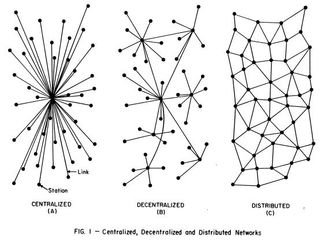
Thus is the legacy of information that spreads from a single source.  There are still those out there who believe, somehow, that knowledge or 'community' springs from a central source, and that we here in the world wait for that central source to speak.  That kind of network has been dead twelve years now, but there we are, mythologizing people I've never heard of ("Ryan Darcy") as though they are the founder of the internet role-playing community.

This is a pretty simple concept, but we're still denying its existence


I don't doubt that Mr. Darcy was there early.  I confess I wasn't that interested in online RPG discussions.  In 1999 I had discovered that all the porn I could ever need or want was available free, and that there were sex partners who were willing to explore that porn with me through ICQ.  So, really, between 1999 and 2002, when I found a quite demented permanent partner, I was quite busy.

Then, as I remember, between 2002 and 2007, I was discovering how the internet could get me all the freelance writing gigs I could reasonably keep up with, as well as a great job with a business magazine, not to mention the hard mapmaking data that I had been looking for all my life and wikipedia to back that mapmaking data up.  So, during those years, when I searched the net for the purpose of role-playing, it was for design information.  Yes, yes, I appreciate that Mr. Darcy - whoever the hell he is - was inventing the social network we have today, with something call "Open Gaming Lisc" (again, something I've never heard of), I was mostly still working hard on my own game, resourcing the hell out of the net to make it happen.

I came across my first blog in 2004, political of course, so there were a lot of flame wars in those days. I didn't see a D&D blog until December 2007 . . . but somehow, I think, that once blogs had been invented, it didn't matter a pig in a poke what the hell Mr. Darcy had done. People would have started blogs about the game without being told to do so.  And they would have started selling their stuff through those blogs without needing the WOTC to circumvent.  Because, frankly, we love this game, and we don't need other people to suggest we should write about it.

We do not do this thing because it is permitted.

Oh, I can only find two google results for "Open Gaming Lisc," and one of them includes this comment from a John Prescott, "This is the same song and dance that the gaming industry heads spat about when WOTC (Wizards of the Coast) did the open gaming lisc for their d20 gaming system rule set. The fodder will eventually sink down to the dregs. Nothing to see here, except maybe someone who is upset that his publisher is getting a way bigger cut on his ebook sales than he is, and that blame lies with the author, not the industry or the business model."
I love it when someone makes a completely off-the-wall reference to me and when I go look for it, I find disparagement.  Ah, legacy.

Some of you, no doubt, will rush to tell me that the open game lisc was that effort by the WOTC to make pdfs available to gamers.  I vaguely remember something about that, and about the WOTC clawing it back.  I'm only guessing here, because there are literally only two references to the three words and the other one is a vague argument about LOTR and Greyhawk.  I could probably do more research, but frankly I just don't give a shit.  Where it comes to free materials about role-playing, I never went to the WOTC, I went to frostwire, which cured me of wanting to see WOTC materials even for free.  Because, seriously, its all just a lot of unmitigated crap.  The idea that role-playing relies on such crap for its 'relevance' is once more the old myth that the existing network is centrally processed.

That central processor died a long, long time ago.  It serves one purpose on the internet, and that purpose is spam.  This is the legacy the WOTC has for me . . . I'm just enough of a presence that they send me spam every couple of weeks.  They obviously don't read my blog, or have any idea what I stand for, but the spam keeps coming.  Yay, legacy.

I can guess at the reason why people are worried, however, despite the evidence and that amount of material available for piracy, comes from a certainty that children are all about the video game.  The video game will kill role-playing, so they say.  How can pencil and paper compete with rendering on that level.

Well, it can't.  But role-playing, thankfully, isn't limited to pen-and-paper.  Nor is it limited to hygeine-challenged manboys clutching their miniatures in their big, mountain-dew-derived fist fat.  Role-playing is as adaptable as any other social framework one might name, which is evident by the number of skype games going on, the use of distributed networks to create game clubs, the practicality of my writing this blog and so on.  The tools are - slowly - being created to advance the game's rendering, too.  Because that's the way it goes.

Not by WOTC, of course.  At a time when the owner of the game should be creating a 3-D advanced app for digitally representing your character, with additional features to show the damage they're taking, based fully on your stats list - at a visual level that would put Sims 3 to shame - they're reinventing pencil-and-paper D&D.  Now.  In this decade.

One of the worst habits that an artist can acquire is the certainty that something needs to be done again, and again, to get it 'right.'  I feel there's a certain rationale in this, but the process can utterly stagnate an artist's work.  They can find themselves going back to the same thing and doing it over and over, ultimately losing their perspective entirely.  It is a habit that will ensure a good artist never receives any recognition.  Because it cripples.

The WOTC is crippled.  It has been crippled since it gave up on 2nd Edition.  I can personally see the rationale for 2nd Edition, but they did such a crappy job at it that  since the WOTC has been caught up its own loop.  It has lost it's perpective.

Though it may have dragged down tens of thousands of players, er, tools, suckers and non-smart people, however, it hasn't dragged down this game.  This game is being shared like wildfire.  This game is proving the central processor is dead.  The only people who are still turning back to the central processor, hoping there's still life there, are those for whom there never was a game.  Not really. These are the people who were just looking for a fetish god to worship.

Well, god is dead.  Deal with that legacy.


Wednesday, May 21, 2014

Made for Drones

Over the next six months or so, I do not intend to talk about 5th edition.  The reader may feel confident that this blog is a Next-free zone.  I do have two players who have given me some idea of what's being offered there - it sounds to me as if WOTC has realized that it's had it's head up it's ass for about fifteen years . . . and in an effort to fix it, they've decided to put their foot up there too, in order to have it wedged between their teeth.

I got some spam from the WOTC the other day, regarding some dumb series they have going.  I jumped right back at them and spammed them about my book of essays.  Where upon a real person thanked me for the information.  So perhaps I should stop ganking the WOTC?

Nah, not yet.  I have this bizarre dream - can't really call it a fantasy - where the WOTC discovers my book How to Run, then my blog, then the content rules on my blog, and they offer me a job.  That would be funny.  Me, working for the WOTC.  I think I'd have to tell them the deal would include Mike Mearls being given his walking papers.  Chris Perkins can stay, I think - I want to see how fast I can make him hate me, and then how long after that it will take to make him a spitting, squalling infant.  I'm guessing I can do both in less than four minutes, fourteen seconds.

I cannot begin to express how much raw, unbridled hatred I have for the corporate end of this hobby. I have no real problem with people who want to work to produce products and make some money; no one is going to get rich doing this, me included, so it's just a way of getting the word out there. Nope, what I despise is the process by which we take things that work, that perform the service needed, then rehash them under the label 'improvement,' when all we've done is complicate the re-training process.  Don't like 4e?  Well, there are only about 2,000 different kinds of role-playing games on the market.  Oh wait, a bunch of fucks in an office that don't really play have released a new version.  Let's talk about that for six months.

I say that they don't really play because really, they don't.  If you think they do, then you haven't any personal relationship with the corporate world.  Managers in the corporate world do not have 'lives.'  They have spurts of non-corporate interaction with fellow humans during which they talk about their difficulties working for corporate goals, while trying to figure out how to make the few hours of their non-corporate existence more corporate-purposed.  For example, a corporate person will spend four hours on their weekend cleaning the side of a highway because it means they can wear a corporate shirt, participate with other corporate volunteers, film it, then employ that footage to make others feel guilty for not spending more of their time working towards corporate aims.

The bullshit, non-complicated one-night adventure RPG ideal is perfect for corporate types.  They can be seen to 'play,' this can be filmed, it's only a very minor distraction from their primary motivations and it can be done with pre-made packaged crap that, in turn, sells the pre-made packaged crap WHILE playing.  It is corporate perfect.

Fundamentally, you are playing a version of the game that has been designed for a corporate drone. How does that make you feel?


Wednesday, February 26, 2014

Spoiled Rotten

John, who posts as jbeltman, added this comment to my work blog yesterday, leaving me to wonder if we have learned anything at all:

"What, fighters get no love? You mention clerics, magic users, etc but not the other classes. Was that just an oversight or are you restricting sages to these classes? I would prefer leaving the areas open to any class so that players can have any character concept they like. Like fighters who know about monster biology or famous arms and armour, or cultures and their military tactics, or art, science or poetry (think renaissance dandy or samurai poet), or religion and they love debating it; or thieves who know all about art and how much it is worth, or locks and mechanical devices."

Now, John's a good fellow, I have no wish to disparage the comment.  He is, after all, arguing for democracy, and the principle of enabling players to participate as they like.  It's noble, really.

Only, we went down this path, didn't we?  This was the sentiment that began somewhere in the early 80s and gained steam through national conventions and people who wanted to listen to players complain that thier characters weren't as powerful as mages and ... well, mages, and how we had to throw open the doors and embrace skills, not classes, because skills were more individual and friendly, and everyone could be the character they wanted to be, not the characters they were forced to be.  Yay.  Because the game is really about how I measure up to other people, it's about how important I am, and about how my personal needs to express myself need to be incorporated right into the game, for the good of everyone!  Because we know, when I get what I need, that makes me feel special, then that is always good for everyone.  That's why everyone needs to get what they need, so that I can too.

And so on until 4e spills squalling out of its mother's uterus, fully deformed and quite literally 'bloodied.'

So why didn't democracy work?  Well, to begin with, we began a system with skills that weren't all exactly the same value, so that power players quickly learned what were the strongest skills for the least cost.  RPG character construction follows exactly the same principles as Wall Street in that regard, or any other system in which the biggest rewards are given to those prepared to be the biggest, least morally compassed dicks.  This then left everyone else at the table as weaker than the biggest dicks playing, so to compensate they had to take the power options too, so that everyone's individuality ultimately became "the perfect path to sheeplehood" ... a process that was honed and refined right up through all the lovely 3.5 days.

This was then improved upon by getting rid of every skill or power that wasn't ridiculously powerful, then reducing everything in the game to meaningless proportions by giving beggars and little children living on the streets upwards of 200 hit points, and really tough monsters thousands of hit points, what with surges and special healing features and wands and god-given special compensations, until a battle between two ordinary citizens having a disagreement over bread prices could take all evening to play to its bloodied conclusion (all conclusions are necessarily bloody now, because bloody is a nice word, it works as a verb and a noun and an adverb and an adjective and ... heh heh heh, bloody - now you say it).

In reality, it isn't the expression of individuality that matters, that's just an euphemism for "When do I get what's coming to ME?"  John's comment above only seems to be about nobility and players liking things and having character development about samurai's loving poetry and so on.  The reality is that we see a rule like the one I proposed yesterday and a big part of our consciousness rushes towards the players in our campaign (because John was legitimately thinking about his players) suddenly moaning and complaining that the casters were getting all the pie, that the fighters and thieves and so on were getting shafted again, poor bloody fighters and their endless misery, standing in the rain and staring into the library at the mages and clerics having a great raucous time shouting phrases out of books and shimmying around in the glory of their superior knowledge.  Have I no love for fighters? John asks.  Hell no.  Freaking brain-dead meat-shields, I hope they get a sword stuck through their middles, spilling their weak-ass crybaby intestines so they spread like a carpet for the beautiful people to walk on.

For forty years players have been pounding their chests and simpering about what their character hasn't got, what their character needs to be happy, how unfair the game system and the world is to their character, blah blah blah, and for forty years the game industry has bent over backwards in absurd ways to compensate for what amounts to a shit load of poor moral fibre and the rectitude of a rectum.  This one cry and the service of it has irrevocably split the players into defensive clans, it has spoiled the continuity of the game, it has damned development, and it has now wasted two whole generations of children.  And still, there is the cry, there is the damnation of any system that says, for the sake of creating individuality, some characters can do this, while some characters can't.

Never mind that this is true for every class.  Never mind that the player can choose which class to play, or that options exist for a player to have more than one class at a time, so that the player can be a samurai poet (monk/bard) or a biology studying swordsman (fighter/druid) or a thief that knows about locks (um ... that would be just 'thief' - locking making is a secondary skill, not a field of knowledge).  The point isn't that the player CAN be those things, the point is that the player has a right to be those things in the way the player wants to be those things.  They want everything personally tailored for their personal satisfaction and their personal need, or else the thing is abusive, unloving, immoral, unacceptable and ultimately proof of poor game design.

And then everyone else, wanting no one to feel abused, answers "Yes, yes, you're right, I'm sorry, I'll redesign the game until you're happy. Okay, Veruca?  Okay?  Daddy loves you, yes he does!  And he will buy you squirrel, any squirrel you want ..."


Tuesday, January 28, 2014

Soulless

There's been a few topics that have leaped to my mind lately; this one is the beginning of deeper, more involved discussion which I'm only beginning to get a handle on. Allow me to explain some of the background.

I have two players in an offline campaign who began playing in my world about 24 months ago, after admitting that they hadn't had much of a chance to play 'real' D&D. They had played a lot of DDO, they're both professional people, highly educated and self-motivated; but somehow the whole D&D thing hadn't caught onto their imagination until they were in the 30s.

At first, there was a fair bit of discussion about what a real game could offer that DDO could not, which I was able to amply prove after a few sessions in my world. Being a serious world, they liked the depth and the unexpected elements that I could bring into play, which obviously no present-day program bothers to incorporate, as they are fundamentally geared towards 'winning' - ie., upgrading. I was able to show gameplay where upgrading was not the whole story.

They naturally hungered for more gaming than I had time to offer, and so they pursued that through the main resource in this town, a place call the Sentry Box, which has been selling games since 1979, and which I have mentioned from time to time. My players got involved in a game night set up, which was the reason I found myself going along with them to play 4e back in December. They invited me, and I took advantage. Since, they've been playing 4e every Wednesday night, typically 2-3 hour sessions. They play in my world every four weeks, for about 5-7 hours a session (we went 9 this past Saturday, until 3 am, which is very rare for me). All in all, they're getting more 4e time overall.

Now, I said this to them this past Saturday, but I don't know what they'll think about me posting this - so I want to emphasize, very strongly, that being relatively new to the role-playing game, my feelings are they don't know what is happening. But having played this game for decades, I can see it clearly.

4e is beginning to screw with their heads.

I don't mean in the sense that they think its a better game (they don't, really) or that they're just becoming familiar with another system that doesn't work in my intrinsically-modified AD&D system, and that the systems don't work the same. No, I mean that the way 4e compels the player to think is damaging the role-play conceptions they have of reality.

I'll give an example that is not the example that came up in my campaign on Saturday (sorry, that one is buried, get used to disappointment). In most games, fantasy, space opera, what have you, an attack is an 'attack.' That is, the attack is a deliberately imprecise mechanistic concept that the brain relates to by having to fill in the gaps of what is happening. I 'hit' with a sword, or I 'swing' my sword. What am I doing, exactly? Not specified. But in my mind I imagine slamming away with the object as hard, as fast, as desperately or acutely as possible, to drive through the enemy's defenses as best I can. I think of it as a human-driven action that derives from my imagination of the event. The die simply tells me if I was successful. But I don't think in terms of beating the die - I think in terms of swinging an actual sword. Because I am making believe in that specific way.

But 4e delineates everything to a flourishing move that has a descriptive narrative that the user must try to adhere his mind to, in order to accomplish the move, which really comes down to casting a magic spell with a sword. It removes the sensation of what's being done, typically with a description that is NOT easily reconcialable with normal behavior. If you and I were to get into a random street fight, this instant, with fence posts we snapped up from the ground, we would swing them and try to hit each other. That is the language we would use in our minds, and in telling the story afterwards, because that is how we conceive of those actions. We would NOT be thinking, "Aha! Now is the time for Full Discipline!"

To digress a bit, I think some of the 4e reasoning arose out of the Princess Bride, which I must explain was a book LONG before it was a movie, and while I like the movie reasonably well, the movie is absolute total shit compared to the book. Hm. Try this. If the book was you having spectacular sex with the woman of your dreams on a warm, empty beach facing the Caribbean Sea while a pitcher of mohitos sat a little up the beach waiting to be had when you're done, the movie would be paying two apes to enact the same scene, ending with pouring the mohitos over themselves and then eating sand. There'd be a similarity there, somewhere, but the experience wouldn't be the same.

That whole bit in the movie where the Man in Black and Inigo are discussing Bonetti's Defense and Capo Ferro was invented by William Goldman in the book ... and done only about ten thousand times better. I think that the people who inventd 4e loved that idea, that swordplay could have names attached to it, and they went whole hog on the idea. The only thing is, Goldman had been writing for films for some time (he wrote Butch Cassidy and the Sundance Kid, The Stepford Wives, All the President's Men, Marathon Man and A Bridge Too Far, explaining why you've never heard of him). He was making a joke (the book is a satire) about the bullshit moves that onstage/screen swordsmen use that makes it look like they're fighting, while not actually risking injury. In other words, he was trying to force the reader out of the idea that this sword play was real, by having the character Inigo learn each style as though it was the equivalent of getting a doctor's licence. It's subtle.

Getting back to the point, by pasting all these non-contextual phrasing on top of swinging a weapon and hitting with it, 4e succeeds in destroying much of the game's improvisational element. Players aren't able to conceive of what they're doing, they merely plug the baffle-gab techno-phasing into the event, which sounds cool, to produce the need to make die rolls that BECOME the purpose of the combat. The die rolls no longer stand in for what's happening ... what is actually happening is removed one step from the player and the die now becomes what the player is actually doing. I'm throwing dice. I'm not swinging my sword.

What this means is that the player loses the ability to superimpose his or her self into the situation. If I and my enemy are standing next to a puddle, and I say, I try to hit him with my sword so that he steps into the puddle, because I have a reason for it I don't want the DM to know, then I can think out of the box and argue my intent to do that. Ordinary D&D is open that way. But what the fuck, do I use a 'Tide of Iron' or a 'Reaping Strike'? As a DM, I can describe a combat anyway I wish, to get maximum value, I can say the player has cut the enemy's wrist and the enemy gamely goes on fighting, but with 4e I have to WAIT until the enemy is 'blooded.'

Ultimately, the word 'blooded' ceases to mean, the enemy has been cut, and begins to mean, "the enemy is past the post and rounding the backstretch for home." It's deliberately both inconsequential (for role-play) and undesirably precise (for combat measurement). It is like looking at the clock during a television show and figuring out how long it will take for the main character to get out of the fix he's in.

WORSE, it causes people who play a lot of 4e to treat all the aspects of ordinary D&D like mechanics. Too much 4e, and all the aspects of D&D become mechanistic in appearance - and application. So much so that over time, you're trying to make the character understand that they're in trouble, and all they're doing is measuring how many hits they can take with how much resource that's left vs. the enemy's combat potential. There is no thinking out of the box, because the box is rigid and set and vapid.

I'm watching it happen to two good characters, who are losing the sense of emotionally investing in the game.

I had never considered just how soulless the 4e option is.

Thursday, December 5, 2013

The Earth Still Orbits the Sun

Last night, I played my first game of 4th Edition. I journeyed down to a gaming club here in town, where they play pretty much ONLY 4th edition. The organizer told me that IF he gets enough people to fill a 3.5 table, he does, but they don't last long. He did not bring up the subject of earlier editions and neither did I.

I can't avoid a rant about the 'problems' with 4th Edition. Obviously, for the players of that system, there are no 'problems.' However, I have some observances that I'd like to discuss.

First of all, the thing that people most complain about, the dragging length of combat, was not so bad. Combat runs at the speed of an earlier-version D&D game played by floundering, inexperienced players ... except that of course these people supposedly know what's going on. It took me about ten minutes to understand at least all that my character could do, which as a 1st level thief wasn't much. A mage, I think, would have taken longer ... but all the characters seem to 'swing' like fighters. The same basic attack is performed in the same basic way from round to round - only the number of persons it affects, the damage it does, or the number of times one attacks seems to change. I found that aspect deathly dull.

As I did the process of doing damage. It is RARE that a character does not do damage in a given round, heaps of damage by early D&D standards, and the damage makes very little difference, like giving someone a firehose, letting them get a sense of the power of it, then asking them to extinguish a volcano. Little halfling thief that I was, I did 62 damage over five rounds and the total effect of all that damage was ... nothing. At least, there was no indication that the damage had any effect. I have forgotten what its like to play a system where a combatant with 1 hit point and a combatant with 100 hit points has exactly the same combat effectiveness.

The attitude of the players around the table, and the combat itself, reminded me FAR more of Panzerblitz or Squad Leader than role-playing. Perhaps Axis & Allies would be more apt ... because movement was treated VERY imprecisely, by a DM who was clearly worried about the length of the rounds. There was something about the running around and the total lack of movement adjustment to attacks that reminded me of Calvin Ball. No one seemed to mind; I certainly did not give any indication that I did. Everyone was pleased with my participation and encouraged me to return.

I have a little insight now as to why my combat system does seem a little ... hm ... restrictive. I argue that you can either run or fight, but there isn't time to do both. I argue that the process of generating enough power to create a lightning bolt, meteor storm or even an unseen servant actually requires time. I argue that being hit has, well, an effect. And I argue that one hit point of damage ought to have some actual meaning.

Very out of step, isn't it?

There were other reasons I was bored during the game, but all of that had to do with the actual nature and experience of the DM. It was particularly humourous when, as the battle went on and on, the bad luck of the party and the plainly superior powers of the monsters was deeply out of synch, and we were all going to die (it does eventually happen, but it's like the taxi you called at dinner showing up at your door after you've given up, taken the bus, come back and dressed for bed).

As he rolled dice behind a screen, I could watch the sequence of expressions cross his face, from oh damn I've hit again ... to I better tell them that it doesn't ... to smile or they'll think something's wrong before saying, "Miss." I wish I could say I was the only one at the table who saw it, but when the players discussed the game at the bar afterwards, sans DM, the fact of it was discussed.

The great observation made by the cleric was, "Well, we knew it was stupid and obviously he was lying, but hey, we're players, right?"

Yes, that's right. That's exactly what I expect players to do.

Nothing has changed. DM's still sadly concoct irrationally tough encounters and then guiltily adjust their die rolls behind screens. The Earth still orbits the Sun.

There was a table of people playing 'D&D Next,' but I didn't get the opportunity to observe. I'm not sure I'm inclined anyway. After a long time of staying away from DM's without gamespaces, sitting in uncomfortable chairs, in a venue without any amenity that dispenses food or drink, I'm quite content to make it another long departure.

Wednesday, October 30, 2013

The Pretense of Simplicity

Criticism is not persecution.

The western culture has a tendency to treat everything that disagrees with individual taste as a 'persecution' of that taste - as if an argument, "X is bad" is obviously equal to "Everyone who does X is a reprehensible criminal who should be shot and killed at sunrise." This is a very Western attitude. It spawns from the cultural bias of several cultures that arose in the 15th and 16th centuries who were being persecuted, who then took every resistance to their extreme. It has also proven to be a great way to spin media, as people in this culture are more afraid of words than ideas ... and a word like 'persecuted' is a beauty. It conjures such lovely, abusive images, such templates of vile hatred and irrational, cold destruction, that it serves to sober an otherwise narcoleptic reader, causing them to sit up and take notice.

But persecution is not criticism.

Persecution is a systematic mistreatment of a specific individual or group, based upon the infliction of suffering, harassment, isolation and imprisonment. It is the spreading of fear for the purpose of imposing one's own will upon all those who listen. Persecution is produced by fear mixed with a desire for power.

Criticism is a corrective exercise. It is an effort not merely to find fault, but to suggest room for improvement, with the expectation that persons will accept and understand that growth and re-invention are key.

Often, criticism will seem abusive. Yesterday, on this blog, I wrote a post that was as creatively vindictive as I could manage. I wrote that playing the Red Box set was equivalent to playing a children's game. I presented that point with derision and mocking. I did so in order to juxtapose my perception of the Red Box set with the praise for same, in order to instigate a dialogue. I have no intention to systematically abuse those who play the Red Box set, nor to inflict further harassment, nor to spread any fear about playing with that system.

I do wish to wake people up as to what's possible. I do wish to compel the gentle readers of this blog to recognize that the adoption of a simplistic version of D&D will do nothing to advance your value nor your potential as a DM. This blog exists in order to spread knowledge, ideas and a philosophy of D&D. The Red Box set is anathema to that philosophy.

I read quite often that the more complicated versions of D&D - including 2.0, 3.0/3.5 and 4.0 - are difficult, confusing, labyrinthine and counteractive to ease of play. Yes, they are difficult. Yes, initially, they can be confusing. It is true that, to an uninitiated reader, or a reader who refuses to initiate themselves, the various books and rules can seem labyrinthine. But it is NOT true that these things undermine the ease or the practicality of playing the game. To demonstrate this, I will produce a metaphor.

Sie trinkt deinen Apfelsaft.

The above is German. And 46 days ago, I would have had no idea what the hell that meant. None at all. And yet, somehow, it is possible to learn the language. It is possible for anyone to learn it. Two things are necessary: the will and the means.

I have wanted to learn German for a long time, and recently someone produced the means. A means which happened to coincide with my will. And here is the result:


I am quite proud of this achievement.  The little flame symbol on the right with the 46 beside it represents the number of consecutive days that I have completed a lesson or practice sequence in the Duolingo system.  I discovered this system on my birthday, September 15th, and I have not missed a single day since. Today is the 46th day since my birthday, inclusive of my birthday.

I would not say I am finding German to be easy. I am crap at languages, I have always been crap at languages, and it has taken some will to dig in and adapt myself to the system. Duolingo teaches language the way it is taught to children. There are no lists of masculine, feminine or neuter nouns. There is no memorization or explanation of irregular verbs, or irregular pronouns. The language is learned by reading it and reproducing it, until one simply recognizes that it is "das Pferd" and not "die Pferd." For me personally, determiners in particular are frustrating as hell. But it doesn't matter. I'm not in a class, where a Prof is impatient with my progress. I'm not working with a program that insists I learn at a pre-arranged speed. I have all the time I like to practice whatever aspect of the language that I like, for as long as I like, and I comfort myself with the knowledge that German children have years and years to learn the language. There's no reason I should expect to produce miracles of knowledge in six weeks.

And still, I know a surprising amount of German now.

Is German difficult? Fucking A. It is confusing and labyrinthine? For me, so far, it sure gawddamn is. Is German ultimately counteractive to ease of communication?

Well obviously not. Germans have no more trouble communicating with one another than the reader does in this language.

COMPLEXITY does not equal impracticality.

In fact, I'd like to argue that in far more ways than I need to describe, complexity improves practicality.

This system that I am using right now, this collection of language, requires a considerable comprehension of words and ideas in order for it to work effectively ... and it took both the writer and the reader a couple of lifetimes to get to the point where what I say strikes home in a particular way. Striking home is the important element here. In order to do it, the requirement is that we BOTH understand what the rules are. We must both understand the meaning of every ... single ... word ... and we must both understand them in the exact ... same ... way. Otherwise it is impossible to get the sense of what I'm saying.

It's not enough that the words that have been created cover just the simple basics of life. The 172 words in German that I've learned thus far won't do! 10,000 words won't do. They won't let me understand Goethe and Nietsche, they won't let me discuss medicine, politics and history - hell, they wouldn't be enough to allow me to discuss the manufacture of coffee. To precisely explain anything, I need all the words I can manage ... and my comprehension and value in the world depends both upon my ability to use those words and my ability to understand someone else using them.

DMs like the Red Box set because it is easy to run ... but it fails in so many regards. It has no rules for any of the things a party might want to do OUTSIDE the precepts of the simplistic game. If I want to establish a fortification, tax peasants, find some bitches, have one of them give birth, raise a child, determine its stats at age 9, train that child, create a treaty with another state by which my child and the stateman's child marry, expand trade, expand the intellectual comprehension of my citizens, plant crops, shear sheep, suffer the weather, sail a boat, drive a dog team, improve my nutrition, avoid disease, etc., etc., THERE ARE NO RULES.

This means that, over and over, any time I get 'weird' in the game, I must return again and again to the defacto judgement of one person, the DM, who has already made it clear that he or she would rather run a simple game by using simple rules. How can I expect to have an impartial decision made by such a person, about something that person hasn't bothered to consider might be important?

I can't. The decision won't be impartial. It will be guided by an individual who has selfishly chosen his or her system for no other reason than that it is simple, and therefore not a lot of work. Using the argument that their "choice" is as reasonable as any other choice. Further supported by the fiction that "difficulty destroys play."

It's all bunk. It's laziness dressed up as libertarian self-righteousness. It's the sign of a BAD world, run by people for whom BAD is the standard, who expect you, the player, to conform to that standard because it conveniences them.

Dump it. Get into a better world. Run a better world. And let's stop pretending that this Pretense of Simplicity is anything more than pretense.

Tuesday, October 29, 2013

Snobbery

Just three days left in October...and to make it worse, I'm writing this on my deathbed.

Well, not really. I'm really just very unwell, as I have been off-and-on for three weeks now. It's a tendency, however, to exaggerate things, such as how sick we are, how tired we are, how difficult a thing is ... and so on.

I'm thinking in this case of all the people who proudly hail the "Red Box" set as though it is some genius work of simplicity, an example of D&D brilliantly reduced to its fundamental, important principles, with none of those unnecessary and troubling gray-area mechanics that make other more complicated editions so very, very UN-FUN.

I can recall the first time I saw the Red Box set. Now I have to get precise about what I mean when I say "red box" ... because there's the Red Box set released by Robert Moldvay (1977?) and the Red Box 'starter' set released in 1983. When I hear people say "red box" I have no idea which one they mean. But then, who the fuck can? It's a matter of great humour that the 'basic' game was re-released so many freaking times under the same name between 1977 and 1983, meaning that no two people today can really agree on what the red box set "is." At least when I mention the original DMG, there was only ONE DMG ... and even now, when I refer to it as I often do on this blog, no one that I know has ever mistaken my reference for the bullshit re-title that came out with 3.0-3.5.

But putting all that on a shelf.

Very well. I remember the first time I saw this Red Box set. It was at a gaming shop in downtown Calgary called 'Catch the Wind.' Just imagine, a gaming shop selling D&D that could afford to be in the downtown mall of a city of half a million (Calgary has a million now, but it was smaller then). Every gaming shop I've seen since was in some industrial park somewhere.

It's a rare gamer around now who remembers that place. Catch the Wind's primary business was in Kites - which is even odder for a downtown shop - but they had a wall that was dedicated to roleplaying games. I bought my Unearthed Arcana and my original Deities & Demigods there (the one with Melnibonean & Cthulhu myths ... but sadly my copy is long gone from this earth).

I was with friends when we saw the Red Box set. By then we had been playing AD&D for four years. I believe our general response was, "What the fuck is this?"

The Owner, who was a sort of grumpy hippie-like dude, thin with a bald head and beard, muttered that it was D&D for kids.

For KIDS.

That seemed pretty goddamn obvious to us. To begin with, there was that little label on the box that said, "For Ages 10 and Up" or something to that effect (this was 30 years ago), and that was always something they ONLY put on kiddie games. And when we soft-talked the owner into letting us open the box (in those days there was no tape, no plastic wrapping, you could just open shit), we stood at his counter for a few minutes laughing our goddamn asses off at what a bullshit simple-Simon game system it was supposed to be. I mean, seriously! Real players played AD&D with all the rulebooks we could get our hands on.

Hell, it used to be a sort of pride when I'd tromp off to run D&D, pull out my handful off hardcover books and let them drop, THUMP, on the table. It was a way of letting the players know, "Okay, this is fucking serious, and you better bet I know these rules cold - I have freaking memorized them."

D&D was serious to us. Players who vowed to progress their way to being DMs knew they were going to be held on account for knowing those damn books backwards and forwards and we all thought that was damn fine. Why should anyone be allowed to DM if they weren't going to prove they were committed to the ideal?

Over the next five or ten years, the Red Box set was around, sure. It was something someone's baby brother was using to play with his kid friends. It was always for sale at the Cons we went to and yes, now and then we met people who actually played the Red Box. But we just sort of looked down on those people as probably retarded or possessing of some other mental deficiency. It certainly never crossed our minds that anyone would actually preach the Red Box as some sort of superior thing. That was inconceivable.

I even remember one of those embarrassing moments when a relative gave me a copy of the Red Box set because they had "heard I liked Dungeons and Dragons." Major gift failure. I remember I read it all the way through and obtained absolutely not one idea from it.

By the late 90s I had pulled back from 'the community' in every respect. If I ran my world, it was almost solely with people who hadn't played for a very, very long time, or who had never played before. I did not play in anyone else's world. And that's how things were until I came across the on-line community of bloggers sometime around 2007. I'd say there was a 15 year gap in my social memory of the progression of D&D.

When, apparently, reading 400 pages of a text-book (the equivalent of D&D, Player's Handbook and Monster Manual) became so HARD that no one of any reasonable, ordinary willingness to run D&D would actually do it. I mean, seriously ... 400 pages? What the fuck? Am I taking a medical degree here? I thought this was supposed to be fun!

Sigh.

So now I converse with and compare notes with people who play the Red Box set with the understanding that I'm not supposed to look down on them. After all, it's not about the rules, it's about the imagination and the FUN. Nevermind that it would mean - were I ever to play in one of those games - that I'd have to rely almost entirely on the DM's Judgement anytime I wanted to do something that wasn't covered in the Mickey Mouse rules as written. I mean, its not like I have an imagination. It's not as if I'm going to butt heads with the DM every time my imagination includes things that aren't included in a 64-page booklet. It's not as though the DM isn't going to use the tiny size of that booklet to contain my imagination in a bottle. No, that would be inconceivable.

But let's be honest ... I am never going to play in a campaign run with a Red Box set. Even if I were at a Convention (I'd better be a paid speaker there, I don't know why the hell else I'd go ... except possibly to sell a DM's Book I may imaginably write some day), if a bunch of really, really excited people really, really wanted me to play, I'd have to tell them I'd rather pop up to my room, take a swim in the hotel pool, get Vodka'd in the hotel bar or, you know, sleep. Because I really just don't fucking care to play kiddie games.

There you have it. I'm a snob. It's a common failing with experts.

Friday, March 2, 2012

On Editions

Is there anyone left in the blogosphere still unclear on the fact that I don't play 1e, or any other edition of D&D?

I thought people could read.