Showing posts with label Gaming Culture. Show all posts

Saturday, June 20, 2026

The World is Too Big a Place

My recent post about the D&D-branded play community addressed the issue that I have long had with the proffered "game" proposed by the company. While sold as "wonderful, communal and magical," in reality I believe the latest version of the game is in fact not a very good product... but that it is made tolerable by a community that has embraced ideals of individualism, "me"-ism and a strong compulsion to feel recognised and not excluded... this last having a lot to do with general social feelings just now that the world has become too big for those who cannot place themselves rationally within the world's present-day internet-driven massiveness.

I've been thinking of late about the world I grew up in — but before I get into that, let me stress, as I have many times on this blog, that I am not a nostalgic person. I do not think the game that I ran in 1984 is better than the game I'm running now. I do not think that the world was a better place in 1976; I do not think that there were more opportunities for individuals to express themselves in the 1970s and 80s. I do not think the culture was "better"... though I will admit that it was more focused and less owned by a corporate elite. I am not interested in writing a post about the "good old days," because in fact I don't think those days were actually very "good." I believe that people say that because they don't adapt well, because they don't know how to make use of new things, because they taught themselves to be confused more easily than younger folks and because, let's face it, things were simpler. I just refuse to consider "simpler" to mean the same thing as "better."

Importantly, what matters here is that that other world was smaller. The number of those who might know of our existence was minimal, limited for the most part to first hand or second-hand sources. Others at school or in my work place might know me, or they might have heard of me, directly, as told by others... but that was all. Very, very few had any experience with actual "fame," either small or large. Politicians did not need to perform in a mass-media fashion because it was sufficient to go to one's riding or district, meet people on a street, shake their hands, talk with them, and feel personally connected. Some one might develop a "reputation," but this was largely only with people already known. When I played D&D, what happened at my table might to told directly to others by my players, or myself, but that was as far as it could conceivably go. Even attending a game con, the larger audience was fleeting, hardly impressive and no means existed by which a person could go to a third source to look me up, to see what others thought of me.

This is all obvious. I only feel the need to say it because no one ever does now.

Another writer might now decide this is the opportunity to talk about how this unlimited visibility is bad for us and soul-crushing, and the reason why everything sucks now, while decrying the loss of the personal or some other such rot. I'm not going to do that.

What's materially relevant is that the world I grew up in had two or three centuries to develop a structure that included a school, a shared workplace, a university-directed path towards careerism, meeting spaces, expectations about politicians, celebrities and the media... all of which, while reaching fruition at different times and with different impulses, did create a sort of structured, predictable world that enabled people to tell us, "you will get an education at school" or "if you improve yourself, you will get a good job." These were myths to some degree, but the result came up often enough that there remained a sentiment that it could be trusted.

Thus the individual growing up in that world could perceive the world, correct or not, as a navigable space; as a finite space. If I did not enjoy my time at one restaurant, I could leave the job and cross the street to be hired there, without someone having the power to look my name up on an internet and learn what my life had been before entering that new space. That limitation matters, not because it was better, but because it was, for the average human, comprehensible.

A finite world can be harsh, stupid, toxic, have its head up its ass... but it exists in a "bubble."  The concept of a bubble became the rage in the 2000s not because it accurately described the average person's behaviour toward the internet — picking and choosing what they desired to believe or hear — but because it connected to the world that the pundits of that time understood best. We have ALWAYS lived in a bubble... but once upon a time, the bubble was something one had to earn. If you worked for the New York Times as a writer, you had to prove yourself to be there... and you had to prove yourself able to stay there. Now a promising youtuber can outproduce the best writer of the New York Times easily, not only in views, attention and popularity, but in volume and legitimacy. That is terrifying for those people who remember when there were kept gates. It is normal for those who do not care about such things.

But... there is a price to be paid to the "popularity" model... and it is the price that vast numbers of persons are paying now. In my younrger life, there was a thing called a "plugger." This was a person who did not have any special skills, any special value to a company, was not inventive or innovative... but they showed up for work day in and day out, they got along with everyone, they had nothing else particularly special in their lives but they did have the resolve to just keep plugging at a job. This often produced its own form of respect. Jimmy has been with this company for 42 years; no, he's not invented anything new, he's not all that clever, we could replace him with someone cheaper... but really, he's still here. Wow. That counts for something.

Unfortunately, it turned out that Jimmy was replaced with someone cheaper. And Jimmy doesn't have the capacity to do all that well in the present climate, where "plugging" will not get you attention on the internet, it will not increase your youtube views, it will not guarantee you a space with the company and, really, we don't care if you plug. What can you do? Hm? Anything?

Pluggers can exist in a finite world. But that world is gone. And unfortunately, there have always been more pluggers than stars. Thus we have the people who have followed the strategy recommended by the internet: post regularly, post often, just keep posting, just keep at it, just count on the future, just plug. But it isn't enough to plug. The 147th boring post is still just boring, it is still just getting 11 views. There isn't a future. The world is too big a place and Jimmy isn't competing with Hal and Mary and Tom for employee of the month. Jimmy is competing with every living soul with access to the internet.

The larger picture here is a conscious understanding that nearly everyone has now that we're very, very small in an amazingly vast and incomprehensibly sized universe. A very large slice of people cope with that by just not getting on the internet at all. Or limiting their contact with the internet to an anti-boredom machine. They don't have delusions of mattering. They don't imagine that something special is going to happen to them one day. They'd like to not be alone. They'd like to be among friends that make them feel important. Friends who want to give them something around a D&D table that it would be impossible to have online. Friends who will let them be a "star" for a few hours on a Saturday night, because the company tells them, "Forget the internet: your place to shine is which you cool new zumbla-raced character with its bahzit character class! You'll be special, you'll be unique, you'll have what the internet and the world cannot give you: relevance."

The corporation, even the pundits on youtube, are selling a very distinct image: that the D&D table can be a finite room where the players can matter because everyone present agrees that they do. All that's needed is to remove every obstacle to this goal: thus, rules can't exist, because that's a hump the players would have to climb over; limitations on action can't exist, because we're here to have fun, not prove anything; every imaginable form of character and self-definition has to be possible because THIS is the goal: to self-define to make oneself important. This is what D&D is selling, in the most analog way possible, because "collaborative" game table is becoming one of the last places where live human beings of the "loser" variety can gather together physically, in the flesh, to "become" more than they are.

It's all kind of... well, I'm sorry to say it, because it's mean and cruel, but it's kind of pathetic.

If, to feel self-important, to feel part of activity you're willing to partake in, you're prepared to give up everything except self-gratification, then you're... well... a child. You're a child who has felt so overwhelmed by the world you've been thrust into that your sole means of ego is to return to the sort of play-pretend games that children play, because they don't actually understand what they're pretending to be. They're thinking that being a doctor means dressing like one and having a stethescope. They're thinking that being a firefighter means having the right hat. They're doing the equivalent of pinning their brand new police officer's badge to their t-shirt and then wearing it proudly in front of their friends, as though this means anything except a piece of tin.

They're not actually perceiving themselves as real life adventurers, who have to overcome impossible odds to achieve unimaginable things, through courage, difficulty, dangers, possible loss of life... they don't want to experience anything even remotely close to those things. They can't even gather the courage to face those things imaginatively. No. What they want is the free badge, pinned to a shirt, so they can strut and pretend they've earned it.

While the company recognises that this impulse is an easier way to make money than to make a difficult-to-understand, but engaging product. The role-player in the present day doesn't want to be "engaged." They want to be empowered, and they want that empowerment to take a shape that the world cannot offer them: with an iron-clad guarantee that they matter.

The world has just become too big a place now for them to be adults inside it.

Wednesday, September 20, 2023

Session Zero

"Session zero" has become a popular term in the role-playing community.  The concept, unnamed, had always been a part of gaming.  The campaigns I ran in the 80s naturally began with the players making characters and a discussion of house rules.  The term itself, however, begins to turn up on the Forge in the mid-2000s, but for the rest of the net, it's common usage doesn't begin until after 2012.  When I wrote and published How to Run in 2014, the term was hardly front and centre in the culture, though of course there would be many individuals who can remember adopting the term twenty years ago.

Today the term is defacto canon for anyone wanting to run D&D.  Upon starting a campaign, I'm expected to introduce myself, talk a little about why I like to DM, then go around the table and have the players talk a little about themselves. Then I'm to provide an overview of the campaign — including, of course, the setting, the "lore," themes and any unique features or house rules.  The players ask questions.  Then we settle down to character creation ... and by the session zero bible, because these things have to be included in any description of the process ... this includes the characters manufacturing backstories.

Then, together, DM and players, openly discuss our expectations for the campaign.  During this phase, we're meant to talk about how much "roleplaying" is expected, what the combat encounters are going to be like and the sort of balancing mechanism we'll be using.  The players discuss how they'll work together as a group, and then as DM, I establish the campaign's "goals" and objectives, and importantly the "theme."  This establishes whether the game stresses heroism or not, exploration of the map, political intrigue, the prospects for character survival and such.  I'll then be outlining the primary quest for the players to pursue, before discussing potential sub-plots and character-specific objectives that I've created for the overall "story."  This helps the players personally invest in what's going to happen.

Next, we need to interrupt this discourse so we can have a frank discussion about "session safety and consent."  Now, I know this idea has been thrown around for a while, but it helps if we understand just what's meant by this.  We want to know what's expected for a DM ... after all, if I were to write How to Run again, I'd have to be sure and include this content.

Let's see ... yes, it's expected that I'll listen to player feedback, I've certainly argued for that.  There's this part about my not including any content that might make a player uncomfortable.  Sensitive topics may trigger a player.  Safety and consent are, after all, an ongoing process.  If a player wants to pause the game and request a change in the ongoing scene, rewinding, fast-forwarding, or changing the tone or outcome, they have the right to propose that script change.  Lines should be drawn to represent any content that's strictly off-limits, so that it won't be included in the game under ANY circumstances.  And in case there's a mis-understanding, every player has an "X"-card that they can lay down at any time, stopping play.  It's only fair and proper.

Shall we stop?  Because I can get into the details of all these things at length; there are posts all over the internet that express why it's responsible to address the game in just this manner.

I'm tempted to go through a step-by-step description of what happens after the ball is snapped in football, and the practicality of using cards to stop play as mass slams into mass, but in retrospect that's probably not helpful.  Take note of the dynamic above.  These are rules for managing strangers ... and in most cases, strangers with a minimal or narrow perception of the game, such as that played in game stores, where rules about loud chatter and overt body language hold sway.  Some of the enthusiasm that one or more of my players might express in a normal running — pacing around the table, hooting when something dies, shouting and waving their arms because their blood is up — that's not acceptable behaviour in a cramped public space full of five or six gaming tables.

I play with my friends and family.  I've sat with them at the hospital, I've helped them clean their apartments, and move, and looked after their plants and pets when they've left town.  We've had Christmas dinners together and birthdays at the bar and gone for hikes and days at the beach.  I don't need to introduce myself, or explain what my game is ... they all knew what it was months before they were allowed to join.  Does anyone here think that after being my daughter for 34 years, that she's going to put an X-card down and stop play?  Ridiculous.  A sarcastic comment, sure ... but if she had any problem with my DMing, she wouldn't use a card.  She'd speak her mind.  Like a grown-up.

These are helpful rules if we're unable to find anyone to play with on a regular basis except strangers.  In some way, perhaps I might have done better with the online campaigns I ran if I'd held the players' hands a little bit more ... if I'd take the time to carefully warn them that I was going to use "themes" equivalent to those found in any mainstream action film, thriller, horror or drama.  Or equivalent to the daily public news, where actual real life people die in hurricanes, are carved up with saws inside embassies, invade foreign countries with artillery and tanks, or lie constantly and unrelentingly if they think it'll help grift money or get elected.

I've always kind of assumed we're all living in this world.  The one with homeless people slowly dying on bad streets, where a shooting at the nearby mall took place in the last few months, where the price of things are going up relentlessly despite our human need to eat food or live under some kind of roof.  This is the world that I and my players occupy, together, every day.  I don't want to play with people who are so sheltered and weak that they can't stiffen their lip, act bravely and face every challenge they're given, no matter what it is.

I don't want to play with these people and I definitely wouldn't want to write a book that catered to these people's fragility, so they could bring themselves around to play D&D.

Yet were I to write a book on the subject today, I'd be expected to do so.  And I'd be called irresponsible if I refused.

On the surface, the session zero seems like a reasonable approach to introducing new players ... but much of the "introduction" is about making people feel comfortable, encouraged, supported, protected and safe.  The only people who need this are those who are easily threatened or made uncomfortable.  Anyone else, who has already chosen to BE comfortable of their own accord, who don't need encouragement to talk, who don't need support because they've already got it, who don't need protection, who don't feel unsafe ... is bound to find all the elements surrounding the session zero concept as something like a group therapy session.

We don't want to talk meet and greet, or about our characters or debate party mechanics or deliberate on the overall campaign, or discuss rules in case something gets out of hand ... we want to play.  That's why we're here.  We have a limited amount of time, we already know the game, we're not children, let's get started.  That's how quite a lot of us think.

Research session zero and you'll find the argument that it's "about creating an environment where all participants, regardless of their comfort level or experience, can engage in the game."

This is a bald-faced lie, because the rules DON'T say that.  The "goal of inclusivity" says that any one single person who has a problem can ruin everyone else's experience, at will.  It says that the right of any one person to be completely respected supercede the right of any other person in earshot to go ahead and play the "uncomfortable" scene that they don't find uncomfortable.

For those people who might want to argue with me that it's my responsibility to provide a good experience for anyone who might be a would-be participant, keep this in mind:  I'm not a game store or an official league.  I'm a person who plays a game in my home, which no one enters without my say-so.  I play with my friends.  I don't make friends with weak people.  I did when I was young and I learned that it's drama-drama-drama all the time.  I make friends with people who can carry their own baggage.  

Needing an environment that will care for you, or that you think ought to exist for other people, regardless of their comfort level or experience, sounds quite a lot like people who can't carry their own baggage.  People like that are hard to have around.  Emotionally, they're very needy.  You show up at their house to help them move their stuff, and find that they haven't packed anything or rented a truck for the day.  They're supposed to show up and help you move, and they don't.  You help them work on their resume and then they don't use it.  Or you get them a job at your office and they quit after a few weeks.  You're at the bar for your friend's birthday and invite them along, but then they get upset by something the bartender says and then its a three-hour pity-party about them, until someone has to leave the party for awhile to drive them home, because they don't feel "safe" taking a cab or using the bus.

I know, I know, this isn't what we're supposed to say ... but anyone who's reading this, who carries their own baggage at least most of the time, learns sometime in their 30s — especially if they have kids — that there just isn't room any more for the kind of inclusivity that seemed possible in high school.  You invite these people to play D&D, and for the whole night every has to put their game on pause for this one needy person.

Cruel as it all sounds, this is what we call straight-talk.  Those who need to feel included, who need support, who need attention, who need someone else to make them feel empowered, who need little cards, who need and need and need, should get a therapist.  I'm not a therapist.  I'm a DM.  You may think me an asshole, but since my baggage-carrying family don't think so, and I have plenty of players, and I don't need support or an X-card to give my opinion, I guess it really doesn't matter if other people think I'm also cruel.

I give plenty of support on this blog all the time.  People write me and I do my best to answer questions.  I think it's my responsibility to be open-minded and flexible, and to provide what benefits I can for my reader.  But this doesn't include telling me what I'm allowed to talk about, or what content to include in my game, or what's over the line, or even what information I'm obligated to give my players when we start playing.

Roll your characters.  You're in a small village on the French coast, about 60 miles south of Nantes.  You have no idea what might happen next.  There.  We've had our session zero.

_____

If you wish to comment, please write questions, ideas or opinions to alexiss1@telus.net and they will be posted on Saturdays.  Feel free to introduce new subjects or present your own work.

If you wish to make a donation to Patreon, it will be greatly appreciated and help with costs for illustrating the Streetvendor's Guide.

Thursday, October 6, 2022

The Death of the Splatbook

I shouldn't cackle, but the gifts just keep coming.

In Montreal, on the Rue St. Hubert, I had so-so luck with three D&D related shops within a block of one another ... although, to be honest, although there were role-playing products, and tables to play on, two of these were deeply involved in M the G far more than table-top RPGs.  Still, out of interest and market research, I spoke with the clerks in each.  Of course, there were no managers present.  Both spoke English adroitly and neither had any real knowledge of 5th Edition at all.  Pathfinder and 3rd were the preferred systems.  Moreover, neither had one clue about OneD&D ... they'd heard nothing about the company's announcement and didn't care, because both store clerks (and three customers) did not care what online said about role-playing.  For those interested, the stores were L'Expedition and Carta Magica.

This does much to restore my faith about things.  It was the sentiment I heard in the mid-20teens, and I'm glad to discover there's evidence that nothing has changed there.  These were game stores, in apparently game store central, whose business model did not include what people online said or thought.  What does that say?

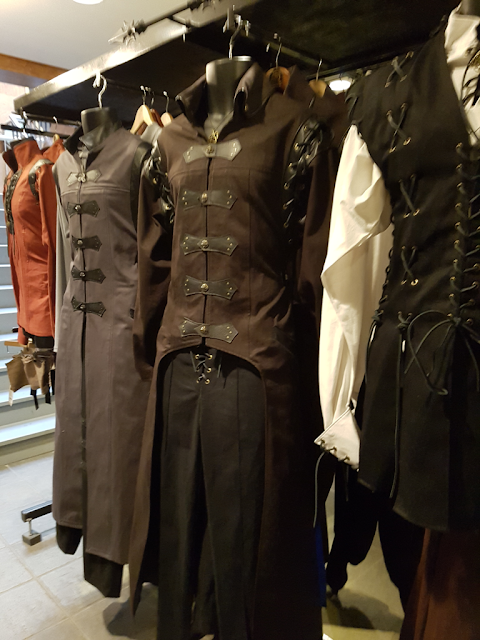
I barely spoke to the third store; it was a cosplay design store and very nice, and I must admit I'm beginning to regret not purchasing this monk robe they had, while I had it in hand.  I've been thinking of something I ought to wear when starting my adventures in game cons again (I'm in negotiations for a space in Vancouver in Feb 2023, but I'm having trouble getting the company to respond) ... and a monk or peasant robe would be suitable for a writer, I think.  I'll finish this post by putting up some pictures I took, plus a link to the website.

In other extraordinary news ... I already mentioned the decision by D&D's company to revert it's proposals for 1s and 20s and how this promises the beginning of a lot of grab-ass revisionment on the company's part.  Today's hilarity includes this headline about the company's proposed "Netflix-style" model ... which is a profound association, given that Netflix tanking just now, as other services steal away it's content.  Netflix is planning on adding commercials to their paid-for content.  Does that sound like a company you'd want your new business model associated with?

Chris Perkins wants us to know that OneD&D is "in" ... and thus my cackling, given the response I've gotten from my readers of late and those of the brief investigations I did in Montreal.  "In" clearly means "in trouble," though I doubt Perkins knows it.  The article fails to address the obvious choice of the company to impose a velvet rope on its website, though naturally that's not how it's being sold.  But then, you're not supposed to see the truth behind the lie.

Clearly, Tasha's stuffed book of nothing did not sell well, leaving the company with huge stockpiles of unsold books ... convincing the company that they had to get out of the publishing business and into the "netflix" business.  So, instead of buying a book full of useless shit, soon you'll be able to pay the company every month forever for the same useless shit ... because it doesn't occur to the company that maybe the reason Tasha didn't sell was because it merely provided the same dreck the company's been providing for years.  But no more of that!  Splatbooks are sooooo 2021.

What's also not mentioned in the article is the collection of writers, editors, copyreaders and other associated publishing staff being fired from their jobs to save the company money.  They're not needed ... and is that not better for the subscriber?  You bet it is!

I'm stunned that as late as this, the company thinks that their online presence is so depended upon that by choosing to monetise D&D this way, it will automatically succeed.  I see the faces of those clerks in Montreal and again, a cackle rises up through me.  This is going to be such a bad idea.

Which is good for me.  I did my own experiment with a velvet rope years ago, moving some of my content to another blog and continuing to write here ... and I got hurt in page views and credibility.  I watch others try the same thing and watch the same disaster play out.  Truth is, making people pay for something unseen is a tricky process.  They've got to be convinced there's something there; I don't believe there's a mainstream of enough people who believe that anything good produced by the company behind a rope won't be made available for pirating in a month or two.  There's no sense to paying up front.

As someone chipping away at a splatbook presently, one that is NOT just a rehash of other existing splatbooks, I appreciate the company clearing the road for me.  Less competition is the most I can ask for.  Thank you, Chris-fucking-Perkins.  It's the first time I've ever had reason to appreciate something you've done.

Speaking of people stepping forward to make better products than the company, I give you the Boutique Medievale Dracolite.  I asked the owner if I could take these pictures and he assented:


The two robes I had considered were the ones at the front on the left and the light brown on the end at the right.


Mouthwatering stuff to be sure.  I'd taken my menu to Montreal but I didn't have it on me when visiting this shop, and it had taken me $30 in a cab one-way to reach the place.  So I wasn't ready to rush back to the hotel and spend another $60 doing a second round trip.  But I think the menu would have fit very well into their stock.  Maybe if I find myself planning a trip again, I'll drop in and see if a deal can be made.

There is a lot of money to be made in D&D.  Pity the company is too stupid to realise how.

Friday, November 12, 2021

Of Little Account

"But Dungeons & Dragons is also a perfect illustration of how capitalism bends and deforms any artistic endeavours to its own ends, and how, whatever the specific details of the situation or the intentions of the people involved, the demand for profit will always subsume the desire for aesthetic value or artistic integrity. Just as television puts the goals of its creators behind the demands of advertisers, and movies are more answerable to accountants and marketers than to audiences and filmmakers, role-playing games bend the knee to owners who care more about the bottom line than the needs of play and story.

"Peterson notes early on that D&D was an unlikely success. Although Gygax left behind a comfortable living in insurance to pursue his gaming hobby, he likely never expected to make more than a modest income. A big reason why is that D&D was never actually meant to be a product. He wasn’t initially interested in selling the slick, glossy product line we see in bookstores today; he wanted to sell a set of rules, essentially guidelines for play that could easily be adopted and adapted to whatever scenario other hobbyists cared to cook up. He wanted this because that’s exactly what he had done as a game player and creator himself, folding J.R.R. Tolkien–style fantasy into his passion for wargaming."

 —  Leonard Pierce, 'Dungeons & Dragons' Is a Case Study in How Capitalism Kills Art


A gift like this doesn't arrive every day.  Err ... ahem ...

I told you so.

Which doesn't exempt the author from being wrong in many places throughout the article.  International copyright law doesn't work the way he thinks it does, or the way the WOTC pretends that it does ... but no professional writer wants to lift up that rock and free the creepy-crawlies inside.  And like most outsiders  and oh yes, this writer is definitely an "outsider" — he's forced to base his article upon public sources of knowledge, which is fair.  After all, he hasn't time to visit around to dozens of local non-league affiliated gaming clubs to learn what grassroots players think or do.  At least he acknowledges that homebrew campaigns still exist, even if he has to link stackexchange to prove it.  I rarely expect this much, so I suppose I'm grateful.

My position continues to be that capitalism doesn't actually "kill" D&D's artistic development.  This is ongoing, and will continue to be ongoing for as long as players and copies of the game are available.  The thudding malaise of the industry does smother improvement and innovation by giving a bullhorn to the stupidest, least imaginative participants (the non-productive 80%), catering to their needs and structurally building a public persona to match those expectations.  Yet we'd be hard pressed to locate an industry that doesn't do this.  The harder pill to swallow derives from the "productive" 20%, who are prone to climbing onto a cross whenever some beloved part of their game is threatened by legitimate improvement.  All the blame cannot be assigned to capitalism.  At least one part in five must be assigned to dogmatic quasi-encephalitic fundamentalism.

"Encephalitic"?  Encephalitis is an inflammation of the brain.  It makes a far better term to describe the online intellectual pollutant than "flame wars."  It's difficult to promote change and growth in an atmosphere fed by tetchy man-boys clinging to the few good memories they had before they were ten — namely, game modules written at a grade eleven reading level hoisted on pedestals formerly occupied by fantasy writers who are degraded now for the crime of not having been born in the "woke" 21st century.

But ... now I'm just taking pot shots at random.

My larger point is that the folderol surrounding capitalism and its billions, the "evil" that wins in the end, evaporates like a puff of smoke the moment some technologist invents something more interesting than Instagram.  Technology giveth billions and technology taketh away.  D&D's value is that it's not based upon a product or a gadget, but upon small groups of humans collaborating in real time, with a set of rules not dependent upon what a hipster or a company thinks.  The whole world does not sit at my gaming table; the whole world has no say in the kind of game I run.  I need the cooperation of just two to four other people ... a number that's far too small for a big company to design for, while being just the right size to commit whatever heinous acts personally suit our ilk.  It defies mass marketing by not depending on what the mass market needs or wants.  It defies influence by the rich.  It does not need a public voice to function, and unlike the "crafts industry," it does not need buyers or sellers.

It needs our friends.  And ONLY our friends.  The rest of the world and what it thinks, the hue and cry of lost artistic dreams and whatnot, the sad demise of the originators, the failing shark tank of present day family members squabbling over scraps, can all just fuck right off.  Because they're irrelevant; just as "the Christian gawd" is irrelevant to the kind of sex I had earlier today, despite 2000 years of trying to dictate how that's supposed to go for all of us.

Tuesday, January 14, 2020

Artistry

Being here is half the game.

I don't want to disparage the age we're living in.  I rather like it myself, being one who considers the "good old days" to be a time of creaky, backwards technology and social standards.  Often, I think back on memories of the world when I was pre-teen and such, and wonder how we managed with the terrible content on a black-and-white television, the lack of computers and the painstaking agony of having to record everything using pencil and paper.  I guess we had the 1950s to compare it to.  Admittedly, it did seem very modern at the time.

Still, while there's nothing wrong with today's culture, it nevertheless breeds habits that I find myself evaluating.  Right now, as I drag myself away from Oxygen Not Included and my latest downloads, I must confess I'm often a slave to the immediacy of convenient gratification.  Whereas once upon a time, I had to wait a week to see the next episode of something, or make a visit to a store to buy the complete set of, say, Band of Brothers, at any time today I simply have to conceive of the show, remember I haven't seen it in a decade and, there you are, all in my possession and ready to watch.  I call a company like Skip the Dishes to bring me food, I pause my game on Steam, I check my email to see if anyone loves me, then settle in to watch.  It is a nice world.

But while day after day passes with such marvelous comforts, intellectually and otherwise, I am reminded by the end of each day that hedonism such as this has its limitations.  When I will think back upon this year, five or ten years from now, I won't remember the steaming breaded chicken or the time I last watched Nix and Dick undermine David Schwimmer ... I will think about the posts I wrote on blogger or the other work I put together on my world.  I'll remember what I wrote, because this writing can't be served a la carte.  There's no one who can do it for me; which is why it is this particular comfort, this power to reach out and have others read me, that is truly the best part of living in 2020.  It is the things we do ourselves that is most gratifying.

Following yesterday's post, I felt I owed an explanation to you, my Gentle Readers.  Between episodes, and game play, while making dinner, taking a shower, enjoying a walk outside in the -37 C weather we're having today, I've been thinking about why I didn't quit D&D.  It is easy enough to say, "because I loved it," but that's only an evasion.  It doesn't say anything.  It doesn't explain why.  Or why I've given nearly 41 years to this game, instead of to something else.  Why, when I was done with school, and married, and had a daughter, didn't I think that my free time was gone?  Why didn't I put aside childish things?

To see D&D as a childish thing, I would have had to see writing as a childish thing.  Or acting.  Or that the musicians I knew were wasting their time, along with the poets, the artists, the dancers and the other performers I knew in the 80s and 90s.  I saw no difference between capturing a moment in fictional time through the medium of preparing and presenting a gaming session, and doing it in the shape of a novel, or rehearsing to present fiction on the stage.  And since I did those things in the company of people who were unrestrained about giving their lives to those arts, and prepared to die rather than give it up, it didn't seem strange that I had simply chosen another mode of expression.  True, drama offers the possibility of fame and wealth; and so does writing novels ... though not for most.  And those I knew who thought they were doing it to get rich were almost always the first to quit.  The rest of us kept at because, well, because.

That's still an evasion.  It's easier to give one, however, because sometimes with true love, it's difficult to dissect what's there without making an ugly mess of it.  But I'll try.

Of all the things I loved doing most as a kid ~ and here I mean, going back to when I first became conscious of being a person, when I was five or six ~ I would have to say that expressing myself was highest on the list.  I loved to be heard.  I read voraciously, both fiction and non-fiction; I soaked up films from the television whenever possible; and I asked questions of anyone who would give me an answer that wasn't "because."  [see?  I know an evasion when I hear one]  In turn, this gathering of information piled up in my head and ached to flow out on my tongue ... which it was not permitted to do nearly as often as would have pleased me, because I was kid and growing up in the early 70s when adults still said with a straight, un-ironic face that "children were meant to be seen and not heard."  Talk about why the good old days sucked.

By the time I was twelve, the log jam of having things to say broke and I began to write things down, effusively and all the time.  I didn't fall in love with writing because I loved words or because sentences are beautiful, descriptive images, but because I had a ton of shit to communicate and hey, that's why we invented words.  I'm still communicating, constantly, because I still have a great deal to say.  That is why this blog, and the other one, and the wiki, combine together to make such a prodigious pile [sometimes, some would say, a pile that steams ...].  Because I like to express my thoughts; I like to have my thoughts heard and read.  I like others to know what I'm thinking.  And so that I deserve to be heard, I like my thoughts to be things worth hearing.

D&D was a remarkable, unexpected medium that simply materialized one day, like a bomb dropping out of the sky and destroying my cathedral of thoughts.  The manner in which the game was realized, through talk, and bound by fixed limits, which were fuzzy because of the dice, took hold of a particular set of skills that had already infected my consciousness.  I had always been in love with maps and geography, and here was a game that applied that specific knowledge to worldbuilding.  I was quick-witted and creative, able to speak and think fast on my feet, and here was a game that rewarded those skills with role-play.  I was exhaustively and obsessively well-read in literature, science and history, and here was a game that drew on those subjects like a pump drawing water.  It was like I had been training for a decade so that at 15, I'd be ready to play.  I don't need one hand to count the number of times something similar to that has happened.

Once I got myself sorted, and began to understand the deeper aspects of the game, I flourished as a DM.  I loved the expressive power and complexity of imagination the game enabled.  And once I hit that time in my mid to late 20s that I described in the last post, when people began to fade away, there was no way I was giving that up.  No way.  Even then I was surrounded by people who said it was just a game and that it was childish, but I knew they were wrong.  A children's book can be childish, but that doesn't make every book so.  The way that most people played D&D then, and the way that most play it now, the game IS childish.  But not my game.  Not my world.  I don't believe that my D&D design is any more childish than George R.R. Martin's A Song of Ice and Fire, and frankly I think it is far less so ... and no one out there is saying that Martin should have put childish things aside and quit writing.  Entertainment is one of the most important things that humans do for one another; it is a gift.  Just as Band of Brothers was a gift, from those ready to take the time to write it, adapt it, perform it and make it ready for me to see it.

I don't understand those who cannot understand how essential art is to the health and wellbeing of others ... and how that effort can never be "just" anything.  Through D&D, I can express myself, and illicit emotional response from my players on levels that I can hardly dream of doing through direct writing.  Granted, I try the latter constantly; but with D&D, the shaping of thoughts, tension, elucidation and epiphany are far more profound and esoteric than what I've been able to do with words.  People remember moments in a game for years and years; they remember what they did, they remember what they felt.  They remember the experience as though it happened in their "real" lives ... which, of course, it did.  The monster and the treasure may have been fictional, but the breathless anticipation, the pain of dying or the shouts of joy, those were authentically real.

I will not give up an art form because others are too busy to appreciate art.


Friday, March 15, 2019

Just Do It Well

UPDATE:

noisms has written another post today, in which he says, after agreeing with me that the videos about worldbuilding are crap:
"But the takeaway message from this is not that there just needs to be better such advice. It's that the entire exercise is fundamentally flawed, being based on a misunderstanding of how to 'teach' worldbuilding."

So yeah ... there's that.

Also, the fellow quoted in the last post decided to proclaim on noisms' post about how seriously he takes any of this, to which noism replied with some spectacularly sage advice.


So there's that.

noisms thinks he's so ... so ... wait, I can't put my finger on it ...

You know that transference theory where you describe other people unresolved things from your past?

I think I'm noism's Dad.

Anyway, food for thought.  Was doing a little reading on the subject of contempt the other day and came across this:
Contempt can be useful to being a functioning member of the moral community. An ethics of contempt provides a much larger breadth of answers than other competing systems of ethics, whether they be based on ethics of actions (judging actions by their rightness or wrongness) or ethics of feelings (e.g., ethics of resentment). By feeling contempt for those things which are found to be unethical, immoral, or morally unsavory, one can both show that they are bad and remove them from the moral community.

Fundamentally, when I write what I write about noisms, I'm doing my best to clean up the moral gaming community as I see it.

And when noisms writes what he writes about me, he's doing the same.

The only difference is, noisms says,  "You should just do what works for you and your group."

That is, unless you're Alexis.

noisms also says, "I increasingly look on prescriptiveness as one of the worst of all evils."

That is, unless I'm prescribing behaviour about Alexis.

noisms is a hypocrite.

Friday, December 7, 2018

The Game Lost

Quoting from B/X Blackrazor's recent blog post, Kids on Bikes, in which JB says,
"The designers' choice was to deliberately shy away from anything sticky or messy or painful.  The first page is devoted to 'setting boundaries;' it is, in fact the first true part of play ... and while I'm a fan of Ron Edwards ... for a game of this type I find it all ... well, inappropriate.  A game of this type should be pushing boundaries, not setting them."

 A part of me reads this and wants to go on a tear about the infantilisation of human interaction and why none of us are ever supposed to let the big bad world invade our comfort zones when we get together with our friends to play a game.  Supportive of that, I could probably pull together some films or books, aimed at either children or adults, where those subjects are brought up and dealt with, whereas in games we're still looking an interpretation of reality as close to the bone as Carcasonne's management of land in 14th century France.  Say it with me now: not at all.

But I have to grant that games in our culture are definitely not treated as art, or made to constructively address issues.  Artworks can afford to be unpopular.  A film can be seen by a few hundred or a few thousand people and still be a meaningful work.  Artworks only need attention.  Games need a culture ... without that, they are unsuited for anything but the trashbin.  Is it any wonder that a game company will do anything to avoid risking that culture by drumming up a subject that will make players uncomfortable?

That was not a problem in pre-PC culture D&D, which despite the efforts to flag game situations and discourage squicky subjects like sex (which is only a participation sport for everyone on the planet) possesses a legacy that won't be entirely quashed.  Naturally, we expect to see things like this turn up, where the game play culture being created contains expectations that as a DM you will "lead by example" and "model the behavior" of your game players:
“I’d like your help. Your help to make this game fun for everyone. If anything makes anyone uncomfortable in any way… [ draw X on an index card ] …just lift this card up, or simply tap it [ place card at the center of the table ]. You don’t have to explain why. It doesn't matter why. When we lift or tap this card, we simply edit out anything X-Carded. And if there is ever an issue, anyone can call for a break and we can talk privately. I know it sounds funny but it will help us play amazing games together and usually I’m the one who uses the X card to protect myself from all of you! Please help make this game fun for everyone. Thank you!"

It's easy to laugh at this because the roots of D&D were firmly established long before "the organizers" arrived.  The original game ideal and context was established in thousands of articles and hundreds of games ~ any kid, anywhere, raised in an environment with x-cards, can one day stumble across a Dragon magazine or a copy of Tomb of Horrors and realize suddenly that randomly killing everything and anything, including murdering prostitutes, was a socially functional experience for tens of thousands of players.  It didn't bother us.  It wasn't any more real than the massacre of whole armies in RISK or Axis and Allies.

For a modern game manufacturer, however, faced with a strike force of helicopter parents descending on game stores to help little Billy and Jody play D&D ~ or any other game ~ not having some standard in place is a terrifying prospect.  When we played in the 70s and early 80s, we were ignored by our parents; they didn't give a shit what we did in the kitchen Friday night as long as we were quiet enough we didn't spoil their Friday night TV line-up.  Hell, they'd go out to see a movie and leave a bunch of us 15-year-old prostitute slayers the run of the house.  Gamestore owners were trolls who rented storefronts that no one else would rent, badly lit and heated buildings with brick facing in rundown neighborhoods.  No parent ever entered a place like that.  If a gamestore ran a game night, no parent ever knew about it.  My friends Asif and Scott and John sure as hell weren't going to tell them.  Come 13, our goal in life was to find places to escape our parents ... we did not invite them to come along.

What here needs an x-card?
We appreciate that we're no longer in the grips of the Satanic Panic (and here's a great video talking about how it affected way more than role-playing games), but nowadays the game culture faces something much, much worse: parents.  Bereft of any guideline to properly prepare their children to face the real world, parents are desperately looking for any bubble-wrap that will protect their darling dearies against the terrible, awful real world.  My gawd, we can't have our precious dearest upset by things like bodily fluids, injuries and poverty in a role-playing setting!  Oh... My... Gawd.  We can't have ... yelling ... at a game.  We can't discuss disease, or dogs put in danger, or sharp objects or ~ heaven bless me ~ going to the bathroom [shudder] infecting a game my child is going to play!  I want my treasured Billy-boy to know he only has to reach out his tiny finger and touch a little safe card on the table to make sure all that ickyness goes away.  At once!  Only then can I breathe, knowing my Billy is safe.

Inventors of this nonsense are seizing opportunities to impose themselves in the place that religious nutjobs held in the 80s; the chance to spread fear that the game will damage the fragile little brains of children and that the children ~ and adults who are just as fragile ~ from these ideas that need not to exist in what some imagine game culture should be.  Games, if you'll excuse the expression, are meant to be fun.  Fun, clearly, as defined by teletubbies, rainbow brite, elmo and the care bears.  Oops, sorry, the satanic panic vid I posted clearly defined rainbow brite as Satanic.  You just never know.

This sensitivity of games, and game culture, is a serious reflection on my own arguments of games as artworks.  Artworks don't have to deal with any of this shit.  Of course, the fuckwits always try to get in the way, but they endlessly lose ground.  And history judges them harshly.

Games, on the other hand, continuously lose ground.  Where the Satanic Panic failed to restrain the course of rock music and literature, D&D did not recover.  It's still losing ground.  The game space is a political battleground where fun is imposed, not inspired.

Wednesday, March 7, 2018

The Angry DM

"But, look, it’s no secret that I am not talking about your hoity-toity story games who think they are the only way to get a satisfying narrative experience in an interactive medium. And I’m not talking about those abstract as f$&% specialty games whose rules are three layers removed from any actual game fiction. I’m not talking about the elitist indie crap that seeks to elevate the medium. No, I’m talking about the standard fare. The Dungeons & Dragons. The Pathfinder. The Star Wars. The old school and the new school action-adventure games. The ones that CAN be great epic stories of mystery and intrigue, like that Game of Thrones thing the kids are all playing. And the ones that CAN ALSO be the dungeon-crawling fun of killing green-skinned evil-doers and taking their stuff. And the ones that CAN ALSO be tear-your-hair-out challenging tests of your strategy and gaming mettle. D&D can’t be anything to anyone, sorry. I’ve said that before. But it can be a lot of things. And it’s pretty easy to get to a lot of things from D&D.
"Oh, and just because I talk about traditional RPGs and play traditional RPGs, that doesn’t mean I also don’t play (and even sometimes LIKE) other games. I play and run A LOT of games. I try a lot of s$&%. Anyway, I got distracted. My point here is that this site is unapologetically about teaching you how to get the most out of traditional RPGs, however you define 'the most.' Deal with it."
The Angry GM,


What I like about the above is how clear it all is.  When I read writing on this level, I come away from it nourished, refreshed and emboldened by a brand new, crystalline version of reality, as the scales fall away from my eyes and I realize, at last, what I need to know to be a better dungeon master.
"What is a Role-Playing Game?
"A role-playing game is a game in which players take on the role of fictional characters in a hypothetical universe. The players attempt to make the decisions that they feel their characters would make if they were real and if their universe were real. Those decisions are based on the characters’ motivations and the games goals. The results of those decisions are played out and new decisions are made.
"Ultimately, an RPG is about choice and consequence. The players make choices for their characters and then deal with the consequences. And goals provide benchmarks for success and failure."

 See?  If I knew nothing about RPGs, I would want a definition like this one: thorough, exemplifying a full detail and aspect of what's going on, right down to the nuts and bolts of the thing.  "Ah, I see," I would say.  The universe is hypothetical, but we pretend that the hypothetical is real.  That's brilliant!  That is completely different from most things that are hypothetical, which are merely theoretical, conjectural, speculative, putative or notional.  Thank gawd that's made clearer.

But the real genius in the above is the description of RPGs involving choices and consequences.  That is so, so very different from other types of games, activities, sports, recreations and past-times.  None of those involve choices in any way, and certainly are not subject to consequences.  This is so cool, this role-playing thing.  Tell me more.
"The Most Important Rule in Every RPG
"There is one rule, one structure, that underlies almost every RPG that exists. It is the most basic process by which the RPG runs. And it goes like this. The GM presents a situation to the players. The players project themselves into the mind of their characters and decide on a course of action for their characters to take. The GM determines the outcome of those actions and describes the results, which becomes a new situation to which the players then respond."

Wow.  A situation.  That is so deep.  As a GM, all that's needed, the most important thing that is needed, is that I need to present a situation.  Damn.  My head is just on fire with all the ideas in my head.  Don't say any more.  I get it now.  I get it all.

... sigh.

hm.

This is such a good example of a typical attempt to explain the game, I had to march it out.  Go on, read the whole post.  It doesn't get any better, it doesn't get any clearer.  The gentle reader and I understand what he's saying for obvious reasons.  We're the choir.  But someone who has never heard of a role-playing game?  The above is an empty field of useless wordage.

The above, however, has nothing at all on the comment that praise the above:
"These abstract articles are good (and necessary) but it’s watching the way you are able to use the concepts in regards to minutia and moving the little bits around that I find fascinating. Well defined examples, or vague generic ones when you’re in that mood, are exciting to follow because you can see thru the bulls&$(# that trips the rest of us up."
"It’s nice to see this clear outline of definitions. While all of these concepts have been touched on in previous articles at some level or another, putting them here in one place serves well to tie them together."
"Very concise and lays out information and concepts in an easy to follow format. You haven’t peaked, this seems like a good foundation for future published work. Great stuff here!"
"This blew me out of the water. I love the systematic way that you laid out and connected concepts from all your articles. I have a feeling that I’ll be coming back to this article for years. Well done, and thank you for all the great work you put in. I truly appreciate it."

These are Russian bots, right?  They're deliberately creating obsequious content in order to promote a lax, non-educational precept to the investigation of RPGs ... no one actually read the above post and actually felt it worthy of actual praise.  Did they?

I'm afraid that, yes, they did.

"Blew me out of the water?"  Which part, exactly?  The part where the DM wears three hats?  Where two of them were "running the game" and "administering the game"?  Because, apparently, these are different things:
"When running the game, the GM presents situations, determines the outcome of actions, and presents the consequences of those actions."
"When administrating the game, the GM handles the organizational and social aspects of the game. The GM must deal with interpersonal problems, disruption of the game, and other social issues."

Funny, because I call both those things, "running the game," because I do them both at the same time, in synchronization.

See, the baseball umpire wears two hats: he wears the game adjudication hat, and he wears the hat where he has to deal with players who respond to the game adjudication. Oh, wait, he actually wears three hats, because sometimes he calls balls and strikes, and sometimes he has to deal with all the other rules of the game.  Oh, wait, he wears four hats, because he also wears the Umpire is not involved in the Game hat.  Oops, there's five hats ... no, six ... wait, it's eight.  Or is it ten?  Fuck, that's a lot of hats.

Sometimes, as a DM, I wear my "gets out of a chair and grabs a coke" hat ... and sometimes I wear the "joke with the other participants of the game while we shoot the shit" hat.  Once upon a time, I even wore the "stops the game for five minutes while I go change the baby" hat.  RPGs are complicated.

Or maybe, what blew the reader out of the water was the 55 words used to describe "Campaign" (which doesn't even rate "The" Campaign):
"A campaign isn’t really part of the structure of the role-playing game. A campaign is the sum total of all of the game sessions involving any sort of continuity between adventures. Usually the continuity involves the ensemble of characters and the setting, but through one or more adventure paths, there may also be a story continuity."

There's a shell that goes straight for the ammunition supply.  That certainly blew my HMS Hood out of the North Atlantic.  "Any sort of continuity."  An unbroken and consistent existence of a thing over time ... of any sort.  Jeez.  That kind of stark lucidity doesn't turn up in a sentence just any day.

But okay, we were given some examples: there's character continuity and setting continuity, and one or more adventure path continuities, and story continuity.  My, my, my ... I do know everything a DM need to know about the campaign now, don't I?

Remember, that was the name of the post.  EVERYTHING you need to know.  Every blessed thing.  From now until the day you stop running RPGs when the cancer cuts you down at 95.  There are a bunch of different continuities and they all have an adjective in front of them.

When I say the RPG community has its head up it's ass, I mean crap like this sort of thing that is praised to the skies. Someone felt the need to write,
"This article is what every single dungeon master section is missing. I’ve paid money for products that have given me far less."
And someone else added:
"Ditto. Not enough DMGs or other such books really teach you to actually GM."

Now, lest I be misunderstood, I don't care that the Angry DM felt compelled to write this post.  He's been spewing out this inconsistent drivel for years.  He has a steady, consistent formula.  He starts with a long, long self-referential introduction that does little more than pick a given word in the previous sentence in order to go off on a tangent, which almost always ends with him disagreeing with something he said at the start, while obsequiously adding a few sentences to make sure hasn't unduly insulted someone by making a declarative sentence that something is something.  If you'll look at the opening two paragraphs that I quoted at the top, you'll see he's done exactly this.  If you go look at the rest of his writings, you'll find he does it virtually every time.

Of course I've read him.  He's called "The Angry GM."  I had to go find out what the fuss was about.  Truth is, he's not really angry ... except in the way that a drunk asshole on a train bridge finds a reason to scream at something, because they're there and, what the fuck, they feel like screaming.  There's no rationale.  He's not actually "angry" at anything.  He's adept at using a ten-year-old's vocabulary while letting his Mom, apparently, replace the swearing with the top row of his keyboard.

I use the symbols technique myself, occasionally.  It's fun.  But I'm also ready to say fuck and shit because, well, fuck it.  I'm guessing he uses the technique because he thinks there's a chance that mainstream television will pick him up and stream him someday, since it is the only medium still in existence (along with radio) that still gives a fuck about swearing.

My deeper issue is with the readers ... who must live in some oppressive hell where no actual light ever enters, where no academic book learning penetrates, where no documentary ever plays, where education and deliberation on a subject are perpetually hidden and who, when told to ignore the man behind the curtain, do so.

Because I would expect some fifty comments under such material to read, "What the fuck is this supposed to be" or "Are you fucking kidding?"  Yet I expect the same thing to occur when I read the comments under a Mike Mercer video or some piece of bullshit article proclaiming the death of role-playing.  Yet it never happens.

Where are the sardonic, embittered, fiery role-players of my experience, who scoff at movies and books that pander painfully to an audience of gormless gits who obviously haven't read a real book in their lives?  Where are the truly angry DMs of my acquaintance who railed for half-an-hour at the piece of shit module, wrapped in plastic, that they just forked out to buy, only to find they were nothing more than half artwork and a bad rehash of Legacy of the Drow?  Where is the anger of people who opened the post, only to find within a few paragraphs that it was nothing more than another pale, flaccid, insubstantial outline of shit that we actually Ought to Be Explaining?

Instead, there's some cheap little flame war in the comments about whether or not the DM is a player.  Like this matters in the enormity of the dearth of anything of consequence being said in an article entitled, "Everything You Ever Need to Know About Game Mastering."

The readers sicken me.  That's the truth of it. I look at those readers ... and then I compare them to the readers of this blog, whom I've flayed and insulted, whom I've belittled, whom I've mistreated and coldly misunderstood, and I get down on my hands and knees and kiss the fucking ground that you people exist and are tough enough to sustain a little abuse.  You guys are wonderful.  If I had to put up with the spineless syncophants that haunt the cloud castles of brown-colored smoke blown up, then ejected, from most of the RPG sites on the internet, I think I'd put a gun in my mouth.

Yes.  I am angry.  Not F$&%ing angry.

I am fucking angry.

The man behind the curtain.

Thursday, January 18, 2018

Finite-itis

For those who don't know, Simon Sinek is a recent guru in the land of behavioral design, in the field of business.  He talks about biology, he talks about the social effects of recent history and psychological theory and he talks about how people need to start thinking differently if they want their businesses to succeed in the future.  His message tends to repeat itself from talk to talk, but he's worth listening to at least once.


I'd like to take a couple of things he says in the video, to run with them.  Specifically, the subject of empathy and the subject of infinite games.

Most people, particularly those who have never played a role-playing game, would tend to identify with "finite" games.  These are games with a finite time-scale, finite resources and a projected winner or loser.  Baseball is the example Sinek uses.  Board games would be another form.  There's only so much property on the board; the property is gained and exploited, until all the money is in my hands or in the bank.  Finite.  And because it is finite, the goal is to win.  The goal is to be the last one standing.

As Sinek explains, with an infinite game, the rules can change, the participants can change, the goals can change and the objective is to keep playing the game.  It doesn't matter if a player dies or drops out, the game goes on.  It doesn't matter if we adjust this particular rule to something we think is better, so that things are different now, the game goes on.  The principles underlying the game are fluid, because it isn't about who wins.  It is about who plays.

When the makers of D&D first began to encounter complaints about the game, going way back to the late 1970s, both the players and the makers failed to recognize they had created an infinite game.  The rhetoric was all about having a super powerful character and being a hero, and fighting through an adventure and getting the treasure when it was done.

Do you see it?  People in the game always talk about "finishing" the adventure.  But the adventure is never really finished.  Even if the party suffers a TPK, the game goes on. The game never stops.  And it doesn't matter if your character is super-powerful, or if your character is a hero, because those are things that suggest we're going to overcome something and "win."  But nobody really wins.  Evil never dies.  The game never stops ... not until, as Sinek says, the players drop out because they lose the will or the resources to play.

Time, for example, is a resource.  And when players no longer have the time to play, because of work or family or some other outside influence, they stop playing D&D.  But that has nothing whatsoever to do with the game.

TSR never understood this.  Gygax never understood this.  Gygax had this ridiculous notion that he was going to turn D&D into a competitive event, like chess, with winners and losers.  It shows the bizarre, egregious stupidity of the man.  In chess, the rules are fully agreed upon. This is possible, because chess is a complex, finite game played on a small field of 64 squares by 32 combatants.  D&D is played on the field of the imagination, for the love of blue bloody barnacles!  How in the hell do we make this finite?  How dense and obtuse does a designer have to be to miss this?

To this day, we still speak of D&D in finite terms.  Players obsess about the lack of a clear "win," the game company continues to sell finite materials with the expectation that participants will go back and buy another finite solution, and virtually everyone carps about the unfairness of this player having more skills, abilities, levels, power, blah blah blah, than that player, because we're still thinking in terms of D&D being a finite game, even when it is so clearly not that it is stabbing us with pickforks all day long.

Back in the day, long before TSR lost the reins of the thing, people complained.  And the company's response, along with the Dragon's response, and the response of everyone who had a means to publish, was to hew and cry about how rules had to be made that would "level the playing field."  The goal, it was clear, was to transform all the player characters into the virtual simulation of Monopoly pieces.  You could be the top hat or the car or the dog, but in actual fact these "differences" would have no meaningful effect on exactly how well your particular playing piece affected the game.  Then everything would be even.  So we invented point buys, which were "fair," and put the blame on players who were willing to stay up nights to get the most out of their point buys, which destroyed the "fairness" of the system.  After all, the system can't be fair if people are going to use their diligence, their intelligence or their passion to outwit and outdo players who won't or can't use those things, who then feel like they've "lost" the finite game they think they're playing.

So the players who felt cheated in 3e carped and moaned to the company, who continued to take up the finite game flag and wave it harder, making 4e, which so leveled the playing field that combat felt like a big, long, dull slog of rolling high damages that ceased to mean anything, since 18 damage is so much more like 24 damage than 1 damage is like 7, so that everything felt "fair."

But, of course, the "winners" figured out how to reinterpret the rules of the infinite, imaginative game, gaming the game with their darn innovation and their darn perseverance, so again the players who weren't super-powerful felt like losers and the company cried, "We have to go back to the beginning, to the beginning again, when everything was equal and fair and no one was super-powerful over anyone else!"  So back to the beginning we went.

And still it is sold as a finite game, and still the gamers recognize the infinite rules and still the problem goes on, and on, and on.  So we have session zeros and stat arrays and dice cheats to level the playing field, to make everyone feel included, to ensure that no one loses, insufferably insisting that this has to be a finite game, because no one can figure out how to monetize an infinite game.

What TSR should have done back in the beginning is write a post saying, "You lost your character?  Let me explain why this doesn't actually matter."

Or, "The guy next to you has a better character than you?  Guess what, he's on your side."

Or, "Your feelings about not having the best character at the table are evidence of ENVY.  And just so you know it, envy is a character flaw, in YOU.  And we here at TSR don't create policy to cater to people's character flaws."

Except, of course, they had to.  Because that's where the money was.

I've been preaching that we need to get away from solutions, so I'm going to suggest this without suggesting it will solve all your problems.  However, consider empathy.  Rather than changing the rules to make it possible for the player to do everything, how about we try a little empathy about the player's disappointment.  "I'd love to help you do that, but ... well, we've got to keep it real."  Or when a character dies, how about we try, "I'd love to just poof him back into existence, but if I do that, when does it stop?  Listen, let's see if we can't figure out another character you can get invested in.  We'll all help with that."

When someone at the table starts strutting around, talking about how tough and heroic they are, how about we remind them that this isn't about winning, that this is about doing, and that there are other people here, and that crowing is also a character flaw. "So how about toning it down, acting respectful of others, or you can find another game."  How about the DM stops catering to character flaws, and stops having them as well, and being concerned about these people that we're playing with in this infinite format ... so that we reduce the will they have to leave?  Or make them feel that the resources they're spending to stay are worth it?

The problem that TSR faced way back could have been solved by promoting politeness, manners and expulsion for having neither.  Instead, they decided the best strategy was to demand that everyone in this infinite game conform.

Great.  How's that been working so far?

It's produced graphics like this:


Sunday, November 26, 2017

Tribal Solidarity

I tried an experiment earlier that I'd like to share.  Searching google, using a modifier to search pages posted in the previous hour, for "D&D", I got a total of 46 hits.  Two of those were chance uses of "D&D" that had nothing to do with the game.  The remainder was content mostly produced by individual creators.  Three were associated with the WOTC.

Taking those that were privately created, 41 total, we might extrapolate an average of 984 pages per day. Some of those posts may be repeats, but then none of them were posts in a foreign language, so we might suppose that non-English posts about Dungeons and Dragons could easily take up the slack.  Let's just assume an average of 1,000 postings per day, most likely by single individuals, giving us a reasonable figure for how many people playing the game decided to post content about it.

We used to say in journalism that for any letter written to the paper expressing a particular opinion, there were about 100 people out there who felt just as strongly who did not bother to write.  We might then argue that on any given day, there are up to 100,000 people thinking deeply enough about D&D to have a strong opinion, though most do not write about it.

These would be the Alphas in the game.  People working, striving, thinking and writing down ideas about Dungeons & Dragons.  It doesn't include people thinking about other RPGs, just D&D.  For any Alpha, it is reasonable to suppose there are between 2 and 10 Betas ... it is really up to the reader to decide what a believable figure might be.  From my experience, any time I have been around participants of D&D, I'd say about 1 in 5 is invested enough in the game to have a strong opinion about it.  The other four are ready to play, but that one participant is really into the game, is really ready to talk about it.

This is the first time I feel I can point to a rational measure of how many people out there are playing today. Half a million.  People can argue my statistical framework is weak and all conjecture ... and it is.  I don't deny it.  But it cannot be denied that 41 people sat down and wrote something on the internet about D&D in just the past hour.  And no one can think those were the only 41 people on earth this last hour who were invested in the game.

Incidentally, I used the same method and looked up kayaking.  50 results for the past hour.  Every result was a business trying to sell a location or a piece of equipment for people wanting to kayak.  There wasn't a single post about a kayaker writing about his or her experience.

Think about that.  The only reason we're invisible is because we don't exist as a market.

We do, however, exist as a tribe.

Monday, September 25, 2017

Those Who Quit the Game

This is an answer to Silberman's question, too long for a comment.  It also addresses Joey Bennett's comment on another post.

Some are not going to like this post ~ but that is, in many ways, the point.  As participants, we're often blinded by the things we enjoy.  And if someone comes along and challenges that enjoyment, we're inclined to get mad.

Now, patiently, consider a noob's first encounter with an RPG.  I don't mean this as a disparagement.  I was a noob, the readers here were all noobs, there's nothing wrong with being a noob.  We have to be noobs before we can be anything else.  But think about your first encounter with the game; or your first few encounters, if it took more than one to make your head buzz just before messing with your mind.

Different, right?  A really different and positive experience, one that hit out of the blue, that you weren't expecting, that rewrote the scale on things you thought you could enjoy.  Bang, it blew your head off and since then you've still been reeling.

Yes, we've gotten more experience, we're deeper in the game now, we're a bit jaded and we're thinking about some bigger things than those first few experiences ... but the real point I want to make is this:  how many people out there are really willing to believe that this game could be a LOT better than the terrific, tremendous game they've already encountered?

I'm thinking not many.  I think people automatically jump to the conclusion that this terrific game ~ played at the rather simplistic standard of your average Reddit bulletin board ~ CAN'T possibly be any better than it is.  That would be ... unimaginable.  And so they leap to the conclusion that a change in the game, any change, must be a change that will ruin this fantastic, incomprehensible thing.

This is what blinds them.  This is what makes them dig their heels into the dirt and scream bloody-blue murder against change of every kind.  The stubborn, foolish, myopic resistance built from too much love for the game.  I don't believe it's disinterest.  I think it is fear.  The response against "improvement" is too earnest, too political and personal, too universal to be anything but fear.  Any close examination of the discussion sites (and after my melt-down last week I spent many hours forcing myself to look more closely at all that toxic shit) reveals answers to questions that graphically deviate from the subject, that rapidly break down into flame wars and threats, that reveal individual malevolence and righteousness over relatively mild issues, all in a way that reflects the way terrified people react when something they love is threatened.

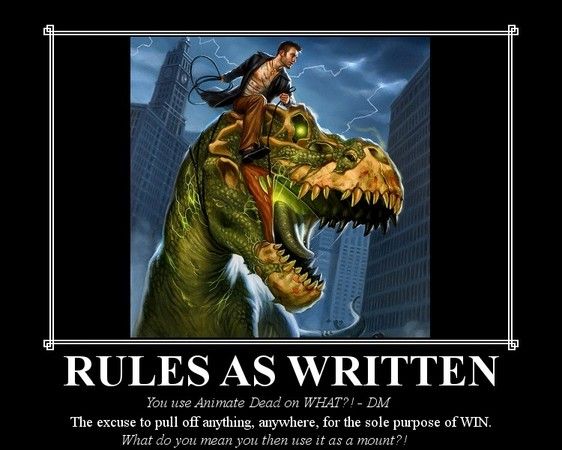
We here, we casually talking about playing the game outside the comforting acronym RAW [rules as written], we're not a threat to their campaigns or their player's interest, we're a threat to the whole system ... no matter how small and impotent we are.  If we keep talking like this, we're going to ruin role-playing.

Point in fact, however, I've been describing the noobs that never move on from being noobs, as Joey Bennett put it.  There's another group: noobs who really don't like this game that much.  They play for a while, mostly with the unchanging noobs, see that the game is fairly repetitive and they quit.  By the thousands.  We know it is so because bookstores and the net are full of people trying to sell the shit they purchased, that they know they're never going to use again.  We know it is so because we can all personally list a long string of names of people we know quit the game.  We don't like to talk about it.  We like to call those people dumb or lost or just misguided.  In fact, they are the anti-thesis of us.  They're people who did not think the game changed the scale for entertainment.

They wanted more and the game wasn't good enough.

Okay.  Let that sink in.  We've grown comfortable dismissing those people but let's try to embrace their thinking for a moment.  They were able to quit, wash their hands of the game and move on.  Why?

Because, I think, they were able to clearly see the problems with the game, such as the interminable dullness of repeated role-playing conversations that appeal to a base need for personal importance and grandiosity, but in fact serve no real purpose.  The blatant and obvious fudging of dice and circumstances by DMs who were clearly yanking a party's chain from personal glee.  The fucked up and confusing nature of point-buying systems that require a sickening kind of munchkinism to care about.  The endless bugs in rules that don't make sense or can't be changed, which are myopically exploited by players and DMs alike to create a sludge of "simulative" dreck.

I think those players who quit see all the same troubles and brokenness in the system that WE see, except that they don't in turn see any way - or motivation - to fix them.  What the quitters do see, however, is that in many, many, many ways, play by the rules is a total waste of time.

Their eyesight is clear.

So is ours.  But we have hope.  We think the game could be better; we're not satisfied with what it is now and we're willing to struggle, however much we can, to find improvements.  To choose systems that definitely seem better than other systems.  To drop rules.  To reconsider the importance of role-playing and rules surrounding role-playing.  And in my case, to massively draft rule after to rule to fill holes in the old, rotten ice where people want to skate.

Want perspective?  Stop looking at why people love the game and start seeing why people quit.  I think this comes with time, IF you're the sort who doesn't embrace the game like a faith, but like a game.  The time spent playing isn't enough in itself; you've got to push yourself.  Cooks don't become better cooks by finding one restaurant and working at the same menu all their lives.  They quit and go work somewhere else, where they learn new things, experience new kinds of management and tools, find different co-workers and push themselves to be different now that they're in a different place.