Showing posts with label Monsters. Show all posts

Sunday, February 18, 2024

Blue Mud

"It’s worth noting that in medieval-Renaissance times animals were viewed as resources to be utilised for human needs, including food, clothing and labour. The practicalities of survival, as fur clothing was in many parts of the world essential for warmth and protection, superseded modern ethical ideals. Further, religion heavily influenced medieval attitudes towards animals and their treatment, stressing man’s dominion over animals while denying their moral significance. In no way is the use of fur in the present encouraged by the following material; it is here for the sake of interest, comprehension and the adding of material substance to the game world."

 — The Streetvendor's Guide


The things we must write so as to reflect the sentiments of present day attitudes.  There's really no way to keep some persons from feeling that the subject material is morally problematic.  Someone is going to be offended.  This is even dearer with the matter of slavery, and to a certain extent with indentured or prison labour, debtor prisoners and deportees, all of which were daily facts between the 12th and 18th centuries.  A large part of me wants to be honest to history, while another part asks, "Are you out of your bleeding mind?  Leave it alone!"  Chances are, I will.  But I don't like it — in part because its putting our heads in the sand to pretend that if we deny a problem, or refuse to acknowledge it, as if that solves everything.  Yet it's realistic to ask, seriously, if such belongs in a game.  Arguably, no.

I've tried to walk the line as much as possible in the manner of the above, when such things have arisen.  I consider myself an empathic, considerate person, one whose fully able to understand the desire to remake and rework society so that it becomes a more just, freer place to live for every kind of person, regardless of the labels we might attach.  On the other hand, I'm resistant in many cases to the temper and approach that's being taken in the present day to FORCE this behaviour from those who don't want to adhere.  Force isn't going to work; it never does.  In fact, it makes the problem worse; which is why it's so aggravating to have to couch ideas in language that avoids any sentiment of condoning a cruel, abusive thing, because of a tendency towards cruel, abusive language being directed against someone doing that.  It's all hypocrisy and it's not getting us anywhere.

Which leads me back to the finished module of Ternketh.  Much of the description is, um, unpleasant.  Part of the reason why I think my ideas for adventures and modules fails to produce any positive effect is that I insist on being an adult, and dealing with adult themes, according to the source material.  Harpies are not cute little beings who fly and sing a song.  The Greek origin of the creature is clearly awful, and of course ethically problematic because some Greeks were very definitely denegrating what they saw as women's nature and poisonousness in the mythology.  Essentially, "women ruin everything," as no doubt seen through the eyes of males who were themselves just awful.

In general, harpies are viewed with the same lens as, say, furs, because D&D is a fantasy setting where creatures like harpies exist as part of the game's lore and narrative.  They're adversaries for the characters; they behave as they do according to their alignment; therefore the considerations that apply to real-world beings do not necessarily apply to fictional beings.  Which is to say, most people are utterly ignorant with regards to the mythological symbolism invoked by the imaginary existence of harpies, therefore it's fine.  But as people are not ignorant as to the existence of fur-bearing animals, however fictional they might be in this context, they must be assuaged in their lack of ignorance.

It's all kind of stupid.  Inevitably, some group of people will cease to be ignorant about harpies, and what they stand for, and will suddenly and apparently without cause launch an attack against anyone who dares present the fictional creature, because obviously it's insulting and hurtful to ... well, to whomever launches the moral assault.  There's fertile ground here for some group to make a name for themselves, to paint signs and stand outside the WOTC's headquarters, or Paizo, or some video game company, with the result that harpies will be quietly removed from websites and whatever else for the sake of "the good of all."  War won, we can move onto sirens.

I'm not cynical.  I firmly believe that with a generation or two, there's going to be this terrific blossoming that embraces all the hunted down "immoral" ideas of the present, gleefully crushing the aging, helpless proponents of modern day rule-making, so that they raise their hands in the air and shout about the immorality of "children today."  Because force doesn't work.  It just invents a fetish.  And fetishes are extremely powerful, because it's wonderfully fun to SHOCK adults by refusing to acknowledge their ideals.

I always feel like I'm standing outside, looking in at this jazz.  Somewhat humorously.  I don't include the paragraph above because I believe it, but because like all the others rubbing blue mud into their belly buttons, I must do the same — soberly, religiously, because that's how it's done.  But I'd be just as happy to stop having to rub blue mud, as I suspect the majority feels.

Ah, but, c'est la vie.

Sunday, October 8, 2023

Water Elemental

It's frustrating when a game book won't give proper rules regarding a monster's attack, which is the case with AD&D and every edition since.  Telling me that a monster can "create whirlpools" is useless if I don't know what the whirlpool does.  And saying that it can capsize boats up to one ton is great, but what if it weighs more than one ton?  Does that mean the creature is helpless?

So, here's a rewrite of the water elemental built today.  Enjoy using it.


_____

If you wish to comment, please write questions, ideas or opinions to alexiss1@telus.net and they will be posted on Saturdays.  Feel free to introduce new subjects or present your own work. 

If you wish to make a donation to Patreon, it will be greatly appreciated and help with costs for illustrating the Streetvendor's Guide.

Thursday, October 5, 2023

Wiki Changes


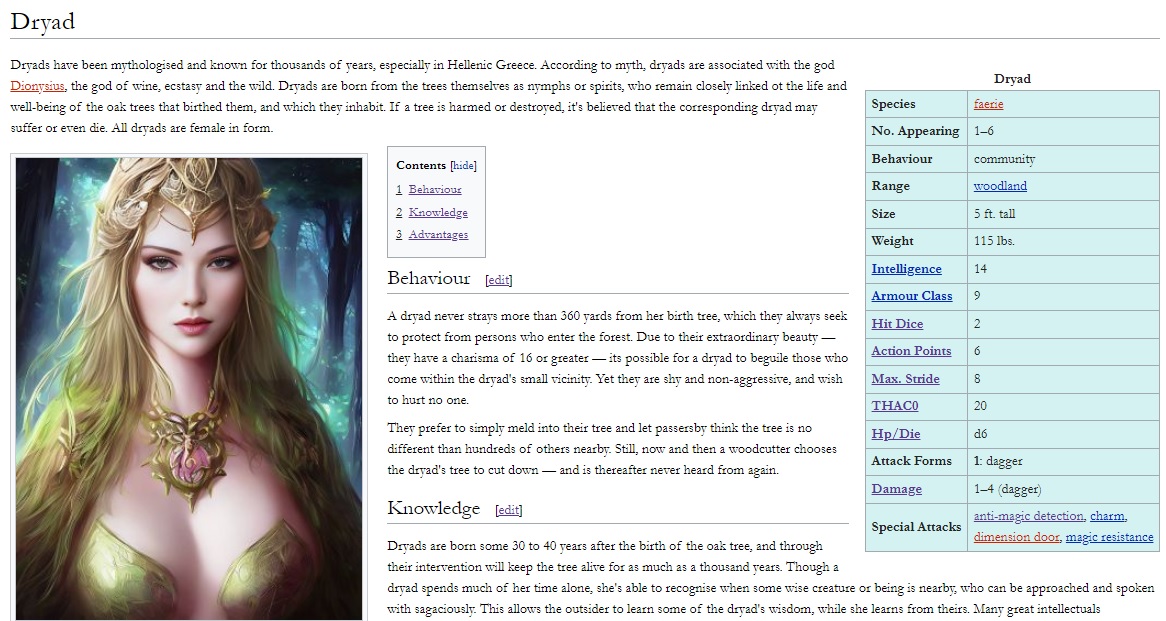
The full text is here.  I've always thought of the dryad as something of a "gotcha" character, designed to screw with the party as a sort of random adventure.  At the same time, the dryad isn't powerful enough to give a stand-up fight, and isn't awash in treasure either.

I think this translates her into a sort of ongoing resource through which the player can access knowledge about the world, provided the character has lived a positive, gracious life.   I'm rather pleased with the alternative proposed here.

Those interested might want to look at the recently updated page for the bonesnapper.  I'm pleased with that one, also.


_____

If you wish to comment, please write questions, ideas or opinions to alexiss1@telus.net and they will be posted on Saturdays.  Feel free to introduce new subjects or present your own work. 

If you wish to make a donation to Patreon, it will be greatly appreciated and help with costs for illustrating the Streetvendor's Guide.

Sunday, February 5, 2023

Death a Hundred Times Over

The recent conflict with mind flayers and TPK's brought about a discussion I had with my players last Friday, 8 days ago, with regards to the dangers of higher level monsters (which is being discussed on JB's page).  I have less experience with throwing monsters of greater power at parties, not because I haven't done it but because that was more than 20 years ago.  I haven't done it lately.  Moreover, I'm a smarter DM now and the monsters have become clearer in my head.  There are definitions for abilities that once upon a time were quite fuzzy.

For example, take a monster like "nalfeshnee," shown.  The monster is on page 20, but I've added a little bit from page 17, where is says what all demons can do.

Specifically, teleportation.

There's no explanation in the books of this ability.  It doesn't say how often the monster can do it, or what kind of magic it is.  I presently choose to interpret it as a "natural ability," like my ability to touch-type: something I can do as often as I wish, which is only limited by how much time it takes me.

This is a ridiculously powerful ability in the right hands.  Anything that can be done AT WILL takes just one action point in my system to do ... and because I don't want the monster teleporting multiple times in a round, I do limit the ability to once a round.

It means, however, that it can pop up next to any player in any hex and attack immediately after ... or it can attack and them teleport to China, leaving the players with nothing to attack, until it pops right back onto the battle field the next round.  "No error," right?

Given all the other things the nalfeshnee can do, it can cause fear, gate in another demon, telekinesis a character into a wall and then vanish ... and what do you do as a party?  Go ahead.  You're a group of 18th level characters, so it's only 30% resistant to magic — assuming you can get a spell off, which takes much longer in my game.  What's your strategy?

Now tell me what you'd do with three of them.

The thing is ten-and-a-half feet tall, so the damage listed is ridiculous.  It ought to be more like 2-16/1-10/1-10.  And even if you do manage to hurt it, then it can just go off to its plane of existence, heal, and return in its own time to restart the fight on its terms.  There has to be some policy in place that says plainly this thing can't show up on the Prime Material plane unless it's invited somehow ... but there are ways around that.

You need a spiritwrack spell, but that only handles one of them and you have to be able to put it in place at precisely the right moment ... then you have to count on overcoming the magic resistance and then the demon gets a saving throw.  That's either an 8 if you count it as an illusionist/mage or an 11 if you count it as a fighter.  All in all, not the best situation.

Most truly high level monsters are exactly as dangerous as this.  It's one thing to fight a dragon when it acts like a complete moron, like Smaug, lashing out at its enemies like a drunken sailor on a bender.  What about a smart dragon, that doesn't fill it's lair with columns for invisible halflings to hide behind and avoid getting roasted.  What if any of the truly dangerous monsters listed actually use their exceptional or genius intelligences?  What then?

My players explained that they were sure they'd figure it out when the time came.

Players are so dumb.


Wednesday, August 30, 2017

A Rant Unfair to Readers

I feel I'm doing a disservice to my readers, working on monsters as I have done the last couple of weeks ~ and not new monsters, but very old monsters.  I don't suppose there's much interesting that is left in these old beasts.

Was passed a monster chart the other day that had a lot of monsters that, I will admit, were utterly unfamiliar to me: drakainias, vemeraks, thulgants, bzastras and so on ... no doubt these are all terribly familiar to the reader.  Yes, well.  I never investigated the Monster Manual II, or the Monster Compendiums 1, 2 and 3, nor any of those monster books that were associated with realms or splatbooks, nor anything published having to do with monsters dating from the rise of 3e. I just didn't care.  I remember flipping through such books a the game store with a vague interest, seeing quickly that these new monsters didn't seem to have much "new" about them.  Just a shifting around and reconfiguring of the same old abilities, with new pictures and new unfamiliar names.  I might have looked at a myconid or a decapus at some point, but I wouldn't remember now.

I'm an old man, I guess.  When I went through the monster manual back in '79, I had at least heard of a chimera or a hydra.  I knew imps and minotaurs from stories.  Yes, there were some odd names, but they grew familiar over a lot of time.  Some I just never used.  I have never thrown a morkoth at a party or a thought eater (and I don't use psionics, at any rate).  I can count the number of times I've used a remorhaz, a groaning spirit or a mind flayer on one finger.  Most monsters, I have always thought, were a bit of a waste.

I went through the Fiend Folio when it came out, still a young feller, but I ditched more than half the monsters almost at once.  We played with flail snails but what a joke, along with flumphs, cifals and tweens.  Revenants were clearly set up to fuck with parties and I did not include them in my campaign.  The few monsters in the Deities & Demigods were better, particularly those from Melnibone and Cthulhu, the two parts of the book that were ripped out after the initial release (of which my original copy was stolen, so that I lost those pages until the internet happened).

But more monsters?  I had enough by then.  I was constantly having to adjust them, too, to make them more tougher or less silly or whatever ~ and that got to be a job that was too big to manage, as it still is.  Back in the mid-80s, I plowed through a description of every monster I used on my Commodore 64, 650 printed pages ... and kept the binder full of those pages on hand until about '91.  By then I was thinking that I should put it into Mac Word.  I would start, but it bored me.  I lost the binder in '97 to a nutjob roommate who destroyed a bunch of my things while I was out of town, so I had to start again from scratch in 98 when I got my Pentium.  Again, did not get far.

The wiki is just the end of a lot of tries to sort out the exact details of the monsters, to explain how the Beholder's eyes actually work or build proper rules for dozens of little details.  How does trample actually work?  When are people actually trampled?  The book makes it sound like characters thoughtfully lay down in front of cattle whenever.  I've always tried to clear that sort of thing up.

More monsters just means more misunderstandings, more work.  For what?  A different monster that also drains blood?  Yet another dragon or demon?  Yet another small creature that exists as a annoyance to play tricks and steal the parties things?  How is the game made better than there are fourteen different creatures that all serve the same purpose?

Humanoid races have always been useful.  We need lots of enemies to fight one another.  But if it is another humanoid race, what is the good of it being just another elf or another dwarf?  How many different kinds of goblin do we need?  Can't we just use goblins?

BUT . . . I know.  The tide is here and I'm underwater.  I'm carping about a world that is never going to change.  And I'm working on a monster list that can barely get a 'meh' out of the reader.  I apologize for that.

Still, the list I'm creating is very good for my game and my world.  These insights into old monsters, how they should have worked and how they can work, are worth a thousand ill-considered add-ons that seem to have been created more to give bored game designers something to do.  When drawing lines to make megadungeons go sour, let's throw five old ideas together into a blender and make a monster.

My daughter feels that I should write a book called the "Blender Monster Handbook," featuring monsters made by random dice and other poor decision-making processes.  She says it will sell.  I think it would be boring as hell to write.

I am sorry.  I am.  None of you readers have asked for this very boring rant.  You don't deserve it. This is just an excuse for me not to start working on making the centaur monster relevant.

Sunday, August 20, 2017

For the Juvenis Boys

I thought the players in the Juvenis campaign might be interested in this entry.  It can be read in full on the wiki.  It might stir a few memories and explain some of the details the party never did fully interpret.


Thursday, April 20, 2017

Reverse Sides

Let's try a thought experiment.

Instead of the usual game, we'll have the players run a group of humanoid monsters located in a subterranean lair.  We can call them "orcs," but any group will do.  We'll assign two adult males, two young males, three adult females and four children to each player ~ and we'll say that orc children grow quickly enough that these children are all mobile on their own, though we could force one of the females to be burdened with an infant if we wanted.

We'll start by assigning each individual hit points and combat abilities according to their status.  Each player should then designate one of their adults (male or female) as a "leader."  Then one of these leaders can be designated the "chief."  Orcs don't usually have stats, so we can forego those, making the character creation fairly simple.

Now assign some weapons and have the characters pick ten pieces of basic equipment for each adult and each young male ~ no more than two weapons, a suit of armor, and 7 pieces of whatever else they feel they'll need (including a shield), but with this limitation.  It has to be something made without an industrial or academic process.  No metal, no alchemy, no poison, no magic, no unusual tools, etcetera.  If we want, we can argue that one of the weapons each orc has was stolen from the outside culture, so they can have a sword or an axe.  Treat each article of clothing as a separate piece, so most will just wear a hide shirt that reaches to their needs.

We will also make one stipulation.  The orcs have two picks.  Without these picks, they wouldn't have been able to dig their lair out of soft rock.  So they'll need those.

Good, now ask them to make their lair.  They have to create tunnels that connect certain necessary points together: a breeding place for young (orcs are birthed from mudpits), a food-producing chamber (fungus or whatever other imaginary food can be grown underground), a place for each orc to sleep, a place to eat, a place for tools to be made, a pen for animals and one or more entrances to the outside.  Give dimensions that these rooms have to be to support the lair's food/shelter needs ~ such and such an amount of space per inhabitant.  Then limit the distance of connecting hallways to 10 feet per person.  The animals can be whatever exists in a dungeon environment that we feel can be reasonably domesticated (lizards, salamanders, weasels, carnivorous apes, worgs, whatever we want).  Fit the number of animals to the space you'll let them build.

Give the players time to draw out the lair.  While they're doing so, explain that they won't be able to carry weapons and wear armor all day long, for months and months of non-fighting time on end, so they will have to store these somewhere that they can be reached in time of crisis.

Let the players devise any crude traps they want to create, giving a 35% roll per trap set of the trap going off, potentially killing one of the members of the tribe.  Make sure that the players understand that any trap in a commonly used corridor (the shortest distance between any of the above required places) will mean a 1 in 10 chance of killing a random resident, from child to chief, because of its ill-considered inconvenience.  Remember, too, that the traps have to be fashioned from ordinary goods.  No complex rock digging, however - we're talking soft rock and the orcs only have picks.

Still, they can make pits with logs over them for daily use and fill the pits with offal or spikes (since wood is easily obtained from outside).  They can make rope from the fibres or sinews of animals that will make springs and stuff.  They can make doors of every variety.  We might want to limit them to a set number of traps, perhaps five, ten or fifteen.  Of course, anything really vicious will start to take its toll on the population of their lair, so they'll think twice about really deadly things.

Good.  Now, give the players a bunch of gold and silver coins, with jewelry and gems.  Give them each a minor magic item.  Once again, point out that they can't carry any magic weapons with them all the time.  They'll need both hands to work.  Have then show where precisely all the money is hidden.  Let them be as precise as they want about hiding it, so long as they keep to the rules of no special means that can be made from the tools they have.

Finally, have the players identify where their orcs are at a given time of the day.  Stipulate that such and such many have to be tending the food making, the animals, the children, maintenance on the tunnels and tool fashioning.  Tools are always breaking and need to be remade.

Now, attack the lair.  Use the players' own characters.  We could create some of our own.  We may want to pick ogres or giants as our humanoids if the players are high level.  Have the players defend the lair with their humanoids while the DM attacks the lair with the adventurers.

If the orcs (or whatever humanoids) are easily killed, or if the treasure is found easily, find some way to penalize the players.  Get them to talk about how they could have done better.  If we want, we can hinge the player's success as orcs to how much experience the players' characters get at the end of the session.

Our goal here is to demonstrate that if the players had to play orcs all the time, they would be a lot smarter about where they stored their goods or how difficult it was to get into their lair.  Even the weakest humanoids could create insanely difficult lairs for a player to break ~ and the above experiment could demonstrate to players and DMs alike what to build and how to break it.

This is the sort of thing that provides empathy for both sides, player and DM alike, while vastly expanding the possibilities of presenting the game.

Monday, October 17, 2016

Breaking the Mold

In the last post, I was asked about the details of the party's adventure and I gave a long answer.  I didn't finish the story, which I said was long, so I thought I would do that now and use it to make a point about monsters.

Let's start with the kelpie I introduced to the party, which I said was different from the Fiend Folio.  The FF describes the kelpie appearing "as a beautiful human woman in order to lure men into deep waters" . . . which of course is done with a charm ability.

Come on.  Did we really need another version of this monster?  Shit, the folio was printed in '81 and this was already such an awful cliche that the writers should have been taken out and bitch-slapped for every version of this they added to the book.  What the hell is it that makes game creators think that DMs need to constantly be charming the party into a near death experience?

When I was 15 and stupid, I did try a few of these scenarios, what with nixies and dryads and whatever the hell else.  They all sucked.  It's the same experience for the party every time: some people make save, some don't, those that make it save those that fail.  Listening to a DM read out random rules from a random splat-book would be more interesting.

Yet these are potentially interesting monsters, if the DM can get the hell away from the obvious dumb-monster response.  Saturday's kelpie in my game was friendly, novel, unexpected and compelling.  No one made a move to kill it (which would have been disastrous for the party) - and for a long time into the future players will talk about the kelpie and remark on its behaviour and someday that will set up another kelpie with a very different agenda.  Rest assured, that agenda isn't going to be charming the party and killing them.  It will be more interesting than that.

Consider.  The solution to the party's dilemma came out of another monster that also behaved differently than its cliched description.

About nine months ago the party was negotiating their way through the Sahara Desert, through a particularly magical part of the landscape.  The party is 7th to 11th level so things have to be more interesting now.  As chance would have it, they came across a creature that wasn't exactly demonic, but had characteristics that suggested such.

So the thief in the party, Nommi, decided to sneak up on it. I have stealth rules that enable thieves to roll 3d6 and then subtract their level from the result.  The number is the distance in five foot hexes that the thief closes to before the target becomes aware.  The target's level is also taken into account if the target has thief-like attributes.  If the thief is within two to three hexes, depending on the amount of armor the thief is wearing, and if the target then rolls against surprise and fails, the thief can backstab.  The rules work the same with an assassin.

In this case, Nommi rolled ridiculously low and ended up with a result of zero.  Thus he slipped right up behind the entity ~ and at that moment, discovered that he was in a position to back-stab a djinn.  I rolled a 1 on a d6 and the djinn was surprised.

The thief decided . . . um, no.  On the whole, it sounded like a really, really bad idea.  So the thief said, "Hello," and the djinn jumped and spun around.  And at that point, the djinn laughed.

The djinn congratulated the thief and remarked on the thief's skills and there was a great exchange as they made friends.  And in gratitude, the djinn granted the party a wish, which the party used, asking to have the McGuffin put into their possession at once.

Unfortunately for the party, this was an icicle of perpetual cold, which created a frozen sphere of about a quarter mile in diameter and affected weather within a thirty-mile radius.  Once the icicle was put in their possession, they were now inside the freeze radius, helplessly frozen inside.  They didn't know this is what the McGuffin did.

The djinn was very sorry and did help the party's back up of henchmen come and spend four months of game time rescuing the party (or rather, trying to rescue the party).  But that is all another story.

The point is that the djinn and Nommi did become friends ~ and Nommi was one of the party aboard the wrecked ship talking to the kelpie.  So, in a flash of inspiration, they called the djinn and got the information they wanted.  They did not have the power to compel the djinn to grant a wish, but the djinn does still know a lot of things and was willing to say so.

Now, I know a lot of DMs would make the djinn very tight-lipped and miserable, and would demand that any information the djinn might give would have to be the result of a wish.  But how straight-jacketed is that?  How much more interesting is it that the party has a djinn as a friend?  A friend, I'll add, who was willing to tell where the djinn's lamp was located ~ which is, again, another story, and another potential adventure someday if the party pursues it.

Things get interesting when DMs get out of the box and begin using these creatures like the intelligent beings they're meant to be - and stop with the most obvious, most annoying angles on their abilities and powers.  Just because a kelpie can charm the party doesn't mean the kelpie wants to.  Maybe the kelpie has other needs or interests. Maybe the kelpie is just friendly.

Wednesday, December 23, 2015

Perhaps They Were Possessed by Blackwolf

Since I do have a lot of posts to write and I spent time turning my way through the book yesterday, I might as well talk about a few things that the makers felt should be included in the original Dungeon Masters Guide.  For example,

"Demi-human troops are unlikely to serve a human master who is not otherwise supporting a cause of the particular race.  Some small number might serve with a henchman of their own race, but not large bodies except for short periods of time, most probably when danger threatens their area.  You might allow exceptions to this as they become compatible with your campaign.  Similarly, half-elves might enlist bodies of elves, halflings might enlist dwarves or elves, etc."

This is the first paragraph of a section entitled Use of Non-Human Troops.  I've always felt the section (it runs six paragraphs and two tables, on pages 105-106) had a strange vibe to it - it sounds distinctly like the authors of the book are wagging their fingers at me, apparently for 'reasons.'  It isn't as though it bears the mark of canon, since who ever heard of halflings (or anyone) able to "enlist" elves??

I have never heard players express a desire to employ non-humans in an army and not because of this passage.  The game goes way, way over the top to stress that bugbears, gnolls and goblins are EVIL and CHAOTIC and probably insanely dangerous to share a barracks with.  I get comments all the time, expressing wonder and amazement, because I chose in my world to set up gnoll and goblin kingdoms, where these creatures calmly collect peat, grow crops, raise their children, tell stories and presumably worry about family members who haven't come home before dark.  Who would ever think of that?

So having created this systemic, milieu-driven racism, hammering it home with every other description in the books (and module after module), why exactly did we create a little section in the DMG to bring up the subject and then moralize about why it just won't work, it just shouldn't be done and oh, in case you were still thinking about it, these troops will absolutely not get along with each other:

"Compatibility of Non-Human Troops:  The general compatibility of demi-human troop types can be determined by consulting the Player's Handbook, Racial Preferences Table.  Lizard men are hated by all demi-humans and humanoids save kobalds, and even the latter are suspicious of them (just as human troops are).  Of the various races of humanoids, many will bully or attack one another as indicated on the table below:"

After which we get a racial preferences table, just like the Player's Handbook, expressly for bugbears, gnolls, goblins, hill giants, hobgoblins, kobalds, ogres, orcs and trolls.  Presumably, this is why lizard men were expressly mentioned in the paragraph before the table, because they weren't included (the table is only a column wide and had to be crushed to where four of the headings are abbreviated - "Bugbr." "Gob." "Hob." "Kob."

Of course, this doesn't tell us anything about troglodytes, lycanthropes, gargoyles, minotaurs, ettin, other giants or any of the faerie folk (whom I presume are non-human).  Is it okay if I use faerie folk as troops?  Do they all get along or do I need another racial preference table for them?

Obviously this was some sort of problem in Gygax's campaigns, something he didn't like and felt he needed to put the kibosh on before it got out of hand in the campaigns of all the strangers who would one day buy the books.  "First it's convincing two orcs to tag along with the party and then it's a squad and a whole platoon!  What next?  Human sacrifice, dogs and cats living together . . . . mass hysteria!"

I will grant there is drama in gathering together a bunch of different humanoid races as an army.  It's nice to imagine them fighting each other - something nicely depicted in the film Wizards, where this problem needs to be overcome by Blackwolf before he can unite his troops . . . but it seems to me this is a player problem to be solves, not an institutional need for a rule-set that demands that kobalds will always hate gnolls or that ogres will always hate goblins.  It's this sort of shit that gets the game defined as racist - with the game using 'alignment' as the all-purpose justification to bestowing the game-makers' commands.

I can't for the life of me guess why this passage was included; they felt compelled to add rules in case the players decided to ignore the writer, but then they also felt the need to include this:

"Non-human troops, bugbears and humanoids, will very difficult to handle.  They will tend to fight amongst each other . . . fight with humans nearby - whether friendly or not (25% if friendly) - run from battle if they see troops on their own side retiring or retreating and fall to looting at the first opportunity."

Have the authors of this ever met a human?  Ever read anything about human troops in war?  These are things that won't happen in human armies?  The paragraph goes on:

"If the master is strong and powerful and gives them cause to fear disobedience, it will be of some help in disciplining such troops.  Likewise, if there are strong leaders within each body of such troops, threatening or driving them on, they will be more likely to obey.  Weakness in leadership, or lack of officering [sic], will certainly cause these troops to become unruly and impossible to control."

Really.  No kidding.  It's a good thing that ordinary troops don't respond like this to poor discipline or weak leaders.

It might be imagined that this pressure is just there to stress that the players have to keep on top of the problem - but then the chance of a strong leader managing an orc unit is only 90%.  That's an incredibly poor morale for a combat troop of any kind!  For a bugbear unit, it never gets any better than 80%.  Jeez.  Why bother?

That's clearly the point.  Why bother, don't do it, here are rules that make it impossible, choke on that you little bastards.  Now let's talk about construction and seige.

ADDENDUM:

For the record, the film Wizards - which I saw when it came out, two years before I'd even heard of D&D - has always been closer to how I imagine a fantasy universe than Lord of the Rings.  The elves experience fear, faeries exist as a unified people, combat is industrial, rape happens, sexuality is part of the conflict/experience and brutality is both normal and undesirable.  In a war, no side wins - the deciding factor isn't how much magic but how willing we are to use every resource available (a luger, if necessary).

The link above gives access to the whole movie.  Someone posted it on youtube two years ago, but it won't be there forever.  Watch it, steal it if you can (good luck finding a copy legitimately).


Monday, August 31, 2015

Read the Books. For Efs Sake, Read the Effing Books.

JB of B/X Blackrazor has a curious way of setting my teeth on edge, even when he's pointing out thinking that is not his own.  A fair part of my visceral reactions, I know, result from JB feeling that I need something like the linked comment pointed out to me . . . in the same way that I need someone reminding me that some people think it's a good idea to take young girls in their care and turn them into sex slaves.

It isn't that knowing these things isn't important or that I have any reason to remain ignorant.  But shit.  Really?

". . . there's this pervasive idea that goblins and other humanoids aren't quite as organized as humans where it comes to this practical selection process . . . it goes a long ways towards explaining why the (often larger, tougher) tool-making humanoids haven't become the dominant species on the fantasy planet."

I guess, on the surface, this looks like a good argument.  Except that the 1977 Monster Manual, published before most people having this "pervasive idea" were born, describes an orc tribe as possessing swords, battleaxes and polearms (which I suppose some will argue were just 'lying around,' which fails to explain why peasant rebellions led by 'organized' humans rarely possessed such items), at least half the time possessing two weapons (that's a fair bit of weapons' training for the disorganized), a social structure of a chief with body-guards, guards, leaders and assistants (sure, disorganized), ditches, ramparts, palisade walls, guard towers, gates, catapults, ballistae, tribal standards, the institution of slavery, the ability to speak five languages and being accomplished as tunnelers and miners.  I recognize that a lot of gamers are dead-brained idiots, but quite a lot of these things required a rather considerable social structure to be designed in 'organized' human culture.  Funny how the extremely sophisticated cultures of the Incas and the Aztecs never got around to building siege weapons.  Oh well, I guess they were too organized.

I'm sorry to let the ordinary suppositioner about history know this, but virtually every 'organized' advancement made by human culture was invented by one small group once upon a time, and then stolen by everyone else.  I'm not just describing things like designing a fishing boat or making a sword, no.  As I argued with my technology posts once upon a time, things like polytheism, priesthood, alphabet and music are profoundly affecting technological revolutions as well, requiring insight and considerable cultural development:

"We hear music, we feel a sense of wellbeing, which in turn we relate to the order of the universe, which deludes us into thinking we can do whatever we want and that we have nothing to fear."

How does this relate to social order?  We put up a standard, a flag, in front of men and we march them into battle, promoting in them the belief that they are fighting for king, god, home, whatever - exactly what the orc in the original text feels when they fight at +1 on hit dice and morale, right there on page 76 of the Monster Manual.

If the pervasive idea that JB describes has it's source, it's that the spreaders of said idea did not fucking read the books!  Which puts them right up there with people who think kids have to wait an hour after eating before going swimming or people who believe Obama is a Muslim because 'Hussein' has an Islamic derivation.  My name has a Russian Orthodox derivation and before that a Varangian Viking derivation, which obviously says I should write "norse celtic" on the government census when it comes around.  Except, of course, that the same people who recognize 'Hussein' have never heard of 'Smolensk,' except as the city in Russia vaguely connected with WWII, don't know about my various heritages because they haven't read those fucking books either.

Is it a good idea to let me know that there are impressively ignorant, grab ass fools in the world spreading dumbfuck explanations for concepts of which they haven't a clue?  Well, yeah.  Except that I got told this some 41 years ago, at the age of 9, and I have quite a few sources all over the net and the media reminding me of this far too many times every day.  So I don't really need another reminder.  They come pretty steady.

Should JB not have commented?  Oh hell no.  I like it when he comments.  He gets me going, and that's always a good thing.  And he did trash Tolkein in his comment, which suitably pointed out the dim-witted pretentious self-important white-guilted Brit that suffuses every nook and cranny of those texts.  I always appreciate that.

It is only that I get the same itch that the reader felt upon learning that an ex-employee from a Roanoke news station twittered a picture of his hand holding the pistol that killed a woman reporter and her cameraman during a live news broadcast:  oh, for fuck's sake . . .


Monday, January 19, 2015

Giant Bull Ant


Species: myrmecia gargantua
No. Appearing: 1
Distribution: widely scattered
Behaviour: solitary hunter
Attack Form: leaping attack
Intelligence: 0
Length: 4 feet long
Weight: 125 lbs
Armor Class: 3
HD: 4
Hp/die: d6
Attacks: 1
THACO: 19
Damage: 1-6
Special Powers: poison
Move/round: 6 hexes (jump 3)
Range: desert

A solitary hermaphroditic ant that is very aggressive in attacking prey, the giant bull ant roams over a wide area, preferring to attack large prey. When prey is encountered, the creature will rush to attack, jumping up to 15 feet (3 hexes) at the end of its movement. The creature will leap over brush, pits, even walls up to 15' in height - for this reason they are viewed with terror by guards on watch. The giant bull ant prefers to attack at night.

It possesses what may be the most powerful insect sting in existence, delivering a dose of poison that will cause 12 damage per hit die or level of the recipient, unless saved against, and half that damage if the save is successful. Moreover, the poison causes a level of pain that makes it impossible for the victim to think for 24 hours due to the agony.

The poison is resistant to the use of herbs for treatment, causing the victim's constitution to be halved when making checks. Thus the poison often kills victims if the spell neutralize poison is not available. Note that even if the spell is used, the pain from the giant bull ant's sting will linger yet one more hour.

Saturday, January 10, 2015

Rethinking the Golem

Changes sometimes have to be made.

Traditionally, there are two things necessary to create a golem: coin in the tens of thousands and a few spells. That is the entirety of the process.  Details about what costs what are maddeningly vague.

Consider this description for the creation of an homonculous (the most detailed example I could find):

"When an homonculous is desired, the magic-user must hire an alchemist, and the latter will require 1-4 weeks to create fluids for forming the creature.  This will cost 1 pint of the magic-user's blood and 500-2000 gold pieces.  The magic-user must then cast a mending spell, a mirror image and a wizard eye upon the fluid to form the homonculous."

60 words.  It is things like this that makes me appreciate the cold-stone hatred people feel for AD&D.

Just what the hell are 'fluids'?  Why do I need to hire an alchemist?  Does this include when I've passed 15th level as a mage?  Are there leveled alchemists?  Why is the local alchemist fine with my constructing a monster?  Why does it have to be my pint of blood and not the alchemists?  Is it because I'm casting the spell?  What if I use a scroll?  Shouldn't I need to pint of blood of the writer of the scroll?  I can understand having to cast some sort of spell to prove the wizard is of a certain strength or power, but why those spells?  Surely a wider range of spells will do.

It is this kind of half-assed design that teaches young DMs to rebuff questions with, "Because I said so."  What other answer are you going to give?

I have never had a character make any serious effort towards the creation of a golem.  I've had a few characters who chanced into a golem manual and considered it, but they've all come to the same conclusion: "Huge numbers of gold pieces for a creature that's guaranteed to go berserk?  Um, no."

The math whiz who invented the golem berserk rule in the original Monster Manual probably thought this was very clever:

"Once created, the clay golem is under the command of the cleric who created it.  Each melee round the clay golem is in combat there is a 1% cumulative chance that it will be imbued with a chaotic evil spirit.  If this happens, the clay golem will immediately pass from the control of the cleric and attacks [sic] any living thing . . ."

On the surface, this sounds like a very small chance.  However, given the nature of random die rolls, the golem will probably go loony within 14 rounds (1% + 2% + 3% + 4% . . .).  Get out your hundred sided and see how long you can go.

I did.  I had 10 tries at it and these are the results: 13 rounds, 14 rounds, 10 rounds, 8 rounds, 22 rounds, 7 rounds, 12 rounds, 16 rounds, 6 rounds and 10 rounds.

The clay golem requires 50,000 g.p. to make (including the 30,000 g.p. vestments, which I presume are resuable).  Even taking my best result, I am paying 2,272 g.p. per round of combat.  For something that attacks once per round (though it has two hands) for 3-30 damage and some nice immunities.  That is going to become an extra problem in short order.  That price seems a little steep.

It's a double-edged sword, isn't it?  We have to jack the price up to keep the creatures rare and we have to make them dangerous to use so that players will think twice.  Yet with these rules a player would have to be an idiot to build a golem.  As an enemy, it doesn't matter if I can hit the golem . . . all I need is 10 to 20 terrified low-level minions to keep the golem swinging - the survivors of which I'll pull back the moment the golem goes postal.  Then the party can deal with the golem's instantly very inconvenient immunities.

I want to rethink the golem, which means rethinking the principles upon which the golem is based.

The golem's inescapable insanity is based upon a Kabbalist myth, invented to teach a lesson to students: don't fuck with nature, because nature will get you.  The same myth has been employed ever since, from Frankenstein and 2001: A Space Odyssey to Skynet in the Terminator series, the creators of the Matrix and whatever recent version of I, Robot that is set to be released in 2015.

(that's always a sore spot with me, as Isaac Asimov's set of robot short stories is a total, well-conceived subversion of this agonized trope)

In reality, we know this trope is crap.  We fuck with nature all the time and somehow nature never bites us in the ass.  We manage to bite ourselves in the ass quite a lot (what with dumping into rivers and ignoring global warming and all that), but the results we're getting from our actions are measurable, logical results, not the principles of nature reasserting itself just because.  There are no special contingency rules in nature that state, "If you try to do something that will make a lot of people feel squicky, the science will fail and the technology will run amuck, destroying everyone."

People used to make that argument against artificial hearts.  Think about that.  Artificial hearts were decried because they would turn ordinary people into monsters.

A rethink of golems must begin with the tale of the Sorcerer's Apprentice (Goethe anticipated me by two hundred years plus).  In the hands of the know-nothing apprentice, the ignorant, science is a dangerous, wild element that seems impossible to contain.  When the wise sorcerer appears, however, the spell is easily broken.

Naturally, most choose to read the poem in terms of man-versus-god, pounding Goethe into the 16th century rather than the 18th.  Man plays with nature and gets in trouble; God appears and bails him out.  This is a rather ridiculous read for someone contemporary with Voltaire, Rousseau and Byron.  Moreover, Goethe's version of the tale is based upon a pagan original, written by the satirist Lucian (think John Cleese after 50).

The lesson is changed from "do not fuck with nature" to "don't fuck with nature unless you know what you're doing."  Problems begin when the ignorant get involved - not because we did something we shouldn't have been doing.  The first is a limit in ability.  The second is a limit in thinking.

That's why I want to toss out everything to do with golems based upon a strict reading of mythology. It makes a nice story for frightening children, but the guidelines are useless for game play.  The golem must be viewed as a rational construct . . . not a doomed failure predestined to be possessed by a random spirit.  The problem should not be in the construct itself, but in the maker.

Speaking of contemporaries of Byron, I wish people would actually read Frankenstein before discussing it.  The failure isn't in the monster, it is in the creator, who is so pathetically weak about his own efforts that he mistreats and drives the monster away, rather than showing love for it.  As the monster hides, it first has the opportunity to see what love and kindness are - then it has these things brutally denied to it.  In hating the monster, it is made into a MONSTER, that then sets out to take its revenge upon Frankenstein and then the world.  It isn't a monster because it is made of dead flesh.  It is a monster because of how it is treated.

According to story, Mary Shelley wrote the book while living with her husband Percy and Byron, who were her audience when she first read the book aloud.  But I digress.

The other change that I'm set to take in creating golems is to steal the ability away from mages and clerics.  These classes already have enough choices and fundamentally I believe they're in the wrong camp where it comes to thinking golems.

Golems are made of earth, stone, metal, wood, bone, natural 'fluids' and so on.  They are made of nature.  It makes so much more sense to me that if a golem is going to live in harmony with nature, it must be created by a class that understands nature.  That is why my golems are found in the sage abilities of druids.

Been thinking about this all week.  Hopefully, writing this post has helped clear my head and I can start building rules about golems now.  All I have written right now in the wiki is "Content to follow."

Wednesday, January 7, 2015

Gingerbread Boy

To create a living creature made of gingerbread, mix together 8 oz. flour, 8 oz. sugar, 4 oz. butter, 1 oz. yeast, 1 oz. salt, 1 oz. pepper and 1 oz. minced ginger root.  While baking, the creator must cast one of the following spells upon the oven: detect magic, faerie fire, purify water, charm person, cause light wounds or the reverse of goodberry.

The result will be a small living boy weighing approximately 8 oz. or one half a pound - or, alternately, for metric sizes, 250 grams (throughout this post, metric weights will be slightly more than imperial weights).  This boy will be correct proportionately and approximately 8 inches in height.  In character the boy will be malicious when fed, ravenously dangerous when hungry.

On its first day of life, the boy's appetite will crave 1 lb. of living matter (or 500 grams), half of which must comprise flesh, bone, hair, fur or hide, even tanned hide.  This will be gobbled quickly and the gingerbread boy's weight will increase by half the weight of the food, or 8 oz. (240 grams).

Each day thereafter the amount of food that the boy will require will double - 2 lbs., 4 lbs, 8 lbs. (500g, 1kg, 2kg, 4kg) and so on.  Each day, the gingerbread boy's size will grow proportionally, increasing by half the amount of living material eaten.  The boy will quite willingly eat anything that's alive, up to half its own weight - so that when the boy reaches 8 lbs. (4kg) it will be large enough to eat rats, at 16 lbs. (8kg) cats and at 32 lbs. (16kg) small dogs and so on.  The boy will double in size until it is as large as 4,000 lbs. (2000kg), whereupon it will collapse from its own weight.

Feeding time must be the first hour after the sun rises; if the boy is not fed by the end of that hour, it will become infuriated, making noise and attempting to break free from whatever confinement it has been placed, squeezing through bars or easily climbing up the smoothest of walls, seeking food on its own.  Once fed, it will become passive, though it will act out abusively towards others, causing animals in particular a point of damage each day if its creator is not there to watch it and sharply reprimand its behaviour (more or less continuously until the sunset).  If the creature does not receive its food by sunset, it will die.

While the boy, when passive, will do what it's told by its creator, this will only last until the creator becomes small enough to eat (that is, when the creator's weight becomes less than half of the gingerbread boy).  At that point, the boy will begin to do as it likes, which will mean randomly attacking anything or anyone within reach.

The boy will possess 1-8 hit points per 50 lbs. of weight, but will only attack as 1 hit DIE per 250 lbs. of weight.  Thus, the boy will have 10d8 hp when it has reached 512 lbs, but will only attack as a 2 hit die monster.

It will do a maximum of 1 damage per 25 lb. of weight, divided between two attacks (the right hand will be the stronger).  Thus, at 512 lb., the boy would do 1d10 damage with each fist.  At 1,024 lbs., this would be 2d10 with each fist.

While still under control, the gingerbread boy will gleefully enter combat, attacking enemies of the creator (eating them if small enough and the boy is still hungry), so that the boy will be useful until it reaches a size too large to be controlled.  A wise player will prepare in advance for when it is time for the gingerbread boy to be killed before it becomes dangerous.

If the boy senses that it is abandoned, it will 'know' the location of its creator and will seek to reunite if able.  The boy will only prefer to eat its creator if no other creature is available - such as the creator's party, animals, enemies, children in particular, etc.

Keep in mind that creating the gingerbread boy and releasing it at some point in a town (for example) will be something that draws attention.  The divination spell, cast by a 7th level cleric, can very easily determine the source of this sort of thing with two questions: who created the creature? and where is the creator now?

Food for Thought.

Monday, December 8, 2014

The Honey Trap

Rarely does wikipedia fail me.  This is one of those times.

As such, I'm going to have to explain this one before I can move forward on it.  For those who don't know, "a honey trap" is a con game in which an attractive woman is used to lure a fellow into a private location where he can be threatened, robbed or killed, depending upon the variant played. Sometimes, a single man - usually very large but sometimes just extraordinarily dangerous - appears at the right moment (preferably when the dupe has removed most of his clothes) and claims to be the woman's husband.  In addition to robbing the dupe, the 'husband' and the woman may work together to blackmail the victim after initially robbing him.  Alternately, the woman may be part of a gang that turns up in order to viciously beat or kill the dupe.

Either way, the woman's part in this is clear - she needs to appear both desirable and willing.  After doing her part, her male counterparts will mop up the mess and she gets her cut of the take.  Women do it because it is comparably easy work if they have the attributes to pull it off.

It is interesting to note that, although the woman will usually not take part in physically hurting the male, she is often the only one blamed.  The victim - for reasons that will seem obvious to many males - has a sort of grudging respect for the men, who are at least 'honest' in their criminality.  The woman, however, is the worst sort of harlot imaginable.  That is because the woman has been able to hurt the man straight to the heart of his ego - he really did think she wanted him because he was just so desirable.

The reason wikipedia does not include this definition is likely due to an intense hatred that feminists have acquired for the honey trapping stereotype.  Because the honey trap has appeared so often in fiction, a belief has grown that there is a conspiracy among male writers to depict women as evil, conniving, selfish, horrible sub-humans.  It is almost impossible at present to write any story about a strong, capable woman that takes shit from no one without that character somehow being subverted into proof of the author's hatred for women.  She's no darker than any of the characters played by male anti-heroes . . . except that because she's a woman, the character has 'obviously' be created to emphasize how much she threatens men.

Some of you may have felt a little of this heat with regards to the succubus, the female demon based upon Christian mythology.  The succubus is proof positive that men hate women - otherwise, why would we create a monster that looked like a beautiful woman, whose sole purpose is to entrance men and then kill them?  In short, the honey pot all in one character - proof positive that men hate women.

As such, there has always been pressure to remove succubus from the lexicon, as well as any similar female-based monsters.  In part, because female-based monsters are often sexually designed or based. Since corporation-marketed gaming must include children as potential buyers, we must downplay sex . . . and what the hell, most players of any age aren't that comfortable with sex.  I've written about that before.  Also here.

There is something particularly harrowing about the honey trap - and the accompanying succubus - that cuts deep into a man's perception of himself.  The anger he feels for the woman afterwards (assuming he lives) and his consummate association with the woman as demon (as a succubus) is a displacement of that self-understanding.  He knows, inherently, that there was always the possibility of his showing fortitude and resolve by saying to the woman, 'no.'  She does not physically force him into the alley way or into the darkness - it is his weakness in character that drags him there, for a number of reasons.  First, because the possibility of sex seems easy and available - but deeper than that, because he has that knowledge about himself that sex usually isn't easy and available.  In short, he knows he must grab it when it arrives or else he will get nothing.  He understands, even as his feet drift in the woman's direction of their own accord, that he has already lost this game between men and women.  If he could have sex whenever he wished, and knew it, the trap wouldn't work.

The succubus is the intensified manifestation of this internal struggle - for the demon represents the projection of man's wish to possess that which is perfect.  The demon, of course, cannot be obtained . . . yet there remains the terror is in the knowledge that the demon is also beyond denial.  The demon is the male's fantasy and at the same time proof of the male's vulnerability.

The intense hatred of the woman following the honey trap is in the male's complete and devastating comprehension that her sexuality bested him.  As he thinks of her, he understands his inferiority, and in that inferiority is the intense hatred he feels for her.  He knows that if he'd had any strength at all, he'd have walked away at the beginning.

That is a profoundly difficult concept to understand if you don't happen to be a man; and a profoundly difficult realization to incorporate if you happen to be one.  It's easy to see how women relate to the surface perception.  Bad woman = depiction of all women as evil and therefore disposable.  That is then exacerbated by the male point of view . . . Bad woman = fucking goddamned evil bitch, ought to kill them all.

Truth be told, perhaps it is better to remove the succubus from the game.  It's presence in our culture has long represented a difficult evaluation of ourselves as persons of two different sexes, with remarkably two different viewpoints, continously subverted by propaganda that continues to insist that there is no difference.  Presenting the succubus into the game properly - in the sense that it subverts pompous narcissism - requires a measure of maturity that is short in supply.


Tuesday, August 26, 2014

Never Fight a Cornered Beholder

I'd meant to write this last week, but this and that got in the way.  Hm.  I'm leaving for Toronto tomorrow.  24 hours from now (7:38 am) I will either be sitting on the tarmac waiting to leave or I'll be in the air crossing the Alberta-Saskatchewan border.

There are several ways in which you can enhance or develop existing creatures into 'deeper' or more threatening monsters.  I thought it might be helpful to review them and consider some of the effects of each, as a helpful overview in making new monsters and appreciating the aspects of old ones.

Let me pause first and explain that monsters are not targets.  They can be used as such, and many a campaign will see them as nothing but video game pigeons to stand up and be shot down - hacked down, melted down - in order to measure the luck or success of the players.  The stand-em-up, shoot-em-down process is the principle reason why combat is seen as boring in most campaigns, as little or no investment is made in making monsters squeal, bark, shout orders at one another or otherwise interact with the party during melee.

I don't know if the reader has considered this.  Envision the players as participants in a football scrimmage, speaking the same language (as they would in my world) or not.  Have one of the goblins on the other 'team' point at a player and shout, "You!  You're going down, you bastard!" while another cries, "Your people killed my mother!"  Another cries "GELF!" at the elf while another screams "Your mother was a human fucker" at the half-orc and the stage is very quickly set.

Most combats - even my own, when I'm hard-pressed for time - are played out in a sort of role-play cone of silence.  I have found that it is always more effective to have creatures snort, yelp, bawl, bellow in pain, clamor, whoop with pleasure (try this after a character drops unconscious or dead) or otherwise make a racket.

The more personality, the better - so in considering how to create or enhance monsters, the reader should definitely keep this in mind.  Statistics are far less interesting or meaningful to the players than purpose and behaviour.

Make monsters bigger.  This is the most obvious and most employed tactic.  No matter what it is, making it bigger makes it more interesting.  All the giant forms of earth creatures employ this, while it is equally as much fun to double or triple the size of something already made huge.  A 7 hit die giant crocodile is already 30 feet long - why not a 21 hit die titanic crocodile too long to be seen all at once?

I must admit I've never had any trouble with this sort of creature.  Bigger is always better, even if the bigger expands to incomprehensible size.  Players are amazed and effectively terrified by mass - just so long as there's still a chance of retreating or hiding when things reach dimensions of Paul Bunyan and Babe the Blue Ox.  I once had my party (with all their henchmen and followers in tow, a total of some 60 people) combat a roc with more than 1,000 hit points, so big that its most effective combat was landing, beating its wings and rolling about on the ground (1d20 incidental damage to everything).

If there is a limitation to this, it's that not everything can be BIG.  It gets tiresome.

Make monsters smarter.  This only works if you're the sort of DM that runs your smarter monsters differently than those that are dumber.  I have seen many a campaign where a so-called 'genius' beholder uses a frontal attack like an orc running forward up a hallway.  For me, any creature above extraordinary intelligence will interact with the party in only one of two ways.  They may want to talk, in which case they're more likely to encourage the party towards an action rather than threaten them. If they wish to fight the party, they're more likely to do it through minions - sending wave after wave against the party until these run out.  Whereupon the intelligent monster would make itself scarce.  The only way that a party would ever likely encounter a beholder in my world would be if it were cornered.

I've had a party fight a beholder once.  But I was very young and I never did think I did a good job of it.

I would hate to be a party fighting one in my world now.  As I have grown smarter, so have my genius-level monsters.

Of course, I've tried creating a scale of tactical/weaponry advantages for very intelligent/high intelligent monsters, but I haven't quite incorporated that into my mindset.  It's something that will come with time.

Smart monsters make for more role-play outside the normal character-vs-authority figure or character-vs-criminal dynamics.  Monsters should have other motivations, even irrational motivations, that should serve to make the game more interesting.  They want things other people don't want or feel offended by things that would never bother a human or demi-human.  Both will need a DM to stretch their imagination.

Make a lot of monsters.  If the individual monster isn't particularly dangerous, that's no problem - make sure they exist in great numbers.  A few days ago I introduced the 'purple frog,' an ugly little beast that's only three inches long and therefore no particular threat.  Naturally, the first inclination is to make it bigger, even if it is only goblin-sized; or alternately to give it an intelligence, since talking to a little ugly frog that's 3 inches long probably would make a party stop and think.

Alternately, we could make thousands of them.

Ever experienced an insect invasion?  I remember a two-week tent caterpillar infestation when I was young - several communities in northern Alberta had one this year.  Here's a nice short video for viewing.  The experience is somewhat less than appealing, let me say.  The sound of rain that can be heard is actually caterpillar droppings falling on leaves, while the crunching of caterpillars under car tires reaches a decibel level that can be heard fifty meters away.  All one can do is escape - and still the occasional caterpillar can be found crawling over the carpet, on the window, poking through the garbage and so on.  So much fun!

Imagine millions of completely harmless, completely normal purple frogs scampering underfoot continuously for two weeks of game time.  Imagine a party unable to get free of them, unable to sleep at night, unable to step without crushing them, vomiting and taking damage from the smell, possibly incurring a disease, having to fight a maddened beast driven crazy by the infestation while the party slips and slides on purple frog guts.  There are all sorts of places.

Of course, everyone knows to increase the number of orcs or kobalds as a party increases in levels - but true infestations hamper everybody.

More to come.  I have other ideas, of course - above are simply the most common three things.  I don't, however, have the time to continue.  I promise to do so, along these lines, when I return.  This is enough for today.

Wednesday, August 20, 2014

Jungle

I've been putting this off for some years - but I am beginning to feel that the problem has to be addressed.

I do not like 'encounter tables.'  I spent much time in the first two decades of my world-building attempting to create random tables for encounters, only to find again and again that the results on those tables did not make sense in the circumstances.  It isn't enough to say that it's night in the jungle, there's a random encounter, let's see what it is.  The particular circumstances matter.  There are animals that do not emerge at night.  There are places where the party might camp where the appearance of particular animals either don't make sense or where the existence of the animal offers no threat.

If, for instance, an animal is specified that guards it's lair very closely, it doesn't work as a wandering monster, does it?  I would need to create some reason why the player is wandering, and not the monster, for the encounter to occur - and I don't like insisting that the player, on watch at three in the morning, wanders away from the camp to hear a sound.  What if the rolled-up monster doesn't make noise?  Or if the player refuses to wander away?

Most DMs would, I think, simply say, "Well, then there's no encounter, and the party wakes up and is fine."  Which makes some sense - except that we should be reasoning that this is what happens every time an encounter isn't rolled!  It's a jungle, nyet?  In a jungle, there are always monsters just a stone's throw from the party, perpetually.  To me, a 1 in 6 chance of encounter isn't the chance that there's a monster nearby that can be ignored - it means an encounter happens.  To get that, it means every monster on the rolled upon table ought to be one that moves.

Which means a table for the jungle at night, as opposed to one in the daytime.  It also means a different table for the party if they're camped near water, where they might get beasties showing up that wouldn't be in an upper valley.  In fact, encounter tables begin to proliferate, if what I want is for them to be useful . . . and I have never had that kind of time.

Worse still, 'jungle' in my Earth-based world doesn't mean anything.  Which jungle?  The Amazon?  The Congo?  Orissa, Mexico, the Mekong basin or north Queensland?  Because the same animals don't appear in all those places - far from it!

Nor can we say that well, at least the monsters are universal - because they're not.  A couatl is clearly based upon Olmec or Toltec roots, while the huge cow-like body of a catoblepas makes no sense in the watery Amazon.  The Amazon might logically be full of slaad and other giant frogs, but what would these things be doing in the mountain jungles of New Guinea or New Zealand?  'Jungles' are not all alike - they do not have the same vegetation, the same topography or even the same climate.  It rains practically every day in Panama, the year round, while the Northern Territories experience staggering dry periods - yet both are considered 'jungles.'

To make good lists, then, I'm facing a considerable uphill effort - made worse by the fact that less than a hundred or so possible jungle 'monsters' split into various tables gets pretty thin.  Which tends to make more universal monsters like spiders and centipedes occur again and again, until the party is spectacularly sick of them.

I'm not happy with a make-shift list of 8 monsters, nor do I understand why anyone is.  That works if the party wants to go to a jungle once for one adventure, then to go elsewhere.  What if the party decides to stay?  What if they remain through twenty or thirty sessions, because they're interested in what they can make the jungle do for them?  What are they going to do, fight giant centipedes and wolf spiders night after night?

Problems like this are the reason why I've given up on encounter tables - but running sessions lately, I'm beginning to realize more thought is needed.  I had one such encounter happen recently, with a jaguar, for which I was able to use some researched notes on the way jaguars attack that I had written four or years ago.  And it worked brilliantly.  I was so pleased I had those notes.  They were similar to the ones I included in this post.

Now, I realize I have to make more of those - no matter how much work that means.  But whew - and I looking at one big mountain to climb!

Monday, August 19, 2013

Gotcha

One thing I did not talk about last week with the whole Nibovian Wife nonsense was how truly stupid the monster is. Basically, the monster (the DM) tricks the player into sex, then gives birth to a creature that hunts down the player forever. The contention of the linked thread was that this was sexist. Technically it is. It bears great similarity to many historical depictions of a woman-gendered character using her natural femininity to bring down or destroy an 'innocent' male counterpart. There's quite a lot of contention about the innocence/guilt of the male in the equation who sleeps with a woman, but the central point here is that the man is being fucked over by an alien who recognizes the best way to fuck over a man is by presenting as a woman. That's sexist.

I don't really care if it's wrong or not. In game, many of the things players do is "wrong." Murder is wrong. Theft is wrong. No one cares if players slip out of town without paying their taxes. A great deal of vice is happily overlooked. Sex, however, is always different. Sex is the vice we can't forgive. I think that's very silly and childish. I've always thought people who had a problem with sex, the practice of sex or the participation of others in sex were very silly and childish. Given that we're all here on account of sex, making sex really one of the truly meaningful acts humans can perform - the creation of other humans - there's no real position one can take against sex without somehow also being anti-human. All positions against sex are, by their nature, either discriminatory (we can have it but they can't) or idiosyncratic (do it this way but not that way). Both positions are indicative of a lacking generousity or empathy.

There are two elements of the monster that bother me a great deal more than its ethical status. The first would be, is there any circumstance in a game where this would be a practical monster to inject TWICE in a campaign. The second would be, does the injection of the monster consider the needs and entertainment of the players, or of the DM?

Because, really, I think this is a DM's monster. I think this is one of those bullshit moments where certain DM's get to wring their hands in glee over the downfall of a particular player character, for no other reason other than the DM being a self-satisfying, masturbating prick. The monster does absolutely nothing for character agency, or to provide the players with either opportunity or challenge. What it does is to derail a campaign that might have been moving in a positive, albeit difficult direction, and force it into a tunnel that has to be marched through at the DM's whim for two or three really insipid, pointless, predictable sessions that can only come out one of two ways - neither of those ways being determined by character play, but by the DM's personal whims or concessions and how the dice happen to fall. It's crap. It's filler. It makes a certain type of sick DM happy. For a player it is nothing but a price they have to pay in order to play with such a fucker. I don't doubt many players have walked from many a game when faced with this sort of thing.

There's NO benefit to having this monster turn up twice. Except, of course, for a DM who runs many parties, who gets to try out his little gotcha monster on all of them. One easily imagines the DM cackling at the table, telling how the last party that faced this little DM wank-fest did this or did that, or died or didn't die, and wow wasn't that fun for the DM.

There is a sort of DM that wanders about the community landscape inflicting this sort of creature (or dungeon) on as many hapless parties that they can reach, spreading it around conventions and local gaming groups like a plague, tricking thousands of neophyte players into believing that this is D&D, that it is all about gotcha monsters and gotcha moments, where they see the smiling face of their fucked up little tin pot DM and think to themselves, "One day I hope I get to fuck over a party, just like him!"

Sometimes it seems to me that's the message that gets passed along from DM to player. It isn't that players wish they had agency and don't get it. It's that players NEVER perceive that there is any other game than this you-touched-the-statue-without-checking-for-traps-and-now-you're-dead bullshit. They're weaned on it from little noobs at the mercy of smug fuckers with a DM screen right up through the ranks until they're smug fuckers themselves.

This game is not about abusing players.

I recognize that I'm talking to a lot of DM's now. A survey ages ago now told me I don't have many actual players who read this blog. I think I need to say therefore that when I hear one of you - either here, or on one of the many other blogs of the blogosphere - talk about how D&D needs to be FUN, and how it shouldn't be about responsibility or work, I'm significantly aware that for a lot of the non-regular readers that means, "Stop messing with my sadism."

The gentle readers here, those that know my violent rage is directed a people who deserve it, know exactly what I'm talking about here. They've seen it. They've experienced it. And they take great care not to play like this in their worlds. They don't need me to preach this.

No, this ire is for the others. You know who you are. You puff yourselves up to look all righteous and indignant, but in truth you slaver over monsters like the one above like wicked children who can't wait to push some poor victim off the swing.

The game isn't always going to be a venue for you people. There are more of us than there are of you.

Friday, June 7, 2013

The Range and Breadth of Monster Databases

Homer2101 left a comment on the last post that included this small observation:  "Maybe the various things the party might encounter, like monsters, could have stats like weather and season sensitivity stored in a table or database ..."

Aye, there's the rub.  No such database exists.  Monsters are not listed according to their activity season by season, nor by the temperature at which they are active, nor even by the vegetation in which they inhabit.  By and large, biologically, the information on monsters suck.  Even where it comes to ordinary biology, what you can find in the books or online isn't that helpful towards determining a mammal's range or commonality ... because biologists don't record stats on the likelihood of creatures occurring randomly.

More's the pity.

Maps like this are helpful, but they're inconsistent, there's no hard data to back up the supposed range, there's little if any information on why the savanna in North Mozambique isn't included in the jackal's range or even if this is a range that's been severely curtailed in the last hundred years.  Did Malawi systematically denude the country of this particular species of jackal?  What about other species?  Or is it possible there's no data for, say, Sudan, because the U.N. agency compiling the numbers did not get permission to camp there and count jackals?

At any rate, I don't have even this much of a map for many real animals, and I still wouldn't have it for owlbears or chimera.  One way or another, we just have to make that shit up.

It's a lot of work, yes; but it could have some real applications where it comes to party planning and world 'fluff.'  Consider the table on the right, which I use in place of giving the temperature in degrees - there are no thermometers, and no temperature scale, in a medieval world ... hard to imagine, huh?  In fact, its very difficult to explain temperature or climate to players without a number scale, that's how culturally dependent we are.

The fahrenheit scale is divided into 10 degree segments ... and as it was pointed out by some of the players online, depending on where you live in the world, the description of 'pleasant' for a temperature in the 60s is debateable.  If you're in Arizona, 61 F is legitimately cold.  It's a warm day, however, if you're in Yellowknife.  Still, I had to have some description for each level, so I selfishly based it on the continental weather in the highlands of Alberta.  So it goes.

If I'm going to build a monster database limiting what monsters appear in what climates, why base it on gross generalizations like "polar" or "subtropical"?  Why not base it on the table above, so that if the party happens to be high in the mountains of Nepal, 20,000 feet above sea level, the local monsters might have something in common with those of the northern Steppes several thousand miles north in Siberia?  More to the point, if the table above is used, and a range of temperatures is comfortable for a given species, the temperature itself might lend itself to a guess as to what kind of monsters a party might encounter.

For example, if a given monster - lets say a black pudding - is comfortable when the temperature is brisk and cool, perhaps it is largely inactive when things grow chilly, and either dormant or not at all present in environments frosty or colder.  Perhaps they are positively aggressive when the temperature rises to pleasant or warm ... perhaps they simply can't exist where the temperature is even higher than that.

What happens when every monster has a given range, not just defining their presence, but their actual character?  If a ranger takes it upon his or her self to learn and memorize the charts, at least where it comes to specific monsters, is it worth it for them to say, "We haven't got any worries about such-and-such today ... but if we see any of these, back off.  This weather makes them crazy."

It's a nice, romantic idea.

Seriously, if you're going to build a random table based on a data base of your own creation ... and if that table is produced by a program, then why not go all out?  Why not specify not just where on the chart the monster appears, but the actual violence factor of that monster?  After all, you're making it all up from scratch anyway.

Or rather, I'm making them from scratch ... since I don't believe anyone else in the world has any interest whatsoever in creating tables like this.  It's only going to take me ages, and its only sort of boring ... a lot more interesting when the time comes that I can generate monsters, but for the time being it seems a deadly grind.

Sigh.

I am starting to do it anyway.  Because that is my nature.  In time, I hope, I'll have something to show for it.

If I don't die of old age first.

Thursday, June 6, 2013

The Great Odds Stacked Against Encounters

The more I think about monsters, and monster encounter tables, the more I want to be specific about how, or when, or where an encounter can possibly occur.  Who hasn't created a sea-going encounter table that included some monster who could not possibly interact with a party aboard a large merchant ship?  Or found that their subterranean encounter table is largely useless because the party is entering an ice cave?  In fact, the possibilities for different encounter 'areas' screwing with encounter tables fairly pushes a DM into establishing from the beginning what the monster ad hoc.  For myself, I've largely given up rolling for what the monster is, instead opting for a 2d6 scale for how aggressive whatever the monster might be that I suppose throwing.  Alternatively, I make sure the party sees the monster, or hears about the monster, in advance, so they can freely decide whether to approach.

I hate this.  I would rather have some sort of system that did hammer down what monsters could occur, and where, in a logical, orderly fashion, and thus remove myself a bit more from the random loop.  See, I believe that if I'm faced with the challenge - the die says this monster appears, deal with it as a DM - it makes it a less homogenous world.  I believe that when the DM chooses all the monsters, he or she will be inclined to choose certain monsters again and again, because those are familiar and the first to come to mind.  I don't feel that improves gameplay.

Nor do I think it rational to make sure that every monster gets a try, like a bored diner going through every dish from the menu on principle.  The distribution should not be based on the need for variety ... there should be some continuity, and that isn't helped by having every weird and bizarre monster show up for a campaign like they're all standing in line somewhere, off-plane, each holding a taken ticket.  We are not serving number 63.

So yes, the problem of nailing down the circumstances for an encounter ... more so than the fact that it is a temperate climate (mean yearly, no account taken for winter vs. summer) and that this is a forest.  That's pretty scant detail for a biological determination.

The basic aggression of the monster would seem to be relevant.  Is the monster the sort that sits and waits for prey, or one that deliberately hunts prey out?  What sort are you more likely to encounter?  It seems to me that something like rats are going to be found a lot more than something like a golem, that requires an elaborate creation process as compared to a brood of 20 offspring.  But are you really going to have rats that walk into the road, confront the party and start fighting?  Or is it more likely they'll pilfer food, that they'll flee the moment they're discovered and that they'll be an eternal pest without much likelihood of actual combat except when the rats have reason to be threatened?

If you're vigilant, you use a trusted water source, you use your exterminate cantrip to kill anything inside a bottle before taking a drink, are you going to get attacked by a throat leech from the Fiend Folio?  Or any other similar creature?  Even if there are such leeches in the brook where you fill your canteen, what really are the chances of collecting one?  Is the brook so thick with them?  Or are we talking about an extreme low chance, so low that the monster might occur one time in a two year span of regular playing?

A lot of the monsters are like this.  You have to really go out of your way to find most of those that live only in subterranean places; if you're not wandering the swamps of tropical regions, you're unlikely to be attacked by a crocodile or alligator.  And even if you're fifty yards from a pond infested with them, they're not likely to leave the water and come looking for you.  Unless you go down to the water and make yourself available, you're mostly safe.  Not guaranteed safe, but the % die roll has to be affected by the fact that you're camped in these rocks 75 yards from the river and not down on the beach.  Of course, there are no tables of any kind for such distinctions.

So, it has to be conceded that there is a difference in not just the aggression of the monster, but in the party's exact proximity to the monster's hunting pattern.  If the monster doesn't hunt at all, there may never be an opportunity for an encounter.  A stag may do nice damage with that rack, but that's not going to matter if the stag flees everytime its encountered (which they are want to do).  If you're hunting a deer, you're not doing it hand to hand - so does anything about it matter except its hit points?

There's a rare, rare chance that you'll encounter the deer when its in rut, whereupon it has a chance of going stupid nuts trying to kill you ... but that's only a danger if you happen to be fairly close by when you see it, or you try to get closer for reasons of your own.  If you come around a corner and surprise a large male deer in rut, watch out!  But how often is that going to happen?

I'd argue half the monsters in the books are pretty much that way - one offs that might be an encounter once in a blue moon, with the right circumstances and chance.  But wasted space, really, where it comes to a regular campaign.

Consider the difference between a huge spider, likened to a wolf spider, and a large spider, which spins webs.  Which are you more likely to encounter in a dungeon?  Which - if you're not an idiot and willing to go stumbling into a web you chance upon - is more dangerous?  A smart party of sufficient power may never, ever be attacked by a large spider (see web, burn web).  But a huge spider will still be a problem no matter what - because it doesn't broadcast its presence and it attacks by surprise.  It's out there to kill everything that moves ... not just very stupid things that don't know what a web is.

If you admit that not going into a cave filled with web is a good way not to get killed by a large spider, then obviously keeping to the road and not stumbling off into the wilderness has to be safer and more encounter free ... at least, of beasties.  You might increase the chances of bandits by staying on the road, but then that matters which road, right?  And how close to town you are, or how many people are on the road.  Too many people makes banditry difficult.  Too few people and it makes it meaningless.  The bandits aren't going to wait thirty days on this remote road in the hopes that something with money comes stumbling by.  They'll probably have someone in the town, and how well you advertise yourself will determine what sort of target your party is.

In any case, there has to be some sort of measure for where you're willing to go - off road, off trail, into caves or not ... and for how long you stay in a place.  If you're passing through a 2 mile hex in an hour, probably you won't meet the baddie that's been put there.  If you camp overnight, that increases the likelihood.  If you deliberately explore the hex, that's one better ... and if you hang out there night after night, sans weapons, running around naked and singing the same song at the top of your lungs, I guarantee the baddie is going to find you.  It's really a question of how badly you want to be found.

Is it even possible to come up with a monster generation system that addresses these things?  Along with the weather, how warm it is, what the weather is and so on?  Where do you draw the line?  Should the height, weight, number, race, amount of armor and weapons, magical signature and so on of the party have an effect on whether a monster will produce itself from the bushes?  Probably.  But how realistic is that?  How far can you go until the chances of actually encountering a monster willing to encounter the party drops so near to zero that the party can feel comfortable marching hither and yon unmolested?

I'm not sure.  There's a serious rethink needed, no question ... and it has to be a lot more complicated, I think, than the shit tables everyone tosses up on their blogs, where forty percent of all encounters in a desert is a lizard of some kind and therefore extraordinarily the same encounter over and over again.

Granted, for many gamesters, I'm asking the impossible.  I'm asking the undesirable.  Well, 'undesirable' until someone does all the damn work that makes it insanely rational and convenient for them.  The willingness of a recalcitrant DM to use a new, friendly mechanic is something akin to the amount of blood a possible victim is spewing while laying alone on a trail within sight of an orc.  The first question, is it a trap?  And later, while eating hearty with your friends, its all about how good a story you weave about your remarkable adventure in overcoming the great odds stacked against you.