Showing posts with label Game Mechanics. Show all posts

Tuesday, July 14, 2026

D&D vs. Sports: Part 2


In my younger days, I played a lot of sports: baseball, hockey, soccer, football... all pretty much except basketball, which I have zero talent for. Hell, occasionally, on D&D nights in the summer, we'd occasionally decide to skip the game so we could play some scrub ball or play four-on-four tag football; because we had the warm bodies and it felt wrong to be inside a stuffy room when the whole outdoors was cooling in the evening. I don't hate sports: I respect them. This is why when I want a metaphor for D&D, I automatically reach for sports and not some board game.

During those league or scrub games, one of the conversations on the table was not how the game needed to be changed to make it "more interesting." Habitually, those who watch sports are quite comfortable that the game being played between the Stars and the Broncos this year follows essentially the same rule set, structure, field size, strategy set and guts as a game between the two teams in 1994. Nobody minds. It's time to ask ourselves why.

The interest in sports does not arise from what the rules will permit "this" time. It comes from watching an ongoing process in which individuals are dealing with difficult situations in real time, then producing strategies to manage those situations on the fly, not knowing for certain that they will work. This creates a constant sense of urgency, impelled in part by a clock but also by a willingness to force one's way past an opponent in order to succeed against unknown odds. The spectator can watch those plans unfold; they can watch players make instantaneous choices, produce unexpected intuitiveness in a throw, a catch, while overcoming failures such as being hit with the ball, tripping, falling, the ball being caught in one's glove, the ball taking an irrational bounce that is still, miraculously, fielded despite the discrepancy. Sports aren't always logical; goofy things can happen and the sport permits that... it even thrives off that.

This is a distinction that D&D combat fails to achieve. The dice are supposed to introduce the equivalent of the above "goofiness"... but the game as written is too simplistic for that. The battle map is often too small for free action, the number of choices a player has is limited by "what is most effective" because each ability is designed unto that player class; there are too few rules that define how one player's actions adjust another player's success in real time, as opposed to merely being a spell that A uses to enhance B. Most war battle games introduce uncertainty through defensive fire during an enemy's movement, morale checks, the presence of rout, support weapon malfunctions, repair attempts, leader loss, concealed units, the presence of mines and other hidden hazards, smoke, wind... D&D has critical hits and fumbles. The battle sequence is too static, too sequenced... and the attempt to alter that, by having everyone roll initiative separately, only creates a repetitive, tired additionally predictive sequence. The game doesn't sustain the sort of uncertainty sports does, not because rules can't do this... but because D&D chooses not to.

In researching this post, I watched too much of this video, from which I am now suffering tramatic blackouts. At 28 minutes in, Mercer produces a set-piece of the battle map with is split into multiple parts, to the unquestionably sincere OOOO's and AHHH's of the players.

At 33 minutes, Mercer is still wetting himself about it:

"...each floating island that used to be the top of Entropis as they slowly shift, held in place and rotate around, the storm still cycling around you... they're floating, and now held in place by these green tethers, and they're slowly shifting."

And the immediate answer to this?

Travis: "Hasted, can I attempt to leap from this island to the one that Vax is currently on?"

Mercer: "Yeah. Make an athletics check."

There you are. That's the whole problem, right there in a nutshell.

Oh, you don't see it?

Yes, true enough, "hasted" related to running distance, launch speed and reaction time, but it's not an increase to dexterity, so the referent here is immaterial; and yes, there is an issue that with the islands sweeping around, Mercer simply reduces that to a "check"... a decorative distance overcome by a die roll. But the larger point is this:

After FOUR minutes of blather, and physical models, and all this hype and bullshit, the player's first question is, "Can I perform an action that ignores all that?" and Mercer's answer is "Yes."

Uncertainty is what makes sports interesting. D&D, and games like it, have abandoned uncertainty because, gee, despite all this prep, we can't actually make the player fight on his own island... can we?

A football field, a clock, a recently injured player and the decision whether to pass, run or kick has more gravitas. Without even trying and without that decision being unusual to any given football game. Even if we reduce the pass, say, to a die roll, then the snap has to be one too, and the centre's ability to block, and the other blockers beside, and the quarterback's ability to back, and the runner's ability to get clear, cover the ground, get into position, be seen by the quarterback, who has to dodge a tackle the blocker failed again, throwing the ball, the ball flying right, the receiver catching it, the receiver getting such-and-such number of steps before getting hit... what, that's twenty die rolls? A lot with low thresholds and not all of them needing to be perfect... but it's not ONE roll, now is it? Just give it a moment and think about that.

The snap need not be perfect; it needs to be manageable. The block need not stop the defender indefinitely; it may only need to delay him for two seconds. The quarterback’s retreat may be shortened because pressure comes through. The receiver may be forced off the intended route, forcing the quarterback to notice the change. The throw may be slightly behind, requiring an adjustment. The catch may be insecure, but held long enough. The receiver may then gain three yards rather than twelve because another defender arrives. Success is not singular... but the pattern of successes and almosts and outright failures produces a wide range of possible outcomes that in turn produce situations that must be managed if we're going to consider the game consisting of more than one pass. This is the structure D&D flagrantly chooses to ignore. It isn't willing to consider the detail of how a ball that is snapped well but not perfectly affects the whole performance down the line. There's no room in that for the game's play, which permits no play. It permits pass/fail results, and only that.

Can I ignore your set up if I roll a 15 or less? Sure.

Is there more to the Vecna battle? Yes, of course. Apart from the two meteor swarms, Grog at one point gets removed from the field, Vecna repeatedly targets Scanlan, Scanlan is reduced to one hit point and then knocked unconscious, Vecna attempts to teleport away. But the party's position is never really threatened. They're never in the third quarter and ten points down; it's not the bottom of the eighth and they've got two outs. It just isn't ever like that. It just rambles on and on with descriptions, before conveniently Grog's banishment is broken, outside allies arrive in waves like the cavalry, Pike's Mass Heel returns every member of the Voc to full health... it's a five hour horror of shite-blathering on an epic scale. Of course they were going to win. The channel needed them to win.

In essence, present D&D, with the way setbacks are reversed, is like playing football if the stadium owner can simply tell the techies at some random point in the game to add "15" to the home team's score. And this being considered normal and acceptable by all the club owners.

It is this last corrosive element that has brought the entire culture around to believing this is an example of "good play." None of the players get dead, right? Then it's fine.

Yet it isn't about just the dead bodies. AD&D has plenty of dead bodies and the combat system is still shit... which is why I beat that one to death with the last post. A system that merely includes a "wait to die" feature as hit points run out is not a "better" game... it's just still shit for other reasons. Those who relish that system have just convinced themselves that there's a tension in watching hit points decline, knowing zero is nearing... but that doesn't make the preceding rounds more interactive, more positional and more responsive to player choice. AD&D combat is essentially watching a slow moving roulette wheel where one has to wait seven to ten rounds to pass before learning if it landed on red or black. If red, where we bet, sure, of course we cheer. But cheering because it's not black gets tiresome for most people.

Most people who play D&D quit D&D. That is a hard pill to swallow for the "I'm still playing after 30 years" crowd. But there are far more of them than there are of us. Thirty years of play may demonstrate commitment, but it doesn't answer why so many people experiencing the process quit after a few years. It's easy to dismiss those people as "not the D&D type," but that sort of self-selection among the fanatics is suspect. It's far harder to admit that maybe D&D in the long run isn't sustainable because it is, in large part, actually a pretty shitty game.

I'm not going to get into why I purport to love the game, or the evidence that my solution for this has been to redesign the thing entirely, so that I'm not actually playing the same D&D as anyone else. Instead, I'm going to simply draw all this out as evidence that those who argue that the game must be played as written for "reasons" like "it's a better game" or "it makes more sense when played that way" are really just talking past the problems the original game and all it's illegitimate children have: an effectively defective DNA problem related to a combat system that has never been meaningfully addressed in any significant way. I think it falls into the classification of those who argue vociferously that the Masarati is a "good car." It's good in a few ways, a few specific ways, having a lot to do with feelings and emotional gratification and status. But the distinction misses the point when something that has to spend so many months out of a year in a shop that finds it difficult to make new parts work on the device is called a "car." The Masarati is a good toy. A good car is something that a person can count on for transport every day.

D&D provides the same kind of defense. It has evocative classes, a rich concept, monsters, spells, advancement, treasure, fantasy identity and a long, emotional history as a social phenomenon. But do these things actually make a "good game"?  I don't think they do. I think, for some, they form some kind of deeply felt sort of process that serves a specific need that some people have. It's not a sustainable service for that need, because it has to be shifted and changed and adjusted constantly, like a house that in constant renovation not because the bathroom, the kitchen or the rec room need to be sorted, but because the renovation itself is the point.  A sport, on the other hand, is the sort of game that works because it does... most of them have been in existence for more than a century and they seem to be doing fine. D&D has been around for half a century and it still doesn't work properly. Maybe that's because the whole thing as manifested now simply shouldn't.

The classes, monsters, spells, treasure and fantasy identities create attachment. They give people something to imagine, collect, discuss, revise and identify with. The game then survives by continually supplying new arrangements of those elements. New editions, subclasses, feats, monsters, settings, encounter procedures and balancing revisions keep the renovation going. That is why the game can remain perpetually defective without collapsing. The defect generates capital for those who benefit from making changes; those who seek stability get nothing. Unlike sport, there's no way to capitalise "established" D&D because the participants have been trained to deny such a thing should exist.

Makes me feel, generally, like the last thing a person should get interested in should be this game... because if they do, it has no good place to take them.

Wednesday, January 21, 2026

Three Other Affordances

In this part two post about affordances, part 1 here, I'll use three more basic games as structural models for a different approach to D&D, not as a replacement of the dungeon, but as something for the players to do besides the dungeon. None of them are new to this blog, but perhaps if I describe them differently, more structurally, it might be easier to imagine how they could each be run separately (or even conjoinedly) as scaled affordances that are spacially bounded, have a repeatable procedure and yet still a reliable payoff. This is not a structure for these different game styles that I've tried to outline before, so let's see where it gets us.

The three games are, not surprisingly, Go, Chess and Monopoly. None of these games, obviously, are RPG in structure... but all are built upon a thematic ideal that attempts to simplify a normal part of the human condition, which can also be likewise simulated by D&D. Go is about the acquisition of territory, the placement of stones that inevitably impose jurisdiction upon a wide area. Chess is control through indirect power; the use of pawns to hedge in larger pieces until the most important is trapped. And Monopoly is the mastery of resources through purchase, improvement and ultimately leverage against persons and larger entities.

Go on a two-dimensional gameboard is an adversarial contest between two sides that place stones to capture "territory." In a D&D setting, it's usually assumed that all the "territory" in the setting has already been "captured," but this isn't actually true. The dungeon is essentially territory that the players enter, clean out and plunder... and then abandon, because the empty dungeon in the game is assumed to have no value. That territory doesn't have to be abandoned; it could, instead, be reconstructed and repurposed to be the first stone the players put on the game board. A DM, obviously, could decide to play "gotcha" with the players — "Oh, you thought this dungeon was cleaned out? Ha, you fools!" — but let's assume a DM not threatened by the players having achieved something fairly.

With the dungeon as foothold, the players can either begin to claim the nearest plots of land, either clearing out any creatures that are there (adventuring), which is like laying stones side by side, or jumping to another dungeon some twenty or forty miles away, which is like placing your black stone on the other side of the opponent's white stone. Effectively, the whole of civilisation is covered by white stones, from the player's perspective, but we may also see it as millions of different shades and tones, not getting along with each other, so that the players can conquer small areas and grow their territorial coverage.

Here is our repeatable procedure: start by clearing out two or three dungeons, each of which we then convert into structured, controlled "stones." We hire mercenaries to defend them, or henchfolk, being careful not to spread ourselves too thinly at the campaign's start. We seek ways to tie our stones together; force out the residents of this village OR impose ourselves (kindly, meanly) as their protectors. We might use our wealth gained through plunder to legitimately make their lives better, or we may intimidate them into making ourselves more powerful. Slowly, we accumulate stones until we reach a level that we can seize larger and larger sections of wilderness or the periphery of society; until, inevitably, we can count ourselves as the local lords over such and such a valley, giving our fealty to some higher power who acknowledges our right to legimately "own" our land. This is our predictable and reliable payoff.

After that, we can legitimately enter a foreign land, plunder, seize their territory and call it our own, and use our king's support as a threat against their king. Again, repeatable, again, a reliable payoff. Wholly douable and we're not endlessly in a dungeon.

Chess on a two-dimensional gameboard is an adversarial contest between two players who use subordinate pieces to temporarily apply pressure against other squares, in order to eventually force an enemy to surrender more entities than the number working for us. If we discard the idea that the board squares are "territory," and instead see the board as a resolution of power over whom the players have leverage, then we can see how the game represents all of society falling temporarily into the party's hands. Think of it thusly: there are not 32 game pieces on a side, and there are not two sides, but rather there are thousands of "entities" that fill up the world, each of which has appetites and vulnerabilities the players can exploit, one at a time. To put it another way, instead of acquiring physical territory, the game becomes about acquiring allegiances, while using those allegiances to "take" our enemies resources from them.

Consider the party encountering a bandit party, one that is small enough for the players to intimidate. Rather than destroying them, the players "make a deal" with them. They'll supply the bandits with food, a place of protection, weapons, healing, if the bandits will harry a certain village. Then they approach the village with another deal; "We'll convince the bandits to leave you alone, not for coin, but for the place in the local market your village's charter allows you to use. In fact, we'll do your trading for you."

The village gets the party legitimate access to the town; guards as another "pawn" are bribed, used to eliminate an enemy pawn, a competitor village. Steadily, as the party gains levels, they make donations to a religious entity to gain their good will; to a local squire; to a guild; the money from dungeon plundering is used to grease whichever group can be induced or motivated to work on the party's behalf, while repeating the cycle over and over. Gain access, use the access to find a weak point, use money to turn this force against that, increase access to higher entities.  And at each step along the way comes entitlements, options, goods received from destroyed competitors and always the readiness to confront an enemy physically who won't concede when pressed.

Pawns are any group that is expendable and numerous: the aforementioned bandits, dock workers convinced to strike, fisherfolk for whom we buy boats so we can corner the market on fish, any group that is really unable to defend themselves because they have no real power. The religious community is a bishop, free to cut diagonally through society, invoking their control through belief, legitimacy, sanctuary, denunciation, charity and moral authority, all of which can be levied even against a monarch. Soldiers are knights, which can move this way, that way, with sanctioned irregularity: they can appear where needed, ignore what they're told to ignore, and force change without waiting for procedure. Fortifications are rooks, anchoring territory, controlling approaches, dealing with common folk who dare to use violence to undermine our framework of promises and lies that ensures our power over them.

And the Queen is the prestige we gain through union with another entity like ourselves: prestige, title, legitimacy, access to the highest levels of society, a piece with maximal mobility that changes what is possible everywhere. It is the most powerful piece because it multiplies your options.

All this relies upon a DM who does not care if we succeed. One who is willing to shrug, even laugh at our audacity, while conceding, "Yes, that makes sense, that would probably work." It needs a DM that understands this is how the real world actually works, who doesn't feel the need to moralise "the decent way to play" the game, like everyone's a hero. I'm that DM. But I don't honestly think there's another DM anywhere who is. Chess, however, is a game where even the most powerful of pieces can be eliminated ruthlessly, in exchange for advantage over an enemy. There is no "morality" in chess, no "favourite knight" we would never part with. Every piece except the king, ourselves, is expendable. D&D, played with that mindset, where every NPC in the game is, in the DM's mind, just as expendable, works. But if the DM has favourites? There's no point in even trying to play this form of game. If the DM won't play chess and insists on playing Tic-Tac-Toe, then the only winning move is not to play.

Monopoly is an economics-themed game where the players move randomly around a 2D board and purchase properties when they become available. Once the properties are purchased, the players collect rent from visitors, until sufficient capital is available to upgrade the property so that more rent can be obtained. In D&D, vast parts of the game setting are available for purchase, much of it dirt cheap or even, in the case of the wilderness, free for the taking. The loop is simple when we translate this into the game setting: acquire assets, develop them, create income, use income to acquire more assets and survive the swings of bad luck long enough to compound. "Boardwalk" is replaced with a riverside warehouse, an inn, a farm, a fishing boat, a kiln, a smokehouse, a toll bridge. "Rent" is accumulated as produce, fees, settlements, margins. "Railroads" and "Water Works" are replaced by smuggling, guilds, trade routes, public contracts, banking... and of course still, flat out plunder.

And at first, yes, plunder is the easiest way to gain, but capitalisation is reliable, foreseeable, non-threatening and, inevitably, it grows exponentially. Though it requires a party not to think small; it requires a party ready to do bookkeeping; it requires a DM willing to just let the players' assets be, just like every other asset with an owner in the game world. If their business have gotten along just fine for twenty years, then the players should expect the same. The DM cannot feel obliged to burn down the players' bakery for the sake of "drama"... and if the players own an inn, warehouse, kiln or ferry, these too should be respected.

In fact, consider it thusly. If it is not permissible to kill the players' character without granting that character the right of a fight for life, then it is not permissible to do the same with the players property without also giving the players a right to fight to keep it. Let us say the bakery does catch fire. Then, if so, the players should be on hand to try to put it out; they should have an equal chance to put the fire out as they would collectively to save their own lives in a fight; and if they should lose that fight, then it is is a fair loss, not the ad hoc removal of something the players have earned upon a DM's whim.

So long as a party can respond — whatever kind of game is played — take actions, make rolls, spend resources, call in help, accept trade-offs and succeed or fail with the same principle as a dungeon fight, then the DM is justified in imposing a threat. But just as the DM cannot say, "your character died in their sleep," just because the DM decides it, then what the character's own, even if we talking about a fish hook, cannot be taken away without the due process of challenge, die rolls and success/failure. This is a contract that every DM should absolutely observe, whatever the game played.

It is the only way to define "fair play."

Once the players understand this contract exists, and the DM will respect it, then they can relax. They can feel able to step up fairly and justifiably with the expectation that "If I work for it, it's mine, and only mine, and not something the DM can arbitrarily take away." With that assurance, players can do anything. They don't have to believe their only choice of action is just another dungeon.

The Grand Affordance

Sort of catching my breath today. Moved over to working on the March Lantern, which will probably be late, not because of this work this month but because I tried to pick it up yesterday and found I'd not saved the file that I'd been working with at the start of this month. So, spent today rebuilding it and there are some details I haven't got notes for, so I'm building them from scratch. Official publishing date is Feb 21st, so plenty of time for that, don't know what I'll have on the 1st of February for a preview, but I'm sure to have something.

Ah, I needed a break from the thief for a bit anyway. Too, I want to get a post written today, and this is a good time to talk about "affordances."

This is a new word for me too. No doubt I've run across it reading about theoretical game design, but I've never had a reason to use it until now... and you know what they say: when you learn a word, it's always easier to remember the word if you use that word right away. Probably best to start with a clear definition.

In the context of D&D, an "affordance" is what the game's rules and the fictional situation make it possible for a player character to do, right now, in play, without the need for a new rule to be invented. This doesn't just count the character's ability to do something — say, to climb walls — but also the needful circumstances that have to exist in the game's setting that makes the ability mean something: in this case, an actual wall to climb, and a reason to climb it. If the dungeon master does not include a wall in the setting that must be climbed for some reason beyond, "Hey, it's fun to climb walls," then the character's ability has no in-game meaning.

And it's in this last that I think a lot of D&D truly fails. On the whole, the affordances created by the setting are so limited — a dungeon is always going to have a pit, a secret door, a puzzle, an empty room, a stuck door — that circumstances get overused ad nauseum because the game culture only knows a handful of "things you put in a dungeon." Those things are designed to trigger the set band of character capabilities... and once you've played D&D for a year, the dungeon, the things the character can do in it, becomes dull because the total number is regrettably finite. The stock obstacles get solved by the stock abilities, which the players inevitably achieve in toto, whereupon it's all just going through the motions.

This is why no deeper game emerges. Not because affordances of both types — abilities and situations — but because the arrival of new abilities advanced in later editions are not complimented by an arrival of new setting problems. Because, in the frame of a game board (which is what a dungeon really is, a 2D setting that characters moved vertically and horizontally through) there are so few situational possibilities that CAN be invented. The dungeon is too narrow a design structure to lift D&D higher.

Thus, you get a design ceiling. We can keep adding abilities, but if the field of action stays "a constrained traversal puzzle/maze with keyed obstacles," then most abilities never have much use, or are merely beneficial to the most peripheral of player needs: the ability to "make torches," say, or "lantern pointing 3," where the light can be shone just that much better on the approaching monsters. Or, more truthfully, minor scouting bonuses, slightly improved resource conversion, small numerical adjustments to detection... whatever we can dream up to sand the corners off the old skill-set.

We can get into affordances that bypass the dungeon model, but before we can do that it's necessary to acknowledge the crushing weight the dungeon imposes upon the participant's mindset. Dungeon crawling is "lucrative." It is the only kind of play that D&D offers that reliably converts effort into a quantifiable reward that brings power, wealth and prestige. Even if the players don't collect "experience" at all, but simply "go up a level when the adventure is finished," this dictates a sort of finish line that can be defined... and finish lines are one-dimensional things to be crossed when exiting a two-dimensional framework. In a three-dimensional world, finish lines are meaningless.

Dungeons are bounded, legible and procedural, making them easy for DMs to run once they have the dungeon example in hand. The module is the LINEAR structure of the game's rules that are not, as evidenced by my recent work, not easily understood as linear.  Room 1, kill monster, collect loot, move forward, turn left, count time, consider light, roll for monster, roll surprise, fight, trap, treasure, rinse, repeat. It's so simple a child can DM it, and many do, every day, however many adults simply can't.  But so long as the dungeon continues to exist as the "grand affordance" to game play, then every attempt by a DM to expand outside of that structure is going to be met by players who say, "I don't get it — where's the objective? How does doing this help me get gold pieces, what's the path here to levelling. Is there a boss at the end? What is the point of this?" ... because these questions are so clearly answered by the dungeon, there's no room for any other kind of game. Hell, most participants are so used to D&D being structured like this, they pin a badge on their chest for running the game in the exact same way for 40 years.

But then, I'd do that if I were a chess player. If I was still playing baseball now, and the subject came up, I'd be saying to my team, "Yeah, I've been playing this game for nearly 50 years."  So what's wrong about saying the same about dungeon-based D&D? Isn't that what everyone expects the game to be?

Assuming — and I've been arguing this for the last 18 years of this blog — that we want to break out of the dungeon affordance, how would we do that? Well, honestly, how have we done that, because in fact a lot of the chance in later D&D arises because the dungeon has  dwindled in the player's eye. This is why they've tried to escape the 2D structure through persuading the players to "roleplay harder." Roleplaying — inventing things for my character to care about that aren't game payoffs (like x.p., wealth, power), and then pretending to care about those inventions, livens the game up for some people. Whatever we might feel about the "acting version" of D&D, it's not linear. It's ridiculously mastubatory, but we've never needed to invent reasons for people to masturbate. There's a legitimate, special pleasure in convincing ourselves that we've just said something really, really clever, which encourages us to try to say something else that's likewise clever. Even it that isn't a game, human interaction is the system where the affordances — the listening apparati of fellow humans — are built right in. A player says something, another player reacts, the DM reacts, the group gets a little hit of social success, and that becomes the payout. It’s self-fuelling.

This personally does not appeal. I would rather get the dopamine hit here by saying actual intelligent things, not just that which seems momentarily clever in-game. I was past playing-pretend at twenty; I get no sense of achievement through acting like a made-person, unless I were to do that on a stage in front of a large audience of total strangers who have no reason to respect me unless I work hard to present a good performance. Once a person has done this in front of hundreds of people at once, and I have, I'm not much impressed because I made my friends, who have been hand-picked to like me, laugh. The laughter of strangers is much harder to win and far more gratifying.

In game play, I want to overcome resistance that's hard to overcome. A dungeon can provide that; a good dungeon can push back hard and so, when it's taken, this feels like an accomplishment. Thus the dungeon's monopoly: it is spatially bounded, it has a repeatable procedure and it offers a reliable payoff. An alternative to that monopoly demands that, to be popular, even a little, it has to compete with the dungeon on those terms: the DM must be able to conceive the structure; the DM must be able to run it in a rational, predictable manner; and in the end it must pay off.

Realistically, however, even if these points are met, most DMs can't do it — in most cases because DMs can't fathom it — and the stranglehold that dungeons have on the game causes a lot of players to mistrust any game structure that does not look like a dungeon. I know. I've run what, three, four campaigns online through text, none of them dungeon based, and the players never ceased to struggle with deciding, "What am I supposed to do, exactly?"

50 years of dungeon-and-field combat play have taught players that unbounded situations (not "dungeon) are where engagement goes to die, where reward goes to die, and where the players feel their collective heads are going to roll because they don't know what a "safe" action is from an "unsafe" action. Dungeons are easy; line up, put the casters at the back, test the hall ahead, keep your weapons out, expect an action or trap at any time. Whatever's coming, it's going to come from behind or ahead, or out of that door, or that well, or that pond, or whatever access to this space that we can see.

But outside... danger can come from anywhere! The players can't look in every direction, cannot tell if that bush is safe, knows they can be hit by things from hundreds of yards away... "safe" is impossible. And everyone we talk to? Piss the wrong one off and your head will roll — while there's no way to know what the "wrong one" remotely looks like. So don't do anything. Pay for your ale, go to your room, block the door with all your gear and seal the door closed with a spell if you've got one, and DM willing we'll all be a nice, safe dungeon as soon as possible.

What I've tried to teach with parties in the non-dungeon setting is this: that everywhere is in fact safe. Don't attack anyone, obviously. Don't enter a large, official guild or castle-keep and start casting spells. Treat the guards in the game as you'd treat a real life police officer. But in reality, so long as you obey the law, no one cares if you're here. They don't care if you're standing on the street, they don't care if you're a foreigner or you don't rub blue mud into your navel like the locals do. You're actually very safe in a town, because no one else wants to break the law either, including the local guard. It's their role to keep things peaceful so commerce can take place.

The reason why this message doesn't land, however, is that there are too many DMs out there trying to turn towns into dungeons, or wildernesses into dungeons. The DMG, with it's town encounter table, tries to do exactly like this? The party is just standing around? Can't have that. Roll a die and then have the guard or rakes or whomever come and bully them. Because this isn't a town, this is a different kind of dungeon. More cowbell. Hammer in hand, every thing looks like a nail. That kind of thing.

In reality, no one wants trouble. The guards don't want to die. The merchants just want to trade. The labourers just want to get their work done. The "rakes" want to be ignored. Even the crooks don't want trouble, which is why they tend to operate as far away from awake people as possible. But DMs refuse to let "safe" exist. They treat safety as boredom. They treat a stable environment as wasted table time. They are conditioned to believe that if dice are not being rolled and threats are not being applied, then the game is not happening. So they invent irrational harassment, random confrontations, petty insults and gotcha consequences. The result is that players learn, correctly, that the DM will punish stillness. If you stop moving, something will jump you. If you talk to someone, or they talk to you, its a trap. If you relax, you’ll be robbed. That is "town as dungeon." And it's why I can't run my world online, because the people who find this blog know D&D too well to believe that a townperson can be taken at their word and isn't trying to set them up somehow. Gotcha D&D, invented by Gygax and pushed hard through the Dragon Magazine and others, ruined this game.

I'm going to go ahead and publish this as the first part of a two-post series. I'm not done, but a lot's been said and I am going to use this to move past the dungeon premise, so it's a good time to break.

Sunday, September 10, 2023

Mechanical Design

Watching this lecture introducing algorithmic game theory, I feel a small amount closer to defining what's wrong with D&D, as a game concept.  This is not something a lot of people like to hear, about a game they purportedly love, but I love it too and I'm prepared to acknowledge that the structure and the function of the game has failings.  All things do.  We study these things to make them better.

The reader is free to watch the lecture, though in no way does it mention D&D, or specifically any of the points I'm going to make here.  Tim Roughgarden uses, as an example, the case where several badminton teams during the London 2012 Olympics deliberately sought to lose matches in an effort to place themselves more effectively on the roster of an 8-team knockout round for the gold, silver and bronze medals.  In the lecture, this leads to an examination of how the goals of badminton players in the tournament failed to align with the goals of the tournament's organisers.  It was at this point that a light went off in my head.

Take this quote from Roughgarden:

"You cannot expect participants to behave in a way other than in their own interests, that is an unreasonable assumption of the designer. You must account for strategic behaviour. If you don’t do it carefully, you will get unexpected and often undesirable consequences."

Matters of system design that properly take into account the strategic behaviours of the participants come under the term, "mechanism design."

D&D, as a game, is a mechanism — one not designed by persons coached in game theory, but by a bunch of amateur game designers in a much more primitive world without the benefit of quality assurance by others with experience in RPGs ... because RPGs did not exist.  Expecting D&D to be sufficiently functional, just because the guys who made it were "smart," is like saying the original horseless carriage with an internal combustion engine should also be sufficient, because Karl Benz was also a smart guy.  Yet, constantly, many, many participants of the game fervently argue exactly that, when touting the original models rolled off the assembly line by Gygax and Arneson in 1974 and 1975.  Even AD&D is no better than a Model T.

Why are we arguing that because a Model T runs, that's all we need for the design of the mechanism?

In the badminton example above, a mis-alignment occurred between the strategic goals of the players and the strategic goals of the tournament's designers.  The players wanted the best medal possible.  The designers wanted the best effort from all teams in all matches.  However, by deliberately losing a match, some teams realised they could compete for the silver and bronze medal effectively, if they weren't knocked out by the team everyone acknowledged to be the best in the world — who did, in the end, take the gold.  The result were two highly laughable matches in which multiple competitors deliberately sought to lose their games against each other, so they'd not have to face best team early in the knock-out process.

Car manufacturing also features two groups: buyers of cars and manufacturers.  Buyers wanted a reliable machine that would go faster, look better and be more comfortable; and they absolutely would not settle.  Manufacturers who produced cars towards those goals could rely on owner of lesser cars to forsake older models to buy new ones — as long as the new ones met the buyer's standards.  Goals for both sides were aligned, so cars grew radically better over the decades, despite the fact that they regularly cause the deaths of thousands, while disastrously promoting local disorder, greed, war, ecological destruction and so on.

D&D, and most role-playing games, feature two groups: the players and the DM.

The players strategic goals are to get more stuff, more money, more power, more choices and in general seek the easiest path towards these things.  In the original game, the balance of these were measurable.  Higher numbers defined coin, experience and level, while the decimation and effect caused by magical items were plainly evident, though somewhat less measurable.  The "easiest" path suggested not dying, and indeed not coming close to dying, with a minimum of hard problem solving — the sort that required coaxing or clues from the DM.

The DM's strategic goal, for the most part, has never been valuably defined.  As someone whose written much about DMing, and has much experience with the subject, I'd boil down the general attitude towards the DM's goal as, "Provide a good game."

I don't want this to be a strawman.  If someone would like to advance an alternative goal, one that can be pointed to on the game company's website, or any other official source, I'd be happy to read it.  At the same time, I can easily find hundreds of examples that exhaustively describes what the DM does, and is responsible for, without a single word of what the DM wants.

Verbs used include in charge, controls, describes, making rules, develops, serves, modifies, removes, creates, says and draws the line.

Not only do we ghost the DM's goals, we're oblivious to why an individual would take on the role.  In part, I believe, this is because virtually any discussion related to "a desire for power" must be censored from correct political discourse (see chatGPT) ... but also because I frankly believe most people haven't a clue.  Like trying to explain why a masochist would be a masochist, anyone who doesn't want to be a DM can't understand why anyone would want to be.

The remainder — on stackexchange, reddit, in the comments section of the company and those seeking my advice — seem most concerned with appearing or being capable, effecting a game that people will like, finding new ideas to present or just, as I've said, providing a good game.  There are a few deplorables who gloat about the acquisition of power.  That's about it.

It stands to reason that this acts disfunctionally as a design formula.  First off, the DM's desire for a good game isn't measurable in any degree.  Informerly, it translates as everyone leaving the table having had a "good time" or "fun," which must assume that from the player's perspective, something was achieved towards their goals of becoming wealthier and more powerful, and not dead.  From that we can extrapolate pretty easily that if a DM consistently makes the players less wealthy, less powerful or more dead, what's not being run is a "good game."

In the short term, the game remains sustainable under this premise.  Initially, the players accept that they must achieve their goals through boundaries imposed by the rules, where the doling out of their goals is also defined somewhat, and where achievement has to occur through situations of combat and problem solving.  Many of Gygax's earliest skeins of wisdom revolve around not making the game "easy" for the players, which goes directly against the player's goal of easy winnings ... but so long as the players are achieving most of their other goals of wealth and power, "easy" can be overlooked and in large part mitigated by a predictable collection of both easily-won and hard-won victories on account of the random die roll.

Gygax was, however, ignored.  With the Dragon magazine, a discourse becomes evident during the second group of fifty issues of pushing back against many of the game's rules, asking for additional abilities and powers, starting players in a campaign at higher levels, pre-made characters and abandonment of encumbrance and other accounting  —  anything that winnowed out player inconvenience or boredom with certain game requirements.  In short, unable to achieve ease through the actual game, players and DMs alike strived to redesign the "meta-game" in accordance with player goals.  Arguably, this helped align what the DM wanted with the players; a good game progressively became giving the players what they wanted, primarily because what a "good game" was had never been effectively or satisfactorily explained.

This alignment has resulted in considerable degradation of system performance.  Consider how it's created an equilibrium.  A typical DM knows what the players want and realises that a change that imposes an additional difficulty on the players may result in quittage of play.  There's even a resistance against encouraging other DMs to create difficulties.

If I, for example, were to tell you, dear Reader, that you should force your players to use encumbrance, and you do, there's a danger your players might quit your game.  This would give you reason to hold me responsible for giving you bad advice.  Fear that I might give you bad advice of this sort discourages me from taking such a position.  Therefore, I strive instead to give you advice that I know your players will like, which perpetrates the overall degredation of the system.  And you, the DM, can point to my advice and say, "Well, Alexis approves of me making things easier for the players."  Not only are your players "happy," you have the benefit of authority to tell you what a good job you're doing.

This has gone on for 40 years, with many "advisors" making good book by playing it safe with players and DMs they'll never meet.

Imagine that the entire car industry, after the Model T, suddenly found that the only thing that buyers cared about was "safety" and "cost."  For whatever reason, the whole population ceased to want any car that went faster, looked more sleek and cool, was more comfortable or was even more reliable.  Maybe everyone in the world somehow acquired this terrific fetish for cars that would break down all the time, were uncomfortable to ride in, had trouble making journeys of more than three miles, couldn't possibly go fast enough to cause a serious injury and so on.  This would mean far less demand on fuel, no real change to the way cities are arranged and probably the disappearance of the automobile altogether.  Not saying this is a laudable goal, I'm just proposing a circumstance.

In that sort of culture, it would make sense for someone to make a case for what a great car the Model T used to be.  After all, it ran pretty well, it got you where you wanted to go, it was more comfortable than a horse and so on.  In a world where automobiles made after the Model T ran like garbage, promoting the Model T would make a lot of sense.

This is what happened with OD&D, and is now starting to happen with AD&D.  Mechanisms that were, in fact, not very good, are being lauded as superior because they are to the degraded hunks of junk roaming around now, pretending to be part of the originator's vision.

I've never had any trouble telling DMs to do irascibly hard things with their games because I'm of the opinion that if your players quit, you should get better players.  My definition of a "good" game is drastically different from that of what was embraced by the industry and pundits fearful of losing their "official" status.  I believe that good games throughout history have been good because they're HARD, not because they're easy.  The easier we make a game, the less value it has.  There may always be people who are ready to spend an evening playing a rousing game of rock-paper-scissors, but most of us grow out of it at a young age.

"Hard" is rather indefinable.  If you play checkers against a 6 y.o., you'll find it's a pretty easy game for you.  On the other hand, play it against a tournament player and good luck.  It stands to reason that D&D, and any RPG, must be measured on the same scale.  If I run a bunch of 10 y.o.'s, I can't employ the same mechanics as I do with a group of adults.  The subject material can't fit the same format and the problem solving must suit the participants.  I may be able to run a more complex, dilemma-ridden game, but my ability is not, and should not be relevant.

At the same time, it wouldn't be my desire to make it easy on the little tykes.  Like examples JB has given with his children, possible death remains part of the context and the need for uncertain choice as well.  The overall must maintain that the game is difficult to play, without being excessively frustrating or impossible.  'Course, a definition of "excessively" is wanting.  Players find it excessively frustrating to write up their own characters, or track how much food they've eaten, or what clothes they're wearing, or accept that no, they can't climb a giant like a tree.  Trees don't move, they don't have hands, they don't kick climbers off their legs or slap creatures in the face who have their arms full.  It's a little funny that these climbers usually purport to accomplish this feat one-handed, since the other one's carrying the knife to be plunged into the giant's neck.

I do not, therefore, encourage that people should get excited about driving a Model T.  Yes, it's an improvement.

But for fuck's sake people.  We can do better.


_____

If you wish to comment, please write questions, ideas or opinions to alexiss1@telus.net and they will be posted on Saturdays.  I do wish someone would, as Saturday's the day after tomorrow, and I haven't got anything to put there yet.

If you wish to make a donation to Patreon, it will be greatly appreciated and help with costs for illustrating the Streetvendor's Guide.

Friday, November 18, 2022

Next Step Unknown

This post occurred to me while doing dishes with my partner Tamara, talking about video games.  The conversation reminded me of a comment from JB's blog, a week ago, from Jacob.  This was in answer to something I said about how I'd want to play in a campaign, but that's not relevant.  Here's the paragraph that needs attention:

"All of that commitment by the DM to generate systems to provide the sort of rational and believable campaign world that you are after would be better spent coding it up and selling it to the masses as a game rather like Sid Meier's Civilisation."


Funny that Civilisation still gets attention as the height of believability, given that it's woefully out of date.  There are far more elaborate and complex logistical games in existence now, such as Europa Universalis ... but of course, no game is remotely as complex as D&D.  This evening, for my running, the party is going to be travelling through Hades, participating in a series of meetings that I've conjured in the last two weeks.  If I'd spent my time trying to code these events into a computer program, the result would be (1) half-assed, because I wouldn't have near enough time, even if I could spend 80 hrs. a week at it; (2) cheesy and crappy, because I'd have to predict all the players' responses to code them ... and of course I can't know what the players' responses would be, because I'm not omnipotent; and (3) non-existent, because I can't fucking code.  Moreover, I wouldn't have time to earn a living, love my partner, play with my grandson, cook dinners every day, make maps and write these posts for people like you, the gentle reader.  So fuck coding.

Still, that's not the point of this post.

For a time, up until 9 years ago, I was pretty heavy into Civilisation, especially Civ IV.  I used the game to build multiple concepts into D&D worldbuilding, the reader will remember.  Since getting the game on Steam, about seven years ago, I've played 2,038 hours of it.  Before that, I owned the disk.  There have been times when I was so down and disinterested in life that I could wake up in the morning, start a standard size game, finish it, start another game, and finish that, before going to bed.  Unemployed, broke, depressed, unable to find work ... 2009 was a very bad year.

When I'd spend four or more hours playing Civ, afterwards I always felt worse than when I'd started.  During the actual game, I'd fall into the flow that comes from managing all the details of a game, but the end result of that management was destructive of my soul.  This is because, for all Civ's elements, the game itself is fundamentally button-sorting.  I understand that sounds counter-intuitive; sorting buttons is usually seen as gathering different objects together according to their type ... and yes, this is what Civilisation is.

Initially, there's problem-solving, yes.  Mostly in figuring out how the rules work, but also in determining the best combinations of units to fight with and more importantly, how to make each centre as productive as possible.  The only thing is, there's a finite collection of city types and forms of development ... and if you play enough of the game, eventually it becomes a matter of taking that button and putting it in the box it belongs.  This can be distracting ... and if I find myself in a mood so that I just want to be kept busy, then Civilisation is "okay."  But I'm not solving problems any more with it.  Mostly, I'm remembering what I'm supposed to do when this situation occurs, or when the bastards next door are the Chinese vs. the Persians ... since we know, eventually, the Chinese ARE going to stab us in the back.  That is, unless we keep them scared.

But, because I'm going through the motions, I'm basically just a Civ-playing machine.  I'm not really playing, since I know that if I don't do this, I won't do as well.  So, when I'm done ... I feel like the previous four hours, or ten, or whatever, were wasted.  For all the intellectual value the game has left to offer, I'd do better spending ten hours selling phones at the mall.

On the other hand, let's take another game: Oxygen Not Included.  Most of you will have heard me refer to this game now and then.  Since I bought the game around Christmas, 2019, I've played 2,368 hours of it.  Some of this includes forgetting the game was still running ... I once left it run overnight and unattended for 13 hours.  Without a dupe dying.  I think that's an achievement of some kind.

What I like about it is that the game provides endless opportunities for problem-solving.  The systems it's built are remarkably intuitive and interactive, so that with time it's always possible to create a better solution or practice for a problem the game provides.  Whenever I think of a "right way" to do something, soon enough I'm deconstructing that way to make it better.  This includes how the rooms and levels are laid out, and how the oxygen, water, power, morale and aesthetic are managed.  Except for the obvious limitations of the premise, I find it the most sandboxy game I've ever played.

When I put it down, I feel fine.  The game sparks my desire to solve problems, so that if I get a game going in the late afternoon, after an hour or so I'll find myself closing it so I can work on something real ... some passage that needs new copy, a map, a blog post, even working on the splatbook.  When I designed the menu, I'd take breaks by playing ONI.

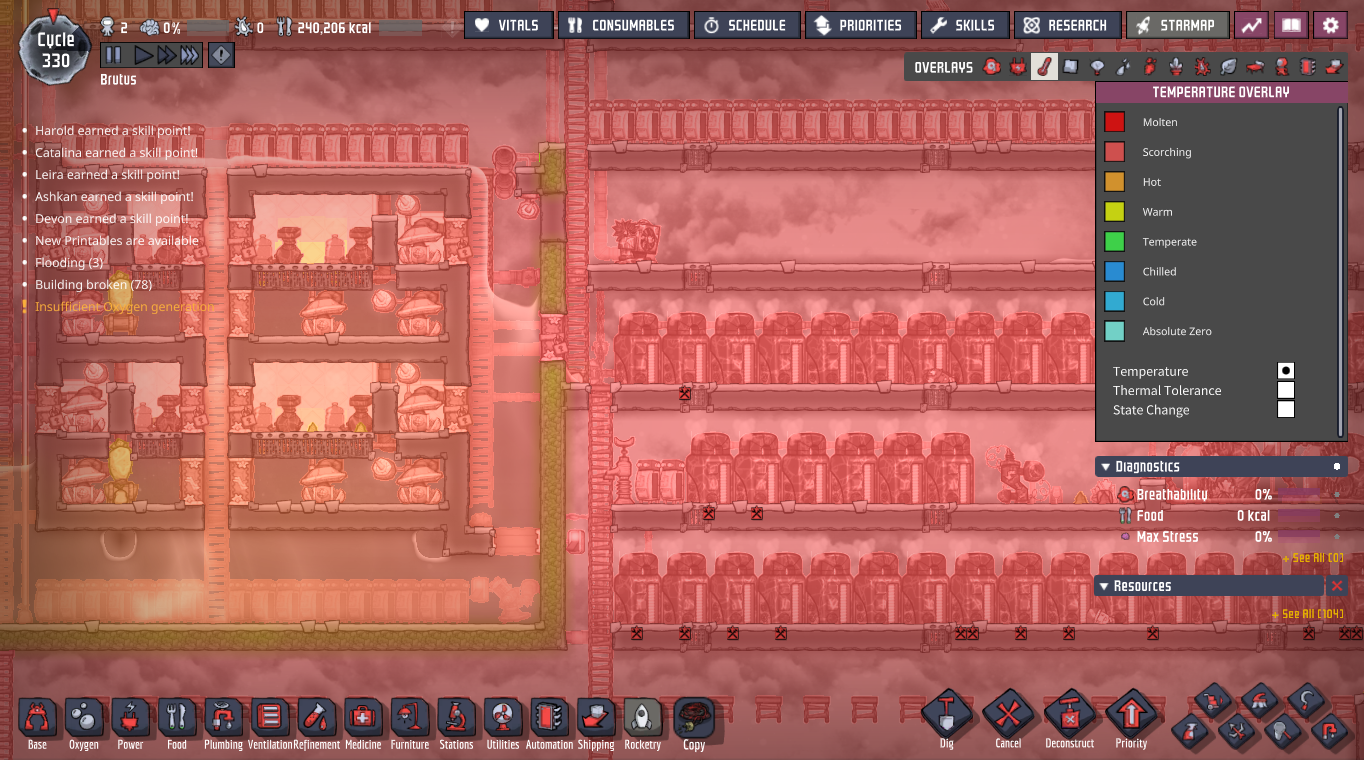
For those who might be interested, here's what happens when you introduce the enormous sea on the bottom of the map to the magma layer beneath:


Still have two dupes left.  Surprisingly, quite a lot of the base, the part around the  is still fairly cool.  See?


Most of the base is trashed, though.  I've been trying to figure out how to rebuild and vent the heat, especially the open hole.  See, the system has become stable, with the steam condensing and falling out of the air, back down into the magma pit where it boils out at 650 degrees again.  So the natural engine isn't cooling.  And if a dupe steps into it, it dies.  I mean, it becomes incapacitated almost instantly.  The heat in the red areas is 250 F.

Here's the thing.  A game like Civ is designed to be played correctly or lost.  A game like ONI is designed to be played badly and struggled back from.  There's always a way back, because the way back depends on the player's creativity and intuition, NOT the game's design.

This is D&D.  At least, the way I play it.  Most see the game as a collection of things the players are supposed to do in order to succeed, such as clean out a dungeon and get the treasure, or recover the McGuffin.  Whereas I see D&D as an endless set of possibilities, where the players can do anything, while I'm able to "code the game" instantly and on the spot, without needing a computer.  Because I am one.

Thus, if the players enter into a valley where anything might be happening, including a volcano having just exploded, the player's responses are ... um ... unknown.  I mean, absolutely unknown, just as I have no knowledge of how to solve the base problem above.  There's no "guidebook" on the internet that will tell me how, because none of the various pundits who blabber about the game have created the situation I've just shown.  The solution has to be mine.

That's what we want the players to feel.  There is no dungeon, there is no pile of buttons to be sorted, no bottles to wash, no pre-set monsters to kill, no thing to get.  There's the situation, there's the players ... 

Have at 'er.


P.S.,

In all fairness, I should show the hole:


Saturday, January 29, 2022

Recognisable D&D

Rule #1 of achieving immersion is not wanting to die.

Give that a moment to sink in.  I haven't said "in the game" yet.  That's because immersing oneself in life requires the same desire to NOT DIE.  That is, not behaving like this:


Long ago, I recognised that some players treated D&D exactly like the above.  Is what I'm doing cool?  Check.  Is it unexpected and provocative?  Check.  Will it put me one roll from death, with a half-way decent chance of survival, if I make the roll?  Check.  Gawd yes, let me do it.

Because game death only matters when the player cares, then there's no reason not to do the above.  Maybe my present character will die, and maybe the next one will ... but when the one after that makes the roll for whatever dumbfuck crazy-ass shit I've done, then I will be a GOD.  Worth it.

More than once, when a player's character died through the player's decision to perform such a stunt, I denied them the privilege of rolling up another character.  "Basically, that's it.  You've had your character.  You're dead.  And there's the door."

All things considered, drawing a hard line on a self-centered player is definitely a better feeling than lucking out at a whack die roll.  The reader can take my word on that.  But then, a lot of readers have stopped reading about sixteen words again, because what I just said is unacceptable.  Players, so it goes, should not be held to account for the way they play their characters, because they are in their perfect rights to play their character any way they want.

"Recognisable D&D" is an extremely fuzzy, subjective ideal.  Using the example of The Keep on the Borderlands, players are expected to tromp out to the Caves of Chaos, kill as many creatures as they can, grab treasure, retreat when hit points get low, heal up ... and go out again.  Each time, the characters who don't die are meant to climb up levels so they can steadily manage the whole thing — thus being entertained by all the clever little bits as they go along.

Suppose we don't do it this way.  Suppose, instead, we go once, grab a handful of gold, then leave the keep and head back to civilised parts.  There, we show a bunch of mercenaries all the gold we found, telling them we "Got it in a single day!"  If they come along with us, we'll give this gold we have now and help them get more.

Whereupon, in recognisable D&D, the DM already feels we're not getting with the "spirit of the thing" — that is, playing how we're supposed to play — and arbitrarily blocks us from raising a small army with the hundreds of gold we have.  So there's an argument, and we say we only want thirty persons, and it goes round and round ... but the DM eventually relents and we get our men and march back to the Keep.

Now, the DM assumes we're going to take our mass directly into the Caves ... and, if "recognisable D&D" means anything, the DM's starting to multiply the number of orcs, goblins and kobalds we'll encounter.  But we tell the DM, "No, we're not going to the Caves yet.  Instead, we build a fort about 1000 yards from the Cave entrance."

"Wait, wait, wait," says the DM, who doesn't know what we're doing, but it's definitely NOT recognisable D&D, so it absolutely cannot be allowed.  Remember that thing above, with someone saying that the way players choose to play their characters, yada yada, sacred blah blah blah?  That only applies if YOU DON'T USE YOUR BRAIN.  If you use your gawd-given human brain to circumvent the DM's expectations, or the expectations of the module maker, then you've broken the covenant and now you're fair game.  You're not allowed to build your own fort; you're not allowed to lure orcs and goblins out of their caves so that you can slaughter them with your own traps and fortifications.

If you try to build your own fort, the denizens of the cave will definitely come and attack you before you're finished, even though they have zero reason to suspect anything's happening, and they never choose to do so against the keep.  If you get your fortification built, the denizens will definitely NOT leave their caves, even though there's no logical reason why they would let interlopers casually start bonfires in their cave entrances, which are right there, ready to be seen.  Frankly, the FIRST thing anyone should do when seeing the caves is to burn everything on the surface forthwith ... as this will reveal every cave entrance and potentially suffocate the denizens with the upstairs fire sucks out all their oxygen.

But again ... this isn't recognisable D&D.

We often hear it said that D&D isn't about "winning" and "losing."  And in a traditional sense, the sense that's usually meant, no, it's not.  But so long as my character is alive and getting stronger, for my money, I'm happy; and when my character dies, whatever the reason, I'm unhappy.  I can usually see that the reason I died was because I failed to prepare enough.  If only I'd thought to bring along another three archers; or another half-dozen bottles of oil.  If only I'd approached more patiently, giving the flankers more time to get into place.  If only I hadn't used the fireball so early in the fight.  Because I think surviving D&D is about planning.  It's not about following the DM's lead.  Or acting as the DM expects.

Anytime I can move contrary to the DM's expectation, I greatly increase my chance of survival.  I had plenty of chances to experiment with this in the 80s ... and I got awfully tired of DMs, caught off guard, suddenly imposing fiat-driven rules to explain why no, I couldn't actually set the hillsides surround the Caves on fire.  There'd been too much rain lately — even if the DM hadn't mentioned rain a single time while we'd been travelling to the Keep or spending time there.  It wasn't the right kind of wood.  We didn't have enough flasks of oil to start a big fire.  Yes, there are trees large enough for kobalds to jump down from, or hide big entrances, but no, there really isn't enough vegetation here.  It was always something.  And after awhile, I didn't want to play anymore.  Not with other DMs, who resisted our using the WHOLE game world and setting to make our designs on how to overcome an enemy, survive and get rich.

That's why I stopped playing.  Because, faced with recognisable D&D, I wasn't allowed to "not die" as well as I was able.

Jump the clock forward more than thirty years, and I often find myself explaining something about how to build a game world, or how to set up an adventure — or how to encourage the players to seek goals that are larger than schlepping out to the Caves of Chaos for their sixth trip — and I am bound to be called to task by someone making an argument that says, "Oh but hey, what about recognisable D&D?"

Yeah.  Well, what about it?

My players sit down at my game world and make the characters that limit what they can constructively do in game terms.  Then, I tell them where they are, and what they see, and they make up their minds about what they want to do.  They decide, and I run it.  I don't care how many monsters they kill.  I don't care how they do it.  I don't care if they kill monsters at all.  Those things aren't up to me.  I don't agree that the game is necessarily about overcoming perilous challenges.  It usually ends up being that, and I'm happy to create peril, but it always happens because those are the choices the players make.

I believe the game is about deciding what to overcome, and then overcoming it.  Making a goal, then achieving that goal.  The best players are those that create the best goals.

The worst fucking players are those that create the worst goals.  Like, for example, deciding that doing something cool in this moment is way more important than not dying.  Or, thinking that making jokes is the reason they play; not paying attention and therefore not playing; throwing the die with intent to cheat; acting in a manner that preserves self and puts other players in greater danger.  And so on.

What is the best goals?  At bare minimum, something that increases the character's capabilities, endurance (hit points) and wealth.  Better still, something that increases the party's options on what to do next.  With great power comes great opportunities.  This is what I mean by seeing parts of the setting as "game pieces."  If we control this town, or we have the ear of the local nobility, or we know the way through the mountains, how do we use that power or knowledge to do bigger and better things.  How do we impose OUR WILL upon the game world.  Once we do "A," that let's us do "B" and "C" ... and maybe then we'll figure out how "C" and "D" will let us do "E," and so on.

I'm talking bigger things than the Caves of Chaos.

Now, I know that most players, propagandised and brainwashed into believing that they're only allowed to do what the DM wants, can't think on the level I'm asking.  In all the campaigns I've run online, it's been a tug-of-war just to convince the players that I'm really going to let them do things I haven't told them to do.  And that I'm not going to "just kill them" for trying stuff.  And that honest to fuck, I don't care what they want to do, I will not arbitrarily stop them from trying.  Repeatedly, I've had to repeat this until I'm blue in the face ... and I never do really see evidence that they believe me.

But off-line ... most of my players have never played "recognisable" anything.  They come to my world from video games, where you try everything in case it works.  Where there is no arbitrary DM's hand.  There's rules, there's what you can do, and there's what you can try.  Coming into my world, they have no preconception that I'm going to jack them.  They just assume that if it doesn't work, it's because they tried to bite off too much; or they didn't plan well enough.  They don't overthink.  They don't look for the meta-trap that savvy players know has to be there, because, "There's just no way the DM's gonna let me do this."

Honest.  Fuck recognisable D&D.  Rule #1 is survive.  Rule #1 of immersion is to consider surviving more important than everything else.  And Rule #1 of worldbuilding is making a game world where surviving is ALWAYS possible, and NEVER certain.

But there is no rule at all that says a game has to include such-and-such familiar elements, or such-and-such situations for the players, or a specific kind of organisation that enables traditional or recognisable anything.

Wednesday, March 6, 2019

Records

Accounting.

If there's anything that is seen as a watchword for not fun, it is having to keep track of fun things.  Yet as much as both players and DM complain about this thankless aspect of a complicated, content-rich game, there are aspects about it that can't be ignored.

My best and most appreciated players have always been those who will dig in and create some kind of control framework for their equipment, their skills and abilities ... and for all those little details about places and people that help keep track of where they've been and who they know.  It is a particular kind of person ~ not based on their personality type, as many people believe, but based on having learned through experience that there is a benefit to keeping track of things.

Allow me to give an everyday example, one that might apply to anyone.  How long has it been since you've misplaced your keys?  Or your glasses?  How long has it been since you've locked yourself out of your house?  Or had to have a particular paper for some official that you misplaced and can't find?  How long has it been since you let your phone run completely dead?  Or failed to get the oil changed on your car?  Or run out of gas?  When was the last time you forgot to pay your phone bill, your mortgage or your car payment?

Some reading this will be able to say, "Last night.  Last week.  I did that Tuesday."

And others will say, "Oh, jeez ... years."

Let me explain that.  All those things above suck if they're not controlled.  Over time, a lot of time for some folks, it is just such a hassle to call the bank or call the insurance company, or stagger around the house looking for keys and other assorted things, they learn to take steps to stop it.  The keys go in a bowl by the front door.  The glasses go into their case at night, which goes into the drawer next to the bed, and always on the same side of the drawer.  We write notifications on email servers to make sure we pay the bills, and we set a day and a time to sit down and do all those things we don't want to do, so we're not doing them on the fly.

Some people call that "being adult," because they can remember their fathers and mothers doing it; because their parents seemed to think it was such a big deal.  Trust me, your father locked himself out of his car.  Your mother has run out of gas at a bad time.  At some point, it became more important for them to prevent those things than it was to just let shit ride, because letting shit ride seemed easier.

People who have learned these lessons, whom we call "responsible," get picked as the people to organize the schedule for this season's little league games.  They're people who get comfort knowing that shit is worked out in advance.  That it is prepared.  That the tables are made, that the caterer's have been called, that Aunt Judy's flight for the wedding will be on time.  Some of us will call that "anal;" or we will call these people, "worry warts."  And sometimes these people will get a bit too controlling; they will try to control everything ~ not just the lost papers and the damage deposit for the hall so that the reading or the dance will take place.  Sometimes these people can get positively aggravating, bossy even, when the world does not work according to the set principles of their clip-boards.

We've met these people, and sometimes been under their thumbs ~ particularly in school, am I right?  And that sets a loop in our heads that says, "Don't ever make me like that!  I never, ever want to be that guy with the clipboard.  I never want to be the sort of person who shouts at my kid to wear his coat.  I want to be relaxed.  I want to be fun."

One day, your kid will come home sick from school; really, really sick.  One day, when everything is on the line, having that clipboard is going to save your ass.  Then you're going to understand.  Then you're going to become one of those people.

I ... think that gets us on the same page.

Let's say you're a DM.  Let's say the players step into a tavern in the little town of Rankin, where they meet in important contact.  It's going to occur to you that you should give the tavern a name.  And that the contact should have a name.  So you shoot one out and you don't write it down.

Does it matter?  That's your first hurdle.  A lot of readers will think it doesn't, not really.  I mean, the players are probably never coming back to this town, and the contact is probably a one-off too.  Hell, we forget people's names all the time in real life, don't we?  And we don't remember every shit-piss bar we've been in throughout our lives.  So we can answer fairly, it doesn't matter.

I was 11 in 1975.  My parents took us down to California to see Disneyland, and then we drove up to visit Sequoia national park.  Outside the park, there's a little town called Three Rivers; and in that town, in 1975, there was a restaurant/bar called Ardfarkle's Grub & Grog.  Telling the name just now, I didn't need to look it up.  It was right there, poking at me, the moment I thought, "think of a memorable bar."  There was something ... really different about it.  I remember the food was good; I remember the interior was all log cabin wood and such; but hell, I was eleven.  What did I know about food, or anything really?  Though yes, even then, I could have drawn a map of California from memory if asked.

I found this online:


And this link, which is a bit creepy, because in an earlier paragraph, before I thought of Ardfarkles, I happened to use the name "Judy."  Synchronicity.

Little things matter.  You may pretend they don't, you may sluff them off, but that's only because you haven't learned enough in your life to realize that the smallest, most trivial things are also those things that pull our lives together.  I remember so little about that California trip; we were only a day at Sequoia N.P. and mostly I only remember the trees.  But I can reach back in my memory and tag something that ~ at the time ~ I never expected I would ever be able to touch again.

Our forebears kept voluminous diaries because they learned that keeping track of these small things that happened so long ago helps enrich our lives.  That is why we write it down.  Someone asks  me, how do I keep track of all this information so that it can be retrieved later if the party ever comes back?

Write it down.  Write it down as you come up with it in the middle of the session, or try to make notes after the game is over.  You won't remember everything, but you'll get better at it with practice and you'll find it gives your game dimensions you haven't encountered.  If you can't write it down, point to your most studious player and say, "You, write that down!  You'll need it later."  You'll find they will.  And when you need that information later, you'll find you can get it back from your player.

You can call it accounting if you like; it is certainly record keeping.  If you need it to be cool, then think of it as recording History.  That's what you're doing.  The books we occasionally read about explorers and pioneers, saying what they did and what they ate on a particular day, that's what history is built on.  You're keeping your own account, making your own diary.  And in the process, building a culture that will envelop your players and your world.

It's effort to do that.  It's remembering to drop your house keys into the bowl and getting your car serviced, and calling your mother on Mother's Day.  These little things add up.  These things make our lives better.  You may be young and unable to see that now ~ but you will see that.  You'll see.

Thursday, January 25, 2018

Dice Rolls are a Threat

Now, if you can keep the last post in your mind, I believe the ground work has been laid for this post.

I was told by François Laroche the other day that, "I guess my difference of view also comes from the fact that I do not value "randomness" as being inherently better than predictability (or "control," as you call it).

Well, since it is my post he was commenting on, and the word predictability means something totally different from control, I think I will continue to use "control" as the word that means what I mean.

Laroche's argument is the sort of false equivalency that I was describing.  When he says, "I do not value randomness ..." he is clearly using that description as though all the forms in which a role-playing system can be played randomly is equivalent in value to every other system; that there is no distinction between this system and that.  He has played in a few systems, where randomness was employed, and he's convinced.  Randomness just isn't that big a deal.

Those experiences are certain to be extremely limited, for reasons I described in the last post.  It takes months to get the hang of a DM's campaign.  Even if our good Mr. Laroche has played in thirty such campaigns over the last ten years, three different campaigns for four months each, that's still just thirty campaigns.  There are tens of thousands of campaigns out there: who in hell knows what is going on, if the participants aren't broadcasting their style on the internet?  There are probably dozens of overtly sexualized campaigns, with players participating in the nude, that none of us will ever discover.  After all, if you ran such a campaign, would you blog about it in this internet climate?

So we're all ignorant.  That is a given. Those who insist we're not are just kidding themselves, hoping for a badge of professionalism that isn't really deserved (though how would that be inconsistent with normal human prestige?)

But rather than continue in this line of reasoning, the best I can do is try to highlight how one type of random series of dice can differ considerably from another.

Let's take the situation with the bridge that is happening with the online campaign.  You, dear Player, are standing at one end of a bridge more than 100 feet above an uncertain watery floor.  The water could be deep enough to catch you, or it could be inches deep and completely irrelevant.  You are 1st level and have no magical powers or items that will carry you across.  And I am your DM.  How do I handle this?

"Control" dictates that the character has the ability to simply cross the bridge.  You, as player, argue that you're a hero, or at least a willing adventurer, you're not like normal people, you don't know the meaning of fear, and therefore you walk across it.

However, I argue thusly.  You and I can easily walk along a sidewalk, without there being any chance of "falling off" onto the grass.  But if a force comes along and suddenly raises that 4-foot-wide sidewalk a hundred feet in the air, what would you do?  We both know the answer, though perhaps I'm the only one to admit it in the game setting, since the player knows that admitting it undercuts the argument.  Both of us immediately fall flat on the sidewalk and pray not to die.  The idea of going along such a sidewalk, with a hundred feet on either side, would be too scary to contemplate.

Why?  Why do we have this response?  Why are we afraid?  Is it our character?  Our constitution?  Our lack of wisdom?  No.  It is our survival instinct.  Our construction as beings says, "Don't walk across that bridge when the drop will kill you, stupid!  What, you want to die?"

So we freeze.  Even heroes freeze.  No "brave" persons saunters across such an obstacle and to argue that one can is to throw out everything that matters about describing an immersive condition for the players to inhabit.

Many who argue control hate that immersive conception.  The last thing they want to do is admit frailty, or hesitation, or anything that reminds them of their real selves, which a great many players dislike intensely.  However, I think the "fun" of the game is to experience, just a little, what it is like to be moving along a narrow pathway a hundred feet over death.  And I know there are others who also feel this way, because quite a lot of us jump or feel creeped out when the camera in a movie pans over the drop and gives us a good feel of what it would be like to be there.


[the maker of this video clearly has a balance or sure-footedness skill a 1st level shouldn't have]

If we discard automatic success, then, we are now stuck with a die roll.  And here is how most DMs handle it: "Roll a die. Success indicates you make it across."

How do I know "most" DMs do it this way, with my lack of real experience of other DM's games?  That is how the modules are written; and the modules are celebrated, gushed over, repeated, bought, sold, treated like fetish objects and thoroughly pitched and pumped to players who have never played them, night and day, on bulletin boards, blogs, vlogs, animations and every other form of RPG communication between participants.  And no one ever, ever says, "Oh, but when you come to the place with the bridge, don't just roll a dice to get them across.  Come up with something more interesting."

No, what they do is they roll two athletic rolls and then everyone dies on the vines.  And the commenting audience is good with that, and everyone says it's "fun."

Yeah, pitted against that, I'd pick "control" also.

If we want a better random approach, we have to take control into account ~ and here is what everyone misses when making vast equivalency statements about randomness.  Some of the situation can be controlled, and some of it cannot, and it is up to us to decide which is which.

We can get the answer for that one by training ourselves to deconstruct the situation.  [That's not how I thought of it when I was 15 and running my first games, but it was what I was doing, having trained myself to do that through many other means, such as learning how to write, fish and make cabins].

First, the character has to begin.  Then the character will become aware they are over the drop.  Don't laugh.  Many's a time we've started something, only to get a little way in and think, "Wow, this is really awful," forcing us to take a breath and pause, deciding if we dare continue.  Following that, there's a moment of triumph as we realize we've reached half way.  And then there's a moment of dangerous overconfidence when we think we've done it, letting down our guard before we should.

Anyone in a rescue profession can see all of these at work.  People freeze up and can't start at all.  People don't think, start off, then realize where they are and freeze up.  People get halfway across, get confident and stop being careful.  People get almost to safety, then look back because they want to prove to themselves that they really did it, and then fall.

All of these are a potential die roll.  Some of them could be suspended for the sake of abilities or dexterity, or personal knowledge, like a thief vs. a fighter or a mage.  Some, with a very low wisdom, might have to roll at all four points.

But so much for randomness. What about control?

Because, again, as anyone in the rescue profession can tell you, there are strategies for each of these as well.  People can be supported.  They can be coached.  The high wisdom cleric can be placed behind the low wisdom bard to give moral reassurance.  Packs can be lightened.  Salt and other materials can be spread on the path to counteract dampness or ice.  People can get down on their hands and knees and crawl.  These are all possible options.  Some might be a little humiliating, such as having your big tough fighter crawl across the terrifying gorge, but you know what ~ in reality, in the military, brave, tough fighters cry.  In fact, it is perfectly all right.  As any veteran could tell you [though they probably won't, because this is kept inside the brotherhood].  If the reader needs it, I know a military NCO from Canada who would be happy to come make comment, arguing the validity here.  Or you can believe Simon Sinek.

It is about a million times more interesting if the party remembers when the fighter got down on his knees and crawled, with the attitude that they would fight to the death anyone who dared say it was true ... because that is fucking real, people. That is life. That is where this game could be.

Randomness isn't dull.  Randomness is a threat.  It is a gun pointed at your head.  It is a bullet that says, "If you don't figure this shit out as best you can, I am going right through your skull."  That is not boring.  That is not something that we describe with equivalencies and statements like "we all play different games."

No, I am playing for stakes on a field you can't even find.  This post is describing one simple bridge, in one simple situation, and I play this way for everything that happens in my game. Your role as player is to try to control every situation to the point where you don't have to roll ... and ultimately to accept, sooner or later, there are going to be rolls you can't sidestep, that you will have to choke down.  And as your hand reaches for your die, you're going to realize something you've never realized while playing an RPG before.

Your hand will be shaking.

Monday, July 24, 2017

Getting Started

Before reading this post, be sure and read this.

Let's suppose that everything you've done as a participant in your chosen role-playing game can be shelved. For whatever reason, none of the players you have now or have ever had will ever play in your game again, and yet you have four utterly untried players waiting to play in your campaign when you are ready to run.  I'll stipulate that they are ready to wait a month, a year or a decade, as long as it takes.  For the moment, however, you're completely free of all ties and responsibilities; none of the adventures you've run will have been experienced by the new players (so you can run them again, if you wish) and nothing that exists in your world right now must needfully exist unless you choose to retain that condition.

For good measure, I'll add that you're guaranteed another 20 years of life, with enough money to live it however you please.  Satisfied?

Now, what sort of world will you run?  I think we can take it that the gentle reader has plenty of experience with role-play, else you would not be reading this blog, so you have some notion of what ideas have worked for you in the past and what haven't.  You probably have a pretty good idea what system you want to run, since it is the system with which you're most familiar and comfortable, so this is unlikely to change.  You might decide to augment the system somehow, or spend a year or two (with your comfortable wealth) working on aspects you've never been able to iron out to your satisfaction.  We can take this as given.

An assessment of the internet indicates that you are likely to run one of the following campaigns:

  1. A game that is adventure driven, in which the players participate in a series of disconnected adventures that exist in a "world" that serves as little more than a cabinet in which the adventures are stored.  The primary goal is to set up a single session or short series of sessions that can be run over a few weeks, a few months at most, before giving up the reins of control for a time to make a new adventure or to make way for other DMs, perhaps other game systems, which can then be enjoyed on a revolving basis.
  2. A game that is a sometime distraction, chosen from a list of possible games that might be chosen on a given night, in which the DM is by no means certain (anyone might be up to the task).  It really wouldn't matter if the game were Settlers of Catan, Forged in Steel, Call of Cthulhu or the Masquerade.  D&D is just another game.
  3. A game that is a light-hearted romp, with simplified rules and concepts, largely narrative-driven and full of character-to-character interaction. The goal is to produce a pleasant evening in which companions can experience the pleasure of acting the part of someone in a fantasy setting, exchanging their usual traits for traits of a series of imaginary personas, who can act with minimal consequences and maximum opportunity for success and conquest.
  4. A game that attempts to depict an actual, personal struggle of an individual in a complex, potentially harsh and unforgiving environment, in which the measure of success depends on the careful preservation of a series of potentially depleted resources, usually expressing a limited capacity for survival and purchasing power.  This last concentrates on problem solving and accounting, since every aspect of the character (including the character's personality) is considered to exit in measurable, finite quantity.

If you're reading this blog, still, it is probable you're looking to start option number 4, obviously the least enjoyable of the lot.  I don't want to paint this improperly.  Everything about the last option discourages any sense of "fantasy" within the definition of a fanciful mental image, typically one on which a person dwells at length or repeatedly and which reflects their conscious or unconscious wishes.  When I began playing D&D, it was clearly understood that the "fantasy" aspect of the game was a clear and understandable description of the setting and only the setting, in no way related to mental fantasies about being rich, powerful, loved, important and so on.  This notion that somehow RPGs are there as a fetishistic manner of living out a life that can't be lived out for real came after, when participants began to displace their sense of unfairness of the game's willingness to kill them when the die turned against them or they did something stupid with the unconscious defense that the game was made for "fantasy purposes" and not as a game where adequate play was the measurement for success or failure.  This led to promotion of fancifulness as the primary motivation of the participants and the complete discounting that the original meaning of "fantasy role-play" meant in a setting with magic and other supernatural elements such as monsters and terrain not ordinarily found in the real world.  In no way does Tolkein, Lewis, Howard, Moorcock or Baum suppose a world in which death, sorrow, misery, unimaginable danger or probable failure are inconsiderable, yet here we are, where "fantasy" worlds are more akin to the sort of fan-service promoted by the Smurfs or My Little Pony.

I'm not interested in those worlds, so I'm going to assume that the reader is the sort of fool who sees an RPG like a golf course, a thing to be devoutly embraced and, simultaneously, devoutly resented ~ and for those who have no idea what that means, I recommend more golf or less reading of this blog.

Then how do we go about starting a campaign based on #4?  Like a novel, or any artwork, we should start with our motivation for initiating the process.  What do we expect to get out of it?  Why, for heaven's sake, do we want to be a DM?

I've been thinking about this quite a lot.  It's worthy of a long post, but I've written about a hundred long posts already on the blog so here I will just sum up.  In the same way that the players are faced with a world which they must problem solve in order to thrive in that world, the DM is faced with players who must be convinced that they have the power to influence that world according to the strategies they employ, in a believable manner, within a boundary that possesses near perfect "play" within the fixed system the DM has invented.  Keeping that system fixed, or running smoothly, without kinks or hitches, even when information is necessarily lacking because it must be invented believably on the spot, exactly within the confines of the previously operating system, is spectacularly difficult and a problem-solving feat that puts player problem-solving to shame.  To make a good game, the DM cannot casually move out of the groove that has been previously established, or the whole system quickly goes wonky and flies out of control, with the player's psychological responses being the determiner for how "off" the campaign becomes.  As the DM deviates more and more from the groove, the players' reliance on the system spins further and further out of balance, until the DM can't put the campaign back into working order because the players' memories won't allow this.  The campaign is broken and stays broken ~ and survives from this point forward by replacing players with independent, proactive imaginations with players with needy, resigned forbearance.

This is the game I play.  My attempt to keep the wheel spinning with grace sometimes ends badly, with players who express boredom or distrust of the campaign, bringing about its end (an end that I accept rather than evade).  Sometimes the attempt enables the game to remain in play for years, until circumstance or separation ends the effort.  It is clear to me, however, that the thing I most get out of the contest is the rush to stay ahead of the players, to first enable them and then compensate for that enabling, then to predict them without predicating that prediction on my power to make the world act any way that I wish.  The more I put my hand in the system, the more smudged the lens gets, until neither I nor the players get anything out of what we see going on.

If this is not the reader's motivation for running the #4 campaign, then I dare the reader to put forth an explanation that is as thorough, as researched, as measurable and as definitive as that which I offer.  No feelings, please.  My description of the groove, as I call it, is part and parcel with the whole design of the campaign, from the maps to the rule-system to every judgement call I make from beginning to end, connected to this blog and every point of advice I've tried to give.  It isn't a "feeling" ~ it is a conscious effort to balance the needs of the campaign's difficulty against the needs of the player to believe they can act fairly and freely to counteract that difficulty.  My personal sentiments as to how I "feel" about being a DM do not enter the equation.

I like it.  That's as far as my feelings go.

Very well.  How are we going to set up the mechanism in which play occurs?  Remember Katie Salen and Eric Zimmerman's definition of play: free movement within a more rigid structure.  What, then, is the free movement and what is the rigid structure?

We want to have a clear concept of how much free play the players ought to have.  In this case, I'm not speaking of the players in relationship to the DM, but rather to the actual world itself.  The world is the rigid structure; but different worlds, and different genres for that matter, offer a wide range of rigid structures that will appeal to different players.  In each case, we can measure the rigidity in terms of the potential for conflict between the players and everything that is not the players: how interested is the setting in the players, how much capacity does the setting possess to observe the players and how likely is it that the setting will take steps to counteract the players' actions.

In giving some examples, I want to express strongly that I am not speaking of any specific game system or any specific game setting.  Setting is something we can leave for later on.
  • Extraordinary rigidity.  This is more likely to exist in games where the scope of the game is somewhat minimalistic, particularly in games where participants are expected to be a part of a clan and where the enemies are part of other clans.  In such situations, players have to both survive attempts by other clans to kill them, will steadfastly adhering, or appearing to adhere, to the strict rules of their own clan.  Another example of extraordinary rigidity occurs in high tech games, where mechanical surveillance is constant and common, where everyone is under suspicion and where a large population encourages draconian methods to keep order.  Another example might be a dystopian environment where the number of potential threats is so high that there's hardly a moment when the players are not at risk; a dungeon might fit this description as well, or a high tech environment with a "raft" of some kind (planetoid, ship) immersed in a highly toxic or otherwise deadly environment. However, though player choice may be limited, the play in the system need only be enough that the players can sort out wrong actions from right actions, encouraging them to move cautiously but nevertheless successfully through that 'scape.
  • High rigidity.  In each case, this will likely be reduced examples of the above, mitigated by short periods in which the players are not under threat or have reason to believe, within certain circumstances, that they are safe.  Spy games, where missions are interspersed with returns to base, or some fantasy campaigns where the participants are able to return to a "safe" town from a dungeon, would fall under this category.  If the town has minimal opportunities apart from resupply, which virtually all space outside a certain "free parking" zone expects the most dangerous of confrontations, then the system likely has little space for players to diddle around doing their own thing.  I don't describe a railroad, exactly, but if we're talking a game rich with superheroes or supernatural, highly aware gods, then the players are going to find themselves consistently interrupted by reprisals that are the result of their previous actions, regardless of the players attempting to settle down or seek compensation in some manner other than adventuring.  We can consider any game where the players are pitted against a host of known adversaries, or where their activities lay the ground work for future, necessary activities for survival, as one of high rigidity.
  • Medium rigidity.  Effectively, the players exist in a relative bubble of indifference from the setting until such time as they begin to impress their actions upon the world.  In a similar way to the above, there are a series of consequences that are stirred up by the players' actions ~ but unlike a high level of rigidity, these consequences may not necessarily lead to conflict.  Whereas it is taken as a given that Batman and the Joker will never make friends (high rigidity), a medium rigidity enables the characterizations of non-players within the campaign a degree of flexibility that will (for example) enable the Joker to get help and to change.  The players may create the circumstances of a war but may then enable the possibility of a truce, rather than the war becoming necessarily ongoing and unresolvable.  The campaign, therefore, enables periods where the players are able to sew up loose ends and, for a time, drop out, reasonably expectant that they will be undisturbed for a period ~ however, this also assumes that when the players again begin to meddle in the affairs of the world, they will once again find themselves in the soup.
  • Low rigidity.  The indifference that the setting was prepared to award the players at the start of the campaign, as described above, is more pronounced and less likely to alter, except in situations where the players make a considerable attempt to make themselves noticed.  Unless the players doggedly make efforts to encourage conflict between themselves and the setting, the setting is largely prepared to let them go their own way.  This doesn't mean that the players won't meet with potential conflicts, but most of these will be disjointed or disconnected, such that the players won't be able to rely upon a concerted effort of the setting to kill them in order to find purpose as gamers.  Put in a world that feels indifferently towards them, the players must be proactive in making changes to their situation ~ no one else in the setting will do it for them.

Any of these structures may be considered "rigid" to a different degree.  To put it in mechanical terms, the controls of a helicopter are extraordinary rigid in their expectations of the pilot.  A small plane would have a high rigidity in expectation.  A car, a medium rigidity.  Finally, a bike would have low rigidity.  A bike can easily be ridden, even turned, without touching the handlebars; it is easy to manage because it extends not very far and perfectly visibly on all sides of the rider.  A car, much less so, though it can be driven without touching the steering wheel.  It cannot be turned, however, without doing so.  A plane is harder still, as it is not wise to take one's hands off the controls for more than a few seconds (a passenger jet is less rigid than a car, with moments of considerable rigidity).  Finally, a helicopter will not allow the operator to let go at all, without the probable result of a crash.

All are perfectly effective vehicles, all are fun to drive, all serve a different purpose and all have free movement in a more rigid structure.  None of them are "better" ~ just different.

The DM needs to have a clear idea, however, of the world's intent towards the players.  It is no good rapidly or randomly switching from one degree of flexibility to another without warning, as this will simply confuse and then frustrate the players, until they are prepared to let go of the campaigns controls in vexation.  Once the degree of fixedness is understood by both the players and the DM, however, and maintained, the game can grow into a pleasing, effective user experience for all involved.

Part of the decision must be the DM's potential for staying in the groove!  Surprisingly, a loose and indifferent campaign is much harder to run than a tight, rigid campaign, in that the amount of variables and grey area expands rapidly once the players are not asked to account the same for every action and counter-action they take.  It can take a lot of time for players to sense the logical difference between "we really pissed everyone off" and "we pissed off a few people" and "why isn't anyone pissed off?", then compare that meaningfully to their own actions.  If the players can count on everyone in the setting trying to kill them, this demands much less exposition and explanation from the DM!  "They're trying to kill you because they are a different clan"; "Everyone in this world is trying to kill everyone"; these are easy.  "They haven't decided if you're worth killing, and in any case they're busy killing someone else" has a nuance that takes a greater degree of effective, purposeful setting descriptive to evoke in a player's comprehension.

What I'm saying is that while an extraordinarily rigid campaign threatens the player like having to fly a helicopter, it runs the most easily for the DM.  And while the low-rigidity campaign is less threatening for the player, like a bicycle, the DM is forced to keep a tight hand on the stick at all times.  The degree of difficulty for DM versus the player is wholly inverted, in terms of the amount of problem solving that must be done.

Think of this question, this degree of rigidity, as the usability of the campaign, both for player and DM. Both parties must be considered in choosing the degree of the campaign ~ will the players enjoy or like a campaign that is either extraordinarily or highly rigid?  Will the DM manage a medium or low rigidity campaign?  Compare the capacity for play, the willingness to play while in constant or semi-constant danger and, overall, the sheer desire to play situations that are either wholly proactive or wholly defensive.  There's a lot to consider in the above.  Do not go lightly into the question.

While the reader is deciding (presuming you're prepared to reconsider your campaign in the light that it can be completely altered from what you're running now), look back into your own past and seek out the setting that will satisfy the needs of useability that you've assigned to your campaign.  It should be a setting you know very well; it should be one you're prepared to reshape and redesign in your imagination, as it needs to be flexible to service the needs of you and your players; and finally, it should be a setting that others will find appealing.  It is no good if the setting is something you're in love with but which is so obverse to user interest that you'll find yourself resenting their lack of requited love for your project.

I do not recommend searching your memory for a movie or a tale of someone else's design.  That design may be universal to all your players, but if it is to be flexible, it will undoubtedly upset others when you change it in a way that seems wrong in their opinion.  If you can create your own vision, one that is easily understood and accessible, that owes no baggage to any other source, that you can present clean and clear to the players, encouraging them to then make it their own (once you birth the baby, you have to let it grow up), you have a greater potential for a group experience than trying to shove an idea down their throats or massively hacking away at a jointly perceived shrine in ways that will infuriate others who have different things about that shrine that they like and you don't.

All right.  That's enough for now.  We can talk more about setting later, if necessary.  As I said already, a good setting comes with experience.  I'll add to it that it comes with a willingness to hack limbs off the setting that aren't working, when they need to be hacked off.  Forestall the surgery if you can, but sometimes surgery is a necessity.  Don't be afraid to get out the saw when the time comes.

Next we will want to talk about player confidence.  I don't know when I will write that, but it's the next logical step.