Showing posts with label Ability Stats. Show all posts

Saturday, July 13, 2024

Age and Ability Stats

There is no Saturday Q&A this week. Twas a heavy time for me with regards to work responsibilities, so I hardly touched the ongoing book, I've not touched the tutorial campaign, and on the whole I've been anxious to set responsibilities aside.

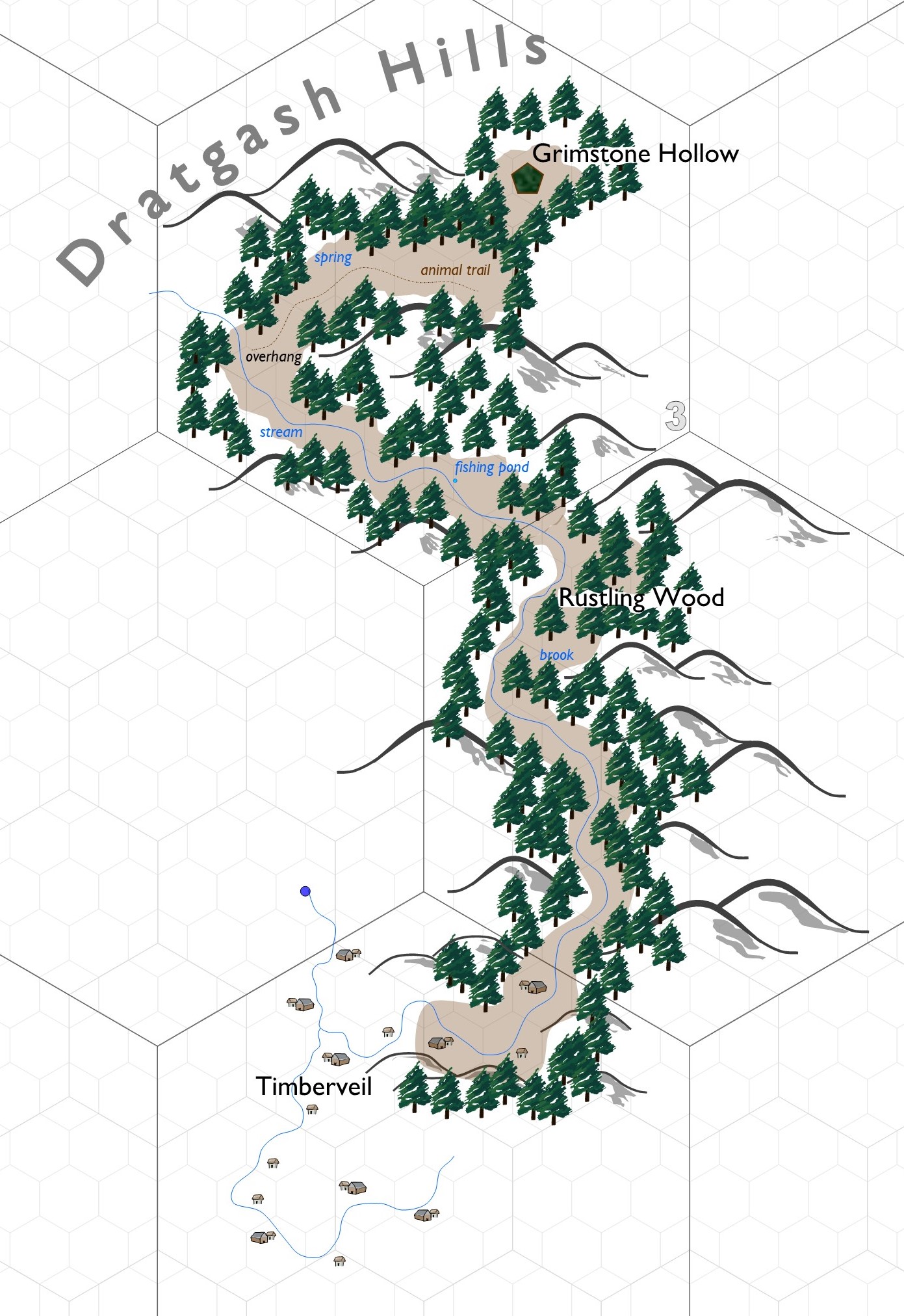
But, to bring us up to date on that campaign, Arliss and Bertrand have just stumbled out of the Rustling Wood, encountering a single peasant hut; I haven't updated the wiki yet, but I expect that they'll seek the good will of the farm to learn more about "Timberveil," as I'm calling this type-7 hex.  And for the record, I can well imagine how overwhelming even this simple start is for those who have never seen my blog before.

Bertrand, who grew up on a farm, will offer his services in exchange for food — there is always work to be done on a farm, particularly in the outback, so this offer will be accepted.  

On the 6th of May, while the paladin works, again not officially, Arliss can explore Timberveil (see here) to see what goes on, and learn something about the next hex down stream (blue dot).  He might also try to find a strapping young soul to perhaps join them; there are 14 chances of 4% of this.

A hardened commoner, should they find one, would add +2 h.p. to a d8 roll for hit points and would be proficient with a club as a weapon.  According to the page linked, he or she would also have a +1 to constitution and strength ... which I'm considering just now.  In fact, all this above has just been to get me to what this post is about.

I've long made the argument that class training would be something that youngster would begin around the age of 10 or 11.  In that post, I proposed that a newborn's ability stats would be equal to zero, and that the child would gain 4-10 (2d4+2) points to their random ability stats the first year, and 1-7 (2d4-1) for each year thereafter ... and that this would end up producing an average of 63 at age 15 — which, as I said then, was the actual average of rolling 3d6 six times for a character's ability stats.

Personally, I think this is a brilliant statistical sleight of hand, but at the time it made little impression.  It deserves it's own page on the wiki, but that's for another day.   In any case, I suggested obliquely with that post that those who did not receive training after age 9, the total added for those last six years would be 2d4-2, producing an average of 57 rather than 63.

This neatly gets us around an untrained commoner having the same number of stats as a trained NPC fighter.  Player characters do better than average, as the average of throwing 4d6 and discarding one die of the lowest amount gives an average of 11.91, or 71.46 for all six stats.  The chance of a PC rolling an 18 for a stat is 3.4992 times better than an NPC.

The problem with that "hardening" given to commoners is if I roll an 18 on 3d6 for the NPC, it gets pushed to an 18/10 strength and a 19 constitution, which doesn't really work for me.  Thus I had to include a note that commoners were prohibited from having their ability stats boosted above 18.

But suppose we use the system I proposed in 2010, and generate the commoner in a manner that an initial 18 of any stat isn't possible ... and so that we may know what the youngster's stats were when that individual was at 8 or 10 years of age.

With a little help from chat, I devised an excel page that will do that generation.  Here's a sample screenshot:


Thus our individual developed a significant dexterity very early in life, so that at the age of 4 he or she had the pre-requisite to be a thief.  Quite believable, as such characters have been a part of fiction since forever.  He or she was quite a beautiful baby (3 pts.), but that faded to just above average.  The other stats are fair.

Point in fact, this is not a levelled character.  It proposes that this person might have been one, if they'd had the necessary training, but that never materialised.  Training would have, according to the 2010 post, improved these numbers by 6 points across the board.  The harden commoner page, which indicates a necessity for being "hardened" in order to enter combat without making a moral check first (and we can therefore assume every levelled person, even a mage or a bard, is "hardened" in this fashion), thus gives an additional +1 strength and a +1 constitution.  That's at least 8 point ability points, on average, that this character could have achieved.

But that's not all.  The original random number per year, up until age 9, the reader will recall, is 2d4-1. And with age 10 to 15, 2d4-2.  The latter is an average of 3, but not a limitation of 3.  Suppose that training does better than restoring that "-2" to a "-1."  Suppose that it, in fact, gives a benefit of 2d4 without subtractions at all, or possibly just 1d4+4, applied to all stats, across the board.

We might even posit that different schools of training offer higher stat bonuses for the individuals who take their training there.  Just in case any player characters want to be sure their children go to the best schools.

Those looking at the excel file I've linked will notice, possibly to their distaste, that I've placed a ceiling of 17 on the ability stats, so that this number cannot be exceeded in the generation.  It's my feeling that the 18 has to result from training; it can't be acquired naturally.  This may go against the grain of many, but the fix is easy enough if the reader understands excel.  It's just how I intend my game to go.

Of course, the whole premise may be disputed by some.  The most likely argument is that ability stats cannot be adjusted and are what they are, and that a character with an 18 strength at the age of 4 simply has a ratio-based 18, which makes him or her stronger than other children of that same age.  Comme si, comme ça.  The original game clearly did not consider ability stats sacrosanct, and there are rules that state they improve or decline with age, so I feel that what's shown here merely fits into those rules.  And anyway, we don't need to know if a 6 year old can beat up other 6 year olds; we want to know, if the 6 year old with an 6 strength tries to help lift up the cart, how much actual help does that provide?

Because, as an aside, my rules for bend bars and lift gates depends on how much combined strength is brought to bear, without a die roll.  If these bars can be lifted with a 17 strength, and you have that or better, then you can lift these bars.  And if you have a 16 strength, and your one y.o. child has a 1 strength and helps, damn it, you can lift those bars.

'Course, you'll think you did it all by yourself.

All this goes to determine what sort of person Arliss and Bertrand might find, and what interesting stats they might have, allowing for the possibility that they could obtain a useful 10 y.o.  Which I think would be most phenomenal.  I'll have to devise some sort of random table that gives an age for any commoner wanting to join the party.

Tuesday, September 13, 2022

Love of Character

Let's take a moment and talk about 3d6 in order.  This was the procedure that began with writing down the character's six stats, usually in the order of Str, Int, Wis, Dex, Con and Chr.  (I don't play this order, because early in my gaming it became clear that by separating the two stats that began with 'C,' new players were able to distinguish them more easily).

Then, the player roll 3d6 and wrote the number down next to strength.  The next roll was written next to intelligence, and so on down the list.  Thus the player was subject to a very rigid system in determining realistically what class could be played ... and commonly, with classes that had high stat requirements, like the paladin, a player had to be very, very lucky to get a set of results that enabled that class to be taken.

I have never used this method.  I have never had a player ask me to play this method, or express any disappointment at this method not being used.  But let me explain my position, nonetheless, because I know that 3d6 was a thing, and may still be a thing, with some people.

Three six-sided dice will produce 216 possible combinations.  If we imagine the dice lined up next to each other, then it needs to be understood that 3-6-4, 6-3-4 and 4-6-3 are all different combinations, even if they all add up to 13.  There are, in total, 21 combinations that add up to 13.  There are 25 that will produce a 12, 27 that will produce either an 11 or a 10, 25 that will produce a 9 and 21 that will produce an 8.  Altogether, there are 146 combinations out of 216 that produce a number between 8 and 13.  That's 68%.

In traditional, Old D&D, the numbers 8 to 13 next to a stat mean next to nothing.  There were no ability checks in the game rules, the range won't give you a bonus to your "to hit" or your damage, it won't give you a wisdom bonus against charm spells, it won't add to your hit points.  If you're a mage in AD&D, the range makes some difference in your spells list, but not an especially significant one.  In any case, if a number less than 12 showed up next to your intelligence, you'd have been a bad player to decide being a mage was a good idea anyway.

In truth, you need a 15 or better in AD&D to have any stat make a significant difference to your character.  The total number of combinations in 3d6 that will produce a 15 or better is 20 of 216.  9.3%.  Not even 1 in 10.

Thus, your chance that any stat you roll in six 3d6 rolls being above 15 is only 56%.  Slightly better than 1 in 2.  Stick a pin in this.

Because 3d6 are being rolled, the chances of you getting a number less than 7 is precisely the same as you getting one above 14.  This means that for every meaningful character stat, one that could make an actual positive difference to game play, there's an equal possibility of a stat that provides a negative penalty against game play.  It's true that this sounds like balance ... but it's not a balance when there is a 56% chance of your character having one stat less than 7, AND a very good possibility of having one negative stat, and NO positive stats at all.  The reverse of this situation is eagerly anticipated, while the converse is, well ... shit.

It's often said that players who roll bad characters will suicide by monster, which is sometimes presented as a "fix" for the 3d6 system and sometimes shamed as "bad play."  I consider the argument immaterial.  The bad characters are not the real problem.  The real problem can be found in the good characters.

Using the 3d6 system, there is a 1 in 216 chance (0.46%) of rolling an 18 ... three sixes.  When this is done, the character having succeeded is awarded by vastly overpowered benefits in the case of strength, and moderately improved benefits in dexterity and constitution.  NO significant powered benefit in Old D&D is given to an 18 that occurs with intelligence, wisdom or charisma.  This means, even IF you roll an 18, you have a 50% chance of that 18 being wasted on a stat it doesn't help.  But if you roll that 18 on strength, then you have the benefit of being three times more powered as a fighter and combatant than a character with a 17.

A player with a charisma of 17 is very nearly as charismatic as one with 18.  As far as needing to be a paladin, either a 17 or an 18 will get you the ticket that lets you BE a paladin ... but the 18 is really wasted.  It might as well be a 17, for all the good it does.

The problem is that whomever rolls an 18 in a set of players, who happens to roll it next to strength, wins a bullshit lottery that puts to shame every other character round the table.  Since most of the stats that everyone rolls are essentially useless, and everything between a 7 and a 14 provides NO meaningful survival benefits (81% of stats), the 3d6 method demonstrates only that the original ability statistics design was a shitty, shitty rule set.  They only work now because we've found ways in the last 40 years to lend additional meaning to stats of every amount ... but that meaning did not originate with the arrival of AD&D in 1979.

Now, 4d6.

By rolling 4d6 and discarding the lowest die, we produce 1296 possible combinations.  The chance of rolling a 3, which can only occur by rolling four 1s, is 1 in 1296.  But the chances of producing an 18 by this method, where the lowest die might be a 3, a 5 or a 2, is 21 in 1296.  That's a 1.62% chance that any given throw will be an 18.  That's almost four times the chance of rolling an 18 over the 3d6 method, with 9.72% of all characters rolled at the table having at least one 18.

Using the same Old D&D rules regarding adjustments produced by ability stats, this increases the chance of a character having at least one stat of 15 or better.  There is a 300 in 1296 chance of doing so ... or 23.1% of any stat doing so.  This makes 15 or better stats far more common throughout the collection of player characters ... importantly reducing the excessive value bestowed upon a very unlikely but inevitably occurring 18 in the 3d6 method.  Because more characters have more 15s, 16s and 17s, the 18 is devalued.  That makes it LESS a game breaker when it occurs ... especially when there's a fair chance that two players at the table will have one.

Now, getting rid of the roll-in-order expectation.

IF the players can choose where to put their 15s, 16s, 17s and 18s, this diminishes the special importance of the character who happens to roll an 18 with their first roll.  He or she feels no special responsibility to be a fighter and make use of that 18 where FATE dictates, and can instead be the character class he or she wishes to be.  This means that any fighter with an 18 can be looked at by another player with the thought, "I could have put my 18 there if I'd wanted, but I'd rather be a mage."  Or a paladin, or whatever.  Less resentment, therefore; a greater personal sense of connection with the character; happier players all around.  AND the essentially broken ability stats system as it existed originally is smoothed out considerably at a time when other fixes were not yet conceived.

I have made the point repeatedly with my character background generator that a player ought not to be able to choose a character's birthplace, parentage, social status and class, or skill-sets that the player learns as a childMy only exception in this is that I allow the player to choose the character's sex.  That is because, realistically, it would be stupidly obtuse in this day and age not to recognise that many people will never be comfortable or encouraged to play a sex that they do not feel able to play.  I'm not stupidly obtuse, so I don't insist on this.

That said, a character's class IS something that the character LOGICALLY should be able to choose.  Before the character can become that class, he or she must raise the money for the necessary training, and then as a fully-functioning teenager and afterwards an adult (as some classes require more than a decade of training), that person must WANT to work and train and pass tests and overcome shortcomings in order to be that class.  If the character didn't want it, then the character would never have excelled in the trainer's expectations ... and thus, would never have been that character class.

Thus, it's reasonable to ask the player to suffer not having parents, or having been raised as a poor street urchin in a whorehouse, or accept that when they were 5, they accidentally got a limb caught in a mill-wheel and had it torn off ... because the character's intelligence isn't that high and hell, the character was only five.  But it is stupidly obtuse to tell the player that his or her character became a fighter because there was no chance of spending years studying books to raise his or her wisdom, or years in the wilderness learning about plants and animals, or years cheating and killing people on the street while increasing his or her reaction time.

See, here's the thing.  That baby there might someday have an 18 strength, but when it's a baby, it's strength is 1.  And the argument exists, does the adult have the 18 strength because the baby was destined to have one, or is it because the baby slowly gained a point of strength every other year until it was 11, and then it began training as a fighter.  Because I think it's the training the baby, later the child, got ... and not the bones or the blood or the speed the baby had as a baby.  Maybe those things helped.  But without the training, there's zero chance that whatever the baby starts with is going to become an 18.  18s are not born.  Like with Olympic athletes, 18s are made.  Just as my intelligence was made with conversations I had with my father, who continually challenged my logic until I went out and found smarter people than my father.  Just as my wisdom was built with books and experience and not my mother's womb.  Just as my charisma was born from my empathy and not my wavy black thick hair (which is now salt-and-pepper).  We are not designed by our attributes!  Our attributes start off as little stubs, that have ever possibility of remaining stubs if they're not fed practice, direction and effort.

Thus, I let players be the characters they want.  Thus I let players organise their ability scores.  And thus I further insist that if the player does not roll at least one 15 AND one 16, or otherwise at least one 17, then all the rolls are scrapped and the player starts again.  As many times as it takes.  Because a player deserves more than a character who "happens" to be what it is.

A player deserves a character that can be fallen in love with.

Friday, January 24, 2020

The Problem

Occasionally I read StackExchange to see what questions D&D players are asking ... and commonly I find queries like this:
"How can I avoid problems that arise from rolling ability scores?
"Rolling ability scores is a time-honored tradition across many editions of D&D. However, it can sometimes cause problems for players and/or the DM. For example, one player character may end up much weaker or much stronger than the rest of the party, which can result in a poor experience for some of the players. In other cases, a player may have their characters repeatedly commit suicide-by-monster so they can try to reroll for higher stats, which can be quite frustrating for the GM and other players.
"What approaches are available to mitigate these problems?
"Note: Answers should ideally be able to prevent both the "Joe rolled all 7s, and his character is useless" problem and the "Karen rolled all 18s and her character makes everyone else's character useless" problem. That is, an answer that only avoids very low average/total scores is not as good as one that avoids both very low and very high average/total scores."

I don't answer these questions on the site, any more than I normally answer questions on Reddit or any bulletin board ~ because these discussions invariably devolve into baiting questions or whataboutisms.  There is an answer to the above question; and it begins with first understanding what's being described.

The "problem" is that the DM, the game as it is played, the usual expectations created by company modules and contest events, perceive that a character with very high ability stats is a "superior" character, as compared to those with average stats ~ and that one with very low stats is, predictably, "inferior."  And this is true, (A) if the DM runs a game that includes a high number of success/fail rolls based on the character's ability stats; (B) if the game itself focuses excessively (more than ordinary) upon bonus/penalty modifiers to those stats to determine success; (C) if the modules being played prepare the DM to focus exclusively on both (a) and (b); and (D) if the mass event includes a feature that rewards "play" based upon the party's success in completing the official module being presented.

If you build the game specifically that way, where every decision being made by the player is followed by the DM saying, "roll to see if you succeed," then obviously we should expect that players able to consistently roll against 17s and 18s will perform fantastically better than those who must consistently roll against 12s and 13s.  If I ask you to play craps, where the rules at the table apply to everyone the same except you ~ because, for you, a 3, 6 and 9 are automatic losers ~ then, yeah, you're going to resent how the game is tipped in favour of those who can roll a 6 without losing all their chips.

I should think most of my readers already know that 5th Edition has been nerfed so hard that this problem was managed by getting rid of players rolling for their character stats.  Essentially, the game writers found the imbalance so insurmountable ~ as told by the game's general audience, who were asked for their input ~ that their only "for sure" correction had to be that every character's stats had to be perfectly balanced with every other player.  After all, equality is the highest virtue.  We need equality to settle, once and for all, the right of every player to feel effective and useful when the game is played.

Those of you playing 5th Edition:  experiencing a lot of equality at the game table?

All that's happened, of course, is that ability stats have become less of a go-to excuse to complain about the lack of fairness that persons feel when something (like the die) goes against them.  But as humans, we don't need ability stats.  We can always find something.

That is because, as humans, we are not equals.  Most of us expect this, accept it and, by the time we cease to be children, move past it.  I'll prove it.  I think it's safe to say that if Ken Griffey Jr. showed up at our company softball game, we'd be glad to meet him, to shake his hand and to let him play.  Obviously, we'd want him on our team ... but we'd also realize that if he were playing, the score on either side wouldn't mean much, as it would depend mostly on how seriously Griffey played.  But here's the thing: in D&D, there is no other team.  There is ONLY our team.  The DM isn't a "team."  If we sat down to play with the "Ken Griffey of D&D," it ought to be pretty obvious from the start that it wouldn't matter what character class he played or what his stats were ... and it wouldn't matter if our stats were higher than his.  He's going to out-think us, out-innovate us, be six jumps ahead of the DM ~ and he'll be funny, clever, charismatic, encouraging, supportive and an all-around helluva guy; because he'll get, like the best players in the game, that while there might be some rivalry between party members, we're not competing against each other to see who "wins."  No one wins.  We all win.  Winning is not what the game is about.  And those who carp and moan about, or lord their lucky rolls over the ability stats of their fellow party members are having bigger problems with their personality than that they need to win at a game without a winning line.

I want to emphasize that many DMs and the public social culture behind D&D push this winning narrative ~ by pressuring us to laugh at players who experience bad luck, or to stand up and scream at the DM upon rolling a 20, "In your FACE!"  And like behaviour that suggests that other players are a personal threat to our comfort and that the DM is the embodiment of the game's persecution of players.  The player who feels they've "got it made" because they've rolled high ability stats demonstrates that we're emphasizing the wrong things in game play.  D&D isn't craps.  It isn't strictly about rolling dice.  It is about setting oneself and one's party up so that when the dice are rolled, we've prepared for bad luck.  We've thought this through and made contingency plans ... and none of us need high stats to make those plans.  None of us should think that high stats will guarantee that a plan works.  And all of us should know that, inevitably, with experience and more levels, those stats are going to mean less and less compared to the battle ready creativity we can bring to any situation.  We're all going to gather more power as we go, according to our real life efforts, smarts, bravery, good sense and willingness to take bad luck into account.

And yet despite that, despite the personal experience hundreds of thousands of players have had trying to solve puzzles or survive against enemies without the wisdom to run when a TPK threatened ... we still think that ability stats are a "problem" because some people will get more and others will get less.  These same people who should have realized that Karen with all her 18s can't be everywhere, and that obviously she is not a one-person army, and that she is bound to draw the greatest amount of direct attacks once she begins to kick ass in a general melee, so that the rest of us are plainly not "useless."  Not everyone on Ken Griffey's team is Ken Griffey ... he's going to need someone at 1st base to throw to.  Granted, at 50 years of age it's possible he can pitch well enough to stop us from ever getting a hit (he's an outfielder), and we'd probably never get him out, but that's beside the point.  If I do catch hold of a pitch, that ball is going way over his head.  My point is that he can't be everywhere; no one can.  Karen isn't going to solve every puzzle, she needs to be healed occasionally (speaking of editions where healing isn't a stupidly easy nerfed thing), she can't fly, she can't breathe under water, she's only one person.  The rest of us are only "useless" if we choose to view the game as a competitive pissing contest ... which it isn't, because if Karen kills half the enemy, we all move ahead.  Not just Karen.  If Ken Griffey Jr. hits a home run and wins the game, the whole team wins.  Not just him.

If Joe throws all 7s ...

[never seen that, but yeah, could happen; never seen all 18s, either, but using 4d6 to roll stats makes rolling an 18 almost as easy as rolling a 7 ... but I digress]

If Joe throws all 7s, then suicides by monster over and over, the "frustration" should absolutely be addressed.  That is, Joe's frustration, not that of the DM and the other players.  Clearly, if Joe is suiciding by monster, Joe has reason to think that if he doesn't have a character with higher stats, he isn't going to be useful, it is because the game is making Joe with his all 7s feel useless.  I am more apt to believe that this opinion of Joe's is not coming from Joe ~ and I am just as inclined to believe that everyone else INSISTS that it comes from Joe.  In other words, that Joe's dissatisfaction is more likely to be ignored and belittled, and that he is bound to be further humiliated for having the poor taste to roll poor numbers, than that Joe is spoilsport.  Given the emphasis that DMs and players DO put on high numbers, and the game balance described above that forces every player decision to become a success/fail roll, Joe has every right to protest and throw the game in the face of his peers.

Either Joe should have the right to re-roll his character, to obtain an accepted minimum (which I do, partly because I have had Joes in my campaign who have been hurt and cannot reconcile themselves with poor rolls, no matter what my campaign awards), or else Joe needs to feel that his numbers aren't really that important.  This requires that everyone at the table feel the same way.  Including the DM.  But it is ridiculous to create a game where Karen's high stats are viewed as making everyone else feel useless, only to then turn around and disparage Joe for not sucking it up and playing his crappy, extra-useless character.  There is something broken here, and it isn't just the game.

Beyond the structure of roll-heavy game designs (and fracturingly competitive game designs), and beyond the win/mock sentiment of game pissing contests, I put the third blame on game campaigns that demand the one player/one character model in game play.  Why shouldn't Karen also have a second character who does not have all 18s?  And why shouldn't Joe also have a second character who does not have all 7s?  Why can't players manage multiple players all living at the same time, allowing parties the freedom to exchange, mix and match different character combinations to different adventures ... so that in this adventure, Karen's second is standing side-by-side with Joe's prime, and in the next adventure Karen is taking on the roll of protecting Joe, giving Joe a chance to prepare, harass the enemy verbally and most of all survive until those ability stats matter less and less in the face of Joe's other gained abilities?  Must we forever look at this game like children in a bus with square wheels?  Can we never look at what's really going on, and reconcile predictable human behaviour with the way we deliberately design games to be confrontational and abusive?

It is really not that hard to change our positions on these things.

Saturday, March 30, 2019

Constitution Breakdown

As before, the challenge of producing this list was daunting.  There is far less rigor in measuring constitution than there is with charisma, but I've learned a great deal.  For one thing, I will have to rework the charisma breakdown, at some point.  Not to change the sense of it, but to flesh out some things that were overlooked.

I have to admit, I was fairly helpless with the following to produce a list that doesn't cater to the male gender.  This was a language problem.  I explored the possibility of delineating reproduction and fertility into the chart, but in very little time I realized how silly and frankly sexist the effort appeared.  I don't wish to account for the effects of constitution on fertility ~ but I'm more than ready to confess that I haven't given the matter sufficient consideration.  I believe that it belongs in a separate post, which can specifically address that subject matter.

On account of language, ALL the words that convey tremendous health become more and more masculine as the scale increases.  I struggled to select words that could be applied to both men and women.  It is not my intention to suggest that all constitution-rich persons are male.  Far from it.

A last point.  I don't think I'll be able to look at constitution the same way again.

With those caveats in order, I present my list.


CONSTITUTION

The measure of a character’s physical fitness, health and fortitude. Together, these affect the character’s hit points and the chance of surviving against system shocks, both medical and otherwise, as well as the shock of being raised or resurrected from the dead. The stat is of considerable importance to all character classes, though it is not the primary attribute of any class.

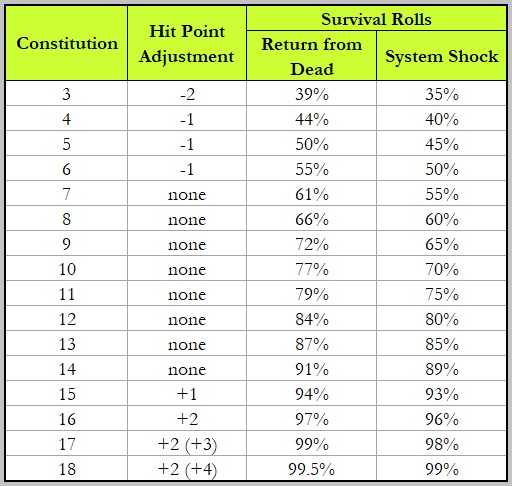
The table shown indicates the adjustments to the character’s hit points, as affected by constitution. Where a penalty is called for, note that this can never reduce the number of constitution points gained from going up a level to a number less than 1, which is the minimum number of hit points a level can add.

Bonuses indicated in brackets apply only to assassins, fighters, paladins and rangers. All other classes gain a +2 bonus to their hit points from a 17 or 18 constitution.

The survival rolls columns show the percentage chance of the character surviving either being returned from the dead or system shock. Raised from the dead includes the spells raise dead, resurrection and death’s door. The constitution score describes the maximum number of times that a character can be returned from the dead.

System shock includes attacks that cause rapid aging, petrification, hits from natural lightning bolts and similar effects. Some diseases may produce the need for a system shock roll. Contrary to AD&D rules, polymorph and shape change spells and abilities do not require a system shock roll.

Further checks related to constitution include forced activity checks and malady checks.

Description of Values

The following attempts to capture some feeling for the amount of constitution possessed by characters, both from the character’s perspective and that of others.

In some ways, those with a high amount of constitution will present many of the characteristics, social interests and natures of those with less ability. A full representation of any degree of the ability stat must take into account that not every person of a particular amount of constitution will adhere to the framework presented. This is only a model upon which further assumptions can be made.

Delicate (3 pts.)
Ordinarily, those with a delicate constitution would choose to be housebound, as there are so few places they can visit safely. They are usually sickly members of a family, who are cared for by siblings and relatives. They will usually be very thin and gaunt in appearance, or have the appearance of malnutrition.

They often possess a serious, chronic and debilitating condition, as the character background generator would determine. Otherwise, their daily lives are fraught with difficulties. They are usually in some kind of pain; the swelling of joints and limbs, constantly aching muscles, severe migraine headaches and bowel troubles are all common, often daily experiences. They have a minimal appetite; they must eat soft, usually severely boiled food; meat is difficult, unless it is a very little fish. Small bits of alcohol are intolerable, causing stomach pains. Any flavoured food might result in vomiting. They lack a sexual appetite. When resting or sitting, they will spontaneously lapse into sleep. Often, they suffer from hand tremors. To rest and regain hit points, they must have a proper tent to sleep in. Most are bedridden.

The only class training they may receive will be as illusionists, the spells of which are thought-based and require little effort.

Frail (4 pts.)
Those with a frail constitution have more freedom to seek other safe spaces, particularly to escape a summer or winter season in exchange for a milder climate, by visiting relatives and friends abroad, where they will stay for weeks and even months at a time. Preferring to give themselves to mental activities, they help by keeping the family finances or acting as record keepers. Resting in bed or upon a chaise is often necessary.

Discomfort is a way of life. Because they use their hands quite a lot, they often suffer from arthritis and other similar aches. When used, all their joints will swell. They prefer soft foods, a little fish, no alcohol or narcotics, except to aid in pain relief. An unsettled stomach is usual. Sharp headaches will seize them, lasting an hour or two, and sometimes all day. Their bowels give them much trouble. They have little to no interest in sex. In body type, they are often thin and tremulous, though occasionally some will show signs of malnutrition.

Those levelled persons, who can only be illusionists, may opt for an occasional physically altering spell, but most are inclined to concentrate upon mental conjurations.

Weak (5 pts.)
Such persons that have a weak constitution are like to venture into the daylight for brief periods, if the outdoors can be softened for their needs. They dislike work but will stoically accept it, though it brings them discomfort and distress. They must rest a fair bit between activities, laying down or sitting.

They suffer aches and pains through the first half of the day, as they don’t sleep well, and whenever the weather is outside their comfort. Their diet will include a morsel of meat, mixed with assorted gentle foods. Heartburn and poor digestion do give them trouble. A headache is common, but sometimes they do get through a day without one. They have a small interest in sex. As they sometimes feel they could almost break free of their weakness, depression is a constant shadow. They are often irritable because of it. If not actually thin, in body type they will exhibit signs of loose flesh and a sallow color. 

As levelled persons, they are limited to the illusionist track; physical tricks are often chosen as spells, even if this does require some effort in throwing or body movement.

Faint (6 pts.)
While studious and interested in being a part of life, faint persons are often just too tired to sustain a long day of activity. As such, they often retire for periods in the morning and afternoon, turning in early during the evening. They will self-select the least physical tasks for themselves, letting stronger persons do the hard work. They often engage a personal servant, if they are able.

For two or three hours in the morning, they suffer from severe stiffness from poor sleep. They can eat a few ounces of meat and their diets comfortably include most fruits and vegetables. They will have bouts with indigestion but not every day. They may allow themselves a nice beer or even a small amount of strong ale, but only a few sips of the latter. They are hit quite hard by alcohol. They experience an ordinary sex drive but do not make active lovers. Headaches are unusual but can be harsh. They may be irritable. They can experience depression for two or three days at a time, but then all will be well for a week or so. They tend to be corpulent and fleshy, or somewhat too thin.

Such persons are able to be bards, clerics, druids, mages, illusionists and thieves, though always pursuing the lightest physical professions in those classes. For example, a thief will be a forger; a cleric will be a theologian; a bard is apt to be a writer.

Unfit (7 pts.)
Resilient enough to become part of social situations, unfit persons will often be the first to drop out of an activity. At the end of the day, they are the last to finish and the last to make it home. They sweat profusely from hard work, which they are at least able to do. They sleep a great deal. Taking the watch is very hard.

Upon awaking in the morning, they are slow to get on their boots and get dressed. They are slow eaters, though they eat a normal diet. And often they eat too much, sometimes as an excuse not to get started. They are slow to stretch out and get going. They drag their feet. They are invariably sore and often prone to complain about it. They will find any opportunity to nap. Weight is a chronic issue. They prefer ale to wine, which is a little strong, while harder liquors are unpleasant to their gut.

Classically, they’re familiar in their role as guards, as being unfit is the minimum constitution for a fighter. As clerics, they prefer the life of a friar. A thief will like easy work as a charlatan or some other poser. Bards may like non-physical clowning or acting. Spellcasters will prefer sedate occupations, such as a druid that enjoys long relaxed days studying the trees, or nights studying the sky.

Ill-conditioned (8 pts.)
Often able to blame their constitution on their corpulence, their large bones or being a “low energy” person, ill-conditioned persons are usually quite comfortable in their idle, leisurely lifestyles. Oh, they could perhaps take the time to get into shape, but they lack the willpower or the sensibility of it, or they simply don’t care. They’re used to themselves.

They do wake up very stiff, but it passes after an hour or so. They don’t sleep that well, but there’s always some time in the day they can catch up with a nap. They see nothing wrong with their extra weight. True enough, the body can let a person down occasionally, but that’s life. The thing is to appreciate the subtle pleasures of ale or wine equally; perhaps a rare spirit, but only rare, because it does upset the stomach.

Ill-conditioned is the minimum constitution for an assassin, who like other fighters will seek occupations where they’re able to hold their own without having to keep up with others, as private guards, muleskinners, horsemen and the like. Bards, whose stomachs require some attending but who can eat most things if cooked well, will tend to gastronomy. Most other character classes will seek comfortable ~ though not lazy ~ professions.

Sufficient (9 pts.)
Describes the usual manner of health for the period, being someone that is slightly less than sound in body and limb, yet able. Making up the stock of farmers, labourers and others who are beaten down by daily toil, blemishing their physical condition, these folk possess the constitution and hardiness to exert themselves at their tasks.

Most have a satisfying complexion, with a taste for strong drink and ale. They have energy at the end of the day to spend, with fit bodies that are nevertheless worn in places. They are sore much of the time, which disturbs their sleep. They feel fair upon waking, and stretch easily as they head out into their day. Each feels comfortable in their bodies, without much complaint.

Among the fighters and assassins, an occasional paladin can count a constitution of this type. bards, clerics, druids, illusionist, mages and thieves are all the common breed of their classes, with slightly less than average in ability and yet passable with regards to their fortitude.

Healthy (10 pts.)
Those characters with a healthy constitution have no daily complaints about the soundness of their bodies. They are fit and trim, in good shape, ready and able to take on life’s challenges. Healthy persons handle stress well, work well, are patient in their activities and are as full of vigour in the evenings as they are in the morning.

Healthy people are predisposed to laughing easily, are talkative and find it easy to rest and relax when working. Their joints are loose and comfortable even after a day of hard labour. They have strong appetites and like to eat meat and vegetables rather than heavier fair. They have a fit body, toned and firm, with a healthy skin color.

Characters of level will be motivated in their actions and goals. They may apply themselves to the deliberate practice of their professions without being weighed down by fatigue or malnutrition, so that many rise to some amount of authority.

Sturdy (11 pts.)
Those who possess sturdy constitutions will be solidly built, athletic, often rugged and vigorous in their movements and their condition. Among their peers, they are often the most reliable, the one fellow in a group of common miners, farmers, sailors or other labouring groups who will go a step farther in getting the job done.

Feeling active most of the time, even upon the moment of waiting, sturdy folk are gregarious. They thrive upon the company of others, they enjoy a good stretch of the legs in the evening and often feel energized enough to perform even harder labour. Their muscles show a distinct definition, and rarely do they feel any strain upon them, even at the end of the day. They sleep deep at night and are never drowsy during the day. Often, when they work very hard, they experience a sense of euphoria. Before battle, they feel encouraged and brave.

In addition to other classes, monks must have at least a sturdy constitution. Such persons, whatever the class, are driven to achieve. The cleric that gives long sermons, the mage or illusionist able to work long into the night, the druid that makes long journeys into mountain fastnesses … each is a symbol of the common, hardest working member of their professions.


Hale and Hearty (12 pts.)
Persons that have hale and hearty constitutions are full of interest, possessing the inner spirit to push them forward. Their constitution leaves them unsatisfied. They want more. They thrive on newness, like others of higher constitution also sometimes do. They dislike inactivity, inertia and the repetition of everyday tasks. This grants them tenacious zeal that is applied to their intellect, their strength or their charisma.

A hale and hearty person enjoy vigorous exercise first thing in the morning, hurling themselves out of bed, anxious to take on the day. They are light and bouncy on their feet. Before battle, they are ready, keen to get started. Their appetite demands a diet of interesting things, spices, pates, caviar, confectionary … anything that is strange and different. Their aroused by perfumes. Copulation produces a state of euphoria. Their skin gives a healthy glow.

Characters with at least this much constitution will venture out as explorers, settlers, missionaries and the like. They have a fascination with foreign places and with travel. This makes them among the chosen to suppress colonies, lead embassies or military operations, sail the seven seas or venture into the deepest dungeons, confident that their adaptability and courage will win the day.

Tough (13 pts.)
Nearly impervious to the elements, largely untouched by pain, those with a tough constitution are hardwearing, long lasting souls. They can be onerous, when pressed by an unsympathetic wilderness or the merciless implacability of fate; but they’re never afraid, and never in doubt that they’ll bear the worst that’s to come.

Tough persons can sleep anywhere, in any conditions, and wake up ready to work or fight. When they breathe in fresh air, their lungs and bodies fill with the heartiness of it like a drug. They will grin and laugh with others in the face of disaster. Before a battle, they feel tingly and excited to face the enemy. They are spontaneous, ready to fell a huge tree one moment, or whirl into a dance if the cadence of a musician’s tune will let them. They are raucous, fun-loving and noble. When they are happy, their faces flare with a bright, cheery color.

As levelled classes, they like the most difficult work, the most dangerous tasks. They have the nature to carry others with them, to treat every bad moment as an opportunity for a joke. They will always give their whole selves to their calling ~ and as such, will often excel where others have failed.

Robust (14 pts.)
Even in their youth, those of a robust constitution have already gained the confidence of a much older person. They have little left to prove to themselves. They will do what is necessary; go where it is necessary to go. In personality, they are profoundly calm, certain, expressing a remarkable fortitude and patience that offers assuredness and respect with the need for words or boasting.

The robust character has no difficulty keeping awake for guard duty, being possessed of tenacity and grit. When passionate, they will pound on the table when emotive. They will speak economically, as though words were money spent. In listening to beautiful music, their bodies are so fine tuned that they are often possessed with frisson. When facing battle, they are pumped, their blood hot. They will shout warnings to the other side, backslapping their companions to urge them on.

This is the ranger’s minimum constitution. Levelled characters of this constitution, because their number is far greater than those with higher constitution, are the pillar upon which societies rest. Their patience shores up the army; their determination overcomes those trials that would starve the country or see it brought to ruin by disaster.

Stalwart (15 pts.)
Strongly built and high-powered persons with a 15 constitution display a vigour that belittles the appearance of most. Though they may not be strong, they will appear to be of such profound health that they will be perceived to be strong. Onlookers will suppose they are a champion, or a hero of some kind ~ while the character will stride like a panther: one moment sitting or reclining in place, the next, tearing apart all enemies without hesitation.

The stalwart character lives in the moment. Filled with irrepressible energy, they will prowl at all hours, waiting for their next opportunity to bring change. If an intellectual, they will rehearse their speeches; they will talk for hours about their newest designs; they will tirade against injustice. And if things become violent, they will explode with adrenaline and endorphins. They will stride forward to catcall the enemy, shouting, roaring, relishing the violence that is to come.

Such persons are hardly to be restrained as levelled characters. They seek action, sensation, thrills. Only their physical limitations, such as they are, force them to submit to a moment of peace.

Formidable (16 pts.)
Atop the world, these persons are blessed with the ability, the fitness and the qualities necessary to do or achieve anything. Possessed of a constant cheerfulness, despite their physique, their sinewy bodies and overwhelming health, they are possessed of a constant cheerfulness. They fear nothing. Every challenge is another opportunity for greatness.

They never feel doubt. They never have headaches, or a poor sleep. Their libido is very strong and, despite their looks, they produce a musk that is deeply compelling. They need no more than six hours of sleep a night. Before battle, they will bang their weapons against their armour, warming up for the coming fight, smiling and happy. They are tireless and nearly always ready to lift themselves up and begin again.

Redoubtable (17 pts.)
Tremendously intense, these capable persons inspire fear and respect amongst all that they meet. Others of lesser stature do not seek to measure themselves against such persons; it is understood, except by their peers, that the matter is settled. Driven by the will to master the very earth with their raw power, some of these redoubtable persons are almost incapable of speech, except in the face of competition.

Before a battle, they will be wild and magnificent, shouting with fury, slapping their weapons against their own fellows in their lust for battle. When the battle ends, it will take a long time for such persons to calm themselves, restoring the deep, quiet churning in their sinews, until they can “live” again. They are competitive and, when alone, often euphoric. Pain means little or nothing to them.

Awe-inspiring (18 pts.)
Though not actually capable of staggering their enemies with the reverential respect awarded to the gods, the awe-inspiring person will create a sense of astonishment and unrestrained admiration among onlookers. Splendid and impressive in raw physical appearance, even if they are twisted and ugly, others will stare open-mouthed at their countenance. They will often feel like gods; and depending on their wisdom, may allow themselves the virtues and vices of gods.

They have a stomach of iron, and live in a persistent haze of euphoria given to them by their own bodies. They can hardly feel pain. In the company of their desire, they are hypersexual and are often welcomed as physical partners, if not as objects of matrimony. In a battle, they are titans, roaring as they swing their weapons, fiery in nature and breathtaking in courage, resolve and fearlessness.

See Also,
Campaign
Running
Swimming
Wednesday, March 27, 2019

Dexterity Issues

Last night I think I cracked the code on breaking down the constitution stat. There's still a lot of work there, so I have nothing to show today.  Still, the goal is to apply the same construction to all the ability stats, with time, so for a moment I wanted to talk about dexterity.

Dexterity is an odd stat.  While it belongs, and it's physical like constitution and strength, dexterity has a strange quality in that it is potential ability in so many aspects.  We teach people how to manipulate objects and play sports, or how to play musical instruments.  To some degree we do these things on our own, but real facility at something requires training.  Children's games build on this, as so many of them are designed to challenge our dexterity by training our hand-eye coordination.  No adult invented dodgeball.  It is a game that grows out of the much-less-pleasant dodgerock, adapted by cruel educators to teach both dexterity skills and the realities of social abuse.

In separating a 12 dexterity from a 13, it is much harder to do that from a visual standpoint.  A more nimble person might seem properly more lean as their dexterity increases, but we have plenty of celebrity examples to show that's not necessarily true.  Large, bulky persons find tremendous comic potential in being both gigantic and profoundly agile.

The truth is, the difference between a 12 and a 13 is in their potential to shine once introduced to a skill.  The 12 dexterity might barely survive in double-A baseball, while a 13 will do all right.  A 14 will drift back and forth between double-A and triple-A, while a 15 might imaginably dream about playing in "the show" for as much as a week, if the Boston Red Sox suffer a lot of injuries.  All these players would look similar, with like body-types, reach, stance, even the way the walked.  But they wouldn't be the same.

So how to measure it?  Probably, by defining different qualities related to those things that can be taught.  What dexterity do you need to snatch a baseball out of the air one handed, or target a football while in mid fall, with a tackle's arms around your waist?  Or, in D&D terms, what is the minimum dexterity for using a bow?  Throwing a dagger?  Jumping 10 feet?  What level of dexterity do you need to so that you don't need to make a check in order to climb a ship's rigging?  In a storm?  When there's ice on the ropes?

The reader should know I hate random checks to see if someone who can jump 12 feet might manage to jump 15 just this once, because that's the difference between ledges.  I loved track and committed to it throughout high school, but long jump just wasn't my thing.  I could jump 12 feet 1 inch, or 12 feet 4 inches, or 12 feet 5 inches.  Three more feet might as well have been the moon.  It wasn't because I didn't have the potential.  Long jump requires training to get past what we can do with physical force and will.  There's a way of jumping off, of hitting your last step perfectly, of throwing your lower body forward as you swing your body in the air, of "running" while flying.  It is a spectacular ballet. It doesn't happen naturally.  The coach tried hard to communicate it to me, but I just couldn't figure it out.


Without that connection, having failed that training, I'm not going to suddenly be able to jump three more feet because the die says 20.  It is one of the silliest notions of 3rd edition mechanics, as it insists we ignore everything about reality.

I'm not fond of measuring anything with a list of stuff that a person can and can't do, as it is never a complete list and the more things added to it, the more arbitrary the list becomes.  I'll need to do a proper amount of research to learn if there are any measures on agility that already exist ~ people ARE researching this stuff, we don't have to make it up out of whole cloth.  For the present, I'm puzzling it out, asking questions and identifying the problem.  That's the first step.

The Big Picture

As a writer and a role-player, I am a believer in numbers.  I believe that numbers are the reason why D&D became a phenomenon at all.  Whatever some might say about the actual role-playing, or the spirit of adventure and so on, none of it would have gotten off the ground without the six basic ability stats.  Ozymandias recently wrote a post about the fundamentals of D&D.  For me, the fundamentals are in the game's design, and the understanding of that design.  The six ability stats, and their conjuration, is the one single eureka moment in role-playing.  We don't give enough thought to how much the game hinges on these numbers.

It has bugged me for years that in the strictest of game terms, where so much of the game relies upon self-image and understanding clearly what that image is, that we have never been able to identify clearly what it means to have a "12" constitution as opposed to a "13" constitution.

We know how to make the numbers dance.  The 13 gives us a very slight edge on the 12 where it comes to checks and rolls ... but honestly, if the two persons were standing side by side, how do we see that this one is a 12 and this one is a 13?

There are only 16 variations in body type, after all, between characters that can barely function with a 3 constitution and those who are the very peak of condition with an 18.  That's not very many.  You would notice if your body were suddenly given a spectacular one point boost in resilience, health, fortitude and endurance.  You would really notice.  You'd be out right now, running and bicycling ... and probably high as blazes, since that boost in constitution would mean an unholy blast of both endorphins and adrenaline.

Yet ... we're supposed to ignore all that.  Who has posted their personal list of subdivisions, hm?  I've never seen one.  Apparently, we think it's impossible, or that it just doesn't matter.  The only third reason I can think of is that people just haven't thought about it.  That seems ... hard to believe.

Louis XIII, King of France from 1601 to 1643;
my game world takes place in 1650.
I had a commenter today who disputed my interpretations of charisma points, which is exactly what I expected.  There's no question my interpretations were weird.  I had a bunch of pages open, I was researching the hell out of charisma, trying to fine-tune the descriptions for each point of gain through a careful use of the thesaurus.  At each point along the pathway, I considered the next logical advancement.  The complete Quasimodo of a charisma is improved by pity, then sympathy, which leads to tolerant indifference.  If I could think of a sliver between sympathy and tolerant indifference, I would have used it.  The next step up the ladder is occasional notice ... the plain girl, the schoolteacher, to whom everyone is polite but no one wants to marry.  From there, I could see a pattern of attention for the individual following a path of social class.

Common people will marry and associate with common people, but the middle class doesn't and neither does the gentry.  Once your charismatic enough to gain the attention of the middle class, you fall out of the orbit of the common; increase further and the gentry get interested in you.  Then, finally, the real players take notice: those with real power and those with titles.  With each group, it is the same progression ... from inattention to some attention to complete attention.  And as you rise above the class, they see you as less and less attainable.

Of course, we in the 21st century, have been taught by films to believe that everyone is attainable.  Fat, ugly men in television sit-coms are constantly married to women with model bodies. Men in their 70s have affairs with beautiful women in their 30s.  It is a fantasy.  Viewed coldly, it is a ridiculous fantasy ~ which we justify by supposing it can be made to work with money.  And the ditzes from Orange County encourage that mockery.

My world, however, takes place in the 17th century, not the 21st.  There's no film, no "entertainment industry," there's a profoundly calcified social strata at play and most people live and die within 10 miles of where they're born.  Masques were worn by attractive women who moved in the upper circles; attractive men gathered in tight cliques and ~ like the Karate Kid ~ acting like complete assholes towards everyone who did not measure up to their evaluation.  Beautiful milk maids were the stuff of fairy tales ... in other words, so completely and absolutely unlikely that these stories became told over and over as fantasies for people who were tittilated by an amazingly attractive woman living in a fireplace.  We've deluded ourselves, in this century, with the belief that the fairy tales had a hint of truth in them ... but of course, we never apply that "hint of truth" to the magic that's cast or the "happily ever after" that neatly wraps up the story.  We're perfectly ready to be jaded about that nonsense.

So as I envisioned characters getting more and more attractive and personable, I thought about how uncomfortable that would be for common folk.  This fabulous popular and attractive fellow of 15 charisma walks into a workman's bar in the evening; the workers have had a hard day's labor behind him, but this fair fellow is on a first name basis with the mayor, he's a bon vivant around town and he has a fine position as the master of the dockyard, which he obtained through being very likeable.  What is the worker going to say around this fellow?  Can the workers be themselves, while this fellow is here?  Can they cut up and tell rude jokes, and bitch about the leaders of the guild, with this fellow in the room?  Of course not.  So they all get very quiet.  And polite.  Oh, of course, the fair fellow is pleasant, even generous.  And it is very kind of him to take notice of us common folk for a bit.  But he makes us nervous.  And he reminds us we are never going to look like he looks, or talk like he does, or have what he has.

That is only going to get worse as the charisma increases.

For myself, I ended up there without intending to do so.  I simply saw no other way around it.

But I was going to take a moment and talk about those who commented about the subjectivity of charisma.  I was asked, is the charismatic person still charismatic if they're in a culture that is not their own?  Surely, charisma only applies to one's own people ... what with different customs and attitudes, charisma must diminish when it shifts elsewhere.

I honestly don't know where that comes from.  We have endless stories of explorers entering lands on all the continents being embraced and beloved by complete strangers in utterly odd parts of the world.  It wasn't at all uncommon for a European to make friends in Japan, among the Hurons and in the deepest parts of Africa ... the charismatic individual simply cast their own habits aside and adopted the habits of the natives.  "Going native," like Gordon of Khartoum or Lawrence of Arabia, goes back beyond Alexander the Great, who fell in love with Persian customs and married a Persian woman, after conquering the country.  We know his fellow Greeks thought this very, very strange.  Dio and Plutarch both write extensively about Alexander's beauty, charisma, communication skills ... and about the obsession he developed for prostration (look it up), which was very NOT Greek.

Charisma has far more power than merely to manipulate.  Charisma is an adaptation.  It allows the individual to become our best friend, by embodying all the characteristics we want to see in a best friend.  The high charisma individual moves through the crowd, mutating instantly from person to person, so that each person feels special, each individual feels like they really know the fair fellow.  But the fair fellow is, in truth, unknowable.  He isn't just one person.  He is hundreds of people, at once.

He could win over the common folk in the bar, if he wanted to.  He could don their clothes, he could go down into the mines with them or work in their fields, and soon he would be adopted as one of their own.  Because he is just so darn likeable.  But honestly, why would he?

One in a thousand might find that interesting.  Thomas More did, and so did Francis of Assisi.  Victor Hugo had that strain in him and so did Leo Tolstoy.  But most beautiful, capable, charming people despise the meek and the common people.  The meek and the common have nothing they want, while they can perform the same mastery of language and likeability with princes and kings.  Why would they wallow in the muck with the pigs?  Why would they enter the bar at all, except to see what it was before getting back in their coach and going to their more interesting, diverting lives?

Please don't think that any list like this I put together is mere manure slung at a wall.  I am not merely invested in doing such things right, I'm working from a very large pile of sources, the sort that most role-players wouldn't think of reading.  Though I urge you to read them.  They're difficult and complex, and full of references that it takes decades to feel certain about, but the depth of information is amazing.

I'm reading a book now, called War and Society in Renaissance Europe, 1450-1620, by J.R. Hale.  I'll give a taste:
"There was probably no single year throughout the period in which there was neither war nor occurrences that looked and felt remarkably like tit.  There were a number of unstable frontiers ~ Scotland/England, Spain/Portugal, France/Spain, French/Imperial Burgundy, Christian/Turkish Hungary ~ which were zones of constant raids and counter-raids, where no one worked unarmed and no garrison force could do what it liked best to do, namely, pawn its arms and make love to taverner's daughters.  The practice of reprisal, whereby a shipowner was empowered by government to recover by violence the value of goods lost by piracy or unlawful sequestration in port, grew into privateering, or piracy-by-licence that made marines, guns and convoys as necessary in peace as in open war.  Moreover, as frontiers, after surveys by land commissioners and the construction of strong-points, did become more stable, especially in the later sixteenth century, their place as zones whence military escalation was always possible was taken by 'those who are called to be the rulers of states should have glory, expansion and enrichment as their principal aims.'  But he did not see expansion as leading to enrichment, though he hoped that wars of conquest might at least recover theri costs.  No government, no privte theorist saw profit as a tenable aim of war; enrichment was to be achieved by a more methodical development of a country's own economical potential and the nurturing of favorable balance of exports against imports.  This process could be benefitted by war, but only to the extent that a foreign war calmed, by diverting, civil passions and gave governments the excuse to pack off the unproductive elements in society ~ rogues, vagabonds and paupers ~ to be slaughtered."

What does any of that have to do with charisma?  To begin with, the above is real.  It isn't dragons, it isn't wizards sending people off to recover quest McGuffins, it's the hardcore business of managing power in huge, massive chunks, with unfathomable consequences hinging on wrong decisions.  The mastery of those decisions ~ what keeps the subordinates from killing off the kings pulling the triggers on the wars and legal justifications and pushback, is charisma.  It isn't strength, it's intelligence to some degree, it's certainly wisdom ... but it is most of all the other stats employed by people who are capable of being liked enough to get a law passed without being murdered in their bed.

In the 16th and 17th centuries, this above was the game.  And for those with the charm to get in the door to take some small part, the halls of power offered something the local bar just didn't offer.  When making a system that defined what charisma was, and how it was applied, I didn't limit my framework to whether or not the girl at the bar looked nice.  I went all in.

I do wish that people would really get it into their heads how vast role-playing is ... all from a set of numbers and rules to play with them.

Saturday, February 9, 2019

Intelligence Scale

Originally, I meant only to add a description of intelligence for character creation; and then I had a bit of clarity before falling asleep last night.  I picked it up this morning and had meant to carry it forward up to 18 intelligence ... but alas, I lost the thread of my intent long before.

The idea follows something I proposed long, long ago, saying I would need time to think about it.  Having got it this far, I probably need time again; or perhaps I've just lost my clarity in the midst of researching and trying to build a fluidity to the change of each intelligence value.  Here's what I have, transferred from my wiki.

Variously defined to include logic, understanding, self-awareness and reasoning, for game purposes I have chosen to describe intelligence as problem solving ability and alertness. In game terms this argues that seeing the answer to a problem is a question of intelligence, not wisdom; and that being aware of what is going on around the individual is also intelligence, and not dexterity. Intelligence as described here bears no similarity to "I.Q."

Ability checks are made against intelligence only when there is doubt that the character's intelligence is sufficient to reason through a set of variables or be alert enough to see the meaning of a given clue or detail. Players cannot simply turn to the PC's intelligence as an ability that lets them roll and instantly "know" things. Players must use their own intelligence 99% of the time throughout the game; however, very often the player will attempt an action or a plan that the character would be unlikely to conceive. In that instance, the player should make an intelligence check. If successful, the action can be carried out.

Take note; "learning ability" is often attributed to intelligence; in my game, that would be part of wisdom.

Intelligence is an important characteristic of mages and illusionists, and a minor requisite for assassins, bards, paladins, rangers and thieves. For mages, intelligence will dictate the maximum number of spells that can exist in the character's spellbook (qv). Furthermore, it should be understood that upper spell levels for mages cannot be employed at all if the mage has a minimal intelligence.

Chance for a spell included in the spellbook describes the percentage chance that is rolled for each spell in the magic user lists to determine if that spell is included in the mage's conceptual ability. This does not apply to illusionists.

Minimum # of successful rolls indicates the lowest number of successful rolls for spells that the mage can have. This does not apply to illusionists.

Maximum Spell level use shows the highest level of spell that the character can use with that intelligence. This column applies to both illusionists and mages.

Description of Values

Zero Intelligence (0 pts.)

Unable to think and lacking self-awareness, these creatures act without will, driven by hormonal responses. They are compelled to find food or to reproduce. Once engaged in combat they will not retreat but will always fight to the death. They cannot communicate with others of their own kind except through the release of pheromones, which may appear to create cooperation but in fact is purely reflexive in response.

Deficient Intelligence (1 pt.)

Sufficient to provide minimal self-awareness and bare instinct resulting in an innate behavior in response to outside stimuli. Creatures of deficient intelligence will experience fear and will herd together for defense ~ but will equally abandon others of their own kind, including their offspring, with self-preservation being more important than social bonds.

Reproduction if primarily sexual, with times of the year when instinctive competition to determine opportunities to mate takes place. Displays feature activities such as showing plumage or rutting. These creatures are always herbivorous and never hunters; they will exhibit some curiosity towards the offer of foods, especially those of a pleasant odor. Without magical influence, these creatures defy interaction and cannot be trained.

Domestic Intelligence (2 pts.)

Necessary for domestication as a creature. Take note that not all domestic creatures have an intelligence of this value; only that they must have at least this much in order to form an attachment to a more intelligent companion. Creatures of domestic intelligence will also show a fondness and loyalty. They can be angered and will become defensive if angered; they will not always fight, however. This defensiveness is often a show of threat before fleeing.

Creatures of this intelligence will form family relationships for life, care for their offspring, defend their lairs, display memory, play, act curiously if not threatened and will actively hunt (including tracking and returning to familiar hunting grounds). These creatures will also cooperate with their own kind, though often they will become aggressive and competitive once food is available. Primary motivations continue to be the pursuit of food and reproduction.

Sympathetic Intelligence (3 pts.)

Necessary for humanoid creatures (with much lower-than-average mental acuity) and commonly the intelligence for successful hunters such as canines, felines, suidae, ursae and a wide range of magical beasts. These creatures will hunt patiently and cleverly, will share food among their clans and will care for and adopt the young of others. They will form close domestic bonds with more intelligent creatures, particularly with tool-making humanoids.

They have strong memories, will form lasting bonds and cooperative relationships with humanoids (hunting and sheep dogs, cormorants, working animals, mounts, etcetera), are strongly faithful, will play and will defend creatures other than those of their own kind. They are able to recognize treachery and also display a wide range of emotions.

Humanoids will be minimally communicative and animal-like in their display of emotions. They will form staunch bonds with others and will sacrifice themselves rather than let those others come to harm (though the sacrifice is not self-aware; death is a difficult concept to grasp). Fighting abilities will be instinctive; they are limited to bashing weapons. Weapons may not be hurled, not because the creature is physically incapable, but because it doesn't not occur. They are limited to daily living skills and are limited in sage abilities to adaptive or instinctive abilities [no defacto list exists at this time]. All efforts to problem solve or be alert, as well as recovering anything from memory, requires an intelligence check.

Cognitive Intelligence (4 pts.)

Enables self-awareness so that the creature is aware of their own awareness, and in humanoids the ability to express consciousness of their own mental limitations. Creatures are able to comprehend money, the importance of some things over others and reasons why they are being asked to do things. Creatures of this intelligence include a wide variety of non-social monsters, many of them with inborn skills, primates and humanoids who represent lower-than-average mental acuity. No humanoid race comprises principally of members that are of this level of intelligence.

Creatures, both humanoid and not, will betray deviousness, be capable of lying, yet will remain naive of consequences for their actions. Play is often extraordinarily aggressive or excessively idle, such as repeatedly throwing a ball against a wall for many hours at a time, mesmerized by the patterns it forms. Memories are long and grudges are common. They are not likely to judge the actions of others except when those actions directly infringe on their freedom.

Humanoids will be haltingly but moderately communicative and expressive with their emotions. They will form highly loyal bonds with fellows and may even fall in love, though they will not understand the social mores associated with relationships. They are not able to rebel against requests from trusted companions without an intelligence check. When a check succeeds, being conscious of their own limitations, they will be enormously proud of themselves.

Fighting abilities are instinctive; bashing and stabbing weapons are permissible. Weapons may be hurled. They are able to do tasks made of two-or-three steps, such as sharpening a weapon AND putting it away or eating from a plate, washing that plate and putting it away. Such things are limited to busywork; tasks that require figuring the place for something unfamiliar, sorting, locating something that can't be seen or is in an unfamiliar place, or any more complex problem requires a check. The creature can watch and be trusted to be aware in that specific direction, but being alert for something unexpected requires a check. Sage abilities must still fit into the descriptions above or are not available to the creature.

Primitive Intelligence (5 pts.)

Minimum necessary for a humanoid culture. Creatures are able to perform all familiar tasks related to food gathering, hunting, raising offspring, sorting and sharing material wealth and rough hand-made tools without checks, but do not have interpretive-based sage abilities.

Though able to understand the spoken word generally, creatures have high difficulty understanding abstract concepts such as philosophy, mathematics, science, mechanics or distant geography. Religion and history is understood primarily through story-telling and art, with no real sense of theology or causality. Magic is appreciated and recognized, but the process bears no comprehension at all. Limitations on such things, or why there should be limitations, are unclear to the creature.

When in simple, day-to-day situations, it is rare that any checks will need to be made. However, the alertness needed to think a player character's way through unusual environments (dungeons, dangerous and chaotic terrains, cities or streets where sensory overload is constant) will require occasional checks if there is no one else to keep the character focused. One such situation is battle.

Should surprise occur, creatures of primitive intelligence are apt not to rely upon their instincts but upon their responsibilities ~ and this may cause the creature to freeze, similar in manner to a deer but for entirely different reasons. Because of this, unless an intelligence check is made, the creature will be unable to take any action except to defend themselves for one more round than is usual. This hesistancy can be overcome, however, if a more intelligent creature, unaffected by this hesitancy, is there to shout "attack!" or similar order at the right moment, spurring lesser companions to action. Thus a chief in a primitive clan or tribe will usually have sufficient intelligence to thus lead their people.

Primitive intelligence allows the use of most hand-to-hand and hurled weapons, but discounts use of the bola, the bow, slings and like weapons that have multiple or moving parts. Common implements with moving parts require a check to use; complex implements, such an astrolabe or abacus, are beyond the creature's ken.

Low Intelligence (6 to 7 pts.)

Though in the upper group for primitive cultures, for most civilized societies this indicates the bottom range of competent intelligence for social participants in daily life. Such creatures are able to work at repetitive tasks, raising food, maintaining domestic animals and other day-to-day social duties without intelligence checks.

They are, however, challenged to understand matters outside their immediate needs and positions. Even if they participate in religion, it is more mystery than belief. They are comfortable at festivals and sport; but discussions of current affairs and politics confuse them. They are apt to ignore the doings of the world. If someone should explain such things to them, it would be an intelligence check.

Low intelligence creatures have access to the full range of weapons and the use of common implements without needing a check. Surprise in combat operates normally.

Monday, June 23, 2008

Strength & Dexterity

Strength & Dexterity

These two tables are going to come as a disappointment to some, particularly those who feel that fighters just don’t bring enough force into their campaigns. Remember, however, that my motivation for these tables did not include giving my party a lot of new powers—but to compensate for the disinterest in what I’ve been calling dump stats. Convincing players to pimp up their strength or dexterity requires no help from any table.

Strength in particular is the big disappointment. It compares very favorably with wisdom and with the father’s profession table, however. And it adds a piece of information that every player needs. This is the first time I’ve ever used a table like this without having to constantly make re-rolls. I’m quite happy with it.


I typically roll a d4 to determine which grandparents are indicated, and a d2 to determine sex of the player's siblings; I usually get asked how many older or younger siblings the player possesses, which is easily determined by rolling a die for the number of children indicated.

I haven't had much interest in rolling great-grandparents, but they could be wedged into the system if anyone wanted.

Dexterity has a bit more oomph. There may be some contentious results on it, but by and large my party has accepted them. I have a thief with a 17 Dex who rolled the “can’t fight with two weapons” result…and he gripes about it…but it’s understood that this is a peculiar circumstance that just has to occur. You may be very quick, but you don’t happen to have the balance that enables both hands to operate in tandem; one hand is far more dominant than the other.

Some might argue it belongs on the intelligence table…and I have a quick, sly answer to that. The medieval mind perceived that such abilities did not transcend from the mind, but from the body. It would not have occurred to anyone that the brain had anything with what the hand was able to do.

Perhaps that’s not fair. But Adler won’t be born for another three centuries, so I don’t worry about it.

Saturday, June 21, 2008

Constitution

Thinking of a comment made yesterday, about balance. There IS an overemphasis on balance within the game, and that emphasis comes from games being made back to the Babylonians…where what makes the game competitive is the individual’s talent brought to bear on the rules as written.

We play chess. The game itself is unchanged by us; we both understand the movement and limitation of the pieces. The winner is determined by ourselves, our weaknesses, our strengths, our experience.

Yes, that’s right: the winner.

The conceptualization of the winner is, to borrow a word, the hamartia of D&D. It is the fundamental error that has kept most from viewing the game through the right lens. Because D&D does not commit player against player, or player against DM. It is not “man versus himself,” either, although that clever rhetoric would appeal to some. The truth of it is that D&D is man against nature…the character against an abstract.

D&D is not an outward expression of the DM, not if the dice are trusted and invoked and allowed to veto the DM’s desires. The game is world-as-gestalt; the fabrication of multiple persons as a something that can be competed against but which can never be defeated. Your character is going to die. Eventually. There is nothing you can do about that.

Well, obviously, you can stop playing. Le petite morte, that.

And because the conflict in D&D is a mirror of the conflict in the real world, the argument for “balance” is fallacious. I am not competing with my friend the paladin; I’ve got his back and he’s got mine. If I want to see it as a pissing contest, well, that’s my failing…that’s not an inherent part of the game. The enemy is out there, and so long as we stand together, the ogre mages and remorhaz of the world can go hang.

So if my friend the paladin doesn’t suffer from the brittle bone structure that I was born with as a child, good. I hope he doesn’t, no one should have to. I get along with it myself because I’m used to it.

Do you see? The mindsets that occur in THIS game occur nowhere else. Your bishop hasn’t had a bad run of luck lately with turning undead pawns. Your king isn’t having trouble with the queen’s infidelity. It isn’t the power or the cool shit you can do that makes this game, it’s the shit-sucking misery that plagues your character’s every effort. When something goes right, it goes right OUTSIDE of you. Just like the real world, when you've knocked a hole-in-one on the par 4. Yes, you strut and tell all your friends that you are da shit, but in reality, you are thinking really deep down inside, man, that was fucking luck.

The effort people take to find ways to reward “good playing” just don’t get it. We are all spectators in our character’s successes and foibles…and it is fucking awesome to see that die tumble into a critical just when the party really, REALLY needs it. We take the credit, we get the experience, and we don’t care that it was random. We swung the club and got the ace and that’s what matters.

This is the game that is the real world. It works by the same rules.

Okay, that said, let’s get down to business.

There’s less need, I feel, to pump up the combat abilities with a lot of power. Still, constitution can pretty much be applied only one way: how much can the character take. The side over the ability I’ve seen in terms of a character’s sickly genetics—a very simple progression from completely healthy to a collection of multiple medical problems.


(that should read, "poison, paralyzation and petrification")

The side under the ability, on the other hand, was more difficult. I eventually hit on a collection of minor, somewhat supportive attributes. Keep in mind, as I’ve said before, most every party member has a 15 or more constitution. I wasn’t interested in giving some result like “immunity from all disease” for a roll of 10 under (that would make 1/3 of the party immune). I do want to be able to kill a party member occasionally with a disease; that keeps them from stumbling out into the wilderness without clothing, tents, tinderboxes, boots (I’ve had players forget to buy them) and so on.

The rules about the first 3 damage being exempt: I’ve known men who worked in hot, blistering environments with skin like leather. This is meant to address that. The same goes for the fellow who’s already been bit...four times—by his pet tarantula, and it doesn’t bother him as much now.

You may notice this is the second reference I’ve made to “weather grades.” I divide my weather into 26 grades, similar to the system originally suggested in the Wilderness Guide—but better. You’ll also note a link to worldwide weather data on my blog. That is because I use this data when I play. It is precise, incontrovertible and does not represent numbers pulled out of my ass—like almost every number I find in the published books…but we’re not talking about the equipment table right now.

A character’s endurance against these weather grades depends on where the character grew up. I have characters running who have come from as wide a range as Egypt (30 degrees latitude) and Karelia (60 degrees latitude). At present they are above the Arctic Circle…it is the second week of October. Which ones do you think are going to handle the weather better?

This is why I don’t say, “the character is unaffected by weather above –10”…because if the character is from Mozambique, that number should be different than if the character is from the Orkneys.

Incidentally, ever seen a world map invented by a Dungeon Master that had clear, recognizable latitudes? Or a rational weather system? That is because weather is the most complex and annoying geographical consideration—and must be explained away by most DMs as “affected by magic” because working out a completely unique weather pattern on an imaginary world is just plain psycho.

Which brings us to the Disorders Table:


Not much to say about this, it is pretty clear. I’m not going to pabulum feed the readers by going all out to write specific effects for each of the disorders, though of course I could. Insensitivity to touch? Player can’t wear armor, player must wear specific fabrics, player reacts violently (and manically) to being touched and so on. Brittle bones? Player suffers +10%, +20%, +40%, double from falls, crushing damage, etc…however much of Unbreakable you want to coordinate into your campaign. Weak stomach? Food allergies, poison save reduced, whatever you like.

I disdain giving a specific list because you, as DM, ought to be able to work that out to suit your campaign. Anything I suggest is going to be either too harsh or too mild. I’ll stay here by the trunk, thank you. It is your path to walk onto that limb.