Ozzie Pippenger wrote a couple days ago:
"Do you leave it entirely up to your players to work out when they have a conflict? What if some of the players insist on doing something the rest have no interest in? Do you ever run extra games or one on one adventures for independent goals? I know my players can have trouble with this. Sometimes two or three of them are working well together, feeding off each other's energy, and making the game much more interesting. Sometimes though, a single player dominates the game and the others slowly stop paying attention."
Of course it happens. I actually have several examples from my online game. Delfig the Bard decided to go back to Dachau to face his demons, while the rest of the party went on. Franz and the party went loggerheads 14 months ago. And even just last week, the present party couldn't decide about killing sheep, going back to the ship or heading out further.
Now, regarding my failure in the 10,000 word post on how to play a character to include something about inter-party conflict, that wasn't an error. This is not something I expect a party to resolve. It is, therefore, not relevant to the act of a player playing a character. It is relevant to the question, how do you control your players in a game ... and this I did mean to address in the book I'm writing, An Advanced Guide to Managing Roleplaying Games. I tell you, if that crew thinks 10,000 words is pretentious, wait until they get a load of my book.
I don't want to rehash the points of the book, but I will say this. People at the table disagree. They are entitled to disagree. They are expected to be patient and reasonable. You will note that in general, I don't dip my hand in when the party wants to wrangle out a choice of action. I didn't intervene with Franz until he started getting combattish ... and later J.B., who played Franz, would agree with my decision. The man has character coming out the yin-yang.
Overall in my gaming, this hasn't been a problem. I believe that is because where I see a single player dominating other players in the game, I don't see that as a "gaming" problem. I see that as a "This person is being a bad person." Whereupon, I say to this person, "What the fuck, man, you're not the only one playing here." And if that particular fellow (its always a fellow - I've never seen a girl player act this way) doesn't get himself straightened out in terms of his self-importance, then he's asked to get the fuck out the door.
I have played with people who were incredible dicks. And I have had DMs tell me, "Well, Bill's really a nice guy ... it's only when he's playing that he acts like this." Really. I mean ... really. Because from where I'm sitting, Bill pretty much looks like an ass, period.
I know, Ozzie, that you're not saying this about any of your players. I'm just presenting this as the extreme. In general, I've always had the sort of players who recognize, logistically, that they're going to have to play together towards the same goal if they want to play as much as possible.
Still, I can remember times when I left one player, who wanted to play a solo game while four other people sat at the table waiting for him (again, its always a guy), stewing in his juices. Once I let a guy sit for THREE hours while I ran the other four who wanted to play together, while he just got more and more pissed because I wasn't prepared to put the adventure on hold for his little joy time. I would never have done this normally ... except this was the first night the guy had ever played in my world. Yessiree folks, he joined an active party, then tried to usurp the campaign for his own ends.
That wasn't the end of it, either. If you'll forgive me, I'll include a war story about this fellow that I won't be adding to the book.
It's the first night of his appearance. He rolls a thief. The party encounters a camped gnoll patrol in gnoll territory, stumbling out of the forest and surprising them. As the battle starts, the thief - we'll call him Dave - breaks apart from the party. Good move, a little 1st level thief against huge gnolls is a bad idea, and the rest of the party was 4th and 5th level.
But where does Dave go? While the party handles the 18 gnolls, Dave makes a big circle and sneaks into a gnoll tent, to rob it. Oh, lovely. Way to build bridges, buddy. The party goes on fighting. The gnolls are losing, so some of them break off ... and one running away, free and clear, runs right into Dave, arms full of loot.
Now, the next bit was funny. Dave starts shouting for help. The party, perfectly aware of what he was doing, refuses. Dave starts arguing with me that the party can't possibly refuse because they don't KNOW he was robbing the gnolls. I answered that the party clearly knew he hadn't done anything to help them, and anyway, they'd only met him a couple days before, right?
Well, the gnoll had been hit a couple of times and Dave had been able to kill it on his own. But he didn't get to keep all the loot, as the party found it while he was fighting.
And then ... then ... while the party strikes out on their continued way south, to get out of gnoll territory, what does Dave want to do? He wants to go off on his own, into the trees, and find his own way.
Seriously.
So he sat on his ass. I gave him several chances, but he stubbornly refused to just rejoin with the party. Then, after three hours with me not running him, he left in a huff. We were all really sorry to see him go.
D&D is a group activity. Explain this to your players. If they can't work out a way to play together, then the least flexible ones are willing to get up and leave. I'd rather play with two flexible people than with four that can't get along. With two, I can add a third and a fourth in good time. I'm at the point now where I run eight, sometimes nine or ten people. And they all want to do the same things, not because I tell them, but because they know if they want to play, they will organize themselves into a program where everyone can do so.
They all like each other, you see. So if someone were a selfish pain, that someone wouldn't be liked. And if not liked, I wouldn't have to be the one to say get out.
Thursday, March 14, 2013

Medicine
We're all very familiar with Anthony's sort of argument. Accuse, question, obfuscate, make no definite statement. This is the pattern of "trolls" on the Internet.
It is an age-old tactic which depends upon two very important suppositions. If you are a troll, assume:
1) That the person you are speaking to will feel guilty whenever he or she is accused of behaving in a manner which is not seen as "normal."
2) That the person you are speaking to will want, more than anything, to avoid conflict.
You can upset almost anyone in this manner. Most people are not ready to be accused of not being nice, and most people, in an effort to find consensus, will agree that "being nice" is important.
However. In an intellectual argument, being nice is not important. What is important is supportable propositions. The measure of a supportable proposition is in how well it can be used in a practical situation and remain verifiable.
Intangibles, such as deliberations on who is respecting who and who is being nice, etcetera, are means to obfuscate verifiable argument. I have no experience with the proposition, "Be nice, get more viewers,"; or even, "Be nice, retain the number of viewers you have." I look around the web, I see nice people, and I'm not moved to read their stuff. Why? Because I don't find it verifiably true. Or because I find it dull and uninteresting. I don't see how the politeness of their presentation improves their material any.
Meanwhile, I am very familiar with the same politeness we all experience every day. The girl at the coffee shop wishes us a nice day. The fellow at the security desk smiles and says good morning as I pass by. The desk clerks at the hotel give us wide smiles and offer to help with our luggage. We learn to recognize these things as "masks." We know perfectly well that these masks conceal their true thought processes. We in turn retain our masks, thanking the clerks and servers and so on in our turn, perfectly aware that this is socially expected. We do it because it makes life easier, it greases the wheels, it helps to get one's coffee or to have one's bags carried. Still, it's all very insincere. We automatically, as a culture, identify politeness with insincerity.
We do not really see our efforts to be polite to everyone as noteworthy. In fact, we equate it with cowardice. We'd like to tell the server at the restaurant that the chicken is shit, and that we're not paying for it, but it is easier to say that it's fine. We understand that we are being cowardly. We do not like this about ourselves, but we've been trained culturally to see any other reaction as unacceptable. Others might think we're crazy.
So where we see someone who is clearly not polite, we react in two ways. The first is to expect the continued rule of social expectation. We fear the person may be crazy. We shy away, often awkwardly and sometimes fearfully.
There is, however, another reaction, one I'm familiar with because I've been living this way for so long. People wonder why this person is not being polite. They're acting like they're crazy, but the words they are using actually make a lot of sense. In fact, they're saying the sort of things I would say, if I had ... well ... the nerve.
We begin to recognize that this person is not being polite because this person is being sincere.
Making the conscious choice to ignore social expectation can be seen as brave. It says, that person does not need to be obsequiously polite, because that person is fearless. That person is ready to take chances. That person MEANS what he or she says.
There will always be trolls, on or off line, who will try to manipulate you with arguments of proper behavior. They will extol the virtues of concerning yourself with what other people think. They will couch their rhetoric in careful, habitual questions, intended to make you stop and wonder, "Am I being a good person?" The default position will almost always be that you want to be good. And you will want to convince them that you are. This is where a troll's power lies.
I am a terrible person. I tore down Tobiah Panshin's work without the least bit of consideration for the effort or the time he put into it. I deliberately mocked him. I mocked his efforts. There wasn't the least bit of empathy in anything I wrote.
If I had approached the matter from the viewpoint of, "I don't want anyone to be hurt," I could have praised Panshin's book and Panshin wouldn't have been subjected to all that abuse. But I would have had to lie. And you, the gentle reader, wouldn't have had any reason to read that post or this blog. I had to approach the work in the way that I did. All written work, of any kind, regardless of who produces it, must be measured against everything that has ever been written. I'm not going to say something is good until it is actually good, in respect to the very best book on the subject, regardless of the social consequences or the personal suffering of any human being, anywhere. That's because work - good work - is more important than feelings.
When people talk about the importance of feelings, they are speaking of the importance of insincerity, social comfort. They are arguing that the worst thing in the world is someone being hurt.
I don't agree. I think insincerity is worse. I think praise of immateriality is worse. I feel that verifiable facts and ideas are what matters, because those are things that will do more than smooth humanity's feathers as it buys a cup of coffee. They are things that will invent a better method for getting coffee altogether.
We can't get better on sugar pills. We've got to take our medicine, and quit griping about it.
UPDATE:
I wrote this post, then I moved onto the next Ted Talk in the list I'm working through, and watched this. Couldn't embed it
There's no one word in the entire piece about "being nice" to anyone. It's all practicalities. And note the final quote. It is the definitive rule of blogging, of arguing, of believing in anything ...
"First they ignore you, then they laugh at you, then they fight you ... then you win."
It is an age-old tactic which depends upon two very important suppositions. If you are a troll, assume:
1) That the person you are speaking to will feel guilty whenever he or she is accused of behaving in a manner which is not seen as "normal."
2) That the person you are speaking to will want, more than anything, to avoid conflict.
You can upset almost anyone in this manner. Most people are not ready to be accused of not being nice, and most people, in an effort to find consensus, will agree that "being nice" is important.
However. In an intellectual argument, being nice is not important. What is important is supportable propositions. The measure of a supportable proposition is in how well it can be used in a practical situation and remain verifiable.
Intangibles, such as deliberations on who is respecting who and who is being nice, etcetera, are means to obfuscate verifiable argument. I have no experience with the proposition, "Be nice, get more viewers,"; or even, "Be nice, retain the number of viewers you have." I look around the web, I see nice people, and I'm not moved to read their stuff. Why? Because I don't find it verifiably true. Or because I find it dull and uninteresting. I don't see how the politeness of their presentation improves their material any.
Meanwhile, I am very familiar with the same politeness we all experience every day. The girl at the coffee shop wishes us a nice day. The fellow at the security desk smiles and says good morning as I pass by. The desk clerks at the hotel give us wide smiles and offer to help with our luggage. We learn to recognize these things as "masks." We know perfectly well that these masks conceal their true thought processes. We in turn retain our masks, thanking the clerks and servers and so on in our turn, perfectly aware that this is socially expected. We do it because it makes life easier, it greases the wheels, it helps to get one's coffee or to have one's bags carried. Still, it's all very insincere. We automatically, as a culture, identify politeness with insincerity.
We do not really see our efforts to be polite to everyone as noteworthy. In fact, we equate it with cowardice. We'd like to tell the server at the restaurant that the chicken is shit, and that we're not paying for it, but it is easier to say that it's fine. We understand that we are being cowardly. We do not like this about ourselves, but we've been trained culturally to see any other reaction as unacceptable. Others might think we're crazy.
So where we see someone who is clearly not polite, we react in two ways. The first is to expect the continued rule of social expectation. We fear the person may be crazy. We shy away, often awkwardly and sometimes fearfully.
There is, however, another reaction, one I'm familiar with because I've been living this way for so long. People wonder why this person is not being polite. They're acting like they're crazy, but the words they are using actually make a lot of sense. In fact, they're saying the sort of things I would say, if I had ... well ... the nerve.
We begin to recognize that this person is not being polite because this person is being sincere.
Making the conscious choice to ignore social expectation can be seen as brave. It says, that person does not need to be obsequiously polite, because that person is fearless. That person is ready to take chances. That person MEANS what he or she says.
There will always be trolls, on or off line, who will try to manipulate you with arguments of proper behavior. They will extol the virtues of concerning yourself with what other people think. They will couch their rhetoric in careful, habitual questions, intended to make you stop and wonder, "Am I being a good person?" The default position will almost always be that you want to be good. And you will want to convince them that you are. This is where a troll's power lies.
I am a terrible person. I tore down Tobiah Panshin's work without the least bit of consideration for the effort or the time he put into it. I deliberately mocked him. I mocked his efforts. There wasn't the least bit of empathy in anything I wrote.
If I had approached the matter from the viewpoint of, "I don't want anyone to be hurt," I could have praised Panshin's book and Panshin wouldn't have been subjected to all that abuse. But I would have had to lie. And you, the gentle reader, wouldn't have had any reason to read that post or this blog. I had to approach the work in the way that I did. All written work, of any kind, regardless of who produces it, must be measured against everything that has ever been written. I'm not going to say something is good until it is actually good, in respect to the very best book on the subject, regardless of the social consequences or the personal suffering of any human being, anywhere. That's because work - good work - is more important than feelings.
When people talk about the importance of feelings, they are speaking of the importance of insincerity, social comfort. They are arguing that the worst thing in the world is someone being hurt.
I don't agree. I think insincerity is worse. I think praise of immateriality is worse. I feel that verifiable facts and ideas are what matters, because those are things that will do more than smooth humanity's feathers as it buys a cup of coffee. They are things that will invent a better method for getting coffee altogether.
We can't get better on sugar pills. We've got to take our medicine, and quit griping about it.
UPDATE:
I wrote this post, then I moved onto the next Ted Talk in the list I'm working through, and watched this. Couldn't embed it
There's no one word in the entire piece about "being nice" to anyone. It's all practicalities. And note the final quote. It is the definitive rule of blogging, of arguing, of believing in anything ...
"First they ignore you, then they laugh at you, then they fight you ... then you win."
Mohandas Karamchand Gandhi
Wednesday, March 13, 2013
The 4th Chapter of The Game Master
A few days ago, Tobiah Panshin challenged me that I didn't do a well enough job discussing his Game Master download, and that I "might try flipping through Part 4" of his book ... if I wanted a better idea of his take on the fundamentals of gaming. And I promised to do a post on Chapter 4 this week.
So, here it is.
You can download a copy of Panshin's writings at his website, which you can find here. That's the second time I've linked it on this blog, but if I can link Brad twice, I can do it for Panshin.
The 4th Chapter is a detailed discussion of the creation of a character's background. Panshin discusses the amount of detail necessary, history of the character, sources of conflict (for character development), character goals, allies and enemies (gained in the past) and the purpose for having a background.
So, here it is.
You can download a copy of Panshin's writings at his website, which you can find here. That's the second time I've linked it on this blog, but if I can link Brad twice, I can do it for Panshin.
The 4th Chapter is a detailed discussion of the creation of a character's background. Panshin discusses the amount of detail necessary, history of the character, sources of conflict (for character development), character goals, allies and enemies (gained in the past) and the purpose for having a background.
Panshin has an ambiguous style. From the start, we’re told a character doesn’t simply spring into existence; then we’re told the background isn’t actually required, which would suggest that the character CAN simply spring into existence ... then it's implied that without a background, your character is sure to be cliched (“Holy von Healsalot”), and finally that the necessity and importance of a character’s origin varies from system to system ... and at last that the character background is “required” to have an RPG experience.
Well, now that we’ve wishy-washed our way into the subject, Panshin launches into purpose with, "I'm going to lay down another bit of truth here ... " I haven't actually heard any truth yet, but okay. Panshin says, "... background has almost nothing to do with telling the origin story of the character." Which, from the unfortunate use of the adverb, would suggest that it has at least a little bit to do with the character's origin story. More ambiguity. But the purpose of the background, Panshin says, is to provide a platform for players "to explore their character's persona and motivations before play begins." It's annoying that it's a character background AND a character platform, but there you are.
Let me pause here. Panshin's writing drives me crazy. He's trying to explain himself with half-sentence metaphors and allusions, but since his writing drowns in adverbitis, he never quite hammers down just what exactly he means. For a metaphor to be useful, it must be first carefully detailed, and then it must be explained in ordinary plain English ... but Panshin repeatedly throws out four words as a metaphor, which he then explains with another metaphor, keeping the whole matter definitely indefinite. So while he compares the character background to actors preparing for a character (a player-directed action), the next sentence is talking about how the game master will exploit the background for story hooks. This leaves us with a generalized sense that backgrounds can be used somehow, but without any actual idea of what a background actually is.
Point in fact, actors who prepare on stage with a character background are doing so with lines and pre-determined scenes - the background is there to allow them to emote better, and therefore clarify their character's tone, stance, apparent comfort with others, etc. The more you understand about your character's background, the easier it is to present the lines your character speaks, since you are better able to identify with the character. But in the next paragraph, Panshin describes a character's "backstory" (where he should have said "background") as a chore. We've already been told that the background isn't a story, but here we are on the very next page and he's already started using the words interchangeably. It's not only bad writing, it is hopelessly inconsistent and utterly useless. It's not enough to say to someone, "Oh, you don't like my writing style, that's fine." These errors are not errors of "style." These are amateurish errors of poor vocabulary comprehension, poor presentation and poor organization. And believe me, I could beat this drum on every paragraph of Panshin's writing. It is exceedingly difficult to debate the various arguments Panshin has chosen to make when he disagrees with himself to this degree. The reader is left trying to guess which word means what in which sentence, as there's no consistency at all.
We're told at the bottom of page 42 that a good background can be formed of broad strokes, and that while details like the name of a village may be important to the character, they don't say anything really about the person. And then we are told that "The best backgrounds give a few facts about the character that the player can use as a go-to reference ..." What facts? Facts like the name of the village? And if not that, what sort of reference is being implied here? References tend to describe details like the names of villages, the names of people, when they were born and so on. If we're looking for mainly esoteric descriptions of a person's general upbringing, then why suddenly are we saying specifics matter? Honest, I could pound my head against a wall.
So, we're given a list to describe these "facts." We're asked to provide an ally, an enemy, a short term goal, a long term goal and a brief character history. I presume, then, that the unnecessary naming of things advice just given can now be suspended so I can name my enemy and my ally. But a goal, short or long term, isn't a "fact." Facts are things that are verifiable. I'm not sure how anyone is going to verify the goals that I have are actually the goals I have, but I'm nitpicking and I can leave that be. I think the bigger issue has to be that to make a character background I now need a character "history" ... and a history is a "story" ... but I've already been told that I'm not supposed to have an origin story ... which I'm being asked to create now ... without facts but with facts ... ARRRRRRGGGGGGG!
Have I learned anything yet about creating a background for my character that I didn't know when I sat down, as a person who has actually lived, actually has a history and actually knows the name of the place I was born. No. But I haven't gotten into the point by point explanation of any of the things on the list, so ... here's hoping.
The next section is about Allies and Enemies. I presume Panshin has his reasons for avoiding the use of the word "friends" ... but there's no explanation, and in any case he begins using the word "friend" and the word "ally" interchangeably by the third paragraph, so there you are.
We're given a definition of ally and enemy of the next two paragraphs that begs credibility, but I suppose I understand where Panshin is coming from. For the record, I have plenty of friends who would not "loan me money" based on the very real principle that friends never should loan one another money, as it often ends friendships; nor do I care very much for the enemies I have, as I don't consider an "enemy" a very valuable commodity and I usually try to separate myself from them so that they can go their way and I can go mine. I suppose I still have enemies in the world, but since I haven't seen any of them in more than a decade, I'm not even sure at the moment that they're even alive. The one fellow I might dwell upon in that regard, an ex-roommate, took it upon himself to destroy half my stuff when I was a week away on vacation. Since he was sort of a loser, I'm almost certain he's dead now ... and if he isn't, I hope his drinking and occasional drug use has turned him into someone I wouldn't recognize. In any case, I don't think it's very important whether I care about him "greatly" or not, as Panshin says I ought to do.
It sounds to me from the inclusion of these people that this is more for the game master's benefit than for the player ... and in any case, I'm fairly certain that once the game starts, there are going to be allies and enemies that appear unbidden in short order. I'm not sure how my providing them is really defining me as a person. Isn't it as true that if the name of my village doesn't matter, we can also assume I have an ally, and that therefore I'm not a complete misanthrope? In any event, whatever allies I had before the game started, or allies I'm going to gain afterwards, my chief allies are going to be the other players ... since anyone except the other players is by definition totally unreliable.
This brings us to the character goals, short and long term. We are told these are goals "external" to the players, typically occurring in "plot-oriented" games - except where games are "character-oriented." And here Panshin demonstrates the height of ignorance. Quote,
"... character-oriented, where the focus of the game is on how the characters deal with their internal reactions to events. For example, romance movies and many character dramas don't feature a lot of things actually happening." [author's emphasis]
Really? Is this the same fellow who was just telling me about actors preparing for a performance? The fellow who clearly doesn't understand much about plot where it revolves around dull, ordinary things like love and drama. Which is to say that in a play like, say, Romeo and Juliet, the only stuff that actually happens is that there's a sword fight in which Mercutio dies, whereas all that shit around the balcony and people talking about feelings is just, well ... dull. This has to be about the stupidest definition of "happens" that I've ever heard. But good. Excellent. We've just made the point that things that have happened to your character are only important if they involve action or - presumably - comedy. Internal things are shit. Got it.
A short-term goal, Panshin says, is something that can be accomplished in a few months of game time. Now, I'm not sure if he means that as "time the characters spend in the milieu" or time actually spent by the players playing the game. I ask this because a few months of character time can go by in the space of three hours ... or less. So we could be talking about some really insignificant goals here. Still, I'm know Panshin means something a little deeper than "I want to have beef for dinner" because he gives examples: a promotion at work, finding a rare item or contacting an organization.
Hm. In the last three years of working at the company where I am now, I have been promoted exactly once ... and I was here for two and a half years. If the item is that rare, why does it only take a couple of months? Can't I just contact an organization by knocking on the door? I think the word Panshin was looking for was infiltrate ... and again, that can take years.
I'm not sure these are useful examples. Panshin says on page 44 that a short-term goal is good for motivation; generally, this is true. He then gives the usual example of the undesirable game that goes nowhere because the players don't have a goal and the DM doesn't insist they have one. So yes, I myself am on record for saying a player should have a goal - not necessarily because it instigates play, however, but rather because being able to pursue a goal in a game world is a rare opportunity and that it should be cherished.
Panshin does come around to giving another example of a short-term goal on page 45 ... only the goal is that Han Solo wants to pay back Jabba the Hutt. Now, I don't like the movies, but it seems to me that the actual goal - long-term, I suspect - was that Solo intended NEVER to pay back Jabba the Hutt. In fact, he smoked Greedo just so he wouldn't have to. In any case, as written, I can't see how it's the sort of goal a character would invent at the start of a campaign:
"My short-term goal," writes the player, "Is to already be in debt to someone, presumably an enemy, and then to pay off that debt in a couple of months." Doesn't this seem ... I don't know ... stupid? When the player actually gets around to describing how much the debt is, what number does he pick? Me, personally, I'd say a few copper pieces. "Yes, I owe Jabba the Hutt two copper. I walk around to his place and pay him off." Success. Short-term goal accomplished. Except that doesn't seem really meaningful. But is it more meaningful to say, "Actually, I'd like to owe him a couple of thousand gold. Yes, that's a good number. Please, let me put my character 2,000 gold behind the eight ball to someone who will kill him if he doesn't pay. Let the fun times begin."
Sorry. This just baffles me. I know Panshin's trying to get across his time-frame here, but he hasn't thought through the specific example he's chosen. He's leapt at Star Wars as a good source that everyone will know (things "happen" in the film), but he's failed to grasp that in this particular case, we're entering the Han Solo character halfway through his adventuring arc. The actual adventure should start before the movie does, where the character says, "I want a ship so I can smuggle stuff. Is there someone I can borrow money from?" Then we don't actually know Han is going to have to jettison his cargo after he borrows the money - that's part of the campaign. Coming into it when the movie starts is ... dumb.
Then Panshin gets into the whole definition of the "long-term" goal. For this, he leaps to another popular cultural example, that of Batman (another story where things "happen"): "Batman discovering the identity of the thug who shot his parents and bringing him to justice would be a good example of a long term goal," Panshin says.
Would it? I'm not a fan of Batman, either, but before the modern era of Batman began, the original canon was that Batman could never possibly discover who killed his parents, since it was just an ordinary uncaught criminal, and therefore Batman had decided to fight all crime because that was his best option. With the new canon, don't we already know it's the Joker, and that Batman has fucked up any and all attempts to bring him to justice pretty much because writers now never want the Joker caught? Is Panshin telling me that a long-term goal is one the game master deliberately fucks over again and again in order to fit the Batman myth?
Panshin says as much: "While a long term goal should ultimately be something attainable, it doesn't necessarily have to be something the character ever actually attains." Well, since this is fantasy, everything is "attainable," so that's not much of a qualifier. As near as I can tell, this is the only useful need to define the difference between a long-term and a short-term goal. Short-term goals are obtained. Long-term goals probably won't be, depending on how much of a prick the game master intends to be. Otherwise, a long-term goal is just something that's hard to get, in which case it really depends on luck and ability, not time.
Couldn't we just define all goals as "goals?" Then we could talk about the word goal and build up a useful representation of one. You know, they write whole books about goal-getting for managers in training and wishing ... the writing in those books is more to the point, more specific, and includes actual strategies for attaining goals, not just a list of other goals fictional character have had in immediately recognized cultural presentations. Panshin doesn't seem to have read any of them, since obtaining the goal is not as important as defining the difference between "long" and "short."
He does go on to talk about picking another goal after accomplishing a goal, whereupon predictably he uses an example from Star Trek (yet again, a show where things "happen") ... and at that point I just glazed over. There's also the predictable line about achieving a goal is its own reward, but over the next three paragraphs I didn't see anything actually useful that further defined what a goal is, could be, or how to achieve it. Apparently there's danger that, once you've achieved a goal in the game, you may not want to play your character any more. I presume this is so you can invent a new character background with new goals, though that's not clearly stated.
I thought at this point Panshin would finally come back and talk about the "character history" earlier alluded to, since we've now gotten through the other four things Panshin listed off earlier. However, it is not yet to be. First, we must talk about "Sources of Conflict" ... which starts with saying that you might not want your character to have "goals" at all. No, seriously. If you're playing in a game that focuses on character development (you'll remember, that's one of those romances or dramas where very little happens), "... you might prefer to ask each of them [Players] for two sources of conflict instead: one internal, one external."
Now, I must say at this point I had to get up and pause for a moment, since the words, "oh gawd" leapt immediately to mind. I don't know exactly how to explain the page and a half dedicated to this particular idea. In general, it concentrates mostly on defining for the reader what an internal or external conflict is; internal conflicts would be exhaustive inner turmoils possessed by the character, acted out by the player, for reasons that are "fun" - remembering that this is Panshin's absolute dictum where it comes to roleplaying games. Ethical dilemmas are, for the most part, very rarely fun ... when you are actually having them. Since we may reasonably assume the player is not actually in a dilemma - since this is something the player is choosing, you'll remember, on behalf of the character - what this really seems to be is a tremendous excuse to get all emo with your character and thus voyeuristically masturbate while simulataneously being free from any actual need to resolve said conflict.
See, where it falls apart for me, is that if we are talking the actual Peter Parker character (yes, I swear, Spiderman is Panshin's next cultural example), this is someone who can't actually wave a hand and say, "Fuck it, if a few people die cause I'm not perfect, so be it." Parker has been raised in a particular way, he has a particular moral sense, and he's actually stuck having to be Spiderman every minute of everyday, with the risks and responsibilities that come with that. But the player , pretending to be Spider Man, doesn't actually have the horrid, gut-wrenching knowledge of having killed someone. No, this player only likes to imagine that he or she has this knowledge. For fun. I'm sorry ... why is this? Exactly? Aren't we moving a bit into the area that the player might just possibly have a few things he or she might be better off actively discussing with a professional, rather than acting out in a roleplaying game? Just saying.
External conflicts ... now that I can get down with. But how exactly is the external conflict the player's responsibility? This just returns to the question of inventing an enemy. How about I just start running in your world, and when I meet someone I don't like, I'll try to kill him. Then, if I fail, or if the someone I kill has friends (allies) that would like to kill me, the enemy problem - the external conflict, as it were - is solved. Hm? Doesn't that seem elegant?
Perhaps, I have to kill someone because he or it or whatever has something I want. And perhaps the thing I want can be a macguffin of some kind. And the external conflict can be about that. I'm not sure why I need to create one ahead of my actual play ... particularly since Panshin never tells me why.
Aha! At last, the discussion of the character history. Which lasts, on the page, eight lines. Five sentences. 120 words. I shit you not.
The first sentence tells me this is the last element of the character's "history." Really. The Brief history is the last element of the character's history? Don't we mean the character's "background"? Interchangeable words again.
The second sentence tells me how long the character history should be.
The third sentence suggests a physical description, a "few notable events" and some "personality." There is nothing written about the parameters of what these should entail. How about I'm 8 feet tall, I was born in a palace where my father used to kiss my ass daily, and everybody loves me to the extent that they shit themselves when I appear. Excellent. Short, concise, matter dealt with.
The fourth sentence reminds me not to tell a "story" ... and that I shouldn't make the effort of making a complicated background. Already solved that one.
Finally, the fifth sentence tells me the background should be meaningful. I think I have that covered too.
And now Panshin concludes all this, stressing cohesiveness, and particularly this little gem:
"The real secret, however, is not what the backgrounds do for the players, but what they do for you as the GM."
I don't know how to tell Panshin this, but it wasn't much of a "secret." It was, in fact, pretty absurdly obvious throughout. Panshin's whole point is apparently to sell this drivel to his players in order to lean on the crutch they've created, rather than actually doing any work himself. And isn't that clever?
Now, Panshin waffles for awhile after this point, talking about a "Bad Background" and all ... but I've written almost 4,000 words now and frankly, he mostly re-quotes himself and talks about how much you should write - that is, not more than Panshin feels like actually reading in order to achieve his purpose, which we've just had him define. It comes down to, "Write a background, but don't bore me."
Why have I gone to these lengths to talk about Panshin's fourth chapter? Well, for one thing, because I want the reader to UNDERSTAND that when I write, I consider all the details and qualities of writing that I've just described. WRITING IS HARD. It is ridiculously fucking hard. And while I may shit around with a blog post or two, I've practiced enough that at least I'm able to make a straight point without then making the opposite point two sentences later.
Moreover, when I write something that's intended to be for the ages - like the book I've published ... and yes, I'm going to give the title, Pete's Garage. When I write a book, I go over the nitpicky grammar and meaning of words over and over and over again, so I don't write the sort of crummy thing Panshin has written. He's very sorry, no doubt, that I don't like it. Frankly, I don't know how anyone can actually like it ... since it isn't actually about anything. Mostly, it's just words strung together without much sense or reason. It defines nothing. It resolves nothing. It gives no valuable advice to accomplishing any specific thing. Anyone who's come through grade school already knows how to do every action Panshin has suggested doing. They don't need Panshin to explain how, cause this is grade school stuff, and Panshin lives down to that minimal requirement.
Don't go to this book look for answers. You already know this. The fact that it agrees with what you already know doesn't make it useful.
Features & Groups
I don't know why people have trouble thinking up things to write about for their blogs. I am beset recently with subjects. Ozzie wants to know what I do about parties who can't agree on what they want, I've got a promised critique of Tobiah's DM's book and I really ought to put together another post about what's new on the wiki (not as much as I wish there was). And then there is what I would like to write about.
Last week, I was thinking about how to relate the infrastructure numbers to actual hexes, and I remembered something I had written about hex content ages ago. Here, let's start with an example that isn't Hothiar. Here are the infrastructure numbers for Kosovo, which I worked out a few days ago.
 Simple little region, part of the Ottoman empire, with a nice range of habitats. The majority is mixed deciduous and coniferous forest, the olive green area that dominates the map. The light greenish-yellow area is intensive cropland mixed with forest ... and the dark green highland areas are coniferous forest.
Now, it should be said this doesn't bear any similarity to modern Kosovo. There has been three hundred and fifty years of deforestation in this area since the time of my world, so if the gentle reader goes on google maps to look for the forest, he or she is going to be disappointed. The readers should also know that this includes historic Kosovo, and not only the modern political state of Kosovo (which does not include Novibazar or the valley to the west of it).
Please also note that the square shape that designates Novibazar at the top indicates that it is the primary market for the region - which my research told me. It's a good example of how so-called 'logic' heterogenizes your world. It's natural to think that the biggest city is automatically the chief trading city, but it isn't always so. Trade is also a question of politics and location - Novibazar is the closest town in Kosovo to the rich markets in Serbia, and therefore the gathering point for trade.
What matters to us today, however, is that we have a good infrastructure range: from zero (the one hex at the top right of the map) to 143, the hex that contains Prizren. Both Prizren and Pristina are obviously well built up ... both would have plenty of facilities, libraries, inns, stables, guildhouses and so on. Ipek too would probably have a lot of that, and so would the area north of Prizren, with an infrastructure of 90. There may be no significant town there, but there's probably a large manor with castle or keep - perhaps that of the Sanjak who rules Kosovo on behalf of the Ottoman Emperor.
But wouldn't it be nice if you had some regulating system the defined the difference between a hex rated at 42 from one rated at 20 ... or that differentiated 2 from 0. What is the difference between the hex above and below Pristina and that empty hex east of Novibazar?
Well, how about this post here.
Let's pull up an image of all the possible combinations for seven hexes, where white indicates settlement and black indicates none, these things I call 'Groups':

Altogether, if you count all the ways the hexes can be moved around, there are 128 possible combinations in 26 different arrangements. If we read the white hexes in the above as areas of intensive cropland mixed with natural vegetation, and the black areas as actual natural vegetation, then we can recognize Prizren and Pristina from the above map are Group I from the above - all cropland - while that one hex east of Novibazar is group VIII - all wilderness.
And how do we designate the other infrastructure against the other groups? Well, I am a numbers guy. There are 128 combinations; there's 100 points between wilderness and what I've been calling a fully occupied hex. Now, I could say a fully occupied hex doesn't occur until 128 ... or I could simply compress 128 into 100. Both work, but I decided to do the latter. I like having 100 as the difference between wilderness and fully civilized.
Which gives us this table:

Now, no one has to do these things my way. I like using a bell curve to designate the differences between the hexes, so that there is in fact a bigger difference between 95 and 100 than there is between 51 and 56. I see this as creating 'a tipping point,' so that most non-civilized hexes are 3 or 4 out of seven.
So, the hex east of Novibazar would be all wilderness. The one above Pristina would have one part in seven settled. The hex east of Ipek would have 3 out of 7 civilized and the one where the Sanjak lives would have 5 out of 7.
Ah, but this is only a beginning. The seven 'wilderness' portions of a fully wilderness hex would be definitely more wild than the two 'wilderness' portions of the Sanjak's hex. What's really needed is seven definite measures of wilderness ... hexes without so called features but with distinct characteristics resulting from how they're affected by the local civilization. When I get back to this subject, that's what I want to talk about next.
Last week, I was thinking about how to relate the infrastructure numbers to actual hexes, and I remembered something I had written about hex content ages ago. Here, let's start with an example that isn't Hothiar. Here are the infrastructure numbers for Kosovo, which I worked out a few days ago.

Now, it should be said this doesn't bear any similarity to modern Kosovo. There has been three hundred and fifty years of deforestation in this area since the time of my world, so if the gentle reader goes on google maps to look for the forest, he or she is going to be disappointed. The readers should also know that this includes historic Kosovo, and not only the modern political state of Kosovo (which does not include Novibazar or the valley to the west of it).
Please also note that the square shape that designates Novibazar at the top indicates that it is the primary market for the region - which my research told me. It's a good example of how so-called 'logic' heterogenizes your world. It's natural to think that the biggest city is automatically the chief trading city, but it isn't always so. Trade is also a question of politics and location - Novibazar is the closest town in Kosovo to the rich markets in Serbia, and therefore the gathering point for trade.
What matters to us today, however, is that we have a good infrastructure range: from zero (the one hex at the top right of the map) to 143, the hex that contains Prizren. Both Prizren and Pristina are obviously well built up ... both would have plenty of facilities, libraries, inns, stables, guildhouses and so on. Ipek too would probably have a lot of that, and so would the area north of Prizren, with an infrastructure of 90. There may be no significant town there, but there's probably a large manor with castle or keep - perhaps that of the Sanjak who rules Kosovo on behalf of the Ottoman Emperor.
But wouldn't it be nice if you had some regulating system the defined the difference between a hex rated at 42 from one rated at 20 ... or that differentiated 2 from 0. What is the difference between the hex above and below Pristina and that empty hex east of Novibazar?
Well, how about this post here.
Let's pull up an image of all the possible combinations for seven hexes, where white indicates settlement and black indicates none, these things I call 'Groups':
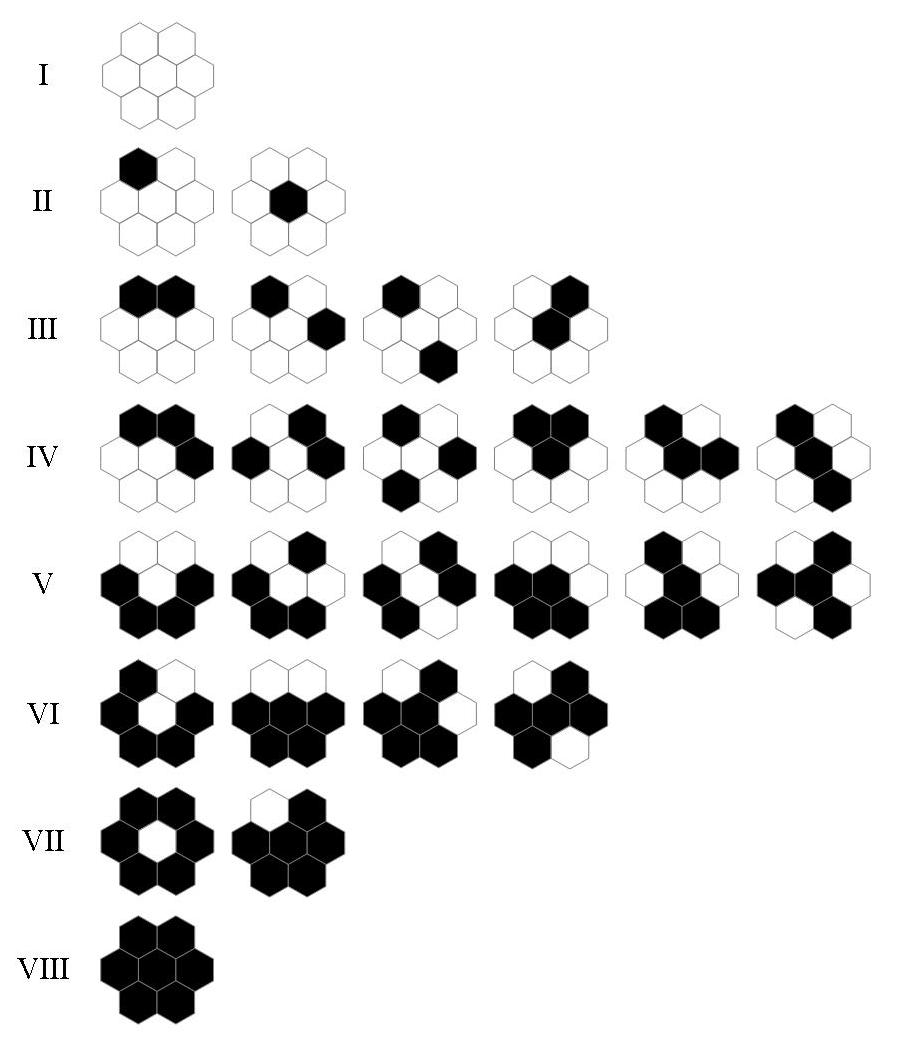
Altogether, if you count all the ways the hexes can be moved around, there are 128 possible combinations in 26 different arrangements. If we read the white hexes in the above as areas of intensive cropland mixed with natural vegetation, and the black areas as actual natural vegetation, then we can recognize Prizren and Pristina from the above map are Group I from the above - all cropland - while that one hex east of Novibazar is group VIII - all wilderness.
And how do we designate the other infrastructure against the other groups? Well, I am a numbers guy. There are 128 combinations; there's 100 points between wilderness and what I've been calling a fully occupied hex. Now, I could say a fully occupied hex doesn't occur until 128 ... or I could simply compress 128 into 100. Both work, but I decided to do the latter. I like having 100 as the difference between wilderness and fully civilized.
Which gives us this table:
Now, no one has to do these things my way. I like using a bell curve to designate the differences between the hexes, so that there is in fact a bigger difference between 95 and 100 than there is between 51 and 56. I see this as creating 'a tipping point,' so that most non-civilized hexes are 3 or 4 out of seven.
So, the hex east of Novibazar would be all wilderness. The one above Pristina would have one part in seven settled. The hex east of Ipek would have 3 out of 7 civilized and the one where the Sanjak lives would have 5 out of 7.
Ah, but this is only a beginning. The seven 'wilderness' portions of a fully wilderness hex would be definitely more wild than the two 'wilderness' portions of the Sanjak's hex. What's really needed is seven definite measures of wilderness ... hexes without so called features but with distinct characteristics resulting from how they're affected by the local civilization. When I get back to this subject, that's what I want to talk about next.
Tuesday, March 12, 2013
Dance
This is difficult to explain on a blog.
Last Friday, urged by my daughter and her friends, I journeyed over to one of the casinos in town to catch a show headlined by Shannon Smith. And it must really, really be said that she and her crew needs to get a really good video on line. This is the best I could find:
And it doesn't begin to capture the feel.
There's something I haven't said about myself since starting this blog. I like to dance. A lot. And I'm good at it ... after a fashion. I'm 100% in the space, my body is an instrument and I just let go. This usually gets the room's attention, it gets the band's attention and it usually brings a round of applause the first time I get up.
So, anyway ... the gentle reader ought to know from my videos that I'm a pretty big guy. I weigh about 260, and you wouldn't think all that could get moving, but it does. Friday night, I proved it. I was slipping into a move I haven't done in about ten years; basically, its all a matter of momentum. I swing my left leg around, I get it under me, I jump with my right leg kicked up to about 80 degrees and I lift six, eight inches off the floor. The people I was with said eight.
I did this without thinking, and I did it in front of the lead singer, Shannon - who lost her place in the song. I was told by the band later that this has never happened before. Shannon laughed, said she couldn't believe it ... and I doubled over, laughing ... and Shannon turned around, snatched one of their albums and gave it to me as a prize. Then she found her place in the song again and we both continued.
I wish like hell I'd had a copy of my book to give her back, but we've been sold out since last week. I expect new copies to arrive today or tomorrow.
So I got a CD for jumping. And its a good CD! Shame no one captured the jump on their phone.
Anyway, it's all off topic. I wanted to say that my will to dance is one of the reasons I love musicians, and add that somewhere that night, between fifteen or twenty dances, I pulled a muscle in my thigh ... and it hurts like hell. So if I've been grouchy lately, we'll say that's the reason.
Last Friday, urged by my daughter and her friends, I journeyed over to one of the casinos in town to catch a show headlined by Shannon Smith. And it must really, really be said that she and her crew needs to get a really good video on line. This is the best I could find:
And it doesn't begin to capture the feel.
There's something I haven't said about myself since starting this blog. I like to dance. A lot. And I'm good at it ... after a fashion. I'm 100% in the space, my body is an instrument and I just let go. This usually gets the room's attention, it gets the band's attention and it usually brings a round of applause the first time I get up.
So, anyway ... the gentle reader ought to know from my videos that I'm a pretty big guy. I weigh about 260, and you wouldn't think all that could get moving, but it does. Friday night, I proved it. I was slipping into a move I haven't done in about ten years; basically, its all a matter of momentum. I swing my left leg around, I get it under me, I jump with my right leg kicked up to about 80 degrees and I lift six, eight inches off the floor. The people I was with said eight.
I did this without thinking, and I did it in front of the lead singer, Shannon - who lost her place in the song. I was told by the band later that this has never happened before. Shannon laughed, said she couldn't believe it ... and I doubled over, laughing ... and Shannon turned around, snatched one of their albums and gave it to me as a prize. Then she found her place in the song again and we both continued.
I wish like hell I'd had a copy of my book to give her back, but we've been sold out since last week. I expect new copies to arrive today or tomorrow.
So I got a CD for jumping. And its a good CD! Shame no one captured the jump on their phone.
Anyway, it's all off topic. I wanted to say that my will to dance is one of the reasons I love musicians, and add that somewhere that night, between fifteen or twenty dances, I pulled a muscle in my thigh ... and it hurts like hell. So if I've been grouchy lately, we'll say that's the reason.
Monday, March 11, 2013
Substance
I said this on Brad's site, but I don't want to risk losing it over there.
What most people fail to understand is that argument does not come down to personalities. It is of no importance who says a thing, or in the manner it is said. It doesn't come down to who's been made uncomfortable or who's been derisive. People may hate my manner. They may hate that I swear. But what they cannot deny is that what I have to say deserves respect. Not because I'm 'a nice guy,' but because I say things that are worthwhile.
While some focus on the visceral, others are focusing on the intellectual. They don't CARE how its presented; they're so thirsty for someone to say something that's meaningful they'll take it no matter what the dipper looks like.
This leaves me free to speak in the manner that is my personality, since I am respected for what I say, not how I say it.
Those who preach that I should say things differently - more positively - are like someone explaining that I should give water in a cup instead of a dipper, as though somehow the water will be more quenching or better tasting. It's cosmetic. These are the arguments of marketing. Our society has become so sick with the process of buying and selling that even intellectual argument must be packaged and made pretty, in order for it to be palatable.
That's no way to become a person of substance.
What most people fail to understand is that argument does not come down to personalities. It is of no importance who says a thing, or in the manner it is said. It doesn't come down to who's been made uncomfortable or who's been derisive. People may hate my manner. They may hate that I swear. But what they cannot deny is that what I have to say deserves respect. Not because I'm 'a nice guy,' but because I say things that are worthwhile.
While some focus on the visceral, others are focusing on the intellectual. They don't CARE how its presented; they're so thirsty for someone to say something that's meaningful they'll take it no matter what the dipper looks like.
This leaves me free to speak in the manner that is my personality, since I am respected for what I say, not how I say it.
Those who preach that I should say things differently - more positively - are like someone explaining that I should give water in a cup instead of a dipper, as though somehow the water will be more quenching or better tasting. It's cosmetic. These are the arguments of marketing. Our society has become so sick with the process of buying and selling that even intellectual argument must be packaged and made pretty, in order for it to be palatable.
That's no way to become a person of substance.
Child Habits
Speaking of writing posts that are meant for children; when I was a child, I was fascinated by things like this: The Largest 100 Countries in the World.
Today I understand that this is not a particularly useful list. Putting things in order is interesting, but it tells you very little about the quality of life or the political existence of the countries listed. The fact that Kazakhstan and Algeria are about the same size as Argentina and Saudi Arabia has little or nothing to do with the infrastructure or culture of those countries.
Yet there was something delightful in ranking them, and regularly I would put together lists like this and like the others linked on the page. And because I would do that, I was compelled to learn where the countries were, like Benin and Malawi. And since they were on maps, I would study and memorize the capital cities and other cities and the rivers that flowed through them. This gave me a really strong background where it came to history, since when some random point was made about the Portuguese starting a colony in Angola, not only did I know where Angola was, I had a very strong conception of the shape of the country, its size ... and in time, its terrain and vegetation.
Today this has led to a party trick I do where I meet some fellow from Nigeria and I ask him if he is from Kano or Lagos. And he will respond by raising his eyebrows and asking me, "Have you been to Nigeria?" Because, after all, you can't possibly know the names of two giant cities in a very populous country if you haven't been there.
What's nice for me is that I can perform this party trick whether you're from Malaysia or Burkina Faso or Paraguay. Now, picture in your mind, without using the internet, where those countries are. Picture what other countries border them, and on what side, and for what approximate distance. No? Can't do it? I can ... and I do it automatically.
Now, this sort of knowledge makes me "pretentious" in the eyes of some people ... but I want to make something clear. I learned this as a child. I was not yet 10 when I could tell you the capitals of every country in Africa. Why? Because it fascinated me.
Today, I have proof positive that this fascination extends to a lot of children, none of whom are pretentious just because they happen to be interested in something that isn't baseball statistics. And here it is:
I would have been almost 30 when this appeared ... but even at nine I knew that the Caribbean was not a nation (its a sea) and that French Guiana is a colony of France - facts which would have really pissed me off as a kid for Yakko getting it wrong, but which now I realize they were needed to make the song come out. I would have guessed that was why back in my childhood, but back then I was incredibly inflexible. Not like now.
Now, no one is going to argue the video above wasn't meant for children. Here's the thing, however ... one of the things we LIKE to do with children is to educate them. And in this world, apart from all the rhetoric and crap about the carefree life of being a child, I remember they made me spend a lot of time sitting in classes learning stuff. To me, learning stuff is part and parcel with being a child ... because the point isn't to praise and worship childhood, the point is to take children after birth and teach them to be adults.
So it baffles me when I hear someone say that since D&D is a game for 'children,' it should be simple and fun. That would be because for me, childhood and the things I liked were not simple and fun. They were complicated and fascinating and they drove me to wanting to know more and more and more. It's my childhood that taught me to question why a sword is a sword and how its made and why it should do 1d8 damage and whether or not it weighs 6 lbs. like the DMG says or whether it should weigh 4. This stuff still fascinates me.
I learned to play D&D at the age of nearly 15. This is five years after I was doing on the bus going back and forth from school what Wakko was doing (without pictures, obviously, and without music). By the time I'd hit grade 10 I had torn through science fiction, gothic fiction, history of war, history of science, medicine, astronomy, geology, geometry and I was just beginning to understand computers (this was a bit early for a home version). But in the summer of 1979, a week before my 15th birthday, I was asking a lot of questions about the meaning and purpose of life and I was reading psychology. Yes, at the age of 14, I was reading Freud.
Now, I don't really give a shit that adults my age now have never cracked a book about psychology, and I don't really give a shit that if I've gathered some knowledge on the subject in the last thirty years that they don't have that this makes me sound "pretentious." What that word means to me, whenever I hear someone use it, is "I am a stupid lazy moron and I don't like people who are smart." This is also something I learned as a child, what with all that time being forced to sit in classrooms with people who did not like books.
There's really no way to avoid the pretentious tag if you want to know something. In my case, it's a little hard to imagine D&D as a "child's game" stripped free and clear of psychology. The former, for me, did not exist before the latter. There was no time in my life when I played D&D without realizing that people lied or resisted inquiry or behaved according to their insecurities according to predictable analysis. This reader got all that from the get-go. As a child.
Does this mean that I was never a child playing the game? Or does it mean that adults do not give children their due? 'Cause I'm willing to bet that at least one of the regular readers or commenters on this blog, and on others, is in fact 8 years old, pretending to be 25, so they can be respected for the knowledge they have and not spoken down to like the moronic idiot we suppose children to be. And here's the thing - I'm just as willing to bet that 8 year old's insight and ability to express thoughts in words is every bit as good as a million actual 25 year olds barely able to spell. And to that 8 year old (or 9 or 10, whatever you are), I say good on you! Just be warned ... people older than you now, people who are the same age as you when you're 25, and people younger than you when you're 50 will go on saying that you're pretentious, just because you had a curiousity.
But forget them. They're all just bricks in the wall.
Today I understand that this is not a particularly useful list. Putting things in order is interesting, but it tells you very little about the quality of life or the political existence of the countries listed. The fact that Kazakhstan and Algeria are about the same size as Argentina and Saudi Arabia has little or nothing to do with the infrastructure or culture of those countries.
Yet there was something delightful in ranking them, and regularly I would put together lists like this and like the others linked on the page. And because I would do that, I was compelled to learn where the countries were, like Benin and Malawi. And since they were on maps, I would study and memorize the capital cities and other cities and the rivers that flowed through them. This gave me a really strong background where it came to history, since when some random point was made about the Portuguese starting a colony in Angola, not only did I know where Angola was, I had a very strong conception of the shape of the country, its size ... and in time, its terrain and vegetation.
Today this has led to a party trick I do where I meet some fellow from Nigeria and I ask him if he is from Kano or Lagos. And he will respond by raising his eyebrows and asking me, "Have you been to Nigeria?" Because, after all, you can't possibly know the names of two giant cities in a very populous country if you haven't been there.
What's nice for me is that I can perform this party trick whether you're from Malaysia or Burkina Faso or Paraguay. Now, picture in your mind, without using the internet, where those countries are. Picture what other countries border them, and on what side, and for what approximate distance. No? Can't do it? I can ... and I do it automatically.
Now, this sort of knowledge makes me "pretentious" in the eyes of some people ... but I want to make something clear. I learned this as a child. I was not yet 10 when I could tell you the capitals of every country in Africa. Why? Because it fascinated me.
Today, I have proof positive that this fascination extends to a lot of children, none of whom are pretentious just because they happen to be interested in something that isn't baseball statistics. And here it is:
I would have been almost 30 when this appeared ... but even at nine I knew that the Caribbean was not a nation (its a sea) and that French Guiana is a colony of France - facts which would have really pissed me off as a kid for Yakko getting it wrong, but which now I realize they were needed to make the song come out. I would have guessed that was why back in my childhood, but back then I was incredibly inflexible. Not like now.
Now, no one is going to argue the video above wasn't meant for children. Here's the thing, however ... one of the things we LIKE to do with children is to educate them. And in this world, apart from all the rhetoric and crap about the carefree life of being a child, I remember they made me spend a lot of time sitting in classes learning stuff. To me, learning stuff is part and parcel with being a child ... because the point isn't to praise and worship childhood, the point is to take children after birth and teach them to be adults.
So it baffles me when I hear someone say that since D&D is a game for 'children,' it should be simple and fun. That would be because for me, childhood and the things I liked were not simple and fun. They were complicated and fascinating and they drove me to wanting to know more and more and more. It's my childhood that taught me to question why a sword is a sword and how its made and why it should do 1d8 damage and whether or not it weighs 6 lbs. like the DMG says or whether it should weigh 4. This stuff still fascinates me.
I learned to play D&D at the age of nearly 15. This is five years after I was doing on the bus going back and forth from school what Wakko was doing (without pictures, obviously, and without music). By the time I'd hit grade 10 I had torn through science fiction, gothic fiction, history of war, history of science, medicine, astronomy, geology, geometry and I was just beginning to understand computers (this was a bit early for a home version). But in the summer of 1979, a week before my 15th birthday, I was asking a lot of questions about the meaning and purpose of life and I was reading psychology. Yes, at the age of 14, I was reading Freud.
Now, I don't really give a shit that adults my age now have never cracked a book about psychology, and I don't really give a shit that if I've gathered some knowledge on the subject in the last thirty years that they don't have that this makes me sound "pretentious." What that word means to me, whenever I hear someone use it, is "I am a stupid lazy moron and I don't like people who are smart." This is also something I learned as a child, what with all that time being forced to sit in classrooms with people who did not like books.
There's really no way to avoid the pretentious tag if you want to know something. In my case, it's a little hard to imagine D&D as a "child's game" stripped free and clear of psychology. The former, for me, did not exist before the latter. There was no time in my life when I played D&D without realizing that people lied or resisted inquiry or behaved according to their insecurities according to predictable analysis. This reader got all that from the get-go. As a child.
Does this mean that I was never a child playing the game? Or does it mean that adults do not give children their due? 'Cause I'm willing to bet that at least one of the regular readers or commenters on this blog, and on others, is in fact 8 years old, pretending to be 25, so they can be respected for the knowledge they have and not spoken down to like the moronic idiot we suppose children to be. And here's the thing - I'm just as willing to bet that 8 year old's insight and ability to express thoughts in words is every bit as good as a million actual 25 year olds barely able to spell. And to that 8 year old (or 9 or 10, whatever you are), I say good on you! Just be warned ... people older than you now, people who are the same age as you when you're 25, and people younger than you when you're 50 will go on saying that you're pretentious, just because you had a curiousity.
But forget them. They're all just bricks in the wall.
Sunday, March 10, 2013
I Have Been Pretentious
Gentle Readers,
I have seen the error of my ways. This site here has shown me that D&D is a game for children. My efforts to investigate it as a game that is involved and filled with adult themes has been pretentious.
So I am announcing that, going forward, I will only be writing posts that are meant for children. I would please ask that you go to Brad's site and give him your support for enlightening me in this very important way.
Thank you.
I have seen the error of my ways. This site here has shown me that D&D is a game for children. My efforts to investigate it as a game that is involved and filled with adult themes has been pretentious.
So I am announcing that, going forward, I will only be writing posts that are meant for children. I would please ask that you go to Brad's site and give him your support for enlightening me in this very important way.
Thank you.
Friday, March 8, 2013
Signage
Now, mucking around with features has brought something to my attention. Let's suppose that we take a simple hex, 20 miles in diameter, without any major water course and without any significant town or village. This can greatly reduce the number of things that might be present.
I said no 'significant' town or village ... we still have to reserve the possibility of insignificant hamlets and such. A typical manor property of the medieval period would correspond (generally) to the following English-minded image (which I'm stealing from my own site, where I posted it in March of 2010):

Farms, forest, meadow for livestock, a small village, a blacksmith, a mill, toll bridge, church, parsonage, church or chapel, manor house. For the hex I'm proposing we can toss out the mill and bridge, since as I said, no sizable watercourse. Somewhat higher country, a few streams too slow to run a mill and with too many fords to bother bridging, etc. The blacksmith is debateable, but for simplicity's sake, let's say no industry.
There still might be a hamlet, with or without a manor. There might be a castle, even, particularly if it is a border hex. A hamlet might contain, with no guarantees, a chapel, a well or a guard house. It might be organized around a mine, saw pits or a quarry, and it might be defended by a palisade. There might be a barn, but probably not a stable.
If you were passing through a hex that was 20 miles across, how would you know it was there?
Here's something that I've been thinking about has to be part of filling the hex: signage. There would be some kind of sign telling the party that there was a hamlet, and pointing at where it was. Now, this is the sort of thing I've more or less taken for granted, but there's a lot to be gained from a sign. For example, I've been thinking about the difference in ponds that are empty of fish and ponds that are actually quite good for fishing. The latter would be a boon to a party ... but unless you sit and fish, you can't tell the difference, right? Well, there's the kind of Natty Bumppo trick where the ranger just looks at the water and knows, but that's really kind of crap.
But a sign! A good fishing pond would be named, because people like to name things. Moreover, the party probably wouldn't just come upon the pond and see a sign in front of it ... there'd be a sign four miles away that said, "Bumppo's Pond," with an arrow pointing along a path.
A sign for the hamlet over the horizon might well include some notation that of a quarry or a mine ... the name of the hamlet itself often indicates things about a town: Fishersville, Watch Hill, Hartford, Plainfield, 'Virginia' Beach, etc. In modern parlance these names usually don't mean much (is there still a 'ford' in Connecticut where the capital is?) ... but in medieval times, these things were exactly what they said on the tin.
The signs should be there. Not just the usual no-trespassing, but signs describing gaps between hills, bogs, roads, meadows, camps, churches, hills, beaches, coves, bridges and so on ... not just where those things are, but at crossroads and turn-offs miles away from where those things are. So that a party walking along a road isn't in a vacuum, they're beset upon to make up their mind to continue straight ahead or to check out the 'South Meadow Great Cedar Swamp' ... only to find out its an 800 foot-wide wetland.
What a disappointment.
I said no 'significant' town or village ... we still have to reserve the possibility of insignificant hamlets and such. A typical manor property of the medieval period would correspond (generally) to the following English-minded image (which I'm stealing from my own site, where I posted it in March of 2010):

Farms, forest, meadow for livestock, a small village, a blacksmith, a mill, toll bridge, church, parsonage, church or chapel, manor house. For the hex I'm proposing we can toss out the mill and bridge, since as I said, no sizable watercourse. Somewhat higher country, a few streams too slow to run a mill and with too many fords to bother bridging, etc. The blacksmith is debateable, but for simplicity's sake, let's say no industry.
There still might be a hamlet, with or without a manor. There might be a castle, even, particularly if it is a border hex. A hamlet might contain, with no guarantees, a chapel, a well or a guard house. It might be organized around a mine, saw pits or a quarry, and it might be defended by a palisade. There might be a barn, but probably not a stable.
If you were passing through a hex that was 20 miles across, how would you know it was there?
Here's something that I've been thinking about has to be part of filling the hex: signage. There would be some kind of sign telling the party that there was a hamlet, and pointing at where it was. Now, this is the sort of thing I've more or less taken for granted, but there's a lot to be gained from a sign. For example, I've been thinking about the difference in ponds that are empty of fish and ponds that are actually quite good for fishing. The latter would be a boon to a party ... but unless you sit and fish, you can't tell the difference, right? Well, there's the kind of Natty Bumppo trick where the ranger just looks at the water and knows, but that's really kind of crap.
But a sign! A good fishing pond would be named, because people like to name things. Moreover, the party probably wouldn't just come upon the pond and see a sign in front of it ... there'd be a sign four miles away that said, "Bumppo's Pond," with an arrow pointing along a path.
A sign for the hamlet over the horizon might well include some notation that of a quarry or a mine ... the name of the hamlet itself often indicates things about a town: Fishersville, Watch Hill, Hartford, Plainfield, 'Virginia' Beach, etc. In modern parlance these names usually don't mean much (is there still a 'ford' in Connecticut where the capital is?) ... but in medieval times, these things were exactly what they said on the tin.
The signs should be there. Not just the usual no-trespassing, but signs describing gaps between hills, bogs, roads, meadows, camps, churches, hills, beaches, coves, bridges and so on ... not just where those things are, but at crossroads and turn-offs miles away from where those things are. So that a party walking along a road isn't in a vacuum, they're beset upon to make up their mind to continue straight ahead or to check out the 'South Meadow Great Cedar Swamp' ... only to find out its an 800 foot-wide wetland.
What a disappointment.
Why I Read Koster
Following in the footsteps of Raph Koster's proposal, tailored obviously for D&D. Please note quote from Koster's site:
Easy mode
"Basically, these are the difficulty levels for game designers. Easy mode is the cop-out game adaptation, the easy answer. A more adventurous team might go for normal mode. But Hard and Nightmare are the regions we rarely venture to in games… some would argue because they aren’t commercial enough. But the movies mentioned all get these points across — in commercially successful content even… so why couldn’t the games?"
Easy mode
- A game in which player characters roll dice, kill monsters, collect treasure and advance in power.
- A game in which players pretend to be avatars, interacting with each other and in-game beings in order to pursue goals which require overcoming obstacles in order to achieve victory.
- A game in which players investigate the limits of their own abilities by attempting to establish social or economic frameworks of their own design, as a means to organize or develop concepts they've created upon the backdrop of a quasi-real world that seeks to promote positive and negative feedback for their efforts.
- A game that forces players to question who they are, challenging their belief systems while psychologically re-engineering their habits and expectations in a world that fails repeatedly to correspond with their wishes while simultaneously tempting them to further flights of fancy.
Thursday, March 7, 2013
May I Remind You of My Book?
My viewership doubled today. People have plainly enjoyed the "How to Play" post. And so I would ask the gentle reader to consider - I've shown my ability to keep a sustained thought going, and bring it to a satisfactory conclusion.
Certainly, my book, Pete's Garage, would be a greater example of the same. It is merely the cost of four cappuccinos. It is very easy to buy. The website is clear and easy to understand. Others on this site already have their copy. Join them. Buy Pete's Garage Here.


Certainly, my book, Pete's Garage, would be a greater example of the same. It is merely the cost of four cappuccinos. It is very easy to buy. The website is clear and easy to understand. Others on this site already have their copy. Join them. Buy Pete's Garage Here.


Wednesday, March 6, 2013
How to Play a Character (The 10,000 Word Post)
UPDATE: This post has been updated and included in the recently released book, How to Play a Character & Other Essays, available for purchase from the Lulu marketplace.
You have rolled dice and scratched out the limitations of your character. You have made a decision about gender, you've followed the protocols of your game in order to determine what your character knows and what particular 'education' he or she has. You've poured over lists of equipment and plugged boots and clothes over your character's body, filled the back pack, strung belts and bands over the shoulders and hips of the character and stuffed or hung those with weapons. You've named your character. You've recorded all the things you're going to need to know about your character so that you can play the game.
What you have here is 'life.' It is a gift. It is the sort of thing for which other people say "congratulations" and for which they throw showers and fill the space with presents. This character is alive.
More to the point, this isn't 'a life' this is 'your life' ... which is to say, this is a life you did not formerly possess, but which is now ready for you to toss away or propel forward at your whim. It is a life you have never had. It is a life free of parental influences, free from guilt bestowed upon you by authority figures, free from fear of the law or fear of the unknown. It is free from these things because you are free from the restraining concerns having to do with pain, suffering, boredom or any other misery. This character, this life you have just recently come into, doesn't need to bother with all that.
There are those players for whom the character will never be themselves. They deliberately keep the character separate. They do not invest. "This is my character, these are 'his' aspirations, these are the things that 'he' wants. I, personally, would never want these things, but this character is nothing like me, and therefore he has other wants and needs."
There is something clinical in that approach, which says that as a player, I can conceive of the things someone else would want. I can process the methodology for obtaining those things, and I can take intellectual pleasure from the methodology succeeding ... but I would never, ever identify with the visceral pleasure in that success. It is apart from me.
Naturally, we presume this means the methods and patterns of killing. This is, after all, D&D. Things are killed. There's blood. Mayhem ensues. At the end of many a hard fight, bodies are strewn across the field. That's something which, if it were to happen before us in the real world, would traumatize us. We could not manage it. We would turn and vomit and hope that we had to never see a sight like that again, and we would hope we could forget the one we'd seen.
We would certainly not revel in the violence. We would not wash our hands in it. We would not be stripping the bodies in glee or arguing passionately with our mates about how many gold teeth, ripped from the jaws of the dead, we were willing to share out. These bloody fighters and thieves are NOT US. They are our characters.
Displacement
This is the shift, or move, which defends us from those things we do not wish to know about ourselves or the world around us. It is a strategy that ties up the world in a pretty box with a pretty bow, that allows us to believe that where it comes to the world, we are exactly what we want to perceive ourselves to be. This is an unconscious process. We do not do it from any sort of strategy that we intentionally employ. Long before we have come to the conclusion that we believe a thing, that belief has been installed - hard-wired, if you will - inside our minds by our need to have it so.
No person who goes off to war, who leaves behind a wife or family, who has grown up on football games and chasing the opposite sex, believes they have it in them to be some sort of psychotic killer. Many may approach the matter from the standpoint that they are willing to kill ... but few imagine the full extent of what they may be prepared to do once the situation becomes hot and dangerous. That is why the way people are affected by war - where there is suddenly no law, no right, no wrong, just the raw force of weapons and absolute application of will - is such a shock. They didn't know they could do those things. They didn't know anyone could do those things. They'd heard of it, they'd had it explained to them, but all along the line there was that displacement that made it all seem far away and unreal ... until the full weight of reality came crashing down on their heads.
Playing a character isn't reality. You're not really alive. It's just paper. And the brutality carried forth by your characters, that's unreal too. And thank heaven, too ... because otherwise you'd have to reconcile your imagination, the one that allows you to cheer and feel your heart rate increase at dice bouncing on a table with the actual, real act of bludgeoning someone to death with a mace. No one wants that. There's only a small percentage who could remotely begin to deal with that.
So, yes, you've displaced your character from yourself. The character may kill for coin and experience, but that's not you.
Except, of course, it is.
The radical game design that is incorporated into the process of D&D is that your personal psychology is being called upon to conjure the necessary tactics and processes that it takes to kill things and take what they own. This isn't being done by a monopoly piece, with which you could hardly identify. This isn't being done by a character in a video game, that looks nothing like you anyway and - really - doesn't begin to fall into the uncanny valley of matching your everyday frustrations against working out those frustrations with a roleplayed axe. No, the character here is wholly imaginary. You may sketch out how you perceive your character to look; you may steal an image off the web; but you know, and I know, that the brain of that character, defined by those ticks and marks on your character sheet, is YOUR brain. You've got to figure out a way to get out of this goblin fortress, and there's no other entity you're leaning upon as a crutch to do that.
If you sit down and think about it, playing a D&D character, taking the necessary mindset that displaces you from your character, is a mindfuck that doesn't occur in any game except this one. You are this character, this living breathing entity, and you're not. You've made the decision to swing and hit, and you haven't. It's just what you think your character ought to do in this situation, with your character's skills, if survival is the goal. Which is to say, on some neanderthal level, it is what YOU would do if YOU had these skills and YOU were there.
So thankfully, you're not. Because that would be too freaky.
It's a dance around the abyss, as it were. There's the great yawning black pool, where the worst things we can imagine slowly swirl in a terrifying void. While we don't want to fall in, we're going to just move to move as close to the edge as we can, and stand on our tip-toes, and look down for just a minute or so ... before falling back, getting up from the table and saying "whew!" ... glad its all just a game!
Expression
Let's lift all the battle mayhem and drop it on a shelf, and just explore the angle of being the character without the PTSD.
I said you had a life to live, and a lot of players embrace that life. It is an opportunity to try things they can't otherwise try; to build up complex structures and networks, to explore unidentified worlds or meet imaginary beings. For some, this isn't their 'character' doing these things ... it is they, themselves. "I am the Grey Mouser," says the player. "I am touring the streets, examining each target, each simple minded fool who doesn't stand a chance against my worthy brilliance ...!" and so on. This is identification with the character, and it isn't as though it doesn't have considerable and enduring precedents that go back through the ages.
This is, after all, acting. I have been given a part - say, a mass murderer of Auschwitz. It is my role in this play or film to represent the verisimilitude of that persona, to involve myself into the mindset of a person who is capable of doing that. I don't concern myself with the reality that it isn't something I would do ... because to achieve the respect the part demands, I have to become that frightening antagonist for the course of the performance - or else the audience won't believe. So, temporarily, I toss my proclivities aside, leaving them on the chair of my dressing room like a old cloak. I am "Klaus the butcher." I laugh at suffering. I take glee in the mass rape of the innocent girl that happens off stage. I order my men, bellowing at them, to enjoy themselves. This is the part. These are the words and the stage directions.
What have I become? Surely, not Klaus. Klaus is killed at the end of every performance, his evil deeds wrapped in a cloak of ultimate justice (we hope) and the audience comes away feeling that we must be vigilant against the Klaus's of the future. So I've played my part. But what have I become?
For the run of the play, I have chosen to express a part of my humanity that I understand to exist. The difference between me and Klaus is, as anyone can tell you, a matter of time and chance. If I, or you, gentle reader, had grown up in the proper families of Germany in the 1920s, joined the proper organizations in the 1930s and excelled at our positions, we could have found ourselves in the comparatively cushy and lucrative positions of executing Jews in the 1940s. If I research my part, and examine it closely, I must admit to myself how lucky I am not to have been brought up in the cultural frame that would have directed me to do those things. There are none of us who are so innocent that we could not have been seduced into that.
So I have re-examined myself through the expression of acting the role. I have caused an audience to re-examine themselves. It is an opportunity.
Granted, we're not talking about players being part of the Final Solution. Hopefully, we're asking ourselves to examine more wholesome lives we could never otherwise lead ... to be farmers and merchant bankers, buccaneers or landlords, kings or queens of land and empire. But along with those things, too, we must include pirates and vampires, mercenaries, master criminals, cult leaders and so on. Once again, we must recognize that the profound element of D&D is that everything is on the table.
It isn't like a video game, where what you are is limited to the programmer's conception for that game. It isn't like a play, where the only part I can play is this, and the only lines I have are these. The field is wide open. There is no 'law' in the arena. The same character I run today as a missionary can turn sour and heretical tomorrow; he can plunder and pillage this month, and the next he can seek redemption and make amends today. My character is not limited to my being male, or my being human. So when we say, "express" yourself, it is the deliberate attempt to become this other being, this other sex, this other idealogy.
Surely, the further I invest myself into the role, the more expressive the role becomes. I'm not saying that the character is a puppet that I move with strings, and the more adept I become the more lifelike it is ... I am saying that for a time, I forget that I cannot actually die as I sit at the table and run my character. I forget that I'm not actually falling through the air, watching the earth rise menacingly towards me, as I furtively roll dice hoping the right combination turns up before its too late. I'm there! I'm in the body of my character, and that's possible because when I close my real, human eyes, I see what I think is there, and I don't want to stop.
If the reader dreams like I dream, the reader has been a scientist and a race car driver; the reader has been old or young, or the victim of a deranged killer or someone holding the stopwatch at a racetrack. When these things and more occurred in the reader's dream, the reader knew those things were true ... but in the dream, they were. It wasn't someone else falling out of an airplane. That was you. And as the ground approached, there was no displacement. You either relished in the conceived rush of air as it went past, knowing you were dreaming, or you awoke sweating as you realized that you were about to die.
Whatever you may have been doing, or whatever you might have conceived of being (sometimes I am a zepplin in my dreams), you never thought upon waking, "that wasn't me." You knew it was you. You said to your partner, "I was a zepplin in my dream last night." You never said, "I dreamed I was running a zepplin character last night."
Well, okay, maybe you have. I don't know you. You're a stranger. And if you think of your dreams that way, you're stranger than I am.
Immersing yourself in the game means expressing yourself through your character ... and by means of that, you gain experiences as that character that you couldn't have otherwise. And that is a powerful drug.
Winning
Then what do we want to do with this opportunity? The answer seems obvious. We want to win the game. Or we would, if this was monopoly, and a 'win' was something as clearly designed as a goal post. It isn't in an rpg. Winning is this fairly amorphous quality that means different things to different people. For some, just gathering all the money they can in the shortest space of time defines a win. For others, having a good time is the measure. For still others, challenging themselves, either by overcoming the odds or 'solving the problem' is the ideal.
I'm as much in the dark as anyone where it comes to defining a 'win' when there are no finish line involved. There's an entire self-help industry designed to aid you in deciding how, in real life, to win, and how to tell when you have won. The reason for that is that as people we've lost the clear definitions our culture once had; three or four generations back, the business of winning was obvious. Make money, use it to make more money, use the massive amounts of money you've gained to build a personal world of power and triumph, use that to beat back the other fellow and - if you're really successful - use it to tell the state and the other fellow what to do. You know you're winning when everyone around you is clearly on their knees. If you're still on your knees to someone ... you're not there yet.
That doesn't allow for a win for very many people ... but in a strongly heirarchical society, everyone understood that humbling yourself before authority was expected and ultimately unavoidable. Unlike the present, when really we simply avoid authority or snub our noses at it. Faced with the expectation that we will never enjoy the appreciable qualities of massive amounts of power, we simply ignore the whole matter and find interesting ways to amuse ourselves.
The roleplaying game has a lot more in common with the old heirarchical system than with our modern avoidist philosophy. You're not only awarded for increasing your abilities and influence ... you're positively punished for not taking the power-acquisition path. How? Well, the game is boring. There's nothing interesting about pretending to get a job in a roleplaying game. It's not like your steampunk character can sit down for the evening with the words, "I read all the plays of Shakespeare. How much experience do I get?" There's no percentage in it. If you're not fighting ... and thus increasing both the level of your danger and the potential reward from the risk you're taking, it's just a dull, dull game.
Whatever your personal motivations - coin, fun, challenge - you must first and foremost recognize the social structure surrounding your eventual achievements: right now you are nothing. With time and effort and perseverence, you will be something. To be something requires acquisition - of power or wealth - and that acquisition will come, must come, from someone or something else. There's nothing to be done about it. You may be a nice person. You may have no personal desires for global domination. But someone has, and your meager acquisition of wealth and power (in the beginning) is, at the very least, an annoyance to someone. Eventually it will become an annoyance they can't ignore, and in the interest of keeping all the wealth and power they already possess, they will have to put a timely end to your existence.
Well, usually in an rpg, they are trying to kill you.
So where it comes to the subject of winning, we can at least acknowledge that you will have to be taking something from someone. Who you take it from is up to you. Your gamemaster is probably going to make this very convenient for you, nicely standing up strawmen you can beat into submission easily with your pain stick ... but if you have any influence on the decision-making process at all, you really ought to sit down and think. "What is it that someone has got that I would really like to have?" ... and ... "Who is it that has things that I think really ought to have nothing?"
Those are two very simple questions, and they will greatly help you in establishing a purpose for your character. In the greater sense, they will build up those goal posts we were saying earlier didn't exist. The questions are open and non-moral in structure. The who and the what could be anything, after all. It does not matter if they're nice people or bad people ... the decision making process is not in how they behave towards their minions, it is in how YOU would behave towards their minions if they were nicely out of the way. Getting them out of the way is the win. One presumes that the thing you want would be the tool that would help with that. So first and foremost, go get the thing you want.
Backdrop
I want to avoid calling this part of your journey as a character the 'setting.' That's really something for the DM to worry about. For you, all that stuff that makes up the world is just a screen you stand in front of. You do not need to be involved in all that. You don't need to invest. Granted, if something comes screaming out of the backdrop at you, you will have to adapt and overcome ... but regarding the principle of all that environment, you're free and clear.
Where are we? You've come to a reconciliation that you are the character. You recognize that being the character gives you the opportunity to do things you wouldn't normally be able to in life, and so its rational you're going to pick things that interest you. And towards that, you've made up your mind to rid some poor bastard of all their wealth and power, and along the way get some of the great materialistic things that bring happiness to your heart. What now?
Well, now we assess that backdrop we're not invested in ... the main feature of which is that stoogy, largely untrustworthy creature whose imagination unfortunately thwarts most attempts at close dissection and examination. (You can dissect the DM physically, but it makes for poor gameplay the next gamenight).
For you, the player, the DM is the backdrop. The DM is also the possessor of all the material you want and all the power you're bent on usurping. Fortunately for you, the DM is not personally involved in his or her wealth and power. He or she is only pretending, acting in a passionless manner on behalf of creatures and personalities that do not in fact exist. The DM is a little like a pro-bono lawyer designated to look after clients who are now dead, leaving the lawyer with obligations and no expectation of remuneration. In other words, the DM is a bit of a sap. Fundamentally, the DM wants you to win - that is, achieve your goals. That is your edge. From your perspective, success or failure matters. From the DM's perspective, success or failure is a matter of making all the right ticks on all the right boxes of documents that fill filing cabinets in an immense warehouse that won't yield up all its paperwork in the DM's lifetime.
Like I said, a sap.
To achieve your goals, you are playing the DM.
Note, I do not said playing against. The DM is not in competition with you, and you are not with him or her. Those who insist on seeing themselves locked in a struggle against the DM for gain have deluded themselves into thinking the structure of the roleplaying game is simple and clear. They see themselves as the protagonist and automatically brand any apparent opposition as the given antagonist. It's a me versus the world philosophy, whether the gain is rank or information or personal conquest. Like the heckler at a comedy club, this individual has missed the point.
The DM is potentially your ally. You need his or her judgement to succeed at your tasks, and as I said, the DM's inclination is that you should receive it. Oh, the DM will try to give the opposite impression; the DM will seem to mind fuck you and confront you with obstacles at every opportunity ... but it is all smoke and mirrors. Deep down, the DM's real desire is that you will thwart all of his or her obstacles and ultimately triumph.
He or she just can't say so.
As a player, you must rise above appearances. You must realize that this individual running the game has no animosity towards you or your character (or should have none ... but more about that later). Hopefully, the DM is a friend. It is up to you as a player to tap into that friendship and make it work for you. Having the DM on your side in a game, whatever the reason, is the brass ring ... and even though with a very good DM it will be hard to have, you've got to keep reaching for it. Otherwise, you're stuck with the success the dice can give you ... and the dice are somewhat less than reliable.
Most often, most players do that by playing the DM's game. This is easiest, after all. The DM clearly wants things from the party ... adventure to this place, kill this monster, achieve this victory and so on. Ordinary players approach the game with the expectation of buying into that agenda - it is much easier than trying to push their own, and if their DM is at all high strung, there's less table drama in the bargain.
It takes a little more chutzpah to deliberately subvert the DM's wishes in order for the player to achieve his or her personal ends ... but that is what's needed! Remember, you ARE your character. You have needs and wants too; and in the long run, your needs and wants should trump those of the DM. You're the one down on the ground, fighting the monsters, suffering the losses and taking the risks. It is your character that is going to live or die here ... a character into which you've sought to invest. If those monsters opposed to you die, the DM's world will go on. The DM can make more at a whim. But if your character dies ... that's it. Something that you have cherished and perhaps loved is gone forever. The DM in no manner can suffer a loss like that. You can. And because you can, you must recognize that this game is hinging on your emotion and not the DM's. That gives you precedence, here. You are the active ingredient, and so it is your actions that matter.
You must stiffen yourself, then, towards winning the DM onto your side in order to win the game (achieve your goals). Some do this with rules lawyering, to corral the DM into actions that correspond to mutually agreeed upon limits to the DM's behavior. Some manipulate through wheedling, whining or out-and-out complaining. Some keep notes on every word the DM has said in order to flash those notes at the right time in order to compel the DM to adher to his or her own rulings. And some innovate.
The first examples above, and other things players do along those lines, are terribly overt and any long-time DM with experience can see them coming and he or she will often ignore such attempts through gravitas: "I am the DM, and I do not sympathize." Some DMs will respond less kindly. Some DMs will fix rules against tactics like lawyering out of sheer meanness, in the sense that they will get their backs up rather than give ground, even when they're wrong. But 'innovation' is a very difficult thing to subvert as a DM, and in fact it is what all DMs crave. It's the sort of thing that softens a DMs heart ... so in a situation where the player is trying to innovate, and failing miserably, DMs will nevertheless go gooey and give more ground than they ought. Innovation is the DM's Achilles' heel, and it is what you want to shoot for as a player.
What is innovation, however, and how to you achieve it? Well, to look at that, first we have to talk about your tools.
Gearing Up
I have often made jokes about players who set off to adventure and without having purchased any boots, stockings, food, belt pouch, quiver, harness and tack for their horses (though they usually remember the saddle), etcetera. The reason why is easy to understand. They've remembered to buy armor and weapons because those are things which they know they're going to need when the fighting starts. They've remembered to choose their spells for the same reason. They've remembered to buy backpacks and sacks because they have their eye clearly on the loot they're going to haul away. There's nothing worse than having to take off your rope and makeshift a sack out of it.
What these players haven't learned to do is to visualize themselves in the world where they've chosen to run. They are 'there.' They're comprehension of the game is on the game itself, and that is no path to success where it comes to D&D. The game allows for far deeper introspection into the behavior and success ... and a good player knows to take advantage of that allowance.
In the Thomas Covenant series, the main character, who is a leper, is compelled from time to time to give himself a 'visual serveillance of extremities,' or a VSE. The purpose of this results from the deadening of a leper's nerve endings, so that the skin lacks sensitivity to cuts, bruises or other damage ... and for a leper, this is deadly. An unobserved cut will be an untreated cut, which will fester and perhaps turn gangrenous before anything proper can be done. The circumstance can lead to the loss of body parts or potentially death. As a side note, I once slipped with a knife and severed the nerve connection between my thumb and forefinger, through the web of my left hand, and ever since there is a definite 'dead zone' in the touch of that my index finger. This is undesirable, as when I cook this is the finger that holds whatever I am cutting, and as such I must concentrate on not letting that numb digit stray out a little too close to the flashing knife in my right hand.
The character, for all the player's identity with it, is like a large entity that lacks any tactile feeling. It is an extension of the player's emotional desires and motivation, but it cannot give back any physical signal that it lacks something important. You cannot feel its bare feet upon the road, and therefore you don't notice you haven't any boots until three sessions after the last journey to the market, when you're seeing suddenly that you've forgotten to purchase them.
If you can look at your character in this specific way, you can see how important it is to have an organized, successfully sketched out representation of that character - the character sheet.
The sheet is your VSE. It's not only the information you need to fight battles and measure your odds of success, it is also the indication of your general wellbeing. It is the only possible representation of your character's physical body, and far too often a casual approach to your character sheet will result in missed opportunities, confusion and - occasionally - epic failure. I once had a character who died because they had forgotten a potion of extra-healing they had received far, far into the past. The character got into a situation where they were cut off from the rest of the party, alone and bleeding. Without any surcease, or time to bind wounds, the character simply bled out. The potion was discovered when the rest of the party had recovered the body, and were dividing up the character's things.
Some gentle readers will snort at the character's stupidity; others might recognize a sad tale for what it was. Certainly the player was less that happy about it. However you personally see it, we all know how long time play can pile up the sheets with notes and bits of information and so on ... and we know that not everyone at the table is doing as neat a job keeping all that stuff under control as others. Most everyone has had the experience of losing a critical sheet with the exact amount of experience, written in haste at the end of a running; or not being able to find something you know you have, except that it isn't written down. No matter how detailed and comprehensive a player's character sheet is at the beginning of a campaign, session after session piles up the data and information and material wealth to the point where it's management becomes a challenge for everyone. Being up to that challenge is more than merely having a head for accountancy ... it is being a good player.
I can make some important suggestions, as follows:
Don't keep loose sheets. It seems like a practical solution, as things that are loose can be moved around and reorganized, but if it's loose it greatly increases the likelihood that it will be lost. D&D tables tend to become terrific messes, and very often a sheet with scribbles on it that don't look important will be thrown out with the chip bags and the rest of the packaging that comes with game nights. Spiral notebooks are more secure - though I would recommend that you don't rip pieces out of them as you go along. An absent-mindedly discarded sheet can have things on it that were important and not necessarily noticed before that sheet hits the trash. Keep your work!
Write neatly and label everything. It doesn't hurt to date things, either, as that gives a sense of how old a particular bit of information is. If you write the experience you want to add to your character somewhere, write that this random five digit number IS experience and add a date underneath. A date is only six figures with two dashes, and can save you a lot of misery. As regards neat writing ... I'm not clear why people who have been graduated for ten years cannot train themselves. Me, I don't write at all. I have literally lost the large callous that used to be on my middle finger, from the days when I wrote whole novels on paper ... and my writing is past legible. That's why I've moved all this sort of thing to computer - and things on a computer are very neat. So ultimately, I'd say get a computer. Barring that, however, force yourself to practice your letters, like you ought to have done in grade 1, and get past that bad habit.
Rewrite your character often. Not only because it needs it, but because the act of rewriting is a VSE. It will move things from the paper into your conscious mind, so that when you are playing the game next week you will know where that thing is because you wrote it down. The worst thing is to have a very neat, very tidy sheet that contains a bunch of stuff you use all the time, but which you haven't actually looked at for more than a year because, well, that sheet doesn't need rewriting. Not looking is not thinking ... even if you've memorized the sheet. If you have memorized it, say it out loud every once in awhile to reinvest that stuff into your mind. In the real world, you could just look around your house to see what you had. Think of rewriting your character as a sort of general cleaning you would do in the spring or fall. By actually having to move around fifteen things in the storeroom to get at that summer stuff, you're reminding yourself of the books and gear and general stuff that you've forgotten all about. You may remember you still have all that, but the process of cleaning reminds you where it is.
Organize your character valuably. The worst sort of organization for an rpg player would be to record all your equipment alphabetically. It is just as bad to push all the details about your character's background into a set of pages where they make up a story that you're probably never going to read again. Subdividing and cataloging a character is antithetical to the character's living self ... you wouldn't subdivide your own experiences. You wouldn't place the objects in your house in a circle along the walls alphabetically.
By grouping objects together in the meaningful groups, we make them convenient for use. The kitchen things in the kitchen, the bathroom things in the bathroom. We keep some books on the shelves of our study and others in the bookcase in the hall. Still others we keep behind the toilet. So why would you list every book on one sheet, separate from the rest of your equipment list? The logical answer would be, "so I can find them." This seems systematic and reasonable, but it doesn't cause you to stumble across those same books in a way that would be useful to your character at an appropriate time.
Your mind is NOT an organization of neat rows ... it is a group of clusters that makes interconnections randomly, depending upon chance and circumstance. The more sterile you make your character sheet, the less opportunity you will have for a happenstance idea that might make the difference between success. As an example, you're looking for something to burn, but because you have your books buried in a sheet at the back of your character, it doesn't occur to you at that moment or at that time that books are flammable. However, the player next to you records his stuff according to where it is on his character, and because he has 'book' written under 'three torches,' he makes the connection immediately.
This may seem strange and counter-intuitive ... but in fact it is very pro-intuitive. Requiring yourself to remember what you have on the basis of where it is as opposed to what it is called or what category it sits in compels you to redirect your investigations towards seeing the character's collection of things as a whole. This, in turn, makes your character more real, more something like you would be in real life. The bag you carry around with you is probably a jumble of a lot of things, but you don't have any trouble finding anything in it because you remember what you've put there and you're able to retrieve it at will. I'm recommending that you try to achieve the same results with your character. And if I might add, rewriting your character often will help with that ideal.
Another general comment I'd like to make would be about the intrisicality of things a character possesses. I have noticed there is too strong a tendency to see objects as whole parts. What I mean is that all too often a player will forget that backpacks and shields have straps or that the handle and head of an axe come apart. I'm astounded at players who find themselves stumped at having to haul something small up from 100 feet below when they only have "50 feet of rope" ... because they've forgotten that rope is made of strands that can be pulled apart and tied to make three times as much length. Perhaps it would not hold a character, but it will certainly drop a bucket down to a pond of unreachable fresh water and raise it again.
The issue is that words written on a page do not have the 'sense' that real objects carry. No one would fail to notice that the straps from a pack would make serviceable bonds for a prisoner if the pack were visible ... but players will cast about for something and come up shy because all they have it the word on a page. Try to see past the word and at the nature of the thing itself ... so that when you are struggling to innovate an immediate solution to a problem, you recognize that you have more options than are necessarily self-evident.
Innovation begins with seeing and restructuring that which is taken for granted. Remember too that the DM will likely take for granted everything your player has ... and by creating more use out of objects that seem to have their purpose neatly rendered, you will impress your DM; that's what you need to get out of this poor situation you're in and into one that lets you succeed.
Proactivity
If it seems I'm presenting the DM as a bit of a dupe whom you can manipulate, I mean that only as a half truth. I don't mean to say the DM will actually bend the rules to ease your way (though some will, either though inexperience or indulgence). You can't quite count on that. But the DM is a human, and humans are inclined to like those with whom they get along ... and strangely, DMs are soft where it comes to players who cleverly manipulate the world they've built. That manipulation ... or 'innovation' as I've been calling it ... is proof positive that their world is inspiring thought and creativity in the player. That is the DM's bread and butter, believe me.
So if you've begun buttering up the DM by demonstrating how smart you are, your DM is bound to let you dig around with things that might otherwise be discounted out of hand. A DM, for instance, is ready to be a little more 'sandbox' with a campaign if the players show a willingness to play it well.
What's needed are proactive players. I've already set a bit of a baseline there. You know what you want. You know who to get it from, or perhaps who to beat to death with it once the thing's in your hand. You recognize that to get those things you're going to have to be more organized in your character and ultimately in yourself ... and that should result in quicker reaction times when you're asked what weapon your carrying or whether or not you've got bandages ("Of course I have, they're in the pack on top of my spellbook, folded and halfway wrapped around the potion of animal control"). The next step is to carry that approach into the DMs world ... and that will bump you against the denizens of that world: all the NPCs and the monsters you'll find, some your friends and allies, some neutral and dismissive, and some of whom are wondering if your bones carry much sweet and juicy marrow.
It is your role in the game to set out in their direction, direct the allies, influence the fence sitters and deny your bone packing to the rest. How you do this is up to you ... but it is important that you recognize the responsibility for doing this is YOURS.
It must be said that many worlds and DMs are not anxious to give you this responsibility. For them, the game is to be presented like a set of midway sideshows, with the DM as barker to shout you onto this ride or urge you to bet your money on that booth. Here's the Funhouse, here's the Matterhorn, here's the ring toss, here's the coin toss. "Throw your dice and take your chances, hurry, hurry, hurry!"
That's derisive and simplifying but what it isn't is unfair. The very act of seeing the Haunted House involves paying your money, getting into car on rails and being taken through a series of pre-planned, preset moments of thrill and split-instant terror. This or that jumps out at you and gets your heart racing and it IS a lot of fun ... when you're 16. When you're 16, the world is new and there are no cliches; there are no predictable endings to films and there are no flat and wooden characterizations. When you're 16, every word you write is brilliant and every thought you have is the first time anyone anywhere in the world has thought that. It is only with time and reading many books and seeing many movies that you begin to realize that most of what you thought was great in your youth depended so much on your perspective. Of course, this assumes that as you get older you do read a lot of books and see a lot of movies, and not all of one type. Some people never grow up.
If you're prepared to spend all your time in prefabricated funhouses, then much of what I've written above is going to be of little use to you. Some of the details about the character sheet might be helpful, and some of that about having the DM on your side ... but all that I've written about winning and being the character will not be of much help. You're like Riker, Data and Worf in that very bad hotel from the second season of the Next Generation, described in the show thusly:
On the other hand, in a sandbox the responsbility IS yours ... and what you do with it reflects on you. For some, that's not a very good thing. It does not suggest a good time. To them, it is the difference between being asked to visit the carnival in town and in having to stay at home and make their own fun. They will take the carnival, everytime.
What I've tried to do is to offer some basic premises upon which to make your own fun. Be the character. Have a goal. Take care of yourself by taking care of your 'physical manifestation,' the character sheet. All that's left to tell you is to set your jaw, be brave and make your own way in the world.
The thing about being a hero in the books, you see, is that as the hero it's all laid out for you - like a video game. You know what you're supposed to do. But life isn't like that. Life is frightening. Life is full of opportunities to make the wrong choices. In life, there's a chance of humiliating yourself and looking stupid. No one appreciates that. So even though in D&D your actual person won't die (your avatar will) there are still things to lose ... the respect of other people, for a start. Specifically, people around a table with whom you're mostly not forthcoming. Or so I suppose.
I've found that where you have a group of people who are prepared to be embarrassed in the eyes of one another, running a character in a sandbox is a lot easier. Expectations are lower and more indulgent. People are prepared to look 'silly' ... and therefore, far more willing to take risks and dare themselves to do things that might otherwise seem like a bad move.
Judgementalism, not just coming from the DM, is a large part of the reason players beg to avoid sandbox play. It takes guts to have your character swagger into a bar, slap around a few of the customers and do it in a way that makes the other players at the table impressed. Too much finger wagging kills it very quickly - and for the gentle reader who has gotten this far, ask yourself how much finger-wagging you've done yourself, in the name of telling others 'the best way to play.'
It isn't that you haven't meant well. You've only done at the table what I've done here ... tried to give your best advice. But human beings who are unfamiliar with getting up on their hind legs and taking action are easily overwhelmed. If you're a player (or a DM), you have to do more than BE proactive ... you have to encourage it in others.
Each player must, in girding on their weapons and armor, gird on a sense of confidence in playing this game. It is not enough to pretend to be the character ... if you ARE the character, then you are taking the character's emotional risks and making those your own. And that is the brilliance of this game. There may not be another place where for three or four hours at a stretch, you can enjoy the emotion of spectacular overconfidence. In ordinary life, you have to worry about injury and disapproval - but in D&D you can be an enormous jackass, literally wallowing in your own glorification, and you can do it whether you prefer to be a 'hero' or not.
It takes energy to reach down into yourself and find the will to be all that you would be if it weren't for the lack of resources or confidence ... but the reward is greater than merely a good show on the midway. The reward can be a transforming experience. It can tell you things about yourself you did not know; it can give you confidence in things you do that are not D&D. It can give you experience from your dealings with people that will contribute to your success no matter what you decide to do. There arn't many games that will do that. You're very lucky to have come across this one.
So lift your character off the ground, walk boldly up to that guard and introduce yourself. Tell the guard what you intend to do. Tell the guard he better help you, or so help him you're going to explain it in clearer terms. Be gutsy. Take chances. Don't just dangle your toes in the water ... dive in!
Self-respect
I wonder how useful any of this has been. I haven't filled this post with suggestions on how to find dungeons or how to set up traps to capture monsters for later fun and profit. I haven't given 18 ways to slyly get rumors out of townspeople or how to go about exploring the wilderness out of town. There's not a word here about the best possible order to march a party or how to pick a selection of weapons that will save your life when things get dark and scary. In short, there hasn't been any practical advice at all. And this was supposed to be about how to play a character.
It isn't that I don't have opinions on how to do those things - I've been playing this game a long time, and I've written tens of thousands of words on this blog. There is a right selection of weapons to pick. There are good ways to explore the wilderness and towns are a good source of daily rumors (though I hate when a player asks for one like ordering ale in a tavern). Still, I think there's something suspect in anyone's perception of what's right and wrong about how to play YOUR character or what's bound to work best for you. Lest we forget, the rest of the faculty of which Neils Bohr also had years of experience where it came to physics. It isn't only how long you've been doing a thing ... it is also about how open you are to new ideas, and how willing you are to throw out everything you've believed in favor of an argument that's better.
So I prefer to leave the practical day to day tactics of playing your character in your given world up to you. You know that world better than I. My firm belief only extends so far as to argue that you're not divided from your character, and that like in the real world, your success will arise from how you innovate your way out of troubles. That's all this has been ... a call to living, and living well, through D&D.
It is a bit embarrassing to explain to others why you would play this game. Words like pretending and fantasy do not carry much weight with the adults of the world. If you were to tell them that you spent your evenings experimenting with quantum physics in an attempt to demonstrably prove that all we see is false, that might put your listeners back on their heels. But if you say that you're experimenting with your own personality, in the hopes of determining a better way to live or face the trials of the daily struggle, that seems ... unlikely. But no more unlikely - or simple - than facing down the demons of numbers and atomic structure.
Introspection and self-improvement are laudable activities ... all you have to realize is that in playing D&D, that is what you are doing. It may be dressed up with combat and monsters, but the principles are there. You are acting the part of someone else, but someone else of your own creation. Which you are, in turn, shaping and reworking to suit your personal tastes. How is that different from what you've done this morning in waking yourself, washing and picking out your clothes, then heading into work to earn your daily bread?
In fact, it isn't different at all. Only you're on the 'edge' when you're playing the game. In real life, the edge is a little too real, and mostly all you learn from it is to stay far, far away. In the game, you can get up close and personal ... and imagine what it would be like to be there, without having to be there.
If you're playing with someone who won't let you go as far as you want - if they're imposing themselves between you and the edge 'for your own good' or because they've decided what edges are appropriate for you ... then you owe it to yourself to agitate against that. Even if you would hesitate to speak up for your rights in the real world, when your boss or your clients patronize you ... in playing D&D, you really ought to rise to the occasion. If 50,000 can stand on the steps of the Capitol and shout against exploitation and the curtailing of their freedom, surely you can stand up at the table, stare your DM in the face and say, "No, I will not go where you say! I will take the road north, because that is what pleases me!"
It helps, obviously, to know what pleases you. You're not a child and you're not taking the north road out of sheer petulance. You have reasons for what you want to do, and like your real self in the real world, you don't like being told what those reasons are. You're prepared to strike north, find what you may find, deal with the consequences and see where the road ultimately takes you. And what you ought to expect is that the DM will facilitate your desire to do this. The DM has, presumably, designed something along the road that will be seen, that may take place, that will ultimately show the way to the next road and the next course of events. And when it happens that something is not going according to your tastes, then you, the player, will change your course and set off otherwise.
And if it should become evident that you are somehow a dupe for others ... that every road leads to the same pre-determined Funhouse, and that you have no freedom at all to choose the path you will, then as a player, defensive of the character you respect and perhaps love, stand at the table and call "Foul!"
Some people style the DM as the 'referee' of the game. The referee does not determine the outcome. The referee does not judge both sides in the contest and then tilt the playing field in the direction of preference. The DM asks the player what the player wants to do, and then the DM enables the player to do that. And if the DM won't, the player must rise from the table and cease the game - because the player has self-respect.
That is the hardest decision a player can make ... but for the good of the game and in the long run for the good of yourself, it must be understand that you, the player, play the character, and no one else. It is no different than the decision that you make for yourself as a human being. You do not compromise your personal being simply because the liquor is available and the drugs are good. When you recognize that someone who's being nice to you, giving you a good time and all, is really just trying to fuck you, that's where you draw the line and leave. Give your character the same privilege. If the game's aim is to exploit you, the game isn't worth it.
Conclusion
I love this game. It's been some great time since I've been able to play it, but if I could play, it would be actly along the lines described above. I think I might surprise a DM; I think I would buy a farm, something on the edge of the wilderness, and I would patiently tend my farm for a few years in the expectation of learning all there was to learn about that part of the world. Rather than depending on the locals for their intelligence, I would gather intelligence of my own. I would learn the names of all the local nobles and their children, I would investigate the river beds and chat up the miller and the local shepherds, who would know me by name as I knew them. I would walk through the forests and venture to the foothills or perhaps the ergs, if that were the environment. When I came across something dangerous, I would withdraw – perhaps after a fight or two – carefully noting down the location and determining the best means of encouraging my friends, the townspeople of whom I was one, to join me in eradicating that threat. I wouldn’t worry at first about how much experience or treasure I had … I think I could be part of the village in merely a running or two – for after all, in D&D, there’s no definite need to play each day in enormous detail.
Then, by the time I was ‘ready’ to adventure, I would have the world in my pocket. It would be up to the DM to recognize that I was one of those locals who tells the party where things are, and what to do. So I would know not just the pathway between town and the abandoned mine, I’d know on a daily basis who used that pathway, what they used it for, why the mine was built, the descendants of the miners and which legends were true or false.
It's the sort of approach that is usually not available to players, but only because they've been shoehorned into expectations they did not create. Rules about time and opportunity are for the most part unwritten rules which players had no part in making. And what is strange is that, on the whole, there are no horrid consequences for not following these rules. They only exist because it suits the sort of shorthand DMs need in order to manage a very complex world with far more opportunities than they're prepared to run. Players are short shrift because they have to be hammered into nice round holes that convenience DMs. The game is more than that. Players deserve more than that. I would like to see a gaming philosophy that argues that its the DM that must adapt his or herself to the square personalities of players. That can only begin with players who recognize that to play their characters properly and to the full extent of their opportunities, they need freedom. Not a little freedom. Lots of freedom. Freedom unending, without limitations on what choices they choose to make. This is, after all, a fantasy world. It is the player living out the fantasy. It is not the DM's fantasy. The DM making that fantasy possible.
And if the DM doesn't like that, well, tough shit. That's not something the players need worry about.
You have rolled dice and scratched out the limitations of your character. You have made a decision about gender, you've followed the protocols of your game in order to determine what your character knows and what particular 'education' he or she has. You've poured over lists of equipment and plugged boots and clothes over your character's body, filled the back pack, strung belts and bands over the shoulders and hips of the character and stuffed or hung those with weapons. You've named your character. You've recorded all the things you're going to need to know about your character so that you can play the game.
What you have here is 'life.' It is a gift. It is the sort of thing for which other people say "congratulations" and for which they throw showers and fill the space with presents. This character is alive.
More to the point, this isn't 'a life' this is 'your life' ... which is to say, this is a life you did not formerly possess, but which is now ready for you to toss away or propel forward at your whim. It is a life you have never had. It is a life free of parental influences, free from guilt bestowed upon you by authority figures, free from fear of the law or fear of the unknown. It is free from these things because you are free from the restraining concerns having to do with pain, suffering, boredom or any other misery. This character, this life you have just recently come into, doesn't need to bother with all that.
There are those players for whom the character will never be themselves. They deliberately keep the character separate. They do not invest. "This is my character, these are 'his' aspirations, these are the things that 'he' wants. I, personally, would never want these things, but this character is nothing like me, and therefore he has other wants and needs."
There is something clinical in that approach, which says that as a player, I can conceive of the things someone else would want. I can process the methodology for obtaining those things, and I can take intellectual pleasure from the methodology succeeding ... but I would never, ever identify with the visceral pleasure in that success. It is apart from me.
Naturally, we presume this means the methods and patterns of killing. This is, after all, D&D. Things are killed. There's blood. Mayhem ensues. At the end of many a hard fight, bodies are strewn across the field. That's something which, if it were to happen before us in the real world, would traumatize us. We could not manage it. We would turn and vomit and hope that we had to never see a sight like that again, and we would hope we could forget the one we'd seen.
We would certainly not revel in the violence. We would not wash our hands in it. We would not be stripping the bodies in glee or arguing passionately with our mates about how many gold teeth, ripped from the jaws of the dead, we were willing to share out. These bloody fighters and thieves are NOT US. They are our characters.
Displacement
This is the shift, or move, which defends us from those things we do not wish to know about ourselves or the world around us. It is a strategy that ties up the world in a pretty box with a pretty bow, that allows us to believe that where it comes to the world, we are exactly what we want to perceive ourselves to be. This is an unconscious process. We do not do it from any sort of strategy that we intentionally employ. Long before we have come to the conclusion that we believe a thing, that belief has been installed - hard-wired, if you will - inside our minds by our need to have it so.
No person who goes off to war, who leaves behind a wife or family, who has grown up on football games and chasing the opposite sex, believes they have it in them to be some sort of psychotic killer. Many may approach the matter from the standpoint that they are willing to kill ... but few imagine the full extent of what they may be prepared to do once the situation becomes hot and dangerous. That is why the way people are affected by war - where there is suddenly no law, no right, no wrong, just the raw force of weapons and absolute application of will - is such a shock. They didn't know they could do those things. They didn't know anyone could do those things. They'd heard of it, they'd had it explained to them, but all along the line there was that displacement that made it all seem far away and unreal ... until the full weight of reality came crashing down on their heads.
Playing a character isn't reality. You're not really alive. It's just paper. And the brutality carried forth by your characters, that's unreal too. And thank heaven, too ... because otherwise you'd have to reconcile your imagination, the one that allows you to cheer and feel your heart rate increase at dice bouncing on a table with the actual, real act of bludgeoning someone to death with a mace. No one wants that. There's only a small percentage who could remotely begin to deal with that.
So, yes, you've displaced your character from yourself. The character may kill for coin and experience, but that's not you.
Except, of course, it is.
The radical game design that is incorporated into the process of D&D is that your personal psychology is being called upon to conjure the necessary tactics and processes that it takes to kill things and take what they own. This isn't being done by a monopoly piece, with which you could hardly identify. This isn't being done by a character in a video game, that looks nothing like you anyway and - really - doesn't begin to fall into the uncanny valley of matching your everyday frustrations against working out those frustrations with a roleplayed axe. No, the character here is wholly imaginary. You may sketch out how you perceive your character to look; you may steal an image off the web; but you know, and I know, that the brain of that character, defined by those ticks and marks on your character sheet, is YOUR brain. You've got to figure out a way to get out of this goblin fortress, and there's no other entity you're leaning upon as a crutch to do that.
If you sit down and think about it, playing a D&D character, taking the necessary mindset that displaces you from your character, is a mindfuck that doesn't occur in any game except this one. You are this character, this living breathing entity, and you're not. You've made the decision to swing and hit, and you haven't. It's just what you think your character ought to do in this situation, with your character's skills, if survival is the goal. Which is to say, on some neanderthal level, it is what YOU would do if YOU had these skills and YOU were there.
So thankfully, you're not. Because that would be too freaky.
It's a dance around the abyss, as it were. There's the great yawning black pool, where the worst things we can imagine slowly swirl in a terrifying void. While we don't want to fall in, we're going to just move to move as close to the edge as we can, and stand on our tip-toes, and look down for just a minute or so ... before falling back, getting up from the table and saying "whew!" ... glad its all just a game!
Expression
Let's lift all the battle mayhem and drop it on a shelf, and just explore the angle of being the character without the PTSD.
I said you had a life to live, and a lot of players embrace that life. It is an opportunity to try things they can't otherwise try; to build up complex structures and networks, to explore unidentified worlds or meet imaginary beings. For some, this isn't their 'character' doing these things ... it is they, themselves. "I am the Grey Mouser," says the player. "I am touring the streets, examining each target, each simple minded fool who doesn't stand a chance against my worthy brilliance ...!" and so on. This is identification with the character, and it isn't as though it doesn't have considerable and enduring precedents that go back through the ages.
This is, after all, acting. I have been given a part - say, a mass murderer of Auschwitz. It is my role in this play or film to represent the verisimilitude of that persona, to involve myself into the mindset of a person who is capable of doing that. I don't concern myself with the reality that it isn't something I would do ... because to achieve the respect the part demands, I have to become that frightening antagonist for the course of the performance - or else the audience won't believe. So, temporarily, I toss my proclivities aside, leaving them on the chair of my dressing room like a old cloak. I am "Klaus the butcher." I laugh at suffering. I take glee in the mass rape of the innocent girl that happens off stage. I order my men, bellowing at them, to enjoy themselves. This is the part. These are the words and the stage directions.
What have I become? Surely, not Klaus. Klaus is killed at the end of every performance, his evil deeds wrapped in a cloak of ultimate justice (we hope) and the audience comes away feeling that we must be vigilant against the Klaus's of the future. So I've played my part. But what have I become?
For the run of the play, I have chosen to express a part of my humanity that I understand to exist. The difference between me and Klaus is, as anyone can tell you, a matter of time and chance. If I, or you, gentle reader, had grown up in the proper families of Germany in the 1920s, joined the proper organizations in the 1930s and excelled at our positions, we could have found ourselves in the comparatively cushy and lucrative positions of executing Jews in the 1940s. If I research my part, and examine it closely, I must admit to myself how lucky I am not to have been brought up in the cultural frame that would have directed me to do those things. There are none of us who are so innocent that we could not have been seduced into that.
So I have re-examined myself through the expression of acting the role. I have caused an audience to re-examine themselves. It is an opportunity.
Granted, we're not talking about players being part of the Final Solution. Hopefully, we're asking ourselves to examine more wholesome lives we could never otherwise lead ... to be farmers and merchant bankers, buccaneers or landlords, kings or queens of land and empire. But along with those things, too, we must include pirates and vampires, mercenaries, master criminals, cult leaders and so on. Once again, we must recognize that the profound element of D&D is that everything is on the table.
It isn't like a video game, where what you are is limited to the programmer's conception for that game. It isn't like a play, where the only part I can play is this, and the only lines I have are these. The field is wide open. There is no 'law' in the arena. The same character I run today as a missionary can turn sour and heretical tomorrow; he can plunder and pillage this month, and the next he can seek redemption and make amends today. My character is not limited to my being male, or my being human. So when we say, "express" yourself, it is the deliberate attempt to become this other being, this other sex, this other idealogy.
Surely, the further I invest myself into the role, the more expressive the role becomes. I'm not saying that the character is a puppet that I move with strings, and the more adept I become the more lifelike it is ... I am saying that for a time, I forget that I cannot actually die as I sit at the table and run my character. I forget that I'm not actually falling through the air, watching the earth rise menacingly towards me, as I furtively roll dice hoping the right combination turns up before its too late. I'm there! I'm in the body of my character, and that's possible because when I close my real, human eyes, I see what I think is there, and I don't want to stop.
If the reader dreams like I dream, the reader has been a scientist and a race car driver; the reader has been old or young, or the victim of a deranged killer or someone holding the stopwatch at a racetrack. When these things and more occurred in the reader's dream, the reader knew those things were true ... but in the dream, they were. It wasn't someone else falling out of an airplane. That was you. And as the ground approached, there was no displacement. You either relished in the conceived rush of air as it went past, knowing you were dreaming, or you awoke sweating as you realized that you were about to die.
Whatever you may have been doing, or whatever you might have conceived of being (sometimes I am a zepplin in my dreams), you never thought upon waking, "that wasn't me." You knew it was you. You said to your partner, "I was a zepplin in my dream last night." You never said, "I dreamed I was running a zepplin character last night."
Well, okay, maybe you have. I don't know you. You're a stranger. And if you think of your dreams that way, you're stranger than I am.
Immersing yourself in the game means expressing yourself through your character ... and by means of that, you gain experiences as that character that you couldn't have otherwise. And that is a powerful drug.
Winning
Then what do we want to do with this opportunity? The answer seems obvious. We want to win the game. Or we would, if this was monopoly, and a 'win' was something as clearly designed as a goal post. It isn't in an rpg. Winning is this fairly amorphous quality that means different things to different people. For some, just gathering all the money they can in the shortest space of time defines a win. For others, having a good time is the measure. For still others, challenging themselves, either by overcoming the odds or 'solving the problem' is the ideal.
I'm as much in the dark as anyone where it comes to defining a 'win' when there are no finish line involved. There's an entire self-help industry designed to aid you in deciding how, in real life, to win, and how to tell when you have won. The reason for that is that as people we've lost the clear definitions our culture once had; three or four generations back, the business of winning was obvious. Make money, use it to make more money, use the massive amounts of money you've gained to build a personal world of power and triumph, use that to beat back the other fellow and - if you're really successful - use it to tell the state and the other fellow what to do. You know you're winning when everyone around you is clearly on their knees. If you're still on your knees to someone ... you're not there yet.
That doesn't allow for a win for very many people ... but in a strongly heirarchical society, everyone understood that humbling yourself before authority was expected and ultimately unavoidable. Unlike the present, when really we simply avoid authority or snub our noses at it. Faced with the expectation that we will never enjoy the appreciable qualities of massive amounts of power, we simply ignore the whole matter and find interesting ways to amuse ourselves.
The roleplaying game has a lot more in common with the old heirarchical system than with our modern avoidist philosophy. You're not only awarded for increasing your abilities and influence ... you're positively punished for not taking the power-acquisition path. How? Well, the game is boring. There's nothing interesting about pretending to get a job in a roleplaying game. It's not like your steampunk character can sit down for the evening with the words, "I read all the plays of Shakespeare. How much experience do I get?" There's no percentage in it. If you're not fighting ... and thus increasing both the level of your danger and the potential reward from the risk you're taking, it's just a dull, dull game.
Whatever your personal motivations - coin, fun, challenge - you must first and foremost recognize the social structure surrounding your eventual achievements: right now you are nothing. With time and effort and perseverence, you will be something. To be something requires acquisition - of power or wealth - and that acquisition will come, must come, from someone or something else. There's nothing to be done about it. You may be a nice person. You may have no personal desires for global domination. But someone has, and your meager acquisition of wealth and power (in the beginning) is, at the very least, an annoyance to someone. Eventually it will become an annoyance they can't ignore, and in the interest of keeping all the wealth and power they already possess, they will have to put a timely end to your existence.
Well, usually in an rpg, they are trying to kill you.
So where it comes to the subject of winning, we can at least acknowledge that you will have to be taking something from someone. Who you take it from is up to you. Your gamemaster is probably going to make this very convenient for you, nicely standing up strawmen you can beat into submission easily with your pain stick ... but if you have any influence on the decision-making process at all, you really ought to sit down and think. "What is it that someone has got that I would really like to have?" ... and ... "Who is it that has things that I think really ought to have nothing?"
Those are two very simple questions, and they will greatly help you in establishing a purpose for your character. In the greater sense, they will build up those goal posts we were saying earlier didn't exist. The questions are open and non-moral in structure. The who and the what could be anything, after all. It does not matter if they're nice people or bad people ... the decision making process is not in how they behave towards their minions, it is in how YOU would behave towards their minions if they were nicely out of the way. Getting them out of the way is the win. One presumes that the thing you want would be the tool that would help with that. So first and foremost, go get the thing you want.
Backdrop
I want to avoid calling this part of your journey as a character the 'setting.' That's really something for the DM to worry about. For you, all that stuff that makes up the world is just a screen you stand in front of. You do not need to be involved in all that. You don't need to invest. Granted, if something comes screaming out of the backdrop at you, you will have to adapt and overcome ... but regarding the principle of all that environment, you're free and clear.
Where are we? You've come to a reconciliation that you are the character. You recognize that being the character gives you the opportunity to do things you wouldn't normally be able to in life, and so its rational you're going to pick things that interest you. And towards that, you've made up your mind to rid some poor bastard of all their wealth and power, and along the way get some of the great materialistic things that bring happiness to your heart. What now?
Well, now we assess that backdrop we're not invested in ... the main feature of which is that stoogy, largely untrustworthy creature whose imagination unfortunately thwarts most attempts at close dissection and examination. (You can dissect the DM physically, but it makes for poor gameplay the next gamenight).
For you, the player, the DM is the backdrop. The DM is also the possessor of all the material you want and all the power you're bent on usurping. Fortunately for you, the DM is not personally involved in his or her wealth and power. He or she is only pretending, acting in a passionless manner on behalf of creatures and personalities that do not in fact exist. The DM is a little like a pro-bono lawyer designated to look after clients who are now dead, leaving the lawyer with obligations and no expectation of remuneration. In other words, the DM is a bit of a sap. Fundamentally, the DM wants you to win - that is, achieve your goals. That is your edge. From your perspective, success or failure matters. From the DM's perspective, success or failure is a matter of making all the right ticks on all the right boxes of documents that fill filing cabinets in an immense warehouse that won't yield up all its paperwork in the DM's lifetime.
Like I said, a sap.
To achieve your goals, you are playing the DM.
Note, I do not said playing against. The DM is not in competition with you, and you are not with him or her. Those who insist on seeing themselves locked in a struggle against the DM for gain have deluded themselves into thinking the structure of the roleplaying game is simple and clear. They see themselves as the protagonist and automatically brand any apparent opposition as the given antagonist. It's a me versus the world philosophy, whether the gain is rank or information or personal conquest. Like the heckler at a comedy club, this individual has missed the point.
The DM is potentially your ally. You need his or her judgement to succeed at your tasks, and as I said, the DM's inclination is that you should receive it. Oh, the DM will try to give the opposite impression; the DM will seem to mind fuck you and confront you with obstacles at every opportunity ... but it is all smoke and mirrors. Deep down, the DM's real desire is that you will thwart all of his or her obstacles and ultimately triumph.
He or she just can't say so.
As a player, you must rise above appearances. You must realize that this individual running the game has no animosity towards you or your character (or should have none ... but more about that later). Hopefully, the DM is a friend. It is up to you as a player to tap into that friendship and make it work for you. Having the DM on your side in a game, whatever the reason, is the brass ring ... and even though with a very good DM it will be hard to have, you've got to keep reaching for it. Otherwise, you're stuck with the success the dice can give you ... and the dice are somewhat less than reliable.
Most often, most players do that by playing the DM's game. This is easiest, after all. The DM clearly wants things from the party ... adventure to this place, kill this monster, achieve this victory and so on. Ordinary players approach the game with the expectation of buying into that agenda - it is much easier than trying to push their own, and if their DM is at all high strung, there's less table drama in the bargain.
It takes a little more chutzpah to deliberately subvert the DM's wishes in order for the player to achieve his or her personal ends ... but that is what's needed! Remember, you ARE your character. You have needs and wants too; and in the long run, your needs and wants should trump those of the DM. You're the one down on the ground, fighting the monsters, suffering the losses and taking the risks. It is your character that is going to live or die here ... a character into which you've sought to invest. If those monsters opposed to you die, the DM's world will go on. The DM can make more at a whim. But if your character dies ... that's it. Something that you have cherished and perhaps loved is gone forever. The DM in no manner can suffer a loss like that. You can. And because you can, you must recognize that this game is hinging on your emotion and not the DM's. That gives you precedence, here. You are the active ingredient, and so it is your actions that matter.
You must stiffen yourself, then, towards winning the DM onto your side in order to win the game (achieve your goals). Some do this with rules lawyering, to corral the DM into actions that correspond to mutually agreeed upon limits to the DM's behavior. Some manipulate through wheedling, whining or out-and-out complaining. Some keep notes on every word the DM has said in order to flash those notes at the right time in order to compel the DM to adher to his or her own rulings. And some innovate.
The first examples above, and other things players do along those lines, are terribly overt and any long-time DM with experience can see them coming and he or she will often ignore such attempts through gravitas: "I am the DM, and I do not sympathize." Some DMs will respond less kindly. Some DMs will fix rules against tactics like lawyering out of sheer meanness, in the sense that they will get their backs up rather than give ground, even when they're wrong. But 'innovation' is a very difficult thing to subvert as a DM, and in fact it is what all DMs crave. It's the sort of thing that softens a DMs heart ... so in a situation where the player is trying to innovate, and failing miserably, DMs will nevertheless go gooey and give more ground than they ought. Innovation is the DM's Achilles' heel, and it is what you want to shoot for as a player.
What is innovation, however, and how to you achieve it? Well, to look at that, first we have to talk about your tools.
Gearing Up
I have often made jokes about players who set off to adventure and without having purchased any boots, stockings, food, belt pouch, quiver, harness and tack for their horses (though they usually remember the saddle), etcetera. The reason why is easy to understand. They've remembered to buy armor and weapons because those are things which they know they're going to need when the fighting starts. They've remembered to choose their spells for the same reason. They've remembered to buy backpacks and sacks because they have their eye clearly on the loot they're going to haul away. There's nothing worse than having to take off your rope and makeshift a sack out of it.
What these players haven't learned to do is to visualize themselves in the world where they've chosen to run. They are 'there.' They're comprehension of the game is on the game itself, and that is no path to success where it comes to D&D. The game allows for far deeper introspection into the behavior and success ... and a good player knows to take advantage of that allowance.
In the Thomas Covenant series, the main character, who is a leper, is compelled from time to time to give himself a 'visual serveillance of extremities,' or a VSE. The purpose of this results from the deadening of a leper's nerve endings, so that the skin lacks sensitivity to cuts, bruises or other damage ... and for a leper, this is deadly. An unobserved cut will be an untreated cut, which will fester and perhaps turn gangrenous before anything proper can be done. The circumstance can lead to the loss of body parts or potentially death. As a side note, I once slipped with a knife and severed the nerve connection between my thumb and forefinger, through the web of my left hand, and ever since there is a definite 'dead zone' in the touch of that my index finger. This is undesirable, as when I cook this is the finger that holds whatever I am cutting, and as such I must concentrate on not letting that numb digit stray out a little too close to the flashing knife in my right hand.
The character, for all the player's identity with it, is like a large entity that lacks any tactile feeling. It is an extension of the player's emotional desires and motivation, but it cannot give back any physical signal that it lacks something important. You cannot feel its bare feet upon the road, and therefore you don't notice you haven't any boots until three sessions after the last journey to the market, when you're seeing suddenly that you've forgotten to purchase them.
If you can look at your character in this specific way, you can see how important it is to have an organized, successfully sketched out representation of that character - the character sheet.
The sheet is your VSE. It's not only the information you need to fight battles and measure your odds of success, it is also the indication of your general wellbeing. It is the only possible representation of your character's physical body, and far too often a casual approach to your character sheet will result in missed opportunities, confusion and - occasionally - epic failure. I once had a character who died because they had forgotten a potion of extra-healing they had received far, far into the past. The character got into a situation where they were cut off from the rest of the party, alone and bleeding. Without any surcease, or time to bind wounds, the character simply bled out. The potion was discovered when the rest of the party had recovered the body, and were dividing up the character's things.
Some gentle readers will snort at the character's stupidity; others might recognize a sad tale for what it was. Certainly the player was less that happy about it. However you personally see it, we all know how long time play can pile up the sheets with notes and bits of information and so on ... and we know that not everyone at the table is doing as neat a job keeping all that stuff under control as others. Most everyone has had the experience of losing a critical sheet with the exact amount of experience, written in haste at the end of a running; or not being able to find something you know you have, except that it isn't written down. No matter how detailed and comprehensive a player's character sheet is at the beginning of a campaign, session after session piles up the data and information and material wealth to the point where it's management becomes a challenge for everyone. Being up to that challenge is more than merely having a head for accountancy ... it is being a good player.
I can make some important suggestions, as follows:
Don't keep loose sheets. It seems like a practical solution, as things that are loose can be moved around and reorganized, but if it's loose it greatly increases the likelihood that it will be lost. D&D tables tend to become terrific messes, and very often a sheet with scribbles on it that don't look important will be thrown out with the chip bags and the rest of the packaging that comes with game nights. Spiral notebooks are more secure - though I would recommend that you don't rip pieces out of them as you go along. An absent-mindedly discarded sheet can have things on it that were important and not necessarily noticed before that sheet hits the trash. Keep your work!
Write neatly and label everything. It doesn't hurt to date things, either, as that gives a sense of how old a particular bit of information is. If you write the experience you want to add to your character somewhere, write that this random five digit number IS experience and add a date underneath. A date is only six figures with two dashes, and can save you a lot of misery. As regards neat writing ... I'm not clear why people who have been graduated for ten years cannot train themselves. Me, I don't write at all. I have literally lost the large callous that used to be on my middle finger, from the days when I wrote whole novels on paper ... and my writing is past legible. That's why I've moved all this sort of thing to computer - and things on a computer are very neat. So ultimately, I'd say get a computer. Barring that, however, force yourself to practice your letters, like you ought to have done in grade 1, and get past that bad habit.
Rewrite your character often. Not only because it needs it, but because the act of rewriting is a VSE. It will move things from the paper into your conscious mind, so that when you are playing the game next week you will know where that thing is because you wrote it down. The worst thing is to have a very neat, very tidy sheet that contains a bunch of stuff you use all the time, but which you haven't actually looked at for more than a year because, well, that sheet doesn't need rewriting. Not looking is not thinking ... even if you've memorized the sheet. If you have memorized it, say it out loud every once in awhile to reinvest that stuff into your mind. In the real world, you could just look around your house to see what you had. Think of rewriting your character as a sort of general cleaning you would do in the spring or fall. By actually having to move around fifteen things in the storeroom to get at that summer stuff, you're reminding yourself of the books and gear and general stuff that you've forgotten all about. You may remember you still have all that, but the process of cleaning reminds you where it is.
Organize your character valuably. The worst sort of organization for an rpg player would be to record all your equipment alphabetically. It is just as bad to push all the details about your character's background into a set of pages where they make up a story that you're probably never going to read again. Subdividing and cataloging a character is antithetical to the character's living self ... you wouldn't subdivide your own experiences. You wouldn't place the objects in your house in a circle along the walls alphabetically.
By grouping objects together in the meaningful groups, we make them convenient for use. The kitchen things in the kitchen, the bathroom things in the bathroom. We keep some books on the shelves of our study and others in the bookcase in the hall. Still others we keep behind the toilet. So why would you list every book on one sheet, separate from the rest of your equipment list? The logical answer would be, "so I can find them." This seems systematic and reasonable, but it doesn't cause you to stumble across those same books in a way that would be useful to your character at an appropriate time.
Your mind is NOT an organization of neat rows ... it is a group of clusters that makes interconnections randomly, depending upon chance and circumstance. The more sterile you make your character sheet, the less opportunity you will have for a happenstance idea that might make the difference between success. As an example, you're looking for something to burn, but because you have your books buried in a sheet at the back of your character, it doesn't occur to you at that moment or at that time that books are flammable. However, the player next to you records his stuff according to where it is on his character, and because he has 'book' written under 'three torches,' he makes the connection immediately.
This may seem strange and counter-intuitive ... but in fact it is very pro-intuitive. Requiring yourself to remember what you have on the basis of where it is as opposed to what it is called or what category it sits in compels you to redirect your investigations towards seeing the character's collection of things as a whole. This, in turn, makes your character more real, more something like you would be in real life. The bag you carry around with you is probably a jumble of a lot of things, but you don't have any trouble finding anything in it because you remember what you've put there and you're able to retrieve it at will. I'm recommending that you try to achieve the same results with your character. And if I might add, rewriting your character often will help with that ideal.
Another general comment I'd like to make would be about the intrisicality of things a character possesses. I have noticed there is too strong a tendency to see objects as whole parts. What I mean is that all too often a player will forget that backpacks and shields have straps or that the handle and head of an axe come apart. I'm astounded at players who find themselves stumped at having to haul something small up from 100 feet below when they only have "50 feet of rope" ... because they've forgotten that rope is made of strands that can be pulled apart and tied to make three times as much length. Perhaps it would not hold a character, but it will certainly drop a bucket down to a pond of unreachable fresh water and raise it again.
The issue is that words written on a page do not have the 'sense' that real objects carry. No one would fail to notice that the straps from a pack would make serviceable bonds for a prisoner if the pack were visible ... but players will cast about for something and come up shy because all they have it the word on a page. Try to see past the word and at the nature of the thing itself ... so that when you are struggling to innovate an immediate solution to a problem, you recognize that you have more options than are necessarily self-evident.
Innovation begins with seeing and restructuring that which is taken for granted. Remember too that the DM will likely take for granted everything your player has ... and by creating more use out of objects that seem to have their purpose neatly rendered, you will impress your DM; that's what you need to get out of this poor situation you're in and into one that lets you succeed.
Proactivity
If it seems I'm presenting the DM as a bit of a dupe whom you can manipulate, I mean that only as a half truth. I don't mean to say the DM will actually bend the rules to ease your way (though some will, either though inexperience or indulgence). You can't quite count on that. But the DM is a human, and humans are inclined to like those with whom they get along ... and strangely, DMs are soft where it comes to players who cleverly manipulate the world they've built. That manipulation ... or 'innovation' as I've been calling it ... is proof positive that their world is inspiring thought and creativity in the player. That is the DM's bread and butter, believe me.
So if you've begun buttering up the DM by demonstrating how smart you are, your DM is bound to let you dig around with things that might otherwise be discounted out of hand. A DM, for instance, is ready to be a little more 'sandbox' with a campaign if the players show a willingness to play it well.
What's needed are proactive players. I've already set a bit of a baseline there. You know what you want. You know who to get it from, or perhaps who to beat to death with it once the thing's in your hand. You recognize that to get those things you're going to have to be more organized in your character and ultimately in yourself ... and that should result in quicker reaction times when you're asked what weapon your carrying or whether or not you've got bandages ("Of course I have, they're in the pack on top of my spellbook, folded and halfway wrapped around the potion of animal control"). The next step is to carry that approach into the DMs world ... and that will bump you against the denizens of that world: all the NPCs and the monsters you'll find, some your friends and allies, some neutral and dismissive, and some of whom are wondering if your bones carry much sweet and juicy marrow.
It is your role in the game to set out in their direction, direct the allies, influence the fence sitters and deny your bone packing to the rest. How you do this is up to you ... but it is important that you recognize the responsibility for doing this is YOURS.
It must be said that many worlds and DMs are not anxious to give you this responsibility. For them, the game is to be presented like a set of midway sideshows, with the DM as barker to shout you onto this ride or urge you to bet your money on that booth. Here's the Funhouse, here's the Matterhorn, here's the ring toss, here's the coin toss. "Throw your dice and take your chances, hurry, hurry, hurry!"
That's derisive and simplifying but what it isn't is unfair. The very act of seeing the Haunted House involves paying your money, getting into car on rails and being taken through a series of pre-planned, preset moments of thrill and split-instant terror. This or that jumps out at you and gets your heart racing and it IS a lot of fun ... when you're 16. When you're 16, the world is new and there are no cliches; there are no predictable endings to films and there are no flat and wooden characterizations. When you're 16, every word you write is brilliant and every thought you have is the first time anyone anywhere in the world has thought that. It is only with time and reading many books and seeing many movies that you begin to realize that most of what you thought was great in your youth depended so much on your perspective. Of course, this assumes that as you get older you do read a lot of books and see a lot of movies, and not all of one type. Some people never grow up.
If you're prepared to spend all your time in prefabricated funhouses, then much of what I've written above is going to be of little use to you. Some of the details about the character sheet might be helpful, and some of that about having the DM on your side ... but all that I've written about winning and being the character will not be of much help. You're like Riker, Data and Worf in that very bad hotel from the second season of the Next Generation, described in the show thusly:
"... I awakened to find myself here in the Royale Hotel, precisely as described in the novel I found in my room. And for the last 38 years, I have survived here. I have come to understand that the alien contaminators created this place for me out of some sense of guilt, presuming that the novel we had on board the shuttle about the Hotel Royale was, in fact, a guide to our preferred lifestyle and social habits. Obviously they thought that this was the world from which I came. I hold no malice toward my benefactors. They could not possibly know the hell that they have put me through. For it was such a badly-written book, filled with endless cliché and shallow characters... I shall welcome death when it comes."Put in that world, you do what you can. There's no opportunity to be proactive, and therefore the responsibility for 'running' your character is not yours. At best, like the characters in the show, you can 'solve the riddle' ... but unlike the characters in the show, who move forward to their version of the real world, you're put into another Hotel Royale to solve a different riddle.
On the other hand, in a sandbox the responsbility IS yours ... and what you do with it reflects on you. For some, that's not a very good thing. It does not suggest a good time. To them, it is the difference between being asked to visit the carnival in town and in having to stay at home and make their own fun. They will take the carnival, everytime.
What I've tried to do is to offer some basic premises upon which to make your own fun. Be the character. Have a goal. Take care of yourself by taking care of your 'physical manifestation,' the character sheet. All that's left to tell you is to set your jaw, be brave and make your own way in the world.
The thing about being a hero in the books, you see, is that as the hero it's all laid out for you - like a video game. You know what you're supposed to do. But life isn't like that. Life is frightening. Life is full of opportunities to make the wrong choices. In life, there's a chance of humiliating yourself and looking stupid. No one appreciates that. So even though in D&D your actual person won't die (your avatar will) there are still things to lose ... the respect of other people, for a start. Specifically, people around a table with whom you're mostly not forthcoming. Or so I suppose.
I've found that where you have a group of people who are prepared to be embarrassed in the eyes of one another, running a character in a sandbox is a lot easier. Expectations are lower and more indulgent. People are prepared to look 'silly' ... and therefore, far more willing to take risks and dare themselves to do things that might otherwise seem like a bad move.
Judgementalism, not just coming from the DM, is a large part of the reason players beg to avoid sandbox play. It takes guts to have your character swagger into a bar, slap around a few of the customers and do it in a way that makes the other players at the table impressed. Too much finger wagging kills it very quickly - and for the gentle reader who has gotten this far, ask yourself how much finger-wagging you've done yourself, in the name of telling others 'the best way to play.'
It isn't that you haven't meant well. You've only done at the table what I've done here ... tried to give your best advice. But human beings who are unfamiliar with getting up on their hind legs and taking action are easily overwhelmed. If you're a player (or a DM), you have to do more than BE proactive ... you have to encourage it in others.
Each player must, in girding on their weapons and armor, gird on a sense of confidence in playing this game. It is not enough to pretend to be the character ... if you ARE the character, then you are taking the character's emotional risks and making those your own. And that is the brilliance of this game. There may not be another place where for three or four hours at a stretch, you can enjoy the emotion of spectacular overconfidence. In ordinary life, you have to worry about injury and disapproval - but in D&D you can be an enormous jackass, literally wallowing in your own glorification, and you can do it whether you prefer to be a 'hero' or not.
It takes energy to reach down into yourself and find the will to be all that you would be if it weren't for the lack of resources or confidence ... but the reward is greater than merely a good show on the midway. The reward can be a transforming experience. It can tell you things about yourself you did not know; it can give you confidence in things you do that are not D&D. It can give you experience from your dealings with people that will contribute to your success no matter what you decide to do. There arn't many games that will do that. You're very lucky to have come across this one.
So lift your character off the ground, walk boldly up to that guard and introduce yourself. Tell the guard what you intend to do. Tell the guard he better help you, or so help him you're going to explain it in clearer terms. Be gutsy. Take chances. Don't just dangle your toes in the water ... dive in!
Self-respect
I wonder how useful any of this has been. I haven't filled this post with suggestions on how to find dungeons or how to set up traps to capture monsters for later fun and profit. I haven't given 18 ways to slyly get rumors out of townspeople or how to go about exploring the wilderness out of town. There's not a word here about the best possible order to march a party or how to pick a selection of weapons that will save your life when things get dark and scary. In short, there hasn't been any practical advice at all. And this was supposed to be about how to play a character.
It isn't that I don't have opinions on how to do those things - I've been playing this game a long time, and I've written tens of thousands of words on this blog. There is a right selection of weapons to pick. There are good ways to explore the wilderness and towns are a good source of daily rumors (though I hate when a player asks for one like ordering ale in a tavern). Still, I think there's something suspect in anyone's perception of what's right and wrong about how to play YOUR character or what's bound to work best for you. Lest we forget, the rest of the faculty of which Neils Bohr also had years of experience where it came to physics. It isn't only how long you've been doing a thing ... it is also about how open you are to new ideas, and how willing you are to throw out everything you've believed in favor of an argument that's better.
So I prefer to leave the practical day to day tactics of playing your character in your given world up to you. You know that world better than I. My firm belief only extends so far as to argue that you're not divided from your character, and that like in the real world, your success will arise from how you innovate your way out of troubles. That's all this has been ... a call to living, and living well, through D&D.
It is a bit embarrassing to explain to others why you would play this game. Words like pretending and fantasy do not carry much weight with the adults of the world. If you were to tell them that you spent your evenings experimenting with quantum physics in an attempt to demonstrably prove that all we see is false, that might put your listeners back on their heels. But if you say that you're experimenting with your own personality, in the hopes of determining a better way to live or face the trials of the daily struggle, that seems ... unlikely. But no more unlikely - or simple - than facing down the demons of numbers and atomic structure.
Introspection and self-improvement are laudable activities ... all you have to realize is that in playing D&D, that is what you are doing. It may be dressed up with combat and monsters, but the principles are there. You are acting the part of someone else, but someone else of your own creation. Which you are, in turn, shaping and reworking to suit your personal tastes. How is that different from what you've done this morning in waking yourself, washing and picking out your clothes, then heading into work to earn your daily bread?
In fact, it isn't different at all. Only you're on the 'edge' when you're playing the game. In real life, the edge is a little too real, and mostly all you learn from it is to stay far, far away. In the game, you can get up close and personal ... and imagine what it would be like to be there, without having to be there.
If you're playing with someone who won't let you go as far as you want - if they're imposing themselves between you and the edge 'for your own good' or because they've decided what edges are appropriate for you ... then you owe it to yourself to agitate against that. Even if you would hesitate to speak up for your rights in the real world, when your boss or your clients patronize you ... in playing D&D, you really ought to rise to the occasion. If 50,000 can stand on the steps of the Capitol and shout against exploitation and the curtailing of their freedom, surely you can stand up at the table, stare your DM in the face and say, "No, I will not go where you say! I will take the road north, because that is what pleases me!"
It helps, obviously, to know what pleases you. You're not a child and you're not taking the north road out of sheer petulance. You have reasons for what you want to do, and like your real self in the real world, you don't like being told what those reasons are. You're prepared to strike north, find what you may find, deal with the consequences and see where the road ultimately takes you. And what you ought to expect is that the DM will facilitate your desire to do this. The DM has, presumably, designed something along the road that will be seen, that may take place, that will ultimately show the way to the next road and the next course of events. And when it happens that something is not going according to your tastes, then you, the player, will change your course and set off otherwise.
And if it should become evident that you are somehow a dupe for others ... that every road leads to the same pre-determined Funhouse, and that you have no freedom at all to choose the path you will, then as a player, defensive of the character you respect and perhaps love, stand at the table and call "Foul!"
Some people style the DM as the 'referee' of the game. The referee does not determine the outcome. The referee does not judge both sides in the contest and then tilt the playing field in the direction of preference. The DM asks the player what the player wants to do, and then the DM enables the player to do that. And if the DM won't, the player must rise from the table and cease the game - because the player has self-respect.
That is the hardest decision a player can make ... but for the good of the game and in the long run for the good of yourself, it must be understand that you, the player, play the character, and no one else. It is no different than the decision that you make for yourself as a human being. You do not compromise your personal being simply because the liquor is available and the drugs are good. When you recognize that someone who's being nice to you, giving you a good time and all, is really just trying to fuck you, that's where you draw the line and leave. Give your character the same privilege. If the game's aim is to exploit you, the game isn't worth it.
Conclusion
I love this game. It's been some great time since I've been able to play it, but if I could play, it would be actly along the lines described above. I think I might surprise a DM; I think I would buy a farm, something on the edge of the wilderness, and I would patiently tend my farm for a few years in the expectation of learning all there was to learn about that part of the world. Rather than depending on the locals for their intelligence, I would gather intelligence of my own. I would learn the names of all the local nobles and their children, I would investigate the river beds and chat up the miller and the local shepherds, who would know me by name as I knew them. I would walk through the forests and venture to the foothills or perhaps the ergs, if that were the environment. When I came across something dangerous, I would withdraw – perhaps after a fight or two – carefully noting down the location and determining the best means of encouraging my friends, the townspeople of whom I was one, to join me in eradicating that threat. I wouldn’t worry at first about how much experience or treasure I had … I think I could be part of the village in merely a running or two – for after all, in D&D, there’s no definite need to play each day in enormous detail.
Then, by the time I was ‘ready’ to adventure, I would have the world in my pocket. It would be up to the DM to recognize that I was one of those locals who tells the party where things are, and what to do. So I would know not just the pathway between town and the abandoned mine, I’d know on a daily basis who used that pathway, what they used it for, why the mine was built, the descendants of the miners and which legends were true or false.
It's the sort of approach that is usually not available to players, but only because they've been shoehorned into expectations they did not create. Rules about time and opportunity are for the most part unwritten rules which players had no part in making. And what is strange is that, on the whole, there are no horrid consequences for not following these rules. They only exist because it suits the sort of shorthand DMs need in order to manage a very complex world with far more opportunities than they're prepared to run. Players are short shrift because they have to be hammered into nice round holes that convenience DMs. The game is more than that. Players deserve more than that. I would like to see a gaming philosophy that argues that its the DM that must adapt his or herself to the square personalities of players. That can only begin with players who recognize that to play their characters properly and to the full extent of their opportunities, they need freedom. Not a little freedom. Lots of freedom. Freedom unending, without limitations on what choices they choose to make. This is, after all, a fantasy world. It is the player living out the fantasy. It is not the DM's fantasy. The DM making that fantasy possible.
And if the DM doesn't like that, well, tough shit. That's not something the players need worry about.
Subscribe to:
Posts (Atom)