Friday, September 9, 2022

Specialness

Thinking about past campaigns, I have no doubt that the individualism of players is something that is barely considered in character generation.  In the days when I ran Andrej and Lukas, I can assure the reader that Robert's approach to the game was very different than David's, with both being very different from that of Maximillian or Butch.  In the Juvenis campaign, Shelby was quite a different player from Pandred, or Drain, or Danielle.  Whatever characters any of these might have been playing, their differences as people and as individuals seeking things from D&D could not be mistaken.

I believe this difference is crucially underrated.  The company markets their game by arguing that you can use feats,

"... to customise your character with extra, unique abilities.  They grant unique powers and abilities aside from your race and class traits, and features."


The statement is plainly a lie.  There's nothing "unique" about a feature that I can choose for every character I run, or that the player across the table can also choose for every character he or she runs.  There's nothing unique about assembling the same build over and over, because it works.  There's nothing unique about having the same list to choose from that hundreds of thousands of other game players can also pick over.  It's an old marketing ploy.  It makes a pretense that because you can pick a shirt that advertises Billie Eilish, it's not the same t-shirt that thousands of other people haven't also bought.  It's not personal ... unless you're stupid enough to believe that because you're the only person in this bar to be wearing the shirt, it makes you an "individual."

The lie plays up to something that psychologists call "specialness" — a belief that what makes YOU valuable is found in the way you differentiate yourself from other people through what you accomplish, or what you earn, or your background, or what you choose to believe ... or even what you perceive is your usefulness to your job, your family or your iconography.  It's a philosophy that discards human value based on shared human traits: that we all bleed, or that we all feel pain, or that we all fall in love.  It's a philosophy that promotes "self-reliance" over compassion; and works as a "higher ground" from which individuals can justify their right to attack people who are "beneath" them.

But here is the crux of the philosophy:  it depends upon your ability to acquire your specialness as proof, somehow.  You must find some kind of specialness which you can lord over others, to PROVE that you're "uniquely" deserving of respect, greater sympathy when things go bad for you, or that your voice is somehow louder and more right because you're YOU.  YOU make more money; YOU know more about the Lord of the Rings than other people; YOU buy the right kind of t-shirts; YOU know the best way to build a character in D&D.

But it's all bullshit.  The company has chosen to hitch its wagon to your belief that your value as a player hinges on your ability to build characters ... and this works because a very large part of the D&D-player demographic consists of pathetic, disgruntled white male deplorable incels who are desperate for something that proves their "specialness."  These players aren't interested in "party."  They're not interested in any part of the game that isn't a platform to prove how special they are.  And the company caters to that.  Because there's money in it.

My position is wildly different.  I don't believe at all that anything a player can "choose" can be remotely special, however large the list of character classes or races might be ... for the simple fact that the choice can be made again and again, by anyone.  The only reason why someone else might not make that choice is because they are, defacto, a different person ... which means they're a different person regardless of whether or not there's a choice.  In other words, it's not the choice that makes us special.  It's that we already are.

Which means six different people running the exact same character build around my game table would still and always be six individuals.  The player's illusion of choice is metaphorical pasteboard.

In my generator, I have a result on the table hair condition & health that reads, "Perfect hair; both superabundant in volume and highly lustrous."  As it stands in the company's game, you can choose to have that hair by writing the words down on your character sheet.  And so can I.  So can every character I run.  Because choice is meaningless where it comes to defining your "specialness" or mine.

But to get that hair result in my game system, you must have an 18 charisma, and then you MUST roll a "1" when determining your hair's condition or health.  You can't choose it.  No one can.  If it comes up, you can wear your hair with the reassurance that it's extremely unlikely that anyone else will also have your personal hair, and even more unlikely that it will have the same colour or texture.  Because all of these things are rolled, NOT chosen.

The depth of this consequence is overlooked ... which is criminally irresponsible for the game system we have now.  Too many candidates for "specialness" who entered into the game during the mid-to-late 1980s chafed against and bitched that they couldn't have an 18 strength any damn time they pleased.  They hated rolling because rolling didn't give them a choice to be special ... they had to actually BE special, through rolling, or else not get what they wanted.  It never mattered to these people that if everyone could choose, then the meaning of being "special" would become a joke ... which it is now, regardless of how many times the company puts the word "unique" into a sentence.  No, what mattered for these people was the brand of being special, not actual specialness.

We see it constantly, all around us.  50 different ethnic groups living in the same country all drive the same cars, eat the same McDonald's hamburgers, drink the same Tim Horton's coffee or use the same phone apps on the same phones ... they wake up on industrialised mattresses, listen to the same programmed news and music on their way to the same jobs that observe the same rules that dictate how the same money they'll earn will be taxed and counted in the same way.  Then they use the same money machines to get their money to cross the same streets to go to the same Burger Kings and to buy the same liquor, to go home and pour their drinks in the same glasses that give them the same drunkedness they feel while watching the same sports and reality shows.

And then SOME of them scream and bitch that their "special" culture isn't recognised, or that their "special" entitlement to run the country isn't catered to, or how it's a crime that everyone doesn't 100 per cent kowtow to their "special" privilege to write about, depict, act as or speak for that "special" group of people who also happen to have their same skin tone and ethnic origin.  We live our lives together as human beings, eating and shitting and bleeding and fucking just like the same human beings, but that's NOT ENOUGH.  That doesn't make us special.  And if we're not special, how can we ever, possibly, carve out some tiny pretense that lets us be better than the next person?

The joke is, we don't have to.  We are special.  We don't have to prove it.  We don't need others to believe it.  What we prove and what others believe has no impact on reality.  All my players around my table are different people.  That's a statement of fact, one that's blatantly evident in the way they play.  What we want isn't a set of rules designed to drive people apart by catering to their specialness, but a set of rules that enables everyone to cheer when one of them rolls something so wildly unlikely that it gives us all reason to feel pleased.  One of us got cool hair.  Awesome.

Thursday, September 8, 2022

What You Can't Do

*stretch*

I've spent most of this year, since turning out the menu, discussing macro-design of one sort or another.  I wrote a bunch of posts on worldbuilding, then on mapmaking, and then finally on how one would write a book for a new dungeon master.  Long series, all of them.  And now I've forsaken all that so I can spend the rest of this year locked in extreme micro-design, right down to the character's eye-colour and whether or not they can handle a mule.  I have been right here these last four days, moving from assignment to book, book to assignment ... and the truth is, in spite of my experience in beginning and moving through large projects, the scope of this latest regarding the background generator is scary.

See, a large part of the problem is this: the generator I designed back in 2012, that some of you have downloaded and used, was created before my sage abilities were re-imagined and vastly expanded.  Those abilities became part-and-parcel of the new generator, the one that I also worked on this year and can be found on my wiki.  Thus, in 2012, when it turned out your character had been raised by farmers, that's all it really said.  And now, when it turns out your character was raised by farmers, there's a link that takes you to this page.  A page, and rule-set, that can be expanded as needed, whenever new information that could be pertinent to a campaign, or is pertinent to my players in my own campaign, comes to light.

Very different from the necessary formatting of a book that's desirably edition-neutral (though it can't be, really, because 5th fucked up all the ability stats, and because later versions have invented a billion fucking races ... and for other like reasons).  Unless, of course, I actually add the various descriptions of the professions to the background generator, so that when your character turns out to be a farmer, there's actual information about how this is managed in game ... along with about 70-100 other skills and abilities.  And that ... is an enormous headache.

For example, take swimming.  "Swimming" consists of one of the most difficult rule-frames that I've ever had to build.  Most game rules super-simplify the problem into practical non-existence.  Your character can effectively swim in exactly the same way that your character can walk.  Except that when you stop walking, you don't drown.  When swimming, you can't "rest."  You have to keep moving, until you're too exhausted to move, at which point you better be near something you can hold onto.  Exhaustion IS a limitation, especially as speed, distance covered and your actual ability to swim all change the particulars of when "exhaustion" occurs.  Now, to that, add temperature, current and wind, since all these drastically effect how far you can swim or how well, and how quickly you become exhausted.  I've tried to at least acknowledge these things, but ANY system for a game has to be simplified, because the process is ridiculously incalcuble in real life.

And none of what I've said so far measure your swimming ability.  We tend to describe swimming as, "Yes, I can swim" and "I can't swim."  But we all understand that this is short hand for a deep grey scale that measures how many seconds you'll live if you fall out of a boat.  Being able to "swim" increases your likelihood of being saved, or making it to shore, but just because you can swim a hundred yards that doesn't make you a particularly "skilled" swimmer.

Now.  This problem applies to many, many skills beyond swimming.  How long you can run, how useful you can be in helping to sail a ship, your ability to ride a horse, your skill at cooking, and many, many other grey-scale skills ... all of which are usually simplified to a black-and-white, you can/can't do it.  Which we know is bullshit.

Most games try to get around this problem by creating die rolls with pass/fail motifs, which are also bullshit.  At my prime in cooking I could, and did, produce hundreds of perfectly flavoured pan-fried salmon orders, while ALSO making other dishes at the same time, without a chance of failure.  Skills are not a random thing.  You know how to reef a sail or you don't.  You know how to sing and hold an audience, or you don't.  You know how to long jump 22 feet, or you don't.  Pole-vaulters knock down the bar because the height is at the absolute barely-possible heights for human beings to vault over.  Drop that bar by a foot and the skilled vaulter will perform vault after vault, flawlessly.

I get around the problem with "knowledge points," which allows me to finely tune the exact capability of any skilled person, regardless of the skill.  If you have enough knowledge points, you'll make the vault.  If you don't, you'll fail.  The trick is, before you jump, you don't know how many knowledge points the next vault will need, exactly.  Only I know that.  YOU have your past experience in my game to tell you what you've done before.  Have you vaulted over something of that height previously?  Then you'll be fine with this.

BUT ... for the book, which I'm forced to add skill-explanations into in a clumsy book-printed format, it's simply impractical to ALSO explain the whole sage-ability system from top to bottom.  Which wouldn't be compatible with any edition of D&D, anyway.  That puts me in the position of trying to provide decent rules for something like swimming, without venturing into the nightmare of cold water, gale force winds, rip tides and how many swimming points you have.  The result is something that my own players would view as a joke and which is still a hard step beyond the even more laughable versions that I've read in various game editions ... where essentially, players can basically swim forever, so long as they can swim at all.

It's weird territory to be in.  Mordor, the company, is forever adding combat feats to every character, regardless of class or logic, and I'm granting skills in ... making furniture.  Performing marriage.  Reading and writing.  I have a very different viewpoint on what makes a character feel alive than what the popular version has embraced.

Take the last, reading and writing.  When I began playing D&D, and for a couple decades after, I made the same assumption that everyone made from the beginning ... that all player characters of all classes can do everything.  Everyone can read, everyone can ride a horse, everyone can drive a cart, everyone can drink, everyone can cook over a fire, etc.  The only exception, it seems to me, was that we agreed that not everyone could swim, in part because we knew from various documentaries that swimming was actually a rare thing in the middle ages ... and because we had personal memories of learning how to swim from special institutions that did not exist in the 12th century.  Of course, that's also true of reading and writing, but somehow that always got overlooked.  The party enters a dungeon, there's a sign on the outside and everyone can read it, right?  I mean, it's never discussed otherwise.  Ever told a party that there's writing on the wall, but in fact no one in the party can actually read it?  Because, you know, all fighters and thieves ... or even mages for that matter, since while they have to read magic, why does that assume they can also read books?  Ever thought about it?

The truth has much to do with what era the game takes place in.  My game happens in the 17th century, so most educated people, apart from fighter-types, thieves and druids can read.  But there's no logic for why a mage raised as a farmer would know how to ride a horse.  Or why a cleric raised as the daughter of a blacksmith would know how to cook.  My sage ability system allows players to choose skills, but the cleric list includes NO options for gastronomy; nor is there any mage or illusionist classes in horseback riding.  Unless your father, uncle or someone else taught you to ride a horse as a child, YOU CAN'T RIDE ONE.  At all.  And that's something that throws up an obstacle in game play.

Now, if your mage is a little tiny 91 lb. elf, maybe you can ride on the big fighter's heavy charger ... but what if your mage is a 157 lb. human?  And what if the fighter is a 102 lb. elf?  What then?

The most important thing about a skill set isn't what the character with the skill can do, it's what all the characters without that skill set CAN'T do.  You may want to buy a cart and a horse to carry all your loot back from the dungeon, but if you have zero experience as a teamster, you will have to hire someone who can drive a cart.  And that person's continued survival is going to matter as you're making your way through the wilderness out to the dungeon and back to town.  If he or she gets slaughtered while watching the horses and holding the cart, then the party will emerge from the dungeon loaded down with treasure only to get a nasty shock.  "Shit, people, Gerald's dead.  Now what?"

And guess what.  I have hundreds of different skills the party doesn't have.  I can't include all those in the background generator book, but I can include the idea that no, your character doesn't know how to catch rats, rob graves or even execute an enemy competently.  Oh, the enemy's likely to die at the end of your attempts, but if your goal was to make it painless, you're about to be disappointed.  Your character doesn't even know what that means.

It's my deepest desire to force a party to measure up their shortcomings and realise that the solution is to gather together a useful group of trusted NPCs, who in turn need occasional attention and grooming to ensure they can be trusted, while at the same time sending the message to the party that they're not supermen.  In fact, they're often stupid about things that a smart non-levelled, non-hero character can do.

So.

Pardon my absence these last many days.  I am working.  Just not here.


Monday, September 5, 2022

Background Preview pp. 10-20

For those patreon supporters who already give me $10 a month, I'm going to grant an 11-page preview of the book so far ... at no extra cost to those persons.  You know who you are.  At present, I don't want to futz around with the post-permission features on Patreon, because frankly they're an enormous pain in the ass.  In any case, IF you're a $10 donator to my Patreon, or if you've been supporting me for a year at any amount, then please send me a message on the patreon website or an email at alexiss1@telus.net, and I'll email you a copy of those pages having to do with determining a character's skin tone, eye and hair colour, with insight as to how the book's pages are more or less going to look.

I'm up to 29 pages so far, so the work is going well.  There are aspects materialising that are going to make the book's progress much slower, but I feel confident that it should top 200 pages before it's finished.  The preview I'm offering has been edited some, but I see there are a few space issues (where art is going is still floating around) ... so the reader should be aware that this is a work in progress, and nothing like a final draft.  Looks pretty good, though, if I say so myself.

I'm putting this out as a call out to those wonderful people who have supported me these many years.  Come get a taste of what you're owed and remember that I am always grateful for what you've done.

Sunday, September 4, 2022

Designing Character Backgrounds in the Shadow of Mordor

In case you haven't heard, the new One D&D has decided to institute a "big change" in character generation.  This post isn't going to discuss the change, or even judge it.  Essentially, however, "ability scores are going to be tied to backgrounds instead of race."  Feel free to chew that one over.

It feels a little funny to be working on a background generation book at just this time, when the company has decided to tether its entire future to making backgrounds the most important part of D&D.  Is it an opportunity for me, since I can see already that my approach is vastly more intricate than the company's?  I think it might be.  I don't see a down side, as yet, though I might make some buyers unhappy when they learn that my system isn't built to be compatible with company, which we can start calling Lord of the "ching".  Or Sauron for short.

I want to add a note into my book about the entrance of characters entering the campaign that seems to me hasn't been directly addressed ... though to some extent we took it for granted.  Here's the passage:

Notes about the end of childhood

Regardless of whether or not a character was raised by a family, a single mentor or an institution, the emphasis in every case should be that the character has achieved the transition from being a child to becoming an adult. This is the important stepping stone that entry into the campaign describes. The moment which becoming a member of the game’s party represents is that of the character obtaining complete prerogative to act as he or she desires. At last, the character has no more lessons to learn, no more teachers that are there to demand answers, no more parents or persons of importance to impugn the character for daring to act on his or her own behalf. The character is free.

Truth be told, this state of being hasn’t been in place very long. The character has just completed his or her studies. The character’s 1st level status has just been attained. And so, while the player is certainly champing at the bit, he or she might also realise that this character hasn’t the player’s experiences, yet.


Of late, as the game's been pushing this background thing, we've gotten into the habit of thinking of "new" characters in a campaign as ready-made, hard-bitten campaigners who are now ready to enter into the DM's new adventure.  There's no sense that new characters are really "new," and the backgrounds that are being invented reflect that.  Perhaps it's because so few characters in a lot of games begin at 1st level, because it's so much more "fun" to start them as 7th to 9th.  Perhaps it comes from a pervasive societal sense of entitlement that we're supposed to be respected as experts by our bosses the instant we emerge onto the job market.  Perhaps the internet has simply made the work of actually obtaining experience at something a dull-as-ditchwater expectation, that we don't think ought to act as a burden on our time.  I don't know.  I do know that new soldiers fresh out of boot start out in a war zone with a low life-expectancy, a truth that ought to apply to new 1st level characters ... not because 1st levels are "weak," but because players with 1st level characters tragically over-estimate their capabilities.  I experienced that in online campaigns with more than one 1st level swaggering around as though one level was something of a great achievement.

Anyway ...

Not sure I'm going to leave the passage above in the book.  I'm looking for another argument as to why I should than I can think up on my own.

Thursday, September 1, 2022

Commas

For Sterling's benefit and no one else, I have a new argument against the use of the Oxford comma.  In laying out justified text, with a mind to wrapping it prettily around nice tables, extra commas fuck up the kerning of letters and produce ugliness.  Less commas look better and ask for less insinuative attention.

Map, Aug 31st, 2022

Got hung up yesterday, and not much time available today, so this will have to be quick.

The full world map, 34% of full size:


Note the large, attached hexagonal appendage on the east.  This is the work I did in August.  Here's a 100% image of it:


I posted the close up of Osijek with a post earlier this month.  The map above represents the heartland of Hungary, which is a large plain filled with giant rivers: the Danube, Tisza, Sava and Drava in particular.  One of these large rivers doesn't belong ... which is intentional.  If any one ever copied this map, the error would stand out like a sore thumb, which is a copyright trick.  In any case, it's a fantasy version of Hungary and perfectly effective for a game world.

Without question, the rivers in this section were awfully intense ... as was the density of population, as villages and roads proliferated everywhere.  I just know that northern France, the Low Countries and England are going to be roads and villages, wall-to-wall.  Won't get there for a long time.

As I said, I'll be slowing down through September.  I haven't make a single map section in 12 days ... been busy with the other layout I wrote about and with the end of the third business quarter at work.  I'll be in Montreal a month from today, so probably I'll wait until the end of October to post another map section.  Or, maybe, I'll get started again and post something earlier.  Depends on what I decide to work on.  Although the Background Generators' got me pretty much by the throat just now.

Tuesday, August 30, 2022

... And the Frog Drowned

I'm always hesitant to rush into making announcements, and I always do so far too quickly.  As a result, many of the things I plan ... books, posters, etcetera ... never come to pass, so that the reader is disappointed or left wondering, "Is the bastard ever going to produce that thing?"

Unfortunately, I like show-and-tell.  And my relationship with this blog is far less a marketing site to push products, and far more a designer's blog to talk about what I'm working on.  Thus, last February, I posted a bunch of newly-created maps that underwent a series of changes before reaching a standardised format ... which, I feel, helps other designers to witness the design process and recognise how my experience fits into their own.

Likewise this year, I've written a series of posts on how one might write a book giving counsel to a new dungeon master ... and I've called that series "The New Dungeon Master," which might suggest I'm writing a book of that title.  This isn't a bad idea, and certainly something I ought to do ... which is odd, because a year ago, I'd have said, "No fucking way."  Still, I'm not ready to take that leap.  Not yet.

Thirdly this year, starting in late February, while writing about maps here, I began translating my character background generator from an excel file into a wiki post.  It is a very long wiki post, 265,313 bytes, and it's not done.  I maintained a fairly steady pace for about three months, then lost my taste for it in late June.  I have every intention of continuing the process ... and, as it happens, a strong incentive for doing so.

Through August, I've produced somewhat less map than in previous months.  I'll still have a significant amount to show tomorrow, just not as much as I normally would (and in a different dimension).  This is because I've let myself lapse into another project.  Yes I know.  But as the reader knows, sometimes my projects do reach fruition ... and with my life being a great deal less stressful, I feel pretty good about coming to the end of these various productive roads.

Here's a hint of this one ... which, as I say, is definitely being previewed way too soon.  I can't help myself.  It's just my way of stinging the frog.


This is, effectively, the same process as making the maps ... and like the maps, it translates awfully to the blog's graphic ability.  The above is a two-page spread of what the character background generator would look like as an 8x11 book ... the size of the original DM's Guide.  I did most of the writing for this back in February-March, this year.  The above reflects the preliminary lay-out.

For those who haven't done it, laying out material is an enormous headache.  It's struggling with white space, struggling to squeeze too much information into too small a space, and sometimes trying to decide how to best provide that information.  The individualised tables for each human/non-human cultural type is challenging ... and done better here than I did with the wiki, which will have to be changed eventually to reflect the above.  Column width in particular is brutally unfriendly.  Unquestionably, there will be those who will shake their heads at the above and pity my miserable design skills.

But I've printed some of these pages out to show various D&D players and the returns I get are generally favourable.  I hope to improve on these designs.  The shading needs darkening, certainly.  I haven't added page numbers and the columns are inconsistent ... but these pages ALSO haven't been fully edited for grammar and spelling, so there's no point in getting finicky with columns and so on.  This is a broad brush at best.  I have plenty of time to review and improve what's here, for which I'm thankful.

Those who have seen Tasha's Cauldron of Everything know that the book is full of large blank page areas, enormous fonts, page wasting so-so artwork, with other filler.  The book is the usual collection of new character classes, new monsters, new magic items and so on.

Producing my own splat-book of a kind, my sole marketing strength is the providing of solid material: lots of words, and entirely different sort of rhetoric, densely packaged and lacking in the usual listmaking, let's-reinvent-the-wheel content we've seen roll by for three decades.  Tasha's book runs 191 pages; I figure I need at least that many pages to mine off the ground.  I'm not worried that it may have little art, if the pages have 11 pt. font from edge to edge.

Incidentally, about tables.  After trying out a lot of different styles, I've settled on what is precisely the table format from the original books: no lines or border, with shading two or three lines wide (not single spaced, as later company splatbooks would adopt).I'm surprised how consistent and good this looks, as opposed to the cluttery alternatives.  Mixed with much black and white text, it is definitely preferable.

I can't say how long this will take.  I have serious plans to run a table at a game con in Vancouver in February 2023; I've made the downpayment for the table but I haven't heard back yet for confirmation.  I'll need to make sure to get that in the next few weeks.  I sent an email yesterday, but naturally it's only be a day.  I'd like to have this as a product on the table at that time, next to the menu and of course my old book.  Between selling this for $80 and the menu for $50 (or perhaps slightly higher prices), I think we'd make a killing.  That is a motivator to getting this done before Christmas.

Saturday, August 27, 2022

The Crux

I'd like to use the space of a blog post, rather than a comment box, to clarify some matters discussed by ViP under this post.  Starting with this (and please, read the whole comment for context):

"Linking these thoughts to your current subject, I can't bring myself to imagine how such improvisation, which those DM most certainly perform on their regular campaigns as well, can play out without leading to all the perverse results you described : unbreakable plot armor, disappearance of all meaningful challenges, death of the game. Am I wrong? Can you really decide what's real in a near-vacuum and still be playing D&D?"


Quickly looking at each of these.  Unbreakable plot armour is NOT caused by "improvisation," but by the DM deciding that, perhaps in the heat of the moment, perhaps long before the game is played, that the character either should not die at all, or otherwise ONLY in circumstances where raising the character again will be a minor problem.  I can see where someone might think that because the DM "improvises" the dice, or "improvises" a cavalry coming over the hill, or "improvises" some other nick-of-time saving circumstance, it's a bad thing, but this is not a problem of improvisation, but rather what it's used for.  It's a mistake to equate the tool with the practice that tool is used for.

The disappearance of meaningful challenges is far more a pre-generation problem, reflecting the DM's desire to "tell a story" as being much more important than putting the party under threat.  In the immediate moment, yes, the DM might be gun-shy about spontaneously creating a dangerous situation, possibly because the DM is so uncertain as to HOW dangerous the situation should be ... but this is a problem of the DM lacking experience, or having weak knees, or putting too little faith in the party to overcome a problem, or a host of other problems having to do with introducing danger into the campaign.  NONE of which has the least to do with something "improvisation" creates.  Obviously, if the DM doesn't know how to improvise, or is afraid of it, or is otherwise doubtful of the usefulness of improvisation, then he or she probably will fuck up an improvisational moment.  But this has everything to do with being unable to use the tool, and not some problem having to do with the tool itself.

As far as "death of the game," my apologies to ViP, but I really don't know what the fuck this means.  "Death IN the game" is one thing, but in no way can improvisation itself, or its practice, be assigned blame because some DM's game blows up just as improvisation happens to have been tried.  Again, this is a case of incompetence or using improvisation for the wrong reasons.  Metaphorically, either cutting yourself in the leg while using an axe, or using an axe to chop vegetables for a salad.  Neither makes the axe a poor tool.

In a later comment on the same post, ViP asks,

"... to make a stuffed toy talk to my kids, that I could do for hours with ease (I did). And you're right, when you're in character, whether it's a NASCAR driver teddy bear or a super spy alligator, you can get into a "diffuse" mode of thinking and rely on heuristics to instantly come out with answers that will delight the child.

"My rephrased question would then be: when you do that for some length of time with adults, is there a moment when you effectively stop playing D&D and start just doing some kind of structured improv?"


I had made the point that at a young age, typically before 36 months, children learn to "play-act" with their toys, making dolls talk to one another, this sort of thing.  This activity is the basis for human imaginative creation later in life, just as a writer creates dialogue between two fictional characters in a story, or an artist is able to convey thought and purpose to an audience without speech or even, sometimes, without the actor even moving.  The "creativeness" comes from essentially mocking real life by compartmentalising actual experiences into artistic boxes that can be presented to the audience.

For example; I take my real-life experiences of hiking through forests and use them to improvise descriptions of a forest the party is walking through.  I rely on my memories, so I don't need to write out these descriptions ahead of time; and I am a practiced speaker, so I rely on my ability to improvise the words I'll need to explain the look of the grass, the trees, the image of a deer in the distance, the sound of trees crashing somewhere half a mile away and so on.  This is the business of improvisation.  I already know these things SO WELL that I don't need to prep.

Likewise, because I've been a dungeon master for SO LONG, 42 and some years, I have hurled literally thousands of monsters at parties; I've presented scores of ambushes, adjudicated even more monster-party parleys, run the "we open the door and start shooting" scenario hundreds of times, and many other situations to boot.  As a result, choosing the number of monsters, deciding what they are, where they're going to stand, how they're going to organise themselves to fight, and so on, is a HUGE part of my considerable experience as a dungeon master.  Therefore, I don't need to plan a monster fight.  I don't need to make notes.  I can rely on making up something "new," simply because I've seen fights from every angle ... and if I don't happen to be creative today, I can rely on dredging up some old memory of a fight that the present players weren't at, and use that.

This same argument applies to drawing dungeons, deciding how people in a tavern are going to behave, how guards will react to players doing whatever, describing a village, describing a town, describing a dock, describing actions aboard ship, describing the behaviour of the local nobility and so on, and so forth, to the Nth degree.

This is why I can improvise so easily.  Because I've practiced.  I've trained.

Thus, no, I don't experience what ViP is concerned about.  I don't rely on heuristics to "please" a party, I rely on heuristics to recreate events that are immediately needed by the game's play.  My experience of a "diffuse" mode of thinking isn't random, it's something I've learned to AIM ... and as such, I never "stop playing D&D" because at no time do I ever forget that I AM playing D&D.  Every word out of my mouth is designed for that purpose.

"Structured" improv is not something that occurs spontaneously; unstructured improv does.  Structured improv is the sort that SERVES dungeons & dragons.  It's not an alternative to D&D.  It is D&D.

Allow me to address a point about training and about participation in the immediate moment.  Think of training as "preparation" for the game, and participation as "improvisation."  Now.  An ability to improvise is nice, but it's amateurish if all you know how to do is improvise.   You might be the strongest and bravest fireman in the house.  You might be able to knock in doors and wrestle hoses with the best of them.  You may have 20 years of experience as a fireman, so that you're terrific when a fire happens.

But guess what: no matter how good you are, no matter how much experience you have, no matter how many fires you've fought, you still have to train.  That's because you've got to keep fit; you've got to keep focused; you've got to maintain your edge ... and it's because no matter how many fires you've fought, the act of fighting a fire is so dangerous, so complex, so uncertain, that you won't know enough in one lifetime to be good enough at it.  So you keep training until you retire.  And you remember that it takes just one error to kill you.

Now, is training enough?  If you train and train, so that you know every inch of your equipment, you've built your body to moon, you've demonstrated that you can face any simulation with flying colours, no matter what it is ... does that mean you're done?  NO.  No, fact is, to be any use as a fireman, you've got to fight fires.  And not just one.  Hundreds and hundreds.  Moreover, no matter how much you train, if you can't improvise correctly DURING a fire, you're going to get yourself, and others, killed.  Because fires are uncertain.  They can do anything.  And no matter how many fires you've fought, the next fire can still do something so new and unseen that it can kill you ... just ... like ... that.

So even though I've DMed a LOT, I still prepare.  I still design and review rules, I still investigate into the background of things, I still look for new ideas and promote learning.  But that alone isn't enough.  I'm no more impressed by a DM who has played dozens of "simulated games" created by other people than a fireman would be of someone who has never fought an actual fire.  If you can't create a situation on the fly, in answer to something the players have said or done, then you're not a dungeon master.  You're a trainee.  You may be a very good trainee, but your skill-set is still lacking in a very, very big area.  You may want to pretend you don't need that skill-set. You can argue that your players don't notice the difference.  But as someone with that skill-set, and ALL the training you've had as well, I can tell you plainly that such arguments are pure bullshit.

Therefore, ViP is right in his last comment where he says there's a *huge* difference between spontaneously inventing detail and months-ahead planning.  Only, in fact, he's lost in trying to present these two things as opposing options of play.  They're not.  They're two sides of the same thing.  And so in answer, yes, every DM ought to be able to improvise, and do it well.  AND every DM ought to be constantly training to be a better DM.  Both during the game and outside it.

Is that always attainable?  No.  Not everyone can be a firefighter.  I can't.  And I'm okay with that.  As I see it, much of the community is make up of DMs who can't DM, who aren't okay with that, because they think DMing is wanting to do it, and not actually doing it.

Friday, August 26, 2022

409 Miles

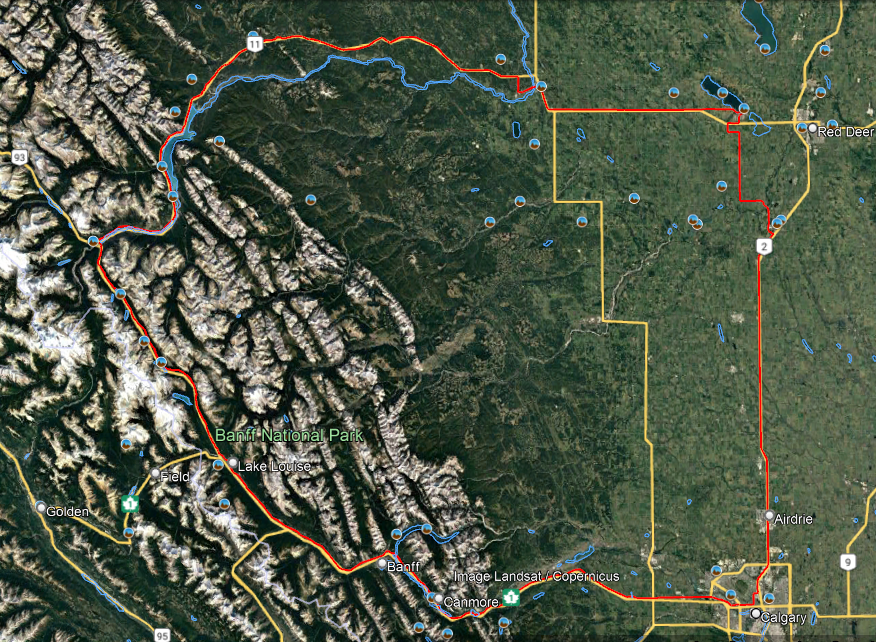
Has nothing to do with D&D, but sometimes I use this blog as a diary.  Here's our driving route from yesterday, mostly on secondary highways, a journey of 409 miles for literally no reason except to drive.  We did not do it to go any specific place or to meet any friends, nor to attend any festivals or walk into any special stores or venues.  We went just to see.


We took our own food, stood below a glacier and six hours later on the shore of a warm freshwater beach.  Including rests, the whole journey took 11.5 hours.

There is something about me that is fascinated with travel ... nothing more than the fact that the world is moving past my window.  It's connected to the map-making, certainly, and somehow to D&D, which is also about going places just to find things and sometimes kill them.  Tamara and I have enjoyed this month of getting around in the car; yesterday really pushed our physical limits, however.  Still, we're hoping on taking a week-long journey in May, and possibly one across Canada in August next year.  So yesterday was also sort of a "training" effort.

For those who might be interested, it cost about $85 in gas.  For those who might wonder, gas prices in Alberta yesterday ran at $7.24 a gallon, or $1.55 a litre.

For Pandred, Crowfoot Glacier:


Thursday, August 25, 2022

The Unknown Response

Going on a trip through the Alberta mountains today, up the Bow River and then down the North Saskatchewan.  The scheduled distance is 425 miles, which we plan to do today, but what with stopping and staring at things, we may not get back until tomorrow.  Mostly, it's an opportunity to test our new car, get some experience driving it and getting a chance to see some country that Tamara and I haven't visited together.

It's interesting to note, with respect to comments going on in the previous post, that we'll be improvising everything about the trip except (a) the route and (b) what we're bringing.  We don't know where we might stay for coffee, what animals we might see, what situations might arise due to other drivers or the wherewithal of our car, what roads might be closed or routes under serious repair.  We suppose I can add (c) that we know what the weather will be.  But I haven't actually checked the area yet for the weather, and we'll be moving from prairie to mountains, to forest and back to prairie before coming home ... and if it turns out that one of those regions expects rain, we're going anyway.

If I were a DM and the players were making this journey, I'd definitely invent something to be waiting for them.  The invention would be made with plenty of time on my part, but the actual thing waiting would be improvised, because I don't know what the players might do when actually meeting the encounter.  With some things, like a group of monsters, it's obvious they're being placed in order to be killed by a party.  But with other things, such as an ongoing event like a plague, a growing rebellion, a famine or the fallout from some disaster, the expected reaction of the party is defacto unknown.  The stranger the circumstance into which the party enters, the less certain that reaction becomes, and the more requirement there is on the DM to be inventive in the immediate moment when the party performs their role.

A large problem with traditional D&D is that it expect to impose situations ... like a monster waiting for a party ... that are easily resolved because the party's response is obvious.  Whereas the party's response to something like a recent mudslide or an open riot spreading through a countryside are far less certain.  They cannot be run with a series of if-then statements.  The DM must float creatively with the party's uncertain response and be ready to judge what additional experiences might arise, on the spot, given that response.

Anyway, I better get myself organised.  We're leaving in 20 minutes.

Tuesday, August 23, 2022

Deciding Why Things Are

This doesn't seem to be an especially popular series of posts, or else I'm talking so high in the clouds no one can hear me.  Nonetheless, with this post I sketched out the general context of a campaign's description, which I am following by going deeper into each point.  I wrote that the players decide the matters of their own lives, the things to which they commit themselves ... that which they see as the best course for them.

And the DM decides those things for everything else.

This is a hard line that many DMs simply cannot accept.  Granted, it's easy enough to see what's on our side of the fence, however enormous the task is.  We're responsible to make lands and NPCs, cultures and sequences of play, motivations and rewards.  Fine.  But in actually running the game, we're put into the position of watching the players struggle with everything that we create, that we're responsible for ... and when that struggle turns against the players, it's very easy to hold ourselves to account for the player's hazard.  If we hadn't included that third giant, if we hadn't decided this battle would be fought on the edge of a cliff ... if we hadn't rolled that bloody critical hit just when the players were starting to turn this thing around.  If the players die, we're all too clear on our part in that; on what we did; on what we could have done differently.

And worse, on what we can do, in real time, to make all those bad decisions and all the party's jeopardy just go away, in time, so that no one has to suffer or die.

With the desperately-named "One D&D," the company is making it clear by eliminating game elements like the DM's ability to throw a critical roll, where the responsibility lies when a player character is seriously threatened.  With us.  With the DM.  The finger is being pointed at you and me, to say "officially," we don't have the right to kill characters.  And if we do, then we're not playing "true" D&D.

Well.  Shelving that.

The DM's penchant for stepping up and saving the characters is the hardest edge for any DM to face.  Speaking from personal experience, I have broken my covenant as a DM to both secretly and openly to rescind parts of my game in order to ensure a character lived and did not die.  Of course I have.  I've been DMing for more than 42 years.  Any DM who says otherwise is lying ... and there are good reasons to lie.  Having the reputation that you're willing and ready to kill player characters, while at the same time reserving the right to covertly not do so, maintains a reputation that most hard-souled DMs consider to be valuable.  We've learned that scaring the players is good for play.  Nothing beats sitting down as a DM to a full table and declaring, "Okay, everything's ready for this week; I hope I don't have to kill anyone tonight."  When we have killed characters before, and the characters know that's a real possibility, saying so out loud sends a shiver through a party that raises tension, the player's sense of excitement and a pulling together of a party that knows they have to pull together to survive.  If there were the least hint that I might not mean it, that's it's just for show ... those benefits would evaporate.

It can take many months to build that kind of reputation.  In truth, it must be built by following through and killing the character.  The killing need not be done zealously.  It should not be done with a gloating tone of voice, or high-handed counselling about why the player "deserved it."  But it must be done.  Upon seeing the die rolled, either too high or too low to save the player, the DM must resist the compulsion to intervene ... specifically because it is ridiculously easy to do so.  One need only say, "roll again" ... or, "that doesn't count."  Any DM can say at the last second, "Before the blade hits, a wizard appears and stops time."  

We can get as ornate as we like.  "You feel the blade cut through your body ... and suddenly you find yourself in a large white cloud-like space; a woman in front of podium with a strange square board in her hand looks at you, looks at the board, and says, 'Hm.  Says here, it's not your time yet.'  You wake up on the floor, with the battle done and the party having won; one of your mates expresses surprise that you're still alive and hurries to help you."

Ridiculously, stupidly easy.

Worse, it costs the willing DM nothing to wade in and "fix" things.  He or she has no awareness that this is damaging to one's reputation.  The player is happy.  The DM is pleased.  There's no evident harm.

Moreover, this has become progressively correct behaviour, promoted by texts, pundits, "official" company rhetoric and the general consensus of the forenamed grander community.

As a player, you are in control of your character.  As a DM, I am in control of everything else.

Wisdom dictates that the correct way to manage the vicissitudes of fate in our lives is to practice restraint.  It begins with very simple lessons, like eating something very bad-tasting as a one-year-old or breaking your arm riding your bike.  Steadily, we accumulate thousands of micro-lessons along these lines as we age, realising that while rage quitting feels so very, very good to do, the aftershock is less so.  Or how owning our first car is associated with so many negative elements, as we choke down how much we have to spend on insurance, gas, new tires, the danger of a life-threatening accident and so on.  Marriage and children present bills we never expected to pay, with which we must make our peace or be crushed beneath.  Through it all, through every trial and heartache, steadily we move towards practicing restraint as the only rational strategy.

This is particularly evident as we watch so many others around us fail to practice restraint.  We watch our friends and family, and especially our acquaintances, throw away opportunities and securities in the pursuit of things that baffle our notions of life.  As the decades roll past, we see them destroy themselves and others, and recognise their willingness to destroy us, while steadily we pull away and into the arms of others who are restrained and practical like ourselves ... assuming, of course, that the reader at this moment isn't actively in the process of destroying whatever value you have in your own life, unaware that you're doing it.  If so, I speak with such people all the time ... and they are never aware of it.  It is always, so the litany goes, someone else's fault.

The effort of holding back, placing checks and hindrances on our own actions, often comes as a frustration to other people ... but as we do it, and see the sense in it, we get to like it.  We don't soar, but we don't face-plant in the dirt trying to fly.  And to be honest, once we get ourselves sorted, just waking up gets to be a delight.

DMing is an act of restraint ... not only upon the players, but more importantly upon ourselves.  Like the things of which we speak in real life, there are things we won't do.  Sometimes, because we've done those things and learned our lesson.  Sometimes, because we've seen others do them.  And sometimes, within the respect we have towards our lives, doing so seems stupid.

For me, deciding to be a DM requires certain things I won't do.  As I've just said, this is sometimes because I ran the game in a certain way, and have decided to stop running it that way.  Sometimes, it's because I've played in someone else's game, or watched people play and complain about it afterwards, or watched new players in my game feel resurrected by the way I play over what they experienced before.  And sometimes, because I feel that I'd have to be a fucking moron to play a game in which dice are meant to dictate everyone's success at something, only to wade in when I don't like the dice because it's easy.

I've played Scrabble off and on all my life, starting from the age of about six.  My parents believed that it was a game we needed to learn, because the benefits were so obvious.  This means that at some point I've played the same game with barely any vocabulary at all, and that I've played the game with the vocabulary I have now ... and all the shades of grey between.  I've played many, many games where at one point all the letters I had were vowels, usually some combination of I's, O's and U's, without anything else.

The rules say that when you're desperate, you can skip a turn by throwing all your letters in the bag and draw new ones.  But that's a fool's choice.  You're better off to play what you have, because every round you skip puts your opponent further ahead of you; and it is too easy to throw your letters in and get back a different collection of unusable letters.

When I was six or seven, my mother — whom I played with most often — could have let me change out my letters and still play ... because she was in charge.  Because she could make whatever rules she wanted for me.  She could have felt sorry for me; she could have been generous and kind.  And if that was the sort of person my mother was, I wouldn't be writing this for you, right now.  That's a fact.

From killing player characters, from forcing myself to do that as a restraint on my behaviour, I've learned how to set up encounters and build events so that, for the most part, I don't have to kill and I don't have to veto a death.  Those players who have been in my games for many years have learned equally well not to test me, while at the same time learning with tremendous pleasure that they're quite innovative when they know they're not going to get reprieved at the last moment.

Sure, my mother felt sorry for me.  And sure, I feel sorry as a DM when I have to kill someone, or take away all their money because they've fallen into a river and it's either strip off your stuff and live, or die rich.  But feeling sorry for someone isn't a good enough reason to make me compromise my values ... or for me to step across that line and decide myself that the player can't make a bad decision.  By restraining my desire to help them, I empower their desire to accept responsibility for their actions.  Which, in the long run, makes their actions feel the sweeter, because they know they've been able to do it AND snub me at the same time.

The momentary relief at receiving the DM's charity is a soul-sickening reality, that any good player will feel ashamed of receiving, and resentful of knowing that it's there.  On the other hand, the very worst players, those without any sense of restraint at all, revel in receiving charity ... and pity and anything that makes them feel they've "won" ... even when plainly that's not what they did.  These people, as they enter into the game world, have such miserable lives lacking in any kind of restraint that they desperately need their D&D game to fill some hollow part of them.  I'm not here for that.  And I don't like these kind of people.  The company, on the other hand, loves these people ... and why shouldn't they?  Players without restraint are addicts ... and what pusher doesn't like a good addict?

When deciding to DM, the best strategy is to consider, from the start, those things that as a DM, you won't do.  Figure out what those things are, and then figure out precisely why you won't do them.  Then, restrain yourself.  If experience teaches me anything, restraining yourself absolutely, even as you watch others in pain, will be the hardest thing you've ever done ... excepting that you may have already learned how you have to do this with your children.  It is one of the reasons why fathers and mothers with excited, avid children as players make such good DMs.  The practice of restraint is universal, after all.  If you've learned how to restrain yourself with respect to addiction, money, family responsibilities, your workplace, religion, politics and so much more, restraining yourself as a DM will be easy.  You've already learned the hardest lesson.

You can do anything.  You must never, ever, do things for that reason.

Friday, August 19, 2022

Good News!

A few small things, as I'm finding it difficult to type.  Better today than yesterday.

On the subject of maladies, it's a credible argument that something bad might happen to a character at any time, regardless of the character's carefulness or the player's game play.  For example, Wednesday morning I was doing the dishes when the bottom of the glass I was washing fell off, causing the exposed glass edge to do this:


Because that's how it goes.  Was nice though; with our new car, we were able to pop over to my doctor right away and get it stitched up within the hour.  Today it's come a long way, so that typing this is less of a strain, though the progressive key strokes are moderately unpleasant micro-pangs.

Somehow, I feel encouraged by yesterday's announcement of "One D&D", once again expressing the company's wish-fulfillment regarding its naming of things.  As a product-maker of old style D&D, for a while now I've been made uncomfortable by the success of 5e and it's propagandistic, soulless destruction of actual D&D game play, by insidiously teaching young children that it doesn't exist.  Much as I hate to admit it, 5e came in with a depressingly good marketing strategy.  Pretend that "real" game players designed the game, then pump it full of hot garbage spewed by gaming "journalists" ... and cementing the whole with game-store policed adventure clubs.  The combination of these has made a shitty version of a great game extremely popular.

It's enough to make me slash my hands ... er, wrists.

However, with the inevitable sorry release of the WOTC's most recent splatbook, Tasha's Cauldron of the Same Old Crap, the company has decided to piss on it's own marketing by announcing that yes, they really are going forward with dndnext, announcing that they're "dropping editions" and moving forward with the badly named 6th edition ... which makes the game's rules even MORE player friendly.

One nice thing about being a games "journalist" is the happy willingness of merely repeating the company's talking points as "reporting," while I assume getting paid for doing so.  Although the company are a bunch of lying liars, and games are "only games," it's perfectly safe to pretend that the new rules are variously awesome, amazing, terrific, a bold step forward and additional boilerplate-type rhetoric that makes sure the writer keeps his or her job while the online magazine retains it's adbuy from the company being reviewed.  It's all quite incestuous.

"6th" edition will succeed in bursting the bubble of approximately 8 million 5e game players ... which for me, is good news.  By continuously undermining its credibility, the company usefully spreads discontent and yes, anger, with company products, since a new ruleset is always a part of every change.  Such poorly considered amateurish marketing desperation is a sure sign that at least 5-10% of 5e players will be pushed towards adopting earlier game versions, which don't change.  As of today, I have potentially four to eight hundred thousand new customers.

Awesome.