Thursday, March 19, 2015

There are Deserts, Then There are Deserts

Have to get back on the horse sometime.

I'm still map-making.  Below is my world's map of central, modern-day Algeria, called "Gaetulia" in Roman and post-Roman times.  Damned if I can find out what it was called in the 17th century - certainly not Algeria.

Specifically, I refer to the Sahara desert south of the Atlas Mountains:

A few details.  Zanatan is a tribal association of Cameltaurs (camel-
centaurs).  Mozab is a kingdom of Goat-men, similar to bare-skinned
gnolls.  Tuwat is an empire ruled by the Djang, large and human-looking
with four arms (anyone remember Dray Prescott?).  Tamanrasset
is a monastical republic consisting of qullan from the old Fiend Folio.
The rest are human.

As ever, green and brown hexes are arable lands (or oases), the brown higher in elevation.  Pale yellow hexes are mixed grassland & desert.  Pale red hexes indicates thin brushland & desert.  Grey hexes are pure desert.  Hexes are 20 miles in diameter.  The above depicted is about the size of Texas & Oklahoma, +10%.  Dotted borders are non-patrolled.  "Arable" is defined by there being proof of human habitation at a latitude or longitude located within the 20-mile hex.  The numbers on the side of the map will tell you how many hexes this is from the North Pole.

While yes, this is the Sahara, it's important to see it as a mix of differentiated expanses and areas - none of which have a great deal of detail to be learned on the 'net.  Still, I thought I might piece together some of these, adding pictures as I go.  What the hell.

The Mountains of Ksour, the Rached Mountains and the Mountains of Zab are all part of the 'Sahara Atlas' - and these aren't even the names we'll find if we look.  Most of my sources are in French, because Algeria was controlled by France for most of its modern period - thank you Google translate. 

Monts des Ksour.  I'm going to use French links through most of this post because they have more information than their English counterparts.  The Ksour chain has a rugged topography made of long ranges running southwest to northeast.  Rainfall is 300 mm a year.  There are rock stations, known for prehistoric art.  On the map above, the grey area marked as mountains is really the southern side; the grass & desert hexes would be the north slope.  I hunted around looking for a south-side pic; I'm only guessing that this is it due to comparing the vegetation with places I recognize on the north side:
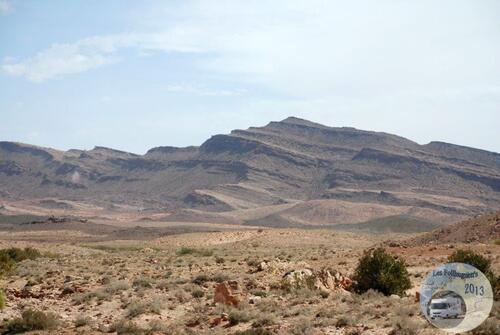
Near Fuguig in Morocco.

Djebel Amour.  'Rachad,' shown on the map, is the older name for these mountains.  The Sahara Atlas changes here, becoming tabular, lower and filled with deep valleys.  Rainfall is slightly higher, 300-500 mm a year.  The mountains spawn wadis both to the north and south.

Near Beni Awf


Monts du Zab.  A mountain knot to the east of an important passage through the Atlas, a group of oases called the Zibans (the mountains seem to be called that too).  I could find almost no hard information about them, beyond the fact that they exist.   For example, I found a gazatteer that said the following: "Entre Ain Rich et Biskra."  I have to love it when a writer is forthcoming like that.  I expect they are a few dry, waterless lumps of stone.
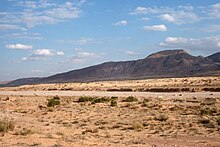
This site confirms Wikipedia; this is the Monts du Zab.

Le Grand Erg Oriental, that I'm calling the Great East Erg, is a massive expanse of dunes and sand following a network of underground river beds (where sometimes water can be found).  It's generally believed that this was once a fertile plain.  Today it is the great sand heap that you usually see in movies, as it's northern edge is near Tunisia (Tataouine, the literal name of the town in Tunisia where the Star Wars movie was filmed).  There are lots and lots of pictures for this area.  I've picked just one below:
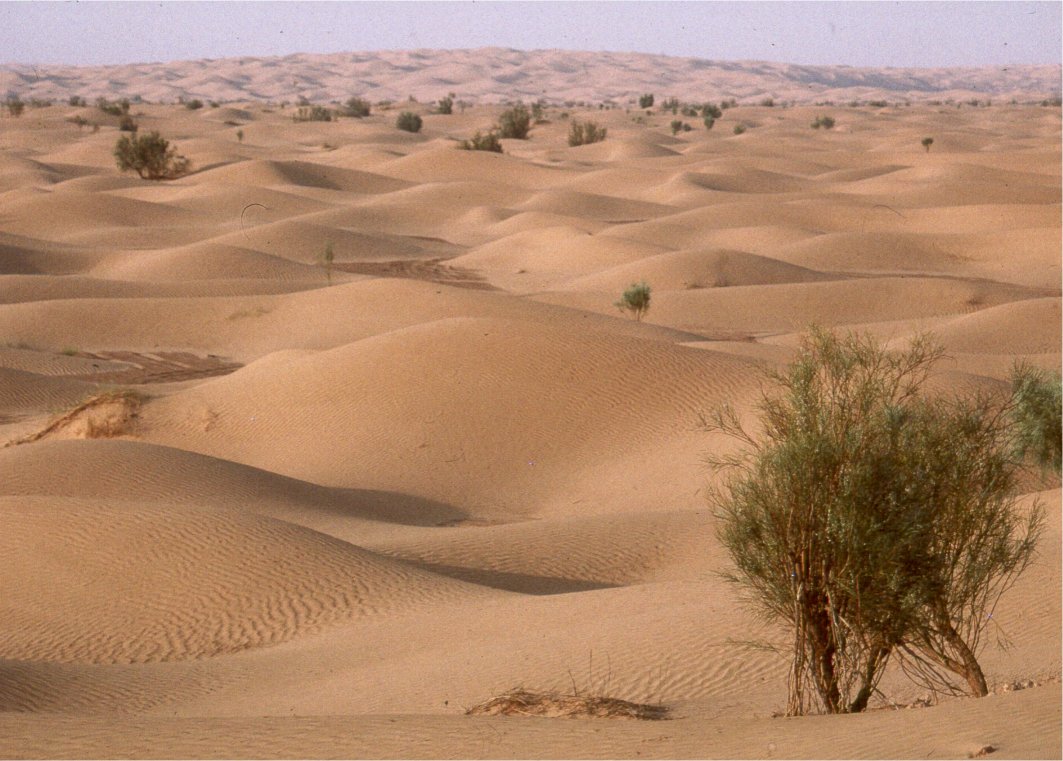


An area of the erg in southern Tunisia.

Le Grand Erg Occidental, that I'm calling the Great West Erg, is even more insurmountable with sand dunes than is the east.  The wikipedia link calls it (trans.) "oases scattered in the sand waves," which is lovely.  Here it writes that the (trans.) "The vastness, the unknown, is strange and magical."  A glance at collected pictures gives is a slightly different character than the Oriental Erg.  For one thing, the dunes in the west seem huge, more yellow and less dusty brown.
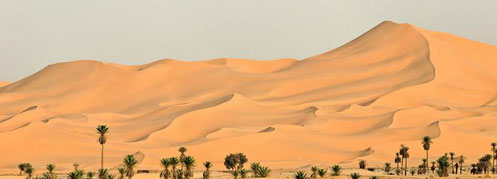
Near Saoura

Plateau of Tademait.  Things get more obscure as we move south past the Grand Ergs.  (I've mistakenly called this 'Tademalt' on the map; course, it's my world, I can call it what I want).  For this, the English wikipedia is better: it calls it a "rocky plateau made of cretaceous terrain."  It adds that this is one of the places where the heat of the Sahara is most extreme.  It is virtually rainless.
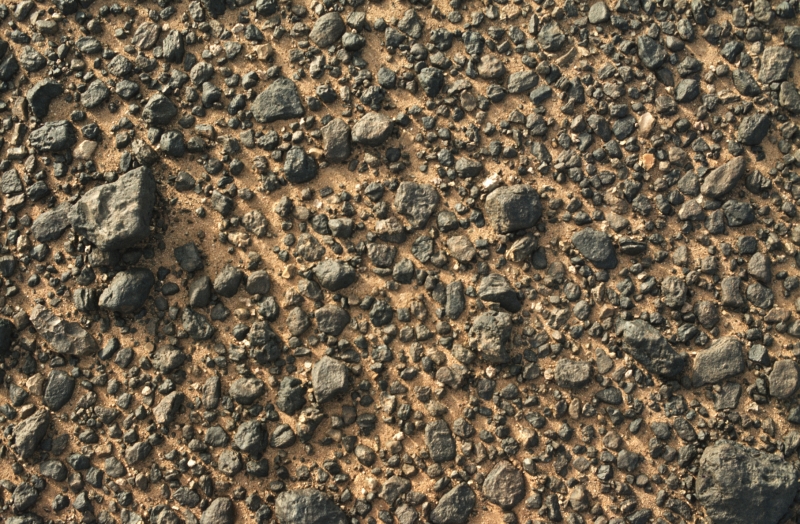
I had to include this pic of Tademait's ground surface.

This is Tony waking at dawn
at the edge of the Tademait Plateau

Touat, Tuat or Tuwat (even Twat, if you're aching to go); a hot desert on the edge of the Tademait plateau, marked by a string of oases on its western edge, making the area practical for travel.  These oases have been used - probably - since the time of the ancient Egyptians, going back to the when the pyramids were built.  Summer temperatures in the Tuwat are consistently 46 C, making it one of the hottest areas in the Sahara.  The actual area of desert is quite small, before it becomes a differently featured area:
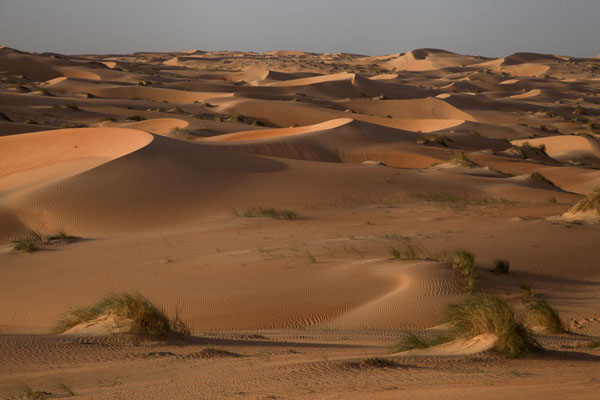
Dunes near Adrar, the most important oasis

Tidikelt is a comparatively green area (the name means 'palm') that is below sea level in elevation - thus it is at the 'bottom' of the Algerian water table.  Temperatures compare with the Tuwat.  On the map, it shows 'Tidikelt Depression' only in the lower corner, but in fact the region extends into the various arable green hexes shown.  Sala (in the non-D&D world, Ain Salah) is a major by-way between north and south of the Sahara.

Called 'The Lion of Tidikelt,' near Ain Salah. 

Asedjrad Plateau.  There was very little information about this.  On my map it is just a small name describing a fairly small area.  Most total detail I could find was "it's a plateau."  That's when you know the place is a long way from everywhere.  For example, this page tells me it's 9 hours drive from the nearest decent city.  The landscape is barren, hyper-arid and 44 C in July (so, slightly higher, slightly cooler than the Tidikelt.  The south edge is marked by the Tinkadiouene, a mesa rising 300 meters above the desert.  Best shot I could get:

Tinkadiouene

Ahenet (no link), including the area of Adrar Ahnet, is an area of stone desert marked with wonderful bluffs, mountainous features and stone blocks.  See here for a 17-minute film of some interesting places where the terrain gets interesting.  Much of what is featured is the eastern edge, near the region of Adrar (not to be confused with the oasis in Tuwat Desert, mentioned above, 500 miles away).  The film gives a good sense of the uninteresting desert also - rocky, unpleasant, flat.

But not without camels.

Ifetese & Agerar (no links).  This is a mystery.  My map clearly lists the Ifetese hills, marks them at +1500 meters, 500 meters or more above the plain - and the Agerar as being a desert between the Ifetese and the huge Ahaggar (Hoggar) mountain range.

However, the internet turns up NO results.  At all.  My Key-Porter Atlas is 1997, but things change.  I can find a reference for a nearby city, Arak, to the Arak Gorges; and Adrar, described above, is directly south of Ifetese.  So what I think is that the "Adrar" has come to include Ifetese and that the Agerar on my map is in fact the "Arak Gorges."  That's how I'm reading it, anyway.  I only mention all this so that the reader can see me showing my work.

Here's an image from the Arak Gorges:

An area described as having wood, water and grazing

Tassili n-Ajjer, or 'The Plateau of the Rivers,' a name I could not resist using on the map.  A massif and high arid plateau of sandstone, where rocks are turned to sand by frost wedging.  I am certain that this range and the Ahaggar are responsible for the presence of water in the gorges above (what I'm calling the Agerar 'rift.'
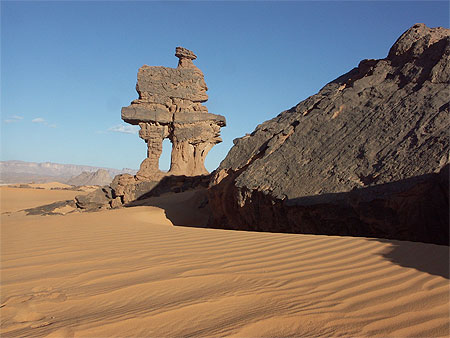
One picture isn't going to be enough for this place.

Fantastic

See more for Tassili n-Ajjer here.

Ahaggar, or Hoggar, mountains.  A giagantic mountain knot about the size of Portugal (the wikipedia entry seems to be missing a zero), with quiet volcanoes, cliffs of basalt and porphyry, comparatively cool weather and terrain to challenge the pictures above.  It is a favorite destination for mountain climbers.  In height, it hits 2,918 meters - so slightly higher (and craggier) than the Davis Mountains in West Texas and not quite as high as the Pyrenees in Spain.  The Ahaggar look NOTHING like either, however:

A very, very different sort of place.
I'm nearly done.  The Erg of Reh and the Inharharene Plateau are sandy extensions of the Great East Erg (without as many dunes).  I couldn't find entries for them, either.  Al Hamra and the Awbari Desert on the east edge of the map are both large areas extending into the Libyan Fezzan.  The Tiniri Sand Plain, at the very bottom of the map (on the right) is a sand flat that covers half the country of Niger, an area bigger than California.

I think by now, however, I've made my point.  I've been searching for pics and explanations now for four hours.  It is time to post this beast.  I'm sure I made my French readers happy by linking a lot of French language pages.  

Tuesday, March 17, 2015

Square

Warning:  this post is not about D&D or role-playing.  Read ahead at your own risk.

I wrote this earlier today on twitter:

"Thinking about writing a book about two middle class noobs who try BDSM and find themselves TOTALLY put off by the culture.  Good idea?"

Wrote this first draft in the last hour or so.  Just consider it a stab at an opening.  I'm debating calling it the title above, 'Square.'


One

Entangled in their thoughts, they drove home the last ten blocks without a word. They rolled up their driveway and into their garage. She climbed out with her purse and the small backpack she liked to carry. He gathered his coat from the backseat and two bags with things they’d purchased at the mall. He followed her into the house.

“I’m going to take a fast shower,” she said.

“Hot chocolate?”

“That would be nice.”

He dropped the bags in the computer room. These had nothing special in them; two movies to watch the next weekend, a pair of jeans for him and a new cord for the computer. He tossed his coat next to the bag and turned towards the kitchen.

From the cupboard, he took down his cup and hers. He flipped on the kettle, which they kept full, and found the fixings for hot chocolate. Carefully, he concocted each cup differently, knowing she liked hers with more cream than he did. Then he put the instant cocoa, the sugar and the cream away and leaned comfortably to wait for the water to boil.

His name was Tom. Hers was Susan. They had been married for eleven years, since meeting together in Professor Hill’s ironhanded religious studies class in university. He had been wasting four years following a political science education. She had used her time wisely with a business degree. They had liked each other immediately.

Following university, Tom had decided to pursue a living through his summer job rather than his education. Every year he worked by framing houses and in other construction, making good money, enough to pay for most of his schooling. Sue’s student loans had been oppressive but his had been light enough to let him pursue another two years of education as a carpenter. He got his ticket four years into their marriage – just as Sue’s career was finally getting off the ground.

Sue made more money than him now – though they mutually agreed that he worked harder than her. Her days were consumed with expanding brand recognition, market placement and event coordination for a tiny stakeholder partnership focused on farmland and rural housing. The partnership had doubled in size since Sue had started with them, five years ago.

Tom had spent that five years building his own renovation business. He had wallowed for some years – but this last season was proving his best ever. As the kettle began to rattle on its way to boiling, Tom considered the troubles surrounding the Swiftson’s kitchen renovation that he had solved that morning. Another month and he’d have it sewn up – giving them more than enough money to finally reconsider their plans to have children.

It hadn’t been a great evening. They’d followed a friend’s advice and seen a very bad film. Tom guessed that Sue was upstairs washing the film’s ugliness out of her system. He smiled. That was like her. She tended to let things affect her physically. He wanted to talk it out, get rid of it that way – but she preferred a personal scrubbing.

The water boiled and he let it be. He’d wait until she started down the stairs before turning it on again. No sense in letting the cocoa grow cold in the cups.

It wasn’t long before Sue came down to join him, wearing her favorite plush white robe. He poured the re-boiled water into their cups and settled down at the kitchen table with her.

“Feel better?” he asked.

“Yes.” She sipped from the cocoa. “Nice.”

“Yeah, some things can be.” He paused. “It was a pretty bad movie.”

“Disastrously bad. Why would someone willingly go somewhere with a man like that?”

“Stupidity? She didn’t seem very bright to me.”

“Her? What about him. Every scene where he was supposed to be this big business guy was painful.” She put her hand to her ear, faking a phone. “No! No! I want it done right now! Because I said so!” She broke down laughing. “Great dialogue.”

He’d heard some of this in the car already – but he chuckled, watching her. “Yeah,” he said. “Pretty bad. That wasn’t the worst thing, though.”

“Oh?”

“Well . . . I expected there’d be more,” he said. “I was thinking, he’s this rich guy, he can afford anything he wants. I figured when he finally does get the girl back to his dungeon, it ought to be a pretty amazing place. Then we got there and it’s what – a bed? A few walls with stuff? Pretty cheap.”

“What were you expecting?”

“I don’t know. I’m pretty stupid about these things. I expected to be enlightened – to see something I never imagined.”

“I can see that,” she agreed. “It wasn’t very much. Not after all the build-up. The book sold something like fifty million copies and the internet has been buzzing about it for a couple of years . . .”

Her voice trailed off as she saw his expression. “What is it?”

“Hm? I was wondering something, that’s all.”

“Go ahead.”

Tom frowned. “It’s not easy to say. Kind of embarrassing, actually. Do you –”

He stopped.

“Do I ever think of trying bondage again?” Sue asked for him.

“Bingo,” he said.

“To be honest,” she started, “Maybe a little. Recently. Since everyone started talking about it all the time.”

“Me too,” he said without enthusiasm. “What was it? Ten years ago.”

“Yeah.”

“And it was bad. Really bad.” He snorted, amused. “You had that little quirt from your grandmother that was kind of a joke. And I tried to tie you up. That didn’t go very well.”

“I had never been tied up before. It was weird.”

“You freaked out,” he said.

“Huge. Remember the handcuffs?”

“Ouch. Yes.”

“Big strong man. So you got your wrists cut a little.”

“A little?” Tom extended an arm. “You see that? Right there? That centimetre long scar?”

“It’s hard to see it between all the other scars.” His hands were full of places where working construction had left their mark.

“You know which one it is. It’s the oldest one.”

Sue leaned forward and kissed it. “There. Is it better now?”

Tom kissed her.

“We were pretty young and stupid, you know,” she said, nose-to-nose with him. “We could probably do a better job of it now.”

He drew back. “Are you saying you want to try right now?”

“No!” she giggled. “But . . . just think about this a minute. We could, you know, explore a little. Read a bit. We have the whole internet. We could learn things we didn’t know last time.”

“Make a plan.”

“Yeah,” she nodded. “Just see what other people do – then decide what’s best for us. How does that sound?”

“Well, I gotta admit . . . I did like some of the things in the movie.”

“Which things?”


- finis

I think I'd definitely cut off the first chapter there . . . and pick the story up with Sue in bed and Tom in the bathroom - and her calling out things she's finding on her smartphone (without Tom and Sue having sex).

I am quite serious about writing this.  42-47 thousand words?

Friday, March 13, 2015

The Find

Let's continue from where we left off with The Search.

First and foremost, I should make it clear that my purpose here is not to write an adventure.  I do have explanations for the various elements that I lightly described in the previous point, but the subject at hand is not the story behind these things.  Any experienced DM ought to be able to create their own 'clues' and the stories behind those clues without needing help from me.  In fact, that is a good exercise - one that I hope some of you have been attempting this past week.

There was a bit of muddy thinking in the comments since Monday.  For example, at no time did I indicate the bubbles rising were anything but ordinary air - of course air is a gas, but when seeing bubbles rising from beneath the surface of a sea, is it at all probable that these bubbles would 'flammable'?  That is wishful thinking in the extreme.

Obviously the metallic taste in the well water is harmless.  A windlass has been built over the well and kept in working condition - one of the points I made earlier indicated that at least one sailor here knows the windlass well enough to know it's temperamental.  Therefore, we know that the well has been used before and probably often.  The taste of metal in water is common throughout the world - the tiniest part per billion will produce a this taste.  Though I would imagine that landlubbers would rush to warn sailors about harmless things all the time - it is what makes landlubbers look so silly.

I see a fairly ordinary approach in playing and campaign running when someone says "I rappel down from above to get a good look" as though this is the simplest thing in the world.  That is because we live in a world where there is always a convenient stone or tree to tie ropes to, or the edges of cliffs above a drop are smooth and polished and in no way likely to cause a rope to fray and break.  I don't blame Shelby for this, the fellow who made the comment - the assumption is always that rappelling down is as easy as pie.  The question is never asked, "Is it possible to rappel down?" because the answer is usually, "Why, of course.  Why wouldn't it be?"

Asking the sailors is a semi-good answer - but there are a number of things they just won't know (as shown below).  Still, it never hurts to try.

I'll forego answering a lot of little questions like, "Can we see the source of the bubbles?" (no) or "What type of tools seem to have been used to work the stone?" (metal ones).  I'll get right to the point and give the backstories to these things, to get them out of the way.  The metal in the well water is a little placer copper that can be found in the bottom, suggesting a mine on the island might be feasible.  The twinkling stones are mother-of-pearl, also a pretty penny if they can be dredged.  The seven-foot humanoid is a triton, a warning to above water persons that the hole in the island below is a burial cave.  The birds get spooked because a giant sea snake swims round the island, below the surface where it can't be seen.  The snake is also the cause of the bubbles.  The moss on the pillars is exactly what Preston guessed - a peculiar species that might have magical application.  The black shape on the islet is a dead giant seahorse, washed ashore and decaying.  The work on the spit was done a generation ago and abandoned because the fellow who wished to settle on the island and make it a going concern was murdered by his wife when she discovered he was running away with his Mistress (a sailor knows the story).  The feeling of unease caused by the natural bridge between the two parts of the island is caused by small tremors that take place regularly in this part of the sea.  The sand in the lagoon is sometimes flat and sometimes rippled because there is a giant crab sleeping in it.

The point here is that the island IS the dungeon.  We have two big monsters, a potential for a number of little ones (there's a boar here, maybe, if the party is low level?), places to walk and explore and get out to.  It's important to emphasize difficulty.  Like the fellow who does try to rappel - we want to point out the lack of a convenient rock or tree and the danger of the sharp cliff face cutting the rope (not just at the top, but at any point where the layers of stone have chipped off) to get down to where the stone has been beaten and polished enough to allow an image to be made.  Only when this is overcome do we want to point out that it's an image of a triton - which can be vaguely determined close up, where the poorly scratched head's shape can be felt, not seen.  Sorry, a glass isn't going to work.  THEN, we need to say to the character, "You have no idea who or what would carve a triton into this stone, here, above the waterline."  Because it is probably the character simply couldn't know . . . not without going to a nearby port town with scholars and asking them about the image on the side of the cliff on the island.

Why would we assume that the characters have any special knowledge of cultural images inscribed on rocks?  Because in the movies, they always do!

My sage tables are designed to solve that problem.  But naturally, we still live in a game world where the first thing is an action (I climb down) and not a thought (do I actually know anything about rock carvings?)

Some mysteries are going to be excessively deeper than others.  Eventually, the party might go and find from an expert about the meaning of the symbol and then decide whether or not to ignore it.  Meanwhile, a totally different party has already tied a rope around a thief's waist (one who can swim) to have him swim down to the bottom of the pool and then follow the tide out along the bottom of the passage with a bucket, finding out there's a whole lot of valuable mother-of-pearl chunks there.

Like any dungeon, a good party investigates everything.

Are there deeper adventures to be found here?  Oh, of course.  After the crab is dead and the sea snake has been either killed or scared off (it would have in excess of 200 hp in my world and would flee once it was reduced to 25% of those - which is fine, as my experience system gives x.p. for damage done and taken, not for kills), there's always the cave where the sea snake lived or the eventual triton raid on the island to 'get rid of the humans' once the party begins mining for copper and dredging up gems.  There are trips to that learned port to gain knowledge about the moss and the triton burial hole and the possible occurrence of a strong earthquake.  Not to mention the arrival of giant birds, pirates, other sea beasts and so on.  We could easily keep a party busy here for months.

That is, assuming we don't make everything easy.  The thief has to nearly drown getting his bucket full of mud and gems; the party has to examine the bucket carefully not to miss the gems; it has to be a point of order if the thief wants to go again, having nearly died the first time.  The party has to think and struggle with each element of the island - while the DM views each feature from at least one more angle than the party does . . . adding more and more features as we go forward.

This is the trick - the feature adding.  The elimination of the 'empty room.'  The recognition that there may yet be one more thing on the island worth finding that hasn't already been noticed.

Supposing, for example, that after the sea snake is gone and the bubbles with it, that now it IS possible to see something down there.  Some kind of . . . is that the wreck of a ship?  With our next post we'll see that it is - and learn where that takes us.

Wednesday, March 11, 2015

Spain & Portugal

Aha.  Seven hundred cities later . . .

Below is my combined map of Spain & Portugal.  The peninsula spreads over two of my map templates, so they had to be put together to show it all (that's why some of the labels appear twice; it's hard to see the overlap except where a label is cut off).  I find this looks a bit odd, but it is the map projection.  Most maps will curve the left and right sides upwards, to give the illusion that the center of the map dips, like it would on a globe.


Morocco and Algeria at the bottom of the map still need work.  But I am most pleased to say that I've finally mapped the coast all the way around the Mediterranean.  That's a big deal for me.

I was going to work on the British Islands next, but after the above I need a break with something simpler.  So I will work on Morocco and Algeria, finishing those . . . then I think I may work on western China.  Nice that I can hop around the globe as I wish.

Just a reminder, I published a book a week ago!  Already, one week.  Do have a look at it.

I'm going to step out tonight, but I will work on the next post in the Island series as soon as I have some time.

UPDATE:

In keeping with Maxwell's comments below, I'm going to post both sides of the map above, as they appear to me when I use it in a game (the edges not cleaned up).


Monday, March 9, 2015

The Search

Having gotten the party onto the Island, we must do something with them.  We can safely assume that they will have little interest in the duties of the other ship mates - they might help, if asked, but I wouldn't count on the party having much interest in collecting water and firewood or in hunting.

We could always hand the players the adventure on a silver platter: "You see a large, crystal shrine rising fifty feet above the trees, with a tremendous sign, Treasure Buried Here."  I once played in campaigns with other youngsters where this was about the game's speed.

Barring this, however, it will not be very long before the party utters those dreaded words, "We search the island."  It may surprises some, but for many the act of describing an island - even a small one - sector by sector becomes a tedious process.

A typical DM will cut right to the chase.  What is the point of dragging it out?  "The party finds a cave where the surf pounds the cliffs on the west side."  Simple, straight to the point, let the dungeon begin.

After all, how is the party going to search the island?  Inch by inch?  Foot by foot?  Do they stroll about at a normal pace, like any of us would searching an island like this, enjoying the sights and sounds?  It's quite unlikely that they'd see anything hidden or unusual that way, since the island is obviously regularly used by ship's crews.  And what is the point, anyway?  Sooner or later the party is going to find that cave, so all we're doing by having the party wander about the island pointlessly is wasting time they could be spending in the dungeon.  Right?

Well, a DM could argue that the party ought to put in some effort.  They ought to try a little before finding the cave.  And if they don't put in the effort, well, tough luck.  If only they had tried - but they didn't.  So sorry, all, no dungeon for you!

This has even less point.  Now the DM has spent time creating the island (and, presumably, the dungeon), only to have a moment of useless superiority by denying the party everything.  What is the party going to do now?  Wander off to another place, presumably, where they DO find the dungeon, so that gaming can result.  Wouldn't it be easier to let them find the dungeon on the island?

Here is a point to consider - why should the party even suppose there is an adventure here?  Unless the DM makes it obvious to the players that there IS something on the island, it's reasonable for them to think, "Oh well, this is just an island, no reason to presume something is happening."  And parties will do this.

Every party that finds a dungeon entrance and starts inside assumes that something is going to be down here . . . but I've found that most players on roads, moving through woods, landing on islands, poking about a village and so on will assume that this is just a normal day.  The reason is obvious - if every 10 mile stretch of road was an 'adventure' like a dungeon, the party would never get anywhere.  If every village was another Hommlet, characters would be in their rights to lay waste to the countryside.  Thus are wildernesses empty, while dungeons full of promise.

Ask this, O Reader: how does a film script convey to an audience that there's more than meets the eye?  Yes, that's correct.  Clues.  An imperceptible movement, catching the character's attention but proving to be a shadow.  An unusual object lying on the path.  The movement of animals.  A cliff that looks distinctly odd when viewed from a particular angle.  An distinctly unnatural sound.  Fit in nine or ten of these little details and a party will begin to think there's something up - without having to put up a big sign.


Suppose we break the island down into its requisite parts.  A ridge along one side of the island.  An opposite hillock.  A central lagoon.  A bridge of land connecting the two parts of the island.  A spit that nearly cuts off the lagoon.  A passage of water connecting the lagoon to the sea.  A small rocky islet.  A small pillar and a large, tall pillar.  Two distinct cliffs, one at the top of the picture, the other bottom left.  A steep shore that runs below the ridge.  The aforementioned well & windlass, where water can come from.  Here are plenty of things from which we can make clues.

The well-water tastes metallic.  There are large bubbles rising in the water on the shore below the ridge.  The cliffs at the end of the ridge are too sheer to climb, but there is the picture of a seven-foot humanoid scratched there, ten feet above the waterline.  The lower cliffs are stepped and easy to climb; these are popular with birds, who for some reason become absurdly spooked without apparent reason.  The pillars are covered with moss.  The islet has a black, indistinct shape on it, that can't be made out.  The passage connecting the lagoon to the sea is littered with stones on the bottom that twinkle in the sun.  The spit seems to have been worked by stone masons, but only in part and for no apparent purpose.  The bridge between parts of the island gives a feeling of unease.  The central lagoon is no more than four feet deep, the bottom covered in sand; but where the sand is rippled in some places, in others it is smooth and flat.

More than enough things to grab our attention.  Naturally, the party will pull out wands and spells for detecting evil, enemies, life, treasure and what have you, but its easy enough to remind them that the distances on these things are usually inadequate.  The lagoon is at least 200 feet across; it's full of little darting fish and algae.  If there's a giant crab buried in the mud, the character with the right means of detection would have to be standing on the right stretch of shore, no?

That could also be a monster laying in the water off shore, making bubbles.  But where, exactly, how far away, how big, etcetera?  A sea snake?  A giant squid?  A natural spring?  The party may have to dive in to find out.

Why does the moss that grows on the two pillars not grow elsewhere on the island?  How hard would it be to swim out to that little islet?  Bad waves, no doubt, a strong current, rocks hard to grasp once the islet is reached . . . a party would have to work these things out.  And what is that disturbing the birds?

It should be understood that all of these clues lead somewhere.  It's tempting to make them a lot of red herrings, but let me remind the reader: in a dungeon, we make every door go somewhere.  We're responsible for doing the same thing in the outside world.

So, what shall we find?  Well, I leave that up to you, gentle reader.  Let me know what you'd like to investigate first - and we can give it a look-see.

Friday, March 6, 2015

The Island

Let's suppose we want the players in a campaign to run across an island.

First, we have to get them there.  The standard way is to have an NPC say, "Go to this island."  We might appeal to the players' desires, saying, "There's a lot of treasure on this island."  But these things are heavy-handed.  We'd prefer something subtle.

Well, it's an island, so presumably the characters are aboard ship.  I've had players who simply refuse to board ships because of storms and the fear of being lost at sea, but we'll suppose that the players have a reason to travel.  Perhaps they desire a change in scenery.  Perhaps the weather is bad and they seek warmer climes.  Perhaps they've been made agents for a company - that should be fairly easy to arrange: "Please go to this other continent and tell the town fathers we can supply them with such and such an amount of wool for such and such a profit, and, oh, take this letter."

We want the party to land on the island, so we'll need a good reason.  There's a storm and a barrel of water has gotten loose and broken.  The captain is seeking fresh water.  He is looking for an island where there might be some.  Perhaps some of the meat aboard has gone bad and to keep up morale, the captain wishes to hunt for some large game on the island.  Perhaps the captain has some messages for a small colony on the island.  Whatever the case, we don't need to force the party to go ashore - we just need to make the island inviting.

What kind of island is it?  This depends on the latitude.  A rocky island, such as those in Greece?  An island of tundra, with few trees?  A tropical island, surrounded by a reef or perhaps with mangrove swamps?  Possibly a temperate island, like an island off France or a shoal such as Bermuda?  We could have a heavily forested, rocky island such as those off the coast of Alaska or Canada.  Whatever we choose, it should suit the purpose the captain has for stopping there.

Let's take an island out of the Azores in the mid-Atlantic - this remarkable real-life example on the right, for instance.  This is Vila Franco do Campo, literally half a kilometer from another island in the Azores, Sao Miguel - but of course we can put it anywhere in our world we want.  Follow the link to give you a series of excellent, detailed shots of how the island looks from various angles.  It's easy to get a rich feel for the place.

Imagine the characters aboard a ship approaching from whatever side you like.  How would you describe the island?  Note the difference in hue between a sunny day and an overcast day.  Note the white water on the left side of the island vs. the comparatively quiet water on the right.  Is the island inhabited, as shown, with roads and possibly a less anachronistic house?  Or do we want the island to be deserted?  That depends, again, on the captain's reason for stopping.

Let's say that it's quite close to its present appearance, except that the pathways are not paved and the hill not terraced.  The volcanic bowl is too shallow for the ship, but the captain orders a long-boat to be steered into the interior and beached.  Men with baskets, bows and axes climb onto the land, seeking wood for carpentry, water, game and provisions.  Does the party want to go?

Probably yes.  They might feel uneasy about it or indifferent.  We may have to entice them.  Saying there's a visible cave is often enough, but let's seek for something less pandering.  The cleric is asked along to lend some moral support or possibly aid if someone is injured.  The fighter is asked along in order to help with the windlass over the island's well, which is temperamental and takes energy to turn.  The mage 'remembers' that there's a songbird on the island that's an ingredient in some potion.  Never underestimate the power of non-player characters willing to ask for help.  Never doubt the player's willingness to seize some small advantage that arises from being in the right place at the right time.

We'll presume that the party is ready to go and is climbing into the boat with the ship's crew.  As we push away from the side of the vessel, we'll want to take that moment to add description.  We want to make the party feel as if they're taking a bit of a journey from the ship to the beach.  "The island looms . . ." - or it swells in size, whatever cliche works for you - these words become cliche because they work.  The island looms . . . it makes sounds . . . the party can smell dead fish on the beach, the sweet odor of tropical flowers . . . whatever we can reach for to make the moment mean something.  The lapping of the water on the side of the boat, the grunt of the men at the oars, the quiet call of the mate, whose nature is that he does not yell at the crew.  "That's it men, pull, pull, steady on, they'll be fresh meat tonight, pull, pull . . ."  All this helps put the player's mind in the place.

But we need tension too . . . so there's the height of the cliffs, the dense blackness at the heart of the trees, the crew saying to watch out for jellyfish in the water, watch out for falling rock, watch for stonefish, watch that you don't tear your boots on the sharp rocks, watch that you don't eat the fruit if it's too yellow and so on.

Describe the skid of the boat on the rocky beach and the clear, crystal water, so clear it has no color at all.  Describe the sweaty backs of the oarsmen as they ship the oars.  The screaming cry of something in the wood, that everyone says is a bird - they're sure it's a bird.

What's here?  What's to be found?  Well, we'll come back around to that.

Thursday, March 5, 2015

Friday Afternoon

"A community of practice is where people gather together, learn together and get better at what you're doing."

I've just put a book to bed.  This is a curious time for me; it is like the first hours on a Friday afternoon when I was a boy - when weekends seemed to last a long time.  I would percolate eagerly with the things I would do, the games I would play and the opportunities I would exploit - and while I did, on the walk home, I was never sure what I would do first.

Some readers will have noticed that I have trouble focusing all my attention on one project.  Even in the last stages of the book's editing, I still gave time to mapmaking.  I kept the blog going.  I went on having ideas.  There were sacrifices.  I haven't worked on the wiki in a couple of months.  I haven't addressed other large projects.  Any ideas like those had to be shelved.  

I have a couple stewing in my mind; but like Friday afternoons, I'm chewing over my options.

When I don't have substance to write about; when I haven't the time to do my research or the energy to tackle a post with a lot of content in it; I usually write about the community.  Or the principles of the game.  Or I bitch about something or somebody.

These are things I have to quit.

I did start already, about a year ago.  If the reader compares my work post March 7th, 2014, with my approach to blogging in the years before, a difference will be noticed.  It hasn't been an instant change, but there has been a change.  I'm still acerbic, still intolerant, but I'm making an effort to turn to these things as a substitute for having something to write about.  There have been a lot of changes in me and my perception of the community this past year.  It has become more positive.  I'm less inclined to go looking for a fight, less inclined to be interested in what others are saying philosophically.  I find myself losing interest in the internet brawl.  I've made my points.  It's clear what I stand for.

Going forward, I have to surrender on what others are doing wrong.  I have to keep going ahead with what I think is right.  This book - this Dungeon's Front Door - it is still tainted in parts by my disposition, my sarcasm, my cheek and my pride.  Much of it is dressed up as humour and wry wit; some of it is not.  The best parts are those where these parts of "me" have been amputated.

The book's writing was a surprise.  My original intention had been to do the same thing I had done with How to Play a Character: find a group of essays I had written online about dungeons, clean them up, remove the acid and make them respectable, then release them as a collection.  

However, when I went looking through my blog for essays about dungeons, all I found was bitterness, spite and anger.  I have not written well of dungeons.  The little time I've spent on this blog on the subject of dungeons has been all negative.  Apparently, I hate them.  Apparently, I have no use for them.

This is not true.  Dungeons have been a mainstay of my campaigns.  I've never not run them.

I realized, after announcing the book, that I was on the hook to write all new material - positive material.  Material that would be useful for the community.  Material that would help people learn and grow better at making dungeons.

To succeed at this, I had to take a step back here and there on issues I've barked about on the blog.  I had to give in on some points.  I had to cast dungeons in a positive light.  This I think I've done.  But there are still places where the old Alexis had a few things to say, as well.  That old Alexis - he's been around a long time.  He's older than I am and smarter than I am; and sometimes, damn it, I like him a bit too much.

So I'd say I was about 95% successful at my aim.  I dare say that last five per cent will be forgiven.

Well, I hope it will be.


Dungeon's Front Door eBook

The eBook is available too.

Starting mid-Tuesday, I've had a cold that came on - yesterday it wrecked me.

Today I'm feeling a bit more human.  I'm hoping later today I can crawl out of my misery and write something of value.

Thank you to those who have already purchased the book.  We had a really great first two days.  You have my deepest appreciation.  I hope that the book will meet with all your expectations.

Tuesday, March 3, 2015

The Dungeon's Front Door Book is Available!

Hooray!

The Dungeon's Front Door & Other Things in the Deep Dark is available for purchase.  At least, the paperback is.

The eBook will take a bit of time yet (be patient, the eBook thing is a real mess, will take me much more time to get it sorted).

Here's a shot of the back and front cover (it would wrap around the book):


Here is the reason why I don't believe in kickstarters.  I'd rather just produce the product and have interested parties invest in the actual existence of the thing.

Please consider buying a copy!

Monday, March 2, 2015

DFD Text

The text on the Dungeon's Front Door is settled.  The book is done.  I need only go through the process of publishing it now, putting it online.

The only difficult obstacle to this, right now, is the blurb that needs to be written for the book's back cover.  The front cover, as the reader knows, is finished; though I believe I'm going to tweak it to rid the cover of the white stalactite that is on the right edge.

The other short book included a blurb that read,

"In ten essays discussing the ins and outs of role-playing a character, the present state of D&D, the aftershock of DMing a game and more, Alexis Smolensk uses his 35 years of experience running and playing the game to entertain and challenge the minds of role-players everywhere. Smolensk pulls apart the motivations behind there being multiple editions of the game, making and breaking camp in the adventure and the intricacies of wild magic, offering humour and inspiration as well. Called by some a mad scientist of RPG writing, and by others a ‘Quixotic bastard,’ Alexis Smolensk may be the most gonzo, over-the-top old school grognard that has ever run the game!"

It's that end, that I've made bold, that I like.  I ripped it from things people have said about me over the years.

There were also three other quotes, pulled from people who commented on various essays in that book:

  • "Grand" - Poor Meepo's Almanac
  • "Never again will I go down into a cave without blankets." - Matt Williams
  • "This made me late for my bus this morning, Thanks." - Are Braaten
  • "I love this, its pure, clean, and murky-grey as my own mind." - Eid

I'd like to do something like this again.  I'd like to go back through my comments this last few months and pull things out that describe me, generally.

Right now, I could probably put the book together tonight and make it available for sale - but it's not good to rush these things.  I am, however, going online with it tomorrow, and NOT the 7th.  Woot!

In the meantime, if anybody wants to point out a comment they've made about me in the past, or something new they'd like to say about me today, to get it on the back of the book as a 'review' of my writing (including getting your blog's name in print, inside bookstores and on D&D shelves world-wide), then do it now.  You have about 12, 14 hours.  Then it will be too late.

Here`s hoping people are looking forward to the book.

Working on Two Things

I have the content for the book back from the editor, so putting the book together as best I can today.  Took a break to finish this: