Wednesday, March 22, 2023
9½ Weeks
Tuesday, March 21, 2023
Getting Started
Saturday, March 18, 2023
4 Things You Should Work On
Time to apply this concept of working to role-playing games.
1. Pick a system.
Notice, I say a "system," not a genre. If I so wanted, I could easily run a modern day spy adventure with guns and smart bombs using the basic D&D system. I could run a campaign set in the future. I could build an old west campaign, or a Roman campaign, simply by applying basic premises. All characters have a set collection of ability stats, hit points and skills. These are applicable regardless of the setting; the only thing that might need to be changed is the "skin" on the character. Rather than a fighter, Rolf Brand of the Galactic Empire is a "marine" or a "space ranger." Janie Jewel the mage is a "scientist." All other principles are easily adaptable.
I can see how this might be unclear to many who allow themselves to be taken with the specific words used to describe specific characteristics. It's the concepts that matter, however, not the words. Rolf still has to decide what to do; he still needs to hit with his neucron-discharger. He still dies. There's still some expectation he gets better with the tools he has and how hard he is to kill, the longer he survives. Interactivity with the setting is managed just fine by the base D&D game rules ... and there are quite a number of other game systems that are equally as flexible.
I wouldn't say that describes 5e or pathfinder, which are so dependent upon genre-based jargon words to describe what the characters are doing, what I called a codex in an earlier post. But Masquerade would certainly work, as would Traveller, most gurps systems, and I think Call of Cthulhu, though I have limited contact with it. I could definitely run a fantasy-like setting with the Traveller system, with a few years of work testing. Remember that I spent at least ten years of game-testing D&D before making it interact between players and a fantasy setting how I wanted. It would take me no more than a few weeks to put my present D&D characters into a space adventure, if I wanted to do so.
2. Learn the rules.
Seriously. Read every book cover to cover, then do it again. Then start rewriting rules exactly as you think they should work, exactly as if you were the game's inventor. Write the whole rule, both the parts you want to change and the parts you want to keep. Then start doing that with every rule that you can't look at in the book without needing to correct it's meaning or its grammar for the player.
Yes, of course this is a lot of work. Do it. Enjoy how much work it is. Enjoy discovering the various nuances of the game rules, and pay attention to what further rule or idea each suggests. When you find yourself getting bored of the work, turn on some music and low volume and keep working. When that doesn't work, put on a movie you've seen a hundred times, one you don't need to look up at, and keep working. Print copies of your work; put them in attractive binders or physically make them into books, with needle and thread. Keep listening to music or movies as you work, thinking about how cool this is going to be when you show your players and other people.
Most of all, not only will you know the rules cold, in the end they'll be your rules. You'll have rewritten them ... and in rewriting them, it'll be a final decision on your part that maybe you'll defend. "No, no, no," you'll say, "That only applies in this circumstance. Here it is in the book I've spent twenty hours binding with thread and covering with leather. Try something else."
3. Don't quit.
If you're like virtually everyone else who tried to run a game or make your own setting, long before you get ten pages of new rules, or finish your first map of your new game setting, you'll already be thinking about quitting. This is because you're bored. You may think this is a response to the thing you're doing being dull and repetitive, that in retrospect the cool new world you were going to make isn't that cool or even that new. But you'd be wrong.
In actual fact, your boredom is a defense mechanism against you ever becoming valuable as a person. In your youth, whenever you raised your hand in school, or got singled out by other peers or by a teacher, or got assigned to work by your parents when you'd really rather have just sat playing video games, the experience really sucked. An equation rose in your lizard brain: (a) doing something that stands out gets you noticed; (b) getting noticed is a form of humiliation. Solution: do as little as possible. Don't get noticed.
Having reached an age older than ten, if you need this list (and for the record, I didn't), then it's evidence that you're not ready to do anything exclusive to your own creativity. Creative things stand out. They make people notice you. And since most creative things, at the start, are just plain awful, most of the initial notice comes in the form of, "Jeebus fuck, who created this piece of shit?" Which is definitely humiliating. It's also something you'll have to go through to create anything of worth ... which, most likely, is something you've never learned to handle. So boredom is the thing that protects you from all that. As soon as anything becomes difficult, or seems to indicate your spending a lot of time on something — indicating you care about something — the boredom reflex kicks in and stops you. Caring about something is bad. Therefore, the amount of time your brain lets you care about anything you do is, oh, about two weeks. Then it's safe to pretend to care about something else. Just so long as nothing gets actually done, and therefore noticed.
If you don't believe any of that, congratulations, you've joined the ranks of all the rest. If, on the other hand, you'd like to get past this boredom thing and actually do something, then seat this thought in your head: if you don't make this game world happen, you're a loser. A great big piece of shit loooooser, and you might just as well stop pretending you'll ever be a DM and just accept that you're a mere player.
Cruel? Yes. But then, we have to get past all that cruel shit that your parents and teachers did to you when you were just a little child only half their height. You're an adult now, and you ought to be able to handle a few cruel things. So push through that boredom and keep working. It's what you do at work, after all, for pay. If you can't work long boring hours at something you care about, when you're willing to do it for someone else's money, well, we know what that makes you ... don't we?
4. Choose a setting.
Let's pretend you're still working. When the players sit at your table, they're going to ask, "What do we see?" It's a good idea to have an answer. Unfortunately for you, it only takes about 30 seconds to describe a tavern, and you've got 3 to 5 hours of game to run ... so you'll need quite a lot of setting. A dungeon with three or four rooms might get you through one night (though it's a bit thin, I think), but if you really want to be a DM, you've got 20 or 30 years to plan for. Conservatively. So in thinking about what your setting is, and what it offers, and how long it takes to describe, think big.
The main difference between rewriting rules, which you'll find yourself occasionally doing, and making a setting is that the first is at least visibly finite. You can see there's a last page to the book and that if you keep working, you'll eventually get there. Unfortunately, the game setting doesn't work like that. The players eat voraciously through game setting every time they play and you'll find yourself scrambling to stay ahead of them. It won't be easy.
Think of it this way. Imagine that starting next week, you've just been given a job as a high school math instructor. It has an impossible salary of $65K a year and forgiven property taxes on your new house — the community is just that desperate for a math teacher. Unfortunately, until now, you've been looking for a job as a physical education instructor. You haven't done any math since you yourself were in grade 12 and now, in just seven days, you need a lesson plan and you need to know more than your students ... who, as it happens, were taking grade 10 math just two months ago.
Now, you can try and wing it. Chances are, if you act with a lot of authority, even if you look like a fucking idiot to the students they won't say anything. Students are like that. But believe me, even though they keep coming to your class, because they want to graduate someday, they are never, ever, going to respect you. And that disrespect is going to carry over to every other student throughout the school, who have never taken a class from you but definitely know who you are, and what a loser teacher you are. Worse, it will carry over into next year, and all the ones after, since the new grade tens will get told by last years' grade tens and elevens that the math teacher in room 229 is a total dickwad. They'll know this before they sit down in your class. And it won't matter in a year or two that you've gotten better, that you know math pretty well now. It's too late. You've got a reputation. Your only hope is to move to another school. If you can find one that isn't willing to ask the other faculty of your school, who also know about you, what kind of teacher you are.
If that's not what you want, then you're going to have to buckle down and sweat the next seven days like nothing you've ever suffered through before. And not just one week, either. You have to stay ahead of these students every single day, which means hour after hour of you being smarter than they are. And you have to do this without losing your composure, without showing that you're feeling any stress in front of the students — because if you fail in this, they may think you know what you're doing, but they'll still think you're a miserable wretch of a human being.
This metaphor is meant to get across two basic principles of being a good DM. First, that even if you think you're such a great shit that you can "wing it," bet your ass what you think and what your players think are not the same thing. Because they won't tell you. Ever. They'll tell each other. They'll marvel over your ego, your cheap efforts, your apparent delusion that you're a great DM, but these things will never be said to your face. For the time being, at least you're running. That's a tick in your favour. But it's probably the only one, and if they can find somewhere else to go, they will.
Second, knowing what you're doing and working hard isn't enough. You're not entitled to be a fuck-tard. If you are, rest assured that this too will be kept secret from you. But your players will know, and any new players will be reassured that yes, their first impression is absolutely right. You are a fuck-tard. It's a pity, too, because if you weren't one, you'd be a half-decent DM.
So ...
In working on your setting, have enough of it for every session and do it with such panache that it feels to the players like you're falling off a log. For a long time, that won't be easy. For a long time, you'll feel very needy, wanting to be told that yes, you are a good DM and yes, they are liking the sessions. But the only opinion that ever counts is that they keep showing up.
If they keep showing up, and you seem not to be wallowing every session, and tempers don't seem to be flaring, than you're likely doing very well. Keep at it. Keep expanding your setting. Keep rewriting the rules. Keep working. This is no time to quit. 200, 300 more hours of play, it'll almost feel like you've got this in hand. A few thousand hours later, you'll be so ready to work on your game, you won't want to do most other things.
That's when you become a recluse, like me.
Modernism
I caught two videos today that express what I perceive as "modernism."
The first is from Mark Rober, who embraces that cheesy youtube-presenter shit-talk drenched with insincerity sauce, so fair warning ... you may have to swallow back your bile at points. I don't know why this style remains popular. Note the creator has far less views than he has subscribers.
The video digs into drone technology not used by the military, though of course it could be, and sells hard all the things it's doing for humanity. Strikes me as terrifically pragmatic, solving enormous logistics problems coming into existence and having an enormous potential for improving millions of lives.
A post-modernist is sure to be filled with fear, then with concern for the jobs of delivery drivers, then panicked at whisper-silent military possibilities, while building an irrational sentiment for why the whole concept is invasive. None of that matters. The concept, which I'm deliberately not explaining, took a relatively small number of people to invent; it takes advantage of pre-existing circumstances not covered by the law in order to establish itself as necessary; and it requires knowledge and education to run. In other words, like everything that's modernist, its existence doesn't rely upon creating some ridiculous grassroots movement or convincing any ignorant person of any thing.
This is key. If you want to invent something, and at some point in the creation process what you're inventing has to be approved of by one or more ignorant people, you've either misunderstood your process or you're right now inventing something that will never exist. Trust me.
That may not have been so pre-internet, when you only had to convince a group of people in one room, within a brief span of time, while controlling the dialogue for as long as necessary to gain approval. But that ship has sailed. It's not possible to do that now, because people own cellphones.
The other video is very different, from Bushradical. Here, Dave is completely sincere and authentic. He makes no effort to sell his accomplishments, which sell themselves. He just says what he and his wife have done over the last twenty years, step by step, admiringly. Note that he has far more views than subscribers.
Dave works. A lot. I won't say how here, except to say that I should've worked as hard at writing as he has at what he does. And this is me saying this. There's a bit of road not taken for me, as a good part of my childhood was actually being the little boy that shows up in some of the pictures. From the age of 5, I took part in my father building a cabin, and at various points the way that cabin looked and the way Dave's efforts look are exactly the same. Gets me right ... here.
At 20, had I any interest, I could have used the money my father had put aside for my university and started building my own place in some outback place along the Rocky Mountain foothills in Alberta. How much expertise I had wouldn't have mattered, as my father would have been 48 and more than happy, ecstatic even, to walk be through everything I'd ever need to know. But silly me, I wanted to be a writer, not a housebuilder, so here I am.
Oh, wait ... I'm actually doing all right, aren't I? I forgot for a moment there.
The lesson is the same that I've been pitching for years now. Work. Which is precisely the message in the first video, both for the company that's highlighted for its mechanical acumen and for the annoying content creator posting it today. Modernism comes down to work. People who work a job do so because they need food and rent, and are either trapped in the present or the past ... but people who work for themselves know there's a future. At the beginning, because it's for themselves, it's always work done without a wage; without the certainty there will ever be a wage. Yet often enough to make it worthwhile, there often is compensation for years of toil and struggle and, it must be said, derision from those who think it's foolish to work at a dream for nothing.
Shows just how little imagination most people have.
Friday, March 17, 2023
Self-sufficiency
This is why I'm not concerned about the fate of D&D.
If the game cannot sustain itself for another generation, then it clearly hasn't got the value I ascribe to it. I'm therefore a member of a certain culture and time, whose interest in the game was cultivated by events around me ... and if the next generation isn't so cultivated, then c'est la vie. Our opinion of D&D is next to nothing when stacked against an insurmountable cultural indifference.
But, if D&D is as good as I think it is, then it'll survive no matter how incompetent its masters are, including those of the company and those of each little table to be found. The game will thrive nonetheless. Moreover, I expect the game to improve, to take steps forward from where it is, and not in the name of merchandising ... and the reason that I think so is because the game has so far advanced for me, personally, in my small part of it.
One way or the other, the plight of D&D has no effect upon me. I am self-sufficient in my game. If I were the only person in the world playing, because everyone else had ceased, I'd still have my players because they, like me, love this game ... specifically, the way I run it. The best way to sustain a love for anything is to become self-sufficient. I depend on nothing produced by any other person, or any comment made by others, or any blog post that's written, or any public presentation of the game, or the game's existence as a movie, or any cultural phenomenon whatsoever. Worries about what the company might do, or say, or legally demand, or rules they make, or content they might release, simply do not exist for me. The world cannot stop me in doing what I have been doing for forty years.
Those who have to worry, who feel compelled to concern themselves with every change, perhaps deserve my pity, but not my sympathy. No one needs anything except what already exists in order to play D&D. What's more, there are so many copies of what exists, that it's impossible not to find everything that one needs. So those who will not be self-sufficient, for whatever reasons they give for themselves, deserve what happens to them. That's how dependency works. If you will be dependent, then the thing you are dependent upon will always be your master.
Am I not, however, dependent upon the reader? I am, arguably, dependent on some readers, but not upon them all, and not upon any one. Moreover, any readers I have must be readers I've earned ... for if I haven't given them cause to read me, then what are they doing here? Giving cause is a responsibility that falls upon me. If I want readers, I must earn them; which must be done through effort, empathy and the distinction of providing relevant material. If I cannot do that, I don't deserve readers. It's really that simple.
In any case, my desire to earn readers is additionally rooted in self-sufficiency. I have read and reconsidered the material, I have researched the material, I've expanded the material, and in doing so I believe I understand the material better than most. Taking the time to propound upon the material, then, suits me ... and if I have readers, it's because it suits them also.
So I put it to the reader. IF you would have D&D survive for you, then become self-sufficient. Make your own world, your own adventures, your own rules, and never rely upon the opinions and actions of others in how you run, except those of your players, whose loyalty to your world you must earn.
So long as it survives in this capacity, for you, then you never need worry about the "death" of D&D, or what other players of other games want, or do. Make your game valuable ... and worry about absolutely nothing else. Because objectively, nothing else matters.
Thursday, March 16, 2023
Folly
(a) I am able to write from personal memory. A computer can write from someone else's personal memory, but it can't extract from that what that memory says about ourselves. Example, the recent post about Annie Lennox.
(b) I can make an emotional connection between totally disparate situations, and explain why they're not disparate at all. For example, that running D&D is similar to the experience of firefighters ... and no, not because we put out "fires." There are completely different relationships. A computer can copy the words describing the equivalency, but it can't perceive an equivalency that hasn't yet been seen.
(c) I can invent something that doesn't exist. At all. As someone who's done this dozens of times, I dare a computer to do it once.
During my university years, in 1992, I took a full-year writing course from an award-winning writer, Aritha van Herk. I'm surprised to find that I've never written about her before. I found the experience less than satisfying. She and I did not see eye-to-eye. I'm certain she didn't enjoy having me in her class any more than my being there.
Aritha — and yes, as I've been in her house, and tapped glasses together at many a bar, and shared hugs, I feel perfectly justified in calling her by her first name — was, and is, a dyed-in-the-wool post-modernist. To explain the position she took in her class, writing expresses creativity in the way that language is used to give an emotional impression of the subject material. Because nothing is "new" in the world, the best we can do as writers is to thematically explain the personal contexts arising from historical moments in our lives, or the lives of other people. Inspiration is found in what we feel, while events only matter in how they affect one's self, or one's own attributes, or characteristics, or actions.
If you can imagine a bottle with her and I in it ...
ChatGPT is a perfect post-modernist writing program. Like the ouroboros, modern writing endlessly consumes itself, regurtitating words like alchemical efforts to transform letters into gold. Having all the words at it's beck and call, the computer can endlessly reorder them to find the perfect, unequivocable arrangement that meets the sentiments of artistry for all such writers who've followed in the path of Guy de Maupassant and Gabriel Garcia Marquez ... in which disillusioned lives and destinies crash woefully on the rocks of cold, cruel reality.
Wikipedia describes post-modernism thusly:
"The postmodern outlook is characterized by self-referentiality, epistemological relativism, moral relativism, pluralism, irony, irreverence, and eclecticism; it rejects the "universal validity" of binary oppositions, stable identity, hierarchy, and categorization."
One recognises the reprecussions of said philosophy in a great many parts of our modern culture: disbelief and distrust of science, non-binary sexuality, ignorance of political events, categorical disrespect for anything that's established, a general distaste for ambition, panic-stricken screeds about the environment and virtually anything else ... and the cold, clear, systematic deconstruction by all sides of the so-called political spectrum of every thing. Welcome to dissatisfaction. Welcome to demoralisation.
Welcome to fear.
None of this is new. Post-modernism has been shambling along for nearly six decades, four in the driver's seat. There's no one left to run it, not any more; most of the voices that praised it's inception were eaten alive in its maw. At this point, the philosophy is self-perpetuating, like a black pill waiting at the desk of a first-grader on day-one of school.
Allow me to confess a dirty secret: I am a modernist. I believe that culture is progressing, despite the masses convinced otherwise. I believe in objectivity, and do not consider it "naive" to maintain that belief. I believe that knowledge accumulates, and that with accumulated knowledge all things are possible. I believe that stable philosophical identities, hierarchies and categories have not ceased to be, simply because a vast number of unenlightened dead-enders are convinced they don't, or shouldn't.
I appreciate the characterisation of these beliefs as "ideology," but I believe that's a mis-characterisation. Calling a thing a thing doesn't make it that thing, no matter how many people buy into it. But I appreciate the mis-characterisation because, for most of those making it, this is all they have. They're certainly not educated, not in any way that counts. They certainly haven't any faith, not in 14,000 years of human adaptation or anything else. Steeped to the eyeballs in self-reflexive shit, they can't see their noses to see past them. So, objectively, I expect them to react as they do, think as they do, proscribe action as they do ... and to be completely irrelevant to whatever happens. They're not contributing; and, where the rubber meets the road, they haven't collectively enough power to obstruct it. And so, like all of the 14,000 years of the past to date, the future will simply run right over them and not look back.
"You" might consider yourself one of "them." If so, as I say, I appreciate your viewpoint. As in, I understand that you don't really have one.
Now, because I've used the word "objective" as a philosophical position, Ayn Rand is going to come up. Let me be clear on this subject. "Objectivism" is a terrible choice of words for the wish-fulfillment fantasy heroism she espouses. I've read The Fountainhead several times; I've read Atlas Shrugged thrice. I've read As I Lay Dying, a book that many don't know even exists. If anyone would like to go toe-to-toe with me on Rand's philosophy, I'm ready. As a diagnosis, her books have merit. As a prescriptive, it kills the patient. It's not "objective" in any way, manner or sense of the word. Calling a thing a thing doesn't make it a thing. But because a lot of very poorly educated political hacks embraced the term because it sounds professional, we're stuck with it. Let me be clear that what I espouse is "objectivity," as in its relationship to "subjectivity," and NOT Randian philosophy.
Personally, I have one argument in making my case that the world is going to get better than this. That argument is that it is better than it was five years ago. And ten years ago, and fifteen, and twenty, and every time period that I can count since arriving on this foolish blue marble. Seeing the betterment is awfully hard for most people, but it's absolutely evident every day, everywhere. I am writing my thoughts in a place where others will read them, for free. I am under no obligation to respect anyone else's thoughts, and yet I'm still free to write mine. All the positions and arguments in the world have no actual influence on my thinking or my life. I know this, because I remember a time when everything I'm doing right this moment, with this sentence, was impossible. I clearly remember it. At a time when I was a full-grown adult with a child. I remember a time up until a few years ago when the work I'm doing for a living didn't exist, not in a manner where I could live and work in my own space, interact with others around the globe and be paid for it.
As a continually ambitious adult, still producing new work at a time when my aged peers are trying to make due with football and house repairs, to stave off the boredom, I find myself investigating and writing about material that would have been impossible to find and correlate as little as three or four years ago. All in a place, where I don't have to leave the same chair.
Not progress? Not change the old to the new? Not obliterate dead-end philosophies? One has to be blind not to see what's going on. Most of what's being written about, talked about, reported about, argued about, defended, attacked, is simply not germane to anything that's actually happening. Millions upon millions of humans existing in the world are forever now in the Land of the Forgotten ... as will most of this inanity, thoughtlessness and pearl-clutching that comprises the universal public discourse.
Ignore it.
Tuesday, March 14, 2023
Reset
Monday, March 6, 2023
Work, Work, Work
"Don't make the mistake of thinking you're gonna find the time to write. When I have to write, I have to have something sacrificed from my schedule. Is that an hour or two of sleep at night, is it a concert, is it a ballgame, is it a movie, is it a favourite TV show ... how bad do you want this?"
Amen.
The people around me are starting to feel the growing commitment I've embarked upon. I've had two brutal hurdles I've had to overcome, when it was impossible to write very much in a day because of the content that had to be found. These are the worst days in writing non-fiction, since forward movement can't be made because of not knowing what to write, while the pressure of feeling the schedule drifting out of reach. I set myself a pace of 1 page a day, about 900 words. As it stands now, I'm at 48.25 pages on my 50th day, and struggling to catch up.
This is not a crushing pace. I've done the November novel writing contest ... 50,000 words in 30 days. The first draft of Pete's Garage came out of that. But the research on a fiction novel is comparatively light ... and all I need to do right now is hit a research wall that I can't climb easily.
Why does that matter. I'll use Jenkin's words, but they could be mine, as I've learned this the hard way:
"This is the thing that hangs up too many beginning writers. They don't have a publisher's deadline, so they have to set their own. And sometimes we tend to ... fudge on our own deadlines."
Again, Amen.
I had deadlines for papers in college, and of course for the silly homework in grade school, but the only thing that mattered about those things was the grade I got from one person. I usually got whatever grade I worked for ... for me, it was a matter of deciding how hard I wanted to work, how many books I wanted to read, how much effort was I willing to put into 2,500 words for a Classical History paper. On the whole, it was one of those per class per semester, which meant 10 to 12 weeks of time, which is a lot of time for that many words. About 25 words a day.
The first time that deadlines mattered started with working for the university paper. Then it wasn't just one judge that I wrote for, but hundreds ... and very often people who were furious with my writing. Long before I began to anger people on the internet, I did it in real life, in print, in a paper that some of my professor also read. By the time I'd been writing for the U of C Guantlet for three years, I'd be sitting in a new class, political science or geology, and the prof would go down the list to see who was present. I'm an 'S,' so it took a little time. Then the prof would start to read my name, and stop. And his or her face would ... twist a bit. I'd say "here" and they'd look at me, thoughts churning, with an expression that said, "Oh, that's what he looks like." Then they'd call the next name.
Three weeks later I'd be in their office, getting approval for the paper I'd write, and when that business was done, the prof would mutter something like, "I disagreed with your position on women," or class warfare, or the national debt, or whatever ... and I'd say "Okay." Because these people had power over me, and didn't like what I wrote. It puts things in perspective, when 20 years later I'm writing for the internet and hearing that people who have zero power over me don't care for my opinions.
But ...
I was saying, the people around me are feeling the effects of my project. Suddenly, I'm refusing offers to have coffee. I'm answering the phone and saying, "No, I don't have time to talk." I'm not interested in seeing a movie. I'm telling my partner that she's going to have to cook dinner for herself tonight. I'm shrouding myself in silence and closing my door. I'm grouching. I'm taciturn. I'm talking too much about the book when someone else is asking me a question.
I'm 50 days into this. Measured by the source material, the book looks to be about 240 to 280 pages. I'm discussing with Tamara whether or not this should be two books. She's helpful, patient. She's been through this before, many times. We've been together nearly 21 years ... and I've been a writer all that time.
How bad do I want this?
Despite efforts and frustrations, I haven't been able to produce a major work of my own writing since 2014. Since then, I feel like I've taken part in an extended dress rehearsal, with one thing after another. I wrote three drafts of Fallow and came to the point where the work simply failed to meet my expectations. I worked on one wiki, transferred it to a blog, then started another wiki from scratch, one that's working out at last. Work is writing and editing, editing and writing, with steady deadlines but small work loads day-to-day, usually not more than 3 to 5 paragraphs ... about the equivalent of this blog. All of it is practice, practice, practice. I think it's getting me closer to Carnegie Hall.
At the end of the day, I take 40-50 minutes to work out, to get physical, to keep up my health. Mostly, I go to bed awfully tired. It's so easy to quit. It's so easy to fudge a day, then the next, then a week, then more. I haven't actually taken a day off all this time, and I admit resistance against any possibility of putting this on a shelf in case I'm unable to pick it up again. I wrote crazy amounts of the Character Background Generator last summer and then punked out at 47,000 words. I'm just about there now, just shy a few thousand ... and very conscious that I don't want to put this down right now, when I'm only about a fifth of the way through.
But ... a break has to be had at some time. I do have plans to travel around Alberta and BC in May; Tamara and I have talked about getting out to Haida Gwaii and then south to Vancouver Island, plus roaming around parts of both provinces I've never been. This is assuming our health holds; Tamara is undergoing some observation and it may be necessary for us to begin procedures where I'd have to give her a kidney. We've had our first meeting on that front and I'm good with that solution; thankfully, I don't have to be compatible with her. Canada Health has a program where my kidney could be exchanged with a stranger's kidney, where that stranger isn't compatible with his or her spouse; thus, my kidney goes there, and his or her kidney goes into Tamara. It's very reassuring.
Barring that, however, which could suspend our plans, I am hoping to take a week to ten days rolling around a bit, when the snow stops falling and before the mosquitos way up north get big enough to carry off the car. That's about, um, 60-70 days away.
If I could keep up this pace until then, I'd feel real good about taking a vacation.
Pricing Horses
Some readers paying attention to my patreon may be seeing a series of products steadily added day by day, with prices attached, while others who have seen the previews for my Streetvendor's Guide may be wondering where the numbers come from. Long-time readers know that I have a pricing table — some have even seen the excel file of that from seven years ago. This is what I'm using to define the cost of everything ... while upgrading the table as I go.
The table's purpose is to supply different prices for different parts of the world, computing these according to the scarcity of products based on how often such products were mentioned, in relationship to geography, in a 1952 set of encyclopedias. Since the encyclopedia includes about 9,000 geography articles, about cities, provinces and whole countries, it's fair to assume that if horses are mentioned an awful lot in some specific part of France, then that reflects a probable good supply of horses there. All it takes is the patience to steadily comb through the list of articles and make note of each reference to each thing as it's given.
I started doing this in 1986.
But ... if the point is to give different prices for different places, where are these prices coming from? I have an answer: Venice. While no longer the centre of finance in 1650, when my world takes place, it still has one of the best distance ratios of any city in the world ... remembering that nearly 5/6ths of all the market cities in my game world exist in Europe. This is undoubtably because the encyclopedia is Eurocentric ... but then, so was trade in the 17th century. So it works out.
I thought a tiny, tiny portion of readers would like to see some of the calculation work I've created towards the Streetvendor's Guide. Everyone else, feel free to click over to JB's blog and see if he's changed his mind and broken his recent self-imposed fast. That seems to take up a lot of my time.
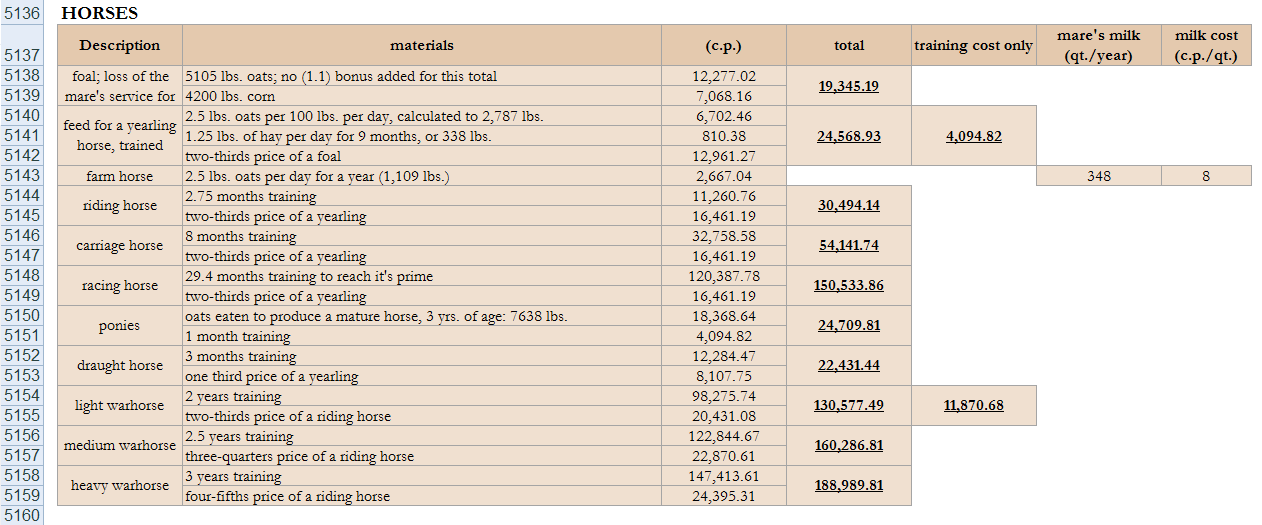
This is my work-up for live horses:
It starts with the birth of the foal, or baby horse. This costs a loss of the mare's service both before and after giving birth, which means she's eating oats and corn in grand amounts. The foal is eating too. The price of oats has been determined elsewhere, as has the price of corn. These things, multiplied by amounts, gives us a total number of copper pieces: here, 19,345. That's a little more than 100 g.p.
Where it says "no (1.1) bonus added for this total," this means that I'm not multiplying "19,345" by 1.1. Normally, when some product in the pricing table is made of two source materials, I add 10% to the total; this accounts for the labour and troubles associated with supply. That 10% figure is a great help in determining monthly wages for the person responsible for mixing the feed and giving it to the horse. Only here, I'm suspending it, for no better reason than my trying to keep the horse's overall price down a little.
When there are three source materials, I add 20% to the cost; when there are four, I add 30%. And so on. This makes more complicated things and gadgets progressively more expensive, beyond the base price of their source materials — while at the same time ensuring that the labourer is paid better. It works very well.
Look at lines 5140-5142 (so far, 5,800 lines in the whole document). "Feed for a yearling horse, trained." It includes a line that says, "two-thirds of a foal." A "yearling" is one-year old, or thereabouts. The amount of food calculates to what the yearling horse eats in 9 months, and then to that is added the younger horse, which the yearling was once. Only, for no good reason, I'm cutting the value of the foal down by 2/3rds, arbitrarily, again to keep down the price. I could probably invent some kind of excuse, but to be honest, I'm diddling with the numbers. Once in awhile, some exception has to be made to some general rule, "because." In a practical sense, there are too many disparate things in the world to permit consistency. I want a high price for horses, but I don't want it to be too high.
As it is, the fabulous price for foals and yearlings reflects the potential for these animals to someday be magnificent beasts. Most of us don't realise what a long-term effort many animals are with regards to training and feeding and housing, before all that investment finally pays off in a good riding horse. There's a sense of attachment, too, in that you've seen your foal grow to be a yearling, and you have expectations of what the yearling will be someday. But there's something else hidden in the price, which helps make sense of the very confusing price for farm horse in line 5143.
Not every horse is as healthy and virile as most of them are in the movies. The value of a horse lies in what it can DO. When a horse can no longer "do," yet continues to eat more than a thousand pounds of oats a year, the price falls precipitously. Here's part of my description of the farm horse from my Guide:
Such horses have no breed, as they’re composed of mixed blood; their quality is inferior, for the most part having been raised on little other than grass and less than half the supportive nutrients that a more remarkable horse takes for granted.
They exist as the cast offs of stables, as horses not intelligent or vigorous enough ... by which time they’ve aged some years. Farm horses may also include horses older than 13 to 15 years, that have given good service in other roles but have come to the end of their use as other kinds of horse.
Even a warhorse, if it isn't worth being put out to stud, or is too old to breed, or hasn't been killed, may someday end up a farmhorse. The low price is essentially the cost of "getting rid of the animal," because anyone who buys is going to get minimal value from the creature at great cost in feeding it. The low cost of 2,667 c.p., about 10 g.p., is to beg someone to take it. This understanding makes it possible for a common peasant to actually own a run-down horse; it may actually have been abandoned, perhaps because it was lame ... and the farmer, who perhaps knew something about horses, took it home and healed it sufficiently to do light work for the rest of its life.
Friday, March 3, 2023
Making of Magic Weapons
Thursday, March 2, 2023
Adult Fare
Last month, you may have seen this article about a Vegan D&D player demanding a cruelty-free campaign. If so, you should see the follow-up, in which the DM explained that there was more to the matter than what the click-baity argument let on.
I have a high personal bar for this sort of thing, which arises from personal experience with cruel things and I think a greater knowledge of history than most.
Recently, poking about the net looking into the butcher's trade, I came across this from The Pictorial Handbook of London, dated 1854. It speaks of Newmarket street, where there were many butcher's shops to be found:
“The slaughterhouses for sheep are almost exclusively in cellars underneath the shop, where the pices or joints are sold in retail. The access to these cellars is by steps, over which a board is occasionally placed, to act as an inclined plane for the animal to slide down. More frequently a much more summary process is had recourse to—the animal is seized by the butcher and pitched headlong into the cellar by main force, where, unable to rise from broken limbs, or other injuries sustained by the fall, they lie awaiting their turn to be slaughtered ...”
My first instinct is to include the above in the Streetvendor's Guide, as a visual, to set the scale on which a fantasy world has every right to operate. Not every D&D game is My Little Pony. There's plenty of real life human history wallowing in gore, slaughter, sadism and extreme cruelty to justify a group of murdering adventurers chewing up the landscape. Moreover, such is the material that causes young children to gaze at in rapture, wide-eyed, realising for the first time how spectacularly dark is the reality of human history ... before, that is, growing up and coming to their senses, assuming they do. I did. Personally, I've felt no desire to walk in the footsteps of either the Huns or the Mongols, rounding up whole villages in order to massacre every living soul.
Well, there was that one time. But never again.
Given the youth of participants, coupled with the sheltering from knowledge by helicopter parents, I'm not surprised by the stark reactions of some to the details of skinning and deboning a pig ... a perfectly ordinary operation to a rural-born child a hundred years ago, some five years after my grandfather had come home from the Great War. Those readers who have dared to watch recent fare like All Quiet on the Western Front or 1917 have merely glimpsed a tiny bit of the day-to-day hellscape that formed a whole generation's perspective on "cruelty." The truth is, the fact that individuals can feel so passionately about the description of a pig's slaughter only goes to show how very, very comfortable the world has become, for all of us. The bar for trauma has been drastically lowered ... and that's a GOOD thing. The last thing we need is a return to the standards of the last century.
It produces an interesting conundrum. Nassim Taleb's 2014 book, Antifragile, Things that Gain from Disorder, makes the valid argument that bad things make us stronger and better able to handle and overcome other bad things. There's no question of that. That doesn't mean, however, that a DM — who may already be fragile — is ready to tackle the rampant fragility of one or more players. For some groups, the game itself, with it's elements surrounding combat and killing, evil, intrigue, villainous characters and supernatural overtones, is a ticking time-bomb.
It's only a matter of time before the DM advances some idea that seemed "really cool" on the surface, only to find that it's tapped into someone's fragility in a way that ends the session or friendship, or perhaps several friendships and the whole campaign. We shouldn't wonder that many young people, with little to no experience in dealing with life's most difficult themes, end up pussyfooting their way around every aspect of role-playing.
This is why, early on, I conceived of D&D as an adult game. Remember, unlike a lot of people who have been around a long time, I began playing at 15, not 9. By that time I'd played D&D a year, I'd had two grandparents die, I had a front-row seat watching an uncle spiral into alcoholism, I'd been beat up several times by groups larger than two and I'd experienced the dehumanising thrill of playing high school football. Life was not, as they say, great. Yet I think I was old enough not to see D&D as a form of escape, which would have been ridiculous ... instead, I saw it as a way to express my frustrations, my desire for having something I could control, and a way to interact socially with others whose lives and frustrations reflected my own.
Children should not play D&D. They should, first, get some sense of how the world works ... meaning that their early activities should be athletic, competitive, confrontational in a healthy manner that teaches them that sometimes we lose, that we have to overcome loss, that effort itself is a form of success ... and that just because someone is on the opposite side in this game, it doesn't mean they hate us or they're an enemy. Sometimes, we agree to take sides in order to experience the abilities and strengths of our friends in the cold light of reality.
Not that I could have thoroughly explained this when I was a child. Obviously. But playing D&D, especially this decade's form of D&D, is a disaster where it comes to a child's upbringing. Participating in adventures where the players always succeed, where everything can be changed at a whim, where the losers are always pretend creatures we don't know ... and where the gloss of magic obliterates the day-to-day struggle for existence in a world without technology ... paints a rather debilitating strategy for, um, fragility.
That's because D&D has transformed from a game of attempt/fail to operative wish-fulfillment. Too much of that cripples children by making a large part of their lives too easy, just as William Goldman warned.
Turns out that taking away all the trauma that a child might conceivably experience doesn't make them happier, or bring about an end to trauma. Instead, the child to find trauma in whatever can be found among the trivial things that are left. The end result is a zero-sum gain. No matter how good or rosey we make the world, it's impossible for us not to find something horrific anyway ... even when that "horrific" is pretty damned silly.
I much prefer a D&D game among tough, resilient adults, who can take being killed as a part of the game, who don't expect things to go their own way, who don't need the game to fulfill some empty hole caused by their lack of a meaningful life. The adventures are sharper, the stakes are higher, the ethics less black-and-white and the artistry in running and playing the game at it's peak. Shouting matches are a sign of passion, of really caring, not a form of emotional tantrum. Nothing is off the table. Nothing is denied. No one expects to have things their way.
It's how I think the game should be played.
Wednesday, March 1, 2023
Contents Thus Far
Sorry to do this, but as things become available, I'm going to tempt my reader.
Here's a content page of the headings I've added since beginning the Streetvendor's Guide, 45 days ago: