Keeping in the spirit of comic cons and fan expos (3 days left), it is a good time to talk about cosplaying.
The reader will find as old age approaches that everything that happens after the age of 25 will be thought of as 'new' whether it is or not. For example, I still think of grunge music as 'new' - even though for many readers out there, it happened and died before being born.
[Well, sort of died. There are still bar bands playing grunge music, thinking they'll be 'discovered' someday in a world now being run by Nikki, Taylor and Katy].
For an old fart like me, cosplaying has snuck up on me. At least, the institutionalization of people wearing costumes as a means to emphasize their fandom for specific characters is a strange, new thing. Like with the previous post, my childhood was also full of dressing in costumes, because that was something we thought was fun. Hell, my whole Canadian generation was warped hopelessly by Mr. Dressup, who became a childhood institution for more than 30 years. I was four when Mr. Dressup first aired. [I went looking for an example of the show from back then, but it seems impossible to find anything on youtube predating the invention of VHS].
And I can remember a Halloween that predated excessive commercialism, predated the terror razor/needle/poison candy scare and predated parents chaperoning costumed children roaming from house to house. These things are truly 'old' - long gone, never to be seen again. But they did leave a lasting childhood association with costuming and the adoption of personalities.
That said, the first time I actually saw a DM dressed in a costume for role-playing I believe I associated the moment with a desire to vomit. As I said yesterday, I was older by the time I began to play D&D and well past the compulsion to dress up in order to identify myself as a different being. I had embraced theater and the arts by then and I knew from experience that the costume is only a very small part of the experience. True character portrayal begins within. After all, the most frightening monsters in our adult imaginations - terrorists, child molesters, serial killers, rapists - are terrifying because they look like anybody.
So on that level, yes, I confess, cosplaying seems a bit childish. But let me rush to assure the reader that I don't think that it is, not for most of the participants. I stick by what I said yesterday: cosplaying is free spirited lawlessness. The same lawlessness I experienced as a child when we would pretend to be vampires and witches, capturing victims and burning them alive in pretend ovens.
[At 10 years of age, several free spirited same-age girls and I role-played some pretty intense scenes together - a bit beyond 'doctor' or 'house'].
If anything, I am deeply respectful.
This will seem like a big step to the left, but just go with it. Some years ago, circa 2007, for a freelance story I was writing, I attended a meeting of transgendered persons to hear their views on the Alberta government's defunding a significant part of their reassignment process. Because the meeting was more or less free and open, and because my 19-year-old daughter was interested also, I brought her along. All told there were about 19 persons there. The meeting's agenda was to lend support for those who would be most affected by the government's decision and to suggest strategies for the future.
It was an educational evening. Not because either my daughter and I were new to the concept; she had gone to school for three years with a boy who was pre-op but living as a girl and I had known several persons in theater and film who were struggling with the lifestyle as early as the 1980s. The educational part was the intensive fear associated with my role as a journalist. It took literally hours of reassurance to convince most of the room that I had no intention of outing anyone or even giving details regarding their personal struggle. I was there to get an overview of the problem and that was all. Nevertheless, I could understand why several of the persons there who worked for the city or the government in particular were terrified to talk to me.
This sidebar connects to cosplaying because of two persons that my daughter recognized from Otafest here in Calgary - a Japanese Animation Festival that is a huge event each year (upcoming in November). My daughter hadn't known that the two persons very much in love with each other were both transgendered; she did know that these same two persons were very dedicated furries.
"Isn't it amazing," my daughter said afterwards, "That two people who happen to be transgendered and furries can find love together. The world is wonderful."
My sentiment exactly.
Cosplaying has become a community that supports individualism through copying the inspiration of other artists (who invent these characters). It is a strange dichotomy. I believe, however, that it does carry forward the most wonderful parts of the exploration into roles that we begin as children - the separation of guilt and repression, which are dumped on us at a young age, from desire and fantasy, that many adults have surrendered by age 30.
In three days I will be in an immense chamber with thousands of such people. Is there any better place to be?
Monday, September 21, 2015

Sunday, September 20, 2015
Nobody's Business
The Edmonton Expo is in four days.
There's very little left to do. We're set up for the scene, we've got the presentation necessary. My daughter, I believe, is cosplaying as Sailor Moon. I am cosplaying as the writer in residence. The only concern left is a delivery of books that should be here by tomorrow afternoon. Fingers crossed.
In light of the Expo, I was asked to write about the Dungeons and Dragons television show . . . specifically this episode. I don't know what I'll say yet; I'm still gearing up to the task. There's a good chance that I'll say something I should apologize for - but we'll see.
Whenever I hear someone remember this show fondly, which seems to happen often, I find myself in awe. Perhaps it is because everyone I played with when the show came out (1983) were already 18 and way, way beyond kid's shit. My memories of the show consists mostly of how really bad my groups considered it to be, how offended we were that a gritty show about D&D had been shat on again (something that hasn't changed) and in particular in which ways the show was nothing like the actual game.
Regarding the linked episode above, I'll keep off the subject of animation quality, voice work and other aspects of production (which are horrifically execreble); I'm also not going to say anything about costumes and the silliness of their design. I'll stick to game interpretations with which I have a problem. I'll give the time stamp for when the problem occurs. I'm going to ignore the title sequence and just start with the show itself (part one), which begins at 01:00.
There's very little left to do. We're set up for the scene, we've got the presentation necessary. My daughter, I believe, is cosplaying as Sailor Moon. I am cosplaying as the writer in residence. The only concern left is a delivery of books that should be here by tomorrow afternoon. Fingers crossed.
In light of the Expo, I was asked to write about the Dungeons and Dragons television show . . . specifically this episode. I don't know what I'll say yet; I'm still gearing up to the task. There's a good chance that I'll say something I should apologize for - but we'll see.
Whenever I hear someone remember this show fondly, which seems to happen often, I find myself in awe. Perhaps it is because everyone I played with when the show came out (1983) were already 18 and way, way beyond kid's shit. My memories of the show consists mostly of how really bad my groups considered it to be, how offended we were that a gritty show about D&D had been shat on again (something that hasn't changed) and in particular in which ways the show was nothing like the actual game.
Regarding the linked episode above, I'll keep off the subject of animation quality, voice work and other aspects of production (which are horrifically execreble); I'm also not going to say anything about costumes and the silliness of their design. I'll stick to game interpretations with which I have a problem. I'll give the time stamp for when the problem occurs. I'm going to ignore the title sequence and just start with the show itself (part one), which begins at 01:00.
- 1:47 - the Dungeon Master tells the party what to do.
- 2:37 - the mages' powers are limited to his hat (and by extension that the abilities of all the characters are due to their magic items).
- 3:04 - characters run away from danger before engaging first (one arrow does not equal engagement for D&D players).
- 3:14 - only barbarians want to fight things.
- 3:23 - "fighting will only make them mad."
- 3:37 - fighting is somehow equated to "heroics"
- 4:30 - in a world where people turn down exchanging bread for talismans (because they're obviously cheap and worthless) there's still room for accusations that the use of magic proves "an evil wizard."
- 4:53 - peasants are willing to rush off to try to destroy a mage after displaying an obviously powerful talisman.
- 5:04 - too exhausted to run; obviously, not too exhausted to fight.
- 6:50 - characters sleep in their armor.
On the whole, mere quibbles. So much of the show is taken up with anvilicious development and flanderization that it's amazing there was time to have anyone portray any event that can be reconciled with D&D. And of course, the fact that it was presented as a kid's show in a pre-internet world, when children's programming was hopelessly relegated to infantilization and marketing, meant that fighting had to be something the participants couldn't do.
That's the saddest part of this show - that it was designed around a game with a fundamental structural dependency on fighting in a media where fighting could not be discussed. Television has always been funny this way. As elementary age boys in an upper middle-class neighborhood, the favorite game was always 'guns.' The television we watched was full of six-shooters, phasers and spy pistols, so those filled our pockets. Guns meant running across open lawns, diving over fences and dying - mostly dying - in spectacular ways. Twitching one's body while running off a five-foot ledge to a slope of grass, skidding to a halt and then holding the 'death pose' for the demanded 30-seconds (rules!) was just the sort of thing to cause mothers to rush onto their back porch and scream in full panic.
At seven we understood the pleasure of fighting. That's part of what we immediately loved about D&D at - in my case - 15. But television has always tried to pretend that fighting is something children do not do. And it has always tried to shove that perspective down children's throats.
As children, we ignored it.
Naturally, the D&D show was nothing like D&D. How could it be? Even if the writers had done due diligence (which obviously they did not do), nothing on earth is more executively meddled with than children's programming. There are too many legal landmines for it not to be that way. The error, of course, was that D&D was promoted as a children's game. It is still promoted that way. It will always be promoted that way. It doesn't matter that it requires more time, effort, ability, expertise, background and practice to manage it than bridge or football pools . . . this is simply the way the world insists on looking at the game. This is why every nerd portrayed playing it on television always emphasizes the fantastical, silly aspects.
When a dragon is presented in a children's show, it is a fat, dumpy thing that clumps around breathing harmless fire. It isn't that dragons can't be scary. We can see a bit of the fear in a movie sort of aimed at adults, where an effort is made to sort of cause the dragon to be aggressive, moving like a clumsy snake and breathing hot fire between talking like a serial killing university professor. We can make it burn down a town.
What we can't do, even in an adult movie with a dragon in it, is show the smashed and burnt bodies of the dead, as they're dying, like we can in a war film. People will pay to watch tank shells splitting bodies in two or to see people cut to pieces by bullets, but no one's going to put up with that shit from a movie with a dragon in it. Because this isn't horror, this is fantasy.
Yet - and here's something that most D&D players never really grasp - role-playing is horror. It is what we would never choose to do in reality - court death, see it as acceptable, take pleasure in destroying an enemy and callously make plans to do it all again. For gain. It is viscerally satisfying to act as brutally as we wish for purely selfish motivations. This is what the game taps into. And the more advanced the game, the greater the agency for pursuing that selfish intent.
Films and television can't represent that because the 'good guys' can never be that way in that media. The 'good guys' can't possess the motivation that D&D demands as proof of winning. It is a game built in an underground and pursued habitually in an environment where authority and morality have no voice. Where 'right' and 'wrong' are limited to what a small number of quiet players accept as the gameplay they want.
A great reason for the success of expos and gaming cons comes from the sense of free-spirited lawless associations that arise from people dressing as they want and playing up the characters they want, without the usual discourse and condemnation that follows from social rule-makers. Role-playing represents a form of media where executive meddling is impossible above the level of the DM, where hours can be spent in the company of others who are okay with arson, murder, genocide and the like. It is the only group activity that allows a meeting of the minds in this way.
But this is a great secret, isn't it? We're supposed to pretend it isn't going on this way around gaming tables. Every once in awhile someone on the net gets upset because someone mentions rape or infanticide and there's a back-and-forth. Doesn't mean anything, however - because if six adults can agree that the castration going on in this role-playing game, tonight, is fantasy and nothing more, then the rest of the world can fuck off. Ain't nobody's business but the players.
That makes role-playing a dangerous game - in the eyes of the controllers and the pundits. This encourages such people to proclaim, again, that RPGs are on their way out. Or that the only people still playing them are children. Or whatever other lie that wants to be said.
But we at the tables know different, don't we. We know that when Eric the Paladin says, "I make a pass at Lorne - how does he feel about that?", we don't have to take a public sampling to find out if the players having sex is okay. All the DM needs to do is roll a die.
Thursday, September 17, 2015
Gone to Ground
Whew.
In early 2012, I began updating all my maps to a later version of Microsoft's Publisher program - and as of yesterday, I completely finished that upgrade. This link on the wiki includes all the sheet maps of my world that I have either finished or are upon the edges of what I've finished, from the Andaman Islands in the East to the western shore of Spain. 72 maps altogether.
Here is a list of links for the latest updated maps, that were not included when I wrote about this a bit more than a month ago:
G 06 - Nubia
G 07 - Arabia
G 08 - Empty Quarter
G 09 - Oman
G 10 - Gujarat
G 11 - Maharashtra
G 12 - Orissa
G 13 - Bengal
G 14 - Irrawaddy
H 08 - Ethiopia
H 09 - Horn of Africa
H 10 - Socotra
H 11 - Arabian Sea
H 12 - Ladshadweep
H 13 - Madurai
H 14 - East Ceylon
H 15 - Bay of Bengal
H 16 - Andaman Sea
Two of the maps - the Arabian Sea and the Bay of Bengal - are merely hexes containing water and no land at all. They are included as placeholders.
I know that I haven't been writing much on the blog lately. Call it my going to ground, just for the time being. On days when I've had energy, I've been working on the book. On days when I have less energy, I've been making these maps. Basically, the revamp of the maps is little more than retracing the coasts, rivers, roads and so on with new, upgraded lines and colors. But that is all done now and I'm glad. Going forward, the maps I'll be posting on the wiki and on this blog will all be new, created since this time.
For no reason at all, I've been doing preliminary work on Burma. I really should finish Morocco, which I've left half done, and the Maldives, that I've left half done, but I'm not in the mood for little tiny islands and a desert. I'll get back to those things.
Part of the reason I do these maps, some of my long-time readers will remember, comes from wanting to look very closely at parts of the world that are obscure and to which very few people pay attention. People think about creating a world based on France or Britain, the Middle East or the Balkans . . . but when does anyone make plans for a world based on Burma? Or Ethiopia, which I may take up next? Who thinks of the Canary Islands or Eastern Siberia?
I'd like to think there are Japanese and Indian players of D&D (who I get page views occasionally) who do think about those places. I would love to see some of the work they do, what they've designed for lairs and caves, what sort of monsters they create. But, of course, the small table of people playing this weekend in Chiang Mai in Thailand don't speak English and they don't read my blog. I bet, however, that they play some sort of role-playing game.
That's just speculation. Good 'ol JB in Paraguay never seems to mention (at least I've never read him mention it) the group of Spanish speaking players occupying themselves with some sort of weird Colonial RPG based on the reclamation of South America by Incans . . . Asuncion has a population of over 500,000 and of course it's impossible for him to have met everyone. I'd like to think this game isn't a first-world phenomenon. I mean, who knows how many people in Kenya are playing D&D right now?
Well, sorry I'm not writing much. I'll be getting my wind back from having to do physical labour day-in and day-out when once upon a time I use to sit on my comfortable ass in a comfortable office writing my comfortable blog posts between five minute spans of actually doing work for twice the pay I'm earning right now. Then I'll post more often.
I hope all my readers are doing well.
In early 2012, I began updating all my maps to a later version of Microsoft's Publisher program - and as of yesterday, I completely finished that upgrade. This link on the wiki includes all the sheet maps of my world that I have either finished or are upon the edges of what I've finished, from the Andaman Islands in the East to the western shore of Spain. 72 maps altogether.
Here is a list of links for the latest updated maps, that were not included when I wrote about this a bit more than a month ago:
G 06 - Nubia
G 07 - Arabia
G 08 - Empty Quarter
G 09 - Oman
G 10 - Gujarat
G 11 - Maharashtra
G 12 - Orissa
G 13 - Bengal
G 14 - Irrawaddy
H 08 - Ethiopia
H 09 - Horn of Africa
H 10 - Socotra
H 11 - Arabian Sea
H 12 - Ladshadweep
H 13 - Madurai
H 14 - East Ceylon
H 15 - Bay of Bengal
H 16 - Andaman Sea
Two of the maps - the Arabian Sea and the Bay of Bengal - are merely hexes containing water and no land at all. They are included as placeholders.
I know that I haven't been writing much on the blog lately. Call it my going to ground, just for the time being. On days when I've had energy, I've been working on the book. On days when I have less energy, I've been making these maps. Basically, the revamp of the maps is little more than retracing the coasts, rivers, roads and so on with new, upgraded lines and colors. But that is all done now and I'm glad. Going forward, the maps I'll be posting on the wiki and on this blog will all be new, created since this time.
For no reason at all, I've been doing preliminary work on Burma. I really should finish Morocco, which I've left half done, and the Maldives, that I've left half done, but I'm not in the mood for little tiny islands and a desert. I'll get back to those things.
Part of the reason I do these maps, some of my long-time readers will remember, comes from wanting to look very closely at parts of the world that are obscure and to which very few people pay attention. People think about creating a world based on France or Britain, the Middle East or the Balkans . . . but when does anyone make plans for a world based on Burma? Or Ethiopia, which I may take up next? Who thinks of the Canary Islands or Eastern Siberia?
I'd like to think there are Japanese and Indian players of D&D (who I get page views occasionally) who do think about those places. I would love to see some of the work they do, what they've designed for lairs and caves, what sort of monsters they create. But, of course, the small table of people playing this weekend in Chiang Mai in Thailand don't speak English and they don't read my blog. I bet, however, that they play some sort of role-playing game.
That's just speculation. Good 'ol JB in Paraguay never seems to mention (at least I've never read him mention it) the group of Spanish speaking players occupying themselves with some sort of weird Colonial RPG based on the reclamation of South America by Incans . . . Asuncion has a population of over 500,000 and of course it's impossible for him to have met everyone. I'd like to think this game isn't a first-world phenomenon. I mean, who knows how many people in Kenya are playing D&D right now?
Well, sorry I'm not writing much. I'll be getting my wind back from having to do physical labour day-in and day-out when once upon a time I use to sit on my comfortable ass in a comfortable office writing my comfortable blog posts between five minute spans of actually doing work for twice the pay I'm earning right now. Then I'll post more often.
I hope all my readers are doing well.
Tuesday, September 15, 2015
Sept 15, Again
Strix Nebulosa, long time friend of mine, wished me a happy birthday on the last post. Thank you Strix. It is indeed my birthday today.
Saturday, September 12, 2015
Comparisons
Why is the Fantastic Four shit?
At the 35 minute mark:
Iron Man: Stark has fully built the suit and it has just finished booting up. He's been shot, threatened, soldiers have died, things have exploded and we've been given a strong back-story about Rhodey and Obadiah. We've already seen problems get resolved. Run time: 2:06 hrs.
The Incredible Hulk: Banner has been tracked down in Brazil, we've killed Stan Lee, the Hulk has ripped apart a bottling plant, we've covered the distance between Brazil and New York and we've been given a strong back story about Bronski and the General. Banner is seeing Betty for the first time in years. Run time: 1:52 hrs.
Captain America: Rogers is being injected with the serum. He's been in the army, thrown himself on a 'live' grenade, made a connection with both Erskine and Carter and we've been given a strong back story on the Red Skull. Run time: 2:04 hrs.
All good starts, with action and things going on, a multiplicity of events and we really care if the next efforts - Stark getting free, Banner avoiding the army, Rogers fighting the Nazis - actually happen.
And Fantastic Four?
We've seen Reed's machine work three times. We know almost nothing about the four main characters and Doom, especially Ben. Having invented the machine in the first five minutes we then have to see him reinvent the machine twice. At 35 minutes three of the characters - and not including Ben or Sue - are drinking a beer, carping and reminding us that the Apollo spacecraft went to the moon.
Run time: 1:39 hrs.
They had 13 minutes less run time than The Incredible Hulk and they wasted a third of it accomplishing jack shit.
Um, wasn't there supposed to be some handbook that says, "Get this much plot line accomplished by so many minutes"? Aren't we told that good movies are ruined by executives who insist on an action scene taking place at precisely 21 minutes or the love scene taking place at exactly 28 minutes - or whatever it is?
Apparently, that's all crap. Executives just meddle. They sure did in this one. Hell, not only is Johnny Storm and his Daddy black . . . apparently he was raised in Compton. How the fuck did that happen? Especially since Sue still talks like a white girl from the Valley.
At the 35 minute mark:
Iron Man: Stark has fully built the suit and it has just finished booting up. He's been shot, threatened, soldiers have died, things have exploded and we've been given a strong back-story about Rhodey and Obadiah. We've already seen problems get resolved. Run time: 2:06 hrs.
The Incredible Hulk: Banner has been tracked down in Brazil, we've killed Stan Lee, the Hulk has ripped apart a bottling plant, we've covered the distance between Brazil and New York and we've been given a strong back story about Bronski and the General. Banner is seeing Betty for the first time in years. Run time: 1:52 hrs.
Captain America: Rogers is being injected with the serum. He's been in the army, thrown himself on a 'live' grenade, made a connection with both Erskine and Carter and we've been given a strong back story on the Red Skull. Run time: 2:04 hrs.
All good starts, with action and things going on, a multiplicity of events and we really care if the next efforts - Stark getting free, Banner avoiding the army, Rogers fighting the Nazis - actually happen.
And Fantastic Four?
We've seen Reed's machine work three times. We know almost nothing about the four main characters and Doom, especially Ben. Having invented the machine in the first five minutes we then have to see him reinvent the machine twice. At 35 minutes three of the characters - and not including Ben or Sue - are drinking a beer, carping and reminding us that the Apollo spacecraft went to the moon.
Run time: 1:39 hrs.
They had 13 minutes less run time than The Incredible Hulk and they wasted a third of it accomplishing jack shit.
Um, wasn't there supposed to be some handbook that says, "Get this much plot line accomplished by so many minutes"? Aren't we told that good movies are ruined by executives who insist on an action scene taking place at precisely 21 minutes or the love scene taking place at exactly 28 minutes - or whatever it is?
Apparently, that's all crap. Executives just meddle. They sure did in this one. Hell, not only is Johnny Storm and his Daddy black . . . apparently he was raised in Compton. How the fuck did that happen? Especially since Sue still talks like a white girl from the Valley.
Thursday, September 10, 2015
Writing for Readers
I received a bunch of terrific comments for the last post, proving that despite people's general feelings towards market research (and I admit the words make my skin crawl as much as anyone) there's a willingness to come forward and make arguments.
Good on all of you.
I feel it would be poor form to debate the individual conclusions, since every single conclusion that has been pulled from the tiny bit of source material is dead right. It is in trying to establish the best course of action between the right answers that makes parsing these opinions so difficult.
I do want to make some general points, however - and it felt best to do this in a blog post, where I had no limitation on the number of words or characters I could use. Some of these general statements will refer to specific things that specific persons have said. I want it very clear that I agree with the reasons for bringing those things to light. They had to be said. And they were considered by me before I wrote the post in question or proposed the poll.
It is revealed on page 2 (or three, as Jeremiah's point about 'I' statements has already got me rewriting the first page) that the story will be about the narrator, Herzog [name chosen to be deliberately Germanic and odd] being 17. I don't want to write anything that is told in a 17-year-old's perspective. I think that would be horrible. I think it would be aggravating for the reader, dull, expressly destructive of the immersive quality of the story and just a huge pain in the ass for me, the writer. I am not 17. When I was 17, I was a terrible writer. I don't need to pretend to revisit that when I don't feel it would add anything to the story.
Therefore, yes, I have chosen to set the book up as told by someone who is approximately my age, recounting something that happened to him when he was 17. This lets me use my whole vocabulary and lets me tell a tale instead of an art project.
I have no intention of writing for any age group or any genre-interested segment of the population. I have no interest in writing material that only a person interested in fantasy would want to read. I think I have designed a good story. The second draft is intended to translate that good story into a good read (thus, I am still fixing the first page, as it isn't the final draft by any stretch of the imagination). I'm still not completely satisfied with the tone of the story-teller (thus, too many 'I' statements as I try to find a voice) but that's something the second draft will fix.
So, no, this won't be written for pre-teens. That said, there's no reason why a pre-teen wouldn't enjoy it. I read the unexpurgated Frankenstein as a pre-teen and I enjoyed that. I read a lot of adult books as a pre-teen, including a number of medical textbooks.
This is for Oddbit, but it is meant in jolly good humour. A word is a word. The only thing that makes a word 'fancy' is the reader's prejudice.
Prejudice cannot be written around.
Yeah, the knees thing. Well, I didn't read that through. My sense is that "I fell backwards" can easily be interpreted as "I fell away." "Landed on my knees" can easily be assumed to mean "hands and knees." But the point is taken. In general, the line is a placeholder. To satisfy everyone, we can write it,
There's no such thing as bad writing. There's only writing that hasn't been fixed yet.
Now, about the word 'bequest.' Yeah, that's a puzzler. I explained how I came upon the word in a comment yesterday but I didn't mention that I had then gone to thesaurus.com to look for a better - or rather, a more 'friendly' word. Sadly, all the other options fail to fit the actual plot of the novel.
I can certainly appreciate anyone saying that the title would put them off. I particularly liked the phrase from James about "a clever, polite, English country gentleman or woman gallivanting about and solving pernicious riddles." I liked it because in many ways this applies to the novel I've written. It is a mystery. It happens to take place in a 14th century fantasy world that includes magic, but there's something going on that isn't made certain until the end. The uncertainty doesn't happen to be a murder, but it does involve a bunch of killing and, as the killing remains in the province of we don't know why or what, yes, the novel is a mystery.
But all novels are mysteries. The forementioned Frankenstein is a mystery - we don't know what's going to happen if the monster wakes up. In To Kill a Mockingbird (a novel I hate, but most readers are familiar with it) we don't know how Boo Radley fits into the story and his presence is definitely mysterious. Robert Asprin's Another Fine Myth is a mystery, from the moment Aahz appears in the story to the uncertainties surrounding Isstvan.
If there wasn't a mystery, no one would read anything. The argument that the title would put people off is, as ever, only a sign that people continue to believe they can automatically tell the difference between a good book and a bad book by the cover. That is why covers are full of boobs, swords, weird scenery and dragons. Pardon me, gentle reader, but what the hell?
Asked with a smile on my face. So it goes, so it is with people. I don't read any modern book unless a friend suggests it - and let's face it, in a world full of books, the only chance anything I write has the least chance of being popular is if all the readers of this blog buy the book because it's me, likes it and tells their friends.
I sold 10 books through Chapters here in Calgary - at $40 a book. Why $40? Because the split with the book store was onerous. I had to make it $10 more just to make it worthwhile keeping track of the unreal, annoying, half-assed sort of merchandising that goes on with real booksellers. It's kind of laughable. However, I've actually heard from two of those people through email and neither mentioned the different price online. Both were people who saw the book for the first time on the shelf and bought it.
That's rather amazing.
If I have to put boobs or swords on the cover of my book in order to make a total stranger who has never read this blog buy it, then I will. There is an actual scene in the book where the presence of boobs does, in fact, upset the 17-year-old. But all in good fun. So there's a justification for putting boobs on the cover. Just so.
I hope, I count on people buying the book because they read me here. I know I can't always count on that. I wrote a great book called Pete's Garage which I put up about 30 months ago. It didn't sell that well online, but everyone who has talked to me about it has liked that book. I think it didn't do well with any regular readers because it's about musicians and most assumed that, not being musicians, it wouldn't be interesting. But I didn't write the book for musicians. I mean, if you're a musician, there are in-jokes and things you're going to get - but in the long run, the book is really written for people who like fantasy.
Being about a musician running a studio for practicing musicians, I included a traditional muse, a traditional satyr and a traditional siren - all musical creatures from Greek fantasy literature. So its really a fantasy novel mixed in with stories about trying, failing, falling apart and falling in love. Hell, there's a fistfight in it.
You guys should buy that book. And then tell your friends.
Why on earth, my lovely friends, do you think I hammer away at this blog all the time. It's to convince you that I can write. It's to reassure you that if I have a book in the works, I'm going to work hard on it. I'm going to fix all the little details about falling off wagons and the titling. I'm going to bounce things around online so that you'll help me make it better and stronger and more interesting.
I'm not the least concerned about someone seeing the cover of the book and making a decision on the title. I want an impression, I want to see what it conjures up in the minds of the blog readers so that I can see how to fit the actual content of the book more into the direction that will appeal to people. It isn't the title that matters, but what you've all said about what you all hope to find inside.
I'll do my best, my honest, level best, to ensure that what you find inside is good.
No matter what the title is.
Let me round this post off with a couple of review for Pete's Garage for those who missed it, who probably don't have a Goodreads account. Not 100% positive, but nothing ever is. I'm happy people read it:

Good on all of you.
I feel it would be poor form to debate the individual conclusions, since every single conclusion that has been pulled from the tiny bit of source material is dead right. It is in trying to establish the best course of action between the right answers that makes parsing these opinions so difficult.
I do want to make some general points, however - and it felt best to do this in a blog post, where I had no limitation on the number of words or characters I could use. Some of these general statements will refer to specific things that specific persons have said. I want it very clear that I agree with the reasons for bringing those things to light. They had to be said. And they were considered by me before I wrote the post in question or proposed the poll.
It is revealed on page 2 (or three, as Jeremiah's point about 'I' statements has already got me rewriting the first page) that the story will be about the narrator, Herzog [name chosen to be deliberately Germanic and odd] being 17. I don't want to write anything that is told in a 17-year-old's perspective. I think that would be horrible. I think it would be aggravating for the reader, dull, expressly destructive of the immersive quality of the story and just a huge pain in the ass for me, the writer. I am not 17. When I was 17, I was a terrible writer. I don't need to pretend to revisit that when I don't feel it would add anything to the story.
Therefore, yes, I have chosen to set the book up as told by someone who is approximately my age, recounting something that happened to him when he was 17. This lets me use my whole vocabulary and lets me tell a tale instead of an art project.
I have no intention of writing for any age group or any genre-interested segment of the population. I have no interest in writing material that only a person interested in fantasy would want to read. I think I have designed a good story. The second draft is intended to translate that good story into a good read (thus, I am still fixing the first page, as it isn't the final draft by any stretch of the imagination). I'm still not completely satisfied with the tone of the story-teller (thus, too many 'I' statements as I try to find a voice) but that's something the second draft will fix.
So, no, this won't be written for pre-teens. That said, there's no reason why a pre-teen wouldn't enjoy it. I read the unexpurgated Frankenstein as a pre-teen and I enjoyed that. I read a lot of adult books as a pre-teen, including a number of medical textbooks.
This is for Oddbit, but it is meant in jolly good humour. A word is a word. The only thing that makes a word 'fancy' is the reader's prejudice.
Prejudice cannot be written around.
Yeah, the knees thing. Well, I didn't read that through. My sense is that "I fell backwards" can easily be interpreted as "I fell away." "Landed on my knees" can easily be assumed to mean "hands and knees." But the point is taken. In general, the line is a placeholder. To satisfy everyone, we can write it,
I pulled back in fright. Seizing the edge of the seat, I let myself fall from to the ground, tumbling into the thick bed of leaves and moss. It must have been Autumn. All I remember is that I ended up somehow on my hands and knees, looking up at the man as he looked down at the reins I had dropped. Those had fallen between the horses, so that he couldn't just snatch them up and drive away . . .
There's no such thing as bad writing. There's only writing that hasn't been fixed yet.
Now, about the word 'bequest.' Yeah, that's a puzzler. I explained how I came upon the word in a comment yesterday but I didn't mention that I had then gone to thesaurus.com to look for a better - or rather, a more 'friendly' word. Sadly, all the other options fail to fit the actual plot of the novel.
I can certainly appreciate anyone saying that the title would put them off. I particularly liked the phrase from James about "a clever, polite, English country gentleman or woman gallivanting about and solving pernicious riddles." I liked it because in many ways this applies to the novel I've written. It is a mystery. It happens to take place in a 14th century fantasy world that includes magic, but there's something going on that isn't made certain until the end. The uncertainty doesn't happen to be a murder, but it does involve a bunch of killing and, as the killing remains in the province of we don't know why or what, yes, the novel is a mystery.
But all novels are mysteries. The forementioned Frankenstein is a mystery - we don't know what's going to happen if the monster wakes up. In To Kill a Mockingbird (a novel I hate, but most readers are familiar with it) we don't know how Boo Radley fits into the story and his presence is definitely mysterious. Robert Asprin's Another Fine Myth is a mystery, from the moment Aahz appears in the story to the uncertainties surrounding Isstvan.
If there wasn't a mystery, no one would read anything. The argument that the title would put people off is, as ever, only a sign that people continue to believe they can automatically tell the difference between a good book and a bad book by the cover. That is why covers are full of boobs, swords, weird scenery and dragons. Pardon me, gentle reader, but what the hell?
Asked with a smile on my face. So it goes, so it is with people. I don't read any modern book unless a friend suggests it - and let's face it, in a world full of books, the only chance anything I write has the least chance of being popular is if all the readers of this blog buy the book because it's me, likes it and tells their friends.
I sold 10 books through Chapters here in Calgary - at $40 a book. Why $40? Because the split with the book store was onerous. I had to make it $10 more just to make it worthwhile keeping track of the unreal, annoying, half-assed sort of merchandising that goes on with real booksellers. It's kind of laughable. However, I've actually heard from two of those people through email and neither mentioned the different price online. Both were people who saw the book for the first time on the shelf and bought it.
That's rather amazing.
If I have to put boobs or swords on the cover of my book in order to make a total stranger who has never read this blog buy it, then I will. There is an actual scene in the book where the presence of boobs does, in fact, upset the 17-year-old. But all in good fun. So there's a justification for putting boobs on the cover. Just so.
I hope, I count on people buying the book because they read me here. I know I can't always count on that. I wrote a great book called Pete's Garage which I put up about 30 months ago. It didn't sell that well online, but everyone who has talked to me about it has liked that book. I think it didn't do well with any regular readers because it's about musicians and most assumed that, not being musicians, it wouldn't be interesting. But I didn't write the book for musicians. I mean, if you're a musician, there are in-jokes and things you're going to get - but in the long run, the book is really written for people who like fantasy.
Being about a musician running a studio for practicing musicians, I included a traditional muse, a traditional satyr and a traditional siren - all musical creatures from Greek fantasy literature. So its really a fantasy novel mixed in with stories about trying, failing, falling apart and falling in love. Hell, there's a fistfight in it.
You guys should buy that book. And then tell your friends.
Why on earth, my lovely friends, do you think I hammer away at this blog all the time. It's to convince you that I can write. It's to reassure you that if I have a book in the works, I'm going to work hard on it. I'm going to fix all the little details about falling off wagons and the titling. I'm going to bounce things around online so that you'll help me make it better and stronger and more interesting.
I'm not the least concerned about someone seeing the cover of the book and making a decision on the title. I want an impression, I want to see what it conjures up in the minds of the blog readers so that I can see how to fit the actual content of the book more into the direction that will appeal to people. It isn't the title that matters, but what you've all said about what you all hope to find inside.
I'll do my best, my honest, level best, to ensure that what you find inside is good.
No matter what the title is.
Let me round this post off with a couple of review for Pete's Garage for those who missed it, who probably don't have a Goodreads account. Not 100% positive, but nothing ever is. I'm happy people read it:

Wednesday, September 9, 2015
Market Research Updated Again
In case anyone thought the last post meant I was going to be months before I posted again, no. It's only that it's hard to write about D&D if I'm not working on D&D. But I'll catch my breath in a few days.
Meanwhile regarding the title of my book-in-progress, The Killing Bequest, I'm putting up a little survey - market research. If the reader is willing, please give me a hand with it. It is set up to allow more than one answer.
UPDATE:
Now that the poll has been in place about 10 hours, let's presume the reader wants to open the book and look at the front page.
Here is the text that appears on the first page of the book:

Would you turn the page?
UPDATED AGAIN:
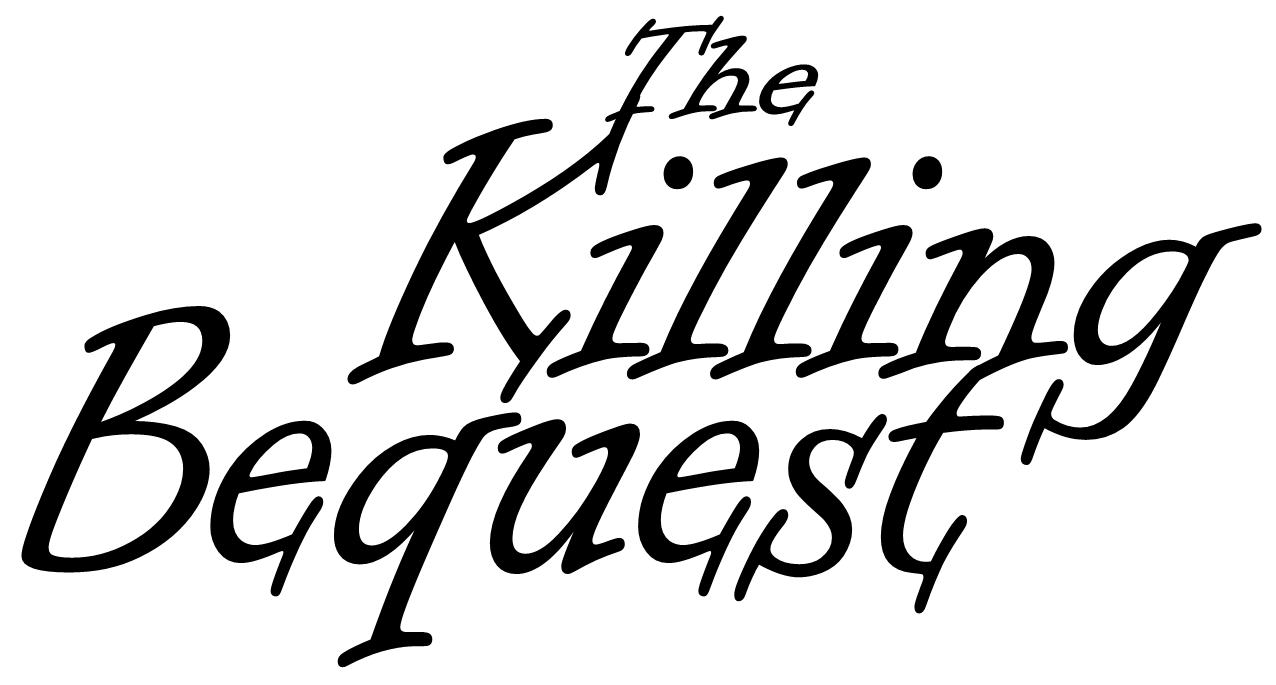
After a comment from Hodge Dunkin, I went to look at what sort of fonts might be available for a cover idea I have . . . and this is why fonts are both fun and why we should stay the bloody hell away from them. Otherwise, we'll come up with something like this:

Meanwhile regarding the title of my book-in-progress, The Killing Bequest, I'm putting up a little survey - market research. If the reader is willing, please give me a hand with it. It is set up to allow more than one answer.
UPDATE:
Now that the poll has been in place about 10 hours, let's presume the reader wants to open the book and look at the front page.
Here is the text that appears on the first page of the book:

Would you turn the page?
UPDATED AGAIN:
After a comment from Hodge Dunkin, I went to look at what sort of fonts might be available for a cover idea I have . . . and this is why fonts are both fun and why we should stay the bloody hell away from them. Otherwise, we'll come up with something like this:
Tuesday, September 8, 2015
Time Off
This is just a quick post to explain where my thoughts are. I've started with a new restaurant, very heavy hours and very heavy work, really pushing me to the wall, but with great opportunities and in a great atmosphere. The main drawback is that I'm starting six days a week and I foresee that coming home I'm not going to be much for anything for awhile.
The principal goal right now is just to stay with it, not think, not question what's happening and to just put my head down. Really not thinking about D&D (I've suspended all my games indefinitely, which my players understand although of course they're disappointed) and putting my small amount of creative drive into working on the second draft of the new book.
The Edmonton Expo is in 16 days. I'm sitting at my computer watching the sun come up, counting minutes before I have to leave for my day shift, wondering how the world works. Here I thought I would never, ever find myself in a kitchen again . . . and now not only am I here, I'm working at one of the busiest and most popular places in the city. And I mean busy. This would have challenged my 30-year-old body twenty years ago. I don't mind saying - the physical requirement here has me, well, scared.
But it really is just D&D, in both a mental and physical sense. A lot of planning, preparation and mental compartmentalization, situational awareness like I wrote about in How to Run and paying close attention to the needs of other people in the midst of extreme stress. A bit more stress than at a gaming table, admittedly.
I wrote last week about shouting and driving away people with a poor attitude - that translates to kitchens as well. All dangerous jobs, in truth. There's no room for a poor attitude in these spaces. I watched a fellow yesterday give himself a second-degree burn on his arm and shrug it off. I'm sure it hurt him terribly (I've had a few of those myself), but he never dropped his genial, it-doesn't-make-a-difference attitude.
Here's a kid at 19, burning himself in a kitchen and no big deal - where all over the net there is this rather silly, petulant hurt resulting from a misunderstood phrase or a criticism.
Really puts things in perspective.
The principal goal right now is just to stay with it, not think, not question what's happening and to just put my head down. Really not thinking about D&D (I've suspended all my games indefinitely, which my players understand although of course they're disappointed) and putting my small amount of creative drive into working on the second draft of the new book.
The Edmonton Expo is in 16 days. I'm sitting at my computer watching the sun come up, counting minutes before I have to leave for my day shift, wondering how the world works. Here I thought I would never, ever find myself in a kitchen again . . . and now not only am I here, I'm working at one of the busiest and most popular places in the city. And I mean busy. This would have challenged my 30-year-old body twenty years ago. I don't mind saying - the physical requirement here has me, well, scared.
But it really is just D&D, in both a mental and physical sense. A lot of planning, preparation and mental compartmentalization, situational awareness like I wrote about in How to Run and paying close attention to the needs of other people in the midst of extreme stress. A bit more stress than at a gaming table, admittedly.
I wrote last week about shouting and driving away people with a poor attitude - that translates to kitchens as well. All dangerous jobs, in truth. There's no room for a poor attitude in these spaces. I watched a fellow yesterday give himself a second-degree burn on his arm and shrug it off. I'm sure it hurt him terribly (I've had a few of those myself), but he never dropped his genial, it-doesn't-make-a-difference attitude.
Here's a kid at 19, burning himself in a kitchen and no big deal - where all over the net there is this rather silly, petulant hurt resulting from a misunderstood phrase or a criticism.
Really puts things in perspective.
Sunday, September 6, 2015
Watch & Learn
Today is the 36th anniversary of the first time that I played D&D - and the first time I ever heard of D&D, for that matter.
To revisit the first post on this blog:
There's more under the link - but the above is enough for this post today.
Since that time, I have done much watching and learning. For some who read this blog, it may fail to resonate just how long I have hammered and sawed at this game. I became enraptured immediately from the beginning, with a mental state that had already spent several years of my youth painstakingly making maps, compounding statistics from an Almanac, making lists of countries based on many things (area, population, resources, largest cities, etc) just for the hell of it. D&D just 'clicked.'
So that the time I spend today, the drive and the effort, it was there 36 years ago, beginning within the very first week of my playing. It was like I was ready to fall in love and then, there it was, first sight.
It has been thus ever since.
I have been working for a couple of weeks now, at a job which they pay me at (for those who remember I was not paid at all for my first cooking job!).
Today I was given an opportunity at another restaurant, better pay, better conditions, a better chance for advancement. Then on the way home from the interview, I saw this:
I wish my camera work was less sloppy (and that my thumb had been cut off as a child). If you're tuning into this right away, the youtube edit fix for sloppy film is just initiating - so this should look better by this evening.
Eileen is terrific, very friendly, spectacularly talented and completely generous in letting me take this video of her and agreeing to let me put it on YouTube. If you see this Eileen, thank you again.
Now I'm going to go work on the second draft of the book I finished on Friday afternoon. It is called The Killing Bequest, which I hope is a good title. The first draft is completely finished and I think it is a marvelous, tight story. I will be writing more about it in the coming months.
For those who have purchased How to Run, or who remember the Fallow posts from a couple months ago, the book takes place entirely in the fiction kingdom of Fallow that I've invented.
Edmonton Expo is coming in 18 days. And it's my birthday on the 15th. I hope all this is a sign.
To revisit the first post on this blog:
It was, I think, a Saturday night. I called up a friend, asked him what if he wanted to do something and he told me, “I can’t, I’m playing D&D.” I had never heard of it.
A game? Yes. “Can you explain it?” I asked.
“No, I can’t,” he said. “You have to play it.” Whereupon he invited me.
My first time playing, I did not understand anything. I was told to be a fighter (it was the easiest to play); my “equipment” was rattled off at me, most of which I was unfamiliar with, and which I wrote down as a list on a sheet of paper under my “abilities.” Lengthy explanations of these things were not given, as that would have held up the game. Watch and learn I was told, and watch and learn I did.
There's more under the link - but the above is enough for this post today.
Since that time, I have done much watching and learning. For some who read this blog, it may fail to resonate just how long I have hammered and sawed at this game. I became enraptured immediately from the beginning, with a mental state that had already spent several years of my youth painstakingly making maps, compounding statistics from an Almanac, making lists of countries based on many things (area, population, resources, largest cities, etc) just for the hell of it. D&D just 'clicked.'
So that the time I spend today, the drive and the effort, it was there 36 years ago, beginning within the very first week of my playing. It was like I was ready to fall in love and then, there it was, first sight.
It has been thus ever since.
I have been working for a couple of weeks now, at a job which they pay me at (for those who remember I was not paid at all for my first cooking job!).
Today I was given an opportunity at another restaurant, better pay, better conditions, a better chance for advancement. Then on the way home from the interview, I saw this:
I wish my camera work was less sloppy (and that my thumb had been cut off as a child). If you're tuning into this right away, the youtube edit fix for sloppy film is just initiating - so this should look better by this evening.
Eileen is terrific, very friendly, spectacularly talented and completely generous in letting me take this video of her and agreeing to let me put it on YouTube. If you see this Eileen, thank you again.
Now I'm going to go work on the second draft of the book I finished on Friday afternoon. It is called The Killing Bequest, which I hope is a good title. The first draft is completely finished and I think it is a marvelous, tight story. I will be writing more about it in the coming months.
For those who have purchased How to Run, or who remember the Fallow posts from a couple months ago, the book takes place entirely in the fiction kingdom of Fallow that I've invented.
Edmonton Expo is coming in 18 days. And it's my birthday on the 15th. I hope all this is a sign.
Friday, September 4, 2015
Step Back
Surely people are aware that many D&D worlds thrive on abuse.
I haven't yet been to any group event where I've witnessed DMs and players where I haven't witnessed first hand evidence of defensiveness, criticism, stonewalling and contempt. That is because when human beings interact with one another - whether having known each other for years or having just met at a gaming table - they habitually seek advantage. In such situations, these four emotions cannot help emerging.
Players and DMs alike feel they are being attacked for what they believe or what they do, and they immediately speak to clarify, protect themselves and forestall judgment because they feel inherently what's coming: a concerted effort, they believe, to change who they are or how they behave in favor of the 'opposition.' Defensiveness comes from distrust, which most players and DMs feel for each other, particularly if they don't know each other. Every dictum brought down by the DM seems to force the distrustful player into a corner and the player responds by balking. Every suggestion the player has for the DM's style of running seems to disparage the value of the DM's world and as a result the DM becomes guarded and uptight. Both sides seek to interrupt what the other side might suggest before the suggestion is even made, in fear of what might be said - and in the process, no one at the table listens because everyone is so engaged with protecting their own viewpoint.
To get past this defensiveness, both sides grow more critical. At first, both sides try to reason, but faced with an overwhelming unwariness the DM or the Player becomes more insistent and less polite about presenting their point of view. The argument adjusts from what "I Believe" to what "You Believe" - with the latter subject to all sorts of correction and assessment. Every statement made by the opposition is then parsed, just as it is here on the internet, consistently as a phrase unto itself without any recognition of the context. Every detail of the other side's perspective is drawn out and pulled under a microscope, evaluated and nit-picked for every flaw. At this stage there is no potential for trust, since the matter has ceased to be about two people disagreeing and has become about the perfect right answer, couched in language which neither side can agree upon. This is why semantic arguments always erupt at this point . . . because in determining what's right and what's wrong, the final arbiter that both sides turn to is the definition of the very words they're using. Semantics always fail, however, because language is far too fluid a mechanism to satisfactorily demonstrate how others are wrong.
Sooner or later, one or the other side surrenders. The sides agree to disagree or someone simply shuts down. There's nothing left to say - and if there were, at least one side realizes there's no point in saying it. The walls go up. Communication ends. If we're not going to listen to each other, then better that we don't speak to each other. Certainly not about this. Leaving everyone at the table in limbo. The matter is unresolved. Those who are left with the task of running the game or wishing still to participate sit quietly, unsure of what to say or do. One or the other combatant - for that's what they've become - is pointedly silent. Whatever they might say is dismissive, spoken like the snap of a pencil: "Whatever." "Sure." "I'm here."
And so begins the contempt. We've disagreed and now nothing, ever, can reconcile the wound that has been caused. I will not forgive, I will not forget. We're done.
This last can become such a style of participation, especially from the DM, that the beginning of the campaign incorporates it. The DM approaches the entire game in defiance of the players. The DM will remark openly, to the players, on how they behave or what they believe, ridiculing them for being players, all in good 'fun' and mockery. It is a defense mechanism. This is how it goes: "Before anyone can begin arguing with anyone, let me as the DM make it clear: I view you all with disdain."
It can be subtle. It can also be openly pompous and arrogant. But contempt is defensiveness in the extreme - it is the natural progression of all human disagreement, to where we hold others in disregard because to do otherwise would be to let our guard down.
This contempt DMs hold is so pervasive in the community that I have time and again seen and read DMs who declare it with pride and pleasure. And so have you, gentle reader.
When I wrote my piece about the reader not playing in my world, titling the post that way, naturally my position was equated with what we have all encountered . . . because this is where our experience lies. Those who rushed forward to condemn me and wag fingers did so because they've been wounded; but the need to do so, with someone in whose world these people will never run, is defensiveness too. It is the hope that if every DM can be corrected to behave properly, then finally the game will be played as it should be played.
Sadly, the pattern of advantage I describe above does not apply merely to gaming, as we well know. It applies to the workplace, it applies to family and it applies to marriage. It is how we are.
I'm in agreement that it should be resisted. But we cannot make things better by making assumptions, acting defensively and criticizing a campaign and a DM based upon a single post or even a whole blog, with someone's world where we have never played. Feeling the need to rush forward and 'save the world by amending what I say says more about the criticizer than the criticized.
Step back, take a breath, evaluate your own motivations and then ask questions. And when the questions come back with answers that make your blood boil, then step back again.
It is what I have been forcing myself to do over and over these last 18 months, as I get my own anger as a default under control. Because we are probably, none of us, wrong. Though it has been very hard for me to make myself believe that.
I'm no better than anyone.
Wednesday, September 2, 2015
Second Look
Hm. Yesterday's post got off the chain, no question about it.
I was thinking of this line from Malcolm Gladwell's Blink (this is my second reference, so the reader knows I'm reading the book right now, not for the first time):
"In order to make somebody laugh, you have to be interesting . . . and in order to be interesting, you have to do things that are mean."
It doesn't just apply to funny; it really applies to everything. The application to humor comes from forcing your audience to listen, to take a second look at what you're trying to say - because if you haven't got your audience's attention, they'll miss the line up for the punchline. Their attention will wander.
If we're writing anything, we have to start with taunting the reader. We have to title the piece in a way that makes people annoyed. We have to challenge the reader to be good enough. We have to make not being good enough matter. If there's any chance of convincing the reader that there's something to aspire to, we have to supply the reader with the ideal that some people are good enough while implying that the reader isn't.
That's mean. It gets under the reader's skin and makes the reader interested. The reader gets argumentative - and being argumentative is a way of being involved. We get nowhere as writers if the reader isn't involved.
If we approach writing without being mean, what's written can be easily dismissed. While reading it, yes, the observer may feel a bit stroked, may find themselves nodding or encouraged . . . but that feeling passes almost immediately when the content is done. There's no thinking process that follows, no piecing together of the author's intent. There's a brief lingering of oxytocin, the encouragement that we're all together in this, but there's no substantive development. It is a hug from a stranger; something that we appreciate when there's no one else to hug.
When reading things that disturb our equilibrium and promote our anger and derision, we're immediately challenged to work through the motivations we possess for making the decisions we've made. I'm annoyed when I listen to some conservative or Republican spew talking points but it centers my self-perception as a liberal and a socialist. I'm angry but I'm listening. I'm engaged. So I find myself returning to things that enrage me . . . I find myself thinking about them for days, deconstructing both the arguments I'm hearing and my own arguments. In the process I'm not only informed about what others believe - I am also more informed about what I believe.
This is part of why I'm not concerned with being virtuous about the beliefs of others. Hammering at the beliefs of others by imposing mine - by tagging a series of visceral instincts in the way of being a good writer - compels the reader to rethink, rehash and reconfirm what they believe. In the process, if there's anything the reader has taken for granted, anything they haven't truly thought through . . . then in rehashing it themselves, they're going to feel uncomfortable for days. That's why people who disagree with me still come back and read this blog; because they disagree with me.
This is why people who disagree with each other so strongly can still be friends; because at the heart of it, the principles of belief for both parties are based upon investigation rather than conciliation. Neither cares if they resolve their differences; that is not the desire. The desire is that all parties should continue to ensure, daily, that they haven't somehow deluded themselves.
Bringing us back to D&D and the subject of a good party. It's usually presumed that to have a good party, conciliation is the Holy Grail. Somehow, we think, we will encourage these players to get along with one another, to think together and be a party with a single, positive agenda. With that conciliation in mind, we rush to destroy anything that doesn't sound like conciliation. A disagreement starts and we crush it. Two players absolutely resist taking part in the same activity and we try to step in and compel them to accept one or the other choice. We make them roll dice to see who gets the highest roll, to force one or the other participant to adhere for the sake of adherence. We shout, "Can't we all just get along?"
Many people who read yesterday's post immediately leapt to a conclusion that I browbeat my players into total agreement with an agenda which I probably impose, shouting down anyone who dares murmur a contrary word. They see my table as an absolutist regime, where the player makes a peep and I land on them with both feet. It is assumed that what I want is conciliation - where, in fact, I want anything but.
My players don't hesitate to shout back. Those who read yesterday's post, who failed to grasp that, can't be held at fault; I deliberately left it out. Because I understand how most tables work. The DM does have absolute authority, most anywhere. I knew it would be taken as a defacto truth that I must have such authority as well. But I don't. My authority does not derive from it being my world or my game, but from the legitimacy that my players grant to those things. My players understand this granting of authority and as such they will, without hesitation, fight with me. And with each other. And I let them. Because a party does not become a 'party' through DM-enforced conciliation, but from the privilege of being allowed to disagree and say so loudly.
I also deliberately left out the legitimacy of my position by failing to point out that as I shout at you and boot you from my table, the other players will be applauding. They will want you gone as much as I do.
I wasn't specific about what are "the wrong questions" a player will ask, but I'll link a post from back in 2012 where I talk about that in depth. I should have done that with yesterday's post but I was rolling and I missed the opportunity. That was an example of bad writing.
The arguments around the table can get pretty rowdy at times. Mostly, I keep out of it. I don't have to police my players because they know how to argue; now and then I have to keep them on track, particularly with a married couple I have running. They get going on a game point and hoo boy! - better get your flak jacket on. Because these two people care. I mean they really fucking care.
I'll offer advice and clarify what one player is saying to another, if needed. I'll keep them from physical contact. But the final resolution for any problem is up to them, not me.
I haven't had the kind of players I'd boot for a long, long time. Barrow, in yesterday's comments, gave an excellent example of that kind of player:
I'm quite sure that most readers recognize the situation - but at the same time, most will fail to see the problem. The assumption will be that here we have players who can't agree on the agenda at hand and are therefore operating at cross-purposes. There's no conciliation.
That is not the problem, however. The problem is that the player has turned to the DM for appeal. And the DM accepts, somehow, that the player is allowed to do this. This sets the DM up as the final word in sorting out player disputes . . . and everything from there gets bolluxed up.
In such a situation, the answer is, "Tell them, not me. Work this out with your fellow players." And then to refuse to run until the players sort it out.
It cannot be sorted out from on high.
The problems lead to a player being shouted at or booted begin where the player refuses to accept this ruling. It's taken me two posts to get here and I've had to mess with the reader's head, but this is a very important point. Players who refuse to deal with other players, who continually treat their fellow players with disregard or contempt because they know they can appeal again and again to a weak DM, are bad players. They need to have their thought processes corrected. They need to have it explained to them that gameplay based on "what my character would do" or player-vs-player or anything that tacitly demands the DM's approval is wrongheadedness in the extreme. Brought about by DMs who think it IS their responsibility to adjudicate in this manner.
It is always presumed that if two players were to launch into PvP in my world, that I would sternly reprimand them and tell them to cut it out. Not at all. The only solution that needs applying is to make it clear that no one is dead. No one can be dead until I, the DM, say they are. And I won't say it. Go ahead, fight it out, if you can do that without the other players telling you to cut it out and get your heads back in the game . . . but when it's all over, it means shit.
No one is dead. And no one is having a personal quest if I won't run it. Nor are there any town guards to be found if I won't answer the question and feed the player's selfishness.
I am not the player's enabler. I'm the enemy. I'm the player's worst nightmare - which is why smart players get together in defense. I'm not anyone's buddy at the table . . . and when players won't accept that, then there's always trouble.
Funny, though. Players, I find, love that I'm not the arbiter of their issues. They love it. If there's one reason why I have a successful, positive world, despite my personal nature, it's that. The players make me a DM. In return, I give them freedom.
I was thinking of this line from Malcolm Gladwell's Blink (this is my second reference, so the reader knows I'm reading the book right now, not for the first time):
"In order to make somebody laugh, you have to be interesting . . . and in order to be interesting, you have to do things that are mean."
It doesn't just apply to funny; it really applies to everything. The application to humor comes from forcing your audience to listen, to take a second look at what you're trying to say - because if you haven't got your audience's attention, they'll miss the line up for the punchline. Their attention will wander.
If we're writing anything, we have to start with taunting the reader. We have to title the piece in a way that makes people annoyed. We have to challenge the reader to be good enough. We have to make not being good enough matter. If there's any chance of convincing the reader that there's something to aspire to, we have to supply the reader with the ideal that some people are good enough while implying that the reader isn't.
That's mean. It gets under the reader's skin and makes the reader interested. The reader gets argumentative - and being argumentative is a way of being involved. We get nowhere as writers if the reader isn't involved.
If we approach writing without being mean, what's written can be easily dismissed. While reading it, yes, the observer may feel a bit stroked, may find themselves nodding or encouraged . . . but that feeling passes almost immediately when the content is done. There's no thinking process that follows, no piecing together of the author's intent. There's a brief lingering of oxytocin, the encouragement that we're all together in this, but there's no substantive development. It is a hug from a stranger; something that we appreciate when there's no one else to hug.
When reading things that disturb our equilibrium and promote our anger and derision, we're immediately challenged to work through the motivations we possess for making the decisions we've made. I'm annoyed when I listen to some conservative or Republican spew talking points but it centers my self-perception as a liberal and a socialist. I'm angry but I'm listening. I'm engaged. So I find myself returning to things that enrage me . . . I find myself thinking about them for days, deconstructing both the arguments I'm hearing and my own arguments. In the process I'm not only informed about what others believe - I am also more informed about what I believe.
This is part of why I'm not concerned with being virtuous about the beliefs of others. Hammering at the beliefs of others by imposing mine - by tagging a series of visceral instincts in the way of being a good writer - compels the reader to rethink, rehash and reconfirm what they believe. In the process, if there's anything the reader has taken for granted, anything they haven't truly thought through . . . then in rehashing it themselves, they're going to feel uncomfortable for days. That's why people who disagree with me still come back and read this blog; because they disagree with me.
This is why people who disagree with each other so strongly can still be friends; because at the heart of it, the principles of belief for both parties are based upon investigation rather than conciliation. Neither cares if they resolve their differences; that is not the desire. The desire is that all parties should continue to ensure, daily, that they haven't somehow deluded themselves.
Bringing us back to D&D and the subject of a good party. It's usually presumed that to have a good party, conciliation is the Holy Grail. Somehow, we think, we will encourage these players to get along with one another, to think together and be a party with a single, positive agenda. With that conciliation in mind, we rush to destroy anything that doesn't sound like conciliation. A disagreement starts and we crush it. Two players absolutely resist taking part in the same activity and we try to step in and compel them to accept one or the other choice. We make them roll dice to see who gets the highest roll, to force one or the other participant to adhere for the sake of adherence. We shout, "Can't we all just get along?"
Many people who read yesterday's post immediately leapt to a conclusion that I browbeat my players into total agreement with an agenda which I probably impose, shouting down anyone who dares murmur a contrary word. They see my table as an absolutist regime, where the player makes a peep and I land on them with both feet. It is assumed that what I want is conciliation - where, in fact, I want anything but.
My players don't hesitate to shout back. Those who read yesterday's post, who failed to grasp that, can't be held at fault; I deliberately left it out. Because I understand how most tables work. The DM does have absolute authority, most anywhere. I knew it would be taken as a defacto truth that I must have such authority as well. But I don't. My authority does not derive from it being my world or my game, but from the legitimacy that my players grant to those things. My players understand this granting of authority and as such they will, without hesitation, fight with me. And with each other. And I let them. Because a party does not become a 'party' through DM-enforced conciliation, but from the privilege of being allowed to disagree and say so loudly.
I also deliberately left out the legitimacy of my position by failing to point out that as I shout at you and boot you from my table, the other players will be applauding. They will want you gone as much as I do.
I wasn't specific about what are "the wrong questions" a player will ask, but I'll link a post from back in 2012 where I talk about that in depth. I should have done that with yesterday's post but I was rolling and I missed the opportunity. That was an example of bad writing.
The arguments around the table can get pretty rowdy at times. Mostly, I keep out of it. I don't have to police my players because they know how to argue; now and then I have to keep them on track, particularly with a married couple I have running. They get going on a game point and hoo boy! - better get your flak jacket on. Because these two people care. I mean they really fucking care.
I'll offer advice and clarify what one player is saying to another, if needed. I'll keep them from physical contact. But the final resolution for any problem is up to them, not me.
I haven't had the kind of players I'd boot for a long, long time. Barrow, in yesterday's comments, gave an excellent example of that kind of player:
". . . I have a Fighter who is motivated to build an army for conquest. There was a time where the Fighter's motive to build an army led him to choose a personal quest over dealing with the group's currently chosen quest. Similarly, the fighter might say. 'I am only interested in building an army, not getting involved in local problems. Where are the town guards.' Thus justifying why the group should essentially skip this hook and focus on their own personal agendas.
"If I overrule the PC motivations, such as removing the fighter's motives in the cases above, am I essentially railroading or is the agency still there . . ."
I'm quite sure that most readers recognize the situation - but at the same time, most will fail to see the problem. The assumption will be that here we have players who can't agree on the agenda at hand and are therefore operating at cross-purposes. There's no conciliation.
That is not the problem, however. The problem is that the player has turned to the DM for appeal. And the DM accepts, somehow, that the player is allowed to do this. This sets the DM up as the final word in sorting out player disputes . . . and everything from there gets bolluxed up.
In such a situation, the answer is, "Tell them, not me. Work this out with your fellow players." And then to refuse to run until the players sort it out.
It cannot be sorted out from on high.
The problems lead to a player being shouted at or booted begin where the player refuses to accept this ruling. It's taken me two posts to get here and I've had to mess with the reader's head, but this is a very important point. Players who refuse to deal with other players, who continually treat their fellow players with disregard or contempt because they know they can appeal again and again to a weak DM, are bad players. They need to have their thought processes corrected. They need to have it explained to them that gameplay based on "what my character would do" or player-vs-player or anything that tacitly demands the DM's approval is wrongheadedness in the extreme. Brought about by DMs who think it IS their responsibility to adjudicate in this manner.
It is always presumed that if two players were to launch into PvP in my world, that I would sternly reprimand them and tell them to cut it out. Not at all. The only solution that needs applying is to make it clear that no one is dead. No one can be dead until I, the DM, say they are. And I won't say it. Go ahead, fight it out, if you can do that without the other players telling you to cut it out and get your heads back in the game . . . but when it's all over, it means shit.
No one is dead. And no one is having a personal quest if I won't run it. Nor are there any town guards to be found if I won't answer the question and feed the player's selfishness.
I am not the player's enabler. I'm the enemy. I'm the player's worst nightmare - which is why smart players get together in defense. I'm not anyone's buddy at the table . . . and when players won't accept that, then there's always trouble.
Funny, though. Players, I find, love that I'm not the arbiter of their issues. They love it. If there's one reason why I have a successful, positive world, despite my personal nature, it's that. The players make me a DM. In return, I give them freedom.
Tuesday, September 1, 2015
No, You Can't Play in My World
I play D&D with my friends. In the case of my daughter, with my family. I don't think that gets in the way of this post, however, since I hold my friends to the same standards as I would hold new D&D players.
If it chanced that I moved to Seattle, Toronto or Phoenix, I know there are readers of this blog who would be very interested in joining my game. I think I could do very well in Chicago, Atlanta, Providence or Portland - on the west coast, at least. I've heard from readers from Vancouver, Winnipeg, Omaha and San Diego, too . . . and overseas in Manchester, Wellington, Strasbourg and Madrid. You know who you are.
I don't write this to pat myself on the back, sorry. I write it to make clear the point that were my circumstances different, I would probably find myself playing with relative strangers - for a little while, anyway, until they made the cut and became my friends.
'Made the cut'? I'm sorry, maybe that wasn't clear. Some of you are not good enough to play in my world.
There will be many different responses to that, but two of them will stand out.
One Group, particularly of those readers who are already thinking, "I wouldn't play in that guy's world if -" [fill in expletive here], feels on some exceptional level that they don't deserve to be judged. Ever. Certainly not in terms of how they play the game. Even less so for how well they play the game - which, and I'm not kidding here, fucking matters to me. If the reader can't play with ability, the reader is not welcome. And what do I mean by ability? Well . . . that's the point, isn't it?
The Other Group, they have smiles on their faces. Right now. They know exactly what I mean by 'ability.' And they don't doubt for a second that they have it.
Ability is enthusiasm. Verve. Commitment. A strong desire to play. An awareness of other players and their equally strong desire to play. Empathy for those players. Most of all, a resolve to make the game work, both for themselves and for me - for every damn person at the table.
"Oh," says one of the first Group. "I have that. No biggie."
I wonder. Because here's what's going to happen if I find you sitting at my table without enthusiasm, a will to pay attention and as much commitment to the game as I have. Here's what's going to happen if I catch you selfishly pressing your own agenda with a big fuck-you to your fellow players. Here's what's going to happen if I catch you with indifference towards another player's situation or troubles - and gawd help you if you show mirth at someone's downfall.
I'm going to boot you.
I'm not going to be kind about it. You'll get some warning - and unless you're living down being the kid of an alcoholic or some other abusive childhood, you're going to feel that warning down to your bones. See, I was a kid among alcoholics and I did have an abused childhood so I come from an awful lot of anger - anger that sort of comes to a pleasant simmer that provides a measurable tension at my gaming table. Some of my players really like it; they know how controlled I am, how on the edge I am . . . and that makes for really good game play. When I say 'roll' the players do it.
I know that some readers here think I must be a bean-counter during my games. They think it must all be accounting and rules lawyering. Um, no. I'm working, I'm rushing, I'm getting older and it is very easy to wear my patience thin. That's why, if you're a fucking tourist, you can catch the next bus.
Worse, I'm a social justice warrior. I really, truly hate seeing anyone unfairly abuse themselves or anyone else. Unfairly abuse . . . that's not a casual distinction. Come sit at my table willingly, of your own free will, and get ready. Because if you fuck around, you're going to hear it from me.
Yet with all this, I have players. Passionate, loyal, dedicated players that don't miss sessions - unless they're in a hospital or they absolutely cannot get out of a wedding or a shift. After which I listen to a long, self-abasing speech these players give about how fucking mad they were when they found out they couldn't play.
See, they're not sorry. They're pissed.
The Other Group is smiling again.
Let me explain something about why you don't have a group like mine. You're not angry enough. You're not righteous enough. You're putting up with way, way more shit than you should be. You're turning a blind eye to suffering and abuse at your table because you're too much of a chicken shit to step up. You're cowed. You're afraid of losing a player.
Whereas I can't wait to show those players the door. Can't. Wait. I can feel it five minutes into a session, when they start to ask the wrong questions and start to make statements about their character's motivations and . . . I can just feel my blood heating from a simmer to a boil.
Just give me a fucking reason, I'm thinking. Just one reason.
This works because the players I've already collected are just as ready to get rid of the new player every bit as much as I am . . . and because I will hold back until the line is crossed. I'll make the line very clear, I'll warn the player back from it . . . and I'll make it clear I'm the sort of person that means what I say.
I do get players who aren't afraid of me. Like I say, if we've both had the same upbringing, if we've both learned the same lessons in childhood, if we've both set our minds to being right while the other person is wrong . . . hell yes, they're not going to scare. That's a given.
But those people break down into two groups, as well. People who learned from those lifetime lessons and just want to fucking play - in which case we get along great, even if we lose our tempers with each other - and people who learned nothing from those lifetime lessons. In which case, I don't want them around.
Now that first group is thinking, "I really, really wouldn't play in that psycho bastard's world if -" [fill in lots and lots of expletives here]
Good riddance. No great loss.
Everyone else makes the cut. Everyone else gets to keep coming back and playing in a great world where we're all invested. Because everyone not invested was shown the door.
Ever walk along with someone when they're shown the door? It's all sour grapes. All of it. They tried out, it sucked, they didn't make the cut and they are understandably pissed. Hey, seriously. Understandably. I get it. I've been booted. I haven't made the cut. I've failed to measure up. Everyone has. It is a fundamental lesson in life. You, me, none of us get everything we want - and it is worse when we realize after the fact that we've just humiliated ourselves in trying to have something that, afterwards, we realized we never did want.
That's how I started this post. By saying that the people who stay are those who want it. When I say that, I mean they want it hard. I mean they're ready to put up with be shouted at or forced to withdraw what they've said or change their minds about how the game should be played or what the hell they're doing there. That's what committed means: that when someone tells me what the rules are, I don't think, "Fuck, those are shit rules" . . . I think, "That's going to take adjustment." On my part. Not the part of the table. Not the part of others. My part.
The players that stay in my world, who enjoy my flashes of passion, who like the rigor and the structure and the ungodly tension, they're people who think that way. If you, gentle reader, gentle misused reader, revolted and disgusted with my attitude, don't think that way, then you're very welcome not to want to play in my world.
There's only so much room around the table as it is.
I can't accommodate everyone.
As such, I feel justified in accommodating only a few, in exactly the way I want to accommodate anyone. Conditionally.
If you, O dear DM, haven't figured out that about your table yet . . . jeez, I don't know what to tell you.
If it chanced that I moved to Seattle, Toronto or Phoenix, I know there are readers of this blog who would be very interested in joining my game. I think I could do very well in Chicago, Atlanta, Providence or Portland - on the west coast, at least. I've heard from readers from Vancouver, Winnipeg, Omaha and San Diego, too . . . and overseas in Manchester, Wellington, Strasbourg and Madrid. You know who you are.
I don't write this to pat myself on the back, sorry. I write it to make clear the point that were my circumstances different, I would probably find myself playing with relative strangers - for a little while, anyway, until they made the cut and became my friends.
'Made the cut'? I'm sorry, maybe that wasn't clear. Some of you are not good enough to play in my world.
There will be many different responses to that, but two of them will stand out.
One Group, particularly of those readers who are already thinking, "I wouldn't play in that guy's world if -" [fill in expletive here], feels on some exceptional level that they don't deserve to be judged. Ever. Certainly not in terms of how they play the game. Even less so for how well they play the game - which, and I'm not kidding here, fucking matters to me. If the reader can't play with ability, the reader is not welcome. And what do I mean by ability? Well . . . that's the point, isn't it?
The Other Group, they have smiles on their faces. Right now. They know exactly what I mean by 'ability.' And they don't doubt for a second that they have it.
Ability is enthusiasm. Verve. Commitment. A strong desire to play. An awareness of other players and their equally strong desire to play. Empathy for those players. Most of all, a resolve to make the game work, both for themselves and for me - for every damn person at the table.
"Oh," says one of the first Group. "I have that. No biggie."
I wonder. Because here's what's going to happen if I find you sitting at my table without enthusiasm, a will to pay attention and as much commitment to the game as I have. Here's what's going to happen if I catch you selfishly pressing your own agenda with a big fuck-you to your fellow players. Here's what's going to happen if I catch you with indifference towards another player's situation or troubles - and gawd help you if you show mirth at someone's downfall.
I'm going to boot you.
I'm not going to be kind about it. You'll get some warning - and unless you're living down being the kid of an alcoholic or some other abusive childhood, you're going to feel that warning down to your bones. See, I was a kid among alcoholics and I did have an abused childhood so I come from an awful lot of anger - anger that sort of comes to a pleasant simmer that provides a measurable tension at my gaming table. Some of my players really like it; they know how controlled I am, how on the edge I am . . . and that makes for really good game play. When I say 'roll' the players do it.
I know that some readers here think I must be a bean-counter during my games. They think it must all be accounting and rules lawyering. Um, no. I'm working, I'm rushing, I'm getting older and it is very easy to wear my patience thin. That's why, if you're a fucking tourist, you can catch the next bus.
Worse, I'm a social justice warrior. I really, truly hate seeing anyone unfairly abuse themselves or anyone else. Unfairly abuse . . . that's not a casual distinction. Come sit at my table willingly, of your own free will, and get ready. Because if you fuck around, you're going to hear it from me.
Yet with all this, I have players. Passionate, loyal, dedicated players that don't miss sessions - unless they're in a hospital or they absolutely cannot get out of a wedding or a shift. After which I listen to a long, self-abasing speech these players give about how fucking mad they were when they found out they couldn't play.
See, they're not sorry. They're pissed.
The Other Group is smiling again.
Let me explain something about why you don't have a group like mine. You're not angry enough. You're not righteous enough. You're putting up with way, way more shit than you should be. You're turning a blind eye to suffering and abuse at your table because you're too much of a chicken shit to step up. You're cowed. You're afraid of losing a player.
Whereas I can't wait to show those players the door. Can't. Wait. I can feel it five minutes into a session, when they start to ask the wrong questions and start to make statements about their character's motivations and . . . I can just feel my blood heating from a simmer to a boil.
Just give me a fucking reason, I'm thinking. Just one reason.
This works because the players I've already collected are just as ready to get rid of the new player every bit as much as I am . . . and because I will hold back until the line is crossed. I'll make the line very clear, I'll warn the player back from it . . . and I'll make it clear I'm the sort of person that means what I say.
I do get players who aren't afraid of me. Like I say, if we've both had the same upbringing, if we've both learned the same lessons in childhood, if we've both set our minds to being right while the other person is wrong . . . hell yes, they're not going to scare. That's a given.
But those people break down into two groups, as well. People who learned from those lifetime lessons and just want to fucking play - in which case we get along great, even if we lose our tempers with each other - and people who learned nothing from those lifetime lessons. In which case, I don't want them around.
Now that first group is thinking, "I really, really wouldn't play in that psycho bastard's world if -" [fill in lots and lots of expletives here]
Good riddance. No great loss.
Everyone else makes the cut. Everyone else gets to keep coming back and playing in a great world where we're all invested. Because everyone not invested was shown the door.
Ever walk along with someone when they're shown the door? It's all sour grapes. All of it. They tried out, it sucked, they didn't make the cut and they are understandably pissed. Hey, seriously. Understandably. I get it. I've been booted. I haven't made the cut. I've failed to measure up. Everyone has. It is a fundamental lesson in life. You, me, none of us get everything we want - and it is worse when we realize after the fact that we've just humiliated ourselves in trying to have something that, afterwards, we realized we never did want.
That's how I started this post. By saying that the people who stay are those who want it. When I say that, I mean they want it hard. I mean they're ready to put up with be shouted at or forced to withdraw what they've said or change their minds about how the game should be played or what the hell they're doing there. That's what committed means: that when someone tells me what the rules are, I don't think, "Fuck, those are shit rules" . . . I think, "That's going to take adjustment." On my part. Not the part of the table. Not the part of others. My part.
The players that stay in my world, who enjoy my flashes of passion, who like the rigor and the structure and the ungodly tension, they're people who think that way. If you, gentle reader, gentle misused reader, revolted and disgusted with my attitude, don't think that way, then you're very welcome not to want to play in my world.
There's only so much room around the table as it is.
I can't accommodate everyone.
As such, I feel justified in accommodating only a few, in exactly the way I want to accommodate anyone. Conditionally.
If you, O dear DM, haven't figured out that about your table yet . . . jeez, I don't know what to tell you.
Subscribe to:
Posts (Atom)