Wednesday, February 9, 2022

Worldbuilding 5b: Generation

Updated today, and steadily in progress:

Left-click the map, then right-click the resulting projection to
open image in a new tab.  This gets a result that gives full detail.


The above map is a combination of random generation and geographical fumbling.  Humourously, I found a huge error I'd made in determining the course of the river through Kronstadt.  There is no such river in the real world.  The actual river, the Olt, flows through Sankt Georgen, then north through the valley to Miclosoara, through the hills by Apata and then along the track given the Olt on the map above.  So, my map is totally wrong.  But, I'm happy with it, so it is what it is.  No doubt, readers from Brasov, Romania [german:Kronstadt] would be displeased, but I've displeased locals with my maps before.

The process of laying out the regions and seeing them take shape is, frankly, thrilling ... particularly because it is random.  The results are unexpected, yet wholly within reason, so that it's fascinating and fun.  Though, admittedly, it's painstaking and occasionally trying.

Okay, something fun.  I'm using four images to denote mountains, which produces a somewhat repetitive composite that annoys me a little, but it's also more practical than accurately sketching every hill.  The largest of these images is the one tagged "Mt. Omu," about 14 miles southwest of Kronstadt.  ["N" is 60 degrees right of the map's top, which is I'm sad to say an element of how my maps depict the Earth's surface].

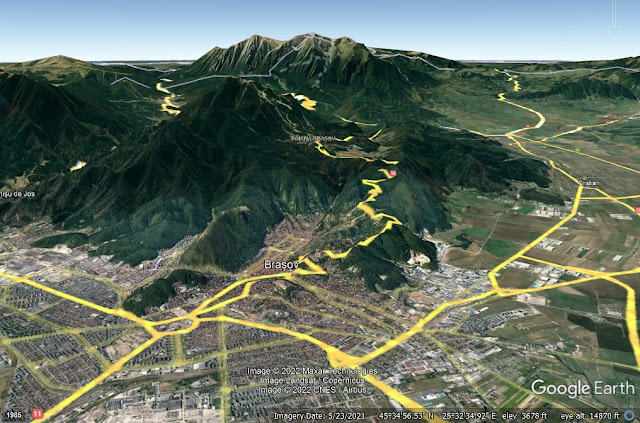
Mt. Omu is a real place.  Using Google Earth Pro, and putting Kronstadt, or Brasov, at the bottom of the screen — and then doubling the elevation exaggeration on Earth Pro — Mt. Omu is the enormous mountain at the back ... and yes, about 14 mi. away.  Some things are the same.


So, as I go along, I use a random generator, I study Earth Pro for the approximate height of local hills, low mountains or high ones, give names to some mountains when I find them, enjoy the map's forward progress as each new 20-mile hex is broken into 6-mile hexes.

The strongest reason I have for building a generator, rather than just sketching things purely from my imagination, is that I worry less.  For example, today the generator made every hex in a group exactly the same.

Here we have 10 contiguous type-4 hexes, each with its country town or village, most of them in the Tarnava valley (the "Tarnava" label needs to be a bit bigger).  The chances of this result was approximately 1 in 56.  I know, because I built the formula.  The hex's base infrastructure was 56.  There are 29 possible combinations, with differing frequencies.

If I were to decide, on a whim, that I'd make every hex a type-4, I'd be asking myself, "Should I have done that?  Is this a good place for it?  Am I making too many type-4 hexes?  Maybe one of those should be a type-5.  I just don't know."

This kind of thinking would haunt me with every decision I made about how important or how dense a given hex is, based on nothing more than my "feelings" ... from a creative standpoint, it's a special kind of hell.  On the whole, raw creativity is fair for something like writing a blog post.  I have a point to make, and each sentence needs to be designed to reach the point desired.  A bad sentence needs adjusting or removal; good sentences suggest the next, and the next after that, getting us where we want to go.

But there are no rights and wrongs with "how much civilisation" does a given hex have.  Which would seem to suggest, "Okay, it doesn't matter."  Unfortunately, an ad hoc approach to these things tends to produce two kinds of results:

Either we're very conservative, carefully choosing the mainstream options because they seem "appropriate" and "consistent" ... producing a very grey field where virtually every part of the map is mostly the same, offering little weird little backwaters and stand-out localities.

Alternately, we go hog wild, making everything strange and unique and "special" ... producing an unreal landscape that's plainly about the designer and not all suitable to the player's imagination.

A carefully tuned generation system, on the other hand, can provide the best of both worlds.  Some areas wind up being randomly consistent, like the Tarnava Valley ... while others are distinctly inconsistent, so that a big city like Kronstadt sits within a mile of a large wilderness without any infrastructure at all.

 
Look at it.  The heavy density of hammers and coins and food suddenly ends with the Busegi Mts., part of the Carpathian Range that swings in a circle through Romania.  A section 54 miles long and 18 miles wide lacks so much as a signpost — and it's here not because I wanted it, but because I'm using the real world as a guideline; and source materials that tell me nothing was here in 1650.  Oh, perhaps I'm wrong about this, the way I was wrong about the Olt River, but I have no evidence to the contrary.  More importantly, I'm using an outside source that is not me to dictate what's here and what isn't.  Therefore I can enjoy the presence of it without feeling responsible, the players can investigate it without suspecting it's anything more than the world being fickle about its geography — and whatever the players find in it, they expect to find because this is D&D and the above is exactly where the monsters are.  Seriously!  You walk 10 miles away from Kronstadt into a temperate mountainous oak and beech forest (Hungarian oak, to be precise, quercus frainetto) and stumble into an owlbear.  Isn't this exactly what you'd expect?

So, the players don't walk into the forest without realising it's bound to have awful things in it.  It's not just a blank part of the map, it's a wild part of the map.  So they prepare.  They're forewarned, so they fore-arm.  Unless they're stupid.  And when I decide what they find, I'm not plunking some module into their path ... I'm thinking, "Okay, we're 10 miles from Kronstadt; there are hunting parties that roam these mountains from Transylvania and from Wallachia; there's a national border dividing Transylvania from the Ottoman Empire controlled Wallachia that runs right through it.  Who or what ought to be here?  What kind of organised, intelligent being would make this place it's home?  Or their home.  A wilderness that has seen the boots of Romans, Goths, Huns, Pechenegs, Cumans, Bulgars ... and lawd knows how many creatures they encountered in the valleys and hollows of this place.  Let me think."

Owlbear.  It's got to be an owlbear.  With a leash and a collar.  And no name tag.

I originally meant to explain the generation method that got us here, but instead I got tied up explaining why there should be a generation method at all.  Realistically, we can't generate everything.  The choice to make it an owlbear wasn't generated; I get that.

But we do all that we can to build a kayak that won't sink and will endure hitting rocks, knowing that when the time comes we'll still have to steer the kayak in a way that keeps it afloat and avoids rocks.  The world's design will only get us so far.  However, it sucks to kayak down a river without a kayak.

I mean that, metaphorically, we generate all we can, and then when that fails us, we take the next step without the generation.  Though the generation won't do everything, doesn't make it useless.  It gets us this far.  And, with experimentation, we might invent another step we can generate that gets us farther.

This is what I mean when I say the map generation is FUN for me.  It doesn't feel like work, because it's so damned cool to see what pops up.  It's almost a video game.

Worldbuilding 5a: Location, Location, Location

I have a post for 4f: Muetar, but for the time being let's skip ahead.  So far in the series, the emphasis has been on comprehending the world's macro-structure ... how geography and political/economic relationships are understood and expanded.  Let's zoom in a bit.

Recently, between writing about worldbuilding I've been involved in my own.  I hope to run D&D sometime in the next couple of months, after a very long hiatus.  We've all had our shots and we're hoping that Omicron is a "turning the corner" moment and not a prelude to something horrible.   Deaths all over Canada are dropping (157 nationwide yesterday) as are cases (7,184) ... so here's hoping that in two months we'll be back to where we were in June last year.

With the expectation of playing, I was able to procure a used table dirt-cheap.  This beauty is 90 inches by 42, is solid as a rock and has something of a medieval like motif on the surface.  I'll be trying to find space to varnish it this summer.  Unfortunately, I haven't any chairs.  We were able to buy a set on order at a fair price (ouch though, a bit), and we've been told it will be a month or two, with the transport back-up and all.  Which is fine.

Until recently, I've concentrated on mapping Norway, as the online party was there.  As things look now, I don't know if I'll ever be able to pick that campaign up again, as it's an enormous time expenditure and I'm working like a very happy dog these days writing.  That, incidentally, is why I've taken to blowing off a little steam about politics lately.  Don't worry, this is always going to be a D&D blog.

So, I've turned my attention to the party's home territory, which I last mapped about eight years ago.  My map-generation system has advanced since then, and so I'm starting an overhaul of the players' domains.  A little retconning, if you will.  This means the appearance of little villages and greater detail than the party's seen previously, plus a heightened inclusion of basic infrastructure.  I'm rather pleased by the results of this, actually, more than I expected to be.

[Yes, that is a framed Airboy poster in the background.  My first wife bought that, actually, in 1986.  Which makes the poster something like 35 years old.  A 12 by 17 inch version costs $35; I found someone selling the original for $225.  I doubt I'll ever sell it].

Without further ado, here's a rough generation of the area surrounding Kronstadt in Transylvania and the player's home territory ... namely, the town of Garalzapan and the surrounding hex.  Each hex of this map is 6.67 mi. in diameter, or about 10.73 km.


The map isn't intended to accurately reflect this part of modern Romania, though it lifts names casually even as this means shifting the actual town several miles from it's Earthly location.  For example, there really are towns named Miclosoara, Venetia and Tarlungen, and these are sort of where they ought to be, but not actually.  After many years of doing this, I'd rather build my own inaccurate but fantastical maps than use modern maps with modern features and modern populations.  I don't care about accuracy.  I care about providing a nifty setting for the players.

There's much going on here, lots of opportunities for adventure, but I'll start with the players' land and talk a little of the party's history.

The party acquired their parcel of land in Transylvania as a granted wish, following a very long campaign in which they returned a befuddled, lost-her-memory Greek Amazon demi-god to her people.  

They were asked where in the world they might want to settle down and "Transylvania" was agreed upon after a long discussion.  This gave them ownership of a piece of land about 2 miles square, but it didn't give them a "title."  That came later.  The party comfortably settled in, having made some enemies in their wanderings around the Caspian Sea, including the very powerful wizard who'd previously held the befuddled Amazon as a slave — and also an unknown enemy acquired by two players individually pulling the same identical card from a Deck of Many Things.  Yep, "enmity between you and a devil."

Now, people can badmouth the Deck all they like.  I haven't used it since that last incident, which was about 2008, but in my experience every time I've used it, players just can't resist.  Looking at the cards, the odds are very against the player — but that doesn't matter, because in gambling, the odds are always against the player.  That's how gambling works.  I've had many a player who refuses to draw; I would probably refuse to draw myself.  However, I've never had a whole party refuse to draw.  Invariably, one or two people decide to draw while the others state their resistance.  Then, as the draws are made, a doubter will suddenly change his or her mind.  Usually, good or bad results notwithstanding, three quarters of the party will usually draw.  The event, done once in a whole long-running campaign, is memorable and rather fun.  I'm always happy to pay out as a DM — though I've never had anyone draw the 50,000 bonus experience card.  I don't see how that would unbalance a game, so I'm fine with it.

So, the party.  They start roaming around, checking out their land ... and find a shrine in the forest about two miles south of their hastily structured settlement — really, not much more than an encampment.  I'm looking around at Romanian mythology and I find reference to "Xalmoxis" — variously with a "Z" or an "S" — that equates the Thracian god with the Celtic Dis Pater ... and whether there is a connection or not, I make the rather obvious leap that the coincidence is brilliantly on the nose.  Thus, the players discover the name of the shrine's patron, find a secret entrance under the shrine, walk right in, poke about, find a portal, and willingly choose to walk through it, having no idea where it goes.  Every player not having the enmity of a devil are refused by the gate; the other two are whisked away to the first level of hell.  There, though mortal, they're imprisoned and tortured.  Don't tell me I don't know how to make D&D fun.

So, the 6th level party rushes about getting knowledge of where they are, obtains some help from two well-connected Transylvanians, a cleric and mage, get boosted to the outskirts of the City of Brass and manage to rescue their friends ... while unfortunately fumbling a +2 spear into the River Lethe, the River of Forgetfulness.  The Druid has not forgotten.

Escaping hell (they were in the suburbs, after all), they make it out onto the surface ... in the frozen waste of the upper Pechora River, as it happened.  I rolled randomly.  It took some effort to get home, during which time the players acquired about a level and a half, growing to 7th-8th level and acquiring a pet mastodon, of all things.  When they got back to their land, after 18 months being away, they found the valley laid waste and their followers huddled in Kronstadt.  A large contingent of goblins, supported by a squad of drow elves, had fortified themselves in the mountains.  The party raised an army, with help from their earlier contacts in the Transylvanian court, and that led to the battle that's been posted in full on this blog.

That battle took something like 9-10 sessions to play out.  Something like 700 combatants took place and we played the whole combat out exactly as we would any other combat, without shortcuts or single rolls for whole units of men.  And yes, this means my personal combat system of stunlocks and full tactical movement.  The party LOVED it.  I gave them several opportunities to simplify the combat if they wished, since I didn't right forcing them to play it all out, and they unanimously refused to reduce the complexity.  The battle ebbed and flowed with spectacular magnificence, complete with moments of unbelievable luck (both good and bad), ingenuity, bravery, sacrifice and yes, player death in some cases.  Two of the dead were not raised, one because they chose to start a new character and the other because the resurrection survival roll failed.

As the party did the deed with the help of a small contingent from the court and a larger contingent from a neighbouring Lord, observations of the party were made and it was decided they were a good group to provide some strength to Transylvanian's eastern border.  The party decided the mage Garalzapan (now 9th level after the treasure boost from the war) was their "leader," so he became "Baron Garalzapan."

The little symbols on the party's hex deserve a little explanation, so here goes.  I've discussed this before, at enormous length, so I'll skip over much of the explanation and only provide an update for where my thinking has brought me so far.

The white "3" means this is a type-3 hex.  The three bread slices indicate that the food raised within the hex will sustain 490 persons yearly.

The two coins represent a production of 210 g.p., from goods and services, meaning that general wealth accumulates by that amount yearly; with a 1% per month wastage, resulting from damaged property, hoarded material and coins that are simply lost, accumulation ceases to increase after 7.92 years ... so that in "liquid" terms, the hex has about 1,663.2 g.p. in circulation (this counts c.p. and s.p. also).  With a typical medieval velocity of 3, the transactional value of this money is 4,989.6 g.p.  An estimated 2% of this capital flows through the player's hands each month, in taxes or in services, or 99.792 g.p. per month.

Folks can quibble about the logic of this, but it's a fantasy game and I don't care.  It's a satisfactory number and it works as a system.  So pfffffffft!

Now, "hammers" have always been a problem, but at last I have a solution for these.  They represent a series of thresholds for the presence of various physical forms of infrastructure.  Without digging into it too obsessively just now, 3 hammer symbols indicate 7 "hammers," which indicates that within the hex there's a windmill (if there were a river it would be a watermill), a well large enough for a village, sign posts, a public storehouse, a bakery, a way station (like a protected walled campground), a sawpit where wood can be purchased, a local shrine (not the one to Xalmoxis), a stone quarry, some mining, a stone gatehouse, a barracks with posted soldiers, a chapel, a gallows and a carter post (from which goods are regularly transported to Kronstadt for a fee).  Some of these things were built by the players but if not them, then private citizens have added these features.

I'm tweaking a system that allows bigger settlements, like Kronstadt or Sankt Georgen (note the specialised black town symbol as opposed to the brown one for country towns and villages) to count the hammers of surrounding hexes, enabling big centers to accumulate infrastructure like regular festivals and fairs, castles, theatres, bath houses, courthouses, arsenals, bardic colleges, hospitals, auction houses, observatories, banks, cathedrals and more.  Such a system would allow me to glance at the number of hammers on the map and know immediately whether a particular settlement had an inn, a monastery, a garrison, a money lender and so on ... dictated by the place's location in relation to other large built-up hexes, not just its own.  Thus, where the population is really dense, even an opera house is a possibility.  My game does take place in the 17th century.

Okay, we're going to talk more on this map, but this is enough of an introduction for now.  I'll expand the map a little more and we'll get down to players moving through the setting it represents.


Friday, February 4, 2022

Worldbuilding 4e: Immer

This is a good time to talk about resources and distribution.  If we're designing a fantasy world, and we care about such things, its good to know from where comes the gold, the iron, the building stone and the gems in our world ... if only because these things give different parts of the world a different character.  Anyone whose read sufficient history or played logistic world-based combat games knows that it matters which countries have iron and which are filled with horses.  It's fairly obvious which countries will produce the most fish, and probably the most wheat and rice ... but what about wine, incense, furs, silk and so on?  If we want prices for these things that will be familiar to earth-dwelling players, we'll want to manage the distribution for these things carefully.

I solved this problem by running the real world, then using real world production references to decide where things come from.  A fantasy world makes this much harder, particularly if the creator has next-to-no knowledge of geology, agriculture, biology, engineering or chemistry.  For example, in a medieval fantasy world, where does acid come from?  Is it hard to make?  What are the base materials?  Are those expensive?  How much acid can be "brewed" at one time and in what sort of containers?  Yes, glass probably, but how common is glassblowing in your game world?

The tendency of most equipment lists from various games and editions is to assume these things are, well, everywhere and convenient, so that shopping for items in the D&D world is like going to the local Walmart.  Nothing is ever scarce and while some things are more expensive, they're not prohibitively expensive for a well-funded player party.  But does this really make sense?  Was it as easy, in the 12th or 15th centuries, to buy, say, a 10 ft. pole in Egypt as it was in England?  How about in India?  Or Siberia?  And what would the pole be made of?  How easy is it to make a pole from a pine tree, as compared to an oak.  I live on a prairie; not a lot of oaks around here, but there are lots of poplar trees ... which, without treating, a sticky when split.  Do we want a 10 ft. pole made of poplar?

These things seem quibbling, but they make the difference between the players always having their way and the players being faced with inconvenience — which knocks them out of their comfort zones and forces them to find new ways of doing things.  Having to do without; having to "make do" with things they have ... these things build character and resolve.  They also reveal weak players in a group — those who can't keep from whining and moaning they can't have everything the way they want.

With this mini-series, I've stressed the importance of how addressing the setting's problems builds a campaign's trajectory.  Cleaning out a dungeon is one means; restoring a wrecked town, or building a settlement in the wilderness, or constructing a fort along a frontier are other ways the players can easily settle into an area and become good neighbours ... with the commensurate relationships that builds with the locals.  Providing reliable, practical goods and services is yet another example of this.  If an area has no mill for the farmers, then building a mill and running it makes friends.  It gets positive attention from the local lord.  It's a foundation to build upon, enabling the player's to receive commendations, status and ultimately the recognition that allows them to be promoted into the noble class.  We don't just start a mustard farm for the money.  We also do it because breaking the spine of the local corrupt mustard guild gives us the appearance of being good citizens — even if we're as corrupt as the guild we're replacing.

None of this solves the problem of where to put the resources.  It's a difficult problem with difficult solutions.   Occasionally, however, someone on the internet does some of the ground work.  Looking around, I came across this page, which my readers should find useful ... though it does require the DM to understand the location of things like volcanic plate boundaries, old vs. new mountain chains, the location of dried-up ancient seas, ocean currents and geological formations in general.  More of those "systems" I've stressed since the beginning of this series.  Without some base logic, the creator might as well roll randomly for things to occur ... which always creates a grey, continuous sludge of egalitarian distribution where anything is concerned.  Interest is built from discontinuity ... and using hundreds or thousands of die rolls only creates sameness, everywhere.

Okay, that said, let's look at Immer, within the whole of Minaria.

Immer's problems are different from those we've seen before.  The environment is quite different from that of Elfland, making it unattractive to the elves, while in turn Elfland is somewhat unattractive to Immer.  As I said before, Immer has no deep need to plunder wood from the forest, as it has no intense shipbuilding industry.

Immer's climate is continental and bleak ... more like the bald, northern steppe of Russia, or Canada's Alberta.  Earth for insulation and stone to contain heat and cut the wind are superior to wooden construction.  Fuels are peat, knotted wood and animal oils ... and large animals like caribou and moose will be common.  The land isn't forested, but would be up-and-down, with willows and buffalo brush in the low places.

Raw materials would likely drive the economy.  Lone Wirzor is 40 miles from the River Rapid, so that goods from there would be shipped in summer months down to Elfland; in winter, the river would freeze.  Castle Altarr has good access to The Invisible School of Thaumaturgy, with one corner of the Well of Lered poking into the Forest of Lurking and making a good transshipment point for goods headed towards Hothior.  Muscaster has good access to Lake Carth in Muetar ... and this last would probably be the strongest path for the import of foodstuffs and valuables into Immer.  Thus many of Immer's problems involve keeping these trade routes viable, ensuring imported food, and maintaining its very dangerous border with Zorn, the goblin kingdom to the east.

Zorn is, of course, another post ... but it's presence is an intrinsic part of Immer's make-up.  Withdrawn behind an impenetrable knot of mountains, it's practically impossible to conquer; even if the surface population could be eradicated, there are likely thousands of sub-surface communities, any of which could breed and reproduce the population of Zorn in a few generations.  Immer relies intrinsically upon a strong Muetar to maintain its frontier against Zorn; and Muetar relies as much upon Immer.  So long as Immer is strong, the balance between Immer and Zorn is more-or-less equal.  If the dam created by The Gap Castle and the fortified Choked in Snow Pass ever breaks, Muetar can come to Immer's rescue ... and Elfland too, in very desperate times, as Elfland surely does not want Immer utterly overrun with goblins.

As long as Immer is strong, Elfland can remain secure in its isolation, while Muetar can turn its attention to its real enemy: Hothior, which it must trade through in order to reach the greater community beyond the Sea of Drowning Men.  Immer, then, is everyone's friend.  They rely upon Immer's raw materials and unique goods, such as the quality woodwork produced by the Gorpin Woodsmen.  And because Immer is always at war with Zorn, the monarchy no doubt has a long history of military training and ideology.  Every young person in Immer knows the day will come when they will perform their time in Choked in Snow Pass; and every old one can recall their days in that place.  Mercenaries from Immer are stoic, ordered and made of iron.  Likely, tales of Immerian soldiers are told throughout Minaria ... in part, because not too many of their kind are seen.

Players in Immer may try their hand at eradicating goblin subterranean habitations in the western Nithmere Mountains, where Immer has authority.  They might foray into Zorn, preferably without starting a war.   They might extend Immer's influence further along the River Rapid, or deeper in the Wild Reaches, or the Frosted Downs west of Lone Wirzor.  They might bring valuables from elsewhere to Immer, where they are always appreciated.  A whole set of adventures could revolve around the School of Thaumaturgy's plans to strengthen Zorn, in order to bring down the Immerian Monarchy and establish themselves as rulers in Altarr.  I could make two years' of runnings on that, starting with hints and suggestions for a few weeks ... then the accumulation of proof through pinpoint adventures ... the difficult exposure of the School to the Monarch of Immer and the general public ... and then a series of events as the knowledge rocked the world, setting up the School's "Defenestration."  Oh yeah, I could make that campaign memorable.

A DM has to look at a piece of ground and see how it influences the thinking of the people there.  How do the people in the Lowlands, in Immer's southwest, view the School?  Negatively, in fear, or positively, because the School is occasionally generous and supportive in bad times?  How do these people view the monarchy in Castle Altarr, as opposed to the people living on the Frosted Downs?  How to the people of Muscaster view others from Lone Wirzor or Altarr?  How does Muscaster view Muetar?  As an entity to be exploited, or as a culture that they emulate?

Sorry for all these questions, but these are the things we must ask ourselves as we design the game world.  We need to know how each group thinks ... and devise interesting, individualistic perspectives for each place, for the players to run into and contend with.  We don't just want to make everywhere a xenophobic nightmare, or a super-effusive friendly honey trap designed to lure players to their death.  We want meaningful, believable characteristics, which together form a tapestry within the kingdom as well as outside it.  The monarchs of Immer must then make peace between its parts, ensuring that those of Gorpin and those from Muscaster can stand shoulder to shoulder for months in Choked in Snow Pass — which can't possibly be a pleasant place — without seeing each other as the enemy.  From what do we build solidarity, and what characteristics bar that solidarity?  These are two facets of world-making that challenges us.  We have to create the discontinuities ... and then solve those discontinuities, at least to some degree.

That's how we make the setting three-dimensional.

Tuesday, February 1, 2022

At Least Visit and Look Around

Today I got my booster shot.  My second shot was back on July 15th; for this one I was good to go just before Christmas, but as I am housebound most of the time, I waited until I could make an appointment with the nearby Safeway.  By my count, I left my home just six times in January: twice to the dentist, once to an electronics store and three times to shop for groceries.  This doesn't count taking the garbage out to the alley.

Getting the shot consists of making an appointment with any pharmacy of one's choosing.  ANY.  This takes about 5 minutes.  Then, arriving 5 minutes before the appointment.  Then, filling out about 2 minutes of paperwork: name, phone, health care number, someone to contact in case something goes wrong, checkboxes for possible complications, sign name.

The shot itself takes two minutes as the nurse goes over the checkboxes again.  It's friendly.  Not businesslike at all, and not pressured for time.  Others are waiting, but everyone is scheduled for five minute increments.  They want to know anything that might matter for the pandemic, so they ask if the job puts us in risk of associating with others who might have covid, are we self-confining, etcetera.  The shot takes 90 seconds and all is done.  There's no cost.  It's Canada's health care system.  There's never any cost.

I had just enough time to mention that my friend in America is certain that free healthcare will go belly up before 2040.  Much jocularity ensued, from the nurse, from the other two nearby pharmacy staffmembers, from the next patient.  We've heard it before.  Most of the joking is very sarcastic.  Most Canadian humour is either sarcastic or very, very dry.

Favourite Canadian joke?  How do you get forty Canadians out of a swimming pool?

You say, "Could everyone please get out of the swimming pool."

Americans don't get this joke.  Canadians usually laugh.  The joke is based on the simple fact that you don't have to be an authority to do the asking.  You could do it, I could do it.  They'll shrug, assume there's a good reason, and get out.

It's the way we are.

I feel very badly that Americans don't have a free healthcare system.  Most Canadians do.  I'm equally sure that most Norwegians, Danes, Finns, South Koreans, Germans and Cubans feel badly also.  I don't know how Americans put up with it.  All I can say is, if you want to live longer, and you have practical skills, move to Canada.  Do it because you'll live longer here.  You'll have more money in your pocket.  In general, you'll feel better about the government you live under.

But don't tell me what I have is going to go away because, oh, someone says it will.  Or because the Brits haven't got their system built better.  Or some crap about wait times.  Between Tamara and I, with her being an American and coming close to losing her sight two years ago, we've been to hospitals and clinics about 40 times.  She's had 4 operations, all for her eyes.  Longest wait we've had has been 5 hours.  Most waits are between 90 and 120 minutes.  We have paid zero money.  Judging from the American system, a five hour wait in Canada means I'm saving something like $800 an hour.

Thank you.  I'm happy to wait.  The chairs are comfortable, I can watch a movie or two on my phone, the staff bends over backwards to help and no one ever denies a treatment, an x-ray or a cat-scan because it's too expensive.  I had a cat-scan for my infected finger, two years ago, to look into the bone.  Spent 20 minutes in the most uncomfortable position imaginable.  Was free.

Got skills?  Come to Canada.  We've got room.  There's jobs here.  We like people with skills.

If you don't have skills, go get some.  We'll still be here.

Worldbuilding 4d: Elfland

And today we're back to climate.  Looking at the whole map of Minaria a moment (and we'll post it here today), there's a tendency for the non-geographical viewpoint to see much of it as having a temperate climate.


Plainly, Shucassam is deemed to have a desert climate ... but what kind of desert climate, exactly?  The Sahara?  Arabia?  Upper Nevada?  Which?  And keep in mind that the Syrian Desert has the same latitude as North Carolina, while Mecca is just slightly north of the latitude occupied by Cuba.  This is quite a difference, though most westerners tend to view it all as one desert.

In the earlier post about Mivior, I defined each hex as 40 miles across.  Suppose that we give Colist, in Mivior, a latitude equal to that of Washington D.C., about the same as Seville in Spain, Athens Greece or Beijing.  Funny, isn't it, that we would assume that Spain and Greece were way south of Washington, but that's only a perception built up by travel posters.  This makes Addat about 360 miles north of Colist ... about the same latitude as Toronto, or Marseille.  Compare this climate and year round weather chart for Washington ...


... with Toronto:


Now, obviously neither of these are commensurate with Colist and Addat; they're on the wrong side of the continent, and Washington is very close to the Atlantic (thus all the "mugginess") while Toronto is not ... but for this example I'm concentrating on a straight line from south to north.  My point is only that there is plainly a difference, and that there would be from north to south Mivior.  Colist is out there on the end of a Peninsula, protected by the Mountains and surrounded by the sea.  Addat is on the sea, but it's exposed to the continental cold weather rolling south from Elfland.  These differences would alter the tempo of living from one place to the other.  We need to be conscious of this.

Consider Elfland, then.  On the surface, it appears homogenous.  In D&D terms, we tend to look at the forest as "all the same," with little change from the north to the south.  Even a little boring; when DMing the setting, it's hard to give personality to any of the hexes, except in their relative distance from Ider Bolis.  In this, knowing the climate can help.

The southern border is just 100 miles north of Addat ... not even as far north of Addat as Ottawa is north of Toronto (about 133 mi.).  Ottawa, however, is not on a Great Lake, like Toronto.  Even over that short distance, Ottawa is more continental than Toronto ... as is the southern area of Elfland that's called "Neuth."

Ottawa is a mere hundred miles from Lake Ontario, but the difference is still distinct, even over that little a distance, as shown by the chart below:


Note how over the little distance, precipitation is markedly up, while freezing begins much earlier in the winter and departs somewhat later.  And also how the "warm" period in summer lasts longer than it does in Toronto.  That has everything to do with the continent heating up and the seasonal barometric high that forms over Canada.

The northern edge of Elfland is about 360 miles north of the southern edge.  In relationship to Ottawa, this is distinctly Low Northern Ontario and Quebec ... I don't have a lot of choices for comparison for this country, but Moosenee in Ontario is about 385 miles north of Ottawa.  Compare it to the above.


It is much, much colder.  It never gets "warm."  Moosenee is on the shore of James Bay, part of Hudson Bay, thus is manages to be overcast despite being in the heart of the Canadian High.  And not a lot of people live there.

This helps us draw some distinctions between one part of Elfland and another, though in all it doesn't seem like a very big place.  There are those who live in Ider Bolis; those who live upon the lake Melting Star; and those who live in that clump of muskeg swamp and islands north of the lake.  The river north of the muskeg is called the "River Rapid" and comes from northern Immer.  The other river, from Aws Noir and the "Spires of the Eternal" has no name ... but we can assume it's frozen solid for six months of the year, perhaps more.  The River Rapid would also freeze through the winter, from November to April.  Neuth is much warmer than most of Elfland, and there's trade from the Melting Star to Addat, which we covered in the Mivior post.  Knowing the climate greatly helps provide different parts of the region with personality.

As a political entity, Elfland is on the fringes.  The game Divine Right decided to split the Dwarven peoples, placing them on two sides of the board ... with Rosengg and Alzak in the far east, beyond Pon, and Aws Noir in the west, cheek and jowl with Elfland.  In human history, similar ethnic groups like this may share some cultural associations with one another, but it's highly unlikely they'd be governed by the same principles.  The problems of Aws Noir and the other dwarves are very different.  Aws Noir is totally isolated.  By climate, even more so.  The mountainous spires would be colder still, and in real terms practically unapproachable by an army.  The same can be said of Ider Bolis.  While the game of Divine Right might enable a player to conquer this region, by any comparison with Earthly geography, it would be much harder than Moscow.  Moscow does not have a huge lake guarding its back door, or an immense muskeg swamp protecting its flank ... as well as "the Mires of the Sinking Kind."

But it fits with recognisable D&D that the elves — eternally a group of self-righteous pricks — would be inaccessible.  I did much the same with my own world, assigning Murmansk to the elves and assuming they'd have transformed it by magic and engineering into a frozen paradise.  Murmansk is one of those places that in the last 500 years has never seen a shot fired in anger.  Calgary also, for that matter.

Thing about Elfland, however, is that while they may have less troubles, they're also somewhat unimportant in the grand scheme of things.  Occasionally, yes, they must fight with Trollwood and the border with Immer is never quite "friendly" ... but Immer has no great crying need for timber because it has no shipbuilding industry.  It has its own wood.  Nor does it have any reason to expect a practical expansion of settlement into the cold, northern Ontario-like woods of east Elfland, any more than Canadians are dying to live along highway 113 in Quebec or highway 11 in Ontario.  These places may have some mineral wealth, but it takes 20th century technology to find it and dig it out, so who cares?

Likewise, a great elf army can hardly pour out of Elfland with expectation of conquest.  The Breaking and the Wetlands to the south are presumably devoid of much food, not to mention cold like northern Wisconsin, while Immer is a cold, wasted land like Manitoba, Saskatchewan and North Dakota.  By the time an elven army had taken Lone Wirzor and sieged Castle Altarr, a combined army of at least two additional monarchies — say, Muetar and Mivior — would be intervening, with the support of the School of Thaumaturgy.  And the Elven flank would be exposed to Trollwood besides.

Thus, they are nicely boxed in, with their one city, their smug superiority and the small trading opportunities their inland status allows.  Political entities without access to the sea tend to become inward looking, particularly those on the fringes of civilisation.  But my feeling is that the elves like it out there.

Once upon a time I owned a copy of Divine Right, but it's long since been lost; many of the details are lost to my imagination, and I cannot find explanations online.  Places like the Mires or "Stump Hole" were starting places for mercenary units.   Undead could be raised on battlefields like "The Unknown Army."  Places like "Sacred Stones" were locations where a king unit could move in the hopes of getting a boon that would give more units, special items or other benefits.

In D&D terms, sprinkling the game world with such places helps provide a sense of adventure for the party.  Stump Hole might be a hard to find, relatively unknown lair for a large humanoid like an ogre or giant ... or it might be a tremendous, defensible rock formation with a community of ogres, too large for a small elven army to defeat, yet remote enough to ignore.  Perhaps it has been entered and "cleaned out" ... and yet the party learns that nonetheless, a new family of 8-10 ogres has settled in and the elves don't know about it yet.

The place Sacred Stones occurs in the "Wild Reaches," a barbarian land so far to the north as to be tundra ... yet it might be a marker for a pathway to some "off-continent" region ... perhaps a land bridge to another entire continent, like journeying through a more southern Alaska into a more southern kind of Siberia.

Battlefields provide context for past political events between Immer and Elfland.  The "unknown" army might have been a third player in a battle that involved existing states; or a fight that took place so long ago that no one's sure who fought there.  Such places are more than a source for undead — a source so large that it can never be truly cleaned up; they are also a source for giving the players knowledge and ideas for future adventures.  Getting to the ancient battlefield is an adventure in itself.  Meeting whatever lives there, who might bar their way, what ancient thing might be learned ... mixed with some possible battles between the party and whatever occupies the place ... makes a good six-month campaign, provided the knowledge is interesting and leads to the next thing.

Placing markers like this provide more than "plunked-in modules."  The subtle characteristics of each place can pull the game setting together in interesting ways, by providing threads between multiple places that paint a larger picture than the existing political situation.  Think of it like a series of ancient Schools of Thaumaturgy, that each — once upon a time — had their hand in many pies, fixing and influencing events in their time.  While recognising that some of these places may be new entities, trying to build what the School has, which they've only started to do.

Monday, January 31, 2022

Grab-ass

In a total disconnect with previous topics, recently a friend in the U.S. sent me this video about a young fellow who sets up cameras to catch a local thief.  Essentially, this takes place in rural America; the thief is a local farmer who fails to catch a third camera set up by the video maker ... so we get film of the thief painting over the other two cameras, the thief's car and the stolen goods in the back of the thief's car.  Then the video maker tracks the thief to his home, calls the local sheriff, who goes in and confronts the thief, and what ensues.

This is supposed to be a terrific example of justice being done; but the video infuriated the hell out of me.  The maker is clever and all, and he gets compensation ... but the utterly grab-ass approach to justice strikes me as one of the stupidest things about America.

Why is the video maker responsible for catching the fellow?  Why does the video maker think it's his responsibility to chase down the thief?  And why is the video maker even present when the confrontation goes down?  Why would the sheriff even enter the thief's residence without first examining the evidence in TOTO, getting a warrant, and THEN go in and search the place.  They shouldn't need to confront the accused thief.  The agenda should be to get evidence and charge the thief, period.  Perhaps for a dozen crimes the thief has committed, and not just towards the video maker.  Oh, sure, the video maker got his compensation, but what about everyone else?  How the fuck is this a law-abiding country?

In CANADA, I go to the RCMP.  I tell them someone in the neighbourhood is repeatedly robbing me.  THEY set up cameras.  THEY look at the evidence.  Then they enter the thief's residence and, if there's stolen goods there, THEY charge the thief.  "The Crown" does.  I'm not asked to bring charges, or even given the opportunity not to bring charges, because the LAW has been broken.  When the law is broken, people get arrested.  A common citizen's opinion about the law is not asked for.

Seeing Americans crow about how they achieve "justice" ... sickens me.  Daily, I read a blog called electoral-vote.com.  Day after day, I read a systematic accounting of people deliberately breaking laws in America, specifically through incompetence, graft, malfeisance, misappropriation of funds and just plain stupidity.  This parade of shit has been going on six years now.  It is only broken ONE DAY a year.  July 4th.  That's the day when everyone talks about What a Great Country America Is.

Friday, an old bridge in Pittsburgh collapsed, the Fern Hollow Bridge.  It was identified as ready to collapse 10 years ago.  No one will be held accountable, even though obviously every authority in the United States, including every municipal leader, state senate and congress person, governor and national political figure for the last TWENTY years is plainly responsible.  But no "law" has been broken.  So, no consequences will befall anyone.  Not for this collapsed bridge or the hundreds of other infrastructure buildings in America.  And the thousands who will be injured and killed in the future.

No civilised country acts this way, or defends this sort of thing.  One would think that what Americans might try next July 4th is to hang their fucking heads in shame.

Bravery, Adventure, Method

Many eons ago I wrote two posts about how to tackle a dungeon, which I meant to be a series but which I never completed.  I got into some back-and-forth with Mujadaddy which I didn't handle well and I lost interest.

In part, this comes from having had a DM's perspective for so long.  I haven't run in any campaign consistently since the mid-1980s.  Experiences with 4th edition and 5th weren't especially pleasant and I found myself facing the same old tiresome tropes that had been there three decades before.  When I look at a dungeon today, I necessarily see it from the DM's perspective; my concern for the players is that they find it interesting, that there's a base level of uncertainty and tension, and that there's exactly enough treasure to whet their appetites but not so much that they progress levels too quickly.

Two sojourns into a dungeon should be sufficient to push a low-level character, less than 5th, up a level.  That assumes they dig in, get into a fight, hold their ground long enough to take and give damage, then beat a healthy retreat.  For me, it's about bravery, not chutzpah.  

I've never taken the position that "reason" — a methodical approach to playing D&D — kills adventure.  I grew up digesting tales of Robert Scott and Shackleton in the Antarctic, Mungo Park and Livingston in Africa, Marco Polo and so on ... and found tales of these real people managing extreme difficulty and danger in a practical manner to be endlessly fascinating.  Jules Verne invented fantasy tales filled with mechanical and well ordered approaches to adventure themes that excited me as a child.  I read and re-red Robinson Crusoe and other tales of lost persons in the wild for the ways they solved problems and extricated themselves from death.

On the other hand, I found Gulliver's Travels and Baron Munchausen to be plodding and dull — and as I grew into adulthood, I recognized that these things were written as political allegories, and NOT as "adventures."  Somehow, they never captured my imagination.  Being very tiny in a very large world was handled much better in Asimov's The Fantastic Voyage, for my money, because it was about concrete science and not fairy tale.

Coming at D&D in 1979, there was no game community to argue most of the points that Mujadaddy made in that back-and-forth.  Ideas like "supernatural malevolence" dominating a landscape, "red shirts" as a metaphor, "tomb robbers," the players are "special," or that "games exist for the players" had no infringement on my DMing or on those who DM'd me.  Hard as it might be to believe, these things came along after D&D players began to form clubs and impose their philosophy on a growing community.

Ernest Shackleton went into the bowels of the worst place on earth and got stranded there with perfectly ordinary seamen, whose only chance to survive was the equipment they bought, their ability to sail and their sheer tenacity.  Generations of those same soldiers undertook battles where they would load and fire and sail amidst volleys of cannonballs fired point blank into the ships they manned.  Yet I'm to believe that men like this won't enter a forest because there might be an owlbear in it.  I'm to believe they won't defend their country because of unseen malignant spirits.  Or that person who are essentially underground thieves are definitively "braver" because meta-game D&D concepts remove honour, duty and resolve from anybody with less than 25 hit points.

I grant that player characters are "unusual."  In my game, they have more training, more equipment, more abilities ... and yes, they have more hit points.  But I also believe that, just as it was with the "British Grenadiers," ordinary folk also have little to lose, a love of money and a willingness to trade the former for the latter.  Otherwise, how is it that so many perfectly ordinary folk were willing to cross one or more continents for the sake of a gold strike?  Was that a lack of bravery?  Was that because they had so many hit points?

Anyway, this post tries to tackle too many themes.  I should come back another day and manage them better.

Sessions & Adventures

Over at B/X Blackrazor you'll find JB putting together a highly competent dissection of the term "adventure" with regards to role-playing.

I have, over the years, tended to view "adventures" within the campaign in a similar manner that a military strategist views an "operation."  Operations are coordinated military actions in response to a developing situation.  For example, the Battle of Kursk involved a plan by the Germans to cut off a salient of the Russian Army with a pincer movement, called "Operation Citadel."  The Russians made their own plans; there were many separate engagements, each of which took its part in the greater whole.  The Russians won the overall battle, the Germans lost badly, and the campaign afterwards continued as the Germans withdrew and the Russians pursued.

In the same sense, the players decide upon an "operation" of entering a dungeon, clearing it out and obtaining the wealth therein, while increasing their control over the territory the dungeon occupies.  The players can view this operation as merely an opportunity to plunder, or they can build upon the dungeon's eradication, in the manner of a campaign, by moving in, occupying the dungeon, or the surface above the dungeon, and fortifying the space.

The actual assault on the dungeon is the "adventure."  But the adventure is just one part of the overall campaign.  During the life of the players, they will embark on many adventures ... but so long as they are running the same character party, they are participating in only one campaign.

JB makes a solid argument that in the text supplied by AD&D, and supported by Tom Moldvay, that "adventure" is merely a colloquialism for "game session."  This maybe; from the evidence, it looks that that was intended.  But here we are, 40 years later, and I don't need another word for "game session."  When I want to refer to a "session," I use that word.  A "session" is a single period of time in which the game functions, whether or not every time we sit down we are experiencing fantasy "adventure."

Occasionally, as complexities and details build up, a "session" may be a long period of players asking questions, so they're able to consider what things they'd like to do in the future.  That is, what sort of operations they may want to run.  The next session I'll run, after about nine months since our last session, will involve bringing players up to date with changes I've made to the wiki about character classes, sage abilities and spells, since I've written a lot of new rules about those things.

I recognise that some people, hearing this, are shaking their heads.  "Gawd, a whole session of accounting?  Uck."  That may be, but the players call for these, not me, as they want answers to questions they've been thinking about a long time.  And face to face with me, and the other players, is the best time to ask such questions, when everyone can participate in the discussion.

Thus, for Gygax's day, a "session" and an "adventure" might be the same thing.  But they're not for me.  It's a fine point, maybe.  But today is the day for fine points.

A Purposeless Essay to Pad the Hatred of My Detractors

Earlier today I got a comment from Calstaff, a new reader I believe.  And I jumped down his throat, because he reiterated the same old tiresome trope from Gygax that I've heard too many times.  Calstaff, of course, has no idea that I've written fifty or sixty posts blasting the argument being made.

This isn't going to be one of those.

Impatience is a natural part of me.  I've struggled with it in various ways, and occasionally it's made things difficult for me with former employers and sometimes friends.  My partner Tamara tolerates it, my daughter tolerates it ... and so do most of my friends.  A lot of my readers here have come to expect it from me, and no longer worry about it.  They write it off as passion, which it is.  Some probably also write it off as the typical tempestuous fury that creative types tend to have.  And some of my most reliable readers, no doubt, act exactly like me.

For a long time with this blog, I worried about burning potential new readers like Calstaff.  I'm worrying about that less and less these days.  Perhaps because I'm getting old.  Perhaps because I've never felt this overall creative.  Pretty much, from when I first get up in the morning, I'm working on the creation of something new ... usually for five or more hours a day.  Because of that, I'm feeling a tremendous indifference towards rehashing old ideas, and especially hearing someone post them as if those ideas are new and profound.

Poor Calstaff.  The post's argument was that immersion begins with staying alive.  And from Calstaff I got the answer that what matters is "acting out your character."  Approaching the game this way plainly has the player put his or her character BETWEEN his or her self and the DM.  But I'm not running the character.  I'm running the player.  The character is incidental.

This should be obvious.  Somehow, it isn't.  I don't know why it isn't.  And that is the source of my impatience.  Like a mad professor trying to give a class, to educate those students who will go on with the material and do important things, I'm infuriated by the dolts in the class with their impertinent, idiotic questions — who are, after all, just there for the credit.  And, like a mad professor, I shout at them to shut up and learn, or get the hell out.

After all, it's plain from Calstaff's bio that, having played D&D since the 70s, and still believing the DMG is one of his favourite books, that he hasn't a chance in hell of getting better than a "D" in this course.  I really haven't got the time to waste on him.

Agder Redone

Once again I find myself messing around with colour schemes for my 6-mile hex maps.  Most maps on this wiki have 20-mile hexes, but I also build maps that "zoom in."  Recently on my wiki, I posted such a map of Agder, a county in southern Norway.   I wasn't especially pleased with how it looked on the wiki, so I spent some time making adjustments to the icons and the general appearance.  The result is this:


The above includes Agder and a larger area surrounding it; opening the image in its own window should provide a clear detailed picture, as I saved this in 300 dpi.

I'm still not sure.  The mountain repetition looks a bit processed, but then there's nothing necessarily wrong with that.  I do like the colour scheme for the larger, more important cities; they're in shades of brown.  But overall, I'm posting this to make the point — outside the series I'm writing — often demands a new look at old work.  It's not a straight line.  This is, I think, my fourth version of a 6-mile hex map, and still I'm looking at it and wanting to change the border colour.

At least, it doesn't look heavy-handed.  With maps, I find, muted variations often look better than primary colours.

Anyway, no, there's no key to the above as yet.  White country is pure mountain rock with little vegetation, the bluish-purple is shield country, interspersed with stunted and very thin pine trees, while the various greens indicate semi-arable and arable lands.  Darker colours are more populated and possess more activity (hammers), wealth (coins) and farming (bread).

Saturday, January 29, 2022

Recognisable D&D

Rule #1 of achieving immersion is not wanting to die.

Give that a moment to sink in.  I haven't said "in the game" yet.  That's because immersing oneself in life requires the same desire to NOT DIE.  That is, not behaving like this:


Long ago, I recognised that some players treated D&D exactly like the above.  Is what I'm doing cool?  Check.  Is it unexpected and provocative?  Check.  Will it put me one roll from death, with a half-way decent chance of survival, if I make the roll?  Check.  Gawd yes, let me do it.

Because game death only matters when the player cares, then there's no reason not to do the above.  Maybe my present character will die, and maybe the next one will ... but when the one after that makes the roll for whatever dumbfuck crazy-ass shit I've done, then I will be a GOD.  Worth it.

More than once, when a player's character died through the player's decision to perform such a stunt, I denied them the privilege of rolling up another character.  "Basically, that's it.  You've had your character.  You're dead.  And there's the door."

All things considered, drawing a hard line on a self-centered player is definitely a better feeling than lucking out at a whack die roll.  The reader can take my word on that.  But then, a lot of readers have stopped reading about sixteen words again, because what I just said is unacceptable.  Players, so it goes, should not be held to account for the way they play their characters, because they are in their perfect rights to play their character any way they want.

"Recognisable D&D" is an extremely fuzzy, subjective ideal.  Using the example of The Keep on the Borderlands, players are expected to tromp out to the Caves of Chaos, kill as many creatures as they can, grab treasure, retreat when hit points get low, heal up ... and go out again.  Each time, the characters who don't die are meant to climb up levels so they can steadily manage the whole thing — thus being entertained by all the clever little bits as they go along.

Suppose we don't do it this way.  Suppose, instead, we go once, grab a handful of gold, then leave the keep and head back to civilised parts.  There, we show a bunch of mercenaries all the gold we found, telling them we "Got it in a single day!"  If they come along with us, we'll give this gold we have now and help them get more.

Whereupon, in recognisable D&D, the DM already feels we're not getting with the "spirit of the thing" — that is, playing how we're supposed to play — and arbitrarily blocks us from raising a small army with the hundreds of gold we have.  So there's an argument, and we say we only want thirty persons, and it goes round and round ... but the DM eventually relents and we get our men and march back to the Keep.

Now, the DM assumes we're going to take our mass directly into the Caves ... and, if "recognisable D&D" means anything, the DM's starting to multiply the number of orcs, goblins and kobalds we'll encounter.  But we tell the DM, "No, we're not going to the Caves yet.  Instead, we build a fort about 1000 yards from the Cave entrance."

"Wait, wait, wait," says the DM, who doesn't know what we're doing, but it's definitely NOT recognisable D&D, so it absolutely cannot be allowed.  Remember that thing above, with someone saying that the way players choose to play their characters, yada yada, sacred blah blah blah?  That only applies if YOU DON'T USE YOUR BRAIN.  If you use your gawd-given human brain to circumvent the DM's expectations, or the expectations of the module maker, then you've broken the covenant and now you're fair game.  You're not allowed to build your own fort; you're not allowed to lure orcs and goblins out of their caves so that you can slaughter them with your own traps and fortifications.

If you try to build your own fort, the denizens of the cave will definitely come and attack you before you're finished, even though they have zero reason to suspect anything's happening, and they never choose to do so against the keep.  If you get your fortification built, the denizens will definitely NOT leave their caves, even though there's no logical reason why they would let interlopers casually start bonfires in their cave entrances, which are right there, ready to be seen.  Frankly, the FIRST thing anyone should do when seeing the caves is to burn everything on the surface forthwith ... as this will reveal every cave entrance and potentially suffocate the denizens with the upstairs fire sucks out all their oxygen.

But again ... this isn't recognisable D&D.

We often hear it said that D&D isn't about "winning" and "losing."  And in a traditional sense, the sense that's usually meant, no, it's not.  But so long as my character is alive and getting stronger, for my money, I'm happy; and when my character dies, whatever the reason, I'm unhappy.  I can usually see that the reason I died was because I failed to prepare enough.  If only I'd thought to bring along another three archers; or another half-dozen bottles of oil.  If only I'd approached more patiently, giving the flankers more time to get into place.  If only I hadn't used the fireball so early in the fight.  Because I think surviving D&D is about planning.  It's not about following the DM's lead.  Or acting as the DM expects.

Anytime I can move contrary to the DM's expectation, I greatly increase my chance of survival.  I had plenty of chances to experiment with this in the 80s ... and I got awfully tired of DMs, caught off guard, suddenly imposing fiat-driven rules to explain why no, I couldn't actually set the hillsides surround the Caves on fire.  There'd been too much rain lately — even if the DM hadn't mentioned rain a single time while we'd been travelling to the Keep or spending time there.  It wasn't the right kind of wood.  We didn't have enough flasks of oil to start a big fire.  Yes, there are trees large enough for kobalds to jump down from, or hide big entrances, but no, there really isn't enough vegetation here.  It was always something.  And after awhile, I didn't want to play anymore.  Not with other DMs, who resisted our using the WHOLE game world and setting to make our designs on how to overcome an enemy, survive and get rich.

That's why I stopped playing.  Because, faced with recognisable D&D, I wasn't allowed to "not die" as well as I was able.

Jump the clock forward more than thirty years, and I often find myself explaining something about how to build a game world, or how to set up an adventure — or how to encourage the players to seek goals that are larger than schlepping out to the Caves of Chaos for their sixth trip — and I am bound to be called to task by someone making an argument that says, "Oh but hey, what about recognisable D&D?"

Yeah.  Well, what about it?

My players sit down at my game world and make the characters that limit what they can constructively do in game terms.  Then, I tell them where they are, and what they see, and they make up their minds about what they want to do.  They decide, and I run it.  I don't care how many monsters they kill.  I don't care how they do it.  I don't care if they kill monsters at all.  Those things aren't up to me.  I don't agree that the game is necessarily about overcoming perilous challenges.  It usually ends up being that, and I'm happy to create peril, but it always happens because those are the choices the players make.

I believe the game is about deciding what to overcome, and then overcoming it.  Making a goal, then achieving that goal.  The best players are those that create the best goals.

The worst fucking players are those that create the worst goals.  Like, for example, deciding that doing something cool in this moment is way more important than not dying.  Or, thinking that making jokes is the reason they play; not paying attention and therefore not playing; throwing the die with intent to cheat; acting in a manner that preserves self and puts other players in greater danger.  And so on.

What is the best goals?  At bare minimum, something that increases the character's capabilities, endurance (hit points) and wealth.  Better still, something that increases the party's options on what to do next.  With great power comes great opportunities.  This is what I mean by seeing parts of the setting as "game pieces."  If we control this town, or we have the ear of the local nobility, or we know the way through the mountains, how do we use that power or knowledge to do bigger and better things.  How do we impose OUR WILL upon the game world.  Once we do "A," that let's us do "B" and "C" ... and maybe then we'll figure out how "C" and "D" will let us do "E," and so on.

I'm talking bigger things than the Caves of Chaos.

Now, I know that most players, propagandised and brainwashed into believing that they're only allowed to do what the DM wants, can't think on the level I'm asking.  In all the campaigns I've run online, it's been a tug-of-war just to convince the players that I'm really going to let them do things I haven't told them to do.  And that I'm not going to "just kill them" for trying stuff.  And that honest to fuck, I don't care what they want to do, I will not arbitrarily stop them from trying.  Repeatedly, I've had to repeat this until I'm blue in the face ... and I never do really see evidence that they believe me.

But off-line ... most of my players have never played "recognisable" anything.  They come to my world from video games, where you try everything in case it works.  Where there is no arbitrary DM's hand.  There's rules, there's what you can do, and there's what you can try.  Coming into my world, they have no preconception that I'm going to jack them.  They just assume that if it doesn't work, it's because they tried to bite off too much; or they didn't plan well enough.  They don't overthink.  They don't look for the meta-trap that savvy players know has to be there, because, "There's just no way the DM's gonna let me do this."

Honest.  Fuck recognisable D&D.  Rule #1 is survive.  Rule #1 of immersion is to consider surviving more important than everything else.  And Rule #1 of worldbuilding is making a game world where surviving is ALWAYS possible, and NEVER certain.

But there is no rule at all that says a game has to include such-and-such familiar elements, or such-and-such situations for the players, or a specific kind of organisation that enables traditional or recognisable anything.

Friday, January 28, 2022

Worldbuilding 4c: Hothior

While no doubt it's useful to have me interpret micro-geographical features into adventure possibilities, this isn't the only goal at hand.  The subtext underlying every adventure must be more than, "Keen, we fought off river pirates and visited the Well of Lered."  Tourism is nice and fun, but of greater import is to give the players a sense of mastery over their environment ... the notion that upon entering a large, impressive city, the character thinks, "One day, I'm going to own this pile of rocks," rather than "Ooh, aah ... big!"

Not that I haven't made the point before, but ... requiring players to start with first level characters, even when everyone else is 9th level, accords a tangible sense of accumulated mastery obtained through effort given.  Players who start as a bunch of drifters hoping to accumulate enough coin to get themselves good armour are building memories for the day when they buy two hundred suits for their honour guard before marching their armies into a neighbouring kingdom.  There was a time, they'll always remember, when an ogre was scary ... and when the day comes to fight the beholder, they'll cheer themselves forward by saying something like, "Remember when we couldn't handle an ogre?  Come on, guys ... we've got this."

I bring this up because the kingdom of Hothior isn't anything like Mivior.  Here.  Have a look:


If Mivior is an enclosed fortress facing the sea, Hothior is a natural cultural and economic powerhouse.  Observe it's location within the greater continent.  It straddles the outflow of three significant rivers: The Deep, the Flood Water and The Ebbing ... each of which grants Hothior access to the interior far beyond the lesser benefits accorded to Addat in the last post, which is near the mouth of The River Sullen.  Ignoring the needs of the game Divine Right, the origin of the map, a D&D version of Hothior would be the world's marketplace, similar to the geographical benefits of the Netherlands of Earth.

Presumably, there's another group of lands across The Sea of Drowning Men, from which arrives great ships docking at the mighty ports of Lork and Lapspell.  The river basins would have rich soils, particularly the Flood Water, while raw materials from Immer, foodstuffs from Muetar and riches from Pon would find their way down river to be sold in Hothior markets to the rest of the world.

For traditional players and DMs, looking for "recognisable" D&D, this is a setting fraught with confusion and difficulties.  Like those DMs who eschew any adventures in towns — unless its a jaunt around the local dungeon-like sewers — Hothior's law & order, heavily taxed and organized setting offers very little.  It's too big to plunder; there are too many eyes on the players actions; one little mistake and it's guards chasing us through the streets and prison to follow.  Players just want to get out, get back to the wilderness, where an adventurer can slaughter a goblin village with no one being the wiser.

Without a sense for the devious or an understanding of how factions operate, it's very difficult for a DM to run "Civilisation."  The players cannot just take out their weapons and start casting spells in town, because "town" is populated by three or four thousand citizens at least ... a few more than an ordinary dungeon with 60 monsters carefully catalogued into bite-sized pieces.  If the town comes rushing into the street, the players are perceived to be, well, fucked.

Yet we blithely watch film after film of good guys and bad guys fighting running battles through streets, where the police are competent only at piling their cars upon one another while masterful artists like Jason Bourne and James Bond zip, leap, dive and dodge their way out of trouble with ease.  Is it just that there are skills that ought to be in place?  Or is it that DMs can't visualise the layout of a town sufficiently to let the players conveniently slip out of sight quickly enough to let a passel of guards run by?

And if the danger in town is that much greater, shouldn't the rewards be that much greater as well?  After all, as I explained above, where Hothior is concerned, the money is here.  As with Antwerp, Cologne and Amsterdam, half the money in the world is either flowing into Hothior or out of it.  Surely the players ought to find a way to dip their hand in the pouring river of money and dredge out a worthy bucket or two.

But no.  That's not the players' experience.  So they anxiously buy a few things they can only get here and vamoose out of town as if chased by their bootstraps.  And DMs sigh relief as they do, so we can get back to good ol' traditional D&D, the way it was meant to be run — at least, according to a bunch of dead guys whose familiarity with the modern world has already shrunk to nothing in the rear view window.

We're not here for this, though; we're here for me to deconstruct the region and explain how topography and other features contribute to game play.  I'll get on with that.

Like other kingdoms, Hothior has its own troubles.  Mivior on the west is an occasional interloper into the Bad Axe forest, as shipbuilding there has a neverending demand for wood — wood that Hothior would prefer to keep for itself, to support boat and shipbuilding in Port Lork.  Despite the mountains in the northwest, trolls have more than once circumvented the mountains and laid siege to Tadafat, cutting off trade along the Ebbing and burning surrounding fields.  Much of Hothior's northern boundary is unsecured, in part because too much public spending to defend against the barbarians there is money not spent to protect against the large, dangerous kingdom of Muetar to the east.  Camel raids from Shucassam wade across the Deep during the late summer season and create other headaches for the lands east of Lapspell.  And, of course, there are The Banished Lands.

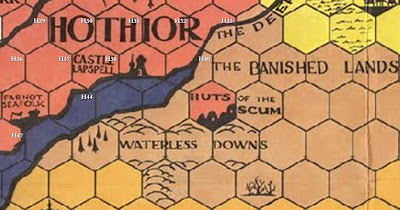
First, a word about these.  There are no Earthly examples of an inlet or estuary bay with this sort of climate on this bank and that sort of climate on that bank.  The St. Lawrence River is the largest estuary in the world ... and yet both climate and topography are indistiguishable.  The same can be said for the Rio de la Plata in South America, the Gulf of Ob in Siberia and Meghna estuary below the Ganges and Brahmaputra rivers.  So, nonsensical.  But I know readers will only shrug their shoulders and argue that something huge and magical happened here, that blasted the land's soil and made it impractical for Hothior to simply occupy both sides of the river and extend its boundaries logically to Shucassam.  As the map says, however, those downs are waterless.

So, instead, let's talk about the "Huts of the Scum."  It's a deliciously suggestive name for groups of weak mercenaries available in Divine Right's game play.  They're worth talking about here because they represent a non-structured populated entity outside the rule of law and kingdom.  Traditionally, DMs would make the place into a "black market" bazaar, where players can buy "anything" — as reflected in the endless cliched existence of Mos Eisley, Bartertown or any other fictional out of the way place.  Naturally, merchants love hauling their stuff 20 or 30 miles away from a river into the middle of a desert, to sell in an atmosphere of arbitrary law and zero meaningful justice, because obviously the tyrannical "might is right" leader of the Scum would never randomly seize all our goods and then bury us in the desert, right?

This is definitely a lot better than selling these same goods in a town right on the water just over there, where there are thousands of customers, a guild to protect our goods and profits, and the ability to pass along taxes to the suckers, er, the good people of Hothior.  Yeah.  That's how things work.

Turning the huts into a desert bazaar is weaksauce.  What about scores of scattered villages of refugees, eeking out an existence of desperation and humiliation ... which actually occurs in places like Afghanistan, Mali, Iraq and Palestine.  And how do the able youth free themselves from those places?  They willingly join as fanatics for the cause of some would-be dictator, ready to sacrifice them as ill-bred cannon-fodder.

Players, however, might recognize a better, higher purpose.  They might investigate water sources, cutting their way into a few underdark places, recognising that if the "Scum" can be set free, and if the Banished Lands can be made healthy, this is a ready starting place for a client-kingdom of either Hothior or Shucassam.  A buffer state, even, if it's able to hold its own through the plucky ability of a group of 14th level player characters.

This comes back to an earlier point: how can the players make themselves useful?  The Huts of the Scum needn't be just another kiosk for players to buy shit.  It can be a piece of ground the players acquire and place under their jurisdiction; a place from which to build; or at least a place where they can return to again and again, as a friendly place that remembers what the players have done and is always ready to help.

In the same manner, traditional D&D would demand that the Bad Axe forest is full of dark evilness, and most likely some forboding, evil-based fortification the players can journey to as a single-shot adventure ... whereupon, the Bad Axe forest is totally forgotten, having nothing else to offer.

In truth, as I've said, Hothior greatly depends on the forest for its industry; it's control over the forest is vital to its military and naval interests.  Timber is a valuable commercial product — yet looking at a game's setting this way is treated as "anti-fantasy" and therefore anti-player.  I disagree.

Each hex of the Bad Axe carries its own personality.  H27, adjacent to Port Lork, is the primary source of timber.  H34, accessible from the sea, makes another convenient source.  Even better, H34 is split in two by an inlet ... and we may assume a small stream, not shown on the map, wending its way up through H26, H18 and H09, to the Hothior controlled mountainous hexes H01 and H02.  The east bank of this wild course is safely Hothiorian ... but the west side is full of Miviorian timber poachers, criminals escaping both Miviorian and Hothorian justice, plus the occasional wandering troop from Trollwood or the Shaker Mts.  The west side of H34 and all of H26, most easily accessed from Mivior, are the most likely places to meet bandits and poachers.

H18 and H10 are occasionally logged, especially for the largest trees, since most of those are missing from the forest closer to Port Lork.  No doubt, the army of Hothior occasionally plunges into H17 and H09 to resecure these parts ... but perhaps no more often than every five years or so.  In that time, a kobald village may have been founded, or a nest of vermin has accumulated; or even some hideous beast and torn apart a section and created an immense lair for itself.  And of course there may be a dungeon of some kind on the lower slopes of the Shaker Mts., anywhere in Hothior's far west.  What's important to remember is that the woods are not just a single adventure ... but potentially more.  There's nothing to stop the players from clearing out some of the back country, bringing bandits to justice, searching to uncover the pass that trolls are using to creep through the mountains, or to eradicate a small keep the trolls have built inside Hothior land.  Numerous opportunities exist.

Looking at Hothior's norther border, we're brought to The Invisible School of Thaumaturgy.  I don't want to create a post specifically for this small kingdom, so we can discuss it here.  In my mind, spellcasting is a guild; one that seeks to protect its secrets, and yet similarly grants those secrets to new members.  A mage must learn how to cast somewhere.  The school has embassies in every major city, where entry is exclusive — thus only characters with sufficient intelligence and dexterity may obtain an education there.

Politically, the School is a free-lance entity.  Positioned between Elfland, Immer, Muetar and Hothior, it can play these off against each other or alternately maintain the peace.  It can keep Trollwood strong and a constant threat towards Hothior, Mivior and Elfland, to ensure that the barbarian lands surrounding the School's fiefdom are kept wild.  The High Marches form a line of hills that reach down into Hothior, while the Forest of Lurking — truly a more entangled forest than the Bad Axe — keeps Muetar at a distance.  The Lowlands of south Immer serve as another frontier.  But we will talk more of Immer later.

The Well of Lered is a 50-mile wide lake formed by springs; floods roll down the Flood Water river when ice and snow melt from the High Marches and the unnamed mountains south of the School itself.  The Ebbing to the west also forms from these mountains and the hills, and probably further springs throughout.

Hothior would dearly like to seize hold of the upper streams, clear out the barbarians, diminish the power of the School, plunder the forests for timber that could be floated down the Flood Water ... except that the magical power of the School is simply too powerful.  Remember, in Port Lork, Lapspell and Tadafat, there are guildhouses dedicated to teaching young Hothiorians to be wizards — and to maintain the School's political status quo.  There are like schools in Muetar and Immer.  To break the power of the guild, multiple states would have to form an alliance ... and there will always be one state that will fear the alliance once its formed.  Mivior can be induced to attack Hothior, the trolls can keep Elfland busy, Pon and Shucassam can be induced to raid into Muetar ... and Zorn, kingdom of the goblins, is an endless headache for Immer.

Thus, Hothior accepts it's northern border, plundering into the forests when it dares, maintaining a watch against the trolls and other barbarians (orcs and such) ... and waits for an opportunity.  Perhaps something the players are able to do, as they operate outside the expectations of the game world.

Incidentally, I don't think the School is really "invisible."  It's merely hard to reach, and represents an ever-present invisible hand influencing Minarian politics.

Who are the Farnot Seafolk?  Nominally, I take them to be an independent guild of sailors and experienced navigators, available as mercenaries and loyal especially to Hothior — who no doubt presses an agreed upon part of their number each year.  The Seafolk know the waters of The Sea of Drowning Men and beyond better than anyone in Minaria; they have skills that enable their semi-independence and their protection.  Farnot is, itself, unfortified.  Their people are scattered far and wide, however, and if another kingdom undertook to destroy the Seafolk, it could be the latter could offer little consequence.  Therefore, it's wise not to play favourites.  Still, it's possible that through the Seafolk, a tribute is paid by some large distant empire across the sea, who would take unkindly to anything foul.  And it would be difficult to track down every last member of the seafolk, to keep news from leaking out.

One benefit of partaking in this exercise of explaining and describing a game world I'll never run is that — while many of these themes are reflected in my game — I'm free to give away details that I carefully keep locked up about my own setting.  For example, I have "Schools of Thaumaturgy" in my world ... but how those operate, and even where they are, remains behind closed curtains.  The troubles of my own kingdoms are similar, but distinct in their own right, as places like Milan, Gilan, Asmara or Mrauk Oo (a real place) have conundrums far more complicated and levelled than anything I've described here ... because my world is bigger, denser, further elaborated upon and more tangible.  Yet Minaria nevertheless serves as a small-scale framework from which the reader can further divise greater complexity.

How would YOU solve the troubles of Hothior's northern border?  How would you make better use of the Bad Axe?  What arrangements would you try to make with the Farnot Seafolk.  How would you approach the Banished Lands.  Are you traditional, and unable to see a world beyond the next dungeon door ... or can you see what I mean when I say, controlling this place or that is like acquiring a larger game piece than what your character represents?