Tuesday, March 22, 2022

Worldbuilding Archive: Settlements

Part 1

I'll start with how I create settlements.

I start with a map from my 1952 Colliers Encyclopedia.  The only way I have of copying it at the moment is to take a picture with my phone, so please forgive the shadow and the slight fuzziness.  The map shown corresponds closely to this area of map that I've published.

I copy all the cities on the map into an excel file, with their corresponding 1952 population.  Then, one by one, I research them to find out when they were founded, how many times they were destroyed, defenestrated, plundered or suffered a plague, among other similar disasters that arise.  I find their latitude and longitude, and their elevation ... and with so many cities, which often have the same names as other places, I make mistakes.  That's why the "Bistrita" in my game world is located near Ramnicu-Valpes and not at the top, north of Reghin.  Most of the time, by the time I learn of the mistake, I decide not the fix it.  As I've said, it's "my world," not the real world.  Slight differences are interesting ... and, as it happens, helpful in a copyright dispute.

If a place hasn't been founded prior to 1650, I discount it.  Sineia and Slanic-Prahova, which are near Brasov/Stalin (1952, remember), are examples.  Mind you, this applies according to when I originally searched for the place.  Wikipedia adds data and changes founding dates all the time, so that searching for a place in 2005 might say that it was founded post 1650, whereas an article today might say it was founded in 1161.  I'm not going to check every location every day, so the existence of the settlement depends on when I happen to research it.  Many places, especially in Romania, were searched before Wikipedia was expansive.  I once used several textbooks and encyclopedias as my primary source.  Not that it matters at all how accurate I am.  If I found no data for when a place was founded, I left it in; I only removed places where the founding date was definitely listed as post 1650.

Next I would create a list like the one shown for each region.  This one is for Moldavia.  The upper list in white are places existing in 1650, according to my research.  The lower part in black with white lettering were founded after 1650.  The numbers are their population according to the Colliers Encyclopedia.  "TOTAL" means the total population of all cities.  "Region Pop. 1952" is the population of Moldavia as given by Colliers.

For some regions, occasionally, there would be no population figure.  In those cases, I would determine the average population of those cities below the median.  That is, of that the lower half of cities.  I'd then generate a random number between 1,000 and the bottom-median average.  I chose "1,000" because there were hardly any places on any map appearing in the entire lexicon of Collier's maps.  Of a place appeared on a map, about 99.99% would be listed as 1,000 people or more.  I tend to think those listed with less were typos.

Incidentally, letting the encyclopedia decide what cities were the most important seemed the best course of action.  Someone somewhere that was an expert in their field decided that these were the places in Romania that deserved representation.  I was willing to go along with that.

Next, I used a formula to calculate the 1650 populations for the existing places from the 1952 population.  Take Botosani; it was founded in 1350.  For it, I used the formula (1650 minus date founded) divided by 4000, multiplied by the 1952 population.  I chose "4000" since that represented the year 2,350 BCE.  There were cities that were founded prior to that date, but most of those had been deserted, abandoned or utterly destroyed, sometimes moved, up to or prior to that date.  For example, Jericho was founded somewhere around 8000 BCE.  It had also been destroyed more than a dozen times before Joshua was supposed to have destroyed it.  So, 4000 sounded like a nice easy number.

Botosani had 29,145 people in 1952.  (1650-1350)/4000*29145 = 2,186.

If a city had been razed or plundered or suffered a terrible earthquake of some kind, I reduced this population by 10%.  If it was plundered twice, then the total was multipled by 0.9 x 0.9.  If the city was destroyed, I reduced its population by half.

Here are the populations for Moldavian settlements using this formula. As can be seen, Bacau has more people than Botosani in 1952, but because it was razed twice, and founded slightly later, it's game population is reduced to 1,689.

During my research, I also look to find what name it was called in 1650.  That's why "Iasi" on the left is renamed "Jassy" in my game world.  If I couldn't find an alternate name, I went with the one I had.  "Piatra-Neamt" is probably two places, but I was unable to find when they were merged, so I left it be.

Calculating a settlement's population demands the founding date; so if I had no founding date, I took the average of those I could find.  For example, the average of the above is 1396.  I then divided the difference of this number from 1650 by 36 (which would be 1650-1396 =254, divided by 36 = 7.1).  I then rolled 6d6, multiplied by the product.  Thus, for example, if I rolled a 22 on 6d6, that's 22 x 7.1 = 156, +1396 equals 1552.  This would mean that places for which I couldn't find a founded date would always tend to be more recent (but not always) than settlements with confirmed founding dates.

I am discussing this at length to show the lengths I will go to establish a universal system that applies to EVERY settlement, everywhere.  And as it happens, it works very well.  If a huge city, like Manhattan, is founded in 1626, it gets a population of 11,748 — not far off the real number in 1650.

The next step is to take the total urban population of this last list, 17 908, and compare it with the total urban population of 1952, 402 761.  Notice I include those places that don't exist at all, since their population influences the total population of Moldavia in 1952.  We divide 17,908 into 402,761, and multiply that number by 2,782,182.  This gives us a population for Moldavia of 123,707.

Now, when I research each place, I also search for who the place belonged to in 1650.  All of Moldavia at that time was within the Ottoman Empire; as such, it was under the authority of an Emir.

Part 2

Now we can play some games.  Counting only the world that I've actually designed, using 1952 figures, the largest cities are, showing thousands of population, Berlin (4339), Moscow (4137), London (3390), Paris (2850), Cairo (2100), Vienna (1731), Hamburg (1712), Rome (1583) and Rangoon (1502).  Keep in mind that these are city populations, not metro, and that the way things were counted back then was slightly different from today, particularly with non-European places.  For example, I have a population figure of 1,490 thousand for Bombay, or Mumbai ... which surely has to have left a lot of people off the rolls.  Nonetheless, it's these figures I used to calculate my populations.

The largest cities of my game world are as follows, again in thousands of population.  I'll list the top 20.  Remember, these are according to my calculating system, so don't expect a perfect alignment with the real world in 1650.  I only include this for interest sake:

Paris (941), Vienna (930), London (838), Napoli (590), Barcelona (534), Lisbon (505), Lahore (467), Constantinople/Istanbul (394), Casablanca (392), Cairo (358), Baku (354), Glasgow (326), Rome (314), Moscow (307), Turin (299), Milan (293), Birmingham (288), Bombay (279), Palermo (275), Tashkent (250)

Casablanca, Glasgow, Birmingham and Palermo are the most off, I think ... but really, it is just a game.  English population figures are always quite high, causing me to wonder somewhat about the original figures.  Casablanca was founded in 650 BCE, however, and was the leading city of the large Saadi Empire at the time of my world.  Baku was a major center of the Safavid Empire.  Italy was a heavily urbanised part of the world in 1650, even though it had lost its grip on incoming world trade by then.  All in all, the figures work ... and I leave them here as a suggestion for how large the reader might want to make their own cities.

Because Jericho was an empty field in 1650, it doesn't appear on the list of "oldest" cities in my game world.  Here's a list of the oldest twenty.  All founding dates are BCE:

Amman (8500), Edessa (8000), Gafsa (8000), Corinth (6000), Coleraine [Eire] (5935), Damascus (5500), Hamah (5500), Anantnag [Kashmir] (5000), Jubayl [Arabia] (4992), Qom (4500), Larnaka [Cyprus] (4000), Rodosto [Thrace] (4000), Sidon [Lebanon] (4000), Aqaba [Arabia] (4000), Chur [Switzerland] (3500), Paterno [Sicily] (3500), Qatif [Arabia] (3500), Muttura [India] (3228), Dvaraka [India] (3102) and Asyut [Egypt] (3100).

Not a very spectacular list.  Seemingly, anything really old just didn't catch on, long-term.  

As a last bit of play, counting only cities with an adjusted population above 5,000, here are my world's newest cities, date only (the largest of these is Bucharest, with 24,873).  Again, might as well include the top 20.  All dates are AD:

Hyderabad (1591), Tsaritsyn [Stalingrad] (1589), Samara (1586), Saratov (1586), Voronezh (1585), Amritsar (1574), Ivanovo (1561), Khortytsia [Zaporizhzhia] (1556), Liverpool (1550), Helsingfors (1550), Colombo (1517), Ahmadnagar (1494), Rawalpindi (1493), Surat (1490), Bikaner (1486), Las Palmas (1478), Hacibey [Odessa] (1466), Sarajevo (1461), Bucuresti (1459) and Jodhpur (1459)

Waste of time, really, since I can't say for sure that any of these founding dates are accurate ... except that they are absolute fact in my game world.  All I can do is hope this sort of information provides some idea of how old or young your game cities might be.

Do remember, all these lists are for parts of the world that I have mapped and calculated regions for.  Manhattan doesn't appear on the list because although I have sort of sketched out the area, I haven't yet incorporated it into the game world.


Part 3 

One problem the reader will have in designating settlements is to answer, "How many?"  This isn't easy to answer.  The world as a whole is inconsistent on this matter.  The best I can do is to offer a series of examples and hope this imparts some of my experience to the reader.

All I can do is give examples:

Andorra, an existing principality and one of the smallest countries in the world, exists in my game world also.  It has one settlement, Andorra la Vella.  As I count my areas in 20-mile hexes, not square miles or kilometers, my Andorra covers 1.5 hexes.  The real Andorra is half that size.

On the other hand, the Duchy of Apuania in Italy has two settlements, Carrara and Massa, which are very close together; the duchy has an area of 1.3 hexes.

Astrakhan, on the other hand, is a large very poor soiled region of 117 hexes in area.  It has two settlements: Astrakhan the city, with 12,841 people, and Langan, an outpost with only 182 people.

Buraydah is an Emirate in the heart of Arabia, 200 hundred miles or so south of Riyadh.  It has two settlements, oases, Buraydah and Qusaybah; the region covers 67 hexes.  It is a large desert area.

Sumi, the same city in Ukraine discussed in the news, is an independent het of 3 hexes; Sumi is the only city.

Nord-Trondelag in north central Norway covers 8 hexes and has two settlements, Levanger and Stjordalshasen.

Tyan-Shan is a monastical entity in upper modern-day Kirghizia; it has one settlement for its 44 hexes.  It is a barren frozen country some 12 to 14 thousand feet above sea level.

I guess we could say that regardless of the area, civilised places with a single settlement, or even just two, will be very tiny in size ... whereas large uninhabitable places will also have a minimum of settlements, just one or two.  All of Ireland in my world is carved into tiny pieces, with each individual settlement representing its own clan and, effectively, it's own country.  These pieces gang together to attack larger enemies, but then fall back into disputing every rock and rill that lays on their perceived boundaries.

The counties of England are relatively small, with between 2 and 10 hexes.  Cheshire, Guildford and Nottinghamshire each have 4 settlements.  Monmouthshire, Lothian, Hertfordshire, Elgin and Dorsetshire each have 3.  Angusshire, Fifeshire, Glamorganshire, Hampshire and Somerset have 5.  But many English counties are stuffed full of settlements.  Yorkshire has 16.  Sussex has 9.  Lincolnshire has 10.  Lanarkshire has 11.  These last are much larger, are heavily populated and industrialised by 1952 standards ... so the encyclopedia crowd wanted to include many more of these cities, cramming them into the map.

A different problem occurs with France.   Because the departments were established after the Revolution in 1689, I used the original provinces ... which are giant areas compared with English counties.  Thus, Languedoc in the south of France has 51 settlements scattered over 38 hexes.  The Ile de France, including Paris, has 24 settlements pounded into an area of 13 hexes.  Forez, including Lyons, squeezes 21 settlements into 9.3 hexes.  And Brittany, a sprawling backwater area of 35 hexes, has so many ports stuffed around it's coastline that it nonetheless has 52 settlements.  And 15 of these are described as "market" towns.  Which I adhered to with my trade tables, giving each the ability to assign its own local price.

It's slightly better in Asia, but this is because the population is predominantly rural.  Hindustan is one massive region under the Moghuls, of 187 hexes ... but it still has 35 settlements - and an adjusted population of 14,144,861 ... which means many, many villages that don't appear on the map.  Odisha has 40 settlements scattered into 281.4 hexes.  The Punjab has 40 distributed into 290 hexes.  Kabolistan, the region around modern Kabul in Afghanistan, has 17 settlements withiin 114 hexes.  

It's difficult for me to say there should be such and such many settlements per hex, since the number for me is dependent on too many variables: the number of settlements actually included on the maps, for instance, or the tendency of a region to urbanise.  Or the size of the regions in different parts of the world.  The reader simply has to guess at an earth-region according to its climate, vegetation, culture, etcetera, count the cities in a square of latitude and longitude and decide that this is the right number of settlements to throw in.  But there is no right or wrong answer.

I can say that one settlement produces a very dull infrastructure map.  Two settlements or three help create shadows and dense places.  Ten are even better, especially if there are about one settlement per three hexes.  But that shouldn't be every place in the world, or the distribution will end up being the same everywhere.  Some places ought to have one settlement per 30 hexes; and others should have four settlements in one hex.  That's just how it should play.

Monday, March 21, 2022

Worldbuilding 5e: Village

If at all possible, I'd like to stress the idea that each part of the world represents a moment in time, in which a sequence of events have caused this place to grow and reach a kind of fruition, whereas that place hasn't reached fruition yet.  Take the two hexes shown: the type-5 on the right and the type-4 on the left.

Fifty years ago, the type-4 might still be a type-5 ... with the "village" of Dragasani being no better than the "hamlet," as we've discussed.  Fifty years from now, the type-5 may have expanded into a type-4.  But there's no certainty of either; each part of the world grows at a different rate, depending on circumstances and how much care has gone into it's development.  The consequence for the game's players is an understanding that every part of the game world should be progressive, as well as interactive.

In a video game, interactivity is limited by the game's intended representation, which is in turn influenced by how long the programmer wants to spend building interactive elements.  D&D doesn't require programming.  If the player wants to interact with any part of my game world on a moment's notice, I have the potential to immediately enable that interactivity.  Want to bash through a wall in Dark Souls?  The programmer has to think of it first.  Want to bash through a wall in my dungeon?  Have at 'er.  I'll figure out the consequence in seconds and we'll see what results.

[yes, of course many DMs prefer to treat RPG's like they're preprogrammed inviolable entities, but we don't need to be limited by them]

Therefore we can look at Dragasani's hex and see that it must have once been a type-5 ... except that now it's richer (+1 coin) and more developed (+1 hammer).  All type-4 hexes get this increase ... and the addition of a village ... leading us to define the village.

Like hamlets, there are villages and villages.  Type-4 is "entry level" ... a scattered collection of houses, hovels, gardens, nearby fields and mills — something like the image shown, but don't take such images too much to heart.  Images like this are designed to provide a general overview of different building forms ... but the ratio of homes would be far greater, the mill's wheel probably much smaller and without the magnificently built weir, and as far as manufactures not every village would feature specifically a blacksmith and a large stone house on the scale shown.  Artists have a tendency to embellish.  My goal is to convey the space found between the houses and structures, and to stress the absence of an enclosing wall.  In some parts of Europe, walls became the rage as a way to buffer sea raiders, who could row up a river and plunder towns far inland.  However, walls take time and lots of money to build and maintain — and the sort of village that occurs in a type-4 hex has neither.

There are four important advancements between the hamlets we've talked about and a "scattered" village.  The first is the making of surplus goods.  The handicrafts produced for local use in a hamlet reach a tipping point where enough of an article is being made that it's quantity is sufficient to be sent to distant parts.  Anything might be the "article" in question: tools, pots, blankets, polished gems, pressed oils, powdered dyes, frankincense, resin, honey, glass ornaments, carved bone, planks, wine, cheese, toys, ponies and hundreds of other things.  Saying this, however, we shouldn't imagine some great quantity of these things.  Two score polished gemstones of a size smaller than a pea, per year, would be a tremendous boon to a single village of 350 people.  Nor should we assume these things are made in "factories."  The making of fifty embroidered chemises a month might be work shared out between a dozen labourers working in ordinary local cottages, the work being done in parlours and bedrooms — the literal meaning of "cottage industry."  No single type-4 village is going to threaten the Potter's Guild of Delft, but as we can see from the map I've devised, there are dozens and dozens of little villages in one small corner of the Carpathian Mts. (and in real life, many more than I've depicted).  Combined, a given product produced in twenty villages and gathered together in a market town like Kronstadt or Jassy would matter on the world market.

Secondly, a village has traffic and trade.  The type-5 above has it's road (and many haven't that), but Dragasani is a minor crossroads.  Not enough to justify an inn (still only has two hammers), but certainly there are enough people passing by to create a slight demand for goods and services by outsiders.  This in turn culminates in a weekly "market day" ... which, traditionally, would happen on Sunday in Christian regions, opening once services were completed.  Sunday was best because as a "day of rest," the peasants were permitted to set down their labours, fill a cart with wares and drag them to the village greenspace.  Why this was not seen as "work" baffles me ... but the Sabbath was made for man and not the reverse, so the powers justified it somehow.  Nearby villages would agree to have different market days ... so that while Dragasani would have their market day on Sunday, nearby Strejesti (a larger type-3 village) would have two or three market days a week, none of them on Dragasani's day.  As the two villages are a mere 12 miles apart, vendors could drag their carts back and forth, benefitting from a unique group of buyers at each end of their journey ... while the locals could ask for things that a peddler might remember to bring next week or next month.

Thirdly, there's the likely presence of some kind of temple.  I don't like to say there will definitely be a singular building for this; or even that if the place of worship exists, there's certainly a priest to occupy it.  Priests pass away from old age all the time; and villages are often to poor to build more than a small shelter.  Many villages are serviced by priests who make a circuit of three or four parishes, preaching at each one no more than once or twice a month.  And some religions don't require temples in the same way that the Judeo-Christian culture does.  Therefore, there's plenty of wiggle room ... and opportunity for a player character cleric to be "assigned" to a distant village somewhere that needs a priest.  This would eliminate the need to build a temple, as the old player handbook requires.  Though this doesn't keep the player from expanding or rebuilding the local church once he or she arrives.

The temple's presence reflects the number of people.  I haven't said yet, but a village on the type-4 level would have between 200 and 400 residents ... though some of these would live in houses on the extreme village periphery.  Imagine instead a close cluster of 20 to 30 structures at the core, with 5-8 persons per structure ... and outlying this, a scattering of adjoined yards, paths, intermittent fields and the inclusion of wells, shrines, sawpits and all the stuff we've discussed being located in thorps and hamlets.  This greater number of people, plus those in walking distance whose cottages and hovels are definitely outside the village, makes giving a service to a congregation a worthwhile affair.  Most visitors wouldn't have any money to give; so the priest's livelihood depends on his or her ability to pull in distant people who come to hear a good performance ... creating a customer base for the village and thus a reason for the few wealthier artisans and landowners to fill up the priest's collection plate.  A poor performer wouldn't get much, for the same reason a bad circus plays to empty seats.

Finally, there is most likely the presence of some form of authority.  Not every slight village would be blessed with a "noble lord" ... but a wealthy squire is certain to have built an extensive house amidst a yard with stables, grape press, chandlery, loom and hired servants would likely be located adjacent to the village.  In fact, the squire — or the squire's ancestors — would be the reason the older type-5 hamlet became a village.  It has everything to do with that "care" I mentioned earlier.  A squire, who for general purposes we can think of as a financially liquid, educated individual with friends in high places, would have justification to provide capital to build roads, better mills and promote trade (the "coin" which the type-4 hex possesses).  He or she might be liked or disliked, but the money pouring outwardly through the neighbourhood would be taken and appreciated.  And in turn, the squire would have the power to exercise considerable will upon the locals by the withholding of that money, or the purchasing of people to deal with troublemakers.

In place of squires, we might have a baronet, invested for some service that was done to the monarchy.  Some villages may be entirely made of a single clan, so that the central authority might be a clan chief or a thane.  Other cultures have their equivalents.  It should be understood that any potentate with real clout or prestige through the land would certainly be found in a more important hex type, since their influence would increase the size and scope of the village and it's environs.  A type-4 is really a backwater among villages.

The exception is the type-4 settlement, like Vaslui here.  I've veered away from talking about settlements, doing little more than mentioning them in passing.  There's got to BE settlements because these determine the originating distribution of infrastructure, which in turn fills out the various villages, hamlets, thorps and wilderness that comprise the detailed map.  I've been asked specifically to discuss the placement of settlements, and that with other thoughts in my head deserves its own post, which I will attend to forthwith.  For the moment, consider Vaslui.  As a "settlement," it gets +1 coin, +1 food and +1 hammer.  This is more of any of these things than what we've seen so far ... and commensurately, this means more produce to be collected at harvest, special kinds of food that are produced throughout the year, a market that takes place on multiple days (like a type-3 hex), the presence of a permanent constabulary, a village hall and an inn.  More hammers means many more kinds of facility, which will need to be discussed eventually.  So, all in all, a considerable expansion beyond anything we've seen yet.  And all this for a village with a mere 665 residents.

In short, we've barely begun to discuss the enormous expansion of services and elements of worldbuilding provided by the game's urban setting ... a setting which is usually boiled down to one inn, one tavern and one market place.  As such, we have a long way to go yet.  So please understand, if it takes me five or six days to get a new post up, remember I have commitments and that I'm describing things which, honestly, I've never thought about myself on this level.  Like anyone else, I've trusted that I'll invent these things in the moment of gaming.  Structurally explaining and resolving each detail in concrete terms for the blog is a mental exercise that forces research and the expansion of my thinking.  It takes time and effort and very often, not a little doubt before I'm ready to dive in and do a good job.

And ... let me say firmly, thank you to everyone who supports me on Patreon.  It makes a terrific difference with regards to my enthusiasm and desire to work hard on this blog as often as I'm able.  You're great for helping.  Be good to yourselves and take care.  I'll try to get the settlements post up by Wednesday, maybe Thursday.  March has been something of a trial regarding my other responsibilities.

Tuesday, March 15, 2022

Worldbuilding 5d: Way Stations & Shrines

With Part 1, I spoke of the emergence of gong pits, cemeteries and granaries.  We can continue from there, but first we have to justify which of things things are to be found in which hexes.

Now, obviously, the reader can organise his or her world in whatever manner that works.  My preference is to have the world tell me what to find there, rather than the reverse.  This way, I'm not making up everything on my own ... I'm employing a semi-independent program that does some of the thinking for me, so I can apply my thoughts to other problems.  This saves me time and bends my will towards the world's logic ... which keeps me fit and trim where creativity is concerned.  That is, I avoid inventing the same arrangement set over and over.

So, let's look at a type-6 and a type-5 hex, in keeping with our earlier post about hamlets.  The two hex-types are nearly the same, except that the type-5 possesses three food as opposed to two.  Since the symbols reflect a (1,0) number system, "three food" is more than double "two food" (7 vs. 3 in a 10-based number system).  This increase may appear due to the small strip of blue stream flowing through the hex, but no; all this land is well-watered throughout.  The type-5 hex indicates irrigation, extensive well-building, reduction of vermin and the surrounding of fields with low walls and fencing to keep out larger grazing animals.  In turn, this assumes the presence of rat-catchers and gamewardens, who protect the crops and manage wilderness populations.

Thus, if the player characters want to advance a type-6 hex to a type-5, there's the program installed in the infrastructure.  Get ready for a larger movement of harvested goods, build wells and walls, lay out irrigation, kill rats and deer, build a bigger mill, enlarge the cemetery, hire extra gong farmers and rat-catchers ... and, probably, introduce a local constable to handle disputes over property, location of walls, drunkeness, poaching and so on.  AND then inspire, in part with the above and also with ingenuity, a lot more people to move to your hex.  Because more than anything else, a type-5 hex has more people.

Here we see a modification to the above, brought about by the presence of water power.  The left hand map shows a river, not a stream, flowing through the type-6 and type-5 hexes.  The stream doesn't increase the amount of food produced, but it does increase the infrastructure for both, by one hammer.  Again, because of the (1,0) number system, two hammers is three times as much as one hammer (3 vs. 1 in a 10-based system).  This means enough development to build more than one mill.  Extra mills can be used for pounding cloth, sawing wood, smashing minerals, working suction pumps for water supply, churning butter, even to press bellows for making brick.  None of these things on the type-6 or type-5 level are extensive enough to create trade goods, but the presence of such things on a very small, local scale, for the local residents, form the beginning of the village that appears in type-4 hexes and the handicraft industries that eventually manifest with real growth.

This adjustment to the hex's life pattern also draws more visitors from the outside, who collect taxes, observe the state of development and consider investing capital ... as well as those squires and church-folk whose interest in the area urges them to act as intermediaries, taking their cut each harvest season.  This encourages someone to found a way station in order to serve passers-by moving on roads or pathways through the region.

A way station is like a campground — except that instead of helping the visitors get in touch with nature, the station is designed to protect the visitors from it.  A space of an acre or more is cleared off and made into a greenspace, surrounded by a windbreak made of fencing, shrubbery and trees.  This break encircles the property, enabling entrance by a single gate, which costs 2 copper pieces to enter.  The station includes amenities like a well for fresh water, possibly a corral that enables animals to get exercise, cut firewood, fire pits, a privy and plenty of space to park a wagon.  These things resemble a campground in many ways.

The way station also provides player characters plenty of opportunity to meet other people, learn about distant places, exchange goods in barter, do good deeds, couple up with other persons moving in the same direction as protection, learn about the best routes for travelling to their destination and in general make friends.  A way station also makes a good jumping off point for the wilderness, as the surrounding region tends to be less inhabited than that surrounding a village.

Other additional amenities might also be introduced, such as an actual barn, a natural pool for fishing or a hot spring.  The way station's owners may have built a stone house with a large kitchen that enables visitors to sit, buy hot meals or drink ... and there may even be a stone cabin or two for those ready to pay extra money to sleep indoors, provided they arrive before the cabins are taken.  The residents might have local cheese, spirits, minor cloth goods or tableware for sale, just as we'd expect with a curio-shop located along tourist routes.

Players might consider buying out a place like this and running it themselves, or building a permanent residence adjacent or across the road.  The way station makes a good stub for eventually starting a village.  There's nothing to stop players from physically willing a village into existence, even if the type of hex hasn't reached type-4 level.  This is exactly how a settlement like Campulung forms: heavy investment, which by-passes spontaneous growth in favour of founding a village whole.  Campulung has 601 people and adds 1 food, hammer and coin symbol to the type-6 hex (which would normally have 2 food and 1 hammer).  Though water power is lacking, Campulung is surrounded by mountains and serves as a transshipment point for ore and founded metal.

Making a settlement, as opposed to an ordinary village, requires an unusual find or the introduction of some unusual good or service.  But this is something that has to be covered later, when someday I get around to talking about trade, references and their relationship to worldbuilding.  At the rate I'm going, we should get there sometime around ... June?

I can't really say.

The added presence of local clergy inspires a different sort of "facility," though we rarely think of it that way in our non-supernatural world.  A real world example would be Lourdes ... but on a much, much smaller scale.  A shrine is "a sacred or holy space dedicated to a specific deity, ancestor, hero, martyr, saint, daemon or similar figure of respect."  For you and I, we visit a shrine for the sense of place and interest it offers.  But it stands to reason that a D&D shrine located where anyone might visit could have incorporated some kind of magical quality, from which visitors could benefit.

I created the sage ability, Seek Shrines, for precisely this purpose.  In essence, I was thinking of hidden shrines in the wilderness, which clerics could locate by feel and signs that only they could interpret.  The ability encourages the players to "hunt" for shrines ... with a day spent in each 6-mile hex to first comprehend whether a shrine exists there, and then another 5-20 hours to find it.  Once a shrine is located, it's presence is permanent; and each day they come back to it, the characters are able to take advantage of the shrine — or glade, sanctuary or holy crypt.  The players could thus create a "shrine map" of the game world, which they could share with others or keep wholly to themselves.

At present, it occurs to me that more "common" shrines might occur in any hex with two hammers ... offering a much weaker but yet beneficial degree of magic.  These "monoliths" might provide a +1 morale for any town resident within 300 ft., or have a 1 in 20 chance of healing an injury ... for those of the same religion as the monolith, or perhaps limited to town residents and those able to understand the proclivities of demi-gods.  There might even be a 2% chance of bringing back the dead, within a certain time period of course.  The presence of literally a thousand monoliths scattered throughout the nearby gameworld could allow for really unusual gifts, like a one-time increase in knowledge, a one-time vision, a one-time rush of experience or anything else that would make a pilgrimage of hundreds of miles really meaningful.  We might even insist that to gain the benefit — a full level, say — the individual must go to a "starting point", walk the whole distance of 763 miles, forego wearing armour or carrying weapons other than a dagger, eat poorly, sleep outdoors without a tent and so on, with the possibility that the character would actually die making the attempt.  And still, if the character were to do it, circumventing wandering monsters the whole way, it would be both well-worth the gained level and memorable as an adventure ... particularly since each character could attempt it only once, and that the benefit would be greater for the 7th level trying to be 8th, than the 1st level trying to be 2nd.

I think that about covers it.  

Monday, March 14, 2022

Map Redux

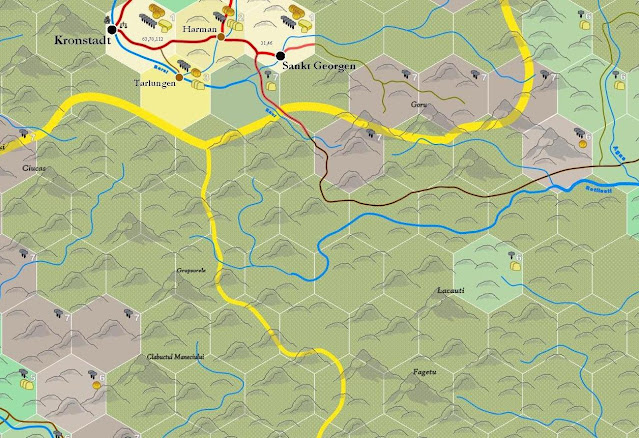
Initially, I'd intended just to map out a few circles of the 6-mile hexes surrounding Kronstadt.  But as the maps became useful for the worldbuilding posts, I went on expanding the map in bits and pieces.  Each time I posted these online, my views shot up, so I know readers are liking the maps.

Problems, however, were forming.  The work was spreading outwards to the edges of the map sheet ... which meant my having to create new sheet, as my computer will handle only so much data.  The Kronstadt map had reached a size of 33 megabytes; that's pretty big for a publisher file.  This is why I present my 20-mile sheet maps in sizes of 30 by 35 hexes ... to keep the size manageable.

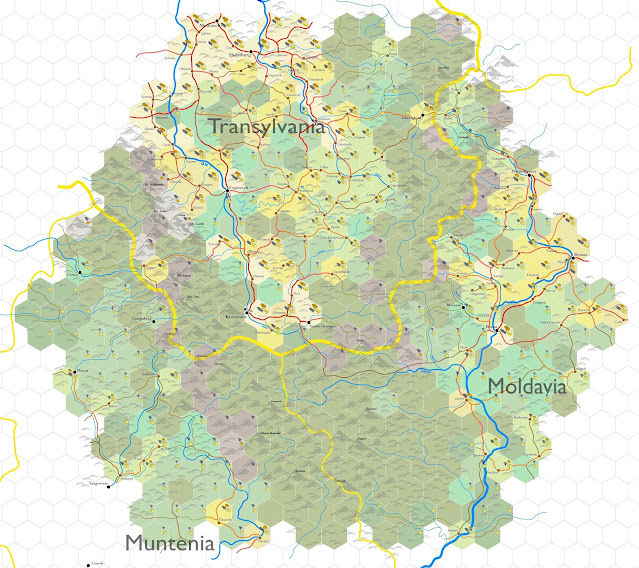
Additionally, the location of Kronstadt happens to fall near the 30th meridian, east.  This is one of the points that my world map shifts 60-degrees in direction, to maintain the map's projection.  As such, every map I've posted of Kronstadt this year has been shifted 60 degrees to the right, so that "north" is in the map's upper right.  Since none of the actual 30th meridian passes through any of the map I've drawn thus far, I decided to shift the whole map to date to the left, to put north at the top.  Here's the redux:


This has also been shifted onto two sheets, shown combined above.  If I continue (and I think I will), the map's bound to spread out onto other sheets as it grows.  I'm really liking the colour scheme; I saw no reason to change it.

I have changed the hammer symbol throughout.  These changes are time-consuming ... but a little done each day produces results over time.  Eventually, I catch myself up to the place I was at before deciding to reformat; this is always a very good feeling.

I'm going to write a post about way stations and shrines in the next day or two.  I'm feeling a lot better, by the way.

Friday, March 11, 2022

Worldbuilding 5d: Gong, Granaries & Graves

I must explain before starting this post that there's is no absolute boundary between a hamlet and a "village."   This is why village-sized hamlets historically went on calling themselves "hamlets," even after they'd reached the size of towns.  For convenience, however, I need my own definition of village, particularly in the context of this series of posts.  So I will ask the reader, please, to understand that the difference between hamlets and villages are not made by size of population, but rather by type of hex.  A hamlet in a type-5 hex may be as large as what we think of as a village; but it isn't rated as a village in this discussion unless it occurs in a type-4 hex or better hexes.  There is an exception; the black-circled "settlements," as I call them, occur on the map as villages, towns and cities, according to their size.  Any settlement (unlike the brown-circled villages) adds +1 food, +1 hammer and +1 coin to the hex's production; this is due to the characteristic importance of these special centres.  I know it's all complicated, and that it seems needlessly so, but the reasons are baked into how infrastructure is designated in the first place.

The reader may remember that I alluded to hamlets as the largest group habitation that occuring in type-6 and type-5 hexes.  However, there are hamlets, and there are hamlets.  As a hamlet in a type-6 farmland hex increases its food supply, on the way towards the hex becoming a type-5, the community fosters children and sustains the lifespan of its elder residents.  Growth adjusts the local dynamic, as more food needs to be hauled out at harvest, more care is needed for more residents, more roofs need thatching, more hands need more tools and so on.  All these things could be made at home, but it becomes more practical, as exports of food rise, to obtain these things from elsewhere ... and this brings more outsiders into daily contact with the hamlet's residents.

There are other things that arise from an increased population, and the animals they begin to keep.  For example, the accumulation of bodily waste that tends to fill up privies and cess pits.  Called "gong," which is a convenient euphemism from the old English word gang, meaning "to go," tends to heap as the number of hamlet buildings swell from fifteen to fifty ... and this produces a new sort of specialist, a "gong farmer," or "nightman," as it was generally agreed that the work of digging up was something to be done at night and out of sight.  Gong has an inherent value as a fertilizer, so it was gathered up and taken beyond the power of smell to official dumps called gong pits.  There the gong was mixed with compost products like rotten food, straw, bones and wood ash.  It takes about 8 months to naturally turn this into a sludge that could dry out, so gong pits were rotated at different times of the year, rather than the same pit being used all the time.  The technical mixing of gong into serviceable fertiliser was more complicated than we might first imagine.

Gong pits, of course, might seem like a good place to get rid of certain kinds of evidence — but the local farmer responsible for these pits would be instantly aware that something was amiss, probably within a single day ... especially since the most sink-worthy pits would also be the ones most often added to nightly.  Nevertheless, stumbling around the outside of a hamlet at night might incorporate these landmarks of the nose interestingly.  That is, provided we're not running the sort of ridiculous disney-fied game that includes safe cards.  After all, it is shit.  Someone's bound to be offended.

Another added difficulty is the number of dead bodies that accumulate over time.  Remember, the growth from small hamlet to large hamlet is slow, but even a community of 100 people will produce 800+ dead bodies in two centuries.  At first, it seems practical to plant Papa and Mamma in the back yard, but six generations and a lot of infant deaths do become a problem, particularly in cultures that don't respect cremation as a solution.  Some cultures favour such solutions as "torn apart by beasts" and quietly dug unmarked graves in forests for the shorter-surviving children, but the number of "important" people who are considered too celebrated for this treatment will mount up.

I'm sorry if I sound less than respectful of the dead here.  In this culture more than any other in history, we greatly ignore the real social problem of what to do with all the past ancestors ... appreciating that a small and rarely-spoken of profession manages that problem for us.  I address it here because there grows a very real need for a graveyard of sorts, once a community reaches a certain size ... even the size of a mere hamlet.  Nowadays, we always associate graveyards with churches because our memories are skewed by movies and churchyards nearly always built 150 years after the actual community was founded.  We have documents telling us that after that after the 7th century CE, that a burial in Europe was under the control of the Church and could only take place in consecrated ground.  This sounds all nice and decent, but it can easily be recognized from any understanding of what Europe was actually like prior to 700 CE that this had to be ignored on a widespread basis — hell, in 700, isolated monks were busy in Ireland copying Bibles, preserving the last shreds of literature about God and Christ in a continent featuring widespread wars between "godless" Saxons, Slavs, Avars and Bulgars.  The Franks may have found sunny Jeebus, but even they didn't have the wherewithal to track down every dead body in the hinterlands of a thousand ex-Romana villages and dictate how bodies were buried.  What with the collapse of society, people still died in their beds and still had to be buried somewhere ... 

The link on Wikipedia says that bodies were generally buried in mass graves, exhumed and stored in ossuaries — and this too sounds very dear and yet ridiculous for isolated farmers scratching out a living in the deep, dense forests of backcountry Europe, with little labour to spare on burying bodies and digging them up again.  This may be all well and good for the village folk, blessed with roads and people who can read & write, who are the only people history has a hope in hell of caring about, but rest assured that tiny hamlets everywhere just do their best with what they have.  Reasonably, a priest or a friar makes the rounds every few weeks and reads words over a body already buried ... and in a community without the drive to build coffins, a sack and a mass grave certainly meet the requirement.  Nonetheless, this grave still occupies space, and that space can surely be called a "graveyard."

Take note that more civilised parts of the world will always do these things with greater sophistication.  The village will have a small church, it will have a local priest, and the graveyard will be a neat little laid out affair.  Cities go a step further, with large crypts and all the ossuaries the profession responsible can build.  In a grander sense, really big places can build their own necropolises for the dead.  But we're not talking about a place where a modern historian could expect to find anything, because the dead of nowheresham Germany were never buried in a manner that an archeologist might dig up.  There are billions of bones buried under the soils of Europe and Asia, and the Americas too, that are simply lost to time.

Nonetheless, when dressing up the game world, we shouldn't forget to add that important repository.  Player characters might take a moment and consider where they ought to bury their own, for one thing; and the manner in which a cemetery or a gravesite is respected could help with the locals sentiments.  Some players are clerics, after all — though they should always be sure they are the right kind of clerics before irresponsibly chanting words over a body of another religion.

Yes, I know, I know.  A discussion about graves and cemeteries should have said something about undead.  The trope is so obvious, however, I don't see that anything needs to be said.

Let's move onto something else.  I've mentioned a "garner" a few times now.  For my game world, I'm defining a garner as a temporary repository for food, gathered together or "garnered" at harvest time with the expectation that it will be distributed or moved to a place where it can be sold off, most likely before winter begins.  When I speak of long-term multi-year storage of food, it should be understood that I'm speaking of a "granary."

A granary is specifically built to keep grain, which can last for 5-7 years, while a beet or a carrot won't.  The single most important part of a granary's design is to keep the grain dry, so it won't rot.  This is accomplished in a variety of ways.

A granary can be independently built, but as a place grows it gains a sense of community, the idea that "we're all in this together."  And because it's clearly understood that we all want to live when the crops don't make it some year, not just the most selfish among us, a large enough habitation will build an institution granary for the general welfare.  A portion of everyone's crop for the year is added to the total, to be paid back when crops fail.  So the granary is like a bank, where funds of grain are deposited for the future.

The granary is carefully managed by a steward who maintains the quality of the grain and keeps a close watch on how much is stored.  Even a small theft would certainly be recognised, as this is the steward's bread and butter, the thing that sustains his or her family.  It's a good job; with responsibility comes status, and a masterful granary steward can be a friend to the community.

He or she can also be convinced to trade grain for coin, since coin takes up much less space and can later be translated into grain in the future.  With enough coin, the steward can send off for a load of grain from elsewhere and make sure the granary is very full, all the time.

I bring this up because I've often seen player characters lay in massive supplies of flour for journeys that will last only ten or twenty days.  This, of course, increases their encumbrance something awful.  The argument is always that as they eat the flour, their encumbrance will lessen ... and they don't want to be caught without food.

However, there's nothing to stop the party from buying grain instead of flour.  A sack of grain is lighter than a sack of flour and any grain mill along the journey can be paid a very small fee to exchange a sack of grain for its equivalent in flour.  This fee would be less than the difference between grain and flour at the market.  Now add to this the possibility of buying the sack of grain from the local granary (again, for less than the cost of grain at the market) and then going around and having it milled.  All without the burdensome demand of carrying around 10 forty-pounds of flour.

Look at the maps I've posted.  Any type-6 hex or better will have a mill.  Any type-5 or better will have a public granary as well.  With most such hexes only six miles apart, is there really any need to lay in a hundred pounds of flour?  Keeping in mind that the granary steward and the miller will be happy for the money, as money is scarce in a hamlet ... and can be used to shore up the buildings and feed cats to kill mice, along with other convenient uses.  Each time the players come through, they make a friend or two, they save on their encumbrance and they gain a better sense for how the game world functions.

I have two other small facilities to discuss before moving onto bigger things, but I'm running out of steam.  I seem to have caught some kind of cold; perhaps it's covid, but I don't it.  No breathlessness so far.  Take care, I'll write soon.

Tuesday, March 8, 2022

Worldbuilding 5c: Hamlet

To reassure the reader, this is not the second in a series to be followed by "village," "town" and "city."  Like the thorp, the hamlet has no significant sub-facilities, so I'm treating it as a single amenity.  Be advised, this post won't be discussing a specific prince of Denmark.

Whether or not the reader chooses to employ the hammer-coin-food symbols I've been using for my maps, designating specific hexes as "kinds" can help in establishing where the players are or what they see.  My take simply lays out these hexes as a sort of flowing pattern, from scarcely populated regions to those that are densely populated.  I think this is better than determining which hexes are what by fiat, but it's better to do the latter than to make no designations at all.

Let's start with a typical type-7 hex.  If the designation "type-7" has rankled the reader and they'd prefer something more esoteric, let's call it "subsistence farmland."  Most of the hex is actually hinterland, with a small cluster of farms gathered around a stream bottom or artesian wells.  Each hex of subsistence farmland would as I said yesterday contain at least one thorp.  There wouldn't be any other services and as shown on the map by the lack of hammers, these particular thorps don't have a mill of any kind.

Chances are the residents wouldn't owe fealty to any lord.  My education tells me that the difference between a "villein" and a "cotter" is that the former is a serf tied to the land, while the latter is a squatter, who does not own the land being farmed (and is therefore not a "freeman") but yet successful survives as a farmer.  For reference, wikipedia makes no distinction whatsoever between villein and cotter, and seems to have no word for "person not under the heel of a lord who isn't in fact entitled to own land."  This is a case of someone thinking every human being fits into a box of some kind.  I assure the reader that millions of people through history have been too difficult to tax, because they chose to exist in obscure places.  I also assure the reader that many amateur historians are bound to think otherwise.

As such, I'm going to call these people living in subsistence farmland "cotters."  It doesn't matter if we call them "fleebsobs," as long as we understand their status.

Each season, these farmlands harvest a certain amount of food, store it in garners, from whence it's taken to a village of some kind and poured into the world's food supply.  The people are isolated, mostly friendly, no more concerned over bandits than the poor people of the American south were worried about Dillinger or Bonnie & Clyde, and probably willing to feed players out of hospitality or in exchange for a quite minor tool of some kind.

Let's look at a different sort of subsistence farmland.  As shown, there are two subsistence farm hexes (type-7) located along the big river that possess an extra hammer; while one type-7, located on a smaller blue line, doesn't have one.  The thin line is no more than a stream; it doesn't appear on a 20-mile map, so it doesn't get a bonus hammer.  Incidentally, any type hex on a river that appears on the 20-mile map gets a bonus hammer.

These examples of subsistence farmland also possess a thorp, but because they have sufficient water power, these thorps include a watermill used to grind grain.  Potentially, the mill could be applied to other manufactures, but it's not here, because these are only type-7 hexes.  The means is here, but the expertise is lacking.  The hexes are just too backward.  Still, it makes for a different kind of mindset than more backward places; and the mill is likely taxed, even if these cotters are not.

The reader might note that the type-6 hex shown has precisely the same hammer & food that these two type-7 hexes have.  What's up with that?  Well, hold your horses.  We'll get there.

This brings us to a different kind of type-7 hex, one that isn't a farm at all.  Where the inhabited hex occurs in mountains or stony land, we have a mining hex.  Here, the type-7 hex isn't awarded two food, it's awarded two hammers.  This designates a thorp with an ox tether, a mine and a waterwheel-sluice.  Potentially, the thorp might be at the end of a cart track or trail (or larger route), which would mean meagre services for carts and wagons (tools for fixing, probably not anything like an extra axle).

A similar type-6 hex, like the one shown, is awarded two hammers and a coin — the latter resulting from an obviously more important hex and therefore providing greater wealth than a mere type-7 mine.  The type-6 hex shown has a third hammer because it's located on the Rotilesti river, giving it a bonus hammer from waterpower.

So, this last image shows two possible type-6 hexes.  The mine-version includes a resident assayer (in a single-person "office," or hovel) to oversee the quality of ore, or it might possibly mean there's an open pit quarry here.  The ore is crushed by a mill, rather than merely sluiced as in a type-7 hex; there's a mule-skinner to manage work animals, a headsman to manage the operation, hauliers, several bunkhouses to keep them and a permanent stone kitchen to feed them.  This collection of buildings and yards is no longer called a "thorp."  It's called a "hamlet."

Now, "hamlet" is a loose term in the real world.  Like thorps, hamlets begin as little places (or evolve from thorps into little places) that refuse to give up the name as they transform into mighty cities.  Thus, we have Birmingham, Faversham, Burnham, Hamburg and so on.  Other names for "hamlet" include wick, catun, buurtschap, weiler, mezra, clachan and many, many others ... and all of these may be variously identified as villages, towns or cities, depending on how long the place has been around and the transformative nature of language being applied to multiple things.  As I wrote with the thorp post, I need a standardised word for a specific kind of habitation, to differentiate it from other habitations.  Hamlet is my chosen word for small not-quite-village sized habitations that occur in type-6 and type-5 hexes (the latter of which will be discussed another day).

Hamlets occur everywhere that's remotely civilised, even in densely infrastructured type-1 hexes.  For simplicity sake, let's call an agricultural-version type-6 hex just "farmland."  I trust that's not too confusing.  Farmland may or may not have access to waterpower — but whether it does not not, the hamlet in farmland will always have some kind of mill.  Where water power is unavailable, a windmill is substituted.  This is one important difference between farmland and "subsistence farmland."  The former may have a windmill.  The latter never will.

Historically, hamlets may emerge from thorps that grow as their usefulness increases.  Hamlets may also be founded at a stroke, as a group of pilgrims or settlers seeking independence.  They may also exist as the remnants of a village or town, where the hamlet is surrounded by the ruined remains of a larger, former habitation.  This can be found commonly in classical parts of the world like Anatolia, Greece, Italy or North Africa.  A hamlet might also cluster around a squire's house, a freeman who is less than a noble (and therefore not a manor lord), and yet act as a beneficiary or wealthy master.

Hamlets can form along roads, in bottom lands below mountains, upon a lake or coast ... in my game, anywhere that a type-6 hex occurs randomly.  Sometimes, this will mean a collection of farmland hexes such as the example above, or a single farmland hex apparently in the middle of nowhere.

Hamlets are not political entities.  They don't represent royal lands or manors, the residents aren't serfs, there's no single dominant individual who rules the place.  Even the example of a local squire doesn't provide for legal authority over the hamlet's residents.

At the same time, the hamlet isn't strictly an economic entity, like the thorp.  A larger number of persons dwell here, who are gathered together because they possess a similar tradition and outlook.  These are people who have bonded together, who share their harvest with one another in lean times, who trade with the outside as a single body ... and whose religious affiliations lack formal spiritual guidance.  Hamlets do not possess a church.  By definition, the presence of a church redefines a hamlet as a "village" ... but only player characters would take it upon themselves to build a church in a hamlet that has no expectation of developing the other qualities of being a village.  In the game world I'm building, the designation of "type-6" means no church, no priest and no deacon.  No religious hierarchy at all.  However, this doesn't prohibit the presence of informal spiritual guidance.  The hamlet may possess a shaman or a friar or nun acting on his or her own initiative.

Hamlets act somewhat as collectivised peoples.  By working together, they produce more free time among themselves; this allows homes that are better built than mere hovels, the development of simple masonry, carpentry, pottery and thatching.  Occasionally, some handicraft-making, such as baskets, farm tools, baked goods, quilt-making and such are collected and transported to small village markets.  The local mill may be used for fulling cloth and pressing wine and oil as well as for grinding flour.  None of these would reach meaningful proportions ... but players could expect to barter their town goods for rations, a serviceable pair of soft shoes or a hat.  Naturally the hamlet would also have a garner, several wells, a sawpit and so on as we've seen with the thorp.  In different parts of the world, this could be extended to polished spices, extracts like camphor and aloe, resins, local wine and spirits, embroidery and much more ... though it's understood none of these things would be available in large quantity; they'd only be enough for more than a few persons.

Farmlands are no more xenophobic than subsistence folk.  They might be attacked and robbed, but it's unlikely in large part, particularly with those surrounded by civilised hexes.  The last example of the isolated farmland hex might be a bit more xenophobic than others — but they would probably welcome outsiders for the sake of the news they bring.  They would protest the permanent settlement of outsiders who failed to share substantially with the community, or who wore out their welcome by appearing too often while acting selfishly.  Players would need to make friends, not merely treat the hamlet as utilitarian ... keeping in mind that working a string of hamlets, each being isolated, could allow for much greater latitude for a party that didn't wish to commit.

Thus, for resupplying base goods, such as food and clothing, falling back to a hamlet might prove more convenient than retreating all the way to a town.  It also serves as a possible location in which the party migh, after building relationships, actively work to expand the actual infrastructure of the hex, promoting it to a type-5 and thence to an actual village ... with lots of possible base locations to choose from that would serve the party's needs.


For everyone out there, I appreciate your support of my patreon or for your input in the comments.  I have more things to write about worldbuilding and I just want you to know that I'll continue to make the material the best I can.

Sunday, March 6, 2022

Worldbuilding 5b: Thorp

In structuring the game world, I need standardised words that describe a standard physical thing.  In the real world, a thorp might apply to half a dozen differently sized habitations, including a village, a hamlet, a farm or an estate.  This fluidity grows out of places having once possessed a small collection of farm buildings ... and as it grew, it resisted discarding the word "thorp" and continued using it.  A modern dictionary is concerned with defining all the possible uses of the term, but I am not.  I need a "thorp" to mean the smallest possible collection of buildings that serves as a "facility."  We discussed facilities in general with this post.  Going forward with part 5 of the series, we'll be discussing different facilities that become progressively more complicated.

A thorp has about 5-20 persons, who may be classified as rural workers who are not farmers — yet they largely exist to facilate farming.  The operation of a grain mill for example, or a "garner," which is a storehouse or a loft for grain.  Other facilities might be a sawpit, for turning lumber into planks, an ox tether for holding oxen for loading directly on their backs; a reliable well; or a boat dock if the thorp is located on a waterfront.  They usually include 2-4 hovels, or houses of about 225 sq.ft, made of whatever materials the area allows — wood, wattle & daub, adobe, loose stone & caulk ... whatever can be made with amateur knowledge.

This is just one kind of thorpe; others occur
wouldn't be seen on a map this scale.
Thorps are everywhere.  On the 6-mile map, they can be found at the end of a dead-end road.  All type-7 hexes will have at least one, sometimes two or three, spaced closely together.   There may be dozens in more populated hexes, but with the appearance of full-sized villages and country towns, thorps tend to balloon into hamlets or get swallowed up by larger places.

They have no political importance.  Any place large enough to have even a small group of elders would rate as a hamlet.  The thorp's purpose is largely economic.  They serve as places where a farmer, located too far from a market, can deliver their produce in exchange for pay or barter; the thorp then transships these goods along roads to a bigger centre for profit.  In turn, locals able to do so can pay to have their grain turned into flour, or buy flour outright from a mill; carters or wagoneers can fill water barrels for a return trip; hunters might use a thorp as a residence during the hunting season, making their camp adjacent.  Thus a thorpe may be surrounded by 5-20 tents representing seasonal occupants — the aforementioned carters, assayers, carpenters putting in their supplies for the next three months, mushroom hunters ... even a herbalist or a resident druid.

Player characters might do the same, making an acquaintance with the thorp's residence, setting up tents for their hirelings or henchfolk, then leaving behind tools and extra weight before plunging into the wilderness.  Players might even meet hunters and let the hunters lead them into the wilderness for some distance, as the hunters would know the country better than anyone.  This allows the players a reliable basecamp making plans and explorations.  They might even choose to gain permission from the thorp — which might be wholly independent or might technically belong to a minor lord — to build a permanent structure and storehouse.

It's necessary for me to point out that a thorpe like this could better serve the trope to which D&D normally assigns to a local tavern.  The thorp is literally on the edge of the wilderness; or located in areas where beyond a few farms, most of the countryside is untempered hinterland.  The woodsmen or hunters venturing inside aren't trading on rumours; they can literally take the players a half dozen miles into the wilderness, point at the edge of a mountain and say,

"Yep, pretty sure there's orcs up there.  None of us like to get too close; but poor Bertrand's body was found in the creek bed there, at the bend where that spur juts out.  See it?  We figure they made him carry his own goods that far, when they killed him and stripped his body.  He wasn't wearing shoes, and his feet were good and cut up; he must have walked three miles before they hacked him apart.  Corpse was clean, though ... layin' in that creek like he was.  If you all start climbing up to the top of that spur and then along it 'til you come to that cliff-face ... well, I wouldn't be surprised if you found a cave of some kind about there."


Moreover, if the party is of the criminal bent (and I don't make moral rules for my party's actions), they can probably handle a thorp as second or third levels, provided they pick their moment and there's none too many strangers around.  Potentially, they could pick a place with 12 residents, kill 'em off, ransack the habitation for at least as many coins as they'd find on a dozen wandering orcs, load up the oxen, mule, donkeys or perhaps even a cart that's convenient and just head off down the road.  Most likely, they'd have a day or two to travel before anyone saw what they'd done, by which time they could trade off their animals (which could be recognised), take a less-travelled road and find their way into some village before ever being suspected.  Players could hit two or three such places without getting caught ... by which time, the plundering wouldn't be worth it any more.  They'd have to look for something bigger.

There's no reason for a DM not to make thorps like this convenient.  Players can use them to spend money on resupplying (though they couldn't buy much beyond flour, meat, fire logs and other things associated with the professions named above), build up an association with locals and still participate in all the familiar parts of D&D that players like.  We wouldn't have to trade in "rumours," but in facts. The world becomes a lot bigger when we don't have to put the village right next to the monsters when we can put lesser stages of infrastructure in between.  Plus the thorp in on scale with lower level parties, unlike, say, a full-sized Keep.

Thursday, March 3, 2022

Worldbuilding 6a: Functionality

Okay, I'm going to do a deep dive with this post, discussing methods to provide the game world with an overarching structure, regardless of the level of zoom.  Those readers who feel that everything should be "done on the fly," or who believe "the world doesn't need a structure because this is all fantasy," may feel free to stop reading now.

When I began mapmaking, I chose to use 20-mile hexes because the world is a very big place.  My informational maps were primarily of 1:4,000,000 scale or larger, loaded with cities and geographic features, but with 1 hex = 1 inch = 20 miles, the result is a lot of hexes that look like the one on the right.  Empty.  However, the commitment of making a map, and therefore the hexes (or the open space of that map, whatever form it takes) is a commitment that if the players enter that hex, I must use my imagination to put something in it.

If I'm running a game and the players enter this hex, I have some base information at hand.  I know the hex is in western Moldavia (of modern Romania); that it's on the border with Transylvania; that the Carpathian mountains run along the border.  It has this stream in it which the little "3" tells me carries about 30 cubic meters of water a second.  The stream may be wide, or deep; it may be narrower and fast-flowing, or slow-moving and wider.  It could be shallow enough to be walked across or 2 metres deep and only 4 metres wide, so that the players have to swim.  The map doesn't actually give me this information.  I have to draw on what I know of the geography of the area (which isn't, frankly, enough or even remotely "accurate") to run the players when they arrive in this place.

And keep in mind, within just 30 miles of this hex's center are 18 other hexes, most of which are also empty and just as vague.  I could concentrate on providing detail for these 19 hexes, but then my game world would only be 100 mi. in diameter.  Yes, I could run a campaign in such a space, but the campaign would necessarily be missing London, Paris, Rome, Constantinople, Alexandria and Moscow ... not to mention other vast parts of the world the players might like to visit.  There are quite a lot of such places.  And though I've undertaken to map them, it's worth considering that of the above empty 20-mile hex, I have some 70,000 other like hexes.  Without about one-fifth of the world's area mapped.

I'm not imaginative enough to create 70,000+ unique hexes, or even to do a thorough job with just 1% of that number.  So my approach has been to construct a generation algorithm that might transform hundreds of low-detail hexes into higher-detail hexes, without my having to be exceptionally creative long-term.  I need only use common sense and some additional information gathering to complete the process.  The result transforms the above image into this:

The adjustment provides me with more information than previously, to use when the players enter the former 20-mile hex.  I've added in hills, low mountains and high ones, roads, villages, additional water courses and separated the hexes according to their "infrastructure" and therefore the amount of civilisation they possess.  I've also added symbols for food, labour and wealth, which clutter the map ... but they also provide immediate information for my creativity to hinge on while the party travels through the area.

Tazlau is rich; with a type-1 hex it's as civilised as nearly any place in the world (there are exceptions, but that's another post).  In that one hex, the landscape is heavily cultivated, the roads are patrolled, there's are seasonal fairs and a village market (though not a world-trade market), a library, a money lender, probably a castle, inns and perhaps even a bathhouse.  Zemes isn't nearly as wealthy, but it's still important; it has an inn and a forge, and a village market twice a week.  Tarcau has a village market only on Sundays, has no inn or forge, but has a "way station," a sheltered yard and kitchen-house where travellers can bivouac.  The roads have various forms but there's lots of them; it's easy to get around.  I can see where the wilder parts of the hex are, where some participate in mining or quarrying ... and I can see a collection of other villages outside the hex, giving our original hex character through its relationships with other places.

As such, during the game, my imagination has much more forage to feed it, at a glance, which is the reason for the preparation that goes into elaborating on the previous hex scale.  Yes, it remains true that a single type-5 hex, which appears in the middle of the above, is very like the type-5 hex next to it.  This one has a deep river in it, that gives it +1 hammer; and it has a road, while the next like hex does not.  And yes, the system is set to produce hundreds and hundreds of type-5 hexes, all alike, or nearly so.

However, they are only like other type-5 hexes.  They aren't like type-4s or type-6s.  And while the hex itself is the same, some type-5s are a comparative backwater to the surrounding hexes, while elsewhere in the world they are the most important hex for dozens of hexes in every direction.  Relationships really matter.

Still, I look at the type-5 image and again, I'm left to my imagination to put something in it.  I have three hills and a bit of another.  I have that road.  I have the three food, which tells me there's fields and livestock and eating.  The two hammers promise that the river has a waterwheel on it, running a mill.  There's probably a quarry here, providing stone for building in Tarcau, Zemes and Tazlau.  But these aren't D&D Adventure notes, are they?  They don't tell me the sort of things that player parties care about.  So why go through this generation at all?

To DM, we've got to have a dungeon master's sensibility.  Where other people see the symbol of a hill, I see wild, uncertain country, filled with various denizens who aren't passive farmers — or even intelligent.  Historically, as an area is developed, the unwanted original residents are steadily exterminated or pushed back into areas that are unwanted by settlers.  This type-5 hex, occurring between three fairly dense built-up areas, has had plenty of history to build up itself, only it hasn't.  Which means the wild areas of this hex are too stony for farming and too barren for herding; the forest and its layout is impractical for wide-scale logging.  In short, parts of this hex have turned into those places where the players can dig into and find all manner of strange things.  With 5,000 years of human habitation of some kind, there may be ancient Roman shrines or covered over burial grounds.  A battle between Christians and Arians may have taken place here a thousand years ago.  A wizard-hermit could easily have retreated to such a place; there might be a hidey-hole full of kobalds or goblins, living right under people's noses.

Perhaps a 30-acre area of dead, rotting wood is spawning the occasional giant bombadier beetle that staggers outwards into civilisation, with such incidents killing two or three people a year.  The pile has to be located and cleaned out; even in an area only three miles across, this could take a couple of weeks.  There may be as many as twenty beetles in such a place.  It would take a party with resolve, resilience, time ... who might care whether or not a few peasants die now and then.  Perhaps the local manor lords just don't care about such things, at least not enough to risk a few of their cherished soldiers.  And when the beetle lair is cleaned out, and some of the rotting field of logs is broken up and burnt, who knows what evil lays beneath, that caused the logs to cluster in just that spot.

Now, I've made this just now, as I'm writing the post.  I had an idea of what I'd write about, and that eventually I'd need an adventure, but I had no particular adventure in mind.  And the "evil beneath" thing?  Didn't occur to me until the last paragraph was nearly written.  But I think like a DM.  All the time.  I can always create some valuable horror that draws in the party, from habit if nothing else.

What matters to me is not the adventure, but the context the adventure occurs in.  I can make the beetle pile just as conveniently for the top map of this post, the single 20-mile hex.  But then, it's just an adventure that happens, that's completed and walked-away from.  But the same adventure in the context of the three villages of various importance, where there are quarries and somewhat backward farms, creates other consequences after the adventure occurs.  Very well, the beetles are dead; the pile is broken up; the evil is vanquished.  There's more left.  There are neighbours to inform; for surely the neighbours would be interested to know the story of something that's happened in their backyard.  The locals will be grateful that no more hapless hunters will have the flesh boiled from their bones; even the manor residents might take notice, offering gratitude, dinners — and the ever standard, "Since you were able to do that, I wondered if you'd be willing to do this?"

The structure and detail of the map provides a sense of why a particular adventure is important to the locals.  How it affects their lives.  Even if the players don't want to advantage of themselves of economic opportunities, the local NPCs have no such qualms.  These will have the players to thank.  These will be able to tell the players of other small problems they have.  Meanwhile, the players can't help but acquire a sense of place.  Even as they leave the area, because adventure pulls them elsewhere, they'll remember that dinner they had in the castle of Tazlau; and those beetles they fought near Zemes.  It's a much more durable memory than stumbling across beetles in the middle of nowhere, killing them and moving on.  Place gives personality; and personality gives significance.

Even as they travel through such a world, the players will find themselves recognising other map patterns and interconnections.  This place is not like that place.  And even, "Hey, we kind of like this place," with it's combination the players haven't seen before.  The kind of place the players may want to invest themselves.

This isn't going to happen just because we make a bunch of maps.  It won't result from a generation system or even a lot of detail.  The DM's got to know how to massage the information, how to use it to build not just an adventure, but a whole campaign.  I've said multiple times that the DM must know the world in depth, with a vision that lets the world feel real to the DM.  This is only part of the formula.  The DM's also got to transform that vision into the sort of movement that grasps the players by the short hairs and makes them pay attention.  In a way that doesn't disappoint, or make the players feel abused or micro-managed, AND provides for tremendous flexibility on the players' part.  For a DM with very little experience, this is like throwing a baseball through a tiny jiggling window 30 yards away, while aware that failing to do so might mean losing your job and your house, the respect of your associates and family, and a lifetime spent selling auto-parts at a store in a shithole town in Oklahoma.  You know, like a professional baseball pitcher feels.  All the time.

We get past this difficulty by knowing what disappointment looks like; specifically, what we mean by disappointment and how we did that last time, and every time before.  Or what "transforming a vision" means.  Many DMs don't even have a vision, much less the least concept of how to transform such a thing.  Where are the players' "short hairs" — what is that even talking about?  These things are necessarily express in fluid, abstract terms because they are ABSTRACT.  I can't tell you where your players' short hairs are, or how to grab them, because I'm not sitting with your players and running them.  All players are different and their short hairs are in different places.  And we pull them in a variety of ways.  I only know that if I were sitting with your players, running them, I'd have them sorted in my mind within an hour, setting up strategies in my mind automatically.  Just as every pitch a pitcher throws tells him something valuable and critical about the batter.  It can't be explained.  But the technique can be acquired.

How?  To begin with, by embracing at fundamentals of the game.  We appreciate why there's a necessity for preparation and thoughtful design — because it saves us time during the complex game while urging us towards greater inventiveness and intuition.  We take the unimportant stuff at face value, things like "what do hit points mean" or "what's my character's job," because we can waste decades debating this stuff while failing to advance one iota at the thing we're supposed to be getting better at: How. To. Run.  It shouldn't matter if the players are wizards, sorcerors or turkey farmers.  The fundamentals remain the same.  Tell me what you do — not what your character does, not your backstory, not what you think you ought to do or what you're worried about doing or even what you should have done.  That's all crap.  Tell me what you DO.    Right now.  And I'll tell you what happens and what you see.  And then you tell me what you DO again.  And everything else that results, that we don't have to think about, like what's the story and why are we here and what sort of game do I want to play and blah blah blah, will sort itself out without our needing to pay attention to it.

The trick of running a game isn't found in understanding the underlying philosophy of the game's various terms — though I'll grant, that stuff is interesting and fun.  No, the trick is having an answer when the player says, "I do this."  That is, having an answer every time.  For hours at a time.  And then doing it again next week ... and being so capable of having an answer, that it doesn't matter what the action is.  Our goal is to rebuild ourselves so we can do that.  To prepare ourselves to do that.  To have tools, like the world we build, or the rules we engineer, that helps us give plenty of play while producing hard limits that deny players the ability to jack-ass their way out of a problem.  We have to think faster than they think.  In fact, we have to think faster than that, because we're staying ahead of four or five people, who all have more time at the table to sit and think than we do.  They can sit back, hand the reins to their fellow players and do nothing but think.  We can't do that.  There's no one to hand off to ... except our earlier selves, who were diligently creating answers and explanations and results for their actions to players who hadn't sat down yet.  Months, even years before they sat down.

So if I seem to get a little loony in my worldmaking, it's that these tools provide me with things I need in the middle of a game.  The only thing that matters to me regarding the game world is how functional it is, and how functional it makes me.
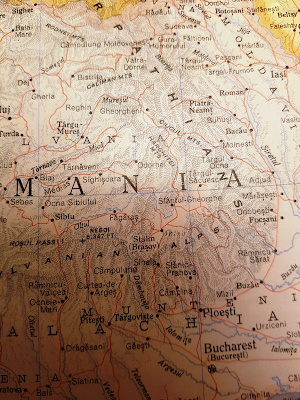
Fighting with Colours

Experimenting with colour changes:


Preferential in some ways; the wilderness stands out better, though it minimizes the appearance of the mountains when looking at the whole map.  Close up, the information is there:


The change was meant to make the more civilised areas more lightly coloured.  The problem is, as we go progressively towards wilderness, the colours get darker and darker (maintaining contrast), and the larger part of most maps are uncivilised.  The result is a dark map.  If I lighten up the wilderness, then everything else also has to be lightened in turn, and steadily the contrast between each level of hex diminishes.  It's tricky.

UPDATE:

From March 3rd, a newer version than last night (with slightly more map added):


Wednesday, March 2, 2022

Resurrection

This isn't a post about worldbuilding — but there will be more of those.

This is a post about the failure of art.  I once sat in on a film class years ago, because it used the same room as my Roman history course that came after ... and hey, I can write anywhere.  I knew the prof from several interviews I'd taken for the university newspaper the year before, when I was also writing reviews of the university drama department's performances.  He and I would have coffee occasionally, disagree with each other a lot and respect boundaries.  I was allowed to sit in his class, so long as I didn't participate.

He used to tell his students remorselessly that screenwriting was about hitting marks.  10 minutes in, the protagonist gets kidnapped.  30 minutes in and the protagonist meets the bad guy face to face.  37 minutes and the murdered girl's sister shows up.  That kind of thing.

I don't like this sort of writing; but I don't write screenplays, either.  In any case, a writer's got to have some idea of just how much dry oats the audience will eat before they're given a drink of water.  And how long it will be, again, before their mouths get dry.  Virtually everyone in the industry knows that if you can't hit these moments precisely, you have no fucking business thinking you're a screenwriter.  I say "virtually" because there's one class that don't have to play by the rules.

Recently, encouraged to do so, I saw Once Upon a Time in Hollywood, from 2019.  I'm not going to say much; on the whole, Tarantino is a garbage director who over-embellishes cheesy pulp plots, catering to a congregation I don't have much use for.  Apologies to any of my supporters who feel that the sun rises and sets on Tarantino's work, and are rushing to remove themselves from my Patreon right now.  Let me help you.  'Course, if any readers out there don't support me and agree with me about Tarantino, throw me a buck or two.  I'm just your writing monkey.

Once Upon a Time in Hollywood hits no beats whatsoever.  I didn't find it a bad film.  I rather enjoyed it.  Not for the story or the characters, they were trash.  But because the film's setting and timeliness contained elements that roused memories of mine that were long forgotten.  There's a scene in the film when the sun is setting, and a montage of restaurants turning on their lights (1970 being a time when the lights were not left on day and night), producing a sudden, deep rising electrical thrum.  I remember the sound of that thrum.  It was dead on accurate.  Very cool.

To pull out another example, I also recently saw The Ballad of Buster Scruggs.  This odd film from 2018 is written and directed by the Coen Bros.  And then almost never hit their beats ... at least, not in the traditional order.  I don't care, personally.  Whatever they wanna do, I'll sit and watch it.  

I enjoyed the film, especially the first half.  There are parts I'll watch again.  There are parts I don't care if I ever watch again, and I couldn't honestly encourage others to watch.  The film comprises six stories.  1, 3 and 4 did fine by me.  2 was meh; 5 took a while to digest, but I found peace with it.  6?  Well ... no.  Not for me.  Too clever-clever.

My point is that films don't need to conform to specific rules and principles of writing ... but the rules in general should stand most of the time, because of what happens when talentless hacks ignore them.  And how much worse it is when talentless hacks manage to glom together 190 million dollars, so they can piss it all away.

Now, I'm going to put up some spoilers.  It won't matter that I warn you, because you're going to keep reading anyway, but it's considered impolite not to warn about spoilers when including them.  These spoilers will apply to two different films.  I will keep the spoilers as vague and indefinite as possible; and all spoilers apply only to the first 52 minutes and 50 seconds of each film, including the opening logos and credits.  One of these films was released in 1999.  The other, in December 2021.

I won't comment excessively on whether or not I liked the films, though as regards the more recent one, I stopped watching at 52 minutes and 50 seconds.  I don't give a fuck what happens after that, because I watched the first slightly less than 53 minutes.  I don't need to see more.  In any case, what follows are two timelines, comparing film A to film B, in terms of what happens when.

We'll start with the later film, film B.

11:46.  The new Morpheus reveals himself as Morpheus.

15:44.  The co-worker whose name I don't care about is sitting at the coffee bar with Thomas Anderson and sees Trinity, or rather, "Tiffany."

20:52.  Thomas Anderson finishes talking to his boss, Smith, and starts talking to his analyst, "The Analyst."

25:35.  While Grace Slick of Jefferson Airplane sings White Rabbit, Thomas Anderson eats steak.

30:03.  Thomas Anderson talks to "Tiffany" about her kids and motorcycles.

31:47.  Thomas Anderson meets the new Morpheus in the bathroom; an immaterial action scene follows.

37:54.  Thomas Anderson talks with his analyst again.

40:39.  Thomas Anderson moves to step off his roof and is super-predictably stopped by Bugs.

46:33.  Thomas Anderson is shown the red pill.

52:50.  Neo is welcomed to the "real world."

Film A.

11:46.  Trinity tells Neo that "the answer is out there" at the club.

15:44.  Morpheus tells Neo that "there are two ways out of this building" over the phone.

20:52.  With his mouth melded shut, Neo is thrown onto a table by two "agents."

25:35.  Before showing him into the room to meet Morpheus in the flesh, Trinity tells Neo to "be honest."

30:03.  Neo, having taken the red pill, is moved to the next room and seated next to a mirror; the others move about getting ready to recover Neo's body.

31:47.  The mirror is taking possession of Neo's hand.

37:54.  Morpheus shows Neo through the Nebuchadnezzar for the first time.

40:39.  Morpheus turns on the television in the construct loading program and tells Neo that he's seeing "the world at the end of the 20th century."

46:33.  Neo is waking up, having "popped" because he's unable to accept reality.

52:50.  While fighting Neo in the training program's dojo, Morpheus tells him, "Don't think you are; know you are."


Pacing.  It is all about pacing.