Tuesday, January 2, 2024

The DM's Role

There are those who would argue that I overgeneralise my beliefs about DMing, that there can't be a universal approach across all Dungeons and Dragons groups.  I agree.  Anything I might say here is probably going to be a disaster if the reader indulges in 5th edition, as the rhetoric spoonfed to those participants argues very highly for a DM that scrapes and grovels before the players, so that they'll be sure to get what they want.

I am old school.  Not in the sense that I run an old-school style game, which I don't, but in that I believe that for the most part, most people haven't a clue what they want.  Which is not to say that I know either.  I embrace the believe that people can change, even that they want to change, but that it can't happen unless we're faced with a terrible crisis, which we must overcome.  I don't believe a DM should make a player's life easy.  I don't think players should necessarily get what they want, even if they earn it.  There are philosophical lessons that apply here, about people who sacrifice everything they have to obtain something they perceive to be of great value, only to be disappointed when they discover that wealth or magic or what have you turns out to be a dud.  The Monkey's Paw, for example, by W.W. Jacobs, or The Necklace by Guy de Maupassant, or The Pearl by John Steinbeck.  Even the very simple line channeled through the character Spock, that having is not necessarily as satisfying as wanting.

These are themes not usually applied in D&D.  The game is taken by most in the same spirit as Monopoly, in which only happiness is gotten through the acquisition of Boardwalk and Park Place, or the elimination of every other player ... because the difficulties of wealth or public perception are divorced from that simplified game.  They can be divorced from D&D too, if that's what's wanted.  The result is a hollow, frivolous game deserving of the reputation that it's for children and not serious people.  We don't have to go far to find pundits arguing vehemently that the game ought to be shallow in this fashion, as it's supposed to be "fun."

I'm a bit old for activities based on wish-fulfillment.  This is why the stand I take, that the DM's role is to govern or make judgments on the player's actions, holding them to a standard that many would find uncomfortable or even aggravating.  The world we know holds people accountable for their actions; those players who want to remain unaccountable, especially to the DM witnessing their play, are interested in a very different "fantasy" than the one I believe in.

I thought it might be useful to discuss the sort of pushback we might expect running D&D in the manner I proscribe.  We should assume that various players will have a different understanding of the game's purpose or goals than the DM, who are here in our world to play another style of play than the one we're offering.  Starting with ...

The DM's Authority.  Not an easy subject to address.  I've made the argument that the DM needs to take a position like Lieutenant Dan:  that it's my place to smarten you up, teach you my game, give you the fundamentals on how to survive and ultimately make you a better player as I see it.

This is going to ruffle the feathers of many a player, who perceives the game to be more collaborative than I've stated — and that the DM is a "guide" rather than an authoritative figure.  As such, the player expect the DM to incorporate the player's ideas into his or her setting, including backstories and suggestions for the adventure's unfolding narrative.  Under this rubric, players might desire to introduce elements such as locations or factions they think should be in existence, give their expectations for what they want and insist that the campaign adhere to a certain tone.  In like manner, players could feel it's their right to suspend certain actions or events the DM might propose, since we're all equal here and obviously, as individuals, we have a right to circumscribe what's important, while censoring what's not.

I've never encountered this player; or, perhaps, the idea is so anathema to the way I run my game, or the way anyone ran their game up until the company handed official status to the cranks for the run-up to 5th edition, that such persons are booted so fast as to make one's head swim.  This late series of posts should have conveyed the solid, constant work that would need doing before a game could be run at all: writing out rules, maps, obtaining materials (I said nothing, incidentally, of trying to find appropriate dice in the mid 1970s), organising a playspace and selling the idea to high-functioning individuals.  It's idiocy, to me, to imagine some johnny-come-lately assuming an authority to tell me what my game world's going to be and what it's going to do.  My players aren't customers, to whom I'm beholden to give what they want.  My players are prizewinners, who are lucky enough to participate.  I can afford to see it that way because my style and approach allows me to pick and choose players who fit with my perspective.

A counterargument is that allowing players to contribute and make suggestions increases their satisfaction ... and that not doing so leaves potential creative value on the table, unexploited.  It's usually assumed that if a DM is inflexible, that must mean that he or she is also "dictatorial" ... which is why I've employed Lieutenant Dan as a model.  There are always soldiers who hate lieutenants; and there are always soldiers who think they can do something better.  And there ready to believe, pretty fast, that all lieutenants are "dictators" — primarily because they cannot see what's really going on, or why, or how the unpleasantness required by the lieutenant is necessary.  I take the stand the army takes; of course players can contribute, and give their ideas, and feel a part of what's going on — as soon as they earn that privilege.

Player Dependency.  This hinges on the assumption I've made that players need me to interpret the game world and rules for them.  There are players who take considerable umbrage to this, who believe that they ought to be free to figure out the nuances of the setting and rules for themselves.  In their eyes, the DM's intervention hinders their sense of agency and discovery.

I have had this sort of player now and then, though never a woman.  It's the sort of person who won't follow instructions, won't ask for directions, won't use a tool in the manner that's intended and who sees advice as a means of control.  Such persons want to treat D&D as a video game, where they can fiddle and test things as long as they wish to the detriment of time spent playing the game.  The process ignores that there are other persons present who maybe just want to get on with things.

The perspective is that of individual player agency, not party agency.  It also assumes the DM's intent in guiding the player's understanding of the rules and setting is to be a hindrance, which is a viewpoint that's been calcified by much BAD design and advice in the D&D community.  Every voice that's made an argument that a "great" way to create excitement or immersion in a game is to arbitrarily fuck with the player's fairly gotten gains or their welfare has contributed to the sentiment that a player should view the game's presentation as a minefield.  Wise persons move very slowly over a minefield.  Therefore, the player shouldn't assume the DM is credible or a reliable source for knowledge.

I don't like being thought of as a liar, whatever the reason.  I have nothing to gain by misleading players.  There are more than enough plain obstacles in front of the players, I don't have to hide a whole field of them in the dirt below the player's feet just to make sure they don't trust me.  I've had very, very little of this issue in real life, perhaps because the other players are just as ready to boo and hiss when a single player needs to ask questions to which everyone else already knows the answer.

I've encountered the issue mostly with online settings.  I assume, therefore, it's also more common with tournament games, where an individual feels no attachment to others at the table, because we don't know each other and we won't be seeing each other again.  It's up to the DM to prioritise gameplay over the individual's need and uncertainty, ensuring that the game progresses efficiently.  Some time can be made for players to explore and learn independently — there are always large parts of game play designed expressly for this purpose.  With regards to the big picture, however, players must learn to take much of what the DM says on faith, or they don't belong in the game.


This post has gone on longer than I expected.  I need to hump my ass to the pharmacy and get my flu shot and my covid shot today (one in each shoulder; done it before, with no issues or after-effects).   I'd hoped to explain how — in light of the above — the DM has to resist downplaying the importance of the player's agency and contributions, and has to resist the urge to overguide the players.  It's very easy from the above to assume that I'd do either ... though again, Lieutenant Dan wouldn't.  Players, like soldiers, must be taught with the express purpose of helping them stand on their own two feet.  It's not the goal for the DM to be constantly correcting the players actions, or constantly rehearsing the setting and the rules.  Like the players, the DM has to be flexible (which is, in the film, Lieutenant Dan's flaw).

We can talk about this with the next post.

Sunday, December 31, 2023

Around the Meadow

Yesterday's post felt a little rushed, and not in context, so let's slow it down.  To wit, how do I talk like Lieutenant Dan to a group of 12 y.o.'s, when I'm not one (though I appear to be), so as not to scare them off.  Taking note that in the film scene quoted, Dan is neither abrupt or rude or cruel, though he does mock Bubba's lip and there's a light tone of contempt — which any soldier out of boot would expect from an officer, and which any child also expects most of the time from someone (even another child) who knows something they don't.  It's second nature.

The first time I went around the meadow feeding chickens, so to speak, I struggled quite a bit with talking to my peers, as I seemed — to myself — to be somewhat ahead of the game regarding schoolwork and reasoning what was going on with parents and teachers ... and I did offend my schoolmates quite easily with my nature.  Yet I learned how to make friends like anyone does, which is a combination of saying things that are appropriate to their ears and not saying things that aren't.  In those years between 9 and 16, however, I never made any "true" friends, which I'll define as those to whom we can say anything, because it'll be perceived that whatever we have said, the listener is ready to think there must be some good reason for it before immediately jumping to the conclusion that we've irrationally turned asshole in the last five minutes.  Such people are rare.  I've never known more than three of them at a time.

Going round the meadow a second time, as this series proposes, would certainly be troubling.  At one time, we'd be possessed with considerable knowledge of how to give support for our peer's feelings, and definitely what not to say, and in addition how to quickly subvert another child's assumptions and actions.

Take a common incidence for a school yard in, say, early 1975, about the time I was in grade 5 — a fight after school.  These were usually grappling, clumsy affairs, based largely on strength and will, and very little on skill.  With the mouth I had, I'd been in about a dozen such fights by the time described.  I'd learned how to make a fist, that I should try to hit first, to obtain a headlock on the other and to avoid landing on my back.  Because I hated fighting, I couldn't make myself hit hard, or aim for parts of the body that would have hurt either my fist or aim for my opponent's eye or nose; I usually went for the cheek, which didn't help me much, though I couldn't understand why.  Like most boys of age 10, I knew nothing about balance.

My father, nor any other relative, had never taken me aside and taught me how to fight ... and though my father didn't encourage it, he didn't discourage it either.  He grew up in rural Alberta, in small villages, as the lone son of the one room school-house teacher, my grandmother.  Obviously, he remembered fights — though he never spoke of them.

It may seem strange on a D&D blog to speak about the sort of brawling we did as children, but these things are educational affairs.  I can imagine myself in such a fight now, without effort, as a 10 y.o. with my present knowledge.  The stance, my readiness, knowing not to swing but to punch, knowing to rest my energy on the balls of my feet, remain flexible, strike fast, avoid clenches ... so on and so on.  Yet I'd also know, which I couldn't know then, that the other fellow didn't want to fight, either.  At the time, they always seemed so sure of themselves, so remote, so ready to hurt me — and none of that was true.

I had a fight in grade 5 with a classmate named Davy.  Much later on, he and I were able to sit out back of my high school and complain about teachers and classes when we were 16, though we never became friends.  When we fought, he seemed furious and hating and implacable; but today I know a lot about Davy I couldn't have possibly known then — that I didn't know about him even in high school.  Davy's father was one of those that beat his children and his wife; just about daily.  This came out about the time I'd reached my early 20s, when Davy's dad was arrested and imprisoned.  Davy's drive to hurt me came from that classic drive to feel empowered, when the last thing he felt every day was empowered.  The last thing I'd want to do today is fight or hurt Davy; and I think, had I the chance, and despite the ring of boys surrounding us who were mostly on his side, I could talk Davy down.  I'd sure try.  I'd engage him just enough to keep him at bay, as I was forced to, but I'd be talking the whole time ... whereas the first time around, I was too scared, too unhappy, to appreciate that Davy wasn't a monster trying to hurt me, he was a helpless victim who needed someone to hate as much as his father hated him.

If we went back to be children, knowing what we know, we could never be one of them.  We'd always be ready to act from our awareness and our experience that didn't fit with how a child could.  Reserve it though we tried, our adultness would always come out in ways we didn't expect; but we'd know how to play that.  We'd know what needed to be said next.  We'd always be apart from them ... but in understanding the hell-horrorshow that children go through from both sides, happening right in front of us, we'd know the only thing we had to do to have them like us is to want nothing from them.

Much of this series has been about the power dynamic between adults and children.  This hopefully blends with the readers' comprehensions of their own childhoods — if they can remember, through the nostalgia, what it was really like to have every moment of our lives controlled and hounded by those who were trying to do their best by us, as they saw it.  Every authority we knew wanted something from us — generally for the right reasons, but at the same time for reasons we couldn't understand as children.  Any voice of authority that spoke to us with respect or appreciation — as some teachers were able — instantly became our favourite.  Any older kid who defended us, or who seemed to grasp our point of view, became idolised.  We were trained to follow.  Given the chance, we'd rush to follow anyone strong enough to lead, who at the same time could accept us for who we were, not whom they wanted us to be.  Thus we drifted into the influence of a friend's big brother, the teacher who made jokes or the school janitor who smiled and remembered our names.

Don't get me wrong.  Ninety-nine times out of a hundred, it was a good influence.  I never personally met that bad one.  Most never did.  Ha.  I still remember Mr. Schmeid, who worked as a janitor in my elementary school, getting his job back when the school re-opened after the fire.  Years after my leaving grade six, because I still lived in the same neighbourhood, if I chanced to meet Mr. Schmeid at a shop or walking, he'd remember my name.  That's a special fellow.

In case painting all around the borders hasn't made it clear yet, this is what a good DM is to faithful players.  Not a tyrant, not a boss ... and not an equal either.  He or she is someone who is a step ahead, who understands the player's situation and dilemma, but who also understands why and for what good reasons players — like children in school — have to be treated as people who still need to learn things about what they really want and what's good for them.  I don't want anything from my players, except that they be better players.  I can't make better players by giving them everything they want, so I don't; but I have to give them some things they want, or they'll never be better players.

More to the point, I don't want anything from them, except that they know how the game works, that they know I'm serious when I'm running and that yes, I'm in authority here.  We're not playing the game together; I'm running the game, and they're playing.

This is the core of Lieutenant Dan's tone and approach to Bubba and Gump.  He doesn't dislike them, but he wants them to survive Vietnam and be of use to the company.  He wants them to understand that this is serious.  That they could die.  That there isn't time or motivation in him to mollycoddle a couple of cherries who very possibly will die their first day in the field — and will die if he mollycoddles them.

That position produces a voice of authority, that a DM must have.  If we haven't got it; if it isn't natural to us; then we haven't learned enough to be the sort of person a DM has to be.  It's that equation that makes us, as DMs, sometimes say, "You're either the type of person who can be a DM or you're not."

At times, I've believed that ... but I'm growing and changing as a person too.  I don't think that's true.  I think its the case that a person isn't a DM yet.  More time is needed.  A greater consciousness of what a DM is, and what running is, and what the goal is, needs to be gained.  Thus I've gone all the way around this barn, and invented this ludicrous supposition of my returning to relive my childhood, to get across.

-----

Not done yet, I don't think.  Not sure.  End of the year, near the end of the holiday season, feeling a bit dry after this post.  Haven't done too worthlessly this year writing posts; 178 altogether.  Not the 300-something of those heady days between 2014 and 2016, though.  Wonder what I need do to find that mindset again.

Happy New Year.

Saturday, December 30, 2023

It Happens That Fast

Lieutenant Dan:  Look, it's pretty basic here.  Stick with me, and learn from the guys who have been in the country awhile, you'll be all right.  There is one item of GI gear that can be the difference between a live grunt and a dead grunt.  Socks.  Cushioned-sole, OD green.  Try and keep your feet dry.  When we're out humping, I want you boys to remember to change your socks whenever we stop.  The Mekong will eat a grunts feet right off his legs [begins dialogue with other soldier]

Forrest Gump: [narrating]  Lieutenant Dan sure knew his stuff.  I felt real lucky he was my lieutenant. [background given about L.D.]

Now, go shake down your gear, see the platoon sargeant, draw what you need for the field.  If you boys are hungry, we got steaks burning right over here.  Two standing orders in this platoon.  One — take good care of your feet.  Two — try not to do anything stupid like getting yourself killed.

Forrest Gump:  I sure hope I don't let him down.


Make some of the words more applicable to D&D and not Vietnam, the above is a platinum demonstration of what a DM should say to a new player entering the campaign.  I vote for, "Keep track of your numbers.  Hit points, experience.   Try to be accurate when recording your totals.  Mess up on your arithmatic and I'm not going to front you points you didn't properly record."

Except I probably will, but I don't want the players knowing that when they start.  Its not just the words or the sentiment.  In the film, Lieutenant Dan talks down to the both of them; and comparatively, he talks faster and with less politeness to the soldier (in the clip, not included in the above quote) who isn't new.  Speak in a hardened, serious tone and we send the message that these things matter, that we care about these things, that doing something that got the player's character killed would be a BAD thing and something that we'd view as stupid.

Take that position.  Don't quantify it, don't ease off on it, don't let the players think you don't mean it.  Look at Gump's response.  That's is dead on the attitude that every one of my present day players have; and something that a lot of my online players felt also.  "I don't want to fuck up.  I want to show I'm able to play intelligently.  I want to do well.  I don't want to disappoint Alexis."

Is that wrong?  Depends on what you want.  Many readers right now are asking, "Why would I want to play in a game with that on my shoulders?  That sounds like a lot of stress.  I'm not going to willingly put myself in a weekly situation where I'm trying to live up to someone else's expectations."

But if, as a DM, we do this right, the players'll comprehend the other half of this equation:  If they don't show up at all, they'll disappoint me for sure.  And that disappointment is going to go on, with them being bitter about it, because they don't even know why they feel that way.

Again, it's human nature.  There's a natural compulsion that's always at work arguing that we don't want to miss out on something.  In this case, a really good game of D&D.  And then here's this DM, talking like my participation doesn't even matter to him.  Like he doesn't need me.  And though he's expressing a bunch of expectations about my behaviour that I basically agree with, he's doing it in a manner that's frankly a bit rude and dismissive.  What makes him think he can talk to me this way?  What makes him think I even want to play in his game?"

Yeah.  Exactly.  What.

Here's the thing.  I don't need players.  I am shoulder-deep in players.  Any time someone drops out of my present campaign, there's at least one more person waiting in the wings, ready to join.  They know what I am, they know how I speak, they know what they hear from my present players ... and they know there's an expectation if they join, because before I need to tell them, my players already have.

I offer something that a lot of DMs don't have.  Certainty.  Like Lieutenant Dan, I know my stuff.  My game moves.  The players like it.  I know they like it.  And in that atmosphere, they don't want to disappoint their fellow players, either.  This is how a bond is formed.  Everyone cares.  Everyone wants to be there.  Everyone wants to try and do well.  There's no room in their hearts for any person who shows up and won't get on board with that.

Much of a new DM's problem arises from a strong desire to win over new participants with promises, encouragements and a powerful desire not to offend the would-be player.  We perceive, because it makes sense to us, that if the game world sounds really interesting, they'll be interested.  If we offer great opportunities and possibilities, they'll think, "Wow, I want that."  And we think that their participation won't happen if, my gawd, we say something upsetting.  So we speak carefully and, often without meaning to, make compromises.  The would-be player suggests doing something, or running some character class or race, that actually isn't in our game, and we find ourselves saying, "Well, that might be possible."  Or we say, "Um, well, actually, there aren't any dragonborne in my game," in a way that sounds pandering and unsure.  We don't speak affirmatively.  We speak with a desire to please.

And people ... hate ... this.  It's counterintuitive.  If we're seen as uncertain or apologetic — even if we don't actually say "sorry," but our tone suggests we might do so — then we're seen as weak.  Anyone weak can be ignored.  Or gotten around.  Or replaced with someone else ... anyone else.   A weak DM is sure to be a bad DM.

It's not reasonable.  It's not fair.  But it is.  Pander to the players; suggest that our perception of the game's structure is shallow or superficial; and the players will instinctively understand that we're trying to appease them, that we need them ... and that if we need them, we can't possible be any good at this.  They won't trust us when we say we're ready to run.  They won't believe us.

And the worst of this is that all this takes place without thinking in the listener's head.  It's a lifetime of automatically understanding who's important and who isn't.  It takes less than 2 seconds for the listener to rate us as one or the other.  Eight spoken words.  Probably not even all of our first sentence.  We get dismissed that fast.

The question is not, should we be Lieutenant Dan?  The question is, can we be him?  Do we have it in us.  Is that who we are?  It involves a risk offending or driving away players.  While understanding that anyone we drive away like this, we don't want as a player.  I don't want that kind of person in my campaign.  I don't need some sook who's going to quail at some phrase or concept, because it doesn't fit their narrow and fragile universe.  I want soldiers.  Player who have it in them to stand up and take it on the chin.  Players who feel confident enough that they think, "Sure, I don't want to disappoint Alexis; but I'm not going to, because I can handle this."

I don't need anybody in my game who can be offended because I don't talk sweet.

Saturday Q&A (dec 30)

Shelby M. writes,

The recent series is thought-provoking, as always. The point about impressing the players and stirring them to excitement with a giant map is interesting, because we see echoes of this still today. Even a few years ago, bringing a hand-drawn map to a game was inspiring. People are still trying to figure that out today, with fold-out maps in mass-produced books; but these things are so devoid of soul that it's no wonder the feeling can't last.

Answer: We don’t impress people with things we don't make ourselves. You may enjoy the dinner I ordered for the both of us, but you won't equate that dinner with ME just because I paid for it. You may thrill to take a ride in my new Lambourghini, but you'll never be able to forget that it's mine and you'll never feel comfortable about borrowing it — unless you're the sort of person I'd never lend it to. It would only be "yours" if you bought one yourself. As regards mine, you'd mostly think I was putting on airs, or that I didn't "deserve" it, or that it was a sign of my decadence.

But strangely, if I show you something amazing that I've made — you instantly equate that thing with me ... and because you know me, and we're friends, you count yourself wise and benefitted through knowing me. Say you had the power to call up Mick Jagger and talk every once in a while. You'd like that he liked you, and that'd make you feel like a better person because you felt worthy of that relationship. Even if you weren't Jagger, just knowing a fellow like Jagger liked YOU would be a tremendous boost — because of what he's achieved. It's part of our anthropological behaviour; even if you're not the fellow in the tribe who brings home the most food, you admire that fellow, and you like being around him. A DM's got to be the sort of person able to bring home lots of food. and share it around.


Maxwell in California writes,

The movie in your latest post has got to be Lawrence of Arabia, yes?

While I’ve had some success inducing the shock and awe feeling in players with the work I’ve put into my game so far, I think I’m falling a bit short of “oh boy I hope I don’t disappoint the dm tonight” that you describe, and the game-propelling intensity of the same. But with grad school finished and my job continuing to be only part time, I’m looking forward to putting some serious labor into my D&D. Including trying to integrate more performing-arts-inspired practice into my game prep — e.g. deliberate practice at improving my ability to portray more than one NPC at once. 

Speaking of which. Given your long history with acting for the stage, I would be quite interested in your thoughts on how the training techniques of actors might be profitably translated into ways that a DM can train himself for the table. I imagine it’d follow a similar style to the chess tactics post that you wrote earlier this year.

Answer: That's correct, it's Lawrence of Arabia.

The idea of not disappointing the DM is difficult to achieve. Much of my intellectual background as a youth was deeply involved in beating people up intellectually and being a step ahead of my friends regarding my education (though I didn't pursue the education that satisfied my teachers or parents). Thus I was a hard fellow to know. This translated well to DMing, however, as the assumption of authority was something I did naturally. For example, the way I speak "authoritatively" on this blog, without feeling the need to pander to those who disagree.

I can't say that anything I learned how to do as an actor was especially beneficial to my DMing. The speaking style is much more akin to a professor than a stage actor, while what's said cannot be merely improvisational, but in the way of constructed speech, again like a professor. Actors are interested most in getting attention for themselves, while a DM must be interested in directing the players' attention towards what they see and what they can do. I would suggest that if you're looking for a theatre connection that fits with DMing, try directing a play rather than acting in one. This will help in the science of herding cats.


Griffin writes,

First thing is completely unrelated to D&D. I wonder if you've run into the online game Cine2Nerdle Battle. It's competitive movie trivia. Two people play against each other. You start with a movie and one person has to name another movie that shares an actor/director/cinematographer/etc. Then the other person has to name another movie that shares someone from that second movie, and so on until leapfrogging movies until one person can't think of one. There are nuances but that is the core of it. No clue if you'd enjoy it but I'm sure you'd be great at it. Link: https://www.cinenerdle2.app/battle

Second, just a question I've had in my head for a while that I believe I know approximately the answer but wanted to get the actual answer instead of theoretical. I know that you like fairly granular rules (see your wiki for numerous examples). My question is that what value, if any, is there in less complex rules? For example, if I didn't have any rules for temperature and I'm not ready to go full Alexis-complexity, is it better to have something simple (five basic levels of temperature) or just not bother?

Third, loosely regarding the next set of rules I plan to run. I think I've finally (again) settled on the foundation of my future games (luckily my prolonged indecision happens in a time where I'm not actually running) and I've been taking heart something that runs through a lot of what you write on the Tao blog though only directly touched on it a few times. The idea that one should be adding to rules instead of rewriting them. I think one of the strengths of your game and how good your rules are is that if something in the rules is even halfway functional you leave it alone and focus the majority of your effort on adding things the rules don't cover. Such as the sage system.

Answer: I think I would do well at such a game ... until a film was named that I hadn't seen, or even heard of before. I used to watch independent art films, but I stay away from them like the plague now; and often I pay no attention at all to excessively popular films that I know I'm not going to enjoy. For example, I don't think I could name a single actor from Oppenheimer, as I don't recognise the lead, I despise Christopher Nolan's direction and I plan never to see the film. Likewise, I only just discovered a few days ago that Jennifer Connelly, whom I love, was in Top Gun: Maverick ... a film I couldn't finish because it's dreck. But I would have tried to watch it months ago had I known. It would seem the purpose of the game would be to catch the other person with a film they didn't know; I might do well at that, as I know an enormous number of obscure films and I have a good head for actors and directors.

I would argue, don't include the rule at all. A rule too simple to inspire the player to control his or her environment isn't worth our effort nor theirs.

Remember that with regards to rules, I've had a long, long time to rewrite the old ones. I began rewriting rules nearly as soon as I began running the game, as every other DM whose world I played in also house-ruled their games. It was standard practice. I never met a DM who was satisfied with the game as written — so there was a licence to go ahead and make changes, which I always did. It's perhaps only the last 25 years that I've seriously taken up my crusade of adding new rules.


Zilifant from Minnesota writes,

Your post titled "Action and Moment" brought a question/conundrum to mind for me that I've struggled with as both a player and a DM.

You stated in your post that you "view the player's character as an extension of the player, with the player's sense and limitations, enabling the player to pit his or her skill against the game's settings and obstacles", and in your wiki under Intelligence you state that "Players cannot use the character's intelligence as a shortcut or alternate means of solving game problems". I agree wholeheartedly and subscribe to both of these statements.

However, my question to you looks at this from the other angle. What if a character has an exceptionally LOW intelligence score? Are they still allowed to use their full faculties as a player to solve problems, or do you expect them to try and play their character in a way that better reflects that low ability score? Similarly, do you allow players to use their own knowledge about modern principles of science (medicine, chemistry, geology, etc.) to solve problems in the game, when those principles and that information would not have been discovered yet in your game world? Or what about skills that a player has that their character would not? Say for instance in the real world a player owns and breeds horses, or is a ship's captain, but their character in the game does not have either of these skills or sage abilities. Would you allow them to use this real-world player knowledge to solve problems, even though there is no plausible reason for their character to know this information?

I don't feel like I've been consistent either playing or DMing when these types of circumstances come up. I lean towards saying "there's no way that Rothgar the 2nd level fighter would know that", but it does seem to take away some agency from the player and doesn't allow them to use their full real-world faculty to solve in-game problems.

Answer: Once upon a time I would have found your question very hard to answer. The confusion between what the player knows and what the character can know has been long overlooked by the game's structure — and has in many ways been used as a justification for the separation of player and character that most systems today espouse. Your example of low intelligence score comes to the core of the matter, encouraging the player to "play dumb" in order to facilitate the character's intelligence score; unfortunately, if the character's intelligence is much, much higher than the player, the latter cannot "play smart" in quite the same way.

'Course, we're never supposed to admit that real people can possibly have an intelligence of less than 18.

We need to divide the actions that players may undertake when resolving problems or implementing a solution. There's what the player knows, as you say, about the modern principles of science (and technology), and there's what the game's rules allow the player to do within the game. My favourite recent example is that of "drownproofing," which is a technique that allows an individual to survive for longer periods if caught in a body of water far from land. The action requires no technology, merely knowledge; and yet, drownproofing wasn't taught until 1940. It may have been known to some persons before then, but we have no written sources for that. It begs the question, how many hundreds of thousands of sailors drowned throughout history who might have been saved had they known a very simple technique that in no way could not have been performed in pre-Neolithic times?

Using this as a case question then to support your point, Zilifant: can a player that knows how to drownproof declare that their character, living in a medieval time, does so in order to survive?

On the one hand, we can argue, "no." That the DM ought to intervene, point out the discrepancy, and tell the player that he or she has to think of something else or drown. This relies on the DM knowing that drownproofing wasn't a thing before the 20th century, which many would not; I only discovered this fact, to my surprise, about a year ago. If the DM were ignorant, then they might say, "sure," and allow the player to act as desired. It's a case where ignorance provides greater freedom of action. Not being so myself, I could argue that freely allowing the character to drownproof wouldn't matter ... since it relies on searchers finding the person before the latter runs out of energy and drowns. If I live in a world without drownproofing, I'm going to quit searching with the expectation that the individuals must have all drowned by now; so it wouldn't matter if the player employed the technique or not ... unless, of course, the other members of the party are the searchers.

In a larger sense, however — and this is the crux of the thing — D&D is a GAME. It's not an attempt to simulate reality. Nothing is to be gained from simulating reality in such a manner that the player's ability to solve problems is arbitrarily hamstrung by knowledge that's had, but can't be used, for "reasons" having to do with the DM's interpretation of what an extension of the player can or cannot do in game. If there is a rule that specifically states the character cannot pilot a boat or raise a mast without sufficient knowledge (such as my sage abilities dictate), then it's clearly defined by the game's rules that the player cannot employ that action. But until someone sits down and creates a crystal-clear set of boundaries specifically defined by the intelligence of the character ("with a 7 intelligence, the following actions cannot be performed), then there are no such rules and the DM should impose none arbitrarily for "reasons" that don't yet exist. If the DM won't put in the time to create boundaries ahead of time, then he or she isn't permitted to impose boundaries arbitrarily.

By extension, any DM worth his or her salt should establish plain guidelines for the setting's time period and technology. My game is set in the mid-17th century. This means that a barometer exists (invented 1643), though it isn't widespread, while a tin-can telephone (invented 1667) does not. This allows me to say, plainly to players, that while they may understand how the latter invention could be easily devised, it cannot possibly occur to their character that such a thing might exist, and therefore it cannot be seen as an option to try in this situation. And in fact, though the barometer does exist, most probably the character, without some grounding in physics, could not make one, just as most probably the player living in the present day couldn't either. Without these guidelines defining the setting, as game rules, I'd be caught in the same conundrum that's proposed in the question above. A conundrum that I, like you Zilifant, was also once caught in.

So, to recap:

1st. Define the technological limitations of your setting in the firmest manner possible.

2nd. Define the potential for the player character's educational limitations within the setting's technology.

3rd. Acknowledge that, for the most part, the player's ingenuity in using a modern-based solution in game really causes no harm to game play, so long as steps 1 and 2 above have been firmly established, since the character cannot possible be used to create some truly dangerous technology such as a gun or mustard gas.

4th. Keep in mind, always, what the social reaction would be to a technology would be at any rate.  Just because I can employ drownproofing doesn't automatically educate my searchers that I'm doing so. Or, in a more general sense, we have centuries of stories about how people react to unexpected, newly produced technologies and innovations. It's not a happy legacy. This too forms a sort of limitation on what players can do, even if they have skills that the character does not, and even if you as DM allow them to use those skills.

On the whole, yes, I allow players to use real-world player knowledge to solve problems, even though there's no plausible reason for their characters not to be, say, racist, superstitious, not overly religious or aware of the game world's global dynamic. Virtually no 17th century individual would be free of any of these concepts, yet we don't ask players to exhibit these specific traits of extreme ignorance or anti-social perspectives. Doing so would provide no additional joy in playing the game. There's nothing wrong with letting the players be themselves with regards to the game's expectations. It is, after all, why we play. To test ourselves against obstacles. D&D is not an experiment, or at least shouldn't be, to enable us to test fictional creatures against the game's expectations.

As an aside, it's a problem that many would-be fiction writers never overcome. We don't write stories about characters who don't exist. We write stories about ourselves and use characters who don't exist as puppets so that we can plausibly remove ourselves to a position of advantage, thus improving our perspective ... and that of the reader. D&D is not about the character. It's about the player.


_____

Thank you.

If readers would like to reply to the above, or wish to ask a question or submit observations like those above, please submit  to my email, alexiss1@telus.net.  If you could, please give the region where you're located (state, province, department, county, whatever) as it humanises your comment.

I'm going to start posting questions and answers as soon as they become available on my patreon page, so they can be read ahead of time by my patreon supporters.  I also need to get into the habit of posting a head's up on Patreon whenever I publish a new post.

Feel free to address material on the authentic wiki, my books or any subject related to dungeons & dragons.  I encourage you to initiate subject material of your own, and to address your comment to others writing in this space.  

Friday, December 29, 2023

Impossible Things to Make

I believe the best traditional D&D maps being drawn are those done by Dyson.  Each is rendered in an evocative, all-too-familiar style that most  equate with the height of height of D&D art.  Poignant details are included with painstaking patience, from the bits of gravel represented by various black dots scattered throughout, to the shaded hatch that's been applied around the useful hexes.  Time is taken.  And the effort is, for most, "wow."

Deconstructing the image, I'm first struck by the method, which is fully on display.  Dyson repeats the map formula over and over, no differently than I do with my earthly depictions; and like those, should I wish to acquire the ability to reproduce the work shown, it's a matter of tracing and absorbing the detail one line at a time ... although this is by no means easy to do.

Next on display is the artist's manner.  Each layout is planned with precision, to provide not only the appearance of the dungeon's halls and corners, but a clear aesthetic effect, most often lost to the viewer.  The exact placement of the empty spaces is as important to the eye as those that are filled, as otherwise the presentation is a dreadful mess.  One could reproduce the skill shown above, but the understanding of the skill's application — that requires a special perspective, one that many who are unable to deconstruct work would also be unable to reproduce.

Finally, we have motivation.  Dyson is deeply immersed in the project of producing like maps, though perhaps not specifically with any one representation.  The method and manner aside, the proliferation of maps on the site linked is many, many, many.  So many that, should one desire a map like this, with some specific need in mind, one would only need to scan through the examples that exist until finding what's needed.  There's a host of choice available.

For myself, I've grown dissatisfied with any form of map not of a real place.  Like most, I too was once enamoured with maps of Middle Earth and elsewhere, attempting to create my own such examples — some of which I sold to other would-be DMs at exhorbitant prices.  In today's money, $365 apiece, because at the time it was definitely a seller's market.  It's a wonder I didn't keep at it, except that I foolishly thought of myself as a writer and not an artist, and so I left off.

Should I have another kick at the can, however, I think I'd definitely give over a goodly number of years to physical artistry.  I'm aware of what I said in an earlier post:  that if it's something I'd be ready to do in the past, why don't I just do it in the present?  Why not become an artist now?  Granted, I'm nearly 60, but there's still plenty of time to invest in copious amounts of hand-drawing and other techniques.

There are things to consider there, however.  First and foremost, I'm not done writing all the things I want to write, which would all have to be put on hold to become an artist.  If Da Vinci had dedicated himself to actually building a flying machine, instead of drawing one and perhaps — as depicted in the occasional story or film — doing a few tests, we wouldn't have the Mona Lisa or The Last Supper.  On the other hand, perhaps the 15th century might have acquired a flying machine, or perhaps sufficient prototypes to make that happen in the 16th or 17th.  In which case, would a few paintings really matter so much?

Either way, it's robbing Peter to pay Paul, which is a reality that every artist faces once time begins to run out.  On the other hand, were I transported back to being 9 y.o., I'd have fifty additional years before getting back to where I am now.  I'd certainly be willing to dedicate at least a third of those towards the ability to draw like Dyson.

In addition, I grew up among a family of painters.  My grandfather had achieved a slight fame as a painter of birds in western Canada, while my father and brother both invested many hundreds of hours in their painting between my being 9 and 18.  Eventually, my father would win several city-wide competitions with his landscape paintings, and once in a field that included much of North America, when his work won first prize at the Calgary Stampede Exhibition.  His talent was unquestionably real, at least for his audience.  He'd have been a marvelous resource if I'd wanted to take that route, once upon a time.

The Wales map I spoke of creating would be an artwork.  Using the Michelin map as a guideline, and pursuing books about Wales for images and descriptions, and finally essaying a trip to the University of Calgary to get a good look at contour maps, I'd be able to acquire a decent premise for presenting elevational characteristics in my final work.  It's all rather funny, of course ... since in 2005, Google Earth is going to make all that research and presentation redundant — not that it matters.  A human-made map is more than merely the image it presents.  It's a physical artifact, drawn upon a physical surface, expressing something that most persons can't imagine themselves expressing.

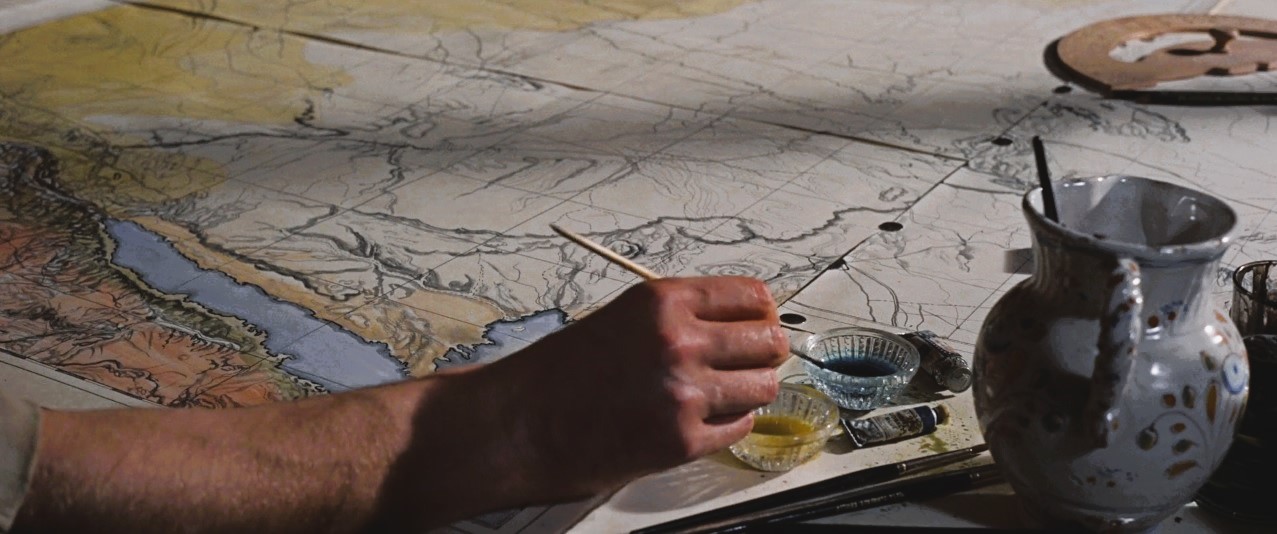
This is a screen shot from a 1962 film; bonus points if the reader can recall which one:


It clearly shows a time when maps were painted onto a paper surface; the thickness of the paper is evident from the paper edges shown — which, additionally, gives a sense of the way in which maps were built piecemeal.  In context, what's depicted is a military map; the hand belongs to a soldier.  This means the rendering has to be sufficiently accurate to campaign with, understanding that a sufficient error might result in the deaths of hundreds of men.

My imagination is belittled by the idea that I'd ever produce work of this quality, in a way that it never can be by Dyson's work.  Given time and motive and practice, I'm quite certain I could reproduce Dyson's technique and appearance in a year or two — given that I've already overcome many troubles that artists encounter in that I know how to work towards a goal.  I could never manage Dyson's output; I'd grow bored of the procedure long before then, but only because the maps represent nothing.  I'm able to keep working at my maps of the world because of the source they depict.  I could, if I wished, go there.

But the painted map above — I am simply in awe.  I recognise that, had my mapmaking interest as a boy led me to mapmaking as a career, I would have ended in some semblance of creating the above ... but I would have needed help getting there.  I can see in the example shown, how someone has drawn the topography, creating a three-dimensional effect that astounds me.  I can see the painter is clearly doing only a part of the work, adding the shading over the sea and the land (blue and yellow water colours shown) ... but my my my, there's so much going on here that I'd be honestly fearful to try.

There could be much here, however, that I'd want to incorporate into my map of Wales.  A run of accurately drawn three-D hills and low mountains, river courses and that delicious shading along the coast.  I learned how to reproduce the colour with the use of high-quality pencil crayons, held at a 30 degree angle above the page and gently moved back and forth over the area like a brush, maintaining a high consciousness of when to shift the crayon and when to sharpen it — which was again done with a quality sharpener used in draughting.

I can recall numerous rules that applied in the practice of making those maps I'd make in my mid-20s.  The table was washed and hand-dried before the evening's work.  My hands were washed too, and dried, and then allowed to air dry.  Paper, over a long period, is notoriously susceptible to human oils ... though a very tiny amount of human oil is a good thing, as it lends a certain shine to 60-weight paper that produces a positive glow.  I couldn't drink or eat while working, nor allow anyone else near, since a single spot of liquid or grime could ruin the long single page being worked upon.  And at the time I had a daughter aged 1 to 3 around, so I needed my wife to manage the darling thing while I worked.  I had no separate room to work in, so I worked on the dining room table we owned, getting started after supper.

I added hills and mountains to those maps, but there was nothing accurate in the exact placement of a hill or mountain "symbol."  Going round again, I'd want to shoot for that.  Maybe later, take courses that would teach me how to sketch and paint the level of map shown in the film shot, but between 9 and 12 I'd at least like to give some approximate semblance to the features in Wales.  I'd have my father show me, and I'd practice with drawing mountains and hills like Bob Ross filling in trees.  It's something I've told myself I should do — but honestly, with online maps, it just so easy to make one mountain and then cut and paste it over and over.

In all this description, however, I've left out the point.  Why go to this trouble?  Why produce the map at all?  How is D&D helped by a map of Wales that's floor to ceiling?  It's just a map — and despite my last post, I'm sure I've changed no one's mind that D&D is a "game of imagination."

Consider the problem of players.  I already know how to make a world, both in the old-fashioned style of the 1980s and 90s and in the modern style of graphic layout.  I'm quite sure I can sufficiently construct the rule-system that I have now over time, at least in partial until I'm awarded to books once again starting after 1979.  It's only five years.  It's been a long time since I considered five years to be a long time.

At some point, as I've said, I'll want players.  I may have some trouble relating to my peers when I'm entering grade seven and they're still just 12 y.o., while I'm past 60 ... but I get along with 12 y.o.'s right now so I don't think that's such an issue.  I've got to convince them, though, that D&D is a game worth playing.  That would be 1977.  Somewhere in the world, there are people playing the basic game by then, but not in my part of the world, so far as I know.  I'd seek it out to be sure, but probably I'd be disappointed.

Then as now, acquiring a player comes down to the same set of obstacles.  For the most part, the game is one, but mostly in how well it's run and not so much in the "idea" of the game.  I've always found the idea to be rather easy to sell — but the game has to be presented in a fashion that people have a concise, inherently practical viewpoint of their participation and the DM's expectations.  This is something that we can talk for a long, long time about, and probably will, but here I'll concentrate on outlining the matter.

"Concise" game-play describes the players' understanding of what the game's about.  In it's smallest terms, D&D is no different from a board game, with the caveat that the players work together, and not against each other.  That point, however, is something that has to be explained and even dictated, in the manner of, "You're not allowed to attack each other.  That's counted as losing the game and you'll either suspend efforts in that direction, or I'll deny you further opportunities to participate."

Note that includes a misnomer.  Within the game's structure, there's no such thing as "losing."  You know that, I know that.  But for a player who has no previous experience with an RPG, it's easier to use terms that are familiar with them.  There's an important distinction in RPGs between "losing" and "failing" — but most board games don't have that distinction.  Monopoly, for instance, is about "failing" to succeed more than everyone else; but it's easier to call that "losing," because that's the acceptable nomenclature.  If you turned to someone who had just lost at Monopoly and said, "You failed to succeed," though factually true, it's probable the response would not be positive.  Most people, with respect to a board game, are more comfortable with the word "losing" than "failing."  The latter is more accurate, however, when it comes to D&D, since there's no one to lose against, while dying is a failure that's awarded with a new character and a new attempt to succeed.  From this the reader should take that when describing D&D to a new player, accuracy is less important than importing the correct mindset into the listener.  Dying = losing is an easy equation.  Use it, and clarify later.

So, I was saying that we need to define what the game's about.  Or, if we prefer, what a successful and ongoing game is about.  Simply put, D&D is about pursuing conflict and reward.  Any other approach to the game, with new players, is certain to produce various degrees of one upmanship and "fucking around," where the player's imagination is given latitude to take the premise of the game and test it's boundaries.  The effect is like putting our thumb on a gyroscope.  The gyroscope continues to exist, but it ceases to be something that draws our attention.

Don't let it happen.  It will anyway, because humans are humans, but if its clear the behaviour isn't condoned by the DM, it might manifest from time to time, but it won't thrive.  Instead, the game will thrive.  Which is the goal.

Thus, the "practical" game emerges.  Discouraged from believing they can "get away with things," the players instead apply themselves to measuring the usefulness of their actual skills and abilities.  These can then be applied to killing monsters and obtaining treasure.  Though the game can be elaborated far, far past the singular model of hack and slash, players have to learn it before they can move on.

No, I haven't missed the obvious flaw in the proposed above.  The question is, how does the DM make it clear that certain behaviour isn't condoned, without the players simply leaving the game?  A failure to address this question is the reason why, O Reader, so many of us have such trouble keeping players, even when we can find them.

We have to be special.  In being the DM, we have to make an impression on a level that encourages the player to swallow things they don't want to swallow, because they in turn want to impress us.  If they're not coming to the table thinking, "I sure hope I don't humiliate myself at tonight's game; all I want is for the DM to approve of my play," then we don't have a chance.  We can't DM.  They've got to feel that they need to live up to our expectations — which means, (a) we've got to earn their approval ahead of time, and (b) we've got to have expectations.

All this content about mapmaking is about (a).  As a DM, when we organise a table, we must be conscious of the need to really stun the players with our apparent capacity to run the game.  An 8-foot tall map of Wales, which obviously took hundreds of hours to create, which in turn looks unbelievably fascinating, is one way — especially when the players are told they're going to be put in this little village right here, such-and-such distance from this hill and this craggy forest.  This is taking hold of the player's consciousness with both hands and giving it a hard shake.  We follow this by hefting up massive amounts of content which we place on the table next to us at the start of the running.  I used to make a show of taking the old heavy rulebooks as a single mass and slamming them down on the table at the start of my games.  Bang! — "All these rules ... this is what I play with.  All of them.  Don't fuck with me."

We'll get on with expectations with the next post.

Wednesday, December 27, 2023

Action and Moment

Were I cast back to 1973 as the writer I am now, I would undoubtedly begin rewriting How to Run, my guide for improving as a dungeon master.  Given that D&D would not come into existence until the next year, and not become widespread until the end of the decade, it would be odd, no doubt, to write such a book.  How to Run assumed that the reader already knew what role-playing games are, and that he or she had already had some experience with being a DM.  I took no time to explain game rules or in comparing one game with another.  I ignored the popularity of games and discarded any notion that it was my goal to "sell" the concept of playing RPGs as something the reader ought to do.  Instead, I wrote exactly what it said on the tin.

I'm certain that a book like that would do well in the 1980s — especially when the D&D market was far smaller, yet large enough for DMs to feel overwhelmed by the game's expectations.  Still, that would be a decade away, and such a book would be of no use to those players I'd want to obtain in Junior High.  I'd want to write it and save it, for the day it could be sold at those game cons I attended in the '83 and '84; but even I have to admit that what the 70s needed was a good, solid introduction to the game from an experienced writer.

I've avoided such a book, sincerely because my few swings at such a manual were dissatisfying.  It's especially difficult in the present.  I've no interest at all explaining how to introduce someone to 5e, or any of the trash products that exist not as games, but as an excuse to preen and simp one's way through mock adventure-based die rolling.  I've no appreciation or consideration for 5e, nor for those who play it, defend it, write about it or claim it to be things it plainly isn't.  If that seems harsh and unfair, for those who don't already know this about me ... please understand that from my perspective, it's as though the Major League Baseball I watched in the 1980s has since been replaced by adult-played children's "T-ball" ... with a world of fans expressing vehemently that T-ball is vastly better than the old, overly difficult and impossible to play traditional baseball.  I cannot resolve in my mind the vapidity, nor the gutless spirit of present-day D&D, in any manner that doesn't leave me feeling either robbed or incomprehensive.  Stupid people have co-opted the game I love.

Thus, should it happen that I could conceive of a solid introductory tome for new participants playing D&D, there's no market for it.  I view the player's character as an extension of the player, with the player's sense and limitations, enabling the player to pit his or her skill against the game's setting and obstacles.  I don't view the character as a stand-alone figure with an invented modality that conveys emotionality and sentiment to things that have nothing to do with the setting.  The proposal that a player is supposed to invent a "back story," such that the character's father was killed and the character is now seeking revenge, strikes me as a stale, artificial attempt to create something the game's setting has been made unable to provide.  The setting motivates action; which in turn spontaneously produces behaviour, much like a transformational chemical reaction that rearranges constituent atoms explosively and well beyond the direction of both players and DM.

Once the players start taking actions of their own accord to compensate for events in the setting, the DM in turn is compelled to respond to the players' actions.  This produces a constant, immersive, spontaneous feedback loop that bangs back and forth so effectively that neither DM nor player wants to let the experience cease.  Thus it's easy to entice the players back, because they want needfully to again take up the series of actions they intended from several sessions back, which have not yet reached fruition.  Throughout every session, the players spend time talking about what they're going to do next, just as soon as the present iteration is complete.  The DM need not waste any time inventing scenarios for the players, once the gyro has begun its spin.  All of the DM's time has to be spent building the setting ahead of the players as rapidly as possible, else the players would be left standing around as if waiting for the next room to get built — a room, I might add, they're slavering to see.

I've written repeatedly how this is done:  every event from the first moment of the game is provided at least one "open door" for the players to look through, to see what's beyond — the "door" being metaphorical.  The method is repeated thousands of times in novels and films; and yet somehow I always find myself speaking to a DM wanting desperately to acquire the method, only to learn that he or she has no interest in reading books or watching movies.  How does a book capture your attention?  How does a film pull you in?  If the reader cannot understand this simple equation, and wants to, then sit and consume hundreds and hundreds of pieces of literature and cinema, even if you only read or watch only the first ten percent of each.  The characters meet a stranger; they stumble across an object or an inexplicably dead body; something already in their possession suddenly acquires some new bit of knowledge that explains it; the party's freedom of movement in infringed by a larger more powerful group; the characters arrive into a situation that's already ongoing; an accident strands the characters; someone with authority is enamoured and invites the party to dinner, for no purpose — but the party slowly realises they can ask a favour of this person; an ineffectual or troublesome member of a character's past appears; the party sees evidence of wrongdoing or persecution; someone asks the party to do something vile, which they won't do; a tremendous accident occurs to the party, or in front of the party, requiring that dozens of helpless victims have to be rescued from some very dangerous situation; the political region changes hands; there's a competition; someone becomes ill; someone becomes unexpectedly rich and publicly so; something powerful and yet benign arrives and needs guidance ...

The list is literally — as the vast number of books testifies — so large that no DM can ever possibly run out of possibilities.  Yet they sit there, on a shelf, in obscurity, while every participant faithfully reproduces the saga of batman one more time.

If I were to describe a role-playing game to those who had never encountered such a thing, I would certainly not use the term "role-playing."  It's woefully non-specific and easily misunderstood, and unquestionably the worst option for what the process ought to have been called.  Using the term, the player is easily duped into thinking a "role" is like a part played by an actor — a part that is scripted and rehearsed repeatedly, and therefore in no way like D&D.  The word "play" is acceptable when applied to a game; I can "play poker" and remain comfortably assured that everyone here understands this is an adult activity.  But as soon as "play" is associated with "imagination," we're rapidly cast into playing pretend, playing house or any number of childish activities that adults shun.  D&D isn't a serious game because it's "played."  Even the acting community has moved away from the term "players" to describe the performers, preferring the more serious-sounding, "actor."

The D&D participant more correctly "acts" within the setting.  Arguing constantly that D&D, and other RPGs, are games of "imagination" only serves to warn adults to stay away, while providing exactly no context for what the game actually provides or what the participants do when participating.  It's corporate buzz-speak, designed to cover up the ever-present difficulty of providing a meaningful setting for the DM to run, beyond the stream of shallow maze-based episodic funhouse concepts that have been the height of company ingenuity these past 50 years.  A setting requires depth and resiliency.  A funhouse is good for five minutes in exchange for the participant's voucher.

When acting upon the setting, the setting acts upon the player:

When I have seen the sea once more,
has the sea seen me, or hasn't it seen me?
Why the waves ask me
the same that I ask them?
And why do they hit the rock
with such a futile enthusiasm?
Don't they get tired of repeating
their declaration to the sand?

 — Pablo Neruda, "The Rider's Song"


The decision to go to a place, to see what's there, to reflect upon what's happened, is the central core of life's experience, and therefore the same centrality that humans experience when playing an RPG.  It makes no difference if the "sea" is imagined or real; the potential for reflection is the same.  Therefore, in fact, D&D is not a "game of imagination," but rather a game of structured moments and tactile proposals arranged to produce specific, quantifiable, predictable, beneficial and immersive responses.

I am not "imagining" an orc, nor am I "imagining" my response.  The orc is defined and I'm accepting the definition, regardless of the immateriality.  My response is defined by the game's limitations and boundaries, in the sense that I know already what I can do; the game's success relies upon choosing the best thing that I can do in this moment.

By arguing that it's a game of imagination, however, we've brainwashed the participants into believing that the solution is to spontaneously create something to replace the orc, because it's new and different, yet offers nothing but an obscure nothingness, since as a player I have no idea what this thing is.  In turn, players are encouraged to spontaneously invent responses that aren't covered in the game's rules — which must therefore be tossed, since there's no way they can apply in this imagination mandate.  This ends in a lot of irrationality and abstractness, producing no concrete feeling for what's happened, what might happen, or even why we're here doing this thing at all.

So I would not, to a group of unknowing persons, argue either that the game can be described as "role-playing" or as "of the imagination."  I'd argue that it's a game in which persons act as generated individuals in a fictional setting, with parameters that are firmly established by the game's rules.  As this is what actually happens when my "players" sit done to "play" in my game world.

This confirms the extraordinarily powerful need for the DM to have a setting, one the DM can understand thoroughly and faultlessly — within human limitations.  This provides the grounding for the participants as they gird themselves up with pre-defined pieces of equipment, their physical being established by metrics for measuring their health, capabilities and action choices.

And so we come back around to the game's map, that of Wales, and it's influence as a setting that I'm devising for the benefit of the players, once I'm ready to introduce them to D&D.  Take note, stated firmly, it's in my interest to ride the actual creation of the game as it will between 1974 and 1980.  I have no wish to create my own role-playing game, nor compete with D&D, nor pretend that's not the game I'd be playing.  All I want is to obtain benefit from all the time I've designed and played the game through the first go-round of my life, to use that experience in the thought experiment that's been proposed here.

Saturday, December 23, 2023

Saturday Q&A (dec 23)

The following is presented in the spirit of rethinking and potentially improving existing rules in D&D, which is accomplished through proposing rules, describing them to the players (and others) and then playtesting those rules to see what game effects are discovered.

Sterling in Maine writes,

With my [efforts] on the missile fire rules, I was aiming (sorry) to hit (sorry, again) the apparent size of target for which the by-the-book range penalties of -2 and -5 should be applied. I used the results from the Great Britain's National Clout Archery Championship results this year and a Yorkshire regional championship of western archery results as a basis. While that part was sort of rigorous, I failed to really connect it with AD&D's combat rules which account for armor penetration and hitting moving targets. The shortcoming became painfully obvious when I began trying to actually use these rules, so I've taken another pass.

To set the context for these rules, I'd like to explain that my group plays a modified version of AD&D. We began play a few months ago using by-the-book rules with only four exceptions:

  • A replacement rule for "Player Character Non-Professional Skills" on DMG p. 12
  • Use of use the male values for ability score minimums and maximums on PH pp. 9 & 15 regardless of sex
  • Omission of alignment
  • A slightly modified starting hit points scheme: 1d6 + constitution modifier + either the maximum normal hit point roll minus 6 or zero, whichever is greater


Over time we propose rules changes and if we achieve consensus on the change, we adopt it. If you're curious, you can check out the rules we have so far proposed, some of which have been "ratified" and some are still in progress, here https://erin1478.blogspot.com/. I have been bothered by the fact that target size is not a factor in missile fire attack modifiers, and questioned the veracity of the missile fire rules generally. A few weeks ago I tried to address it, but when I tested my proposal it kind of fell apart. I've made a second pass with which I'm much more pleased and would like to share it in case it has any value for others.

It should also be noted that we have adopted 1" = 22' for distances both indoors and out instead of AD&D's 1" = 10' inside and 1" = 30' outside. There are vertical clearance rules around missile fire as well which are not addressed below, as this is exclusively about range adjustments, but which I bring up as it's mentioned by Gygax in his justification for differing indoor and outdoor scales.

The following is the proposal I sent to my players earlier this week with a little more explanation added and a couple of errors fixed:

With my previous iteration on the missile fire rules, I was aiming (sorry) to hit (sorry, again) the apparent size of target for which the by-the-book range penalties of -2 and -5 should be applied. I used the results from the Great Britain's National Clout Archery Championship results this year and a Yorkshire regional championship of western archery results as a basis. While that part was sort of rigorous, I failed to really connect it with AD&D's combat rules which account for armor penetration and hitting moving targets. The shortcoming became painfully obvious when I began trying to actually use these rules, so I've taken another pass.

This time, I'm using the same data that I had from those actual archery contests, but counted the targets as being equivalent to an armor class 10 target (no armor to penetrate) and immobile, giving the attacker a +4 to hit. To relate it to the attack matrices, however I had to equate these real-world, champion archers to a class and level in the game. I chose 7th level fighter as representative of competitors at this level. This is of course arbitrary, but I comfort myself with knowing that there is only 1 person in all of Mallow [this is the barony in which the PCs reside] with that level of archery competence and there are far more people practicing archery on a regular basis there than in modern day Yorkshire. Incidentally, the AD&D rules give a 7th level fighter the title "Champion" so that fits nicely.

For a 7th level fighter to hit the clout circle at 560' away 45% of the time, considering it an AC10 target, held immobile for a +4, the archer would need to suffer a -9 penalty. Likewise, the other rates of championship hits are equated to the penalty required to make a 7th level fighter hit that percentage of the time.


Interpolating between these values for the angular size of target which would give a 7th level fighter an attack penalty of between -18 and -8 is straightforward enough. I continued to extrapolate the angular target size implied above and below those penalties until passing the smallest angular size the human eye can perceive. The human eye can discern a minimum angular size of about 1/60 of 1 degree. Some sources report it as low as 0.01, but I've used the 0.016667 figure. In theory, that penalty is valid all the way to something as small as 0.00545 degrees to the eye, but if your eye can't see it, you can't aim for it. The -21 penalty means that a 7th level fighter needs to roll a 22 in order to hit that small an immobile target, making it just impossible. Somewhat crazily, this gives a 17th level fighter, the absolute pinnacle of AD&D combat prowess, a 45% chance to hit an immobile target just barely large enough for him to see (and within range of his weapon of course). For such a fighter proficient with and employing a composite longbow, that would be an orange at 630', 1.75 football fields away.

For penalties less than -8 and bonuses, I had to choose a maximum bonus and angular size increment. I chose to set the maximum bonus at +7 as this would give even the common man proficient with a bow an automatic hit on a stationary AC10 target. Following the same angular size increment which took the penalty down from clout circle to western target, a certain hit for the commoner must be at least 2.89454 degrees to the eye which is equivalent to a straw mannequin at 59' or a 10' by 10' barn door at 198' and is consistent with the modern recommendation for beginning archers to use an 80 to 90 cm target at 18 to 20 yards. A first level fighter who is untrained in the bow could hit it 95% of the time and an untrained commoner 75% of the time.

Interestingly, small distances close by make a significant impact; in close, a couple feet closer can improve the archer's chances by 5%, but further out distance changes mean much less. On the table below, read the rows as adjustment up to the range specified in feet for the target size in question. For other target sizes, one can calculate angular size as twice the arc-tangent of the target diameter over twice its distance away, or simply scale the distance from one of the sizes given. For example, at 70' a 3' diameter target has an angular size of 2.45006, so a 1' diameter target would have a third of that, or 0.81669 giving a -13 penalty.


In tactical unit combat, using our AD&D movement scale of 1" = 22' and a 1" marker representing a squad or more, units would be one or more rounds away and that's at least 132'. At that range the difference between missile adjustments is at least half an inch on the table, and maybe several inches. For hand-to-hand with a 1" figure or marker per combatant, a scale of 1" = 3 1/3' is necessary. In close combat on the individual scale, the increments are at least an inch and maybe as great as a 3 inches on the table.

At first I thought that this table was too granular to be practical, but I'm changing my mind the more I look at it and its implications for tactical decision-making.

What do you guys think?


_____

Thank you.

If readers would like to reply to the above, or wish to ask a question or submit observations like those above, please submit  to my email, alexiss1@telus.net.  If you could, please give the region where you're located (state, province, department, county, whatever) as it humanises your comment.

Feel free to address material on the authentic wiki, my books or any subject related to dungeons & dragons.  I encourage you to initiate subject material of your own, and to address your comment to others writing in this space. 


Friday, December 22, 2023

The Ghosts of Christmases Past & Present

11 p.m. on Friday and my first dinner for Christmas is done, put on for friends.  We had a large stuffed chicken and honeyed carrots, with nog, wine, 12-year-old rye and very little conversation about politics.  Mostly, talked about music and writing, philosophy and here and there, family and stories from the past.  Good times.

I haven't much energy left but I felt compelled to write a moment about this strange series I'm writing.  I understand perfectly the absurdity of it all — and I certainly appreciate how much opportunity it gives me to talk about myself, my early life, my troubles and strife, and all the good things that make for a good old-fashioned inflated ego.  I can only say that it's what's on my mind at present.  I hope that it rings clear that these are not times I'd ever want to relive, nor are they things I feel nostalgic about.  I'd enjoy seeing Mr. Leavitt or Mr. Mullen again, certainly; but given the premise, it would be impossible to relate to, or be friends with, any of those friends I had at that time.  I cannot, as some writers imagine is possible, believe that I could simply forget every lesson I've received over the last fifty years so I could "play" with a bunch of children that, at best, I have few memories about.

Though perhaps that's an element in this investigation that spoils the reader's pleasure ... that I refuse to play blind man when describing with my parents were like, or the rest of my teachers, or the world at large.  For the record, my parents weren't monsters.  Later, my father would knock me around with his fists once he'd lost all ability to intimidate me with his voice, and my mother would retreat into her shell whenever faced with a moment of stress ... but they did not drink, or gamble, or fail to pay the rent or set out to maliciously humiliate myself or my siblings.  Their version of "love" was fully based on the principle that their responsibility towards their children was to ensure they had a good life ... and therefore my parents pounded the drum of school and church and work for work's sake, all-fired certain that the best way to drive children towards a university, a professional career, a house and a family was to give no other options to that plan, and to ground us, intimidate us, and restate their position hundreds of times until our growing old enough to understand how much of it was really bullshit that had been taught to them, which they had failed to recognise as such.  Or maybe they always knew, but hoped and prayed they were wrong.

Much they tried to teach me stuck — but nearly always in ways they didn't intend.  My father repeated constantly that I "needed to take responsibility" for things, but he meant school and my grades and the respect I had for teachers.  I interpreted it as taking responsibility for what I believed, for helping others who could not help themselves, that I was responsible to the truth about the cruelties and misery in the world ... these being all sorts of esoteric things my father didn't give a damn about.  I'm not nostalgic about my father; I'm not in love with my father as a man, or as my progenitor; because after all this time I still think he was wrong.  I think that, in the end, he was a very selfish man, someone who worked hard and got his, and had very little time to spare for others unless that sparing in some way helped himself.

They had a very comfortable and contented life.  They never lost their home, they were never broke, they never lacked for the money to do the things they wanted ... and despite heart troubles in my mother, who did suffer on account of that, after being given 3 years to live in 1977 she went ahead and lived 35 years instead.  As much trouble as she had, medical science kept pace and kept her alive year after year.  She saw her children grow up and marry, and she was given six grandchildren.  Her house was full every Christmas; her children lived in the same city with her and neither she nor my father ever had to live out the lyrics of Cat's in the Cradle.  They'd been married for 54 years when she died; as far as I know, neither ever had an affair on the other; and though they quarrelled, they were there for each other, through good times and bad.

It is a sin for many people not to speak of one's parents with reverent tones.  It's a sin not to want to return to the foolhardy dimwittedness of childhood, when we were mesmerised by shiny objects and remarkably simple things.  It's a sin not to pay lip service to the glories of some past decade in which we were children, as if any decade in human history — ever — has been worth speaking about in glowing terms.  Nostagia is bunk.  For those readers out there who had great and wonderful parents, who have their backs up reading this for the sin I've committed in no longer loving mine, wake up please and realise that there are untold hundreds of millions of children in the world who have terrible parents.  I was not treated well, kindly, generously, patiently or lovingly by mine, for all their abundance.

I have no desire to be as ignorant as a child again; I don't yearn for the shallowness of childhood games and dreams.  I like being educated and aware.  I am enormously grateful for the wisdom I've acquired.  I hold dear every soul who's taken the trouble to teach me, help me, be gracious onto me and give me reason to believe in the goodness in the world — a goodness I can experience and enjoy, right now, without the need for blinders nor wistful fantasies about a time that never actually existed.  I don't need or want the memory of friends long gone away ... I can walk ten paces from where I sit at this moment and seize hold of my Tamara, squeezing her with love and asking if there's anything she wants or needs, which I am pleased and honored to provide, if she's ready to name something.  It is in this now that I'm happy; and it's with that happiness in hand, that I've built over the course of my life stone by stone and hug by hug, that I can comfortably stab and maim a past I have no special love for.

To me, it's a problem to solve.  If it were such-and-such a time, and this were my goal, these would be my obstacles and these would be my assets.  I am deconstructing.  And because I am, I am happy.

Forgive me, dear reader.  Let me finish, since I don't know if I'll write again before the 25th, by wishing you all a Merry Christmas.  May you all spend it as you wish, with people you love, who love you, and may this year be memorable for you in all the years hence that you have to spend.