"Luddite Rule (or, George Lucas Rule):" Speaking of which, technology is inherently evil and is the exclusive property of the Bad Guys. They're the ones with the robots, factories, cyberpunk megalopolises and floating battle stations, while the Good Guys live in small villages in peaceful harmony with nature. (Although somehow your guns and/or heavily armed airships are exempted from this.)
Ah, this.
Within my experience, this is far more a trope of film and video game than it is of D&D. It was advanced for film as a thematic principle for a number of reasons - it creates conflict, first and foremost, and it was important in the 1920s and 30s to establish the main character as someone the audience could identify with ... at a time when audiences were less well off and were largely rural born and living in cities when their parents were not. Thus, the viewer IS someone who came from a small village, and now found his or her self in a highly technological world (full of switchboards, tubes and typewriters), where the Bad Guys were bosses with the technology who forced farm boys and farm girls to work as operators and secretaries. So it made sense that they'd go to the moviehouse to watch ordinary rural-derived heroes put down smarmy, know-it-all villains with their honesty, their home-spun good sense and their spunky insight. This is called the George Lucas rule because he loved those old films and serials that devised those themes.
If the gentle reader will forgive me for not rushing straight into D&D, I'd like to also mention a similar theme, where a technologically dependent city-dweller is presented as a feckless boob when faced with the common sense of the ordinary clodhopper. It was a favorite theme of O.Henry, and made it's way through successful franchises like Ma & Pa Kettle, right up to the Beverly Hillbillies of the 1960s, where the rich, connected banker wound up being made a fool in every single episode.
So it isn't so much that science is somehow something that only bad people like, it is that science is understood by one kind of person, which is then seen as bad by the sort of people who do not understand science. And since group B is a lot bigger than group A, and films are dependent upon selling to the largest possible market share ... science is bad.
This has been carried forward into video games largely because many of the front line programmers working out there (and those with money) were born in the 60s and the 70s and are still influenced by those themes that were pounded into their heads at an early age. That, and the writing for video games is atrociously awful, and hopelessly mired in themes that the writers themselves are plainly too ignorant to understand ... i.e., it was always done this way, this works, let's keep doing it. As the TV tropes page says, "Writers are not scientists."
But of course video gamers aren't rural born, love technology, don't relate remotely with the whole "I was born in a small village" cliche and generally get mildly sick at all the sappy bullshit.
Which is why D&D seems exempt from this. I know there are players out there who embrace the concept of happy peasants capable of doing anything a king can do (yes, still pissed about that). Still, I think most players don't identify their characters as rural hayseeds, but rather fundamentally cosmopolitan and awfully streetwise. This is because, well, we are, aren't we? D&D has never been an overly popular game in small towns and villages (woe betide the poor bastard living in Jordan, Montana, population 364) and it is far easier to get a game going in a big city - anything with more than 200,000 is a safe bet there's a game going on somewhere. As such, the busy ratrace of daily life is ordinary for us and we're tapped into the highest technology available ... there's a shop just down the road that sells it. So it's a rare player that eschews an artifact of massive power potential on the basis of, 'my character is a simple soul and despises gadgets.'
Moreover, there's a natural reason not to give the enemy too many specialized items; unlike the movies, where everything gets conveniently blown up, many items - after being used by the Bad Guys - fall into the hands of the Good Guys. A smart DM knows not to load up the villains with too many nice toys, since those toys will have a drama-destroying impact on future obstacles the DM cares to invent.
Going one step further, my players will generally speak of the days when they will have the resources to make their own golems, raise their own remorhaz beasts, build their own underwater submersibles and so on ... so clearly, they're ready to embrace the power. I don't know one of them who talks of the day when they'll retire their character to some small village somewhere.
I guess they all want to be Bad Guys.
Wednesday, June 9, 2010

Monday, June 7, 2010
Vegetation Classification
Here is Kuchler's classification, reprinted without permission (they may come hunt me down later). Sorry, I did not get to choose the classification letters - if I could have, I would have picked other ones. But it's Kuchler's system, so they are his letters:
b - Vegetation largely or entirely absent
i - Plants sufficiently far apart that they frequently do not touch
z - Dwarf shrubform, maximum height 3 feet
The predominant vegetation forms include (image below descriptions):
B - Broadleaf evergreen trees (Amazon, Congo, Sumutra-Borneo, Southeast Asia)

Bs - Broadleaf evergreen shrubform, minimum height 3 feet (Mediterranean scrubland)

Bsp - Broadleaf evergreen, shrubform, minimum height 3 feet, growth singly or in groups and patches (chaparral, Baja, Sonora Desert)

Bzi, Bz - Broadleaf evergreen, dwarf shrubform, maximum height 3 feet, plants sufficiently far apart that they do not touch (sagebrush - Nevada Desert, scattered areas of the Western U.S.)

D - Broadleaf deciduous trees (Ohio-Indiana, Western Europe, Zambezi Basin, Southeast Asia highlands, Deccan Plateau)

Di - Broadleaf decidous trees, plants sufficiently far apart that they frequently do not touch (caatinga - Northeastern Brazil)

Ds - Broadleaf deciduous, shrubform, minimum height 3 feet (Yucatan Peninsula, Haiti)

Dsi - Broadleaf deciduous, shrubform, minimum height 3 feet, plants sufficiently far enoguh that they frequently do not touch (Mexican Plateau)

Dsp - Broadleaf deciduous, shrubform, minimum height 3 feet, growth singly or in groups or patches (desert regions worldwide, Sahara, Kara Kum, Arabian Peninsula)

Dzp - Broadleaf deciduous, dwarf shrubform, maximum height 3 feet, growth singly or in groups or patches (Sind, Indus Valley)

DsG - Broadleaf deciduous, shrubform, minimum height 3 feet, with grass and other herbaceous plants (outer pampas of Argentina, Ecuador)

DG - Broadleaf deciduous trees with grass and other herbaceous plants (Serengeti, Russian wooded steppe)

DBs - Broadleaf deciduous trees with broadleaf evergreen, shrubform, minimum height 3 feet (Bihar-Orissa in India)

E - Needleleaf evergreen trees (Northern Canada, Pacific Northwest, Russia & Western Siberia)

Ep - Needleleaf evergreen trees, growth singly or in groups or patches (New Mexico)

G - Grass and other herbaceous plants (Great Plains, Russian Steppe, Pampas, Veldt, Manchuria)

Gp - Grass and other herbaceous plants, growth singly or in groups or patches (Gobi Desert, eastern Iran & Afghanistan, central Australia)

GBp - Grass and other herbaceous plants with broadleaf evergreen trees, growth singly or in groups or patches (southern Spain, Australian Outback)

GD - Grass and other herbaceous plants with broadleaf deciduous trees (savanna, from Kenya to Senegal, central Zaire)

GDp - Grass and other herbaceous plants with broadleaf deciduous trees, growth singly or in groups or patches (Uruguay)

GDsp - Grass and other herbaceous plants with broadleaf deciduous, shrubform, minimum height 3 feet, growth singly or in groups or patches (Sahel, south Texas, Somalia, Peruvian Puna, Thar Desert)


GSp - Grass and other herbaceous plants with broadleaf evergreen and deciduous trees (semideciduous), growth singly or in groups or patches (Gran Chaco, Central Brazil, Northern Territory, Queensland)

L - Herbaceous plants other than grass (tundra, moors, heath, highlands above the treeline, worldwide)

M - Mixed: broadleaf deciduous and needleleaf evergreen trees (Central Europe, Virginia-Tennessee, Szechwan China, North Island NZ)

N - Needleleaf deciduous trees (taiga, northern & eastern Siberia)

ND - Needleleaf deciduous and broadleaf deciduous trees (Khintan Mountains China, Amur Basin)

S - Semideciduous: broadleaf evergreen and broadleaf deciduous trees (Yangtze Basin, Brazilian Rainforest, Bali)

Ss - Semideciduous: broadleaf evergreen and broadleaf deciduous, shrubform, minimum height 3 feet (high Pampas western Argentina)

SsG - Semideciduous: broadleaf evergreen and broadleaf deciduous, shrubform, minimum height 3 feet, with grass and other herbaceous plants (Swanland Australia)

Szp - Semideciduous: broadleaf evergreen and broadleaf deciduous, dwarf shrubform, maximum height 3 feet, growth singly or in groups or patches (Patagonia)

SE - Semideciduous: broadleaf evergreen and broadleaf deciduous trees, with needleleaf evergreen
trees (Yunnan China)

b - Vegetation largely or entirely absent (includes both snowfields such as Greenland or Antarctica, or desert ergs such as parts of the Sahara, the Takla Makan in China, the Empty Quarter in Arabia or large areas of central Australia)


The various formulas are used to designate types of vegetation. Each formula constitutes a short description of the chief characteristics of a vegetation. The classification is based on whether plants are woody or herbaceous, and if woody, whether they are broadleaf or needleleaf, or if they are evergreen or deciduous. The small letters are added to give more detail to the description.
All capital letters other than G and L imply trees, unless accompanied by s or z. The small letters refer to the capital letter immediately preceding them. Thus, DsG means that the vegetation consists of broadleaf deciduous shrubs (Ds) and of grass (G); GBp represents grass (G) with patches of braodleaf evergreen trees (Bp). Modifiers include:
b - Vegetation largely or entirely absent
i - Plants sufficiently far apart that they frequently do not touch
p - Growth singly or in groups or patches
s - Shrubform, minimum height 3 feetz - Dwarf shrubform, maximum height 3 feet
The predominant vegetation forms include (image below descriptions):
B - Broadleaf evergreen trees (Amazon, Congo, Sumutra-Borneo, Southeast Asia)

Bs - Broadleaf evergreen shrubform, minimum height 3 feet (Mediterranean scrubland)

Bsp - Broadleaf evergreen, shrubform, minimum height 3 feet, growth singly or in groups and patches (chaparral, Baja, Sonora Desert)

Bzi, Bz - Broadleaf evergreen, dwarf shrubform, maximum height 3 feet, plants sufficiently far apart that they do not touch (sagebrush - Nevada Desert, scattered areas of the Western U.S.)

D - Broadleaf deciduous trees (Ohio-Indiana, Western Europe, Zambezi Basin, Southeast Asia highlands, Deccan Plateau)

Di - Broadleaf decidous trees, plants sufficiently far apart that they frequently do not touch (caatinga - Northeastern Brazil)

Ds - Broadleaf deciduous, shrubform, minimum height 3 feet (Yucatan Peninsula, Haiti)

Dsi - Broadleaf deciduous, shrubform, minimum height 3 feet, plants sufficiently far enoguh that they frequently do not touch (Mexican Plateau)

Dsp - Broadleaf deciduous, shrubform, minimum height 3 feet, growth singly or in groups or patches (desert regions worldwide, Sahara, Kara Kum, Arabian Peninsula)
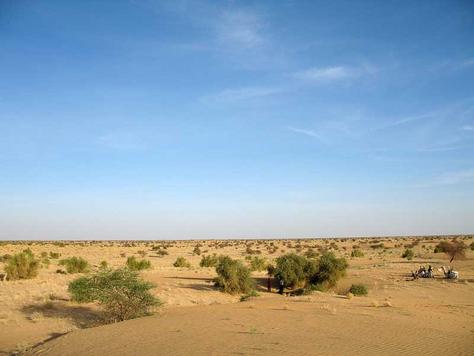
Dzp - Broadleaf deciduous, dwarf shrubform, maximum height 3 feet, growth singly or in groups or patches (Sind, Indus Valley)

DsG - Broadleaf deciduous, shrubform, minimum height 3 feet, with grass and other herbaceous plants (outer pampas of Argentina, Ecuador)

DG - Broadleaf deciduous trees with grass and other herbaceous plants (Serengeti, Russian wooded steppe)

DBs - Broadleaf deciduous trees with broadleaf evergreen, shrubform, minimum height 3 feet (Bihar-Orissa in India)

E - Needleleaf evergreen trees (Northern Canada, Pacific Northwest, Russia & Western Siberia)

Ep - Needleleaf evergreen trees, growth singly or in groups or patches (New Mexico)

G - Grass and other herbaceous plants (Great Plains, Russian Steppe, Pampas, Veldt, Manchuria)

Gp - Grass and other herbaceous plants, growth singly or in groups or patches (Gobi Desert, eastern Iran & Afghanistan, central Australia)

GBp - Grass and other herbaceous plants with broadleaf evergreen trees, growth singly or in groups or patches (southern Spain, Australian Outback)

GD - Grass and other herbaceous plants with broadleaf deciduous trees (savanna, from Kenya to Senegal, central Zaire)

GDp - Grass and other herbaceous plants with broadleaf deciduous trees, growth singly or in groups or patches (Uruguay)

GDsp - Grass and other herbaceous plants with broadleaf deciduous, shrubform, minimum height 3 feet, growth singly or in groups or patches (Sahel, south Texas, Somalia, Peruvian Puna, Thar Desert)


GSp - Grass and other herbaceous plants with broadleaf evergreen and deciduous trees (semideciduous), growth singly or in groups or patches (Gran Chaco, Central Brazil, Northern Territory, Queensland)

L - Herbaceous plants other than grass (tundra, moors, heath, highlands above the treeline, worldwide)

M - Mixed: broadleaf deciduous and needleleaf evergreen trees (Central Europe, Virginia-Tennessee, Szechwan China, North Island NZ)

N - Needleleaf deciduous trees (taiga, northern & eastern Siberia)

ND - Needleleaf deciduous and broadleaf deciduous trees (Khintan Mountains China, Amur Basin)

S - Semideciduous: broadleaf evergreen and broadleaf deciduous trees (Yangtze Basin, Brazilian Rainforest, Bali)

Ss - Semideciduous: broadleaf evergreen and broadleaf deciduous, shrubform, minimum height 3 feet (high Pampas western Argentina)

SsG - Semideciduous: broadleaf evergreen and broadleaf deciduous, shrubform, minimum height 3 feet, with grass and other herbaceous plants (Swanland Australia)

Szp - Semideciduous: broadleaf evergreen and broadleaf deciduous, dwarf shrubform, maximum height 3 feet, growth singly or in groups or patches (Patagonia)

SE - Semideciduous: broadleaf evergreen and broadleaf deciduous trees, with needleleaf evergreen
trees (Yunnan China)

b - Vegetation largely or entirely absent (includes both snowfields such as Greenland or Antarctica, or desert ergs such as parts of the Sahara, the Takla Makan in China, the Empty Quarter in Arabia or large areas of central Australia)


Biomass
Just for those who cannot get enough, here's some reading I've been doing this morning upon determining biomass - this is data pertaining principally for Botswana, but the database development is interesting.
Now compare that with these figures here.
I can hear the casual gamers groaning.
Now compare that with these figures here.
I can hear the casual gamers groaning.
Friday, June 4, 2010
Engineering II
I am posting this second version of my Civilization Posts, because for me this is what I'm thinking on. I have been giving a lot of thought to the one I ought to be writing, "Theology," but it will have to wait for awhile. I run the blog, it does not run me.
Here's the thing. I was raised the son of an engineer who became very disappointed when he son decided not to go into engineering, but instead into writing and other Bohemian pursuits, such as acting and journalism. But as it happened he did manage to instill into me certain characteristics that, clearly, continue to define the manner in which I approach a problem ... such as, how does one establish a trade system, or how does one define the qualities of an NPC.
There is an old joke, that goes as follows:
A mathematician, a philosopher and an engineer were asked, what is the sum of 2+2?
The mathematician replied that the answer was '4', but specifically it could be defined as '4.000' or however many zeros you wished to add to establish the accuracy of the reply.
The philosopher answered that we could not be certain of any particular definition, since reality is defined by perception, but we could reasonably judge within a common framework that the answer might be given as more than three and less than five.
The engineer answered, "What do you want it to be?"
When I told this joke to my father, he did not laugh. Instead he answered, "Damn straight." I remember we had a discussion afterwards in which he explained that when he was in university (he went to the Colorado School of Mines), those who were flunking out of engineering courses were not those who 'couldn't handle the math,' but rather those who just didn't get the fundamental principle that engineering is not about assessing, it is about doing.
With regards to the disaster in the Gulf, I have spoken to a few engineers who assure me that a) the technology in existence operates like it does because it is what the money wanted built; and b) the solution is straight forward and practical - but it does involve a second hole and it will take months. And finally, that the second hole could be drilled beforehand, as a precaution, for every deep water platform in existence, but that no one wants to spend that kind of money.
Money is the universal limitation on engineering. I am told that everyone in the field knows this.
Well, okay. I make a D&D world, so I don't have to worry about money, and I don't want this to devolve into a long discussion about social political and technological recent events - so please make the comments relevant to D&D, at least obliquely. What I want to talk about is the inaccuracy of my world, and why it doesn't matter.
I did touch upon this with my last post about peasants and so on ... but reading through the link on the last post, about the sociology of political divisions, I am struck by my approach vis a vis towards producing a solution to a world-design problem.
Let's take something not so simple, that I have not yet solved: given a hex size of 20 miles across, with an approximate area of 309 sq.m., how many monsters of a given type ought to exist in the hex? This is to say, IF the party is going to 'clear out a hex,' as suggested in several places in the original DMG and Player's Handbook, how many creatures will the party have to fight until they are a) mostly eliminated; or b) completely eliminated?
Now give me an answer that applies to all types of hexes, from tundra to jungle, that takes into account the increase in animal size with regards to open-vegetation environments, as well as animals which are not large enough to be considered 'monsters.' At what point is the hex 'clear'? When there are no dangerous creatures larger than a dog? Are giant centipedes, throat leeches, ear seekers or rot grub to be cleared, or not? Can you answer? I mean, without pulling the number from your ass?
Fact is, you can't. No one can ... not that I've seen so far. The answer ought to lie in the biomass of a zone - for which I can find total tonnage/hectare - but how precisely is this biomass deconstructed so as to give numbers for elephants, sphinx, dopplegangers, ochre jellies, ixitxachitl and dragons? Ideas, anyone?
The general point of this post is to emphasize that a portrayal that accurately gives answers to any of the questions above is a matter of entirely no relevance whatsoever. An correct number for dragons? Huh? Define correct.
It is exactly that which justifies the rectally derived numbers that virtually no DM, anywhere, ever bothers to write down for any part of their world. Why bother? Why not just say, when the party has to clear the hex, "Uh, sure, there's a dragon and a keep that has six ogres, two roving bands of brigands and a few hundred giant rats." There, done, problem solved, please go away now.
And yes, this is engineering, by definition. Problem solved. It is rather piss-poor engineering, something like dropping two boards over a chasm and telling the driver that as long as he keeps his car wheels on the boards, no problem. My father tells of how he did exactly this over a Colorado gorge back in the 1950s, and it obviously worked, he lived long enough to make much of my life unpleasant. But even he wouldn't recommend it as a standard. It would be better to build a bridge.
Where it comes to building bridges to solve problems in your D&D world, it helps to remember that there are a wide range of solutions, ranging from the two boards to complicated archways designed to handle all manner of traffic. The principle to be followed is this: what does it do, and what does it allow?
The above example of what is in a hex, dragons and ogres and what not, answers the question, and lets the DM get on to other things. I personally don't see the benefit of that. I'm not anxious to 'get it over with' and move on. Instead, I want to make THIS the interesting thing, the thing that draws the party in and compels them to burrow around and find every last fucking thing until they KNOW the hex is clear. I want them to feel like they have accomplished something outlandishly difficult, so that when they are sitting by their hearth in their home, they FEEL like they've goddamn owned their land.
So I want the structure of my full hex to be better thought out ... hell, I want it to be randomized to the point where there are things in that hex that I, as DM, don't want to be there! I want to roll up a lich and shudder to myself, thinking, uh oh. Be damned if the party is ready for it. Or if I'm ready for it, for that matter. And when I find out that the lich has a vampire buddy, I want to be thinking, oh shit, oh shit, oh shit ...
Obviously, I also want a table that spits out the result that the only relevant thing in the hex is a set of caves populated by only kobalds. I don't want the table to be necessarily brutal. But I want the possibility of brutality, and when the dice comes up that way, I want to point at the table and say, "Guys, I hate to tell you this, but the Gods don't like you."
Okay, that's what I want a system to do. What do I want it to allow?
A nice thing about an overall system is the continuity it provides. Many DMs don't think it's true, but a party can tell when they're being jerked around by an irrationally constructed world, and it gets exhausting. Oh, look, we thought we would be safe here in this peasant village where we came to rest, but there's five wraiths feeding off the peasants. Oh, look, I've spent months building up my fortress, and now its being attacked on the day its finished by a huge army that has conveniently appeared on the horizon. Oh, look, we thought we cleared out that dungeon but a whole group of demons and devils have popped out of the ether and made it their new home. Oh, look, it doesn't matter what we do, everything we've created is being torn down for the sake of story. Oh, yay.
It is comforting to the party to know that if they cut down or burn down or blast away everything that lives or moves in the adjacent hex to their own that the number of attacking creatures would actually go down and stay down, and not ramp up on the whim of the DM. It is comforting to the party to know that if they deviate from their route to avoid the dark woods, that they won't be attacked anyway - you know, because this hex was presumably cleaned out by someone, at some point in the past. It would be nice to think that since every civilized hex is occupied by various lords of the manor, that the lords of the manor would do something to kill the nasty horrible creatures living in their own domain, so they couldn't attack random travellers on their way through. You'd think that would be something the local lords would want, you know, to facilitate trade and such.
I want my parties to have the reassurance of that. That going from wilderness to civilization is the sort of thing that makes them feel safer - that falling prey to a nasty creature living in the sewers of a city is something that doesn't happen every time they drop into town to buy supplies.
So I'm thinking that an engineered system that took account of these things would help provide a stronger structure to my world, and create a balance for the players so that they knew that if they did this, or went there, they could expect such-and-such. As opposed to a DM who's bored or whimsical or prejudiced in favor of one kind of monster (Another otyugh? For shit's sake!), who forever plays with the results to satisfy their constant need for self-importance.
(What am I saying? I create systems to satisfy my constant need for self-importance. Bad Alexis! Bad!)
In any event, the long and the short of it is engineering some kind of system that works and provides a valuable result. Engineering as a technology is more than the sum of the mathematics that goes into the construction of a bridge or the development of a methodology for the removal of oil, or what have you. It is a mindset, wherein the end result is the issue, and not necessarily the minor details. This has occasionally had some disastrous effects where it comes to building things that one would hope to remain standing, or applying efforts to extract things that one would hope not to leak out all over the environment. Such considerations are necessary for the engineer who doesn't want to kill people and such. But engineering itself is not defined by competancy. It is defined by adequacy. A bridge that remains standing without falling down is the minimum degree of adequacy desired; just as an effort to model something in order to determine how much money the project will need is, equally, not made inadequate by its degree of inaccuracy. It is accurate enough. It serves the purpose for which it was designed.
That is the only measure.
Here's the thing. I was raised the son of an engineer who became very disappointed when he son decided not to go into engineering, but instead into writing and other Bohemian pursuits, such as acting and journalism. But as it happened he did manage to instill into me certain characteristics that, clearly, continue to define the manner in which I approach a problem ... such as, how does one establish a trade system, or how does one define the qualities of an NPC.
There is an old joke, that goes as follows:
A mathematician, a philosopher and an engineer were asked, what is the sum of 2+2?
The mathematician replied that the answer was '4', but specifically it could be defined as '4.000' or however many zeros you wished to add to establish the accuracy of the reply.
The philosopher answered that we could not be certain of any particular definition, since reality is defined by perception, but we could reasonably judge within a common framework that the answer might be given as more than three and less than five.
The engineer answered, "What do you want it to be?"
When I told this joke to my father, he did not laugh. Instead he answered, "Damn straight." I remember we had a discussion afterwards in which he explained that when he was in university (he went to the Colorado School of Mines), those who were flunking out of engineering courses were not those who 'couldn't handle the math,' but rather those who just didn't get the fundamental principle that engineering is not about assessing, it is about doing.
With regards to the disaster in the Gulf, I have spoken to a few engineers who assure me that a) the technology in existence operates like it does because it is what the money wanted built; and b) the solution is straight forward and practical - but it does involve a second hole and it will take months. And finally, that the second hole could be drilled beforehand, as a precaution, for every deep water platform in existence, but that no one wants to spend that kind of money.
Money is the universal limitation on engineering. I am told that everyone in the field knows this.
Well, okay. I make a D&D world, so I don't have to worry about money, and I don't want this to devolve into a long discussion about social political and technological recent events - so please make the comments relevant to D&D, at least obliquely. What I want to talk about is the inaccuracy of my world, and why it doesn't matter.
I did touch upon this with my last post about peasants and so on ... but reading through the link on the last post, about the sociology of political divisions, I am struck by my approach vis a vis towards producing a solution to a world-design problem.
Let's take something not so simple, that I have not yet solved: given a hex size of 20 miles across, with an approximate area of 309 sq.m., how many monsters of a given type ought to exist in the hex? This is to say, IF the party is going to 'clear out a hex,' as suggested in several places in the original DMG and Player's Handbook, how many creatures will the party have to fight until they are a) mostly eliminated; or b) completely eliminated?
Now give me an answer that applies to all types of hexes, from tundra to jungle, that takes into account the increase in animal size with regards to open-vegetation environments, as well as animals which are not large enough to be considered 'monsters.' At what point is the hex 'clear'? When there are no dangerous creatures larger than a dog? Are giant centipedes, throat leeches, ear seekers or rot grub to be cleared, or not? Can you answer? I mean, without pulling the number from your ass?
Fact is, you can't. No one can ... not that I've seen so far. The answer ought to lie in the biomass of a zone - for which I can find total tonnage/hectare - but how precisely is this biomass deconstructed so as to give numbers for elephants, sphinx, dopplegangers, ochre jellies, ixitxachitl and dragons? Ideas, anyone?
The general point of this post is to emphasize that a portrayal that accurately gives answers to any of the questions above is a matter of entirely no relevance whatsoever. An correct number for dragons? Huh? Define correct.
It is exactly that which justifies the rectally derived numbers that virtually no DM, anywhere, ever bothers to write down for any part of their world. Why bother? Why not just say, when the party has to clear the hex, "Uh, sure, there's a dragon and a keep that has six ogres, two roving bands of brigands and a few hundred giant rats." There, done, problem solved, please go away now.
And yes, this is engineering, by definition. Problem solved. It is rather piss-poor engineering, something like dropping two boards over a chasm and telling the driver that as long as he keeps his car wheels on the boards, no problem. My father tells of how he did exactly this over a Colorado gorge back in the 1950s, and it obviously worked, he lived long enough to make much of my life unpleasant. But even he wouldn't recommend it as a standard. It would be better to build a bridge.
Where it comes to building bridges to solve problems in your D&D world, it helps to remember that there are a wide range of solutions, ranging from the two boards to complicated archways designed to handle all manner of traffic. The principle to be followed is this: what does it do, and what does it allow?
The above example of what is in a hex, dragons and ogres and what not, answers the question, and lets the DM get on to other things. I personally don't see the benefit of that. I'm not anxious to 'get it over with' and move on. Instead, I want to make THIS the interesting thing, the thing that draws the party in and compels them to burrow around and find every last fucking thing until they KNOW the hex is clear. I want them to feel like they have accomplished something outlandishly difficult, so that when they are sitting by their hearth in their home, they FEEL like they've goddamn owned their land.
So I want the structure of my full hex to be better thought out ... hell, I want it to be randomized to the point where there are things in that hex that I, as DM, don't want to be there! I want to roll up a lich and shudder to myself, thinking, uh oh. Be damned if the party is ready for it. Or if I'm ready for it, for that matter. And when I find out that the lich has a vampire buddy, I want to be thinking, oh shit, oh shit, oh shit ...
Obviously, I also want a table that spits out the result that the only relevant thing in the hex is a set of caves populated by only kobalds. I don't want the table to be necessarily brutal. But I want the possibility of brutality, and when the dice comes up that way, I want to point at the table and say, "Guys, I hate to tell you this, but the Gods don't like you."
Okay, that's what I want a system to do. What do I want it to allow?
A nice thing about an overall system is the continuity it provides. Many DMs don't think it's true, but a party can tell when they're being jerked around by an irrationally constructed world, and it gets exhausting. Oh, look, we thought we would be safe here in this peasant village where we came to rest, but there's five wraiths feeding off the peasants. Oh, look, I've spent months building up my fortress, and now its being attacked on the day its finished by a huge army that has conveniently appeared on the horizon. Oh, look, we thought we cleared out that dungeon but a whole group of demons and devils have popped out of the ether and made it their new home. Oh, look, it doesn't matter what we do, everything we've created is being torn down for the sake of story. Oh, yay.
It is comforting to the party to know that if they cut down or burn down or blast away everything that lives or moves in the adjacent hex to their own that the number of attacking creatures would actually go down and stay down, and not ramp up on the whim of the DM. It is comforting to the party to know that if they deviate from their route to avoid the dark woods, that they won't be attacked anyway - you know, because this hex was presumably cleaned out by someone, at some point in the past. It would be nice to think that since every civilized hex is occupied by various lords of the manor, that the lords of the manor would do something to kill the nasty horrible creatures living in their own domain, so they couldn't attack random travellers on their way through. You'd think that would be something the local lords would want, you know, to facilitate trade and such.
I want my parties to have the reassurance of that. That going from wilderness to civilization is the sort of thing that makes them feel safer - that falling prey to a nasty creature living in the sewers of a city is something that doesn't happen every time they drop into town to buy supplies.
So I'm thinking that an engineered system that took account of these things would help provide a stronger structure to my world, and create a balance for the players so that they knew that if they did this, or went there, they could expect such-and-such. As opposed to a DM who's bored or whimsical or prejudiced in favor of one kind of monster (Another otyugh? For shit's sake!), who forever plays with the results to satisfy their constant need for self-importance.
(What am I saying? I create systems to satisfy my constant need for self-importance. Bad Alexis! Bad!)
In any event, the long and the short of it is engineering some kind of system that works and provides a valuable result. Engineering as a technology is more than the sum of the mathematics that goes into the construction of a bridge or the development of a methodology for the removal of oil, or what have you. It is a mindset, wherein the end result is the issue, and not necessarily the minor details. This has occasionally had some disastrous effects where it comes to building things that one would hope to remain standing, or applying efforts to extract things that one would hope not to leak out all over the environment. Such considerations are necessary for the engineer who doesn't want to kill people and such. But engineering itself is not defined by competancy. It is defined by adequacy. A bridge that remains standing without falling down is the minimum degree of adequacy desired; just as an effort to model something in order to determine how much money the project will need is, equally, not made inadequate by its degree of inaccuracy. It is accurate enough. It serves the purpose for which it was designed.
That is the only measure.
Wednesday, June 2, 2010
The Division of Territory in Society
Now and then, it pays to simply sit at the feet of some other genius and learn. I found this thesis very intriguing some years ago, and recently chanced to stumble across it again. I would strongly recommend that any budding creative geographers read it through, as it will help identify the structure of your invented territorial divisions.
Tuesday, June 1, 2010
Cross-country Cutting
In writing about filling hexes on Sunday, I recalled an incident that happened to me some years ago when I used to hunt upland game. I was carrying a 12-guage shotgun, and making my way along the edge of a coolie - which is a sort of sloped ravine, typically 10 to 15 metres deep and 40-60 metres wide. The slope was covered in buffalo brush - a sort of tight scrub that grows where there's a lot of water, nine feet high and so thick that even when there are no leaves on the branches you can't see past a couple of metres. But the branches are very thin and you can push through it if you're willing to work hard.
I was. I had decided for some reason that I would walk along the bottom of the coolie for a half mile or so, and see if I couldn't scare up game down there. So pointing the shotgun into the air, with the safety on (naturally), I plunged into the buffalo brush and fought my way to the bottom.
There I found a little brook, not moving very fast, with a hardened cattle run on either side, where the clay had been pounded down to the hardness of concrete. I also found myself about five metres from a bull, whose set of horns was about, say, that wide (picture me holding my hands apart wider than my shoulders). And it was looking right at me.
I want to say at this point that I did not feel at all comforted that I had in my hand a fully loaded shotgun. I did not think it would be much help.
I have had, in my years as a Canadian, the opportunity of walking cross-country through the western prairie, the Canadian shield and through parts of the Rocky Mountains, and there are certain truths to be considered. Now when I say 'cross-country,' I mean up to and including areas where there are no fireroads, no trails, no paths of any kind. I mean taking a trajectory through the bush at a given point and striking out for whatever might be on the other side.
It is never as convenient as it appears in film. The back country is loaded with fallen trees, overgrown vegetation, sloppy bogs, soggy bottomlands, roots, stones and boulders, creeks and rivers. A traveller in this environment is going to get scratched up, is going to get wet, and will from time to time find themselves in a compromising position at exactly the moment when one does not want to be - such as, with both legs straddling a mossy, soaking dead tree and one foot caught between other dead trees in the same pile. Very often the river courses will not have convenient stepping stones, or will be six to eight feet deep immediately next to the bank without any means across except to swim. The countryside will be full of blind corners, or wide open exposed places where there is nowhere to hide, where a party would need to either scurry across in plain sight or blunder through the area in blindness, the way I did with that bull.
Of course, one can be 'prissy' when walking through the wilderness. They can refuse to climb over fallen trees, or cross rivers except where there are fords, or cut down the brush as they move through, or circumvent the thickest growths. They can argue that they won't be 'caught' with their pants down defecating next to some tree, and are prepared to wait for a 'proper' facility - such are the principles of many people that I have unfortunately been hiking with.
But something that needs to be understood is that, in some of the wilder places that we know about, 'going around' is a fruitless option if any sort of travel is to be managed. Depending on the thickness of the brush, the general terrain and the recent weather, yes, it can take four hours or more to travel only one mile through a given area. And this includes getting one's feet wet and a load of other discomforts. The action of candy-stepping through the wilderness only increases the time variable by 'n' to the point of zero gain. Worse, going around obstacles with fervent insistence virtually ensures that one will become disoriented and lost, and in very little time.
The reason why I bring any of this up is to suggest to the DM that the party will be caught with its pants down on occasion after occasion, because the terrain makes it so. It is all well and good to argue that they are a couple of feet from one another while travelling along a road, but rough terrain will break up a party into fragments, easily hundreds of metres apart, as one member of the party (the tallest and strongest) forages ahead, while others drag along after. Arguments that the party would 'stick together' again reduces the overall travel speed immensely, and ignores the reality that the fastest moving and most agile members of a party can save the straggling members much time by striking out ahead and finding what routes are most practical. Human beings are not made to walk through such country as though they were tethered together ... they naturally become impatient with slower companions, who in turn tend to select their actual routes through the wild according to their own tastes. This is to say, simply because the ranger will leap over that four foot trunk with the greatest of ease will not mean that the dwarf won't notice an easier place to cross ten or twelve metres to the left. It is natural for each person to think for themselves in just such a matter - for the ranger to not think about the dwarf when his or her eye is upon the crest of the mountain two miles away and not measuring the height of the obstacle he or she has just crossed.
So I sometimes find myself in an argument with a party when I patiently try to explain that, no, they can't all strike at the owlbear this round - in fact, it will take six or ten rounds for some of the party to get within striking distance. Yes, sometimes when it comes to killing that giant centipede, the illusionist is on their own. Too bad, so sad, that's life in the wild.
Oh, yes, I did sort of leave the gentle reader hanging with regards to the bull. I would like to report with a very glad heart that the bull was, initially, completely disinterested in me. Moving very slowly, I lightfooted it across the brook - it was less than a metre wide - and decided that as long as the bull wasn't going to bother me, I wasn't going to bother it. So I began making as wide a circle around it as the bottom of the coolie allowed, not taking my eyes off it for a second.
At this point, apparently, my father - who was on the top of the coolie on the side opposite to where I had been - could see me making my little route around the bull ... who stood there bored and chewing its cud as though a man with a shotgun was the most natural thing in the world. My father could see everything, as the buffalo brush only covered the one slope of the coolie - which is typical.
I got on the other side of the bull and had reached to base of my father's slope, when the bull dropped its head and took a step in my direction. I can remember to this moment the thud the bull's hoof made as it fell on the ground. That one step was enough - at once I was five meters up the slope, bounding my way up rather than running. I heard my father explode with laughter, and in chagrin I stopped, and looked back. That bull hadn't moved at all.
It sure scared the shit out of me.
I was. I had decided for some reason that I would walk along the bottom of the coolie for a half mile or so, and see if I couldn't scare up game down there. So pointing the shotgun into the air, with the safety on (naturally), I plunged into the buffalo brush and fought my way to the bottom.
There I found a little brook, not moving very fast, with a hardened cattle run on either side, where the clay had been pounded down to the hardness of concrete. I also found myself about five metres from a bull, whose set of horns was about, say, that wide (picture me holding my hands apart wider than my shoulders). And it was looking right at me.
I want to say at this point that I did not feel at all comforted that I had in my hand a fully loaded shotgun. I did not think it would be much help.
I have had, in my years as a Canadian, the opportunity of walking cross-country through the western prairie, the Canadian shield and through parts of the Rocky Mountains, and there are certain truths to be considered. Now when I say 'cross-country,' I mean up to and including areas where there are no fireroads, no trails, no paths of any kind. I mean taking a trajectory through the bush at a given point and striking out for whatever might be on the other side.
It is never as convenient as it appears in film. The back country is loaded with fallen trees, overgrown vegetation, sloppy bogs, soggy bottomlands, roots, stones and boulders, creeks and rivers. A traveller in this environment is going to get scratched up, is going to get wet, and will from time to time find themselves in a compromising position at exactly the moment when one does not want to be - such as, with both legs straddling a mossy, soaking dead tree and one foot caught between other dead trees in the same pile. Very often the river courses will not have convenient stepping stones, or will be six to eight feet deep immediately next to the bank without any means across except to swim. The countryside will be full of blind corners, or wide open exposed places where there is nowhere to hide, where a party would need to either scurry across in plain sight or blunder through the area in blindness, the way I did with that bull.
Of course, one can be 'prissy' when walking through the wilderness. They can refuse to climb over fallen trees, or cross rivers except where there are fords, or cut down the brush as they move through, or circumvent the thickest growths. They can argue that they won't be 'caught' with their pants down defecating next to some tree, and are prepared to wait for a 'proper' facility - such are the principles of many people that I have unfortunately been hiking with.
But something that needs to be understood is that, in some of the wilder places that we know about, 'going around' is a fruitless option if any sort of travel is to be managed. Depending on the thickness of the brush, the general terrain and the recent weather, yes, it can take four hours or more to travel only one mile through a given area. And this includes getting one's feet wet and a load of other discomforts. The action of candy-stepping through the wilderness only increases the time variable by 'n' to the point of zero gain. Worse, going around obstacles with fervent insistence virtually ensures that one will become disoriented and lost, and in very little time.
The reason why I bring any of this up is to suggest to the DM that the party will be caught with its pants down on occasion after occasion, because the terrain makes it so. It is all well and good to argue that they are a couple of feet from one another while travelling along a road, but rough terrain will break up a party into fragments, easily hundreds of metres apart, as one member of the party (the tallest and strongest) forages ahead, while others drag along after. Arguments that the party would 'stick together' again reduces the overall travel speed immensely, and ignores the reality that the fastest moving and most agile members of a party can save the straggling members much time by striking out ahead and finding what routes are most practical. Human beings are not made to walk through such country as though they were tethered together ... they naturally become impatient with slower companions, who in turn tend to select their actual routes through the wild according to their own tastes. This is to say, simply because the ranger will leap over that four foot trunk with the greatest of ease will not mean that the dwarf won't notice an easier place to cross ten or twelve metres to the left. It is natural for each person to think for themselves in just such a matter - for the ranger to not think about the dwarf when his or her eye is upon the crest of the mountain two miles away and not measuring the height of the obstacle he or she has just crossed.
So I sometimes find myself in an argument with a party when I patiently try to explain that, no, they can't all strike at the owlbear this round - in fact, it will take six or ten rounds for some of the party to get within striking distance. Yes, sometimes when it comes to killing that giant centipede, the illusionist is on their own. Too bad, so sad, that's life in the wild.
Oh, yes, I did sort of leave the gentle reader hanging with regards to the bull. I would like to report with a very glad heart that the bull was, initially, completely disinterested in me. Moving very slowly, I lightfooted it across the brook - it was less than a metre wide - and decided that as long as the bull wasn't going to bother me, I wasn't going to bother it. So I began making as wide a circle around it as the bottom of the coolie allowed, not taking my eyes off it for a second.
At this point, apparently, my father - who was on the top of the coolie on the side opposite to where I had been - could see me making my little route around the bull ... who stood there bored and chewing its cud as though a man with a shotgun was the most natural thing in the world. My father could see everything, as the buffalo brush only covered the one slope of the coolie - which is typical.
I got on the other side of the bull and had reached to base of my father's slope, when the bull dropped its head and took a step in my direction. I can remember to this moment the thud the bull's hoof made as it fell on the ground. That one step was enough - at once I was five meters up the slope, bounding my way up rather than running. I heard my father explode with laughter, and in chagrin I stopped, and looked back. That bull hadn't moved at all.
It sure scared the shit out of me.
Sunday, May 30, 2010
Filling The Hex
Here is the direction of my fun lately:

I like the above map very much. It represents some ten million inhabitants, and over three hundred communities. Because I never do anything the easy way, I've steadfastly computed from my own population statistics (remember, having very little to do with the real world) versus the comparative topography to determine where the intensely cultivated places ought to be. Not having any idea myself how this would look when I started (the numbers were generated, the rest was simply following rules suggested by a system), I'm pleased that it has given me an interesting scattering of densely populated centers and adjacent forested zones, the combination of which makes for adventure possibilities (along with added features should I ever turn these maps into some immense wargame!) and to suggest ready obstacles to travel.
The specific vegetations are appropriate for those parts of real Germany, applying the formula created by A.W. Kuchler, who created a classification based on whether plants were woody or herbaceous - and if woody, whether they were broadleaf or needleleaf and evergreen, or deciduous. By and large the system has fallen out of favor with biologists since the 1980s (I couldn't find a decent representation of it on line) but it works excellently for my D&D world (and that would be one more F.U. for those people insisting that what I'm making here is a model).
Just as a side note, and without going long into the subject, I have much the same trouble as everyone else as regards determining what is inside a hex. If you consider the map, and each hex having a diameter of 20 miles - the reality is that you can put an awful lot into just one of those hexes. One need only mark out a distance of 20 miles on a real map, and then go out and walk it, to get a sense of just how huge one of these hexes is. When you consider that what you would see during that twenty mile walk is only a ribbon of the proposed width of a hex ... we are all tackling a gargantuan task just to define the contents of ONE hex, much less the multiples that many of us work with - such as the example above.
As such, however in depth my efforts may seem, they are pathetically shallow when it comes to proposing the events of one day's walk through a world. I try not to worry about it. 99% of what I do in a running is flat-out right off the top of my head (or from the seat of my pants), and not derived from maps and charts. However, it is through designing and describing my world in different ways, and forcing myself to obtain new data to do BOTH activities, I am loaded up with new ideas daily which I then have a chance to implement later, when it seems appropriate. This keeps my mind active - and more importantly, pushes me to think beyond my usual prejudices.
For those DMs who claim proudly that all this work isn't necessary - because they make everything up anyway - I must suppose that the well they draw their water from must be pretty dry, or stale to say the least. Same 2D characters, same 2D adventures, same 2D arguments about 'what this game is about.'
But to those of you out there carrying water in from new sources, keep at it people. Water that you sweat for is always sweeter.
Really? You're Effing Kidding Me.
Some well meaning reader has pointed out to me that there was a protracted discussion on another blog regarding my erstwhile post a couple of weeks back about peasants and my world's class structure. I am loathe to post the link, given that my regard for the blogger has dipped about as low as is possible, but you can find it on Monsters and Manuals. That's as much advertising as I intend to do. I wouldn't recommend chasing it down ... the discussion is between a very silly person and a person who is obviously intelligent (since he has, rightly, a very low opinion of me) but whose willingness to beat his head against the wall baffles me utterly.
It seems to me that I've made a very poor choice in choosing the word 'peasant' to refer to the most impotent member of the society - the word itself is charged, it seems, with so much meaning that I was a fool to call my weakly minded, poorly educated, unhealthy, socially distasteful world inhabitants by that name. I should have picked some other moniker ... but I did not see any need to refer to 68% of my population as the 'snot-people.' Still, that might have provoked less reaction.
It has been argued by some that I am trying to create a 'ultra-realistic model of the world,' and that it is impossible to do that, and therefore I am deluded and wasting my time. Huh. I'm not sure where it came from that the real world was remotely of any interest to me. I am trying to create a D&D World. I am not trying, on any level, to create a representation of the actual world in any way, shape or capacity. Where it comes to D&D, and to this blog for that matter, I really don`t care if I`m creating an 'accurate' model in any sense of the world. What I am actually doing is creating a basis for rolling dice to determine what type of person one might encounter. If you are on a random road somewhere in my world, I'm suggesting that it's grossly more likely that one would meet a peasant before one met any other type of person. And if you were in a throne room, on the other hand ... well, that should be obvious.
What the difference between this model and any other encounter table would be, I haven't a clue. I only want a little more rationale for why the number is '01-68' than that I pulled it out of my ass.
It has also been argued - with the fervor of dogmatic belief - that 3d6 is somehow the only legitimate basis for rolling stats, period. I am astounded at this, for even the Dungeon Master's Guide, written by that asshole Gygax, says quite clearly (p.11):
Not, as has been suggested, to make any 'model' for anything else.
Now and then, I firmly believe these bloggers get their heads so far and deep up their own asses that they fail to remember that the reason we do all this work is to create a more playable, deeper game. And not to satisfy the rectum-derived philosophical leanings of people (names not given here) that have zero to do with D&D.
So, to recap:
It seems to me that I've made a very poor choice in choosing the word 'peasant' to refer to the most impotent member of the society - the word itself is charged, it seems, with so much meaning that I was a fool to call my weakly minded, poorly educated, unhealthy, socially distasteful world inhabitants by that name. I should have picked some other moniker ... but I did not see any need to refer to 68% of my population as the 'snot-people.' Still, that might have provoked less reaction.
It has been argued by some that I am trying to create a 'ultra-realistic model of the world,' and that it is impossible to do that, and therefore I am deluded and wasting my time. Huh. I'm not sure where it came from that the real world was remotely of any interest to me. I am trying to create a D&D World. I am not trying, on any level, to create a representation of the actual world in any way, shape or capacity. Where it comes to D&D, and to this blog for that matter, I really don`t care if I`m creating an 'accurate' model in any sense of the world. What I am actually doing is creating a basis for rolling dice to determine what type of person one might encounter. If you are on a random road somewhere in my world, I'm suggesting that it's grossly more likely that one would meet a peasant before one met any other type of person. And if you were in a throne room, on the other hand ... well, that should be obvious.
What the difference between this model and any other encounter table would be, I haven't a clue. I only want a little more rationale for why the number is '01-68' than that I pulled it out of my ass.
It has also been argued - with the fervor of dogmatic belief - that 3d6 is somehow the only legitimate basis for rolling stats, period. I am astounded at this, for even the Dungeon Master's Guide, written by that asshole Gygax, says quite clearly (p.11):
"While it is possible to generate some fairly playable characters by rolling 3d6, there is often an extended period of attempts at finding a suitable one due to quirks of the dice. Furthermore, these rather marginal characters tend to have short life expectancy - which tends to discourage new players, as does having to make do with some character of a race and/or class which he or she really can't or won't identify with."He then goes on to suggest four methods of rolling characters, all of which are designed to make characters which are clearly above the average ... plus other comments about NPCs that suggest from the outset that player characters are clearly meant to be 'better' than the common man. Then there is this little gem, same page:
"You should, of course, set the ability scores of those NPCs you will use as parts of the milieu, particularly those of high level and power. Scores for high level NPCs must be high - how else could these figures have risen so high?"Now, certainly Gygax gives further rules for how to do this, but frankly I came to the conclusion that his rules were shit and rather simple-minded. So taking the spirit of what he wrote above (the boldface is my own), I came up with my own methodology in order to create a more meaningful D&D world.
Not, as has been suggested, to make any 'model' for anything else.
Now and then, I firmly believe these bloggers get their heads so far and deep up their own asses that they fail to remember that the reason we do all this work is to create a more playable, deeper game. And not to satisfy the rectum-derived philosophical leanings of people (names not given here) that have zero to do with D&D.
So, to recap:
- Heard: a lot of noise about the way die rolling has always been done.
- Not Heard: specific reasons why the players would find the modified stats for NPCs unplayable or impractical.
Friday, May 28, 2010
Globetrotting In Italy
Really, I have nothing else to write of late; working on projects, and investigating into Italy (researching 433 different cities takes time) ... so the gentle reader gets nothing but more pictures. Between you and I, however, I feel that things like this should be inspirations towards those dungeons and settings you're all so on about. How big is big, I think the question ought to be, particularly considering this immensity from the small town of Monreale, Sicily, built in the 12th century by the Normans (those who weren't conquering England):

And this would be a spectacular shot of the town of Cefalu, also in Sicily, on the north coast:

Update:
I've only just realized. This is two years, today, that this blog has been in existence. Just chance that I remembered the anniversary.
Thursday, May 27, 2010
Beautiful
I am researching the various areas of Italy, which is why I have lately posted a few pictures of castles from Latium. This picture below is from the region of Apulia, or Puglia, in Southern Italy ... specifically, the locale of Gravina. I just felt the need to share it. I'm adding other pictures as I find them.

Incidentally, part of the reason why I have not been posting heavily this last week has been that I am working on some new projects, and hope to have a few things to show within a week or two.
The Citadel at Matera, in the region of Basilicata:

And for my friend Carl, here's a map of Ancient Lucania. Note the city of Metapontum, on the far right, which was not heard from or seen again after 207 BCE.

In terms of where I'd rather be right now - and to keep with the latest trend of publishing images of castles - this would be the Citadel of San Stefano in Monopoli, on the 'heel' of the Italian Boot:

Following a link about karst topography, I came across this picture, from the Kravice Trebizat River in Bosnia-Hercegovina:

Tuesday, May 25, 2010
Videogame Settings
“The Compulsories:” There’s always a fire dungeon, an ice dungeon, a sewer maze, a misty forest, a derelict Ghost Ship, a mine, a glowing crystal maze, an ancient temple full of traps, a magic floating castle, and a technological dungeon.
If you will follow the link, you will find a long, long list of cliche'd videogame settings - any one of which, if worked upon with imagination and a glimmer of originality, will probably win you the 'design your own dungeon' contest of your dreams. As I look over the list, it occurs to me that there are a lot of them that I have used for D&D in the last two years, notably Chokepoint Geography, the Shifting Sand Land (when my players were in a Persian desert) and a First Town. I've used quite a few on the overall list in thirty years, so I don't claim any innocence. A setting like those named is easy to create on the spur of the moment, easy to grasp for the players and typically fairly direct in terms of running through a number of scenarios, one after another. I will probably use them again.
But my opinion of them? I mean, how do I feel, as a DM, after running as long as I have?
Meh.
Remember that as I write this that I've been running a single combat with my offline campaign which has now gone continuously for 8 runnings. So I am clearly insane. My players, too, are clearly insane. I was told over the weekend by another DM that he wished he had players with the sort of resolve and commitment that I have. I suppose I should be grateful ... except that it seems to me that I've always had players like that and I am therefore guilty of taking them for granted. Naturally, as they read this they will agree that I am very ungrateful and that to show my gratitude for all their years of loyal playing and appearance at sessions I need to grant them all one level and their choice of three magic items ... each ...
Ahhh ... fuck 'em.
But keeping this steadfast, plodding behaviour in mind, I have no strong desire to subject my players to a lengthy dungeon, of any variety. Online, it would make the most sense that I would put my new players inside some underground hole and have them fight their way out ... and then let them find some tiny village, and only after that let them find their way to some significant city. In that way they would've had the opportunity to guess my playing style and get comfortable with it. But did I do it that way? No. I screwed them by dropping them very unfairly into this greatly random environment with unlimited choices and opportunities, and then expected them to adapt.
Even when I dropped one group onto a moving ship, without any chance to move about, I still didn't give them a clear set of objectives. I gave them nothing. And in the space of a year, with three different parties, I still have not employed a single lair of any sort ... not one that was underground, or on a mountain top, or anywhere else.
I am such a selfish bastard.
The reasons for this selfishness is simple. I am bored stupid with the video game format of get this, grab that and go there. I don't even play that sort of video game any longer - mostly because I consider myself spoiled by games like Sim City 4, Zoo Tycoon, Civilization IV and yes, the Sims (not the recent version, however, where everything was grossly dumbed down for the popular people). I call these things 'maintenance games,' since they mostly force players to fix and replace and fiddle and what have you to keep the game going optimally. Civ IV is of course the most linear of them, but I am a fiddler at heart - I want to play games without clear guidelines as to winners and losers. I don't have the necessary testosterone to give a shit who shoots who in Call of Duty or any other first person shooter game, based on the seratonin-induced thrill of pretending to kill. My seratonins are long since dried up - except for actual, real life sexual activity - and I need diversions for my brain. To many guys, I know, that makes me a bit of a pansy. Twas ever thus. Who knew that someday jocks would start defining manliness where it applied to video games?
As a result, the more two-dimensional the format, the harder it is for me to get interested. This massive combat I'm playing is anything BUT two-dimensional. It is complex, non-guaranteed strategy played at its limit, with no promise of victory. That fascinates the hell out of me, and it fascinates my players.
I am reminded of the first time the game of D&D was explained to me, back in September of 1979, using these approximate words:
"Imagine that you're standing in front of a door and beside the door there are three buttons. And you have to pick the right button, or a big block falls down from the ceiling and kills you. But if you pick the right button you can go through the door and live. What do you do?"
Well, back then, when I was fifteen, that sounded pretty cool. Now it sounds stupid. It sounds, in fact, moronically insipid to the extreme ... and it begs me to ask, "Do I have to press a button? Couldn't I just walk away?"
But for most DMs, of course, you DO have to press a button. That is the whole point. You are not permitted any non-button-pressing privileges. This format is designed that a button must be pressed and you are to do the pressing. You are told, "If you look very closely, and very carefully at the clues that I have spent half the night before concocting in my brain, you will know exactly what button to press. Go on. Make up your mind."
I have. I've decided to play the game differently.
I've decided that, now and then, I will create such moments if the party insists on getting themselves into such a trapped situation - but I won't trap them there, and chances are they haven't really trapped themselves, either. Chances are, there's a different way out - most likely, the way they came in.
In other words, if the party really wants to explore an underground lair, I won't stop them. But they've got to want it. They've got to want it enough to seek out such a place, and enter it all on their own ... in which case, they are welcome to stay for as long as they want.
Personally, I can think of other things to do.
If you will follow the link, you will find a long, long list of cliche'd videogame settings - any one of which, if worked upon with imagination and a glimmer of originality, will probably win you the 'design your own dungeon' contest of your dreams. As I look over the list, it occurs to me that there are a lot of them that I have used for D&D in the last two years, notably Chokepoint Geography, the Shifting Sand Land (when my players were in a Persian desert) and a First Town. I've used quite a few on the overall list in thirty years, so I don't claim any innocence. A setting like those named is easy to create on the spur of the moment, easy to grasp for the players and typically fairly direct in terms of running through a number of scenarios, one after another. I will probably use them again.
But my opinion of them? I mean, how do I feel, as a DM, after running as long as I have?
Meh.
Remember that as I write this that I've been running a single combat with my offline campaign which has now gone continuously for 8 runnings. So I am clearly insane. My players, too, are clearly insane. I was told over the weekend by another DM that he wished he had players with the sort of resolve and commitment that I have. I suppose I should be grateful ... except that it seems to me that I've always had players like that and I am therefore guilty of taking them for granted. Naturally, as they read this they will agree that I am very ungrateful and that to show my gratitude for all their years of loyal playing and appearance at sessions I need to grant them all one level and their choice of three magic items ... each ...
Ahhh ... fuck 'em.
But keeping this steadfast, plodding behaviour in mind, I have no strong desire to subject my players to a lengthy dungeon, of any variety. Online, it would make the most sense that I would put my new players inside some underground hole and have them fight their way out ... and then let them find some tiny village, and only after that let them find their way to some significant city. In that way they would've had the opportunity to guess my playing style and get comfortable with it. But did I do it that way? No. I screwed them by dropping them very unfairly into this greatly random environment with unlimited choices and opportunities, and then expected them to adapt.
Even when I dropped one group onto a moving ship, without any chance to move about, I still didn't give them a clear set of objectives. I gave them nothing. And in the space of a year, with three different parties, I still have not employed a single lair of any sort ... not one that was underground, or on a mountain top, or anywhere else.
I am such a selfish bastard.
The reasons for this selfishness is simple. I am bored stupid with the video game format of get this, grab that and go there. I don't even play that sort of video game any longer - mostly because I consider myself spoiled by games like Sim City 4, Zoo Tycoon, Civilization IV and yes, the Sims (not the recent version, however, where everything was grossly dumbed down for the popular people). I call these things 'maintenance games,' since they mostly force players to fix and replace and fiddle and what have you to keep the game going optimally. Civ IV is of course the most linear of them, but I am a fiddler at heart - I want to play games without clear guidelines as to winners and losers. I don't have the necessary testosterone to give a shit who shoots who in Call of Duty or any other first person shooter game, based on the seratonin-induced thrill of pretending to kill. My seratonins are long since dried up - except for actual, real life sexual activity - and I need diversions for my brain. To many guys, I know, that makes me a bit of a pansy. Twas ever thus. Who knew that someday jocks would start defining manliness where it applied to video games?
As a result, the more two-dimensional the format, the harder it is for me to get interested. This massive combat I'm playing is anything BUT two-dimensional. It is complex, non-guaranteed strategy played at its limit, with no promise of victory. That fascinates the hell out of me, and it fascinates my players.
I am reminded of the first time the game of D&D was explained to me, back in September of 1979, using these approximate words:
"Imagine that you're standing in front of a door and beside the door there are three buttons. And you have to pick the right button, or a big block falls down from the ceiling and kills you. But if you pick the right button you can go through the door and live. What do you do?"
Well, back then, when I was fifteen, that sounded pretty cool. Now it sounds stupid. It sounds, in fact, moronically insipid to the extreme ... and it begs me to ask, "Do I have to press a button? Couldn't I just walk away?"
But for most DMs, of course, you DO have to press a button. That is the whole point. You are not permitted any non-button-pressing privileges. This format is designed that a button must be pressed and you are to do the pressing. You are told, "If you look very closely, and very carefully at the clues that I have spent half the night before concocting in my brain, you will know exactly what button to press. Go on. Make up your mind."
I have. I've decided to play the game differently.
I've decided that, now and then, I will create such moments if the party insists on getting themselves into such a trapped situation - but I won't trap them there, and chances are they haven't really trapped themselves, either. Chances are, there's a different way out - most likely, the way they came in.
In other words, if the party really wants to explore an underground lair, I won't stop them. But they've got to want it. They've got to want it enough to seek out such a place, and enter it all on their own ... in which case, they are welcome to stay for as long as they want.
Personally, I can think of other things to do.
Thursday, May 20, 2010
More Grist For The Mill
Now, this is my fourth post on this subject, and I think it is time for a few ground rules. It should be quite clear by now that I am bent on continuing with this system regardless of my critics, so those who wish only to piss and moan at this point are invited to take their comments on the road, to post them on their own blog, where they can speak to their hearts delight about how I am fucking with the laws of nature or whatever.
Comments criticising the methodology will continue to be entertained, but any comment which disparages the overall system on principle will, henceforth from this post on, be deleted. This sort of stick-in-the-mud thinking (however dressed up as intelligensia) is destroying the potential for rational discussion.
Very well.
The principle flaw in those numbers for classes given on the last post would be that they represent only the minimum age possible with regards to a candidate successfully mastering their class. In the case of mages, where the age range is from 26 to 40, in actual fact only 1 in 64 candidates would succeed at becoming a mage in that time (the DMG gives the age range as 24 +2d8).
So, if you really want to get ambitious, you can work out the number of mages according to their actual successful completion. This isn't as easy as it sounds; I thought I would calculate it out by a) multiplying the total that had reached a certain age by the chance on 2d8 (age 26, 1 in 64: age 27, 3 in 64; age 28, 3 in 64; and so on), while continuing to remove 5% of the candidates for failure ... because they could get to age 36, say, and still fail to become magic users. That's just the way the ball breaks. Some doctors make it through pre-med and med-school, and they fail their internship. Life is a bitch.
But I found out that even without any failure rate, with everyone who reaches age 26 eventually becoming a mage at some point, there are virtually no candidates after age 37. Here's the table I was able to generate (these numbers continue to be per 100,000 population):


Comments criticising the methodology will continue to be entertained, but any comment which disparages the overall system on principle will, henceforth from this post on, be deleted. This sort of stick-in-the-mud thinking (however dressed up as intelligensia) is destroying the potential for rational discussion.
Very well.
The principle flaw in those numbers for classes given on the last post would be that they represent only the minimum age possible with regards to a candidate successfully mastering their class. In the case of mages, where the age range is from 26 to 40, in actual fact only 1 in 64 candidates would succeed at becoming a mage in that time (the DMG gives the age range as 24 +2d8).
So, if you really want to get ambitious, you can work out the number of mages according to their actual successful completion. This isn't as easy as it sounds; I thought I would calculate it out by a) multiplying the total that had reached a certain age by the chance on 2d8 (age 26, 1 in 64: age 27, 3 in 64; age 28, 3 in 64; and so on), while continuing to remove 5% of the candidates for failure ... because they could get to age 36, say, and still fail to become magic users. That's just the way the ball breaks. Some doctors make it through pre-med and med-school, and they fail their internship. Life is a bitch.
But I found out that even without any failure rate, with everyone who reaches age 26 eventually becoming a mage at some point, there are virtually no candidates after age 37. Here's the table I was able to generate (these numbers continue to be per 100,000 population):

Clearly, only a player character has any likely chance of being 40 (rolling on the DMG's table).
Anyway, this is just an exercise to get us warmed up. I had wanted to answer a question from Jhandar, who asked, "What is to keep a lord from mandating magical training for citizens of prerequisite Intelligence?" And now I can answer that. Nothing. Except that, quite probably, the time it would take for the plan to reach fruition, and the likelihood that most of the candidates would fail before reaching the mark.
But then, some of those would-be mages who failed would still possess some cantrips (though probably not any spells), as well as book larnin' (according to my sage tables) and the general increase in the population's well-being. It wouldn't do that much, however, to influence a country's economy, or their military prowess.
A different question I haven't been asked, and which I haven't answered, would be what level would all these classed/leveled persons be?
Ah, now this is fun. And if the last posts riled the credulity of the gentle reader, these are not likely to fare any better. Mind the warning in the first paragraph.
Rather than creating a random table and assigning each level a random chance, I conceived instead of the following table:

This table is fixed on the very simple principle that individuals with higher statistical strengths, and with greater resources on account of their opportunities and wherewithall, are likely to gain more experience than their stay-at-home cousins. The numbers are not so unlikely - my party members, in the space of a game year, are quite able to go up seven or eight levels ... it really depends upon how ambitious they are. Where it comes to some social constructs like the nobility, which is free to go hunting daily and have game (and x.p.) scared up for their convenience, it is obviously much easier to reach second level than a poor student who has lucky to find a position at an obscure pastor's country church. And, of course, there is experience for treasure. A celebrity (hero) or adventurer may do well in that capacity, but the noble or liege's cut from the treasure trains of a conquered foe would be unmatched.
This table is also based on the total experience earned falling off as the individual tends to settle down and travel less. No doubt an individual would be at the top of their game in their late 30s, but that would be on account of everything they had done up to that time - not because they are still out razing dragons and such. Of course, they might be - one quest in two years for the local hero still pulls down a healthy 29,000 x.p. Not to be sneezed at.
The pleasant thing about this table is that it establishes the NPC's level upon his or her age, and not upon their particular authority. Thus, a grizzled 47 year old sargeant might actually be higher level than the 26 year old regiment commander ... which fits better with things that I have read on such matters. Playing this encourages players to think twice when dealing with old NPCs - you don't know where they have been.
The other convenient application is that it does not, as many random tables do, equate a 7th level paladin with a 7th level thief. It is the x.p. that is indicated, and therefore compared with the class requirements. A total of 47,000 experience, therefore, does indeed indicate a 7th level thief, but only a 5th level paladin.
It might also be helpful to point out that knowing the NPC's experience points is useful for hirelings and so on, when the party wants to know how tough is their purchased sargeant-at-arms. The calculation can be made swiftly, starting with whatever age you want to spontaneously assign the sargeant ... now you know his experience, his level AND his stats.
There is much more to this NPC generation thing than rolling up six stats and hoping one of them in strange enough to create a character out of. Age is relevant ... and how helpful is it to have age, stats and experience all linked together in one system?
One last table. This is not meant to be anything except a showpiece. It takes the average x.p. required for all classes, and compares it to an age arc based upon a 3% death rate ... and then calculates the number of individuals who would be at each level, and arranges those numbers according to the individual's status. This, then, is the general distribution per 100,000 leveled persons:
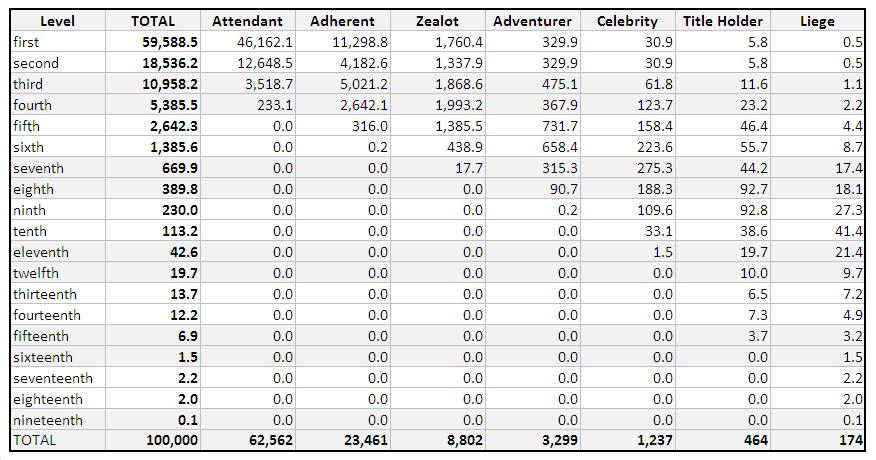
But of course this table is flawed, for reasons I've already given - it doesn't make the valuable distinction between differing classes needing differing amounts of experience (and the 'average' is not determined according to the distribution of classes as given in the earlier post). As I said, this is nothing more than a demonstration, to show what sort of table could be calculated, having been given the figures.
It is interesting to note that the higher strata stutus groups jump quickly through the lower levels at a young age, peaking at a certain level before dropping off again. That, to me, was proof positive that the data produces the sorts of results I need. If you encounter a liege lord, it would be possible that they would be 1st level, but highly unlikely ... and they would be no older than 15, and would likely have a regent commanding the kingdom. It wouldn't be possible to have a liege, actually in authority over the kingdom, who was less than 8th level. And that's as it should be.
Subscribe to:
Posts (Atom)