Thursday, September 24, 2020
Beware the Nawdae
Monday, September 21, 2020
Tao
In 1987, I had been running a group of players for about five years, including my wife Michelle. She was like the woman character from Knights of the Dinner Table. Mike J. was a genius, the kind of player every DM wants and the sort that played a game five moves ahead of what he said. Brothers Craig and Mike W. were steadfast, honest players, with Craig being staid and cautious, and Mike W. being energetic and emotional. Darcy was enthusiastic, but the sort that constantly got himself into trouble. I describe them because, in 1987, these were my only audience where it came to anything I did with D&D.
I had quit having anything to do with public gaming. I had done public gaming with Mike J., whose friend Rob used to organize those events in the 1980s, so that I had shared beers with just about everyone on the inside. Rob understood my sort of gaming no better than most people online do -- he was a "the game is meant to be fun" sort. I just didn't like the scene; I didn't like playing with strangers and I felt that by necessity of being something that strangers could sit down and play on the spur of the moment, the games were stale and dull. When I hear someone today talk about playing at a Con, I still shake my head because I remember those wooden, two-dimensional game designs, which I was asked to run by Rob, when I agreed to DM at Cons in '84 and '85. Ech.
So, I went into the weeds. I sat at home, designed my game, and didn't think about what I was doing. I didn't start university until I was 21, and kept at it as a professional student until I was nearly 30. I had no aspirations to become part of the ratrace and, now, I suppose I regret that a little. Instead I wrote and designed and designed and wrote, and looking at all that work from today's vantage point, there is hardly a thing I did in those years that amounted, in itself, to anything I do now. I got a lot of running experience and I got a sense for what an in-depth world demanded. The Mac computer replaced my old commodore 64 and then I moved onto a Pentium III; it's laughable to think those are the equipment I used. Nothing I designed in those days had lasting value; it was all gutted, replaced, circumvented or vastly expanded.
The reader has to understand. I was 31 years old in 1995. That's the age that I know a lot of my readers are at right now, who come to me and express their discontent with their D&D campaign, or their struggle with what to run or how to run it. If I think about what I was doing in 1995 with my game, it's a little sad. I have no maps from that era, no adventures that I wrote, no rules, no tables ... really, nothing at all that I can dredge up now and say, "See, this has real value." If you're reading this and you're 31 or younger, then consider for a moment what it will be like when you're 56 and the world you're running was completely designed from scratch, starting at an age older than you are now. Are you impressed by my world? Then know you have plenty of time to make this, if you're ready to work at it.
Thinking about my mindset in '95 ... the '87 campaign lasted another five years and then broke up. I played scattered games with other people and then almost nothing between '95 and 2004. I went on working at my "world" ... which I remember starting anew in '98, the bare bones of what became this thing I run now. When I worked at a project, I had no audience at all. Even back in '87, when I told my players that I was going to create a trade system that would adjust prices from place to place, that was something that I only ever conceived of for my players. I never had any aspirations to publish it, and I certainly didn't conceive that there would someday be an internet, where I could share it with other people. It was just something I did for my own pleasure, in private, just to see it happen. When I finally solved the concept 15 years after inventing the idea, there was no one to tell except my present partner Tamara. That did not stop me from beginning to build the model. I still wasn't running anybody when I started to build the 20-mile scale map of the world, in 2004, that I am still building today. I did that work for me. For the pleasure of doing it. I didn't spend any time writing things about it, or trying to explain it, or justify it. I knew how it worked and I didn't need to explain it to myself. When I began running again in '04, I didn't keep track of the encounters or the adventures, because those were for my new players and no one else, and I definitely didn't expect to ever run those adventures again. Even if I had had another party, there's absolutely no way that I would run some adventure I had invented for another party. In 41 years of playing D&D, I have easily run 10,000+ hours, and I have never run any adventure more than once.
Funny, it's never occurred to me even to acknowledge that before. I do see people talk about the multiple times they've run White Plume Mountain or some such, but I just don't see why the fuck I would do that. It's a dumb ass adventure in the first place, I can definitely do better, but more importantly, what an awful, paralyzing BORE it would be to wade through a bunch of scenes that I've already watched play out. Ech. Just ech.
Anyway, the stuff I ran in 2004 was for then, not for now. I didn't keep my notes, I didn't track any of the events, I didn't think about doing either. It wasn't until I came across D&D blogs in 2006 that I began to think about writing one ... and yeah, when I finally decided to climb aboard with it, I got all excited about explaining what I had been doing. And, when it happened that people just didn't get it, I got excited about justifying it, too.
That's what this blog, and about 18 months ago, the Higher Path, came to be all about. After 10 years of banging my head against a community that didn't want to listen to explanations and were boneheaded about accepting justifications, I went and made a space where I could just explain without justifying, in depth, as deliberately and extensively as I wanted. I have written a couple of million words of explaining. I've written three books of explanations. I have explained myself and my game, and what the game is, and what it could be, until I was blue in the face.
Perhaps it's been Covid. Perhaps it has been having to explain stupidity to an audience that is capable of living in a country run by Donald Trump and not ganging up in the millions to burn the fucking white house down. Perhaps it is that I had 8 months of unemployment in 2019, to sit and write and explain and such, expecting that was an unusual circumstance ... only to have it followed by another 8 months in 2020 where I am literally being paid by my government to stay indoors and not go out, where I will catch Covid and die. 16 months of essentially "retirement-quality" living, where I am making just enough money to pay my bills and eat, but not go out much and accepting that being at home, without even much face-to-face contact with my daughter and son-in-law, while she moves through her pregnancy, will affect a person.
Starting the first week in August, I hit some kind of wall. At that time, I wrote some long diatribes, where I explained that not hearing feedback, and not seeing any actual effect from all the explaining I had been doing for 12 years, was having an effect. People took that to mean that I wanted my readers to comment more often, and told me so, even though I wrote several times that while that would have been nice, it wasn't my place to expect it. It still ISN'T my place to expect people to comment! I do see some readers trying to do so, and thank you, but that isn't what any of that crisis was about.
A wall like that would have knocked a lot of people right off line, permanently. But I've continued to write, sporadically for me but still a damn sight more than most bloggers. I've continued to create public content. I'm still here, still accessible, still D&D-positive, still the same guy that I was.
If the reader is finding that I seem to have changed a bit, then they'd be right. I have come to a conclusion.
At least as far as a public blog goes, I'm not interested much in explaining D&D anymore. I have explained it. There's more than 3,000 posts going into the past that explains D&D in remarkable clarity. People who are, at this time, unable to understand what D&D is, or how I see it, are simply too dumb-fuck stupid for me to bother with, anymore. I don't want to care any more whether or not they get it.
They'll never get it. They'll play their stupid D&D for a few more years, then they'll quit. Or they'll get work with the company and settle into a groove where they steal content that's been made before and rewrite it endlessly. I hope they all feel sick inside for doing that, but it will feed them like pigs to a trough, so they'll keep doing it. I imagine most of them really, really hate D&D, but they'd be contractually obligated to say otherwise.
If the reader is looking for a parallel to my perspective just now, I'd suggest Jon Stewart. Stewart and I are very different sort of people, but here you have a man who walked away from huge popularity on national television, for reasons that I'm sure are still cryptic to most people. He did explain it at the time. He is a smart, comprehensive fellow who understood politics and wants to bring about change. After years of trying to do that through comedy and satire, he finally understood that his audience really wasn't getting it. He was explaining, but they weren't grokking what he had to say. This led him to feel that he was wasting his life; or that he would be wasting it, if he went on doing what he was doing. Instead, he felt he could do more on a grassroots level, making films and honing his desire to communicate his politics in some other way.
That's where I am. I don't see any point in explaining the game or even why I do any of the things I do as a DM. Oh, I'll still do it, it's habit now. But just now, I feel I'm doing better work by working on the wiki, and posting that content to this blog, than I ever did trying to explain D&D. I'm sure I'm losing readers. People gotta hate, and they look for visceral ways to hate everywhere on the internet. I hate good when I rant, so I drew a lot of that kind of reader. They've melted away now. My numbers are less than half of what they were this time last year. My numbers are all the way down to what they were in 2013. Once, I could count on 35-50 thousand page views a month. I'm lucky if I can get 20K now. And they're falling all the time.
Some people will argue that's because blogs are dying, but I still read wildly successful blogs all over the net that are thriving and doing very well. Only the badly-written blogs are actually dying. People will never tire of reading the written word, because in many ways, it is deeper and more thorough than video can be. There's too much fluff to address in video-making; too much time spent needing to keep people from growing bored at the pace of speech the speaker is using. That is never a problem in text. People are always able to read as fast as they want to.
No, I can point to decisions I made all along the way that sacrificed my viewership. A lot of it was backing off on rants and really being draconian about trolls and comments. Some of it was from becoming very academic in my writings. Some of it was because I would stop writing consistently; and some of it, because I wrote too much about myself.
Right now, I want to find my way back to the work I did way back when, in '87. Those days when I would design a hobgoblin the way I wanted hobgoblins to be, or the way I wanted the quest spell to work. I'm a way, way better designer today than I was in '87; and I still really care about those things. At this point, I think it is more important to just visit the design I'm making than it is to talk about it theoretically. I would rather spend an afternoon drawing up a description of how a sailing ability works than explain why there ought to be sailing abilities and what those abilities contribute to game play.
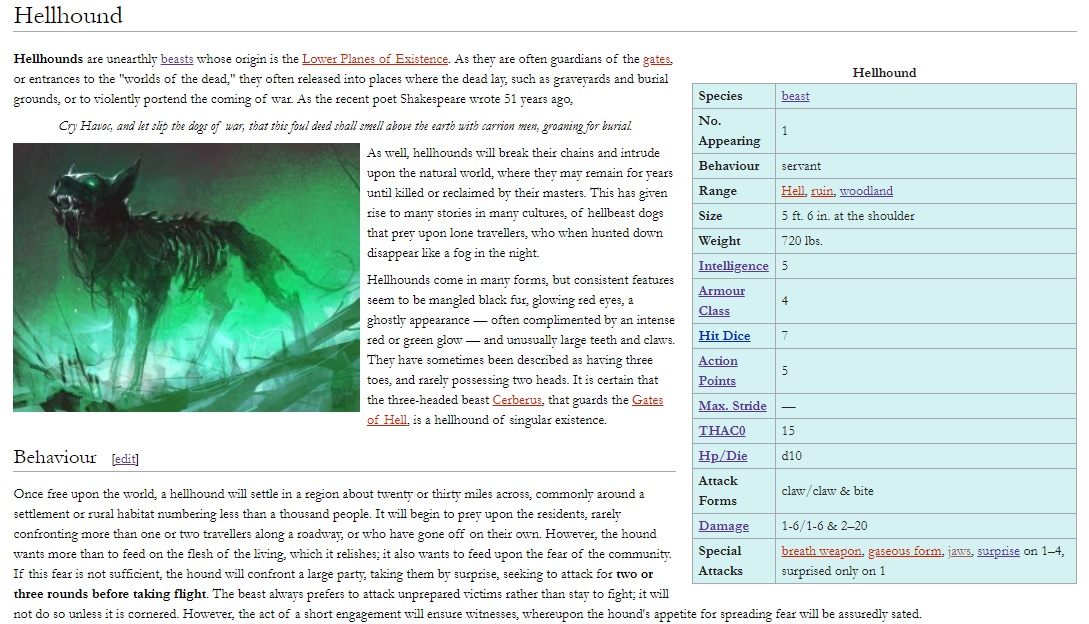
Rather than write yet one more post answering questions I did with my book, How to Run, on how to DM, I think just now I'd rather just be a DM and do as a DM. Sometime tomorrow I'm going to rewrite the hellhound monster. Not because I need one for my game, or because I especially like hellhounds, but because it is the next monster on my list and, well, everything deserves a good design. Judging from some preliminary reading about hellhounds on wikipedia, I'm sure it isn't going to work exactly like a classic hellhound; it certainly isn't going to be a diatribe about how evil they are, or lawful, or hungry. I'm sure its mostly going to be about when one should expect to find them and why they are actually in that place.
And if it seems pretty good, and I find a decent picture, something that isn't too fuzzy, abstract or cartoony -- I like a well-made, gritty picture that's clear in its depiction -- then I'll take a screenshot of the page and post it on the blog. And what with the wiki's content and the few words I'll say, I feel that's good enough reading material for a blog to keep people from getting bored over their coffee.
In the meantime, it'll help me make the transition from "teacher" to "guru." See, I've been a teacher. I've been teaching class for years. I've had students gather around and I've explained all these many concepts about game play, in lots of dense detail. But now, if you climb to the mountaintop, I'm not to ask you to listen to me explain things. I'm going to be here, doing my own thing, just being. If you like, you're welcome to find a place on the mountaintop next to me, and be a little yourself. Hopefully, I can get to a place that when a reader asks, "What is the DM supposed to do when a player says--" by raising a hand to stop them before answering, "The bee gathers honey not because it is sweet, but because it is food."
And let my readers figure that shit out without my needing to explain everything.
My aspiration is to be this guy:
Sage Ability Scuttlebutt
This page isn't finished yet. I had a terrific breakthrough on the subject material today, mostly because I was under fire to get something in order before my game party sailed off. Before I go any further, I want time to think and I definitely want to get Sterling's response to it; Sterling is our local sailing guru, this being his main occupation. I haven't heard from him for a while, which usually means he's at sea right now.
The complete page, such as it is, can be found here.
The breakthrough was to measure the ability of the character to sail, not upon what they knew of sailing (I myself know zip; I've never actually been aboard a moving sail boat, but like Spiderman I've seen a lot of old movies), but upon the weather. My approach is to say that sailors of varying skill can handle a boat without any problems up to a specific point where the weather gets worse ... whereupon, rolls have to be made or bad things happen.
I've done my best making a list of "bad things." A sailor could probably create a list of about 250 things, which would be fantastic (Sterling) if every one of those bad things could be defined as an in-game consequence, and the % chance of that bad thing could be established into a table of sorts.
I know the system here is a terrible oversimplification; but that's not really important. Everything about D&D is an oversimplification to some degree. All I really want is for players to feel there's a "game" in choosing whether or not to take sailing skill as their option, whether or not they want to take other skills that will allow them to train other sailors, and whether or not they want to risk three hours of bad weather to get to their goal. It's not a game if there isn't a chance of risk, and that risk has to be something that players without any understanding of sailing (or any other subject) can still comprehend for themselves and mess with.
The weather being changeable, I think it is more than enough to say, "Okay, you leave port today, it's a beautiful day, you don't know what it is like tomorrow." This makes it spectacularly valuable to have "predict weather" as a spell, particularly if you know that you are absolutely going to be able to sail a particular kind of climate without fail. And since I use real world climate data for my game world, IF you know the climate of an area, then you can be really quite certain that the chances of a bad storm in this season and this part of the world is almost unheard of ... just like a real sailor would know.
I really like that as part of the ability's construction. A lot of players won't go to sea because the chances of getting caught in a storm and sinking are "random" and impossible to manage. Here, this system says, "If it gets super-stormy, and you are of this skill, and your crew is of this skill, then you'll come through under all but the very worst conditions." In short, you could sail in anything less than a full-on violent storm or hurricane, and know ahead of time that you can do it.
In addition, the system shifts the survival of said storm from "the condition of the ship" to "the ability of the crew." This argues that the ship's condition is what it is BECAUSE of the crew, and therefore only the crew needs to be rated.
P.S.,
Where the amount of wind on the wiki page is described, this refers to the "Beaufort" scale. I haven't added the page for the Beaufort Scale to the new wiki (though you can find it on the Control Weather page), so I'll repost it here. I have posted it to this blog before (I love this image).
Thursday, September 17, 2020
It's a Jungle Out There
Question: how many bad artists does it take to draw a hippocampus?
Answer: apparently, all of them.
I did not have much fun finding a good picture for the hippocampus entry below. Nor was it easy to find good material. The hippocampus has largely disappeared from D&D, and was never well covered back in the day. There are almost no legends about the beast, except about it's shape; if you look it up on wikipedia, you get a litany about where it's been depicted and how, but nothing about the nature of the beast. Ultimately, I had to dig up the Dragon Magazine #273, The Ecology of the Hippocampus, by Margaret and Ramsey Lundock (one of which is, or was, a terrible fiction writer), which gave some meaty information, most of which I disagreed with or ignored, but the structure of which gave me ideas to write. As far as I know, this page on the Authentic Wiki is now the only extant, freely available description of hippocampi that is not mostly about what they look like or where they live (hint: in the water). Enjoy.
This is not how I spent most of my day. Creating monsters creates a need to discuss where those monsters live, pages which I am calling "ranges." Today's page to be created was Jungle, which proved difficult because I like to include details about what sort of features one is likely to encounter in these landscapes. Jungle is, unfortunately, rather devoid of these features. I read through several book descriptions that waxed on about the unchangeableness of the jungle, and how this is one of the characteristics that drive people mad when they're forced to live in them for weeks or months at a time. Much of the description of the jungle came from a book on "military geography" which was quite useful to steal from, because I'm a completely human without any compunctions or shame where it comes to good, solid plagiarism. I'd feel a little worse about it, if it didn't come after searching for texts about jungles all day only to find source after source plagiarizing one another. Why should I hold myself aloof?
The quest got so extensive that I learned there was an escape-from-the-worst-conditions-possible Australian movie made in 2017, called, sensibly enough, "Jungle." With Daniel Radcliffe. I watched it between other duties this afternoon, having plenty of time for some reason, and it follows the pattern of most such movies that have been made in the last ten years. Person drops into environment, gets into trouble that really ought to mean their death, person survives when they absolutely should not. The film is ... dark ... which should be expected. It is a true life story, that apparently remains honest to the facts, if the internet is at all trustworthy. Radcliffe clearly suffered to make it and the film deserves more attention than it received.
That said, with a strong desire to squeeze as much drama out of a jungle as a film can, the results were that jungles are devoid of features and are horrible because of their unchangeableness. Oh well. I managed to contrive a very short list of "interesting" stuff to see. It would be hard to run a jungle effectively, with players sitting around comfortably drinking pop and coffee.
Each page is a hill to climb, but I feel good at the end of the day.
Monday, September 14, 2020
The Minds of Little Hobgoblins
Read the whole page here.
Sorry to go dark there for the weekend. These pages about humanoid races are absolutely the worst; they wind up taking two or three days and I feel completely spent when I'm finished them. I try to make each of them unique, and "human" in their motivations and understanding. I understand that some gentle readers will contend that they ought not to be human, since they're not, but I hasten to point out that we have no idea how to express the actions of non-humans; we only know how to pick and choose from our vast and varied behaviours as a species ... which, in fact, narrows the collective opportunities offered by the creature's presence. I know, I know: it sounds like we're stepping outside ourselves, but that's merely a delusion on our part. We can't step outside ourselves in search of a motivation. If you, o reader, can invent it, then guess what: it's a human concept. No way of getting around that.
If you compare the hobgoblin to the kobald that I did a couple of weeks ago, you'll find they're very different from each other (which isn't the case in the source material). Some will read the page and presuppose the hobgoblins are "lawful evil," like a little army of medieval nazis (see the 1977 movie, Wizards), which is another form of narrowing. That's not really it at all, here. Hobgoblins are agrarian. They are extremely family oriented, on an unsettling human level (but, still a human thing in some human cultures, sorry), loyal, even welcoming of strangers. Just don't face them on a battlefield, because they've anticipated Frederick II culturally.
I could write a post about how a significant number of people believe that creating structure is antithetical to creativity. And how these same people believe that by eliminating the structure, eliminating order, is the pathway to individuality. Odd, that all these "individuals" all make the same arguments, with the same vague quibbles, and none of these individuals ever seem to accomplish anything or demonstrate their expressiveness in a concrete way.
My take on the hobgoblin is not to put them in a two-dimensional, predictable box, but to give them guidelines in which they can act believably and rationally. Hobgoblins are going to think first about their tribe, and then themselves. When they think about beating you in battle, they will think about it as their tribe beating you, not from the perspective of their own, personal accomplishment. The worst thing that hobgoblins can imagine would be exile from their tribe; they would rather die; and if they were exiled, that is exactly what they would choose: to be dead, rather than endure it.
That characteristic makes them positively frightening; and yet, at the same time, for reasons that could be role-played and appreciated, if a group of hobgoblins accepted you as a member of their tribe, they could be the best friends you ever had.
Being able to flip this concept one way, then the other, shows how structure provides creativity, rather than the reverse. But I wouldn't expect those who loathe structure to appreciate that.
Wednesday, September 9, 2020
Clantasy Role-playing
Non-descript kobald speaks. Doesn't matter which. There's no personality, no means of differentiating the kobalds, even to ourselves. Perhaps we have a collection of different kobald figurines. These three have a spear, this one has an axe, that one has a yellow helmet, this one a blue. Everything is random, everything is a number.
Okay, so we try to assign a personality to this group of kobalds. Or dwarves, maybe, that are going to follow along with the party for a time. This one is Oin, he's fat; and Gloin is his brother. We've got Bifur and Nori, Dori, Dwalin ... well, you know the list. And then, two months later, the party runs into another group of dwarves, and now these dwarves are going to follow along with the party. What are we going to do? Call them Oin and Gloin again?
Creating personalities for hundreds of potential NPCs is dull, purposeless work, and it absolutely doesn't help to slap a name label on everyone. We put up with the faceless, interchangableness of the bland wooden stick figures that move around the party because every alternative is a crushing labour that never succeeds in paying for itself. For one thing, the party just doesn't care that this bartender is sad because his wife has left him, or that another bartender is an asshole because, as it happens, he's slowly dying of the gout. These things aren't personal, they don't actually apply to the game and, worse, they're overdramatic and boring. The players and I would rather have stick figures.
So ... what? What's to be done? That's the game, leave it as it is, stop worrying about it and accept that there are limitations to things. End of post, you've made you point. Walk away.
For a long time I've stubbornly equated an NPC's class, hit points, level and so on to specific roles that these individuals occupy. I don't believe in a "king" who has less than 10 levels. The reason for assigning a regent is to ensure the kingdom is being run by a 10th level character, until the prince or princess can be raised to become a 10th character. We teach them weapons, we train them to fight bouts and practice drills so that they take damage and deliver damage; we organize jousts and tournaments, and hunting expeditions where we flood the landscape with animals so the young royal can practice shooting and raking in hit points, all summer long, for five to six hours a day if need be. It's dull, patient work, ensuring the royal get those experience without seriously getting hurt, and most of the time the future monarch doesn't like it much. But that's the price and responsibility of the monarch. Being crowned means, you've accumulated 10 levels.
Why ten? One more than the minimum lord has. Are there nobles with less than 9 levels? Yes; but they have lesser titles, like sir, squire or baron. They're not called "your grace" (using English parlance), or "my lord," until they've met the requirements. They're called "sir," "squire" and "baron." I am most strict about these things. A prince is "your highness" but not "your majesty." At least, not in my game world.
By designating an individual by their title, and that title conferring a certain capability, I'm not merely slapping a label. A "potter" has a specific, measured number of knowledge points that describes exactly what the potter does; and those points accumulate very slowly with time, or very quickly with game experience. If you're communicating with a potter who is building his own professional kiln from scratch, and he is an old man, you can probably guess he got there through slow accumulation. If, on the other hand, the kiln-maker is a teenager, you might want to be careful. Naturally, there's no reason to think you shouldn't be careful with the old man, either. He's old. He's had time to acquire real experience.
I'd like to define every non-player character by a yard-stick that applies to every humanoid in every culture, and to every intelligent monster as well. It's not meant to be a simple yardstick; I am thinking of something quite Holmesian, in that you notice details about the NPC that helps you put together a puzzle, to tell you how experienced and capable this individual is. The more things you can discover about the character, the more reason you might have to bear that character respect.
I once got into an argument with a player because he drastically underestimated a guard standing at a main castle gate, at a time when the castle expected to be sieged any day. The castle was under the sovereignty of a 16th level cleric, which the party knew. The guard looked like a guard ... but when the 2nd level player character decided to roust him, it turned out the guard was 7th level.
This infuriated the player. A 7th level, I was told, would be covered with expensive armour and weapons, symbols, other evidences of wealth; he'd be obviously powerful and dangerous looking. I failed to see why a 7th level would not, if standing on the open street, choose not to dress up as if for a parade, and why he should bring along a bunch of money in order to watch an important gate. Additionally, I failed to see why 7th levels should be scarce in a large city, in a castle with thousands of inhabitants run by an Archbishop for a significant part of Germany. The player exploded at me and quit the campaign.
I have a different idea of what it means to be 7th level. Or 10th, for that matter. Most seem to see it as some phenomenal accomplishment, something that is so rarely duplicated that surely, anyone above 6th must stand out like a gleaming beacon of magnificence. Yet. I've run many a party, from first level, and I notice that quite a lot of them manage to reach 7th level without ever having done anything earth-shattering. Enter a few lairs, clean up on a few treasures, take one adventure that takes up one year of your life and don't die, you will probably reach 7th level in my world. I have a group of players in the Juvenis campaign that haven't yet been more than 20 miles from their starting point, and they're 3rd and 4th. One is almost 5th. And the amount of game time that has passed? A month. It's taken us several years of running on line, to be sure, what with breaks and all, but in the passage of time the players have been fighting often enough to feel like they've been in a war.
Why would 7th level seem at all unattainable?
This scale that I speak of wouldn't be based on how much money the character carries or spends on clothes. That was Gygax's thing; gawd knows where he got it from. I occasionally meet a fellow for coffee, though I haven't this year. We talk about his music and my writing. He's aged 62, 1.67 meters tall, about 79 kilos. He looks sort of like an older version of Floyd the musician from the muppets. He's also an ex-master sarjeant, which you wouldn't guess if you talked music with him, but you might guess if you talked history. Highly dangerous people do not wear badges that identify them as highly dangerous. That's just idiocy talking.
Coming all the way back around to the kobald and dwarf thing. I've long wanted some structured social explanation for the old saw of meeting a group of humanoids in the hinterland. What are they doing, who are they, how would they react, etcetera. All this, without needing names and personalities, but having a sensible idea of how dangerous an individual was, based on the role they performed. That's how pages like the one below gets made, and slowly tweaked and adjusted. Rather than try to do this individually for every humanoid, I'd like to presume that most humanoids of a certain habit and purpose would tend to follow the same precepts.
Read the full page here.
Tuesday, September 8, 2020
Ki-rin and Bear It
I've never thrown a lich at a party. I've had them moving around in the background, but never actually had one come face to face; never engaged one in combat. I can say that about a lot of monsters, particularly those in the books that were so obscure that I would forget they even existed for years at a stretch. For example, the ki-rin.
This thing drifts onto two colums, but I've stacked the text to make a clean picture. This thing is staggeringly overpowered; it has so many abilities that I doubt I'd use them all in a fight, even if a party were to take on the thing. And psionics too ... gawd, to think I used to play with psionics. But, as I said, I was young once.
This creature does have a precedent, but it's more properly called a "Qilin." The wikipedia page discusses how the creature's "one horn" that's shown in the picture is actually quite wrong, and that western assumptions of that kind have produced identifications between the qilin and unicorns that isn't there in Chinese mythology. Wikipedia spends a bunch of time talking about the association between the qilin and giraffes, which is interesting but more probably a case of certain scholars seeking desperately to write thesis papers.
I have dutifully maintained references to this creature for decades without ever using it. Frankly, as written here, why would I? The beast has no personality, no purpose for being other than to harass parties. I think it was probably seen by one of the founding cronies as some kind of quest-giver. What party is going to pitch themselves against this, what with the magic, the natural abilities and the psionics. When this thing shows up and tells you to get the McGuffin, you go get it.
So much power, and so boring.
I've been making decisions about what monsters I want to keep and which I don't. I had tried to create a form of kapoacinth, or sea-going gargoyle, but lately I decided I really didn't like my attempt and that I didn't like the idea at all. So I burned it. I could just as easily do the same with this creature. And yet ...
Suppose we take the power down a notch or so, get rid of the single horn, give it more of an appearance like the Chinese legend fortold ... and see it as something disinterested in forcing players do quests. No psionics, of course, and get rid of rules about creating illusions when, in fact, the original rules had no guidelines on how these illusions were supposed to function. Leave it as having a lot of power, but get rid of any killer aspect the creature might have. Keep the old D&D name, so I don't need to worry about someone telling me it isn't exactly like a traditional qilin.
Go with something like this:
Full description here.
I really like the picture. It conveys the gentleness of the creature. The lighting tempers the creature's golden colour, giving it more of a mystical feel and less of a garish cartoony feel. The beast is simply enormous; and using my hit points per die rules, the number of hit points it has is virtually doubled. The wiki page goes through a proper description of the powers, basing them on existing game elements. And the one ability, that it can create any magic item at will, makes the ki-rin itself the quest, as players decide they want something specific and all they have to do is successfully find the beast and convince it that the player's need is worthy.
I also take a little humour in that, after decades of doing nothing with the beast, I happen to run across it now, as my daughter is just 4 weeks or so out from giving birth. See? Says it right in the description. The beast is equated with the arrival of a baby to a family.
Nice.
Sunday, September 6, 2020
Rambling, 41 Years, Bitch, Bitch ... Whatever
This morning, I reworked the "Modern History" page on my wiki. I promise, it isn't very interesting. Just a rehash of important moments between 1500 and 1650.
The page exists because I need to create a touchstone for player who don't know history very well, who might get a little out of a quick overview of the immediate background. "Modern history," of course, ends in 1650, when my world starts for new parties. My oldest party has made it all the way to 1653 - which of course, looks pretty much the same. History moved slower then.
Not that there's a huge change in the world between now and 2017. It feels, this last twenty years, like culture has sort of ... stalled.
Think about it. Take a major cultural film, like The Matrix. That movie is 21 years old. It sits almost halfway between my entire time playing D&D. Yet, with a few tiny upgrades to the computer imaging, if that film had never come out, they could release it today with virtually the same dialogue and philosophy that it was released with in 1999. Sure, the fan boys would bitch about the graphics, but you know, we're just talking about tweaking a bit.
It's absurd that 21 years has not produced a serious change in what we believe or how we communicate. If I go back 21 years before The Matrix, and pick a comparable blockbuster sci-fi fantasy film like, say, 1978's Superman, the difference is ENORMOUS. It isn't just that the special effects and the logic are hideously hilarious, it's also the whole "this is how people talk in a newsroom" depiction. The dialogue, from the scenes on Krypton to the love scenes between Supe and Lo, are egregiously camp. Who the hell talked like that in 1999? And who would have put that dialogue in a movie that wasn't deliberately a farce?
If I listen to what's new, what do I hear? Hip hop. If I listen to music from 1999, what do I hear? Hip hop. And if I listen to music from 1978? I get this:
Come on now, really? Look at the massive trends in music between the above and 1999: New Wave, Rap, Grunge ... these are huge cultural shifts. What comparable shifts have we had since 1999? Beyonce then, Beyonce now. It is like a desert out there.
I blame the internet. Everyone can produce every kind of music they want and find listeners. As a result, the entire music scene has turned ... grey. I still meet that type of fan that is amazingly into some obscure band that has deservedly remained obscure.
But what do I know? I still play a game that became popular when Donna Summer still had top 10 hits.
In 1979, D&D was becoming huge. We discussed and debated the game, but no one used the words "I hate" with relation to the game then. I didn't first hear that until I started playing Empire of the Petal Throne with an older group, who felt the need to slam D&D at every opportunity. I played other systems, too -- and always, there was that necessary conversation about why this system was better than that system. But I didn't hear D&D players say they hated any system until 2nd Edition. Oh, sure, we hated half the Fiend Folio; and we hated the Oriental Adventures splatbook; gawd, what a horror that was. But we didn't hate "D&D."
In 1999, that's all anyone talked about. I love my 3.5 version, I hate yours. 21 years later and it is the same old thing. Two new editions and nothing has changed. "I tried 5e, and liked it for awhile, but now I hate it." Amid this atmosphere, there's really no room for cultural shifts. Not that I'm going to counsel putting aside your hate and how good it would be if we could all just get along. Yet I wouldn't have guessed how toxic D&D was going to become, and how so many people would embrace that toxicity, way back in 1979.
Then again, I was very young. The signs were everywhere. I didn't take them seriously.
I still don't. I lie to myself and say that 5e is "just a fad." Probably isn't. I'm still sure than there's going to be a 6e and at least one after that. Sales of 5e are brisk, though, so as long as they are things are stabilizing a bit. At the same time, I'm not at all worried that the old game is going to evaporate and die. Nothing is going to change. We're just all going to go on, living in this silly, stale, unchanging grinding argument forever.
At least, until Larry Niven's wire gets invented. Still waiting, Larry.
I don't want to use it. I just like the idea of so many other people using it that the world becomes a big, quiet, empty place full of people who would get bored of that kind of thing.
Saturday, September 5, 2020
Making Links, Improving Pages
Pages like this are mostly an opportunity to create a list of links ... different savannas in the world, different common features. Compare savanna with subterranean, which is a long list of things that we take for granted, such as doors and walls and halls. Some stupid part of my obsessive compulsiveness says these things ought to have some kind of proper description; certainly one doesn't exist in any of the books. Then again, do I want to spend all this time making pages to describe such mundane things? Have I done anything except create a lot of useless work?
I don't know. It seems fit to make these pages, so I duly create the link and wait for the day it comes up in the list. No worries. It isn't like this wiki is ever going to be "finished."
Another obstacle is a sense I have that each page should be made as best I can. I find myself taking more and more time with pages that I would have once dashed off, or did dash off four years ago. With spells, I've got this idea of including in the description a heading, "Bringing the Spell into Play." This means, in addition to telling how the spell works, I feel like it would be useful to explain some of the things I might personally do with the spell, or which I would accept from the players. I have only adjusted two of these so far, but then I only had the idea on Thursday. Plus, I'm searching the blog randomly for one or two posts a day, upgrading whatever comes up; mostly, I'm focusing more on monsters right now than spells.
You can read my retake on Enthrall, or you can look at Lower Water, which I did today. An image of the latter is below. I'll highlight any of these that I think deserve it.
Captain America Never Fought This
Read the full page here.
I love the hydra, but it has been one of those monsters that seems like it's tough and scary, when in fact it has all the danger offered by a bunch of orcs. And so, all the venom (which was a part of the original myth) and the immortal head (also sourced mythologically). I've adjusted the experience so that if players do nothing more than nick and lightly damage the hydra's heads, they're effectively unhindered. It isn't mentioned in the post above, but this also means the heads cannot be, in my system, "stunned" -- unless the body is. Yum.
Hm. I see I've misspelled Lernaean on the table. I'll have to fix that.
Thursday, September 3, 2020
Refreshing Comments
Jim Davis has left a new comment on your post "A Rundown on What Advice Exists":Alexis,I appreciate the feedback, even though I'm only just now reading it. I've been an intermittent reader of your blog for a few years now and think How to Run is superb DM advice, so I take "not too bad" and "wouldn't be the worst DM I've had" as compliments. I'm genuinely curious about the times I've gone up my own asshole (you're not the first to observe that) but I understand if I'm a little late in soliciting that level of feedback.Thank you for your honesty; it's refreshing to get anything resembling a genuine critique.And yes, I was looking through your backlog to see if you'd watched any Web DM. I wanted to know what you thought of our videos. I'm very glad you didn't think they were terrible.-Jim "punchable demeanor" Davis
Jim,
Your comment was refreshing also.
I kicked a lot of people that day. I've reread my post; I confess the knife was just as sharp as I could grind it. I don't take it back. I will, however, be positive. You've been either genuine or sarcastic. Either would be understandable and I deserve the response you've given. In return, I'm anxious to be genuine, and write in a manner that won't be understood as sarcasm.
By my count and the internet's, you and Pruitt are significantly popular. You're long lived; your last video was yesterday. You receive 100,000 or more views per video; I receive nothing like that kind of traffic. You have 24,000 followers on twitter and by the looks of their comments, they genuinely love you. You're interviewing Luke Gygax, you're in the heart of the community, your words are listened to and treasured. That's not sarcasm. That's what I see as an honest evaluation of how others feel towards you.
Which leaves me puzzled as to why you would comment on a blog post I wrote three years ago. I am just as puzzled as to why you would be an intermittent reader of my blog at all. I don't write the sort of content you produce, at all. There isn't a glimmer in anything I've seen in any video you've produced -- though I admit, it's been a couple of years since I watched anything -- of the least influence I've had on your material. You say that my How to Run is superb DM advice; but there's no evidence that you've taken it, and as far as I know, you've never told any of your viewers this. If you had, no evidence of it has ever materialized as visitors to my site from yours.
My content is ... critical. Sometimes viciously, sometimes academic ... but always deconstructive and always critical. I was taught to be so and I embraced it with both arms. The content of your programming is motivational. Your method is to inspire your audience; to encourage them to believe in themselves. You present the game as something that's fun, and you try to helpfully simplify the game processes, so that your listeners will feel confident. Your advice devotes itself to reminding the players to "don't stress" and play the game however they want to play it. That sentiment is uplifting, cheerful and fortifying.
If you do read me, and this spirit of incentivising promise is indeed your genuine feeling, then I can't imagine how frustrating it must be to see the brutal, negative hatchet job I commit against the game you support and believe in, day in and day out, mercilessly. I should think it would be the kind of thing that would make you sigh, shake your head slowly, and mutter to yourself, "That poor guy. He just doesn't get it. He doesn't see how simple and how much fun this game could be. He's so smart; he's so comprehensive about the game; but he just can't seem to take his hand off the downer stick. Hopefully, someday, he'll see the light and come out of this dark place he's stuck in."
If I believed in what you say on your videos; if I wrote the kind of things you say; and if I stood by them as right and legitimate ... then that is what I would think about me. I would feel sorry for me.
On the other hand, if you were to read this blog, and really believe that How to Run was a bit of superb DM advice, given how it guts the sentimentality of role-playing with a fish knife ... then, I don't know. That book argues that good game play can't be brought into being through motivation and simplification. It can't be brought into being by believing in yourself. If that's what you think is "superb" ...
Then I am sorry for you, that you've chosen to spew pretentious bullshit for years on the internet in order to make a buck.
Understand. I'm not saying this last is what you're doing. But I am saying that if this last isn't what you're doing, then your praise of my book was a lie; and that probably, you've never read my book.
As a bit of genuine criticism. It's the way you lift your chin as you're getting into character, knowing that you're about to speak. In film making, it's a self-conscious tic that a good director would point out, and that an acting coach would address, spending a couple of afternoons to get you past the habit of doing that. People in film-making, particularly in video journalism, take is as evidence of an amateur; which you're not, obviously, having done this for so long. But it is, nevertheless, amateurish, at least in the eyes of anyone who's spent any time doing this sort of thing for a living. The good news is that it's fixable. Find a good acting coach; they're pretty much everywhere; if you talk to some community documentary filmmakers, you can fix that habit right up in no time. Think of it like not quite having a good poker face. Once you sort that out, your face will be far less punchable, and in general people with more money will find you more reassuring and fundable. Good luck.
Wednesday, September 2, 2020
Where, Jackal, where?
It is in just about every humanoid monster description. It's meant to sound all demented and nifty, all this evil, this service of evil creatures, their associations wtih evil creatures, their making humanoins suffer "a lifetime of slavery" and "agonizing death," blah blah blah ... but it is repeated so ungodly often, it borders on a fetish.
The reason is quite clear: the worse the creature is, the less guilty we should be about killing them ... so we heap on the gore and hideousness and what not. It's precisely the same tactic used in hateful propaganda, familiar as Donald Duck fighting the Nazis and the Japs. Make the enemy look stupid, make them look like cowards, preach about how they stab babies and drink blood, anything that alleviates any possible guilt that anyone can ever have about killing these creatures. Keeping in mind that this isn't propaganda from world war II, this is published in 2014. When the anti-racists online carp about the questionable nature of slaughtering orcs and black elves in D&D, they can pick up a book published in the last year (every splat book from the company indulges in this) and see it right on the page. Where you see Jackalwere, think Jap. Think Jew.
These murderous sadists are not my jackalwere. Admittedly, I have a race or two like this; the players just finished helping wipe out a frogling lair, and they were pretty bad. But the average orc in my game is a farmer; the average kobald builds a village where they can raise meat for food; the average bugbear is a hunter gatherer. True enough, some of them raid, and some of them kill. But that's true of humans. We humans invented this grilling-babies-on-pitchforks shit. Not all of us, obviously. Just enough of us who happened to be in charge of the war effort, who thought this was a good idea, and just enough people working for the company, who no doubt literally get off on the ooey-gooey magnificence of their writing prowess. "Kewl, Mike! But wait -- when I'm done writing the gnolls, the readers will barf!"
But of course, all the people in charge at the WOTC are adults. They're not infantilized man-boys. The repeated theme of the passage written above throughout all their splat books proves that!
I prefer humanoids that can change sides in a fight. Humanoids who appear to have learned something through their mastery of large political sub-divisions. Humanoids who love their children and their partners. Humanoids that are, at least in some ways, like us ... in a way different from sociopaths. With D&D, you're either all bad, incredibly so, or you're so squeaky clean you shit soap. This polarization is boring. Being good or evil is okay; but I'd prefer if we could stop being so two-dimensionally evil. Or good.
I had more trouble with the Jackalwere than usual. But there is no mythological "jackalwere;" and the Anubis warrior thing appears to have been an invention for the Scorpion King. It doesn't fit Anubis, at all. A little looking turned up cynocephaly, but the content here and elsewhere on the net is, well, meh. I kept on looking and turned up this god, Wepwawet. But yeah, no jackalwere here either. At some point you just have to make things up.
I remember my creative writing instructor telling me in university, way back 30 years ago, not to make things up. It's much better to write about what you "know," because then you will always write from the heart. If you write about things you just make up, readers will be able to tell and it won't sound genuine and authentic.
One has to admire the obtuseness of this point of view, given the mountains of literature and religious influence on society that were clearly "made up" on truly gargantuan levels; and the purebred evidence of how many people cheerfully and violently believe it, to frightening degrees. There's something so utterly navel-gazing about post modernistic writing, which yet finds a way to exist in a universe that has Poe, Scott and Shakespeare books aplenty. I wonder; did my instructor suppose that Lew Wallace learned to drive a chariot before writing Ben Hur, or that Jules Verne actually built a submarine? More likely, she just didn't "believe" it. A rather idiotic standard to hold fiction to, if you ask me.
Anyway, you can read the whole wiki page for my Jackalwere here. I made it all up.