Sunday, September 1, 2019

Character & Characterizations

In the halcyon days of my youth, mostly during university, I spent hundreds of hours sitting in writers' groups and literary discussion seminars in a quest to learn how to write better.  In that era, I learned about the adoration that writers have for the shape and sound of words, an adoration that does not extend therefore to messages and communication.  I also learned about the love and infatuation that writers have for characters, while simultaneously dismissing any notion that these characters should change or adapt to their circumstances.  Slowly, I learned that for many writers, writing is a fetish.  For many, a group of words or a character is something like building a power drill that is intended to be framed and hung on a wall, never to be used for any purpose except show.

Of course, it doesn't really matter if someone wants to write that way or even to say it's "good writing."  I don't want to read books like that; most people don't, and it's standard among those kind of writers to carry a grudge against people who don't "get it" and "don't appreciate" what they're trying to do.  It is an indisputable problem of fetishistic books ~ if the reader isn't into the same fetish, the writing won't carry the day.  Thus, fetishistic writers tend to be successful when writing about highly popular subjects: teen romances about vampires and rich businessmen, or books about mothers about to give birth to children, etcetera.  In which case, it doesn't even matter how well the books are written, or how long they anguish on with their themes while nothing is actually happening.  If I want to read about 19th century prostitution, and its agonies, there are a number of books I can pick up ... and it won't matter if the characters of those books ever do anything.  I'm not reading the book for it's plot or that plot's relationship with my life.

The habit of making characters an end in themselves, however, bleeds into role-playing ~ where players and DMs alike develop models that are intended to exist as inviolate entities, meant to ride above the waves of the game setting.  My angst-driven overly impulsive half-elven fighter, who feels he cannot be happy as either a human or an elf, will carry on that motif into every battle, every adventure, every conversation, for dozens of sessions, without ever learning anything about anything, and certainly never getting over his entrenched angst.  Because, obviously, that's how I want my elf to be.

This gets exhaustive for everyone else, who have heard every pre-scripted line a hundred times already, who get to where they can speak my elf's words before I do.  Fetishes are like this, even those that are not blatantly sexual or bigoted (though these get noticed at once).  Fetishes are tiresome.  They're boring.  They contribute nothing to game play except for the fetishist ~ and as such are at best selfish and at worst perniciously narcissistic.

I don't expect to change anyone's approach to character building, naturally.  I'm only explaining why these characters grow increasingly unsatisfying over time ... even for the fetishist, who eventually needs to create another like character with a slightly different fetish.  Characters who do not change over the course of time are sterile and ~ more to the point ~ unbelievable.  As "characters," they fall into the uncanny valley of stereotypes ... the sort that makes others around the table roll their eyes when the totally inflexible character decides to face down the dragon one on one or commit suicide for totally stupid reasons.

To them, the answer is obvious: "It is what my character would do."  The more accurate sentiment would be, it is what their characterization would do.  That's not a character.  That's a tool hanging in a frame where it doesn't get used.

Excitement comes from change ~ from the process of learning from mistakes, adapting to new circumstances, accepting that the past is past and making the effort to recreate ourselves from the new ideas we discover as we progress through time.  People who cannot get past their old lives, their old belief systems and their old habits are considered to have sociological and psychological problems.  Since those problems apply to the actual players, who are most likely to play characterizations rather than consider the possibility of character growth, we need to ask ourselves, what psychological drama is being played out at our gaming table.

This is a taboo.  We're supposed to pretend that if a player wants a character that is a stubborn idiot, this is a "choice" and not a red flag indicating the player may have other problems than our game world.  That is, unless those old buggaboos of sex and bigotry arise.  Then we're empowered.

Otherwise, our hands are tied.

A number of features have arisen surrounding the game to cope with this resistance to change.  The DM changes the genre, or the campaign, or shifts from party to party, or runs all adventures episodically, with a complete new list of characters for every one.  In addition, we start characters at 9th or 12th level, so that players are empowered to create their characterizations without having to worry if they're "strong enough" to play that particular ideal.

This is the saddest part: the game is clearly structured to encourage player character change!  The characters are expected to start off weak and legitimately humbled, knowing that virtually everything in the setting can kill them.  With effort and time, the humility is shucked away, the new character potential emerges, the characters are given larger prospects, the player swaggers a bit more knowing what's already been accomplished ~ and everyone can poke fun at each other, talking about the old days when "our characters" were soft and easily breakable.

All that is casually swept away in favor of jumping straight to 10th level, so that everyone can swagger immediately, and create back stories that make sense for high level characters (that would be ridiculous for a 1st level), while stiffening themselves with as much starch as needed to make their characters utterly inflexible.

This turned out to be a large problem with two online campaigns that I ran, in which the players had exact, intractable visions for what they were ... a vision that I began to screw with, because the world just doesn't care who you are.  My game delights in forcing people to lift themselves out of their prejudices, to make themselves suitable for new conditions and a shifting setting.  I want to push my characters into dilemmas, because these create drama without my having to return again and again to the old saws of more monsters and more puzzles.  The players I had, however, came from a different game experience; one where their pigheadedness was encouraged and even celebrated, because it didn't have to last more than a few months or just one adventure.  By next year, everyone is going to have a new character anyway.

I believe this sentiment underlies a great many unhappy game tables, without the participants being even vaguely aware of the problem.  This is my only reason for shedding light on it.  The diehard, steely-eyed character can't even sustain a modern-day, 100-minute film, much less a campaign expected to endure between 20 and 100 hours.  Why are we still encouraging this character in our game worlds?

Think about it.  This character is not interesting because he's inflexible; he's interesting because he's complicated.


Sunday, August 25, 2019

Pilgrims in New England

A couple of weeks back, a reader asked me to map a part of the United States, specifically Vermont.  We discussed the usual fee, to be met at some future time ... and then I just ignored all that and went ahead to do the work anyway, because it tickled me to do it.  Vermont is completed now, in 20-mile hexes, which can be seen in the image below.  The remainder of the map shows the notes and icons I use to sort out those areas adjacent to Vermont — details about elevation, location of rivers, towns plotted and so on.  Anyway, here's the whole of my work so far, from eastern/upstate New York to western Maine, from southern Quebec to Massachusetts:


Without the state lines to make it familiar, it doesn't look right.  I'll explain what's going on above briefly: the lands are divided into two groups, the settlers from Europe and the natives.  My world taking place in 1650, I tried to include predominant settlements made by Europeans by that date.  The remainder is made up of tribal nations, approximately where those tribes dwelt in 1650, without the effort to nail down every single tribe or be profoundly detailed.  Native tribal settlements reflect the same approximate locations as later European settlements ~ which, from my reading, is not far from the truth.

I researched about 520 cities and towns in the making of this map, on Wikipedia of course, as it is somewhat universal.  Some readers who have already seen this map on the other blog were able to pick out their home towns.  Those who have been reading my blog for 11 years must have wondered if the day would ever come.

I'm not going to talk more about the map; I have elsewhere and that's just repeating myself.  I wanted to use it as a lead-in to another issue related to the time and the area.  The predominant settlement is famously that of the Massachusetts Bay Colony, in which a bunch of profoundly religious and entitled people hell-bent on punishing everyone not as good as themselves escaped from a culture that was hell-bent on stopping them from being pricks to everyone in England.  The 1630s and 40s are a somewhat lurid time in American history, what with the hangings, the burnings and the witchcraft.  Some will tell you it really wasn't all that bad, but any reading of the actual events will show that these dangerously pious settlers were quite willing to overreact in the extreme to rather banal infractions of the social code.

For D&D purposes, I'd like to bring out the case of Anne Hutchinson, Puritan spiritual advisor and nutjob in the true sense of the American breed.  She's particularly interesting in that, while brought to trial and convicted, she was not executed but was instead exiled ~ most likely due to the popularity of her views and the threat those views gave to local ministers of Massachusetts.  Once exiled, she went to the Providence Plantations in Rhode Island, where she was kicked out again because of Massachusetts' interest in expanding their political authority.  Thereafter she settled in the modern day Bronx, the Dutch New Netherlands, beyond English authority ... where she would be slaughtered by the Siwanoy natives a year later.

Hutchinson vehemently disagreed with the Pilgrim fathers over their interpretation of God's word.  She believed that the soul was saved by faith, not by good works, and her willingness to preach this very loudly ended in her being called a heretic and an instrument of the devil.  Thus was the manner in which individuals fought over God's message and purpose, as they still do ... because, quite simply, no one can say absolutely what that is, because all we have are a mass of conflicting words that can be interpreted however one wishes.  So it goes with founding ideas on make-believe.

Inside the D&D universe, however, religion is not based on make-believe.  Religion is a real thing, based on real gods, who can show up and do on a regular basis, through spells, magical items and quests which, coincidentally, are pursued by "pilgrims."  A god might not choose to speak ~ but apart from our own personal experience with gods in real Earth [in which gods don't actually exist, sorry] ~ there is no logical reason for a god to hide!  The Anne Hutchinson problem can be solved in a finger snap by a number of means ... whereupon Anne is either acknowledged to be right or else she stands in the face of the god she's arguing wrongly on behalf of and says, "Oops, my bad."  Or, continues to behave stubbornly and THE GOD kills her.

The resistance the reader may feel to this rational truth arises out of the cognitive dissonance that we've been trained to accept, in which a god, "obviously" existing according to more than half of the world's population, doesn't appear to sort out these issues for "reasons" and "the grand plan," or whatever other justification we have to make up.  We're forced to make due with what we have; but a D&D framework and culture, not so much.

And this radically changes everything about the European Settlement in the New World.  It has to.

Look, if we're going to talk about Christianity, either God believes that humans should be their brother's [and sister's] keeper or God believes that executing whomever the fuck we want for whatever fuck reasons we want is just fine and dandy.  It isn't both.  We accept both in this ridiculous world because, again, reasons, but a real god competing with an infinite number of other real gods is not going to hide his or her lamp under a bushel.  If the Christian God won't make an appearance, it won't take long for any of a million Hindu gods to start showing up in Europe and crowding the dumb Christians out.  "Sorry, you believe in a god that isn't here, that's letting your baby die?  Oh, Sister, come on!  I'm here now and ~ oh, look at that, your baby's fine.  Tell me again, who do you believe in?"

If there's infighting between humans over religion, its because the gods want it that way ... and humans being a dumb as they are, the gods just have to wave something shiny in front of them and the swords come out followed by a lot of blood.  In a D&D world, the Thirty Years War fought between the Catholics and the Protestants can only take place because a real God thought, "Hm, I have a reason to denude Europe of 8 million people in a violent way; this should work."

Most importantly, all this takes away the most commonly used excuse that people have for God's absence:  that you have to accept his existence on faith.  Well, no you don't.  A little augury, a little divination, a little direct commune, a trip to the outer planes ... there ain't no faith, baby, there's hard evidence.  So Anne Hutchinson's position isn't founded on her being more or less pious ~ it is entirely founded on whether or not she's willing to accept the direct word of the almighty.

That, I know, still won't be enough for people.  And just to show you that I'm up on my theology, there is a story about a group of Jewish rabbis arguing over a point of Jewish law as written in the Torah.  It goes that a rabbi, arguing alone, is so sure that he's right that he calls out to the heavens and says, "If I am right, may God make all the trees surrounding the temple bend down to the ground."  And at once, the trees do.  But the other rabbis are unmoved, and continue to argue, so the one rabbi says, "If I am right, may God announce his presence by entering the Temple itself," whereupon a great wind blows open the doors and windows of the Temple.  And still the other rabbis are unmoved.  So the one rabbi says, "If I am right, let God say that I'm right," and there is suddenly a great booming voice that says, "This Man Is Right."  Whereupon the other rabbis tell God to shut up, because they have the word of God already, right in the text of the Torah, and that word is immutable, even from someone who might appear and sound like God.

For myself, I intend not to present my game's Massachusetts as anything like the real one of the mid 17th century, for the reasons I've given.  I don't think it would make a good game, anyway.  And I enjoy the notion of Europeans and Natives working together, helping each other to explore a continent that is very much empty, even if the native tribes have already founded small villages (and occasionally large settlements) in some of the land's rivers and valleys.

This, I believe, allows me to enjoy the high points of both cultures, while happily trashing the low points.


For those interested in reading more about my New England world design and other matters, make a $3 donation per month through my patreon.  It's easy, it's painless and you will gain the benefit of the backlog to date for your contribution.

Sunday, August 18, 2019

The Down Side & The Up Side


For the last month I've been committed to producing more positive posts about D&D ~ and no, not so much here, but elsewhere.  That has got me thinking about the game's bigger picture.  I could say that I'm trying to grok D&D on a different plane ... to "drink" it, for that is the definition of "grok" that Heinlein offers.

The problem has always been that D&D is hard; and, if we're going to be honest, it costs too much effort for most people.  I'm not just talking about the rules or the process of playing.  D&D, and other role-playing games, carry other forms of baggage that we tend to downplay.  It is socially difficult; even if family and acquaintances can appreciate and approve of the game's play, this doesn't mean they get it.  The game separates us by giving us a vocabulary and a set of memories that can't be easily shared with outsiders.

As well, many of us can point to the game as a place where we've lost friends.  I could do the same with a baseball diamond or football, but somehow I feel the friends lost through D&D more keenly than with sports.  Perhaps that is because I've given more of myself to the game.  I have, for game purposes, gone some distance towards humiliating myself ... acting like a clown to produce a certain effect from the players, making spooky voices, letting my emotions pour over the table.  With those moments in the mix, the bitterness reflects other serious relationships, where I've exposed by vulnerable side.

A number of times, those breaks occurred because, in running the game for anywhere from five to nine players, or more, I couldn't give all the personal attention that some players felt was their due.  I had to keep order.  The game gives little help to managing the endless details that arise and it demands that an honest DM, one who won't reshuffle the cards for the players, must be willing to kill a player's favorite character ~ which is, for a great many people, an unfair ask.  This is the hidden truth underlying the present movement to justify constant and unrepentant fudging of the dice, "for a good game."  We're really talking about the tension that D&D puts on the social contract between all-too-human persons.  As a species, humans are rarely equipped to let an inanimate object like a die, or a small game rule, cause pain and suffering to a friend or ~ potentially ~ a stranger whose reaction is impossible to predict.  Better, most think, that the game's function should be suspended than having to deal with the real consequences of playing out the game as written.

The game is hard.  We can play it to assuage the feelings of sensitive players and entitled strangers, but what that does to us ~ knowing what we're doing and why ~ can steadily push us towards apathy and self-doubt.  And every time we do the opposite, and stand up to the players ... well, even if the friendship survives the fallout, we grow hesitant and less certain of our skill as game masters.

Just now there's a real rush towards the game by parents who have discovered that D&D offers their nine- and ten-year-olds' what's called "face time" ~ an alternative to cell phones and video games.  But these are people who often have very little personal experience with the game, if we can believe the manner in which the phenomenon is being reported.  The initial rush of rolling dice and killing monsters wears off; without a deeper understanding of the game, the surface experience is ~ after a mere two or three years ~ ultimately unsatisfying.  Except for a few outliers, most just don't last very long in a sustained campaign.  We're not teaching children to like the game.  We're teaching teenagers to hate it.

I've sat and stared at that last line a few minutes now, wondering if its unfair.  I would say "yes" if there were any signs that the gamestores or the company had any overall plan for non-beginners.  So much of the rhetoric, the books, the resources and so on are geared to a particular kind of player ~ and once past those first ten adventures, the players are more or less cut loose.  We're expected by the company to just keep coming back to the next adventure, without the ennui of growing experience.

We all have stories of that phenomenal DM that we played with ~ or that we still play with, for a lucky few ~ and how they took the game to some higher level.  But rarely do we question the underlying truth here: that some people really get how to run; and that most don't.  And with recognition of the latter, we must face the possible truth that even after several years ~ even after ten years ~ some of us are not ever going to be good at this.  Even saying it out loud is cruel.  But where are we going to say it?  Are you going to sit in a counselor's office and talk about your feelings of loss and inadequacy with respect to a make-believe, fantasy game?  A process that has to begin with explaining what the game is first, before you can try to explain why your sense of inadequacy is swallowing down your soul?

How many of us, as we get into our 30s and 40s, are beginning to wish we'd never encountered the game?  I'm not speaking for myself; these are not my feelings.  I'm an insane, engaged, potentially sociopathic fanatic who's able to live and breathe the game at will.  I'll happily spend twenty hours explaining the game to a stranger so that I can get to the point about where I'm planning on taking my concepts next year.  No, I'm fine.  But look around.  You can find hundreds of D&D bloggers coughing up their last post, expressing their helpless lack of interest, the cold reality that they're just getting too old to play the game any more.  And a horde of others who still "want to play" but can't quite bring themselves ~ after an absence of years ~ to get back into it.

This isn't the reaction that an endlessly fun activity produces.  I won't find fanatical skiiers talking about not skiing or foodies deciding to purge themselves of cookbooks; car fanatics don't quit going to car shows "because the crowds are different now."  The crowds aren't different.  We're different.  It's not the same game for us anymore ... because we aren't 17 anymore.  We got genre-savvy.  We're not moved by a great hook the way we used to be.  We're so bored of the "questgiver" that we can write out the script before the DM speaks.

Maybe ... maybe the new family is more important.  Maybe the job is more important.  Maybe it is a silly game.  Maybe it was fun while it lasted, but hey, sometimes we've just got to move on.  It's a part of growing up.  And hey ... I'm really tired of explaining what this game is to people anyway.  They never seem to get it.

It's hard to explain why I never felt that way.  I started playing with my 15-year-old friends in 1979.  By 1986 most of those were out of university and trade schools and looking for jobs.  By 1990, they had kids.  By 1994, they had two or three and were starting to feel the pinch of having to buy a house.  By then, none of them were playing in my world.  The last ones made their excuses and I took a personal break myself.  I should have quit.  My own daughter was six and I had responsibilities.  I was writing as a journalist, I was editing a magazine, I was having some tough times.

I wanted to work on the game.  I knew it wasn't the thing I'd been sold.  I knew that from the beginning.  It wasn't just a vehicle to put characters in front of monsters for the purpose of solving puzzles and resolving combats.  Some of that mattered; but there was a bigger thing going on, and though I never found anyone who admitted it, the whole human experience is capable of being measured by this game.

I couldn't let go of that.  I could contain the whole experience of the world in a story I wrote; I could write a play about anything and work to have it staged.  I could work with friends to make films.  I did work with plays and film; and I liked the group dynamic involved.  But it never matched the potential for me personally that I found with D&D.  I didn't need stages and equipment and all the trouble it took to make theatre and drama; I could produce that drama spontaneously, again and again, every weekend ... and every weekend the plot, the dilemma, the danger and the investment were always new.  They were always felt.

I can't imagine quitting.  But it breaks my heart that the game is so fucking hard that it breaks people's resolve to overcome the troubles involved with creating those weekends.  Cut out the rules, cut out the human factor, reduce the pain or the risk, simplify the decision-making process, reduce the player character structure to a facade, strip the gears, pull out the guts, don't give anyone cause to quit or walk out or feel inadequate.  Process the game in a blender until it oozes out as the greyest possible sludge.  Anything it takes so long as sitting down for a game session doesn't cost anything.  Because life, and relationships, and time, and imagination, and whatever else might be in short supply doesn't give us enough capital to pay that cost.

Whatever the reader might think, this is looking at the game positively.  For me, at least.  I can go through each one of the "negative" points above and see the cure.  D&D is hard.  It is hard enough to provide enough sustenance to keep our attention engaged ... if we're willing to engage ourselves.  And no, engagement does not mean watching another quick fix or easy answer video on youtube.  We have lost friends through the game. We've also made friends; and all that embarrassment has made us better friends that we would have had through sports or any other game.  It is hard to stand up to our friends; and it is hard to hurt them; but it is also a chance to find what we're made of, to stand up for something, to defend the hours of effort we've put in to create our worlds and to be respected for those worlds ~ even by people we've hurt by killing their characters.  When those players will take it, and stand up to it, and praise us for being true, we all win.  No one has to feel ashamed or servile.

We can make more game for those kids who want to play.  We can explain to them that it doesn't end at just the next adventure.  We can explain that the whole of human experience is available.  It doesn't have to be a simplified, two-dimensional game.  It can be more.  It can be art.  It can rise above what the gamestores and the company and even what the parents expect.

If we don't treat the game like make-believe fantasy nonsense, we won't show any doubt as we explain our part in it to anyone, not family, not co-workers, not counselor's, not even those who have played and want to say that it's just fun bullshit to do sometimes.  Being genre-savvy isn't a curse; it's an opportunity.  If the questgiver is an obvious trope, stop using it.  Find another way to engage players.  Find a better way.  Build a world that is so rife with opportunity that the players never feel they need be given a reason to adventure.  Rise above the grey.  The sky is blue.

Those who quit do so because they will not see what's next.  That doesn't have to be you.  There is always a next step.  To take it, however, you'll have to change your shoes.  You'll have to try a new road.  You'll have to stop walking the same familiar path.

And that will take work.


I have found another path.  I am finding it easier to publish positive posts about D&D when I know that not everyone is reading.  Those readers who are used to finding my posts on a regular basis can continue to do so, for a $3 donation a month through my patreon.  It's easy, it's painless and you can assure yourself that there are a month's worth of posts you can catch up on when you join.

Let me add, it doesn't hurt to give a little more if you'd like me to keep doing what I'm doing.  I love this game.  I want to keep showing its full potential.

Sunday, August 11, 2019

The Finger

I have been doing some soul searching since yesterday morning, the impetus of which began with Bill Maher's show on Friday night.  Rest assured, this isn't about Maher; I have a love/hate relationship with the comedian that doesn't need elaboration, except to say that while I agree with many of his opinions, he's often stupid enough to believe that the presence of people like Anthony Scaramucci on his show can be called, in any way shape or form, "discourse."

On the far left of the image, however, you'll see a fellow named Tom Nichols, with whom I was not familiar ~ and yet, having my peculiarities, I liked the few things he was able to say and decided to google him.  That took me to this book launching of his work, The Death of Expertise.  The greatly enjoyed his talk, finding that the hour long video went by awfully fast ... and so decided to look for his book.  This I also found on youtube.

I've heard the whole book now and I feel ... informed.  It is a brilliant, brutal indictment of intelligentsia and those who believe they're intelligent, one that has me asking the question, do I really know what I'm talking about?  Who am I to call myself an expert on anything?  Maybe, I'm a deluded git with a blog who writes well but little else.  By what standard do I measure myself, when there is no standard I can point to in D&D, except for people whose work I dislike and did not find at all useful in running my game?  And as I write this, I am forced to recognize that criticism of such standards as, say, Gary Gygax, is part of the problem.

Nichols' position is that too many of us think we're experts, when really we're not.  As Nichols puts it in his book launching,
"We've gone from a healthy skepticism about experts to something different.  We've gone to a kind of epidemic of narcissism where we all think we can replace experts.  We all think that what experts do can't be that hard, and we could probably do it better ourselves."

When I started playing D&D in 1979, the notion that the game's rules were a "guideline" was not something I learned from reading the books, it was already a part of the culture.  It was something my DM at the time knew, it was something that the owner of the game shop The Sentry Box knew, even when that game show was a virtual non-entity on Crowchild Trail, with virtually no lighting and crummy carpet, hunkered in a space the size of a bedroom, it permeated the conversations I had with every person.  The game was meant to be adjusted, fixed, fitted to our campaigns, with gusto and without hesitation.  Without question, that element in the culture, that certainty that change was right and proper, both ensured the survival of the game and the entitled spawning of a generation of narcissists.  Because obviously, knowing that the game was there to be changed, and not necessarily knowing how, was something bound to end in a disaster of mythic proportions.

The principle dialogue today about D&D is not one about change, but about wrongness.  The act of defining wrongness, of calling it out, comes from a certainty that we know what "right" is.  And yet the definitions we have for "right" make no sense.  "Rules as written" is an idiotic platform, given that we have endless rules for multiple games scattered over dozens of publishers who all claim legitimacy through association, if not direct employment, with the originating company.  Every fired or discharged ex-contractor or ex-employee that ever worked with anyone is out here on the internet, claiming expertise, pointing the finger at wrongness, producing their own rules and redefining what the rules as written mean like so much 2nd century Christian theology.  No one can play the rules as written because no one, anywhere, has all the rules, or can hold all the rules in their head, a task made obviously harder in that the rules disagree endlessly with one another.  Yet there is a whole force out there claiming expertise in the obedience to rules, like Sufi muslims claiming inheritances in countries that have been conquered a dozen times since Fatima.

"Old School" is an equally ridiculous dogma, one that immediately demands a definition for the term itself, which cannot be agreed upon by anyone, even the discorporated entity that invented the concept.  I can point to arguments I had with people in 1980, before many supporters of the Old School were even born, by which the definition of the term would have been impossible to settle then, when certainly everything up to 1980 would have to be included in any definition made in 2019.  The ideal is narcissistically ridiculous ... yet people claim it, because it empowers the ability to point at wrong with pseudo-expertise, as though the words themselves conveyed a divine right available only to those who dare to evoke the shibboleth.  "Old School" is a myth.  I am no more Old School (though I am often defined as that by commentors seeking to put me in a box) than I am a child of the 60s Era.  I happen to have been born in the 1960s.  I happen to have played D&D in 1979 and 1980.  That is as much relevance as it has to my present existence or my present view of the game.

Any of us who are defined by this finger of wrongness feel the unfairness of its decree.  We are all so certain that we're the expert, we're the holder of the finger, we're the ones who have sacrificed the hours and made the mistakes and done the learning that distinguishes us from all these others around us who have clearly not learned from their mistakes.  They, not I, have taken their games down the wrong path.  They, not I, have fucked up alignment or class systems, point buys and worldbuilding.  I did the work.  I saw the right path.  And if we see someone whose path deviates from what we built, what we created, what we right now believe, out comes the finger of wrongness that declares that user unclean.  We are the expert.  Everyone should listen to us.

Speaking on the subject of politics, Tom Nichols notes:
"There are many examples of these brawls among what pundits and analysts gently refer to now as 'low-information voters.'  Whether about science or policy, however, they all share the same disturbing characteristics: a solipsistic and thin-skinned insistence that every opinion be treated as truth.  Americans no longer distinguish the phrase, 'you're wrong,' from the phrase, 'you're stupid.'  To disagree is to disrespect.  To correct another is to insult.  And to refuse to acknowledge all views as worthy of consideration, no matter how fantastic or inane they are, is to be close-minded."

This is not only true of politics but of every discourse on every subject everywhere on the internet.  My sins begin with describing multiple points of view on D&D as wrong, then in failing to acknowledge hundreds of frankly abusive, distracting, derailing or otherwise useless comments delivered to my rhetoric as something I needed to debunk and correct.  I went into the blogging field with the belief that I could teach and failed to recognize that people who already believe they're more expert than I could ever hope to be.  And who am I to say that I am not exactly like them?  Upon what do I base any right myself to correct or teach anyone?

Do I point to my intelligence?  Intelligence can easily be a delusion.  As David Dunning wrote, regarding the Dunning-Kruger Effect,
"In many cases, incompetence does not leave people disoriented, perplexed or cautious.  Instead, the incompetent are often blessed with an inappropriate confidence, buoyed by something that makes them feel like knowledge."

That could easily be me.  My whole existence could be based on a set of beliefs and decisions that I've made that are leading me into actions that I define as "right" but which are only a misunderstanding ~ one that I have perhaps perpetrated for 40 years.

Do I point to my readers, those who support me on Patreon?  Is that really the measure I want to rely upon for my credibility?  Defining value based on one's followers seems a frightening path.  I don't mean to disparage you, my generous readers, but I am profoundly uncomfortable defining my worth by what others think of me.  I would far rather have something more concrete to point to ~ assuming that any rock I might find isn't just one of my own imagination, conveniently erected in the sea for me to stand on.

The question is made worse by the very nature of the role-playing field.  It is barely recognized by game theorists.  The official makers and distributors are willing to do whatever it takes to monetize the occupation, including dumbing it down so that children as young as four can play it.  There are no accredited sources, no examples of play that are not tainted by the stain of commercialism, no scientific studies and no doctoral theses that I know about discussing the effects of the game on child rearing, developmental education, social impact, inter-relational psychology or any like research I might postulate.  The "experts" who are often named, such as Gygax or David Arneson, either didn't live or barely lived to see 4th Edition and were not even here when 5th Edition was launched ... and yet 5e is named as by far the most popular version of the game now being played.  There are no new independent experts to take their place.  Who exists to comment on the game whose bread and butter doesn't ultimately depend on the game?  Accreditation, and any chance of recognition of same, is a fantasy.

And so why not feel that any of us are "the expert" ~ who is to say we are not?  Except, of course, all the other "experts" who snarl endlessly in the Reddit and Twitter pits over the tiny bones of gameplay.  What atmosphere is this to provide for the value of any opinion?

"The death of expertise is like a national bout of fueled temper.  A childish rejection of authority, in all its forms, coupled to an insistence that strongly held opinions are indistinguishable from facts.  Experts are supposed to clear up this kind of confusion, or at least serve as guides through the thicket of confusion issues, but who are the real experts?"

Based on premises put forward by Nichols, without quoting every line, I'd like to start with the reasonable dictum that we cannot all be experts.  I'll admit and confess as well that my agenda here is to put forward the case and the evidence for my being an expert, without defacto stating that I am not.  Perhaps I am not ... and certainly there are many, many people who believe that case is settled.  I do not do this to convince others, but to convince me.  I am the jury ~ and if I cannot find sufficient evidence to convince myself, than I am the first who should condemn my behaviour and assign myself to rehabilitation.  I am at least self-aware enough to know that many would not, or could not, conceivably think in such a manner:  the aforementioned Dunning-Kruger effect would discount any possibility of that, since I should believe that I'm absolutely an expert were I so deluded.  On the contrary, I'm ready to admit I've been wrong, and could be wrong again, about things I believe and hills I've been prepared to die on.

We don't need to propound upon the evidence: it is here on my blogs for the eyes of any reader to examine at will.  But there will be some need to trot it out and make it dance for the court.

Experts have specific skills.  I need not question my skill as a writer, it is proclaimed for me by others almost daily.  I need not question my skill as a fantasy map-maker, it is, again, proclaimed by others routinely, whenever I post a map.

I have a clear skill as an online DM.  Were I able to restart my campaign today, I am not in doubt that my players would be happy to join and would only not do so due to their commitments and my own inconsistencies as a reliable DM.  If my online campaign fails, it is because I am not running it, and not because I do not know how.

When I write, I typically sketch out a thousand words or more on a subject; if I feel I haven't made my point, I will write more.  Often I write multiple posts on a single subject.  If I find some flaw in the material, I will write on the subject again, pointing out the flaw.  Where I have a shortcoming in some ideal, or where I'm unable to explain it sufficiently, I stop trying to explain it ... until I find a new approach.

I have now failed to sufficiently describe my proposed regional development concept three times.  Whereas most bloggers would carefully never discuss the concept again, or perhaps rush to admit that it was a bad idea from the start, to bury it forever, I am merely rethinking it.  It is on the drawing board, not in the trash.  Often, I take a position today on something that disagrees with something I said five or six years ago.  When I am accused of disagreeing with myself, I own it.  I do disagree with me.  Old me is not as smart as present me.  And I know that present me is not as smart as future me.  That is why I seek out books like The Death of Expertise and why I search to discover something about random people who turn up in television talk shows.  Because I am always searching, always looking for other people to teach me and turn me into future me.

I am often accused of arguing there is "one true way" to play D&D.  This is odd, since I don't play D&D right now the way that past me played it 30 years ago, 10 years ago, 5 years ago or even 2 years ago.  I don't believe all the same things past me believed when pass me said them ~ and past me did not believe all the things that super-past me believed.  I can point to a hundred ways that I have played the game; so where is this "one true way" that I'm accused of?  I don't even play D&D "my" way.  Or won't, two years from now.

This relates to another thing that experts do.  Experts create "new knowledge."  I am not merely trying to move a pile of dirt three feet to the left and calling it a different pile.  We are familiar with megadungeons.  Is there anything "new" about a new megadungeon?  Have we a "new" way to design a game module?  If so, I'm not seeing it.  Are we advancing the science or practice of dungeon mastering?  When I see "experts" in D&D talk about DMing, I see language equivalent to the self-actualization of self-help books.  We are told to believe in ourselves.  To do it "our way."  To "have fun."  To surrender ourselves to the impulsivity of doing whatever seems necessary in the moment to create "a good game" ~ be that fudging or changing the game world to fit whatever the players said five seconds ago or to practice godmodding.  D&D is used as therapy for those who are having a hard week.  Behaviour rules at game cons strategize to offer players "self-care" and "safe space" in enable their free and friendly socialization in an environment populated by complete strangers.  The rhetoric is turning itself on its head to provide healthy coping skills for DMs and players alike and calling this  a pathway to better game play.

Is this right?  Playing the game with my friends, both on and off line, did I find myself wanting more strategies enabling me to care for the social and entertainment needs of my players?  I can't say that it was.  Going back as far as I can remember, it has always seemed that we all wanted to play and that our reasons for play were not part of the dialogue.  That it has become part of the dialogue is not in doubt.  DMs are told how to run by their players, who want the DM to "be in charge" but yet to consent to their demands unequivocably.  And I have read rules from game stores and game cons that threaten to cast out DMs who do not accede to this expectation.  These rules are themselves being written by people like John Stavropoulous, inventor of the x-card, who has become famous overnight.

I can say without hesitation that this is not my D&D.  But is it D&D?  Yes, today it is.

I believe that I am creating new concepts in D&D but it is not this.  I am concerned with the game itself and not its participation, its popularity, its social function, its public relations or in the welfare it provides for thousands finding their one night of solace in a week of stress and discouragement.  My concerns about a player's mood surrounding the game has everything to do with their attention and focus.  I am not responsible for the contentment of other people ~ and charges that I am stem from Nichols' words, quoted above, that argues that holding the player to a standard is calling the player stupid, that denying a player an action for game reasons is disrespect, that adhering to the rules is insulting and that my choice not to run my game with the sole intention of satisfying the player is a personal, vindictive, emotional attack on everything they believe about themselves.

I won't argue that it isn't.  Upon what basis would I use to argue such an assumption, other than my opinion?  I'm in a box.  If I don't service the player, the exact way the player expects to be served, then I'm wrong.  And since I cannot ever truly know what the player expects, as the laws of the physical world do not supply me with that capacity, I am at the mercy of the player, who is free to tell me when I am wrong and why, without fear of in turn being wrong or having to explain themselves.

I have only one answer to such a charge.

Get.  Out.

To have the freedom to give this answer, I cannot ever run a game in a space I do not control.  And likewise, to write freely as an individual, whether or not I am an expert, I must write in a space that I control.  Or in a space where another person who believes what I believe about social behaviour agrees to support my unrestrained freedom to DM as I will, or write as I will.  No other option is available.

Final argument.  I want to be an expert on game play and upon methods of comprehending and running D&D as a game.  Towards that end I work to educate myself and follow the dictates of fields where expertise is accredited ~ and where that expertise can be quoted and interpreted in how it affects D&D.  In a field where no expert exists, and everyone is an expert, this is my sole means of enlightening myself and others towards something better than writing another self-help book for DMs.

Monday, August 5, 2019

New Blog Doing Well

I've had a number of well-meaning individuals tell me that in advertising my new blog, I should write half posts here as teasers.  Click the link and read the rest of the blog post on the Higher Path.

I did try that when I was writing the MasterClass blog.  I'm not convinced it worked and at the time I felt it was something of a dick move.  I don't much like it myself when I start reading something only to find it isn't all there.  So I've decided not to do this again.

I've written 15 posts on the new blog to date.  The content is clearer, I think, being much less concerned with selling myself ~ as I'm having to do now.  There's no reason to, as everyone there is already buying.  There's no need of moderating the comments.  I can talk straight on the subjects that interest me without having to cater to the lowest common denominator.

I encourage you to spend $3 and try it out.

Sunday, August 4, 2019

This Shoddy Pedestal

"We all know that acting in character adds fun, but role playing enhances D&D for everyone at the table.  Role playing heightens the drama and the humor.  It raises the stakes by making goals, successes and setbacks personal.  It fosters relationships between characters."
~ David Hartlage, DM David

Like me, you've heard a ton of this rhetoric.  It washes upon the shore of D&D like a pounding sea, relentlessly telling us that our games need this role-playing, forever assuming that we don't already have it or that we're not perfectly happy with our games the way they are.  We're reminded of the benefits it will bring to our storytellings, of how much fun it will be, of how it will enable us to focus less on mechanics and how it will create spontaneous, memorable experiences.  Whenever the subject beats its chorus, expression and eloquence reaches to the very heights of game oratory.  It is surprising we don't automatically genuflect when we hear it.

I am a believer in role-playing.  I feel it immensely contributes to a game, but not because it adds to story or circumvents mechanics, and not because it uniquely creates moments of surprise.  Every part of the game can create a sponteneity, mechanics and role-playing are not polar opposites and drama is a given ... no matter how much actual role-play is taking place.  But I like role-play because it contributes to the player's personal, emotional investment in the moment-to-moment events of the game.

Where it comes to the hot air espoused by the role-play chorus, I cannot help but notice that nine times out of ten, this "stake-raising" ends up manifesting as players acting in a deceitful, self-serving and grasping manner.  We're told that we're advancing the story, but instead mainstream role-players are bent on tricking townspeople, misleading them, defrauding them of their goods or "getting around" them as they try to do their jobs ... and in general acting like a bunch of venal, materialistic assholes.  The moment a player opens a conversation with a merchant, a guardsman or an official, the first words out of their mouths are bound to be a string of unrelenting lies, followed by a desperate and amateur confidence game concocted by the player for nefarious purposes.  Players do not "make friends."  They push and shove against every weak point with sociopathic persistence ... and when they do not get a thing, they carp, they cry foul, they mutter about the unfairness of DMs ~ and then they try again.

I was recently told of a group of players who nearly ruined a campaign because they insisted on a personal audience with the local king ~ even though the players were nobodies, it wasn't their kingdom and they had nothing of any benefit to the king to say.  None of that mattered.  What mattered was that the players, greedy and avaricious to a fault, felt they had a right to talk to the "top man," no matter who the hell he was or what he might be doing.  This was about the players, after all, and them getting their cut, their entitlement, their expected, exclusive privilege to ask and receive whatever the hell they wanted, period.

I wish I could say this was rare.  However, whenever I read anything on Reddit, whenever I watch a let's play campaign, whenever some player is discussing what happened in last week's campaign, it invariably boils down to "We screwed these people, we stole from those people, we left this bunch of people holding the bag, we convinced this old fart to hide us or give us gold or kill his own daughter ..." or whatever the hell else the writer is expressing about their own utter lack of self-consciousness about criminal acts of inhumanity played for fun.

Now, all right, I get it.  It's not like NPCs are real.  Or can feel pain.  Or deserve better.  It's a game ... and we all have to accept that most DMs play NPCs like cardboard cut-outs pasted with labels that say, "Mess with me, that's why I'm here."  But none of this stony-hearted, unsparing behaviour relates at all to the profound grandiloquence we hear when some pundit sings the praises of the role-playing gods.  No one ever says, "Add more role-playing to your campaign so your players can be utter dicks."  No one ever admits that this adding to the story includes a long sequence of falsifications, cock and bull stories, barefaced lies and alternative facts that the players will myopically view as "playing the game well."

Surprise a character with an NPC and stand back as a host of bullshit whoppers quickly bounce off the walls.  Trust a character who already has 15,000 g.p. with 50 more and watch the player gleefully rub their hands together at screwing over the trusting chump.  Put a player on the carpet in front of the king and get on your gas mask as the air is rapidly polluted with mendacity, until the brown is fairly thick enough to cut into small pieces.  Allow a player to roleplay and expect the "stories" that follow to be fibs of spectacular proportions, bluffs, pretense, memberships to this years' Annual Wild Goose Hunt (with fun and prizes!) and yarns of terminological inexactitude.

So why don't we just tone down the magnificence a little and put it plain to players?  During a role-playing game, try lying.  Go ahead and use your weapons and roll dice and whatever else you do with your feats ... and remember that if you meet an NPC, lies also work.

Then we can stop this campaign of lying to ourselves.

Sunday, July 28, 2019

Goofy Game Gimmicks

A DM was recently telling me his woes about his players visiting towns and "not having any fun there."  He meant they they wouldn't buy drinks or food at a bar, even when they were encouraged to do so.  His plan was to provide a special incentive for them in the way of tokens that would be used for a lottery to see who would receive a game bonus ... but as I was listening, my own mind began to work out its own peculiar solution.

I don't suppose I'd ever put the things below into practice, but in some cases I do think it would create some absurd and funny situations.  Decide for yourselves if you'd ever implement these gimmicks.

My first thought was to suggest that if the actual players wanted to drink anything at the table ~ and of course half the experience of table-top is junk food and the like ~ then their characters would have to pay the cost in gold or silver.  The character, of course, would be buying ale and mead in the game world, but one game beer would allow the player to drink a comparable substitute: coke or mountain dew or what have you.  Specific comparisons could be imposed and prices arranged, so that if the player was fine with pop, then a purchase of ale would be sufficient.  But if the player wanted to drink something more posh, like an energy drink, oh, well, then obviously they're have to be a charge for brandy or some comparable addictive beverage.

Likewise, chips and cookies and whatever else at the game table would have to rely upon the character's purchase of staples, meats, vegetables, whatever seems a fair comparison.  And if the player doesn't want to spend character in-world money on their real world cheezies, they can do without, can't they?  We can fairly stipulate that players who won't have their characters pay for their drinks can have as much water as they like, for free ~ in both the game world and out of it.

Now, once I started thinking about this, a few other thoughts came to mind.  Obviously, the character would have to buy these vittles and drink in advance ... if it's not on the character's sheet to be marked off, well obviously the player can't drink it now, right?  This would certainly make the next trip to the town market a little more interesting.

Another matter that is bound to come up, for some tables, is the subject of tobacco.  I have players who regularly step out for a quick smoke whenever there's a break, so naturally it's only fair that the characters have also thought to buy some tobacco for this moment.  Of course, it would be a bit tense around the table if Jean and Jimmy weren't able to have a puff at all that night, because they had forgotten to pick up tobacco at the last village.  It might be a good time to have a wandering stranger passing by, calmly smoking, so the players can anxiously ask if the NPC can lend a bit from their pouch.  This, I think, would play out hilariously.

And, point in fact, we can carry this a little farther.  If you'll excuse the connection ~ and perhaps the lack of taste in mentioning the subject ~ it seems only fair that if the player goes to the bathroom during the session, we should assume the character does too.  Which brings up another point.  What if the character can't go to the bathroom, or smoke, or drink or eat, because there is a combat going on?  Wouldn't it be perfectly logical to demand that these things be put aside for the duration of the combat, to be happily imbibed afterwards, in the glow of a well-earned victory?  Wouldn't that put just a bit more inconvenience on Steve or Shiela, if they were uncomfortably shifting in their seats waiting for the battle to finally be done?

Though they could, reasonably enough, simply exit the battle for a few rounds (timed, of course), to deal with the situation.  That would be fair.

This does put me in mind of something, however.  If we're limiting the players actions by virtue of what the characters have the freedom to do, they why not insist that all players, for the course of every combat, remain standing?  Obviously, no one is performing a combat sitting down, are they?  Of course not.  Still, there's only so much that a party will stand for, isn't there?  Perhaps we can forego this little suggestion.

It did occur to me that rolling to hit could be made a bit more, erm, legitimate, if the player had to roll the die with something in their hand ... a weapon substitute, so to speak.  It doesn't have to be anything excessive.  A pencil, for instance, or any longish object that isn't going to put out a fellow player's eye.  I can see imposing this and then, unfortunately for the player, my having to remind them that they don't use their left hand to swing their sword (unless the character happens to be left-handed) ... which would necessitate throwing their attack die with their left hand, while their right gripped their pencil.  Hm.  That might be a bit cruel as well.

I do think there must be other parallels between character and player that could be imposed.  Many tables already use a simple premise that if the player's character isn't present for a given parley, that the player should keep silent.  This is essentially the same line of thought.  Whatever binds the character's actions could, in some manner, bind the player as well.

Which is not to say that we expect the players to settle into sleep, while one keeps watch.  We have to be reasonable on some points.

When we say "immersion," we don't mean we have to flood the apartment or anything.

Thursday, July 25, 2019

Shocking Events

Yesterday, while taking a shower in the evening, I began hearing some loud banging on the shower wall.  My shower shares the same wall as the outside corridor of the apartment ~ and my shower and bathroom is next to my front door.  As such, I came out of the shower soaking wet, asked my partner Tamara who was banging, and looked out the peephole of my front door.

At that point, the cops starting shouting.  I could see a woman cop, immediately in front of my door, gun drawn and held in both hands at a 70-degree angle from the floor; she was shouting, and her partner was shouting, for someone to get down on the floor.  I can see her clearly in my mind's eye as I write this.

They shouted this at least five times, by which point I ran into the living room and got Tamara and myself down on the floor ~ and everyone reading this knows why.  But no shots rang out.  The neighbor kittycorner from us, and someone else at his apartment, were arrested.  There were five cops altogether and one of these had a dog.  So, drugs.

In case someone worries that I live in a slum, this
is the view out front of my apartment building.
All was peaceful and quiet not long after.  It's been a nice calm day.  And I am surprisingly not overly bothered by this.  Yet it does encourage me to communicate what's happened.  I am a writer.

In any case, I guess it isn't clear enough on this blog to simply say, look at my Patreon.  So let me spell out the blog issue a little more clearly.

I am still blogging, on the same subjects I always have.  And every day.  On a blog called "The Higher Path."  This blog costs $3 a month to view, through Patreon.

I have supported you, the reader, through a thousand hours of getting up in the morning and looking for something to read on the internet.  You know there's almost always something here, and almost always something that will get your minds thrumming on the subject of role-playing and game play.  I know many of you read me on game day, specifically because I do that.

Well, I'm still doing that.  But now, I must insist you support me also.

Please do.

Sunday, July 21, 2019

Done, Not Finished

Breathe.

I am completed the principle writing of my book Fallow, formerly called the Fifth Man.

This doesn't mean I'm done.  But it does give me a tremendous certainty that it will be done, and soon, so much so that I'm putting together cover proposals.  I expect changes in the layout and text, but the image works just fine for me and I believe I'll go with that.  Only ... the image is 5000x1650 pixels, so the precise part of the image that will be used is still up in the air.

I have slightly more than 120,000 words to edit and pull together, to correct for continuity errors and to artistically enhance sections that don't meet the best possible criteria.  I have been doing this part of the task piecemeal for a year ... but now the book has to be melded into a unit.  For the first time, I feel I'm in a headspace to do that.

There have been great changes in my thinking in these last three weeks, since I last posted here ~ and these will affect my readers.  I'm going to considerably reduce the amount of posting that I will be doing on this blog, Tao of D&D, going forward from this time.  I have written more than 2,600 posts over 11 years, covering virtually every subject within role-playing games and D&D in particular.  I have not quite posted once per day, but I know from my stats that most readers do come here everyday, particularly weekday mornings ... so I know this will mean there isn't a thousand words waiting for you when you load up your work computer and want to put off starting your day.

It is only that I feel that much of the effort I have applied here has been in vain.  We talk about throwing things out into the void but ~ and this is the crux of it ~ I am throwing ideas and vision into this void that isn't to be found anywhere else on the internet.  I am not another DM preening on my amazing running ability.  I'm not another shill writing derivative reviews of company products.  I'm bored and done with flame wars and with pushing off those who are determined to treat the best game in the world as an ongoing exercise in Saturday night redundancy.  I'm not interested in being open to the same old dictates and the same old memes about what the game is "about" or why enough rules that empower players to predict results from strategies is "bad."  I cannot make any more headway with these people that I have already made.  If the arguments I've proposed thus far aren't enough to register a message, then ... so be it.

I will be continuing to write on this blog, and much the same material as I always have.  I'll just write less on the ol' Tao.  About the same as a typical D&D blogger.

But I am a writer.  I can't stop writing; it is my extraordinary pleasure.  So there's no reason why, just because I don't write here, that I should stop writing at the pace I enjoy.  And if the reader is interested in seeing that other writing, I won't deny the reader the pleasure of it.  Writing should be done for others and not only for oneself.

If the readers are interested in knowing where else I'll be writing, they should check out my patreon page.  The answers can be found there.

Later, gators.

Friday, July 5, 2019

Who's Doing the Appropriating Here?

Gawdammit.  I can't sleep.  Two days into a hiatus and now I have to break it to get this nonsense out of my head.

JB wrote a post about Appropriation on the 3rd; and Ozymandias wrote another yesterday ... and in his he quoted this benchmark on the subject by Lindsay Ellis.  Whereas I can't sleep because people are wrong on the internet.

Look, I get it.  Cultural appropriation is a relatively new bugaboo and people are scrambling around trying to define it according to what the appropriator of some other culture is doing ~ and this is particularly fed by anger surrounding sport teams like the Indians and the Redskins.  But ... this is a complete misreading of the social phenomenon, sorry.

Let me redefine the term for you, as a departure from definitions you're likely to hear.  Cultural appropriation happens when the people of that culture appropriate their OWN culture, draw a line around it, then argue politically that because its OURS, no one else is entitled to any part of it, nyeh!

For example, when white people decide that only white people are entitled to protection from the law, or the right to vote, or the freedom to live in what neighborhood they wish, or the right to bear arms, or any other right that white people casually decide that African, Oriental, Muslim, Hispanic or whatever people you choose to name are not entitled to that specific benefit.  Like when a Norwegian can arrive in America and expect to stay with their family in a hotel, while a Mexican is separated from their children and all other privileges of being treated as a human.

It is the white people appropriating whiteness, and calling that right of appropriation a matter of "cultural integrity" or "purity" or whatever other bullshit we care to name, as a justification for selfish, brutal, racist or otherwise crap behaviour.

And this is no different when a Native Canadian tells me I can't write a fiction novel with a Native Canadian in it, because I'm not Native Canadian, or when I'm told I can't possibly understand what it means to be a mother because I'm not a woman, or when a transsexual tells me I can't understand what it mean to be non-binary because I am, in fact, binary.  The appropriation is by the culture weaponizing that culture as a means to silence free speech and free access to the total human experience.

Every other argument is an extension of that weaponization, that pretends to decide that there is a "line" between neutral something and offensive something.  The line is obvious: you step over it when it's my motivation to control you ... and if no motivation to control you exists, then you're free to do as you like.

At least, until someone figures out a way to weaponize something you've been doing for decades, but is now suddenly offensive and unacceptable.

I am the first to argue, do no harm.  Blackface is mockery, pure and simple, and anything that is mockery or much like it is harm, and I'm opposed to that.  My writing a positive non-white character, or a woman for that matter, into a story as a protagonist is not mockery and I won't be held accountable for it.

And I am the first to argue that another person's notion of behaviour is deserving of respect, as long as it does no harm.  I won't defend the ritual mutilation of children supported by religion nor the abuse of animals ~ I don't give a shit how old the religion is or how deep the bias is.

Above all, I will not be silenced or coerced into silence by the guilt of someone weaponizing their culture as a means to stop me from enjoying the benefits of their culture.

That's a line I won't accept.

P.S.,

Sorry for this.  The post was writing itself again and again in my head, not letting me sleep, when I should at least have been trying to figure out the expositional patterns of chapter 26.  Hopefully, I can reobtain my focus on things that actually matter.

Tuesday, July 2, 2019

Surcease

I'm going to stop posting on the blog now.

No one should be concerned.  I'm anxious to stop dividing my attention between the book and most anything else, so I'm going to shelve posts for a time.  I am close to finishing the last rewrite of the book, to be followed by a period of editing and ~ I hope ~ workshopping the book with other people.

At this time, I ask that readers do not stop supporting me, especially now of all possible times.  I'm extremely anxious about my Patreon.

I've been five years at this brutal coffin I'm building and the last thing I have on it is perspective.  I want badly to finish it, to live up to my commitments to people online, to restore my dignity and to have the content live up to the admiration of at least a few people.

For that, I have to put down everything else.

I'll still be available on facebook or email, for anyone who wants to talk or find out how I'm doing.  You won't be interrupting me; probably, it will distract me long enough to rouse me out of some fit of depressed dementia I've driven myself into.  I always appreciate hearing from others.

I just won't be eliciting attention by writing posts here, is all.

Thank you.

Monday, July 1, 2019

New Hex Generator

If perchance you've seen the new link I added for "Groups" on the wiki, I've completed an updated (and simplified) version of my very old hex generator (which I think I first committed in 2011).  The new generator can be downloaded at this link.

The images below have been randomly generated, but the generation is primarily for distribution, not content.

These would be the placement of 6-mile hexes
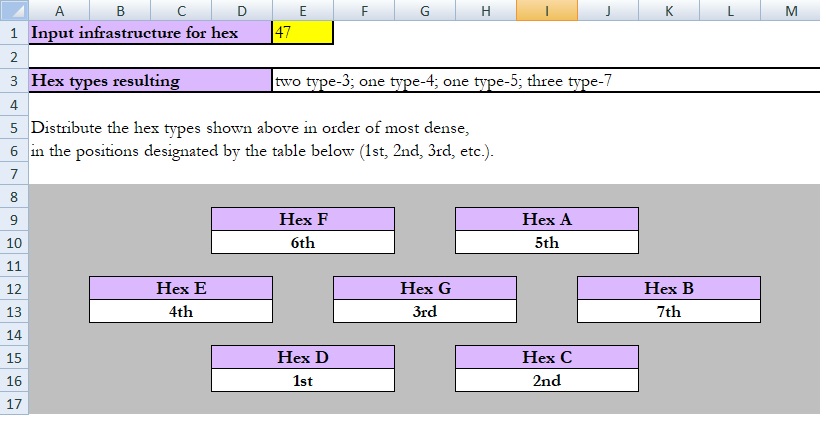
Under the "Input Infrastructure" tab on the excel file, you'll see the single point of inquiry, asking the user to insert a number.  It may be any number, but all numbers 448 and above produce the same results.

This will result in a group of designated "hex types" ~ in the example shown, two type-3, one type-4, one type-5 and three type-7.  The user is assumed to make note of these on a hex map matching the arrangement shown, in the positions designated.  In this example, the two type-3 hexes would be placed in the 1st (hex D) and 2nd (hex C) positions.  The type-4 would be placed in the 3rd position, the type-5 would be placed in the 4th position and the type-7 hexes would be placed in the 5th, 6th and 7th positions.

We would then go to the tab on the document named "type-3" ~ which, as we've already written down the positions of the hexes, we can now calculate as often as we wish.  We can quickly generate content for the two type-3 hexes:


By moving to the type-4 tab, we can generate this image:


And the type-5:


Then finally, the three type-7:


With these images generated, we don't even need a hex map.  We can simply put the images together into a single graphic (tightened up):


Of course, there are some holes:


What do we do about those?  Well, it's perfectly simple.  Just take the six adjacent hexes as a guideline and roll a random d6 to determine the center hex.  Doing this for each "hole" neatly fills in the map.

Final distribution of 2-mile hexes

And there you have it.  Not a satisfactory map, obviously, but a good template to work from, giving you interrelationships between the two manors at the bottom of the map, placement of roads, a river or two connecting farm and tilled lands together, etcetera.  Incidentally, there is a description for every one of these results that can be found on the linked hex generator.

Increase the number to produce a more civilized countryside; reduce the number to increase the amount of wilderland.  We used 47, which is a bit of a backwater.

I can see a way to expand the data above into "build hexes," but I'm pretty sure it is a lot of steadfast, painstaking work.  Hmf.  Sounds like fun.