As before, please consider supporting me on Patreon. The less time I spend working as a cook, the more time I spend designing games, writing and making work like the above.
Tuesday, March 14, 2017
E7
As before, please consider supporting me on Patreon. The less time I spend working as a cook, the more time I spend designing games, writing and making work like the above.
Saturday, March 11, 2017
Wednesday, March 8, 2017
Process
I know there are some people worried about me, just a little bit. Rest assured, I'm not broken, I'm just resting.
I was driven to work out the bard and monk sage abilities, as I had no structure for those at all. I have a structure now, though of course there is a ton of work to do on those. I'm not stressing it, however. I was asked by a friend to do a little more work on the bard, so I will be kicking at that subject over the next week.
Both online campaigns are in mid-adventure at the moment and I've left 7 people on tenterhooks for two days, while I work out some issues. No worries. I will be picking up the campaigns again in a day or two. I'm just resting.
In the next month or so, however, I'm going to be concentrating on two things: the comic and the book. The reasons for this are simple. Money. I did not begin the comic because I've always wanted to be a comic book artist, but because I realized I have gotten just good enough to create what could be considered adequate design. The top down feature is original to the art-comic-strip world and I am a good enough writer of humor that I can keep this going for a time. I am hoping it brings some attention to the blog, to me, to the wiki and in general to my Patreon account.
My Patreon has been up for about a year, and during that time I have a cadre of extremely supportive, phenomenal, dedicated contributors who are paying through the nose to help me. The average donation for this group is above $10 a month. These people really like me.
My Patreon does not have two or three hundred people giving the relatively nothing cost of $1 a month, which seems reasonable and practical to ask but which appears to be an epic fail on my part. I'm simply not compelling the ordinary folk to donate. Frankly, I've likely acted the misanthrope one too many times. The majority of the online blog D&D community just don't like me.
So I have to go look for a new audience. The comic is a chance to do that. I think it is funny. My friends and acquaintances here in the real world seem to think it is funny. I accept that it is going to be harder with strangers, largely because I need to build up a body of work in this field. I am learning as I go. I think readers will be pleasantly surprised as the comic progresses. I have 13 total scripts and 7 completed comics as yet unposted. I will be putting them up on Wednesdays and Saturdays. My goal it to produce a minimum of 150. 150 comics is a book that I can sell.
As well, the strips may convince complete strangers that I'm worth a buck for a few months.
It takes about three hours for me to make a difficult strip, about 90 minutes to create an easy one. I'm told this is an insanely productive turnaround time. I have no idea. I've never been a comic artist. I did not draw things in school. I have none of the past characteristics one would associate with an online comic strip creator. I'm a writer.
Now, the book. I am struggling to hold myself to 1,667 words per day. That is the November Book in a Month pace. It's a little slower than a book a month, however, as I'm counting rewrites, editing and places where I'm burning down a part of the book and writing something better from scratch. Overall, the work is progressing. I want to have a final copy the 1st of June.
I am, however, terrified by the whole damn work. It is 16 months in the making right now and I have great reservations about the value of the project. I have lost all perspective at this point and I have exactly no one that I can trust or communicate with whose perspective I trust (or respect). I feel alone and somewhat set upon by the wolves of my consciousness, making me extremely bitter about the whole project. So, normal artist shit.
I'd love to put up some sort of measure online, every day, that would matter to someone, to signal my commitment, but I can't think of one. At best, I can feel myself growing stressed and angry ~ and these are good signs. When faith quits, when enthusiasm dies, when doubt creeps in and despair upon its heels, anger will get us home. Anger is the artist's friend.
So, fuck this fucking project. I'm going to finish the fucking thing so it will quit pestering me.
Sorry. Just thinking things through a bit.
Everything I do on and off line costs in time and energy where it comes to completing things that will improve my survival and standard of living. I want to play, I want to have a good time, I want to self-care . . . but ultimately there is what's important and what's really important. If the reader will just bear with me, I'll just get past this trouble and then all will be sweetness and light.
I was driven to work out the bard and monk sage abilities, as I had no structure for those at all. I have a structure now, though of course there is a ton of work to do on those. I'm not stressing it, however. I was asked by a friend to do a little more work on the bard, so I will be kicking at that subject over the next week.
Both online campaigns are in mid-adventure at the moment and I've left 7 people on tenterhooks for two days, while I work out some issues. No worries. I will be picking up the campaigns again in a day or two. I'm just resting.
In the next month or so, however, I'm going to be concentrating on two things: the comic and the book. The reasons for this are simple. Money. I did not begin the comic because I've always wanted to be a comic book artist, but because I realized I have gotten just good enough to create what could be considered adequate design. The top down feature is original to the art-comic-strip world and I am a good enough writer of humor that I can keep this going for a time. I am hoping it brings some attention to the blog, to me, to the wiki and in general to my Patreon account.
My Patreon has been up for about a year, and during that time I have a cadre of extremely supportive, phenomenal, dedicated contributors who are paying through the nose to help me. The average donation for this group is above $10 a month. These people really like me.
My Patreon does not have two or three hundred people giving the relatively nothing cost of $1 a month, which seems reasonable and practical to ask but which appears to be an epic fail on my part. I'm simply not compelling the ordinary folk to donate. Frankly, I've likely acted the misanthrope one too many times. The majority of the online blog D&D community just don't like me.
So I have to go look for a new audience. The comic is a chance to do that. I think it is funny. My friends and acquaintances here in the real world seem to think it is funny. I accept that it is going to be harder with strangers, largely because I need to build up a body of work in this field. I am learning as I go. I think readers will be pleasantly surprised as the comic progresses. I have 13 total scripts and 7 completed comics as yet unposted. I will be putting them up on Wednesdays and Saturdays. My goal it to produce a minimum of 150. 150 comics is a book that I can sell.
As well, the strips may convince complete strangers that I'm worth a buck for a few months.
It takes about three hours for me to make a difficult strip, about 90 minutes to create an easy one. I'm told this is an insanely productive turnaround time. I have no idea. I've never been a comic artist. I did not draw things in school. I have none of the past characteristics one would associate with an online comic strip creator. I'm a writer.
Now, the book. I am struggling to hold myself to 1,667 words per day. That is the November Book in a Month pace. It's a little slower than a book a month, however, as I'm counting rewrites, editing and places where I'm burning down a part of the book and writing something better from scratch. Overall, the work is progressing. I want to have a final copy the 1st of June.
I am, however, terrified by the whole damn work. It is 16 months in the making right now and I have great reservations about the value of the project. I have lost all perspective at this point and I have exactly no one that I can trust or communicate with whose perspective I trust (or respect). I feel alone and somewhat set upon by the wolves of my consciousness, making me extremely bitter about the whole project. So, normal artist shit.
I'd love to put up some sort of measure online, every day, that would matter to someone, to signal my commitment, but I can't think of one. At best, I can feel myself growing stressed and angry ~ and these are good signs. When faith quits, when enthusiasm dies, when doubt creeps in and despair upon its heels, anger will get us home. Anger is the artist's friend.
So, fuck this fucking project. I'm going to finish the fucking thing so it will quit pestering me.
Sorry. Just thinking things through a bit.
Everything I do on and off line costs in time and energy where it comes to completing things that will improve my survival and standard of living. I want to play, I want to have a good time, I want to self-care . . . but ultimately there is what's important and what's really important. If the reader will just bear with me, I'll just get past this trouble and then all will be sweetness and light.
Tuesday, March 7, 2017
Way of the Spirit
As ever, as I move towards the last, the mire grows deeper and less pleasant. Instinctively, I know what is going to be simplest with these things and I always know what to leave to the end. By the end, however, I am more than ready to have done with it.
This field, or "way," concentrates on what is known and what is felt. I have no easy explanation for it. There are four studies, or paths, upon which the monk can focus: calligraphy (meditative writing); insight (knowledge gained from within); mindfulness (heightened awareness from within); and tranquility (the discovery of inner peace).
I have accumulated 31 abilities for the field, more than any of the previous categories: 9 amateur, 9 authority, 7 expert and 6 sage. These were hard to invent and contain elements that are wholly unlike what one normally expects for D&D.
I will need to say some things about calligraphy. I have been deliberately non-specific about the "characters" employed; I feel that in some religions these will be letters, in some they will be phrases and in others they will be iconographic. Fundamentally, whatever the religion, I am treating them as the written word and not works of art.
These are not spells. Calligraphy will not make much of a study for a player, I think, though one might be interested enough if they gain some skill as they move up levels. The various characters must be written on either permanent structures, vessels or vehicles large enough to house persons or carry great weight, or upon expensive parchment. The words must be written with a brush, not a pen, and large enough to take up a whole page or to be seen at a distance. Finally, if the characters are written on parchment, it must be upon a specific sort of table that cannot be simply carried around in a backpack. Such a table could be carried in a vardo, however (a wagon used as a home). The expectation would be that it takes time to set up to create calligraphy (in keeping with most of what I've seen when writing appears in a wuxia film).
At present, I don't have the niggling details sorted out for calligraphy yet, but then I don't have those details nailed down for any of the monk abilities. This is just an overview. As a limit, the character will be allowed to create one of any kind of calligraphy once per day, and will only be able to keep the power in as many calligraphy characters as the player or non-player has levels.
On the whole, I wouldn't describe the abilities below as particularly earth-shattering or powerful. They are generally quite specific and much more useful for non-player characters than for players. Still, it rounds out the monk and provides opportunities for game adventures.
Amateur Way of the Spirit
- Characters of beneficence (calligraphy). Drawn on the surfaces of commercial buildings, wooden vehicles or vessels, these five characters will increase sales, lessen theft, reduce accident or damage, ease the effects of storms and help residents find their way home.
- Commune with magic (insight). The monk is able to detect the presence of magic in weapons and armor, sufficient to describe the base power of the weapon but not specialties or details that would require an identify spell.
- Sense attention (insight). The monk will be made aware of any individual who is watching the party ~ spying them, where they are and how far away. This will be known without the watcher's awareness. Range is 120 ft, within line-of-sight.
- Sense vibration (insight). The monk will feel adjustments being made to floors and walls, indicating activity taking place, the danger of collapse or vibration caused by other sources.
- Resist fear or curse (mindfulness). Provides a +3 saving throw against fear and curse spells and magic (including calligraphy).
- Wakeful sleep (mindfulness). Enables the monk to remain semi-conscious while "sleeping." The monk is considered awake for calculating stealth; if an individual comes within the range necessary to be detected, the monk may attempt to awake from sleeping by making a successful wisdom check.
- Meditation (tranquility). The ability to engage the mind at length while the body remains motionless. Does not provide the ability of inner sight (see below), but for each hour after sunrise spent in meditation, the monk gains a +1 modifier to a specific saving throw against magic or unnatural forces. Four hours of meditation would provide four +1 bonuses to four different saving throws that day. The benefits of meditation cease when the sun rises again.
- Rested state (tranquility). The monk may replace 1/2 hour of required sleep per night with 1 hour of meditation. Enables the monk to rise earlier and sleep less. Typically, 6 hours of sleep are considered a minimum for two days, followed by one night of at least 8 hours of sleep.
- Smile (tranquility). A disarming, beautific smile that has the ability to compel aggressive others to seek parley. If the monk wishes (it must be an expressed desire), the monk's outward aspect becomes passive. Any aggressor moving into an adjacent combat hex must save vs. poison. A fail indicates the aggressor will seek parley, even if all around others are fighting. The monk, in turn, cannot take aggressive action either, but can defend, as can the former aggressor. Can only affect creatures of average intelligence or greater. Can only affect any given aggressor once.
Authority Way of the Spirit
- Character of speech (calligraphy). Drawn upon parchment. When the parchment is crushed in the hand, sends a silent message to close ally of the monk, within line-of-sight (up to 240 ft). Can be used once.
- Character of warning (calligraphy). Drawn upon a structure. Promises all who see it that the consequences of improper entry or behaviour will bring bad luck (effectively, a curse).
- Characters of propriety (calligraphy). There are four characters of propriety. The first is drawn in the home, to preserve the family and keep them whole. The second is drawn upon gravestones, to remind the living of the dead and to keep their influence strong. The third is carried on standards, to ensure loyalty and a strong union. The last is drawn for students in schools and places of training, to ensure honesty and right thinking in knowledge.
- Commune with reliquary (insight). Determines the base nature of any magical item, including artifacts. However, details and the degree of effect that the item has will not be known.
- Inner sight (insight). Enables one hour of meditation per level. During the time spent in meditation, the monk will be fully conscious of any change in the surrounding 20 feet (four combat hexes), meaning that by stealth the monk cannot be approached by closer than 5 hexes. Does not provide other meditation benefits.
- Mind rest (mindfulness). Simulates the effects of rest in a shorter period, so that the monk may "rest" within a period of one third of a day, or eight hours. This is done through contemplation (meditation is not necessary). The full effects of rest are gained. Mind rest can only be employed once per day.
- Close mind (mindfulness). Strengthens resistance against ESP, sleep and charm spells, providing a +2 saving throw against each of these. The monk may make a wisdom check to effectively cease the benefits of ESP into the monk's mind.
- Master (tranquility). Provides the skill necessary to teach other monks right action and right thinking.
- Serenity (tranquility). Strengthened ability to dispel aggression. Like smile (see above), the monk's serene appearance will affect all within six hexes, so that each must make a saving throw. Most likely, if more than half fail, or if the leader fails, a general parley will occur. Can affect creatures with low intelligence or greater.
Expert Way of the Spirit
- Character of alarm (calligraphy). Drawn upon a structure. Promises all that the consequences of improper entry will do more than sound an alarm, it will predict the invasion so that the speedy arrival of allies will ensure conflict; further, it shall rose the wrath of the sleeping ancestors.
- Character of revenge (calligraphy). Drawn upon parchment, which is then burned. Will call justice against a deservedly wicked and malevolent individual who holds public power, ensuring that there will be an attempt on the life of that person within ten days. It does not promise that the attempt will be made by an assassin or that it will be successful ~ that is left to the gods. But if the target is deserving, then an attempt will result.
- Cast eye (insight). When the monk meditates, necessitating remaining in one place, the monk is empowered to "see" from any place that is within 10 hexes of the monk's body. The monk can only watch from one position at a time, however, so the monk must declare what is being observed.
- Other world eye (insight). The monk is able to see into the ethereal plane. In my game, the "ethereal" is a dual world that co-exists with the prime material, but those in the ethereal plane may move freely about without being observed, while choosing or not choosing to observe the prime material.
- Banishment of fear (mindfulness). Provides complete immunity from fear spells or magic.
- Spirit sight (mindfulness). Reveals the true nature of a creature, whether shape-shifted, possessed or something that might be an illusion.
- Freedom from mind (tranquility). Empowers the monk to pass time without the notice of time. Of questionable value in a D&D game for a player, perhaps, but nevertheless interesting and worth noting.
Sage Way of the Spirit
- Character of protection (calligraphy). Drawn upon a structure. Promises that the building itself will act to repel those who would dare improper entry or behaviour in this place.
- Character of upheaval (calligraphy). Drawn upon parchment, which is then released from a high place upon the wind. Has the power to raise an army of thousands, who will gather against a state that deserves to fall. This army does not come under the control of the monk, but of the gods, and will succeed if the gods so choose.
- Script of the darkness (calligraphy). Enables communication back and forth with a demon of the underworld; the monk may gain information, but at a price: the demon is entitled to information about the material world, about which the monk must be forthcoming.
- Other world sight (insight). Enables the monk to visually locate entities upon the astral plane. The monk must meditate to obtain this vision, and must have some object or personal experience associated with the entity being observed.
- Appeasement (mindfulness). Enables the monk to force out unwelcome spirits, mental invaders or demons seeking to possess the consciousness of the monk. Provides complete immunity to ESP and makes the monk aware of clairaudience or clairvoyance when these are employed, either by spell or with a magic item. The monk may make a wisdom check to disrupt either clairaudience or clairvoyance when they begin.
- Pass into the ethereal (tranquility). Enables the monk to pass into the ethereal plane at will. [effects on stealth may need special rules, at present undetermined].
And there we are. That's a monkey off my back.
There would have to be more abilities than this, particularly in the higher levels. This is all I can come up with in the space of, what, nine days? Seriously, nine days ago all I had were a few ideas, certainly not 98 separate abilities. Whew.
Sunday, March 5, 2017
Way of the Heart
No question about it, this was more complicated than the previous two. But I think I have it tamed now.
This field, or "way," concentrates on influencing the physical world, either through manipulating the body's intrinsic capacity or ability, or manipulating the physical laws of the universe. There are four studies, or paths, through which this can be done: breath (augmenting the body structure); blood (preserving the body); yin & yang (empowering the body without outside force); and the path of the dragon (altering the universe).
I really had no name for the last category. I found myself pouring over lists of Chinese martial arts terms, searching for the right words; I picked this one because it is the name of the game, the dragon is a powerful symbol in martial arts and because I'm a huge fan of the 1981 movie Excalibur, in which "the dragon" is Merlin's allegory for the world itself. So this fits nicely into west meets east for universality. It isn't necessarily an Oriental description.
I have accumulated 28 abilities for the field, much more than the previous two categories: 11 amateur, 6 authority, 9 expert and 2 sage. These were easier to invent but difficult to categorize. The edges of the categories are a little sloppy, but the distribution of the abilities is fair.
Amateur Way of the Heart:
- Amend self (blood). With a short period of fifteen rounds concentration and relaxation, the monk may self-mend and restore a number of hit points equal to one's day's rest, once time per day.
- Resist fatigue (blood). Enables the monk to act without the need of rest for periods up to 30 hours +2 per level, without the effects from forced march [requires updated forced march rules].
- Vitality (blood). Reduces both the nature and degree of disease by a modifier of 1 point (a result of zero clears the body of disease altogether).
- Fleetness (breath). If any of the monk's action points (AP) are used to move from one combat hex to another, the monk receives 1 AP to be counted in that round.
- Jump (breath). Strengthens the monk's ability to leap further and higher than is ordinarily possible [requires a proper set of jumping rules].
- Scrambling (breath). Skill at climbing steep terrains or urban environments, where handholds and ledges are common. See wiki.
- Interposing aura (dragon). Creates a minor wall of force between the monk and others, protecting two sides of a combat hex. Requires one complete round to put the wall in place, whereupon it will remain so long as the monk does not depart from the hex. Can be replaced in another as often as desired, always at the cost of a round of concentration. The wall cannot be passed through or attacked through with bludgeoning, hacking or hurled weapons; missiles and piercing weapons can penetrate normally. The wall will dissipate the round after the monk departs the hex.
- Phantasmal figure (dragon). Like the illusionist spell of the same name. The figure is created from the life force, or qi, of the monk, in the space of one round and acts as described in the link. One figure may be created per day.
- Backflip (yin & yang). Enables the monk to retreat direction backwards from a combat out of a melee hex without the usual 1 AP penalty. The backflip will retreat the monk two hexes (which must both be empty) as it incorporates two complete turnovers. If the monk is able to perform a flying jump kick, the kick can be used in combination with the backflip at an additional cost of 2 AP.
- Drunken art (yin & yang). Requires the character to be smashed/heavily intoxicated. In this state, the monk will fight as well as they might sober, experiencing none of the attack die, dexterity or wisdom penalties for intoxication (although charisma and intelligence are affected). Hit points and morale benefits are unaffected. ["Don't make me drunk; you wouldn't like me when I'm drunk"].
- Healing energy (yin & yang). Creates healing energy that can be applied to others. Once per day, the monk is able to heal 1 point of injury damage per injury sustained, or 1 point per level of all other h.p. damage. The monk cannot self-support with this ability.
Authority Way of the Heart:
- Fast (blood). Empowers the monk to sustain existence on less food than would normally be required, merely one quarter the amount needed by others.
- Purgation (blood). Cleans poison from the body, calling upon the heart muscle to clean the blood and reduce round-by-round damage resulting from poison.
- Feign death (breath). Permits the monk to slow the heart, taking a single shallow breath of air per minute. State can be sustained for up to 45 hours without needing to eat, drink or sleep. The monk is conscious throughout and can become active instantly.
- Lightened body (dragon). Empowers the monk to push away from the earth, a distance of 2 ft. per level, so long as the monk is within arm's reach of a wall or can reach a fixed object at the height of the push. If the body is lightened in other circumstances, the monk will fall once reaching the apex of the push (a possibility also if the object grabbed for requires a dexterity check).
- Protective aura (dragon). Reduces the damage caused by magical and natural area effects by 1 point per die. The aura protects the hex where the monk stands, so that up to two others in the same hex can likewise be protected.
- Controlled descent (yin & yang). Character is able to fall short distances without harm. The character will take no damage from the first 20 feet, if falling within arm's reach of a wall. Speed of the whole fall is reduced to 10 ft. per second per round.
Expert Way of the Heart:
- Immunity (blood). Provides immunity from disease.
- Animus (breath). Enables the monk to attack from and defend two combat hexes simultaneously, provided both hexes are empty. To others, it will appear as though the monk is two persons, as the body 'wavers' between the two hexes. At the end of the monk's round, either hex may be designated as the destination hex without an AP cost.
- Death state (breath). Enables a state of minimal animation; the blood slows, the organs of the body quiet, outward senses shut down. The monk can hear sound but nothing else. Appears that the monk is dead. Can be sustained for one day per level. Requires three rounds to achieve animation.
- Inner breath (breath). Circulates air within the body, refreshing it without requiring the monk to breathe the surrounding atmosphere. The monk can therefore survive without air, underwater, buried underground or in a poisonous atmosphere for a period up to one day per full breath.
- Cloud (dragon). The monk may breath out a cloud of obscuring cloud which will fill the combat hex and conceal the monk's movement for one round. Requires 1 AP. May be used again following either sunrise or sunset.
- Rise (dragon). Enables the monk to tread the air above a solid surface, levitated to a height of 1 foot. Uneven surfaces may be run over without penalty and reduces the length between jumps by a distance of 2 feet (1 ft. per surface). The monk's body is treated as if it is on solid ground with respect to defense, overbearing or similar effects. Neither water nor living matter, such as tree limbs, can be risen over, but the ground beneath a growth of plants remains supportive.
- Wither flesh (dragon). Enables the monk to modify one damage/level caused during combat to manifest as necrotic damage, withering the flesh.
- Blind Man's art (yin & yang). When blind, the monk is able to fight as well as a sighted character. The monk must actually be blind or the ability requires a blindfold (part blindness is distracting).
- Mastered descent (yin & yang). Character is able to fall increased distances without harm. The character will take no damage from the first 40 feet, if falling within arm's reach of a wall. Speed of the whole fall is reduced to 8 ft. per second per round.
Sage Way of the Heart:
- Touch of death (dragon). Also known as the quivering palm, kills humanoid creatures upon a single touch (saving throw against death permitted).
- Descent of the crane (yin & yang). Character is able to fall any distance without harm, if falling within 8 feet of a wall. Speed of the whole fall is reduced to 6 ft. per second per round.
UPDATE:
I have one more amateur skill, associated with the Way of the Stick, Path of the Fist. The character is able to grab the opponent, drawing them close and Headbutting them, causing double ordinary open hand damage. However, the monk will also receive 1d6 damage from performing this move.
Thursday, March 2, 2017
Way of the Stone
I sense some trepidation as I move forward with this; that's understandable, the gentle reader can't guess where I'm going. I trust that I'm on point, however, so I'll just move forward.
The Way of the Stone concentrates on defense. There are four kinds of defense: can't be hurt, can't be moved, can't be touched and can't be seen. I'm still struggling with category names for these. For the present, in order, I will use pedestal (power to support), wall (impenetrable), moat (empty barrier) and smoke (ability to vanish). That is, until something better comes along.
So far, I have accumulated 18 abilities: 11 amateur, 5 authority, 1 expert and 1 sage. These are quite difficult to invent.
Amateur Way of the Stone:
Expert Way of the Stone:
Sage Way of the Stone:
The Way of the Stone concentrates on defense. There are four kinds of defense: can't be hurt, can't be moved, can't be touched and can't be seen. I'm still struggling with category names for these. For the present, in order, I will use pedestal (power to support), wall (impenetrable), moat (empty barrier) and smoke (ability to vanish). That is, until something better comes along.
So far, I have accumulated 18 abilities: 11 amateur, 5 authority, 1 expert and 1 sage. These are quite difficult to invent.
Amateur Way of the Stone:
- Correct stance (moat). Posture, proper movement and relaxation improves the monk's ability to balk attacks. Reduces natural armor class by 1 point.
- Evade missiles (moat). Permits a saving throw against fired or hurled weapons. Save vs. magic blocks or dodges weapon.
- Heightened balance (pedestal). Retains the body's equilibrium against chance of falling. See wiki.
- Root feet (pedestal). If desired, the monk is not driven out of a combat hex when stunned, but holds position. The skill also effectively increases the monk's weight 50% against overbearing attacks.
- Strength of the pillar (pedestal). Increases the character's encumbrance limit by one point of strength. The skill also enables the monk to bear twice their ordinary weight limit if the character does not need to move [beneficial if a roof support needs a little help].
- Back tumble (smoke). If desired, if the monk is stunned and forced back a combat hex, the monk can choose to use this momentum to tumble back one additional hex away from the enemy.
- Camouflage (smoke). The ability to proficiently disguise the body. See wiki.
- Stealth (smoke). Approach others without their knowing, without being seen or heard. See wiki.
- Block pain (wall). If the monk has sustained an injury, the limitations of the injury (arm, leg, back, etcetera made inoperative) can be ignored completely for 1 round per level of the monk, per week. No consequence results from this use, though the injury does reassert itself and must be healed normally.
- Correct fall (wall). By relaxing the body, the monk removes 1 h.p. of damage per die when falling.
- Invigorate body (wall). Counters the effects of cold. Increases natural CLO when desired (+0.5), provides a +1 save against cold attacks and subtracts 1 point of damage per die of magical cold damage.
Authority Way of the Stone:
- Awareness (moat). Provides heightened preparedness against surprise attacks. Monk is surprised only 1 in 6.
- Mystic block (moat). If the monk has been struck in the previous round and is not stunned, the monk may use their first attack in the round to "roll against the hit" rather than the enemy combatant. The roll to hit equals the enemy's armor class; a successful hit removes damage from the last attack done to the monk in the previous round [if the monk was attacked twice, the second attack that caused damage would be removed but not the first attack]. Only one attack per round may be used to attempt a mystic block.
- Mislead (smoke). If desired, a monk that is fighting among others can discount themselves from being a target that round. This will not reduce the number of enemy attacks, only that they will be directed at the monk's allies that are within reach. The ability cannot be used if the monk fights alone.
- Harden sinew (wall). If it is indicated that the monk sustains an injury, the monk is allowed a saving throw against magic. Success indicates that the injury does not take place ~ however, the monk will still receive any hit point damage in full that would have caused the injury. Indicates the monk's increased ability to relax the body.
- Purify body (wall). Counters the effects of heat. Reduces natural CLO when desired (-0.5), provides a +1 save against heat and fire attacks and subtracts 1 point of damage per die of magical heat and fire damage.
Expert Way of the Stone:
- Wisp (smoke). Enables the monk to delude an opponent into believing that the monk has not shifted one hex to the left or right during combat. The actual shift requires an ordinary action point cost and must be the last action taken by the monk that round. The first attack by an enemy the following round will be wasted into the monk's previous position.
Sage Way of the Stone:
- Petrify (wall). The monk turns to stone, obtaining a death-like state from which the monk retains awareness. Requires 3 rounds to employ. May be broken instantly. While petrified, the monk is immune to combat attacks that would have no effect on stone.
As before, that's a start. I'll be discussing the Way of the Heart with my next post.
Wednesday, March 1, 2017
Way of the Stick
At last, impatiently, I can get to the meat of this thing. At least, to the first "field" or "way" that a monk has access to: the Stick.
This concentrates on attack forms. So far, I have accumulated only 18 such forms: 10 amateur abilities, 6 authority abilities and 2 expert. Nothing on the sage level, but I have plenty of time for that. I would like more and this number of abilities, but at the moment I'm drained.
I've had to fit each of these ability ideas into the present combat system. This is tricky and to be honest, I don't know how well any of this is going to work. That will take game testing (and a lot of players correcting me when I forget what my own damn rules are ~ but that's why I write them down).
I've divided Way of the Stick into four studies, or as a monk would call them, "paths." We have the hand and the foot (attacks originating with open hand or with kicks), the claw (weapon attacks) and fist (grappling attacks). The fist represents the closed hand, which isn't used to punch, it is used to grab.
Amateur Way of the Stick:
This concentrates on attack forms. So far, I have accumulated only 18 such forms: 10 amateur abilities, 6 authority abilities and 2 expert. Nothing on the sage level, but I have plenty of time for that. I would like more and this number of abilities, but at the moment I'm drained.
I've had to fit each of these ability ideas into the present combat system. This is tricky and to be honest, I don't know how well any of this is going to work. That will take game testing (and a lot of players correcting me when I forget what my own damn rules are ~ but that's why I write them down).
I've divided Way of the Stick into four studies, or as a monk would call them, "paths." We have the hand and the foot (attacks originating with open hand or with kicks), the claw (weapon attacks) and fist (grappling attacks). The fist represents the closed hand, which isn't used to punch, it is used to grab.
Amateur Way of the Stick:
- Improved dual-wielding (claw). Reduces penalties for attacks with two weapons when using two daggers or bo sticks. [exact reduction yet undetermined ~ likely +1 with either or both weapons]
- Rhythm speed (claw). If any of the character's action points (AP) are used to attack with a weapon, the monk receives +1 action point to be counted in that round, after the attack has taken place.
- Disarm (fist). Grasping the enemy's arm or wrist, or using the monk's grip on the weapon employed, the target's weapon is forced out of their hand. Normal fumble rules apply. Move must be called. Causes half open hand damage.
- Pin (fist). Upon a successful open hand strike that stuns (by damage or target strike), the monk may declare that the opponent is pinned. The stun indicates the monk has moved into the target's hex and grappled [proper grappling rules yet undetermined]. The opponent is then pinned and must make strength check to break free. The monk can, with the next attack, cause grappling damage (1d4) without a roll to hit, strengthen the pin [lower the target's strength] or release the pinned target.
- Back kick (foot). Enables the monk to strike with the foot at a target in a rear or flanking hex without changing facing. Attack is performed at -2 to hit. Cost is 2 AP. Damage equals open hand attack.
- Kick practice (foot). Enables the monk to break objects (see item saving throws) as a normal blow, without consequence. Requires time to focus and breathe with rhythm; cannot be performed in combat. Saving throw for items is increased 1 point per level of the monk.
- Snap kick (foot). Kicks opponent as a primary attack, against the knees or torso. Can be performed only if the monk has not been hit in the previous round. Cost is 3 AP. Damage done is twice normal open hand damage -1. Thus a 2nd level monk performing a snap kick would cause 2d4-1. (1-7, average 4).
- Correct form (hand). Open hand attacks are performed at one level higher with regards to the number of attacks per round. Thus a 2nd level monk would attack 5 times every 4 rounds, rather than once per round, but still do normal damage for 2nd level.
- Hammer strike (hand). Striking outward with both hands with a 3 AP cost. If the blow hits, regardless of whether the opponent is stunned or not, the target will be knocked back one combat hex. Adds 1 damage to normal open hand attack.
- Target strike (hand). In an open hand attack, if the monk hits five points higher than the amount needed to hit the target's armor class, the target will be stunned, regardless of the damage done. Achieved through having hit an acupressure point.
Authority Way of the Stick:
Expert Way of the Stick:
- Deft eye (claw). The monk cannot cause friendly fire with thrown or fired weapons.
- Weapon art (claw). The monk adds one damage to all weapon attacks per four levels acquired.
- Seize weapon (fist). If the target is employing a one-handed weapon, the monk can perform a move more intricate than disarm, gripping the target's wrist and taking the weapon from the target's hand. Move must be called. Requires a -3 to hit modifier.
- Throw (fist). Upon stunning with the open hand, the monk may declare an intention to "throw" the opponent. If so, the opponent is moved to a hex that would normally be on the monk's flank or rear. The destination hex must be empty. The opponent takes no additional damage [but is still stunned]. Uses remaining AP for that round. The monk's facing may be in any direction following the throw.
- Flying jump kick (foot). The monk moves one hex, jumps, kicks the opponent with both feet. Must be the monk's first attack that round. Cost is 4 AP (including movement). Monk gains +1 to hit. Damage done is twice normal open hand damage.
- Sweep (foot). Upon stunning a target, the monk may expend 2 AP and sweep the opponent's legs out from under. Does not require a 'to hit' roll. Causes no damage, but attacks against the stunned, now down target are made at +2.
- Throwing art (claw). When employing stars or throwing knives [need to be added to the monk's choice of weapon proficiencies], the character will be able to hurl/throw objects at a cost of only 1 AP each (up to the monk's number of open hand attacks per round).
- Correct effort (hand). Open hand damage is caused at one level higher than the monk's present level.
Well, that's a start, anyway. I'll be discussing the Way of the Stone with my next post.
Core Monk Abilities
I have decided to retain four "core" abilities for the monk class that all monks possess and improve in, regardless of what sage abilities they've chosen to pursue. These are armor class, number of attacks, open hand damage and number of proficiencies. Here's a breakdown for the 17 levels that a monk can attain:
I wrote on Friday that back in the 1980s I had adjusted the monk's starting natural armor class from the Player's Handbook "10" to "8." Now I'm adjusting it again, to "9," to create an ability for monks who want to concentrate on defense (they can improve the armor class listed on the table above by 1 point or even 2).
The AD&D rules have always limited the monk's weapon attacks to 1 per round. I'm making adjustments to the weapon damage bonus in the PH (and making it a different sage ability), so now I can improve the number of times a monk hits per round with a weapon. The list given is, in fact, the number of attacks a fighter can perform per round ~ so the monk is not better than the fighter in this regard. But as I said in my last post, the monk is a fighter, so this is fair.
The open hand attacks per round are higher; this is intentional, as I prefer the monk to turn to their open hand rather than concentrate on weapons. This, I have found in the past, is something that happens automatically as the open hand damage increases. I hope that additional open hand/martial arts abilities that I will add with the sage abilities will encourage players to consider non-weapon attacks sooner.
Finally, proficiencies. Monks are limited to staves, jo sticks, bo sticks, clubs, daggers, hand axes, javelins, pole arms, spears and crossbows. The non-proficiency penalty for a monk is -3 to hit.
The Monk's Nature
I am nearly at the point where I'm ready to start coughing up abilities.
At several points there has been some discussion about, as Maliloki put it, "world-building" monk abilities: social skills, knowledge of history or literature, animals, plants, etcetera. The original Player's Handbook had monks talking to animals and plants, for example. We're used to tropes where monks are able to talk to birds or sense the emotional status of the surrounding natural landscape. The Chinese term "jianghu," which describes the hermit-like nature of the monk, means literally "rivers and lakes." This would seem to suggest a druidic root to the monk's background.
However, just as I mean to consider the monk a universal class and not one based on Eastern mythology, the druid is also a universal class and not based on Western mythology. The descriptions of jianghu will apply as well to druids as to monks. Druids are also hermits. Druids can also manipulate qi.
As such, I want these classes distinguished from one another. I rush to point out that there are three other means by which a monk can gain skills as a cultivator, a social climber, a scholar or any one of the sage abilities ascribed to the other classes:
Remember that eventually the monk, as it improves, gains ALL the amateur studies associated with the class. As they get really high level, they'll get all the authority levels for all the classes as well. Are all monks musicians? Alchemists? Historians? I don't believe that they are or that they should be. I want the monk class to be distinct and not watered down with a lot of abilities that really ought to be the domain of other classes, that shouldn't in turn have to compete with the monk. The druid should feel that the druid is the center of attention where plants and animals are concerned. The monk should be the center of attention where focus on the body as a unique and profound fighting style is concerned.
At several points there has been some discussion about, as Maliloki put it, "world-building" monk abilities: social skills, knowledge of history or literature, animals, plants, etcetera. The original Player's Handbook had monks talking to animals and plants, for example. We're used to tropes where monks are able to talk to birds or sense the emotional status of the surrounding natural landscape. The Chinese term "jianghu," which describes the hermit-like nature of the monk, means literally "rivers and lakes." This would seem to suggest a druidic root to the monk's background.
However, just as I mean to consider the monk a universal class and not one based on Eastern mythology, the druid is also a universal class and not based on Western mythology. The descriptions of jianghu will apply as well to druids as to monks. Druids are also hermits. Druids can also manipulate qi.
As such, I want these classes distinguished from one another. I rush to point out that there are three other means by which a monk can gain skills as a cultivator, a social climber, a scholar or any one of the sage abilities ascribed to the other classes:
- First, the monk can have parents that possessed these skills and gave them to the monk. This is part of my background generator. It presumes you grew up around your father, that you gained his skills as a young child, and that today you're able to act upon those skills. Since farming is a very common thing for your father to have had as an occupation, this explains all the western monks who have formed colonies to cultivate vinyards and farms. Too, a monastery only needs one "farmer." The rest of the participants will learn to farm as they spend their years tilling and tending the plants. There's no need to create a sage study that will cover something that can be done as a virtual laborer.
- Second, the monk may have the opportunity to cross-train due to their high wisdom. This, too, is part of the background generator. It is a random chance, but if it is gained by the correct roll against the character's wisdom, the character can take any study from any class and include it in their own sage abilities. Thus, some monks will have history, alchemy or literature in their knowledge base, as well as a potential knowledge of plants, animals or anything else. We have to ask the question, do all monks need this as part of their class construction?
- Finally, the monk may choose to be multi-classed. I know this isn't acceptable in the player's handbook but I have no limitations on mixing classes, whether a character is human or any other permissible race. Therefore, a character can be a cleric-monk, a druid-monk, a paladin-monk, a mage-monk or what have you. This means a full slate of sage abilities from the alternate class, so that many monks who have chosen more than one class would be well versed in druidic, clerical, magical or bardic fields of pursuit.
Remember that eventually the monk, as it improves, gains ALL the amateur studies associated with the class. As they get really high level, they'll get all the authority levels for all the classes as well. Are all monks musicians? Alchemists? Historians? I don't believe that they are or that they should be. I want the monk class to be distinct and not watered down with a lot of abilities that really ought to be the domain of other classes, that shouldn't in turn have to compete with the monk. The druid should feel that the druid is the center of attention where plants and animals are concerned. The monk should be the center of attention where focus on the body as a unique and profound fighting style is concerned.
Like recently where I have begun treating the assassin as one of the fighter class, I feel that the monk, too, is properly a "fighter." Not a spellcaster and not a thief. I have chosen to strip most of the thieving abilities from the monk, with the exception of stealth and climbing. Likewise, I have also chosen to strip those abilities that are magical in nature, such as avoiding magical damage or speaking with plants and animals.
The monk is properly a creature that has spent so much time concentrating on the methodical training necessary to accomplish the monk's feats that they are virtually unschooled where it comes to the outside world. This, too, is a trope ~ and I believe the more definitive one. It is true that a monk is always cast as someone with wisdom (mostly Kant-derived wisdom, but hey, it's the movies and television), but the bigger descriptor is someone who just doesn't "get" the world. "Why do ordinary people act so strangely?" This is written on the face of every monk who finds that they are cast out into the world. This is just as true with the European monk as it is with the Asian.
So I intend to cripple the monk by making them the best fighter and combat artist in the game ~ but the worst social component in a party. Not uncharismatic, necessarily, but not the character with the answers about how this bridge works or what rocks are these, what is the local law here or can I mend a pair of shoes. For these things, I want my monk to be surprised, confused, and unsure about how to react.
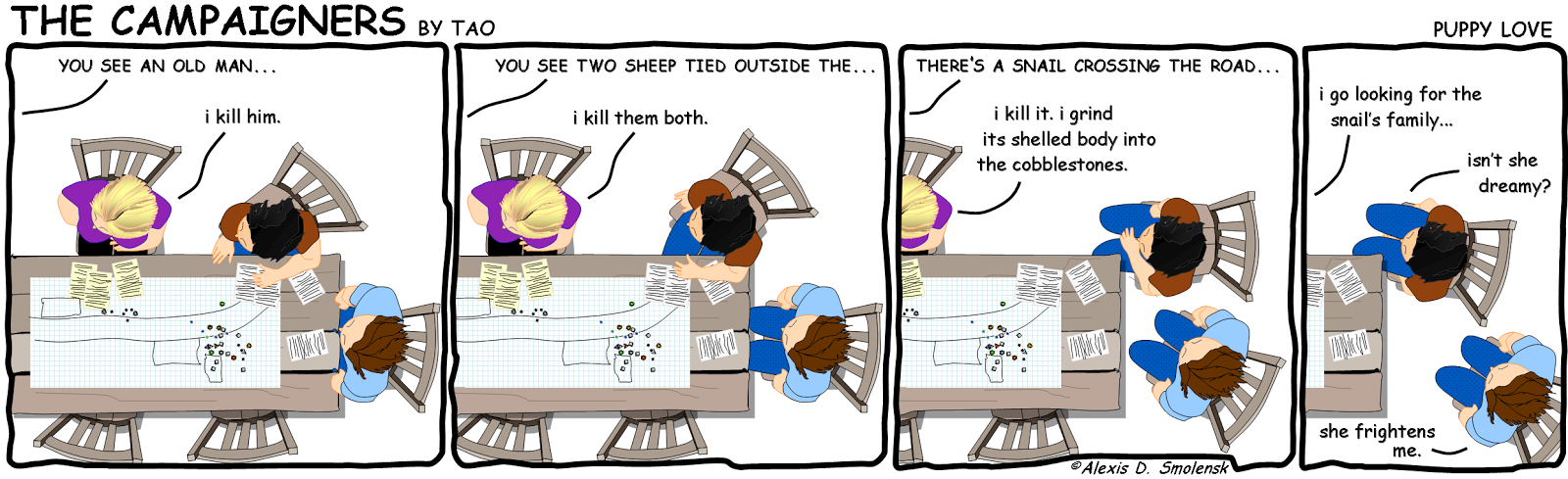
Do look at the comic below. I will have a new one when Saturday begins.
Subscribe to:
Posts (Atom)


