Friday, April 15, 2016

Days

There's a rhythm in rush these days,
Where the lights don't move and the colors don't fade
Leaves you empty with nothing but dreams
In a world gone shallow in a world gone lean;
Sometimes there's things a man cannot know
Gears won't turn and the leaves won't grow
There's no place to run and no gasoline
Engines won't turn and the train won't leave.

I will stay with you tonight
Hold you close 'til the morning light
In the morning watch a new day rise
We'll do whatever just to stay alive.

Jose Gonzalez - Stay Alive

Wednesday, April 13, 2016

Today. And Tomorrow.

13 Days until the preview of my book, The Fifth Man, comes out. There is still time to support my writing endeavours, if the wonderful people I've met this last two months find it in themselves to be generous. A small $25 donation wins you an excellent module, the preview to the book, the support of a hardworking writer and my eternal gratitude.

Ultimately, we were able to raise $2,868 of the $6,200 we were striving for.  I haven't had a donation in more than a week and so I am thinking we are perhaps at the bottom of our well.  Unlike every other kickstarter in the universe, however, the fact that I have fallen short means nothing.  I will finish the book and I will make good on my promises.  I am eternally stunned to hear of people raising $80,000 out of a request for $100,000, only to blow the money and throw in the towel on a project they supposedly cared about.

I edited 9,500 words today.  That is a lot harder than it sounds.  It isn't just a matter of correcting spelling; it is ensuring that every word spoken by a character is IN character; that the continuity is right; that the pacing and pattern and detail is all in place, leaving the reader to feel as though they've been seated in a comfy chair designed by gods.

Earlier today I wrote about two films that I called badly written.  I think this happens far more because these things happen because writers - particularly screenwriters - are pressed to finish projects in a time period that is unreasonable.  I think it is also because to write, a writer must have time to think, to concentrate on that one project to the absence of everything else.  Writing is thinking; it is elaborating upon a moment in time with reflection, reason and a willingness to admit that a given passage or a given plot development isn't good enough.  All art obeys this rule; but all artists do not.  Far too often, as I've said before, 'good enough' weakens a piece of art - because it isn't, not really.  Yet it is hard to keep coming back to something again and again that we thought was done . . . and it is so very human to convince yourself that it is, even when deep down inside you damn well know that it isn't.

Some artists tend to understand this better when they're young and poor and there are no distractions beyond the distractions they make.  It is harder for Tarentino or Scott to free themselves from distraction and bullshit, so they churn out projects in far less time with far more money than they should be spending, because they have to cut corners and pay people money to do it.  Artists with 30 years of fame under their belts hardly get a chance to think, unless they go all Garbo; it is easy for me to dedicate my mind to a single task because there are no events to attend, no meetings to attend, no charity events to attend, nothing that costs me time and money that I 'owe' to other people.

I'll never forget Vonnegut talking about that, about being pulled into the machine, and how the machine keeps a writer from writing.  In the end, he was able to separate himself; but he never turned out work again like that he did in the 60s and 70s.  Then again, he didn't have the internet.  The internet might have revived him.

Ah well.  I'm already old; and I never did get caught by the machine.  I know I would do the comic con circuit, if I could - though that goes forever now, you can do that circuit every weekend all year round if you want.  I watched the writers at their booths, the kind getting $5 a signature, talking about the same things over and over to fan after fan.  They all looked tired.  They looked unhappy.  Like having to go work in the back house of a restaurant, up to their elbows in rotten food and grease - but for more money.  I look at that and I wonder, is that what I'm doing it for?

I'm not.  I'm doing this because I love it.  I get up at 7:30 on my day off and after an hour of searching the net for the usual intellectual wake-up stuff I'm on my computer, working until 4 pm on the trade pricing table.  Then I'm editing, to take a break to write a post for the blog, to get back to editing until midnight.  And when I have to stop, because I get to the end of chapter six and that seems like a good place, I sit in the living room, on a different computer; and after ten minutes of looking at the net I'm writing a different post.  I just mean to write a few words about the preview coming out but I find I'm not done there.  I'm still writing.  It is almost one in the morning and I am still writing.  As I finish these words, I realize I have been continuously working on one project or another for 15½ hours.

And the worst thing?  I can't do it tomorrow.  Because I have to go work.  Which sucks.  But yes, you all know that already.

Well, 13 days.  That's the important thing right now.  And even though all you brilliant readers have donated already, I'll just say again there is a jumpstarter.  There is a patreon.  There are no expectations, no recriminations, no extortion where it comes to not finishing the job that people have already paid for and which they deserve to receive.

Damn, you know?  The internet is a wonderful thing.

Tuesday, April 12, 2016

Writing, Films, Nonsense, Thanks to Everyone Who Voted


That is very gratifying.  It isn't that I have hundreds of readers or anything, but a 93% success rate is confoundedly agreeable.  And here I thought people, on the whole, were getting tired of me.

I'm sorry I haven't got a long, drawn out post to present this evening about the trade system or some other worthy topic.  I'm working on my book and, having eaten some fuel, I have to get back to it.  But I wanted to post the results of the poll before taking it off the sidebar.

So, more material on trade would be a good idea.  So noted.  The next big problem is taking all those references about goods and services and making them work for you in terms of creating prices.  I've been steadily working on my own pricing table week by week, distributing it out to the three people who have pledged $10 on Patreon; they're looking at the very guts of my work, as it gets structured.  Those with a sharp eye will watch me change lines, shift details and fix numbers when I need them to fit what I know will be the player's preconception of pricing.

Worked all last week and I had today and yesterday off.  Most of the nicks and cuts on my hands have scabbed, so I'm ready to go get a bunch of new ones tomorrow.  Right now, I count 14 days before I'm responsible for putting out a preview of The Fifth Man.  Most of the main characters will be introduced and most of the continuity is worked out.  A few people who paid for character names will be disappointed, since their characters appear later in the book than the preview.

I am really enjoying the content as it fleshes out.  The characters come across as real, distinctive, likeable.  As near as I can tell, I haven't had to resort to any tropes that could be defined as bad writing: no handwaving or deus ex, both of which infuriate me when I read a book or see a film.

Quickly now - I've seen two movies in the last two weeks that I feel are worth remarking upon.  First, there was The Hateful Eight.  This is just dreck.  Dreck.  The expositional writing is so awful there might as well be a ticker-tape across the bottom of the screen, like on the Fox Channel, reading "Tarentino just couldn't think of a better way to introduce these two characters than this; please stand by."  There is literally a scene where one character walks up to another and says, blatantly, "What's your story" - before then moving on and doing it again.  Two more times.  Over and over, he was apparently unable to move the exposition in any other way.  It's painful to watch - and it just goes on, mawkish minute after mawkish minute, in an interminable stylistic suck that Tarentino has managed to dupe an audience with because there's blood and swearing.  Personally, I like blood and swearing.  I swear all the fucking time on the blog and when people on screen get shot, I like seeing blood is going to come out - because that's what happens and it doesn't shock, offend or even disturb me (it would in real life, but shit, this is a movie).  I do, however, have a problem when the amount of blood changes from scene to scene, is conveniently easy to clean up when it ought to be all over a wooden floor, conveniently fails to have any impact on the players who should be smelling it a mile from the main setting and ultimately exists in a kind of cartoonish silliness for the purpose of exploitation.  Great director?  Bleh.

The Martian.  Surprised me.  After Prometheus I swore I'd never see another fucking Ridley Scott movie again - and watching Exodus go by I was bloody grateful for the promise.  But . . . after watching that doof Neil deGrasse Tyson promote it (I respect what the guy knows, respect his intelligence, like it when he gets pissed at stupid people; but I'm exhausted when he dumbs down science so that 'everyone' gets it - fuck everyone, Tyson; they don't care), I conceded to giving it a watch.  Wasn't bad.  Thought it was going to be dreck.  Wasn't.  Wasn't great, either.  The Matt Damon parts were smart but watching the bureaucracy jerk itself around arguing about money and time reminded me of much better movies made 40 years ago.  It's supposed to be drama, instead it's a domino-line of tropes, blathered by people without personalities or proven merit (and sorry, giving a character's title at the start of the scene does NOT constitute evidence of merit).  There's a little trope called informed ability and woah, is this movie ever stuffed full of it.  Just more lazy writing.  But the Matt Damon parts were good - despite the fact that I can't for the life of me remember the name of the character, because the name was absolutely of no importance in the film, just like every other personality trait.  The science was wonderful - when it was on screen.  My main issue with the film is this, however (spoiler): we all knew that the ship heading back to Earth was ultimately going to come back to Mars to rescue him.  This is an American film and we know how Americans think: leave no one behind, not even dead people, ever.  Unfortunately, we had to wait three quarters of the film for the characters to come around to this realization, along with a very convenient rocket explosion and a series of other very convenient plot points that guaranteed that the end would be tense and full of speed and terror and lots of importance.  Which it wasn't, because of the director's fingerprints, drool, jizz and virtually every other bodily fluid smeared all over the fucking film.  This one could have been great, really great.  Unfortunately, it was directed by another "great" director who has far, far more fame than he has ability.

Well, hope that didn't piss off too many people.  I have to go back to writing now.

Sunday, April 10, 2016

How to Run: An Advanced Guide to Managing Role-playing Games

For many of my readers, none of this will be new.  I feel that it is something I should do, now that it's been nearly two years since the book was published.

The book is divided into four parts:  The Art of Presentation (6 chapters), Managing Yourself as DM (2 chapters), Managing Your Players (2 chapters) and Worldbuilding (4 chapters).

Breaking it down, chapter-by-chapter:


Chapter 1: Early Days

At the start, I am quite frank about once being utterly unskilled as a DM.  I talk about the difficulty of role-playing games and start the theme of the book.  Although it is very, very hard to be a DM, this is something that comes with experience.  We shouldn't be hard on ourselves at the beginning, we should realize that with time and patience, and a lot of hours spent running, we will steadily get better.  We can learn that the rules are tools, we can learn to experiment in our building and design and we can educate ourselves from a wide variety of resources to expand our minds and the options we can bring to the table. (9 pages)


Chapter 2: The Carrot and the Donkey

Here I talk about motivation - about developing the campaign as a 'theatre' that the players willingly enter.  I talk about the first steps in starting a given session, getting the players "in the mood" and making them feel uninhibited.  Then I discuss arousing the players' curiosity, getting inside their heads and the importance of avoiding 'formulas' that will supposedly get the same returns running after running.  I talk of the importance of making better and better carrots to keep a party intrigued and keep them coming back for more.

From here I talk about the participation of symbiosis.  Everyone in the game must be on the same page and they must want the same things, both DM and Players.  Working together in a supportive relationship will enhance participation and drive the players towards wanting that carrot.  Players who disrupt this formula must have it explained that role-playing is a group activity - there isn't room for one player to hog all the air in the campaign to the exclusion of other players.  By reducing conflict, we can make the game move faster and make the experience more pleasant for everyone. (14 pages)


Chapter 3: The Players

This chapter features a breakdown of player 'types' based on solid psychology templates: three subdivisions of the categories extroverted, introverted and indifferent.  I arrived at nine classes of players - understanding that these are not boxes intended to categorize people, but as jumping off points to talk about strategies in dealing which each form of behaviour.  Any real player will be an amalgam of these classes: the important thing here is that we have something to work from.

These nine classes are Enthusiastic, Obligated, Conditional, Predisposed, Disenchanted, Badly Behaved, Social, Shy and The Guest.  In each case I give the reader an idea of what each has as a motivation, how to recognize that motivation and strategies on how to deal with it - with a reminder that players are the game and that our game must be tailored for the collection of people in it. (33 pages)


Chapter 4: Drama

At last, I get into the gears of running the game.  I begin with a breakdown of the formula that has defined successful drama since the ancient Greeks, discussing it in terms of role-playing and presenting details to players.  I talk of adding complications to the adventure, of encouraging player innovation and about bringing the traditional adventure to a good conclusion.  This first part of the chapter is written as a solid play-by-play for DMs wanting to guideline on meat-and-potatoes adventure building.

At this point I begin to tear apart the dramatic structure in terms of role-playing not being a stage-play created for an audience.  In fact, there is no audience; the Players are the actors upon the stage and there is no script - therefore, there is no real need for specific dramatic cues that were designed to keep an audience in their seats for two hours.  Players easily sit in their seats for four or five hours without any trouble.  While understanding that the game can be run on the traditional dramatic structure, it does not need to be.  We can change what's happening on the spur of the moment - what I call "Here and Now" DMing.  This is where we let the symbiosis we talked about in Chapter 2 develop into a dramatic experience that is both written and experienced in real time. (17 pages)


Chapter 5: Continuity

This chapter discusses the importance of building causality into the campaign, in order to carefully seed events in the future out of what's going on in the present.  Nearly every DM understands that player actions demand consequences when the players do something very bad - but we need to understand that the campaign needs to be reacting all the time to what the players do.  The players have to feel that they are influencing the campaign just as the DM is influencing the players.

To enhance the fluidity of the world, I then discuss five ways in which the DM can poke that fluid:  I call these Shock (surprising the players with the unexpected, unbalancing them); Rage (stirring up emotions like anger and resentment in order to fire the players towards taking action); Distraction (filling out the moment-to-moment game with little things that compromise player comfort while creating obstacles); Despair (letting the players experience the low-point of disaster and ruin without rushing to save them); and Triumph (total victory).  Of these, the comparison between Despair and Triumph is key to the game, for if the players are assured they will always be saved then there is no real sense of overcoming impossible odds; there is no high if there is no low. (29 pages)


Chapter 6: Pomp

For the chapter, I discuss the grind of being a human body putting out a performance - being conscious of one's appearance, stance, voice, personal tells (like in Poker) and other similar ways in which we interact with the space that we're in.  I talk about "Space" as well, the place where the game is played, the distractions of that space and its convenience.  I talk about "Relations" between persons at the table (are they friends or practically strangers) and how this can change the dynamic.  I talk about the trappings of the game, the mechanics of the meta-game and how these things can serve to clutter a campaign, the influence of the dice and the manner in which we sit together at the table. (15 pages)


Chapter 7: Vigilance

Now I have moved out of the presentation and into managing ourselves as DMs.  I talk of how DMing is an act of courage, of how easy it is to fall into doubt and question the authority we've suddenly been given.  This then leads into a discussion of legitimacy: what is it that gives us the right to DM, to make decisions that affect others, that drive the game and enable us to play with the heads of our players?  There are strategies for winning loyalty and respect, strategies that - if we don't follow them - will make more work for us as our games become increasingly illegitimate.

I talk about overload, the amount of information coming at us and how we wallow while trying to handle it.  I detail what I experience while DMing and about maintaining the social context while still managing the game.  The key is data; getting it, distributing it, being open about ourselves and our difficulties and relying on the players to understand our mental limitations where it comes to the information that's flowing into our heads while running.  From here I explain how I got better at managing data through pattern recognition, and about how this same pattern recognition proved to be a back-up for my gaming where it came to stress.

Stress is a large part of DMing and I talk extensively about it, as well as on how to think better while DMing through understanding how our thinking is compromised by our physical limitations.  Finally, I discuss good habits vs. bad - and about how if we're not aware of the latter they can build up and make it impossible for us to ever be a good DM.  I feel this is the most important chapter of the book. (29 pages)


Chapter 8: Decision Making

Here I come back to momentum and experience in running the game, emphasizing tactics that a DM can adopt to make things move faster.  I talk about maintaining focus and about the capacity we have to control our impulses if we are aware of those impulses.  In many ways, these strategies will help in a hundred ways outside the role-playing game.

In every case, it is important to remember that we can only control ourselves and that we must not perceive that the problem originates with the player.  By applying the right strategies to our own gaming we can mitigate or eliminate troubles that the players are having - particularly if we emphasize that player-to-player symbiosis that we are responsible for creating.  This then leads into Foresight, the ability to guess - and effectively - where the players will want to go with their characters.  It may be a very high standard we are setting for ourselves, but if we want to be a great DM we must pursue the harder course - taking that responsibility onto ourselves and changing the way we view running in order to make the game better for everyone. (24 pages)


Chapter 9: Power Politics

Starting the section on Managing Your Players, I use the chapter to emphasize that we cannot change other people; we can only change ourselves.  To Manage others demands changing those parts of ourselves that win over the players - there is no strategy that describes "controlling players" by some imaginative formula.  Control is maintained through respect; respect is maintained by acting in a manner that is worthy of respect.

From here I talk about player expectations and how to meet them, most of all the important balance of providing a game for the players while being the absolute arbiter of the campaign.  It is a difficult balance to walk and it is full of pitfalls.  I debate theories that the DM 'serves' the players or that players need to 'buy in' to a campaign.  These sound good on the surface but in fact they create division at the table and fail to achieve that all-important symbiosis.  DMs play with players, not for players.  Whatever powers the DM has, this can't be compromised - or else there will be no players to play with. (17 pages)


Chapter 10: Bad Games

Here I return to the effects those bad habits have that I introduced in Chapter Seven.  While bad habits do not make us 'bad people,' they can easily challenge the experience in such a manner as to make it bad for everyone at the table.  Relying too much on our personal charisma, for example, or exploiting player vulnerability because it makes for apparently good drama, produces conflict, shame for players who feel used and dissension between player factions that ultimately arise when one group feels pitted against another.  There will always be bad games - the key is to recognize the signs and to see why bad habits should be avoided. (18 pages)


Chapter 11: Beginnings

Conclusively, I begin a four-chapter discourse on making our own worlds from scratch.  This begins with a discussion about what all designers must manage - regardless of what fields they happen to design in: function, structure and behaviour.  Function is the purpose for which something is made.  Structure is how it is made.  Finally, Behaviour is how the thing is actually used.  If I build a cellphone to keep me informed, built from electronic parts, this does not keep a user from using it as a coaster for their coffee.

When building our worlds, we need to keep these three things in mind, if we want to design a world that will serve its purpose, work excellently and be appreciated by the user (ourselves included).  Bringing these things together is called formulation, which I talk about as the chapter closes. (25 pages)


Chapter 12: Elements of Design

Once again, the chapter translates the exact premise that engineers and manufacturers experience when trying to make anything that exists in our world.  The world we build must follow the same principles, since it too is a 'product' that will be 'used' by the Players and by ourselves.  The chapter discusses the individual needs we will want our worlds to provide: a sense of place, authenticity of experience, suitability to the players interests, convenience, simplicity of use and so on.

I speak at length about Aesthetics and the beauty of the world, how beauty draws players to the game and how presenting phenomenal amounts of beauty will awe the players and make them more pliable to the campaign.  If the campaign is impossibly wonderful, then players will feel less inclined to walk away from it - since they will truly be losing out on something amazing, something that holds a greater importance for them.  The more work we put into our worlds to make them beautiful, the more profound will be the effect of those worlds on our players' behaviour.  I talk about how to do this.

Finally, I talk about the materials the world is made from, personal prejudices for some materials over others (and for some gaming systems over others - without naming names!).  I talk about the use of dice, about cheating, about tempo in gaming and finally about the cost of finishing a game (in time and money) to make it what we want it to be. (27 pages)


Chapter 13: The Creative Process

Here we move away from theory and towards practical application.  Having developed a philosophy, now we need to develop ideas.  We need to brainstorm, breaking out of our prejudices and into training our minds to understand that some ideas produced at random can expand and elaborate upon our world concept.

Once we have done that, we can begin writing the proposal - the bare bones of a campaign, to present to players as a way of seeing what might need to be adjusted and what their behaviour might be.  Proposals "sound" dull and difficult, but communication between a DM and Players is the key to a great game.  A proposal need not be formal - but it should include what the DM wants so as to get feedback on what the players want. (23 pages)


Chapter 14: Modelling

Having built up the philosophy and the technique, I embark on a chapter long account of a fictional kingdom, Fallow, that I use to set out the guidelines of what a proposal ought to contain and details that we will want to include.  I talk about entities (everything that exists is an 'entity'), entity sets (groups of entities that function together) and relationships (the pre-existing association between factions of non-player characters in the campaign), to help the reader build up an idea of what to place and where.  There are a great many kinds of relationships - the most common of these are detailed one by one.

I also talk about disclosing this information to the players, what to tell them and what to hold back, so that they can 'discover' about the world as they go forward.  There will always be more world, more kingdoms, more people to be met and more relationships to be discovered, both far away and right under the players' noses. (30 pages)


Chapter 15: Gaining a Level

This chapter falls into the Appendix of the book and is part of no other category.  In it I talk about the ways in which role-playing games can influence the rest of our lives, primarily because they give us skills (education, understanding, interactive abilities, a sense of working for our own causes and so on) that translate well to many other practical and vocational activities.  At the end, I talk about how writing the book has transformed my own perspective of the game, how it made ME smarter and more aware, since it was vigorously researched.  I make mention of how it was not based on 'game design' texts but upon sources far more technical in structure: psychology articles, conceptual design, consumer behaviour, physiotherapy, situational awareness for emergency response, models for persuasion and so on. (12 pages)


Now, if you've read the book, please send this post to them.  Please link it to your facebook.  Please twitter it.  Please get the word out there.  It takes you thirty seconds to slap the url to a page and say, "Read this.  It is worth the time."  Those thirty seconds may make an incredible difference to my experience and my world.  I will get on my knees and beg you to do that.

If you have not read the book, please see from the above that this is not the same patter that you're likely to read in any other book or see on any youtube video anywhere.  This is a hardcore, advanced, deliberative point-by-point attack against the substance of DMing that is designed to shatter the game as you now play it and put in its place something better.

Saturday, April 9, 2016

Building an Index Table

For those who are familiar with excel, this is fairly straight forward stuff.  As I go forward, however, it gets harder to explain what I'm doing.  I'll try to make this clear enough so that if the reader finds they're wallowing a bit, someone close should be able to help them walk through it.

At this point, we're going to make what I call the "index table."  Basically, we're just going to divide the distances we've generated into the references we've generated.

I suggest making a table that looks like this:

Table A
It has a lot of empty space, but this is just a set up.  The reader will note that there's only 1 iron reference in our whole system, all coming from Alzak.  That's interesting; all those mountains in Pon and I didn't roll a single iron reference.  Well, scarcity, right?  It would certainly make a campaign heavy on wooden weapons, particularly if we wanted to make the only iron forging located in Alzak as well (which would give the Dwarves a considerable advantage in the world); but I'm digressing.

All we want to do now is insert our distance calculations from the previous post into the above table.

We'll have to make a reduced version of the distance post's last table, by keeping only the part highlighted in orange, below.  Note below how the cell K3 equals the cell C3 - but that the reduced version has no merged cells:

Table B
The cells K3 to K11 can now be attached to Table A, above: either by copy and pasting them as values (when you go to paste, use the drop down menu by right clicking and then select "paste special" and click the "Values" button), or - if you're really clever - incorporating the right-hand side of Table B right into Table A, as shown below:

Table C
I would normally be doing this on several worksheets in one document, to save space, but here I'm arranging the format just to make it clearer to the reader.  Honest, it is best to set up one worksheet per level of table in your document - even several documents, as I keep my distance calculations completely separate from my index calculations, just for my sanity.

Very well, I'll remove the little table on the left of Table C and we'll move onto the next part, which is slightly tricky.  Each number, from cell D4 to cell AI12 needs to be divided by the distance numbers.  The way we do this is to divide D4 by C4, D5 by C4, D6 by C4 and so on, the same way for every line.

We do this by creating another complete table, a near duplicate of Table C:

Table D
We'll call these the "top half" and the "bottom half."  D16 in the bottom half equals D4 in the top half divided by C4.  By putting "$" signs in front of the C and the 4, we ensure that when we copy left from D16, all the cells above will be divided by the same distances we've inserted.

I hope that is clear.  The benefit here is that if we want to put in the distance numbers for a different market (other than Marzarbol, which is shown here), then the "TOTALS:" will change automatically without our needing to build this table again.

These totals are the "Index" for the pricing table.  I can show the reader how to build further content from the Index, but obviously I'm interested in getting readers to donate $10 to my Patreon, to have a look at my own pricing table from start to finish.  Please excuse the pitch, but I'm not quite earning enough money to see me through to managing my bills before the first of May and I can use all the help I can get (either through Patreon or through direct donations).  We had a good donation yesterday and it lifted everyone's spirits, given that we're spending a lot of time counting every penny at the moment.


Making a Distance Table

Okay, the next problem.  Determining the distances between our market cities.  I think what I'm going to do going forward is to put up a test run on the blog, then clean it up for the wiki.  I also think I'm going to put a disclaimer on the wiki that I'm not going to explain excel there - but that I'll put a link for occasionally explaining excel here (especially when its requested and it is practical for me to do it).

First of all, let's throw up another copy of the map, this time completed with roads:


When doing this for your world, you're going to be tempted to create roads from every market to every other market.  Resist this!  Two things to remember: it is very expensive to make a road; and not having a road between Groat and Adeese, or between Alzak and the Gathering (sorry, name got cut off, it's in the bottom right), gives meaning to the control of Pon over the area.  The limitation of trade, forcing everything through Marzarbol, creates tension in the area, gives the inhabitants something to fight over and creates adventure potential.  So be careful how easily you slap-dash those roads out.

Note also that the road intentionally bypasses Rosengg and continues on to Alzak.  We need to make up our minds if we want to force trade to go through the mid-point town or have the potential to just continue on.  These things can also create interest in the shape and tenor of the campaign's economics - how important is that crossroads, exactly?

Okay, for this next part, I'm going to need you to change the settings on your excel program.  You're looking for "excel options" - on my computer, it looks like this:

If you're using a different excel, you should be
able to find this in the help menu.
That will take you to this page - where you must choose the "Formulas" option:


You will want to click the box that indicates "enable iterative calculation"  Then it is very important that you set the "Maximum Iterations" to 1.  This will stop your excel program from harassing you about making circular arguments.  We're going to be intentionally making circular arguments and we want to be free to do that.

This little discovery saved me immense amounts of work, I can tell you.

Okay, we're going to go through the looking glass, now.  This may be a bit of a mind-bender, but I'll try to make it as clear as possible.

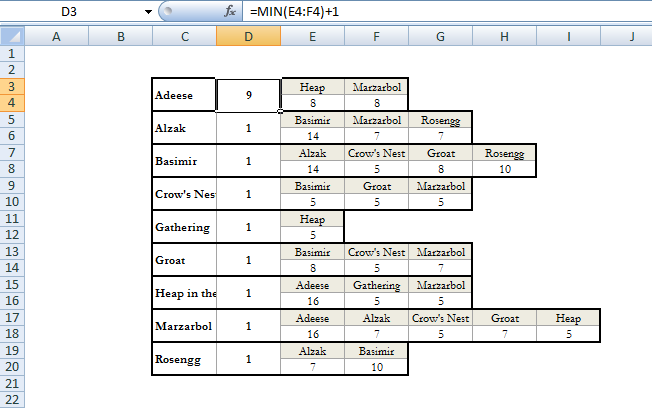
First, you want to set up an excel table that looks like this:

If you're not familiar with excel, you are probably way out
of your depth at this point.  Please do your best.
Each of the boxes shows the distance between the various markets on the map above to other markets with which they're connected.  At the top, it can be seen that I've made a formula for Heap to Adeese that shows "D15+7."  7 is the distance in hexes between Adeese from Heap.  To this we add 1 to account for the market at Adeese, giving us a total of "8."  It is very important to realize that these two markets - Heap and Marzabol - on Adeese's line indicate markets shipping to Adeese, not from Adeese.  Shipping from Adeese is shown on the lines next to Heap and Marzarbol.  That needs to be very clear.

This above will take a little time to set up - but once it IS set-up, you'll never have to worry about it again, no matter how many additional markets you add to your economy in the future.  Moreover, you can add them one at a time - so that if you didn't want to include Adeese yet, you can just leave it out of all your lines - then add it at a later time.

Next, we want to replace the 1 in the D column with the following:


The function "=MIN(E4:F4)" will find the minimum number between those two results.  Since Heap and Marzarbol both count as 8 hexes (adding +1 to the seven-hex distance of their own markets), the cell at D3/4 will equal to 8+1 (for the Adeese market), or 9.

(If you want to know how to merge cells, look up "how to merge" in your excel help menu).

Note that the number under Heap in the Hills from Adeese has jumped from 8 to 16.  This is because now the formula is measuring the distance from Heap to Adeese and back to Heap again, and still adding both markets (14 hexes +2).  When you are working with multiple routes between cities, this will calculate the shortest distance between all possible routes instantly, no matter how many market cities you add to your system.

Okay, let's add the minimum-choice calculation to every line (in the D column only):

The numbers will adjust every time you hit return, but because
of the iterations they won't adjust more than once.  To adjust them
intentionally, hit F9 at the top of your keyboard.

You will soon notice a problem.  While you're not getting circular calculation warnings, the numbers will keep climbing no matter how often you hit the F9 button (manual calculation).  For the present, don't worry about that.  We will solve that problem later.  At the moment if your numbers are climbing to infinity (and you can see that by repeatedly hitting F9), you're doing this right.  (you'll also notice that there's a lag between the numbers in the EFGHI columns and the "minimum" in the D-column; do not worry about that, it is normal).

Our next thing to remember is that we don't need all our markets at any one time: we only actually need the one where the players are.  To get that, we only need to put a "1" in the cell of whatever market we want to calculate.  Then, once we hit F9 a sufficient number of times, the lowest number will ultimate self-generate into all the cells and it will stop changing.  With only nine markets, I only had to hit calculate (F9) four times for Marzarbol to completely calculate:


These are then the distances between Marzarbol and all the other markets in our system.  Marzarbol itself is divided by 1, while Heap's references are divided by 6, Groat's by 8, the Gathering by 11, Crow's Nest by 6 and so on.

If you prefer a purer distance in hexes, merely eliminate the "+1" from your calculations and all your distances will be shown in the exact hex difference between the markets.

This is exactly the system I presently use to determine distances.  Here's a screen shot of of my Distance Table for part of France:

Land distances are shown in brown; sea distances in blue.
The example is shown at the point where there is no market chosen,
so that is part of the reason for the high numbers.
When I finally do add England to my trading system, many of these markets will have additional connections across the English channel; which means I will have to individually update them.  It is typically a 2 to 7 day job to upgrade all the relative markets to a new map region, depending on how details the region is.  With England, it will be my last really heavy change - but for the moment, I haven't done Spain yet (so I have two big additions left to do).  Africa and the remainder of Asia shouldn't be too bad - though China might be something to consider, far in the future.  From this, however, the reader can probably see why I've been holding off adding Spain.

ith my next post, we can talk about the next stage in applying the distance table to calculating the references, to make them ready for the pricing table.

Friday, April 8, 2016

Breaking Down Advanced References for Tutorial

Woah, I'm tired.  Kitchens are exhausting.

First off, I'd like to point out the poll I'm adding for three days to the sidebar.  I just want a sense of whether I'm writing these trade posts for two or three people or not.  Please feel free to weigh in.  If you're not up on the trade system yet, I suggest having a look at this page to catch up.

The content below more properly belongs on the wiki, but for the moment I am worn and I'm not quite trusting myself to remember everything - so I'm floating a balloon here first, to work out any kinks there may be.  Or maybe it's just easy to write here, as the wiki tends to be a little more 'professional' in tone.

I've put together what I would think is the bare minimum of necessary undeveloped goods that the system needs to make most of the equipment that players will want to buy for their characters:


Aromatic woods would be unprocessed incense, such as frankincense and myrrh.  We can't build castles without stone, can't make leather without cattle or horses, we need zinc to make brass, we need tin to make bronze, etcetera.  There's still lots of room for subdivision and there are many products not on here (such as sulphur or resin, for example), but in my judgement this will fill out most equipment tables fairly well.  Things like fish, fruits, vegetables, cereals or stone can easily be identified as "local variety" if the character wants to have a specific type named.

On Monday I suggested creating a table as a method to designate one reference per hex of country controlled by a given market - as an aid to determining which sort of terrains (features) would provide what sort of references.  Here's a table that I've created as a guideline (please feel free to adjust it):


Obviously, there's no reason why one hex couldn't have ten or twelve references - but I think if I were trying to make a system from scratch, without using the world as a crutch, one hex = one reference (approximately, given the natural 20 roll and the many blank spaces on the roll) would make sense for me.  I've deliberately made it so that many hexes would have no references at all (scarcity, always scarcity) - but this also makes the possibility of mapping out which hexes do and which do not, to help with things like locating dungeons, wilderness hexes within a kingdom and places where the party might someday go in and try to exploit the area.

Let's go back to the map that I made for the Kingdom of Pon:


Counting nine markets on the map, we can make a die roll for each hex controlled by a kingdom (or tribe, in the case of the Gathering).  We don't want to include any of the hexes outside of a kingdom - we can argue, first of all, that such hexes have never been colonized because there is nothing of value there; we can also suppose that such areas, even if they have people who are actively raising animals or growing things, are so out of the loop that they don't meaningfully affect our market structure.  Like people living on the fringes of our present day culture, they don't trade outside their communities so they don't count where the economy is concerned.

If I assign the nearest hexes to each market, by type, here is what I get:

Because Alzak and Rosengg are supposed to be Dwarvish mountains,
I'm rolling 2 reference checks for each hex.
For Adeese, I'm counting all the hexes in Shucassam as 'desert' and not 'plain' because on the original Divine Right map, this is what the Shucassam kingdom was meant to represent.  Moreover, I'm counting the hexes around the Sea of Zeti twice: once as a seacoast for the sea/lake column above and once as a desert (like I say, a hex can have more than one reference, there's no issue with that in the system).  Similarly, I'm counting every hex with a river in it twice, once for its terrain and once for the river.  For this post, I'm not going to make any distinctions regarding which hex produces what - because it doesn't matter for me as regards the tutorial.  For me, as long as I know which market the reference attaches to, that is enough.

When I rolled out the totals for the above, I got these results:


I did goof a little with these results, to make sure that every kind of reference would be found on the map and to ensure that the Gathering produced at least one good (the existence of the tribal village must be based upon some foundation).  Obviously the plain-based cities have the most references, being that they are surrounded by rivers, plains and the best chance for having something produced in every hex, even if it is only cereals.  Obviously, the more interesting stuff is produced in hexes with hills, mountains, scrub or deserts (when it happens).

Going forward, I will be using these references for my advanced tutorials (discarding the 2 each of each reference I used in my basic presentation).

Please, do comment on the poll.  I would like to know what people are thinking.

Tuesday, April 5, 2016

Extra Fiddly Details

Just got this comment from Maxwell that really demonstrates how a certain kind of laziness has infected the game.  I am talking about standardized character sheets.

They started off usefully enough: cover the basic stats and details so that people didn't have to keep writing "strength" and "constitution" out every time they rolled up a new character ("str" and "con" didn't save enough time).

But then the character sheet was transformed into a time-saving device for DMs who were too lazy to look up saving throws, weapon damage, a complete list of existing skills (including those the character does not possess) and other basic details for which tables were made.  Not only were these things not part of the actual character (they describe the character's random relationship to the world), but the existence of these things in the face of the player actually takes away from some of the game's drama.

There is an important moment of uncertainty and unease when a character is told to make a saving throw.  I never tell characters what their saving throw is for or what they have to roll.  If possible, I like to wait until the roll is made before looking it up.  The saving throws are on my wiki, so anyone CAN look them up, but since they often don't know what they're making a saving throw for (as the attack is hitting them from the dark, as it were) this isn't always helpful.

Why do I do this?  The same reason the camera takes time to pan from left to right when we're introduced to the main character.  TIME is relevant.  TIME creates drama.  A pause is one of the most important dramatic identifications - and when you eliminate that time by having the player know in advance that a 13 will save their life, the player rolls the dice and knows before there is time to create anything, much less drama.

But I have had a player come into my world and diligently write down all this information because they must have it at their fingertips or else they can't feel comfortable playing.  That's an excellent sign of a player who has gotten really, really used to being in control at the table.  They've learned to game the game through knowing as much as they possibly can - and it is unnerving to have a DM who takes that all away from them by denying them knowledge they think they deserve to have.

Fact is, sometimes there is a modifier to the saving throw because of the monster being faced.  Sometimes, the world just isn't what it seems to be.  Players have to adjust to that.

Now, if I'm rolling the die, it's different.  I will virtually always tell them what I need to hit or what I need to save - because I'm not looking to give myself drama.  I'm presenting drama - and that means I can make up for the player knowing what I have to roll by not rolling the die.  Remember how I just said the player will roll as fast as possible, knowing the result?  It is the opposite for the DM.  I will roll as slow as possible, to build up as much tension as I can before that die hits the table.

Fucking character sheets.  Burn them.  Burn them all.  How in the hell can you bring in a new player into your campaign if it starts with introducing them to a page that looks like a fucking tax form?  Are you kidding me?  I swear:  make your players copy out their character sheets by hand and then burn them in blazing, sacramental act of cleansing.  Then make it clear:  you never want to see another damn character sheet at your table, EVER.

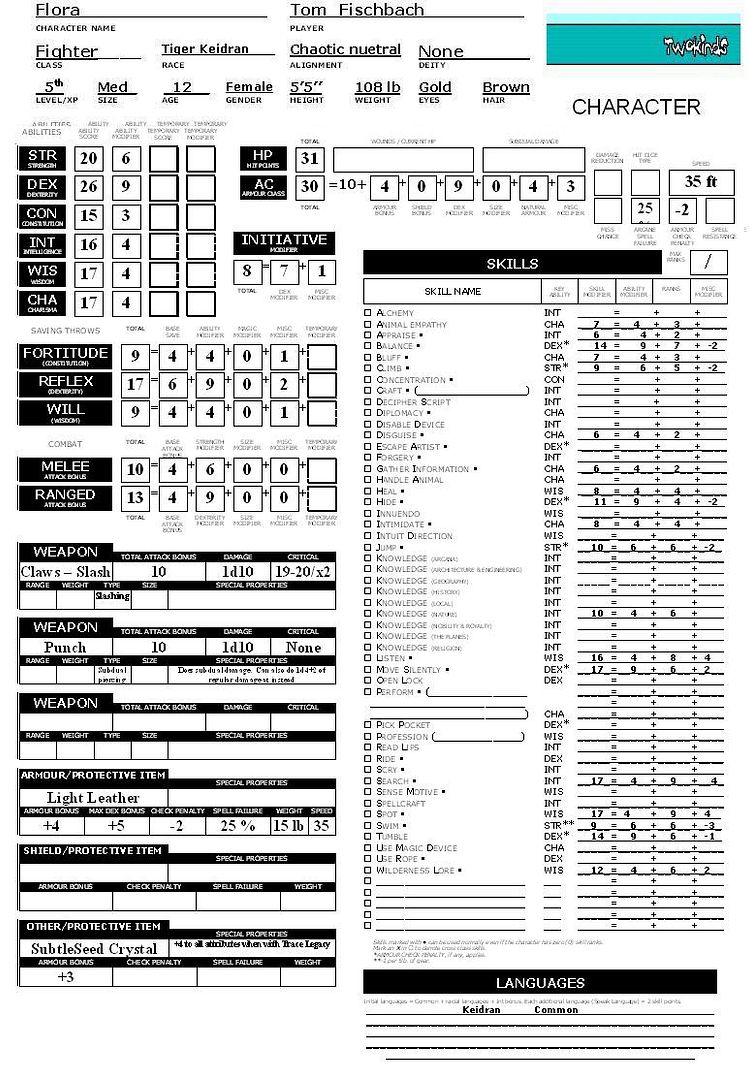
Not only do character sheets make the creation of the character convenient and easy, they make an imprisoning box that denies all personality and life.  Look at this sheet I've found off the net: Flora's character sheet:

The most interesting thing about this sheet is that
"Flora" must be a person.  And don't geek out over
the numbers: anyone can write out a higher number.

This thing is dead.  There's no room on it for personality, for identification or for anything that suggests an actual live person is supposed to be represented by this insensate, spiritless computer throw-up.

Compare it to this:


Oh my gawd, I want to hug this character sheet.  This is a bloody work of art.  This character sheet has acquired consciousness.  The reader may think it a jumble; or inconvenient; but it makes perfect sense to the person who created the sheet, who can look at the scratched out parts behind the lettering and knows what those things mean and how they were acquired.  This sheet is riddled with scars.

There is no comparison.

Want to make your players care about their characters?  Get rid of the sheets.

Drink and Be Merry

This post is probably the result of my be forcibly kept from my keyboard for 10 hrs. yesterday, but what the hell; I have something more to say about liquor.

The following is a table of prices for liquor in Benghazi, Cyrenaica (modern day east Libya).  There's no special reason I've chosen this place; it was the last time my off-line players went to market, so the numbers have just been left as a default.


Chartreuse isn't on the list because its produced in Spain, and I haven't added Spain yet. Of course, I established earlier today that I'm going to move the production to France, but that's a lot harder than it sounds - and at any rate, there's no point in updating the sources until I get the pricing table in order.  That said . . .

(oh, I suppose I should also add that 17th century Libya was under the control of the Ottomans, who were not fundamentalist regarding distilling liquor; plus Benghazi had a large Greek merchant population so there would be no reason a person couldn't buy liquor there)

The prices are all created, as the tutorial explained, from distances, references and relative cost of ingredients.  Arrack, the coconut liquor, is ridiculously expensive because I haven't added any parts of my world that produce coconuts to the general system.  That means getting coconuts to make liquor is extremely difficult - thus, a stupidly high price for something not considered that valuable.  When I add West Africa, East Africa and Indonesia to the mix in the next few years, that price will drop precipitously.

Elixir de Spa is a different matter.  My sources say it is remixed cherry liqueur (kirschwasser), so that it is thrice distilled, piling up the cost of the ingredients; it is also made in only one place in the world, in Belgium near the German border.  Thus, any place that more than a few days away from it and the stuff is going to be pricey.  We can assume that if there is someone with a bottle of the stuff in Benghazi, that someone has brought it from a long way away and doesn't want to part with it - except at an extraordinary price.

Others are going to notice that even whiskey and gin are really expensive, whereas local spirits seem to be almost irrationally cheap.  The thing to remember is that it seems like this might be the system exhibiting glitches, it's more a matter of perspective.  We live in a world of super fast-and-easy delivery.  The Renaissance did not.  Any distilled beverage that was replaced in any single locale was bound to be non-existent outside that locale; and I only have a few places that produce classic "whiskey" or classic "gin" (none of which probably did in the 17th century, but we must stretch definitions now and then).  Most people did not drink anything like a brand-name distilled juice . . . but on the other hand, distilled juice was, in fact, easy to make.

My first wife Michelle (my daughter's mother), when she was a teenager, used to work in a mall kiosk called Grandma Lee's, where they sold baked goods, cookies, banana bread and such.  Some of these were made fresh so there was yeast available on the premises.  As 16-year-olds, they used to mix some yeast into fruit juice, along with berries that went in the muffins and such, then 'hide it' on top of the cupboards of the kiosk for a week at a time.  Everyone knew about these little cups except the management, presumably.  In a week, after a shift, they'd all get a little tipsy.  Distilling is really, really easy.

The important thing is not to 'fix' the prices, but to realize that high prices like this promote scarcity and empty player wallets, and are thus a good thing.  We tend too quickly to lower the prices of things to make them 'reasonable' - and not only is reasonable unnecessary, it is boring.  We can always say that above a certain price the substance just isn't available, and I'll eventually work on my rules for that.

What we want, however, is to concentrate on using these high prices to promote a good game.

One way might be to identify a benefit to paying a certain price for liquor - improved morale, a better chance to hit, a better saving throw, plus power for casting spells, adding dexterity (snooker players claim a little drink does) or other ability statistics, etcetera - IF the amount paid is very high and IF the character doesn't actually get flushed.  Call it a 'happiness' measurement; obviously, it could apply to any number of things, beyond spirits.  Basically, the idea is that if the character spends enough on themselves in a certain period of time, they can gain the benefit.  The actual amount could be staggered, as well, so that 50 g.p. produced this result, 500 g.p. produced a better result, 5000 g.p. a better result still . . . and we can stipulate that the product paid for must be something relatively useless, like a bottle of Armagnac or a bright and shiny new sword (which in no way is better than the old sword, except that it's new).

That's the simplest method.  I think a better method would be to create a list of thirty or forty luxuries (easy, from my list), one of which would especially appeal to the player's character.  Those things might be incense, intoxicants, spirits, textiles, fruits, spices, nuts, perfumes, pottery, color dyestuffs, woods, glass objects, whatever we want.  Basically, Vladimir collect ceramic unicorns, and when he finds one, he's absolutely deadly with that axe.

Here is where it matters.  Scarcity means that many of the things on the above list can't be found for any price.  So that when the party does go to a new town, and the die rolls for that object line up, bingo - the player is super-happy (and the character too).  Where do the players want to settle?  Well, obviously, where they can find enough pistachios, saffron, tea or good gin to keep themselves happy.

I was just hit by inspiration upon finishing this section of my pricing table.  Now I have to put this stuff down, have an hour to eat and relax, then get started again on the book.  21 days is awfully close (and I work for the next three!).

Commercium

This isn't a new post - but since I can't find the picture I put up years ago that was a close up of my Evil, Insane Killer Distance Table, I'll just go ahead an put up a new one.  I've updated the imagery since then, anyway.


I've downloaded it in 300 dpi, so it should be legible.  This is a section of central France and southwestern Germany.  It shows the relationships between 118 markets (though obviously not with those markets off page).  Some of these relationships are roads (brown lines), but some are rivers (blue lines).  In the latter, the arrow indicates the flow of the river.  Because of the flow, Speyer in Germany is 1.2 days away from Strasbourg but Strasbourg is 1.9 days away from Speyer.

There are also places in grey that are convenient way-stations between markets that made mapping this easier.  Rather than have 12 cluttered and inconvenient lines between Troyes, Chalons-sur-Marne, Metz and Nancy, it is easier to just show how routes between them pass through Vitry-le-Francois and Commercium.

The latter is, incidentally, the old name for Commercy, a city in Lorraine.  I post the French link because it has way, way more information than the English Wikipedia page (I so love google translate - google can take over the planet so long as google translate remains in existence).  Believe me, the town is named very well.  It may not be self-evident for many from the map above, but the routes are based on the shortest distances between individual places, accounting for both mountain passes in Europe and difficulties of getting up over high elevations.  As such, the most southern land route between Italy and central France runs up from Turin to Aoste, thence into Switzerland at Lausanne and from there, to Besancon in Burgundy.

This makes Burgandy incredibly important to land trade in Europe.  It explains why the first medieval fairs took place there in the 14th century, it explains why both Charles the Great and Spain fought like demons to control it, it explains why it was famously the richest county in Europe, it explains why Germany and France fought over Alsace and Lorraine for centuries (both together are the gateway from one half of Europe to the other).  Commercium as the name of the city describes exactly the presence of pure, unbridled wealth passing through those cities between Nancy and Troyes (which was said to be the size of London in the 15th century).  This power didn't go away until long sea voyages around Africa put the balance of trade onto the Atlantic seaboard - making Amsterdam, Rotterdam and Antwerp an even bigger crossroads between the Atlantic and the Rhine valley, where Burgundy/Lorraine/Alsace still served as a collection point for central Europe.

Anyway, regarding the transport section of the tutorial, this is my personal method for keeping track of how far each market is away from all others.  I do have an excel table that helps me calculate any single market here from every other market (I have over 900), but I'm going to forego writing about that just now.  I'll put it up on the wiki soon - but I worked my ass off yesterday and I'm tired.


Heh, heh, heh.  My feet and my hands are now begging people to consider making a donation to my jumpstarter.  I know, I know, we're all working hard.  But if I can get enough donations I can ask for less hours at work and spend more time focusing on writing my book, so I'm still asking for support.

21 days until I will be posting my book preview.  A $25 donation is needed to see that.

The Monks that Make Chartreuse

Hmpf.

This is the sort of thing to make me bang my head on a table.  As Maxwell wrote yesterday, the pricing table is based on building blocks.  If I want to determine a price for gin, say, I can look up a recipe for gin, determine what's in it, gather those things together and compare them against a ratio for gin making and boom, I have a price for gin.

However . . .

Since I'm using details of the real world, I am forever finding these odd, unusual substances in the pages of an encyclopedia, things I would never, ever think to add.  Today's example is a liqueur I've never actually tasted, Grand Chartreuse (or simply Chartreuse).  I have this reference from Tarragona in Spain (though it should be Voiron, France - I have no idea why the detail is included this way in the encyclopedia, but I'm going with it).  This is the only reference to the distilled beverage.  Naturally, this means that if we're not actually adventuring in Spain, this stuff is going to be expensive.

Unfortunately, for my pricing table, it is a little difficult to gather the ingredients together to make the product because only two people in the world know those ingredients!

I can just see me writing to the monks:  "Please, sirs, I have no intention of making your product, but I have this table-top role-playing pricing system that needs . . ."

Uh, no.

I'll just jury-rig something, probably using saffron as a central herb, making the stuff really, really expensive.  If someone wants to write to tell me what Chartreuse tastes like, and make suggestions about ingredients, I'd appreciate that.  In the meantime, consider the same sort of restriction applied to people in your world that make, oh, magical rods and staves.

I thought some might find the linked page interesting.

UPDATE:

Oh, here it is:

"After 1904, when the Chartreuse trademark belonged to "Compagnie Fermière de la Grande Chartreuse”, the liqueur made by the monks in Tarragona nicknamed “Une Tarragone.”

I will probably fix my source table (the name I call my table that places references), moving the liqueur to Vauvert, France, where it started.

Sunday, April 3, 2016

3rd Podcast

The 3rd Podcast from my daughter and me is posted on Soundcloud:


It's a little silly at the beginning, I think; my daughter and I cut up a little and chortle at each other's words.  There's a lot of hand gestures going on that the mic doesn't catch and obviously we have known each other a really long time.  But I think it is terrifically sincere, so if you're tired of people trying to read content and interview like professional journalists and news journalists, this will be refreshing.  Have a listen when you can and then have a look at the other two posts I put up today.

I will be posting another podcast no later than April 24; I am thinking of trying my hand at this without my daughter (who is a busy youngster) so that it isn't quite so long a wait between podcast content.