Tuesday, March 1, 2016

Enlarged

I would ask the reader to take the time to look over this post and remember that I am still seeking a much smaller sum of $4,762 in donations before the end of May.  That's just $50 a day; every small donation counts!


As I write my third post about the enlarge spell, I trust I won't be taxing the patience of my readers.  Trying to nail down the details of this spell's effects has been kicking my ass for a couple of weeks now (admittedly, I have been writing a book) and I feel like I'm finally on top of it.

I've introduced a few odd additions to the original description of the spell in trying to account for things the writers of the Player Handbook failed to consider.  For example, while the spell does transform a creatures' equipment in the effect (so that the player's friends don't rip out of their clothes and everything remains G-rated), where is the line drawn?  If the character picks up the end of a rowboat while the spell is being cast, is the rowboat is affected?  What if the character is holding the rowboat on the end of a rope that is run through a pully and the rowboat is clear of the ground?  What if the pully is being held by another character who has been made stronger and is wearing a pair of levitation boots?  If the character picks up a keg full of oil, which is then lit with a long fuse before the spell is cast, does the barrel and the oil, and the fuse, all increase in size?

If you think characters won't come up with questions like this, you don't play D&D.

My full spell description can be read on the wiki.  I had to include a downloadable file (excel) that can be used to calculate the new height and weight from a character's original size.  I have not included any table that will calculate an object's new weight and size - mostly because it is less important, since the object doesn't move, and because my players nearly always use the spell to make one of their own party a big bruiser - these adjustments to the damage done by creatures (both enlarged and shrunk) explains why.  Note that these tables bear very little similarity to the ones I posted last week:


In keeping with discussions last week, I've chosen to make all the space between 56 lbs. and 250 lbs. a sort of neutral zone where damage is always the same for everyone in that range.  Enlarged weapon damage is then adjusted for sizes of 250 or more (adjusted against a weight of 216 lbs, because it has a cube root of 6).  Shrunk weapon damage is adjusted for sizes of 55 lbs or less (adjusted against the cube root of 60).

I don't think that looks half bad.  It is possible for a character to be greater than 250 lbs. in weight and less than 56; and some of the characters in my campaign are.  The smaller characters should be fine; there's no real adjustment until the size drops below 49 lbs - and even at that, the sort of weapons that do 1-10 damage can't be used anyway because the length of these weapons is too long to be used by short, 50 lb. characters.  The shrunk table will mostly be used for determining the actual damage of weapons used by smallish monsters (kobalds and the like), the Monster Manual's numbers be damned (I think they were pulled from backside nether regions, anyway).

The bigger characters, on the other hand, will probably start carrying more massive weapons just so they can get the damage increases.

Note that I don't mind mixing and matching dice to get results with the right averages.  2-14 damage, for instance, is obtained by rolling a d6 with a d8, giving an average of 8.  I don't know why D&D players are particularly opposed to this mix, but they are.  I don't see what difference it makes.  It gives many more options to the amount of damage that can be done by creatures and smooths out that gap between 2-12 and 2-16 or 4-16.

I hope this means I can put the enlarge spell to bed now.  I hate this thing with a heat like a thousand suns just now.

March and My Jumpstarter

At this time, I must try to push again for contributions to my Jumpstarter campaign.  As it is now March, I'm under some pressure to raise a little more money this week in order to cover the cost of silly things like utilities and food.

I'd ask that if the reader hasn't made a contribution yet that you kindly consider a small donation of $25 or perhaps $15, either of which will help us out tremendously with the little things.  We've done amazingly well, raising over $1,400 in three weeks from wonderful readers who have said many kind things about their appreciation for the blog and my other writings.  But there's always a little more hurt in the future, which I know many readers will be experiencing as well.

So if you can help a little, please do.  Remember that I have offered a list of rewards for those who contribute, connected to both the module that I've made, Ternketh Keep, along with the book I'm writing, The Fifth Man.  Regarding the latter, I'm just now working on the crisis that moves the story from the end of the first act and into the second.  Fine stuff, as I introduce some of the characters that people have given money to have renamed after themselves.

Here again is the list of my Jumpstarter rewards:

  • For $10, I will provide an online copy of my latest gaming adventure, Ternketh Keep.
  • For $15, Added to the above, I will also provide plans to the Airship I've created.
  • For $25, Added to the above, I will also give as a bonus an 80-page preview to my book, no less than two weeks prior to the official publishing date of the novel.
  • For $50, Added to the above, I will handle the purchasing and sending of the book as soon as the book is published.
  • For $75, Added to the above, the copy received by the reader will be personally signed by me, along with a gamer girl t-shirt (as long as supplies and sizes last).
  • For $100, Added to the above, I am prepared to work the reader's name into the novel, promising at least one story significant line (as long as unused characters remain).

Please make all donations through the donate button found on my blog's sidebar.  Allow me to share a part of my creative process with you, while you in turn enable me to produce the best possible novel that I can.

Monday, February 29, 2016

Combat Summary

Because I was asked about a summary for Saturday night's adventure in Ternketh Keep, I thought it might be fun to post the experience tally board for the last combat I ran that night.  Below is an account sheet in excel that I use in every combat, to keep track of how much damage people have caused and how much damage they have taken.  During the actual game my accounting is double-checked by the party, who can see the board on the duplicated monitor readout that I use for my games, so that if I forget to add something to their damage caused or their damage taken, they can remind me.


 The list includes all the members of the party, listed in order of how fast they move and react in combat (highest dexterity first, highest wisdom breaking dexterity ties, highest constitution breaking wisdom ties).  Share of bonus experience is awarded according to importance and decision-making among the party members.  Main characters have a 1.00 share; henchmen have a 0.5 share; henchmen of henchmen have a 0.25 share; and followers that are leveled have a 0.125 share (which appears as 0.13 on the display).  The "In?" column indicates whether or not the member of the party took part in the actual combat (made an attack or was attacked at some point, regardless of attack success).

My experience distribution rules (calculated by the spreadsheet) are explained on the wiki.

I'm sorry I can't say what the combat was against.  It was a single encounter detailed in the module, Ternketh Keep, available through my Jumpstarter Proposal.

I told Oddbit that the total damage the party did was equal to 297; the adjustment shown on the table above shows 251.9.  That is because magic damage is accounted as equal to 3/10ths weapon damage for experience purposes.  The party mage cast magic missile and burning hands (wanting to reserve other combat spells for later combats).

Total experience (adding 10%) amounted to 11,057.  Without the 10% bonus, 10,279.  As can be seen, some participants do not get a 10% bonus.

Classes are as follows (for participants only):

  • Taver is a 2nd level illusionist
  • Vlad is a 2nd level ranger
  • Olie is an 8th level thief
  • Demifee is a 6th level mage
  • Sunsky is a 1st level fighter
  • Holly is a 4th level fighter
  • Perkin is a 3rd level fighter
  • Sharper is a 7th level fighter
  • Woodsole is a 5th level druid
  • Fehim is a 2nd level fighter
  • Sven is a 5th level cleric


Sunday, February 28, 2016

Critical Hits, Fumbles & Friendly Fire

If someone would like to read my official rules on critical hits, fumbles and friendly fire, see this page.

There's always something unaccounted for.  It occurs to me that some sort of rule should be made regarding the final location of thrown weapons - I've never had good rules for this and I should make some.  It's not an easy fix, however.  Usually, I just play that the missed weapons are "somewhere" in the line of fire, typically thrown past the target.  Hmf.  I've not had a player complain, but a good rule for it would be better.

Saturday, February 27, 2016

Head-Game

Just waiting for the first people to show up so we can play our game tonight.  Starting right off with a fairly meaty monster; party is already hurting somewhat for hit points, so this is going to be particularly nasty (potential for 40 hp damage if a save isn't made).  Sorry I can't say what the monster is; it's part of Ternketh Keep, part of my crowdfunding proposal.

It could kill someone.  That's the point.

In my game, that's a lot of tension.  The players got sight of the thing at the end of last running, two weeks ago, so they're bound to be ill at ease as they come in tonight; I know that my partner has been on tenterhooks for the last few days, worried that she's going to lose her 4th level henchwoman fighter, Holly.  I don't think she will - they've got plenty of healing, poison antidote and both slow poison and death's door as spells if it comes to that.  Still, I want the party to worry - so as they come in, I'll wait for just the right moment to express sorrowfully, with concern, "I hope I don't kill someone tonight."

The key is to say it with honest regret; to sell the moment as something that I, as DM, have legitimate reason to be anxious about it.  Moreover, the moment it is said IS very important; not as the party has just come in, or as they're working themselves up . . . but in that sweet-spot moment when it is plain they're gathering their courage.  When is that?  Well, one has to get a feel for these things.

See, they're going to mention it themselves; they're going to mention it to each other; they'll need to, because that is a part of building each other up.  It is like the chatter that goes on before the start of a football game, sometimes between plays.  This is not the moment; the moment is when this crests.

We must listen when our players talk to each other (if they're not talking to each other about the game, you have party troubles).  We want to hear what they say.  We won't get into their heads if we don't.

Peace of Mind

Some of my readers might remember that in the midst of all this fundraising, I'm actually running the very same 'module' that I'm using as a donation reward.  The players coming tonight to play don't know what's in the module and they're honest enough that they don't want to know.  Even my partner, who lives with me and has held my hand through this past month, doesn't know what the adventure contains.  So just give that a moment's thought; many of my readers know something that the woman I love doesn't.

This is the first time that I have painstakingly written out an adventure since the 1980s.  Like most other young players back in the day, I too thought it needed to be done the way that it was in The Village of Hommlet and Keep on the Borderlands.  As I steadily churned out my own adventures, however, session after session, year after year, I looked for shortcuts.  I stopped writing down things like how many hit points everything had or precisely what treasure was in each room.  These were things I could work out later, on the day of, a few hours before a session, while the players were high-fiving each other and so on.  Slowly, I realized it was just as easy to draw out the game map on a battle mat (when I used to play with miniatures) from memory rather than having it pre-made up.  It was better to add the rooms one at a time; then what was behind each door was a mystery until I drew it onto the map.  It only took a moment to draw lines, after all.

Then, with practice, I stopped writing out room 'descriptions.'  I knew what was in the room, I could 'write' it up with my words as easily during the game when the time came, so I stopped wasting time writing this stuff down ahead of when the game actually happened.

Finally, after decades, I just stopped all preparations completely.  Now and then I would draw out something complex if there was a battle coming - a fort, a kobald nest, a stable, whatever (just look at that horrid art from just five years ago - who was that artist?).

This is where I had gone.  Me, write out a traditional adventure in the form of a module?  No, I'd stopped doing that.  Why bother?

But the improvement in the artistic quality of my representations of people and things has been steadily changing me this last year.  More and more I've wanted to spend time to give the players a better representation of themselves.  Your character has a +2 Trident of Warning?  Let's try to depict that.  Your character is over sixty with grey hair - and has a silver wolf skin - and minimum armor?  I'm game, let's make that happen.  That arm isn't thick enough?  Your hair is receding?  Well, I'm not a great artist, but I can do my best.  And so we get the image on the right, which was done while the player was watching me draw his character.

I began thinking that it might not be a bad idea to put a little more effort into the setting, too.  Design some rooms that look more like rooms where places lived.  Design some monsters that look scary or at least off-putting.

Then, beginning this online crowd-sourcing campaign meant actually writing out room descriptions, like I did back in my early days of play.  So just now, as I write this, everything that I'm going to be running tonight is completely designed.  I don't have to do anything.

It is strangely . . . comforting.  I don't have to keep things in my mind; I don't have to make last minute preparations.  Tonight, I won't have to draw any rooms or invent any room descriptions off the top of my head.

Weird.

Acting as a DM is a fluid process of learning and changing and altering one's approach to this game.  There's never a single, unfailing approach.  We adjust ourselves, learn new skills, adapt, improve and then find ourselves reworking our worlds in ways that we never thought of - or even in ways we once did.

I can't figure out why anyone supposes I know the "one right way" to play this game.  I don't even approach it exactly the way I did five years ago.

Maybe five years from now I'll have reason to write another book explaining how to run.


Friday, February 26, 2016

Believe in Your Country; This Will Pass

This is not an indictment of the American political system.  Rather, I'd like to remind my American friends of a few realities that might bring them a little comfort in the face of Donald Trump.

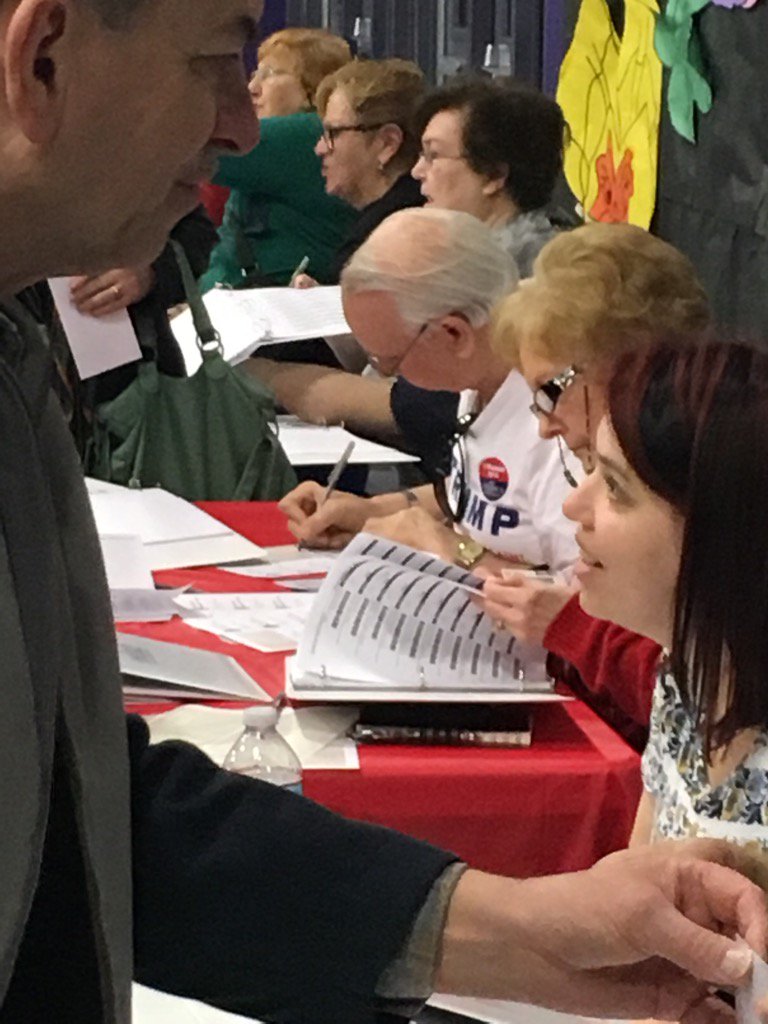
There are considerable concerns with the present Republican race; for example, poll-workers during the Nevada  caucus wearing Trump gear and other voting problems, which suggests a far greater breakage in the system than the candidate's popularity.  I saw several examples on tweets and other media during the campaign, while real time discussion of the phenomenon was in play.  Personally, I feel that this, as well as the Republican party's inability to set their own agenda or control its candidates, is a sign of the party's imminent collapse.

Parties have collapsed before - in American history as well as in every other democracy.  Parties are not the system; they are a method by which a given political agenda tries to play the system.  Right now, the GOP is playing that system very, very badly - and it is no surprise, given their tactics of the last ten years: attempts to defund the government, oppose majority rule, discount any respect for the presidency, the will to peace-driven foreign policy and now the staunch refusal to recognize their responsibility in naming a new Supreme Court Justice.  As issue after issue has arisen in front of the Republicans, they have handled it poorly, particularly in terms of their own base.  As posited by this source,

". . . this time, a lot of Republican voters feel that the GOP establishment really treats them like suckers. Once in office they forget all about their promises to ban abortion and push gays back into the closet. Then they pass trade deals that ship jobs overseas and try to privatize Social Security and cut taxes for the rich. These aren't policies blue-collar Republicans want at all. This year they have had enough and have found a champion, albeit a strange one in a thrice-married, four-times-bankrupt, New York real estate billionaire."

The decision of the base to support Trump is nothing more than the Republican base sending a message to their own party: "You don't believe what we believe."  At this time, a substantial core of the American people do not believe that the election is important.  They believe that this message is important.  They would rather say what they believe than win an election.  This is a clear sign that the GOP establishment has failed in their mandate.

I have heard many express concerns that Trump will be the candidate.  Americans have asked me how much property costs in Canada.  This is a joke, of course - but there are many who can identify with the need to make this joke.

But I don't see anything to worry about.  Of course, I think Trump will lose the general election.  I can't imagine that the America that would not vote Romney into a majority four years ago would now find Trump a viable alternative - but let's say that I'm wrong.  I might be wrong.  Strange things happen in an election.  Suppose for a moment that Trump wins and becomes the President of the United States.

Even as a "Republican" president he would be in contention with a Senate or House rules by his own party.  Trump won't follow orders, which is what the Republican party wants - so that will make him no more useful to the Hill than a Democratic president would be.  Just as there has been a deadlock in place these last four years, where the only available air has come through decisions made the Supreme Court, that deadlock would continue - only now, between a recalcitrant ideologue and a hateful Legislative Branch.  And if, by some miracle, the Democrats were to take back the Senate or re-establish themselves in the House, the situation would be the same.  Whomever has to deal with Trump will find themselves having to manage a child in the White House.

The real damage won't be domestic - this deadlock will simply continue, as it has already existed these past six years.  The real damage will be in America's foreign reputation - which will be long-lasting and harsh; but I don't see the appearance of a Trump in the White House being any worse than most of the acts America has performed these past 15 years.  I think people will try to paint it as more horrible . . . but I don't believe that anyone outside the American Press finds this race to be the least bit surprising.

I don't believe the Press does either.  They're doing their jobs.  All elections must be refashioned into horse races, no matter what the circumstances.  All foregone conclusions must be sold as 'surprises,' all expected results must be termed in the after-analysis as 'unexpected' and all candidates must be depicted as 100% viable until it becomes impossible to paint them that way.  And I do mean impossible; someone, somewhere in America, still believes that Ben Carson could become President this year - and he might, given the probability of a brokered convention this year.  Until that brokered convention happens or Carson officially drops out of the race, someone, somewhere, will write another story that feeds Carson's supporters with the belief that he might win - because Journalism is about selling possibility and fantasy, just like palm readers do.

If someone fails to grasp that I just called journalists a bunch of lying, carny-show charlatans, I'll make that a little clearer:  everything that you see and read in the media about this election is complete horseshit.  The only thing that counts are the numbers that have happened - not polls or opinions or projections.

I think it's easy to understand how Trump supporters find Trump appealing.  He doesn't look like a politician.  He looks like a businessman.

Of course he's a lying racist.  Of course he's an idiot.  Of course he is completely self-centered and completely without any concern for any other human being.  But given the agenda of the Republican pundit these past twenty years, through the words of Beck, Limbaugh, Palin and endless others, which has engendered blue-blazing hatred for anyone who has put forth any opinion of any kind, the base has learned to stop listening to what people say. They can't hear Trump, except the way dogs hear humans - tone matters a million times more than message.  They can't see Trump's hair; they're seeing Trump's shoulders and casual way of walking, his ease, his apparent non-threatening posture.

This interpretation is incomprehensible to anyone with an education - i.e., people who can read, express themselves, evaluate facts and data, etc.  But it makes perfect sense where it comes to people who have become so calcified in the American message that they can no longer relate to any idea that suggests the future of America is based upon what people do or decide.  America is an unchanging truth.  It can never be challenged, it can never fail, it can never be anything but what it is:

Perfect.

That's not an admonition against Americans.  That's a description of a particular kind of American.  A kind that has to be made to see that they're wrong about their country; beauty depends on someone coming 'round once in awhile and picking up the garbage.


Pardon Me; It's a Fairly Long Process and Requires a Considerable Patience and Resolve to See the Matter Through To Its Conclusion

Earlier this evening I was taken to task by a reader for inadequately marketing my crowd sourcing proposal.  It was explained that I have wrongly selected the reward levels for the materials I've created and that I should realize that "a campaign of this sort is a tool that provides value beyond simple fundraising."  To this was added the point that I should not view this as "something that is entirely in the favor of one part or the other."

Finally, I was told that my work is salable - if, by some possibility, I could find a way to market it.

Such advice baffles me.  I am selling my work.  How to Run has been available for purchase for 19 months now and to date has earned me, through sales online, at expos and through box stores such as Chapters/Indigo in Calgary, $8000.  In addition, I have published three other books in the recent 36 months and am working on the second draft of a 5th book right now.  I have found a way to market these books: through Lulu, Amazon, iBooks, and Barnes & Noble; in both paperback and ebook form.  In the last 28 days I have sold 17 books of various titles; this is better than a book every two days, despite the fact that the most recent book was published 11 months ago.  Every book that I have on any of these websites has a rating of either 4 or 5 stars.

Since starting this blog, I have advanced effort after effort to promote and sell myself as a writer and as a game designer.  I have never for a moment imagined that anyone who made any sort of purchase with me wasn't exchanging what they had for what I had.  I certainly never felt that they nor I were getting the better end of the deal - nor have I ever had anyone suggest this was the case.

As a writer, for nearly all of my life, I chased the dream of having some publisher recognize my work as deserving of being published.  Towards this end I have mailed and mailed and mailed envelopes with chapters, outlines, proposals and whole books, waiting for the day when magically some publisher or agent, would pick up a piece of my work and, like in all the movies, express their joy at seeing something of mine.  "Why, my lad, of course we'll publish you!  Here's a $20,000 cheque!  Stop working, get us that book and we'll put it on every shelf in America!"

(no Canadian imagines that every shelf in Canada means anything).

While waiting for this momentous moment I wrote articles for magazines and received dismal, laughable compensation.  When competitions for writing plays and short stories came out, I wrote for these and would sometimes receive a nice, handwritten letter telling me I had won third prize and no money.  When I went to the University of Calgary I wrote for the Gauntlet, the paper there with a circulation of 10-12,000, started quite a few letter writing wars and got to the point where on the first day of class a professor would recognize my name from the paper and either praise me or grumble - but still, no money.

In the 90s, when 'Zines became the rage, a friend and I started a Zine, sold advertising, published the thing entirely with our own skills (learned from the Guantlet) and turned a profit; not enough of a profit to live on, but a profit.  Still, when my partner decided it wasn't worth the slim profit, and quit, I started another Zine, on my own, sold advertising for it myself and turned a profit.  But, again, that was doomed to failure when a combination of losing my job and breaking my arm and having money stolen from me ended in going broke.

So I began writing for the stage.  I put together plays.  I edited the work of other stage writers and made a little money.  I sold more work as a freelance author.  Then I got my big break!  I got a regular paying freelance gig for a real estate magazine that earned me the incredible sum of $300 a month.  Then I got a job with a business newspaper that would pay me $25 an hour for acting as Head of Research and then Head of Circulation, a place where I was appreciated and supported and was surrounded by other writers . . .

And then 2008/09 happened; advertising dried up during the great newspaper plunge; and it turned out the business manager was stealing $40K a year from the paper's coffers; the owners lost all they owned; I lost my job; and I went back to writing.

Then I got a great gig with a video-on-demand service and that lasted until . . . last year.  When another recession hit and it has been a bloody miserable crapfest since.  And not just for me.

Despite all this, I consider myself a success.  Yes, dear readers, I know I've had to be a hypocrite with the module and all (though I dare anyone to find another module anywhere available on a digital, piratable format).  Yes, I know I've had to get on my knees and try to make something happen more quickly than I would have preferred.  Yes, people have every right to feel that I've gone against my principles and sold out.

Whatever happens to me, I will still be a writer.  In my youth, every teacher and authority would tell me, "The chances of being a successful writer are a thousand-to-one!"  This was intended to dissuade me.  This was intended to make me give up writing and apply myself to something else.  Instead, I've decided to keep at it and keep at it until the odds have steadily lowered; to a hundred-to-one; to forty-to-one; to ten-to-one.  So it goes.

Rest assured, I am marketing my work.  Not every writer in the world makes it the way writers always do in the movies.

Wednesday, February 24, 2016

At Least It Runs

In discussing weapon damage on a recent post, I asked readers to offer advice that addressed a question without 'fuzzy' explanations and without ideas that would change any existing rule in the game.  The result?  A fluid, imaginative conversation where several persons made quite reasonable and proactive suggestions.

I haven't decided precisely what to do in the matter discussed; probably, I will create a weight threshold for changes in character mass so that below that threshold, weapons cause 'ordinary' damage and that above that threshold, weapon damage increases.  I haven't decided what the threshold will be; I may make up my mind to let characters not enlarged by the spell that started the conversation, but who are yet above the threshold, to enjoy a moderate advantage in weapon damage done.  Since this is likely to affect only humans and half-orcs (since an unusually high random number would be needed to beat the weight threshold, likely beyond what any of the smaller demi-humans would manage, including the dwarf), it would serve as a bit more of a balance for those races over elves, half-elves and so on.  Recently, in one of my games, it became evident that in a player party of 11 player characters and henchmen, only one character was racially human.  This tells me that the benefits for being non-human are perceived as immoderately high in my game; a lightweight adjustment to weapon damage for big humans might have a good balancing effect (even if it means the benefit isn't guaranteed).

For now, I'd like to write a bit upon the default position of many gamers who see changing rules surrounding parts of the game completely as the best possible option.

I don't feel this can be discussed enough.  New Rules do not change the way in which a phenomenon or machine works or functions.  It is the pity of so many individuals - many with real power or resources - that the contrary persists as a dogma.  When we change the old rules to solve a problem, we only create more problems.  Adjust weapon damage so that larger races will do more damage and slowly every player will drift towards those races - while feeling unfairly induced to do so, they will bitch and complain in our campaigns that they no longer enjoy the benefits that smaller races once offered.  Result: simply a different, yet equally unhappy situation.

Change anything about the present system because players are unhappy and they will soon find something about the change that makes them unhappy.  This is called behaviour.  Players, being human beings, will always appreciate every benefit and they will always chafe against any detraction.  What is truly interesting about this truism is how varied and profoundly complex are the 'detractions' that humans are able to chafe against.

For example - the obvious example - if we set ourselves to remove everything that a player might chafe about regarding their character; if we make every character powerful, if we make every character perfectly adjustable, if we make every character the fantasy of the player . . . the player will chafe against the lack of things to chafe against.  It is the hedonistic principle: too much of a good thing is a bad thing.

The solution is to stop fixing for that reason.  Stop fixing from clinging to any supposition that the changes being made to rules or die rolls or what hits and what doesn't or for how much and how often and so on will 'improve' anything about your game.  They won't.  For a very brief period - one session, perhaps - they will give the illusion of improvement, but soon after the illusion will evaporate.  Call it the illusion of 'newness.'  Anything 'new' looks good for the space of a day.  We may love a new car because there are features we can enjoy and appreciate that perhaps didn't exist in our old vehicle; but it takes very little time to notice something annoying.  Soon we are resenting the size or placement of the cup holder or the lack of pick-up the engine has in cold weather or some other relatively minor annoyance - because complicated things in our lives always have a minor annoyance about them because they are complicated.  We're only happy if the new annoyances are slightly less than the old annoyances; we're only happy if the new car is a vast improvement over the old car.  The joy of replacing a $40K vehicle with another $40K vehicle lasts only as long as the smell does.

Yet every blog in the blogosphere goes on and on about this week's change to the rule system that has occurred to the blog writer last week.  Not a change in the writer's attitude towards their world or what they intend to let their players do or how they've decided to better sell the existing system; but a complete overhaul.  Spells are now obtained thusly; only this many spells are available; these spells are no longer available; all spells are available only if the caster has jumped through these completely new and different hoops I have just invented.  And so on.

I very rarely - it does happen - see someone writing about a rules system they implemented last year that is still in place.  Yet when it is discussed - very rarely - it is always with an eye to the dissatisfaction that still exists in the campaign.  "The players are getting used to it but, well, I don't know . . ."

This is because nothing . . . ever . . . works.  Ever.  Role-playing campaigns are either profoundly precise machines like Bugattis that fly at incredible speeds but spend 90% of their lives in the shop or they're makeshift maintenance nightmares that we kick and curse at and yet manage somehow to keep running year after year despite all expectations to the contrary.  They work not because the rules are sound or right or logical or address all contingencies, but because there is a human being at the helm that keeps the damn steering column from drifting the car again and again to the right, threatening to put us in the ditch.  We run these games with both hands on the wheel, all the time, because easing off and trusting the vehicle is a bad, bad mistake.

It would be nice if the solution were a better car; unfortunately, we didn't have a Porsche nor a Ferrari conceptual understanding behind the first role-playing game.  Rather, our template for role-playing games was something closer to a Lada or a Yugo.  A piece of shit that at least ran at the start for a little while before all the designers realized that the only possible solution was another Lada, another Yugo.  After forty years, here we are.

Okay.  So the system doesn't run quietly or look hot; it doesn't attract chicks and it doesn't win at the road show.  But we have to admit; none of us are going to make something amazingly better in our basements, not with the sort of design ideas we're putting out there.  We have to admit that the way this game runs is about as good as it's going to, until there is some amazing technological miracle that comes around.  And that's all right.  It still gets us to point B.


Monday, February 22, 2016

Size & Weapons

There's no doubt that the Podcast I posted with my daughter and I is a far more interesting thing than anything I have to say today, and I do urge the reader to go and listen to it - all the same, however, I am still wrestling with problems associated with the enlarge spell.

Specifically, this:

Something that has been eternally overlooked in early versions of D&D (and possibly later ones as well, how the hell would I know?) is that all humans and demi-humans within a certain height and weight cause the same amount of damage with the weapons they're using.

Take orcs, for instance: my old Monster Manual lists them at 6+ feet tall, yet their long swords are presumed to do the same amount of damage as an elven female that's 4 and a half feet tall and is probably a third in weight.  If I were to use the weapons' damage table I put up on my last post and apply it to elves, half-elves, gnomes or halflings, an "enlarged" halfling that was still smaller than an ordinary human could be causing 50% more damage per hit.

This would suggest, then, that any weapons' damage adjustments that were made should not be based upon the character's comparative change, but upon a ratio that was then applied to a fixed number: say, 175 lbs., the average weight given for an average human male in the original Dungeon Master's Guide (which I'm guessing presumed that humans in a fantasy medieval setting would be a bit starved).

Well, we all know why that won't go over well.

It means that a halfling or elven character will suffer greatly in the amount of damage they can cause. It means that not only will humans gain a key advantage over demi-humans, but that humans who happen to get lucky and roll characters of massive size and breadth will have an even greater advantage.  I have a half-orc fighter in my campaign, Hig, that is 260 lbs - if we judge weapon damages on weight, then Hig's weight must give him considerable advantage over the 60 pound halfling thief in my world.  Can these two characters really do the same amount of damage with a short sword?

I have brought this question up in front of my players and the general consensus is there will be absolutely no adjustments made to weapon damage based on character weight.  The emphasis is THEIRS.  I'm quite certain I would face an insurrection were I to try to bring in a rule reflecting the reality on this principle . . . yet of course these same players would happily embrace any enlarging spell framework that would allow their weapons to do more damage.

What to do, what to do?

I've heard all the alternative arguments, so if my readers could please refrain from advancing hand-waving points regarding "large people move slower," "smaller surfaces offer greater impact per square inch" or "elves have greater skill with a blade" and so on.  Such arguments are exercises in lampshade hanging, have no relevancy where it comes to numbers and are necessarily based on prejudices regarding the weapons skills of races other than humans (none of which I buy into, as I am not a DM who thinks highly of such nonsense).  I'm only interested in rules that can be absolutely applied to all contingencies.  If elves are so amazing with blades, why is it they don't hit more often or possess more proficiencies?  Are they amazing with every weapon?  Because, after all, the weight problem applies to everything from a club to a pole arm.  If I hit you with something bigger that I am able to swing in the same amount of time (a round) with the same chance of hitting you, then I'm sorry, mass applies and you, my friend, will take more damage.  If you are 40 pounds and you're swinging a mace at a cat, and I am 250 pounds and swinging the same mace at the same cat, and we both roll the same die and hit it with the same number, then the squished, splashy aspect of the hapless cat is going to be less enchanting when I'm done.

Here is one of those significant times when I have to argue that "simulation" deserves a good kick in the balls.  Yet it would be desireable to have some sort of scale that could be applied to creatures that were really big, say 300 lbs. and up.  And it would be nice if this wasn't based on some fuzzy scale like, "everything between 50 and 300 lbs. causes damage A and everything between 301 and 550 lbs. causes damage B."  I like the sort of nuance that says a difference between 221 lbs. and 243 lbs. matters.

For the moment, I don't have a solution.  I'm going to think about it.  If anyone wants to offer a mathematical solution (please, no fuzzy solutions), I am certainly going to listen.

Exemptions for characters only?  All other halflings in the world can only do 1d4 damage with a "long sword" to scale?

I'd consider it.

Sunday, February 21, 2016

The Spell Enlarge

Finding myself stuck on my book for a bit, I'm taking a few hours to go back to something that is old business.  This post is going to discuss AD&D, so if that doesn't interest you, please go check out the podcast I made available earlier today.  It has been described as,

"Clear and crisp . . . a lot of subtlety.  I was recently discussing with a friend how it's difficult to find D&D podcasts that are actually worth listening to."

You don't want to miss it.

Meanwhile, 

I have always had trouble with the Enlarge spell as written in the original Player's Handbook, specifically because it totally fails where it comes to expressing the actual physical changes that occur in the character changing size.  Here are the salient bits (expurgated):

"Enlargement causes increase in both size and weight; the effect is to increase the size of a living creature by 20% per level of experience of the magic user, with a maximum additional growth of 200%."

The size of what, exactly?  Height?  Weight?  The spell description doesn't say.  However, it seems to imply that height is the adjustment, since it speaks of persons 12 feet and 18 feet tall.

If we increase the height of a human that is 6 feet tall and 216 pounds, by 200% (to a 300% total), then yes, we will have an 18 foot tall human.  However, in doing this, we will have increased the weight of the human to a total of 5,832 lbs.  The new height may be 6 feet x 3; but while the old weight was 6 x 6 x 6, the new weight is 18 x 18 x 18.

The writers of the Players Handbook don't seem to be aware that while height increases as an arithmetic number, weight increases geometrically.  A human that is 18-feet tall has not had its size increased a mere 300%.  It has actually had its size increased 2700% . . . the amount that would require a mage of 135 level to case (if no +200% restriction existed).

Thus, the spell is fucked up.  Logically, neither height nor weight should be adjusted, but mass.

I've decided to make two adjustments to the spell.  The first was that the increase of 20% per level should apply to everything about the mass of the character, including weapon damage and the distance the character should be able to cover.  Neither of these were discussed in the original spell description . . . though the point was made that a +1 sword would still be +1 - a really, really important stipulation, that, on a weapon that should be at least three times larger as the mage reaches 10th level.  It's clear to see from that rule what sort of arguments went on around Gygax's table.

The other adjustment I made was that there should be no limit.  20% per level, period.  No limitation except the number of levels a mage has.

We should therefore be able to start with the character's weight (216 lbs) and apply it to the character's height (6 feet) and see what happens when we increase mass per level of the mage.  The cube root given is for the character's weight in order to determine the character's new height.


Many players and DMs will actually hate this - because it doesn't sound near as sexy as being 18 feet tall.  This means that a 1st level mage can only make the 216 pound character weight 259 lbs (120% of the original weight) and 6'5" tall.  Which sucks, right?

I don't really think so.  I feel that adjusting the weapon damage ought to follow:


This greatly increases the amount of damage an individual can bring to the table once the spellcaster reaches 4th level - particularly if the spell is cast on a character with multiple attacks per round.

I think we should remember - this is only a 1st level spell - on the same rank as things like dancing lights and unseen servant.  The increasing capacity of the enlarge was always way over the top.

In any case, I have tried this with my players and they are just fine with it.

There are other issues here - the reverse of the spell, for one, and movement as I've already mentioned.  I'm not going to deal with these - in a while I will provide a fully updated version of the spell for my wiki and I will be sure to link that to the blog when I'm done.  For now, I should be returning to my book.

Please keep those donations coming!
  

Tao & Tao's Daughter

In the interest of giving the blog reader a little more bang for the buck (and inspiration), my daughter and I discussed the possibility of creating a podcast.  This we have now done - surprise!

First, I'd like to give my thanks to Cameron Cushing @Epicsphere for his help in editing and support in getting this project off the ground.  Cameron is an old hand at podcasting and his advice was most valuable.

Readers should be able to tell that this is indeed my daughter; we are much alike.  I know that concept will cause some to turn a deathly pale.

And so it begins.  Of course it may all crash and burn, but it's best not to think of the future. Warning:  some of this content is blue.


Come on and make a $25 donation; get a little swag and help make a difference.