Wednesday, July 22, 2015

The Incomprehensible Mystery of Human Development

Earlier today, following some page views of this blog to their source, I stumbled across this page from stackexchange - five years old and still sending visitors to me.  Once again, it links the Fall Out! post I wrote so long ago.

That one really got stuck in people's craw.  Apparently, it is nearly a criminal offense to suggest that players should be so put upon as to suggest they're not shoulder-to-shoulder at the moment of an encounter.  I find it funny and a bit sad . . . but there we are.

The deeper issue, the one that inspired this post, can be found about 2/5ths down the page, where one of the commenters makes this argument to defend parties sticking together:
"Most hunting parties, on the other hand, stick close together, at least until the prey is spotted. This is to reduce the risks from the prey, from one another's weapons, and from other predators. Generally, such a group stays within a couple yards of each other, staying clearly within one another's sight ranges. Many use hand signals once prey is spotted, reinforcing the need for short ranges.
"A military unit moves much the same, maintaining similar paces by long hours together, and by having it drilled repeatedly into them. Patrols don't tend to bunch up, but also tend to stay between single and double interval (2.5-5 feet; roughly 0.75-1.5m) in a single file until encounter, and then bunch up for instructions if time, or spread to line abreast if no time, but again, tending to stay single to triple interval (2.5-7.5'). 
There is something deliciously dissonant about this argument that, I've found, almost never obtains its most obvious rebuttal: the world in which fantasy proposes to take place comes at a time when the above described military training hasn't been invented yet.  One might just as well argue that four passengers in a car don't wander from one another either during a trip - since both the gas-powered vehicle and the above described patrol patterns were invented together and at the same time.

But this rarely occurs to the military fanatic, who fervently believes that Colonel Washington's men at Fort Wilderness performed the fist or the two-finger hand signal that has become so common in films this last decade, mostly because it is such a great way for directors to show that this group of dorks are really brilliantly trained commandos.  Of course, as they move around they fuck up in about a hundred other ways, showing that they're not that brilliant, but that's not important; the guy pressed his index and middle finger together and waved it - yay, film.

It is very, very hard for these military types to accept that prior to modern warfare, there was far less reason to standardize arm and hand signals for use between individual soldiers on the battlefield.  The practice didn't come into use until long after army discipline was developed - the late 17th century - following certain practical developments in speedily reloading and firing the new rifles of that period.  It took 150 years after that just to develop the most basic structures of a modern combat unit, much less the sort of developments and adaptations proposed by military writers throughout the 19th century.  When the Civil War began, most of the 'tactics' consisted of reloading as fast as possible, massing the men under command and rushing them at the enemy . . . because this modern commando vision of men perfectly communicating with each other through hand signals hadn't been invented yet.

Nevertheless, any argument that proposes "sight ranges" as being relevant to D&D character movement is worth posting.  The world needs humour.

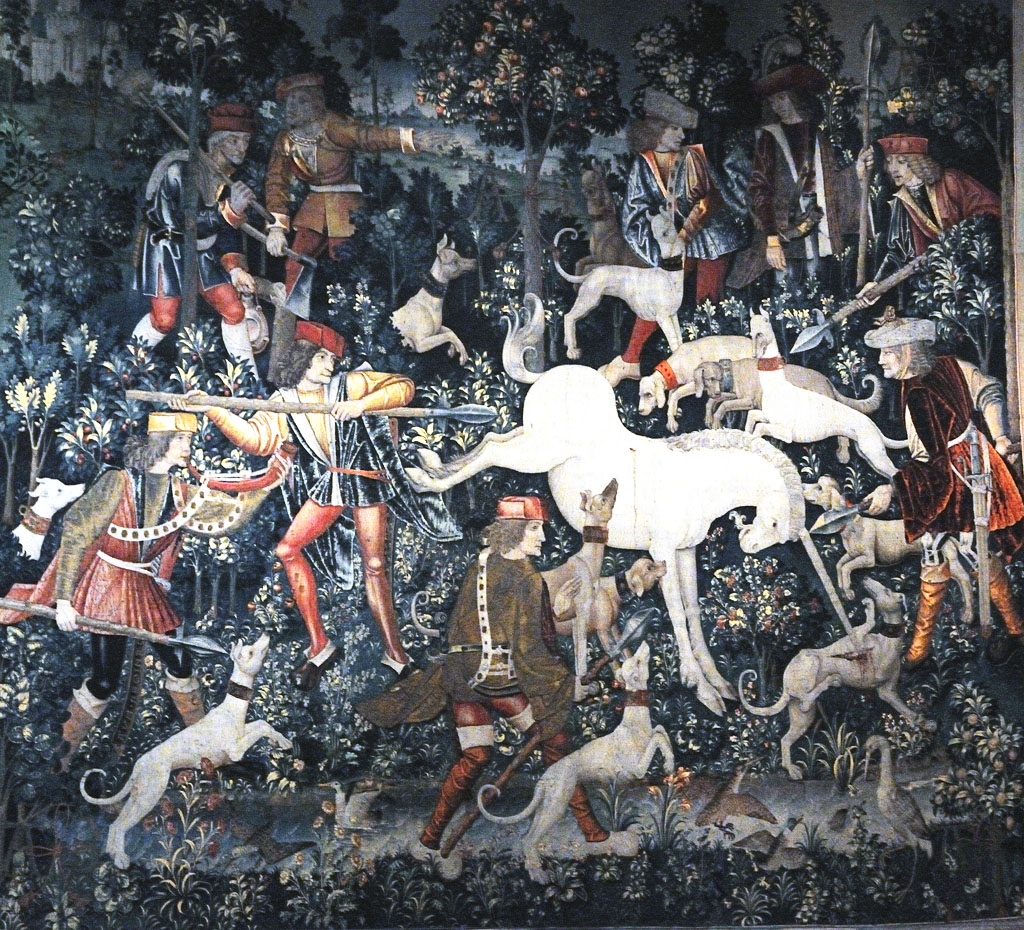
I feel compelled to point out that most Medieval depictions of 'hunting' tend to show their subjects scattered higgledy-piggledy within the frame, as this Unicorn Tapestry, circa 1495-1515:

Note the lack of effort each hunter takes in remaining out of
each other's sight ranges.
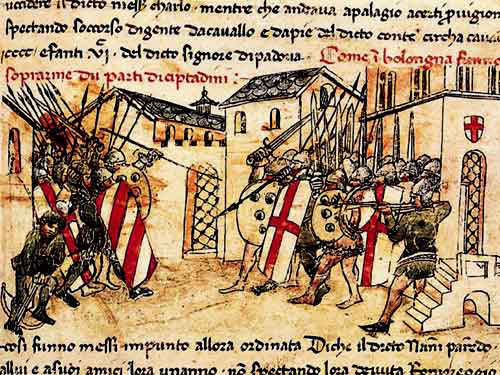
Or take this 14th century depiction of an urban fight between Guelfs and Ghibellines in Bologna:

Hand signals are a bitch when every hand is filled with a
weapon or a shield.
Even in the midst of battle, these men do not seem to be "standing abreast" . . . rather, they seem smashed together without much rhyme or reason, except that there's enough room for the fellow on the left to load his crossbow.

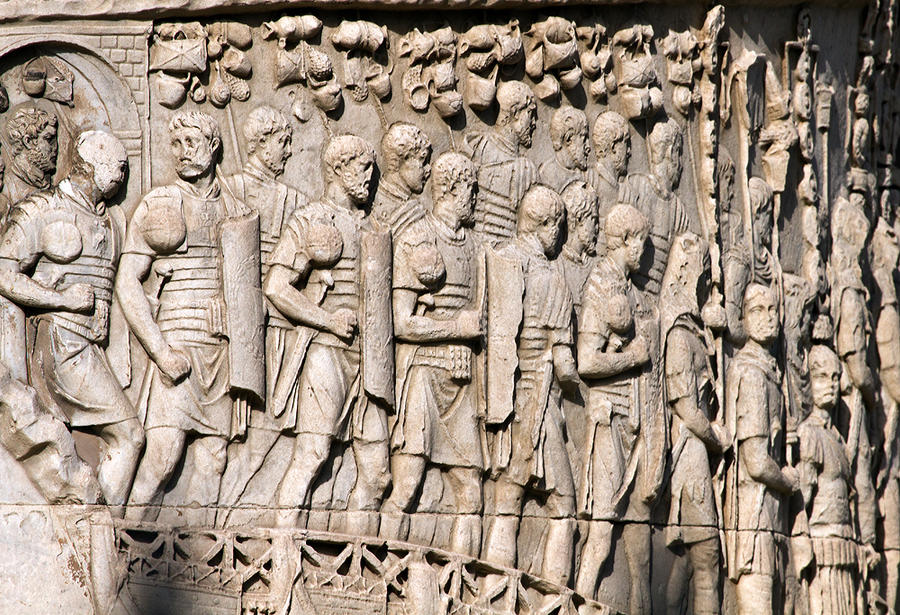
While we do know that Romans marched in time and as a group, we have no contemporary examples of what this actually looked like.  Everything we imagine about Roman soldiers marching has been recreated in our heads, first in Renaissance painting and later in film.  Here's a Roman depiction of soldiers, from Trajan's Column: 

Not exactly lockstep
Here's another:

Not quite the discipline we've been led to expect

Once upon a time, soldiers really did not act like modern trained regulars.  That's a recent development.  Somehow, to some people, it doesn't seem like that's possible.  It seems to them like our neanderthal forebears must have been slashing brilliant commandos, simply because they hunted all the time and had not yet learned how to speak.  They MUST have developed some clever way to talk to each other, right?

Somehow, it never occurs that it's possible that they just didn't.


Tuesday, July 21, 2015

Training

This is last category for discussion, finishing up the subject begun by this post.  Training is the process of both sharing one's knowledge and helping others to improve their existing performance, whatever that may be.

With regards to the latter, the Trainer need not be superior to the Trainee.  Most Olympic trainers cannot, nor ever could, excel in the sports for which they train.  That is because 'training' as a whole is a knowledge, not a capacity for performance - it is best to remember there is a distinct difference between these two things.

The argument that it requires a 5th level fighter to train a 1st level fighter contains both elements of truth and fallacy.  It is important that the Trainer have more experience than the Trainee, so the 5th level/1st level argument holds up; however, it is NOT important that the Trainer have more ability than the Trainee.  Thus in a physical contest, it does not follow that because the Trainee can beat the shit out of the Trainer that the Trainer has nothing to teach.  Rocky Balboa would have cleaned little Mickey's clock, yet that is completely irrelevant.  Mickey knew more - and if Rocky wanted to win against fighters stronger than Rocky, he had to listen and follow Mickey's advice.

We have to be careful about assumptions like being a greater level proves greater ability as a Trainer.  It does in my sage abilities format, as the more levels a character obtains the more points they have in Training - presuming that is the skill that the character chooses to take!  Very easily a 2nd level fighter with Training could be superior to an 8th level fighter with no interest in the subject.

I only take the time to point this out to establish that the old way of doing things will be made deservedly dead.

Training breaks down into the acquisition of mechanical skills, personal adaptation, mental development and performance.  Mechanical skill is the knowledge necessary in learning how to do something - mountain climb, dogsled, sail, swim, kayak, bareback riding, survival, weapon use, cliff diving, surfing, etc.  Personal adaptation is the process of improving oneself in order to make mastery of the skill, either by increasing one's knowledge and ability to think quickly or by actively strengthening one's muscles, endurance or dexterity.  Mental development is the practice of maintaining one's clarity, one's enthusiasm or focus, so that greater acuity is possible without despair.  Finally, Performance describes going farther, faster, longer, more intensely or practically, actually mastering the skill through activity.

Player characters wishing to occupy themselves in various sports or skill sets, therefore, would be looking to take Mechanical as a field.  This would steadily increase the character so that virtually any sort of physical activity would become part of their skill set.  While this does not ensure mastery (that's the performance category), it would ensure enough competency to enable the character to safely work or act as mechanical knowledge allowed.  In a storm, for instance, the character would know what to do, even if there was some doubt of being able to do it if it were an extremely dangerous, nearly impossible task.  If the task were merely routine, however, the character would be fine.

Where it comes to enabling others to become combat-trained or leveled persons, player characters would do well to take Personal as a field.  Since the character already is a fighter, it presumes the character has already achieved this knowledge and physical acuity.  Therefore, the emphasis of the category is outwards, towards others who wish to do the same.  Without the Leadership skill, there would be some question of recruiting people able to improve themselves - but the player character with Personal as a Training field would be know what to do and how to teach, at least as much knowledge as it takes to be a fighter.

Mental development is a black hole for role-playing games, as it presumes the player character's cognitive abilities serves as a stand-in for the character.  The player character is exactly as stressed as the character and it is meant to be this way, for the whole substance of role-playing demands that the Player feel the capacity to control the character's actions absolutely.  Therefore, while mental development is a central tenet of training, I'm not sure I'm going to include this as part of the sage ability.  The door is still open, however.

Performance, likewise, is probably left up to chance and the actual process of gaining experience and levels.  I doubt very, very much that I will be making any changes to actual player performance.  I may allow some set of die rolls to deal with a greater ability to do nearly impossible tasks (as noted above), but I'm not sure if this would be positive to the functionality of the game.

This, then, is where my thinking on the subject of Training stands.  I've covered all five topics in depth now; I will probably begin with this last on the Wiki, transforming my thoughts into substantive, practical rules.  A much, much harder job.

Leadership III

I was going to move on, but it's worthwhile examining these points from Ozymandias, particularly this last:

". . . you'd be taking something the players have right now (complete control over their NPCs in battle) and limiting it unless the fighter characters focus on leadership."

Unquestionably the answer to that last is yes, I would be adding some limitations to the existing system.  I'm not sure what limitations yet, as I'm still formulating the specifics, but it stands to reason that any addition in rules will create limitations where none existed before.  This is why 'rule' relates to a 'boundary.'

However, I wouldn't expect there to be much of an increased limitation.  I've already built in two containment systems on the players' utilization of their hirelings/followers, the aforementioned veto and morale system.  As regards most things in combat, my emphasis in rule-making would be to allow the character with leadership experience to circumvent that containment: to overrule my veto or to improve the hireling/follower's morale and make it less of an issue.

We have to understand, however, that for every hireling/follower that the party acquires, there is an endless parade of NPCs that the players do not control.  Many of these have characteristics that simply prevent any possibility of alliance with the players.  One does not simply convince Captain Ahab to change his mind and suspend his quest in order to ship the party to their desired destination.  Othello is not going to become less jealous after sitting down with a player to have "a good talk."  Becky Sharp will remain hell-bent on improving her social position.  That's just how it is with these people; while not necessarily evil, they are obsessive and therefore strongly resistant to change - and so it goes with most of the population, to a lesser degree, as we all know from any personal exchange we've had with someone who has a personal political axe to grind.

D&D would have it that any good player ought to be able to radically change these circumstances with "really good role-playing" . . . which in turn puts the DM in the position of having to reward players who chatter well with an automatic NPC about-face.  As someone who does argue very well, who goes at it like a pit-bull, I've seen this actually happen perhaps four or five times in my life - this coming from someone who has given it plenty of opportunity to happen.  People are bloody-minded, stubborn, argumentative forces to be reckoned with, as the reader has already discovered having lived long enough to learn how to read.

It is possible, however, to play to what people believe in order to get them to do as we want, without needing to change their minds.  It takes talent, however, to spy the belief system, recognize how to get the chisel underneath the person's defensiveness and distrust, then pry up the person's willingness to help out in just such a way that the person feels good about themselves when it's done.  It is also a talent to recognize that person in a whole room of people who don't possess the sort of belief system we need for just this sort of operation.

This is what a leader does, however.  A leader finds those people who are already predisposed to follow a certain banner, who then waves that banner in front of those people and gets them moving.  Recruitment, therefore, is critical where it comes to building a team that can be briefed, right from the start.

Normally, if I had a player enter a town and try to hire anyone, they'd come up empty.  The player characters are obviously strangers, they talk strange, they wear road-battered clothing, they carry weapons, they're mostly unwashed and they have no references of any kind.  A person would have to be crazy to work for someone like this.  Therefore, most of the time, the only hirelings that players have are a) associates that the background generator has given them; b) characters who they have aided or rescued in some way; and c) characters who happen to be going in the same direction or who have the same goals as the party.  In the case of (b) and (c), it is the players' actions and decisions that makes the difference in those NPCs being willing to hire on and join . . . and I make the decision myself, based on whether or not the players have respected those NPCs.

The leadership skill would circumvent my decision.  In effect, it would say that no matter what the players' actual words or personal treatment of the NPCs, the leadership skill would trump it.  If the player, as my world goes right now, said to an NPC, "You idiot! Do that again and I'll kill you!", I would have the NPC fade.  With the leadership skill however, I must presume that the character's words were much more appropriate, considerate and motivational.  Therefore, the NPC would not fade.

In answer to Ozymandias, then, the ability wouldn't determine that the team would do something right or wrong based on the brief (technically, that would be an expeditionary/tactical consideration).  Rather, it would ensure a greater chance of the Leader meeting and transforming strangers into allies, whom the player would then have the opportunity to run personally, with a greater morale in the face of danger, a greater chance of sacrificing themselves at the player's order (over my veto) and therefore offering a greater resource for the party.

Leadership doesn't make people better in terms of ability, only in terms of their willingness to act.  Once having done so, we would rely upon the expeditionary/tactical ability of the player to pick the right people for the right job, ensuring probable success.  This doesn't make individuals better - but it would allow individuals to work at their greatest efficiency.


P.S.,

I considered for a long time whether or not 'recruitment' ought to be an ability possessed by Leaders or by Trainers.  I settled on Leaders; and as a proof, I offer the present military system in which those people who recruit new soldiers are completely divorced from those who train them.  I see recognizing potential and enabling potential as both different process and mindsets.

Leadership II

There exists a curious parallel between the stat abilities of a D&D character and something that behaviorists refer to as the 'trait theory of leadership.'  This is an historical perception (that now tends to be viewed as a fallacy) that the ability to be a leader is based upon a model of traits that are recognizable in the candidate, things like intelligence, interpersonal skills, extroversion, honesty and so on.  Thomas Carlyle took a crack at codifying this at near the beginning of the Victorian Age (when every ideal was ultimately codified, whether this worked or not), so we have him to blame for the "Great Man Theory."  Take a crack at it, it's a great view into the 19th century mind.

The theory has been challenged by historians since its presentation, mostly to say that history is just as adept at creating great persons as great persons are in creating history.  Well, none of that is relevant to our discussion here, of a game, but it is interesting to note that when a DM takes up the argument that a character's stats determine that character's ability to lead men or promote action, the DM is diligently following in Carlyle's footsteps.

My principle of sage ability is based upon a character's decision to apply themselves and grow better, over time, measured by experience and levels gained.  Thus the character who chooses to be a leader will become a better leader, regardless of their ability statistics.  This, I know, is hard to relate to traditional D&D practice.  A fighter with an 8 charisma becoming a leader of men?  Ridiculous!

Yet we have many examples of trusted, reliable leaders who were ugly, poor of speech, who were known to have a distressing body odor, who were physically weak or overly intellectual, etcetera.
These leaders compensated for their poor qualities through honesty, hard work, luck, subordinates and generosity, patterns of behavior that have nothing whatsoever to do with charisma.

On the other hand, if any of us chooses at an early age to think continuously about leadership, to throw ourselves into politics, to learn all that we can learn about what people want, to practice debating and addressing crowds, to adapt ourselves to crowd-pleasing methods, whatever our original charisma, we will learn to be leaders.  Parliment or Congress is just another Carnegie Hall.

With this in mind, we have to throw out our preconceptions about how to turn friends into allies and how to turn allies into followers.  We don't really need to know which element of ability the fighter possesses that enables leadership - we can simply assume the fighter, having chosen that field, has learned to employ some method of some kind in order to get there.

We only need concern ourselves with where 'there' is.

And here the work has already been done for us.  There are 8 functions of leadership, according to John Adair: defining the task, planning, briefing the team, controlling what happens, evaluating results, motivating individuals, organizing people and setting an example.

Some of these have a definite overlap with our earlier discussion of planning an expedition, so we can drop several of these - those things that have to do with organizing.  For Leadership as a stand alone sage ability, we have four:

1) briefing the team describes the process of explaining matters to people on their level, so that they understand, thus creating a feeling of inclusion and camaraderie.  This is in part the leader standing ahead of the army and giving a great speech before going into battle; but it is also the leader as a friendly father patiently explaining what an individual soldier has failed to understand about being a part of the team.  This also includes knowing what the hold back, what not to tell, knowing that too much information of the wrong kind will undermine morale.

2) motivating people is the next step; after the underling understands, that same underling must feel a willingness to be a part of what's happening, to join in - and more than that, to join in such a manner that they're willing to take orders and believe in their hearts that these are the right orders.  The leader encourages the idea that he or she is the only person for the job, not only in their own opinion but in everyone's.

3) evaluating results could be misunderstood as a part of expeditionary or strategical planning; we screwed up, how should we have done this differently?  Here, however, what we mean is the leader's ability to be introspective about their own actions as well as that of their underlings, to recognize where the success or failure resulted from a failure to brief or motivate, as well as right or wrong decisions made.  A leader cannot wallow in grief; at the same time, a leader must look at every part of the equation and ignore nothing.

4) setting an example is the practice of making clear in the followers mind that the leader is one of them, willing to do the same work, take part in the same struggle, have the same goals and suffer the same consequences.  A great leader is not an elitist - a leader rates their own success in terms of what everyone has achieved, together, as a group, understanding that the celebration of the victory is not something accorded to the leader but something that everyone shares.

Each of these things are typically played out as an act of role-playing.  We explain to the NPC what we want; we try to motivate the NPC; we question our relationship to the NPC and we quest to struggle side by side with that NPC in times of struggle (described in the last post).  The trick is to fit these actions into practical, identifiable rules that the players can employ whenever they find themselves in the position of wanting to get an NPC on board with their agenda.

Obviously, I think some of the calculation has to include a sacrifice of more than just money to pay the underlings off.  It is very important, I believe, that this sacrifice must be something inherent, which the player will want to embrace for the gain in power that it promotes.  I don't know how possible that is; but the purpose to writing these posts is to identify the boundaries of the various fields of knowledge within the fighter's overall sage abilities.  Leadership is one of those fields.  Having written this and the previous post, I think I have a better handle on what is needed - though I am sorry, I have no hardened proposals to make.  Those I will save for the Wiki.

Monday, July 20, 2015

Leadership I

Setting war aside, we move onto the next subject in the fighter's repertoire.  For me and for most anyone I've known, there are great problems where it comes to the acquisition and management of non-player characters, both for the player and for the DM.  While the latter has always had to put up with parties that see men-at-arms as little more than cardboard obstacles designed to slow the enemy up for a round or two, players have had to accept an endless parade of conveniently skilled, story-driven hireling backstabbers.  NPCs are foils for both sides.  Where is the trust?

Because even a long term friend and hireling will turncoat on a dime as the DM runs his or her latest Josh Whedon plot line, players on the whole learn to do without them.  Because they're not 'real,' there's nothing to stop us from squeezing out of each NPC all the juice we can get, as far as the DM will allow . . . and since most hireling sacrifices take place underground, far from the eyes of others, it is hard to argue that more can't be obtained with sufficient capital.  It seems the only option the DM has is to have a random hireling bite back . . . but that only results in a total distrust of all hirelings, effectively eliminating the option from the game.

Gygax wasted four pages of the DMG making up interaction rules for henchmen and hirelings - gawd knows if he tried to play those rules himself.  I wasted a couple of months trying to evolve interaction rules for players and everyone else.  Player-NPC interactive mechanics are an unequivocal, unavoidable shit pile.  As I step into it again, the reader can bet I am going to do so carefully.

For a long time, I have been running henchmen as additional, obstensibly fanatic characters whom the players "meet" and then run exactly like typical player characters.  These henchmen appear when the character reaches a certain level, supposedly because the character has gathered a reputation or acted in some way publicly that the henchman has approached, in awe, begging to follow the original player character eternally until death.

Recently, my players have begun hitting name-level, acquiring followers.  These are not henchmen (they have a mind of their own), but they are completely loyal and willing to perform most any action the player asks of them.  During the campaign, the player again runs these people - but I reserve the right to veto any act the player would have them perform.  I hardly ever need to.  Players understand that they're not going to replace these followers easily and for the most part, the followers' entry into combat is more or less designed by the player to keep them alive.

I have a theory that IF the player is allowed to play the NPC (even a hireling or a servant) without the DM interfering, the player is far, far less likely to sacrifice that character - particularly if it is made clear to the player that advancement for the NPC is a possibility.  Even an munchkin gets that a weakling NPC who might someday be a 5th level helper will tend to keep the NPC safe.  I believe that the willingness to sacrifice NPCs willy-nilly begins with the DM insisting on controlling every single action of that character.  By not allowing the player to co-opt the NPC, the DM greatly downgrades the character's worth to the players. Why not burn off those men-at-arms?  We have no power over them anyway.

I challenge any DM reading this to hand over any NPCs running with the party in their present campaign to the party!  Simply give the party all their stats and tell the party, "I'm going to let you manage these guys so that I have more time to run.  Jim, you can run the two bowmen, Janie, go ahead and direct the heavy footman and John, you've got the sapper.  Here are their hit points and stats.  I'll call nix if you have them do anything really stupid but for the most part, they're yours."

I began doing this within a year of running my first games and it has never gone sour.  If the players get too entitled, then I will just have the NPCs fade into the darkness; "You look around and the NPCs have deserted you."  Players are always chattering among themselves anyway, it is easy to argue that for five minutes, no one has so much as mentioned an NPC so it was easy for them to slink away.

I only need to do this, however, with new players fresh to my world, those who have learned bad habits under other DMs.  My players cherish their NPCs because its a harsh, brutal world and they recognize every friend they can get will help keep them alive.  It helps that in eight years of the present campaign (offline), I've never had a hireling or follower go turncoat.  The same is true, I suppose, of the online campaign.  An NPC they meet, who they haven't built an association with, might turn out to be an enemy, but never a friend.  NEVER a friend.

Why ditch that potential story option?  Because it's trite, it's overused, it's arbitrary (oh, so very arbitrary) and it builds bad blood between a DM and a player.  Fuck all that.  There are other plotlines, other stories, other ways to build up tension.  I don't use that cheesy option because I don't need it.

Seriously.  Ditch it.  When your head goes there and you think, "Woah, that will be cool, they'll never see that coming," smack yourself in the face.

Think instead, "Woah, that's me being a fucking turncoat to my players by arbitrarily deciding to be a dick.  Maybe I shouldn't."

Well, that was a digression.  I was talking about henchmen and followers.

Hirelings are people the players buy, who have no particular loyalty to the players' prestige or personas.  Over time, they might develop some.  For my world, I use a very simple system, morale.  The link explains the principle.  On the whole, it lets the players run the hireling and then puts a die roll between having the hireling enter or remain in combat (or any other danger) based upon what sort of experience the hireling has.  Not all hirelings work on a wage principle.  I consider anyone adventuring with the party and getting a share of the treasure to be a hireling (or 'ally').

I keep meaning to write some rules on how much wages/treasure a hireling expects to get but I haven't yet.  Probably have to this winter to support the leadership rules I plan to add to my campaign.

Friends are people who are working with the party but who have not committed themselves to anything.  Friends are not always easy to identify and usually there is a period during which the players aren't sure if such and such is a friend or foe.  Here I can play with loyalties and trust where it comes to interaction, because no agreements have been made, no assurances given.  Any friend might in fact not be a friend, so people freely lie to the party or are believed to have lied because the party knows not to trust anyone who is merely a friend.

Thus, a friend might give the party a gift that turns out to be something else; the party knows this is a possibility because, apart from the gift, there's no proof of any other commitment.  Parties, knowing this (and knowing me), recognize very well that these relationships can go either way.  They are not, therefore, angered or resentful when a 'friend' goes the other way.  Not like they would be if a hireling or a follower did.  There is a line.

Most friends in my world, however, really are friends.  On Saturday, my party met a Wyth; a humanoid creature resembling a razorbacked hog, frightening to look at and blessed with obvious thieving abilities.  These abilities were recognized by the party's 7th level thief (Olie) - so the party was reasonably unsure.  Moreover, the Wyth would not speak, only shake its head or nod.  It ate raw meat from a oiled bag and that seemed disturbing.  Without any sort of surety between them, the Wyth headed off and so did the party.

In a town, the players were told that Wyths are dangerous and that they will follow a party until they can gather together enough of their band to launch an assault.  When the party moved on, descending through a canyon to the plain below, Olie caught glimpses that showed they were being followed.  Olie slipped back, found the Wyth and confronted it, 25 feet apart.  Olie threatened; the Wyth did not speak.  It pulled out a piece of raw meat and offered it to Olie.  Olie refused it.  Olie managed to scare the Wyth away and then returned to the party.

Didn't work.  The Wyth continued to follow.  That night, it approached another player on guard, Maze the cleric, moving to the edge of the firelight.  From that distance, it again offered the meat.  Maze also refused.  When Maze moved to wake up the others in the party, the Wyth disappeared.  The next day, the party descended into the plain and they didn't see the Wyth again.

The worst thing was that the Wyth wouldn't speak; this had the party confused and threatened.  When they reached a city on the plain, they asked again about the Wyth.  Here they were told a different story; that people in the hills don't trust the Wyths but that they're harmless.  And the meat?  Apparently, Wyths won't talk to anyone they haven't shared food with.  It was trying to get the party to eat so they could talk together.

This had a terrific effect on the party, as they realized their distrust had cost them a possible friend.  To this I added by saying, "It had things to tell you."  That went through the party's head like a bomb.  Naturally, they did not see the Wyth again.

Making friends is difficult.

This is where Leadership as a skill comes in.  How to change a stranger to a friend, how to make a friend a hireling (or ally) and how to turn hirelings into followers.  In turn, how to acquire people in a campaign that a player can personally manage or run.  I'll write more on this next.

Friday, July 17, 2015

Expedition II

Digging through the subject matter of military operations (or 'expeditions' as I'm calling them), it's quite clear how much has changed in the description of battlespace mechanics since the Vietnam War.  Thankfully, I'm not on the hook to explain the ins and outs of modern operations theory (like I could!) - but I am left with the task of walking back those theories to produce role-playing rules for its more primitive ancestor.

Hammering down the content is the best I can hope for with this post.  Content?  Basically, what features of managing, organizing or effecting a battlefield do we want to include in the system?  Before getting to that, first I want to make a distinction between 'strategy' and 'expedition' where it comes to the skill set the player can steadily acquire.  And while we're at it, we might as well also distinguish tactics.

Strategy describes the entire war.  If Sauron is attacking Middle Earth, his strategy is to encourage Saruman to raise and army and smash the threat Rohan presents, particularly any chance that Rohan might support Gondor.  If Saruman can ruin Rohan, then Gondor will be alone.  There's not much more to the plan than this in the book; presumably, however, Mirkwood and other friendly groups to Sauron are doing something.  Moreover, the timing is such that the candy-ass elves are in the mood to weep home to the west.

Expedition describes the actual attack on Osgiliath in order to secure it as a ford across the Anduin, enabling the deployment of the Witch-king of Angmar's forces on the field before Gondor.  Laying out the battle plan for the field is a huge task, for deciding which group stands where and who attacks from which flank demands a peculiar set of skills quite apart from those of strategy.  Since Sauron is busy with strategy, W.K.A. has the duty.

Tactics describes the orc troop who fell upon Boromir and killed him before spiriting away Merry and Pippin.  In the novel there is no name given to the leader of the orcs; but of course this was to dramatically highlight the surprise and horror of Aragorn finding Boromir dead and full of arrows.  We know there would have been a leader, someone who chose the right moment to attack the Fellowship when they were scattered.  This skill at directing a few persons - effectively the party attack patterns in ordinary D&D - is called tactics.

As a set of general headings that might serve to systematize what parts of expeditionary force should matter to us, I propose the following: agility, efficiency, situational awareness, intelligence, surveillance, reconnaissance, environment, tactical responsibility, chain of command, units and logistics.

Agility is the speed of getting of the force to the place where we want it while maintaining a fighting trim.  Efficiency is both the combat effectiveness and resilience the force has in obtaining the desired goal.  Situational Awareness is our capacity to understand what is going on during the actual battle, enabling us to make changes as needed.  Intelligence is what we know about the enemy.  Surveillance is what we can see.  Reconnaissance is the process of learning about what we do not know and cannot see prior to full commitment.  Tactical Responsibility describes what duties we give to what part of our army, particularly in terms of what geographical area a given unit is responsible for.  Chain of Command describes who we trust, who they trust and how much control we have over people we will never personally address.  Units are the subdivisions of our force.  Finally, Logistics describes the physical support of our force in terms of tools, supplies, transport, housing and rehabilitation (medical and otherwise).

These are, for the most part, too fiddling to manage from a strategic standpoint - that is why the actual problem of taking down Gondor is not managed by Sauron personally.  Politically, the method for capturing a given goal in war is handed over to a trusted general - this was ever more true prior to the 20th century, when communications between an army and the political head of the country was non-existent.  It is also the reason many kings went along or led the army personally, though this wasn't required or even standard practice.  Edward III let his son Edward the Black Prince smash the French at Crecy and Poitiers, probably without knowing much at all of what was going on.  Justinian of Byzantium sent Belisarius to reconquer the Mediterranean and did not jog his elbow.  Fernando Alvarez had effectively carte blanche in the Netherlands, provided he filled the coffers of Charles V and Philip the II.  The lesson here is that, unless we are willing to take the risks of getting killed or captured in battle personally, we have to accept that whatever we send the general off to do, the general will make up his or her own mind about how to do it.

Conversely, most of the above terms do apply to tactics, but in ways comparatively simple to moving  whole army.  Agility also applies to two soldiers crossing a line of fire to get behind a boulder, but this has is massively different from getting an army across a river.  Characters in D&D tend to have perfect situational awareness (since we can slow down time as much as we need and all, plus looking at the battle map from above and in at any angle that pleases us), but in the midst of a battle, with people shouting information at a commander continuously and waiting for orders, 'seeing' what's going on even at the level of a squad assaulting a tower is an impossibility.  There is too much situation to allow complete awareness.  Characters practice logistics when they stop at the market to buy two weeks of rations; hauling two weeks of rations for five thousand soldiers and the support companies behind them is an incomprehensible nightmare, even if they're only five miles from a big city and there's actually enough food available.  Doing it on time and without considerable waste is incomprehensibly difficult, especially when we calculate in theft, corruption, incompetence and sheer human distrust and stupidity.  This explains why armies prior to modern transport/communication apparatus consisted largely of roving thuggery.  It is better than starving.

So, how do we set up a rule system to handle these Ten Things for players?  You got me.  But I'll have it worked out by the time I have to start building the ability-set in the wiki.  The secret is starting small and concentrating on only one bit at a time.


Thursday, July 16, 2015

Expedition

From the early 15th century: "military campaign; the act of rapidly setting forth," from Old French expedicion "an expediting, implementation; expedition, mission" (13c.) and directly from Latin expeditionem (nominative expeditio) "an enterprise against an enemy, a military campaign," noun of action from past participle stem of expedire "make ready, prepare."  I present this as an alternative to the term, "military operations," which did not come into use until 1749.

I don't know that there's a single DM reading this who would either feel up to the task or even be willing to have something like this, long term, be a part of their role-playing game . . . but let's pretend that it's a possibility.  Let's pretend that your 12th level characters can pull together an army, between them, of a few thousand.  Let's pretend the DM has the wherewithal to do more than just have you write off gold pieces to bivouac them, train them, organize them into battle squadrons (1560s) and march them out with the express purpose of conquering a part of the world.  Let's pretend that the DM is willing to let this - we'll call it a 'war' - continue over several seasons in time, in which more soldiers are found and trained, more ground is taken or lost and that the possibility of winning or losing is in doubt, enough doubt that the experience itself actually causes a sense of engagement that lasts for months of running.

We'll have to pretend because we know there are NO rules for this.  We know that the set up that exists in most worlds comes down to the DM rolling a d6 and stating - pretty much ad hoc and without much personal desire to see the thing through - that we've won or lost.  We also know, alas, that because the Gygaxian crowd never considered the possibility that players might imagine themselves running a lengthy campaign as Caesar, Belisarius or Jenghis, with zero interest in dungeon-delving, such is not considered an acceptable way to play the game.

Let me repeat that.  We're in the wrong if that's what we want our players to do.  That's not what D&D was designed for.  If that's what you want, there's a war gamer group right down the road.

That's why we have to pretend; because we can't role-play that shit.

Here I want to point out a fundamental difference between 'wargaming' and 'role-playing.'  In wargaming, the ideal is to measure ourselves against what Caesar, Belisarius or Jenghis did.  They won or lost such-and-such a battle, we want to see - given an approximate simulation - if we will make the decisions that will enable us to win or not.  We know what those conquerors tried; we want to see if our change to their tactics improves the situation, if we can think of something they did not or prove to ourselves (dissonantly) that we're the equal of them.

This is nothing like role-play.  When I roll a die as a fighter, my actual personal ability as a fighter is immaterial.  The fighting ability is inherent in the statistics of my character, not in me.  I am playing my character to see if his stats and luck will win out over some other creature or character's stats and luck.  Strategy comes into play, of course, but I have the benefit of many things that are imaginary and unreal, very much making this situation different from a simulation.  No RPG battle ever occurred in the real world.

This means that if we make rules for running a campaign in D&D, it isn't just a matter of inventing rules for large unit battle resolutions, which I can then run like any other war game.  In D&D, I am entitled, also, to my fighter's superior understanding of war and the movement of men in ways that I do not possess!  I don't want to be limited to my own ability to develop and organize an expedition, nor do I want any player in my campaign to feel similarly bound.  If they are a total wash as a wargamer, in role-playing they should have the benefit of being able to win just like any other world-class conqueror.

I am guessing I'm probably the first person in the history of the game to make this point.

It means that rules for running an expedition must include a reasonable chance for success regardless of the player's personal military understanding or experience.  A know-nothing player can roll a die for their fighter and kill a dragon; rules for military expeditions must possess that same fundamental gaming structure.

A very tall order.  I am still thinking about it.

Wednesday, July 15, 2015

Surprise Review

A very pleasant review of my book, How to Run, on Amazon:

"I stumbled upon this book in the "local authors" section of my bookstore. I love anything written about role playing, especially books on GMing, so I immediately purchased it.

"By the end of the book it occurred to me I was reading what could become (and deserves to be considered) a classic work on the art of gamemastering. Smolensk is an immensely talented and perceptive writer. According to the book he has been gaming (mostly gamemastering) for close to 40 years. "How to Run" is an extended manifesto for gamemasters, giving the author's philosophical views on how to run a good game based on the experience of some 11,000+ hours of gaming.

"The observations in the book are system- and genre-neutral. It does not contain any charts and tables, or reference to specific game mechanics, classes, etc. There aren't many examples given, so it takes some work in certain cases to relate the book's concepts to the real world of your game. But the effort is quite rewarding, and the book has changed the way I view campaign and world design. The author is a firm believer in the sand-box approach, and this was the first clear exposition I've seen about how to build a sandbox that is completely tailored to your players' needs.

"Regardless of whether you agree with his views, I think it would be hard not to be inspired by the author's unapologetic and consuming passion for the game and for gamemastering. It is a rare treat to read something focused on this aspect of the hobby (a sub-niche within a niche), executed with such sustained eloquence and insight.

"A must-read for gamemasters - highly recommended."
Very nice.

No Escape from the Pillory

"An escape from the pillory was a rare event, but the general chaos and disorder that were associated with its use was not, and reports of punishment at the pillory abound with tales of an angry mob only scarcely under control.  Two culprits taken down from the pillory at Chelmsford, for example, were 'begrimed with rotten eggs' and as they were escorted back to the gaol 'assailed with the indignant shouts and execrations of the populace.'  At Charing Cross, a man convicted of assaulting a drum boy was pelted with 'mud, eggs, turnips, and other missiles' until he was 'completely enveloped with mud and filth', and it was only with 'the utmost difficulty that the peace officers could prevent him from being torn to pieces by the mob.'  Not only did unruly spectacles such as these fit ill with new ideals about civic decorum, they also tilted perilously close to a breakdown of order.  The pillory was sure to attract a large crowd of men and women, drawn largely from the lower sections of society, with the consequent risk that disorder was never far away.  It was all sharply at odds with the neat and ordered market-place that civic elites were attempting to fashion."
Emma Griffin, The 'Urban Renaissance' and the Mob

At some point in history, the pillory came down.  Not, as some would argue, because we became a more enlightened people; but because the pressures of urban life was creating something new with the late 18th century, which the above quote describes - specifically, an intense, dangerous, unbridled hate, seeking a target that could be attacked without fear of retribution.  The old-fashioned punishment of placing people in stocks, cages and other pillories offered just such an opportunity.  Their decline was not marked by a general distaste for anger or brutality - as Ms. Griffin points out, capital punishment even as a public spectacle was quite safe from reproach.  No, the decline had much to do with where it was happening - the market place - where violent crowds were both a matter of threat to the established order and bad for business.

We'd like to think we invented 'haters.'  It has been here all along.  We've simply reinvented the market place, let the same old people rush on in and make what new torments we can devise for ourselves.  It is at least pleasant that we are all so far apart from one another that the market place can go on letting us hate as much as we please.

I've heard a number of older people argue, "There were no haters in my day."  That's dissonance for you.  What that really means is that in their day, hate was organized and largely state-sanctioned. Today's hate is somewhat less directed, somewhat less ordained by the priests of power.  It's personal, from the hip.  Spontaneous. 

Hate is a hard thing to talk about because, yes, while we are all victims of it, we are also all perpetrators.  All innocence is pretense, the disguise behind which our turning minds justify things we dislike, things we think others should dislike, things we judge as lacking on merit and our sacred quest to ensure that lack of merit is understood, vilified and stamped out - as much as we can manage, at least.

I write here not to argue innocence; only to explain what's happening.  We were all raised with an agenda, some of it acquired from our upbringing, some from the media, some from our own experience.  Most especially from the bitter experiences we have had, those experiences where people and forces humiliated us and made us feel less than those around us.  In so many ways, it is the steady battering against our egos that make us envy, resent and despair over things we will never have, things we have but cannot appreciate and things we never wanted but which we're stuck with, forever.  This is what makes us hate, the sense that we are trapped.  Trapped in our limitations, trapped in our distaste, trapped in our company, trapped in our frequent and helpless addictions to things that have ceased to satisfy us.

Yet humiliation is a tricky thing.  It does not only lay us low, it also produces a craving for approval, as we cast about for someone who won't hurt us, who won't hate us, who won't take advantage of our shame and our doubts.  In the deep dark misery of that craving, too often we don't care where that approval comes from . . . and all too often that approval will come from the exact same people and origin as the humiliation itself.  The very friends and family who will take malicious pride in smashing down our character will, in the same instant, reach out with a hand and hoist us out again with condescending tenderness.  Our tormentors and our saviors are so often the same person.

While we, in turn, do the same for others.  Condemn and spare, hate and reprieve, the endless cycle that creates the dependency that returns us again and again to the source.

Hating and humiliating is the steam that drives us, at the same time denying us the will to make our own decisions, encouraging the will to subordinate ourselves to others, subverts our strength to make demands or take a stand and leaves us terrified of abandonment.

We do not need to worry about that.  We have plenty of tormentors for company.


Tuesday, July 14, 2015

Stunning

Pictures we cannot take on our cell phones:

What we've learned.

Once upon a time, I considered astronomy as an occupation.  Then I decided I wanted to be a writer.  Many who went the other way are happy today.

Monday, July 13, 2015

All Activity

Yesterday, I made some sweeping generalizations about a skill set surrounding small unit tactics, if certain fighters had such knowledge.  The big problem, for most campaigns, is the expectation here that is placed upon the DM.  Fundamentally, the DM is being asked to subvert their own ruleset or expectations in favour of granting the players (apparently arbitrarily) greater knowledge of their universe and a greater potential for managing it.

This just isn't possible for the ordinary campaign.  RPGs are structurally caught in a vortex surrounding the DM, the DM's troubles, the DM's limitations and ultimately the DM's emotional sensibilities.  While the rules for RPGs are directed at the players, the complex implementation of those rules has transformed the DM into the Star of the Show and the remaining participants as extras and bit players.

Contributing to this is the reality that the DM, making the world, is not nearly as replaceable as the players.  Like any primadonna who fancies themselves 'the Talent,' DMs can have someone removed from the set for nothing more than stepping on the DM's moment.  Structurally, the failure in role-playing has always been found in what prejudices the DM keeps sacred.

Proposing rules like Tactics deeply challenges the very tenor of the role-playing game.  To the present, 'fantasy' has been built on the premises (and the prejudices) of the founders and subsequent drinkers of the kool-aid who have followed.  Thou shalt consider weapon-use based upon these principles, Thou shalt respect the role-play and keep it Holy, Thou shalt respect the limitations imposed by alignment, Thou shalt minimize the dreams and wishes of the players to a scale the DM can envision . . . etc.

It is this last that I continuously challenge with my world and which brings the most envy from others who wish they could play there.  The limitations of D&D are not necessarily the sort of dungeon that can be made, the arrangement of player-vs-monster battles or the collection and spending of loot.  Let me say it in bold:

All Activity Potentially Falls Into D&D's Scope

All activity.  All of it.  Everything that can be dreamed or imagined, that can be expressed, that machinery or magic can enable so as to make it challenging and worth doing . . . ALL.  Every bit of it.  Not only what the DM wants to do or what the most vocal player at the table will allow, but everything that open minds shall willingly address.

When I see the umpteenth dungeon map being drawn out and shown, without any special notes or details except the map itself, I wonder, do we not already have enough maps of rooms and halls?

Time & Work
I do appreciate the work and the application.  I appreciate the value of dungeons, I have and run dungeons quite regularly.  I wrote a book about them.  But is this it?  Is this the whole game?  Is this the limitation of imagination that begins with the question, "What do you want to do?"

Is it this?

Or is this what the DM will let you do?

Sunday, July 12, 2015

Tactics

Many years ago I wrote a popular post about the distancing of individuals during travel in the wilderness.  Parties, as we know, like to imagine that if an encounter happens in the wild, they are surely close enough to one another to ensure a perfect defensive formation when attacked.  Moreover, most DMs comply with this desire.  Otherwise, players might complain.

So the wizard never gets caught with his pants down in the middle of a bad case of the runs brought on by that second-rate salted pork the party saved money on.  The fighter never drifts back a bit while the cleric and the thief have another of their arguments.  No one seeks their own space for their own thoughts - and of course, while camping, no one ever wanders more than ten feet from any other party member.  Not even to get water or see to the horses.

I'm on record slamming that, arguing that the party should definitely be caught scattered in the woods, having to occasionally fight off the first attack by themselves, screaming in panic and hoping the rest of the party can get there in time.  So please, let's take it that in my world, parties en route will drift apart, even if they don't like it.

However . . . suppose that one fighter in the party had a sage ability in Tactics.  Suppose that as the party approached a particular bit of topography, a particular bend in the road, this fighter had a bell go off:  "Hey, hey, everyone," the fighter calls.  "Come here, come closer, I want to tell something."

So the party approaches.  "This looks like a good place for an ambush," says the fighter.  "Maybe for a mile or so, we ought to bunch up, stay close."

Do I have a problem with that?  No, not at all.  Even a mob can organize their thoughts well enough to stay focused for a mile, if the fighter saying so has already proven his good sense about these things.  It is that last notation, however, that matters.  What counts is that, when the party does bunch up, it turns out the fighter was right - it was a good place for an ambush.

So how would Tactics play out in a D&D campaign.  Well, the above example for sure - reasonable expectation that the party was going to be ambushed.  I'd like to propose a few others, all of them out of the ordinary and all of them adding to the fighter's ability without affecting attacks or damage:

  • Time to Advise.  If the reader's world is like mine, we both press the players to make decisions about what they're going to do in a crisis without feedback from others.  Sure, before they march into the temple, I expect them to plan; but once things start happening, I insist they go it alone.  Often, if one player gets a bit pronounced about telling other players what to do during combat, I take attacks away from that player.  Obviously, they are using all their time talking to other people - they don't have time to attack.  But we can always make an exception.  A good tactically trained fighter could fight and be permitted to send a solid message to other players about what to do (which could be played out by using the other player's suggestions to enhance the fighter's actual tactical ability - no every player with this skill will necessarily know how to give a tactical suggestion).
  • Sound Judgment.  Most players won't take advice from the DM; in fact, I've run with a number of players who consider it anti-characterization . . . since, of course, their characters couldn't possibly know the DM's mind.  But suppose, quite reasonably, that a tactically trained fighter could read the situation as well as the DM.  That would be fair, no?
  • Setting up an Ambush.  Just as a player can see one coming, the same player ought to be able to plan their own.  How?  By setting the movement of the enemy so that at the moment of attack, every player in the party has a) the right range; b) initiative; c) a great chance to get their first missile shot in unseen (could be a wisdom check); and finally, we can adjust the enemy so that they're strung out in the stupidest way possible.  Okay, yes, I know most DMs do that for the party anyway . . . but now there would be an excuse!
  • Cover and Concealment.  In wilderness travel, a greater chance to move closer and surprise an enemy in their camp or lair, as well as a greater chance to avoid patrols, both in the wilderness and in an urban environment.  In effect, a chance to read the situation and determine the best possible approach and the best possible hiding places.  In rules terms, this could mean slight modifiers for a dozen or so things - which in composite, would make a big difference, especially in large parties.  A slight adjustment is probably best, otherwise it might over balance the system.
These are just a few ideas.  The bigger picture is in the DM adjusting the situation to make things easier for the party; ensuring that the place where the party goes over the wall has a minimum of guards (because naturally the tactical-experienced character 'chooses' the right wall to climb over). The party could effectively dodge patrols until finding one that seems to possess guards or soldiers likely to listen to a parley.  A trap placed has a greater chance of someone walking into it, because the tactical fighter knows just where someone will step while walking along a trail.  If there are two groups of missile-users, the tactical fighter's decision to split them up will result in a crossfire - because the enemy will be caused by the DM to walk right into one.  This sort of thing.

A bit too much power for player characters?  There are ways to get around it, the most obvious would be to increase the number of enemies or give them a tactical fighter of their own.  And a chance, always, that the tactical fighter does make a mistake.  This is always a possibility!