So sorry, the wiki still isn't up. I'm informed that "unsettling" occurred during the move; there are service people working on the issue presently.
In other news, I'm afraid I've removed 26 names from having access to my higher path blog. To all such persons, I thank you gratefully for all that you've donated in the past; I have written on that blog since 2022, but as I'll be putting the continuing series there, the time has come to clean house. If I have accidentally removed anyone that shouldn't have been removed, then please write me immediately at patreon, here in the comments, or on my email at alexiss1@telus.net, tell me the correct name of your account on patreon and I'll get that repaired.
Showing posts with label Wiki. Show all posts
Showing posts with label Wiki. Show all posts
Friday, October 4, 2024

Thursday, January 5, 2023
Easter Egg
Here's an interactive thorp generator. Easy to build. You can find the link at the bottom of the thorp page.
I've added a second sheet for the communal hamlet. Overall, this seems a better approach than putting together a filter page for the facilities page. But I should still add a table there.
Update:
Another sheet has been added for the bailey hamlet, which is only partially described on the wiki. This new sheet includes the carter post, bakery and granary, which makes a large impact on the nature of a small hamlet's population. I'll work more on the bailey hamlet, but I'm fighting against a bad cold at present. Feeling better this evening than I did this morning. The wiki also includes a description for the "timbered," or half-timbered house.
Monday, June 6, 2022
Background Recklessness
Believing that a character's background should consider the decisions the character has made in the past, a number is generated by rolling a d20 and subtracting the character's intelligence. The result, from +17 to -17, is compared on the "Choices" table of the background generator.
 As can be seen, most of the results are only slightly debilitating ... with a very low chance that the character will be seriously impeded physically. For those who may be interested, here are some rules regarding the running of blind characters in my game world.
On the whole, the more intelligent the character, the smarter he or she has been and the better the result. However, I consider it possible that anyone, regardless of intelligence, has experienced a moment of recklessness, which has a 1 in 20 chance of occurring according to the table. The result gained is a "zero" after rolling and subtracting intelligence. Here's a copy of the table on the wiki.

Is this fair? No. There's a chance that a perfectly good character may come around to this table and achieve a 1 in 2000 chance, ending up blind. There's a 1 in 500 chance that some really serious crippling condition will be gotten. And if so, that player has a detriment to overcome, until such time as they can increase their status and capital to where they can have some cleric cast a spell and fix their problem.
Of course, if the character joining an ongoing campaign begins with a high-level party, this problem can be solved with a finger-snap. I find this somewhat disappointing, but I'm satisfied with the game world and I'm not going to change long-established rules for this one background idea. Perhaps a player will decide to allow their character to give it a try, for the challenge it offers. I doubt it, but we'll see.
As far as it being fair, yes, this is certainly a kick in the breadbasket. But to remind the reader: D&D is not a competitive game. It is a group of characters with varying talents and abilities overcoming a problem together. Which is to say that the blindness of one character also becomes a concern for every player, if the campaign is run respectfully for every participant. Jokes will be made, of course; but I would also expect empathy and support from fellow players, as the one without a hand or a leg — together with others — sorted out the best strategies for casting magic, combat, defense and so on.
The conversation about character faults has been going on a long time, so I'm not covering any new ground here ... but as I recently completed the layout for the table, it felt right to give it a look.
Monday, May 16, 2022
Nobles
Okay, so there's this:
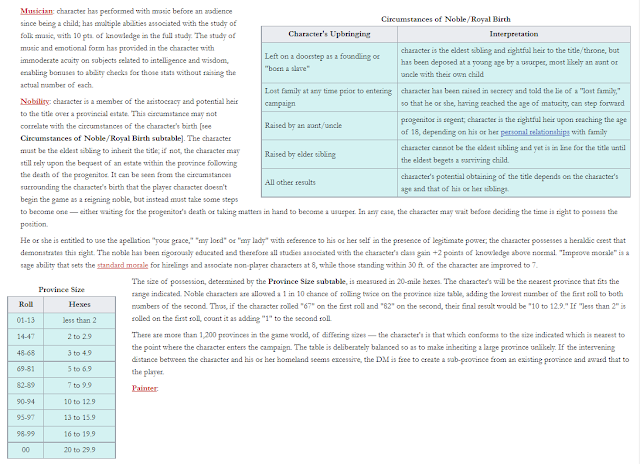
Although on the surface I'm categorically against "balancing" a campaign, as I've discussed before, the above does give me pause. Is it fair to grant one player a lot of money, potential power, the pleasure of being called "your grace" without having done anything to earn it — except being born to the right parents, with land, and even additional knowledge contributed towards sage abilities? Is it not, in fact, a bit much?
On the surface, it appears to be. The chance of becoming a noble is far higher for player characters than the percentage of population would seem to indicate; though of course we're all going to rush to the argument that PCs are "special." My reasons are more that it's interesting to have backgrounds that are both unique and reasonably legitimate in their chance of occurring. It is a mere 1 in 200 chance that any character will be a noble, a member of a royal family or in line for ruling a whole kingdom. That's fairly rare; we don't have to make it 1 in 2000, or 1 in 20,000 just to meet the criteria of demographics.
What interests me is the sort of adventures this builds. Yes, of course there's the long campaign to get the character whose been kept from the title by a usurper, but in the long run that's just one adventure. The harder task is to create adventures for the character after he or she has become the Count of Such-and-Such or the King of So-On-and-So-Forth. Does the character retire, thereafter to adjust laws in the land to suit the player characters? Or can the players invent plausible reasons why the Queen of Country-X needs to slip off and kill a dragon or two? Is it all wars going forward, mixed with the horrors of "accounting" and bitterly adding columns of numbers ... or worse, the palace intrigue of Throne of Games?
[sorry. I know what the title is. Just saying it could have gone either way]
There are sure to be campaigners who hate the idea. "Why can't we all just be ordinary adventurers?", they're sure to argue, wanting nothing more than to play the same old game in the same old way. Thankfully, I'm not bound by this kind of player. I like the opportunities that a different way of seeing the world offers.
And really, the benefits aren't that much. The character starts with some nice money — which won't be all that much once the players participate in a few adventures — which can be shared around if the party has a positive, team-structured attitude. The title is nice, but obviously the party isn't going to use it; if they were asked to do so, that would be quite a joke; and meanwhile, the title's going to get used to help everyone, so it's fine. The hirelings like the character a bit more, so there's less trouble with hirelings; the character will use his or her knowledge to help the party in general; and the +2 bonus for charisma checks will make this character the front guy when dealing with NPCs. That's mostly it ... except for the player actually getting power and being able to use it to have the rest of the party executed.
BUT ... that's only an element of a player-vs.-player campaign. Since I don't allow it, and I'm not going to run your noble character alone, without the party around, I guess you're going to have to see yourself as just another party member. Poor you.
Since the very beginning of my running D&D starting in 1980, that's always been the baseline. We're all friends. We respect each other. We share. I must have been busy running D&D when the toxicity of fuck-you-I-got-mine took over the community. I have experienced it in small packets: game worlds I played in once, and never again — and even, in some cases, for less than an hour before getting up and leaving. The occasional player I've had online who clearly entered the game with Goggles of Selfishness +4. No doubt, one has to be wary. But it is possible to play this game without worrying that making one player a noble will break the party's unity. At least, between me and my friends.
So ... sometimes I don't know what it serves to create rules like the Background Generator in the present climate. I like 'em. The page is 195,446 bytes so far, which would rank 4,744 on the list of longest pages that occurs on Wikipedia. And I still have lots to go.
Sunday, May 8, 2022
Exploring as a Player Character

The above combines the table entry for the "explorer" character background plus an additional description of how having an explorer as a progenitor has affected the player character's life before entering the game's campaign. Thus the party meets Titus the 1st level fighter at a bar, it's assumed they hit it off and Titus asks to tag along with the general group. I usually don't role-play this process because it happens so often in the game's progress that it's a little silly to keep playing meet-and-greet scenarios one after another. This only wastes game time and the result's always the same. I know situations arise when players decide to act "in character" and transform the first meeting into a game conflict, but that's a subject for another post.
The party knows already by this time that before Titus became a 16 y.o. fighter, he actually climbed aboard a ship and spent 28 months on a journey to [rolling randomly] the Spice Islands of the East Indies beyond Asia, an archipelago now called the Moluccas. How randomly? Suppose the players are in Europe; "exploring" assumes a far-off place that isn't well-known to Europe, so start with the oceans: north & south Atlantic, east & west Indian, Arctic, Antarctic ... and then count the Pacific in four quarters. That's 10. We roll the NW part of the Pacific, which we divide into five 15 degree latitudes, starting at the equator. Getting a "1", we divide the nearest band above the equater into six 15 degree longitudes eastward from the tip of the Malay Peninsula, which divides the Pacific from the Indian Oceans. We roll a "2," which gives us either the Spice Islands or the big island of Sulawesi. Easy peasy.
Titus was there between the ages of 9 and 12. He's been there, he made friends, he came back. He has memories of that place, two thirds of the way around the globe. With some charts, some money, a ship and a crew, and some friends, he'd know what to expect when arriving. Not only has he been, but he spent years talking about it, he's read his progenitor's diaries, he's discussed the possibility of returning and he's studied navigation. Titus is ready to go. Someday.
Maybe he won't. It's out of the die's hands, it's something for the player to decide. He can adventure locally, raise the cash and increase that by thousands more. Maybe the party's interested, maybe they're not. Let's ask, what value does the effort have? What does the party get out of it? Numerous people know the islands, so "discovering" them is out. What else is there.
Foremost, there's adventuring. Side quests along the way, time spent, battles fought, treasure found ... the journey gives opportunities to meet new and interesting monsters. This is obvious and, in truth, can be managed just about anywhere. Why go to the Spice Islands when the Black Forest in Germany is nearby?
The islands are distant and although they're known, they're not well known. There are many places nobody's been, and many products no one has discovered. So there's mapmaking and there's trade. Mapmaking can lead to accurate charts that are drawn, reproduced and sold to military, whaling and other trade captains all over Europe, for dear prices. It's like inventing the first cellphone. Moreover, going and seeing leads to writing it down in a book, or telling audiences in person, which is more money, notariety, status, the opportunity to meet the most important people in Europe and impress them with things they don't know and stories about the player character's immense bravery. This leads to knighthoods, gifts of land, tens of thousands of gold for another journey (since the character has shown his or her mettle) and doors of all kinds being opened.
Regarding trade, any number of islands producing valuable spices, woods, dyestuffs and extracts for perfume do so as a market that's never been tapped. The players can collect a cheap boatload of valuable something, and make a deal to ensure that the party, and only the party, is allowed to collect the goods from that place. This means an arrangement to come back two years hence and pick up ten times as much cheap valuable somethings, which the natives are happy to collect over time, waiting for when the party will come back and re-acquaint themselves as friends. I give you the real stories of Marco Polo's father returning to China and bringing little Marco along, or William Bligh visiting Tahiti with Captain Cook and then returning again himself some years later. This means that when it comes time to collect all this lovely wealth from the Spice Islands, the PCs don't need to go themselves. They need only send some associated member of the earlier, original crew as captain of the return expedition. Only, we'd hope, this captain would do better than Bligh.
Further, upon returning to Europe, the party could offer the trading rights to a specific political entity. In my game, in 1650, the Dutch have already beaten back the Portuguese and the English from the Banda Islands ... but the wider collection of islands in that part of the world would remain in dispute for the next 150 years. So suppose the players return with charts of the Spice Islands, complete with the location of Dutch bases, and offer this to the English? Suppose the players convince the English to send warships, and go along, and fight the Dutch? It's possible.
'Course, the DM has to be able to run a thing like that. The DM needs a good sense of geography, world geopolitics, how national entities react, how to make it possible for the players to succeed on a world stage and how to do all this without pre-determining what must happen, as a story narrative. If we do it without a narrative, we just allow the players to fuck around in the East Indies, and see how it goes when they lead a war squadron against Dutch shipping, then we have no idea what's going to happen. Depends on the choices the players make. Depends on their skillset as players. Depends on how strong we make the Dutch strongholds, or how flexible we are as a DM with the campaign going either way, because it doesn't matter to us which way it goes. That takes skill as a DM. It takes a positive philosophy as a game-runner. It takes a vision that the game can offer people the possibility of doing anything — even allowing the players to take the East Indies from the Dutch and keeping it for themselves. Because their battle plan made sense.
But I digress.
Having a background as an "explorer" is very unlikely. It's a 1 in 50 chance, if the player even rolls on the right table. There are six possible tables, so in reality it's a 1 in 300 chance. It's worse if the character has a slightly above average constitution and it's no chance at all if the character's constitution is below average. So what's the deal? We're going to roll maybe 25 characters over five years of playing a campaign ... what good is it if no one ever rolls an explorer?
Part of the progenitor concept is that it defines many of the persons in the game world outside the players, without requiring that each activity be represented as a character class. An explorer can be a mage, a thief, a bard, a monk, whatever ... because the action of "exploring" isn't the same as a collection of skills associated with a given class. We can easily assign three skills in addition to a character's class, even if those skills are not normally a part of that class. It's a way for an illusionist to be a navigator, even though none of the illusionist's normal track-skills include navigation.
This means the world is full of non-player characters who are explorers. The players don't need to be an explorer themselves. If they want this sort of experience, or to persue an exploring campaign, they need only find some fellow whose been to Patagonia or Zanzibar or the Marquesas Islands ... but who doesn't happen to have enough money for a ship or anything else. Yet Isaac or Freida or Beverly has been to those places; and she or he has the needed skills, the past history of studying books and charts, the friends waiting for them in Patagonia or wherever, so that all this can be set up by making Beverly an associate follower-slash-associate of the party. And once Frieda or Isaac has gotten the party in the door, then the NPC can go home, as a friend and future contact, and the party can play the part of Marco Polo on their own.
This logic applies to all the professions listed on the progenitor's lists, and many professions not listed there because they're too small a part to play to serve as a player character background. This means that how a party plays the NPCs is a BIG PART of how my game world is organised. These are valuable persons, and virtually inexhaustible, since I have many millions of established people living everywhere. So if the player doesn't happen to have a skillset, that skillset is definitely waiting around to be hired and perhaps made into a friend. It's a matter of approaching the NPC politely and reasonably, while making an offer that's as tempting to the NPC as it is to the player.
Exploring that possibility — the art of assembling people to perform great deeds — is the Holy Grail of D&D.
Monday, April 25, 2022
The Biggest Page
I apologise. I owe the reader two villages and I'm acutely aware of it. However, in my free time I'm also working on my D&D wiki ... the recent work upon which this post discusses.
One thing I adore about working on a wiki is that slowly, steadily, the hundreds of pages of random notes and ideas I have pours steadily into this one source. The process is normally slow and requires much deliberation and reworking of the idea, to make it comprehensible and of value. Yet I don't tire of the process, so I don't worry about it's chronological aspects.
A practice that I follow for existing content is to use the "random page" feature to bring forth posts that need editing and rework. This dredges up pages from the nether regions and puts them to the fore of my attention. Part of this process is to commit to the page when it appears — and not merely click the random button again for a page that's more "fun." Nope, gotta fix the page as it appears, no matter how unpleasant that prospect is.
Some months ago I promised myself that when the Character Background Generator rolled into view, I'd make a written version of the excel file, complete with tables. Well, the day came on Friday afternoon ... and for three days, I've been working on it.
No, the wiki-version of the Generator isn't done. It isn't even close to done. It's 80,000 characters, which averages to better than 1,000 characters an hour for the last 72 hours (the number of hours it's been between starting and writing this paragraph). It's now the longest page on the wiki. I am just at the point where the next section will be generating the character's secondary skills and social heritage ... and this, my dear readers, is a deep, deep well of a process. Deeper than most realise, since the version most have seen is the 2012 version of the generator ... whereas I'm working from the unfinished, never revealed 2019 version. And later on in this process, I'll be writing completely new content for the source material from 2012, which is woefully out of date for my campaign.
So, I'll be adding to the page for awhile. I ask the reader to view it, to come back here and discuss anything that seems odd to read or any spelling/grammar errors that aggravate. I don't mind being edited or encouraged to do a better layout with this sort of thing. There are some changes to the bigger hair/eye colour tables that I'm undertaking. I want things to be better. It's only that I've been working at breakneck speed on the material and in some cases I made a few bad early choices.
Well, that's all. I'll get back to the villages. I'm just focused elsewhere for a little while.
Friday, December 10, 2021
Prohibitive
One of the more fascinating sage abilities, with an unusual and player-friendly benefit:

The overall structure is game-building because it doesn't rely upon the player to possess the sage ability, for the players to enjoy it (as the page explains). It provides another reason to enter a city or town beyond the need to buy equipment and restore hit points ... and it makes the Bard Class more valuable to the party as a whole, with something concrete the bard can employ on a regular basis.
I need to add that the ability described above is an extremely minimal skill. Later on, something that would be gained at 4th-6th level, is Master Instrument, which gives the benefits of the above except that it increases the number of times the skill can be employed to once a week, instead of once a month, and adds an addition +5% experience to the benefits described on the Play Instrument page. So this is really just a stepping stone. The larger motive is then for the players to visit even larger cities, where even better musicians can be seen giving performances. This increases the motivation to travel, by giving real benefits to travelling.
I have other ideas up my sleeve for the bard as well.
I've touched on this before, but I'd like to return to the subject because sometimes it haunts me. If I could, I would invent metrics for fulfillment, happiness and health and incorporate them into D&D. These would be influenced by a combination of player behaviours and choices, random events such as weather, the after-effects of combat and the game environments visited.
Let's take health. Now, personally I wouldn't transform this into an "ability stat" or even concoct the player's health from ability stats. "Health" wouldn't be fundamentally based on a comparison of one character's health with another's ... but rather, as a metric describing the character's present health vs. the character's potential health.
As an example, let's say that Claire has a constitution of 3, meaning that she's generally in poor health at best. There are already dozens of circumstances by which Claire's 3 constitution is bound to be tested. Therefore, if Claire's health were, say, equal to 20 out of a possible 20, it means that she's at peak health for Claire. She may not be at peak health for someone else, but she can't feel what it's like to be Jerome or Tesha, so who gives a damn what their healths are.
From this, we can argue that health is a characteristic fundamentally applicable to itself, which affects other metrics, but isn't a composite of other metrics. It means we can use it as a self-defining thing, used to measure functions of the game world that aren't reflected by the player's hit points, ability stats, experience level, knowledge and so on. Stuff like, say, Claire's tolerance of some perfectly healthy foods over others. Eating the wrong foods in a state of poor health can kill you. But we don't have saving throws for "food choices" or "food quality." And the rules surrounding disease don't sufficiently deal with this problem. Nor do we expect Claire to make an ability check every time she eats something.
Suppose we define peak health at 20 points, as stipulated. When the character takes care of his or her self, peak health is maintained. But taking more than 8 damage reduces health by 1 point. Vomiting from bad food reduces health by 1 point. Two days exposure to rain, even in tent, reduces health by 1; and without a tent, by 2. Entering a big city reduces it by 1. Climbing down into the sewers; or into a dungeon; or failing a save vs. poison; or catching a cold; or not having a bath; or living on shipboard for a day; and anything else that seems applicable ... each of these things cuts the character's health by 1 point.
Which is fine. We can set a leeway of 10 points, so that as long as the character's health is between 11 and 20, it's no big deal. They can wander through a dungeon, get themselves beat up, crawl around in an offal pit, visit a prostitute, whatever ... usually, they're fine. But as that metric drops towards 10, the character begins to think, "Hm. Better not push that. Might be a good idea if I do something healthy for a bit. Eat a little better. Have a bath. Visit a doctor. Buy a tonic from the apothecary. Get that number up a bit."
Then, and only then, if the character gets into some very unusual situation, the character's health never becomes a serious problem. It's just a minor detail that needs to be monitored without stressing over.
At 10 health, however, the character's constitution drops by 1 point. And it continues to drop by 1 point for every point of health below 10. At 9 health, the character automatically rolls a 10% chance for disease. And each point of health below 9 requires a similar roll. At 8 health, the character's strength drops by 2 points. And each point of health below eight costs another 2. At 7 health it's charisma, and at 6 health it's dexterity ... and by then the character is a real mess and seriously needs some kind of serious R&R somewhere.
So it really matters that the character is careful about how many truly stupid unhealthy things he or she does.
With a character like Claire and her 3 constitution, going outdoors costs a point of health. Eating food that isn't severely boiled costs a point of health. Alcohol is a point of health. Even sex, or a lack of sleep, or too much time travelling, are reasons to be concerned about her health. And for her, once her health drops to 9 overall, she has exactly 1 constitution point. It can be argued that her constitution can't drop below 1 ... but it follows that for every subtraction after 1, she has to make a save vs. bodily-derived poisons or she absolutely dies.
One could run a character with a 3 constitution ... but under this system, it would be a serious challenge, with serious issues to address. It wouldn't just mean often missing a constitution check.
I don't implement ideas like this because I recognize the expected push-back from a community that thinks encumbrance is the equivalent of driving the Allied armies to Arnhem. Therefore, most readers will assume this post is a thought experiment and no more. "Hey, what about this? Obviously, I'd never do it."
I'm not sure where this "we must never change the original structure of D&D" came from. Human beings change the original structure of everything. Microwave ovens came into being about the time of D&D, and the one I use today is a far sight different and better than the one my parents purchased in 1979. The video games I play today are spectacularly better, more complicated and more prohibitive — the word being used to describe games with a very high cost and a very high learning curve. I'm considering finally getting into Europa Universalis, and that's how it's been described to me: prohibitive. In other words, really consider whether or not we're up to playing this particular game. And yet, the game is insanely popular, in a way that D&D encumbrance isn't, even though I'm familiar enough with EU to know it's much more brain-crushing that figuring out encumbrance. I don't know anyone running around saying that we don't need these complicated war games when perfectly good, simple games like Global War were invented in 1979.
It's a little bit like the goal in D&D is to hack off our foot, scream at anyone approaching with a prosthetic, then go online and scream about why everyone should hack off their foot.
Why shouldn't expansive rules for things like health and happiness be implemented into the game? We've created about a million character classes, two million character races and three million stupid character religions and philosophies, not to mention four million unneeded weapon types and five million ways not to roll dice in a game designed for rolling dice. Why exactly should a Waterdhavian Noble be a thing, when simple rules surrounding every character's health are a bridge too far?
Answer me that one, and I'll put down ideas of a metric for a character achieving moral, mental or cultural fulfillment.
Thursday, November 21, 2019
My Daughter Shows Me Her D&D
Here is a video in which my daughter explains how she's transferred my wiki content to books that she uses to run her campaign. I find it exciting to hear my own passion being reflected in her voice ... sometimes, it is great to be a father.
Speaking of the wiki, I've added new content today and one post several days ago. And I've updated this page on the wiki, which you should read first to understand some of the other new content.
Bard Sage Abilities
Plus more:
Speaking of the wiki, I've added new content today and one post several days ago. And I've updated this page on the wiki, which you should read first to understand some of the other new content.
Bard Sage Abilities
Plus more:
Sunday, June 2, 2019
Time Efficient & Bragging Rights
I live in a state of wonder.
Yesterday, Homer2101 wrote of my decay rules,
 I honestly don't know how people who live in this world can exist so blithely unaware of how human beings think. How pervasive is the shot in the image shown, of people waiting many hours for the first touch of a phone they could buy without waiting a week later? Does Homer not realize that there are players ~ some who I have had play in my game ~ who would throw away an item the second it became "used"? Just because? That is how they would see their characters.
I think it's great that Homer crunched the numbers. It's useful information, and the fact that numbers can be crunched shows how potentially reliable the system is for actual play. But we do ourselves a disservice when we think the game boils down to how the numbers dictate we should play. And it astounds me that ~ although there are many people who will never buy anything new, on principle ~ that anyone talking about the subject can be so cognitively dissonant about the way that humans think. People won't buy "new" because it is cost effective. They'll buy new because it is "new." They don't care about the cost. The gold in their pocket doesn't mean as much to them, as it might to others. They're adventurers. There will always be more gold. But something that is new, is fleeting.
Hell. Even a new gold piece has a special worthiness that surpasses the value of the metal. If I were playing a character, and had just bought a new shield, I would look at my fellow player and his used shield and smirk. "Are you still using that crappy old thing? Mine is new!" Oh, what a prick I would be, bragging about my new shield.
 Another example, another concern. The image on the left is the ThinQ Alexa "smart" refridgerator. You've most likely heard about it. It is a micromanager that enables you to scan every item of food you put into your refridgerator, so that you can scan it again as you take it out, so the item can keep track of what you have and what you've eaten. Presumedly, how many calories you're consuming, and from the things I'm reading, speakers for playing music and a voice that carps at you for eating the wrong foods.
There are some things that puzzle me about it. There are quite a lot of foods that I don't keep in a refridgerator, like flour, sugar, beans, canned items and so on ... and these things get added to the refridgerator after they're cooked together into meals that I make without measuring, because after decades of working as a professional cook I eyeball everything, including most of the common baking I do. So once I make a meal, out of substances both from and not from the refridgerator, then put them in the refridgerator as left-overs, I'm curious how I scan those left-overs in. Or, for that matter, if I cut seven slices of cheese off a block, and return the slightly smaller block to the refridgerator, does the refridgerator weigh the cheese? Or any of the other things I shave down as I'm cooking? I don't buy pre-packaged foods ... and I'm definitely wondering how I scan out one potato. Oh well. There's probably some way it manages this.
If this is the amount of niggling micromanagement we're willing to install into our daily food-consuming activities, some five or six times a day, why would anyone care about having to roll 40 dice to account for equipment decay?
Is it that my readers, and their players, don't know how to speed up the die-rolling process?
I imagine a player with forty items rolling a die, getting a decay result, putting down the die, picking put an eraser, scratching out the "n" next to the character sheet, picking up a pencil, writing in a "u," putting down the pencil, picking up the die, rolling a decay result, putting down the die ...
Are your players really like this? Homer postulated six seconds per roll. Mon dieu!
Suppose that it was determined that, out of 60 pieces of equipment, 22 were new. Some of those wouldn't need to roll at all; if the characters take the effort to pack all the extra uncommonly used articles in a single backpack that doesn't get opened or adjusted, then only the backpack need make a check. Thoughtful storage would reduce wear and tear. But let's say, I have 22 items to roll, and I have to use a d4.
First, I can simply roll the dice quickly, in batches of six, noting out loud, "fine, fine, down, fine, down, fine" ~ down meaning an item is downgraded. Then I make a quick check on my character sheet on the 3rd and 5th item, and begin rolling again. This way, I can easily do six rolls in six seconds.
Obviously, I'm not using a dice tower. Dice towers are game momentum killers. If you're at all interested in the pace of your game, make your players get rid of them. They're only a way for the player to glom more attention to themselves as they fetishize their die rolls, making others wait and creating unneeded noise at the table. But what am I saying? Most of you have already figured this out.
I can speed the process still faster by having my neighbor roll dice, calling off the twenty-two items as I make ticks on my character sheet. Or, I can roll the dice and my neighbor can make the ticks. Unless, of course, both you and your neighbor are such profoundly distrustful prats that you can't trust one another to be both honest and faithful ... in which case, why the fuck are you playing with this person, much less sitting next to them?
With the two-person method, I can make 22 rolls in twenty seconds, and probably less. The checks, once made, don't even need to be addressed during the game session. The character sheet can be adjusted later, when we're not playing. Or does that make too much sense?
I'm more than a little astounded that this doesn't seem obvious. With five minutes and a little sense, with me rolling the dice and the players making ticks on their paper, I could manage five players' equipment. They would trust my dice, because they trust me, and I would trust them to give the correct number of things that needed a check and to apply the checks to the rolls that hurt worst of all. I know I could trust my players to do this, because if a player is the sort that won't, it will soon become obvious not only to me, but to every other player I have. Before I settle in to address the issue, I will probably have two other players separately come to me and say, "You know, I saw Jack doing ..." These are the kind of players I have. They don't want to cheat. They like playing fair.
It must be hard having so little mastery over your game, or the fundamental mechanics of your game, like dice rolling, that you have to make concessions so often for the sake of players who perceive that checks are egregious. I had been thinking the decay system was a bridge too far, but in retrospect I'm seeing that I've created something rather simplistically elegant.
I refuse to hold myself to a standard of "time saving" with people who will drive all over town for hours on a Saturday to find just the right household towel, between 6-hour sessions playing fortnite and a four-hour football game, but won't sit for five minutes and roll 60 dice. Fooey!
Yesterday, Homer2101 wrote of my decay rules,
"New items' markup doesn't justify the 2.5 extra average degradation rolls. The discount for worn and shabby items doesn't offset their reduced life expectancy under stress. Used items are always most cost-efficient ..."

I think it's great that Homer crunched the numbers. It's useful information, and the fact that numbers can be crunched shows how potentially reliable the system is for actual play. But we do ourselves a disservice when we think the game boils down to how the numbers dictate we should play. And it astounds me that ~ although there are many people who will never buy anything new, on principle ~ that anyone talking about the subject can be so cognitively dissonant about the way that humans think. People won't buy "new" because it is cost effective. They'll buy new because it is "new." They don't care about the cost. The gold in their pocket doesn't mean as much to them, as it might to others. They're adventurers. There will always be more gold. But something that is new, is fleeting.
Hell. Even a new gold piece has a special worthiness that surpasses the value of the metal. If I were playing a character, and had just bought a new shield, I would look at my fellow player and his used shield and smirk. "Are you still using that crappy old thing? Mine is new!" Oh, what a prick I would be, bragging about my new shield.

There are some things that puzzle me about it. There are quite a lot of foods that I don't keep in a refridgerator, like flour, sugar, beans, canned items and so on ... and these things get added to the refridgerator after they're cooked together into meals that I make without measuring, because after decades of working as a professional cook I eyeball everything, including most of the common baking I do. So once I make a meal, out of substances both from and not from the refridgerator, then put them in the refridgerator as left-overs, I'm curious how I scan those left-overs in. Or, for that matter, if I cut seven slices of cheese off a block, and return the slightly smaller block to the refridgerator, does the refridgerator weigh the cheese? Or any of the other things I shave down as I'm cooking? I don't buy pre-packaged foods ... and I'm definitely wondering how I scan out one potato. Oh well. There's probably some way it manages this.
If this is the amount of niggling micromanagement we're willing to install into our daily food-consuming activities, some five or six times a day, why would anyone care about having to roll 40 dice to account for equipment decay?
Is it that my readers, and their players, don't know how to speed up the die-rolling process?
I imagine a player with forty items rolling a die, getting a decay result, putting down the die, picking put an eraser, scratching out the "n" next to the character sheet, picking up a pencil, writing in a "u," putting down the pencil, picking up the die, rolling a decay result, putting down the die ...
Are your players really like this? Homer postulated six seconds per roll. Mon dieu!
Suppose that it was determined that, out of 60 pieces of equipment, 22 were new. Some of those wouldn't need to roll at all; if the characters take the effort to pack all the extra uncommonly used articles in a single backpack that doesn't get opened or adjusted, then only the backpack need make a check. Thoughtful storage would reduce wear and tear. But let's say, I have 22 items to roll, and I have to use a d4.
First, I can simply roll the dice quickly, in batches of six, noting out loud, "fine, fine, down, fine, down, fine" ~ down meaning an item is downgraded. Then I make a quick check on my character sheet on the 3rd and 5th item, and begin rolling again. This way, I can easily do six rolls in six seconds.
Obviously, I'm not using a dice tower. Dice towers are game momentum killers. If you're at all interested in the pace of your game, make your players get rid of them. They're only a way for the player to glom more attention to themselves as they fetishize their die rolls, making others wait and creating unneeded noise at the table. But what am I saying? Most of you have already figured this out.
I can speed the process still faster by having my neighbor roll dice, calling off the twenty-two items as I make ticks on my character sheet. Or, I can roll the dice and my neighbor can make the ticks. Unless, of course, both you and your neighbor are such profoundly distrustful prats that you can't trust one another to be both honest and faithful ... in which case, why the fuck are you playing with this person, much less sitting next to them?
With the two-person method, I can make 22 rolls in twenty seconds, and probably less. The checks, once made, don't even need to be addressed during the game session. The character sheet can be adjusted later, when we're not playing. Or does that make too much sense?
I'm more than a little astounded that this doesn't seem obvious. With five minutes and a little sense, with me rolling the dice and the players making ticks on their paper, I could manage five players' equipment. They would trust my dice, because they trust me, and I would trust them to give the correct number of things that needed a check and to apply the checks to the rolls that hurt worst of all. I know I could trust my players to do this, because if a player is the sort that won't, it will soon become obvious not only to me, but to every other player I have. Before I settle in to address the issue, I will probably have two other players separately come to me and say, "You know, I saw Jack doing ..." These are the kind of players I have. They don't want to cheat. They like playing fair.
It must be hard having so little mastery over your game, or the fundamental mechanics of your game, like dice rolling, that you have to make concessions so often for the sake of players who perceive that checks are egregious. I had been thinking the decay system was a bridge too far, but in retrospect I'm seeing that I've created something rather simplistically elegant.
I refuse to hold myself to a standard of "time saving" with people who will drive all over town for hours on a Saturday to find just the right household towel, between 6-hour sessions playing fortnite and a four-hour football game, but won't sit for five minutes and roll 60 dice. Fooey!
Sunday, May 26, 2019
Um, Effort? Anyone?
Working on demons and demonology the last couple days, being commissioned by a reader to do so, I can't help notice the illogic of much detail that's been written by module-makers and their ilk. I'm not an alignment-guy, but even I know there's a benefit to following principles that recognize good vs. evil, or law vs. chaos.
The Abyss is clearly defined as chaotic and evil. And yet, I am reading everywhere about the queen of this or the duke of this group of demons or of such-and-such realm. The Forgotten Realms Wiki describes the marilith as follows:
Excuse me? Tacticians? Generals? Strategies? Hey, dummies, what do you think the word "chaos" means?
I've always seen the Abyss as a mess of layers where the denizens are at the mercy of incredibly powerful loner serial killer types, who don't work together, don't make plans, don't have purposes, seeing existence as the pure hedonistic pursuit of physical and immediate emotional gratification. They don't form "armies." Hey, buddy. This is the abyss. We don't follow "orders." We don't even want to give orders. Chill out, take a pill, slaughter a few fresh souls and get off my fucking cloud, man.
The Abyss has enough room for that. It has enough room for everyone. Ain't no resources and no land we gots to fight for.
It would be one thing if the various morons in charge of the "official" worldbuilding program had real insight about how a grand big picture of modules should work. Instead, it's just the same concept repeated over and over by half-baked derivative slack-asses without real creativity stretched across every kind of monster. If devils form armies, then obviously demons should too, and why not everything else in the universe? Call it Rule 69. Eventually the fan service of every game concept mirrors every other concept.
That this doesn't make any sense in the universe that's published and re-published ad nauseum as dogma plainly doesn't matter.
It is disconcerting that after 40+ years, there is so painfully little that's been expanded on the nature of so many creatures and concepts that are instantly recognizable to many of us. Sometimes, what we do have is plainly ridiculous. Quote, "Mariliths stood around 9 feet tall and measured 20 feet from head to tip of tail. They weighed 4,000 pounds."
Huh? A Kodiak bear stands between 8 and 10 feet tall and weighs between 600 and 1400 lbs. This is four times that average, for a creature that has a woman's volumptuous body and a thin, snake-like body. Is it made of basalt?
I said "morons" and I meant morons.
40+ years and we get 29 words about their personalities, and these don't even make sense as they basically describe character aspects that are diametrically opposed to chaos. All in all, it's enormously frustrating.
I've written a bunch of posts lately about the importance of having rules, but this is a special problem that pervades throughout the game universe. If we go looking for dense, meaningful content, it just isn't there. We're given the same statistics, with half-notes that improve nothing, with the expectation that we're going to use these ideas for combat and for nothing else. And then we're told by a whole other group of twits that the game "shouldn't be about combat," or that combat bores people, or whatever.
What a bunch of shiftless jerks.
The Abyss is clearly defined as chaotic and evil. And yet, I am reading everywhere about the queen of this or the duke of this group of demons or of such-and-such realm. The Forgotten Realms Wiki describes the marilith as follows:
"Maraliths were the tacticians of Abyssal hordes and queens of the Abyssal realms. They served as the generals and advisors to the demon lords of the Abyss. They sought strategies that brought the most destruction in whatever realm they were in."
 |
| All the pics I found for mariliths were poor. This one is so overused it's painful. A less cartoonish, expressive image is dearly needed. |
I've always seen the Abyss as a mess of layers where the denizens are at the mercy of incredibly powerful loner serial killer types, who don't work together, don't make plans, don't have purposes, seeing existence as the pure hedonistic pursuit of physical and immediate emotional gratification. They don't form "armies." Hey, buddy. This is the abyss. We don't follow "orders." We don't even want to give orders. Chill out, take a pill, slaughter a few fresh souls and get off my fucking cloud, man.
The Abyss has enough room for that. It has enough room for everyone. Ain't no resources and no land we gots to fight for.
It would be one thing if the various morons in charge of the "official" worldbuilding program had real insight about how a grand big picture of modules should work. Instead, it's just the same concept repeated over and over by half-baked derivative slack-asses without real creativity stretched across every kind of monster. If devils form armies, then obviously demons should too, and why not everything else in the universe? Call it Rule 69. Eventually the fan service of every game concept mirrors every other concept.
That this doesn't make any sense in the universe that's published and re-published ad nauseum as dogma plainly doesn't matter.
It is disconcerting that after 40+ years, there is so painfully little that's been expanded on the nature of so many creatures and concepts that are instantly recognizable to many of us. Sometimes, what we do have is plainly ridiculous. Quote, "Mariliths stood around 9 feet tall and measured 20 feet from head to tip of tail. They weighed 4,000 pounds."
Huh? A Kodiak bear stands between 8 and 10 feet tall and weighs between 600 and 1400 lbs. This is four times that average, for a creature that has a woman's volumptuous body and a thin, snake-like body. Is it made of basalt?
I said "morons" and I meant morons.
40+ years and we get 29 words about their personalities, and these don't even make sense as they basically describe character aspects that are diametrically opposed to chaos. All in all, it's enormously frustrating.
I've written a bunch of posts lately about the importance of having rules, but this is a special problem that pervades throughout the game universe. If we go looking for dense, meaningful content, it just isn't there. We're given the same statistics, with half-notes that improve nothing, with the expectation that we're going to use these ideas for combat and for nothing else. And then we're told by a whole other group of twits that the game "shouldn't be about combat," or that combat bores people, or whatever.
What a bunch of shiftless jerks.
Friday, May 24, 2019
Three Spells
These three spells were commissioned yesterday, by Giordanisti, which should be a familiar name to most of you. The spells aren't new ~ but this particular trio has inspired a great many arguments at game tables and my personal take has accumulated over time in order to suspend misunderstandings.
In particular I have always hated the web spell as written. Under the right circumstances it is effectively a death spell, which is ridiculous for 2nd level. A 5% chance of dying outright per round, after ten rounds is effectively a 50% chance. So I have rightly toned the spell down to the level of mirror image, audible glamer and rope trick. Still useful, but not the devastating spell that it was.
As I wrote yesterday, to have me do some writing for you costs a $12 donation for 800+ words (I generally feel inclined to keep going once I open up a subject). This can be done through Patreon or the donate button you'll find on my side bar. Talk To Me First, however, to agree on material before you send me any money. Do remember that you're not just buying something for yourself, but for hundreds, perhaps thousands of other readers.
WEB
Range: 1 hex per level
Duration: 20 rounds per level
Area of Effect: see below
Casting Time: 1 round
Saving Throw: none
Level: mage (2nd)
Creates strong sticky strands that form a web curtain that is, at full extent, 40 ft. long, 15 ft. wide and 5 ft. deep. This may be attached to a vertical point or hung between vertical points, or doubled back on itself to create a thicker curtain. If sufficient surrounding structure exists, such as walls and a ceiling, the web will fill a space of 3,000 cubic feet. It is not strong enough to be climbed upon.
The web may be cast so that it passes through a combat hex with allies or opponents, so that creatures will be caught in the web. All caught persons will find themselves trapped, requiring effort to extricate themselves. Movement out of a webbed hex will cost 3 action points (AP) per hex. Attacking out of a webbed hex costs a penalty of -4 to hit.
A heated blade does not improve speed of movement, but the hex to which it is applied will be cleared of webs. Likewise, a torch and similar open flame will not set the entirety of the webs alight, but if it is applied while moving, again, the webs in that hex will be cleared.
See also,
Mage
Mage 2nd Level Spells

HASTE
 Range: 60 ft.
Duration: 1 round per level
Area of Effect: one creature per three levels
Casting Time: 2 rounds
Saving Throw: none
Level: mage (3rd)
Advances the speed of movement for the recipient so that all actions require half the time they would normally require, while also doubling the recipient’s number of attacks. The recipient’s total action points per round are effectively doubled. Contrary to popular belief, the spell has no actual effect on time.
The spell has no effect upon a recipient’s armour class or ability to hit, though the probability of hitting is increased by the addition of more attacks. If the recipient normally has multiple attacks, these are doubled also: 5 attacks in 4 rounds would become 10 attacks in 4 rounds; 4 attacks in 3 rounds would become 8 attacks in 3 rounds, and so on.
Once a recipient has been affected by the spell, they need not remain inside the spell’s range.
Spellcasting is not, however, improved; while the caster may be able to perform the mental and physical actions of producing the spell more quickly, the actual coalescing of power, or the attentions of divine beings and such, cannot be adjusted.
The spell will counteract the effects of the 3rd level mage spell, slow.
See Also,
Mage 3rd Level Spells
LIGHTNING BOLT
Range: 40 ft. + 10 ft. per level
Duration: instantaneous
Area of Effect: up to three targets
Casting Time: 2 rounds
Saving Throw: ½ damage
Level: mage (3rd)
Evokes a powerful stroke of magical electricity that leaps out from the caster’s hands (both are required) as a bright flash. A crash of noise accompanies the bolt, but as it is about 110 decibels there is no affect on hearing. The lightning can be split so as to affect up to three targets; moreover, this targeting is accurate, so long as the caster has line of sight. Additionally, the course of the lightning outward allows pinpoint accuracy, so that friendly targets will be unaffected by the bolts created.
As the lightning is magical and not natural, it cannot be passed through a conductor, nor does the presence of water nor connection with the ground alter the spell’s effect in any way. Likewise, magical lightning will not rebound from mirrors or any other surfaces, contrary to popular belief.
 Against living creatures, the spell causes 1d6 damage per level of the spellcaster, so that a 7th level lightning bolt will cause 7-42 damage. The damage is rolled individually for each target. Any struck individual is entitled to a saving throw against magic which, if successful, will half the amount of damage taken.
Whether a save against damage is made or not, from 5-20 random objects that are carried or worn by the target must make saving throws for items against lightning. Solid objects enclosed inside a container need not make a save, unless the container itself fails save. Liquids, such as potions, holy water and beverages, must make save regardless. A fail will spoil the magical effect; other liquids will merely acquire an unpleasant metallic taste but will be otherwise unharmed. Beverages should be counted as durables with regards to nutrition.
Post Script,
In particular I have always hated the web spell as written. Under the right circumstances it is effectively a death spell, which is ridiculous for 2nd level. A 5% chance of dying outright per round, after ten rounds is effectively a 50% chance. So I have rightly toned the spell down to the level of mirror image, audible glamer and rope trick. Still useful, but not the devastating spell that it was.
As I wrote yesterday, to have me do some writing for you costs a $12 donation for 800+ words (I generally feel inclined to keep going once I open up a subject). This can be done through Patreon or the donate button you'll find on my side bar. Talk To Me First, however, to agree on material before you send me any money. Do remember that you're not just buying something for yourself, but for hundreds, perhaps thousands of other readers.
WEB
Range: 1 hex per level
Duration: 20 rounds per level
Area of Effect: see below
Casting Time: 1 round
Saving Throw: none
Level: mage (2nd)
Creates strong sticky strands that form a web curtain that is, at full extent, 40 ft. long, 15 ft. wide and 5 ft. deep. This may be attached to a vertical point or hung between vertical points, or doubled back on itself to create a thicker curtain. If sufficient surrounding structure exists, such as walls and a ceiling, the web will fill a space of 3,000 cubic feet. It is not strong enough to be climbed upon.
The web may be cast so that it passes through a combat hex with allies or opponents, so that creatures will be caught in the web. All caught persons will find themselves trapped, requiring effort to extricate themselves. Movement out of a webbed hex will cost 3 action points (AP) per hex. Attacking out of a webbed hex costs a penalty of -4 to hit.
A heated blade does not improve speed of movement, but the hex to which it is applied will be cleared of webs. Likewise, a torch and similar open flame will not set the entirety of the webs alight, but if it is applied while moving, again, the webs in that hex will be cleared.
See also,
Mage
Mage 2nd Level Spells

HASTE

Duration: 1 round per level
Area of Effect: one creature per three levels
Casting Time: 2 rounds
Saving Throw: none
Level: mage (3rd)
Advances the speed of movement for the recipient so that all actions require half the time they would normally require, while also doubling the recipient’s number of attacks. The recipient’s total action points per round are effectively doubled. Contrary to popular belief, the spell has no actual effect on time.
The spell has no effect upon a recipient’s armour class or ability to hit, though the probability of hitting is increased by the addition of more attacks. If the recipient normally has multiple attacks, these are doubled also: 5 attacks in 4 rounds would become 10 attacks in 4 rounds; 4 attacks in 3 rounds would become 8 attacks in 3 rounds, and so on.
Once a recipient has been affected by the spell, they need not remain inside the spell’s range.
Spellcasting is not, however, improved; while the caster may be able to perform the mental and physical actions of producing the spell more quickly, the actual coalescing of power, or the attentions of divine beings and such, cannot be adjusted.
The spell will counteract the effects of the 3rd level mage spell, slow.
See Also,
Mage 3rd Level Spells
LIGHTNING BOLT
Range: 40 ft. + 10 ft. per level
Duration: instantaneous
Area of Effect: up to three targets
Casting Time: 2 rounds
Saving Throw: ½ damage
Level: mage (3rd)
Evokes a powerful stroke of magical electricity that leaps out from the caster’s hands (both are required) as a bright flash. A crash of noise accompanies the bolt, but as it is about 110 decibels there is no affect on hearing. The lightning can be split so as to affect up to three targets; moreover, this targeting is accurate, so long as the caster has line of sight. Additionally, the course of the lightning outward allows pinpoint accuracy, so that friendly targets will be unaffected by the bolts created.
As the lightning is magical and not natural, it cannot be passed through a conductor, nor does the presence of water nor connection with the ground alter the spell’s effect in any way. Likewise, magical lightning will not rebound from mirrors or any other surfaces, contrary to popular belief.

Whether a save against damage is made or not, from 5-20 random objects that are carried or worn by the target must make saving throws for items against lightning. Solid objects enclosed inside a container need not make a save, unless the container itself fails save. Liquids, such as potions, holy water and beverages, must make save regardless. A fail will spoil the magical effect; other liquids will merely acquire an unpleasant metallic taste but will be otherwise unharmed. Beverages should be counted as durables with regards to nutrition.
Post Script,
I have received a request for demon generation spells and demon monster descriptions, so that will be coming up on the wiki this next week. To my American friends, have a pleasant Memorial Day weekend.
Thursday, May 23, 2019
Evasion & Counter-tracking
The following exists because it was paid for by Silberman, who comments here regularly. He donated $12 to my Patreon for the following content, in accordance with my recent policy. A cost of about 1.25 cents a word. I encourage other readers to commission work from me, just remember to communicate with me about what you'd like to see before sending a direct donation or contributing to my Patreon. Let me just say that this is a great way to buy a gift for your fellow readers and to keep me working.
I'm afraid I don't have proper tracking rules as yet to compliment this work, but who does? After the research that led me to create the sketch below, I have a better idea now of how I would design those tracking rules. These are two sage abilities that would be found under the sage study, Scouting.
EVASION (sage ability)
 Provides the character with skill at consciously avoiding detection by others who may be actively hunting the character, or in a position to witness traces left by the character. The measures taken will not fool another who has tracking ability, nor monsters with tracking abilities, but it will be sufficient to conceal the character’s movements with other beings, particularly humanoids.
The ability grants no benefits to others associated with the character, who will unavoidably make obvious tracks on trails, stamp vegetation, mark soft wet places as they walk, etcetera, even if counselled to do otherwise. For the possessor of the skill, however, evasion will include actively choosing routes that won’t reveal footprints, bending back grass and vegetation, selecting hard surface entry and exits onto trails, roads and river banks, the wisdom not to sit down upon halts, to listen automatically for movement of others who may be moving in the area, a heightened awareness of wet environments, knowledge not to cross open spaces, how to maintain one’s equipment to leave the least scent, the presence of scent with regards to air movement and wind direction, etc. All of these things provide a negligible chance that the character, acting alone in the wilderness, will leave any track that will be noticed or remotely followed by a creature other than than those gifted in tracking.
The skill does not offer any special benefits to not being seen or improvement in the character’s stealth ability.
See Scouting
COUNTER-TRACKING (sage ability)
An advanced skill similar to evasion, providing the character with techniques that will mislead or delay those with tracking ability, particularly confounding tracking monsters and animals such as dogs or familiars. These measures have the potential for shaking off pursuit by enabling the tracked character to outdistance a tracker; or, in certain conditions, to obscure the trail so that it cannot be followed at all.
 The ability will grant some benefit to others associated with the counter-tracking character, in that false tracks can be created so that up to four others besides the skilled character can be potentially shepherded away from trackers. The ability does not allow the number of those in flight to be hidden, but by directing others to take specific actions and movements, the counter-tracker can have the tracker moving in circles that will waste time.
This technique includes laying false trails and backtracking around objects, having a group “jump off” a trail at different points, creating deception tracks, shepherding groups to enter stream banks and exit in ways that will leave confusing evidence of movement, various use of water to break tracks, creating boxes and figure eights with movement both on land and in water, leading trackers to probable spot-points for the best effects from snares and traps, varying direction of march and using vegetation to foul leashed animals and their handlers, forcing them to untangle themselves before continuing pursuit.
Speed of Flight
Laying false tracks requires time and careful effort ~ others with a minimum 13 intelligence and 14 wisdom can give aid. Note that enemy trackers can anticipate counter efforts if a team’s movements are sloppy, allowing them to leapfrog the apparent tracks and close distance with the pursued.
Counter-tracking reduces forward movement for the pursued by 25% and for the pursuers by 30-35% (d6+29). A leashed dog adds +4% movement speed to the pursuers. An unleashed dog will move faster, gaining a +5/6% benefit, depending on the training of the dog. Shepherded characters with less than 13 intelligence should make an intelligence check each hour. Each failure will “speed up” the pursuer by 3%.
The DM should determine the actual distance separating the pursued from their pursuers, then keep track of this distance accordingly.
Pursued characters should decide each hour if they intend to move their best normal movement or if they wish to counter-track. Normal movement, during which the pursued will move at 100% speed in that environment, will leave blatant tracks that can be followed. The delay of the enemy tracker to begin moving at full speed as well may count as distance gained, but that distance will be lost again if the character acts again to counter-track.
Sightings
Note that trackers and pursued may, if coming close enough, gain a visual sight of each other, not only across open ground but perhaps for brief moments as elevation allows line of sight into a valley, up at higher ground or potentially across a large body of water. A wisdom check is needed to determine if either group catches sight of the other; the lowest roll against wisdom determines who sees first. If the d20 rolls are equal, both pursued and pursuer see each other at approximately the same time.
See Scouting
I'm afraid I don't have proper tracking rules as yet to compliment this work, but who does? After the research that led me to create the sketch below, I have a better idea now of how I would design those tracking rules. These are two sage abilities that would be found under the sage study, Scouting.
EVASION (sage ability)

The ability grants no benefits to others associated with the character, who will unavoidably make obvious tracks on trails, stamp vegetation, mark soft wet places as they walk, etcetera, even if counselled to do otherwise. For the possessor of the skill, however, evasion will include actively choosing routes that won’t reveal footprints, bending back grass and vegetation, selecting hard surface entry and exits onto trails, roads and river banks, the wisdom not to sit down upon halts, to listen automatically for movement of others who may be moving in the area, a heightened awareness of wet environments, knowledge not to cross open spaces, how to maintain one’s equipment to leave the least scent, the presence of scent with regards to air movement and wind direction, etc. All of these things provide a negligible chance that the character, acting alone in the wilderness, will leave any track that will be noticed or remotely followed by a creature other than than those gifted in tracking.
The skill does not offer any special benefits to not being seen or improvement in the character’s stealth ability.
See Scouting
COUNTER-TRACKING (sage ability)
An advanced skill similar to evasion, providing the character with techniques that will mislead or delay those with tracking ability, particularly confounding tracking monsters and animals such as dogs or familiars. These measures have the potential for shaking off pursuit by enabling the tracked character to outdistance a tracker; or, in certain conditions, to obscure the trail so that it cannot be followed at all.

This technique includes laying false trails and backtracking around objects, having a group “jump off” a trail at different points, creating deception tracks, shepherding groups to enter stream banks and exit in ways that will leave confusing evidence of movement, various use of water to break tracks, creating boxes and figure eights with movement both on land and in water, leading trackers to probable spot-points for the best effects from snares and traps, varying direction of march and using vegetation to foul leashed animals and their handlers, forcing them to untangle themselves before continuing pursuit.
Speed of Flight
Laying false tracks requires time and careful effort ~ others with a minimum 13 intelligence and 14 wisdom can give aid. Note that enemy trackers can anticipate counter efforts if a team’s movements are sloppy, allowing them to leapfrog the apparent tracks and close distance with the pursued.
Counter-tracking reduces forward movement for the pursued by 25% and for the pursuers by 30-35% (d6+29). A leashed dog adds +4% movement speed to the pursuers. An unleashed dog will move faster, gaining a +5/6% benefit, depending on the training of the dog. Shepherded characters with less than 13 intelligence should make an intelligence check each hour. Each failure will “speed up” the pursuer by 3%.
The DM should determine the actual distance separating the pursued from their pursuers, then keep track of this distance accordingly.
Pursued characters should decide each hour if they intend to move their best normal movement or if they wish to counter-track. Normal movement, during which the pursued will move at 100% speed in that environment, will leave blatant tracks that can be followed. The delay of the enemy tracker to begin moving at full speed as well may count as distance gained, but that distance will be lost again if the character acts again to counter-track.
Any of the following will add 1-2% to the speed of pursuers who are employing an animal to track:
Any of the following will allow the tracks of a counter-tracker to eliminate further pursuit:
A pleasant or warm day.A wind speed of calm or light air.Flat open ground under a canopy of trees, slowing evaporation and wind dispersal of scent.Any member of the pursued has less than a 11 constitution, meaning they’ve gained a heavy body odour from sweating while in flight.Frozen or thawing ground, which retains scent better and longer.Two hours after sunrise or two hours before sunset.Items dropped or left on the trail, including pepper and like products, which in fact will not affect a animal trained to track. These items confirm the pursuer’s belief of being on the right track.
Any of the following will allow the tracks of a counter-tracker to eliminate further pursuit:
Rainfall equal to 30 mm over a three-hour period.Any rainfall followed by a warm or hotter temperature.A wind force of 6 or greater.Populated, crowded areas where foot traffic will obscure sign and scent.Fast running water.Moving at night.
Sightings
Note that trackers and pursued may, if coming close enough, gain a visual sight of each other, not only across open ground but perhaps for brief moments as elevation allows line of sight into a valley, up at higher ground or potentially across a large body of water. A wisdom check is needed to determine if either group catches sight of the other; the lowest roll against wisdom determines who sees first. If the d20 rolls are equal, both pursued and pursuer see each other at approximately the same time.
See Scouting
Post Script:
Most of the material above was extracted from this linked document on military counter-tracking techniques. A very interesting read.
Sunday, May 19, 2019
Tarot Sheets
I've been meaning to get this work done for ages, since Pandred brought it up and Agravain found the images for me ~ thank you again, good sir!
These are my tarot card descriptions, which were first posted on my Same Universe Wiki back in 2011, before it collapsed and I eventually put together another wiki to survive it. These images never made it, however, so this is the first time they've seen the internet in about seven years.
In my world, Tarot is an occult practice, which is deciphered by those links to my wiki. The actual descriptions for the cards can be downloaded from my Google Drive. I'll add to this by posting the images below, as well; though because it is blogger, it will make a mess of the website.


These are my tarot card descriptions, which were first posted on my Same Universe Wiki back in 2011, before it collapsed and I eventually put together another wiki to survive it. These images never made it, however, so this is the first time they've seen the internet in about seven years.
In my world, Tarot is an occult practice, which is deciphered by those links to my wiki. The actual descriptions for the cards can be downloaded from my Google Drive. I'll add to this by posting the images below, as well; though because it is blogger, it will make a mess of the website.
Thursday, May 16, 2019
A Small Update
There, at last I've made these links all work.
Give Proficiency: grants possible skill with an instructor’s weapon proficiency.
Give Secondary Skill: grants an ability acquired by the instructor from his or her progenitor.
Lots done, lots to do.

Give Proficiency: grants possible skill with an instructor’s weapon proficiency.
Give Secondary Skill: grants an ability acquired by the instructor from his or her progenitor.
Harden Commoner: lessens the experience needed for a commoner to become hardened as a combatant.
Reading & Letters: provides skill in teaching others how to read & write.
Train Man-at-Arms: provides the training needed for a comrade to become a man-at-arms.
Reading & Letters: provides skill in teaching others how to read & write.
Train Man-at-Arms: provides the training needed for a comrade to become a man-at-arms.
I meant to have that done Tuesday, but I got hung up with the progenitor's list, which is an upgrade of the secondary skills post I added in April.

Wednesday, May 8, 2019
The Paladin's Warhorse

Also known as mearas, an unusual breed of wild horses, the largest of which are chosen by a benevolent holy spirit called a luris, or being of light. Thereafter the spirit and the mearas become one, becoming familiar as a paladin’s warhorse. The animal is as intelligent and long-lived as any human or demi-human, and literally exists to serve the paladin once they have achieved sufficient power ~ that is, upon attaining 4th level.
Relationship
At this point the warhorse will present itself, remaining by the paladin’s side, as a companion, mount and protector. The paladin’s warhorse will share an understanding of the paladin’s needs that resembles ESP ~ but while the warhorse will perfectly understand the paladin, the warhorse is only able to communicate with the paladin as would an ordinary horse. Typically, a paladin will therefore speak ordinarily with the warhorse, asking questions to obtain the warhorse’s knowledge or desire.
The warhorse will likewise recognize the value of the paladin’s companions, and will seek to protect them also, if able to do so without abandoning the paladin. The warhorse will allow any rider whom the paladin accepts, and actively take care of such persons to the best of its ability, even if not in the paladin’s company. For example, if the paladin indicated that the warhorse should bear the party’s mage to another land or region, the warhorse would willingly do so, for as long as it took, thereafter returning to the paladin, with inherent success.

The warhorse is almost always a destrier, or great horse, of enormous size, 17 hands tall, with flanks that make for easy riding and a steady, smooth and even bearing, regardless of what particular gait being taken. If the paladin is too small in stature for such an animal, the paladin’s warhorse may be a courser that is 16 hands high and only 1,900 lbs. The other stats as shown on the right hand table, however, are the same.
The warhorse will appear fine and very strong, most commonly in a color that best suits the tastes of the paladin (the player is free to choose) and of a like gender (which may also be chosen). Males will appear as geldings.
The paladin’s warhorse will have powerful hindquarters, so that it is able to easily coil and spring to stop, spin, turn or sprint forward. They have a short back and well-muscled loin, strong bone and a well-arched neck. The mane and tail hair is typically lush and quite long, though it can be trimmed if desired. Overall, the warhorse’s color is startlingly rich, and at night the animal has been seen to shine with a glisten that resembles the surface of frost or rime in moonlight, though no light-source is present.
Advantages
When defending itself without a rider, the warhorse will rear upon its hind legs and kick forward, or kick backwards with its hooves. The warhorse can attack either forward or backward in a given round, but not both. If bearing a rider, the animal will be able to attack with its teeth.
In caretaking a rider, the warhorse doubles the amount of horseback riding knowledge possessed by whichever rider is mounted, when related to horse handling or horse-mounted combat. If the rider has less than 10 points of knowledge, and depends upon assisted riding, the warhorse will gently carry the rider as a passenger.
Other Notes
The warhorse cannot be sold or given to other persons. When its tasks are done, it will always return to its liege paladin. If the horse is deliberately sent away forever, it will wither and die within 60 to 90 days.
See Player Characters
Friday, April 5, 2019
Writing to Spec
As the DM's Workshop continues, I'm interested in providing an offer to boost my Patreon numbers and to provide some payback to my keenest supporters. I've seen around many sites that D&D designers will offer hand-drawn maps or that they'll create a one-page dungeon according to specifications.
 It's not in my skill-set to do the same, as I don't draw and I don't think in static dungeon set pieces. But I can offer a write up on my wiki, regarding any subject that relates to the real world (places, moments in history, science, culture, etc.), AD&D (spells, monsters, combat, magic items, artifacts, outer planes, etc.) or rules in D&D that don't exist, that I'd like to create at some point. Basically, the reader would be pointing me at a subject I could write someday, but I don't plan to do so anytime soon.
No doubt, some negotiation would be involved. I'm not interested in writing wiki entries about something that will never appear in my world (tieflings, for example), but I'd be willing to put effort towards something I'm probably never going to cover on my own (drow elves, for example). My take on some popular things won't be canon, of course. I've never run in, or seen run, or read, the Vault of the Drow or any associated materials (if the reader can believe it).
Before jumping in on it with Patreon, I want to see what sort of a headache it might be. The requirement would be $12, for a minimum of, say, 400 words (3 cents a word), which would get one such post per month. Those Patreon supporters who have presently satisfied the criteria for the month of April would be Carl, James, Andrea, Justin, Jack, Vlad, Wandrille, Ken and Walter. And for the sake of long time past support, I'd like to also make that same offer to Tim T., Jonathon L., Shelby U. and Pat L. That's 13 posts; I'd like to see how hard that is.
If anyone wants to donate the difference between their support in April and $12 (through Patreon or the donate button for a one time only experiment), I promise to get to everyone, whether or not I can by the 1st of May. If it is too damn popular, and just out of my reach, I'll consider raising the bar or abandon the idea. I'm calling April a test.
If we can't agree on a wiki topic, I will certainly refund your money. Please ask questions if I haven't made myself clear. Anybody want to give it a go?

No doubt, some negotiation would be involved. I'm not interested in writing wiki entries about something that will never appear in my world (tieflings, for example), but I'd be willing to put effort towards something I'm probably never going to cover on my own (drow elves, for example). My take on some popular things won't be canon, of course. I've never run in, or seen run, or read, the Vault of the Drow or any associated materials (if the reader can believe it).
Before jumping in on it with Patreon, I want to see what sort of a headache it might be. The requirement would be $12, for a minimum of, say, 400 words (3 cents a word), which would get one such post per month. Those Patreon supporters who have presently satisfied the criteria for the month of April would be Carl, James, Andrea, Justin, Jack, Vlad, Wandrille, Ken and Walter. And for the sake of long time past support, I'd like to also make that same offer to Tim T., Jonathon L., Shelby U. and Pat L. That's 13 posts; I'd like to see how hard that is.
If anyone wants to donate the difference between their support in April and $12 (through Patreon or the donate button for a one time only experiment), I promise to get to everyone, whether or not I can by the 1st of May. If it is too damn popular, and just out of my reach, I'll consider raising the bar or abandon the idea. I'm calling April a test.
If we can't agree on a wiki topic, I will certainly refund your money. Please ask questions if I haven't made myself clear. Anybody want to give it a go?
Wednesday, April 3, 2019
Complete Wiki Index
The following is a complete set of links that appear on my wiki to date. A copy of this will be appearing on the wiki, and I expect to update it monthly. I hope this makes it easier to find things on the wiki. To be honest, Blogger doesn't make it easy to lay this out. This is the best I can do.
PLAYER’S HANDBOOK
Character Abilities: ability stats ~ charisma ~ constitution ~ dexterity ~ intelligence ~ strength
Character Races: character race limits ~ character race relations ~ dwarf race & physiology ~ elf race & physiology
Character Classes: assassin ~ bard ~ cleric ~ druid ~ fighter ~ illusionist ~ mage ~ monk ~ multi-class characters ~ paladin ~ ranger ~ thief
Alignment & Background: alignment ~ character background generator ~ skill gaining
Character Readiness: assassin combat abilities ~ bard combat abilities ~ cleric combat abilities ~ druid combat abilities ~ fighter combat abilities ~ illusionist combat abilities ~ mage combat abilities ~ player character hit points ~ thief combat abilities ~ weapon proficiencies
Inherent Abilities: martial music ~ on guard
Class Sage Abilities: assassin sage abilities ~ bard sage abilities ~ cleric sage abilities ~ druid sage abilities ~ fighter sage abilities ~ illusionist sage abilities ~ mage sage abilities ~ monk sage abilities ~ paladin sage abilities ~ ranger sage abilities ~ thief sage abilities
Sage Abilities ~ definition
A-E: acceptance ~ acupuncture ~ affirmation ~ aid rest ~ amputation ~ arboriculture ~ assay ~ assassination ~ audition ~ avian behaviour I ~ avoid encounter ~ balance load ~ bargaining ~ beast forms ~ beast origins ~ beekeeping ~ binding wounds ~ biography ~ birdwatching ~ burial ~ business dealing ~ butchering ~ camouflage ~ carve sigil ~ cave finding ~ caving I ~ celestial navigation ~ choose prognostication ~ climb walls ~ cognitive history ~ comprehend aura ~ concentration ~ conspiracy ~ construct bivouac ~ contrive ~ control golem ~ cultivate ferns & mosses ~ cultivate mushrooms ~ define morality ~ detect land ~ detect mania ~ detect slime ~ detoxification ~ diagnose ailment ~ diagnose & treat farmyard disease ~ distill liquids ~ domesticate horses ~ domestic brewing ~ dowse for water ~ dual attackers ~ endurance running I ~ essence ~ extemporize
F-I: faculty ~ falsifying ~ fame ~ farming ~ firm footwork ~ fishing ~ floriculture ~ foraging ~ free diving ~ free spirit ~ functionary ~ grassroots movement ~ greater history ~ heraldic adoption ~ heraldic code ~ heraldic registration ~ herding ~ history of empire ~ horse breeding ~ horse feeding & diet ~ horse handling I ~ horse handling II ~ horse jumping I ~ horse-mounted combat I ~ horse-mounted combat II ~ horse physiology ~ horseracing ~ horseshoeing ~ hunting ~ identify amphibians & reptiles ~ identify artifact ~ identify bugs & spiders ~ identify clean water ~ identify earths ~ identify mammals ~ identify manifestation ~ identify sea life ~ identify slime ~ immersion ~ insect behaviour I ~ inspiration
J-R: judge belief ~ know bioregion ~ know deity ~ know fungi ~ land suitability ~ leap to feet ~ letters ~ leverage ~ locate self ~ locus infrastructure ~ machinate ~ make a reading ~ make art ~ make fire ~ mammal behaviour I ~ mandragora ~ mariner combat ~ marriage ~ metacognition ~ military studies ~ minor invasive surgery ~ mistletoe I ~ mountain routefinding I ~ mushroom hunt ~ navigation ~ noesis ~ parkour ~ passing through ~ pathfinding I ~ pathfinding II ~ patronage ~ phalanx ~ predict emergence ~ predict meteor events ~ prepare ingestive poisons ~ preach ~ predict beasts ~ primitivism ~ proselytize ~ prospecting ~ protective bracken ~ pruning ~ purgation ~ reading ~ reading tides ~ recognition of signs I ~ recognition of signs II ~ recognition of signs III ~ recognize heavens ~ recognize hero ~ religious history ~ repertoire ~ repose ~ reveal approach ~ ritual slaughter ~ rock foraging ~ running
S-Z: sailing ~ scaly behaviour I ~ schmooze ~ scrambling ~ sea life ~ seek bedstead ~ seek shrines ~ senses I ~ set injury ~ sheltering ~ sight & fire ~ skiing ~ smelt natural metals ~ snatch & grab ~ solicitor ~ sphere of influence ~ stability ~ standard bearer ~ steadfast ~ stealth ~ studied artifacts ~ studied beasts ~ studied heroes ~ swimming ~ sylvics ~ teamstering ~ telescope making I ~ theistic design I ~ theistic design II ~ theistic expression ~ timesense ~ tinkering ~ tracking ~ transmogrification ~ treat disease ~ tree climbing ~ turn undead ~ underground mining ~ validating heraldry ~ vegetable gardening ~ vigor ~ warhorse training ~ water discipline ~ woodcutting ~ woodland foraging
alchemy ~ amphibians & reptiles ~ animal physiology ~ architecture ~ artifacts ~ astronomy & astrology ~ athletics ~ backstabbing ~ balance ~ beachcomber ~ beasts ~ birds ~ blightlander ~ bugs & spiders ~ bushes & shrubs ~ camelback riding ~ chicanery ~ collaborate ~ concealment ~ conceptualism ~ conducting ~ creativity ~ criticism & composition ~ current affairs ~ demi-gods ~ disciplinarianship ~ divination ~ dog training ~ double-dealing ~ dweomercraft ~ empowerment ~ engineering ~ faith ~ falconry ~ flying mounts ~ flowers & sprigs ~ forester ~ forgery ~ fungi ~ geography ~ geology ~ gods ~ golems ~ grasses & grains ~ guile ~ heightened senses ~ heraldry signs & sigils ~ heroes ~ history ~ horseback riding ~ instruction ~ jack of all trades ~ judgement ~ jungle bushcraft ~ language ~ law & policy ~ lockpicking ~ logic & ethics ~ logistics ~ mahout ~ mammals ~ martial discipline ~ medicine ~ mercantilism ~ morale strengthening ~ mosses & ferns ~ motivation ~ murder ~ natural astronomy ~ occultism ~ oceanography ~ outer planes ~ performance ~ mountaineer ~ physics ~ pickpocketing ~ piety ~ poisoning ~ politics ~ pragmatism ~ publishing ~ puissance ~ religious art & music ~ religious design ~ ritual ~ scouting ~ setting & removing traps ~ setting traps ~ sharp practice ~ slime molds ~ sure-footedness ~ trees ~ tutoring ~ unarmed combat ~ underwater mounts
Spell Use & Acquisition: bardic spell acquisition ~ cleric spell use & acquisition ~ druid spell acquisition ~ illusionary spell acquisition ~ magical spell acquisition ~ spellcasting
Bard Spell Lists: bard 1st level spells ~ bard 2nd level spells
Cleric Spell Lists: cleric 1st level spells ~ cleric 2nd level spells ~ cleric 3rd level spells ~ cleric 4th level spells ~ cleric 5th level spells ~ cleric 6th level spells ~ cleric 7th level spells ~ clerical spell tables
Druid Spell Lists: druid 1st level spells ~ druid 2nd level spells ~ druid 3rd level spells ~ druid 4th level spells ~ druid 5th level spells ~ druid 6th level spells ~ druid 7th level spells ~ druidic spell tables
Illusionary Spell Lists: illusionist cantrip tables ~ illusionary spell tables ~ illusionist 1st level spells ~ illusionist 2nd level spells ~ illusionist 3rd level spells ~ illusionist 4th level spells
Mage Spell Lists: magical cantrip tables ~ mage 1st level spells ~ mage 2nd level spells ~ mage 3rd level spells ~ mage 4th level spells ~ mage 7th level spells ~ mage 9th level spells
Spells
A-C: abjure ~ accompaniment ~ aerial servant ~ affect normal fires ~ aid ~ air walk ~ alarm ~ alter self ~ animal friendship ~ animal summoning I ~ animate dead ~ animate object ~ animal trance ~ armor ~ atonement ~ audible glamer ~ augury ~ avatar ~ barkskin ~ bind ~ blade barrier ~ bless ~ blindness ~ blink ~ blur ~ burning hands ~ call lightning ~ call woodland beings ~ change self ~ chant ~ charm person ~ charm person & mammal ~ chromatic orb ~ cloak of fear ~ cloudburst ~ color spray ~ combine ~ command ~ commune ~ comprehend languages ~ confusion ~ conjure animals ~ continual light ~ control temperature ~ control weather ~ create wildfire ~ create food & water ~ create water ~ cure blindness ~ cure critical wounds ~ cure disease ~ cure light wounds ~ cure serious wounds
D-G: dancing lights ~ darkness ~ darkness 15 ft. radius ~ deafness ~ death’s door ~ deeppockets ~ delude ~ detect charm ~ detect illusion ~ detect invisibility ~ detect lie ~ detect life ~ detect malevolence ~ detect poison ~ detect snares & pits ~ dispel emotion ~ dispel exhaustion ~ dispel illusion ~ dispel magic ~ dispel malevolence ~ divination ~ dust devil ~ earthquake ~ endure cold & heat ~ enlarge ~ entangle ~ enthrall ~ erase ~ ESP ~ exorcise ~ faerie fire ~ fascinate ~ fear ~ feather fall ~ feign death ~ find familiar ~ find traps ~ fire trap ~ firewater ~ flame blade ~ flame strike ~ flame walk ~ flaming sphere ~ fool’s gold ~ forbiddance ~ find the path ~ fog cloud ~ forget ~ forte ~ friends ~ gate ~ gaze reflection ~ giant insect ~ glyph of warding ~ goodberry ~ grazioso ~ grease
H-O: hallucinatory forest ~ hallucinatory terrain ~ heal ~ heat metal ~ heroes’ feast ~ hold animal ~ hold person ~ hold plant ~ hold portal ~ holy word ~ hypnotic pattern ~ hypnotism ~ identify ~ illusionary script ~ imbue with spell ability ~ improved invisibility ~ insect plague ~ invisibility ~ invisibility 10 ft. radius ~ invisibility to animals ~ invisibility to undead ~ irritation ~ jump ~ knock ~ know intent ~ Leomund’s trap ~ levitation ~ light ~ limited wish ~ locate animals ~ locate object ~ locate plants ~ lower water ~ magical vestment ~ magic missile ~ magic mouth ~ magic stone ~ massmorph ~ material ~ meld into stone ~ Melf’s arrow ~ melt ~ mending ~ message ~ messenger ~ minor creation ~ mirror image ~ misdirection ~ mount ~ murk ~ neutralize poison ~ non-detection ~ Nystul’s magic aura ~ obscurement
P-R: paralyzation ~ part water ~ pass without trace ~ penetrate disguise ~ perception ~ phantasmal bow ~ phantasmal camp ~ phantasmal feature ~ phantasmal figure ~ phantasmal guard ~ phantasmal killer ~ phantom armor ~ phantom steed ~ plane shift ~ plant door ~ plant growth ~ prayer ~ precipitation ~ predict weather ~ preserve ~ produce fire ~ protection from cantrips ~ protection from fire ~ protection from lightning ~ protection from malevolence ~ protection from malevolence 15 ft. radius ~ purify food & drink ~ purify water ~ push ~ pyrotechnics ~ quest ~ raise dead ~ ray of enfeeblement ~ regeneration ~ remove curse ~ remove fear ~ remove paralysis ~ repel insects ~ resist cold ~ resist fire ~ restoration ~ resurrection ~ rope trick ~ run
S-Z: sanctuary ~ scare ~ scrying water ~ serenade ~ shadow monsters ~ shatter ~ shield ~ shocking grasp ~ silence 15 ft. radius ~ shillelagh ~ sleep ~ slow poison ~ snake charm ~ snare ~ span ~ speak with animals ~ speak with dead ~ speak with monsters ~ speak with plants ~ spectral double ~ spectral milieu ~ spell immunity ~ spider climb ~ spike growth ~ spike stones ~ spiritual hammer ~ spook ~ starshine ~ sticks to snakes ~ stinking cloud ~ stone shape ~ stoneskin ~ stone tell ~ succor ~ suggestion ~ summon insects ~ symbol ~ Tasha’s hideous laughter ~ taunt ~ Tenser’s floating disc ~ tongues ~ tree ~ trip ~ true seeing ~ ultravision ~ unseen servant ~ vanity ~ ventriloquism ~ wall of fog ~ warp wood ~ water breathing ~ water walk ~ whispering wind ~ wind passage ~ wish ~ withdraw ~ wizard lock ~ wizard mark ~ word of recall ~ wraithform ~ wyvern watch
Cantrip Tables: haunting sound cantrips ~ illusionary cantrips ~ legerdemain cantrips ~ person-affecting cantrips ~ personal cantrips ~ reversed cantrips ~ useful cantrips
Cantrips: bee ~ belch ~ blink ~ bluelight ~ break ~ bug ~ chill ~ clean ~ close wound ~ color ~ colored lights ~ cough ~ crack ~ creak ~ cricket ~ croak ~ curdle ~ dampen ~ dim ~ dirty ~ distract ~ drip ~ dry ~ dust ~ dusty ~ exterminate ~ firefinger ~ flavor ~ footfall ~ freshen ~ furnish ~ gadfly ~ gather ~ giggle ~ groan ~ hairy ~ haze ~ hide ~ knocking ~ mask ~ mirage ~ moan ~ mouse ~ nod ~ noise ~ palm ~ polish ~ pottery ~ present ~ rainbow ~ rattle ~ ravel ~ salt ~ scratch ~ smokepuff ~ snap ~ sneeze ~ sour ~ spider ~ spill ~ sprout ~ stitch ~ tangle ~ tie ~ thingamagig ~ thump ~ twitch ~ two d’ilusion ~ unlock ~ warm ~ wheeze ~ whistle ~ wilt ~ woodcraft ~ wrap ~ yawn
DUNGEON MASTER’S GUIDE
Armor & Weapons: armor list ~ banded mail ~ chain mail ~ crossbow ~ holy water sprinkler ~ javelin ~ leather armor ~ padded armor ~ ring mail ~ scale mail ~ shield (armor) ~ spear ~ splint mail ~ studded leather ~ using found objects as weapons ~ weapons list
Melee: attacking in combat ~ attacks with two weapons ~ combat rounds ~ critical hits & fumbles ~ damage ~ entangled & snarled weapons ~ grappling ~ helpless defenders ~ hit dice ~ hit points ~ hit points per die ~ incidental damage ~ initiative ~ melee ~ multiple defenders in one hex ~ near hit ~ necrotic damage ~ negative hit points ~ overbearing ~ precise hit ~ pummelling ~ rear & flank attacks ~ roll to hit ~ saving throws ~ saving throws for items ~ stun lock ~ surprise ~ THAC0 ~ using poisoned weapons ~ wounds
Movement: action points ~ charging on foot ~ charging while mounted ~ combat hex ~ crashes & collisions ~ drawing a weapon while moving ~ fight while unsteady ~ movement in combat ~ normal pace ~ running ~ sprinting ~ submerged combat ~ triple-speed ~ tumbling
Range Combat: ballista ~ catapult ~ grenade missiles ~ line of sight ~ mangonel ~ shrapnel ~ skipping
Further Actions: ability checks ~ fight while immersed
Naval Combat ~ index ~ anchor ~ arc of fire ~ backing sail ~ barge ~ bireme ~ caravel ~ carrack ~ coaster ~ cog ~ collisions (naval) ~ crew quality (errata) ~ damage to hull & rigging ~ dekares ~ dogger ~ drifting ~ fouling & unfouling ships ~ grappling & ungrappling ships ~ hardpoints ~ holk ~ junk ~ ketch ~ knarr ~ line of sight ~ logging movement ~ movement allowance ~ movement execution ~ movement notation ~ naval sequence of play ~ ship hexes ~ ship’s attitude ~ ship’s weapons ~ ship types ~ simultaneous movement ~ sinking ~ transparency in logging movement ~ turning ~ wind (combat) ~ wind change ~ wind effects on movement ~ yawl
Trade & Equipment ~ overview ~ coins ~ equipment notes
Animals: working animals
Apothecary: amaranth ~ betel nut ~ bloodletting ~ blue mass ~ boric serum ~ camphor oil ~ citronella oil ~ faerie oil ~ gripcolle ~ healing salve ~ mandrake root ~ monk’s head ~ poison ~ quicksilver ~ wood alcohol
Trade System: fish fins ~ fish (freshwater) ~ fish (saltwater) ~ locating references ~ manufactured goods ~ pricing equipment ~ quantity of goods ~ references ~ resources (trade commodities) ~ sea ivory ~ seaweed ~ shellfish ~ sources ~ sponges ~ trade system ~ transport ~ turtles ~ undeveloped goods prices
Travel: assisted riding ~ freight ~ horse gaits ~ interplaner relationships ~ locality ~ locus ~ mountain climbing ~ overland travel ~ riding animals & mounts ~ slope line table ~ travel & movement
Adventure ~ overview ~ addiction ~ aging ~ clothing insulation ~ clothing insulation calculator ~ death ~ dehydration ~ disease ~ encumbrance ~ experience ~ falling ~ food ~ forced activity checks ~ gaining levels ~ illumination ~ injury ~ intoxication ~ malady checks ~ mild afflictions ~ pleasant weather ~ severe afflictions ~ sleeping for rest ~ temperature grades ~ terminal afflictions ~ throwing a grapple ~ torch ~ warm weather ~ water sources
Non-Player Characters: aristocrats ~ artisans ~ bands ~ bandits ~ clans ~ crews ~ drovers ~ enlistment of hirelings ~ followers ~ functionaries ~ henchmen ~ heroes ~ hirelings ~ mercenary hirelings ~ morale ~ standard morale ~ traders ~ tribes ~ village leader
Encounters: common language ~ encounters ~ rouse sleeping creatures
Animal Friends: animal friends ~ desert animal friends ~ jungle animal friends ~ ocean-going animal friends ~ savanna animal friends ~ steppe animal friends ~ tundra animal friends ~ woodland animal friends
Magic: artifacts ~ Ardebil Carpet ~ astrological chart ~ bone throwing ~ demonic possession ~ Holy Crown of the Hungarian kings ~ numerology ~ tarot ~ Tauroblic Altar of Lugdenum ~ tea leaf reading ~ Theotokos of Kazan ~ wild magic ~ wishes
Politics & Culture: abaddon ~ agitate ~ anachronism ~ animism ~ art vs. product ~ cabal ~ civil disobedience ~ college (bardic) ~ congregations ~ conspiracy theories ~ disperse (speech) ~ European world ~ feeding the poor ~ incompetence (political) ~ influence ~ Islamic world ~ mantraism ~ modern history ~ music (art form) ~ mythology ~ Oriental world ~ pogroms ~ prehistoric world ~ rabble-rousing ~ rally ~ religious philosophy ~ religion ~ shamanism ~ sukha (philosophy) ~ upeksa ~ vegetable patch ~ war in heaven
Waterborne Adventures: diving ~ swimming combat ~ wind speed
Astral Adventures: Abyss ~ Crann Bethadh ~ demonic culture & origins ~ devilish culture ~ Eden ~ Elysium ~ ether ~ four elements ~ Gehenna ~ Pandemonium ~ Prime Material ~ Tartarus
Design: 2015 weather generator ~ 20-mile hex ~ all cities ~ development level 5 ~ development level 6 ~ development level 7 ~ development level 8 ~ development levels ~ fishing ~ hex groups chooser ~ map key ~ mapmaking ~ original United Nations statistics ~ six-mile map ~ two-mile map ~ technologies ~ weather tables
Dungeons: Ternketh keep
Kingdoms & Provinces: Archangel ~ Astrakhan ~ Bjarmaland ~ Brinyu ~ Burgenland ~ Croatia ~ Cumana (het) ~ Cumana (sanjak) ~ Donbass ~ Guns ~ Harn ~ Harnia ~ Hungary ~ Itossia ~ Khlynov ~ Kiyev ~ Kostroma ~ Kursk ~ Little Ruthenia ~ Moscovy ~ Moskva ~ Nissi An ~ Nizhne-Novgorod ~ Novgorod ~ Nyatria ~ Ruthenia ~ Ryazan ~ Seraphina ~ Sumi ~ Tatarstan ~ Tula ~ Upper Hungary ~ Voronezh ~ West Border
Peoples: tribes of Cumana
Biomes: Balkan forest ~ mixed forest
Maps ~ sheet maps
A: A01 Greenland Sea ~ A02 East Svalbard ~ A03 Jotunheim ~ A04 Kara Sea ~ A05 Laptev Sea ~ A06 Laokkoy
B: B01 Lofoten ~ B02 Lapland ~ B03 Yak’Margug ~ B04 Ob Gulf ~ B05 Lower Yenisey ~ B06 Tunguska ~ B17 Denmark Strait ~ B18 Iceland
C: C01 North Sea ~ C02 Baltic Sea ~ C03 Lithuania & Poland ~ C04 Upper Volta ~ C05 Ural Mountains ~ C06 Ob & Irtysh Rivers ~ C07 Lungos ~ C08 Angara ~ C09 Lena ~ C24 Connaught
D: D01 Germania ~ D02 Carpathians ~ D03 Danube Mouth ~ D04 Don & Volga Rivers ~ D05 Buzachistan ~ D06 Qanda ~ D07 Balkhash ~ D08 Altai ~ D09 Khangai ~ D10 Yablon ~ D30 Brittania
E: E01 Spain ~ E02 Italy ~ E03 Greece ~ E04 Anatolia ~ E05 Asia Minor ~ E06 South Caspian ~ E07 Khorezm ~ E08 Turkestan ~ E09 Tarim Basin ~ E36 Portugal
F: F01 Gaetulia ~ F02 West Libya ~ F03 Cyrenaica ~ F04 Lower Egypt ~ F05 Palestine ~ F06 Babylon ~ F07 Persia ~ F08 Registan ~ F09 Punjab ~ F10 Himalayas ~ F11 Tibet ~ F12 Namkin ~ F41 Canary Islands ~ F42 Morocco
G: G06 Nubia ~ G07 Arabia ~ G08 Empty Quarter ~ G09 Oman ~ G10 Gujarat ~ G11 Maharashtra ~ G12 Orissa ~ G13 Bengal ~ G14 Irrawaddy ~ G15 Laos
H: H08 Ethiopia ~ H09 Horn of Africa ~ H10 Socotra ~ H12 Ladshadweep ~ H13 Madurai ~ H14 East Ceylon ~ H16 Andaman Sea ~ H17 Gulf of Siam
L: L32 Paraguay ~ L33 Parana
MONSTER MANUAL
Taxonomy: beasts ~ demon ~ devil ~ dragon ~ dragon’s lifespan ~ mammals ~ monster ~ monster & animal species ~ monster behaviour ~ number appearing & distribution ~ range (habitats) ~ slime molds
A-D: alpaca ~ ankheg ~ ant (giant black) ~ ant (giant bull) ~ ant (giant carpenter) ~ antelope (sable) ~ ape (carnivorous) ~ ape (gorilla) ~ axe beak ~ baboon (mandrill) ~ badger ~ baluchitherium ~ barracuda ~ basilisk ~ bat (giant) ~ bear (black) ~ bear (brown) ~ bear (cave) ~ beaver ~ beetle (giant bombadier) ~ beetle (giant fire) ~ beetle (giant rhinocerous) ~ beetle (giant stag) ~ beetle (giant water) ~ beholder ~ boar (warthog) ~ boar (wild common & hylochloerus) ~ bonesnapper ~ brownie ~ buffalo ~ bugbear ~ bulette ~ camel (wild) ~ carrion crawler ~ catoblepas ~ cattle (domestic) ~ cattle (wild) ~ centaur ~ centipede (giant) ~ cheetah ~ chimera ~ cockatrice ~ couatl ~ crab (giant) ~ crayfish (giant) ~ crocodile ~ demon (manes) ~ devil (lemure) ~ displacer beast ~ djinni ~ dog (blink) ~ dragon (huakinthos) ~ dragon (malignans)
F-Z: firenewt ~ frog (giant) ~ frog (huge) ~ frog (large) ~ frog (large poisonous) ~ frogling ~ fungus (violet) ~ gargoyle ~ gelatinous cube ~ giant strider ~ hippogriff ~ hyena ~ lurker above ~ mite ~ moa ~ naga ~ ostrich ~ pudding (black) ~ rhea ~ snake (boa constrictor) ~ treant ~ troll ~ worm (giant blood)
PLAYER’S HANDBOOK
Creating the Player Character ~ character creation ~ player character index
Character Abilities: ability stats ~ charisma ~ constitution ~ dexterity ~ intelligence ~ strength
Character Races: character race limits ~ character race relations ~ dwarf race & physiology ~ elf race & physiology
Character Classes: assassin ~ bard ~ cleric ~ druid ~ fighter ~ illusionist ~ mage ~ monk ~ multi-class characters ~ paladin ~ ranger ~ thief
Alignment & Background: alignment ~ character background generator ~ skill gaining
Character Readiness: assassin combat abilities ~ bard combat abilities ~ cleric combat abilities ~ druid combat abilities ~ fighter combat abilities ~ illusionist combat abilities ~ mage combat abilities ~ player character hit points ~ thief combat abilities ~ weapon proficiencies
Secondary Skills
Inherent Abilities: martial music ~ on guard
Sage Knowledge ~ knowledge points ~ sage field ~ sage study
Class Sage Abilities: assassin sage abilities ~ bard sage abilities ~ cleric sage abilities ~ druid sage abilities ~ fighter sage abilities ~ illusionist sage abilities ~ mage sage abilities ~ monk sage abilities ~ paladin sage abilities ~ ranger sage abilities ~ thief sage abilities
Sage Abilities ~ definition
A-E: acceptance ~ acupuncture ~ affirmation ~ aid rest ~ amputation ~ arboriculture ~ assay ~ assassination ~ audition ~ avian behaviour I ~ avoid encounter ~ balance load ~ bargaining ~ beast forms ~ beast origins ~ beekeeping ~ binding wounds ~ biography ~ birdwatching ~ burial ~ business dealing ~ butchering ~ camouflage ~ carve sigil ~ cave finding ~ caving I ~ celestial navigation ~ choose prognostication ~ climb walls ~ cognitive history ~ comprehend aura ~ concentration ~ conspiracy ~ construct bivouac ~ contrive ~ control golem ~ cultivate ferns & mosses ~ cultivate mushrooms ~ define morality ~ detect land ~ detect mania ~ detect slime ~ detoxification ~ diagnose ailment ~ diagnose & treat farmyard disease ~ distill liquids ~ domesticate horses ~ domestic brewing ~ dowse for water ~ dual attackers ~ endurance running I ~ essence ~ extemporize
F-I: faculty ~ falsifying ~ fame ~ farming ~ firm footwork ~ fishing ~ floriculture ~ foraging ~ free diving ~ free spirit ~ functionary ~ grassroots movement ~ greater history ~ heraldic adoption ~ heraldic code ~ heraldic registration ~ herding ~ history of empire ~ horse breeding ~ horse feeding & diet ~ horse handling I ~ horse handling II ~ horse jumping I ~ horse-mounted combat I ~ horse-mounted combat II ~ horse physiology ~ horseracing ~ horseshoeing ~ hunting ~ identify amphibians & reptiles ~ identify artifact ~ identify bugs & spiders ~ identify clean water ~ identify earths ~ identify mammals ~ identify manifestation ~ identify sea life ~ identify slime ~ immersion ~ insect behaviour I ~ inspiration
J-R: judge belief ~ know bioregion ~ know deity ~ know fungi ~ land suitability ~ leap to feet ~ letters ~ leverage ~ locate self ~ locus infrastructure ~ machinate ~ make a reading ~ make art ~ make fire ~ mammal behaviour I ~ mandragora ~ mariner combat ~ marriage ~ metacognition ~ military studies ~ minor invasive surgery ~ mistletoe I ~ mountain routefinding I ~ mushroom hunt ~ navigation ~ noesis ~ parkour ~ passing through ~ pathfinding I ~ pathfinding II ~ patronage ~ phalanx ~ predict emergence ~ predict meteor events ~ prepare ingestive poisons ~ preach ~ predict beasts ~ primitivism ~ proselytize ~ prospecting ~ protective bracken ~ pruning ~ purgation ~ reading ~ reading tides ~ recognition of signs I ~ recognition of signs II ~ recognition of signs III ~ recognize heavens ~ recognize hero ~ religious history ~ repertoire ~ repose ~ reveal approach ~ ritual slaughter ~ rock foraging ~ running
S-Z: sailing ~ scaly behaviour I ~ schmooze ~ scrambling ~ sea life ~ seek bedstead ~ seek shrines ~ senses I ~ set injury ~ sheltering ~ sight & fire ~ skiing ~ smelt natural metals ~ snatch & grab ~ solicitor ~ sphere of influence ~ stability ~ standard bearer ~ steadfast ~ stealth ~ studied artifacts ~ studied beasts ~ studied heroes ~ swimming ~ sylvics ~ teamstering ~ telescope making I ~ theistic design I ~ theistic design II ~ theistic expression ~ timesense ~ tinkering ~ tracking ~ transmogrification ~ treat disease ~ tree climbing ~ turn undead ~ underground mining ~ validating heraldry ~ vegetable gardening ~ vigor ~ warhorse training ~ water discipline ~ woodcutting ~ woodland foraging
Sage Studies
alchemy ~ amphibians & reptiles ~ animal physiology ~ architecture ~ artifacts ~ astronomy & astrology ~ athletics ~ backstabbing ~ balance ~ beachcomber ~ beasts ~ birds ~ blightlander ~ bugs & spiders ~ bushes & shrubs ~ camelback riding ~ chicanery ~ collaborate ~ concealment ~ conceptualism ~ conducting ~ creativity ~ criticism & composition ~ current affairs ~ demi-gods ~ disciplinarianship ~ divination ~ dog training ~ double-dealing ~ dweomercraft ~ empowerment ~ engineering ~ faith ~ falconry ~ flying mounts ~ flowers & sprigs ~ forester ~ forgery ~ fungi ~ geography ~ geology ~ gods ~ golems ~ grasses & grains ~ guile ~ heightened senses ~ heraldry signs & sigils ~ heroes ~ history ~ horseback riding ~ instruction ~ jack of all trades ~ judgement ~ jungle bushcraft ~ language ~ law & policy ~ lockpicking ~ logic & ethics ~ logistics ~ mahout ~ mammals ~ martial discipline ~ medicine ~ mercantilism ~ morale strengthening ~ mosses & ferns ~ motivation ~ murder ~ natural astronomy ~ occultism ~ oceanography ~ outer planes ~ performance ~ mountaineer ~ physics ~ pickpocketing ~ piety ~ poisoning ~ politics ~ pragmatism ~ publishing ~ puissance ~ religious art & music ~ religious design ~ ritual ~ scouting ~ setting & removing traps ~ setting traps ~ sharp practice ~ slime molds ~ sure-footedness ~ trees ~ tutoring ~ unarmed combat ~ underwater mounts
Spells
Spell Use & Acquisition: bardic spell acquisition ~ cleric spell use & acquisition ~ druid spell acquisition ~ illusionary spell acquisition ~ magical spell acquisition ~ spellcasting
Bard Spell Lists: bard 1st level spells ~ bard 2nd level spells
Cleric Spell Lists: cleric 1st level spells ~ cleric 2nd level spells ~ cleric 3rd level spells ~ cleric 4th level spells ~ cleric 5th level spells ~ cleric 6th level spells ~ cleric 7th level spells ~ clerical spell tables
Druid Spell Lists: druid 1st level spells ~ druid 2nd level spells ~ druid 3rd level spells ~ druid 4th level spells ~ druid 5th level spells ~ druid 6th level spells ~ druid 7th level spells ~ druidic spell tables
Illusionary Spell Lists: illusionist cantrip tables ~ illusionary spell tables ~ illusionist 1st level spells ~ illusionist 2nd level spells ~ illusionist 3rd level spells ~ illusionist 4th level spells
Mage Spell Lists: magical cantrip tables ~ mage 1st level spells ~ mage 2nd level spells ~ mage 3rd level spells ~ mage 4th level spells ~ mage 7th level spells ~ mage 9th level spells
Spells
A-C: abjure ~ accompaniment ~ aerial servant ~ affect normal fires ~ aid ~ air walk ~ alarm ~ alter self ~ animal friendship ~ animal summoning I ~ animate dead ~ animate object ~ animal trance ~ armor ~ atonement ~ audible glamer ~ augury ~ avatar ~ barkskin ~ bind ~ blade barrier ~ bless ~ blindness ~ blink ~ blur ~ burning hands ~ call lightning ~ call woodland beings ~ change self ~ chant ~ charm person ~ charm person & mammal ~ chromatic orb ~ cloak of fear ~ cloudburst ~ color spray ~ combine ~ command ~ commune ~ comprehend languages ~ confusion ~ conjure animals ~ continual light ~ control temperature ~ control weather ~ create wildfire ~ create food & water ~ create water ~ cure blindness ~ cure critical wounds ~ cure disease ~ cure light wounds ~ cure serious wounds
D-G: dancing lights ~ darkness ~ darkness 15 ft. radius ~ deafness ~ death’s door ~ deeppockets ~ delude ~ detect charm ~ detect illusion ~ detect invisibility ~ detect lie ~ detect life ~ detect malevolence ~ detect poison ~ detect snares & pits ~ dispel emotion ~ dispel exhaustion ~ dispel illusion ~ dispel magic ~ dispel malevolence ~ divination ~ dust devil ~ earthquake ~ endure cold & heat ~ enlarge ~ entangle ~ enthrall ~ erase ~ ESP ~ exorcise ~ faerie fire ~ fascinate ~ fear ~ feather fall ~ feign death ~ find familiar ~ find traps ~ fire trap ~ firewater ~ flame blade ~ flame strike ~ flame walk ~ flaming sphere ~ fool’s gold ~ forbiddance ~ find the path ~ fog cloud ~ forget ~ forte ~ friends ~ gate ~ gaze reflection ~ giant insect ~ glyph of warding ~ goodberry ~ grazioso ~ grease
H-O: hallucinatory forest ~ hallucinatory terrain ~ heal ~ heat metal ~ heroes’ feast ~ hold animal ~ hold person ~ hold plant ~ hold portal ~ holy word ~ hypnotic pattern ~ hypnotism ~ identify ~ illusionary script ~ imbue with spell ability ~ improved invisibility ~ insect plague ~ invisibility ~ invisibility 10 ft. radius ~ invisibility to animals ~ invisibility to undead ~ irritation ~ jump ~ knock ~ know intent ~ Leomund’s trap ~ levitation ~ light ~ limited wish ~ locate animals ~ locate object ~ locate plants ~ lower water ~ magical vestment ~ magic missile ~ magic mouth ~ magic stone ~ massmorph ~ material ~ meld into stone ~ Melf’s arrow ~ melt ~ mending ~ message ~ messenger ~ minor creation ~ mirror image ~ misdirection ~ mount ~ murk ~ neutralize poison ~ non-detection ~ Nystul’s magic aura ~ obscurement
P-R: paralyzation ~ part water ~ pass without trace ~ penetrate disguise ~ perception ~ phantasmal bow ~ phantasmal camp ~ phantasmal feature ~ phantasmal figure ~ phantasmal guard ~ phantasmal killer ~ phantom armor ~ phantom steed ~ plane shift ~ plant door ~ plant growth ~ prayer ~ precipitation ~ predict weather ~ preserve ~ produce fire ~ protection from cantrips ~ protection from fire ~ protection from lightning ~ protection from malevolence ~ protection from malevolence 15 ft. radius ~ purify food & drink ~ purify water ~ push ~ pyrotechnics ~ quest ~ raise dead ~ ray of enfeeblement ~ regeneration ~ remove curse ~ remove fear ~ remove paralysis ~ repel insects ~ resist cold ~ resist fire ~ restoration ~ resurrection ~ rope trick ~ run
S-Z: sanctuary ~ scare ~ scrying water ~ serenade ~ shadow monsters ~ shatter ~ shield ~ shocking grasp ~ silence 15 ft. radius ~ shillelagh ~ sleep ~ slow poison ~ snake charm ~ snare ~ span ~ speak with animals ~ speak with dead ~ speak with monsters ~ speak with plants ~ spectral double ~ spectral milieu ~ spell immunity ~ spider climb ~ spike growth ~ spike stones ~ spiritual hammer ~ spook ~ starshine ~ sticks to snakes ~ stinking cloud ~ stone shape ~ stoneskin ~ stone tell ~ succor ~ suggestion ~ summon insects ~ symbol ~ Tasha’s hideous laughter ~ taunt ~ Tenser’s floating disc ~ tongues ~ tree ~ trip ~ true seeing ~ ultravision ~ unseen servant ~ vanity ~ ventriloquism ~ wall of fog ~ warp wood ~ water breathing ~ water walk ~ whispering wind ~ wind passage ~ wish ~ withdraw ~ wizard lock ~ wizard mark ~ word of recall ~ wraithform ~ wyvern watch
Cantrip Tables: haunting sound cantrips ~ illusionary cantrips ~ legerdemain cantrips ~ person-affecting cantrips ~ personal cantrips ~ reversed cantrips ~ useful cantrips
Cantrips: bee ~ belch ~ blink ~ bluelight ~ break ~ bug ~ chill ~ clean ~ close wound ~ color ~ colored lights ~ cough ~ crack ~ creak ~ cricket ~ croak ~ curdle ~ dampen ~ dim ~ dirty ~ distract ~ drip ~ dry ~ dust ~ dusty ~ exterminate ~ firefinger ~ flavor ~ footfall ~ freshen ~ furnish ~ gadfly ~ gather ~ giggle ~ groan ~ hairy ~ haze ~ hide ~ knocking ~ mask ~ mirage ~ moan ~ mouse ~ nod ~ noise ~ palm ~ polish ~ pottery ~ present ~ rainbow ~ rattle ~ ravel ~ salt ~ scratch ~ smokepuff ~ snap ~ sneeze ~ sour ~ spider ~ spill ~ sprout ~ stitch ~ tangle ~ tie ~ thingamagig ~ thump ~ twitch ~ two d’ilusion ~ unlock ~ warm ~ wheeze ~ whistle ~ wilt ~ woodcraft ~ wrap ~ yawn
DUNGEON MASTER’S GUIDE
Combat ~ combat index
Armor & Weapons: armor list ~ banded mail ~ chain mail ~ crossbow ~ holy water sprinkler ~ javelin ~ leather armor ~ padded armor ~ ring mail ~ scale mail ~ shield (armor) ~ spear ~ splint mail ~ studded leather ~ using found objects as weapons ~ weapons list
Melee: attacking in combat ~ attacks with two weapons ~ combat rounds ~ critical hits & fumbles ~ damage ~ entangled & snarled weapons ~ grappling ~ helpless defenders ~ hit dice ~ hit points ~ hit points per die ~ incidental damage ~ initiative ~ melee ~ multiple defenders in one hex ~ near hit ~ necrotic damage ~ negative hit points ~ overbearing ~ precise hit ~ pummelling ~ rear & flank attacks ~ roll to hit ~ saving throws ~ saving throws for items ~ stun lock ~ surprise ~ THAC0 ~ using poisoned weapons ~ wounds
Movement: action points ~ charging on foot ~ charging while mounted ~ combat hex ~ crashes & collisions ~ drawing a weapon while moving ~ fight while unsteady ~ movement in combat ~ normal pace ~ running ~ sprinting ~ submerged combat ~ triple-speed ~ tumbling
Range Combat: ballista ~ catapult ~ grenade missiles ~ line of sight ~ mangonel ~ shrapnel ~ skipping
Further Actions: ability checks ~ fight while immersed
Naval Combat ~ index ~ anchor ~ arc of fire ~ backing sail ~ barge ~ bireme ~ caravel ~ carrack ~ coaster ~ cog ~ collisions (naval) ~ crew quality (errata) ~ damage to hull & rigging ~ dekares ~ dogger ~ drifting ~ fouling & unfouling ships ~ grappling & ungrappling ships ~ hardpoints ~ holk ~ junk ~ ketch ~ knarr ~ line of sight ~ logging movement ~ movement allowance ~ movement execution ~ movement notation ~ naval sequence of play ~ ship hexes ~ ship’s attitude ~ ship’s weapons ~ ship types ~ simultaneous movement ~ sinking ~ transparency in logging movement ~ turning ~ wind (combat) ~ wind change ~ wind effects on movement ~ yawl
Campaign ~ index
Trade & Equipment ~ overview ~ coins ~ equipment notes
Animals: working animals
Apothecary: amaranth ~ betel nut ~ bloodletting ~ blue mass ~ boric serum ~ camphor oil ~ citronella oil ~ faerie oil ~ gripcolle ~ healing salve ~ mandrake root ~ monk’s head ~ poison ~ quicksilver ~ wood alcohol
Trade System: fish fins ~ fish (freshwater) ~ fish (saltwater) ~ locating references ~ manufactured goods ~ pricing equipment ~ quantity of goods ~ references ~ resources (trade commodities) ~ sea ivory ~ seaweed ~ shellfish ~ sources ~ sponges ~ trade system ~ transport ~ turtles ~ undeveloped goods prices
Travel: assisted riding ~ freight ~ horse gaits ~ interplaner relationships ~ locality ~ locus ~ mountain climbing ~ overland travel ~ riding animals & mounts ~ slope line table ~ travel & movement
Adventure ~ overview ~ addiction ~ aging ~ clothing insulation ~ clothing insulation calculator ~ death ~ dehydration ~ disease ~ encumbrance ~ experience ~ falling ~ food ~ forced activity checks ~ gaining levels ~ illumination ~ injury ~ intoxication ~ malady checks ~ mild afflictions ~ pleasant weather ~ severe afflictions ~ sleeping for rest ~ temperature grades ~ terminal afflictions ~ throwing a grapple ~ torch ~ warm weather ~ water sources
Non-Player Characters: aristocrats ~ artisans ~ bands ~ bandits ~ clans ~ crews ~ drovers ~ enlistment of hirelings ~ followers ~ functionaries ~ henchmen ~ heroes ~ hirelings ~ mercenary hirelings ~ morale ~ standard morale ~ traders ~ tribes ~ village leader
Encounters: common language ~ encounters ~ rouse sleeping creatures
Animal Friends: animal friends ~ desert animal friends ~ jungle animal friends ~ ocean-going animal friends ~ savanna animal friends ~ steppe animal friends ~ tundra animal friends ~ woodland animal friends
Magic: artifacts ~ Ardebil Carpet ~ astrological chart ~ bone throwing ~ demonic possession ~ Holy Crown of the Hungarian kings ~ numerology ~ tarot ~ Tauroblic Altar of Lugdenum ~ tea leaf reading ~ Theotokos of Kazan ~ wild magic ~ wishes
Politics & Culture: abaddon ~ agitate ~ anachronism ~ animism ~ art vs. product ~ cabal ~ civil disobedience ~ college (bardic) ~ congregations ~ conspiracy theories ~ disperse (speech) ~ European world ~ feeding the poor ~ incompetence (political) ~ influence ~ Islamic world ~ mantraism ~ modern history ~ music (art form) ~ mythology ~ Oriental world ~ pogroms ~ prehistoric world ~ rabble-rousing ~ rally ~ religious philosophy ~ religion ~ shamanism ~ sukha (philosophy) ~ upeksa ~ vegetable patch ~ war in heaven
Waterborne Adventures: diving ~ swimming combat ~ wind speed
Astral Adventures: Abyss ~ Crann Bethadh ~ demonic culture & origins ~ devilish culture ~ Eden ~ Elysium ~ ether ~ four elements ~ Gehenna ~ Pandemonium ~ Prime Material ~ Tartarus
World ~ overview
Design: 2015 weather generator ~ 20-mile hex ~ all cities ~ development level 5 ~ development level 6 ~ development level 7 ~ development level 8 ~ development levels ~ fishing ~ hex groups chooser ~ map key ~ mapmaking ~ original United Nations statistics ~ six-mile map ~ two-mile map ~ technologies ~ weather tables
Dungeons: Ternketh keep
Kingdoms & Provinces: Archangel ~ Astrakhan ~ Bjarmaland ~ Brinyu ~ Burgenland ~ Croatia ~ Cumana (het) ~ Cumana (sanjak) ~ Donbass ~ Guns ~ Harn ~ Harnia ~ Hungary ~ Itossia ~ Khlynov ~ Kiyev ~ Kostroma ~ Kursk ~ Little Ruthenia ~ Moscovy ~ Moskva ~ Nissi An ~ Nizhne-Novgorod ~ Novgorod ~ Nyatria ~ Ruthenia ~ Ryazan ~ Seraphina ~ Sumi ~ Tatarstan ~ Tula ~ Upper Hungary ~ Voronezh ~ West Border
Peoples: tribes of Cumana
Biomes: Balkan forest ~ mixed forest
Maps ~ sheet maps
A: A01 Greenland Sea ~ A02 East Svalbard ~ A03 Jotunheim ~ A04 Kara Sea ~ A05 Laptev Sea ~ A06 Laokkoy
B: B01 Lofoten ~ B02 Lapland ~ B03 Yak’Margug ~ B04 Ob Gulf ~ B05 Lower Yenisey ~ B06 Tunguska ~ B17 Denmark Strait ~ B18 Iceland
C: C01 North Sea ~ C02 Baltic Sea ~ C03 Lithuania & Poland ~ C04 Upper Volta ~ C05 Ural Mountains ~ C06 Ob & Irtysh Rivers ~ C07 Lungos ~ C08 Angara ~ C09 Lena ~ C24 Connaught
D: D01 Germania ~ D02 Carpathians ~ D03 Danube Mouth ~ D04 Don & Volga Rivers ~ D05 Buzachistan ~ D06 Qanda ~ D07 Balkhash ~ D08 Altai ~ D09 Khangai ~ D10 Yablon ~ D30 Brittania
E: E01 Spain ~ E02 Italy ~ E03 Greece ~ E04 Anatolia ~ E05 Asia Minor ~ E06 South Caspian ~ E07 Khorezm ~ E08 Turkestan ~ E09 Tarim Basin ~ E36 Portugal
F: F01 Gaetulia ~ F02 West Libya ~ F03 Cyrenaica ~ F04 Lower Egypt ~ F05 Palestine ~ F06 Babylon ~ F07 Persia ~ F08 Registan ~ F09 Punjab ~ F10 Himalayas ~ F11 Tibet ~ F12 Namkin ~ F41 Canary Islands ~ F42 Morocco
G: G06 Nubia ~ G07 Arabia ~ G08 Empty Quarter ~ G09 Oman ~ G10 Gujarat ~ G11 Maharashtra ~ G12 Orissa ~ G13 Bengal ~ G14 Irrawaddy ~ G15 Laos
H: H08 Ethiopia ~ H09 Horn of Africa ~ H10 Socotra ~ H12 Ladshadweep ~ H13 Madurai ~ H14 East Ceylon ~ H16 Andaman Sea ~ H17 Gulf of Siam
L: L32 Paraguay ~ L33 Parana
MONSTER MANUAL
Taxonomy: beasts ~ demon ~ devil ~ dragon ~ dragon’s lifespan ~ mammals ~ monster ~ monster & animal species ~ monster behaviour ~ number appearing & distribution ~ range (habitats) ~ slime molds
Bestiary ~ index
A-D: alpaca ~ ankheg ~ ant (giant black) ~ ant (giant bull) ~ ant (giant carpenter) ~ antelope (sable) ~ ape (carnivorous) ~ ape (gorilla) ~ axe beak ~ baboon (mandrill) ~ badger ~ baluchitherium ~ barracuda ~ basilisk ~ bat (giant) ~ bear (black) ~ bear (brown) ~ bear (cave) ~ beaver ~ beetle (giant bombadier) ~ beetle (giant fire) ~ beetle (giant rhinocerous) ~ beetle (giant stag) ~ beetle (giant water) ~ beholder ~ boar (warthog) ~ boar (wild common & hylochloerus) ~ bonesnapper ~ brownie ~ buffalo ~ bugbear ~ bulette ~ camel (wild) ~ carrion crawler ~ catoblepas ~ cattle (domestic) ~ cattle (wild) ~ centaur ~ centipede (giant) ~ cheetah ~ chimera ~ cockatrice ~ couatl ~ crab (giant) ~ crayfish (giant) ~ crocodile ~ demon (manes) ~ devil (lemure) ~ displacer beast ~ djinni ~ dog (blink) ~ dragon (huakinthos) ~ dragon (malignans)
F-Z: firenewt ~ frog (giant) ~ frog (huge) ~ frog (large) ~ frog (large poisonous) ~ frogling ~ fungus (violet) ~ gargoyle ~ gelatinous cube ~ giant strider ~ hippogriff ~ hyena ~ lurker above ~ mite ~ moa ~ naga ~ ostrich ~ pudding (black) ~ rhea ~ snake (boa constrictor) ~ treant ~ troll ~ worm (giant blood)
Subscribe to:
Posts (Atom)