Showing posts with label Streetvendor's Guide. Show all posts

Tuesday, July 9, 2024

Ship Pricing

Let's talk about pricing ships, as that's the part of the Streetvendor's Guide I'm working on presently.

The idea is to produce a consistent pricing method, so as bigger ships emerge, there's a definable explanation for why they're so expensive.  This involves a demonstration for the player, who can see what's being bought, while at the same time giving a frame of reference for a ship's size and complexity.

Let's start with something very simple:  an oar.  Here's the guide's description for it:

Oar g.p. per item.
Flat-bladed oaken pole used to propel and steer boats through water, with a 12 in. handle shaped for a comfortable grip. Used with the rower facing the stern. Price given is for the 12 ft. long tool used with launches and longboats.  45¾ lb.

Here we have the price of the oar and it's weight.  The initial price of the oar is the cost to have a piece of oak sawn out from the tree as a piece (which itself has a price, but let's not go back that far), which for clarity's sake I define as the wood's "crafted" price ... essentially, wood that's ready to be crafted, rather than after the fact.  "Sawnwood" is easily misunderstood, as wood is sawed for a number of other reasons which, again, we don't have to go into.

The crafted price for oak is 9.21 c.p./lb. ... and this is adjusted for the shipbuilder, as opposed to the furniture maker, the wagonwright, the tool maker and a number of other artisans that also use "crafted" wood.  Ship crafted oak costs 15.91 c.p./lb.  As shown, the oar above weighs 45¾ lb.  Multiply those numbers and we get 726 c.p. and change, which divided into g.p. equals 3¾.

That's the initial pricing structure, but let's take this up a notch and discuss the "cogboat."  Here's how that appears in the Guide:

Cogboat167¼ g.p. per vessel.
A lighter cargo boat than the launch, developed in the 12th century, propelled by two oars with a third crewmember at the tiller. 18 ft. long with a 5 ft. beam, the boat requires a draft of just 2½ ft., very suitable for Baltic coastal regions. Provides space for 10 passengers and up to 1¾ tons of cargo. The keel cuts smoothly through the water at a speed of 2 to 3 knots, though it suffers somewhat in harsh weather. 1,350 lb.

Unlike an oar, a cogboat is made of three different materials, each of which has it's own price.  These are the same oak the oar was made of, plus ironmongery pieces (very definitely not steel, but smithed iron), and pitch.  This last is to seal and waterproof the boat, preventing water from seeping into the vessel.  Pitch has a price of 14.24 c.p./lb., which is based upon the cost of cut pine timber; search where you will on how pitch is made, it's very interesting.  Ironmongery has a price of 12.15 c.p./ounce ... meaning that it's much more expensive than wood or pitch.  Once again, the same crafted shipbuilding oak is still 15.91 c.p./lb.

I put these together in an excel table, with a lot of other similar things, that looks like this:


Yes, I know, all our attention is on the "bastarda" above the cogboat, and I promise we'll get there, but one step at a time.

Under "wt.," we see how much crafted oak shipbuilding, pitch and ironmongery we need to build the vessel.  The price for each of these is shown under "material cost" in c.p.  This number is then added together and appears under "combined materials."  The total weight of the cogboat is then again expressed under "wt." on the far right.

Now, most of you will have noticed that the "combined materials" is higher than the actual three items in the "material cost" column.  That is because, as things become complex, several different materials must be worked together to create a general whole.  To reflect the general complexity of the item, the total is accordingly multiplied.  An oar is a very simple item, made of one material, the total is multiplied by "1".  Two materials together would be multiplied by "1.1" and something like the cogboat, shown here, is multiplied by "1.2."  The actual total of material costs is multiplied by 1.2, which gives us the 32,112.11 c.p. shown ... which translates to 167¼ g.p.

There, that gives some idea of what's going on with the bastarda.  Let me put up the Guide's description of that, though some of you have already seen this on my patreon today.

Bastarda34,612½ g.p. per vessel.
Formidable galley developed in the late 15th century, measuring 120 ft. in length with a 20 ft. beam, with a shallow draft at approximately 5½ ft. Built primarily for ramming and boarding, the galley is equipped with 60 oars, each requiring multiple rowers; this allows for a combined 200 active and relief rowers. An additional crew for navigation, combat and managing the sails rounds the ship’s full complement to 300.

An upper deck above the “ormes,” or rowing deck, provides space for combat operations, allowing for 10 to 12 catapults and other engines for ranged attacks. Two masts support sails to enhance speed when wind conditions are favourable. At the stern, six private quarters for officers each provide a small bunk, a writing desk, storage compartments and space for one person. The remaining crew sleep in three large communal areas. Cargo capacity beyond ballast, crew and equipment is 152¼ tons. Structural weight, 83 tons; difficult.


That's a bit more than the "galley, large" that's priced at 25,000 g.p. in the original Players Handbook back in 1979.  Nor is the bastarda the largest of galleys, either.  But the reader can see how I got to the price.  It's one heck of a lot of crafted oak ... and for the record, the "crafted cedar" is considered separate because this is the cost of building the decks and internal structures, while the "crafted pinewood" is, as it states, for "fixtures" such as the private staterooms and various pieces all around.  It isn't that the inclusion of two additional woods is the reason for adding "0.2" to the multiplier that also affects the price of the oak, but that the overall complexity of the vessel is reflected in the presence of so many different kinds of aspects that must be accounted for.  The presence of the sails on the table does not itself justify an increase in price, but objects that need rigging and sails are unquestionable more expensive and difficult to build.  So the total of all the various parts of the ship are, in the end, multiplied by 1.6 after being added together (7 materials = ratio 1.6).

And that is how the same costs for each requisite part of anything determines the price of every object in a comprehensible manner.  If there is a drawback, it's that if the price of oak wood changes, that change affects the prices of many, many other objects also.

Now, what is the meaning of that last word, after the structural weight:  "difficult"?  Well, it has a meaning that has nothing to do with the cost of the ship, but I'm not explaining that today.

Incidentally, I went around in a wide circle on the subject of ship's weight ... because "displacement" includes the ship's ballast, crew and many other things that are not actually part of the ship's construction ... and therefore are not part of the ship's price calculation, or how much the ship weighs before adding things into it.  Probably, when a character buys a ship, it already has ballast in it; but it seems to me that the cost of that ballast ought to be separate from the price of the ship, per se.  Clearly, somewhere else in the guide, I'll have to explain what ballast is and how much it costs.

Good enough for now.  Enjoy your week.

Sunday, February 18, 2024

Blue Mud

"It’s worth noting that in medieval-Renaissance times animals were viewed as resources to be utilised for human needs, including food, clothing and labour. The practicalities of survival, as fur clothing was in many parts of the world essential for warmth and protection, superseded modern ethical ideals. Further, religion heavily influenced medieval attitudes towards animals and their treatment, stressing man’s dominion over animals while denying their moral significance. In no way is the use of fur in the present encouraged by the following material; it is here for the sake of interest, comprehension and the adding of material substance to the game world."

 — The Streetvendor's Guide


The things we must write so as to reflect the sentiments of present day attitudes.  There's really no way to keep some persons from feeling that the subject material is morally problematic.  Someone is going to be offended.  This is even dearer with the matter of slavery, and to a certain extent with indentured or prison labour, debtor prisoners and deportees, all of which were daily facts between the 12th and 18th centuries.  A large part of me wants to be honest to history, while another part asks, "Are you out of your bleeding mind?  Leave it alone!"  Chances are, I will.  But I don't like it — in part because its putting our heads in the sand to pretend that if we deny a problem, or refuse to acknowledge it, as if that solves everything.  Yet it's realistic to ask, seriously, if such belongs in a game.  Arguably, no.

I've tried to walk the line as much as possible in the manner of the above, when such things have arisen.  I consider myself an empathic, considerate person, one whose fully able to understand the desire to remake and rework society so that it becomes a more just, freer place to live for every kind of person, regardless of the labels we might attach.  On the other hand, I'm resistant in many cases to the temper and approach that's being taken in the present day to FORCE this behaviour from those who don't want to adhere.  Force isn't going to work; it never does.  In fact, it makes the problem worse; which is why it's so aggravating to have to couch ideas in language that avoids any sentiment of condoning a cruel, abusive thing, because of a tendency towards cruel, abusive language being directed against someone doing that.  It's all hypocrisy and it's not getting us anywhere.

Which leads me back to the finished module of Ternketh.  Much of the description is, um, unpleasant.  Part of the reason why I think my ideas for adventures and modules fails to produce any positive effect is that I insist on being an adult, and dealing with adult themes, according to the source material.  Harpies are not cute little beings who fly and sing a song.  The Greek origin of the creature is clearly awful, and of course ethically problematic because some Greeks were very definitely denegrating what they saw as women's nature and poisonousness in the mythology.  Essentially, "women ruin everything," as no doubt seen through the eyes of males who were themselves just awful.

In general, harpies are viewed with the same lens as, say, furs, because D&D is a fantasy setting where creatures like harpies exist as part of the game's lore and narrative.  They're adversaries for the characters; they behave as they do according to their alignment; therefore the considerations that apply to real-world beings do not necessarily apply to fictional beings.  Which is to say, most people are utterly ignorant with regards to the mythological symbolism invoked by the imaginary existence of harpies, therefore it's fine.  But as people are not ignorant as to the existence of fur-bearing animals, however fictional they might be in this context, they must be assuaged in their lack of ignorance.

It's all kind of stupid.  Inevitably, some group of people will cease to be ignorant about harpies, and what they stand for, and will suddenly and apparently without cause launch an attack against anyone who dares present the fictional creature, because obviously it's insulting and hurtful to ... well, to whomever launches the moral assault.  There's fertile ground here for some group to make a name for themselves, to paint signs and stand outside the WOTC's headquarters, or Paizo, or some video game company, with the result that harpies will be quietly removed from websites and whatever else for the sake of "the good of all."  War won, we can move onto sirens.

I'm not cynical.  I firmly believe that with a generation or two, there's going to be this terrific blossoming that embraces all the hunted down "immoral" ideas of the present, gleefully crushing the aging, helpless proponents of modern day rule-making, so that they raise their hands in the air and shout about the immorality of "children today."  Because force doesn't work.  It just invents a fetish.  And fetishes are extremely powerful, because it's wonderfully fun to SHOCK adults by refusing to acknowledge their ideals.

I always feel like I'm standing outside, looking in at this jazz.  Somewhat humorously.  I don't include the paragraph above because I believe it, but because like all the others rubbing blue mud into their belly buttons, I must do the same — soberly, religiously, because that's how it's done.  But I'd be just as happy to stop having to rub blue mud, as I suspect the majority feels.

Ah, but, c'est la vie.

Saturday, February 3, 2024

Getting it Done

So where have I been?  Those familiar with my Patreon know that I've been spending a lot of time posting there, nearly every day, sometimes three times a day.  It's not that I'm trying to sell myself there, but that it's a better platform for posting what I've done in a given day than here on blogger ... largely because it's central and better for publishing pdfs or pngs.  Much of the material I'm posting there is also being created for my Map Blog, which I've taken up again since January 15th.

For all the things I watch or read about creators at work on the internet, I see little about creators themselves.  The linked video is a year old and mostly on the mark — particularly this insight that creators are not expected to create "content" on Youtube, but "ad space."  This is old news to a journalist like me, however, who learned in university that articles in newspapers have been there to create ad space since the 17th century.  But Youtube is new and glitzy, and teenage creators don't have some old hand cold selling advertising on the phone to tell them what's what, like I did.  All content is for the purpose of creating space for ads.  That's the reason "public material" was invented.

It's no mystery here that I began playing D&D a bit more than 44 years ago ... but more importantly, I began working on my game at nearly the same time.  Less than four months after my introduction, I had an idea for a game world and had convinced some fellow players, and friends who had never played the game, to give it a try.  I don't know what calendar day I launched the world; I'd guess about a month after I'd gotten the D&D books for Christmas of '79.  That is, sometime in the last week, 44 years ago.

Until 2008, all of 28 years, all the time spent in building and creating my world was done alone, with the exception that my players would see evidence from week to week of things I sought to introduce.  In creator terms, it's something like a sincere group of musicians with ten years experience of playing together, who haven't yet published their first album for a record company.  All that while, there's plenty of time to test things on audiences, change lyrics, change the bridge, practice getting it right and building a deep familiarity with the chords and colouratura of each piece.  And there's time to write a lot of pieces, since constant touring and press junkets don't exist to get in the way of being a musician.

Which is why, as most know, the second album is rarely as good as the first.  There's less time.  There's all this fame in the way.  There's the total uprooting of the musician's lifestyle to this other thing.  There are fifty voices having a say beyond the band members.  It takes someone who's either willing to fight every minute for the integrity of their vision, or be willing to say "fuck all of you" and walk away from money, fame, glamour and fans, knowing that in the long run their talent will pay off despite the temporary loss of these things.  The greatest musicians, writers, designers and other creators are those with the strength to do one or the other — take on the industry and win, or do it without the industry.

This is not most people.  Most people with talent will compromise; and nearly all of those without talent can talk animatedly about how fast they'd compromise, if only they got the chance.  This latter describes nearly every person on youtube or any other creative platform.  Because they don't have content to create, they spend years searching sites that might tell them what content they might create if only it would make them rich and "happy."  What they're not doing is "creating," because they haven't anything to create.

To attain the top 1% of youtube creators, the cherished 610 thousand channel owners in the whole world, we need 56 followers who regularly follow our videos and watch them to the end.  This requires a very minimal skill set.  One has to be able to turn on a computer, sit in front of it, use a simple program that can be bought, and talk about something moderately popular for 10 to 20 minutes, three times a week.  There are 61 million creators on youtube.  In front of an audience of 2.7 billion.  There are 44 watchers for every creator.  It takes only the least bit of resilience to get our 44 watchers watching ... and yet only 1% of all would-be creators can do that.

None of this describes me.  I didn't work on my game world for 28 years with the expectation of a musician.  There was no rich moneyed company by which I could ever be "discovered."  When I read the Dragon magazine in my teens, I thought the writing was shit, I thought the approach to D&D was shit, I thought the people involved were amateur writers who would never amount to anything.  And as writers, except pitching to their own audience, that's all they ever were.  None rose to the status of Leiber, Anderson, Anthony or even Asprin, much less Tolkein.  None of the artists achieved anything.  Neither have I, obviously, but for fuck's sake, when I measure myself against a "creator," I'm self-aware enough to measure myself against Zelazny or at the very least Pratchett ... NOT fucking Arneson.  Jeebus.  I may be just another of the D&D hacks out here, but as least I know it.  I'm not here writing eulogies for so-called "legendary" game designer Jennell Jaquays.

Forgive me if I haven't got cares to give about people who have had zero influence on my work or my thinking process.

I attribute my "success," as it were, as I have more than most on Patreon, to my disregard of success as a goal.  It's something I'd like to have.  It's something I think I deserve to have ... but I don't have it because it's not a "goal."  It's not something I'm aiming to achieve and it never has been.  For reasons that make no sense to most people, I'm trying to make a world here — the best possible game world I can create, with the best possible rules, and the best possible tools to make it go.  It happens that a lot of things I've learned how to do, and things I've happened to create, are things that other people find worth seeing or having.  These are things they haven't figured out how to create themselves.  Having these things gives them an opportunity to have a better world, with better rules and tools.

My readers aren't going — I should gawddamned hope — to stand out in the rain at some vigil upon my death, because they and I don't give a rat's crap about my halo effect.  When I die, the spigot gets turned off.  That's the only thing to feel sad about.  Chances are, I'm going to weaken and be unable to do what I'm doing now long before I actually die, just as happens to nearly every creator.  It's a pity that Chita Rivera died on Tuesday, without much fanfare I notice, but it's not like she was in the middle of making of film or anything.  Carl Weathers died too, day before yesterday.  I'm sure they'll be missed sincerely by their families.  The rest of us are entitled to a feeling like, "Gee, I remember watching them," and that's about it.  With the one who says,"I heard this and I am soooo saddened by it," it's more selfishness than sadness.  But I digress.

Now and then, I've got to back away from writing blog posts because this isn't getting me anywhere.  Just now, I'm exercising some 400+ minutes a week — though gently, very gently.  I get in about 90 minutes of floor stretching and 330 minutes of walking, most of the latter on a treadmill that we bought for ourselves a year ago because Tamara needed a firm, reliable surface to walk on.  Calves and thighs are toughening up, I'm shedding a little weight and I'm in a state of calm tiredness and moderate sweating that awakes in brief hot flashes, mostly at night when I'm sleeping.  Blood pressure is steady at 120/80, heart rate is 65-66, I'm eating less and not doing too bad.

When I find time separate from writing for work, I write or edit the Streetvendor's Guide.  I've done all the cloth now, have been stuck for three days completing the small section on rope and cordage for ropes and fishing nets, and am on the verge of starting hides, skins and furs.  At the same time, I finished editing the two introduction sections at the start of the book and I'm cleaning up the section on cultivation, having added an additional three quarters of a page of content since starting on that.  Parts of this work are being posted on Patreon every Friday (I just posted edited versions of pp. 24 and 25), for the benefit of those patreon supporters who give me a minimum of $10 each month.  Showing is about 1/6th the content I'm publishing there each week ... so if you're really interested in knowing how the Guide is going, and that it's actually going, then help me pay for the artwork that's set to support this thing.

When I'm too tired to work on this — because, frankly, wanting to be both accurate and interesting is more important to me than getting it done — I spend bits of time here and there working on mapping the Balkans.  I got interested in resurrecting the map blog because I found I needed some kind of thing to pass the time that felt moderately robotic and yet interesting enough to get my head out of the Guide occasionally.  My partner told me to "smile" the other day, because I haven't for awhile.  It's two weeks into my work-out plan (with the kidney foundation being quite supportive, I should say), and between that and the Guide I admit I've been fairly grim.  There's nothing for it.  On a good day I get three quarters of a page of new-written material done, or a full page of editing done, between other commitments and the limitations of my energy supply.  So when I have enough gumption to distract myself, I work on maps.

When I haven't got the mental energy for those, I drift into some mild problem-solving game like a jigsaw puzzle or Oxygen Not Included, or I drive in EuroTruck Simulator 2, or Two-Point Hospital or whatever, while listening to a movie or music.  This is just waste time, honestly.  But I'm the sort of person who can't just sit and stare.  If I do that, then I start thinking about what I'm not doing; and if I'm not doing the Guide, and thinking about it, this doesn't encourage me.  It fact, it makes me quite aware of how BIG the damn thing is, and how STUPID a person has to be to start a project like this, and how it's still an unbelievable time before it's going to be done ...

This doesn't push me towards doing it, it pushes me away.  I've learned these last ten years that this is a sort of self-preservation thing; that as homo sapiens, spending too much time doing something without an expected yield in the short term is a great way to die of starvation in the savanna.  To get the Guide done, I have to trick my animal brain into thinking I'm doing other needful things.  Then, at some point, playing a game or making a map, I have a thought that goes, "Why am I wasting time with this drivelling shit when I could be working on the Guide?"  Then I close everything and work on the Guide.  It's quite a reliable technique, even if it does involve putting my animal brain to sleep while sneaking up on my ego with a dagger.

Being creative is about getting something done.  It's not about making money, or becoming famous, or winning approval or respect.  Those who succeed at it are those who want to get things done.  If the thing getting done is popular, all the better.  If the success gets in the way of getting the thing done, well, see the success for what it is, kick it to the curb if need be, and get it done.  Because getting it done is all that matters.

For people with nothing to do, who want to have youtube channels or blogs, well of course they're never going to achieve anything.  Because from the start, they've never had anything to do.  

Sunday, January 14, 2024

Learning Curve

With respect to yesterday's Q&A, my friend and I.T. was able yesterday afternoon to install Publisher 2007 on my Windows 10 operating system without difficulty.  I'm now able to access both programs and I can report that my ability to work on maps is fully restored.  I made adjustments and reworked a 20x40 mile area of Serbia yesterday without any difficulty at all, though the publisher file is 33,451 KB.  I'm most pleased.

I understand that it's surprising that I'm able to make publisher work at all with maps of this size.  A typical publisher file runs somewhere in the area of 150 to 1000 KB.  After a few tests last night, I'm confident that I could probably create files up to 75,000 KB, though I shouldn't have to.  I'm playing around with the benefits of this computer that I'm working on now.  My friend (he built the computer) demonstrated that it indeed has a ram of 32 GB, so all my publisher files run faster now than they did.  Those who give a $3 monthly donation on my patreon should find a pdf of a map on my site that I posted back in May 2022, rendered in 150dpi.  The pdf is somewhat better than the version blogger allowed.  Unfortunately, it was still to big to render in 300dpi.  We can't have everything.

I had to re-teach myself how to make maps the way I stopped doing in February last year.  Then, I got interested in working on the Streetvendor's Guide so I put those things down.  11 months is a long time to leave off on a project ... and there were a few glitches as I forgot how to do certain steps.  I stepped back about four months on the S.G. also, working on editing and the index for a time, as I was really stuck and blocked with the clothing section (now solved).  In the same way, coming back to serious researching and designing original content also involved the same re-learning curve that I experienced last night with the maps.  The reader can guess from the title that this is the subject of this post.  I promise, I'm going to come back around to character building soon.

No matter what sort of game preparation or worldbuilding we want to do, there are four stages of learning that we must overcome: (a) what do I want to achieve; (b) how do I achieve it; (c) how can I systematise what I want so that I can standardise the achievement; (d) how do I maintain trust and enthusiasm for the system?

For most, (a) is assumed to be the way the company does it, or even better, the way that a given creator did it once upon a time.  Rather than breaking new ground in the creation of a dungeon, for example, it seems easiest to follow TSR's method dating back to KOTB or White Plume Mountain.  This, at the same time, gives an answer to (b), as it's fairly plain that by drawing the dungeon this way, providing details of the rooms in this way, and ending the adventure how the template does it, more or less solves (b).

The real leap is (c).  This asks us not just to create one dungeon or one adventure, but to build a framework that tells us how to create and design multiple adventures that all fit the same general motif ... especially so that when we want to create a new adventure, we already know from the frame what adventure needs to be made next, and in what manner, that fills out our grand design.

The value of this is sometimes difficult to convey to the lay creator.  For a time, one that varies in length depending on the creator, the "freedom" of being able to do whatever seems good at the time beckons — and any infringement on that freedom is viewed with disdain or even hostility.  I remember being in that headspace, until late in my 20s.  "I'll just work on whatever seems good right now," was my thinking ... and I hear the echo of that from all sorts of writers, craftspersons, musicians and couples sorting out their marriages all the time.  "A plan?  A plan is what we make when we want to make God laugh."

The result, however, is a lot of wasted work that never sees the light of day, and the bitter exposure of too many failures.  I count all that in my past as a valuable learning experience.  No books or meaningful content came out of those years, but I did practice writing a lot.  And I did haul around a lot of that writing until I was forced to throw it out in self-defense.  Making a plan for the work we do isn't a straight-jacket; if that's how it feels, then we've either made the wrong plan, or we're still working through ambivalences about doing work.  A plan is an assurance that we're using our time well.  That everything we do has value.  That our vision has greater scope that "what feels good right now."  The pyramids cannot be built frivolously.  Or when the workers feel like it.  Truly monumental things need a monumental vision.

Therefore, progressing from (b), what we want, to (c), how do we get it, is a tremendous alteration in our thinking as creators.  It transforms what we want from, "We want what Arneson wanted," to, "We want to be better than Arneson."  That realisation has the effect of demoting our "hero" to our "mentor" ... though obviously my mentor isn't Arneson.  This transformation is positive; I'm quite sure that Arneson also wanted to be better than Arneson.

Being better means we can't just copy any more.  The template we've worked from isn't enough.  What's needed is a new template.  That's the crux of (c).  We're not just making scenes and places and characters now; it isn't just a bunch of parts that are shelved like books, ready to be pulled out individually and used.  We're moving from parts to a machine, one that incorporates the books as instrumentation, so that before we have to think about what part we need, the "machine" puts that part automatically in front of us.  Once the machine is built, we'll know how to turn it on, we'll know how to feed in data, and we'll get a result for that data ... but all the middle part ceases to exist for us, even if we're the ones that built the middle part.

I'll try this as a simple metaphor.  Let's say, we learn how to make a toaster and we go through the rigamarole to build the thing from scratch.  We design the components and assemble them painstakingly, fitting them this way and that, until we end with a working toaster.  And like any toaster, it works by putting bread in the top, pushing a button down and waiting for the bread to pop up.

After all that work, we can forget all about the machine itself.  We get up in the morning, put our toast in while thinking about the day ahead, get our toast out and butter it, eat and move on.  There's no need at all to think about the toaster itself any more.  Oh, sure, if the toaster breaks, we can fix it.  But thinking through all the middle part is discarded.  The toaster works.  It saves us time.  We can go and do other things.

My methodology for making maps is like the toaster.  I have a series of steps that I go through that can be done mostly without my needing to decide anything.  I do this, I do that, I follow each step, and presto, map.  No time is wasted wondering if this is working, or if it's put together right, or if the toast is going to taste good.  All that's been sorted.  The only cost is some of my time, which I can give when I don't feel especially creative and I just want to churn out some product.  It's more valuable than my spending time playing a video game, while providing about the same level of immersion.

(d) is the least esoteric about the above.  (c) is hard to envision because (d), having enthusiasm for the method, seems for most of us to be impossible.  As an example, I'll use my friend and I.T. guy.  Here's a brilliant, capable fellow, has endless knowledge of computer systems ... and like most of his type, has the expected server bank in his basement that would probably let him manage a satellite, if he could get one in space.  He stores my authentic wiki on it, as well as content for a wide number of other users.  This is one reason why I don't need to worry about someone trying to hack my wiki.  They'd have to hack him — and I wouldn't recommend it.

But he can't stop fiddling with things.  He and I have talked about it, and it's not a unique habit among his type.  For the most part, he's not improving anything ... he's just finding different ways to do the thing he's already doing.  Most of the time, this fails completely, and he has to make repairs to bring it back to where it was.  I'm certain he likes this process.  The effect is, however, that for all his ability, he follows his industry; he doesn't lead it.

Of course, there's no reason he should.  I only bring this up as a metaphor because there are far more dungeon masters in the world who are intentionally breaking their game worlds than making them.  They can perceive (c) for a time, building the "game toaster" as it were, but in the end they can't just let it be a toaster.  Though it works fine, they're always taking the toaster apart and fixing something that doesn't need to be fixed ... and though they spend an enormous amount of time doing this, in the end it never does more than make toast.  Meanwhile, the food processor doesn't exist at all.

Returning to my map-creating system this week, I felt zero inclination to "rebuild it and make it better."  I tried publisher on Office 365, it didn't work, I obtained my old publisher program on the new system and the thing I wanted to do was make a map in the same old way.  The results speak for themselves.  What's not understood, however, is the results don't happen if I'm not able to quiet the inner voice saying, they could be better.  Maybe they could.  But I don't want to get bogged down in (c).  I want to trust my system, and maintain my enthusiasm.  Then things get done.

I do this by reminding myself for a time that however complicated or difficult this seems at present, I'm practicing.  I'm giving my trust to the system and letting myself adapt to it.  Take the Streetvendor's Guide and the manner in which clothing is discussed.  One serious problem came in describing a specific item of clothing — say, a tunic.  A medieval-Renaissance tunic is what we'd call a shirt.  It has many different shapes and forms, and can be made in every cloth under the rainbow.  My guide provides descriptions for thirty cloth varieties.  If I give space in the guide to every possible make of tunic, I won't have space for all of the clothes that are available.  Plus, this is a problem that's going to come up when I have wooden items can can be made of twenty kinds of wood, or metal items that can be made with twenty kinds of metal.

I had to step back and think about how to manage this.  Tunics appear in every part of the world, but they're not made of the same cloth in every part of the world.  Most clothing made in north temperate climates, speaking for the time period and not post-Industrial times, are made of wool.  North temperate describes Britain, Scandinavia, the Baltic Lands and Russia.  Even colder climates require furs, and that's a whole section separate from cloth.

Most clothing made in south temperate climates — France, Germany, northern Italy, the Slavic lands, Russia in the summer — is made of linen.  That made in subtropical lands — Ottoman, Persian, South Asian — is made of cotton.  And where silk is common, certain kinds of clothing are made from that.  I realised that the solution was to define what the tunic was in different parts of the world ... and then give the name for that thing as it's given in different parts of the world.  Thus, if we want to price a cotton tunic, it doesn't have a European name because at the time, it wasn't made in Europe.  A cotton tunic is a gomlek or a kurta; a linen tunic is a cotte, as it was called in those parts of the world where it was worn — and it's longer than a tunic, reaching to the knees.  A silk tunic is a hanfu.  The finished list looks very odd to the Western eye, but it's accurate.  All I need do is provide rules (which was always intended) to teach the reader how to price a cotton hanfu, or a woolen cotte, or a linen tunic, if that's what they want.

But I'm not used to this thinking.  It's taken time to bang my brain into thinking in this format, using items whose names are utterly unfamiliar to me.  Pursuing them, describing them, I can recall each item being worn in various films.  The Chinese emperor at the end of Mulan is wearing a "changshan," though I wouldn't have known that's what it was called without this work.

To get used to this, to think in this frame, I have to practice at it.  And reassure myself that with patience and familiarity, it'll come naturally.  I have faith that it will, because I've been here before with difficult things and it always does.  But if we don't stick with it; if we don't wrestle through it for as many weeks or months that it takes, we don't get any practice at practicing things ... and we never learn how to beat the learning curve.  For anything.

I adapt more quickly than most because I've forced myself to adapt many times.  The first few times is a real bitch.  This is what I was doing in the late 80s, as I started to pursue problems like trade and deeper worldbuilding into my game system.  Took 15 years to codify my trade system.  Yet I've accomplished 85 pages on the Streetvendor's Guide in just 7 months (discounting my time off to think).

I remind myself that it took something like 30+ people to put together Tasha's Cauldron, with text equal to about half the size of my proposed Guide.  I'm doing all the writing for this by myself, with one artist for support.  There's just the two of us.  It took the company something like two years to produce Tasha's dreck.  If it takes me until next January to finish the Guide, I'll have accomplished a miracle.

Tuesday, September 12, 2023

D&D Reno Videos

Like everyone else on the internet, now and then I watch one sort of reno video or another, with this fellow being my favourite.  Judging from the comments, these are popular not only with those in the trades, but very often with men in their 70s and 80s, who I should think pine for the days when they could walk casually on beams thirty feet over the ground.

And this gets me to thinking.  D&D perhaps needs these sorts of videos.  Of course I know we have this sort of thing, and sometimes content like this, but it's not really, um, working on a D&D design, is it?  Mostly, it's either a sort of purposeless artistic exercise, or filler commentary on half-considered themes, but we're not watching a person work on their game world in the way we watch someone building their house.

I try to imagine filming myself building an excel table, or filming myself actually writing the Streetvendor's Guide in real time, and it suggests something as interesting as watching the grass grow, or paint dry.  The process is painstaking, time-consuming and not very productive over an hour time frame.  I did do something like this, and wasn't pleased with the result.  Recently, though, I acquired the GeForce experience screen recorder and have been playing around with it a bit.  My daughter and I tested it on a let's-play video that she's in the process of editing now ... I'll provide a link when it's available.  I could be recording myself writing this post right now, which could be an interesting experiment.  Not your usual youtube fare.

The next thought that leaps to mind would be the 6-mile maps I had been posting earlier this year.  That's a bit difficult because I'm working on two different incompatible computers at the moment.  I have one that has Office 11, which I use for work content, and then this that I'm working on now that still uses Office 7 ... which my maps are made on.  I haven't tried moving them over to publisher 11, though I suppose that's an inevitable experiment I'll have to take up some time.  My previous experience with later publisher programs — 2016 I think it was — suffered in that the program ran so slow that my map files were impractical on account of being too big.  I'd change a line and have to wait 30 seconds for the program to catch up.  I haven't examined this newest version, and that computer is a lot more powerful than any I've ever had, so maybe things would work out all right.

One issue is that I normally work on a two screen desk top.  I'd work on three screens if I had the table space.  The screen capture can only grab one screen, so I'd always be doing something off camera ... which might work all right, I'd have to experiment a little and see.  Stuff could be pulled over the main camera, but that would slow down the work I was doing in order to shift windows around.  Could work though.  Can't know without trying.

Returning to the Streetvendor's Guide, that's quite tempting.  There's a lot going on there.  Besides actually describing the object, along with research (though I'm having to depend a great deal on chatGPT to have anything to say about clothing articles, there's such a dearth on the net), there's calculating the price from my excel trade table — which might sound strange to a lot of people who could reasonably wonder why I don't just pull numbers out of my ass.  I am trying to produce a consistency, however, though there are problems.

If you must know, it's like this: 

Let's take silk and wool both have a price based on the availability of fibre, cloth and tailoring.  My price table, however, is designed that if you're in China, the price of silk will be much cheaper than wool, whereas if you're in Scotland, the reverse is true.  But I can't turn out a Streetvendor's Guide price for every part of the world.  It wouldn't even look well to provide multiple prices for any given object (say an "eastern" price, a "western" price and a "tropical" price.  Honest, it may sound like a good idea, but in practice this would look confusing and awful.

Therefore, I have to obtain an approximate "standard" price that, unfortunately, attempts to reckon with people's prejudice of what the price of wool compared with the price of silk "ought" to be.  I've chosen Venice as the base location of my pricing table; for the economic system I'm running, it's more or less central to everywhere, having easy and quick access to the Black, Red and far Mediterranean Seas.  As a choice, it's not perfect ... but ah well, there's no such thing as perfect.  And since the content, in all honesty, is competing with those who are pulling numbers out of their ass, it'll do.

All the same, it seems a very nitpicky way to go about things, but I like it and there are other benefits.  If I adjust the price of something for some reason — let's say sugar — that adjustment will automatically correspond to scores of other products.  For this reason, while you may have seen a price for something on various teasers I've put up, that's really just a placeholder.  The real price isn't absolutely established until all the prices are fixed.

I could have fixed the prices first, then written the book ... but as I've learned through researching the products, it's better to fix the prices one item at a time.  As I learn about that item, I have a better idea of how to calculate the price.  It's slow, it's methodical, but I stand by the results.

Well, all this sounds a little crazy.  It might be interesting to watch me produce an hour of writing video, though I can't imagine who, besides the four people reading this, could conceivably care.


_____

If you wish to comment, please write questions, ideas or opinions to alexiss1@telus.net and they will be posted on Saturdays.  I do wish someone would, as Saturday's the day after tomorrow, and I haven't got anything to put there yet.

If you wish to make a donation to Patreon, it will be greatly appreciated and help with costs for illustrating the Streetvendor's Guide.

Sunday, September 3, 2023

By Touch

Houppelande ... 27 s.p. for woollen garment.

A medieval outer garment that ceased to be popular after the 15th century, consisting of a loose floor-length robe reaching to the wearer’s ankles. The neckline could vary, from a high collar to a wide front opening that extended from neck to the waist; in both cases the garment was typically closed with laces or toggles. The sleeves were extravagant, wide and hanging straight, or fitted to the upper arm. The garment was worn under armour and was favoured for its freedom of movement and warmth, especially by older combatants whose waist tended to spread. Beginning in 1300, fancy-dress styles emerged with flared sleeves and dagged edges, as the article became fashionable at court. Requires 10 yd. Wt. 60½ oz.
 — Streetvendor's Guide


After 44 years of playing D&D and researching medieval history, I was surprised at the term above, as I'd never heard it.  Digging up any proper detail about it proved devilishly difficult, especially since I had sources that, though lacking pictures, disagreed with this page from wikipedia.  It's valuable to remember that wikipedia is also an unreliable source, as is much of the internet.

From the description above, the reader might recognise the garment being described from a hundred Hollywood medieval films.  In the scene shown, from 1938's The Adventures of Robin Hood, Basil Rathbone is wearing the garment.  While dressy, and of course it could be embellished, as plain, ordinary cloth, it's excellent for wearing under armour in cool weather, as was common in northern Europe.

But, fashions change.  And a simple garment in one century can become ridiculous fluffery the next.  We wear "pants" today that are quite unlike the pants of a two centuries ago, but we go on calling them pants because it would seem silly to give them another name, given the slow progression of fashion through time.

Scholarship of fashion is simply abysmal.  The whole field is mis-managed and rife with emotionality, so that individuals in the present stress those garments they find most interesting, while failing to recognise that few examples of these have survived through the centuries in part because clothing doesn't hold up well to time ... and in part because beginning in the 17th century, it was found that old clothing could be used to make paper, so virtually every scrap of historical evidence was collected together and reprocessed into materials for keeping records, printing newspapers and making books.  Thus, researching any specific type of clothing usually dredges up three or four examples of garments that can easily be "mixed up" with something else, or multiple garments that are the same but all have different names.

I've seen arguments that the subject lacks clear research objectives, which makes the subject matter difficult to peer review.  There aren't enough experts; there isn't enough funding.  No standardisation exists because there are multiple communities, hailing from multiple regions around the world, that don't agree for cultural reasons.  The whole field is a mess.

And here I am, trying to create a practical description for specific garments for a D&D campaign, where actual correctness doesn't matter, so long as the reader can piece together, in their mind, what the garment actually looks like ... and hopefully, to some extent, what it feels like to wear in battle or while travelling.  This, because I believe there's a great respect for tactile elements within the game, for those who want more than to see their characters as stick figures.  Even if we don't actually dress up in medieval garb while playing (and, for the record, ech), it still invokes a strong emotional feeling to imagine the one's house emblazoned on an article of embroidered clothing, dyed forest green, as we slip it over our shoulders while breaking an imaginary camp on an imaginary morning.

Indeed, much of the Streetvendor's Guide strives to grant this invocation.  What we eat, what animal we ride, what wood our quarterstaff is made of, how soft the leather of our saddle feels, right down to the smell of the perfume we store in our pack, are heightened if we have a description of these things, to stoke our imagination.  Somehow, for probably human reasons, there's satisfaction in knowing how the things we carry and wear appear and work; and how they infuse our consciousness with a desire for more things, and to protect the things we have.

Those players who lack this sort of imagination will ever find they can't really engage with the campaign.  They can roll the die when they're told, they may vaguely understand they're swinging a sword or making magic happen somehow, but they can't feel what it's like to be in the clothes or eat the food they find.  Which is a pity — which is all the pity, because so much of the setting depends on what our five senses tell us.

No doubt, inventing a background and a character motivation helps fill up this gap ... but they fail to acquire a proper understanding of the game's setting as we do "by touch."

_____

If you wish to comment, please write questions, ideas or opinions to alexiss1@telus.net and they will be posted on Saturdays.

If you wish to make a donation to Patreon, it will be greatly appreciated and help with costs for illustrating the Streetvendor's Guide.

Wednesday, August 16, 2023

Art Test

Received some artwork for the Streetvendor's Guide and it's precisely what I asked for; the artist, Kelly, did a brilliant job.

It's just that I'm not sure this is what I should have asked for.  See, I'm as used to the overhyped imagery of splatbooks as much as anyone, and feel that the words should do the speaking, not the art.  But have I played it down too far?

Here are two examples of illustration, set into the text.  Expectations are that the artwork throughout the work would reflect this style and lack of colour.  The question to be answered is, have I made a mistake and gone too far away from the splatbook's usual style?


Wednesday, July 5, 2023

Bridges I Can Cross

It's been a very good week of writing, though admittedly not here on the blog.  Every day for the last week I've written a thousand words or more on the Streetvendor's Guide, so I feel back in the groove again, in a way I haven't been since March.  I've completed the first draft of the "Innkeeper" section, which runs twelve pages.  Seven varieties of lodging are described, with unique services and bedding down descriptions for each.  I've also outlined three kinds of tavern, with details regarding space and what might be served in each.  Throughout the section are brief notes that would surely be helpful if a player ever wanted to own an inn or tavern.

Today I started "cloth."  A better header might have been "textiles," but as a word it doesn't exist in English until the 1620s ... and I am doing my best to avoid anachronistic language when I can.  This isn't always possible, of course; the middle ages don't offer enough words of any kind to describe all that needs to be said in the book.  But when I can avoid a particular word or a phrase in the header, I do.

Still, I know what a bridge too far looks like, and met it today.  Here's part of the first draft, as I have it now:

Each kind of fabric represents a varying amount of thickness, softness, protectiveness or general luxuriousness. Luxury fabrics are harder to make, and are therefore more expensive. Also, particular fabrics serve better in some kinds of weather than others. A muslin shirt is much more comfortable in the tropics than one made of flannel. Thus the sort of garment a character wants to wear has much to do with the garment’s durability ... and that’s best described by the thickness of cloth.

In the cloth industry, fabric weight is measured in grams per square metre (GSM). I think in this particular case it’s best to stay with this anachronistic measurement, as it simplifies any searching for particular fabrics that we may wish to do. Translating the convenience of GSM into “ounces per square yard” would prove especially onerous, to the point where even I am ready to skip it.


I know there'll be some who read the above and say out loud, "Oh thank gawd."  I've argued on many occasions that D&D ought to observe medieval units of measure as much as possible, because they're difficult to remember and awful in design ... compared to metric.  I believe firmly that struggling with 12 pennies to the shilling (c.p. vs. s.p.) helps put a player in the frame of mind that a person of the period had, as they adapt their minds to the system, knowing the system won't adapt to them.  Of course I have my detractors on this point.  And of course I could be bloody-minded about translating the GSM to old units, replacing the ounce with "pennyweights" or "grains," which were used to measure tiny amounts.

What's lost, however, is being able to search the internet for the exact weight of cloth the player character might want.  As it is right now, I can search "How many GSM is Calico" and get the instant answer that calico is a medium-weight cotton cloth with a GSM of 165.  That's too convenient to ignore.

I hope — and am writing the book with this belief — that instead of being the final word in the cost of things, the Guide is a jumping off point for any player who wants to invest their time in asking the internet questions.  This practice fills much of my time in the writing process.  Since around 1998, I've been piling up a list of items to ask questions about ... and it is this work, and not the writing I'm doing today, that makes the book possible.  If I hadn't taken the time to build up a massive list of raw materials from which things could be made, I'd have no idea how to organise the material I'm writing now.

As an example, I meant to write a series of paragraphs today about how the price of a piece of clothing can be elaborated beyond such and such an amount of cloth per item.  I have a base price for silk, wool, cotton, linen and much more.  I have a basic amount of cloth that a piece of wardrobe needs (ask the internet how many yards of cloth it takes to make a shirt and you'll be given an answer).  But this isn't where the cost of clothing ends.

Double the GSM of a given cloth and we double the price.  Add dyestuffs to the cloth and we increase the price.  Increase the amount of cloth used, such as in making pleats, and we increase the price again. Add other kinds of cloth to the garment, like lace, and the price is increased further.  Embroider the cloth.  Use gold or silver thread to embroider.  Make the buttons of ivory or precious metal.  Weave beads, bubbles of glass or crystal, pearls or precious gems into the fabric with threads.  Now take all that and multiply the cost against the most prestigious dressmaker in the realm, or on the continent, or in all the world.  In the end, you have a single garment that costs more than what it takes to feed and arm a regiment for a year.

What's frightening is that with the system I've built these last twenty years, whatever you want to add to your garment, I can tell you what it costs ... without making up a single number.

And as it happens, the same garment will cost a different amount in London that what it might cost in Madrid, Damascus or anywhere.

The trick before me is to decide what's a bridge too far on this account.  I can't, not realistically, provide different numbers in the book for different places.  The Streetvendor's Guide has to apply to many game worlds run by individuals ... a baseline for some costs is necessary.  But I do wish to provide sufficient rules that if a player wants to create something elaborate in the way of dress, the Guide does include the fundamentals for calculating this.

If not for 20 years of back work, there'd be no way for me to do this.  But just now, as I move forward into cloth making and then clothes, I think I can see my way.  The language has to be just so.  As does the clarity over all.  But those things are overcome through writing and rewriting.

And they must be overcome ... because going forward into the book, virtually every other make of things works like clothing (which includes leather and furs).  It's wood after clothing, which includes furniture, fixtures, carriages, ships and housebuilding, each of which has its own facets that make a thing unique and expensive.  Wood is followed by stone, which is in great part about construction ... which, like clothing, can be made to taste.  This is followed by brick, pottery and glass, and thereafter by metalwork.  Metalwork is sure to be, by all accounts, the largest part of the book.

Much to do, much to do.  But at least food is, at last, entirely behind me.

Saturday, April 1, 2023

Elaboration of Things

I do have a post for what happens after entering the dungeon, but first ...


Would anyone like the comment on the absurdity of including this in a book for dungeons and dragons?

It's taken me some time to realise that part of the reason people aren't more inventive with dungeons or outdoor settings is that most people don't actually know anything.  Until researching the above, I didn't know most of this about marmalade.  I know what it tastes like.  I didn't know it came from quinces, I didn't know it was as old as the Romans and I certainly didn't know about the development of the mixture.  Since I'm the sort that usually knows about things, I feel safe guessing that the above is new to most of you.

There are a few things in the above that have D&D applications, at least as description fluff.  The mage can have a garden full of quince trees, the innkeeper might be brewing honey in the back yard to make next years marmalade supply.  Really expensive marmalade can be used as a sort of treasure, as anything made of boiled honey keeps for a long time.  I have a container of honey in my non-refridgerated pantry that's been there for two years.  Still good.  But ... I live in a cold country.

It's larger that this, though, because marmalade's not the only thing on this very large list.  There are four complete pages on confections, odd beverages and condiments, together suggesting a complicated state of affairs that gives some sense of what cities and towns are really like.  It's not just people buying and selling, there are hundreds who are fixated on the manufacture of substances that won't keep long, that must be rushed out to inns and ornate houses in time to appear on someone's dinner table.  This puts something on the carts being pushed around, or the boxes being carried, that can be tripped over by thieves or smelled as the players step out the inn's door.  All this adds tactile sensory detail to the game world that gives dimension ... but if it never occurs to the DM that none of this is going on, because the only things that seem to exist in the world are a few animals and bits of equipment that adventurer's might need, then city life is rather stale, all round.

Which is what I mean when I say that a lot of DMs, including both adults and children, have simply never had cause to search for far-reaching and elaborate details that could be used to describe the game world.  I believe that the overall collection of things, things of every kind, might insidiously fetch themselves into the DM's thoughts, so that suddenly all sorts of fascinating things emerge inside dungeons or along the roads, or on a tavern's eating bench.  I mean, things other than beer.

Friday, March 31, 2023

End of March, the Streetvendor's Guide

Pardon me as I interrupt this series.  It's the end of March and I promised a 5-page preview of the Streetvendor's Guide at this time.  If the link doesn't work, you can find the preview on my Patreon page.

It's been a helluva month. I roared through March, finishing up the livestock and the 20 pages related to foodstuffs, as well as nearly six pages of fish, plus all the research for these things and other details written besides ... and I have, I confess, finally hit my wall.  It was threatening as of two weeks ago and then I had that experience where I deleted my own work ...

And yeah, it's felt like I'm not superhuman and I've needed a vacation.  The book is not the only thing on my agenda.

I've reached the stage in the creative process where it's necessary to remind myself that it's not important how quickly I complete the work, nor does it matter what other people are going to think about it.  Those are things that I can deal with later.  For the present, I know, the only thing that matters is that I keep moving forward, at whatever pace I need to at this moment.  I've got a good start under me; the response has been completely positive.  The work, I think, is good; the research has been enlightening.  The only burden on my imagination at this point is the sheer scope of the thing.  I've completed 60 pages, 56,000 words, and I can see the remaining text to write being three or four times that.

Jeebus.

I'm going to take a few moments and address a question that's been asked enough that it needs a public reply.  No, I'm not going to provide a pdf version of the book.  I understand the benefit of such a thing: that it's readable on all platforms, that it's uniform, that it can be read easily on a phone, for those who don't own a laptop or a computer.  But understand ... the primary benefit that a pdf has for the reader is that it's sharable.  That is of zero benefit to the writer and publisher.  For corporations with great big pockets, they can afford to lose some business online for the sake of advertising, a "loss leader," as it were, but here's the thing.  I don't have deep pockets.  I don't have a lot of other products that this one work will help sell.  I can't cash in on a smash of publicity, except in book sales ... and there will be no meaningful book sales if I produce an official pdf.

Now, some diligent thief can easily produce a pdf from the physical book, if they wish to buy it, and put that pdf online ... but the thing with that is, it's not "official."  An "official" copy says, effectively, please give this to all your friends and take money out of my pocket; after all, I've only struggled to write the thing, I don't deserve to earn more than peanuts for it.

Whereas a bootleg copy says, I've decided to fuck the artist out of some money because I'm a prick, especially since I'm getting nothing out of this effort except some unearned cred.  Here's a free copy of the guy's book.

With the second one, users tend to feel, ah, guilty.  And if they like the pdf, they tend to think, I ought to give that artist a little money and buy his book, since I do in fact like it.  But with the first one, that guilt goes away.

And sorry, I want that guilt.  I want to be able to impress people with the heavy volume I'm writing.  I don't want them to easily get a copy online; I want them to pay for the privilege of reading the product of my exhaustion, misery, sweat and nagging creative burnout.

I don't mind that people ask.  I do think, though, that if you could possibly forego wanting to possess the book in a manner that's convenient for you, you could pause and consider for a moment if that manner is convenient for the author.

Please be well, all.


Wednesday, March 22, 2023

9½ Weeks

No, not the film.  It's been 9½ weeks since starting on the Streetvendor's Guide, more or less on a whim after considering the project for about 18 months.  Since that time, I've fallen 6 days behind my goal of one page a day.  I've completed 60 pages and a bit, and just under 55,000 words.  I'm happy to say that I did get some work done yesterday, and a considerable amount today.  I have a few items of fish-based food to add (fish oil, garum, caviar), plus a survey of vegetable oils, and then I am done with store-bought foodstuffs.  Then I have tobacco products to do, and then I'm free to start the Innkeeper section.

This involves detailed descriptions of rooms, services provided by an inn to its guests, then more food as I recreate much of the content from the menu, including additional menu items.  Once that's done, I can finally stop describing how things taste, as I'll be entering into textiles and talking about how things feel.

Around the last few days of March, I'll publish another five preview pages for those donating $10 or more to my Patreon, or anyone who wants to do a single $10 donation using the donate button on the sidebar.  Remember to send me your email address when you do so; I'm at alexiss1@telus.net.  By then I hope to have written an additional 9 pages, so that in all I'll have previewed only 15 out of a total of nearly 70.  This isn't bad for me or for you; after all, you're just paying $2 a page full of good stuff.

Any who wish, obviously, feel free to give me whatever you can.  The time is getting closer to when I have to start assigning pictures to the content, though to keep the book as light as possible, I don't intend to fill it with images like a WOTC splatbook.  Those who have seen it understand that it's dense but quite readable ... I don't want to take away from it being a slab of material that takes the reader months, even a couple of years, to fully unpack.  Some, I know, have found themselves looking up things from the previews to read more on something.  If nothing else, the Guide is a jumping off point to hundreds of hours of looking things up on the internet.

I'll keep this short.  Today's snippet on Patreon relates to mustard.  Long-time readers know that I started this blog with a discussion of mustard and it's relationship to role-playing.  Fun to add one more aspect to that age-old bit.

Monday, March 6, 2023

Pricing Horses

Some readers paying attention to my patreon may be seeing a series of products steadily added day by day, with prices attached, while others who have seen the previews for my Streetvendor's Guide may be wondering where the numbers come from.  Long-time readers know that I have a pricing table — some have even seen the excel file of that from seven years ago.  This is what I'm using to define the cost of everything ... while upgrading the table as I go.

The table's purpose is to supply different prices for different parts of the world, computing these according to the scarcity of products based on how often such products were mentioned, in relationship to geography, in a 1952 set of encyclopedias.  Since the encyclopedia includes about 9,000 geography articles, about cities, provinces and whole countries, it's fair to assume that if horses are mentioned an awful lot in some specific part of France, then that reflects a probable good supply of horses there.  All it takes is the patience to steadily comb through the list of articles and make note of each reference to each thing as it's given.

I started doing this in 1986.

But ... if the point is to give different prices for different places, where are these prices coming from?  I have an answer: Venice.  While no longer the centre of finance in 1650, when my world takes place, it still has one of the best distance ratios of any city in the world ... remembering that nearly 5/6ths of all the market cities in my game world exist in Europe.  This is undoubtably because the encyclopedia is Eurocentric ... but then, so was trade in the 17th century.  So it works out.

I thought a tiny, tiny portion of readers would like to see some of the calculation work I've created towards the Streetvendor's Guide.  Everyone else, feel free to click over to JB's blog and see if he's changed his mind and broken his recent self-imposed fast.  That seems to take up a lot of my time.

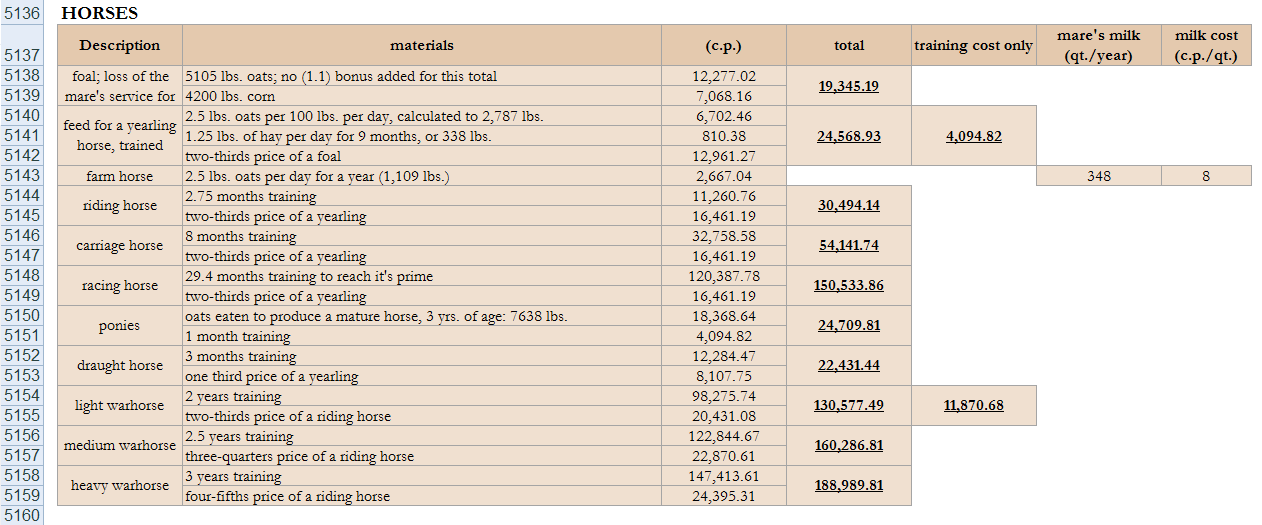
This is my work-up for live horses:


Now, I want to stress that first, this is intentionally a simplification of the problem at hand: to determine how much a horse that the players want to buy costs. And second, that I'm under no obligation to "accurately" represent anything. What I want are a series of calculations which make sense within a given framework, producing fairly rational prices that, above all, must be able to represent practical prices a hundreds of locations other than Venice.

It starts with the birth of the foal, or baby horse.  This costs a loss of the mare's service both before and after giving birth, which means she's eating oats and corn in grand amounts.  The foal is eating too.  The price of oats has been determined elsewhere, as has the price of corn.  These things, multiplied by amounts, gives us a total number of copper pieces: here, 19,345.  That's a little more than 100 g.p.

Where it says "no (1.1) bonus added for this total," this means that I'm not multiplying "19,345" by 1.1.  Normally, when some product in the pricing table is made of two source materials, I add 10% to the total; this accounts for the labour and troubles associated with supply.  That 10% figure is a great help in determining monthly wages for the person responsible for mixing the feed and giving it to the horse.  Only here, I'm suspending it, for no better reason than my trying to keep the horse's overall price down a little.

When there are three source materials, I add 20% to the cost; when there are four, I add 30%.  And so on.  This makes more complicated things and gadgets progressively more expensive, beyond the base price of their source materials — while at the same time ensuring that the labourer is paid better.  It works very well.

Look at lines 5140-5142 (so far, 5,800 lines in the whole document).  "Feed for a yearling horse, trained."  It includes a line that says, "two-thirds of a foal."  A "yearling" is one-year old, or thereabouts.  The amount of food calculates to what the yearling horse eats in 9 months, and then to that is added the younger horse, which the yearling was once.  Only, for no good reason, I'm cutting the value of the foal down by 2/3rds, arbitrarily, again to keep down the price.  I could probably invent some kind of excuse, but to be honest, I'm diddling with the numbers.  Once in awhile, some exception has to be made to some general rule, "because."  In a practical sense, there are too many disparate things in the world to permit consistency.  I want a high price for horses, but I don't want it to be too high.

As it is, the fabulous price for foals and yearlings reflects the potential for these animals to someday be magnificent beasts.  Most of us don't realise what a long-term effort many animals are with regards to training and feeding and housing, before all that investment finally pays off in a good riding horse.  There's a sense of attachment, too, in that you've seen your foal grow to be a yearling, and you have expectations of what the yearling will be someday.  But there's something else hidden in the price, which helps make sense of the very confusing price for farm horse in line 5143.

Not every horse is as healthy and virile as most of them are in the movies.  The value of a horse lies in what it can DO.  When a horse can no longer "do," yet continues to eat more than a thousand pounds of oats a year, the price falls precipitously.  Here's part of my description of the farm horse from my Guide:

Such horses have no breed, as they’re composed of mixed blood; their quality is inferior, for the most part having been raised on little other than grass and less than half the supportive nutrients that a more remarkable horse takes for granted.

They exist as the cast offs of stables, as horses not intelligent or vigorous enough ... by which time they’ve aged some years. Farm horses may also include horses older than 13 to 15 years, that have given good service in other roles but have come to the end of their use as other kinds of horse.

Even a warhorse, if it isn't worth being put out to stud, or is too old to breed, or hasn't been killed, may someday end up a farmhorse.  The low price is essentially the cost of "getting rid of the animal," because anyone who buys is going to get minimal value from the creature at great cost in feeding it.  The low cost of 2,667 c.p., about 10 g.p., is to beg someone to take it.  This understanding makes it possible for a common peasant to actually own a run-down horse; it may actually have been abandoned, perhaps because it was lame ... and the farmer, who perhaps knew something about horses, took it home and healed it sufficiently to do light work for the rest of its life.

This means that every "yearling" for sale is that virile beast from westerns and horse-racing.  It's not only a matter of age, but of breeding and class besides.

Farm horses are most likely to give milk on a regular basis, as for the most part a truly valuable mare breeding a thoroughbred foal will give most of its milk to the offspring.  If a farm horse gives birth, the foal is gotten rid of as soon as possible, since feeding two horses is out of question for most.  Thus the mare's milk, about 348 quarts until the mare stops lactating (estimated 17th century numbers, not modern numbers encouraged by all sorts of science).  The price of the mare, divided by 348, gives us a price of 8 c.p. per quart.  This compares well with cow's milk, which calculated to 12 c.p. per quart.

So, "training."  Add together the prices for the yearling, oats, hay and 2/3rds foal, and multiply that by 1.2, you get 24,569 c.p.  That extra 20% equals 4,095 c.p.  That's the future cost of 1 month's training applied to older horses.

Yes, it seems like a lot.  It's actually 21 g.p. per month.  Note that I've dropped the price of feed from further calculations, so "training" also takes that into account.

Now, suppose you have a yearling in your possession.  You've got to wait until it's nearly two-and-a-half years old before you can put a saddle on it, or use it for any real work, because it's knees have to strengthen over time.  In the meantime, you can give it a lot of attention, make sure it attaches itself to you, or someone on your estate, and give it a modicrum of training.

If you want a riding horse, that's just 2.75 months.  If it's a carriage horse, which actually walks differently, more "regally," that's 8 months.  A pony is quite meek, so it takes a single month.  A draught horse takes 3 months, but as it begins to train it's actually able to do work, so it pays for some of the price of it's younger self — thus it only costs one-third the price of a yearling, rather than two-thirds like riding horses, carriage horses or racing horses.  The pony is more or less the equivalent to a yearling; it eats less overall, so the price of a trained three-year_old pony is comparable to an untrained one year old horse.

You can train your horse to be a racer, but that doesn't make it a successful racer.  I have rules about what makes a successful racing horse on my wiki.

Finally, you can have a warhorse.  A warhorse has to be trained as a riding horse first.  Thus, it boosts the price a bit.  The kind of warhorse you can have, heavy, medium or light, depends on the weight of the horse.  Nonetheless, the heavier horses are more likely to be armoured, and forced to engage more brutally, acting less like a riding horse than a warhorse, so they cost more.  That cost is expressed in how many months of training they require.

Next to the light warhorse is a figure, 11,871.  This equals 10% of the base cost for a light warhorse, which is 98276 + 20431.  This number is used to determine the monthly cost for an "attendant," for whom 36 months of pay is equal to 10% the price of a light warhorse.  This attendant runs alongside the rider, or leads the rider's horse when travelling, and catches the horse when the mounted combatant dismounts to fight the enemy.  A good attendant can run so well that when the combatant gets off, the attendant is there within a round or two to grab the horse and hold it, in case the combatant wants to get on again ... which the attendant also helps with.

Having an attendant was perfectly normal.  Virtually every horse-soldier had one.  It was often the offspring of a trusted servant, or someone else's trusted servant, paid for and trained from the age of a boy.  The more familiar name is "squire," but that name changed it's meaning over 500 years, so that it ceased meaning a knight's attendant and started meaning a wealthy landowner.  Language is funny.

Anyway, there you have it.  All this silly pretense at pulling numbers out of my ass, eh?  Go ahead and say so, if that's what you think it is.  I need the book to do well; I need the numbers to make sense.  And though I have no intention of making the numbers available with the published copy, I do intend to do other things with the pricing table than this book.  I'll need to know how practical my methods are.


Wednesday, March 1, 2023

Contents Thus Far

Sorry to do this, but as things become available, I'm going to tempt my reader.

Here's a content page of the headings I've added since beginning the Streetvendor's Guide, 45 days ago:


Pity I couldn't complete the page.  The page numbers are subject to change, as they've been collected prior to editing, and prior to the addition of any images that would move the pages forward.  The numbers also count the inclusion of title pages, not counting the outside or inside cover.

Oops, I'm sorry.  If anyone's confused, these are all subjects I've already written up.


Saturday, February 18, 2023

Town Market

I don't know how well the image will post, but here's a list of products available at the town market, according to the Streetvendor's Guide.  A copy can also be found on patreon.


Can't say the prices are final ... something always comes up.  Changes would be slight, in any case.  Nor is this the format the items would be published in.  I just wanted to throw the list together, so that it's organised when I actually make a page for this.

Book passed 30,000 words yesterday, after 33 days work.  For the next few days, it's all fish, fish, fish.  Then onto foodstuffs.

A large fruit box carries 25 lbs.  A burlap grain sack carries 40.  

Wednesday, February 15, 2023

Stock Raising

First, this bit that's also on my patreon:

Elephants

There exists contention that the Indian elephant is necessarily more sagacious or tractible than the African variety. Those animals first encountered by Alexander were no doubt the former—but we can assure that the elephants led by Hannibal and Jugurtha were undoubtedly African. The failure of the elephant’s popularity in the west, and its lack of effectiveness in war, more likely comes from an inexperienced and deficient training of African elephants, compare with the proficient tradition that existed in Asia, especially Thailand, for thousands of years. In any case, the details given below are for Indian elephants.

Domesticated elephants are not raised from infancy, as they become unmanageable in the intervening years before adulthood, a period that’s better managed by the herd rather than by trainers. It’s best to capture a young adult elephant from the wild, when it’s about the age of 8 to 12. It weighs about 3½ tons, between 8 and 9 ft. at the shoulder and 10 ft. at the back. As it matures to an age of 35 to 40, it can grow to be as much as a full fifth larger.


A quick run-down of where I am.  So far, about 15,000 words written on various animals, most of which have been referenced on past days on patreon.  As can be seen from the above, I'm making an effort to be all inclusive ... and just in case anyone wonders, I am including information on some unreal domesticated animals, specifically dire wolves, worgs, hippogriffs and oliphaunts.  I know, I know, I said that I wouldn't be including magic in the book, but these things won't be treated magically.  They'll be treated just as though they are real animals, with real problems in their training and maintenance.  I trust the reader is surprised at the depth and breadth of the subject material, far surpassing anything I've seen on these subjects.  Even at that, there are huge swaths of material I could add, that I'm not for the sake of space.

The pages also include 80+ things that can be bought, none of which are wools, hair, meats, skins, hides, bones, bristles, ivory and whatnot.  These are pushed to other parts of the book, where they can be compared and addressed according to another setting.  The products I've included thus far are specifically those that can be bought in a stockyard or a kennel.  There are 11 kinds of horse and 5 kinds of dog, to give an idea what I'm going for.

I apologise for being a one-trick pony at the moment.  Juggling the book and my job over the weekend was taxing; I'm finally back to a normal balance and it's likely to stay that way for a while (but there are always surprises).  The book continues to be on schedule nonetheless, with 31 eight-by-eleven two-column pages written in 31 days.  It's first draft of course and needs editing, though I've glanced over it and in general the work is about the same level as the previews I've provided (which were also first draft).  Nothing would please me better than to have the principle writing done by mid-July.  Though, to be honest, that seems hard to conceive.

If you find I've skipped a day putting up a patreon snippet, it's because I didn't write that day.  Anything I do put up will be something I did write that day, so you can see how far I'm going.  To finish animals, I just have the war elephant, oliphaunt and hippogriff to do ... and then it's fish before getting started on foodstuffs.

Lots and lots of fish.  But I need prices for fish before I can figure out prices for fish stores and dishes, as well as fish oil, just as I need prices for animals before I can calculate meat, leather and so on.

I'm here, I'm working, I'm showing that I'm working ... it's all I can do.  There'll be five more preview pages for those who donate $10 to my patreon each month.

Incidentally, I'm identified that there are 8 people who contribute that much every month who aren't included in the $10 tier list.  There must be something that has to be clicked on patreon for it to recognise you as a tier lister.  I don't know what that is, but you might be sure you're on that list.  I still don't know why some contributors have no problem while others cannot access material.