Showing posts with label Trade Prices. Show all posts

Tuesday, June 27, 2023

Pricing Esoteric Wages

Most readers here know that with my streetvendor's book, I'm including hiring costs for select professions, enough I hope that they can serve as a guideline for others in their worlds, when needing to fix a price for someone I've left out.  Of late, in detailing hostels, a sort of "alms-house" for travellers, I bumped into the following and was hard put to define the job's income:

Charitable nurse ... 9¼ c.p. per day.
Procures an attendant able to care for sick and wounded persons, increasing the amount of healing that can be gotten in a day. As varying game rules treat recovery in far too many ways to cover here, the exact benefit is left to the dungeon master. Note that the fee is nominal; the actual income the nurse receives is covered in large part by the organisation that supports the hostel, as a "good work."

Depending on demand, such nurses may not be available every day, as they must sometimes share out their gifts among the whole. Characters should be able to count on personal attendance nearly all the time, however, and certainly never less than one day in two.


The skill-set described, though the book won't say so, matches the sage ability in my game world, "aid rest."  But because different systems and D&D editions deal with healing in vastly different ways, I've chosen in situations like this not to provide any specific rule in the text.  If someone wants to know how I do it, my name, my wiki and the book's name will be easily found online.

Regarding the "nominal fee" ... in fact, 70% of the nurse's income is covered by the group that has built, and manages the hostel, such as was done by the Knights Hospitaller, the Swiss Confederation, independent rajahs in India, the bureaucracy in China and many more.  Which would mean the nurse's actual income is 2½ s.p. per day, not the number given.  But don't worry.  I intend to provide the real number later in the book.

In any case, this post is about the number itself and where it came from.  Usually, I can pin the cost of hiring on goods collected or produced, such as with fruit picking, catching fish or baking.  In this case, however, there's no intrinsic monetary value in healing the sick ... which may be why humans resisted the practice on a national level for so long (with some nations still resisting it).  Yet I needed a number, and I must admit that for some time I was stumped.

To possess the sage ability linked above requires, by my game rules, 10 knowledge points.  In my game, these don't materialise out of thin air — levelled persons collect knowledge as they advance up levels, but at 1st level they start with a randomly generated amount of knowledge (see the link) that they've accumulated before becoming levelled, as part of their training as fighters, mages, clerics, monks, etcetera.  Therefore, they were technically able to learn things without needing either a level nor a single experience point, which means that any person, regardless of their status or experience must be able to do the same.  Thus rules exist for this too.

Thus the nurse above might be a non-levelled person who has simply accumulated 10 points of knowledge as a healer, merely by taking the time necessary to learn and make the necessary abilities checks.  He or she is allowed to make those checks every two weeks.  Because "nursing" is a scientific skill (in my opinion), she would need to roll against her intelligence and wisdom.

If the nurse's int & wis were ordinary, success and a point gained would come every 8 weeks ... but if those were much better, say 14 in each stat, then success would come every 4 weeks (a success out of every 2.04082 tries).  And surely we'd expect that a would-be nurse, accepted for training by a group such as the Knights Hospitaller, would be most likely to have a minimum of 13 in either stat, and probably better.  

In fact, we may easily suppose that a group of would-be nurses were expected to succeed in a given time frame ... and that this would include those with higher stats, who more succeed in their rolls, and a few with lower stats that are unexpectedly lucky.  Everyone else would be dismissed, just as happens in any school where expectations aren't met.  We may therefore assume that every trained nurse succeeds in reaching his or her competency within a year ... or not at all.

From this, we can assign a space of 1 year per 10 points of knowledge.  As it happens, in my game, a 1st level cleric begins with an average of 35 knowledge points ... that might have taken anywhere from 3 and a half to 7 years to accumulate.  Which would mean that if he or she started training as a human cleric at the age of 14 to 18, then 1st level would be attained somewhere between the ages of 21 and 25.

[ah, but admittedly, I'm just playing around with numbers]

While training, our nurse essentially lives with instructors and governors day in and day out.  For an up-front fee, or as a charity in some cases, if someone with promise is found, the school pays for lodging, food, maintenance and wages, to ensure continued education.  All this costs money — and there, aha!  A value is established upon which the nurse's income can be defined.  In this case, the equivalent of a year's poor food for the nursing student to eat, waving the other costs as in some way paying for themselves (as most are themselves involved in teaching as a "good work"), the total cost of education for 10 pts. of knowledge is 11,385.03 c.p.  This number can also be established (though some would argue) as the nurse's yearly income ... which calculates out to 31.19 c.p. per day, or about 2½ s.p.

Crazy, I know, to take this much time to peg such a partry amount of money, though 5 g.p. per month, as it works out, isn't bad for an NPC.  But there's bigger fish to fry.

Since everything that anyone can do is ultimately rolled into my sage ability table, it means that I can define anybody's income, based merely on how much knowledge they have.  There's an argument to be made that mages don't educate students as "good work," and thus room as well as board may need to be fitted into the calculation ... along with other adaptations.  But the main point is there IS a calculation!  How much does it cost to hire a 1st level cleric?  35 knowledge points.  Um, sorry, that's 17¼ g.p. per month.  Minimum cost, obviously.  Took me about 20 seconds to calculate that.

I'm having so much fun, I could almost die.

Monday, March 6, 2023

Pricing Horses

Some readers paying attention to my patreon may be seeing a series of products steadily added day by day, with prices attached, while others who have seen the previews for my Streetvendor's Guide may be wondering where the numbers come from.  Long-time readers know that I have a pricing table — some have even seen the excel file of that from seven years ago.  This is what I'm using to define the cost of everything ... while upgrading the table as I go.

The table's purpose is to supply different prices for different parts of the world, computing these according to the scarcity of products based on how often such products were mentioned, in relationship to geography, in a 1952 set of encyclopedias.  Since the encyclopedia includes about 9,000 geography articles, about cities, provinces and whole countries, it's fair to assume that if horses are mentioned an awful lot in some specific part of France, then that reflects a probable good supply of horses there.  All it takes is the patience to steadily comb through the list of articles and make note of each reference to each thing as it's given.

I started doing this in 1986.

But ... if the point is to give different prices for different places, where are these prices coming from?  I have an answer: Venice.  While no longer the centre of finance in 1650, when my world takes place, it still has one of the best distance ratios of any city in the world ... remembering that nearly 5/6ths of all the market cities in my game world exist in Europe.  This is undoubtably because the encyclopedia is Eurocentric ... but then, so was trade in the 17th century.  So it works out.

I thought a tiny, tiny portion of readers would like to see some of the calculation work I've created towards the Streetvendor's Guide.  Everyone else, feel free to click over to JB's blog and see if he's changed his mind and broken his recent self-imposed fast.  That seems to take up a lot of my time.

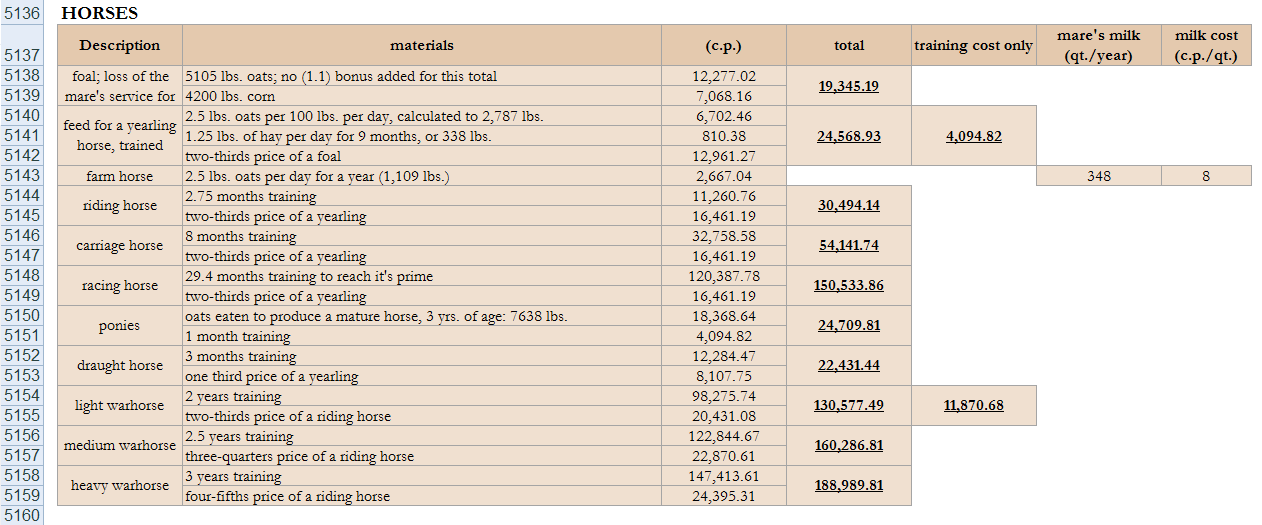
This is my work-up for live horses:


Now, I want to stress that first, this is intentionally a simplification of the problem at hand: to determine how much a horse that the players want to buy costs. And second, that I'm under no obligation to "accurately" represent anything. What I want are a series of calculations which make sense within a given framework, producing fairly rational prices that, above all, must be able to represent practical prices a hundreds of locations other than Venice.

It starts with the birth of the foal, or baby horse.  This costs a loss of the mare's service both before and after giving birth, which means she's eating oats and corn in grand amounts.  The foal is eating too.  The price of oats has been determined elsewhere, as has the price of corn.  These things, multiplied by amounts, gives us a total number of copper pieces: here, 19,345.  That's a little more than 100 g.p.

Where it says "no (1.1) bonus added for this total," this means that I'm not multiplying "19,345" by 1.1.  Normally, when some product in the pricing table is made of two source materials, I add 10% to the total; this accounts for the labour and troubles associated with supply.  That 10% figure is a great help in determining monthly wages for the person responsible for mixing the feed and giving it to the horse.  Only here, I'm suspending it, for no better reason than my trying to keep the horse's overall price down a little.

When there are three source materials, I add 20% to the cost; when there are four, I add 30%.  And so on.  This makes more complicated things and gadgets progressively more expensive, beyond the base price of their source materials — while at the same time ensuring that the labourer is paid better.  It works very well.

Look at lines 5140-5142 (so far, 5,800 lines in the whole document).  "Feed for a yearling horse, trained."  It includes a line that says, "two-thirds of a foal."  A "yearling" is one-year old, or thereabouts.  The amount of food calculates to what the yearling horse eats in 9 months, and then to that is added the younger horse, which the yearling was once.  Only, for no good reason, I'm cutting the value of the foal down by 2/3rds, arbitrarily, again to keep down the price.  I could probably invent some kind of excuse, but to be honest, I'm diddling with the numbers.  Once in awhile, some exception has to be made to some general rule, "because."  In a practical sense, there are too many disparate things in the world to permit consistency.  I want a high price for horses, but I don't want it to be too high.

As it is, the fabulous price for foals and yearlings reflects the potential for these animals to someday be magnificent beasts.  Most of us don't realise what a long-term effort many animals are with regards to training and feeding and housing, before all that investment finally pays off in a good riding horse.  There's a sense of attachment, too, in that you've seen your foal grow to be a yearling, and you have expectations of what the yearling will be someday.  But there's something else hidden in the price, which helps make sense of the very confusing price for farm horse in line 5143.

Not every horse is as healthy and virile as most of them are in the movies.  The value of a horse lies in what it can DO.  When a horse can no longer "do," yet continues to eat more than a thousand pounds of oats a year, the price falls precipitously.  Here's part of my description of the farm horse from my Guide:

Such horses have no breed, as they’re composed of mixed blood; their quality is inferior, for the most part having been raised on little other than grass and less than half the supportive nutrients that a more remarkable horse takes for granted.

They exist as the cast offs of stables, as horses not intelligent or vigorous enough ... by which time they’ve aged some years. Farm horses may also include horses older than 13 to 15 years, that have given good service in other roles but have come to the end of their use as other kinds of horse.

Even a warhorse, if it isn't worth being put out to stud, or is too old to breed, or hasn't been killed, may someday end up a farmhorse.  The low price is essentially the cost of "getting rid of the animal," because anyone who buys is going to get minimal value from the creature at great cost in feeding it.  The low cost of 2,667 c.p., about 10 g.p., is to beg someone to take it.  This understanding makes it possible for a common peasant to actually own a run-down horse; it may actually have been abandoned, perhaps because it was lame ... and the farmer, who perhaps knew something about horses, took it home and healed it sufficiently to do light work for the rest of its life.

This means that every "yearling" for sale is that virile beast from westerns and horse-racing.  It's not only a matter of age, but of breeding and class besides.

Farm horses are most likely to give milk on a regular basis, as for the most part a truly valuable mare breeding a thoroughbred foal will give most of its milk to the offspring.  If a farm horse gives birth, the foal is gotten rid of as soon as possible, since feeding two horses is out of question for most.  Thus the mare's milk, about 348 quarts until the mare stops lactating (estimated 17th century numbers, not modern numbers encouraged by all sorts of science).  The price of the mare, divided by 348, gives us a price of 8 c.p. per quart.  This compares well with cow's milk, which calculated to 12 c.p. per quart.

So, "training."  Add together the prices for the yearling, oats, hay and 2/3rds foal, and multiply that by 1.2, you get 24,569 c.p.  That extra 20% equals 4,095 c.p.  That's the future cost of 1 month's training applied to older horses.

Yes, it seems like a lot.  It's actually 21 g.p. per month.  Note that I've dropped the price of feed from further calculations, so "training" also takes that into account.

Now, suppose you have a yearling in your possession.  You've got to wait until it's nearly two-and-a-half years old before you can put a saddle on it, or use it for any real work, because it's knees have to strengthen over time.  In the meantime, you can give it a lot of attention, make sure it attaches itself to you, or someone on your estate, and give it a modicrum of training.

If you want a riding horse, that's just 2.75 months.  If it's a carriage horse, which actually walks differently, more "regally," that's 8 months.  A pony is quite meek, so it takes a single month.  A draught horse takes 3 months, but as it begins to train it's actually able to do work, so it pays for some of the price of it's younger self — thus it only costs one-third the price of a yearling, rather than two-thirds like riding horses, carriage horses or racing horses.  The pony is more or less the equivalent to a yearling; it eats less overall, so the price of a trained three-year_old pony is comparable to an untrained one year old horse.

You can train your horse to be a racer, but that doesn't make it a successful racer.  I have rules about what makes a successful racing horse on my wiki.

Finally, you can have a warhorse.  A warhorse has to be trained as a riding horse first.  Thus, it boosts the price a bit.  The kind of warhorse you can have, heavy, medium or light, depends on the weight of the horse.  Nonetheless, the heavier horses are more likely to be armoured, and forced to engage more brutally, acting less like a riding horse than a warhorse, so they cost more.  That cost is expressed in how many months of training they require.

Next to the light warhorse is a figure, 11,871.  This equals 10% of the base cost for a light warhorse, which is 98276 + 20431.  This number is used to determine the monthly cost for an "attendant," for whom 36 months of pay is equal to 10% the price of a light warhorse.  This attendant runs alongside the rider, or leads the rider's horse when travelling, and catches the horse when the mounted combatant dismounts to fight the enemy.  A good attendant can run so well that when the combatant gets off, the attendant is there within a round or two to grab the horse and hold it, in case the combatant wants to get on again ... which the attendant also helps with.

Having an attendant was perfectly normal.  Virtually every horse-soldier had one.  It was often the offspring of a trusted servant, or someone else's trusted servant, paid for and trained from the age of a boy.  The more familiar name is "squire," but that name changed it's meaning over 500 years, so that it ceased meaning a knight's attendant and started meaning a wealthy landowner.  Language is funny.

Anyway, there you have it.  All this silly pretense at pulling numbers out of my ass, eh?  Go ahead and say so, if that's what you think it is.  I need the book to do well; I need the numbers to make sense.  And though I have no intention of making the numbers available with the published copy, I do intend to do other things with the pricing table than this book.  I'll need to know how practical my methods are.


Tuesday, October 24, 2017

Calculating Scarcity in Market Items

A small number of my readers will be happy to learn that I'm replacing parts of my trade pricing table with excel's vlookup feature.  I have found a practical application for it and I'm incorporating the function.

One problem I have had with the trade system is the question of availability.  It is all well and good to have things with prices that vary from place to place, but that still leaves the question, "How many can I buy?"  Or, for that matter, if there is anything on the shelf at all.

I have tried a number of methods for this over the year, one of which is still a part of the system as it is located for patreon supporters right now.  But it is based on random numbers and I must admit, for some things, random numbers just suck.  It was because of random numbers that I conceived by sage abilities system as things you can absolutely do vs. things that you absolutely cannot do.  There are some things that still incorporate random numbers, but the principle of knowledge is not one of them.  I know that the Serbians were massacred and driven out of their homeland during World War I.  There's no random chance that I will forget that.

Of late, I've figured out a way to get the random chance out of the availability of items.  Though it drastically flattens the likelihood of finding a given object, or how many are available, because the number of items is so large and the algorithm is hard to predict, that is only noticeable to the designer.  Eventually, the players will grasp the idea for some items, but I doubt they would for the whole list of goods and services that can be purchased.

It works like this.  Imagine what it's like to buy things in a general store.  You want to buy something very common like a torch and you find there's a big basket of them.  But then you want a flint to light that torch and it turns out there's just one left.  Or the store sold the last one this morning and you're out of luck.

That's what I'm reaching for.  That common items will always be there, or virtually always; and less common items will tend to be missing from the shelf marked "telescope" or "silver holy symbol."  Unless, of course, the player happens to be in a town where telescopes are made.  Then there will be a basket-full.

I'll just trust here that readers are vaguely aware of my trade system.  Every time I want to talk about it there's too much to explain and I have already been down that road.  Still, basically there are a set of references that I express to the fourth significant digit.  The number of references for any given object, from extraordinarily rare gems to general foodstuffs ranges from 0.0025 to 20.0000.

I'm beginning with the premise that if we're at a particular market, say Stavanger in Norway where the online party is, a total references of >1 for that object means that every possible version of that object is available.  If Stavanger's shipbuilding industry is >1 reference, then ships of every size can be purchased or built from scratch at that port.  Of course, the boat might not actually be in the harbor, but an agent in Stavanger can get it for you in a period reasonable with the 17th century, say a month or two.

From there, we create a series of tiers.  >1 reference equals Tier 1.  Dividing that number by four, 0.25 - 0.9999 references equals Tier 2.  Dividing it again by four, 0.0625 - 0.2499 equals Tier 3 and 0.01563 - 0.0624 equals Tier 4.

We then rate every object that is sold on a scale of 1 to 4 "sets."  Set 1 includes anything that is grossly common: ordinary stone, iron bars, a cloak, chickens, torches, a stay at an inn, ordinary wine and beer, whatever.  Things we absolutely expect to always find in any market town.  Set 2 is one up the scale: things that are a little less common but could still be expected to be found in any civilized society: a holy symbol, a metal candelabra, butter and cheese, hard boots as opposed to soft ones, books, a vial of salve for wounds, a stay at a nicer inn, etcetera.  Set 3 would mean low level luxuries; the sort of thing that peasants would never buy but would find its way into a merchant's household: porcelain, stained glass, a rare liqueur, a fur coat, a particularly nasty poison, a carved oaken bureau, a pet war dog and so on.  Finally, Set 4 would include every rare thing that conceivably existed.

For Set 4 things to be found, the number of references would have to equal the Tier 1 level.  At Tier 2, at best we would find Set 3 objects.  At Tier 3, no better than Set 2.  Finally, at Tier 4, only Set 1 objects would exist.  If the number of references isn't high enough for Tier 4, nothing of that particular good or service is available.  If we're so far from the makers of weapons that less than 2% of a reference exists, then no, there's nothing here, not even a dagger.  You'll have to make due with a club you find somewhere.

I know it sounds to some people that the Tier number should equal the Set number, and that's fine for them if that's how they want to do it.  It's just reversing the scale.

I like that this system narrows the import reach for objects that ought to be unusual, while maintaining commonality in areas where the object is actually made.  It may be hard to find a fur coat in Italy, but in Russia everyone is wearing them, even though they are a set 3 object.  You may have the money to buy everything in existence: but if it isn't on the shelf because it is never imported (its just too far away), then there's no point in waiting to see if something will come in next week.  No one ever brings it here because it isn't wanted.

This gives me ideas for how to manage the starting question, how many are there - but I haven't quite solved that one yet.  I'm patiently working on creating a page that gives everything a set number, then compares that with the automatically generated tier system ~ which is where vlookup is coming in handy.  Yes, it was a good suggestion and now that I'm starting to get used to it, I'll be using the function more often.  I'd like to thank those readers who poked me about it and to promise them that yes, even an ornery grognard can change.

I should be able to update the pricing table on the private drive for patreon donations in a week or two: sooner if readers clamor for a beta version that's only partially made.

Tuesday, July 15, 2008

Prices

So.

We have numbers for where goods and services are, and we have a method for how to get translate that into numbers. And we have a system for the distribution of those articles. Any questions so far?

Let’s move on, and see about how to work out the price of an actual item. This is going to get fairly complicated, so get out a pen and paper and follow along. In this case, showing the work is de rigueur.

Thankfully, I don’t have to work through this process every time. I have it on excel, with each formula automatically translating the numbers; but I’ll go through it here, so it can be understood how its done. Sadly, my price table is behind my source table, the one I posted yesterday, as I spent last week adding France. Therefore, these numbers will not fit; that doesn’t matter. I’m not in the mood to update my price table at the moment, which will take three or four days…I’m working on other things. It is the SYSTEM that matters, not the numbers.

(You wouldn’t be using these numbers anyway—you’ll be using the numbers generated by your world).

The numbers apply to Kronstadt, where I believe I’ve mentioned the party is near. The importance of the town is that it occupies a gap in the Transylvanian Alps, as a gateway between the Great Hungarian Plain and the Black Sea.

Okay, disclaimers done. Let’s start with iron ore.

Total Iron references (at the time of the making of this table) are 319. Of this, Kronstadt imports 6.565. You’ll remember that this is the product of various market zones all feeding into Kronstadt depending on how far away they are.

The 6.565 is computed against total world production, and we find that Kronstadt has access to 1,622,076 stone (16 lb.) of iron ore (metal equivalent). This is worth 13,727 ounces gold; translating this into copper pieces per stone (64 c.p. per g.p., plus 2 grams gold content per g.p. which means 15.55 g.p./ounce of gold…remaining coin content is typically copper) gives us 8.42 c.p. per stone.

To this, I apply a travel modifier divided by 1% of the world’s total; Kronstadt’s comparative availability is 2.1% of the world’s total…that means the 8.42 c.p. is divided by 2.1, giving us a cost of 4.09 c.p. per stone of metal content for unprocessed iron ore.

Okay. Pig iron:

The smelting references for Kronstadt are those for smelting in general and for smelting specifically iron ore, which adds up to 4.743. (From this point on we ignore the world’s totals…those only apply to the raw materials). The base price for smelted iron (pig iron) equals (ore price)/4.743+(ore price). In other words, the greater the number of references available to Kronstadt, the lower the service cost of transforming it into pig iron; a reference of “1.0” would exactly double the cost.

Thus we have (4.09)/4.743+(4.09) = 5.0 c.p. per stone. However, it requires 5.67 stone of coal and 0.72 lbs of limestone added to the blast furnace to make one stone of pig iron. The cost two raw substances is also worked out, and in total they add 64.8 c.p. to the final cost…giving us a final total of 69.8 c.p. per stone of pig iron.

Wrought Iron:

So far, all we have is puddled metal…it is not even as far as it needs to be for it to be smithed. It has to be mixed with other metals…specifically manganese and nickel. There are hundreds of wrought iron combinations; I use one I found in the old encyclopedia, which is common enough for use here: 93% pig iron, 6% manganese and 1% nickel. 0.93 pounds of iron costs 4.1 c.p.; 0.06 lbs. of manganese is 1.2 c.p., and 0.01 lbs. nickel is 0.9 c.p. This is 6.1 c.p. total for the raw materials.

The availability at Kronstadt for metallurgy, or the making of alloys, is 1.806 references. Once again, 6.1/1.806+6.1 gives an adjusted price of 9.5 c.p. per pound of wrought iron. Now we can move on to smithing.

Ironmongery:

The availability of iron smithing in Kronstadt is quite high; Transylvania was famous for its metal working, which was part of the reason it was able to oppose the invasion of the Ottomans for so long. Even as Hungary fell in the 1500s, Transylvania continued as a “client-kingdom” of the Ottomans, enjoying soveriegnty in their own country in trade for the occasional force of men and the much needed metal goods it was able to provide the much, much larger empire.

Transylvania’s references for ironmongery is 3.72. Applying this to the price of wrought iron (9.5/3.72+9.5) gives us the quite reasonable price of 12.1 c.p. per pound.

This can now be translated into actual goods. Of course, the party could, if it wished, buy bars of wrought iron. At 9.5 c.p. per lb., a 20 lb. bar of iron would be a mere 170 c.p., or less than 3 g.p. Of course, if a first level party broke into a smithy and found a stack of 400 such bars, it would make a tidy little treasure. Moving it, on the other hand, might be interesting…but a smart little adventurer might figure that out, and just how high a level can a blacksmith be?

Well, I’d estimate fifth level. But if a thief snuck up behind him at just the right moment…

But I digress.

Lets take a very simple piece of ironmongery: a catapult ball. For a small catapult, my sources tell me this would weigh 57 lbs. All we need do is multiply the catapult ball’s weight against our known cost for ironmongery, giving us 689 c.p., or 11 g.p.

Of course, not all ironmongery is built equally. Some things are harder to fashion than others: for different things I assign a level of workmanship. I try to keep the numbers low…twice as hard, three times as hard and so on. An anvil might be 1.5 times more difficult to craft than a catapult ball; a door, being nothing more than a poured square with a hole for the handle, 1.75 times. A cauldron, which must be balanced, 2 times. A chain, 4 times. And so on.

Here is a list of the ironmongery items I’ve added to my equipment list:


This is not exhaustive, by any stretch of the imagination. I’m sure there are things missing. But to get the price for those things, I do not have to pull one out of my ass. I can judge its workmanship by other items on the table, determine its weight and there you are. Plus the comparison between the objects makes sense.

The above list, you'll also notice, contains no tools...that is the next tier, in which tools are more expensive than ordinary iron objects.

And if the party moves to a place where iron doesn’t happen to be common…say the Guinea Coast of Africa, the reference numbers go down and the costs go up. Or the reverse, say in Alsace-Lorraine in France—where every party ought to go to buy their weapons.

Does this help fill some of the holes in how my trade works?

Thursday, July 3, 2008

Haulage

The greatest influence on the price of anything is the cost of transporting that item from point A to point B. In the modern world, we have very little sense of the cost involved, because the price of transportation is profoundly cheap in comparison with that of the medieval or ancient world. Often, scholars tend to see through a poor lens when making estimates for the cost of haulage, because, for the most part, the only scholars who care very much about such things are historians—who have little experience with the science of economics (trust me, I’ve known a lot of historians).

I am no herald for the genius of economists; “head up ass” is standard operating procedure for that crew…but when discussing economics it helps to go to the books and find out how it’s done. The transportation system I use is based on a fairly simplistic economic dictum, a fairly inaccurate one because it does not take into account a vast array of influences. For economists, it is where you start. For me and my world, it is simplistic enough to work without hopelessly bogging me down into details that I haven’t a long enough life to solve.

It works this way:


Viewing the above, not to scale diagram, we have cities A, B and C and the distance between them. This distance can represent whatever unit you care to apply—a mile, twenty miles or a day’s travel. I use, for my purposes, the time it takes for a wagon to travel a distance of 20 miles—which, over a level distance paved by a good road, is approximately one day.

The system argues that the availability of an article imported into City A from City B is equal to the availability of that article in City B divided by the distance between the two cities. In other words, if City B produces 5,000 tons of wheat, the availability of wheat in City A will be equal to 2,500 tons. This does not mean that the actual amount of wheat in City A is 2,500 tons, or that the actual amount in City B is 5,000 tons (together that would be more wheat than City B produces). This is a representational total, to give a comparison in the value of wheat between cities A and B.

So, wheat is twice as costly (200%) in City A as it is only half as available.

What if City C also produces 5,000 tons of wheat?

Here is where things get a little complicated. City C’s availability of wheat continues to be 5,000 tons, but economically we also add 1,250 tons from City B (divided by 4 for distance). City B also totals out at 6,250 tons, after adding a quarter of City C. City A gets half of City B and 1/5th of City C, equaling a total of 3,500 tons.

Between importing from both of the other cities, City A has improved its supply in comparison with the other cities very slightly…the price is now about 179% (6,250/3,500).

Suppose, however, that City A also produces 1,000 tons of wheat. Re-evaluating the above calculations, we now have:

City A: 4,500 tons. Price: 150%.
City B: 6,750 tons. Price: 100%.
City C: 6,450 tons. Price: 105%.

Thus, the manor lord selling his excess grain in City A is able to sell it at 150% of the price that a manor lord in City B, because he is able to anticipate how much it will cost to ship in extra wheat from the other two cities.

Of course, each city may have different population levels, meaning a lower demand for wheat; and if you like, you can apply the same economic rule to the population of the three cities to discover how much inter-travel there exists between them (remember, City B and City A will likely share a greater percentage of casual labor between them, as they are only two days apart).

The above example is as simple as it gets. Establishing an economic system of your own, you could simply divide the world into four or six or eight different regions (depending on how much work you want to do), make a judgment call on how difficult it is to move material from one region to another, and there you go: an economic system. From something as simple as that, you would have a reasonable idea of what the ship the party was plundering OUGHT to be carrying, beyond making an ad hoc call about it. You could also, from the numbers I provided yesterday, make a reasonable estimate of the total income of any of the kingdoms of your world, and how unlikely they would be to succeed at a war with a neighboring kingdom…or how much they might dearly require help from a powerful mage and his buddies, vis-a-vis, the party.

With a little imagination, there are a number of facts you could interpret from the manner in which your kingdoms interacted with one another economically. What is the shortest distance of travel? Where ought there to be a trading point or an entrepot for the collection of goods before moving on to the next market? What countries would establish tariffs, and upon what goods? Where would smuggling actually make sense?

These are all questions that DMs usually answer by effectively pointing randomly at a map and saying: “there.” Which helps create the completely confusing and irrational world that raises the eyebrows of the smartest member of your party. It is the same as the player asking, “Why is that castle there?” Only the question is, “Why would they be smuggling tobacco into a tropical country?”

For myself, I have about 500 designated trading centers, based on the City A, City B and City C example above. That means 500 different calculations on the price of all the individual commodities…approximately 140,000 calculations every time I want to determine the actual value of traded goods in a given city. I would like to say a computer does these calculations, but in fact only some of them are. And there are several steps involved. Thankfully, it does not take me too long…three hours or so…to produce a new table. It would take me much, much less, but I’m a lousy programmer.

Wednesday, July 2, 2008

Values

I last left off where I had a system for the location of produced goods and services, and I had a total production number which—admittedly—was an estimate. However, a fairly reasonable estimate from everything I’ve read: the number for iron ore production, for example—this is iron content, mind, not the total weight of the rock in which the iron is found—came to 5 million tons per year. Which is an unimaginable number for most D&D worlds…but mine has an estimated population of well over 200 million (it should be close to a billion by the time I’m finished adding China and India). Plus, 5 million divided into 600 “references”, or mining zones if you like, is 8,300 tons per zone, or 23 tons per day for each…a quite reasonable number.

If you were working from your world, in reverse, you could designate the areas that would be iron producing and thus have a reasonable production estimate…useful if your players decided to do some mining. You can get ore to metal ratios from the internet, to see how much total rock would need to be extracted.

How does this, however, translate into a price?

One of the products that I have references for and a production total for is, of course, gold. 149 references for 312,000 ounces production yearly. It would be nice to think that one could simply compare the iron to gold, that 78 million tons of iron was equal to 312,000 ounces of gold—but I will tell you right off, that will not work. No matter how much you fuck around with it.

For one thing, all the iron in the world is not actually equal in value to all the gold in the world. The two may seem to have something to do with each other, on the surface, but they don’t. If gold did not exist at all, iron would still somehow be traded for food and for wood at the same basic rate that it’s worth defines…that is, the demand for the substance. While one might think that the availability of gold coin should somehow help define that worth…it just isn’t so.

Part of the economic problem in comparing one commodity to another is that in many parts of the world people just get along without it. While gold may be useful as currency, many cultures only use it for jewelry (not having currency as part of their social structure); yet these cultures continue to have economies, based often on community property but not always.

I experimented at length comparing commodities, attempting to use food as a base rather than gold, on the argument that everyone must eat food—but sadly, you wind up with a rather random collection of figures that just don’t represent a working economy.

Another problem I had was with any system that based the value of things strictly on their availability. If you divided that availability into whatever standard you’re using (capital, population, what have you), then things that are very rare and not immediately found nearby will have prices that are ridiculously inflated. Fine, I thought to myself when I first started…rubies should be very expensive in Germany, where no mined rubies are to be found.

However, the same principle must be applied to, say, sea slugs…which no self-respecting German would pay excessive amounts for. So I thought, put a ceiling on the value of goods; above this ceiling, it is either unavailable, or it doesn’t cost more than blank. But what is blank?

And what about obviously cheap things that I did not find many references for, simply because by and large they are not seen as particularly commercial: like thatch, or straw hats? Should they be inordinately expensive? Of course not.

The system that worked used the following logic: if a commodity is mentioned often by my source, then that commodity must have an inherent value proportionally higher than something that is not mentioned often. Thus, if iron ore is mentioned 600 times, and ostrich feathers are mentioned twice, then all the ostrich feathers in the world are worth—base worth only, please—one three hundredth part of all the iron ore in the world.

This may seem ad hoc. Believe me, it works fabulously. All the more so when you remember I have over 19,000 references (I’ve been adding France lately, which should bring this total to over 22,000). Which means—follow the logic, please—that the total value of EVERYTHING is equal to 19,000/600 * the value of iron.

From this assumption, I’m able to calculate the value of any commodity in the location of its development…that is, before transportation costs are added.

What this means for a world for which someone would want to make an economy from scratch is this: begin with the total population of your world, and compare it with Earth. This will give you a working model for the production figures you need.

Designate then the total number of points you wish to assign to each region in your world (I call the points references, but you can call them whatever you like). Kingdom A has 20 points of iron production, Kingdom B has 40 points, Kingdom C has 10 points. The specific locations of these points can be assigned later; it’s best to think only in terms of the big picture. Wherever you assign a lesser number of points, the value of the particular commodity will be higher.

Choose a base monetary unit that can be used to represent the value of said commodity. I use gold pieces, but food or copper will do just as well. To calculate the value of the commodity in a particular region, begin first with this formula:

The total value of all the world’s production of the commodity is equal to the total of your chosen commodity divided by the number of “points”, multiplied by the number of “points” of the commodity. I'll just go ahead and use gold.

Let’s say you have assigned 35 points to the production of gold, and 70 points to the production of iron ore. And you have decided on 175,000 ounces of gold produced worldwide. 175,000 / 35 = 5,000 oz. per point…multiplied against the 70 points you’ve assigned to iron ore, all the iron in your world is worth 350,000 oz. of gold. Simple.

Formula 2: Base price = Total world value / production.

If the total production of iron in your world is (conveniently), 5 million tons, then 350,000 oz. gold / 5,000,000 tons equals 0.07 oz./ton.

This sounds like very little, particularly using the old AD&D system that a g.p. is one tenth of a pound. In fact, a gold piece typically weighed about a quarter of an ounce (7 grams)…which sets the price of our iron now at approximately 3.5 tons = 1 g.p. (ignoring, for the moment, that a minted coin would be worth more than its gold content). Using the AD&D standard of 200 c.p. per g.p., the price of raw, unprocessed iron would be 1 c.p. = 35 pounds.

Of course, this is your system; you’re free to muck around with the numbers as you see fit. Since I’m using the system to reflect the earth as closely as possible, I wound up with a figure that 1 stone of unprocessed iron ore (16 lbs.) equals 6.1 copper pieces.

This doesn’t reflect the final cost, however…I haven’t spoken yet about the services required to transform that iron ore into worked metal. By my system, a piece of ironmongery totals out at 14.1 c.p. per pound. That is, it does in Transylvania…specifically in the town of Kronstadt, the modern city of Brasov, nearest trading town to my player’s land.

Before I can get into any discussion of services, I must get into the subject of transportation…and how that changes all the numbers.

I hope people can follow the logic thus far.