Showing posts with label Weapons. Show all posts

Friday, March 3, 2023

Making of Magic Weapons

Between work and the book, and normal routine, I've also been working on this for a patron supporting my $30 tier, "Wiki Request."  This is a bit of freelance writing, this month related to the creation of magical weapons:


Some have wondered at my method for doing this.  I've wondered myself, since I've never sat down to design the particulars, ever.  Obviously, throwing a lot of money at the problem is not included.  In fact, the rules describe exactly NO coins to be spent in any way, though obviously there would be costs involved, as characters must eat and pay staff, maintenance and taxes.  But those are other matters having nothing precisely to do with the making of weapons.

For those who haven't read the above, yes, it means virtually any weapon, though the examples given are all from the AD&D Dungeon Masters Guide.  There's two pages of special powers also listed in that book, any of which could be adapted for a weapon, and I'm an open minded fellow.  If someone wants to bring me a weapon idea from 5th edition, one that isn't plainly ridiculous, I'd certainly consider it.

Sorry to say the rules aren't cut-and-dried ... mainly because the powers aren't cut and dried.  It does explain what you'd need to make, say, a Holy Avenger, without answering the question in solid terms.  You need something else that possesses that power.  What would that be?  Not for me, the DM, to say.  I'd expect a player bent on creating a +5 Holy Avenger from scratch to explain just exactly how the sword ends up being "holy" ... and no, holy water alone ain't gonna cut it.  Still, there's got to be a way.  It takes some imagination, is all.

It does tell me that if and when I start writing out magic items in my wiki, I'll have to include passages on how that item comes into existence.

Monday, May 13, 2019

Impossible!

Play around and game design long enough, and eventually you'll shatter some intricate fabric of the game that you've been playing for 40 years.

I can't possibly explain how many times I've been in conversations ~ and arguments ~ about classes being free to use weapons in D&D.  I would expect the issue itself is dead as a dodo in 5th Edition, but that doesn't matter because the weapons are indistinguishable from one another anyway with regards to the effects of combat.  For me, the weapon by class restrictions have long been Biblical.

I have mostly argued that they exist because something needs to balance the power of the cleric or the wizard, and give a benefit to the fighter who, let's admit, never lacks for needing benefits.  So I have taken a hard stand, a slightly unrealistic stand, arguing for playability, enduring all the mentions of Gandalf's sword (who is, incidently, NOT a wizard, look it up you morons), Elric of Melnibone (who is barely a wizard), and Friar Tuck from that brilliant 1938 Robin Hood movie.

Okay, I made up that last one.  No one on the internet has ever seen the 1938 Adventures of Robin Hood, and so they don't know that Friar Tuck uses a sword in it, though he is obviously a cleric, but that is my cross to bear, isn't it?

A friar with a sword?  Ridiculous!  Eugene Pallette squares off with Errol Flynn.

Incidentally, the film ~ and the legend ~ has a bard in it, mixing up Will Scarlet and Alan-a-Dale.  Ah Hollywood, what a minx you are.

The youngster was clothed in scarlet red,
In scarlet fine and gay,
And he did frisk it over the plain,
And chanted a roundelay.

Describing Will Scarlet, circa 1600.  But I digress.

Without intending last night, I was sketching out some of the details for my post earlier today, and realized there was a way of looking at weapon's use that I hadn't considered before.  For a couple of decades I had adjusted my thinking to the simple logic that clerics weren't able to use edged weapons simply because their masters didn't bother to teach such things.  We use bludgeoning weapons because we always have, and we always will, goes the call, and if that doesn't sound like religion, nothing will.  How is a mage going to learn to use a sword when there is so much time needed to learn how to cast spells and cantrips?  Where would a druid find a crossbow?  That sort of thing.

And of course the classes do use these weapons.  Fighter/clerics, mage/rangers ... there's plainly nothing wrong with a spellcaster using a sword if the training is there.  It doesn't mess up the magic or the prayers when it's part of a multi-classed character.  So there's room for flexibility.

I think I've found a nice formula for this, that fits into my ideas for allowing player characters to advance common ordinary people into roles as soldiers and even levelled persons.  I've had this spontaneously happen in more than one campaign and the players seem to love shepherding non-player characters into tougher, stronger roles.

I've made this link live, this evening: Give Proficiency.  It explains how the player character with the Instruction sage study can teach anybody ~ well, almost anybody, there is a restriction, though it isn't class ~ how to use a sword.  Or a bow.  If you have the stats (and they're not that high), and you put in the time, then yes.  Your illusionist, mage or cleric might be able to use a long bow.

And the way I've put it together, I don't think it breaks the game at all.


Thursday, February 28, 2019

Grapple Throwing

Some real D&D, then. I've never had actual rules for this before. About time I should think.

THROWING A GRAPPLE

A grapple is a hook or claw used to catch or hold something. When tied to a rope and thrown to catch a grip, the grapple aids in climbing. A grapple may also be used to drag the bottom of a waterway, catch items floating on the surface of the water and be used to grapple vessels together for convenience or as preliminary to boarding.

Throwing a grapple involves hurling the claw outwards with success, then hooking the claw tightly against resistance by pulling the rope taut. Snagging off the rope to keep it taut is often needed if the rope is then used to retain its hold or to support weight. The process of throwing a grapple is not unlike rolling a d20 to hit. The table shown indicates the armor class that the thrower needs to hit for the grapple to be successfully hooked.

The process requires the full movement rate of the thrower for that melee round. This includes testing the rope if successful, but not snagging the rope off, which requires 2 action points (AP). Failing includes the time needed to hold the rope until the grapple comes to a rest and avoid being hit (automatic) if relevant. It requires 2 rounds to ready a grapple to be used again.

Striking an enemy with a thrown grapple or one that is used in combat will cause 1-4 damage. The table below shows the grapple’s range adjustments.

See Also,
Campaign
Combat
Grappling & Ungrappling Ships

Monday, November 27, 2017

Swords & Axes

I occasionally question the relevancy of some of my posts, given that I continue to live in a world affected by Advanced D&D from the late 70s, in a world full of players who know nothing except 4th and 5th edition.  So when I think of something like today's topic, I have to pause and ask myself, does this problem even exist now?

Still, it doesn't hurt to write to the three or four people who live in the past, like me.  So here goes something irrelevant.

One detail that always bothered me about long swords and battle axes might immediately leap to the reader's mind.  Given that both weapons do the same damage (original game), and given that the long sword can be used with a shield, because it is a one handed weapon, while the battle axe cannot, needing two hands, why would anyone ever choose a battle axe as a weapon?

Oh, of course some people will think that it's "cool," that swinging a battle axe in a fight gives a certain joie de vive, something that can't be gained from an every day weapon like a sword (in the opinion of some). Still, it would be preferred if there was a practical reason that made one weapon a better choice than the other.  The long sword clearly favors armor class.  What does the battle axe favor?

I could increase the damage done by a battle axe, say to a d8+1; but though I've often thought of that, it feels like wrong thinking.  The sword was ultimately a better weapon, being developed later and being more widespread.  Arguably, the battle axe ought to do less than a sword ... with the caveat that it seems like a terror weapon in the hands of the Vikings because most of those on the move would have been more hearty than their average victim.  The comparable damage of the battle axe to the long sword could just be a user strength bonus.

Still, let's not change the damage done by either weapon.

For years, I've been using a system of breaks and fumbles, so that a weapon can break at an inopportune moment in a combat, much to a player's distress.  At first, I used a system that weapons would break on a 1 in 6 ... but a few years ago, with my wiki, I adjusted some weapons so that they had a superiority in how likely they were to break.  For example, I adjusted the club so that it would break 1 in 4, reflecting a cheaper weapon with little or no craftsmanship.

I had the long sword/battle axe quandary in my head then, as it has been in my head since I began playing this game ... and because of that, I adjusted the battle axe so that it would break only 1 in 8, compared to the long sword's 1 in 6.  The justification?  There isn't one.  I just wanted an advantage for the battle axe.

Oh, we could pretend that the handle of the battle axe is springier than the sword, or that using two weapons means that it can be controlled better, or that it will land head first, protecting the handle, but this is all nonsense.  I can't give a viable argument at all and I won't pretend.

Something had just occurred to me yesterday, however ... which shows how scattered my thinking is half the time.  I'm writing about coins and working on a development/infrastructure system, yet my head jumps into an annoying problem that has been bugging me for years.

Here's my thought.

The weak point on a battle axe is the point where the handle meets the head.  If the weapon breaks, it ought to be the handle; the heavy blade of the battle axe ought to endure the bounce it takes on stones, or from hitting the opponent's armor, or whatever causes it to break.  Then, because of the way the head attaches to the handle, this is an easy fix.  During a respite, the head can be lashed to another handle in less than fifteen minutes, making the weapon combat effective again.

A sword's weak point is, again, where the blade meets the handle.  However, a sword is made so that it includes a metal protrusion that extends into the handle, which is then bound in wood and leather, making the sword and handle a single piece.  When a sword breaks, the weak point is where the working blade narrows into the part that makes the handle.  It is the metal that breaks.  Then, without that protrusion that enables the blade to be fitted into the handle, there's no easy way to repair the sword, not without a forge and a good deal of time.

I ought to reverse the chance of breaking ... make the sword harder to break than the battle axe.  Remaining would be the logic that when providing weapons to a lot of fighters, it's the battle axe that ought to be considered over the sword.  In the long run, it's cheaper.

Let's say a skirmish between two companies runs about twenty rounds before they break off.  Each company is a hundred men.  Twenty rounds of a two hundred combatants swinging is 4,000 rolls ... but what with people dying off and falling unconscious, lets say the two sides manage to roll half that number (I don't want to calculate an exact average).

That's an average of 100 drops and fumbles.  If 1 in 6 breaks, that's 16 broken weapons (so favors the average).  Likewise, 1 in 8 would be 12 breaks.  Divided evenly between the two companies, of course.

If the combatants are all using swords, and swords cost 20 g.p. apiece, 6 breaks a skirmish will count heavily against the company.  If every skirmish costs 120 g.p. (and worse, from weapons left on the battlefield from the dead), that's going to mount up over a season.

But if the company can recover its battle axe heads, they lose considerable less in capital every time they fight.  Wooden handles are cheap.  Even if the battle axe does break more often, and does need two hands, it has a considerable fiscal advantage over the sword.

Of course, now that I've written something about weapons, I can expect to be vilified for having all my facts wrong, that in fact battle axes and swords break differently than I've just explained and that it actually takes months to fit a new handle onto a battle axe head, or some other happy horseshit, as that is always the case with people who fight flame wars over weapon posts.  It's the risk I take when I blog on this subject.

Wednesday, January 25, 2017

Answering a Question About Spears

In the interest of shaking off this funk . . .

Training to fight and defend in a mass formation, in which the presence of friendly combatants on the left and right offer greater stability and defense during combat.

The formation is a straight line, offering a front of defense against an enemy, to help protect the defenders while the advance or fight. The skill enables the single combatant to take advantage of the formation, learning to move with it and in it without creating gaps or weakening the front that it gives the attacker.


This front, or "wall," ensures that each combatant in the line (with the exception of those upon the ends) can be attacked by only one enemy per round. Because the front is largely created from the use of shields and one-handed weapons, where the amount of flank being shown is minimalized, the use of large shields in the line provides an extra +1 armor class adjustment over and above the usual benefit from such a shield. Thus, members of the phalanx are harder to hit when in formation than they would be as scattered combatants.

Additionally, when the phalanx consists of two rows of friendly combatants, there is an adjustment to the usual stunning rule: in this case, a defendant is not driven back one combat hex when stunned. The other members of the formation, themselves trained, will support a stunned defendant so that ~ although they will not be able to fight the following round ~ they will be able to retain their position in the line.

Finally, those with phalanx training will be trained to use a spear with only one hand. Normally, the spear is a two-handed weapon ~ but with proper training, received with this study, the weapon can be balanced with one hand when acting within the formation. Because the formation requires that only one hex must be defended against, the spear's point needs to move less, and thus it can be handled. Outside of the formation, the spear must still be used with two hands.

The formation requires that all the participants have a minimum of 10 points of knowledge in martial discipline.

See Martial Discipline

Sunday, August 21, 2016

Bickering

I admit, I am crusty where the subject of weapons is concerned.  I don't mean to be.  It's a combination of bickering for the sake of accuracy and frustration that, where weapons is concerned, there is no accuracy.

I grew up in a bickering household.  If anyone made the mistake of saying that an event had taken place on the 18th of June, my mother was sure to remark that it was the 19th.  If a color was described as blue, my father was sure to stipulate that it was more correctly described as azure.  Wrenches were crescent wrenches, cups were mugs, saucepans were skillets and carpets were throw rugs.  This steady habit of correction hammered away at every misconception and slight error, tempering every dinner conversation and every family outing.  It's in my blood.

If this blog seems to consistently fail to put an apostrophe in "its" when presenting the contraction or puts the apostrophe there when describing the genitive case, it isn't that I don't know the difference.  I'm well aware that "your" is genitive and that "you're" is second-person contraction form of the verb "to be" . . . but I make the mistake on the blog all the time because I just don't care when I'm writing a first draft.  It's a question of self-defense.  It would have been so easy for me to slide into the obsessive-compulsive trap, given my upbringing.  In blocking an obsession to get every word exactly right, I write more words per minute.  The error can always be fixed later.  It's only a blog.

What is funny about my upbringing is how often it turned out that my parents were wrong.  I learned this when I got older.  No one really knows what the difference is between a cup and a mug; and very few people care.  It seemed to really matter to my parents.  Only the cosmos knows why.

I began reading about weapons the moment I began playing D&D, very nearly 37 years ago.  I started with the high school library and, when that failed to provide enough, I threw myself wildly into the city public library.  After that, it was the university, where I found shelves of detailed books, many of them copies of medieval and Renaissance texts.  Then there was a long dearth of new knowledge . . . until the internet came along.

It turns out, according to the internet, that every book I ever read about the subject was wrong.  Swords aren't as heavy as scholars think, or they're heavier, or they're longer, or they're made of materials that we didn't know about, etcetera.  Spears are better than swords according to this source, though this source says they aren't, although this other source claims that this is only true when talking about this kind of sword or this kind of spear.  The Katana is the greatest sword ever made, except for the sources that say is wasn't, that the greatest sword was the one made in Scotland or Italy or Spain or . . . well, you can find a source that will say anything you want.  The same is true for every other weapon, as no one agrees on how the weapon was made or how it was used.  People quote contemporary sources and other people point out that the contemporary was known to have lived a soft life and probably never used the weapon in combat.

No one is right.  I don't know how long it's going to take for people to realize this.  The legion of details, vlogs, arguments, websites dedicated to the argument, makers of modern weapons, the SCA, the museums, the archeologists and any other source we can name, have descended to nothing more useful than bickering.  No one knows and no one is right.

Most of the time, when someone tries to clarify a point about weapons, they name one of these sources - but all of these sources are quite clearly biased.  The subject of weapons (and armor, for that matter) has so many amateurs and self-promoting ivory tower seat-warmers muddying up the waters that the discussion is actually dead.

Make the weapon do whatever you want it to do.  I promise, look around the net, you'll find an "expert" that supports your invention.

This is the case because we don't use these weapons.  If we used them as armies hacking away at each other, the answers would be sorted pretty quickly.  We'd have legitimate army training manuals - the sort that are written in this modern century, not the clumsy opinionated nonsense that calls itself scholarship in the 15th century - defining exactly what weapon should be used, by what combatants and in what theaters.  Unfortunately, no one has employed these weapons seriously since before the rise of the gas-propelled projectile.  And no culture familiar with the comprehension of science, observation and conclusion, has ever used these weapons.

So give it up.  Quit arguing.  Quit proposing that such-and-such said this, so this must be true, because it isn't.  It can't be.  We have no evidence that anything that has ever been written on the subject is true, nor do we have any evidence that any of the writers were in a position to know.

Stop bickering.  Please.


Friday, December 18, 2015

Tools, Treasure and Improvements in Tech 5 Culture

I'd like to finish my description of primitive culture, or tech-5, with this post.  I have three things to talk about: tools, treasure and improvements.

Tools & Treasure

Several members of the clan will carry a stone blade for cutting and general purpose work.  This won't be as sharp or as balanced as a dagger and probably half its length, so think of it as 1d3 for damage.  The primary weapon for most warriors will be either a spear with a stone head, flint axes or stone hammers, neither of which will be good for throwing (they will do full damage for these weapons, however).  Spears and javelins will be rare in desert cultures but there will be enough wood to make effective flint axes.  No one in the tribe will be armored in any way, including a lack of shields.

The density of population in these areas is so low (and most dangerous beasts as well) that there's no practical value in carrying a shield for months on end with the chance it might be used.  Even if armor could be made of leather, the same argument carries.  These are not peoples who gather together for the purpose of war; even interpersonal conflict is rare, usually occurring only when individual clans of separate tribes may chance to dispute over a campsite (more about that in a minute).

Certain persons in the clan would carry certain tools that would double as treasure (the weapons above would also be treasure of a sort).  This would include a steel and flint, drums, the clan's standard (which might be ransomed to the rest of the tribe or to any survivors), found mushrooms and any boats for fishing that may exist.  Beyond this, most of the tribe will carry a zahato, also called a bota bag or goatskin bottle (similar to a wineskin), the nozzle of which will be made from horn.  Some may carry hatchets made of bone (for cutting soft wood) or bone scoops used for digging.

The value of these things will be unremarkable.  A more valuable treasure will include the fur or buckskin that every member of the clan wears (desert clans will wear fleece gathered from killing wild sheep or goats), which will have some value when sold in bulk.  Some members of the tribe will carry gold, silver or copper nuggets, gathered from rivers (placer deposits) and sometimes beaten flat into rough jewelry.  As superstition and mysticism are central religious ideas, as mentioned by kimbo on another post, there would be a number of pieces that would be traded or possessed for purposes of enhancing one's social status or prestige.  This might be small idols shaped like people and animals, rattles, flutes made of bone (not especially musical), carved disks, attactive stones, crude cups, parts of animals (teeth, patches of hair, pieces of horn) and fairly anything else that might be imagined.  Most of these things would have moderate value if sold in the nearest market - but some would be very valuable to a collector in a part of the world far from where such objects could be found (said collectors would reside in places of exceptional tech level, where universities would be located).

Improvements

An 'improvement' is a permanent change on the wilderness wrought by the culture and there wouldn't be many of these.  However, as the clans would follow along behind wild herds or denude the immediate area of forage, there would be pressure to move from place to place, seasonally or sometimes over a period of years.

Certain tribes, made of a half a dozen clans or more, would occupy vast areas of the region and would travel over the same ground year after year, generation after generation.  As a result, a series of regularly used campsites would be used by these clans, sometimes once a year and sometimes only in years where usual food supplies were thin.  As the clan members do not herd or ride animals, nor employ vehicles, the only necessary path connecting these campsites would be a narrow trail.  As a trail like this would only be cleared at the convenience of the clan passing through, it may be difficult - even for a ranger - to follow the trail if individuals were unfamiliar with it.

In deserts, the 'trail' would be a series of recognized features in the distance or 'boundaries' made by the edges of stone or sand fields that must be circumnavigated to reach the next oasis or well.  A stranger that did not know yon pile of rocks was the best way towards a water source could wander in a desert until death while unknowing that life was a mere two miles to the right or widdershins.  Thus the importance of obtaining a pathfinder (possibly from a clan) who would know the way to go.  Such 'obtaining' might prove interesting when dealing with a close-knit culture that doesn't use or appreciate traditional wealth.

These routes or trails would be important improvements for these peoples.  The campsites above would be tailored year after year until they were quite comfortable.  Crude wells (little more than deep holes dug in soft earth, subject to regular collapse) and ditches would be redug, certain familiar trees used for building larger shelters for long stays and last year's growth would be cut down and cleared away to make a safe, open site.  Pits would be built of stones for fires and there would be existing tree stumps, logs and stones that would be used for sitting and work by a dozen generations.  The camps themselves would be picked for their defensive value, so that one side of the camp might be a defensive outcropping of rock, the edge of a cliff, a waterfall and pond (with fish!), a loop of river or a mound giving a good view of the surrounding distance.  Large flat stones may be employed (and improved over time) as slaughtering tables, tanning or speaking podiums for when whole tribes gather.

Each camp would have a feel of 'coming home' for the clan.  Each would be different in its own way - small and cramped or expansive and convenient for two or three tribes.  Where a 'settlement' appears on one of my maps, the 'campsite' is so convenient and practical that there is almost always a few clans spread within a dozen yards of one another.  This is an opportunity for boys and girls to meet (allowing crossbreeding between clans), share fetish articles and other treasure, trade for a better knife, compete in games of some kind, access the rare shamans and elect new tribal leaders.

Some camps would encourage some clan members with artistic skill to carve art into the stone or carefully paint stones protected by caves.  These artworks would develop a sort of fetishism of their own, so that specific campsites might be travelled to specifically to see these works - in the way of a primitive pilgrimage.

A party might come across one of these campsites - empty - and wait for months before a single clan showed up (though a clan might appear the next day, too).  If a clan has just left such, the locale will be denude of all forage and the hunting extremely poor - even a high level ranger will be hard put to come up with so much as a hare.  The food has simply been eaten, the herds driven further upstream or downstream by regular hunting.  The 'dead spot' may be as wide as ten or twenty miles, depending on the size of the clan and how long they remained in the area - remember, these clans would know perfectly well the location of every berry patch, every beehive, every nest, every good fishing pond and so on.

I think this experiment has been useful.  I have some ideas for posts in the immediate future that might prove valuable for most readers in helping describe for their players environments such as these mentioned above.


Wednesday, October 22, 2014

Unreason

There is a natural resistance against things about which we cannot know for certain.   The effectiveness of certain weapons over others, particularly in terms of personal experience with the use of those weapons.

How interesting is it that we have so little context from the men who actually used swords and axes to kill other men.  How resistant those men were to writing down the details, or how resistant were editors to publish books containing such information.  How few soldiers today return from the fields of war to write detailed accounts of enemy's heads blowing open or the pleasant, comfortable way the rifle felt in their hands as it warmed steadily through a fire fight.  How is it that such accounts are not commonplace, given the number of soldiers in the world who have shot or fired such weapons, who have been educated enough to at least write an account of it?

Perhaps there is some knowledge that is better not to share.  It is better that the descriptions of war are not associations between cock and gun, but reconciliations between normal perception and the scattered, irrational experience of being under fire.

An officer came blundering down the trench:
"Stand-to and man the fire-step!"  On he went . . .
Gasping and bawling, "Fire-step . . . counter attack!" 
Then the haze lifted.  Bombing on the right
Down the old sap: machine-guns on the left;
And stumbling figures looming out in front.
"O Christ, they're coming at us!"  Bullets spat,
And he remembered his rive . . . rapid fire . . .
And started blazing wildly . . . then a bang . . .
Crumpled and spun him sideways, knocked him out
To grunt and wriggle: none heeded him; he choked
And fought the flapping veils of smothering gloom,
Lost in a blurred confusion of yells and groans . . .
Down, and down, and down, he sank and drowned,
Bleeding to death.  The counter-attack had failed.

From Counter-Attack by Siegfried Sassoon


Strange that the efforts to settle upon changes the the damages or use of weapons never takes into account the battle itself.  What DM proposes that players, set to enter combat, will forget that they even have a weapon?  Or that they may, stunned and confused, wander throughout the melee, axe dropped heedlessly upon the ground, until they are cut down or they find themselves hours later, lost, having forgotten where they are?  Where is the madness of fighting?  Where is the unreason?  Where are the clumsy, untrained dupes who have been conned into coming who are now unable to bring themselves to kill anyone?

Where is the humanity?

Let's not pretend any of this game is real.  It is as far from real as anything gets.

Monday, October 20, 2014

Dogs & Cars

I must say it.  I don't care about weapons.

I'm a D&D player, so I know I'm supposed to, but somehow I just can't get interested.  For me, it's been four decades of people declaring that a 'long sword' is 'this' or that no, it's actually 'this,' that it is used with two hands - er, I mean one hand, or both one hand and two hands, etcetera, etcetera.  Four decades of the sword weighs this much, no this much, well in fact this much, except that you're all wrong and it weighs this much.  Four decades of every sword is basically the same weapon, except when they're not, except when every different culture seems to have invented their own version and stuck with that version for centuries, for apparently no reason whatsoever, since every sword is the same and training with every sword is the same.  Except for all those people who say it is not.

Four decades of meeting people who 'train with weapons,' who teach others how to use weapons, who make their own weapons, who unearth weapons from archeological sites, who all strangely tell me different 'truths' based upon their 'real experience' with the use and manufacture of weapons.  Four decades of opinions that distinctly differ from the opinions of others, in a culture where everyone has to begin their personal 'truth' about weapons with some form of the statement, "Let me begin by saying that everyone else is wrong . . ."

I don't know why the scholarship in this field is so universally fucked up, but I have been around long enough and heard enough now to know to doubt anyone who argues from the position of, "I know this to be true because I have done this or read that."

Any argument that requires a resume before starting is highly suspect.

Where this sort of thing dominates in other fields, there is an opinion that I believe has credibility: "We just don't know."  Strangely, in a macho-male dominated field like weapons, however, the number who are willing to say that are very few.

We don't know.  We don't have reliable records made and kept by contemporary sources, we don't know for sure that the weapons we have pulled out of ground were made for fighting, despite the nicks on such weapons (how do we know the weapons weren't used to hack and cut things to impress visitors, the same way 'weapons' are used in thousands of basement apartments today).

We do know there has never been a universal policy or philosophy in weapons manufacture, ever. Consistency in weapons didn't begin until long after the industrial revolution - and even today the value of the world's best weapon is not based upon its accuracy, range, muzzle velocity or rate of fire, but upon its ability to be made cheaply and remain functioning in absolutely shit conditions.  Even as I write this, however, someone, somewhere, is readying an explanation for why I have that wrong - and moreover, why the exceptional distribution of the weapon in all environments and among all cultures doesn't prove anything.  Nor the fact that the weapon was first put into service 65 years ago, despite all the technology developed since then.

We don't know.  Three words that most of us don't know how to say or don't like to say.  We just don't fucking know.  For me, where it comes to D&D, or the made-up justifications behind the changing of the weapons rules in D&D, every argument for why something needs to be changed about damage or weapons use comes down to a series of elaborate justifications to produce nothing more than ass-generated results.

We just don't have to work this hard.

Allow me to provide a game example.  I do this in the hopes of expressing how very, very little the actual use of actual weapons in actual history matters.

How fast does the roadster piece move in Monopoly?  And how fast does the dog piece move?  Look at that!  The same amount.

Did that require thousands of hours spent training with dogs and cars to establish the movement of either in a game?  Would thousands of hours help make better rules for the movement of either?  Does it fucking matter?  Or is it all just a lot of crap spewed out to satisfy the unhappy whims of people who are so bored with the game they have to fiddle with nonsensical rule changes?

Because I think it's spew.

My 'long sword' does 1 to 8 damage.  It has always done 1 to 8 damage.  It always will.  Why?  Who cares.  Because it does.  Because it's a game piece and that's how much damage it needs to do to make it different from another weapon that does 1 to 6.  Isn't that enough?

There are a million complex things in this game that are pretty hard to manage:  tension, character development, managing players, keeping abreast of what's happening and setting a pace that presses for player emotionality and enjoyment, just to name a few.  The accuracy of damage that a sword does seems pretty far down the list - particularly when changing that damage will have no appreciable effect on the game except - from what I've seen done in the last four decades - to fuck up the original balance.

That balance was simple.  You have hit points.  You have a weapon.  The weapon removes hit points.

And the dog goes as fast as the car.

Thursday, July 24, 2014

Swords Shall Be Bent . . . and Logic Too

Polybius was a Greek historian of the 2nd century BCE who lived much of his adulthood in Rome - about which he wrote a series of 'books' that are compiled together and called The Histories.  It's great stuff about war and individual prowess along with geography and ethical arguments about governing.  The Histories are the critical works about the first and second Punic Wars, in addition to the rise of Rome from a local bully to a Mediterranean-dominating superpower.  It takes patience and focus to read it, but I strongly recommend it for those who want a good sense for pre-Dark Ages battle.

All this is so I can quote a few passages from a battle between the Romans and the Insubres, in 223 BCE:

"They [the Romans] had learned from previous battles that the Gauls are at their most dangerous in their first onslaught while their ardour is still fresh, and also that because of the way their swords are forged, as has already been mentioned, it is only the first slash which takes effect.  After this the edges are immediately blunted and the blades become so bent both lengthways and sideways that unless the men are given time to straighten them with the foot against the ground, the second blow has virtually no effect."
The Histories, Book II.33

In my Penguin copy, there's this footnote:

"The same details concerning the soft edge of the Gallic sword are found in Plutarch's account of Camillus' victory over the Gauls in 377 B.C.; it may have become a traditional legend."

Then, later in the same chapter, Polybius writes,

"As soon as the enemy [the Gauls] had delivered their first sword cuts against the shafts of the spears and so put their weapons out of action, the Romans closed with them and rendered them helpless by leaving them no room to raise their arms to slash; this is the stroke which is peculiar to the Gauls, and the only one they can make, as their swords have no points.  The Romans, on the other hand, made no attempt to slash and used only the thrust, kept their swords straight and relied on their sharp points, which were very effective."

Such fascinating detail!  The design of the broad sword vs. the slashing swords of the Gauls, the manner in which the Romans could press in on the Gauls and keep them from even swinging and the softness of the metal that the Gauls could smelt.  This last is the most interesting to me, because once again we come back to the subject of orcs.

Humans, as we know, are part of an extensive culture - a necessity, since the players are bound to play some sort of humanoid that moves from place to place, expecting to be able to buy goods, stay at inns, use roads for travel and so on.  This unification means that technology is shared, so that developments spread throughout the geo-political culture.

Orcs and other humanoids, however, are necessarily isolated.  They have no trade, which means that unless a particular group of orcs happens to be sitting on a good supply of soft coal (hard coal could not be easily mined until the 18th century, after the development of harder steels and steam power) as well as iron, limestone and a hardening metal such as nickel, manganese, chromium or tungsten, we wouldn't find a society that could mass produce good metal for weapons.  Even if those materials did exist, there's no guarantee that the masters in house were clever enough to have developed metallurgical skills to match the highest degree of human-based technology.

In short, the orcs simply wouldn't have weapons to match human weapons, just as the Gauls did not have weapons to match the Romans.  It's no good, either, arguing that the orcs could have found enough weapons to sustain them, for as we know from both Polybius and Livy, the Gauls won plenty of battles against the Romans and this didn't help them.

See, the problem with found weapons is that the use of the weapon is dependent upon the individual being trained in the use of that weapon.  The Gauls may have found plenty of Roman broadswords, but this didn't make anyone among the Gaulish tribes suddenly professional at being able to manipulate and effectively use the weapon once they had it.  See, there are muscle groups that need developing, a stance to be adopted, techniques, a way of thinking about the weapon and so on - and these things are NOT self-evident.  Gauls might have tried, but they would have soon found the Roman weapons were too heavy in all the wrong ways - even if the actual weapon was lighter, without those muscle groups it would have felt wrong.

Suppose that we have an especially developed group of orcs who luck out in the mineral department so that they have everything they need.  Let's also say that there's a really brilliant orc that stumbles upon the secret of an improved forged iron, making perhaps the best iron in all the world.  It's a possibility, right?  Why not simply say that?

First of all, because obviously not every orc clan in the world can be so lucky - though we can expect a DM to cheat and suppose they might be.  With a genius orc iron founder in every clan, yet.  It still doesn't fly, for one simple reason.  Technology does not stand still.  Whereas today the orc founder comes up with something really original, the human culture doesn't depend on just one genius.  It jumps forward any time someone, somewhere, comes up with an original thought.  The orc clans in the traditional vision, however, are not communicating with each other.  They're in dungeons, deep underground, isolated and hardly trading thousands of tons of materials with other clans, or sharing knowledge from one clan to another as quickly and easily as humans are.

No matter how you look at it, the orc technology is going to lapse, and when their swords fall against the swords of humans, and their friends elves, dwarves and so on, those orc weapons are going to fail.  They're going to break or bend, and then the orcs will go where the Gauls went.

My solution was to make the orcs a huge culture, with huge territories, where they numbered in the millions and traded among themselves.  I also felt that in times of peace, the orcs ought to be able to trade with humans and vice versa.  Why not?  We trade with genocidal nations, even where the leader is a cannibal, all the time.  Why not orcs?  Wall Street wouldn't care.

Most, however, will simply ignore all this, giving orcs and other subterranean humanoids magical powers over the manufacture of iron weapons, which appear mysteriously no matter how many levels down we go - while no evidence of a forge - or a chimney leading outside from that forge - ever makes an appearance.


Wednesday, May 28, 2014

Origin Benefits

I haven't had many pure campaign thoughts lately, but this has occasionally teased at me.  One of the benefits of running the real Earth as a world, as I do, is that there comes a lot of social baggage that turns useful now and then.  For example, that the weapons that exist in the world can be identified with a locality.  The spear or the dagger with the Italians, for instance, or the pike with the Swiss, the axe with the Germans and Scandinavians, the short bow with the Turks, the scimitar with the Arabs, the busacca of Arica and so on.

Some time ago, on pressure brought from my players, I got rid of level limits for non-human races . . . which I balanced with my mass hit point system, that gave marginally more hit points to humans because they're bigger and therefore more meaty.  But still, humans have no special bonuses, unlike elves, dwarves and so on, and I was thinking that perhaps a bonus might be offered for the weapon (or possibly other cultural benefit) associated with where the human comes from.  I already use a table that determines the origin of characters (based upon where the character is found in my world, similar to the manner in which goods are distributed), so that means the bonus would be randomly generated also.

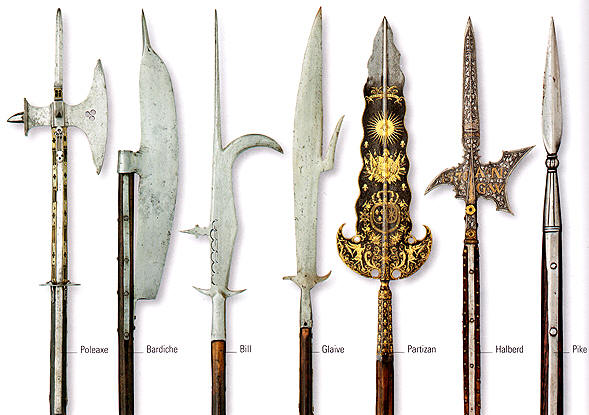
If your human character turned out to be from Russia, you might be tempted to make the pole axe your choice weapon, simply because you received an automatic +1 to hit with it, like an elf with a long sword:


It really does make sense.  If you're a fighter, trained in your native land, it's only natural that your training would more likely be in the use of native weapons.  It follows from there that a Russian would be more adept with a partisan that a Spaniard, who would perhaps find it easier to use a rapier and dagger simulataneously (the dex penalty would be reduced, rather than offering a 'to hit' bonus for either weapon).

This makes sense to me.  It also makes sense that Norwegians, Swedes, Finns or Russians might be better at fighting bears, while Egyptians, Berbers and Sudanese would be better at fighting elephants.  There might be a whole host of little benefits, some of those being additional benefits being applied to dwarves, elves, half-orcs and so on.

Haven't settled down to any design, but I think it would be a fun angle to play around with.

Thursday, October 24, 2013

Slings

At the beginning of Malcolm Gladwell's David and Goliath, the author addresses the deadliness of slings as terror weapons in an adroit, redesign-encouraging passage:

"Slingers had a leather pouch attached on two sides by a long strand of rope. They would put a rock or a lead ball into the pouch, swing it around in increasingly wider and faster circles, and then release one end of the rope, hurling the rock forward. Slinging took an extraordinary amount of skill and practice ... but in experienced hands, the sling was a devastating weapon. Paintings from medieval times show slingers hitting birds in mid-flight. Irish slingers were said to be able to hit a coin from as far away as they could see it. And in the old testament book of Judges, slingers are described as being accurate within 'a hair's breadth.' An experienced slinger could kill or seriously injure their target at a distance of up to 200 yards ... imagine standing in front of a major league baseball pitcher as he aims a baseball at your head. That's what facing a slinger was like. Only what was being thrown was not a ball of cork and leather, but a solid rock."

There's more; it's a very good book. Gladwell's point is that in the Goliath vs. David conflict, David is actually the far deadlier combatant. This detail is also added: "... a typical size stone, hurled by an expert slinger, at a distance of 35 meters, would have hit Goliath's head with a velocity of 34 meters per second, more than enough to penetrate a skull ... in terms of stopping power, that is equivalent to a fair-sized modern handgun."

This is all fascinating, and in the light of the above many DM's would be encouraged to alter the amount of damage from a sling from a mere d4 to a d6 or a d8. Some might even be encouraged to create a possible rule where an accurate hit from a sling would have a 1 or 2 percent chance of death for the opponent ... because that is the way that things like the above are usually interpreted.

But note that, while Gladwell makes his point, he is careful several times to qualify the effects as coming from an experienced slinger; that use of the weapon was extraordinary; that the hand-gun stopping power was something an expert slinger could accomplish.

The paintings of slingers hitting birds were not intended to be representational of every slinger, everywhere ... they were examples whereby the painter was IMPRESSED by the event. The description of Irish slingers hitting a coin is the sort of thing that either the Irish would say in order to boast of their accomplishments, or something the opposition would say as a rumour sweeping through a camp. So it would be true with the Book of Judges, which anyone would have to admit was a set of propagandistic tales of the first order.

I don't doubt that some slingers could do all of the above. There's no question at all that a slinger could kill at 200 yards. It is not the deadliness of the sling that is in question, it is whether or not the average, non-expert, non-extraordinary soldier could pick out a specific target at 200 yards and, with a sling, hit that target so squarely that it would react as though it were struck by a bullet.

And the answer to that is no, certainly not.

There is a tendency to presume that when anything is described in an historical context about an event or a practice, that this is a representational description. It would be like Alpha Centaurans reporting on events they had seen on Earth and writing down the words, "Humans are able to throw balls of cork and leather at 100 miles per hour!" (or whatever unit of measurement they would be using). Not ALL humans, obviously! Just some humans.

So when you read about a sling killing at 200 yards, does that mean a sling aimed at something 200 yards away and then consistently and predictably hitting target after target at that distance? No, it doesn't. It means we found one body lying in the dirt, with a stone in its head, and someone said, "Wow, those slingers are two hundred yards away ... that's amazing!" Chances are, in the heat of battle, the slinger probably wouldn't have known they had killed that target; they're just slinging like mad, keeping up a steady volley of stones in the direction of the army that's coming on, and hoping they do the most damage possible.

One reads the same sort of assumption error when long-bows are described as killing targets at 800 yards ... and then a DM vastly increases the range on their weapons in the game - because that sounds logical. It's bee proven that a bow can be accurate at half a mile.

That's "can be" ... but does that mean "will be in this specific instance"?

Because, really, it's the will be that matters.

Here's something else to consider, while we're pondering the above event between the slinger David and the opponent Goliath. Off hand, with all the memory you've got, how many recorded encounters can you recall between a single slinger and a single target where BANG! ... one hit, and the target died?

Myself, I can only recall the one.

I have a rule in my AD&D version of the game that if you roll a natural 20, the damage is doubled. Thus, the sling would do 2-8 (d4x2) rather than 1-4. The player then rolls another d20, before doing damage, and if another natural 20 is rolled, then the damage is tripled (d4x3). Another d20 is rolled, and another natural 20 causes the damage to be quadrupled. And so on. As long as sequential 20s are rolled, the damage is increased in kind.

The chances of rolling two natural 20s is 1 in 400. The chances of three, 1 in 8000. The chances of 4, 1 in 160 000.

I have had four 20s rolled during a combat at my table. So the odds I haven't seen are 5 20s, or 1 in 3.2 million. But once the four 20s were already rolled, the chances of that had been reduced to 1 in 20.

With all the slings that have been fired in all the years of history since the Upper Paleolithic, we have this one account. Gladwell describes it in his book almost as if it were a foregone conclusion ... but even the people who witnessed it chose to describe it as the will and hand of GOD, and not an obvious result; and that particular way of looking at that particular event has not been shaken in the 3,000 years of history since David, even though for all that time slingers have been hitting birds and things within a hair's breath and coins as far away as they could be seen. Where is the written account of someone in the Roman era saying, "Yes, well, don't stand facing some guy with a sling, because that's pretty much a guaranteed death." There isn't. Slingers - with an S - are terribly, awfully dangerous. A slinger - one - well that pretty much depends on the individual, and whether or not god is on that individidual's side.

I don't disparage Gladwell's book. It is a spectacular book; you're an idiot if you don't buy it and read it. I have every reason right now to believe that Malcolm Gladwell is the smartest man on the planet. Gladwell would be the first to disagree with me. All I want to say is that where we are adding up the logic of things, we have to be careful not to presume that because A is true, B is true as well; because we don't have any evidence that B is true. We haven't actually done any groundwork on the effectiveness of slings used on a battlefield where combatants are massed in the tens of thousands.

We have done a lot of study, however, on the use of rifles on such battlefields ... where we can demonstrate that YES, rifles in the hands of experts can be counted on to hit and hit and hit targets up to half a mile away. And guess what? In actual combat, it's extraordinarily doubtful that this accuracy accounts for much. There's too much mayhem and distraction and targets that can't be seen and a motivation not to actually shoot at people (people really would rather miss) to be certain that accuracy is about anything except a pissing contest performed by military folk on a firing range. I would like to see the accuracy obtained from two soldier in opposite, open positions, firing in each other's direction simultaneously at targets a foot and a half to the left of the opposite soldier. Now that's research.

David just happened to roll an awful lot of 20s all in succession, just enough to kill Goliath. I don't think the damage done by a sling needs to be changed at all.

Tuesday, July 9, 2013

Armor Weapons Tech Table

Recently, the post I wrote in 2011, Rethinking Intelligence, has make a terrific jump in page views. I have no idea why. Recently, however, I have been rethinking some of the ideas I had for applying Civ 4 technological development for monster intelligence (and I have no idea where that original post is), which has led to this.

The basic premise would be that monsters would have a "cultural intelligence" which would not necessarily correspond to that of the monsters individually. For example, humans would have a cultural intelligence of 18, even though individually their intelligence is average. This is because while most humans are not necessarily geniuses, they are able to take advantage of the inventiveness of genius ... and therefore, able to use technologies which individually they could never have invented.

The tendency in D&D is to assume every monster has the same cultural intelligence. Goblins and kobalds, described as low intelligence, are able to use bows or make armor every bit as well as most other cultural races ... while the 'very' intelligence of dwarves or the 'high' intelligence of elves does not expressly improve their armor class or weaponry past a +1 bonus to the latter - which isn't enjoyed by certain other creatures of similar intelligence.

This homogeneity grew from a lack of strategy; having invented intelligence, there was no follow through on how that intelligence practically affected the gaming world.  Intelligence was primarily invented as a limitation for magic spell use; later it was incorporated as a generic die check for the purpose of limiting character comprehension below that of player comprehension.  But the actual scope of varied monster intelligences in terms of how that affects monster cultures - for that, there are no details at all.

The first problem, then, would be to determine just what makes a cultural intelligence. Obviously, the intelligence notes in the various monster manuals are insufficient, since as I said it only takes a few geniuses to raise the cultural intelligence of the entire race. The problem is, I think, that a practical range of intelligence was never suggested. Clearly the range for humans is not 9 to 11; the range for goblins can therefore not be 5 to 7.

But need it be 3-18? Isn't it desireable that various races be given a wide-spread range on stats like intelligence and wisdom, whereas for other races the range is very narrow indeed. Why not designate some humanoids as barely out of the stone age? Why not limit gnolls, for example, at an intelligence of 12? We could posit hill giants at 8, stone giants at 10, frost giants at 11 and so on ... giving us a wide range of differing technological availability for each. Humans and demi-humans, obviously, would enjoy the intelligence limitations imposed in the Player's Handbook ... but all the other races are entirely up for whatever particular the DM of that world feels appropriate.

Suppose that we took the various elements of weapons and armor development as composed in the Civ IV tables and stretched them over the cultural intelligences we designate. Clubs for warriors, axes and spears for bronze age, swords for iron age, short bows for archery, long bows for medieval culture, crossbows from machines and polearms at the highest. Once again, yes, I'm ditching all gunpowder development for D&D. And I'm saying that an 18 cultural intelligence for a D&D world equals the equivalent of 16th, 17th century technology.

What we might arrive at is a table like the one below. Now, this isn't meant to be historically accurate, not by any stretch of the imagination. It is intended to determine specific technologies which can be applied to specific intelligences, loosely derived from hints or clues from the various books describing monsters:


Brittle weapons would be those that break easily; my clubs, for example, break on a 1 in 4 when a natural 1 is rolled on the 'to hit' d20. Durable weapons would break on a 1 in 6; tough weapons, on a 1 in 8 or better. The various weapons chosen for each intelligence level are meant to portray a general increase describing flexibility of use, convenience and damage done.

Proficiencies is a measure of the culture's education system, nothing more. It takes time to learn a particular weapon; a more efficient education system enables faster, more complete learning of more weapons in a similar amount of time. Thus, a goblin fighter may train as long as a human fighter, but the human fighter will learn more because the education system is BETTER.

Those multiple weapons are not designated to be alternate power weapons. Why would you train with a long sword if you already knew how to use a battle axe? Your second weapon would be something you could throw ... and then, as technology improved, something you might fire instead. Eventually, something you would throw AND something you would fire. Specialist weapons would be a bludgeoning weapon, or a pole arm specifically for battlefield encounters.

Yes, I'm saying that not all armors would be available to all cultures. The lower cultures would have to get by on leather; the very low cultures, with nothing at all. Of course, there's a chance upper cultures would want to advantage themselves of the increase speed and movement of not being in chain or plate ... the increase in intelligence, specifically, would allow them the option of either.

At last, magic. Humans and demi-humans would know how to make a +5 weapon. Goblins would not. Incidentally, "specials" includes things like the +3 frost brand or the +2 giant slayer. Those items would necessitate a more advanced culture.

Food for thought. Run with it as you will.

Thursday, January 3, 2013

Cleric Introduction & Spells


Been holidayin' ... but I must write something for this blog, mustn't I?  Thus I am offering this past two months work on the cleric.  I trust it will be of some use to someone.  Take note ... much of it is lifted, and does not appear on the subscription data that serves as my own work.  That is why I am not charging for this.  If WOTC wants to find me and give me trouble, I'll have to take this down.


There.  Plenty of content.


Monday, August 8, 2011

The Unreliability Of Firearms

And once again, it's a question of firearms.

Some time ago, Anthony who writes in the blog Of Pedantry suggested putting up a firearms page on the Same Universe Wiki, which seemed like a good idea to me although I don't use firearms in my world.  The Wiki as I imagined it then wasn't intended to be strictly for use to describe my world, but as I published an inordinate amount of stuff there, more than 150 pages, and alternate sources (I think) published 3 pages, it seems like it was made for my world only.

Furthermore, since it is on my blog that I run the 17th century, and Anthony's post included the words "17th century," there seems to have been a connection made.  These last seven months I find myself having to answer questions regularly about why I don't use firearms.

I had asked Anthony to write something about the use of magic vs. firearms on the Wiki page, and he duly complied ... but I feel he did not go far enough with regards one circumstance.

Firearms, unlike hand-held weapons, are not in and of themselves more than just intricate, heavy clubs.  Without bullets, or more to the point powder, they don't deliver a lot of damage.  And while powder is, for use, split up into tiny parcels, during its production phase it tends to be conglomerated into some rather nifty large packets that are just aching for a magic user's intrusion.

Take 30-300 damage
Yes, that's right soup fans, unlike the modern army that can pile up munitions for convenient acquisition by moving armies, with a reasonable assurance that a random shell or spy won't succeed in blowing them to hell, this is all changed when a mage or druid can turn invisible, walk right up to a great big pile of gunpowder, put a fire trap on any convenient keg and then have a programmed lackey open the keg a half minute later, giving the mage time to skedaddle.  Or any other convenient spell of your liking.  If we can train assassins to sacrifice themselves for the good of the state, we only need a first level mage with a burning hands spell to do the job personally.  And the invisible spell can be cast by someone else.

There's no rational, reasonable way for an army in a D&D world to store gunpowder in any conceivable way that doesn't demand several high level mages, and I promise you my little army of low level apprentice-trained casting scum is going to out do your scant number of wizards in the long run.  Answer: armies in a world with magic have to train their warriors to fight with swords, because firearms just aren't dependable.  No matter what suppositions you make, in the long run the first battle you lose because the enemy used magic and swords is going to be the last time you lose a battle that way.

Without anyone willing to spend hordes of money developing, manufacturing and distributing weapons that will likely never work as anything other that complicated clubs, swords and magic will persevere as the only practical options for armies to use.

Oh, and for those who would suggest that armies wouldn't distribute the gunpowder in the field, or store it there in large piles, that only means that it will be the manufacturing centres that will be hit, blowing up every factory that dares to mass produce black powder.  While perhaps some small maker might be able to produce a few pounds at a time in a basement (which I presume is true for my world), it would never be enough for an army.

So sure, a few people might make their own weapons, and use them, but most would never waste the time training apprentices to make a complex tool that will go to waste anyway.  The knowledge of how to make guns would never be widespread.  So expecting to find them for sale in a public market would be foolish.  No one would buy them.  The general sense would be, yeah, they're interesting, but when your gun doesn't fire in an alley, what are you going to do?

It is important to note that firearms were not a hugely embraced phenomenon in human history.  It took more than 250 years for guns to outnumber hand held weapons on the battlefield, mostly because of the consistent unreliability of firearms ... I feel without question magic would tip the balance in the matter, and that firearms were finally just abandoned after their early development in the late 1400s did not prove their worth.  The intellectual energy of the world was put elsewhere.

Does this at last put the matter to rest?

Friday, December 3, 2010

Time For A Break

Why would anyone ever use a battle axe as a weapon?  Forgive me, I ask because the rules in AD&D show that a battle axe does the same damage as a long sword and it needs two hands to wield.  It actually does less than the long sword against L-sized creatures, if you use that rule (I don't).  Therefore, for no gain at all, you're losing an opportunity to use a shield.  Why use a battle axe?

The tendency would be to repair the problem by A) increasing the damage caused by a battle axe; or B) giving the battle axe other power, such as being able to throw it, or that using it as a two handed weapon somehow increases your AC.  Either of which is a problem, since the battle axe is not the only weapon that has problems in the system as written.  No, rather than revamping the weapons damages (its been done), or the combat system to reflect two handed weapons (which must have been done somewhere), it would be nice if the battle axe had some intrinsic quality that made it practical to use as an option.

And I have it.

For a long time I've been playing a house rule that a 1 on a d20 'to hit' was a dropped weapon.  For a time I played it so that if you dropped, you spent the next round recovering the weapon ... but I don't play that anymore.  You lose part of your next turn recovering it, but not your whole turn.  I've considered a modifier so that sometimes you dropped your weapon farther away than at your feet, but not so far.

What I do play is that if you drop your weapon, you roll again to see if you break it.  For years and years, this meant rolling the d20 again on a 'drop,' and if you rolled a 1 a second time, the weapon was broken.  Then the group I played with wondered if you rolled a third 1, and we decided that you would break your arm.  On a fourth 1 in a row, you'd somehow accidentally kill yourself.

We didn't worry much about how the weapon broke, or as I said, how far it bounced.  The modifier I mentioned before could have it that if you threw a 2 on the second d20, the weapon landed five feet away.  Or ten feet.  Or a 2, 3 or 4 on the second d20 had different consequences.  But as I said, I haven't decided about that yet.

Incidentally, during the mass combat I ran earlier this year, I had two broken arms occur from three 1s rolled, and 1 death.  But those weren't quite 1:8,000 and 1:160,000 odds.  Because last fall, a bit more than a year ago, I changed the breaking rules.

Rather than the second roll being a d20, I changed the die to a d6.  I did this so I could reflect the value of cheap weapons vs. really valuable weapons, those which didn't happen to be magic.  An ordinary, crummy weapon, I reasoned, would break 1 in 6 upon dropping.  A 'hard-forged' weapon would break on a 1 in 8.  A 'blessed' weapon, one that had been hard-forged and both lucky and loved in its construction, would break on a 1 in 12.  And a 'mastercrafted' weapon would be the kind made by an artist ... and it would break on a 1 in 20.

The odds of a weapon breaking in any given round 'dropped' from 1 in 400 attacks to 1 in 120.  At once, weapons started breaking as part of normal combat.  Not just for the party, obviously.  Most every weapon used by a goblin or an orc is ordinary.  I thought the party would start shelling out for better weapons, but no.  A hard-forged weapon is three times as much as an ordinary one; a blessed weapon six times as much and a master-crafted 18 times as much.  The party's practice has been to simply double up on the weapons they have, and if they break one in mid-combat, they'll fight with a dagger or whatever secondary weapon comes to hand.  They'd rather be without the weapon and save money, than pay a bit extra to reduce the chance of their weapon breaking.  Go figure.  No one has yet figured out that in the long run it increases the chance of breaking their arms.

But the rule does allow me to make the weapons of high-intelligence races all of better quality, so they don't break as easily ... and it lets me give less breakable weapons as a treasure that differs from another magic weapon.  Granted, it isn't +1, but that beautiful sword I got from that Elven princess doesn't break on me.  Plus, it strongly creates a purpose for characters to build up an armory.  The attrition rate on weapons in a large battle over 20 rounds is considerable.  Overall, this breaking thing has been a successful rule.

I realized, as well, that it also redeems the lowly battle axe.

The gentle reader may never have noticed that there's no price for javelins or quarterstaffs in the books.  No doubt some well-meaning soul has corrected this, thinking it was a stupid oversight, but in fact no.  Either weapon is quite easily fashioned from a stout sapling - taking longer for a javelin than a quarterstaff, granted - and in fact there is a literary source that proves it.  Robin Hood has no staff when he encounters John Little on the bridge (he isn't 'Little John' yet).  The tale goes, he asks for leave to go 'cut one,' and John patiently waits while he does so.  It doesn't take long.  And when Robin announces he's ready, his staff is every bit as good as John's.

The benefit to both weapons is that they cost no money.  They are peasant's weapons for precisely that reason.

Keeping that in mind, then, what part of a battle axe do you suppose breaks, when it breaks?  Yes, that's right, the handle.  A sword or a dagger are both forged as one piece, and if they break, the handle and blade are both pretty nigh useless without being completely reforged.  But a battle axe's heavy blade isn't going to break, since the stress is delivered to the handle, which like the weakest link gives before the head does.  And when the handle breaks, do we need to go out and buy a new axe?

Nope.  We just need to replace the handle.  And the handle is free.

This makes it the perfect weapon for Vikings, or anyone who spends a great deal of time away from civilization.  There's a ton of mineable iron in Sweden, but not a whole lot of towns with blacksmiths to forge that iron.  Can't be making the three hundred mile journey into Stockholm everyday.  Once a lifetime will do, until finally the blade tarnishes and gives out.

And the same can be said for a number of other weapons, such as the flail, mace, morning star, military pick ... they all have easily replaceable handles.  If you want a good grip, and a good balance, they'll take more whittling than a quarterstaff, but we're only talking a good day or two of effort - depending of whether you like to carve your handles or not.

So the question arises for me, since I haven't considered this prior to a couple of days ago.  What's the cost on a mastercrafted axe handle?  Is it really a question of craftsmanship, or is it the wood that's used?  Does it require a master to carve and fit heavier woods - like ironwood or teak - or can anyone do it?

I don't know.  I haven't answered that yet.  Probably, a combination between a battle axe never being mastercrafted, but harder woods providing a 1 in 8 chance of breaking as opposed to a 1 in 6.  Remember, the strongest wood will break if swung hard enough, even against a baseball.

So in the end, if you can afford it, a sword is still probably better overall.  But if you're marching into the wilderness, make sure to bring an axe along.

UPDATE:

I had meant to mention; magic weapons break on a 1 in 20, regardless of material.