Showing posts with label Nobility. Show all posts

Monday, May 16, 2022

Nobles

Okay, so there's this:
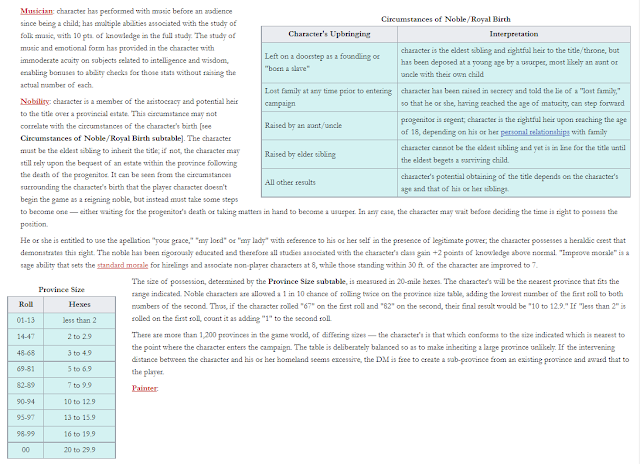


Although on the surface I'm categorically against "balancing" a campaign, as I've discussed before, the above does give me pause.  Is it fair to grant one player a lot of money, potential power, the pleasure of being called "your grace" without having done anything to earn it — except being born to the right parents, with land, and even additional knowledge contributed towards sage abilities?  Is it not, in fact, a bit much?

On the surface, it appears to be.  The chance of becoming a noble is far higher for player characters than the percentage of population would seem to indicate; though of course we're all going to rush to the argument that PCs are "special."  My reasons are more that it's interesting to have backgrounds that are both unique and reasonably legitimate in their chance of occurring.  It is a mere 1 in 200 chance that any character will be a noble, a member of a royal family or in line for ruling a whole kingdom.  That's fairly rare; we don't have to make it 1 in 2000, or 1 in 20,000 just to meet the criteria of demographics.

What interests me is the sort of adventures this builds.  Yes, of course there's the long campaign to get the character whose been kept from the title by a usurper, but in the long run that's just one adventure.  The harder task is to create adventures for the character after he or she has become the Count of Such-and-Such or the King of So-On-and-So-Forth.  Does the character retire, thereafter to adjust laws in the land to suit the player characters?  Or can the players invent plausible reasons why the Queen of Country-X needs to slip off and kill a dragon or two?  Is it all wars going forward, mixed with the horrors of "accounting" and bitterly adding columns of numbers ... or worse, the palace intrigue of Throne of Games?

[sorry.  I know what the title is.  Just saying it could have gone either way]

There are sure to be campaigners who hate the idea.  "Why can't we all just be ordinary adventurers?", they're sure to argue, wanting nothing more than to play the same old game in the same old way.  Thankfully, I'm not bound by this kind of player.  I like the opportunities that a different way of seeing the world offers.

And really, the benefits aren't that much.  The character starts with some nice money — which won't be all that much once the players participate in a few adventures — which can be shared around if the party has a positive, team-structured attitude.  The title is nice, but obviously the party isn't going to use it; if they were asked to do so, that would be quite a joke; and meanwhile, the title's going to get used to help everyone, so it's fine.  The hirelings like the character a bit more, so there's less trouble with hirelings; the character will use his or her knowledge to help the party in general; and the +2 bonus for charisma checks will make this character the front guy when dealing with NPCs.  That's mostly it ... except for the player actually getting power and being able to use it to have the rest of the party executed.

BUT ... that's only an element of a player-vs.-player campaign.  Since I don't allow it, and I'm not going to run your noble character alone, without the party around, I guess you're going to have to see yourself as just another party member.  Poor you.

Since the very beginning of my running D&D starting in 1980, that's always been the baseline.  We're all friends.  We respect each other.  We share.  I must have been busy running D&D when the toxicity of fuck-you-I-got-mine took over the community.  I have experienced it in small packets: game worlds I played in once, and never again — and even, in some cases, for less than an hour before getting up and leaving.  The occasional player I've had online who clearly entered the game with Goggles of Selfishness +4.  No doubt, one has to be wary.  But it is possible to play this game without worrying that making one player a noble will break the party's unity.  At least, between me and my friends.

So ... sometimes I don't know what it serves to create rules like the Background Generator in the present climate.  I like 'em.  The page is 195,446 bytes so far, which would rank 4,744 on the list of longest pages that occurs on Wikipedia.  And I still have lots to go.

Wednesday, August 7, 2013

Correcting Little Errors

Just a word or two about stereotypes.

In the last post, the well-meaning Friend of Gort made the assertion (with all good intentions) that most nobles left their lands in the hands of stewards and such, and spent their lives involved in court intrigue and other things (not his exact words).

This is, in fact, a load of shit. No disrespect intended ... it is the same load of shit that Hollywood and many modern-written tales would have you believe, based upon the one court in all the universe, that of Louis XVI in the 18th century. It isn't even true of the Sun King Louis XIV, though many poorly educated scholars would have the gentle reader believe it is.

I don't venture to say that there were LOTS of nobles wandering about court, attending to the King and his household, filling up the Royal Apartments and so on, or that the Versailles wasn't a literal playground of intrigue and other man-on-woman sports. I am only saying that this would not include the 'majority' of nobles.

How do I know this? I read books.

If you read books of the actual period, you'll find that very often the noble is very much in his castle, mostly because the noble is flat broke, trying to make a go of a business that isn't very forthcoming, in some obscure part of Gascony, Leon, Naples, Mother Russia and so on. From art history we know that the Medici spent most of their time at home, that the Borgia's certainly did, and so did the Estes and the Sforzas ... largely because to step away from their homes in Northern Italy would mean immediate seizure of said homes by brother or son, not to mention that most of these fellows were not all that popular outside their immediate environs. During the Mongol hegemony in Russia (13th to 15th century) the nobles certainly weren't sucking up to the Tatar court on the Volga, and collections of nobles anywhere else in the great expanse would have been poor planning. Novgorodian nobles certainly stayed in their backyards, as did those of the Galician kingdom under David, who had to be on hand to protect his people from the Magyars ... who were a very rural, dispersed tribal people through most of their history and really not free to wander about Budapest (or Buda & Pest, as purists insist). Most of the German Princes had no court to attend, since the Emperor's Court wandered considerably. The Teutons, the Swedes, the Finns and the Norwegians were made of tremendously isolated provinces and did stay at home.

In literature, Shakespeare repeatedly describes the local nobles preferring to be at home, not to the court, such as in Much Ado About Nothing or Twelfth Night; the feuding families of Romeo & Juliet are living at home; the King and his companions are where they can fall in love with country wenches in Love's Labours Lost; and of course the Duke isn't actually stupid enough to leave the city in charge of Claudio in Measure for Measure. Comedies? Of course. But set in the life and times of people who could see such things without pointing and shouting, "They'd all be a court!"

Pick any writer of the period, take the life story of any significant person ... Francis of Assisi's father lived at home and tried to encourage his son to take over the state; Voltaire preferred his estate to anywhere and so did Kant. Hundreds of nobles preferred the pursuit of personal interests to court life, and in fact many courts had to make it a law that nobles must attend court a certain part of their lifetime - because nobles would rather not do so. If this is not enough convincing, try Simon Schama's Citizens, which is in large part about the oppression of the world's most popular court making it impossible for nobles to live their own lives AT HOME, bringing about the French Revolution ... and ultimately how very, very long it takes to find all the various nobles and have them executed.

In short, there are many, many more nobles in the world than those who happened to prefer court, and to argue that MOST of them did not attend their own estates shows a gross ignorance of the subject material. Time to go read more.