Showing posts with label Cold Start. Show all posts

Sunday, December 31, 2023

Around the Meadow

Yesterday's post felt a little rushed, and not in context, so let's slow it down.  To wit, how do I talk like Lieutenant Dan to a group of 12 y.o.'s, when I'm not one (though I appear to be), so as not to scare them off.  Taking note that in the film scene quoted, Dan is neither abrupt or rude or cruel, though he does mock Bubba's lip and there's a light tone of contempt — which any soldier out of boot would expect from an officer, and which any child also expects most of the time from someone (even another child) who knows something they don't.  It's second nature.

The first time I went around the meadow feeding chickens, so to speak, I struggled quite a bit with talking to my peers, as I seemed — to myself — to be somewhat ahead of the game regarding schoolwork and reasoning what was going on with parents and teachers ... and I did offend my schoolmates quite easily with my nature.  Yet I learned how to make friends like anyone does, which is a combination of saying things that are appropriate to their ears and not saying things that aren't.  In those years between 9 and 16, however, I never made any "true" friends, which I'll define as those to whom we can say anything, because it'll be perceived that whatever we have said, the listener is ready to think there must be some good reason for it before immediately jumping to the conclusion that we've irrationally turned asshole in the last five minutes.  Such people are rare.  I've never known more than three of them at a time.

Going round the meadow a second time, as this series proposes, would certainly be troubling.  At one time, we'd be possessed with considerable knowledge of how to give support for our peer's feelings, and definitely what not to say, and in addition how to quickly subvert another child's assumptions and actions.

Take a common incidence for a school yard in, say, early 1975, about the time I was in grade 5 — a fight after school.  These were usually grappling, clumsy affairs, based largely on strength and will, and very little on skill.  With the mouth I had, I'd been in about a dozen such fights by the time described.  I'd learned how to make a fist, that I should try to hit first, to obtain a headlock on the other and to avoid landing on my back.  Because I hated fighting, I couldn't make myself hit hard, or aim for parts of the body that would have hurt either my fist or aim for my opponent's eye or nose; I usually went for the cheek, which didn't help me much, though I couldn't understand why.  Like most boys of age 10, I knew nothing about balance.

My father, nor any other relative, had never taken me aside and taught me how to fight ... and though my father didn't encourage it, he didn't discourage it either.  He grew up in rural Alberta, in small villages, as the lone son of the one room school-house teacher, my grandmother.  Obviously, he remembered fights — though he never spoke of them.

It may seem strange on a D&D blog to speak about the sort of brawling we did as children, but these things are educational affairs.  I can imagine myself in such a fight now, without effort, as a 10 y.o. with my present knowledge.  The stance, my readiness, knowing not to swing but to punch, knowing to rest my energy on the balls of my feet, remain flexible, strike fast, avoid clenches ... so on and so on.  Yet I'd also know, which I couldn't know then, that the other fellow didn't want to fight, either.  At the time, they always seemed so sure of themselves, so remote, so ready to hurt me — and none of that was true.

I had a fight in grade 5 with a classmate named Davy.  Much later on, he and I were able to sit out back of my high school and complain about teachers and classes when we were 16, though we never became friends.  When we fought, he seemed furious and hating and implacable; but today I know a lot about Davy I couldn't have possibly known then — that I didn't know about him even in high school.  Davy's father was one of those that beat his children and his wife; just about daily.  This came out about the time I'd reached my early 20s, when Davy's dad was arrested and imprisoned.  Davy's drive to hurt me came from that classic drive to feel empowered, when the last thing he felt every day was empowered.  The last thing I'd want to do today is fight or hurt Davy; and I think, had I the chance, and despite the ring of boys surrounding us who were mostly on his side, I could talk Davy down.  I'd sure try.  I'd engage him just enough to keep him at bay, as I was forced to, but I'd be talking the whole time ... whereas the first time around, I was too scared, too unhappy, to appreciate that Davy wasn't a monster trying to hurt me, he was a helpless victim who needed someone to hate as much as his father hated him.

If we went back to be children, knowing what we know, we could never be one of them.  We'd always be ready to act from our awareness and our experience that didn't fit with how a child could.  Reserve it though we tried, our adultness would always come out in ways we didn't expect; but we'd know how to play that.  We'd know what needed to be said next.  We'd always be apart from them ... but in understanding the hell-horrorshow that children go through from both sides, happening right in front of us, we'd know the only thing we had to do to have them like us is to want nothing from them.

Much of this series has been about the power dynamic between adults and children.  This hopefully blends with the readers' comprehensions of their own childhoods — if they can remember, through the nostalgia, what it was really like to have every moment of our lives controlled and hounded by those who were trying to do their best by us, as they saw it.  Every authority we knew wanted something from us — generally for the right reasons, but at the same time for reasons we couldn't understand as children.  Any voice of authority that spoke to us with respect or appreciation — as some teachers were able — instantly became our favourite.  Any older kid who defended us, or who seemed to grasp our point of view, became idolised.  We were trained to follow.  Given the chance, we'd rush to follow anyone strong enough to lead, who at the same time could accept us for who we were, not whom they wanted us to be.  Thus we drifted into the influence of a friend's big brother, the teacher who made jokes or the school janitor who smiled and remembered our names.

Don't get me wrong.  Ninety-nine times out of a hundred, it was a good influence.  I never personally met that bad one.  Most never did.  Ha.  I still remember Mr. Schmeid, who worked as a janitor in my elementary school, getting his job back when the school re-opened after the fire.  Years after my leaving grade six, because I still lived in the same neighbourhood, if I chanced to meet Mr. Schmeid at a shop or walking, he'd remember my name.  That's a special fellow.

In case painting all around the borders hasn't made it clear yet, this is what a good DM is to faithful players.  Not a tyrant, not a boss ... and not an equal either.  He or she is someone who is a step ahead, who understands the player's situation and dilemma, but who also understands why and for what good reasons players — like children in school — have to be treated as people who still need to learn things about what they really want and what's good for them.  I don't want anything from my players, except that they be better players.  I can't make better players by giving them everything they want, so I don't; but I have to give them some things they want, or they'll never be better players.

More to the point, I don't want anything from them, except that they know how the game works, that they know I'm serious when I'm running and that yes, I'm in authority here.  We're not playing the game together; I'm running the game, and they're playing.

This is the core of Lieutenant Dan's tone and approach to Bubba and Gump.  He doesn't dislike them, but he wants them to survive Vietnam and be of use to the company.  He wants them to understand that this is serious.  That they could die.  That there isn't time or motivation in him to mollycoddle a couple of cherries who very possibly will die their first day in the field — and will die if he mollycoddles them.

That position produces a voice of authority, that a DM must have.  If we haven't got it; if it isn't natural to us; then we haven't learned enough to be the sort of person a DM has to be.  It's that equation that makes us, as DMs, sometimes say, "You're either the type of person who can be a DM or you're not."

At times, I've believed that ... but I'm growing and changing as a person too.  I don't think that's true.  I think its the case that a person isn't a DM yet.  More time is needed.  A greater consciousness of what a DM is, and what running is, and what the goal is, needs to be gained.  Thus I've gone all the way around this barn, and invented this ludicrous supposition of my returning to relive my childhood, to get across.

-----

Not done yet, I don't think.  Not sure.  End of the year, near the end of the holiday season, feeling a bit dry after this post.  Haven't done too worthlessly this year writing posts; 178 altogether.  Not the 300-something of those heady days between 2014 and 2016, though.  Wonder what I need do to find that mindset again.

Happy New Year.

Saturday, December 30, 2023

It Happens That Fast

Lieutenant Dan:  Look, it's pretty basic here.  Stick with me, and learn from the guys who have been in the country awhile, you'll be all right.  There is one item of GI gear that can be the difference between a live grunt and a dead grunt.  Socks.  Cushioned-sole, OD green.  Try and keep your feet dry.  When we're out humping, I want you boys to remember to change your socks whenever we stop.  The Mekong will eat a grunts feet right off his legs [begins dialogue with other soldier]

Forrest Gump: [narrating]  Lieutenant Dan sure knew his stuff.  I felt real lucky he was my lieutenant. [background given about L.D.]

Now, go shake down your gear, see the platoon sargeant, draw what you need for the field.  If you boys are hungry, we got steaks burning right over here.  Two standing orders in this platoon.  One — take good care of your feet.  Two — try not to do anything stupid like getting yourself killed.

Forrest Gump:  I sure hope I don't let him down.


Make some of the words more applicable to D&D and not Vietnam, the above is a platinum demonstration of what a DM should say to a new player entering the campaign.  I vote for, "Keep track of your numbers.  Hit points, experience.   Try to be accurate when recording your totals.  Mess up on your arithmatic and I'm not going to front you points you didn't properly record."

Except I probably will, but I don't want the players knowing that when they start.  Its not just the words or the sentiment.  In the film, Lieutenant Dan talks down to the both of them; and comparatively, he talks faster and with less politeness to the soldier (in the clip, not included in the above quote) who isn't new.  Speak in a hardened, serious tone and we send the message that these things matter, that we care about these things, that doing something that got the player's character killed would be a BAD thing and something that we'd view as stupid.

Take that position.  Don't quantify it, don't ease off on it, don't let the players think you don't mean it.  Look at Gump's response.  That's is dead on the attitude that every one of my present day players have; and something that a lot of my online players felt also.  "I don't want to fuck up.  I want to show I'm able to play intelligently.  I want to do well.  I don't want to disappoint Alexis."

Is that wrong?  Depends on what you want.  Many readers right now are asking, "Why would I want to play in a game with that on my shoulders?  That sounds like a lot of stress.  I'm not going to willingly put myself in a weekly situation where I'm trying to live up to someone else's expectations."

But if, as a DM, we do this right, the players'll comprehend the other half of this equation:  If they don't show up at all, they'll disappoint me for sure.  And that disappointment is going to go on, with them being bitter about it, because they don't even know why they feel that way.

Again, it's human nature.  There's a natural compulsion that's always at work arguing that we don't want to miss out on something.  In this case, a really good game of D&D.  And then here's this DM, talking like my participation doesn't even matter to him.  Like he doesn't need me.  And though he's expressing a bunch of expectations about my behaviour that I basically agree with, he's doing it in a manner that's frankly a bit rude and dismissive.  What makes him think he can talk to me this way?  What makes him think I even want to play in his game?"

Yeah.  Exactly.  What.

Here's the thing.  I don't need players.  I am shoulder-deep in players.  Any time someone drops out of my present campaign, there's at least one more person waiting in the wings, ready to join.  They know what I am, they know how I speak, they know what they hear from my present players ... and they know there's an expectation if they join, because before I need to tell them, my players already have.

I offer something that a lot of DMs don't have.  Certainty.  Like Lieutenant Dan, I know my stuff.  My game moves.  The players like it.  I know they like it.  And in that atmosphere, they don't want to disappoint their fellow players, either.  This is how a bond is formed.  Everyone cares.  Everyone wants to be there.  Everyone wants to try and do well.  There's no room in their hearts for any person who shows up and won't get on board with that.

Much of a new DM's problem arises from a strong desire to win over new participants with promises, encouragements and a powerful desire not to offend the would-be player.  We perceive, because it makes sense to us, that if the game world sounds really interesting, they'll be interested.  If we offer great opportunities and possibilities, they'll think, "Wow, I want that."  And we think that their participation won't happen if, my gawd, we say something upsetting.  So we speak carefully and, often without meaning to, make compromises.  The would-be player suggests doing something, or running some character class or race, that actually isn't in our game, and we find ourselves saying, "Well, that might be possible."  Or we say, "Um, well, actually, there aren't any dragonborne in my game," in a way that sounds pandering and unsure.  We don't speak affirmatively.  We speak with a desire to please.

And people ... hate ... this.  It's counterintuitive.  If we're seen as uncertain or apologetic — even if we don't actually say "sorry," but our tone suggests we might do so — then we're seen as weak.  Anyone weak can be ignored.  Or gotten around.  Or replaced with someone else ... anyone else.   A weak DM is sure to be a bad DM.

It's not reasonable.  It's not fair.  But it is.  Pander to the players; suggest that our perception of the game's structure is shallow or superficial; and the players will instinctively understand that we're trying to appease them, that we need them ... and that if we need them, we can't possible be any good at this.  They won't trust us when we say we're ready to run.  They won't believe us.

And the worst of this is that all this takes place without thinking in the listener's head.  It's a lifetime of automatically understanding who's important and who isn't.  It takes less than 2 seconds for the listener to rate us as one or the other.  Eight spoken words.  Probably not even all of our first sentence.  We get dismissed that fast.

The question is not, should we be Lieutenant Dan?  The question is, can we be him?  Do we have it in us.  Is that who we are?  It involves a risk offending or driving away players.  While understanding that anyone we drive away like this, we don't want as a player.  I don't want that kind of person in my campaign.  I don't need some sook who's going to quail at some phrase or concept, because it doesn't fit their narrow and fragile universe.  I want soldiers.  Player who have it in them to stand up and take it on the chin.  Players who feel confident enough that they think, "Sure, I don't want to disappoint Alexis; but I'm not going to, because I can handle this."

I don't need anybody in my game who can be offended because I don't talk sweet.

Friday, December 29, 2023

Impossible Things to Make

I believe the best traditional D&D maps being drawn are those done by Dyson.  Each is rendered in an evocative, all-too-familiar style that most  equate with the height of height of D&D art.  Poignant details are included with painstaking patience, from the bits of gravel represented by various black dots scattered throughout, to the shaded hatch that's been applied around the useful hexes.  Time is taken.  And the effort is, for most, "wow."

Deconstructing the image, I'm first struck by the method, which is fully on display.  Dyson repeats the map formula over and over, no differently than I do with my earthly depictions; and like those, should I wish to acquire the ability to reproduce the work shown, it's a matter of tracing and absorbing the detail one line at a time ... although this is by no means easy to do.

Next on display is the artist's manner.  Each layout is planned with precision, to provide not only the appearance of the dungeon's halls and corners, but a clear aesthetic effect, most often lost to the viewer.  The exact placement of the empty spaces is as important to the eye as those that are filled, as otherwise the presentation is a dreadful mess.  One could reproduce the skill shown above, but the understanding of the skill's application — that requires a special perspective, one that many who are unable to deconstruct work would also be unable to reproduce.

Finally, we have motivation.  Dyson is deeply immersed in the project of producing like maps, though perhaps not specifically with any one representation.  The method and manner aside, the proliferation of maps on the site linked is many, many, many.  So many that, should one desire a map like this, with some specific need in mind, one would only need to scan through the examples that exist until finding what's needed.  There's a host of choice available.

For myself, I've grown dissatisfied with any form of map not of a real place.  Like most, I too was once enamoured with maps of Middle Earth and elsewhere, attempting to create my own such examples — some of which I sold to other would-be DMs at exhorbitant prices.  In today's money, $365 apiece, because at the time it was definitely a seller's market.  It's a wonder I didn't keep at it, except that I foolishly thought of myself as a writer and not an artist, and so I left off.

Should I have another kick at the can, however, I think I'd definitely give over a goodly number of years to physical artistry.  I'm aware of what I said in an earlier post:  that if it's something I'd be ready to do in the past, why don't I just do it in the present?  Why not become an artist now?  Granted, I'm nearly 60, but there's still plenty of time to invest in copious amounts of hand-drawing and other techniques.

There are things to consider there, however.  First and foremost, I'm not done writing all the things I want to write, which would all have to be put on hold to become an artist.  If Da Vinci had dedicated himself to actually building a flying machine, instead of drawing one and perhaps — as depicted in the occasional story or film — doing a few tests, we wouldn't have the Mona Lisa or The Last Supper.  On the other hand, perhaps the 15th century might have acquired a flying machine, or perhaps sufficient prototypes to make that happen in the 16th or 17th.  In which case, would a few paintings really matter so much?

Either way, it's robbing Peter to pay Paul, which is a reality that every artist faces once time begins to run out.  On the other hand, were I transported back to being 9 y.o., I'd have fifty additional years before getting back to where I am now.  I'd certainly be willing to dedicate at least a third of those towards the ability to draw like Dyson.

In addition, I grew up among a family of painters.  My grandfather had achieved a slight fame as a painter of birds in western Canada, while my father and brother both invested many hundreds of hours in their painting between my being 9 and 18.  Eventually, my father would win several city-wide competitions with his landscape paintings, and once in a field that included much of North America, when his work won first prize at the Calgary Stampede Exhibition.  His talent was unquestionably real, at least for his audience.  He'd have been a marvelous resource if I'd wanted to take that route, once upon a time.

The Wales map I spoke of creating would be an artwork.  Using the Michelin map as a guideline, and pursuing books about Wales for images and descriptions, and finally essaying a trip to the University of Calgary to get a good look at contour maps, I'd be able to acquire a decent premise for presenting elevational characteristics in my final work.  It's all rather funny, of course ... since in 2005, Google Earth is going to make all that research and presentation redundant — not that it matters.  A human-made map is more than merely the image it presents.  It's a physical artifact, drawn upon a physical surface, expressing something that most persons can't imagine themselves expressing.

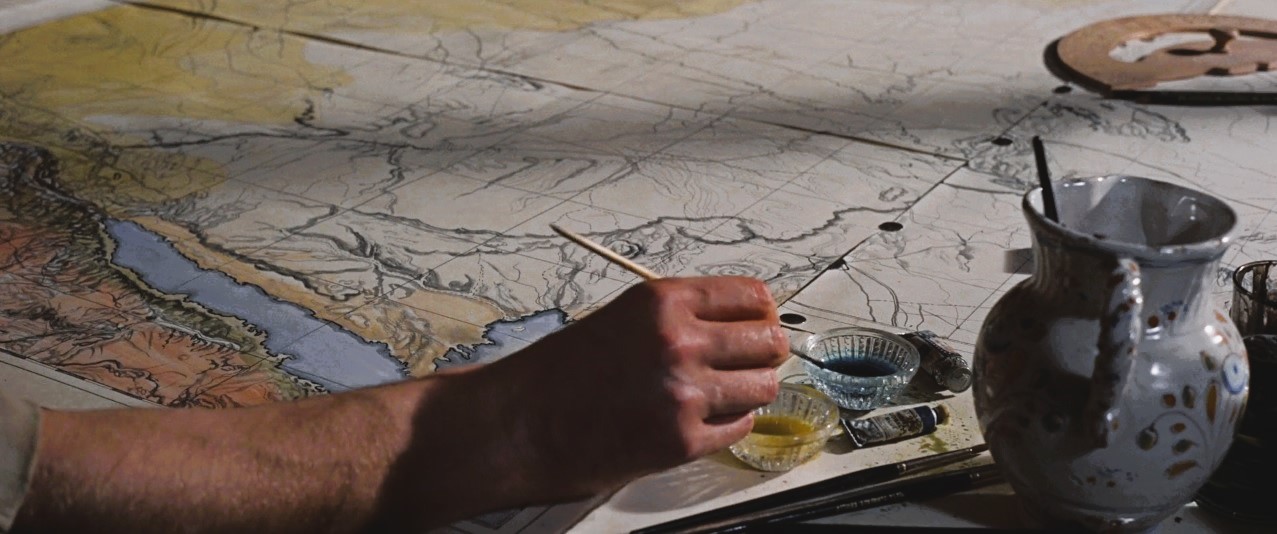
This is a screen shot from a 1962 film; bonus points if the reader can recall which one:


It clearly shows a time when maps were painted onto a paper surface; the thickness of the paper is evident from the paper edges shown — which, additionally, gives a sense of the way in which maps were built piecemeal.  In context, what's depicted is a military map; the hand belongs to a soldier.  This means the rendering has to be sufficiently accurate to campaign with, understanding that a sufficient error might result in the deaths of hundreds of men.

My imagination is belittled by the idea that I'd ever produce work of this quality, in a way that it never can be by Dyson's work.  Given time and motive and practice, I'm quite certain I could reproduce Dyson's technique and appearance in a year or two — given that I've already overcome many troubles that artists encounter in that I know how to work towards a goal.  I could never manage Dyson's output; I'd grow bored of the procedure long before then, but only because the maps represent nothing.  I'm able to keep working at my maps of the world because of the source they depict.  I could, if I wished, go there.

But the painted map above — I am simply in awe.  I recognise that, had my mapmaking interest as a boy led me to mapmaking as a career, I would have ended in some semblance of creating the above ... but I would have needed help getting there.  I can see in the example shown, how someone has drawn the topography, creating a three-dimensional effect that astounds me.  I can see the painter is clearly doing only a part of the work, adding the shading over the sea and the land (blue and yellow water colours shown) ... but my my my, there's so much going on here that I'd be honestly fearful to try.

There could be much here, however, that I'd want to incorporate into my map of Wales.  A run of accurately drawn three-D hills and low mountains, river courses and that delicious shading along the coast.  I learned how to reproduce the colour with the use of high-quality pencil crayons, held at a 30 degree angle above the page and gently moved back and forth over the area like a brush, maintaining a high consciousness of when to shift the crayon and when to sharpen it — which was again done with a quality sharpener used in draughting.

I can recall numerous rules that applied in the practice of making those maps I'd make in my mid-20s.  The table was washed and hand-dried before the evening's work.  My hands were washed too, and dried, and then allowed to air dry.  Paper, over a long period, is notoriously susceptible to human oils ... though a very tiny amount of human oil is a good thing, as it lends a certain shine to 60-weight paper that produces a positive glow.  I couldn't drink or eat while working, nor allow anyone else near, since a single spot of liquid or grime could ruin the long single page being worked upon.  And at the time I had a daughter aged 1 to 3 around, so I needed my wife to manage the darling thing while I worked.  I had no separate room to work in, so I worked on the dining room table we owned, getting started after supper.

I added hills and mountains to those maps, but there was nothing accurate in the exact placement of a hill or mountain "symbol."  Going round again, I'd want to shoot for that.  Maybe later, take courses that would teach me how to sketch and paint the level of map shown in the film shot, but between 9 and 12 I'd at least like to give some approximate semblance to the features in Wales.  I'd have my father show me, and I'd practice with drawing mountains and hills like Bob Ross filling in trees.  It's something I've told myself I should do — but honestly, with online maps, it just so easy to make one mountain and then cut and paste it over and over.

In all this description, however, I've left out the point.  Why go to this trouble?  Why produce the map at all?  How is D&D helped by a map of Wales that's floor to ceiling?  It's just a map — and despite my last post, I'm sure I've changed no one's mind that D&D is a "game of imagination."

Consider the problem of players.  I already know how to make a world, both in the old-fashioned style of the 1980s and 90s and in the modern style of graphic layout.  I'm quite sure I can sufficiently construct the rule-system that I have now over time, at least in partial until I'm awarded to books once again starting after 1979.  It's only five years.  It's been a long time since I considered five years to be a long time.

At some point, as I've said, I'll want players.  I may have some trouble relating to my peers when I'm entering grade seven and they're still just 12 y.o., while I'm past 60 ... but I get along with 12 y.o.'s right now so I don't think that's such an issue.  I've got to convince them, though, that D&D is a game worth playing.  That would be 1977.  Somewhere in the world, there are people playing the basic game by then, but not in my part of the world, so far as I know.  I'd seek it out to be sure, but probably I'd be disappointed.

Then as now, acquiring a player comes down to the same set of obstacles.  For the most part, the game is one, but mostly in how well it's run and not so much in the "idea" of the game.  I've always found the idea to be rather easy to sell — but the game has to be presented in a fashion that people have a concise, inherently practical viewpoint of their participation and the DM's expectations.  This is something that we can talk for a long, long time about, and probably will, but here I'll concentrate on outlining the matter.

"Concise" game-play describes the players' understanding of what the game's about.  In it's smallest terms, D&D is no different from a board game, with the caveat that the players work together, and not against each other.  That point, however, is something that has to be explained and even dictated, in the manner of, "You're not allowed to attack each other.  That's counted as losing the game and you'll either suspend efforts in that direction, or I'll deny you further opportunities to participate."

Note that includes a misnomer.  Within the game's structure, there's no such thing as "losing."  You know that, I know that.  But for a player who has no previous experience with an RPG, it's easier to use terms that are familiar with them.  There's an important distinction in RPGs between "losing" and "failing" — but most board games don't have that distinction.  Monopoly, for instance, is about "failing" to succeed more than everyone else; but it's easier to call that "losing," because that's the acceptable nomenclature.  If you turned to someone who had just lost at Monopoly and said, "You failed to succeed," though factually true, it's probable the response would not be positive.  Most people, with respect to a board game, are more comfortable with the word "losing" than "failing."  The latter is more accurate, however, when it comes to D&D, since there's no one to lose against, while dying is a failure that's awarded with a new character and a new attempt to succeed.  From this the reader should take that when describing D&D to a new player, accuracy is less important than importing the correct mindset into the listener.  Dying = losing is an easy equation.  Use it, and clarify later.

So, I was saying that we need to define what the game's about.  Or, if we prefer, what a successful and ongoing game is about.  Simply put, D&D is about pursuing conflict and reward.  Any other approach to the game, with new players, is certain to produce various degrees of one upmanship and "fucking around," where the player's imagination is given latitude to take the premise of the game and test it's boundaries.  The effect is like putting our thumb on a gyroscope.  The gyroscope continues to exist, but it ceases to be something that draws our attention.

Don't let it happen.  It will anyway, because humans are humans, but if its clear the behaviour isn't condoned by the DM, it might manifest from time to time, but it won't thrive.  Instead, the game will thrive.  Which is the goal.

Thus, the "practical" game emerges.  Discouraged from believing they can "get away with things," the players instead apply themselves to measuring the usefulness of their actual skills and abilities.  These can then be applied to killing monsters and obtaining treasure.  Though the game can be elaborated far, far past the singular model of hack and slash, players have to learn it before they can move on.

No, I haven't missed the obvious flaw in the proposed above.  The question is, how does the DM make it clear that certain behaviour isn't condoned, without the players simply leaving the game?  A failure to address this question is the reason why, O Reader, so many of us have such trouble keeping players, even when we can find them.

We have to be special.  In being the DM, we have to make an impression on a level that encourages the player to swallow things they don't want to swallow, because they in turn want to impress us.  If they're not coming to the table thinking, "I sure hope I don't humiliate myself at tonight's game; all I want is for the DM to approve of my play," then we don't have a chance.  We can't DM.  They've got to feel that they need to live up to our expectations — which means, (a) we've got to earn their approval ahead of time, and (b) we've got to have expectations.

All this content about mapmaking is about (a).  As a DM, when we organise a table, we must be conscious of the need to really stun the players with our apparent capacity to run the game.  An 8-foot tall map of Wales, which obviously took hundreds of hours to create, which in turn looks unbelievably fascinating, is one way — especially when the players are told they're going to be put in this little village right here, such-and-such distance from this hill and this craggy forest.  This is taking hold of the player's consciousness with both hands and giving it a hard shake.  We follow this by hefting up massive amounts of content which we place on the table next to us at the start of the running.  I used to make a show of taking the old heavy rulebooks as a single mass and slamming them down on the table at the start of my games.  Bang! — "All these rules ... this is what I play with.  All of them.  Don't fuck with me."

We'll get on with expectations with the next post.

Wednesday, December 27, 2023

Action and Moment

Were I cast back to 1973 as the writer I am now, I would undoubtedly begin rewriting How to Run, my guide for improving as a dungeon master.  Given that D&D would not come into existence until the next year, and not become widespread until the end of the decade, it would be odd, no doubt, to write such a book.  How to Run assumed that the reader already knew what role-playing games are, and that he or she had already had some experience with being a DM.  I took no time to explain game rules or in comparing one game with another.  I ignored the popularity of games and discarded any notion that it was my goal to "sell" the concept of playing RPGs as something the reader ought to do.  Instead, I wrote exactly what it said on the tin.

I'm certain that a book like that would do well in the 1980s — especially when the D&D market was far smaller, yet large enough for DMs to feel overwhelmed by the game's expectations.  Still, that would be a decade away, and such a book would be of no use to those players I'd want to obtain in Junior High.  I'd want to write it and save it, for the day it could be sold at those game cons I attended in the '83 and '84; but even I have to admit that what the 70s needed was a good, solid introduction to the game from an experienced writer.

I've avoided such a book, sincerely because my few swings at such a manual were dissatisfying.  It's especially difficult in the present.  I've no interest at all explaining how to introduce someone to 5e, or any of the trash products that exist not as games, but as an excuse to preen and simp one's way through mock adventure-based die rolling.  I've no appreciation or consideration for 5e, nor for those who play it, defend it, write about it or claim it to be things it plainly isn't.  If that seems harsh and unfair, for those who don't already know this about me ... please understand that from my perspective, it's as though the Major League Baseball I watched in the 1980s has since been replaced by adult-played children's "T-ball" ... with a world of fans expressing vehemently that T-ball is vastly better than the old, overly difficult and impossible to play traditional baseball.  I cannot resolve in my mind the vapidity, nor the gutless spirit of present-day D&D, in any manner that doesn't leave me feeling either robbed or incomprehensive.  Stupid people have co-opted the game I love.

Thus, should it happen that I could conceive of a solid introductory tome for new participants playing D&D, there's no market for it.  I view the player's character as an extension of the player, with the player's sense and limitations, enabling the player to pit his or her skill against the game's setting and obstacles.  I don't view the character as a stand-alone figure with an invented modality that conveys emotionality and sentiment to things that have nothing to do with the setting.  The proposal that a player is supposed to invent a "back story," such that the character's father was killed and the character is now seeking revenge, strikes me as a stale, artificial attempt to create something the game's setting has been made unable to provide.  The setting motivates action; which in turn spontaneously produces behaviour, much like a transformational chemical reaction that rearranges constituent atoms explosively and well beyond the direction of both players and DM.

Once the players start taking actions of their own accord to compensate for events in the setting, the DM in turn is compelled to respond to the players' actions.  This produces a constant, immersive, spontaneous feedback loop that bangs back and forth so effectively that neither DM nor player wants to let the experience cease.  Thus it's easy to entice the players back, because they want needfully to again take up the series of actions they intended from several sessions back, which have not yet reached fruition.  Throughout every session, the players spend time talking about what they're going to do next, just as soon as the present iteration is complete.  The DM need not waste any time inventing scenarios for the players, once the gyro has begun its spin.  All of the DM's time has to be spent building the setting ahead of the players as rapidly as possible, else the players would be left standing around as if waiting for the next room to get built — a room, I might add, they're slavering to see.

I've written repeatedly how this is done:  every event from the first moment of the game is provided at least one "open door" for the players to look through, to see what's beyond — the "door" being metaphorical.  The method is repeated thousands of times in novels and films; and yet somehow I always find myself speaking to a DM wanting desperately to acquire the method, only to learn that he or she has no interest in reading books or watching movies.  How does a book capture your attention?  How does a film pull you in?  If the reader cannot understand this simple equation, and wants to, then sit and consume hundreds and hundreds of pieces of literature and cinema, even if you only read or watch only the first ten percent of each.  The characters meet a stranger; they stumble across an object or an inexplicably dead body; something already in their possession suddenly acquires some new bit of knowledge that explains it; the party's freedom of movement in infringed by a larger more powerful group; the characters arrive into a situation that's already ongoing; an accident strands the characters; someone with authority is enamoured and invites the party to dinner, for no purpose — but the party slowly realises they can ask a favour of this person; an ineffectual or troublesome member of a character's past appears; the party sees evidence of wrongdoing or persecution; someone asks the party to do something vile, which they won't do; a tremendous accident occurs to the party, or in front of the party, requiring that dozens of helpless victims have to be rescued from some very dangerous situation; the political region changes hands; there's a competition; someone becomes ill; someone becomes unexpectedly rich and publicly so; something powerful and yet benign arrives and needs guidance ...

The list is literally — as the vast number of books testifies — so large that no DM can ever possibly run out of possibilities.  Yet they sit there, on a shelf, in obscurity, while every participant faithfully reproduces the saga of batman one more time.

If I were to describe a role-playing game to those who had never encountered such a thing, I would certainly not use the term "role-playing."  It's woefully non-specific and easily misunderstood, and unquestionably the worst option for what the process ought to have been called.  Using the term, the player is easily duped into thinking a "role" is like a part played by an actor — a part that is scripted and rehearsed repeatedly, and therefore in no way like D&D.  The word "play" is acceptable when applied to a game; I can "play poker" and remain comfortably assured that everyone here understands this is an adult activity.  But as soon as "play" is associated with "imagination," we're rapidly cast into playing pretend, playing house or any number of childish activities that adults shun.  D&D isn't a serious game because it's "played."  Even the acting community has moved away from the term "players" to describe the performers, preferring the more serious-sounding, "actor."

The D&D participant more correctly "acts" within the setting.  Arguing constantly that D&D, and other RPGs, are games of "imagination" only serves to warn adults to stay away, while providing exactly no context for what the game actually provides or what the participants do when participating.  It's corporate buzz-speak, designed to cover up the ever-present difficulty of providing a meaningful setting for the DM to run, beyond the stream of shallow maze-based episodic funhouse concepts that have been the height of company ingenuity these past 50 years.  A setting requires depth and resiliency.  A funhouse is good for five minutes in exchange for the participant's voucher.

When acting upon the setting, the setting acts upon the player:

When I have seen the sea once more,
has the sea seen me, or hasn't it seen me?
Why the waves ask me
the same that I ask them?
And why do they hit the rock
with such a futile enthusiasm?
Don't they get tired of repeating
their declaration to the sand?

 — Pablo Neruda, "The Rider's Song"


The decision to go to a place, to see what's there, to reflect upon what's happened, is the central core of life's experience, and therefore the same centrality that humans experience when playing an RPG.  It makes no difference if the "sea" is imagined or real; the potential for reflection is the same.  Therefore, in fact, D&D is not a "game of imagination," but rather a game of structured moments and tactile proposals arranged to produce specific, quantifiable, predictable, beneficial and immersive responses.

I am not "imagining" an orc, nor am I "imagining" my response.  The orc is defined and I'm accepting the definition, regardless of the immateriality.  My response is defined by the game's limitations and boundaries, in the sense that I know already what I can do; the game's success relies upon choosing the best thing that I can do in this moment.

By arguing that it's a game of imagination, however, we've brainwashed the participants into believing that the solution is to spontaneously create something to replace the orc, because it's new and different, yet offers nothing but an obscure nothingness, since as a player I have no idea what this thing is.  In turn, players are encouraged to spontaneously invent responses that aren't covered in the game's rules — which must therefore be tossed, since there's no way they can apply in this imagination mandate.  This ends in a lot of irrationality and abstractness, producing no concrete feeling for what's happened, what might happen, or even why we're here doing this thing at all.

So I would not, to a group of unknowing persons, argue either that the game can be described as "role-playing" or as "of the imagination."  I'd argue that it's a game in which persons act as generated individuals in a fictional setting, with parameters that are firmly established by the game's rules.  As this is what actually happens when my "players" sit done to "play" in my game world.

This confirms the extraordinarily powerful need for the DM to have a setting, one the DM can understand thoroughly and faultlessly — within human limitations.  This provides the grounding for the participants as they gird themselves up with pre-defined pieces of equipment, their physical being established by metrics for measuring their health, capabilities and action choices.

And so we come back around to the game's map, that of Wales, and it's influence as a setting that I'm devising for the benefit of the players, once I'm ready to introduce them to D&D.  Take note, stated firmly, it's in my interest to ride the actual creation of the game as it will between 1974 and 1980.  I have no wish to create my own role-playing game, nor compete with D&D, nor pretend that's not the game I'd be playing.  All I want is to obtain benefit from all the time I've designed and played the game through the first go-round of my life, to use that experience in the thought experiment that's been proposed here.

Wednesday, December 20, 2023

Writing at 9

So imagine that your 9 y.o. daughter comes to you one day and asks if you'll take her to a music store.  This seems a little strange, because you've never seen her have any interest in music, but of course you won't say no and one afternoon, you and you daughter head off.  You're maybe thinking in your head that instruments cost a lot of money, but maybe there's some kind of installment plan, or maybe after you see if playing an instrument is something that interests her, you can make an arrangement to buy a low-budget version.  For example, I saw a drum kit advertised at a local coffee shop recently for $250 Canadian.

You get to the store and your daughter shows a definite interest in the guitars.  The shop has one she can try, but you have to vouch for her because she's nine.  As she takes the guitar on her lap, however, she does it in a way that makes it seem that she's very familiar with it.  You watch as your daughter automatically tunes the guitar, absolutely engrossed in the activity, and this too seems ... oddly capable.

Then, without warning, without dropping a chord, she launches into Big Yellow Taxi, singing the lyrics spot on, sounding so bloody close to Joni Mitchell that it's freakish ... particularly as you watch your daughter move her fingers along the frets.  You're staring wide-eyed at her; she looks so comfortable playing it might be like she's played the song hundreds of times.  You're so flabbergasted, trying to figure out where this is coming from.  She finishes the Mitchell song and right after, she starts playing Nobody Knows You when You're Down and Out by Eric Clapton ... and you're not sure you know this song.

If you've been reading this series about time travel, then you have some notion of what I'm talking about.  Your 9 y.o. daughter isn't really 9; she's actually someone who aged into being an 81 year old woman who worked as a professional musician for sixty years, steadily building set after set of cover songs for performances she gave at clubs and occasionally on stages.  From her perspective, recently, she found she was dying of cancer and took the opportunity to return to her own 9 y.o. self, some five or six years before the age she was when she actually started learning to play.  She has played Big Yellow Taxi hundreds of times ... and now that she's young again, there's no reason to wait until she's 14; nor does she have to learn how to play.  And you, her parent — who knows none of this, and wouldn't believe it if you were told — have to invent some story to tell yourself that makes what you're seeing and hearing believable.  "Our daughter is a prodigy!" you tell you wife, when you get home.  "You should have seen her.  She was amazing!  I've never seen an adult who could play as well as she does."

Of course, your daughter remembers being fourteen ... and begging you for a guitar, which you resisted because when she first started playing the first time, it didn't sound quite so good.  In fact, she remembers half a dozen conversations you had with her (10 years in the future) that revolved around you explaining that while this music thing was nice, it wasn't taking her anywhere and she really ought to think about going to university.  I don't hold that against you.  Taking a position against a would-be artist who doesn't show a great amount of talent straight off is the safer bet, and of course you love your daughter.  But her picking up the guitar now, and playing like she did, the entire trajectory of her second go-round in the world is going to be very, very different.

And this highlights a critical point about learning.  As we go forward, doing things we like to do, there's a strong tendency to under-value our progress.  We compare ourselves with our peers, or worse, with people who have accomplished great things in the field.  We spend a couple of decades pitching and trying at our tasks and think at the age of 31, "Damn, I've been doing this for twenty years ... when is something going to change?  When I'm I going to stop being so incompetent?"  We don't measure ourselves by the trials we've experienced, or the obstacles we've overcome, especially because we perceive that truly successful people don't have those things.  It seems, to us, so easy for them.

But as the years go by, we do change.  We do improve.  If we keep at it, we'll be lucky enough to have one of those moments that cause us to stop and take stock, thinking, "Wow ... okay.  I couldn't have done that ten years ago."  Those moments are golden.  And if we have them consistently, it's easier to push ourselves creatively than it was before.

I was a terrible writer as a kid.  I had no talent at all.  My teachers certainly knew it; my parents too.  I was good at math, I had a good memory, I found it easy to pass my courses and didn't bother to get A's, because as I saw it, I didn't need them.  Students with a C+ average were graduated to the next grade just like those who worked four times harder to get A's.

I knew what I wanted; I wanted to make maps, I wanted to study statistics and astronomy ... and as grade 4 shaded over the next three years into grade 7, everything else faded away and was replaced with the one thing that I truly wanted to do.  I wanted to be a writer.

This, as I suggest, impressed no one.  I had no aptitude for this.  I did have a loud and precocious mouth, I had a natural talent for finding the fault or the weakness in someone's argument and I had a streaming imagination that poured out of me like a pitcher throwing 100-mile fast balls over anything but the plate.  It turned out, in the long run, that these were the right ingredients.  True enough, for some years I impressed no one with my writing ... nevertheless it poured out of me, day after day, as I wrote for myself.  I wrote down anything that interested me; I made up stories and dialogues and struggled with description; I wrote screeds about things in a diary I kept, that sometimes friends would read; I wrote poetry; and eventually, as I took more and more drama in school, I wrote scenes for us to act out.  In grade ten, I wrote a 7-minute scene (I remember the story very well) that two girls and I performed in a city-wide High School festival.  Didn't win anything, but the audience laughed at the right moments and I felt great.  In grades 11 and 12, the teachers all acknowledged me as a wannabe writer, though their expectations were low.

In university, I joined the campus paper and became something of a small time celebrity for the editorials I wrote.  One got my editor punched in the stomach by an angry woman because he wouldn't retract my statements.  After three years, on the first day of a given class, a prof would read out my name for attendance and then pause, look hard at me and say something like, "Oh, that's what you look like."  It was tons of fun.

It's been 47 years since I made the decision to be a writer.  Trying to imagine what all this experience and practice would be like stuffed into the head of a 9 y.o. boy makes my head hurt.

This is something that's escaped all the movies about time travel, and characters who live for hundreds of years, as we're on that.  It's always assumed that after one life time, surely life would just be so boring.  The elves of Middle Earth live for hundreds of years ... yet somehow they have no interest in doing nothing more than sitting around talking about why people shouldn't do stuff.  They don't invent science, they don't fiddle with technology (reforging a sword like it was is a big deal), their architecture always looks like the place was built once, and now it's fine and never, ever has to be rebuilt.  They live a thousand years, but their population doesn't overwhelm the planet, despite being able to have children.

This is not how we are.  This is how we become, as our bodies begin to ache and break down, as we find ourselves getting more and more tired after doing the shopping, as it's harder and harder to get to sleep at night and so on.  Just at the point when our wisdom crests, there's this equally growing force that compels us not to exploit that wisdom in doing anything that might take a lot of energy.  And so, we think, we'd get horribly bored if we had to live a second 75 years, or a third and a fourth.  What would we do with ourselves, we say.

I've lived almost my entire life in Calgary.  I've ventured out, lived in other places for a few weeks at a time, but somehow, with family here, and work here, and the fact that I can write anywhere, whenever the prospect of leaving has come up, it just seems to be, what's the point.

With a whole other lifespan, I could spend the next sixty years in Maine ... or England ... or Nairobi.  That alone would be a different pattern of life, with new and different pursuits, opportunities and peoples.  I could go on writing, but what other skills might I now have the time to acquire, if I did go back to being 9?  I haven't had time to be a sailor, or an artist, or to work as a humanitarian volunteer.  Having already given a lifetime to being a writer, a skill I'm never going to lose — I can see undertaking any of a hundred new skills quite easily.

"But Alexis," I hear.  "Didn't you say that time travel was just a way of telling ourselves that if we want to do something, we should just start now?  If you want to be an artist, you don't need to travel back in time.  You could start taking classes now."

Except there are still things I'm trying to do now as a writer ... that I'd have to forsake if I started putting time towards being an artist.  I have only so many hours a week that are available to me — and only so many years left on this earth.  I can't afford to squander that time on things that would take my full attention and much time to order to achieve competency.

Ah, but if I went back to being nine, think of all the time that would buy me.  I'd know I was healthy, and that I could expect to live at least until my present age, and remain in pretty good shape — barring an accident.  I'd know what was going to happen in the world, and where not to be on what dates and in what months and years.  I'd have many more years to write.  Which would mean I'd have a lot more time to squander on other things, just as I squandered years learning to write the first time around.

And I'd want to get started on things right away.  I wouldn't want to pretend to be a 9 y.o. bad writer for a few years and plausibly become a good one.  I'd want to start writing serious works right off.  There's no internet to share them.  Self-publishing is impractical.  I can write about D&D but it'll be some time before I can send articles off to Dragon magazine.  The best use to which I can put my writing would be right in the noses of all my teachers.  Those same teachers who wanted to take me under their wing and convince me to get A's the first time around.  Well, the second time around, I'd just go ahead and get the A's.  I'd convince my grade four teachers that I was obviously going to write for a living.  I'd win competitions between schools.  I'd have people tripping over themselves to clear a path for me.  It wouldn't be fair.  I'd be competing against non-time travellers.  But it would be a way to back off my parents about what I wanted to do in my spare time; it would be a way to earn money; it would be a way to find myself in another city going to a prestigious university.  If that's what I wanted the second time around.

I didn't want it the first time around ... and I'm not sorry for that.  But if I had a second time, sure.  Would be interesting to see how the other half did it.

Monday, December 18, 2023

Making a Map in 1974

Continuing with the premise that I am 9 y.o., and following the premise that I'm earning money to buy tools and products, as well as Christmas presents, some weeks go by.  Because I want specifically a Michelin map, none of the map companies in the city (and there were several, which I came to know through my father), it's not available as a general commercial product until the late 1970s.  I checked, calling around town, because research.  So, unfortunately, I have to obtain the address for Michelin maps, through the library because the Yellow Pages are local (but I might get lucky and find a Michelin office in Calgary), write to them with a money order, and wait to receive my map in the mail.  That's most likely a 3 to 4 week timeline.  Just imagine that sort of world.

So I see my school burn down and I'm shipped off to Sir Winston Churchill, as I said.  My older brother, who is in grade 9, and goes to Simon Fraser Junior High, has to walk me and my sister, who's in grade 5, down to the high school where the city has found us rooms to learn in.  Here's some context:


With my house marked with a red loop, the reader can see Dr. E.W. Coffin Elementary at the top centre of the map, at the head of Barrett Dr.  At the bottom of Barrett Dr. is Simon Fraser Junior High, where I went through grades 7 to 9.  Across a large green field at the bottom left is Sir Winston Churchill.  As can be plainly seen, I never had a long walk school, though as I said I did get bussed for a time because my elementary school burned down.  As the reader can also see, my brother wasn't overly taxed by having to walk my sister and I to school.  Though he thought he was.

So I have my drawing tools and I have my map, and I've bought a roll of plotting paper, 40 weight if I can find it, because this paper is designed for draughting and is resistant to smudging.  The edges are very sharp and will align perfectly with one another if care is taken.  This is how we can map strips of Wales and then put them together as the pieces are completed.

Unfolding the map of Wales, we need it to be as flat as possible.  This can be managed by smoothing out the map on a large floor surface — our kitchen floor was large enough — and then very patiently asking to borrow my mother's iron, which at that time must have been a valuable kitchen tool from the importance my mother attached to it.  Then, laying a bed sheet on the map, this being large enough to cover everything in a single piece, and using the iron at a very low temperature, we ensure that all the  crimps and folds of the map are evened out.  From then on we can roll the map up when not in use, like a map should be kept, and beg a cardboard tube from my father's supply, as his work involved his dealing with oil well sites and such all day, and there were always empty tubes good for maps collecting among his things.

Now I've thought about this a lot ... I need to draw graph lines over the whole of the map of Wales; that means a large table, it means a table with a very straight edge, it means needing a T-square and finally, it needs a person who's capable of respecting the desire of a 9 y.o. to do a good job.

In the fall of 1976, I'm going to start grade 7 at Simon Fraser.  And this will introduce me to one of my favourite teachers through the years, Mr. Leavitt, whose going to teach me shop for three years.  Unfortunately, we haven't met yet.  But he does know my brother, and they do have a good relationship.  In grade 7, when my brother started those same classes, the first task was to draught the parts of a stool, then cut those parts out of wood, then finish the wood, then assemble the stool.  When I reached grade 7, I made the exact same stool, though I finished it differently.  As chance would have it, I lost my stool when my parents sold their cabin in 2009 (they just didn't realize it was anything but a stool, and assumed no one would want it).  But as chance would have it, I have my brother's stool still with me, right now.  I don't get along with my brother, so fuck him, I'm keeping his stool.

See, one of my issues at being 9 is that my brother is still living at home.  He's five years older than me and he's a bully.  We share a bedroom together, which he resents; I am able to speak, which he resents; I like to spend time in our bedroom working at my desk, which he resents.  This resentment regularly builds up into periods of hitting, pushing ... and occasionally, destroying things that matter to me.  He will leave home one month after he finishes high school, following a big argument with my parents; until then, I still have to be on my guard.

Anyway, Mr. Leavitt.  It would take nerve to head down to Simon Fraser, walk boldly into a school with a lot of older students, watching out for my brother (who was not the type to defend me against others), in order to reach Leavitt's shop so that I could introduce myself.  As I said, he did like my brother, and my brother liked him.  This is because Leavitt respected competency above all things, and I have to give that to my brother.  Leavitt was also friendly, empathic, able to play outside the guidelines of his role, had considerable latitude regarding what went on in his shop (because much of the work we did there was dangerous) and, finally, loved to teach.  This last could have been written out in large soldered iron metal letters, 20 inches high, and strung along the side wall of his shop.  Leavitt liked very much anyone who would let him teach something.

He certainly had the table and the T-square I wanted, along with other tools for draughting ... and just possibly he might have let me come in on some late Friday afternoon (he tended to tool around in his shop long after classes were done), and let me have a couple of hours use of a nice, big, flat table.

My other option would have to be to approach my father to ask if he'd take me to his office and use a table there.  He worked in a downtown office for Gulf Canada, a subsidiary of Gulf Oil.  He worked at Elveden House in downtown Calgary until I was out of grade 9, when he moved to a big office in Gulf Canada Square.  His Elveden office was tight, cluttered, insufficient for his needs and he would often come home and take over the kitchen table after dinner to get his work done.  Still, there were tables there that I could use ... if he let me.

This must all seem strange to the reader, as I talk about the difficulties and problems of getting hold of a simple big table in the time period.  It's all to explain how different the world was at the time, and the ways in which the world viewed anything that might have been tried by what was seen as a child.  Nowadays, no one gives a moment's thought to a bunch of 9 year olds getting together to play a game once a week, because group activities and individual achievement is far more celebrated today than it was at the time.  I grew up in the age of "Because" as an answer and "Children are to be seen and not heard" as an acceptable philosophy of parenthood.  Money was not spent on children.  Children's things were not respected or carefully preserved.  And things that a child might want to do was seen with suspicion, unless it was specifically related to some official activity like making a project for a science fair.  It if had been my goal to grow beans under ultraviolet light as my science fair project, my father would have bought me the pots, the beans, the lights, everything I wanted, and would have set aside a large area in the basement rumpus room for me to use for months while I grew beans.  But making a map is not "official."  It isn't homework, and it isn't for a church club or a cub scout badge.  Therefore, by all the measures of the time in which I grew up, it wasn't respectable.

This perhaps helps explain some of my indulgence in D&D — not as an escape, but perhaps as an association that could appreciate my kind of crazy.

Anyway, enough dithering.  Let's assume we have the table and move forward.

Start by squaring the road map as precisely as possible to the table's corner, so that the paper lines up with the top of the table on one edge and the side of the table with the other.  This allows us to use our T-square in two directions.  The top of the actual map, between it's white borders, is perfectly straight in relationship to the map's physical edge, so check the T-square that's guided by the table edge against the top edge of the printed map.  This ensures that the lines we draw will be precisely east-west.  Then provide sufficient masking tape to the edges to be sure the map's not going to move as we work on it.  Don't overdo it with the masking tape, because we may have to do this process over more than one visit.

Using a 3H or 4H pencil, start ticking half-inch increments down one side of the map, starting from the map's top.  Do not measure each tick against the previous tick; measure every tick we make against the top of the map.  This can mean needing a yardstick, if one is available.  If we have to use a shorter ruler, don't measure further than the first 12 inches; we can measure the next 12 inches when the first 12 inches are sectioned.  But a yard stick is far, far superior here.

Now, do the same measurement down the other side of the map.  We want to be able to draw our east-west lines using two guidelines, both of which are desired to be as accurate as possible.  Lining up the T-square, using a 2H pencil, draw out the parallel lines one by one, patiently.  Look at the gap between each line before making the next line.  Does it look right?  Is there anything about this new line that looks less than perfectly parallel?  If it does, double-check the measurements.  Be precise, always.  There are lots of points in this process where going back is not only very difficult, but potentially too late.

Continue down the whole map, or until we've reached the limit of our ruler.  Now begin the process of making half-inch ticks along the top of the map, not forgetting to exchange our pencil for the 3 or 4H.  Make a second line of ticks along the bottom line we've already drawn, 12 inches down the map if that's all our ruler allowed.  Exchanging the pencil again, fill in the vertical lines, squaring off the map.  Continue this process until the whole map is squared ... even those areas that are just sea.  In some cases, we'll need those empty sea squares for counting off how far we are from the edge of the map, as we're drawing later.

Why a 3 or 4H pencil?  Because it's easy to erase if the tick is made in the wrong place.  The lightness of the pencil ensures it won't leave a confusing residue behind.  Why a 2H?  The map is going to get rolled up and unrolled dozens and dozens of times.  Our humanly oil-producing hand is going to be moving overtop of the pencil marks over and over, as we spread the map or turn it or in a hundred other way.  Over time, these 2H pencil marks are going to degrade; we want to be sure they leave enough of a shadow so we can use them months from now.

Good.  The whole map is squared off, assuming we've had the time.  There's nothing clever about the purpose of these squares, though there was in the 14th century.  We're simply using these squares as an method for hand-drawing and plotting our larger map of Wales in the future.  We can plainly see that such and such a city symbol is in the bottom corner of such-and-such a square.  We can then transpose that symbol by eye to it's parallel square on our self-created map without difficulty, with sufficiently enough accuracy to escape the eye of any but the wisest cartographer.  And there aren't many of those around.

The next simple task is to decide how large our finished Wales map is going to be.  If the Michelin map is 3 feet high, and we want a Wales map that's 9 feet high (measuring the distance from floor to ceiling in my room), then we need simply make each replicate square on the finished map 1½ inches high.  This multiplies the scale by three in both directions.  If, on the other hand, the height of my room's wall is just 8 and a half feet, this makes each section 1.41667 inches square — which anyone can tell us is a very difficult thing to measure using crude tools.  Canada hasn't adopted the metric system yet, and won't until I'm in grade eight — so a centimeter measurement isn't easy to achieve.  The best alternative would be to make each square 1⅜ths wide, those gradations actually appearing on our imperial ruler.

We can now roll up our map, thank Mr. Leavitt, assure him I'm looking forward to seeing him when  I start junior high, and go home.  The next bit I can do on my parent's kitchen table.

From our roll, we want to cut a piece of paper that's about six to ten inches longer than our maps going to be.  We can trim the edge later.  There were rolls available back in the 80s that were just 12 inches wide instead of 24, as the link above indicated, but who knows what I might find in a print shop in the 1970s.  That was a very different world, I can tell you.  A public print shop was next to unheard of, even in a fair-sized city like Calgary (population, 443,000 in 1974).

Before we cut the paper, however, make sure the surface we're working on is very clean.  Wash the table, then be sure it's very, very dry, every time before working.  Take note of any divots in the wood and work away from them if possible.  When using a pencil, don't press down, ever.  It's just good sense to apply a careful, methodical patience to every action.  Never rush or hurry in any action when drawing.  Measure twice, as described above, and even three or four times, as mapmaking is more precise than carpentry.

That first line drawn at one end of our 9½ ft. cut of paper is critical.  It must be drawn a perfect 90 degree angle from the edge of the paper's roll — knowing as we do that the edge is perfectly straight, since this is draughting paper.  To get this near-perfect, use the end of the paper as a straight 90 degree angle from the long edge, since we know this is perfect also.  Now we want to draw our lines with a 6H pencil, one that's very hard.  That's because, eventually, we want these lines to disappear from the final product.  Since they are so narrow and so light, we can see them clearly when we are plotting the initial part of our map, but later as we fill the map, and ultimately colour it, these lines simply vanish.  Therefore, it's important not to press the pencil down to make the lines clearer.  Not doing so is part of our purpose here.

Steadily build up a lattice work of squares on the draughting paper, just as we did on the road map.  It's not necessary to square out all of our 9½ ft. roll.  We can only work on a small part of it at a time; and when working on that small part, let the remainder of the scroll remain rolled up, with a paper weight, something that we also must keep clean, holding the roll in place.  Feel free to apply masking tape to the corners of the roll to keep it pasted to the table while we're working on it, remembering however that placing and removing tape repeatedly will degrade the edges of the paper.  But then, we've provided an unusual surplus at both ends of the roll so that the edge can be degraded at no cost to us.

Now, we can begin mapmaking.  Deciding which places we're going to include in our new map, and what features, many of which will be plainly indicated on the Michelin map, we can sketch each one in as desired.  We can add more of our own, too, though personally I never liked to do this.  I always felt that the map could retain more value if it appealed both to persons who played D&D and those that did not.  This is easier if there's no D&D flotsam muddying up the design.

This is far enough along as far as mapmaking goes for the present.  There's more to say, but that's in the way of artwork and I'll leave it for then.  I'm going to turn away from this aspect of the series momentarily while I pursue something else, namely a thing I'd be able to suddenly do with an alacrity that would terrify both my teachers and my parents ... a thing I definitely wasn't that good at when I was nine.

I can write now.


Saturday, December 16, 2023

Troubles in Setting up to Map-make

From this premise of my being 9 y.o., and it being 1973, let me continue in discussing the game setting, which I said would most likely be the 17th century wilds of western Britain — for I would, unquestionably, accept the year 1650 as the game world's basis.  I've adopted that date for two decades now and am most pleased with it.

My habit with building a world is to start with a map.  Take note that in my case, I'm not leaning on the map to give flesh and substance to the setting.  I'm using the actual existence of Wales for that.  Rather, my intention is to provide those things for which we use maps everyday:  to enable the players to navigate the world; to provide spatial relationships between different locations, landscapes and features; as a means to enliven the player's consciousness about places they might like to go; and as a touchstone for how the Wales of the 17th century is different from more modern maps with which they're familiar.

Furthermore, the process of designing and sketching the map informs me about Wales.  As I lay out the topography and political elements in detail, I obtain a grasp on river courses and general drainage, travel routes, patterns of trade and communication between the sea and the hinterland, and of course those places where people live and where they don't.  I've been making maps of all kinds for so long that I've can't help perceive those cues that serve me well whenever I'm immersed in some geographical investigation.  Building a map provides me with more than a tool to be used in game.  It's like a massive, complex mnemonic, where rhymes are replaced with bending lines and markings.

Thus it follows that if I want to obtain the best education from rendering a map of Wales, a few expectations arise.  First, I want an accurate depiction of Wales.  An inaccurate depiction would fall short of providing me with an in-depth knowledge of the actual Wales, at least as far as I can obtain it without actually going there with a tripod and surveyor's rod.  I like gritty, but even now I don't have the time and being only aged 9, I'm going to find it hard telling my father that I have to drop out of school so I can make a map of Wales.

Secondly, I want my map to be BIG.  This is something I find fails to resonate with a lot of DMs, mostly because the creation of anything really large and complex takes an enormous amount of time and effort, and people don't have that in them.  But for me, assuming the various elements of not expecting to run a game world for three years, and wanting to have something that's going to knock the eyes out of would-be players who can see, at a glance, that I'm amazingly serious about this new game, I'd shoot for a map of Wales reaching from floor to ceiling.  Call it nine feet high, probably about three and a half feet wide.

Now, in my youthful circumstance, this creates a few problems.  My parents know already that I am deep into geography.  It was my first love affair; I invested myself passionately into the studying of maps and soon after the sketching of them, along with memorising statistics about the sizes of countries and cities, so that trivia-wise it was hard to stump me by 1973.  If this is 50 years ago today, the 16th of December, then in nine days I'm going to be given my first World Almanac and Book of Facts, for sale right here on Amazon today.  I don't know it's coming; my parents have figured out that this is probably something I'd like — and damn, were they right about that.  See where the print length describes the book as 1,040 pages?  This thing is a brick.  And not only did I read and view every page, but this thing became a bible for me over the next ten years, with me getting a new version every Christmas up until 1982.  After that, my parents and I agreed that I'd buy my own.

At the same time, my parents were also a bit ... shall we say, underwhelmed ... about the time I spent pursuing geography.  Specifically, to the detriment of my homework, which I didn't care about.  Whereas a giant map of Wales wouldn't be, per se, an eyesore they wouldn't let me put up in my room (as an example, here's what was on my room's wall in 1978), the time I put into it could have been seen as improper where my so-called successful future as an engineer was concerned.

Still, I'm sure I'd find homework a cakewalk the second time around, and something I'd be willing to do for the sheer pleasure of seriously investigating math or French for a change, instead of the burden I thought it was at the time.  There would be other considerable changes in my relationship to school and my teachers that I'll get into with a later post.  And overall, I think my process of making the map might have intrigued my father, especially in that I'd need him to get involved to some extent.

Having set the goal, the next issues are financial.  I need paper, pencils and tools — I'm sure my father had a T-square, though I'm not sure he'd let me use it — a map to work from and a place to work.  Physical maps take a lot of space to work on, and anything as large as what I'd plan would have to be made in pieces.  However, unlike the map I made in my early D&D years, I've learned a great deal about paper and how to lay them side by side to make the seams virtually unseeable.  That was a skill I'd mastered by the early '90s ... but I lost those physical maps forever through their being misplaced by my in-laws, whom I should not have trusted.

To buy this paper, 60w "satin," or "semi-gloss," as well as 40w flat-matte for the original map sketches (to do things right), and all the other stuff, I need money.  That won't come from my parents, specifically my father.  My mother has no say whatsoever about money; she doesn't even know, which seems amazing to me, how much my father makes for a living.  I myself never learned ... though I have talked to numerous engineers in his field and I have a reasonable idea.  Getting money out of my father, who had a Scottish mother — sorry, but that's not a joke, that's a definition of a once-upon-a-time attitude towards how money was respected and handled — would be by no means an easy task.  It was not a matter of going round the house and doing chores, and getting paid for them, as many of my friends could count on.  My father did not pay for chores.  I asked him about this once, carefully, when I was in my late teens, in the manner of, "Dad, why was it you never gave us money for chores?"  His answer was, simply, "You were paid.  You were paid in food and clothes and having a roof over your head, and being given an opportunity to make something of yourself."  My father could be a peach.

It was completely acceptable in my father's universe to earn money from other people, so long as the chores at home were done.  I couldn't have taken our snow shovel out that December, but I could have knocked on doors after a snowfall and offered to shovel other people's walks with their shovel.  I didn't have the nerve for that when I was nine ... but I've worked door-to-door sales in my life, I've done phone soliciting, I've sold all sorts of products in retail and I've worked in trade shows.  The trick to getting over the fact that you're nine, and little, and probably not able to shovel a very heavy snow, is to work the words, "Can you help me earn some money for Christmas presents this year?" into your first sentence.  Then, even if you can't actually do a good job shovelling, you have to be earnest and give it your all anyway, because it gives the homeowner a warm, fuzzy feeling that they've helped out a kid who has the chutzpah to go far.  That's something a 9 y.o. wouldn't normally know, of course, but time-travelling me would hammer that button as often as I could.

It's fun to imagine the look on my father's face when I come home having spent my earned money on my own snow shovel, one I can carry with me when I go looking for work.  He'd wonder if aliens hadn't come and stolen away his son, replacing him with one of their own.

So we earn some money.  The first thing I need is a map to work from; not an atlas map, or some vintage historical map (which would get a lot of details wrong), but a thoroughly reliable, highly detailed layout with all the information I'd need.  As I learned in the days long before GoogleEarth, the best and most reliable map to work from is a Michelin road map.  I'd want one that was virtually the same as that sold today: Wales and SouthWest England, 1:400,000 scale.  I can't seem to find the dimensions of the map; the folded product dimensions are 10 in. by 4.5 — but I've played with these often enough to know it's fairly big, probably about 32 inches by 40.  That's a guess.  Wales is 150 miles wide, so in the scale described it would be 2 feet wide on a map; I don't know how much environs the map would provide all around Wales.

Mapmaking must be done on a very smooth, even table ... and obviously when working with large scale maps, a pretty big table.  In 1973, my parents had a kitchen table with two leaves and a big dining table with one; the latter being preferable, but it had rounded ends and in any case, absolutely out of bounds.  The kitchen table was mine to use, but the sides were also very slightly rounded, so a T-square would have been useless if the goal was to draw straight lines.  And our first goal is to take the road map and segment it throughout with half-inch squares.  I did not get into the use of wholesale hex maps until computer graphics came along, and that's more than 20 years hence from our time period.

Now, there are suitable tables in schools, public libraries, at the university (which would be a trip, showing up there at 9 and having perfect knowledge of the place and its facilities) and even community centres and my own Lutheran church ... any one of which I might be able to arrange if I build up a relationship with a teacher, librarian or my minister.  That last one's tricky; but I haven't said the things I'm going to say to him yet, so I might win him over.  Mrs. Zachariah, my 3rd grade teacher, might have understood.  I never really knew the librarian at the Georgia-Thompson public library, as it was a long way from our house (I could walk the distance in about 16 minutes as an adult — but that library is gone, at any rate).  A new, closer public library won't be built until I'm 12.  That one is still there.

I think I'll leave off here, before getting into the particulars of actually making the map.  I sure am having fun with this.

Friday, December 15, 2023

The Atmosphere of the 1970s

With the reader's kind permission, I'd like to continue this series, as one reader put it, "disentangling and pursuing to various lengths" its elements.  I'll recall the reader's memory and repeat that it is 1973, I am 9 y.o., there is no D&D anywhere in the world and I retain all the knowledge up until the present day I'm writing this, as I have time travelled back to the year stated.  For me, this is merely a thought experiment, combining elements of my life at the time with the real problem of how does one get a campaign started in a world without most of the conveniences we have at present, where no one conveniently knows the game or has even heard of it.

The first thing on my agenda is, as I said, the making of the setting.  I prefer to run the Earth as a game setting, but I must begin somewhere on the globe.  Given the limitations already thus described, and knowing I'd have to sell the game to a group of young persons, I think of all the places in the world that the best start would be in the wilds of Britain — that being the forested counties of the west bordering upon and including Wales itself.  First because it's actually easier running D&D in an region that is a mixed wilderness and fairly civilised place; secondly because the region believably speaks English, and my early players would have no formal understanding of "common" languages; and thirdly because it already retains, for many at that time, a strong memory of the adventures of King Arthur and Robin Hood, thus making the setting an easier sell.

Incidentally, I personally have no memory of the Lord of the Rings at that time.  I have no anecdotal memory of the "Frodo Lives" meme post 1967, nor of the popular music inspired by the books between 1970 and 1974.  I was immersed in science fiction in the 1970s ... I had no interest in fantasy fiction until after my actual introduction to D&D in 1979.  Nor do I remember any of my peers or friends talking about this Lord of the Rings book, or even the Hobbit.  My first encounter with the Hobbit, which inspired me to read the book (and be relatively disappointed by it), was the 1977 Rankin/Bass film that aired November 27 of that year — which I watched that night on television, with great pleasure.

Thus I don't believe I could rely much on Tolkein's cultural value regarding my peers.  Though the Hobbit was published in 1973 and the Lord of the Rings in 1954-55, his works floundered in obscurity for decades before they made their way into mainstream culture.  Tolkein died in September of 1973, a little more than three months before my thought experiment, and just as he was barely seeing the beginning of society's claiming of his work.

I want to pause here, as this reflection gives me a excuse to recall such things as Tolkein's influence on fantasy thought and imagination — always a good subject for a D&D blog.  I wish to make the observation that Tolkein was phenomenally talented as an "imagineer" in the Disney-sense; he invented, and gave flesh to, many marvelous and fantastic concepts that continue to grip the zeitgeist of literature and RPGs.  He deserves tremendous accolades for those contributions.  I'm very glad he lived, I'm very glad he chose to break with the sentiments of his day, I'm very glad he was able to conceive dualities between mythological and historical texts and to apply those concepts in a manner sufficient to relay what was possible in both literature and social phenomenology.

But Tolkein was not a great writer.  His books are not great books.  They are viewed with a synchophantic nostalgia by many, who deliberately blind themselves to the poor sentence structure, the clumsy narratives, the second-rate adaptations of earlier, better works, the periods of excessive overwriting, the agonising horror of digressions into perfectly awful characters that should never have escaped an editor's hatchet ... and, for me, the painful overuse of juvenile-fiction tropes of marathon prepositional phrasing coupled with a plot line that runs like a tour guide repeating, "... and we're walking, and we're walking."

The reason why Tolkein floundered for so long is simply that he deserved to.  The culture for which he wrote admired writing; the culture in which Tolkein thrived was one transformed by the media of radio and television into McLuhan's "culture of ideas."  What matters to our culture is that orcs, as a concept, exists at all ... not that they were "written well."  The culture's priorities had to change into something that could celebrate the ideas Tolkein invented while at the same time mostly ignoring the process by which those ideas came into being (i.e, "writing").  Today, Tolkein is far, far more impressive as a movie than he is as an author — though he had nothing whatsoever to do with the movie, or the concept of even the 1977 Rankin/Bass film ... because he was dead by then.

Those few who grip to Tolkein as an author fail to impress — merely because it's so obvious how tiny and frivolous is the selection of books with which they compare Tolkein.  If a person has read a mere hundred books twice in their lifetime, then it's certain Lord of the Rings would seem monumental ... and more so if that reader had read the tome a dozen times or more.  Time spent re-reading and re-reading Tolkein is time not spent reading something else ... a mathematical calculation that seems lost on the fan.

But let's have this digression end here.  My point has been to outline to some degree that the world of imagination in 1973, and the few years after it, have very, very little in common with anything we're familiar with today.  Jaws won't appear in theatres until June 20, 1975.  Star Wars won't happen until May 25, 1977.  Even Logan's Run, which only the oldest will remember as a huge phenomenon in the culture of science fiction, won't arrive until June 23, 1976.  Prior to these adventure giants, the largest single phenomenon of science fiction culture in 1973 is Planet of the Apes.  As far as pure fantasy goes, the giants were the Conan series, John Carter of Mars and Tarzan; but these pulp fiction wonders were universally panned by the main stream in general — until, again, the mainstream changed, to where the quality of writing underneath Conan mattered less than the concept of Conan himself.

In short, when convincing players to jump into a game like D&D, useful cultural references just aren't available.  Gygax and the boys really were stumbling into something unusual and rather fantastic at the time I'm waiting for my school to burn down that Christmas of '73 ... but of course, without any resources to pitch the concept they were building, early D&D relied upon the remarkable changes that would come about as technological and directorial choices began to forge a new fictional landscape with the late 1970s.

In 1973, we're really in the weeds.  Which is, again, a reason why my focus would have to be on building a game version that I could run ... before even considering the effort of pitching it to players.  As I've already said, my little self is going to enter Grade 7 in 1976, transferring to Junior High ... at which time I would meet a whole new group of friends post-elementary.  Friends who played tactical wargames.