Showing posts with label Horses. Show all posts

Monday, March 6, 2023

Pricing Horses

Some readers paying attention to my patreon may be seeing a series of products steadily added day by day, with prices attached, while others who have seen the previews for my Streetvendor's Guide may be wondering where the numbers come from.  Long-time readers know that I have a pricing table — some have even seen the excel file of that from seven years ago.  This is what I'm using to define the cost of everything ... while upgrading the table as I go.

The table's purpose is to supply different prices for different parts of the world, computing these according to the scarcity of products based on how often such products were mentioned, in relationship to geography, in a 1952 set of encyclopedias.  Since the encyclopedia includes about 9,000 geography articles, about cities, provinces and whole countries, it's fair to assume that if horses are mentioned an awful lot in some specific part of France, then that reflects a probable good supply of horses there.  All it takes is the patience to steadily comb through the list of articles and make note of each reference to each thing as it's given.

I started doing this in 1986.

But ... if the point is to give different prices for different places, where are these prices coming from?  I have an answer: Venice.  While no longer the centre of finance in 1650, when my world takes place, it still has one of the best distance ratios of any city in the world ... remembering that nearly 5/6ths of all the market cities in my game world exist in Europe.  This is undoubtably because the encyclopedia is Eurocentric ... but then, so was trade in the 17th century.  So it works out.

I thought a tiny, tiny portion of readers would like to see some of the calculation work I've created towards the Streetvendor's Guide.  Everyone else, feel free to click over to JB's blog and see if he's changed his mind and broken his recent self-imposed fast.  That seems to take up a lot of my time.

This is my work-up for live horses:
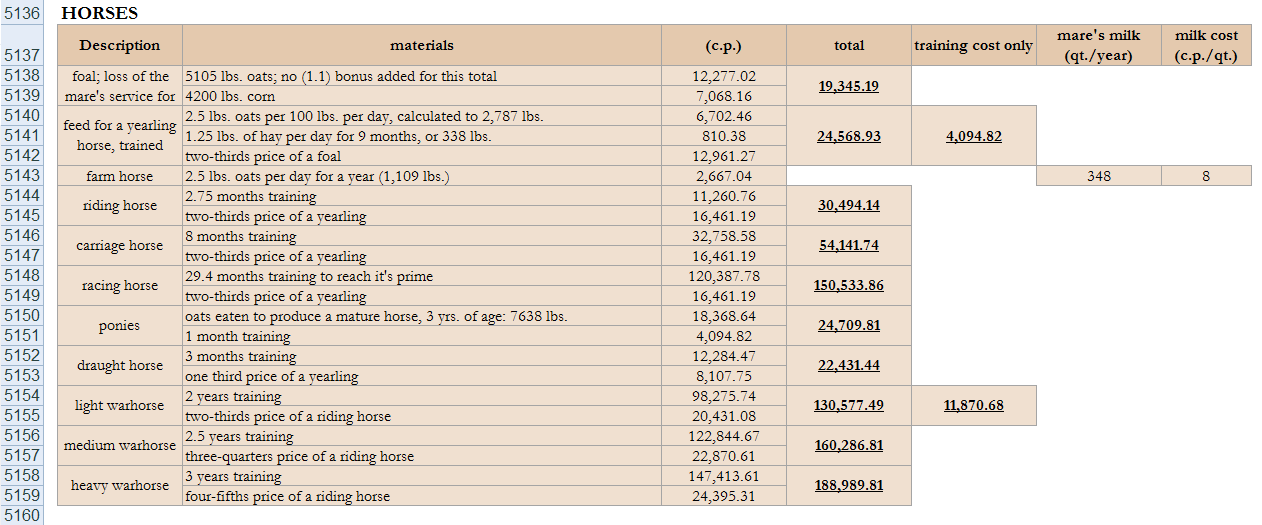


Now, I want to stress that first, this is intentionally a simplification of the problem at hand: to determine how much a horse that the players want to buy costs. And second, that I'm under no obligation to "accurately" represent anything. What I want are a series of calculations which make sense within a given framework, producing fairly rational prices that, above all, must be able to represent practical prices a hundreds of locations other than Venice.

It starts with the birth of the foal, or baby horse.  This costs a loss of the mare's service both before and after giving birth, which means she's eating oats and corn in grand amounts.  The foal is eating too.  The price of oats has been determined elsewhere, as has the price of corn.  These things, multiplied by amounts, gives us a total number of copper pieces: here, 19,345.  That's a little more than 100 g.p.

Where it says "no (1.1) bonus added for this total," this means that I'm not multiplying "19,345" by 1.1.  Normally, when some product in the pricing table is made of two source materials, I add 10% to the total; this accounts for the labour and troubles associated with supply.  That 10% figure is a great help in determining monthly wages for the person responsible for mixing the feed and giving it to the horse.  Only here, I'm suspending it, for no better reason than my trying to keep the horse's overall price down a little.

When there are three source materials, I add 20% to the cost; when there are four, I add 30%.  And so on.  This makes more complicated things and gadgets progressively more expensive, beyond the base price of their source materials — while at the same time ensuring that the labourer is paid better.  It works very well.

Look at lines 5140-5142 (so far, 5,800 lines in the whole document).  "Feed for a yearling horse, trained."  It includes a line that says, "two-thirds of a foal."  A "yearling" is one-year old, or thereabouts.  The amount of food calculates to what the yearling horse eats in 9 months, and then to that is added the younger horse, which the yearling was once.  Only, for no good reason, I'm cutting the value of the foal down by 2/3rds, arbitrarily, again to keep down the price.  I could probably invent some kind of excuse, but to be honest, I'm diddling with the numbers.  Once in awhile, some exception has to be made to some general rule, "because."  In a practical sense, there are too many disparate things in the world to permit consistency.  I want a high price for horses, but I don't want it to be too high.

As it is, the fabulous price for foals and yearlings reflects the potential for these animals to someday be magnificent beasts.  Most of us don't realise what a long-term effort many animals are with regards to training and feeding and housing, before all that investment finally pays off in a good riding horse.  There's a sense of attachment, too, in that you've seen your foal grow to be a yearling, and you have expectations of what the yearling will be someday.  But there's something else hidden in the price, which helps make sense of the very confusing price for farm horse in line 5143.

Not every horse is as healthy and virile as most of them are in the movies.  The value of a horse lies in what it can DO.  When a horse can no longer "do," yet continues to eat more than a thousand pounds of oats a year, the price falls precipitously.  Here's part of my description of the farm horse from my Guide:

Such horses have no breed, as they’re composed of mixed blood; their quality is inferior, for the most part having been raised on little other than grass and less than half the supportive nutrients that a more remarkable horse takes for granted.

They exist as the cast offs of stables, as horses not intelligent or vigorous enough ... by which time they’ve aged some years. Farm horses may also include horses older than 13 to 15 years, that have given good service in other roles but have come to the end of their use as other kinds of horse.

Even a warhorse, if it isn't worth being put out to stud, or is too old to breed, or hasn't been killed, may someday end up a farmhorse.  The low price is essentially the cost of "getting rid of the animal," because anyone who buys is going to get minimal value from the creature at great cost in feeding it.  The low cost of 2,667 c.p., about 10 g.p., is to beg someone to take it.  This understanding makes it possible for a common peasant to actually own a run-down horse; it may actually have been abandoned, perhaps because it was lame ... and the farmer, who perhaps knew something about horses, took it home and healed it sufficiently to do light work for the rest of its life.

This means that every "yearling" for sale is that virile beast from westerns and horse-racing.  It's not only a matter of age, but of breeding and class besides.

Farm horses are most likely to give milk on a regular basis, as for the most part a truly valuable mare breeding a thoroughbred foal will give most of its milk to the offspring.  If a farm horse gives birth, the foal is gotten rid of as soon as possible, since feeding two horses is out of question for most.  Thus the mare's milk, about 348 quarts until the mare stops lactating (estimated 17th century numbers, not modern numbers encouraged by all sorts of science).  The price of the mare, divided by 348, gives us a price of 8 c.p. per quart.  This compares well with cow's milk, which calculated to 12 c.p. per quart.

So, "training."  Add together the prices for the yearling, oats, hay and 2/3rds foal, and multiply that by 1.2, you get 24,569 c.p.  That extra 20% equals 4,095 c.p.  That's the future cost of 1 month's training applied to older horses.

Yes, it seems like a lot.  It's actually 21 g.p. per month.  Note that I've dropped the price of feed from further calculations, so "training" also takes that into account.

Now, suppose you have a yearling in your possession.  You've got to wait until it's nearly two-and-a-half years old before you can put a saddle on it, or use it for any real work, because it's knees have to strengthen over time.  In the meantime, you can give it a lot of attention, make sure it attaches itself to you, or someone on your estate, and give it a modicrum of training.

If you want a riding horse, that's just 2.75 months.  If it's a carriage horse, which actually walks differently, more "regally," that's 8 months.  A pony is quite meek, so it takes a single month.  A draught horse takes 3 months, but as it begins to train it's actually able to do work, so it pays for some of the price of it's younger self — thus it only costs one-third the price of a yearling, rather than two-thirds like riding horses, carriage horses or racing horses.  The pony is more or less the equivalent to a yearling; it eats less overall, so the price of a trained three-year_old pony is comparable to an untrained one year old horse.

You can train your horse to be a racer, but that doesn't make it a successful racer.  I have rules about what makes a successful racing horse on my wiki.

Finally, you can have a warhorse.  A warhorse has to be trained as a riding horse first.  Thus, it boosts the price a bit.  The kind of warhorse you can have, heavy, medium or light, depends on the weight of the horse.  Nonetheless, the heavier horses are more likely to be armoured, and forced to engage more brutally, acting less like a riding horse than a warhorse, so they cost more.  That cost is expressed in how many months of training they require.

Next to the light warhorse is a figure, 11,871.  This equals 10% of the base cost for a light warhorse, which is 98276 + 20431.  This number is used to determine the monthly cost for an "attendant," for whom 36 months of pay is equal to 10% the price of a light warhorse.  This attendant runs alongside the rider, or leads the rider's horse when travelling, and catches the horse when the mounted combatant dismounts to fight the enemy.  A good attendant can run so well that when the combatant gets off, the attendant is there within a round or two to grab the horse and hold it, in case the combatant wants to get on again ... which the attendant also helps with.

Having an attendant was perfectly normal.  Virtually every horse-soldier had one.  It was often the offspring of a trusted servant, or someone else's trusted servant, paid for and trained from the age of a boy.  The more familiar name is "squire," but that name changed it's meaning over 500 years, so that it ceased meaning a knight's attendant and started meaning a wealthy landowner.  Language is funny.

Anyway, there you have it.  All this silly pretense at pulling numbers out of my ass, eh?  Go ahead and say so, if that's what you think it is.  I need the book to do well; I need the numbers to make sense.  And though I have no intention of making the numbers available with the published copy, I do intend to do other things with the pricing table than this book.  I'll need to know how practical my methods are.


Friday, August 19, 2016

The Horse Charge

I am futzing around some in my free time to work on horse charging.  I interupted working on combat rules to go and get a handle on how horses move . . . so updating the charging rules on foot for horses is the next step.

That made me think of my favorite horse charging scene, from 1987's The Lighthorsemen, which I linked to an earlier post on this blog.  Found the link was dead, looked for a new copy of the scene and this time I believe I'll embed it:


I couldn't find a good cut of the scene so I've posted the whole movie.  The relevant scene begins at 1:31:00.

I love this scene.  I love the work that went into it, the pacing, the sheer beauty of the horses running (I think horses are beautiful), the absolute daring of the participants and the scale of the film to cover it to this degree.  It is evident that the director was in love with horses also, from every shot and cut.

If you're willing to watch is, listen in particular to the sound.  The scene is 1917, outside Beersheba in modern day Isreal.  Imagine the beat of the hooves in a 17th century setting or earlier.  The intensity of the wall of flesh moving towards you at the speed they're moving.  The stress, knowing this was coming, would be incredible.

If you watch the horses speeding up, you'll see from the movement of their hooves that they move into a trot, then a canter, then a full gallop.  The moment they change to the gallop is exhilarating, both in appearance and increased sound.  I've watched thousands of movies - and although the overall film is not good, I find this personally one of the most beautiful shots in film.

The horses, you can see, are fighting the bits; that's not filmmaking, that is horses naturally moving together and reacting to the stress themselves. At the start of the charge, the guns judge the distance at 2800 meters.  For us old British system folks, that's one-and-three-quarter miles, or the length of the Royal Ascot horse race, founded in 1711.  The fastest time on that race track is 1 minute, 12.46 seconds.  Double that, even treble that, we're still not talking about much time to load the guns or be steady enough to shoot well.  At one point in the film, the shot shows that the sights have not been reset on the defender's guns - that is supposed to demonstrate that the defenders are shooting too frantically, in too short a time, to properly reset their guns.  Leadership error, to be sure, but there isn't much time for the officer to shout "Cease Fire," then name a distance to reset the guns for, without the sights still being wrong when the order is given to fire.  Finally, what it would look like, from the ground, hearing the horses as they closed in?

The horses, I must mention, would be tired at the end.  Dead tired.  The horses that come to the end of a race are beat by the end of the race, something not much covered in film.  Consider that by the time they come to the end of a charge, how useless they would likely be for battle; they might manage that initial charge . . . but after?  I am considering how to make rules for that.

Cavalry charges - even light horse, in the medieval period - were absolutely devastating.  That's why swords were given up for spears, pikes and pole arms - because there was no chance of surviving the charge without spearing the horse to pieces.  We tend to over-value the importance of the bow because of Crecy and Agincourt - but those were special cases where bowmen were massed.  The real influence on the Cavalry charge, the thing that weakened it in the field, was the Swiss pike - and then, ultimately, the bullet.

In a world without bullets, the only useful weapon to have is a shaft with something pointy on the end.  Pity that more D&D players don't take such weapons as proficiencies.  That, in my world, is likely to change.

Wednesday, August 17, 2016

Why Horse Around?

I have to ask myself from time to time: is there a point where the game I'm designing becomes too gritty, too much for the players to manage, too much for me to manage.  At what point should I stop adding rules, knowing that there are just so many rules that a person can keep in their head.

Of late, one of my grittier players expressed a 'concern' about the proposed horse rules.  There was a definite feel of ". . . erm, maybe this is more than what is needed . . ."

I should warn the reader; this is going to be one of those posts where I look at something from a bunch of potentially negative angles and then decide not to change because I don't want to change.  That really is the truth.  There's no point lying about it.

I admit, however, when one of my strongest players shows hesitation, that's a sign.  That is a moment for introspection.

On the recent poll that I ran, that I've just taken down, about a quarter of the participants tagged the choice, "why would anyone want this?"  I added that to the poll because it is a fair question.  Why would anyone want this, why would I want this?

A central part of the rules proposal is this:  that when the player wants to ride their horse at the enemy, or along a road, or up into the hills above the road, the usual statement that the player will make would be, "I ride my horse at the enemy."  "We ride to the next town."  "We head up into the mountains."  The last would probably make no reference to the horses in the party's possession at all.

Usually, when the party is in a town and wants to buy some horses, the players say, "We want to buy some horses."

Simple.  Direct.  The way the game has always operated.

My rules would propose the following statements for the player to make when riding:  "I gallop at the enemy."  "We trot our horses along the road."  "We amble our horses off the road and over the hill paths."

My rules would propose the following statements to be made when buying horses:  "I want a good pacer.  I want a foxer that does well off road.  I'm not a rider; I want a quiet 9-year-old that doesn't have much spirit."

When players usually ride a horse into battle, they usually say, "I ride my horse at the enemy," accepting that when they get there, they get there.  No fuss.

My rules would propose that the character plan the speed of the horse, that they choose to trot until they get to such-and-such a distance, then they dare to canter, then they kick the horse into a gallop, hoping they haven't done it too late or too early, hoping that their timing on their charge isn't off so that they're stuck three hexes in front of the enemy when the enemy gets to let loose with a volley of crossbows at perfect range.

I can see the problem.  The first time the players try it, they'll probably screw it up.  They'll probably feel overwhelmed by the rules and the finicky nature of it and get confused about the difference between a canter and a trot.  They'll judge the field wrong or miscount or find themselves at the slamming end of a cavalry charge that I mount at them without making the mistakes they'll make.  They'll lose a lot of hit points and feel that they've been screwed by rules they had no part in deciding upon, and hate the horse rules because these will stop letting horses be, well, non-entities.

Let me step back and consider a different variant.  I played a number of modern RPGs once upon a time, spy games, future games, auto games and so on, where cars were involved.  The cars raced around the track and never once in any of those games was the player asked to say when the car would be shifted out of first gear or into third.  We would just say that we make the car go faster, always describing the experience in numbers - numbers of miles/km per hour or numbers of hexes between the where we were and the corner.  We were never "in the car."  Like with most games, D&D included, all these things were decidedly meta-gamed, from God's point of view, where there was time to count the distance between the car and the wall and divide it by the distance per second, then measure the angle of the turn needed in the time left over to make the turn without hitting the wall.

This is most games.  Either the images and the squares are obvious, like chess pieces, or they're represented in such abstract terms that distance or timing means nothing at all.  I played many games where I would say to the players, "Ogg is moving towards you, he's close enough to shoot an arrow without penalties at if you want.  Derek the Fighter is closer, if he wants to run in with a weapon, he's close enough to melee.  No, Gareth is too far away for an axe throw, unless you want -5 to the die roll.  Yes, the mage can cast a magic missile easily."  And so on.  Such games are not tactical, they're not complicated with movements and angles and line-of-sight; and they are totally dependent on the DM's whim as to who can swing or shoot or cast what spell within what range at which opponent.

Which is why I moved away from them.

There is a legitimacy to those who call for less rules, or at least for a ceiling on present rules, because it does seem easier to have God's point of view and be able to see horses as very easy to manage, interchangeable vehicles that enable the players to move faster between towns and between enemy combatants.  The more that horses operate like hover-boards without rules, the less clutter there is on a battlefield and that is a good thing.

This does not keep creators from inventing hundreds of different styles of weapon or armors, mostly because these all work like a hammer to some extent and go on like a jacket.  Horses are complicated.  They're difficult to relate, because most players have never, ever been on a horse.  Or, at best, they have been on a trail ride, not maneuvering their horse but instead acting as part of a train, on an animal that is trained to train.  Most have never actually operated their own horse, have never cantered, wouldn't know what a canter was if they were actually moving at one and couldn't care less.

Asking a player to describe their actions driving a car, saying that they're pressing on the gas pedal or turning the wheel or changing gears seems way too gritty for players who'd rather just look down on the car like God or imagine the car as an abstract - and this for people who drive cars every day, who know from experience how much it matters to touch a gas pedal just so much or turn a wheel just so much.  Driving is a visceral experience and that sort of thing can't be captured - it is supposed - in an RPG.

People know cars and they don't want that.  People don't know horses; that makes it a hundred times worse.

What is the value, then, in wanting any such rules for horses?

For me, it makes the horse real.  It matters what horse a player picks to buy.  It matters because this horse potentially goes faster than that horse, in a way that will matter when the battle plays out.  It matters because the player has a level of horse skill that lets them do things with a horse that other players can't do.  It matters because the horse itself becomes a treasure, an acquisition, a cherished thing that can be taught additional skills - because we've defined skills and details for horses that can be tweaked, adjusted, played with, overcome, used as a defect or exploited as a measure of some special injury or obstacle that will matter where it comes to the players achieving the end of an adventure.  The player tried for this and the horse is tired.  The player tried to make the horse do something it wasn't trained to do and now the horse's leg is broken.  The player bred the horse, trained the horse, taught it to be a warhorse, rode the horse in a dozen battles and now the horse is dead.  All because we have rules for these things.

There are no rules for horses in most books.  And what books do have rules don't talk about the horses themselves; they talk about charging, hit points, how fast a horse can go, how much does a horse cost and so on.  Nothing whatsoever about what makes a horse a horse.

All of which makes the horse a very dull, easily ignored part of the game.  And that is what I have seen players do for thirty plus years.  Ignore their horses.  Hand them over to just anyone, because it doesn't matter; if this horse dies, we'll just plug another into its place, because all horses are the same.  No horse is special.  We wouldn't know how to make one special if we wanted to, because there are no rules for that. No one took the time.

There are hundreds and hundreds of other parts of D&D that are exactly the same.  We're not talking about the difference between complicated rules and simple rules, we're talking about no rules vs. any rules.  My only answer to that is to keep making up new rules and to hope, seriously, that the wiki can keep them all straight and organized so that when I want to look up the many odd things that players may want to do in my world, I will have at least the basis for giving them all the dimension on that thing that they could wish for.

Sometimes, yes, it means they're going to have to canter their horse rather than ride their horse.  But you know, that's going to pay off in the long term - because when they meet the girl or boy of their dreams, and it turns out that person loves horse-riding or equestrianism, our D&D player is going to come off as much less of a moron . . . in fact, it's good public relations, because he or she is going to ask, "Where did you learn all that stuff about horses?"


Saturday, August 13, 2016

Horseback Riding

Following the creation of my charging rules for combatants on foot, the next logical step is to create rules for fighting from horseback. However, before I can do that, I need rules for how a horse moves and how easily it can be mastered by a rider.

This has led me back to working on my sage tables, as the mastery of horses is logically an ability that is acquired through training and expertise.  A year ago I suggested that a Cavalry field would start with mounting and maneuvering warhorses . . . just today I've created some rules (shown below) for persons with very little experience in doing that (amateurs vs. experts).  Rather than making one set of rules that apply to all horse riders, I'm working towards rules that would distinctly favor those with a lot of riding experience over those who can just manage to keep in the saddle.  This creates a wide frame for horse combats, with players able to perform an increased number of actions as their levels increase and their proficiency in horses does as well.

Like the rules I made about shipping, I hope that these rules will more firmly fix what can be done from a horse and what can't, at a level of detail that has been expressly lacking in the game - and which does not presuppose that there is a possibility that someone who is trained and able will fail to succeed, the idiot's solution to the problem that birth 3rd Edition.

I recently spoke with a local horsejumping association - one that holds national and continental tournaments - on the limitations of turning a horse as one might wish.  Here's the take: there is no limitation on how a horse can be moved or how tight a turn can be made, no matter what the speed of the horse, including at a full gallop.  A 360 degree turn at a full gallop?  It's called barrel racing.

The only limitation is the rider.  How fast can the rider think and manipulate the horse naturally in the shortest amount of time.  This is the basis upon which I am going to base my system - that once the rider has managed a certain level of skill, the horse can be made to dance on the battlefield if need be.

Very well, the main wiki article on horseback riding, up to what an amateur can do, is listed below.  The links to the sage abilities under amateur all work.  Some of the others are placeholders.

Horseback Riding

In a departure from usual table-top fantasy rules, not everyone is able to ride a horse. Horseback riding is a skill that is acquired with knowledge points gained with sage ability. It is possible to ride a horse without this knowledge - but the rider must be led by someone with experience. See Assisted Riding.

Knowledge of horseback riding allows the character to make use of a horse in a wide variety of ways, with additional skills in training and managing horses, administering to their health, breeding and recognition of breeding, employing horses in combat and a proficiency in the skill of riding, driving or vaulting. Furthermore, this ability at riding will translate to an ability to master larger and more aggressive horses as knowledge is accumulated.

Horses are divided into several forms, based on size, physical ability and training. Warhorses different from riding horses, in that they will support a rider using weapons without adverse movement. Ponies describe both young horses that have not matured and certain breeds that are naturally small as adults. Draught horses, while heavy, are bred to be docile and usually move a walk (a trot could not be long sustained, while the animal would resist a canter or a gallop).

In most cases, a particular animal can be described by its weight:
  • riding horses: 800 to 1100 lbs .............. (2d4 x 50 +700)
  • warhorse, light: 1000 to 1300 lbs ......... (2d4 x 50 +900)
  • warhorse, medium: 1300 to 1700 lbs ... (2d6 x 40 +1220)
  • warhorse, heavy: 1700 to 2000 lbs ...... (2d4 x 50 +1600)
  • draught horse: 1000 to 1500 lbs .......... (2d6 x 50 +900)
  • pony: 600 to 800 lbs ............................ (2d6 x 20 +560)

A horse's total movement is typically 7 action points, or AP. It should be noted that some horses will be slightly faster or somewhat slower, with bonus AP potentially measured in fractions of 1/2, 1/3 or 1/6. This offers some question as to a horse's potential to win or fail to win races, when trained; details regarding these differences is left to discussions about the breeding of horses and racing potential of horses discussed in some of the links below. For most purposes, these details need not be considered.

Amateur Knowledge

Domesticate: gives the basic training to young or feral horses, enable them to perform as ordinary working animals.
Feeding & Diet: gives judgement regarding the physical size and needs of horses.
Handling I: enables the character to direct the horse or ride at various gaits with minimal skill.
Mounted Combat I: the character possesses enough skill to fight from a warhorse with minimal skill.


Tuesday, July 16, 2013

Horse Technologies

To begin with, the treasure table I put up yesterday has been upgraded so that the input data & results appear on one page.  Some of you who are not familiar with excel will find this much easier to view.

One thing I failed to make mention of was the Civ IV development index ... which the reader will find shown now on the Input Page.  This is in reference to the number of 'coins' a particular bit of land area would have, in accordance with various NTME posts I wrote last fall, particularly this one.  These things all link together.

By changing the comparative Civ IV development, you multiply coins, gems & jewelry on the Treasure Table by any number you choose to insert there.  So if the treasure isn't enough for you, there's a simple toggle you can play with.

A note about gold, silver and copper coins.  I suppose I am as robotic as anyone in the acceptance that there ought to be more copper coins than gold coins because gold is more valuable.  When you think of it, however, that really doesn't make a lot of sense.  You may have more pennies in your house than dollars in your wallet, but in reality you possess many more dollars in general wealth than you own in pennies.  Moreover, you are FAR more likely to have a hundred dollars in your wallet than 100 pennies in your pocket.  I've never quite made that connection.

This is why on the table there are almost always more gold coins than silver or copper.  The latter two exist to make change ... but the principle wealth anyone possesses ought to be gold pieces.  In reality, copper is so useful for so many things it is more likely that it would be melted down for use rather than hoarded away - so finding tens of thousands of copper pieces would be so unlikely I can't be bothered to include it.

Besides - and lets be honest here - copper is so degraded in value in the game that most characters after a certain level can't be bothered with the necessity of hauling all that weight for an easily dismissed gain.

As I said, the war tab is based off the cultural intelligence table I posted last week - along with this below:


This obviously deserves some discussion.

Once again, I don't want to get dragged into a debate about whether horses of a particular variety existed in Earth history at the same time as a particular armor or weapon, or versus a given tack or tactics.  Anachronisms are bound to occur, and whereas I can appreciate them, generally I am anxious to produce a playable measure for limiting some cultures while promoting the technological superiority of others.

Thus, I perceive that some cultures would be possessed of heavy warhorses, while others would not.  The same may be said of the stirrup, barding, hippogriffs or the availability of paladin's warhorses.  I realize some will recognize there's a magical quality in paladin's warhorses (they're not 'bred') ... but we can agree, I think, that some cultures will have learned how to call them, while others will not have.

Tactics were the most interesting part of the table.  Bareback riding would have been the first efforts made to actually ride a horse by gripping the mane and with the rider's thighs.  Consider - the first people who lived with horses ... why would they ever think that horses could be 'broken'?  If you had never seen a broken horse, and every time someone had tried to ride such an animal they were bucked off, wouldn't you just assume for generations that it was an animal that simply refused to be used in that fashion?  "Ride what?  The animal whose meat and milk we eat?"

Just to point out, not all horse-like animals can be domesticated.  Zebras have never been ridden - and cannot be ridden (as described at length in Jared Diamond's Guns, Germs and Steel).  The first persons to succeed with horses must have been stubborn, or drunk, or both.  I'm sure there were a number of factors at work there.

A bareback riding culture might have some reconnaissance options, but we're certainly not talking about a combat cavalry.  That wouldn't arise until at least a cultural intelligence of 8.  Skirmishing would represent a disorganized body of blanket-saddled men moving at the edge of an army and merely harrassing an enemy - NOT acting as a unit, but as individuals, most often dismounting before attacking, then quickly remounting their animals.

Organized raiding would be the step up from this, where groups of men would skirmish at specific enemy targets, still generally dismounting - though now there's a saddle, but no stirrups, something hard to imagine.  Horses tended to be much smaller animals, which could be better gripped with the thighs, as that's pretty much all you had to keep you on a horse.

The cataphract charge is the shock tactic of bunching horses as closely together as possible and all rushing against a line of men, using the bodies of the horses as weapons to trample and create a breach.  In my world, this would mean effectively one horse per hex, with some attacking possible from the horse but mostly on the ground after much of the cataphract was dismounted.  Generally, this reflects the standard Roman tactic.

Lancers appear with the development of the lance (see the other table) and the appearance of the stirrup (approximately the Mongol period).  Yes, there were lancers prior to this, but because of the impact, without stirrups, knights tended to be thrown off the horse - so the lancer as a reliable tactical unit really doesn't exist until after the invention of the stirrup.  Prior to that time, most lance combats were one-on-one honor bouts, even in war.  The battle of Hastings was fought mostly on foot.

Mounted bowmen, too, appear throughout central Asia around the turn of the millenium; the crusaders fought them, the Seljuks were deadly horsebacked archers and several armies in India featured them.  They predate lancers by some degree, but they're close enough I feel it was really a question of geography (the steppes of Central Asia vs. the forests of Europe, along with European horses vs. Central Asian horses) and not specifically intelligence.

Hit & Run presumes the mounted cavalry has transcended the need to get off the horse to fight, and that skirmishers are now rushing into combat and out without having dismounted.  Ambushing refers to the tactic of more thoroughly managing the movement of groups of mounted soldiers so as to move more quietly, in single file, and to keep the horses silent so as to surprise hosts of men - then hitting them from multiple sides in a controlled, managed action.  This takes tremendous skill, and there aren't many examples of it prior to the 14th century.

This leads to schooling horses.  I haven't talked about the advancements yet, but the next stage is tactics depends on teaching the horse to do more than simply bear a rider.  Sharp turns, gaits, managing to traverse difficult terrain and keep footing, these are things we take for granted in horses but which at one time were unknown.  The earlier reference to breeding comes from the fact that most horse breeds that exist now were manufactured from earlier natural strains, thus the creation of the warhorse and inculcation of certain desired traits.  This really took off when schooling horses became a necessity for military tactics.

The hussar charge is an improvement on the old cataphract in that the horses were more tightly packed together.  Tolstoy in his book War and Peace speaks in one scene of feeling Paul's knees pressed against of the flanks of the horses on either side of his own, as the charge was so compact as to utterly shatter an enemy position when impact occurred.  Hussars were the terror of the battlefield once this tactic was introduced - and it necessitated terrific schooling on the part of horses.

A very great problem with the hussar charge, however - and this in the age of gunpowder, the late 16th century - was that the mass of flesh packed together in this fashion made the hussar charge tremendously vulnerable to shot.  In a D&D world, it would be no less vulnerable to area effect spells like fireball, color spray, cone of cold, ice storm, burning hands, etc.  The solution that was applied was to have the hussars ride at the enemy loosely grouped, and then concentrate in the very last moments before the actual charge.

Point in fact, you will probably never see this in a movie, unless someone decides to do with with CGI.  The best scene from a good cavalry movie, the Light Horsemen, shows a cavalry on Beersheba as it rides wide open and straight at the enemy ... but the actual tactic of the late concentration was dropped after the American Civil War, and there are no soldiers left anywhere in the world who are trained well enough to effect such a charge, even on screen.  Though I think there may be some cavalries who could train up to doing it ... if they could be bothered.

Have a look at that movie link; it's one of the most beautiful depictions of horses in motion I've ever seen.

A few other notes.  Clingor would be, I think, a reference to the Thomas Covenant series ... it's a call out to campaigns that include some sort of magical cloth or saddle that enables the rider to be better fixed upon the horse, and not knocked off.  Magic barding is somewhat obvious; magic horseshoes would be like the horseshoes of the zephyr or some other similar item.

There you have it.  I suppose I'll come back around to another treasure post when I have the magic portion added to the Treasure & Arms table.


Thursday, January 10, 2013

...And The DM Is Pushed Aside

Something that I have been saying since playing D&D in the early 80s is that a DM must take his or her self 'out of the loop.'  That is to say, the less immediate influence you have over your own world, the better.  That influence should be moved towards the rules, towards the dice and towards the setting of your world.  Specifically, how should things be if the setting of your world, and not your own feelings about it, makes the final ruling?

This, however, is mostly impossible.  There are too many circumstances, too many ad hoc decisions which must be made, too many times when the 'last word' of the DM is the only word there is.  And still, I am tickled pink when my world 'over-rules' me.

This happened to me last night, while making a determination about a player's horse, and I felt I had to write about it.

One default position I tend to take is to reduce virtually all vague characteristics about a thing to its lowest common form.  If the party finds a sword, it will probably be a short sword.  If a player character has failed to note on their character sheet whether the crossbow is light or heavy, I will definitely rule that is light.  Ill-defined chests will always be small, as will quivers, saddle-bags, shields and holy symbols.  And most of the time, horses will be riding horses before they are warhorses, and they'll be light warhorses before they'll be heavy ones.

Perhaps, after a fashion, it's my way of being a dick.  I prefer to think that the smaller or lighter version of anything is bound to be far more common than the larger or heavier version, so unless there are some specific circumstances regarding the size of something, I will tend towards the least rather than the most.

So, it was determined from the character's background that the character's father had been an outrider, and that the character had inherited a warhorse upon leaving home.  I hadn't specified the size of the horse, so when the character asked, I was inclined to say, "light."

However, I had also generated the character's place of birth, so it seemed logical to first find out what sort of horses came from that area.  The locale was Andria, in the modern province of Barletta, in the historical region of Apulia, which at the time of my world was under the authority of the King of Naples, himself subject to the Emperor of Spain.

The most common sort of horse that originates in southern Italy is by far the Neapolitan breed, so it only followed that I would supply that horse.  The appearance is very definitely "Roman" in the sense of statuary from the ancient period, and the horse is somewhat short, just above 14 hands ... as you can make out from this image.


But here was the real kicker.  Wikipedia, it should be noted, says this about the breed:

"Between the 16th to 19th centuries, Naples and the surrounding regions were known for their high-quality Neapolitan horses. The best horses were bred by nobles for transportation and cavalry. At the beginning of this time period, the horses were likely small, coarse and heavy, suitable for carrying heavily-armored warriors. However, as elsewhere, the use of firearms brought on the desire for a more attractive, agile horse."

And of course, because I don't have fire arms, I had to accept - quite happily, I might add, because as I said I love when my world pushes me out of the way - that the player character's free horse - one which the player would have known since it was foaled - was a heavy warhorse, and not a light one.

The player was understandably happy about this.