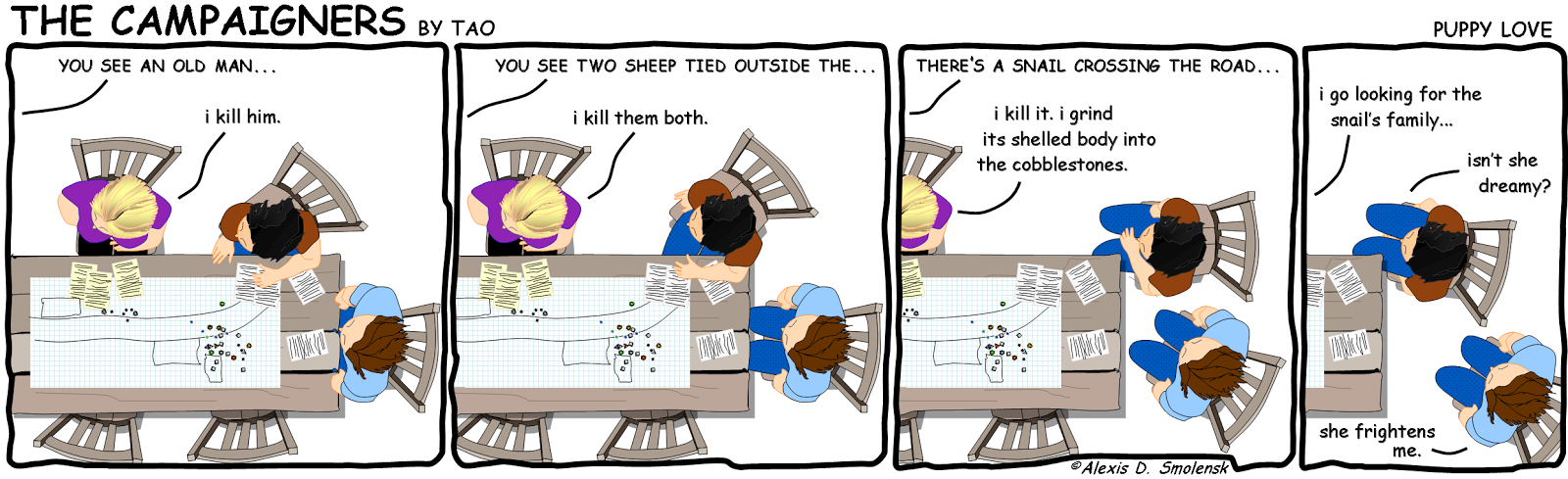
Some of you, I'm sure, have encountered this feeling. The first dozen or so posts on a blog are a huge thing. We find ourselves checking for comments every five minutes and wondering who will think it is the most amazing thing they've ever seen, expecting something big to come out of every post. At first, that is. Then, gradually, if we keep at it, the process of posting and checking the post becomes a routine.
With the comic, my first few weeks were spent in the height of anticipation. The time between comics felt like a long time, as I anxiously waited for the moment when I would be able to post a new one. But that feeling has gone now. Now, it feels that the comics are barely up at all before it comes time to post a new one. Whereas before there was no sense of missing a deadline, because I was ready to work on comics that would be coming out weeks and weeks after the one I posted today, now it becomes more and more evident that the train I'm on is moving faster and faster while I'm creating slower and slower.
This is what everyone experiences who sets a target for producing work. Even as the regular practice of creating and setting a quality standard imposes itself, so does procrastination. A day goes by without working, then another day, then a comic is posted and we remind ourselves, "Oh shit, I better make something right now. I don't want to have to be putting in work last minute!"
But we know that day is coming. At least, if we don't sort ourselves out and behave responsibly.
Just now, I'm not worried about getting comics out in time. I still have a back-log that will keep me going a couple of weeks (which is down a long way from when I was five weeks ahead) ~ but I live in fear that I will get stuck for a joke. And that is what this post is really about: writing jokes.
The one thing I don't want to do is get into the habit of creating what I call "low-hanging fruit." I'll give an example from the Dragon Magazine #191, having found an archive just the other day:

This comic is an absolute piece of shit. First of all, it's sexist. Second, its a pathetic cliche, which itself started as a fabricated urban myth that got picked up by television and then repeated many, many times. Everyone asks for directions. I know this, because I am asked for directions very often. So it doesn't even ring of truth. Finally, for some reason, even though the cliche makes an argument that men are the stupid ones, the woman is made out to be embarrassed by the dialogue. For fuck's sake.
Pillsbury, the author of this dreck, had a month to come up with this. For fuck's sake. I wish I had a deal to draw comics for the front-line magazine in the game culture, so I could phone in a decades-old joke. This is the worst kind of low-hanging joke to reach for; it only requires watching reruns of old Johnny Carson shit and stealing from it.
But, sadly, there were many people ~ boys ~ who laughed at this. Some of you, just now, smiled. Low hanging fruit is out there, people use it and make a career out of it, just like Johnny-fucking-Carson did, as everything he spewed out for decades was stolen from the generation before him.
The same Dragon issue had three other comics: I'll post them together:

These are three jokes written by three different people. Yet they're really just the same joke. They are all three anachronisms. Take something modern, slap it into the fantasy realm, point at it with an image and then have someone say something perfectly ordinary that is only funny because it's a thing belonging or appropriate to a period other than a fantasy existence.
Bleh.
Yet again, some of you smiled. That smile is worth deconstructing, because if we're going to tell jokes, we ought to know a little about why they work.
First of all, we smile or laugh in part because we know it is supposed to be funny. The joke is framed as a comic and for that reason we are given the cue to a certain type of behavior. Those pathways have already been driven into our brains by a million comics that we read when we were soft, easily persuaded children at a young, easily impressed age. As such, even by the time we get old and jaded, we can still relate to the format even if the actual joke itself is trash.
Secondly, jokes are built on the unexpected. The joke I put up last night, the latest comic that can be found on the sidebar, is built on three unexpected results, one after another, only the last two of which are actually funny. I'm going to spoil the comic now, so if you haven't read it, pause here.
First, we don't expect the adventure to work things out with a succubus and get married. But the better twist is the pun based on a common phrase that parents use to describe other people's children (a cliche). It works, because the cliche doesn't carry the joke, the pun does. This is then followed by the double-entendre regarding baby-sitter fees. If you don't see the entendre, think about it. I did. It took me an hour of patient thinking to nail down that joke.
Jokes work best when they confer fridge logic: when the joke isn't completely gotten on the first try. This is what I aim for: a joke that has to be mulled over, where the whole joke isn't evident at once. The British culture is brilliant at producing comedians who do this naturally, which is why I watch far more British comedy than North American. There used to be a fair Canadian culture that produced this kind of humor, too, but that has been gone for more than a decade now. Sadly, the best Canadian humorist working right now (obviously, in my completely non-humble opinion) is Katherine Ryan ~ and she abandoned North America for Britain.
Searching for that unexpected twist is the difficult part of writing humor. If I have a favorite for this, it would be Jimmy Carr, who is a class by himself. Here is the sort of classic twist he has the habit ~ meaning something he does so regularly that I am in awe ~ of producing:
"If only Africa had more mosquito nets, then every year we could save millions of mosquitos from dying needlessly of aids."
That is 21 words. And in it he sets up the standard patter of NGOs asking for use to care and be concerned, only to slap us down. The writing in those 21 words is so tight, most people I know won't realize it. Look at the word groups in the one sentence: "If only Africa" (the set up), "more mosquito nets" (the standard NGO request), "then every year" (building the immensity of the cause), "we could save" (the heart of the pitch, lulling us to expect the usual end of the sentence), "millions of mosquitos" (mid-twist, where it should be millions of people), "from dying needlessly of aids." Bang. A four-word punchline.
You can see Carr deliver the joke if you're willing to sit 1 minute and 10 seconds through this toxic bullshit.
I dream of writing like this. If you haven't seen Jimmy Carr do stand-up, go look for him on you-tube and be ready to laugh very, very hard: because he is not like American comedians. He doesn't spend three hours setting up a joke.
Time and time again, I find myself thinking up the low-hanging fruit for a comic and then I tell myself, "No, you can do better. You can definitely do better. Then I think for a few hours, or days, and slowly hammer out the difference in my head between what counts for low-hanging fruit and what doesn't. And I live in fear that, in the end, after too much time, I will drift into that because I have burned out on writing things that are actually funny. And I will know that people will smile and laugh anyway, because ~ hopefully ~ by then they will be trained to know that I'm funny, even when I am not.
That is why so many comics, both mainstream and internet, limp on for years long after they've ceased to produce anything noticeably clever. Because, once, they did. And as humans, if once a dry well had water in it, we will keep going back to that well over and over, hoping that one day we'll look down into the hole and water will be there. It takes a long, long time for us to stop doing that.