Showing posts with label Wilderness. Show all posts

Saturday, June 22, 2024

Taiga Wilderness Random Generator Page Rules & Tables

As near as I can tell, I've completed this page, as part of the random outdoor generator I've been working on.  Added today are rules explaining how "agency" works, as well as an order provided for how the rules are resolved each day.  Anybody wants to weigh in, I'd certainly appreciate any suggestions for things that need clarification.

Sorry about the title, I just wanted it to be very, very, very clear what I'm talking about here.

Readers have every reason to doubt it.  No one has ever built a sustainable, relevant, game-friendly and useful outdoor generator before, so there's no reason to think I've done it.  However, I believe the agency rules are a staggeringly brilliant idea, I believe it makes the wilderness interactive for players, I believe that it provides terrific detail that can be built upon both for the taiga environment and for other environments, and I believe I've done the impossible in just under three weeks.

In any case, I'm in a position to run my two characters in the tutorial again, in which they try to find their way out of the wilderness.  Incidentally, I think this system works just fine for those trying to find their way into the wilderness, and gives rules for stumbling around in the dark looking for the dungeon that's wanted, rather than going straight to it as though the entrance is lit up by neon, even though the players have never, ever, actually been to that dungeon before.

Under these delusions, I'm of course quite happy and insufferably pleased with myself.  Please feel free to throw onions.

Sunday, June 16, 2024

Cracking the Encounter Nut

As I try to get my nutcracker around this nut ...

Having invented an initial list of 'contents' for a taiga's wilderness hex, where the players randomly turned out to be, I'm confronted by a glaring problem that's I've met before, though not for some time.  But first, let's list off those contents:

predator, wood for tools, fuel, animal tracks and signs, seasonal camp, monster, drinking water; pond, lake, attract attention with smoke?, humanoid footpath, treacherous ground, grazing animals and other game, detect intelligent presence, animal trail, wildfire, natural shelter, identify sunrise/sunset, artificial light source at night, storm, gathering food, natural landmarks, creek or stream, dungeon, fishing, viewpoint, next hex, shrine; glade, ally; adventurer.  This isn't an exhaustive list; just what I was able to clearly identify last night.

Some of this may be counterintuitive, so briefly — since we're assuming that the players are moving through an area they don't know or maybe can't find their way out of, instead of creating a "get lost" roll, I'm simply adding the next hex over as something the players "discover," in the same way they stumble across a lake or a bear.  Finding an ally or adventurer is simply game play; the likelihood of an actual adventurer stumbling around in the hex with the players is ridiculously low, but for playability sake, we can rate that at, say, 1%.  Because it's fun.  Detect intelligent presence means that the players have just found some object or sign that indicates there's a potentially dangerous and intelligent monster in the area, something uncivilised; this being distinct from the humanoid footpath or seasonable camp, which are things that have been made by civilised persons, but which is presently abandoned.

But the key to this list is this: some of these things are random occurrences, and some of these things are so common that one can't shake a stick without hitting one.  Wood for tools and fuel, for example, or the choice to light a signal fire and attract attention (the roll is meant to indicate a place where this is realistic; obviously, any tree can be lit on fire, to the party's detriment in the long run).  Still other things can be searched for (grazing animals, foraging) while some definitely cannot (storms, wildfire).

Plus, and this is important ... it's an extremely boring hex if we only make one 'contents' roll per day.  An environment such as this cannot be reduced to one thing, even once per day.  As the players move through, they're going to pass over various features; as well, sunrise and sunset are going to occur every day, though not necessarily where they're helpful to the players.  We cannot see where the sun rises if there's a dense pass of 100 ft. trees that blot out visibility beyond a hundred yards.  Thus, this particular "event" is meant to specify that the players happen to be in a place where, yes, they can glimpse the horizon and where the sun comes up, orienting themselves.

If, however, we give four rolls a day, that's four chances that a random monster's going to come up.  We can assess for that by adjusting the chance of a monster from an overall 1 in 6 per roll to, say, 1 in 24 per roll.  But we'd have to do the same for wildfires, storms, grazing animals and so on, drastically reducing the chance of a single die roll producing something interesting.

I have a proposal, but it strikes me as ... hard to organise.  Suppose we accept that there's only one roll chance for all those things on a d100 table that can arise by chance.  Then, for everything else, things the party would definitely want to find and obtain, we could assign a "number in something" chance on a separate column, based on that table.  We could then give the players two rolls on this column, hoping to be lucky.  Effectively, we carve the day into two halves for the players intentions (find their way out of this hex, climb up a ridge looking for a viewpoint), and at some point during that day, something unintended happens all on its own.

For example, let's say there's a 2% chance of stumbling across a viewpoint, even though the characters are in hill country, simply because the conifer growth is too thick.  Or say there's a 6% chance of finding a pond.  And now let's say that instead of waiting for these things to happen in the daily-roll, the players instead say, "We try to find a pond."  Then we could assign a triple-times chance of their successfully doing that ... a 18 in 100.  And if they don't we could either (a) dictate that there is no pond in the hex, or (b) dictate that if there is a pond, it's going to be stumbled across randomly.  It can't be searched for again.

From that point forward, we have to decide which things can be searched for and which cannot.  In some cases we can assign things (wood, for instance) as not being part of the random table, since it's always around the party.  And an automatic chance of the party finding it.

Can the party deliberately search for a monster?  Sure.  Further, we can argue that, having found one (or a pond, for that matter), the chance exists for trying to find another one the next day, until the chance fails (the monsters are really buried).  Thus, a "dungeon," starting with a 1% chance randomly, can be found with a 3% chance if searching for it.

This, however, argues that if the players remain in the hex long enough, eventually they will find a dungeon, or anything else on the table.  It's inevitable.  I'd propose a ten-roll limit ... after that, the contents of the hex are more or less what they are.  'Course, there can always still be a wildfire or a storm; another monster can always drift in from another hex; there might yet be an adventurer.  This would seem to require a separate, "residual" table, that could be rolled on, oh, once a week, or a fortnight (two weeks), that wouldn't include dungeons or viewpoints, or any permanent notable feature that might be used as a guide for getting out or finding this particular hex again.

These are my thoughts so far.  Want to let them stew a bit before I start to order them into a proper table.

Friday, June 14, 2024

No Empty Hexes

Continuing yesterday's conversation, let's just talk about how to best generate the wilderness.

I recognise that there are many who strongly resist the use of hexes, or any means that "parcels" the wilderness into areas ... but I must point out that with movement upon the earth's face, we've been subdividing the surface for the last 300 years.  Surveying has existed since the ancient Egyptians, but it didn't become common practice until the late 17th/early 18th centuries ... so it's right to think that for those in the so-called game world, anything other than measuring ground with chains to see who's farm is whose, or putting up markers, little subdivision of land takes place.  But this is all the hex is: a means of parcelling a large space of land so we can assign characteristics to it, and so that we can identify one parcel from another.  And so that our accounting of the land can apply to what character's can do or see in a day, those parcels have to be fairly small.

For those who still insist on creating maps in this century using pencil and paper, when there are far greater resources that are available, I understand that making a lot of "hexes" is demanding.  Squares are far easier, since they merely need a straight edge, and for best results, a T-square.  Draughting tools for making hexes are more complex and inconvenient.  Not for me, however.  I have "hex paper" on demand, as much as I want of it, so for things like this I find it very easy to apply.  Moreover, since a hex is more nearly like a circle than a square, the center point of any hex is equidistance from its bordering hexes, which cannot be said for the square.

All that is such a waste of time to say, because it convinces no one, but yeah ... I somehow feel before plunging into this that I should explain why I'm using hexes, and not straight lines.  Though why, I can't guess.

But okay, so, the players enter a hex.  Forgetting the hex's topographical and other details, I'll need to explain the point of adventuring in this fashion ... that is, what exploring accomplishes that a pre-fabricated adventure, or a dungeon, does not.  Forgive me if I descend into pedantry at this point, but the internet has plenty of ink and I do feel we need to fully grasp the game's structure beyond the nonsense storytelling/collaborative/lore and "epicness" jargon that we're spoonfed online.

The dungeon's function is to deliver experience and wealth into the party's possession, while presenting situations that are engaging and include a reasonable measure of risk.  This last stipulates that for the party entering, there is a high likelihood of success, better than one might obtain at a craps table; in fact, better than betting on red on a roulette wheel.  Were I to rate the odds, there ought to be a 20% chance that one character dies during the effort, 6% that two die and 1% that everyone dies.  But this doesn't include the possibility of someone losing an arm or a hand, beings struck blind, losing a valuable magic item, losing a considerable number of resources and, naturally, making an enemy that will continue to pursue the party until, in fact, someone is actually killed.

Worse odds than this and there's little reason for players to enter the dungeon.  It's just experience and coin, after all, which only goes so far as a motivation.  If players aren't entering dungeons, its either because they have no reasonable expectation of surviving as a group, OR, the demand for money in the game world isn't high enough to make the risk worthwhile.

Along the same lines, the wilderness ought also to exist to provide things the players want.  It's not there to look like a real world, it's not there as "flavour" and it's fucking useless if it's empty.  Each and every hex has to provide the players with something.  Otherwise, like a gun hanging on a wall in a play that never gets used, it shouldn't be there.

I feel this needs to be hammered upon, because the Gygaxian poison from the 70s continues to run rife through this culture.  Gygax, and most of the creators of his era, were lazy.  So lazy, in fact, that where it came to a game world, he and his intellectual kin kicked the can down the road by suggesting that the board from another game entirely be used to fill in the hole created by their laziness.  That game was Outdoor Survival.  Here's the map board that was suggested for use as the D&D "wilderness."


Apart from the extreme crippling incompetence of the era's proposal, something for which everyone attached to the original books ought to have apologised for the rest of their lives, please note how ungodly empty this map is.  This made sense for the Outdoor Survival game, which I've played ... though admittedly, it's just a longer, more dimensional version of playing the children's game Candyland.  And as I pointed out yesterday when I discussed the wilderness generation page in the original DMG, when Gygax proposed to randomly generate an outdoors, his system basically presents an even emptier version of the above.

There's no "game" here.  It delivers nothing into the hands of the players.  It is nothing more than an extremely boring obstacle between where the players are and where they want to be, "filled in" with random monster encounters which, by the original rules, are ridiculously deadly to players while putting nothing whatsoever into the player's pockets.  You enter the 1st level dungeon and expect to fight, at worst, 7-12 orcs with one HD, with an expectation of treasure.  Then, on the way home, as a random encounter, you're beset upon by 2-20 wolves with two HD, with jack shit.  Why would anyone ever enter the wilderness?

The very idea of the wilderness was poisoned from the beginning by such half-assery, accompanied by a steady resistance and laziness that declares the wilderness impractical or otherwise undesirable as an adventure environment.  As I sit to start creating a random generator, I have exactly zero resources, accumulated from over 50 years of D&D, to draw upon.  Oh, there were "attempts."  The infamous, massively incompetent "Wilderness Guide" of 1986, which did wake me up to things the game definitely needed, but which that rule book absolutely whiffed upon.  I've read and sometimes owned other so-called guides, mainly from 3rd edition, which provided a terrific degree of random shit, without any organisation applied to it.  Basically, when the party was in the desert, you could slap some "black sand" in front of them for, again, flavour.  But beyond a short paragraph description, there were no game rules or metrics attached to it, so in essence, it was painting the desert black.  Hands in the air, now: Worldbuilding!

Very well, what does the wilderness supply?  Well, it need not be the same things as a dungeon. After all, there are things that can't be found in a dungeon: food, for one thing, that the players can safely eat. Wood to make tools, fresh water to drink ... horses, and grass for them.  Places where houses and storerooms can be built, places where men-at-arms and supplies can be held at the ready. A safe place to sleep.

There are, I believe, four things that the wilderness supplies to players, which contribute deeply to the fabric of the game beyond the necessity of passing through: threat, supply, knowledge and deliverance.  Each covers a wide range of possibilities, which the wilderness designer, whether or not randomly generating a space, needs to be aware of.

Threat includes everything that makes the players feel unsafe.  No matter where they are in the game world, there are always threats; but this concept includes not only the threats themselves but the means by which the players protect themselves against those threats.  This includes, naturally, the monsters that are present in the hex — and here I'm arguing that every hex has monsters, always and without exception, though most of the time due to circumstance, the size of the hex and pure chance, the players are liable to pass through a hex without seeing one.  But this needs to be clear ... if the players go looking for a monster, they will find one ... at least, until that monster and others are "cleared out" of the hex.  Because finding a monster, and knowing one is there to find, is a bloody point of this game!  The value is in the monster's presence; the players knowing they'll find it, or them, whatever form it or they take.  It's having a reason to be there in the first place, since some of the monsters that can be found will, as with a dungeon, have treasure.  Hell, so far, "Grimstone Hollow" may only be this lair of these hobgoblins.  So far, there's nothing the players have found to indicate this is anything more than that. 

Where the players camp, how they camp, what equipment they bring along and what vigilance they adopt, these too are part of this hex's presence.  At no time can players be made to think that if they're moving through wilderness they're safe because a little piddly die roll has to come up a 1 in order to attack them.  That perception goes on the fire.  The players must be taught that preparation is what will keep them safe, not the odds.  Take this exchange:

Players:  We turn in.

DM:  You turn in?

Players: Yeah, it's dark, we're not travelling at night.  We make camp and we turn in.

DM:  O ... kay ...

Players:  What?

DM:  Nothing.  You turn in.  Got it.

It's my temptation as a DM to explain, um, maybe they better explain what preparations they take beyond "setting a guard," who can be feathered with nine arrows from the darkness as said watch stands next to the fire, in plain view, bored, getting warm.   Is it worth making an encampment?  Is it worth trying to find a place where their backs are against a stone wall, where there's a gap in the rocks that covers their front, where some kind of alarm exists to warn the watch upon falling asleep?  I don't know.  If the "monster" out there smells the party, they'll come and look.  They'll look and decide.  They might go away, they might stay.  But it shouldn't be a "random monster roll" that decides one way or the other.  It should be what the player's camp looks like.  It can be a die, but not that die.  Not one the players think they can count on.

Threats come from the terrain, too.  Slips, falls, maladies, bad weather, rain, dropped equipment, torn clothing, soiled or stolen food ... anything and everything that might happen in a wilderness is a threat.  These things too need to be accounted for.

Supply is king in this environment.  We're not entering a dungeon for an hour, we're crossing a considerable amount of land, during which time we need to sleep, rest, eat something and thus dwindle our resources.  And while the environment threatens that supply, it should also offer boons that help the players out.  A brook where it's practical to waste an hour or to and catch fish.  A berry patch.  A bee hive.  Naturally occuring salves that can be used to cure wounds, which can only be used here because they can't be feasibly stored.  Grazing animals, of course, that might be taken down with a lucky shot.  Their leather, though wet, can be dried out in a few hours to a day, and rinsed too if possible.  It can be used wet, though it's difficult to work with.

My sage abilities are designed to handle some of these problems, but suppose, like Arliss and Bertrand, that it's unlikely either has any scouting, foraging or hunting ability (they could take logistics, I suppose).  Even a dope can stumble into a deer, however; I know, because I've done it multiple times.  One time, I was just 8 feet from the deer when it stepped out from the wood next to me.  I didn't have a shot gun, I was fishing; it was June.  But the players always have weapons.  In a low-technological society, without guns, this sort of thing should be fairly common, just as it was moreso in Alberta in the 1960s and 70s than it is now.

Like with a threat, every hex ought to have something.  That doesn't mean it will be found; hell, it might be a gold mine, passed over and over with the players never knowing.  Specific resources have to be looked for, by persons who know how; but it's reasonable to assume that if I know how to hunt for mushrooms, and we're in a temperate deciduous forest, there are mushrooms to be found.

Knowledge is key to getting out.  Being able to cross a piece of land and find the tiny brook in it that leads to the creek, that leads out onto the plain.  Getting atop a hill to a viewpoint and being able to see the land two hexes away, to see if the hills keep going, or if perhaps there's the sign of a river below, or fields in the distance.  Seeing any distance in the wilderness is hard due to the terrain and vegetation, the weather and the height on which we stand.  Potentially, from a 200 ft. rise, I can see about 17 miles before the curve of the earth ... but the last third of that distance will be hazy and indistinct without aid (or even with, given the time period's technology).  The problem is, where 200 ft. rises occur, there are usually other such rises, and they get in the way.

Still, it gives a reason to climb out of the valley to see if this is a good place to look.  This means giving up the river-as-guide technique, where the river may lead a party on quite a merry chase before it reaches a civilised hex.

There are the various signs of life, too; things they leave behind: spoor, scents, kills, shucked skin, actual signs that say, "you've already entered our land, prepare to die," that sort of thing.  As players move through the land, they need to be told things that they can use to make intelligent decisions about where to go next.  It cannot just be a random choice of go left or go right.  They should regularly be given enough reason to believe that if they choose to go in this way, there's a better possibility of them finding their way out, or their way to whatever they're looking for.  And if using a random generator, this knowledge should adjust what does get encountered next, proving the legitimacy of the system.

Deliverance is, obviously key.  Somewhere out there, there are civilised people, with farms and things to sell, where there are taverns with beer and inns with semi-clean beds, at least a roof anyways, and something more to see than trees and rocks and rocks and trees and trees and rocks ... you know.  "Canada."

Desirably, by contriving these four guidelines to play, the wilderness ought to be constructed, even randomly, into a more intuitive, creative, meaningful place to adventure.  My personal feeling is that the environment ought to be as rich in combat and treasure as the dungeon, or perhaps there should be little difference between the two.

Saturday, May 28, 2022

Wildered Wildlings Wilding the Wildness

Very well, this argues that we should do something other than dungeons and town-talk, but let's answer the harder question.  How do we run the wilderness?

I touched on this five years ago, but specifically in relation to the adventure, not as it applies to exploring or moving through the wilderness as one might through a dungeon.  I confess that this is a hard nut to crack; but crack it we must, or else nothing I've said thus far have the remotest value.  Your players, as Lance put it, go into the wilderness "in a random direction with no plans or foresight."  What to we, as the DM, do?
Verticle axis increased 2:1

I live on the edge of a wilderness, a happy place called The Rocky Mountains.  This is the country about 65 miles east of me.  People come from all over the world to see these mountains; and naturally, when I have friends drop 'round, a trip to the mountains is always on the iternerary.  Yearly, in every season, like clockwork, people go out into these mountains and die, mostly from failing to take along sufficient equipment, underestimating the distances and the difficulty of terrain and ... occasionally ... because they try to use their cell phone as a flashlight so they can walk out at night, running out their battery and making it impossible to triangulate their position.

If I should take you out here, and you feel hardy, we could walk a trail or two.  And you'll be sure to ask me if there are bears and the answer will be, yes, there are definitely bears.  Big grizzly bears the size of a Volkswagon Beetle, able to run faster than us.  "But it's not the bears you have to worry about," I'll say.  "It's the pumas.  'Cause you'll never see them or hear them before it's too late."

This kind of thing is fun to say, but the truth is, I've spent many hundreds of hours in these mountains on back trails, fire trails and sometimes straight through the bush, up and down over deadfall ... and the nearest I've been to a grizzly bear that I could see was a quarter of a mile, standing in a gas station with binoculars watching the bear go up scree across the highway and way, way above us.  I've never seen a puma, but that's as I said.  I've certainly never been attacked by one.

In actual fact, the chance of stumbling across a normal animal in the bush is about 1 in 3.  And that will almost certainly be a goat or a deer.  Hollywood likes that scene where the protagonist finds himself face-to-face with a deer that's just 20 feet away ... and plays it up like this is some mystic moment in time.  In fact, it's ridiculously common.  I've had 30 or 40 such sightings, a few right inside Calgary, since the deer can enter through several routes along streams and rivers into the city parks with impunity.  A truly dangerous animal, however, is quite rare.  It's only that, if we were to run into one of the dangerous ones, there's a very good chance only one of us would survive.  No, not the faster runner.  Rather, the one unlucky enough to be closer when it starts.

Let's set aside animals for the time being, then.  Of course, for D&D, we can populate the wilderness with whole armies of owlbears, but this is low-hanging fruit and ultimately not exactly valuable for a sustained wilderness journey.  If we want them to fight monsters, we can run a dungeon.

We want our wilderness to create function and behaviour.  Not everyone knows what these are, so in a couple of sentences, function is how a thing operates.  Your phone is structured out of various materials but it functions, or operates, through electrical and computative processes that spits out responses for queries ... and translates voice and image into electronic signals that are sent to other phones.  Behaviour is how you act when you, your body and your mind, interacts with the phone, along with how you respond to the content and frustration you receive from the device.

The wilderness has a game function, and it has a game behaviour that the players elicit.  We want to define what those things are.

Let's go back to front.  What sort of behaviour do we want?  Obviously, the players aren't bored, the players are keen to remain in the wilderness and excitedly talk to one another about what's going on.  You know, like they act when they're in a dungeon.

The wilderness is usually made to function by pouring monsters over the players, getting the response of fighting monsters, but as I said, we're shelving that.  I'm sorry that this is starting to sound like a youtube video, where I purposefully keep the answer out of your reach to waste your time, but I just want to establish the dynamic clearly.

The function of the wilderness is that it contains whatever valuable details we wish to give it.  The players are walking along, assuming there's going to be a wandering monster any second, and instead they come across something else.  A dilapidated hovel that's been abandoned for ten years.  A dead skeleton laying face down by a creek holding a leather bag with items or a weathered book.  An unnaturally beautiful glade, with fresh water and sustenance ... that, no, is not magical and is not protected by a magical being, but would make an excellent base camp.  Rock carvings that suggest a greater purpose, followed by more rock carvings, or a cairn.  A recent kill, but no beast in sight.  Another party, friendly, who can share information with the party and direct them to places of good hunting, forage, the shelter of a hermit, knowledge of a druid that watches over the landscape, even knowledge of which fork to take.  And, as I promoted in the last post, this other party doesn't lie, or have ulterior motives.  They're just glad to see other intelligent beings in this dangerous wild place.

No, no, no, no, no.
Most of all, we want to create a series of connecting pieces, that encourages the party to believe they're onto something.  Here I don't mean a set of story-set clues, though Kipling and Stevenson made good use of that idea.  Rather, recognise that the wilderness is not a haphazard sploosh of homogenous features splashed over a hex map.  Even the tiniest of streams create pathways, legged creatures choose the easiest course through a landscape and leave behind a trail, ravines lead upwards to vistas where the players can get their bearings or over divides from one valley to the next.  Like vegetation forms territories for herbivores and predators alike — and both rangers and druids should be able to recognise predators from the animals that are present, the sort of path, markings and tracks and other signs.  A good ranger should be able to tell when the party has left the range of one predator and moved into the range of another.  As players follow along patch after patch of berries growing along a pathway, saving their carried food supply, they'll notice if they're steadily climbing or descending, even if this is a huge open steppe with nary a tree in sight.  Steppes have gulleys and coolees, that lead to streams and lake shores, which must be patiently circled, forming another sort of path.

As the players follow these paths, so do others, because these are the natural courses to take for anyone moving through the wilderness.  This is an important point.  Think of this wilderness as a set of odd, criss-crossing tiny highways that enable predictable travel ... and thus, the meeting up with things along the trail that are sensibly there to be found.  It's not at all random to find this odd, unexplained object along the way.  Whoever dropped it was probably going the same way the party is now, though a week, a day or an hour before.

Consider as well that there are macro-effects going on around the party that affects the landscape as a whole.  Rain, wind and lightning can force the characters into places they wouldn't normally go in search of shelter.  At some times of the year, animals are in the time of their biological rut, making them violent as they compete for mates, so that what might normally be a peaceful beastie along the trail is a definitely threat.  In late spring, many forest and prairie rivers are in flood, drowning the countryside or roaring through gaps that are now impassable.  In deserts, dunes move; sandstorms arise for days at a time, greatly changing the landscape and causing neophytes to lose their bearings — which, in the desert, can only be truly found in the stars.

Other strange things might be seen as well.  Suddenly, the forest is a flurry of animals, fleeing, bounding, scrambling all around the party in the same direction ... and just a suddenly, the mass flight ends.  The forest grows quiet ... but in fact, even though the party searches, they never find exactly what caused the frenzy.  Was it a great beast?  Or do our noses sniff a forest fire?  And as regards those, they can be detected for sixty miles when they occur, even five miles against the wind, since the wind is never steady in the mountains and smoke gathers in the atmosphere in a wide circle.  A flash grassfire is much more dangerous, for they do appear out of nowhere and burn themselves out rapidly.  But it's better when the party stumbles across the after effect rather than the effect itself.  After all, a forest fire is a chance thing ... but a forest that's burnt out remains so for years and years ... and it's eerie to walk through ten miles of charred flooring and trees torched into dead poles, not knowing how much further it will be until we reach the end of the burn.  A section of blackened prairie is just as unpleasant, especially as every item is blackened with soot and the player's shoes are gummy with pine tar.

Taking the creatures down off the shelf, now, allow me to stress against constantly using them to ambush or otherwise jump-scare the party.  Five days into the wilderness, the party stumbles across a group of three ogres building a house, cheerfully working and assuming they're alone out here in the great nowhere.  Now, yes, the party could rush out and kill them all ... but the braver, thinking sort might realise these ogres seem a good bunch of fellows, and step forward to parley.  After all, these ogres know this country, better than the party does.  And the party's done nothing to them; they have no grudge to bear ... at least they don't if we allow for all sorts of intelligent monsters to possess ordinary, common emotions.  Sure, they'll trade; they'll give information.  Heck, one of them was going up through that country in a few days to cut some big oak trees for a ridgepole.  He could go today, as a guide, if that helps the party.  "Sure," says the ogre, "I know just where that thing is.  I can point it out for you easy."

The trick, of course, is to think of things to find.  Consider, first, that the world is very, very, very old ... and that there's stuff out there that might pre-date, well, anything.  Second, the world is connected to a lot of other worlds, and stuff drifts through from place to place.  You know how we can feel sure that if a satellite crashes to Earth, it's almost certain to land nowhere because there's a lot more nowhere than somewhere?  Well, if stuff appears randomly from another plane of existence, it's sure to appear where somewhere isn't.

Third, the sort of people and things that abandon the civilised world for the wilderness have their own, shall we say, "way of thinking."   What they do, what they build, what they think is important, makes for a wide variety of weird things just laying about for a party to find.  Fourth, if the party is headed out there, chances are other parties are as well, and most likely looking for the same sort of non-specific things.  These other parties are allies, not enemies; there's lots and lots to find, and therefore lots to share; and there's death out here in a hundred ways, so yeah, let's cooperate.  Try to point these things out clearly to parties who think they have the ability to conquer the whole wilderness.

Last, and most important, the wilderness is sort of like civilisation's dumping ground.  All that's happened, all that is happening, if there's a good place for something we don't want, it's definitely the wilderness.  Which means anything might be out there, just lying around.  Why it is, and what it's for, and who's lost it and is diligently searching, are all good questions for a party to ask when this thing is inexplicably just laying here on the side of the trail.  Especially if it's something valuable.

Sunday, January 5, 2020

Eerie Silences

I want to quote this piece from Pierre Berton's The National Dream, here describing a surveyor, Robert Rylatt, who was given the task of surveying the Howse Pass in 1871.  The pass is some 200 km northwest of Calgary, Alberta ... and at the time, less than half a dozen Europeans had seen it.  For a brief period, it was proposed as a possible route for the Canadian transcontinental railway, but later discarded.

The quote describes Rylatt's initial impression of the land, from Berton's paraphrase of Rylatt's diary:
"On his first Sunday in the mountains, he found himself alone ~ the others were working five miles farther up the pass.  It was his first such experience in the wilderness and he made the most of it.  He watched the sun dropping down behind the glaciers on the mountain tops, tipping the snows with a gold that turned to red while, in the shadowed gorges, the ice could be seen in long streaks of transparent blue.  He watched the glow leave the peaks and the gloom fill up the valleys.  he watched velvet night follow ghostly twilight and saw the pale rays of the aurora compete with the stars to cast [Rylatt's words] 'softening hallows of light around these everlasting snows.'  Suddenly, he began to shiver and a sense of irreconcialable loneliness overcame him.  It was silence ~ the uncanny and overpowering silence of the Canadian wilderness: 'Not a leaf stirred; not the hum of an insect; not even the noise of the water in the creek ~ this being too distant.  I listened for a sound but did not hear even the rustle of a falling leaf ...
"He made a fire, as much to hear the crackling of the wood as for the warmth.  It came to him that no one who had not experienced what he was going through could ever really understand what it was like to be truly alone:
" 'Your sense of being alone in the heart of a city, or even in a village, or within easy distance of fellow beings ... gives you no claim to use the term alone.  You may have the feeline peculiar to being alone ~ that is all.  Listen sometime when you think you are alone.  Can you hear a footfall; a door slam in the distance; a carriage go by?  Or the rumble of one ...?  Can you hear a dog bark?  Have you a cricket on the hearth or even the ticking of a clock ...?
"Rylatt realized that the tiniest of sounds can give a feeling of relief ~ 'the sense of knowing your species are at no great distance' ~ but here, in the solitude of the Rockies, there was only silence."

I've experience that, in those same mountains.  For those who might know, Howse Pass is bounded on the east side by Howse Peak, 10km south of Saskatchewan River Crossing.  There's a lake on the east side of Howse Peak, Chephren Lake, where I've fished and spent the night, some 44 years ago.  There, and dozens of other places in the Rockies, I've heard that self-same eerie silence.

Chephren Lake, with Howse Peak in the background

Friday, December 20, 2019

Distance and Time

Over the past years, going back decades, I have tried to produce various versions of the table shown, here provided by dungeonbot.  And while the effort here is at least somewhat gritty, I must admit that numbers alone are simply not adequate.  Somehow, the structure proposed, exactly the sort I've made myself over and over again, fails to capture any meaningful nuance of what happens when players move from one part of the world to another.  And this is a problem, as any quick search of "make D&D travel more interesting" on youtube will show.  There are no satisfying answers to this question that I've found.  All the pundits that I've found advise the DM to do things that will probably work only once, without addressing the fundamental problem of a game world: it is too big to effectively fill if the party is going to travel distances requiring more than a week.

I have always tried to solve the problem of space with descriptive paragraphs intended to capture a mood.  For example, with the Juvenis campaign, I described the party's approach to their first adventure thusly:
It is not a long walk around the south edge of the lake, and now that it looks like the brewing storm has melted away and given to clear ~ if somewhat crisp ~ skies, you make fair time. Those who have been playing with the clothing insulation calculator will notice they have to take off some of their clothing to avoid taking damage today, as it is hot climbing over deadfall and not tripping over roots.
There is a lot of snow on the ground around the lake, in trenches and low places, but these are easily avoided. The lake, however, is completely clear of ice. The party rounds a hill on the west side of the lake and begins across a flat boggy meadow plain that slowly tilts upwards as they go northwest, into the wind. Occasionally you have to cover your noses with a hand to warm the skin, but it is not cold enough to cause much distress.

In light of such efforts, it may seem incongruous to insert some number to determine how far the party actually gets, but of course that information (whether we state it or not) is relevant to the matter of investigating into a wilderness.  As any one who has done some serious back country hiking will tell you, hours matter.  You can't spend too many of them on the way out, or you will find yourself in trouble before you can get back.  And every pound you hoist on your back will slow you down and bring fatigue ... whereas not enough equipment can mean a very unpleasant night, even if the weather doesn't turn bad.  Time is a critical factor in any travel ... and however poetical the passage above sounds, I'm deliberately glossing over how much time the trip takes because, factually, I don't actually have an answer.

Oh, sure, I can pull up a number for distance/time like shown on the table above ~ but is that number really accurate?  Or is it just a flat number that is automatically applied to every wilderness, as though wildernesses are all alike?  Obviously, they're not ... and such numbers never take into sincere account matters like the party's knowledge of the area, the knowledge of wilderness spaces, how much is carried and how believable it is that a mage can keep up with a ranger over such country.  I have hiked with people who were not up to it; not everyone is and such resolve does not exist in everyone.

So, in fact, the number is pretty nigh useless, if we really want to grasp the matter of travelling.  And if we want to make players feel the travelling that they ask their characters to do.

This is my headspace at the moment, where I am thinking the problem of travel through from end to end.  It is the reason why I find myself reaching to make the combat round shorter, because that is the one change I can make that doesn't call for a drastic restructure of the entire combat system.  The adjustment to a shorter time span for the round may seem rushed ~ but it aligns with actual walking speed, which is the more important matter here.  And while I don't want to get absurdly gritty with the travel system I'm considering, I must admit, ANY system I design must align with what other systems I've previously built.  At this time, I may be unready to incorporate how well your dinner is settling on your stomach with how far you can walk or ride today, the rational approach at this time is to make room for that becoming a thing at some point.  There is NO point in my building a deepened travel system that doesn't account for all the directions that travel system might eventually go.  Otherwise, I'm only creating headaches for myself further down the road.  Who knows what I might wish to add in 10 years?

[incidentally, my daughter has been playtesting the nutrition rules with her campaign for a couple of months now, and says her party loves them; most reassuring]

I haven't put something on the wiki yet because, even scratching the surface, I'm waist-deep in a river that just looks to get deeper.  Starting out with the question of how far can a person walk given the number of action points (AP) they have, I realized that the difference between the road and the wilderness isn't enough.  One road is very not like another, so that I found myself settling in to make categories for every sort of route the party is likely to travel, short of untracked wilderness.  It made sense to tag the route-type to a 20-mile hex's infrastructure, which then brought up the subject of crossing rivers, whether by ford, ferry or transshipment, depending on the width and depth of the obstruction.  Obviously, the existence of these would be tagged by the infrastructure also ... and having resolved upon that, I found myself thinking about tolls and costs for such things, leading to the table below.

table may be subject to change before appearing
on the wiki.
The various sorts of routes, eight in all, would be progressively more difficult to walk, include less drainage, have more bends and deviations around topography, more tight places, a greater likelihood of being washed out or flooded, etcetera ... reducing the straight-line distance between two points and the time it would take to get there.  But though I had originally intended to include the road's effect on foot travel based on the encumbrance of the traveller, I realized I only have encumbrance numbers for walking ... because until now, I've not applied encumbrance to how loaded down an animal is, considering both that which is carried by the animal and that which can be pulled by the animal.

And this is a problem also, because while a horse, say, can carry a rider a greater distance in a shorter amount of time, a horse becomes tired after six hours of being ridden.  This means that some of the distance the animal travels will be while it is led ... and that speed will depend on how much the rider chooses to carry while leading the animal.  Which, in turn, makes it very difficult to produce a simple table.

And, of course, the categorization of various route surfaces is child's play to the possible types of wilderness to be crossed in absence of a road.  And I would also like to take into account such things as weather, orientation, pathfinding, supplies, the discovery of resources such as fresh water, matters relating to camping and how much free time a day a character can find while all these other things are going on.  After all, not every minute is spent in travelling.

All of that is pretty gritty ~ and for some, definitely not the way they'd want to go with their world.  But I think most of that resistance results from the fear of whatever work might be involved in calculating out the specific details.  Which is why, as I'm doing the work, I will have an eye for how to save it where it comes to calculations.

However, I think in the long term, the greater win will be in having a more definite idea of the space being crossed, and explored, if the method of exploration isn't limited to merely distance versus time.  There needs to be a clear understanding of what that distance is, and just exactly why this amount of time passes when crossing it, all of this being wrapped up in a deeper understanding of what it means when the party decides to leave the trail and see where that takes them.


P.S.,

I had meant to post this on my closed blog ... but as long as I've posted it here, it can stand.  Further content about travel, an encumbrance table for animals drawing or carrying loads, and more as I create it, can be had by donating $3 to my Patreon account.

Friday, March 27, 2015

What Players Will Accept

Some years ago, a discussion about something called 'wilderness damage' made the rounds of several blogs.  I never implemented it into my campaign (for all it's slashing brilliance), largely because it was bound to be unpopular with my players.  Like many new ideas, it would increase the player's record keeping requirements while at the same time actually making the campaign more strenuous and therefore less pleasant.  Therefore, after several private attempts to play with the idea, I shelved it.

Once digging into the matter, I expected that the most difficult thing to manage would be the weather or the choice of route - those things that appear on the original table I proposed back in 2011.  Instead, the real trouble arises as we consider what individual conditions for each player serve to exascerbate those effects.  Listed below are some of those conditions:


  • wearing armor; types of armor vs. clothing
  • clothing itself; wool vs. cotton vs. linen vs. silk in various climates
  • footwear; hard boots vs. soft boots or sandles
  • shelter; tents vs. 'sleeping under the stars' or choosing to pay money for an inn.
  • constitution; who fares best where it comes to poor weather?
  • dexterity; who is most likely to fall in rough places, the thief or the clumsy cleric?
  • intelligence & wisdom (see above)
  • characters who keep watch vs. those who sleep all night
  • cleaniness vs. filth
  • food that is eaten
  • riding vs. walking
  • rangers & druids vs. other characters
  • elves, gnomes & halflings vs. other characters

It is these individual differences that make it hard for some characters to comfortably make their way through the outback as opposed to others.  Take any expedition where survival became a critical factor:  the Greeley Expedition, the Shackleton Voyage, the Donner Party, Edmund Kennedy's third expedition in Australia, violence that occurs among Canadian surveyors described in Pierre Berton's National Dream, even the 1996 Everest disaster, and the reader cannot help but understand that there are differences in each person's ability to endure.  What is always weird in these cases is that some live, not because they're special or able or strong, but simply because they have a greater will to survive than others.

No system that sets forth to describe the wilderness in terms of damage can be applied equally to all persons.  Some will live.  Some will die.  It is useless to pretend that a system like this can be universal.

The players understand this.  That is why, if said system were put in place, a DM could absolutely count on players producing arguments like, "If I keep my shoes in repair, will I suffer less damage?  What if I carry a lighter weapon?  What if I take a swim in the pond in the middle of a hot day?  Do I take the same amount of damage if I drink more water?"  And so on.

Here is the problem.  Now the solution.

Embrace the chaos.  Why?  Because it is worth all the chaos, all the individual arguments, all the trouble of having to assign point values to every tiny change or infringement on the character's welfare, however long it takes to finally assign (and possibly to program) each aspect into a calculation system that keeps this character going and makes this one take a day of rest.  It is worth it because finally, finally, it would be nice if a journey taken by players actually felt like a journey.  It is worth it if players would only view a distance of 700 miles with doubt and indecision, knowing that its very possible someone will die along the way.  It is worth it if travel isn't just a math problem of dividing the distance between the number of kilometers travelled in a day, producing the number of wandering monster rolls that must be made before the party gets where they're going.

As yet, I have not introduced the rules I conceived with these two posts on climate, here and here.  However, my players' embrace of the ideas has confirmed for me that the 'feel' of my campaigns are changing.  They are steadily moving towards maturity, towards a desire for the kind of problem solving that challenges the norms, that demands a higher approach to overcoming hazards.  I feel that, more than ever, my players are beginning to program themselves towards agreeing that yes, wilderness travel should not be a walk in the park.  It should feel like travel.  The world should be more than fighting in 19th century mobile theatre devices (presented on computer, in my case).

So I am returning to this idea . . . but I have a new twist on it.  Something that I think will massively change the way that parties - particularly young, low-level parties - approach adventure.

Experience for damage taken.  Somehow, in 2011, I was somewhat leery of this idea.  Just now, I can't think of why.  It seems reasonable to me that players, faced with taking damage along a journey from exhaustion or from minor incidents while hunting up wood for a fire, tripping over stones, losing their balance under a heavy pack and so on, would grow stronger and more durable through the simple process of covering the distance between here and yonder.  How many monsters did Lewis and Clark fight?  If you were going to assign 'bonus xp' to their journeys, how much would you give?  Now give me a total for Nikolai Przhevalsky.  For Alexander Gordon Laing.  For Jacob Le Maire.  For Martin Frobisher.  Distance in miles just isn't going to cut it.  Some of these went through deserts, some of these went by ship, some of these hacked their way through jungles.  What measurement are we going to use?

Because surely all these explorers went up levels.  Surely they grew more handy with their knives and weapons, their hands grew calloused, their wits sharper, their minds more ready for the unknown and unexpected.  Don't tell me that because they never had to fight monsters, they're not worthy of being in the upper levels!

Players will do the record keeping if it gets them closer to another level.  We all know that is true.


Wednesday, March 13, 2013

Features & Groups

I don't know why people have trouble thinking up things to write about for their blogs.  I am beset recently with subjects.  Ozzie wants to know what I do about parties who can't agree on what they want, I've got a promised critique of Tobiah's DM's book and I really ought to put together another post about what's new on the wiki (not as much as I wish there was).  And then there is what I would like to write about.

Last week, I was thinking about how to relate the infrastructure numbers to actual hexes, and I remembered something I had written about hex content ages ago.  Here, let's start with an example that isn't Hothiar.  Here are the infrastructure numbers for Kosovo, which I worked out a few days ago.

Simple little region, part of the Ottoman empire, with a nice range of habitats.  The majority is mixed deciduous and coniferous forest, the olive green area that dominates the map.  The light greenish-yellow area is intensive cropland mixed with forest ... and the dark green highland areas are coniferous forest.

Now, it should be said this doesn't bear any similarity to modern Kosovo.  There has been three hundred and fifty years of deforestation in this area since the time of my world, so if the gentle reader goes on google maps to look for the forest, he or she is going to be disappointed.  The readers should also know that this includes historic Kosovo, and not only the modern political state of Kosovo (which does not include Novibazar or the valley to the west of it).

Please also note that the square shape that designates Novibazar at the top indicates that it is the primary market for the region - which my research told me.  It's a good example of how so-called 'logic' heterogenizes your world.  It's natural to think that the biggest city is automatically the chief trading city, but it isn't always so.  Trade is also a question of politics and location - Novibazar is the closest town in Kosovo to the rich markets in Serbia, and therefore the gathering point for trade.

What matters to us today, however, is that we have a good infrastructure range: from zero (the one hex at the top right of the map) to 143, the hex that contains Prizren.  Both Prizren and Pristina are obviously well built up ... both would have plenty of facilities, libraries, inns, stables, guildhouses and so on.  Ipek too would probably have a lot of that, and so would the area north of Prizren, with an infrastructure of 90.  There may be no significant town there, but there's probably a large manor with castle or keep - perhaps that of the Sanjak who rules Kosovo on behalf of the Ottoman Emperor.

But wouldn't it be nice if you had some regulating system the defined the difference between a hex rated at 42 from one rated at 20 ... or that differentiated 2 from 0.  What is the difference between the hex above and below Pristina and that empty hex east of Novibazar?

Well, how about this post here.

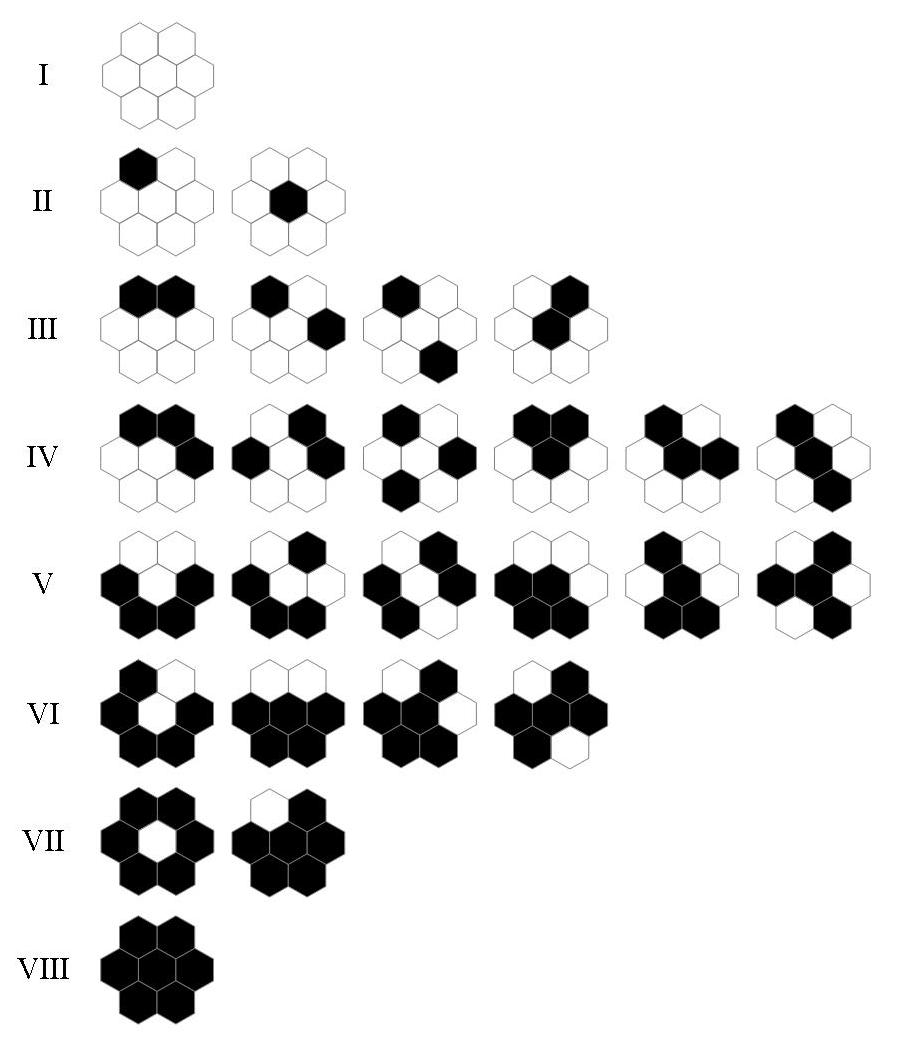
Let's pull up an image of all the possible combinations for seven hexes, where white indicates settlement and black indicates none, these things I call 'Groups':


Altogether, if you count all the ways the hexes can be moved around, there are 128 possible combinations in 26 different arrangements.  If we read the white hexes in the above as areas of intensive cropland mixed with natural vegetation, and the black areas as actual natural vegetation, then we can recognize Prizren and Pristina from the above map are Group I from the above - all cropland - while that one hex east of Novibazar is group VIII - all wilderness.

And how do we designate the other infrastructure against the other groups?  Well, I am a numbers guy.  There are 128 combinations; there's 100 points between wilderness and what I've been calling a fully occupied hex.  Now, I could say a fully occupied hex doesn't occur until 128 ... or I could simply compress 128 into 100.  Both work, but I decided to do the latter.  I like having 100 as the difference between wilderness and fully civilized.

Which gives us this table:


Now, no one has to do these things my way.  I like using a bell curve to designate the differences between the hexes, so that there is in fact a bigger difference between 95 and 100 than there is between 51 and 56.  I see this as creating 'a tipping point,' so that most non-civilized hexes are 3 or 4 out of seven.

So, the hex east of Novibazar would be all wilderness.  The one above Pristina would have one part in seven settled.  The hex east of Ipek would have 3 out of 7 civilized and the one where the Sanjak lives would have 5 out of 7.

Ah, but this is only a beginning.  The seven 'wilderness' portions of a fully wilderness hex would be definitely more wild than the two 'wilderness' portions of the Sanjak's hex.  What's really needed is seven definite measures of wilderness ... hexes without so called features but with distinct characteristics resulting from how they're affected by the local civilization.  When I get back to this subject, that's what I want to talk about next.

Sunday, February 24, 2013

Fleshing the Wilderness

So, I'm trying to follow up on this post on the placement of features in the wilderness, and finding already that I'm going to need a host of new rules.

For example, features such as armories, army camps and castles should increase the number of patrols a party is likely to encounter, doubling and even tripling them.  Some hexes it would be impossible to go to a tavern or a market without there being soldiers in evidence, much more so that there might be otherwise.  But what is the baseline?  The appearance of a patrol has always been inserted into an encounter table - but we know that patrols don't really work on a random basis.  They are variously regular, they cover the overall land surface and they're deliberately designed to enforce the law.

What is the baseline?  A patrol once per week per set area, so that a party staying in one place for an entire week should be met at least once.  Or perhaps, for the die's sake, a low patrolled area would be 1 in 8 days (instead of a week); various levels above that would be 1 in 4 days, every day, every 8 hours.  And the number of patrol might increase from 4 guards to 9 guards to 22 guards.

This is all assuming there are any guards at all.

Moreover, what is it exactly that the guards ought to expect?  A relaxed, very rural area would be more casual than a heavily patrolled region with castle and army camp.  Searches?  Questioning?  What defines an area as off-limits, and what is the medieval punishment for failing to be informed?  Attack; imprisonment; or just pushing off?  This isn't random - established militaries behave according to their presence and local importance.

Regarding something else.  If I add a black market to my trading table, what items does it provide?  Certainly addictive substances like tobacco, opium and distilled beverages; perhaps caviar; probably whale oil.  Weapons yes; perfumes maybe.  A definitive list has to be established, along with how much less it can be bought for, not to mention the possible danger in having said items once purchased.  I also think that some kind of % roll should be worked out for assassins and thieves in order to find the black market, increased by level.  Unless I want to say they can automatically do so.  That seems less than desireable.

A similar problem occurs with the presence of an auction house.  Cheap and sometimes damaged goods should be available - but probably not the sort of things seen in a modern auction on the road show.  This would be more along the line of estate sales ... specifically the house, or items such as wagons, horses and other livestock, ships and boats, land, workshops, mines, quarries and anything else large or that could be purchased in lots (as opposed to quaint artworks and label-oriented items).  Prior to the 18th century, few people were concerned or cared about a specific maker, so the auction house would mostly be there to move things that couldn't be put on a shelf.  A definitive list would need to be made.

Rules would also have to be established as to how damaged some of the lots were, and how that affected the final price.  Cheaper, certainly, but how much cheaper?  And if it was something like a resource lot, how is the price affected by the expected gain from said resource in the future?  All those have to be considered.

Some things are easier.  An almshouse would mean cheap, available unskilled labor, and plenty of it.  Apothecaries, guilds, fish wharves, blacksmiths and the like that are located outside market towns - where I limit my markets - would provide limited equipment lists in those specific fields.  The list I have for specialty places (so far) can be downloaded from my equipment list found here.  An archery range would mean available bow-using mercenaries; a barracks would mean hired footmen; an arsenal would mean sappers and artillerists.  In other words, you couldn't just hire all the mercenaries you wanted in the same walmart-o-rama.

And there are degrees of everything.  A courthouse might mean obtaining writs, hiring lawyers, resolving property issues or appealing for recognition of your status as a land owner or developer ... but not all courthouses everywhere would be able to handle all matters.  Local courthouses would do for local matters; but if something came up for high level characters, potentially involving the kingdom and foreign affairs, it would have to be a prestige court.  How does one begin to establish what and where and how much?  One step at a time, yes ... but it calls for imagination.

Has anyone ever come up with good rules for determining how much meat per day a ranger (vs. someone else) can gather from a given region per day?  And what if the area is well stocked, or the hunter is poaching a game reserve?  What is the difference between a good fish pond and a poor one?  Where are the rules that make it worthwhile for players to bother stopping to fish for a day in order to stock up, as opposed to simply buying their way through your world?  Which is the more romantic way of managing their supplies?

Up to now I have 58 general features; I'm just sketching out their general importance, but there's lots to do here.  Rules to make, aspects to consider, players to educate and encourage towards a whole new set of wilderness-oriented tactics.

It ain't just the survivor's boardgame any more.


Sunday, February 17, 2013

Infrastructure Perspective

Okay, this one is going to seem strange to some people.

To me, a lot of the trouble that people have where it comes to "designing their world" is that they don't know what to design.  The default is to design things that are very small - buildings, streets, dungeon hallways and rooms, etc.  These could be termed 'microdesign' in that they serve to apply to the immediate needs of the party, in terms of what is five feet to their right and fifteen feet to their left.  Useful, obviously.  But apart from the immediate, these things don't help much where the party decides to march off in a direction, say a large open landscape where they're going to see two thousand acres in a day.  You can design one small part of one acre, but you can't really get a sense for the scale.

What is needed, then, is 'macrodesign.'  Here, I think, the game and most of the players are notably lacking, because they just don't know how to approach the problem.

To try and sketch out a method, I'm going to return to an image I once used to describe my trade system: the map of Hothior, from the old game Divine Right!


Ah, so familiar, so conveniently neutral.  I am going to use this to demonstrate a system which really works better on the maps on my world, but for the general audience I think it would be best to simplify that so that anyone can apply this.

That does mean I will need to add some information to the above to make my system work.  To start with, I need to give a population figure to each of the above cities, Port Lork, Tadafat, Lapspell and Farnot.  I also need to establish a population for the region.

If the hexes are 20 miles across, the above region is about the same size as modern day Bosnia (without Hercegovina).  Recognizing that there really ought to be more than four cities in an area this size, I'm going to identify the population at 2,000 per hex (there are 50 hexes, counting all those on the water as a full hex).  Total, 100,000.

For city populations, we'll say Port Lork has 8,000 people; Lapspell, 6,000; Tadafat, 4,000 and Farnot, 2,000.

I'm introducing these numbers so that you, in your world, can take the probable size of cities that already exist.  Obviously, the population isn't going to be distributed evenly throughout the countryside.  More importantly, neither is the infrastructure ... and what I mean to do is produce some infrastructure numbers we can work with.

Let's take the total value of the cities (20,000) and divide it into the total population.  From that, we can presume that each city influences 5x its base population:  Port Lork, 40,000; Lapspell, 30,000; etc.

Let's further divide these bigger numbers by 259 (persons per square mile).  We'll call this the BASE Infrastructure Number.  For Port Lork it is 155; for Lapspell, 116; for Tadafat, 77 and for Farnot, 39.  Let me add those numbers to the map just for convenience.  In addition, I'll color code what amount is coming from which centre:
 

Now, let's say that for every hex away from the core hexes, the cities themselves, the Infrastructure Number is halved.  Let's also say that if the adjacent hex is a forest, the number is cut to one third.  If hills, the number is cut to one quarter.  And finally, if mountains, the number is cut to one fifth.  The number is always rounded off to the nearest whole number before calculating the next hex.

Let's just work out the hexes immediately next to the core cities:


The important thing here is that where an overlap occurs, the numbers should be added together.  The hex between Farnot and Port Lork, therefore, adds 20 and 78 together.  The gentle reader may also notice I didn't extend the Port Lork number into the hex adjacent to the water ... that is because this infrastructure system is measured overland, except where overland is impossible.  Also, because this is infrastructure and not actual population density, the whole seashore is counted as one hex, even if not all that hex is land.

The influence of all the cities are ultimately expanded outward until they cannot be anymore.  As well, each city's influence affects the actual hexes of other cities.  So, even though its messy, let's expand all city's influences out to their maximum:


That's annoyingly difficult to read (and I hope done accurately) ... but it shows the pattern distributed from each of the four cities.  Usually I would do one city at a time and add up the numbers as I went along, but this is for demonstration.

Let's add up the numbers to get a single total for each hex:


Now, let me stress.  This is simplified from what I usually do.  I usually have more cities; I have elevations for every hex which influence the total distribution and son on. 
Also, I don't suggest that what we have here are any surprises.  Obviously the mountains and Bad Axe forest were going to be empty.  Obviously there was going to be higher numbers around Port Lork.

What's interesting here is we have exact numbers.  We could say that these were % die rolls for whether or not there was an Inn in the hex.  We could use the inverse number for the likelihood of bandits.  Or a measure for how good the roads are.  A minimum number could indicate a ferry (50) or a bridge (100).  A forest hex with 60+ could have industry; 30+, gameskeepers; and less than that, thieves or brigands. 

It's really up to you how you want to assign values, and what for.  If you want your cities to be more metropolitan, increase the penalty for infrastructure in adjacent hexes (divide by three or four or whatever you wish for each hex out).  Add a penalty for crossing a river.  Roll a die and make "evil" hexes that severely lower the numbers.  What's important here is that you find a way to measure a lot of blank hexes in some way that establishes a frame upon which you can build up all the little pieces I spoke about in my last post.  How many points does a hex have to have before there's a hospital?  A school?  How little does there need to be for the party to be able to have a free hand in the area?  Where does management and government hold the greatest power?  You have a yardstick to give all that space a greater integrity.  Call it a sort of "infrastructure perspective."

Go have fun.

Wednesday, May 25, 2011

Bloody Attrition

Several days of being sick and I still have an ache that proves my head has been removed and replaced with a basketball full of pudding.  Through the blear, however, there are several posts I could think to write.  Most of them are not about D&D.  This one is.

I wish I had the time to work up a decent set of modifiers or perameters that would create an environment vs. players damage system that would make me happy.  These things get like a piece of gristle and I can't let go.  But then, new angles come up and I recognize that not rushing into creating a system is sometimes a good thing.  Here's the new angle for today, and this too comes out of that Kohima book I'm grinding through rather slowly (it isn't light reading).

Let's look at it from a wargamer's perspective.  I played wargames before D&D, and both wargames and RPGs tend to suffer from some of the same assumptions.  Let's consider the map below:

Site of the largest tank battle, ever.
It's a small section of the Central Russian Uplands, a vast area of rolling hills and steppe south of Moscow.  I've chosen this because of the proximity of the road from the south, through Belgorod and Oboya, and the road from the east, through Staryy Oskol and Tim.

In most wargames, roads provide double the movement speed for units moving from hex to hex.  In other words, while it may take one full move to go straight east from Belgorod, it also takes one full move along the road from Belgorod to Oboya.  This also means that it takes 4 moves to go from Belgorod to Staryy Oskol through Kursk (8 hexes) and 4 moves to cut across country from the bend in the road north of Belgorod, following the black arrows, to where you can meet with the road again.

Some games get 'complex' in that they would differentiate between the height of hills in the first hex of the black arrow east of the Belgorod road (the reader will note that the corner of the hex reads 895 feet) and the next hex along the black arrow route (377 feet).  This drop in elevation might mean that the black route was slightly slower, and that therefore the road through Kursk was still faster.

What I have never seen in a wargame, however, are rules that argue that attempting to go overland had a chance of actually bogging down the unit so that it couldn't move at all for several days.  And I have also never seen any rules that suggested the unit coming out of the rough country (the black arrow route) emerged at half its combat strength.  And yet this is what would be proposed by a D&D rule regarding damage from travel.

Consider larger units in the game than just the character party.  The fighter, cleric and mage devise a strategy by which the main body of the player's army, led by the cleric and the party's hired officers, will attempt a cautious assault upon the castle gates with catapults and siege towers, mostly to draw the enemy's attention.  And meanwhile a hundred picked men under the fighter - with the mage along for support - will move through the dark swampy forest and over the mountain spur above the fortification and flank the weaker defenses from the rear.  A simple glance at the castle will show that there are less men posted there, the walls are not nearly as high and there are no ballistae mounted on the towers there.  Obviously, the castle defenders do not expect an attack from there.

Why not?  Are they just dumb?  Surely a child could see that was the direction from which to attack - at the castle's 'Achilles heel.'

Ah, but is it?  Perhaps the builders of the castle were no so dumb after all.  When the flanking group finds their strength wittled down by freezing water and hundreds of nips from normal sized rats and mid-sized centipedes; and when they find themselves tearing up their hands and boots on the naturally sharp rocks during the ascent of that spur; and when they find themselves losing men from slips and falls from the upper slopes that are covered with dew when the picked men try to make the climb at night; perhaps this won't seem like such a good idea.  Don't imagine a group of daring men emerging from the unwatched side and quickly cutting through the 'weak' defenses like butter.  Imagine a group of torn, bleeding remnants who, after crossing the wilderness to reach the castle, have half their hit points or less, with dead and weakened companions scattered over the land where they've just come.

There's another rule I have been considering.  If a party were to move through a given wilderness hex (or any hex without a road), it follows that the second time they moved through that hex circumstances will have slightly changed.  First of all, they would have found better routes by trial and error already ... so they ought to move faster.  And in finding the routes, they ought to take less damage.  In fact, every time they move through a given wilderness hex, their time and their circumstance ought to improve.  Oh, certainly, there's a point where it couldn't get better, and they would still be subject to the weather, but it should still improve.

In our little scenario of the flanking group above, how many lithe bowmen familiar with the terrain would it really take to screw the party, but good?  Defenders would know the rocks, and would know just where to set up ambushes, who knew when an attacking party was bound to get trapped between the deep bog and the soft ground where running towards a group of three or four archers was practically impossible.  It wouldn't take anything to pin them down when the party came to a certain point on the far side of the spur.  The defenders would have names for every feature, and would say to one another, "They'll have to climb their way up over Finn's drop, or climb through Kelly's defile.  If they're fool enough to do the latter, we'll have Ransom and Troy pin them down when they round Leggim's bend, and drive the back end of their group west from Oram's roost.  We won't last long, we'll have to back out after they scramble up the slope that's there, but Davie and Dan can dodge into Galick's cave.  They'll never find it, as we all know."  (Laughs all around)  "We'll get four or five of them for sure.  Then we can back up and when they go over the ridge near Wavel's Grave, we'll set off the traps."

And so on.

A group of defenders who knew the wilderness well would make life hell for a group of interlopers who knew nothing about the country.  Even with a guide leading them, that guide would have to be someone who knew the country well - and the guide would then be known very well to the defenders.  If the guide really knew the country, he'd know enough to tell the party, "Don't do it, you fools, they'll kill half of us before we'd get there."  Or the guide would have enough larceny in his heart to know when to keep his head down at the bad bits, and when to disappear with the party's money.  Otherwise, the guide's chest is going to be the first target aimed for by the defenders ... without much pity, either.

There are a lot of angles on this rule than what I've seen.  It's more than merely travel.  It's attrition, too.

Thursday, May 19, 2011

Nights That Bump the Thing

Jovial Priest tells me that he wants his players to feel that "they are masters of their own destiny," and I assume he is anxious about it since he made the point more than once.  I, personally, don't believe in destiny ... and if there were a destiny, I certainly don't think anyone would be in control of it.  Either way, I can't think of anything more anathema to the drama of a campaign than in leading the players to think they are the masters of all they survey, just because they ARE players.  At least three quarters of the tension I build up in a single campaign is in emphasizing to my players that the world is a damn scary place, and that it will rip them a new one given half a chance.  Of that remaining quarter, a good 3/16ths comes from dicking my players around making them think the big scary world is going to rip, and right now, only to produce a feeling of relief when it turns out things aren't as bad as they looked.

That leaves 1/16th of the game spent in player comfort.  They have to rest sometime.

My perception that a world - any world - is not something one has authority over probably comes from my being Canadian.  There is a fundamental difference between Canadians and Americans - of which, as it happens, both groups tend not to be aware.  I learned it myself in my second year of university, when my eyes were forced open with Harold Innis and Northrop Frye.  And while it may seem strange for the nationality of the DM to influence the way in which a game is played, the game is based upon the personality of the players, and personality is influenced by environment.  Allow me to explain.

It is an American motif that the wilderness is something that was meant to be conquered.  American history, with which I am very familiar, revolves around wars perpetrated against the previous inhabitants of the land comprising the nation as it exists now, and wars perpetrated against others wanting that same land.  In other words, the land was seized.  There is nothing more American than the ideal of the individual American settler battling against all odds to force the land to produce wealth.  The land, it must be said, has always been treated as something that is controlled.  The perception is deeply held in the American pysche, and for good reason.  The land was controlled.  It was reworked, reshaped, and brought into line with the desires of the American people.

When an American moves off into the tamed wilderness, there is a sense that this is one's domain, the backyard of one's owned property.  There is even a tendency to believe that the wilderness wouldn't dare harm those who deign to walk within it.  Of course, that occasionally proves to be wrong ... but only occasionally.  There was a recent case in the news where a Canadian couple, following a GPS tracker, managed to lose themselves in the back country of Nevada.  The woman was found after 48 days.  As far as I know the man is still missing.

I want to make the point about how strange it is when this happens to Canadians ... and how Canadian's feel when they hear about it.  My American friends are pissed at the GPS tracker, how it shouldn't have led them astray and how the company ought to be sued.  My Canadian friends feel, generally, that the couple deserved what happened to them.  Idiots.

The reason for that is that Canadians do not trust their wilderness.  They don't believe it can be tamed, or controlled, or made to serve its masters.  This is wholly because our wilderness, as opposed to the American wilderness, is a much nastier, colder, more deadly place.  It has driven Canadians into what Northrop Frye called a 'garrison mentality.'  In his words (emphasis added by me),

"Small and isolated communities surrounded with a physical or psychological ‘frontier,’ separated from one another and from their American and British [Canadian] cultural sources: communities that provide all that their members have in the way of distinctively human values, and that are compelled to feel a great respect for the law and order that holds them together, yet confronted with a huge, unthinking, menacing, and formidable physical setting - such communities are bound to develop what we may provisionally call a garrison mentality....In such a society the terror is not for the common enemy....The real terror comes when the individual feels himself becoming an individual, pulling away from the group, losing the sense of driving power that the group gives him, aware of a conflict within himself far subtler than the struggle of morality against evil."

The greatest fear, then, is being alone, and that community is security.  And within the D&D campaign, not just the community made up by the party, but the community of the town, the village, the protective influence of the manor structure and even that implied by the existence of a road, which suggests maintenance and authority - even if only on a very small scale.

I believe the Medieval mentality is closer to that of Canada than of the United States, particularly in those northern parts of Europe like Scandinavia, or parts more isolated, like Poland or the highlands of southern France.  Canada is a wide, untamed country, even in this day and age, and it is likely to continue to be one for some time.  The land here is not so easy to build roads across as in the States; the weather is not so moderate; and the opportunities for crop growing and land exploitation are not nearly so rich.  The wilderness will simply kill you ... even if you are prepared for it.

We were discussing last week of how persons of low level or hit points could expect to enter the wilderness for a day or two and survive.  I'd like to point out here that, though that might be true, ordinary persons did not travel into the wilderness at all, for any reason.  Most persons never had any reason to leave their small plots of land, the nearby meadow, the well-tended copses where they foraged their pigs or the edges of the local creek.  Most persons were born, lived and died within 7 miles of the place where they were born, never going anywhere.  And when they did go elsewhere, such as with the Crusades, a War, they tended to suffer Death from Famine and Pestilence in large numbers.  Beyond one's little world rode the four horsemen ... and there wasn't any question about it.

I wonder sometimes if most people who play D&D really have any idea of just how menacing the wilderness can be.  At present, I'm reading this marvelous book which has been on my shelf for at least a decade, and which I have never seriously picked up.  It is Arthur Swinson's description of Kohima, the battle fought in 1944 in Assam in the eastern part of India.  I am finding I could write a post about virtually any paragraph ... but i want now to post something that describes the wilderness over which the British fought the Japanese:

“The Naga Hills form the northern sector of the great mountain barrier between Burma and India, which runs down from the Himalayas to the sea.  To the south lie the Lushai hills and below them the Chin Hills.  From end to end the barrier is some six hundred miles long and up to two hundred across; it is a very inhospitable region indeed.  The ridges, and therefore the valleys and rivers between them, run from north to south, making any lateral movement extremely hazardous and difficult, even in fine weather.  But Assam is wet and includes Charapunge, the wettest place on earth where eight hundred inches of rain have been recorded in a single year.  In the monsoon, which lasts from mid-May till early September, the jungle paths sink deep in the mud, and the smallest streams swell quickly into great rivers and cascade towards the south.  There is no comfort for man or beast in ‘those hellish jungle mountains’ as General Slim called them; and the insects are an endless torment.  There are sand flies, ticks, mosquitoes and leeches.  The latter crawl up your legs during the night and suck your blood till they become swollen to [the] bursting point.  The mosquitoes must be the largest and most persistent in the world; some strains, such as those around Mao, bringing up great septic sores, and anyone whose face has been attacked might well be in the terminal stages of smallpox.  Where insects abound there is always disease; and in Assam one is prey to dengue, scrub typhus, malaria, cholera, scabies, yaws, sprue and every known form of dysentery.  There is also the Naga sore, caused by pulling off leeches and leaving their heads beneath the flesh.  After four to five days a small blister appears which grows steadily till it is five or six inches across, and destroys not only skin but flesh, and even muscles.  The stink from this putrefaction is foul in the extreme, and, unless adequate medical care is available, the victim may die.  The correct course (as the troops soon learned) is to let the leech have its fill of blood and drop off, or burn it with a cigarette end.”

That's a long quote.  But it needed to be posted in its entirety.  Every detail richly describes how characters travelling through such a region would be likely to die regardless of enemies.  They would suffer damage, considerable damage, and not in some silly manner that left them one magical hit point at the end of a week.  Human beings did enter that forest in 1944, they did die of all those things described above, and they did it with relatively modern equipment and medicine, and with care and concern for the participants.  Even a powerful cleric or a mage would be hard pressed to eradicate every bug, cure every disease, administer to every ill, and to do so for a party of more than six to eight persons.

The Naga Hills of Burma and India go Canada one better ... but I would imagine a DM from that region would have a strong sense that the dangers of a campaign are not limited to things that go bump in the night.  The NIGHT itself is a legitimate enemy.  It's presence and it's influence over the party are very much in the main stream.

This was very much in my mind when I perked at the sound of Zzarchov's damage for wilderness travel in the first place.