Showing posts with label The Campaign. Show all posts

Wednesday, November 7, 2018

15th Class: Experiential

After the previous two classes covering game consensus and situated learning, we come now to the existential development of the role-playing character.  This is the process by which the character consciously or unconsciously shifts it’s original purpose and conception through hundreds of hours of game play.  Essentially, dealing with the world, managing the struggles and difficulties associated with adventuring, the precepts upon which the character was founded grow less and less important, while the existential needs and wants of the character take precedence.  The player will, without awareness, reshape his or her perspective, so that past expectations will be achieved or discarded in favor of a new perspective.  Just as we do with our daily lives.

This. too, is connected with meaning making.  The meanings we created once no longer apply; we have new knowledge now … and with it, new meanings.

From the perspective of playing and managing a role-playing game, we need to ask ourselves, how can we advance this change in knowledge, and thereby advance the habit of characters constantly making new meanings for themselves? How can we encourage player and character growth, together?  Because obviously it is not really the character that grows, but the player’s conception of the character.


Before we can answer that question, we must first understand the principles underlying rupture and reconstruction.  This is a universal phenomenon which we all know from personal experience.

The normal pattern of an individual's life follows a pattern of stability interrupted by rupture, followed by restructuring and then new stability.  Ruptures can be radical, causing PTSD, defying restructuring and lasting in years of oscillation between temporary comfort and difficulty.  Ruptures can also be highly transitory, so that something upsetting that happened a particular morning can be acknowledged, managed and ultimately restructured within hours.  Psychology tends to look at the larger moments of rupture because these are much more difficult to manage and often require outside assistance.

Ruptures are highly variable in type.  Ruptures can result from cultural changes and conflicts, such as war or the appearance of some new ideology or social-changing technology.  Ruptures can result as a change in a person's environment, such as moving to a new city or country, a change in management at work or a recession.  Relationship changes, such as divorce, a death in the family, a child leaving home, new love or a change of interests can be a rupture.  Merely growing older, an increase in health issues or changes in one's belief system should also be included.  Ruptures may happen in an instant, or they may accumulate over a period of years.  We need to recognize here, however, that the origin of the rupture is much less important than the effect the rupture has upon the way the person views their immediate world.

We each move from home to office, from office to entertainment venue, from venue to home, from home to parents home ... and each of these spheres possesses a recognizeable identity for us.  We go where we are comfortable; and the less we recognize the sphere, the more hesitant we are to go there, or let ourselves interact with it.  Going on vacation is stress-inducing because we don't know that sphere and we have reason to question that choice.  A bad vacation can very much be a rupture, one that we will have to deal with while losing that opportunity to relax from our day jobs.  This is one reason why some people never go on vacation.

Ruptures, when they occur, cause uncertainty.  Uncertainty is generally seen to be full of tension and anxiety, but it can also be felt as excitement (again, the thrill of going on vacation, to see something we've never seen, is both exciting and stressful).  Uncertainty can be paralyzing.  It can bring on the oscillation between our coming to terms with what's happened, while feeling despair or depression as we fail to overcome the rupture.  We feel a compulsion to explore, to experience newness, but we are also well aware from our own experience that newness can often have a high price.

Our takeaway here should be that we often deliberately court rupture.  We change jobs for the sake of opportunity, we seek out relationships or to end relationships, we adventure into dangerous places for the sake of newness, we play dangerous sports and other games ... and we do these things because, following the oscillation of the reconstruction process, we grow as people.  We see, we experience, we learn, we advance, we develop new ideas and we come away with new tools and methods of managing ruptures that might occur in our future.  If a rupture occurs, we feel certain that we will handle it and that ultimately that management, that reconstruction, will make us stronger.

Most meaningful activities, the ones we most remember, the ones that bring us the greatest amount of satisfaction, deliberately risk some form of rupture.  The very concept of game-playing is rupture on a micro-level.  Let's take a moment and view a typical role-playing campaign in terms of micro-ruptures.

The players create their characters in an atmosphere of certainty, with free time to conjure up backgrounds, purchase equipment, chat with each other about plans and build up their confidence.  Soon, however, after venturing out, they encounter a difficulty.  They have to reassess; change some of their expectations.  But then they advance, restore their characters, head out again ... and get into some really serious trouble.

Soon, it looks like it could end in a total-party-kill.  Several members of the party begin to identify their situation with inevitable doom.  Another disaster befalls the party and yet they fight it out.  Things swing wildly back and forth.  For a moment, the party is safe; then all hell breaks loose.  Someone's character dies.  Another falls unconscious.  Then something is found - treasure, or equipment - and the dead character is restored and the party advances in ability ... one more difficulty and the party retreats back to town and catches their breath.  There is a moment of comfort again.

But because of their actions, a new rupture is forming.  The enemy has followed the party back to town and now there is a momentous battle.  Magic items are used, some are destroyed; the enemy seems impossible to kill; there's no telling who will win; the party's tension rises, the moment is very exciting ...

We deliberately pursue this format of game play because it reflects our characteristics as biological, thinking entities.  We equate rupture with growth; we equate the threat of rupture with purpose.  And then, following the rupture, we narrate the process of stability-rupture-reconstruction and new stability as a story ... because that is how we are constructed to think.

For those who may be familiar with the term, "the Hero's Journey" described by Joseph Campbell is nothing more than the fundamental structure of human being's adapting and reconstructing themselves psychologically following any rupture that might have occurred in their lives.  Campbell's "universality of theme" exists because every person writing a story is a biological human being.

Our goal is to see clearly how creating rupture is the heart of the campaign structure - much more so than story or heroism.  Story is only the recording of the process; heroism is only the self-perception of how we rose to the challenge.  Both are second-hand descriptors of what is really happening.  We need to lay aside non-specific language and address the functional process directly.  We will continue with this subject, applying the cyclical process of experiential rupture and growth after the Mid-Term exam.

I'll take this moment and say a few words about the Mid-Term, which will be the next class.  There will be four essay questions on the exam - the student should choose only two of the essay questions, then write a 500-word essay on each of those two questions.  For those students who cannot follow instructions, you will be graded on the first two exam questions that I see pass my desk.  Each exam question will be worth 50% of the total mark on the mid-term, which as I said before will be worth 40% of your final grade.

You will be given one week from the time when the exam is posted to submit your answers.  Your answers should be submitted to my email, alexiss1@telus.net.  You will not receive a grade if you do not submit your answers to my email.  You may, if you wish, submit your answers directly to the blog (splitting your answers up as needed to make it fit), but answers submitted to the blog will not be published until after the exam deadline has passed.  Answers submitted to the blog but NOT to my email address will not be graded and will not be published.

I will be grading each essay according to the following method:

  • F Grade.  Essays which show no evidence of grasping or understanding the course content will receive an F Grade.  Take note that answers that introduce outside, unsupported content not included in the course material run a considerable risk of receiving an F Grade as well (I will consider new material that is sourced on a case-by-case basis, subject to the academic value of the source).
  • D Grade.  Essays that accurately repeat the barest material included in the course content, providing no personal insight, will receive a D Grade.
  • C Grade.  Essays that show an excellent grasp of the course content, yet show little or no personal insight, will receive a C Grade.
  • B Grade.  Essays that demonstrate a strong recognition of how elements of the course content influence one another, offering personal insight, will receive a B Grade.
  • A Grade.  Essays that provide remarkable intuition from the course content and the source material, which surprises the examiner with its acumen, will receive an A Grade.
You will not be graded on your spelling or your grammar.  Remember that a D is a Pass.  I wish the best of luck to all concerned.

Saturday, October 1, 2016

Churchill's Flood

Just before this past weekend I wrote a post called Acts of Faith.  That was intended to be the preliminary to another post, one that has been floating around in my head for more than a week - but then I got wrapped up with the Expo and some making of maps and I never did get around to it.  Worse, the post was meant to answer a question that a reader asked me - that even after a lot of thought, it's a question to which I'm not sure I have an answer.

This is the best time to plow into things, however.  Just as I would sit and talk to someone over coffee, I find it just as easy to write out my thoughts here online.  So let's get to it.

What is the one thing that anyone could do that would really, truly, be the most valuable thing to make our worlds better?

From a strategical standpoint, where should we start?  It isn't that we won't have time to do other things, in the long run, but given that we have a session that is starting in about two or five or ten days, what can I do today that will make that session run better?

My first instinct is to say that it's too late.  Role-playing is a difficult process and getting better requires forethought and consideration.  Real, relevant change happens in the long term and always after ages of apparent failure and disappointment.  Winston Churchill, in describing British armaments manufacture prior to World War II, belaboured the point that with great things, the payoff is necessarily in the future: "The first year yields nothing, the second very little, the third a lot and the fourth a flood."

Yet his argument is also that we start today because without starting, there is no future.  And so it isn't that we're without a strategy that we can't employ this minute . . . it is that we shouldn't expect a result from that strategy the minute after.

But it isn't true that we can't do something that will affect the session that I am running, say, tonight.  There are a number of practical, useful things I can do, all of which can be managed in the eight hours between 11 a.m. and 7 p.m.

I can think. For this, I can sequester myself from other people, concentrate my mind on the matter at hand and think.  I'll start by deconstructing the player's reactions so far to the various things they've faced, their apparent motivations, things that they seem to have found expressly interesting.  I can diagnose things that haven't worked, both recently and in my long past, and force myself to think about those uncomfortable things that I would rather forget and examine them for reasons why I screwed up or why the players resisted or resented the ideas presented.  I can settle on an evaluation to my diagnosis and make up my mind to do something tonight that will satisfy that which the players have always liked and eschew that which the players have disliked.

For example: my players who had bought a ship and hired a captain were surprised to find that the captain they hired was an enemy of Spain, having once been a Catalan rebel and a Genoese pirate.  The captain, knowing he was about to be arrested when the ship landed in Morocco, fled the ship, abandoning the party to the first mate, upon whom they then relied upon to continue their journey towards the Canary Islands.  The going was difficult because the mate (now new captain) did not know the waters as well - and yet eventually the party's ship made its way to Aguilar in south Morocco, well out of Spanish influence.

The former captain was then speeding the length of Morocco on horseback, sending a message by pigeon ahead to Aguilar for the party to wait for him; that he had information that was of special use to the party.  The former captain knew the party would have to land in Aguilar to supply before searching the islands of the Canaries, as that had always been the plan.  The party heard the message and decided to wait.  The captain arrived, having spent three days in a library in Fez to acquire his story, then told the story to the party to set up the forthcoming adventure.  There's a huge amount of treasure laying at the bottom of the sea off an island that the former captain (now full captain again) knows and isn't telling.  The treasure was sunk there when the last pretender to the Portuguese throne fled the country in 1580 after the Spanish unification with Portugal, following a sea battle in which many of the Portuguese crown jewels were seized by two Spanish ships that fled south from the Madieras, were pursued, caught near this island in the Canaries and sunk (this last being completely made up for the campaign).
How much treasure could two of
these carry?

The party has heard the story and have decided to trust the captain, to search for the sunken ships.

This is where my campaign was left five months ago, as I struggled to find money, work, organize my life, survive, change places of residence and adapt to endless changes.  Thing is, and I admit this quite freely, I have no plans whatsoever in place for the campaign beyond this point.  I know the island, I have a general idea of what the scene should be, but I haven't decided upon what creatures the players may have to fight, I haven't invented enough rules for underwater adventuring or combat, I haven't made up my mind as to how much treasure is there (enough to get them all up a level, for sure, which will be a lot since they're all 9th to 11th at this point) and many other details.

So, what could I do right now?  Well, I could certainly decide some of those things, yes?  I could start sketching out a map of the treasure's location.  I could sit and think about other obstacles I can put between the players and the treasure to buy myself more time.  I could write rules for underwater combat.  There are definite strategies I could employ today.

I have already set up some major contexts for what could happen.  The captain is clearly not to be trusted.  The historical relationships through which I built the adventure have real documents and references that I can turn to for ideas if I need to.  There could be Spanish still hunting the captain and it must be remembered that the Canaries are a Spanish Viceroy.  And, of course, the players have been adventuring for awhile and have made other enemies not connected to this adventure who could pop up nonetheless.

Most of those things, however, take time, a lot of time, more than eight hours; and it's easy to feel overwhelmed by that and throw hands in the air and shout, "No way!  There's just no way!" before deciding it's a good time to get incrementally better at Overwatch.  "Fuck it, I'll muddle through somehow."

Muddling, however, sucks.  I was muddling with the previous running, with the captain catching up with the party and giving his story.  Much of that running went rather stale, with the party travelling by sea around Morocco and not much happening.  If I had thought about it and taken some time, they could have encountered something without the captain, or come across some other information about the area that had nothing to do with the Portuguese jewels, that could nevertheless now exist as another layer on top of what's happening now.  But I didn't do that because I muddled.  I was tired and I was phoning it in and I knew it.  I knew I was taking a break and I was glad of it, glad to be putting aside my game and paying attention to other things.

Coming back to my game, I can't muddle.  I need a proper strategy.  Bringing this post back around to the main point: what can I do in 8 hours to make this happen?

Hah ~ I can't.  Thankfully, I'm not setting up for a game tonight.  I meant that above as a "what if," knowing that many readers are starting their game tonight.  I'm going to come back around to playing in two weeks ~ and my first night is going to be mostly accounting, updating the players on the rules, getting them set up for the adventure and, possibly, letting them get their feet wet [!] with a minor adventure action and nothing more.  I don't expect to be in a thick adventure until four weeks from now.

So, there's a short term answer for those who are looking for something they can do right now: stall. Skip a session if need be; if that's out of the question, create a very short side-quest into a dungeon or just long enough to keep the players busy for a session that you can muddle through without much trouble, that gives them a boost in treasure and power and makes them better able to handle the actual adventure.  Then use the extra time you've created to design something worthy.

In the very short term, during the session, hold off on bringing the players back to the point.  Let them muddle around, let them overthink things, let them stall for you!  They're having fun and it will give you time to think.  This game - dungeon mastering - is all about thinking.  Do it, practice it, apply it.  Our only chance of improving our short term game is through having one epiphany after another, rapidly enough that we can prove we're smarter than they are.

Yet, this all sounds nice but it doesn't actually answer the question.  What makes the epiphanies work, hm Alexis?  How do I know it even is an epiphany, Alexis?  Answer me that one.  And while you're at it, please explain why you're not just full of shit?

Sometimes, it feels like I am.

I admitted that I didn't have a proper answer to the question. All I've said so far are some of the things I use to side-step the "best thing I can do for my world" question.  Like everyone else, I'm wallowing too; I'm struggling, I'm thinking things up on a dime, I'm putting off the work and not doing the things I should be doing (underwater rules) so that I can frivolously map Scotland.

Fact is, I don't have an answer for what the underwater rules should look like; I have nothing good to base them on, since apparently everyone else who has tried to make such rules had no idea either.  And unlike horses, we don't have a lot of real world discussion about swinging swords and firing crossbows underwater.  People in the Middle Ages and Renaissance did not fight battles under the sea ~ it was a good way to drown.  And there was no reason to do it.

There are a lot of things about the game that I just don't have a straight answer for.  I know how to map Scotland.  I don't know precisely how this adventure with the players is going to go.  So I waste time doing the former (because it keeps my hand in the game and continues to build up resources I may use later) while waiting for inspiration to solve the latter.  It's what everyone else is doing, also.

Churchill's flood pays off when it comes to things like knowing the game rules cold (which DMs should do) or spending a lifetime reading about history (so that I can wonder what happened to the Portuguese crown after 1580 and discover that there's an adventure to be built out of it).  It pays off when the maps are already there and I've done the research to find out how the Canaries were settled and what purpose they serve in the Spanish geopolitik.  It pays off when the players decide to do something really weird and I already have house rules for that or I can base a precedent making decision on something else that I have rules for.  Working at random things in my world every day and all the time steadily accumulates until the immediate needs of the campaign have the potential for inspiration from the knowledge base I've acquired or the habits I've adopted from running my world as long as I have.

Can anyone have that by "doing the most important thing" in the short term?  No.  That's the cold answer.  No.  There is no specific, definite thing that anyone can do that will universally fix every campaign.

But individuals running their games can do the next thing.  And that is really the key.  The next thing.  I did this yesterday, today I'm going to get up and work on this for some time.  And tomorrow I think, if I'm not still doing this, I'll do that.  And so on.  Every day.  Patiently.  Waiting for the flood to happen.

Sunday, June 19, 2016

The Manor House Part I

In 2010, I wrote a post called Estate du General, which was, I said, trying to get a handle on what the structure and format of a manor house and demesne.

Yesterday, I found pages that includes the statistics behind that post.  It is one of the things I feel was meaningful among all the 'practice' writing that I've chosen to throw out, described in my last post.

What I'd like to do is rewrite that post and add more to it, based both on my old notes and on things that I have learned since, along with my imagination.  While this will mean some repetition, I think that the content will be so much more in depth that none of my gentle readers will care.

Geography & Authority

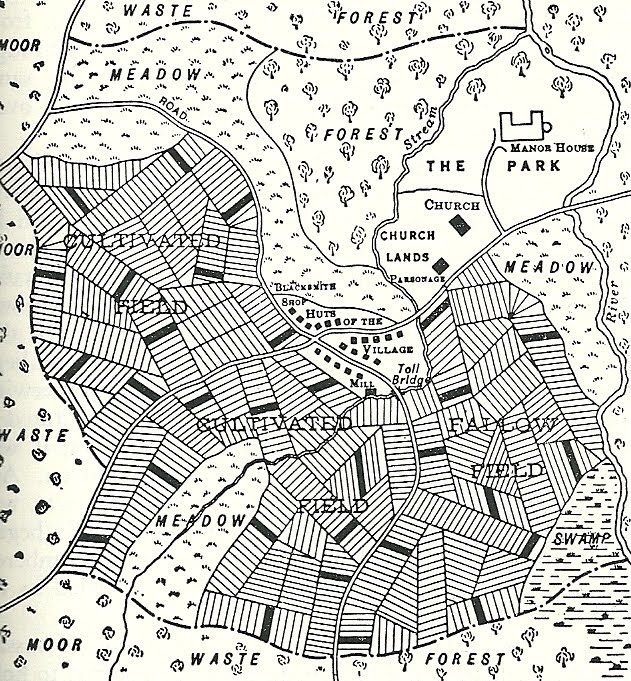
We'll start with a manor lord that fits D&D.  Our manor lord will be a mage, Ikhnaton, who once did a favour for a royal household and was granted a manse in compensation.  Our mage is a baron.  This manse is 1419 acres in size, or 2.3 square miles, about the size of a neighborhood subdivision or a small town of about 2,500 people.  As before, I'm going to use the same image that I used with the previous post:


Let's get a clear idea of the map above.  We have two cultivated fields and a fallow field.  Let's call the cultivated field on the left the "West Field;" we'll call the one in the middle the "South Field."  The Fallow Field is the "East Field."

We'll call the meadow that is surrounded by the South Field the "High Meadow," because the stream enters the manse at that point, flows into the South Field and then into the Village proper, past the Church Lands (including the cemetery) and then The Park, which is Baron Ikhnaton's personal yard, paddocks and gardens.  The stream then meets the river at the top right at the northeast boundary of the manse.  We'll call the meadow that's along the river at the right the "River Meadow."  The third meadow, the one in the top left, we'll call the "North Meadow."  The forest is the last section of our manse - we'll call it "Stream Wood," to separate it from the forests surrounding the manse.

We have two roads through the manse (no one in a medieval mind-set would have thought of these as four roads going outwards from the village).  These aren't really 'roads;' they're more like cart tracks.  Probably, some gravel has been added to the length of roads through the village (and some to the boundaries of the manse in the worst places), but the routes will by and large be only hardened courses with cropped grass down the middle (called the 'long acre') and ruts.  One of the two roads has a toll bridge on it, about 18 feet of boards over the slow, deep stream, so we can call this the "Toll Road."  The other road passes the Church and the Manor, so we can call it the "Main Road."

Let's break down the size of each piece of land:

Forgive the medieval measurements.  They're appropriate for the
time being described.  2.47 acres = 1 hectare

Ikhnaton, being a D&D character, is never home, so the manse is actually under the control of a steward that Ikhnaton employs.  This person administers all three types of land - though he spends most of his time overseeing the immediate concerns of The Park.  To help him look after the other three parts of the manse, he employs a reeve, a hayward and a warden.  These, in order, look after the dwellings (and the people), the fieldwork and the secondary land.  The reeve ("shire reeve" or sheriff) is there to keep peace, keep track of outsiders, ensure that the tolls on the bridge are collected (for which he employs a keeper) and to hang out a lot at the blacksmith's and the miller's.  The hayward ensures that everyone works when it is their duty to do so, that the boundaries on the fields are kept right, to manage the labor on Ikhnaton's fields and to keep order through the day between farmers; he manages the animals on the meadows but not the meadows themselves.  The warden watches over the back country, helping to select trees to be cut, catching poachers and patrolling the outer boundaries of the manse.  This last is why the master of a prison is called the "warden" - because the job means keeping the borders secure.  All three of these report daily to the steward.  This accounts for most of the law in the manse.

The only appeal is to the church.  Here we may be dealing with a pastor, a teacher, a recluse or simply an individual who was given a benefice by the church and doesn't really care about things like religion.  However, whoever resides here is an important person, with capital, outside influence and potentially the power to produce an insurrection at will, if goodwill has been sown with the peasants.  We'll say that on Ikhnaton's land, the Church Lands are occupied by a gentle friar that doesn't give services but does offer regular spiritual support, advice, alms and occasional support for the steward, Reeve, Hayward or Warden.  The Friar might step forward to restrain a punishment if the case is unusual.  The Friar could also, of course, use his influence to have someone exiled or expressly punished "for the good of the community."

These names are European, obviously: but most cultures have had these roles filled in some manner.  They are logical subdivisions of labor and social justice - so whatever the titles may be or the sort of religion in question, these figures are recognizable from society to society.

The Manor

The Park, or the Manor, consists of several buildings.  It is typical to think that every manor must be a castle or a fortified building, but since most were not we'll treat Ikhnaton's manor as a villa rather than a keep.  The assemblage of structures includes the main house, a kitchen, a winery, a longhouse, stables and a paddock.

The Main House is 30 ft. by 60 ft., about two hundred years old, with a stone and mortar foundation. The main floor is broken limestone and mortar, while the two stories above the main floor are constructed of timber, wattle and daub.  There are three fireplaces inside the house.  The main door would be located along the longest side of the house, not on its end, as the house runs along a circular drive.  Three authorities of the manse, the steward, reeve and hayward, live in the main house with their families, on the second floor.  The third floor is shut off and reserved for when Ikhnaton is here (at which point it is opened, cleaned and made ready for the mage).  This third floor consists of a main bedroom and an extensive laboratory/library.

The second floor also includes two women, married to the reeve and the hayward.  The steward's wife died last year while giving birth.  The steward has two children left to him, the reeve and hayward have four between them.  These children also live in the house, where they are not expected to labour.  They are tutored by the friar and have a governess (the vintner's wife).

In an office on the first floor is a young scribe and his wife; they have no children.  This fellow keeps track of the manse's accounts while his wife takes care of him and acts as a midwife for the manse.  Technically, they are "servants," though of course they are treated well.  There are fourteen other servants in the manor - cleaners, launderers and servers - made up of spouses and elder children from those who live in the surrounding buildings.  These are watched over by the reeve's wife, who has taken over the duty from the steward's former wife.  All these servants arrive at the house each morning - none of them live in the house walls.

The Kitchen is attached to the main house but is not actually part of it.  It has been added alongside the house (with an inside door to the house), overlooking the back yard away from the road, where it can take advantage of the garden, the pond and the path that leads to the river (which helps provide food to the manor).  Both the cook and the baker live in the kitchen building, with their wives who are both servants in the main house.  The cook has two boys who help out in the kitchen while the baker has a 14-year-old daughter who has also been co-opted as a servant in the house.  There are two younger children who do general kitchen chores as well.  All nine of these people retire to a loft built on top of the kitchen at night.

The Winery is built against the back side of the main house, but there is no inside door.  The Vintner lives here with his governess wife and their seven children.  Three of these are servants in the main house; the eldest boy, 16, works alongside his father.  One of the remaining children, a boy of 9, has been selected to be a playmate to the steward's son, who is about the same age.  They are seen everywhere together, though of course the steward's son makes all the decisions about what the two boys do when there are no adults around.

The winery's remaining two children are younger than eight and are more or less free to do as they like, as the father does not want them underfoot (the mother is forced to be more concerned with the house children than her own youngest ones, so they are able to raise themselves - though they tend to attach themselves to various adults throughout the manse, including the warden, the friar, the various stablehands, etc., who help look after them, and all the other children in the same age group).

The Longhouse provides lodging for the swineherd, the shepherd, the reeve's deputy, the hayward's two deputies, the vintner's assistant, nine fieldhands and the four stablehands, along with 15 wives and an assorted 41 children, aged from baby to 16.  Five of the wives and three of the children are all servants in the main house.  A boy of 15 sometimes helps the scribe by running messages throughout the manse.  Along with the stablehands are 8 boys who help in the stable and paddock.  All of the remaining children who are older than ten work in Ikhnaton's fields each day - with the exception of the shepherd's son, who helps out his father.  We may assume that the shepherd and swineherd's wives also help in moving the sheep and the pigs each day.

If the reader is losing track, I don't blame you.  Here's a breakdown:


So, why go through all this detail?  Well, to emphasize that even the most common manor house would have considerably more people as part of its structure than the few that Hollywood usually depicts (as they have to worry about how many extras to pay).  This may sound like a lot; 14 servants in a house this size was certainly nothing unusual - and 20 farmhands (11 who are children) for an area of 270+ acres (a third of the manse, which was typical for the lord to own) is hardly an excessive number, considering all that needed to be done.  10 acres or 4 hectares, for those without a sense for these things, is an enormous area to manage.

The stables may be a bit more than Ikhnaton needs: but perhaps, like me, he really likes horses.  Perhaps, like the wine the vintner makes, it raises capital for the manse.  Something has to pay and feed all these people.

Take note, none of this begins to describe the village itself.  That is a whole other pile of people.  Some might also notice that I haven't mentioned any fathers, mothers, grandparents or other relatives to the above.  These, not being part of the business of the manse, have residences in the village, where they are visited regularly.

Still, what does this have to do with D&D?  Nothing.  Everything.  The thing about NPCs is that most DMs tend to view them as a faceless mass.  On the other hand, an imaginative person can look at that last list above and begin to see there are interesting patterns in the families and individuals.  Just try to envision the individuals here.  What is the stablehand without a family like?  Or the fieldhand in the same boat?  What is the relationship like between the mother and the son who both work as servants in the house?  What kind of gang do all the youngest children form before they're forced to work in some way?

Now try to imagine that you are Ikhnaton.  Who of these do you want to know by name?  When your manor is being looked after, who do you turn to if you want to check up on the steward?  The scribe?

Take a step back, then, and try to see the whole.  You're looking at a street in a town, at a tower overlooking the valley: the guard you're trying to talk into letting you through the gate.  Can you see it yet?  Can you see how the big picture forms from the little picture?

No?  Well, we'll keep at this.  We'll see what comes out of it.

Monday, September 8, 2014

New Campaigns

"Hello.  This is Sandra.  Sandra was once a ten year old girl back in the days when America was great, when she went to school with Democratic Candidate Bob Gillon.  Back then, your candidate tried to steal a kiss from Sandra under the school bleachers.  Do you want to elect a candidate that tries to force himself on little girls?"

I know, I know, I promised to stop writing about American politics.  It's only that you cannot imagine what it's like to be outside your country and see ads like this.

Thank god I still live in a country where firing a gun - at anything - on live TV will probably not get you elected.  Admittedly, I can't quite be sure.  I live in Alberta.

(that's an in-joke for Canadians only)

Been a strange weekend.  I write a post about seeking advice about D&D, and get an answer that there's a polite Star Wars forum that exists.  Logically, I should now write something about finding your own role-playing style, apart from the mainstream, only to find myself proved 'wrong' by evidence that excessive consumption of rabbit meat results in malnutrition.

I am not sure when I stopped writing in English - but it is the only explanation I have at present.  I look at the page and it looks like English to me, but apparently it isn't.  I've gone over.  I've lost touch. I'm just writing gobbledegook at this point.  The blog doesn't support guns, it doesn't support white cops killing blacks, it doesn't bemoan the death of Christmas and therefore this blog cannot be understood by American readers.

My apologies.  This is some kind of cultural break.  A miscommunication.  A failure to communicate.

The moron with the gun in the real political ad above thinks he's doing something very clever.  He thinks he's making a point.  There are tens of thousands who will see the ad and scream at their TVs rabidly, "Fucking A!!!"

The first words of the video, "Millions of dollars of negative ads are flooding into Alaska ..." will make no connection whatsoever with the viewer.  They will not realize they are watching a negative ad - or that it is being shown in Alaska.  They will not recognize that the very cheap looking video will have actually cost several hundred thousand dollars.  They have no understanding of filming for television, so they don't know what sort of grease it takes to fire a gun on network TV.  They will never see the tab being spent to buy network space between showings of Rick Castle, Fuckwit.  The people yelling approvingly at their TVs are ignorant.  Cheerfully, malignantly, indignantly, extravagantly ignorant.  Because this is the nature of appealing to the stupidest, most moronic subset of any group.  Do exactly what you are telling others not to do.  Do it, then pretend you're not doing it.  No one will notice.

Take a hobby.  People enjoy the hobby, but there's this nagging, fundamental issue that will not go away - a significant number of people are uncomfortable or unclear on how exactly to participate. There are endless discussions on what is accepted or not accepted, what's the right way to play and why it is very, very necessary to understand that there is no right way to play.  The rules keep changing.  Pundits rise up and declare the new rules are wonderful.  Pundits rise up and claim the new rules are stupid.  The wave rises and falls.

The hobby is dying.  The hobby is stronger than it ever was.  We don't have anyone in our school who can DM.  I don't know how to DM.  I DM, but my players think my game is shit.  I started a campaign, but it broke up after the first session.  We played for two months and then we decided to start a different campaign using a different system.  We don't play seriously.  We don't play enough. Pathfinder is better.  Swords & Wizardry is better.  Lotfp is better.  My game is better now.  No, I can't explain how.  No, I can't say it is definitely the system.  The new campaign feels better.  The new campaign is simpler.  The new campaign has more role-playing.  The new campaign has more character.  The new campaign, the new campaign, the new campaign.

What the hell?  Why is it always the 'new' campaign?

Have we simply gone so far that we've missed the relevance of those words?  "I've been running for 25 years - yes, I just started a new campaign last month."

I would like to know how many new campaigns an average DM starts per year.  Per decade.  Per lifetime.

I've been running 35 years and I have started three campaigns.  I ran the first for three months, starting three months after discovering the game.  I ran the second for five years, starting three months after the first failure.  I have been running the third for 28 years.

Why is that not typical?

Why do we want to pretend it shouldn't be?  Why have we invested the word "new" as something that's beneficial or great in a campaign?  Doesn't that mean that all the time and effort and discovery and design that went into the old campaign was thrown out?  How rarely we use those words: "I threw out my old campaign last week."

Why?  What was wrong with it?  "Oh, well, it was . . . well it wasn't . . . the players didn't . . . but it's okay, because I'm starting a new campaign next month."

Well good for you.  I won't hope this one will be the one that takes, because it won't.  It will be shit just like the one before, because it's plain that no lessons were learned.  People are killed by guns every day, but as a would-be Senator the message I want to send will be that you should use a gun to express your discontent with the other fellow.

Lessons.  Not learned.  Repeating the same mistakes, over and over.  Because no time is ever taken to examine the mistakes.  Find me the blog post that says, "I started a campaign but it was total shit.  I screwed over the players, I spent too much time on dungeon making, I tried to railroad the players into a story that bored the shit out of them, I really screwed the fucking pooch.  I did.  Not the players.  It was all my fault.  I'm really looking over my mistakes and I've decided to change the way I play.  I'm going to think it over long and hard before I start another campaign."

Those posts are out there.  People rarely go into detail.  It's embarrassing.  I can't really blame people for not tearing into themselves in the public eye.  We could use a little more of it, however - as that would build at least some sense that improvement matters.

Instead, we get, "I've started a brand new 5e campaign and it's BETTER!  It is so, so, so better!"

Oh yeah?  How?


Friday, October 18, 2013

The Third Adventure

One thing I love doing as a DM is playing three adventures simultaneously with the same players.

The way this is managed can be worked out by any DM with experience and the willingness to be patient.

The first adventure is always whatever the players WANT to do. They want to plunder a dungeon, start a farm, travel to China, etc. In an extended campaign they're bound to have a long term goal which cannot be fulfilled in a few runnings, which will usually require that they travel or build ... and the events associated with that goal are usually obstacles in the way of achieving that goal. The party settles in to do some goldmining and someone either wants to seize their claim or push them off the land, that sort of thing (to describe a cliche sort of obstacle).

The second adventure is what people in the industry of making modules likes to call a "side adventure." It's the event that occurs while the party is on their way to something else, where some element of the side adventure is so intriguing or so appalling that the party must investigate or set things right. They're on their way to China, but this village on the way is being plagued by bandits, several children and old folks have died, "We really ought to fix this." Something on these lines CAN be cleaned up in a few runnings.

The third adventure is my favorite, a large part of why I find running D&D an unmatchable enterprise. The third adventure is where something is happening that is so big, so unfathomable, that the party is only one tiny element on the edge of it. The entire planet is going to be taken over by Slaad, but no one the party has ever met has even seen such a creature. By chance the party stumbles across one and kills it. An X-files like crew of ridiculously high-level people show up, bundle up the evidence, briefly make the acquintance of the party and then disappear ... for six or seven months of running, NOTHING is heard again. No information, Nix, leaving the party to assume it was all a glitch and that it can be ignored.

It is like the Alien space ship grabbing Brian as he falls, rescuing him before he dies, then dropping out of the film never to appear again. What did it mean? In the movie, probably your best guess. In my world, something far too magnificently important to be even remotely grasped by mere players.

Admittedly, it is a bit of fucking around with people, but in my head I have the whole trail of events sketched out. These people over there did this, which caused this, which resulted in this event, spawning that getaway (which the party witnesses), followed up by this bustling about in the aftermath, which produces a plan, which involves the party being contacted in order to do "this," which the party does or doesn't, which cause groups A, B and C to frantically find another way to ... and so on.

I freaking love it. And I'm prepared to sit on it for a decade, if need be (I did once, between '83 and '93). I'm in no hurry.

In a complete world, it is like when you get pulled over to the side of the road because you're driving with a load that's not covered - when you did not know that was even against the law, now. Some people, somewhere, made decisions that now result in you paying a $300 fine. Tough luck. The world is moving all around you and you haven't a clue what they're doing.

It's important to let the party know they're just tiny little fish in a gargantuan, baffling, random pond with elements so remote - yet so influential - that it is more than just a little scary.

Like life is.

Friday, February 15, 2013

The Paradox of Choice

I'm sorry to keep doing this to you people out there who haven't the opportunity to see these videos wherever you may happen to be, but lately I've just been feeling very visual, I've been seeking out lecture videos on youtube (which is a marvelous, time-consuming exercise) and its terribly convenient to be able to point out to people, "See, I'm not crazy, really brilliant people think so too!"

A fellow asked me recently why it was that I was driven to create this complicated environment for my players, in depth and elaborate in the extreme, but I continued to embrace the sort of clumsy cardboard framework of character classes.

I explained that the reason for this had a lot to do with choice.

It is generally believed by the friendly fuckwits at WOTC, and the many, many fools who frolic there, that increasing 'choice' into the fabric of the game cannot help but improve the game.  This is a natural extension of a lot of different sociological factors that began with the Me Decade of the 1970s and carried forward into marketing and so on ... an ever accelerating process which is loosely connected to the subject we've been talking about the past few days, that being market research.  Generally, market research was designed to identify what people wanted, so that markets could then produce those wants and therefore target people's needs in a way that would make them very happy.  The introduction of 3.0 and 3.5, concentrating as it did upon many classes and many races, along with skill sets that offered hundreds of ways in which to fabricate a character for YOU personally, was a natural extension of something that was exploding in the marketing culture.

(Here you thought D&D was an 'underground' phenomenon.  Shame on you)

This has backfired.  Of course, I don't expect you to believe me that it's backfired, so let me have Barry Schwartz explain it to you:


In general, for those who can't hear the video, Schwartz makes two fundamental points.  The first is that having choices - a great many choices - produces paralysis.  People feel, particularly where they have little or nothing to base a choice upon, that they are almost certain to make the wrong choice.  This has the consequence of making them feel inadequate in the face of change, causing them to either make choices for the sake of just getting past making the choice (and being disappointed) or of making no choice at all.  In D&D, this is commonly expressed in farming the choice out to someone at the table, usually the DM, who has far more experience than the player.  Depending upon the DM, this can be either a good thing or a bad thing, but the principle issue is that it isn't the player making the choice.

Schwartz's other point is that increased number of choices causes individuals to concentrate more upon the choices they did not make rather than the ones they did.  So the character who, as part of the creation of their character, has decided upon the skill of making armor, discovers too late that fishing would have been more useful and valuable given the campaign they're in, and are therefore dissatisfied with their choice to the point where they blame their own shortcomings.  This is a much bigger problem than most campaigns realize, as the words "I've been fucking stupid," are somewhat anathema to the game, producing players who are sullen and unhappy with the characters they had the freedom to create.

I would argue, for anyone familiar with the original class system, and familiar with the later skill-choice system, that their memories of the game are that people in general, particularly less experienced players, are much less happy with the characters they ran in 3.5 than characters in earlier game-systems.

Look at the elements of human nature.  We as people are almost entirely unable to choose who we are.  The skill sets we have when we reach the age of 18 are largely those things which our families happened to know.  If your father was not a great cook, you're probably not much good in the kitchen.  If your mother was wild about fishing, and took you into the woods to fish every summer, you probably know quite a lot about fishing.  For the most part, you're just not familiar with things that haven't been dangled in front of you, and this is even more true of someone growing up three generations ahead of you, who did not have access to most modern media.

So who you are and what you know is something you simply have as you become a young adult, and except for some envy issues you probably have about friends who get given cars by their rich parents, you're probably content that you know how to play hockey or basketball or curling or what have you.  Yes, you may not know how to sail, but you're not bitter about it when you first encounter a sailboat.  You never got the chance to learn.  It's not your fault.

So if the game includes a powerful restriction on who you are - i.e., a rigorous class structure of fighter or mage or thief - you're prepared to live with that.  Moreover, every fighter is the same, every mage is close to the same (the hard part is choosing spells) and every thief is the same.  You're not punished for not picking the "right" elements of the fighter that lets you fight differently from other fighters.  And once you're used to fighters, a fairly shallow learning curve, you're comfortable playing them.

The world, on the other hand, for you in reality, is a wide open vista.  You don't want to live in a cage.  You want a big, massive, complicated world because that is the world you live with everyday.  Having a million choices in the world is more comfortable for you, because the world actually offers you a million choices.  Yes, sometimes you'll make the wrong choice, but since you're not identifying your personality on the choices you make in the world, you're more comfortable when you make the wrong choice.

So in general, it is better to make the character creation process more stale and predictable, because your players will be happier.  And it makes more sense to make the actual game world more elaborate and complex, because your players will be happier.  Those players who are familiar with the variety of choices, who have parsed them out in depth, will grumble about the lack of their choices, but the base line for ALL your players will be improved.

Schwartz is talking to an audience in the hope of making the whole world understand this entirely proveable concept against their gut instinct, which is making all of us - daily - less happy.  But for your world to improve on the basis of his argument, the only person who needs to believe this is YOU.

I really liked this one:

Monday, September 17, 2012

Adventures

I agree, there has been a lot of personal content on this blog.  I don't see that as exactly wrong, but I'm sure it drives a set number of readers away.  Then again, when I work to put content on this blog, and shake up the world with looking at the game of D&D a new way, the readership does not spectacularly change.  In fact, it falls off a bit.

I think what people are really looking for in a blog is a way to help them with their campaign.  Specifically, they want adventure ideas they can plug and play with their people come the end of the week.  With regards to this, I have always been selfish.  I don't share campaign ideas - not many - on this blog.  I keep them to myself, so I can run them in my campaign.  If I write my ideas out publically, how can I expect to surprise my players?  If I spend time make up new campaigns just to please the readers, what will I do when I run out?

Still, it's mostly an example of laziness.  History has all the campaign ideas you could ever possibly want; but you have to actually read it, and history - especially at the beginning, when you don't know anything - is boring.  It is. 

China and Japan are rattling sabres at each other just now, and most of the people who chance to hear about it (not in the forefront news yet here in Canada) will think mostly, "now what?"  The general attitude is bound to be that people just can't get along, anywhere, and isn't that just a shame.  Some will hear that the conflict over the Senkaku Islands is one about natural gas, and that will just convince them that states are petty and squabbling greedy children, run by fatcats.

I've heard about six different versions so far of how the islands got into Japanese hands, none of which actually mention the First Sino-Japanese War of 1894-95 ... in which Japan kicked the holy hell out of China using modern weapons.  The war really only ended because there were other states in the Yellow Sea that Japan didn't want to offend (not China) - and after the war, Japan forced a treaty that gave them most everything they could claim that hadn't already been claimed.

D&D Campaign:  the party encounters a countryside which is being plundered by an army using swords against defenders using farm tools.  The defenders are falling back, and appeal to the party to help them escape, preferably paying them a few potables and whatever jewelry that belonged to their mother to have the party simply fight the squad of twenty men hot on the refugees' trail.

The bigger picture with China was that the Japanese conquest was on the tail end of a long period of conquests by several European powers, acts of pure unmitigated bastardly colonialism by Britain, France, America, Russia and others.  This period was the after effects of floodgates that were opened by the First Opium War of 1839-42.  There was a collection of Brits (and others ) selling excessive quantities of opium to Chinese traders, in order to make piles of money they way  Colombian drug lords do.  Britain did not give two shits in a teacup about Chinese authority, and when the Chinese tried to interrupt their trade (with very complicated circumstances involving the complicity of a member of the royal navy), the Brits showed up with ships to open that trade up again.  The event inspired the first "Unequal treaty" imposed on China by Europeans - there would be many more.

D&D Campaign:  the party stumbles across a large city that has fallen under the control of a dozen different invaders who have broken into hundreds of factions, plundering and getting drunk, getting killed by others who again plunder the plunder, and all the while there is streetfighting and a state of scattered chaos.  There are no authorities, but there are things to steal, blocks to occupy, inter-street treaties to be made and blood to be spilled.

D&D Campaign:  the party must slip aboard a ship in harbor and destroy the cargo of intoxicants by any means that are practical, magic or otherwise, in order to assure that the product will never be sold to innocents.

D&D Campaign:  the party finds themselves aboard a perfectly innocent ship that is seized and held illegally by a petty despot claiming to be operating in the best interests of the crown - but if word can be gotten out to the despots superiors, that's to be the end of him!

The Opium Wars themselves had grown out of what was called "the Canton System," implemented in 1757, in order to restrict European traders to one port upon the coast of China, to have access to silks, porcelain and tea - this last a very valuable export.  The trade was controlled by a monopoly of Chinese merchants called the Cohong - and these 13 merchants would be the only ones authorized by the Chinese government to trade with the foreigners.  At this time, international trade had not reached considerable levels, though there was an increase in British and European shipping picking its way along the Chinese coasts.

There had always been Chinese trade with the West, particularly along the Silk Road ... and the new Mandarins at Canton were eager to buy western goods - which they could sell at considerable prices into the heart of China.  Furs and silver were highly prized.  But there was a resistance to foreign goods that undermined Chinese ethnocentrism ... which of course reduced the import of guns and artillery that China would ultimately need to preserve itself.

D&D Campaign:  the party gains access to one particular merchant in this mercantalist arrangement, so that the part becomes themselves intermediaries between outsiders and the buyers of goods.  Knowing this, the party is seized and forced to take assassins to the merchant's house - if the party agrees, the merchant will die.

D&D Campaign:  the party encounters a merchant from the concealed kingdom that is NOT one of the accepted merchants ... and this merchant wants to buy weapons, all the party can provide.  There's a great deal of money to be made - he will pay twice the value of any weapon the party provides; will the party turn all that easy money down?  To tempt them further, offer to have the party meet the lord of the land where the trade will take place, and hear from his own mouth that the party will not be arrested (then DON'T arrest the party once they agree ... let them make a bundle!)

One such city that had existed before the Canton system on the coast of China was Macau, which had been settled by the Portuguese in 1535.  The Portuguese rented the peninsula, paying an annual tribute and importing 5,000 slaves to enable their small number to properly manage the area.  More than 20,000 Chinese would also settle there, so that Macau became East Asia's first peaceful multi-cultural city.

On June 24, 1622, the Dutch would try unsuccessfully to seize Macau.  There had been three raids previously, but this was an all-out assault.  The Dutch had learned that Macau was not well-defended; they moved to seize the city upon gaining this information with a fleet of 8 ships.  Once they had gained Macau they planned to force the Chinese to trade with them.

From Wikipedia:

"On June 8th the fleet sailed into Cam Ranh Bay or firewood and water, where it incorporated four Dutch ships encountered off the coast of Indochina and detached a ship with dispatches for William Janszoon, admiral of the Anglo-Dutch Fleet of Defence blockading Manila. So when the fleet set sail again from Cam Ranh Bay two days later, the fleet was composed of eleven ships. A few days later, the fleet encountered a Siamese war junk carrying 28 Siamese and 20 Japanese people. The Japanese asked to join the Dutch expedition, and their request was granted. The landing force now amounted to about six hundred, with some Japanese, Malays, and Bandanese among the numbers."

Read the rest of the entry here, and ask yourself if you really need me to come up with adventures for you.

Friday, March 16, 2012

Fishing

With all the talk of 'hooks' in game running, I wonder if people give much time to thinking about the metaphor, and where it comes from.

Hooks are used to catch fish.  Good for the angler - not so good for the fish.  Still, that is the point after all.  Hooks work well to catch fish because the fish cannot see the hook.  The fish sees the bait, or the fly or the spoon attached to the hook ... and while rushing up to swallow the spoon, it gets the hook in its mouth.  Excellent, that's breakfast.

So if you are a DM, and you are dangling hooks in front of your party, and they're not biting, don't be surprised.  Fish don't bite at hooks.

Now, I am a spoon hook fisherman.  I screwed around with fly-fishing once, but I'm not looking for reasons in the wilderness to keep myself busy.  Nor am I a big fan of bait.  I like my fingers clean.  For me, the easy toss of a spoon out into the lake, the soft clicking of the reel as I draw the spoon back, this is for me.  No muss, no fuss.

As a kid, I used to think that it made a big difference what spoon you used.  I had a favorite one that was a frog, with six black spots on it, and I had one that was white with a red stripe, and one that was neon green and orange, with two red jewels on it.  They were standard hooks, and if you fished in the 70s and 80s, you know exactly which hooks I mean.

But experienced anglers learn that what catches the fish isn't the pretty painted pattern on the one side, it's the flash of chrome or gold on the back.  The spoon, with its dull and shiny side, spins as it drags through the water, and the spin is what catches the fish's attention.  The spin also nicely distracts the fish from the hook, dragging behind.

In fishing, you must be careful not to reel too slowly, or the hook will drag the bottom, or it won't spin well - it will ride with only the dull side showing, and the fish won't see it.  You must be careful not to reel too fast, or the fish won't have time to see it and pursue.  You must reel in just right.  It's a learned skill.

The flash of the spoon, my gentle readers, is the treasure or the reward the party wants to have.  The dull side is what the party can't quite see - the obstacles or the terrain or the monsters, if you like.  The hook is invisible.  The hook is what the party is well and truly caught on when its too late to pull out.

The tendency is to think the treasure is the hook.  In a way it is, since going after the treasure is going to get the party in trouble.  It's very, very important, however, not to let the party see what the trouble is.  That is what I discussed on the previous post.  As an angler or as a DM, you do your utmost best not to let the fish or the party know there even is a hook.  By sphinx and merry catoblepas, you want your party to think the treasure's so easy to get, their biggest trouble is going to be having enough bags to carry it back home.

Never, ever, show the hook.

Wednesday, September 28, 2011

No Solutions Necessary

Thing about this campaign, there are days when it is just too busy over there.  Damn, I love a good fight.

In the link, if you have the patience to read through the fight, you can see that I've given the party a very tough enemy on the outset of the campaign.  Here we're dealing with three first levels and a second level, with a low level NPC providing very little help, fighting a giant crab that appears to weigh about a ton.

Too much?  I don't think so.

I make no pretense about the party being able to win.  I warned the party ahead of time that the crab would be BIG, I provided a setting and I offered up a logical reward and a whole lot of fishnet.  I had no idea in doing so what they'd even use the fishnet for.  I had no prior idea how they would succeed in killing the dangerous foe, nor how they'd do it.

You see, as a DM running a sandbox, I don't have to plan any of that.  It's none of my business.

Reading lately this post from Dreams in the Lich House, the general sense seems to be (not saying it definitely is) that there is something not quite kosher about the use of plot hooks in a sandbox campaign.  I disagree, in part for the reasons I gave in the comment section of the linked post, but also because the real sin isn't the plot hook, it is the plot solution.  This is the DM's having an idea of how the hook should be addressed - as opposed to, say, how the players feel like addressing it.

For example.  Suppose that the party learns that there's a slavering, nasty half-orc rapist in a small neighborhood gobbling up young girls.  The DM's solution is that the players find the rapist, rid the neighborhood of him and become heroes.

On the other hand, maybe the party grabs a young girl, stakes her out in the square at night and waits for the half-orc to turn up (killing the occasional townsperson who makes a pain of themselves by appearing).  When the half-orc does, they give it the girl, and promise many more girls if the half-orc will come along with them as a friend.

Some DMs will be horrified.  Some will punish the party by having the half-orc be unbalanced so that it tries to kill the party in their sleep.  But some DMs will think its great, and will only ruin the situation if the party falters on their promise to keep the half-orc fed on young girls.  See, the thing is, the young girls are themselves imaginary, and nothing is actually lost or gained in the game by deciding to play it that way.  But some DMs don't like that.  They think every player should see opportunity the way THAT DM sees opportunity.  But opportunity is a movable feast.

So I try to give the opportunities without thinking up the solutions ahead of time.  I hadn't thought of any way the net might be useful ... I just figured a fishmonger would have a net and would bring it along in case it was useful.  But then, I didn't TRY to think of a use, either.  It's better if I don't.  I want to keep an open mind, and the mind's front lawn works best when it isn't tramped over repeatedly.

Anyway, the combat is proving to be a good time.  No word on the victor yet.  There may not even be one.

Monday, May 30, 2011

The End of Wars

On this Memorial Day weekend, I'm confident some gentle readers will stir themselves to check the computer.  Here in Canada we had last Monday off.  Since we never had a Civil War, it was necessary to venerate a dead English Monarch in order to give ourselves an excuse to sleep in on a Monday in May.  Dead monarchs, as it happens, produce less patriotic rhetoric in their wake than do the ends of brutal conflicts - but then, they cost much, much less.

All my campaigns begin in the year 1650.  The long-running campaign has just started into January, 1653, but I did just start another separate two weeks ago for some friends who had never had a chance to play D&D.  My reasons for picking that year are varied, and have much to do with there being colonies in the New World, with the restoration of Portugal to independence, the rise of the Dutch and the relative stability of India and China.  India in the last thousand years has never been really stable, but the Moghuls were at the height of their power and the boundaries in the north at least were set.  In China the Manchu Dynasty has been in power for all of 6 years, ending a thirty year war of conquest that deposed the Mings.

In Europe, the Thirty Years War has only just come to an end.  As a comparison for violence, passion, bumbling generals and destruction, it was a civil war that compares well with the American Civil War, the end of which brought about the establishment of today's holiday.  The German war lasted much longer, but only because it was a series of conflicts taking place in different parts of central Europe, all revolving around a similar motif - the justification to plunder those not of one's own chosen religious belief.

Specifically, Catholics plundering Protestants, Protestants plundering Catholics, and everyone plundering the Jews (the last was standard practice up until 60 years ago).

At various points between 1618 and 1648 various adventuring states or independent 'generals' raised armies and marched out to put right the question of whose religion was most just - proving in the process that religion is a wonderful justification for greed, gluttony, lust and wrath.  These invasions are today called 'Interventions.'

Except for brief periods of the warring period, there were no 'fronts' as we understand them in modern warfare.  Certain cities or towns were entered repeatedly by various forces identifying as Protestant or Catholic, either of which were prepared to execute citizens in the interest of accumulating gold or power.  Anything you can imagine your D&D players not being allowed to do was done abundantly.  The destruction amounted to 2,000 castles, 18,000 villages and 1,500 towns in Germany alone.  The treaty ending the war was signed on October 24.  I could not find a holiday associated with it.

My choice in running the years after the war, rather than during it, allows for an understanding of tolerance towards religion in my campaign.  I quite like clerics.  Unlike many who are made uncomfortable by the injection of religion in a campaign, I enjoy the various aspects of social counsel and networking that clerics have available.  And I did not want to force a given religion on my players.  There is some intolerance that remains, but Europe did not fight another war on religion (nationalism became the rage) and the burning of heretics fell off.  So if a player wanted to play some religion that was very unpopular, it was possible in that enlightened age as they remained discrete.

Moreover, the need for reconstruction - in China as well - provides lots of opportunity for players who wish to be upwardly mobile to move into desolated areas such as Brandenburg or Bohemia.

Why it should matter that a particular period in history is suitable for my campaign must seem strange to some people.  After all, it is fantasy, why not simply rework the circumstances to fit exactly what I want?  I think in answer to that I must say that I am not capable of reproducing out of my mind the complexity and value added to my campaign by real historical sources.  By having a set period, and adhering to that period, my campaign is aided by the thousands of letters, details, crises, diplomatic events and circumstances which were naturally produced by that time.  Any given part of the world can be examined for my benefit to see who is fighting whom, what they are fighting over and what is the likely result - enabling me to present these details to the players as though they are current affairs.  And if my players choose to pick up a book or two about the time period and learn themselves, I am flexible enough to change my perspective to suit what they have learned.  I would rather allow a third-party source (even when offered to me by a player) to set the course of events than to rely on my own 20th century habits.

If the gentle reader can understand, I am not varied enough in my experience, nor varied enough in my imagination, to account for all the parts of the world that exist in my world.  But books and accounts that exist ARE.  But I am not enough of an investigator to read all those accounts myself, so I welcome others who are willing to pitch in and help, even if that means changing a long-held belief about how a particular aspect of my world works ... if the written accounts of the period prove me wrong.

Is it not a better system when the basis for that system does not rest in the hands of a single individual?

But I had better address a likely contention, namely this post here, specifically with reference to the words, "I decide."  Of the rules that I lay out, as described on that post, this that I have described on this post is one.  It is a rule that I myself adhere to that relevant material from the time period in question must - within certain D&D established premises - must be accorded respect.  It is my world ... and it is the greater world too, which I do respect, and bend my world towards.  Provide me the document, and I will see what I can do.  It can be frustrating for me ... but it is ultimately rewarding, too, since I learn every time it happens.

I leave the American gentle reader with this postscript: that while it is understandable to celebrate the strength and beauty of one's country, the devastation wrought by war is something that should encourage tolerance, and not intolerance.  The men who established the recognition of this day in 1865 had only just seen the results of partisanship taken to its logical conclusion - the systematic murder of brother against brother and father against son that is war.  The continued identification with any set of beliefs without an open mind can lead to no other event.  Thus, on this day, in remembering that men died for your country, please remember also that they would have much rather have lived for their country, and that living would have been made possible with less certainty about how any one group has the right to rule over any other group.

Thursday, November 11, 2010

Bloody Marvelous

Only a few days ago I wrote about guilds, and made comment about the staggering change in productivity that led their demise.  Then, last night, I sat down with my copy of Adam Smith's Wealth of Nations, intending to bone up for the Economics essay I'll write sometime in the future ... and found this, first page, Book 1.  I'd forgotten it was there:

"To take an example, therefore, from a very trifling manufacture, but one in which the division of labour has been very often taken notice of, the trade of a pin-maker: a workman not educated to this business (which the division of labour has rendered a distinct trade, nor acquainted with the use of the machinery employed in it (to the invention of which the same division of labour has probably given occasion), could scarce, perhaps, with his utmost industry, make one pin in a day, and certainly could not make twenty. But in the way in which this business is now carried on, not only the whole work is a peculiar trade, but it is divided into a number of branches, of which the greater part are likewise peculiar trades. One man draws out the wire; another straights it; a third cuts it; a fourth points it; a fifth grinds it at the top for receiving the head; to make the head requires two or three distinct operations ; to put it on is a peculiar business; to whiten the pins is another ; it is even a trade by itself to put them into the paper ; and the important business of making a pin is, in this manner, divided into about eighteen distinct operations, which, in some manufactories, are all performed by distinct hands, though in others the same man will sometimes perform two or three of them. I have seen a small manufactory of this kind, where ten men only were employed, and where some of them consequently performed two or three distinct operations. But though they were very poor, and therefore but indifferently accommodated with the necessary machinery, they could, when they exerted themselves, make among them about twelve pounds of pins in a day. There are in a pound upwards of four thousand pins of a middling size. Those ten persons, therefore, could make among them upwards of forty-eight thousand pins in a day."


A very weak part of modern historiography has begun a vast rewrite of various persons and events without this in mind ... insisting, instead, that human beings have always been the same, and that they have always perceived the world in the same way, regardless of technological or cultural innovation.  In popular culture this manifests itself in ridiculous presentations of historical figures as ludicrously fore-sighted, often liberal or sympathetic creatures, such as Spartacus' speeches from Kubrick's movie of the same name, or the recent insistence that Marie Antoinette was really a nice person and deserved none of the damning rhetoric about her.  That such opinions should hold in films is de rigueur ... the audiences are modern, even if the figures are not.  But when it comes about that serious books are written to defend positions like this, it demonstrates the cognitive dissonance of the historian's profession, that can preach the commonality of rewriting history for the sake of the winners while in the same breath rewriting history to satisfy the social mores of those who donate to university coffers.

I titled my last post Racism in the hopes of prodding a bit of discomfort among my gentle readers - but I saw no evidence, which in fact encourages me to believe that political correctness does not have the pull that the media suggests.  I should have called the post something along the lines of Genetic And Geographical Considerations Regarding Chromatic Distinctions As Applied To D&D Characters.

(forgive me, I'm reading War And Peace and Wealth of Nations; I'm stuck in an era two and three centuries ago)

But since the question hasn't come up, I'll pose it:  Is the game responsible for restraining ideas like racism, sexism, child abuse, rape, cannibalism or other such activities consistent with the course of historical behaviors?  Would you allow any of them, or others, in your game?

If a character decided that his particular interest was picking whores off the streets, fucking them, beating them within an inch of their lives and then paying them on the way out the door, would you make an express effort to A) hoist them out of your campaign; B) ensure very quickly that some game karma was turned around on the player; C) make streetwalkers extraordinarily hard to find; D) calmly look the other way with the recognition that, "Well, that was fairly common"; or E) would you calmly ensure there was a streetwalker visibly available for the character every time he drifted into town?

When you read the title of this post, no doubt the gentle reader assumed I meant the fortuitous discovery of Adam Smith's point ... but now I would imagine that same title seems a bit uncomfortable, now.

I want to say that thirty years ago, playing the game with boys much younger than I am now (and being a boy much younger than I am now), killing women and children, raping, burning things down just to hear the screams of the victims inside ... those were fairly common elements of a ordinary Friday evening session.  There's something about human beings that encourages us to explore the darker sides of our nature.  Anyone who's put a lot of chairs and fireplaces into a home in the Sims knows that.  Incidentally, doesn't seem to work as well in Sims 2 ... but the microwave is a death trap, as always.

If we can do it in video games, why not D&D?  Everything else about VGs gets co-opted for RPG's, so why shouldn't the whole range of human behavior be casually explored?  Only, the horrors we can commit with VGs are limited to what the programmers mistakenly (or intentionally) allow past the radar ... while human imagination is not quite so limited.  So if Genghis Khan (and others) have enjoyed their success through the heaping of tens of thousands of human corpses for the purpose of see what flames be made from human skin and oil, why shouldn't my slightly deranged character?

For the same reasons, I suppose, that we don't join groups in bars that chatter about things like that.  Nerds and geeks are possessed with the same reluctance to embrace sick, psychotic behavior as anyone else, and having a player slavering at the table for descriptions from the DM about how much blood they've managed to squeeze from the whore's (deleted) does tend to make all present wonder about Johnny's other, non-RPG-related proclivities.   So let's not invite Johnny back, hm?  Better yet, let's tell Johnny we've all moved.

I'll be honest, I don't have to police this one.  My own imagination is worse than my players (as some of the above should show), and I am fine with restraining myself.  The players have done some questionable things, like butchering a hundred orc women and children for no reason, when they found a village where all but the very old and the very young had gone off to war.  But such behavior gets cat-calls and abuse from the women members of the group (which the male members are in relationships with), and things get sorted out.  I've always thought a DM ought not to get involved in the squabbles of players.

But I'd run the other if players were willing ... for a time.  It can be, honest, very 'bloody' marvelous, taken in short bits.

At some point, that sort of hedonism tends to wear, as the effort to be more and more demented becomes a very tired point.  I have the Marquis de Sade's writings for excess being done well (I recommend Juliette), and frankly I'd rather run a party interested in construction rather than destruction.  A greater challenge, better conflicts, and overall a sense of accomplishment that cannot be achieved in wallowing.

Which is not to say that if construction cannot be done upon many, many corpses.  Some of which, it must be said, might be less ... virginal ... than they were previously.

See?  I am not out to lunch.  Given this sort of distinction regarding production, you cannot base any economic system applying to pre-Industrial history by post-Industrial standards.  Like every other aspect of D&D, from culture to religion to politics, the game designer must think differently, and not within 20th century frameworks.  The present has come about due to technological innovations which did not exist, and therefore can not be assumed to have had an impact, on earlier human behavior.