Showing posts with label WOTC. Show all posts

Sunday, June 21, 2026

And They Tell this Stuff to Children

Here is a subject that is never spoken of enough.

When the makers of RPGs, regardless of the given company — and of course there are many now — seek to sell their game, the marketing that's pursued promotes the product to a young, new, accessible, family-friendly, easy-to-onboard culture... something that, in particular, a kid can enter. The wording is always carefully balanced to include short words, to suggest emotional ideals such as "imagination," "adventure" and "fun," because the goal is to make something that absolutely encourages young people to play. Most of us here began playing D&D, as the front-leading example, when we were quite young. Therefore it seems perfectly natural to us, having been introduced to the game in school and early in life, that the company should go on promoting the game to the next generation.

However, when any part of the company's position is challenged on the ethics of its practices — fudging, for example; or story-manipulating the player's experience with railroading, illusionism, concealed forced outcomes; or questions of consent, the politicisation of the game with "safety tools" and "consent checklists"; corporate control over community labour; digital ownership and platform control; and monetisation of the product, building brands, the endless stream of book selling, the normalising of performance-centered versions of play, the mechanics of audience retention — then suddenly the imagined game table is composed of consenting adults who have negotiated every premise. Children are useful as customers; but magically, when discussing their customers, the manner in which the product's pitch affects children is never a part of the discourse.

Yes, I began playing D&D at 15, but the company did not at the time tell me what to think about D&D, what to believe about the game's purpose, what it was supposed to mean to me or any other form of propaganda, such that pours like heaven's flood, drenching the landscape now. I was given the rules and allowed to play. What I did with the game, how I spoke to my players, how they spoke to each other, that was NOT discussed by the game's seller. Now, if one wants to buy the product, the pitch that you should like the game you just purchased is there on the front page. Because the last thing we can allow is to let children think for themselves, when the opportunity exists to tell them how to think, fast and early, before they develop any opinions of their own.

We don't think about it because nowadays, the lawnmower we buy includes text before the instructions that tells us how much we're going to love our lawnmower... or the microwave, or even Christmas lights, if some justification can be made to provide printed material with the product. Sometimes, I believe the safety pamphlet is really only there as a performative way of the company telling us that they "care." As if to say, "See, we don't want you to hurt yourself by plugging in these five-watt fairy lights in some imagined manner that might cause the tiniest of shocks — if that doesn't tell you how much we LOVE you as a customer, we don't know what will."

It might be nice to buy a blender and not be told the lifestyle feeling I'm supposed to derive from owning my very own way to make pulverised carrots, but, c'est la vie. It's the world we live in now.

The difference is that my blender is not giving instructions in order to mind-fuck my players according to a supposed understood emotional contract that allows me as a DM to run a game in which the dice, or any other aspect, in an "advisory" way, for the player's larger benefit (as defined by me), to help them avoid an unwanted consequence (as defined by me), so that I can "save them" (a necessity that is, again, defined by me) from an unsatisfying game experience (as I define it). All, I might add, without admitting that I'm doing any of this.

Moreover, if a nine-year-old walks into an appliance store to buy a blender by himself, the store won't sell it to him. Guess why.

We supposedly live in a culture that views marketing and selling products as a rule-governed social practice. From the law's point of view, marketing and selling are regulated forms of public conduct. A thing may be offered to the public because it is presumed to be intelligible. The buyer is not merely handed an object; he is given a public account of what the object is, what it is for, how it is meant to be used, what sort of experience it promises and what kind of relation he is entering by purchasing it. The product’s description, packaging, instructions and surrounding language are not incidental. They form the buyer’s understanding of the thing.

At present, the role-playing game is not being sold as a product. It is being sold as a social practice. It tells persons, including children, how to exercise authority (as the company defines it), presenting it in scope as a "rule-governed game" while then immediately undermining the so-called rules by flat-out stating that the rules do not need to be followed. The DM does not need to follow them, the game is better served by not doing so, the DM should instead concentrate on the "vibe of the table," while the company argues loudly that those running the game — and again, this can be read by children able to read just as well as by adults — are empowered to subordinate the rules to flow, story, fun, pacing, and emotional management of, yes, other children.

But don't talk about that. The WOTC never does.

A company should not be legitimately permitted to give public advice, market a game as accessible and family-friendly, while at the same time pretending that it's messaging is begin received only by mature adult tables who have negotiated all ethical premises in advance. A company cannot pretend to sell this form of propaganda about how to play a game in a manner that imposes lies, manipulation and brand-serving product language and then pretend it is not responsible if children do not understand the message.

Obviously, I have no problem with a game being sold. My problem is with people being told, screamed at really, through multiple mediums, supported by a cadre of fairly ignorant lock-steppers who ALSO do not discuss children when giving advice on their youtube channels, the principles by which the game should be played.

It is the word should that really gets under my skin, to be honest. Which might sound strange to some, since I've spent a lot of time on this blog doing my own shouting about how the game "should" be played. The difference, I think — and some might disagree — is that I'm not spending my time telling people how to feel about the game, or how to ensure others feel about the game as you should. A subtle difference, to be sure. Certainly one I don't expect the majority to grasp. But there is an enormous difference between my teaching a little leaguer how to hold a bat in order to achieve the best possible swing with the best possible leverage, to permit a better physical contact with the ball, and badgering that same little leaguer into liking the game more, because he should, because it's a great game, and everyone should love it, period, no questions asked. I think there's a difference.

Feel free to disagree.

Wednesday, June 17, 2026

Back House Garbage

This is something of an ungenerous image to post, but I feel it says in a screenshot something very important about the pattern of streaming D&D that continues to proliferate, in search of the money Critical Role made.

The moment is from the WOTC's Dungeon Masters, episode 8, campaign 1 Finale. I'm not going to give the time stamp, you'll just have to watch this to find the moment. Yes, the fellow on the left is definitely picking his nose. The fellow on the right is not smelling his armpit, though the freeze suggests that; he is, rather, apparently checking out some growth or something to do with the skin behind his elbow... apparently because he's so bored with the ongoing campaign that he's forgotten that a camera is running.

This is a problem I have with the "actors" from all such things that are being presented by some sort of "official" organisation or corporation: while they may be actors or even have experience with improv, they aren't "professional."  The lack of immediate attention from moment to moment allows them to slip into a habit that all unprofessional actors do... get bored, start looking around, allow their faces to express momentary contempt at what the dungeon master says, or another actor... all of which produces an effect more like a reality show full of bored jerks (in other words, normal) and not a D&D session.

The assumption that professional discipline isn't necessary comes from the belief — again, in from a very unprofessional point-of-view — that improv doesn't need to be professional. This is an amateur's assumption that because something is improv'd, it doesn't require pacing, timing, care, attention, mindfulness and respect for other performers. In the scene above, the fellow on the left is talking to the DM while performing the act, while the fellow on the right is ignoring that the fellow next to him is talking. Professional actors know to turn and look at whomever is talking, because it draws the audience's focus to that person. NOT doing this isn't just poor acting, it's flat out disrespectful. I shouldn't be able to capture one second of two actors in the same shot, with one talking, and the other doing anything.

True enough, at an ordinary table, people scratch themselves, they check their phones, they make side jokes, they get up for snacks and ignore the other players, or roll their eyes and so on. They naturally behave much of the time that it's their turn that counts, that when others are playing its fine to look over one's character, look off blankly, yawn, stretch, whatever... because it makes little difference to the game: but the WOTC isn't presenting "a game"... not really. The WOTC is presenting something it hopes will encourage sales, interest, attention, a willingness to follow... and, one hopes, the fostering of a positive attitude towards the game itself.

This video fails utterly to accomplish this. One doesn't need to take my word it. This is the "big finale," presumably the most important episode... and yet, after 13 days live, 52K page views. In the scene of the screen capture, we're talking about the Alchemist's character's abilities and spell slots, as though that ought, on camera, to be something we need to highlight in a 1 hour, 35 minute episode. In D&D terms, that's not very long. If I were to run a session that short, it would be over in a finger snap, so far as the participants and myself were concerned. Instead, this hour and a half drags... nothing really happens. There's no build of tension, just display. The DM is making a lot of show, but there's next to no actual game play. The players are told things that happen (with the DM's voice literally enhanced technologically to sell the scene). This is a terrible representation of what the game of D&D offers.

On some level, this is what hurts D&D, and always has. Going back to the Dragon Magazine, there's always been this sort of... let's call it a "lets-go-camper vibe" with respect to the game that's always been very successful at undermining the game's credibility.

When I was 14, I worked one summer as a camp counsellor at a camp that was just a half-mile from my parents' cabin in Sylvan Lake. Junior counsellors ranged in age from 14 to 17, and seniors 18 to 19... presumably, in retrospect, because we could all be counted on to work for the experience for free. I certainly was willing.  Each cabin of eight boys had a senior and a junior counsellor. My senior liked to use the evenings to get together with the other seniors and drink (legally, in Canada, this was always possible at 18), leaving me to look after the eight boys, aged 8 and 9,  between eight and ten at night. Bedtime was eight, but it was always at least an hour of sitting in the cabin getting them all to sack out, boys being boys. Mostly, I let them talk, because I get along with kids. I could easily remember, then, being 8, and I liked being looked up to.

One of the things the boys like about me was that I wasn't rah-rah-rah all the time. I'd just talk to them like people. This was 1979, the same year Meatballs came out, meaning I hadn't seen it, but I would talk to the boys like Tripper talked to Rudy. You know, normal. Turns out, kids like that. Makes them feel like they matter, like they're mature... like they're respected.

But that was not the other camp counsellors. With them, it was all Morning Has Broken every morning and Kumbayah every night, like some hellscape of virtue signalling that went on relentlessly for hour after hour, day in and day out. Because, by gawd, these kids were going to "enjoy" their camp experience, no matter how hard it had to be shoved down their throat.

From the beginning of the Dragon Magazine, I've felt as a participant in this game that the game itself was assumed never to be enough for me. I had to find dragon cover art to be "cool," I had to swoon over critical rolls, I had to be fascinated with beholders and I had to stop dead in my tracks at the very idea that Gary Gygax, the Gary Gygax, had deigned to write an article for the magazine that was, after all, selling his shit. And that has more or less been the official position for the last 40 years. I'm not supposed to just watch this latest manifestation of Critical Role. I'm supposed to wet my pants because the DM's voice has been deepened with an echo effect when she speaks as "Lord Soth."

I'm frankly just sick to fucking death of it.

Let me repeat: I was fourteen when I noticed that the counsellors standing around the camp's flag pole at the abusive hour of seven A.M. in the summertime, their hands on their hearts as they sang a 1931 Christian hymn made popular in 1971 by Cat Stevens, having rousted the kids out of bed at 6:30 — who were still waiting to be fed, remember — were also hung over from drinking hard the night before. This kind of fucks with your head when you're young and your eyes are open. I was between grades 9 and 10 and was already beginning to see that a lot of life was a sort of ridiculous performance art, where adults pretend that we're all wonderful good people for the sake of children only to become, well, themselves when the kids are all in bed. It wakes one up to things... like, politicians on camera and off, teachers in a classroom and not, front house and back house in a restaurant.

My game sessions are like a bunch of cooks occasionally burning the food, dropping a chicken breast and then throwing it on the grill anyway, grazing at the fries while waiting, getting the line swept enough to keep from slipping, but not so that it's really clean... that only happens after close. Whereas the WOTC is like the front house, pretending our eggs only come from hens that have never had sex or that yes, absolutely, the fish is fresh, even though this is Sunday and the order was delivered Thursday. And I can't unsee the reality of this just because the WOTC wants me to wet myself with glee every time it churns out another product like this video. Which is full of stuff that reveals this was made in the back house, not the front.

It is full of shabby reality, made worse by the truth that whoever edited this video ought to be fired. Today. Without a good reference. The failings on camera here are accidental, amateurish, incompetent. Garbage. And there's no value to branding garbage like this while selling me on it being an immaculate chicken.

Friday, March 7, 2025

How Wizards of the Coast Operates Like a Drug Dealer

It's not difficult to understand why so many new school dungeon masters today feel that their role is to manage the emotions of the players at the table. They've been told through endless writeups online and off that it's their responsibility to make sure that every player is having a good time. They've been taught to believe that players deserve a "hero moment"... and if one doesn't chance to happen though standard play, then it's the DM's "job" to make sure it does happen — either by lying about what the dice says, or adjusting the enemy monster's number of hit points... or by any means necessary to make sure that every player feels special. The game be damned.

Who has taught the DMs to do this? Why, obviously, the Wizards of the Coast. Their own published materials express again and again that game consequences are secondary to everyone having a good time. This sentiment has been vastly increased by D&D next... with books flat out saying that the rules don't really matter at all. Feelings do. It's pretty clear that dungeon masters are supposed to embrace this concept for the good of the "game" — and coincidentally, the company's profits also. It even more plain that Wizards of the Coast, with the rhetoric it's been putting out there, doesn't feel that they're responsible for providing a good game, either through rules or design. Oh no, this is the DM's "responsibility." And how are DM's expected to do this? Cheat. Lie. Anything that's necessary. Because happy players buy product. Unhappy, frustrated players don't.

The Wizards of the Coast makes it quite clear that they target a wide audience that includes both adults and teenagers. Legally and developmentally, teens are still minors... who are being actively shaped by marketing and encouragement of the same sort that is being given to adults: manipulate outcomes, manipulate your friends...

...and join a game culture in which dishonesty is seen as acceptable and even necessary for the game's premise.

Wizards of the Coast likes to say that "it knows what it means to be a DM."  But this doesn't directly say, "Don't lie.  Don't play mind games with your friends' expectations.  In fact, it tacitly suggests that company, like the DM, would do whatever's necessary.  This is a chilling approach for a billion dollar company to take in the public face it adopts.

For the typical dungeon master, fudging dice and quietly adjusting a monster's hit points on the sly, this is seen as a selfless act.  Every player, in their opinion, ought to have a chance to deal out the "killing blow."  And since we can't count on the rules or the dice to determine how and when this happens, it falls to the strong, responsible Dungeon Master to make that determination.  After all, having godlike powers over the characters is standard policy.  Why not play a little god on the side with a few actual human beings?

Pressed on this point, these same DM's protest their gracious sainthood, explaining that they're "helping their players" by smoothing out difficulties, nudging the "story" — the predestination of game play the DM has arbitrarily imposed because, again, the company encourages it — in the "right" direction.  They're curating a satisfying arc for each player's character... though of course as the DM defines it, not the player.  It's fairly obvious, though such DMs do not admit it, or may even be incapable of understanding what they sound like, is that these game managers aren't doing any of this for the players at all.  They're doing it for the sense of self-importance the practice gives them.

It hardly has to be said by anyone whose played the game... but for any parents reading this, who may not be well-versed in the game's structure and function:  a dungeon master wields an incredible amount of social power at the game table.  The DM says who is allowed to speak and who isn't; they are empowered to judge every person's action, capriciously, ignoring the rules when they feel the rules don't apply in this specific situation.  Since each player's success in the game depends on the DM's rulings, it's relatively easy for a charismatic DM to mount social pressure against one player's refusal to conform to the group's dynamic.  If we were to compare the Wizards of the Coast's game to a religious cult, the DM is the priest and the players aren't.  It is this exact arrangement that blew up the 1980s with fear of the "Satanic Panic," that feared DMs might be using their influence to mess with the heads of their players.

The "Panic" is long gone.  It was defeated by the simple fact that most dungeon masters were responsible, decent, rule-abiding individuals who considered the importance of game play to be more important than ideology or righteousness.  But once upon a time, this attitude failed to adequately fill the coffers of the actual game manufacturer's... who set about imposing new rules and new attitudes in an effort to dismantle the control of ordinary DMs who just wanted to play an ordinary game. 

Being a fair and capable DM is very difficult.  It takes enormous respect for the game, a willingness to commit hundreds of hours learning the rules and how to apply them, an actually selfless "hands off" approach to game play, letting the dice and the rules — agreed upon by everybody — to dictate right from wrong.  For these reasons, and especially because most DMs find the role to be somewhat thankless, there have never been enough dungeon masters for all the players who want to play.  But that dearth is a double-edged sword, one that certain factions within the D&D community have sought to weaponise.

Because dungeon masters are more likely to buy new rule books, because they have reasons to buy maps and modules, because it is their homes that are dressed up for play... and because they are naturally more involved with the game than anyone, where it comes to buying product from game companies, dungeon masters are early adopters and pioneer customers.  They're the much sought-after charter customers, who help shape the product; they're beta testers, as they're the first to engage; they're inside customers, especially since social media's onset, because they form exclusive groups together.  And they're champion users: they are always the first to promote something they like.  If you're going to succeed as a company that sells product to D&D players, then DMs are your gold standard customers.  They make your money for you.

Wouldn't it be great if there were more of them?

Well, one way would be to reduce the importance of the rules.  If the rules weren't sacrosanct, if they could be gotten around and ignored, then it wouldn't be such an obstacle to new, wannabe DMs.  What if we, as a company, began to build new game systems that steadily undermined the necessity of ability for prospective DMs?  Wouldn't they, as they began to engage the game in their new capacity, still buy all the books and maps and modules?  Especially if we made those less complicated also?  

Without rules, there would surely be greater chaos at the table, so we'll need something to counteract that. Conflict is a huge impediment to wannabe DMs. No worries. D&D needn't be a conflict-driven game; no, it's a "story" game. Better, it's emergent storytelling, that's it. It's a game of imagination, of group storytelling, where people's characters can now have the weight of backstories — nonexistent in the old game — that subverts the player's personal motivations in game play, subverting those with the more practical, simpler, constrained motivations of a fictional being.  Conflict will still occur, but we'll have reduced how much that conflict revolves around the rules and the game's expectations, replacing it with conflict between what my fictional character wants versus your fictional character.

But it's okay, because the dungeon master is going to make sure that every fictional character gets exactly what they want when the story ends.  And all those former premises of D&D?  Risk, challenge, consequence — gone.  The game isn't about skill, strategy or luck any more.  It's about delivering an experience that aligns with what WOTC — er, the new school DM — has rebranded as "good" storytelling.

And what do these new schoolers get out of playing god?

The Drug

Serotonin is a neurotransmitter, a chemical, naturally produced in the body, which has evolved to reward specific behaviours in the host.  When we feel confident, when we feel important, or we recognise our heightened status above others, that's serotonin at work in our bodies, rewarding us for having succeeded in becoming those things.  When a tribal member returned to the camp with the largest chunk of meat, receiving the praise of everyone and knowing that he, Ugg, was better than any other, he felt compelled during the next hunt to achieve that reward again.  He didn't understand it any better than most modern humans do; in fact, for most, they don't realise how many of their "feelings" are really just kinds of evolutionary drug highs.  En masse, humans pretend it just isn't so.

But those who make a living by telling companies how to adjust products or change the colouring on a bottle of shampoo know perfectly well how to manipulate us as biological entities.  For those with experience and training in marketing, accessing and manipulating human behaviour is their bread and butter — especially since a great many buyers refuse to believe they can be manipulated.  There is little incentive to educate them.  We want buyers who don't know why they're buying... it's how we get rich, acquiring a little of our own seratonin.

Who better to advantage than a crowd of people already getting their seratonin fix by adopting the role of DM, where they're in charge?  DMs are assertive, dominant, self-assured... all things encouraged and rewarded by surges of seratonin.  The feeling of authority — earned or not — is wonderful.  All we need do is convince someone they are in control... and let the seratonin do the rest.  Would-be dungeon masters fit the profile and are far easier to get onboard that people with actual power.  All that's needed is a product to sell them.

Whatever Wizards of the Coast is doing today, we can be sure of one thing: it isn't about game design, storytelling or even community.  It's about making money off  people who have been primed to want what they're selling.

For let's be honest... we can see evidence of DMs seeking this serotonin high.  They enjoy being the "provider" for their players: the one who determines who gets to be important tonight, who gets to be the person with the biggest emotional payoff.  It feels good to be the one that makes others feel good.  It's the same pleasure that a storyteller feels when an audience gasps at a twist.  It's the same satisfaction that we feel when a guest praises our hospitality.  It's not necessarily malicious... but it's not selfless, either.  We're getting precisely what we sought for: to have a party so we could feel like the big kahuna.

Where the wheels fall off the wagon is where dungeon masters continue to pay lip service to dungeons and dragons as a "game" while deliberately and consciously subverting its game like features in order to get that high. No one says, "Come and participate in my dungeons and dragons make-you-feel-important event, so you can feel great."  No, they deliberately frame the event as though it is still a game.  They sell it as a game... and then they blatantly cheat the game to make themselves feel important.  For through all this, there's one massive contingent of people who have been exploited by all this marketing cleverness and redesign: the players.

Those DMs who have bought into the company's rhetoric are actively, reprehensibly, exploiting players to achieve this high.  And they don't care.  Any investigation into the dialogue going on between dungeon masters on various social media sites makes it clear that DMs not only feel justified in this exploitation, they choose to frame it as good will and kindness, the phrasing a contemptuous landowner would use in the abuse and ill treatment of slaves.  Players are fodder, players are easy to get, there are more than enough players to go around, oh to hell with players if they don't know how the sausage gets made and so on.  It's toxic, it's pervasive and it's silently encouraged by an institution that fails to speak out about it or condemn DMs for this behaviour.  On the contrary, the new books of D&D Next give their full, blind approval to it's continuation.

For a game that is sold to a significant number of children that are aged less than 12.

Let's not hedge.  Just as the clothing industry is about selling sexualised products to young children who aren't old enough to make rational purchase choices, so that the sizes of everything available proliferate between zero and 6, with almost nothing available for sizes larger than 10, the present state of D&D is about conditioning young, impressionable minds to accept deception and exploitation as normal and expected.

The Dealer

Since 2008, WOTC has pushed hard a philosophy of game design that prioritises player empowerment over fair play.  Fourth Edition, which removed resource management as a meaningful challenge, stripped away the mechanical limitations of spellcasting and introduced cooldowns that ensured no player ever had to go without something powerful to do.  The game was no longer about survival, tactics or long-term planning.  It was about making sure that every player always felt powerful.

Fifth Edition has continued this trend, embedding it even more deeply into the culture of the game.  Now, the entire structure of D&D is built around protecting the player's experience at the expense of challenge.  Failures are softened, setbacks are temporary and dungeon masters are encouraged — both in the official books and in online discussions — to do whatever is necessary to keep their players happy.

The result has been a fundamental shift in what players expect from D&D.  A generation has grown up with the belief that D&D is not a game to be won or lost, but a storytelling experience designed to ensure that everyone gets their moment to shine. They do not see a Dungeon Master who cheats on their behalf as a liar—they see it as a kindness. And because of this, they do not expect fair play.  No DM expects that the dice will actually determine the outcome, but the argument is still being made that it does and it will.

If players are confronted by a situation where they genuinely fail, they get angry.  They rush onto social media and denounce the DM.  "Can you believe my player died?  What's D&D coming to?"  The moment that players, raised from childhood in D&D now, experience the "game" for what it actually is — something that involves real consequences — they reject it outright. 

And this is exactly what Wizards of the Coast wants.  We are given ever-larger estimates of how many people are playing the "game"... which isn't one anymore.  It's a bunch of participants engaging in something that, in any other context, would look like a cult.  The more players they can claim, the more successful they appear, the more important they can present themselves as being.  But they don't care any more about the participants than a dealer does... so long as they keep buying.

Friday, July 19, 2024

Guesses

So, where is D&D going?

I stumbled across some rumours about Tencent Holdings Inc. acquiring Wizards of the Coast, something that's arises primarily from financial analyses and reports highlighting Hasbro's financial difficulties. Hasbro's significant financial losses, including layoffs and reduced revenue from its toy business, have spurred speculation that it might sell off profitable divisions like WOTC to stabilize its finances. Tencent is a publicly traded company listed on the Hong Kong Stock Exchange; it's also a Chinese multinational conglomerate founded in 1998, with shareholders that include investment firms and funds. It's one of the world's largest technology companies, with a market cap of 400 to 500 billion, USD. Hasbro's market cap is around 10 to 15 billion.

Hasbro has absolutely denied that any such acquisition is going to take place, saying, "We don’t make a habit of commenting on internet rumours, but to be clear: we are not looking to sell our D&D IP." Still, a report by the Chinese news outlet Speed Daily, which suggested that Hasbro was considering selling, published on Jan 31, 2024 and was thence translated and disseminated by platforms like Pandaily.

Here's where the story gets interesting. Balder's Gate 3 officially released on Aug 3, 2023. Larian Studios, which developed and released the game, was not the original developer of the Baldur's Gate series. The original Baldur's Gate games, Baldur's Gate (1998) and Baldur's Gate II: Shadows of Amn (2000), were developed by BioWare and published by Interplay Entertainment. As such, Larian had to approach the WOTC with the proposal to develop Baldur's Gate 3, and after discussions, WOTC granted Larian the necessary rights to use the Baldur's Gate name and the Dungeons & Dragons mechanics and lore.

BUT ... Larian had wanted to do on developing further works based on that property. In December 2023, Larian Studios' CEO Swen Vincke expressed frustration and sadness publicly when he learned that much of the company's D&D team were sacked ... these being the same persons who, essentially, had given Larian "carte blanche" to further develop Balder's Gate. This story, published by PCGamesN on December 15, 2023. According to the article, these layoffs were part of a broader reduction in workforce by Hasbro, which had announced substantial job cuts due to financial difficulties.

So, let's review the timeline. Balder's Gate comes out in August '23; four months later, in December, Hasbro fires all the people that Larian had worked with. In January, Tencent is "rumoured" to be in line to buy the WOTC.

Oh. Nearly forgot. Tencent holds a minority stake in Larian Studios, which has facilitated collaboration and support, particularly visible with the success of Baldur's Gate 3. Essentially, Tencent is Larian's monster big buddy, who this last year made a whack of money from Balder's Gate, unquestionably the game of the year.

So, as I was saying, this "rumour" suddenly appears. Hasbro absolutely denies it, which makes sense, since it's common for companies to withhold information about potential mergers or acquisitions until deals are finalized to prevent market instability. It's also common to throw rumours out there, knowing that they're false, in a bid to cause market instability. A huge Chinese company, seeing a successful product line threatened, which has control over a lot of Chinese media, invents a rumour, gets the rumour passed around various outlets and ... instability results.

In March, 2024, with the rumours in the water, Vincke announced that Larian wouldn't be continuing with any future Baldur's Gate projects after Baldur's Gate 3. And now, since March, Hasbro's stock has risen approximately 23%. Arguments have been made that Hasbro has been able to strengthen it's digital capabilities and supply chain productivity, and that it's riding the wave of a positive momentum in the market. But, Hasbro's recent layoffs at Wizards of the Coast (WOTC) appear paradoxical given the division's strong performance. Despite substantial layoffs, including key personnel involved in Dungeons & Dragons and Magic: The Gathering, WOTC has continued to thrive.
Any investigation into why dredges up the standard company boilerplate answers, that a broader strategy by Hasbro to cut costs and focus on "fewer, bigger brands" amid challenging market conditions has steadied the company's financial health. That new appointments like Tim Kilpin as President of Toy, Licensing & Entertainment, and Gina Goetter as Chief Financial Officer are part of ... get ready for this ... Hasbro's "Blueprint 2.0 strategy" aimed at enhancing the value of its brands and improving operational efficiency.

I have a theory. It could be evidence of a proxy fight. If Tencent is steadily acquiring Hasbro's stock, that could account for the irrational jump, after years of the stock performing badly. Tencent might see strategic value in influencing Hasbro, particularly due to the lucrative Wizards of the Coast division. Acquiring control, or at least significant influence, over Hasbro could provide Tencent with substantial leverage in the gaming and entertainment industry. By circulating rumours of a potential acquisition, Tencent might aim to create uncertainty or pressure on Hasbro’s current management. This tactic could be designed to lower the stock price initially, making a takeover more feasible, or to rally shareholder support for changes in leadership or strategy that align with Tencent’s interests.

Hasbro has been circling the drain for a while now. It could be ripe ... and it apparently has poked a bear large enough to smack it down once and for all. None of this, obviously, has anything to do with the WOTC's design problems, but I stumbled upon this and I thought the reader might be interested. It's a bit more like the writing I do for my day job, so it's going to look odd here.

Thursday, October 6, 2022

The Death of the Splatbook

I shouldn't cackle, but the gifts just keep coming.

In Montreal, on the Rue St. Hubert, I had so-so luck with three D&D related shops within a block of one another ... although, to be honest, although there were role-playing products, and tables to play on, two of these were deeply involved in M the G far more than table-top RPGs.  Still, out of interest and market research, I spoke with the clerks in each.  Of course, there were no managers present.  Both spoke English adroitly and neither had any real knowledge of 5th Edition at all.  Pathfinder and 3rd were the preferred systems.  Moreover, neither had one clue about OneD&D ... they'd heard nothing about the company's announcement and didn't care, because both store clerks (and three customers) did not care what online said about role-playing.  For those interested, the stores were L'Expedition and Carta Magica.

This does much to restore my faith about things.  It was the sentiment I heard in the mid-20teens, and I'm glad to discover there's evidence that nothing has changed there.  These were game stores, in apparently game store central, whose business model did not include what people online said or thought.  What does that say?

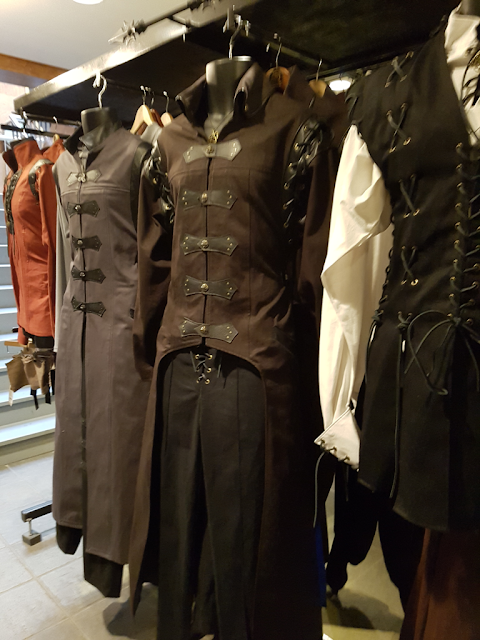
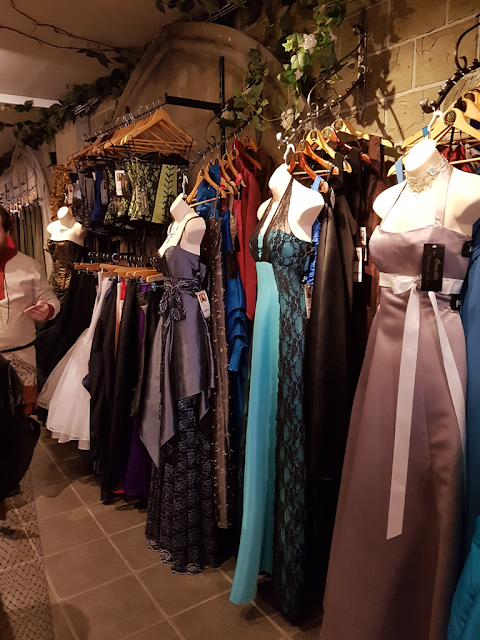
I barely spoke to the third store; it was a cosplay design store and very nice, and I must admit I'm beginning to regret not purchasing this monk robe they had, while I had it in hand.  I've been thinking of something I ought to wear when starting my adventures in game cons again (I'm in negotiations for a space in Vancouver in Feb 2023, but I'm having trouble getting the company to respond) ... and a monk or peasant robe would be suitable for a writer, I think.  I'll finish this post by putting up some pictures I took, plus a link to the website.

In other extraordinary news ... I already mentioned the decision by D&D's company to revert it's proposals for 1s and 20s and how this promises the beginning of a lot of grab-ass revisionment on the company's part.  Today's hilarity includes this headline about the company's proposed "Netflix-style" model ... which is a profound association, given that Netflix tanking just now, as other services steal away it's content.  Netflix is planning on adding commercials to their paid-for content.  Does that sound like a company you'd want your new business model associated with?

Chris Perkins wants us to know that OneD&D is "in" ... and thus my cackling, given the response I've gotten from my readers of late and those of the brief investigations I did in Montreal.  "In" clearly means "in trouble," though I doubt Perkins knows it.  The article fails to address the obvious choice of the company to impose a velvet rope on its website, though naturally that's not how it's being sold.  But then, you're not supposed to see the truth behind the lie.

Clearly, Tasha's stuffed book of nothing did not sell well, leaving the company with huge stockpiles of unsold books ... convincing the company that they had to get out of the publishing business and into the "netflix" business.  So, instead of buying a book full of useless shit, soon you'll be able to pay the company every month forever for the same useless shit ... because it doesn't occur to the company that maybe the reason Tasha didn't sell was because it merely provided the same dreck the company's been providing for years.  But no more of that!  Splatbooks are sooooo 2021.

What's also not mentioned in the article is the collection of writers, editors, copyreaders and other associated publishing staff being fired from their jobs to save the company money.  They're not needed ... and is that not better for the subscriber?  You bet it is!

I'm stunned that as late as this, the company thinks that their online presence is so depended upon that by choosing to monetise D&D this way, it will automatically succeed.  I see the faces of those clerks in Montreal and again, a cackle rises up through me.  This is going to be such a bad idea.

Which is good for me.  I did my own experiment with a velvet rope years ago, moving some of my content to another blog and continuing to write here ... and I got hurt in page views and credibility.  I watch others try the same thing and watch the same disaster play out.  Truth is, making people pay for something unseen is a tricky process.  They've got to be convinced there's something there; I don't believe there's a mainstream of enough people who believe that anything good produced by the company behind a rope won't be made available for pirating in a month or two.  There's no sense to paying up front.

As someone chipping away at a splatbook presently, one that is NOT just a rehash of other existing splatbooks, I appreciate the company clearing the road for me.  Less competition is the most I can ask for.  Thank you, Chris-fucking-Perkins.  It's the first time I've ever had reason to appreciate something you've done.

Speaking of people stepping forward to make better products than the company, I give you the Boutique Medievale Dracolite.  I asked the owner if I could take these pictures and he assented:


The two robes I had considered were the ones at the front on the left and the light brown on the end at the right.


Mouthwatering stuff to be sure.  I'd taken my menu to Montreal but I didn't have it on me when visiting this shop, and it had taken me $30 in a cab one-way to reach the place.  So I wasn't ready to rush back to the hotel and spend another $60 doing a second round trip.  But I think the menu would have fit very well into their stock.  Maybe if I find myself planning a trip again, I'll drop in and see if a deal can be made.

There is a lot of money to be made in D&D.  Pity the company is too stupid to realise how.

Sunday, September 4, 2022

Designing Character Backgrounds in the Shadow of Mordor

In case you haven't heard, the new One D&D has decided to institute a "big change" in character generation.  This post isn't going to discuss the change, or even judge it.  Essentially, however, "ability scores are going to be tied to backgrounds instead of race."  Feel free to chew that one over.

It feels a little funny to be working on a background generation book at just this time, when the company has decided to tether its entire future to making backgrounds the most important part of D&D.  Is it an opportunity for me, since I can see already that my approach is vastly more intricate than the company's?  I think it might be.  I don't see a down side, as yet, though I might make some buyers unhappy when they learn that my system isn't built to be compatible with company, which we can start calling Lord of the "ching".  Or Sauron for short.

I want to add a note into my book about the entrance of characters entering the campaign that seems to me hasn't been directly addressed ... though to some extent we took it for granted.  Here's the passage:

Notes about the end of childhood

Regardless of whether or not a character was raised by a family, a single mentor or an institution, the emphasis in every case should be that the character has achieved the transition from being a child to becoming an adult. This is the important stepping stone that entry into the campaign describes. The moment which becoming a member of the game’s party represents is that of the character obtaining complete prerogative to act as he or she desires. At last, the character has no more lessons to learn, no more teachers that are there to demand answers, no more parents or persons of importance to impugn the character for daring to act on his or her own behalf. The character is free.

Truth be told, this state of being hasn’t been in place very long. The character has just completed his or her studies. The character’s 1st level status has just been attained. And so, while the player is certainly champing at the bit, he or she might also realise that this character hasn’t the player’s experiences, yet.


Of late, as the game's been pushing this background thing, we've gotten into the habit of thinking of "new" characters in a campaign as ready-made, hard-bitten campaigners who are now ready to enter into the DM's new adventure.  There's no sense that new characters are really "new," and the backgrounds that are being invented reflect that.  Perhaps it's because so few characters in a lot of games begin at 1st level, because it's so much more "fun" to start them as 7th to 9th.  Perhaps it comes from a pervasive societal sense of entitlement that we're supposed to be respected as experts by our bosses the instant we emerge onto the job market.  Perhaps the internet has simply made the work of actually obtaining experience at something a dull-as-ditchwater expectation, that we don't think ought to act as a burden on our time.  I don't know.  I do know that new soldiers fresh out of boot start out in a war zone with a low life-expectancy, a truth that ought to apply to new 1st level characters ... not because 1st levels are "weak," but because players with 1st level characters tragically over-estimate their capabilities.  I experienced that in online campaigns with more than one 1st level swaggering around as though one level was something of a great achievement.

Anyway ...

Not sure I'm going to leave the passage above in the book.  I'm looking for another argument as to why I should than I can think up on my own.

Friday, August 19, 2022

Good News!

A few small things, as I'm finding it difficult to type.  Better today than yesterday.

On the subject of maladies, it's a credible argument that something bad might happen to a character at any time, regardless of the character's carefulness or the player's game play.  For example, Wednesday morning I was doing the dishes when the bottom of the glass I was washing fell off, causing the exposed glass edge to do this:


Because that's how it goes.  Was nice though; with our new car, we were able to pop over to my doctor right away and get it stitched up within the hour.  Today it's come a long way, so that typing this is less of a strain, though the progressive key strokes are moderately unpleasant micro-pangs.

Somehow, I feel encouraged by yesterday's announcement of "One D&D", once again expressing the company's wish-fulfillment regarding its naming of things.  As a product-maker of old style D&D, for a while now I've been made uncomfortable by the success of 5e and it's propagandistic, soulless destruction of actual D&D game play, by insidiously teaching young children that it doesn't exist.  Much as I hate to admit it, 5e came in with a depressingly good marketing strategy.  Pretend that "real" game players designed the game, then pump it full of hot garbage spewed by gaming "journalists" ... and cementing the whole with game-store policed adventure clubs.  The combination of these has made a shitty version of a great game extremely popular.

It's enough to make me slash my hands ... er, wrists.

However, with the inevitable sorry release of the WOTC's most recent splatbook, Tasha's Cauldron of the Same Old Crap, the company has decided to piss on it's own marketing by announcing that yes, they really are going forward with dndnext, announcing that they're "dropping editions" and moving forward with the badly named 6th edition ... which makes the game's rules even MORE player friendly.

One nice thing about being a games "journalist" is the happy willingness of merely repeating the company's talking points as "reporting," while I assume getting paid for doing so.  Although the company are a bunch of lying liars, and games are "only games," it's perfectly safe to pretend that the new rules are variously awesome, amazing, terrific, a bold step forward and additional boilerplate-type rhetoric that makes sure the writer keeps his or her job while the online magazine retains it's adbuy from the company being reviewed.  It's all quite incestuous.

"6th" edition will succeed in bursting the bubble of approximately 8 million 5e game players ... which for me, is good news.  By continuously undermining its credibility, the company usefully spreads discontent and yes, anger, with company products, since a new ruleset is always a part of every change.  Such poorly considered amateurish marketing desperation is a sure sign that at least 5-10% of 5e players will be pushed towards adopting earlier game versions, which don't change.  As of today, I have potentially four to eight hundred thousand new customers.

Awesome.

Friday, April 8, 2022

Easier

"The principal rules designer for Dungeons & Dragons is hinting that future rules updates will see hit dice used in different ways. Last week, Wizards of the Coast posted a new "Sage Advice" video for Dungeons & Dragons, in which host Todd Kenreck discussed various design elements seen in the recently released "Heroes of Krynn" Unearthed Arcana playtest. Near the end of the video, Crawford and Kenreck discussed the new ways proficiency bonuses have been used in recent rulebooks, starting with the 2020 release Tasha's Cauldron of Everything. Crawford noted that one of the design goals for that book was to find new ways to use existing elements of the game. Near the end of that discussion, Crawford hinted that we'd see other design elements find new uses in the coming months, specifically naming hit dice as an example.

"Referencing how the D&D community has embraced the new uses of proficiency bonuses, Crawford said that players will likely embrace the coming changes even more. 'I think we'll see a similar thing in the months ahead as we start exploring more and more ways to use hit dice and other elements of the game," Crawford said. "We are basically looking at everything on the character sheet and asking if this piece is doing enough. Is there something we're doing in the game that we can actually hand to [those elements]. Then, the whole game gets tighter, easier to teach, easier to learn, more fun to play, easier to balance, etc.' "


Get ready for some serious bullshit.  The word "easier" was repeated three times.  THREE times.  This is an excellent example of what I meant when I wrote last week, "The more a DM can be influenced ... because a DM respects decisions and advice given by a company ..."

The company will go on smashing every part of the game into smaller and smaller broken pieces, making the whole utterly useless.  From statements like the above, we can be sure than one day soon, there will be tumbleweeds blowing through the offices of the WOTC, as the world moves on from "official" D&D.  Like us, people who started playing D&D in 2015 will learn in 2030 that the game is completely unrecognisable.

Tuesday, December 4, 2018

Hasbro

2018-10-17 17:52 ET - News Release

Hasbro, Inc. (NASDAQGS: HAS)
Class Period: April 24, 2017 - October 23, 2017
Lead Plaintiff Deadline: November 27, 2018
Allegations: During the class period, Hasbro, Inc. made materially false and/or misleading statements and/or failed to disclose that: (1) Hasbro’s relationship with Toys “R” Us was becoming increasingly important to Hasbro’s business, as Toys “R” Us was the primary retail brick-and-mortar toy store in the United States; (2) Toys “R” Us was in far worse financial condition than was being publicly reported and it would have to dramatically scale back its operations or file for bankruptcy and liquidate; and (3) Hasbro was experiencing significant adverse sales issues in the key markets of the United Kingdom and Brazil which were negatively impacting the Company’s efforts to grow sales in those markets.

2018-11-16 22:50 ET - News Release

NEW ORLEANS, Nov. 16, 2018 (GLOBE NEWSWIRE) -- ClaimsFiler, a FREE shareholder information service, reminds investors that they have until November 27, 2018 to file lead plaintiff applications in a securities class action lawsuit against Hasbro, Inc. (NasdaqGS: HAS), if they purchased the Company’s shares between April 24, 2017 and October 23, 2017, inclusive (the “Class Period”). This action is pending in the United States District Court for the District of Rhode Island.
About the Lawsuit
Hasbro and certain of its executives are charged with failing to disclose material information during the Class Period, violating federal securities laws.
On October 23, 2017, the Company disclosed disappointing 3Q2017 financial results including that U.S. and Canada operations were negatively impacted by the Toys “R” Us bankruptcy, contributing to a 5% decline in operating profit to $217.3 million, or 21.9% of net revenues, compared to $228 million in 2016. Further, the Company’s CFO advised that challenges in the U.K. and Brazil would likely continue through the year with sales increasing only 4% to 7% from the fourth quarter a year ago.
On this news, the price of Hasbro stock plummeted.

According to Hasbro's Quarterly report, Oct 22, 2018
Hasbro Gaming revenue increased slightly to $280.8 million. Continued revenue gains in DUNGEONS and DRAGONS, DUEL MASTERS, JENGA and DON’T STEP IN IT, as well as new social game launches, were partially offset by declines in PIE FACE and other gaming properties. Hasbro Gaming revenues increased in the U.S. and Canada segment but declined in the International and Entertainment and Licensing segments. Hasbro’s total gaming category was up 5% to $447.8 million, including growth in MONOPOLY and MAGIC: THE GATHERING.

This is the only mention of D&D in the Hasbro quarterly report.  Hasbro has made no press releases since Oct 22.

Hasbro has had a hard year:


Thursday, April 12, 2018

Core Principles

Fair's fair ... I can accept that I'm an old grognard and that where it comes to the game of Dungeons and Dragons, I'm conservative.  I'm ready to change the combat and experience rules, throw out a lot of the peripheral material designed to support character design, rebuild monsters, consider mechanics that standardize role-playing and such ... but where it comes to "the core principles of the game," I'm utterly inflexible.

I made mention of those principles in the last post and was not called out on them.  I find that reassuring.  It suggests to me that the reader has a good idea of what I mean ... at least the gentle readers who still visit this blog.  But I feel that the subject needs to be reviewed now and again: particularly when I make outlandish claims that stupid shit being done by the WOTC is going to kill the game.

Being inflexible, I don't believe I'm writing an "opinion" about those core principles.  Rather, I'm writing about what the core principles ARE, whether or not I write anything.

The game, as we know, started as a battle game invented by a group of university students.  Without mentioning names, this group created a series of rules to dictate how armed, armored figures could fight each other to the death in colosseum framework, for the pure pleasure of rolling dice to determine if my armed figure could beat your armed figure in a fight.

That establishes the first two core principles of what became D&D.  D&D is about fighting.  And D&D is about resolving issues by throwing dice.

Now, we live in a world where a plethora of players would argue that the game has "evolved," so that it is no longer about those two things. In fact, role-playing doesn't even need those two things, so both can be discarded without anything whatsoever being lost.  I strongly disagree.  Both fighting and die rolling have been discarded by a particular kind of player because these are both things that are outside the player's direct control.  Fights are not necessarily won.  They might be lost.  And dice, rolled openly, fairly, cannot be made to favor any individual, no matter how earnestly that individual feels about the importance of being personally stroked by the game's play.

Fighting and Dice are threats.  Threatened people despise both.  And it is very, very clear from the rhetoric gushing forth on the internet, that most of the present adjustments to the game revolve around the removal of game threats.  Specifically, anything that gives the emotional feel of losing.

Let's go back to the beginning. The originators of the game began to notice themselves growing emotionally attached to their own battle figures, particularly when those battle figures succeeded in a string of battles, due to the odd nature of random number generation.  Talking about it among themselves, it eventually happened that they began to make unique and specific rules surrounding the persona of long-term survivors ... which eventually morphed into the creation of drama-fed mechanics: charisma, intelligence, wisdom, alignment [for good or ill] ... and ultimately motivation, ambition and character.

These, then, became the next two core principles.  Character we know well.  Attachment, however, is often overlooked, misunderstood or frankly made meaningless by the present-day rhetoric.  But the core purpose to making a character grew out of the attachment the player had for the character.

The character mechanic was designed to feed this attachment.  And because dice rolling was a key structure of the originator's design, one that they liked, and because it was clearly understood that what made the character's likable was that they survived fights, the character-building rules that followed employed dice and the acceptance that not all characters would be equal!

In the arena, some characters deserved to die. Other characters deserved to live, ALWAYS through luck, either luck of the attack die or luck of the character stat.  That was the thrill, the core principle: to throw characters into an arena and SEE which characters would die and which characters would live.  Because seeing, without knowing ahead of time, was exciting.

From this, role-playing evolved from an attachment into a powerful desire to make those characters more and more real in the players' minds.  The passion to speak for the character, to sketch the character, to devise habits and aspirations, weaknesses, prejudices, dispositions ... these things were naturally evolving things within the framework of dice-rolls that went against all our plans, that favored or disfavored our designs, the results of which we had to overcome by our wits and risks, in a way that did not seek to break the fourth wall by insisting that the DM solve those problems for us!

It is all about the love.

But of course, not everyone felt that way.  With the rush of players who flooded into the game in the early 1980s, thousands and thousands of players recognized at once that the DM could break the fourth wall, any time; and because of this, there developed a particular kind of recognizable player who missed the whole damned point of the game. 

This player hated failure; hated the very idea of failure for the sake of failure.  For this player, any altenative to failure was better than failing ... even in a game where the probability, nay the certainty, of eventually failing was very much the point.  This player, then, turn to gamesmanship: the use of dubious, not technically illegal, obtaining of advantage, by turning the screws on the DM, by means of rules lawyering, bemoaning a lack of balance, coercion, whatever was necessary to turn the game in their favor.

We recognized these players.  We recognized when these players had gotten a hold of an existing group.  We walked away from such groups.   It is quite possible to read dozens of articles written at the time, in the Dragon magazine and elsewhere, about this type of player.  We understood the player was a threat, yes ... but we assumed, if we kept this player out of our games, we were fine.

THEN the company, the fucking company, made it clear with the release of second edition, that the company could be played.  And steadily, through the 1990s, and the 2000s, the fucking gamesmanship fuckers have been gameplaying the company, en masse, driving the company to make more and more ridiculous concessions, pissing all over the core principles of the game, until fights are seen as boring, and dice as unnecessary or changeable at will, where character creation is regulated and processed to guarantee the utter greyness of balance, where role-playing is GOD in an Olympus where the mechanics have been cast out and made lame ... and where attachment to character is a bloody joke, because really, who cares?
"I stopped playing him because, well, I got tired of playing a healer, jeez, it's so boring; I'm playing a tiefling now; her parents were killed when half the planet was destroyed; I really like her because she has green hair ..."

It is this distance from the character that is killing the game; a distance that is increasingly encouraged by every official position taken on what the game is about.  And yes, I would expect a lot of people to just not get that ... because they are children of the way the game has been fucked over these last 30 years.

That moment when the originators began to realize they were identifying with their cardboard chits, playing the combat game of Chain Mail, was the result of a human biological habit, one that we are utterly unable to resist, called anthropormorphism.  It is what enables us to make characters of anything and everything, from toasters to moons.  We can't help ourselves.  When we see a drawing like that in the text above, we give human traits, emotions and intentions to completely impossible things, because we are built this way.

However, when we seek to hold things more and more at arm's length, insisting that everything can be controlled, that it has to be controlled, denying uncertainty, denying failure, building superficial constructs where those things can't occur, in order to make ourselves feel safe and comfortable, we increasingly divorce ourselves from everything that makes something pleasurable, exciting, surprising or spontaneous.  With statistics, and cheats, and parity ... we drain the blood out of things.  We make them less human.  Less tactile.  Less lovable.

Less alive.

Tuesday, April 10, 2018

You Won't Believe this Shit


Okay, I'm going to say it.  This sort of crap could kill D&D.

It just takes one generation of too many young children being led down the garden path of this completely bogus version of role-playing, to snap the chain between teaching DMs and learning Players.  The very fact that the video maker simultaneously realizes that there will be push-back against what he's saying ("I'm just reading off the current rule-set ...) while failing to express serious misgivings about what he's saying is telling evidence that there is a growing army of cheerful, gormless drones who have already lost touch with the core principles of the game.

Consider this:


"Starting off, they do not use variant rules; the only exceptions are the variant race options and the variant point buy in the Player's Handbook.  You are not allowed to start with a 1st level character that has fly ... so no aarakocras.  When making the character and levelling up, the rule is, PHB plus 1, which means you're allowed the Player's Handbook plus one other supplemental book.  One extra book.  Also, you're not allowed to roll for anything that mechanically affects your character or character creation, or when you're levelling, so you don't roll for stats, don't roll for health and you don't roll for wealth.  You can roll for fluff like personality traits ..."

Looking at this, we're not describing a broken game. We're describing the spectacularly broken social construct that surrounds the game, that consists of the community that plays the game.  The rules above, all the rules, are specifically designed to cripple, restrain or emasculate the asshole munchkin who uses splatbooks, die rolls and circumstantial character enhancements in order to fuck with the campaign, fuck with the other players, and fuck with the DM.

And why do those splatbooks and character enhancements exist?  Because the company needed money, because no logical thought was put into the universe being built, because for two decades the company responsible for fucking up magic cards, the game, with new cards that would destroy whole packs of old cards, thought this would be a good idea with Dungeons and Dragons, too.

Characters that fly?  That sounds cool.  Fifty supplemental books that enable all sorts of shit for people who were willing to buy those books, dig through all the badly written paragraphs and engineer what was said diligently, excitedly, expensively and without mercy?  That sounds really cool.  Variant rules?  Hey, what the hell.  It will be great!

And now here we are.  Hamstringing players so that they have to play mediocre replicants rather than humans, who are encouraged to roll for "fluff" but must obey the marching orders of Mein Kampf, with thousands of participants all over the world playing a whole year at ONE adventure, that everyone else is also playing, with DMs reading out of the same book, like some badly written episode of fourth season Lost that takes 200 hours to see.

This is potentially the death of this game.  Not because this shit won't be played ~ it will be played. It is being played, and it is very popular.  No, the death is going to come because one day you're going to hold out dice to a player in your world and the question will come back,
"What are those?"

Tuesday, February 6, 2018

Credibility

So, on Quora, I asked the question, "How can anyone giving advice about "How to dungeon master" prove their advice is competent?"

Obviously, they can't; which is my point.  What's always interesting in a question like this is the way in which people answer ... as Miguel Valdespino did.  The full comment is available on the Quora list I just posted; some of it is a joke, some of it attempts to help me as though I must be some sort of noob ... and the remainder goes as follows:
"RPG’s are a hobby and your DM ain’t getting paid for this. What’s more, these games can be played in many ways. I’ve seen everything from martinet killer DM’s to loosey-goosey hippies. Each group has it’s own feel and it’s own problems."

I don't want to disparage Valdespino here; though I must point out that his self-made description reads, "Over 3 decades of RPG's."

At the same time that he is saying there's no way to tell, he's being sure to establish his own credentials by telling you how long he's been playing.  And he's not alone.  Let me run through some other commenters that we can find on Quora, from a search for "role-playing games."

  • Ed Han, Been playing for decades. 
  • Edward Conway, played from 1st edition on, familiar with 5e and Pathfinder 
  • Thomas Pierson, I own more games than is probably healthy 
  • Inigo Gonzalez, GM for The Penumbra Extinction, an actual-play podcast 
  • Robert Anthony Ramos, Been playing RPGs since the early 1990s. 
  • Steve Waddington, Player and DM for over 40 years 
  • Rebecca Harbison, Played and ran tabletop games for 20 years 
  • Travis Casey, GM since 1980; wrote columns on RPGs, currently publishing 
  • Matt Slater, Lifelong roleplayer, 30+ years experience 
  • Steffen Hauser, playing Pen&Paper Games since 30 years 
  • Thomas Narvaez, Avid 15+ Year gamer 
  • Adam Smith, Fan since 1st Edition AD&D. Currently DMing 5th Edition 
  • Samuel Silbory, I've played and/or DMed every edition of D&D 
  • William Travis, D&D player since the red box days

And on it goes.  See a pattern?  We can argue all day that there is not "certification of competence" associated with D&D, but it is plain that if it isn't there, people will go ahead and make one up.  And as one can tell from the above, it is based on a) how long you've played; b) how many games you've played/purchased; and c) are you a DM?  Publishing and podcasting is a good secondary notation.

In my last post, I talked about how it became necessary to establish accreditation for surgeons because the number of people dying on operating tables was getting embarrassing.  I want to ask the question, how did that accreditation happen?  Do people not think that before the establishment of surgeon's colleges in the 18th and 19th century, there was a rather intensive effort for individual surgeons to create measurements for what made them a better surgeon than the cutthroat down the road?  Of course they did.

Patients not dying, obviously.  Getting a diagnosis right.  Being able to train others to do what you do.  Shared, reproducible knowledge!

Note that no DM ever says, "Have trained dozens, scores, hundreds of people how to play and run D&D."

Why?

I'm guessing most of the reason comes out of Valespino's rebuttal.  That DMs come in all shapes and sizes, and we can't know what sort of DM we're going to get until we run with them.  Game "feel" is not universal.  Game problems are not universal.  And most important of all, no one's getting paid for this.

Those are tremendously specious arguments.  What does "pay" have to do with it?  If it has, we've just discounted the first hundred years of amateur Olympic sports, where rules were rather in force, no matter who you were, not to mention the millions of people who are right now giving their time free of charge to NGOs, not only a home but also overseas, in some awfully dangerous places, where still, rules apply.  And somehow, these volunteers manage to teach other volunteer noobs how to volunteer.

But DMing is just too darn hard.

We can teach people how to talk to people in the jungles of Brazil, the urban slag heaps of Sao Paulo, the war zones of East Ceylon and Zaire, where the people really are different, where the rules really are different, where martinet killers and loosey-goosey hippies really take on characteristics of immeasurable proportion ...

But DMing is just too darn hard.

Yet there it is, the quest for credibility.  Believe my answer on Quora, because I've been playing for a long time; I've played lots of different kinds of games; I own a lot of modules; I'm a DM.

Something here just doesn't add up.

Today, just before starting this post, I asked the question, "How can the game company run D&D tournaments at hundreds of Game cons world-wide if there's no such thing as a way to accredit a DM or a Player?"


And got back this answer:


Which, nicely, came back just in time for me to get to this point in the post.

Do you agree?  Do you think "League" accreditation is indicative of being able to Dungeon Master or Play?

I'm asking four questions of Cliff, who of course has done his best to create his own aura of credibility, just as everyone does (because we're human):
  • Does accreditation as a DM originate with the WOTC?
  • Does this accreditation indicated competency and ability running D&D, or does it indicate competency and ability adhering to WOTC policy?
  • How rigorous is this accreditation?
  • How are the people who examine and evaluate the game reports accredited?

I feel these are fair questions.  They're questions we should all start thinking about.  Just as soon as we're ready to pull our heads out of the sand.


PS.  Giley has recently responded to say that this tracking method isn't an accreditation at all.  Which makes me wonder why he answered my question with it.

Tuesday, January 16, 2018

Hubris

Yesterday, I performed a humiliating, public face-plant on Twitter.  There is no other way to describe it, except to add more synonyms for the word humiliating.  And although only a fool draws attention to his shortcomings and failures, I'd like to talk about it, rather than pretend it never happened and hope that no one ever finds out about it.

The fault was mine.  For years, I had been building a false story in my head, which I hadn't properly researched and was based on assumptions I had made, based on misreadings of things that I have seen.  Some of these things want me to make excuses for my behaviour, but ... though I'm going to talk about them, the reality is that I should have done my research before getting myself into a bad, stupid, incalculable moment of ignorance.

To begin.  I have had a hate for Sly Flourish, real name Mike Shea, since reading his book, The Lazy Dungeon Master.  I made myself read the book in preparation for writing my own How to Run book; and oh yeah, how I hated it.  There are a lot of things about this book that I do not like, even before getting into the actual content.  To begin with, the title.  I'm a fanatic where D&D is concerned, so this is a trigger for me.  I view the title in the same way I would view a book named, "A How to for the Lazy Doctor" or "A How to for the Lazy Engineer."  I recognize that a lot of people don't take the game as seriously as I do ... but I also recognize that there are a lot of abused people out there in role-playing games, because many DMs, especially those with official status, don't give a shit about people.

Secondly, the pen name.  Mike Shea and his readers no doubt think this name is very cool, pulled from a phrase in 4th edition, meaning an at-will power available to rogues at 1st level.  Being a person able to look at language outside of its fandom credentials, I veiw the word "sly" as deceitful and duplicitous, and the word "flourish" as waving to attract attention, usually so a different fucker can steal my wallet.

So yeah, I don't think it's a very cool name.

The book itself is full of meaningless drivel.  For example, under "Preparing for Improvisation," Shea writes,

"There's a careful balance between feeling prepare and feeling relaxed. The less you're prepared, the more nervous you might feel. Preparing for improvisation steers you the right way. Fill your toolkit with aids for improvisation instead of tools that force your game down one particular track.  You can find many of these tools in Appendix A."

This is it.  The whole section.  Appendix A gives nothing in the way of improvisation hints.  Appendix A does include one-sentence lists of adventure seeds, movie-inspired quests, adventure locations, fantasy names, NPC character frameworks, PC relationships, combat outs, encounter-wide environmental effects, encounter terrain effects and "20 Things That Never Should Have Been Found."  These are all fairly cliche.

Most of the sections of the book go into the headlined subjects with this much depth.  Many discuss the subject with less depth.  Many parts of the book send you to read other people or listen to someone's podcast.

Anyway, forget the book. The reader can invest themselves if they wish.  I, as I said, hated the experience.

Now, this is the part where I began to dig my own grave.  For various reasons, I came under the impression that Mike Shea, Sly Flourish, was one of the minions of Wizards of the Coast.  He isn't.  Nevertheless, at the end of The Lazy DM, it does say that Mike is "a freelance writer for Wizards of the Coast."  Somehow, seeing this, or things like it, got into my brain like a worm that wasn't about to let go.

It didn't help that Shea titles his writings like this:  A Guide to Official D&D 5th Edition Published AdventuresOr that he has a page called the "Neverwinter Wiki" that features a WOTC Dungeons and Dragons logo in the upper left hand corner.  Or that his blog has his tongue so far up into the WOTC's butt its hard to see his shoulders.  This, however, was all just my impression.  Shea is a freelance writer, putting out his own stuff just like I am.  He is not a part of the WOTC.

Sigh.

So ... Monday, when I came across a tweet from Sly Flourish on my twitter about how it was minimally necessary to spend at least $900 in order to publish an acceptably quality adventure for the sale, I saw my opportunity to get involved.  I piped up and said that I had done it for free, and that it wasn't actually necessary to spend any money.  I was thinking of Ternketh Keep, that I wrote in 2016.

At once I was jumped by a number of Flourish's followers, who first mocked me, then insulted my privilege at being a writer, a copywriter, an editor, an artist and a great story teller all at the same time, as in "How Dare You Be Talented" when the rest of us are just normal creators.  I must admit, this got my blood up.  So, too, did Shea's reply, when he said that he couldn't edit like [name drop] or draw like [name drop] or lay out content like [name drop], in a very salesman-like manner.  I did not want this fellow to sell me his contacts, I wanted him to engage.

Took me two days, but I steadily preached the message of self-publishing and training yourself to perform skills, so a creator wouldn't have to rely on Sly Flourish's cronies, who I assumed worked for the WOTC ...

... and the face-plant came when I said so.

Oops.

So I said I was wrong and apologized.  And let them beat me up for awhile, and I repeated that I had been wrong and apologized some more, and still more. And Shea graciously called his dogs off me, and acted like a wonderful fellow, accepting my apology.  I apologized again, grovelling as best I can, accepting that yes, I'm obviously a doof.

And I am.  I wanted so bad to finally have at one of those smug, self-righteous know-it-alls from the WOTC that I walked right into being hoisted on my own petard.

Of course [and I don't deny it], I am a smug, self-righteous know-it-all from the Tao of D&D.  And ten times the asshole any of those guys are who are earning a living re-inventing the same crap from 20 years ago with a paint-job and selling it to kids for $60 a copy.  But I'm an asshole who is at least writing new material.  So yeah, I want to talk to one of these guys and get them to admit they don't really care about the game, they just like the paycheque.

I wanted this too much.  And that's what hubris is about.  Wanting something too much, and getting it right in the neck.

I thought about hiding it.  That was the smart thing to do.  Writing this post is the stupid thing to do.  But it is also the Alexis thing to do, so ... I guess it's that I don't want to pretend that I'm something I'm not.  If I'm going to highlight my successes, its only fair that I also highlight my failures, my stupidities, my prejudices and my insufferable hubris.

The fact that I am launching a public podcast is all the more reason to come clean.


UPDATE,

Mike Shea has read the post and asked me to remove the link to the illegal copy of his book.  I have done so.  Shea also says that the link on Neverwinter nights with the title "Sly Flourish" refers to the ability, but not to HIM.  That's a pity.  I'm not removing the link for that; I did not know one from the other.  That's because I did not do the research ~ but that's what the post is about.  I saw the name he chose associated with a WOTC site and made a wrong assumption.  How many others, I wonder, have also made the same wrong assumption?