Showing posts with label Ternketh. Show all posts

Saturday, February 17, 2024

Ternketh - Basement & End Notes


Basement


1. Stairwell. These black stone stairs will lead down into a small room with two doors, one of which will be hopelessly wedged open by plant and molded material generated by the yellow musk creeper in room 2. In all, there are 20 zombies, these having 4 HD because they are so near to the empowered creeper. Though they will occupy the stairs, they will not climb above the doorway, as they exist to protect the creeper itself – the party will have to fight for every inch of ground it wishes to gain, however.

2. Torture Chamber. This room is completely occupied by the yellow musk creeper’s generated growth, but the creature itself is approximately in the center of the room. It is able to ‘see’ through the open doorway at any intruders coming down the stairs.

This creeper has 10 hit dice and can use its prime attack as often as it needs to. Once it can see its opponent appearing at the bottom of the stairs, the creeper can fire a grenade bomb through the doorway that will explode into a small cloud of spores, affecting everyone within a 10-foot area. These spores will burn the skin, both outside the body and from inhalation (causing 1d6 damage) and will reduce a character’s intelligence by 1d4 if save is not made against poison. This is an area affect spell and the creeper does not need to ‘roll to hit’ to fire its bomb.

Characters that have their intelligence reduced to less than three will move towards the creeper and embrace it’s tentacles. Others that come within reach of the creepers tentacles can be attacked from any direction (up to six combatants at a time may attack the creeper, once they have positioned themselves in the torture chamber) for 1d6 damage if a tentacle hits.

The creeper is vulnerable to fire but is damp enough that it will require more than a torch or a brief application of magical fire to set it alight. If it does burn, however, it will release a black, toxic smoke that will act as an acid on the skin, causing 4-40 damage to everyone that is affected (the smoke will bloom outwards at 20 feet per round), half damage if the character saves vs. breath weapon. The toxic smoke will then hang in the room and passages for 2-8 hours, causing an additionall 1d6 damage per round to anyone or anything in its reach.

As the door from the chamber to the stairs outside cannot be closed, the creeper will continue to harass any movement it sees until it is finally killed. This will make it difficult to haul out treasure from 5 if the party attempts to ignore the creature.

3. Basement Passage. This wide passage offers a respite from the other dangers in this part of the Keep. It is surrounded by reinforced doors. The door that leads to 4 is about six inches narrower than the other doors, which should be mentioned. The party should also be told that the hinges of the door to 6 are partially broken and that the door opens outwards and not into the crypt.

The strongest odor will be from the yellow musk creeper and the doors will deny the characters hearing any noise (largely because the creatures in 4 and 6 make too quiet a sound to be heard through a thick door). The characters moving through this passage will be heard, however, if they speak in ordinary voices or do not indicate that they are talking quietly, alerting the giant slug to their presence. If this is the case, no surprise should be rolled for the monster once the crypt door is opened.

4. Treasure Passage. Upon opening the door, the characters will discover that this space completely suffused with green slime. Due to the narrowness of the passage, and the slime coating the floors, walls and ceiling (and able to drip), it will be impossible to move through the passage without being attacked. The slime was never the intent of the makers of these passages, but it has arisen since the first bodies were killed here (its formation would remain a mystery to the party). It extends only as far as the door to 5 and can be destroyed in the usual manner.

There are two pit traps in the hall, which cannot be detected except by means of a thief’s searching for traps. Each is only a ten foot deep pit but the spikes are fitted with additional blades designed to be truly deadly, so that falling into the pit will cause a victim to suffer 4d10 damage. Characters who step onto the pits unaware are entitled to a dexterity check before falling in, but as the floor next to the pit is also designed to tilt, this dexterity check is with a -4 penalty. There are two such traps; they must be identified separately.

The door to the treasure room (see 5, below) is wizard locked, so that it can only be opened with dispel magic, knock or a magician of at least 15th level. As a result, the harpies have never successfully opened this door.

5. Treasure Room. This very large room has plenty of treasure in it. The amount should be equal to what’s necessary for one character newly become 6th level to reach half-way to 7th, times five or six characters. As such, the room should contain about 90,000 g.p. worth in value. About 20,000 of this should be in jewelry worth an average of 1,000 g.p. each; another 10,000 should be present in gems (30-300 in number). I should estimate that about 25,000 g.p. be amassed in non-perishable items, such as highly valuable wine, pieces of art, enamelware, art pottery, gold cups and crystal vases, jade statuettes, ivory idols, medallions, musical instruments, rare books or whatever else of that nature seems appropriate. This would leave some 35,000 g.p. in coins, mostly in gold but with a considerable mass of silver and coppers. It is imagined that the DM is best able to decide what these things are.

I am stingy with magic, so I would likely have three pieces of magical armor and two magical weapons, a +2 suit of leather and a +2 shield, with a suit of +1 chain mail, a +2 spear and a +2 short sword. Another DM might offer more. As there are pieces of magic in the crypt, I would be satisfied with these objects in the treasure room. The only reason for them being here could be that they were more valuable to the original inhabitants of Ternketh as heirlooms and proof of lineage than they were as weapons of war (in which case there is a possibility of their being destroyed). To the players, of course, these are just tools.

6. Crypt. This circular space of eight rooms and a central foyer is most notable for the giant slug. This creature has been strangely altered and transformed by a diet of the occasional yellow musk zombie, harpy filth and licking up whatever green slime is able to emerge out from the treasure passage (see 4, above). These incursions have caused it to break open the door leading into 3, which closes again when the slug retreats to its lair. The slug is huge, double normal density (but not size), so that it has over 100 hit points. It’s mouth has mutated into a larger, more terrifying orifice so that it now does 2-24 damage on a strike. It is able to spit acid up to three times a day, for 4-32 damage (half damage if save against breath weapon is made).

The slug will choose to combat intruders in the narrow passageway between the foyer and the door into 3, where it is able to completely fill the passage but it is difficult to bring any more than two attacks per round against it (one melee and one using missiles or magic). The party may, if they wish, choose to seal the slug into the crypt and leave it there, but by doing this they will miss out on the additional treasure that is contained in the surrounding tombs.

Five of the tombs contain nothing of note except the skeleton of the buried. This includes the impressive circular tomb, which has a roof shaped like a dome, where a nine-foot statue of a naked wrestler stands over the coffin. Only the tombs marked by a number contain anything of value. The one tomb with a entranceway along the first passageway into the crypt’s foyer is the only one that does not contain a skeleton.

Though the harpies did once enter the foyer, they did not disturb any of the bodies; any evidence of their filth was long ago gobbled up by the slug.

I’ve not made up any stories for any of the unimportant dead (as far as treasure is concerned) if the players choose to use a spell to speak with them. If it happens to me, I will simply wing it.

7. Carved Tomb. The walls of this tomb are etched in shallow geometric symbols which seem to bring a strong sense of peace. Upon entering, the room will become alight with a soft blue light, emanating from the jewel that has been emplaced in the staff that lays on top of the sarcophagus in the room.

This is the Staff of Aryabhat, an artifact that acts like the staff of the withering with unlimited charges. It can only be employed by a spellcaster. It will function in combat as a +2 quarterstaff with no negative effects. Before it can be used to wither an opponent (in which it would normally use two or three charges), however, the wielder must be fully investigate the item with identify and must attain the 9th level. Thereafter, the staff can be used to age or wither limbs – but every time a power is used that would use up a charge, the staff will instead permanently reduce the user’s maximum hit points by the same amount. Thus, to wither an opponent’s limb would cause the caster to lose those three hit points, forever. While the caster can gain new hit points from going up a level, those that are lost to the staff cannot be regained by any means whatsoever.

There is no evidence as to who the occupant of the tomb is or how they died.

8. Ornate Tomb. Along with the marble sarcophagus in the room, there are three trunks and several weapons hanging from hooks on the wall. These are a +1 hand axe, a +1 mace, a +1 dagger and a +1 crossbow. No bolts can be found in the tomb. There are a dozen stone busts of various sizes (five in the trunks, seven standing on the floor), each carved in granite, all of the same person, that would be worth an average of about 150 g.p. per bust (though each weighs between 40 and 140 lbs). A name deeply etched into the wall above the tomb reads Baurchuk Idiqut of the Uyghur.

9. Couples Tomb. This is a stone tomb with a hammered bronze leaf, representing perhaps 40 lbs. of the metal. If the lid is removed (it weighs four hundred pounds), it will be evident that the corpses inside were buried alive. What’s more, after being buried, they killed each other – apparently over a huge ruby gem that was buried with them, worth approximately 15,000 g.p. The skeletons of the pair will be seen gripping each other, the gem laying in the coffin between their rib cages. One skeleton is a woman and the other a man.

From this it might be assumed that the gem is cursed. It is not. The tale of the two is that they resented the other’s feeling of ownership over the gem so much that it filled them with jealousy, causing them to murder others who were perceived as part of a conspiracy to steal the gem. Ultimately, this couple coldly slaughtered some forty people before they were caught and buried together.

Final Notes on the Adventure

The level of treasure that I’ve added to the Keep is meant on some level to compensate for my present party having fought several battles without any real treasure. Another DM may see the number of weapons offered as too many and favour some other magic form or perhaps that there is not enough magic overall. I stress that the amounts found of everything should be a suggestion and that DMs should feel free to adapt the amount of coin to their own campaigns.

I also realize that in a number of systems a strong wizard could easily walk through much of the dungeon. I hasten to remind the reader that this was designed for an AD&D campaign, where an 8th level mage was much less powerful than later edition counterparts.

No doubt some will note that it is possible to enter the Keep and make off with the treasure without directly encountering the harpies in the barracks or the assembly hall and temple. It should also occur to some that these creatures do not themselves sit on a big pile of treasure. This is intentional.

Most thinking parties will realize that the Keep isn’t secured unless all the rooms are explored and cleaned out. If they don't do this, the DM should feel free to have the harpies create an encounter of their own, using stealth to attack the party unawares. I can think of two ways that the harpies might try:

As there is a great deal of treasure to haul out, weighing a lot, an attack made when players are burdened with heavy objects such as stone busts, barrels, bronze or whatever would be very effective – particularly if the party was staggered along a route from the basement treasure room to the front gate. If this were the case, the harpies might be able to kill two or three party members without the others being present.

Secondly, it should be reasoned that some harpies from the Keep are out hunting the surface of the world for edible victims. The undiscovered harpies in the keep may wait for these (presume another six total), then attack the party’s airship (if they use one) while it is moving away from the keep. This would be particularly effective, as the attack could be made while members of the party are sleeping – and doing so in the belief that they’ve gotten away with their plunder, safe and sound!

One way or another, it can be assumed that the party will have to earn treasure discovered in the keep from the harpies as well as any other monster within. By not painstakingly cleaning out the Keep, the party are simply giving the initiative to the harpies to choose when it is best to attack for them, rather than rooting them out and trapping them inside the assembly room and keep.

Thursday, February 15, 2024

Ternketh - South Rooms

South Rooms

16. Armory. This large room is the suiting area for guards and soldiers of the keep, used in old days primarily for ceremonial duties – so along with the swords, spears, axes and a wide range of other weapons, there are dozens cloaks hanging on the bare walls (and scattered over the floor, most of these with rents in the fabric), sashes, helmets and armours that were shiny and polished. These things, of course, have all be despoiled. The room is nominally empty, but a wandering monster encounter should be rolled if someone enters: a 1 in 6 will indicate a giant rat that sits and looks at the party from about 20 feet away. It will squirm away under the far right side door into room 19 (it only needs the one-inch space under the door to fit in.

17. Artisan’s Room. While most making of materials such as weapons, tools or other goods in the castle are made in the town, there was one Keep inhabitant who’s job it was to mend or repair objects, particularly armor and weapons. This is the room where that skilled person lived. There is a comfortable bed, a bookcase that is filled with low-quality works (popular writings) and two books about armor and repairing things. There is also a trunk in the room, unlocked, that contains clothes, some hammers and tongs and a pouch with about 50 c.p. and 30 s.p. The harpies have done their work with the room.

18. Soldier’s Quarters, Wu. These are barracks for soldiers, not guards, but the distinction might be easily lost on the party. The wall over the table indicates gives a brief history of the Wu Clan, giving no details that are especially important (make something up if you feel it is necessary, but this is all two thousand years ago). I would tell the party that it is propaganda for the soldiers and of no importance, being quick to reassure them that there is nothing in the passage to overthink and waste time with, as players will if they think its a clue. The passage is primarily decorative, to motivate the soldiers.

There are four chests in the room. These are locked and contain clothes, blankets, one weapon in each (a dagger and 3 hand axes) and small iron coffers that will rattle with coins (not many, perhaps 3-30 s.p. and 1-10 g.p.). Because of the locks, the harpies have not defiled the contents.

Somehow, a chink in the outer walls has allowed a family of giant rats to make their home in the room – these have spread into 19 also. The party will hear the rats before seeing them. There are 35 giant rats that will attack from this room. These will be aggressive and rabid. If characters remain in the room for more than one round, those present will be swarmed by four rats each. After the first round, this will increase, until up to eight rats will attack medium sized characters every round (leaping from the bunks and tables if necessary) and up to six against small characters. Their number will keep the door from being closed or force it open, as the door swings both ways.

19. Soldier’s Quarters, Yao. See 18, above. This room is also occupied by rats. There are only 21 giant rats in the room, however this is where the king rat dwells (treat as a rat that has grown fat, with three times the size of a normal rat, twice the damage done on attack and a level of intelligence bordering low). If the party is attacked in this room and manages to kill ten of the attacking rats, the king rat will call all rats from 18 to join the fight. The door of this room also swings both ways, like that of 18.

The history of the Yao Clan on the wall has the same lack of importance as that of the Wu Clan, but it is a completely different story. There are four chests in the room. These are locked and contain clothes, blankets, with a short sword in each and small iron coffers that will rattle with coins (not many, perhaps 3-30 s.p. and 1-10 g.p.). Because of the locks, the harpies have not defiled the contents.

20. Priest’s Room. As the party can only reach this room through the assembly hall (see 21, below), it should already be evident that the religion practiced by the original inhabitants of the Keep was Buddhism. The priest’s room is lush and unusually luxurious, with a marble floor, rich bookshelves, silk bedclothes, a couch and other furnishings. The room is empty but is polluted as expected. There are gold coins strewn over the table and floor, at least 200 in number – there are other signs that a struggle went on here, with little spatters of blood (but nothing excessive) on the walls and floor.


There are two chests, both of which are completely empty. The books in the room are common tomes containing sayings, mantras, moral tales, tantras and records of the keep. We may wish at this time considering the inclusion in the room of a secret compartment, one that the harpies never discovered, that might conceal a scroll with a raise dead spell, cure disease, restoration or heal spell (or some combination thereof). It depends on how generous we wish to be. I would likely include the raise dead spell, even if the party didn’t need it, just because it is nice to have. Obviously, the secret door would have to be looked for and found.

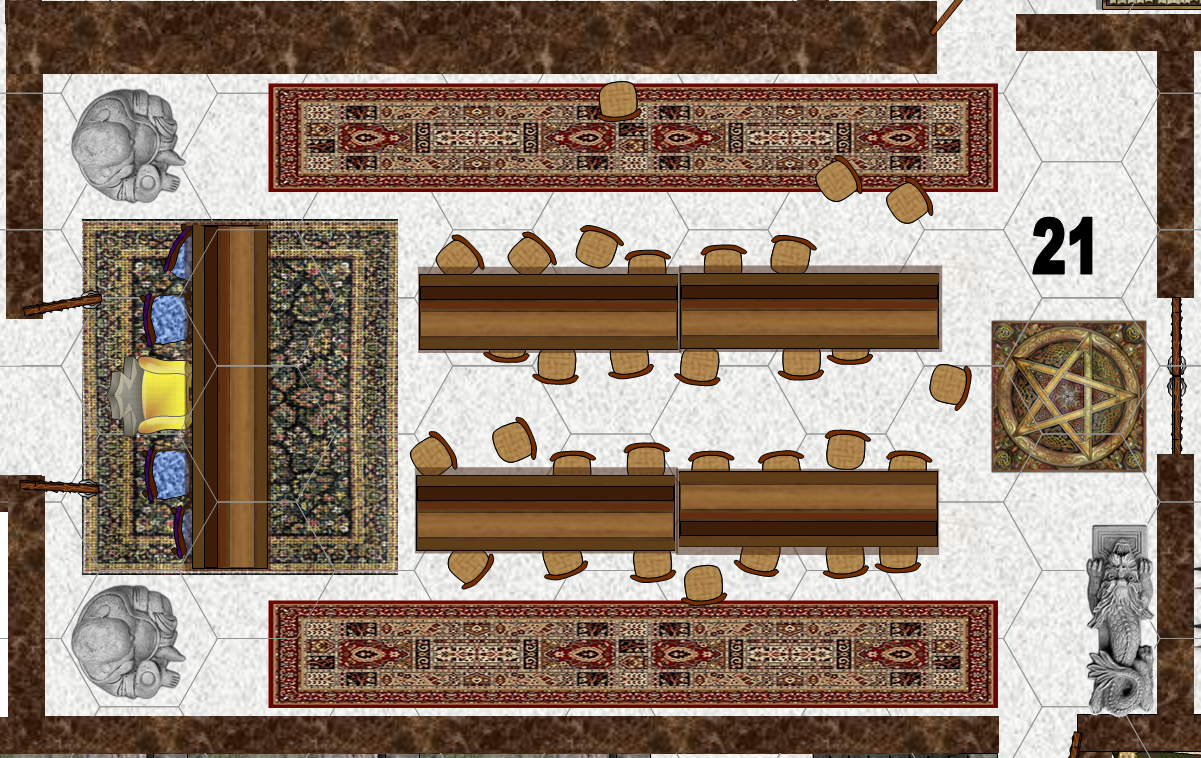
21. Assembly Hall. This is the giant room where the Lord of the Keep would address the subjects. There is a large table where the Lord, the magician, the priest and two others sit, perhaps the commander and the Lord’s spouse. There are four other large tables with 31 chairs, several carpets, the statue of a dragon by the front entrance (towards room 16) and two Buddha statues (unseemly, but perhaps acceptable for Ternkethians – heresy is strange). The heads of the Buddhas are only an inch below the ceiling of the 13 foot high room.


The hall also has five harpies. These will attack any intruders together, though they will have to come from all over the room to do it – unless they perceive they are outnumbered (there are more than five opponents, regardless of how strong these may be. If this is the case, the harpy nearest the door to 22 will push open the door and let loose a bloodcurdling scream. This will call in the remaining harpies from the temple. If the number of intruders increases to more than ten (or two of the harpies are killed during the combat), all harpies will retreat out of this room into 22.

This is the chief residence of the harpies so the stench and filth is greater here than any other part of the Keep. All players that enter will suffer -1 to their strength and -2 to constitution (with corresponding loss in hit points) for as long as they remain in the room (or in the temple beyond). The harpies do not feast here, they prefer to do that outside, but they do use the assembly hall as their toilet.

22. Temple. This great chamber served both as a place of worship and as a sleeping area for more than one hundred residents of the Keep. The chamber has 26 foot high ceilings, which are supported by stone arch rafters where the harpies will hide if pressed hard by combat. The floor is covered with carpets and large comfortable pillows. The black altar at the west end of the room is simple, about eight feet off the floor with a very low dais, surmounted by a cluster of incense lamps. In the lower east corner, opposite the stairs, is a beautiful ten foot high female buddha carved from an unidentified blue stone, sitting in a pool of water with blue tile beneath. Though this has been defiled again and again by the harpies, it has somehow retained its appearance and the water within seems able to purify itself (and the whole font) regardless.

The area is made for a great missile combat. There is no actual place where a harpy can completely hide without a chance of being struck by arrows or bolts, but shooters suffer a -5 penalty to hit if a harpy is hidden up there – and they must move to where they are underneath the rafter where the harpy is hiding. The location of the rafters is indicated by the pillar bases depicted in the side walls.

During the combat, harpies will dive at their enemies on the floor (roll initiative, giving the harpies +3) and seek to break up their enemy by moving from rafter to rafter. Combatants on the ground must look down if they don’t want to trip or fall over a large pillow (two feet in diameter) as these make the floor uneven – this will also contribute to the harpies’ +3 bonus to gain initiative, as they will selectively pick their moments when an enemy moves to a better position. 

Any harpy engaged with an enemy on the floor will prefer to fly up again into the rafters than continue the fight (in some systems this allows an attack of opportunity but in mine I consider the character’s attack prior to the harpy flying to be the only chance the character gets). The characters should be required to count their shots, as ammunition may be important if they have bad luck in killing harpies. Most likely, the spellcasters in the party will be needed to finish the harpies off.


Wednesday, February 14, 2024

Ternketh - Magician's Rooms

Magician’s Rooms

13. Magician’s Study. This seems to be a room dedicated to the study of astrology and celestial mechanics. There are bookshelves, a table with instruments (and instruments strewn over the floor, most of it broken), a table and bench (with a book open on the table to no particular page), a once valuable carpet, now worthless, and a large etched symbol taking up a third of the study floor, as it is about 13 feet in diameter.

This room is also completely crammed with 24 zombies, all of which have 3 HD. These bump into each other endlessly, making shuffling, bumping sounds. These will have to be fought through before any further progress can be made. Only then will the party find that the door on the east side of the room gives way to the stair that leads into the Keep’s Basement.

The exact purpose of the symbol and books should be left in doubt. The sum total betrays a pseudo-science/religion that died with the inhabitants of the Keep, particularly the line of magicians that once understood the mechanics here. The DM should see this as the potential for another adventure, one that could lead to the discovery of a new kind of magic or simply an artifact of some kind, depending on what might work for the campaign. Sometimes not all questions are answered.

Long before the yellow musk zombies took over this room, it was cleared out and desecrated by the harpies – so everything is polluted just as elsewhere in the Keep.

Regardless of this, however, if the room is searched the party will find three books of interest. At present, these things are somewhat cursed and in poor shape, but they can be cleaned and the curse removed by the proper means. Two of these books will be of great value to obscure astronomers but probably not to an ordinary trader – they are notes and observances of celestial movements in the far northern hemisphere dating back two thousand years, making them extraordinary and rare.

The third book is entitled Detailed Mechanics of Terrestrial & Lunar Transitions (admittedly describing the reader’s fantasy world as ‘earth’ or ‘terra’ – feel free to adjust the title). This is a magic tome that requires an illusionist of 9th level or a mage of 11th level to comprehend. It describes in details a process of being able to physically travel from the earth to the moon, using symbols such as those found etched into the floor – thus, a potential adventure, if the players choose to pursue it.

The door to the 14 has been barred from the inside and must be physically or magically forced open. If the party makes a great deal of noise taking this door down, the harpies in the assembly hall (see 21, below) will become aware of the sound. This will change the circumstances of in the lord’s passageway (see 15, below).


14. Magician’s Quarters. It will become apparent from the odor of the room that, though the air is stale, the harpies never did pollute this room. The magician that once dwelt here (11th level) is he that was responsible for creating the glyphs that will be found in the Lord’s room (see Yard – 10, above). In the corner between the door and the curving wall of the stair are the bodies of four charred harpies, burned and then piled here. The magician is dead too, his skeleton lying in the bed. It has dessicated and dried and has no odor or maggots – as near as can be told, it is not undead as the magician was a good man. If spoken with by spell or resurrected, he will give a long description of how the Keep was surprised and taken by the harpies. He will also be happy to help the party find whatever they need to find. Presumably, any party of sufficient level to resurrect skeletons is probably too powerful for this scenario, so an 11th level mage couldn’t further unbalance an already unbalanced situation.

There are stores of grain and water in the room, in sacks and sealed barrels, so he did not starve to death (died of a broken heart, actually). There is a trunk that contain about 3,000 g.p. worth of coins, gems and jewelry. A second trunk will contain a collection of unusual and rare minerals that are of little economic value except to a collector. There are similar collections on two cabinets with drawers of carefully pinned butterflies and beetles, submarine fossils and plant forms that are pressed between glass. There are some 250 objects in the room (the insects are contained in glass boxes) that would be very valuable to a very specific expert somewhere, perhaps 20-80 g.p. per object. No ordinary trader would buy them, however.

There are also books in the room that will suggest three possible adventures that might interest the party. The first is an open book, written in the magician’s hand, describing where the harpies originated (in a deep cave in a high range of mountains, left to the reader to place as needed), where a harpy Queen holds court and makes policy.

There are several books that tell of an atoll of distant islands where the fossils and plants came from, where an elixir is brewed that will increase the strength of the user as long as this elixir is taken on a regular basis. The people there are all very strong and friendly, but the exact location of the atoll is lost and would require a ship and perhaps a year of exploration.

Finally, books about coleopterology (a branch of the study of beetles) and lepidoptera (study of butterflies) suggests a method for creating giant, intelligent insects of both forms, further suggesting that there is a land where this was done, causing the destruction of a culture now overgrown in a jungle, leaving its wealth behind. A map suggesting the course to this jungle land is included.

The DM may wish to include potions or scrolls in the magician’s things, but I personally wouldn’t do this. The less power I give to the party as they fight their way through the Keep, the better – though I might concede to including a potion allowing healing if the party really does need a boost at this time. I’m not heartless.

15. Lord’s Passage. This was originally included in the Keep as a means for the Lord to travel from his room to the assembly hall (see 21, below), so as to make a grand entrance next to the throne. If noise is made breaking down the door to the magician’s room (see 14, above), then three harpies will emerge from 21 into the passageway. If the passage is empty when they do this, the harpies will immediately defecate near the doors (harpies are able to do this at will every few hours) then retreat back into the assembly hall.

If someone from the party is watching the passage, however, all three harpies will sing. One will fly forward to challenge the intruder, but will immediately give ground if encountering real opposition. All three harpies will remain in the passage until the one that has gone on the attack is dead or is able to retreat with the others.

If the players enter the passage after the defecation, the odor will be so rank that characters will suffer a -1 to their strength and constitution abilities (with a corresponding reduction in hit points, if applicable). If the harpies were not made aware of the party’s approach through the passage, the passage will be empty and will give no such penalties.

Monday, February 12, 2024

Ternketh - North Rooms

North Rooms

These are chambers beneath the yard, which can be accessed at three points, each of which gives to a 13 ft. flight of stairs downward.  The floors of the lower level are made of stone.  Though it's imaginable that there would be windows facing the outside, which is the open sky far above the land's surface, these would be additional places that needed defending; therefore, the walls are solid throughout.

1. Guard’s Lounge. A simple room with nothing more than a table with four chairs. It may be described as completely empty or the DM may wish to describe the table as being rich with claw marks (which I forgot to say when I ran this). The smell should be musty and reminscent of dried fecal matter and faintly stale urine, though the room has not been used for that purpose in perhaps a year.

2. Guard’s Barracks. These are the north barracks. There are eleven bunks, three chests and a table and chairs. The chests are locked and contain clothes, blankets, one weapon in each (2 daggers and a hand axe) and small iron coffers that will rattle with coins (not many, perhaps 3-30 s.p. and 1-10 g.p.). 

Because of the locks, the harpies have not defiled the contents. The same cannot be said for the bedding and every other surface in the room (with something fresh left in the one corner).

If the party is not careful about checking corners, a harpy in the room will attack the first entrant, attacking from behind. If discovered in the corner it will fly over the top of the bunks (there’s about four feet of space, more than enough) towards the door leading towards the commander’s lounge (see 3, below). It will stand its ground against up to two opponents but will flee against three. The room, however, will not leave much room for manuevering. Note that there is a grey pillar in the middle of the room and that the space between the table and the wall is quite narrow (only two feet).

If the harpy flees, it will rush through the commander’s lounge, the mess, the kitchen and the main tavern, trying to get to the stairwell to the surface (see 6, below).

3. Commander’s Lounge. Similar to the guards’ lounge, this features two chairs (for heart-to-heart chats) and doors that lead into the commander’s quarters, the tavern’s back room and the mess. If the party asks, the door to the commander’s quarters will have the strongest smell, as the carpet inside will retain a stronger odor than the hard floor.

4. Commander’s Quarters. This is a small 6-foot square cubical large enough to contain a posh bed, trunk and (once) fine carpet. This trunk was not locked and though it contains a very excellent scimitar with a jewelled handle, that will appear to be +2 if examined, it is cursed from the harpies desecrating its magic. Along with clothes and blankets found in the truck, a lock box will contain 100 g.p. and double that amount of silver, along with a silver holy symbol with turquoise, worth another 100 g.p. The holy symbol is also cursed, so that a character possessing it will be -1 against all saving throws. The carpet will be rotting and worthless.

5. Back Tavern. The Keep includes a small area for socializing and drinking that is separated into two parts. The back tavern reaches from the commander’s lounge to the corner behind the stairs at 6. The area features a column in the bottom center of the room.

The area will include two zombies that have wandered into this space through open doors and become trapped here. It is probable that the party will dispatch them quickly, unless chance has it the party is surprised, in which case one of the zombies might get a lucky hit. Though below the surface of the yard, these zombies will only have 2 HD.

6. North Stairs. These lead to the north door of the yard (see Yard location "3"). The space is narrow (4 feet) and characters must move single file through this space.

7. Front Tavern. This area features several chairs, tables, a short bar and a tapped barrel. The barrel is dry, as the tap was left open long ago. The tavern is empty, unless the harpy from 2 has successfully fled. If that is the case, then the harpy will be hiding here, either in front of or behind the bar, depending on whether the room is entered from 5 or from 9. If the harpy is hiding in front of the bar, it will attack (surprising 3 in 6) in a way so as to keep the party from pressing forward (so that it will fight only one enemy). If pushed back, it will retreat into the corner and take a position above the barrel, where again it can only be fought in melee by one person at a time (though others can hurl weapons or fire missiles).

8. Storeroom. While the reinforced doors to this room will not bar entrance, they are ‘sticky’ and it will be apparent they haven’t been opened in a long time. The interior is filled with many boxes, crates, trunks and barrels, only marginally soiled. All the barrels have been partially unsealed for years so the contents will be evaporated or unpleasantly flat. There is no edible food here but the trunks do contain many books, pieces of kitchen ware, mugs, pottery jugs, oil lamps, bolts of cloth, small wooden articles, books and tools. One of the large crates does contain 60 bottles of rice wine that have been sealed and are still good. In all, there is probably some 400 g.p. and 2,000 s.p. worth of salvageable goods in the room.

If the party passes through the room, a random member will be attacked by a huge spider. If the combat that follows lasts more than four rounds, another member of the party will be randomly attacked by a spider (or the same person, if they are fighting alone), so long as anyone remains in the room. There are some 15 huge spiders that will attack in this manner. If magic is cast that has a pyrotechnic effect (that is, something that can be visibly seen, including a magic missile), then the sensitive nature of the spiders will be aroused and twelve will swarm the occupants of the room at once.

Once all the huge spiders have been dispatched, the phase spider will suddenly blink in, attack the party member most isolated from the others (roll surprise again). It will remain long enough to allow the party a round, if the party was not surprised, before blinking out again. The spider’s poison works like that of the snake, except that it causes 40 damage over ten rounds (assuming neutralize poison isn’t available) to those failing save. The phase spider will continue to attack until it produces an unconscious victim. If it takes more than half its hit points in damage, it will simply move into phase and remain there (unless it cannot).

9. Passageway. This space serves as access between the kitchen, tavern and storage room. Once upon a time, this was a very busy area. Each time the passage is entered, a wandering monster roll should be made to discover if the party encounters a poisonous snake from the kitchen or a huge spider from the storage room.

10. Kitchen. A cramped space with rotted food that has become so dessicated that it no longer carries a strong odor. The sacks and stores in crates will be moldy and past any value. The tables, stools and single purple-covered chairs will be soiled and ruined. The stoves have pipes that will send smoke up through the rampart wall towards the outside Keep wall.

If the party tarries in the kitchen for more than five rounds, they will draw attention from three poisonous snakes that will emerge from the drain in front of the cutting table next to the two stoves. These will slither under tables and stoves, making them difficult to attack – presume that each round it may be impossible to reach 1-3 snakes to attack them, while the snakes will still be quite capable of slithering out to attack the party.

11. Mess. This is the dining area for guards and the commander. The shorter benches are easily stepped onto in combat. Fighting from atop a bench will increase a character’s to hit by +1 while defending from atop a table will increase a character’s armor class by 1. This is helpful as the mess contains seven zombies.

Like the zombies in the back tavern (see 5, above), these will have 2 HD and have been trapped by the doors being closed. The harpy from 2 is able to rush fairly easily through the room without beign attacked by the zombies partly because it knows what’s here and has had plenty of practice dodging zombies.

12. Back Passage. This is an empty passage with only a stool at the end nearest to the Magician’s rooms (see 13, below). The passage was originally built to carry meals from the kitchen to the Lord’s chamber. There are four dead bodies of zombies in this room that have been ripped asunder by harpies, so that they are nothing but piles of mold and yellow plant-flesh. The door that separates this passage from 13 is reinforced, but a thief listening at the door will hear the shuffling zombies beyond.

Saturday, February 10, 2024

Ternketh - Yard & Tower

Beginning with the ramparts map and the yard map, which are nearly the same. The ramparts map demonstrates on the keep's layout at the level of the walls and roof of the central tower, while the yard map gives the same view but from the ground level, including the tower's interior. For the most part the ramparts map can be ignored unless the party does not ascend onto the walls.

The chinked stone imagery of the yard map (and indeed all maps) is considered to be a solid wall and cannot be moved through. This pattern represents a fill of the solid wall up to a fifteen feet height.  These are not the maps I sold, but maps I created for my own use.  They can't be sold because they're full of proprietary material.


Yard Map Notes

1. Gate. This narrow gap in the wall is only six feet wide. There are no wagons in Ternketh and large groups are discouraged from entering, so the party will have to move in no more than two at a time (an average human is about 25 inches in diameter when wearing armor). Nothing whatsoever can be moving on the bridge before the gate or in the yard beyond; the players will be expecting resistance but in fact virtually everything is underground. The party will be seen by one harpy, but this one will be hiding near the water trough behind the central tower (see note 7), where it cannot be seen from the gate.

2. Entrance Way. This is a square area twenty-two feet wide and eighteen feet deep, with two evident reinforced doors, one at each far corner to the left and right. The ground between the doors and throughout the yard is littered with bones and scored with tracks of dried blood, the latter being dry for years. This would seem to suggest that bodies were dragged over the surface and butchered here, then eaten and the bones broken apart. This is precisely what happened. The various skeletons have since been kicked apart and mixed together. It is a grisly scene.

The door on the right leads down via stairs into the guard’s lounge (see Lower – 1, below) on the north side of the Lower Map. The door on the left leads down via stairs into the armory (see Lower – 16, below) on the south side of the Lower Map.

3. North Door. This door gives way to the stair that leads down into the guard’s tavern on the north side of the Lower Map.

4. Drain. This is a very wide hole in the ground of the yard, about four feet wide and covered with an grate. The bottom of the shaft is about twelve feet below the surface; the inner walls of the shaft are made of mortared stone; there are many chinks and cracks in this and the hole is quite dark. 

There is a 10º slope in the yard immediately surrounding the drain and the north yard does generally slope towards it. The remainder of the yard has shallow grooves everywhere throughout the yard to help flush the surface towards this drain.

Near the drain is a very large pile of bones, with plenty of dried blood that remains despite what must have been many rainfalls. The bones are about a foot deep here and the blood that was let here is much darker than elsewhere in the yard.

A close inspection of the drain, tapping the metal or trying to remove the grate, will awaken four snakes (one per round) that will rush out from where they like to rest in the inside walls or in the clay pipe that runs below ground from the kitchen to the drain and thence to the well (see Lower Map). The snakes will not attack immediately upon coming out, unless the characters outside give ground.

5. Well. This is a very wide shaft that goes right through the keep. The well is 30 feet in diameter and has a lip around the outside that is about three feet high. Though drawn in a perspective that suggests the bottom is smaller than the top, this is for visual effect; the walls are vertical. There are many chinks between the stones, which support the nests of more than one hundred finch-sized birds. These serve as prey for the snakes (which also prey on mice and sometimes giant rats). A close investigation of the well sides will reveal a snake sitting in the stones about five feet down; there is little chance the investigating character will be bitten unless the DM wants it. Of course, if the characters begin to descend into the well, they will probably be attacked.

The plank that reaches over the well seems to have no immediate purpose. In the early days of the Keep, it was used to rid the residents of criminals, but it hasn’t been used for that purpose in two centuries (if the party tries to speak to the dead about it). It is strong and will support a very heavy weight throughout. Opposite the plank there is evidence that there was once a windlass that reached over the well, but this is now gone; all that’s left are the metal fixtures bolted into the well’s edge. This was done by the harpies.

Though it would seem useless, the magic of the Keep – the same magic that keeps stone floating in the sky – will cause water to collect in the bottom of the well, enabling it to serve as a cistern. It will be difficult to see, but there is two feet of water suspended in the bottom. The well will not hold anything but water, so that persons and things falling in the well will drop right through. This dweomer also has the effect of purifying water, as impurities fall out while leaving the water behind.

6. Water Trough. The trough itself contains nothing but some bad smelling damp sludge in its bottom. However, next to the trough will be hiding a single harpy, that will be aware of the party moving into the yard through the main gate. If the party enters by ship, landing in the yard or moving down from the ramparts, simply place the harpy on whatever side of the central tower best hides it. The harpy will want a single victim to attack, if it can get that. Otherwise, it will wait until discovered, then it will attempt to flee towards the yard entrance’s south door (see 2, above) or to seek shelter in the ramparts. It will sing once there, if anyone comes as close as 60 feet from it. If pressed further, it will fly off the Keep completely, seeking to reach the door already mentioned by flying under and entering the yard through the gate.

It knows well what is waiting behind the central tower door (see 9, below). It hopes that in the melee there will be one victim that can be attacked by surprise.

If the harpy finds itself facing only one opponent, it will always seek to attack, counting on its claws and teeth to charm its victim. The purpose of the harpy being here is to cause as much trouble as possible, so the harpy should not make any attempt to enter a stand-up fight; if someone approaches to help a single victim, the harpy will cause damage but will flee rather than fight two opponents.

7. Cages. These are shallow cells with stone floors and sides that were used for keeping animals for food and sometimes for unusual biproducts, such as rhino horn or bear claws. They were also once used for human prisoners. The top of each cage is a frame of heavy wooden timbers. This frame opens in two ways; half the frame can be unlocked, though it requires two persons to lift the frame and roll it to an open position. On the side that can’t be opened, there is a human-sized trap door.

The harpies keep their freshest kills here, so there are half-eaten bodies in one of the three cages that were caught on the surface within the last few weeks. At the time of the party’s approach, this will be the cage farthest from the gate. The nearer cage on the right will have corpses that are several months old and the nearer cage on the left will have corpses that have been picked clean. Each cage is about one third full. The harpies change which cages they’re using as the dark ooze will clean the bones of one cage before deciding to move to the next (once the new bodies are ripe).

At present, the ooze is in the cage nearer to the gate, on the right (where the bodies are several months old). It will not be a hazard so long as the cages are left alone – however, it is evident that the harpies are not removing valuables from the bodies, so there are visible holy symbols, prayer beads, scattered coins, necklaces, weapons in scabbards, armor, gemstones set into helmets and so on. The DM should decide how much value would serve as an enticement – and whether the cage with the ooze has the best visible treasure in it. I wouldn’t myself; once the party tried one cage and found treasure without any threat, they would definitely enter all three cages.

The ooze will surprise 3 in 6, due to it being hidden under the bodies and refuse.

8. Pillory. The platform with its gibbet (hanging cage) is empty of any victim. There is nothing at all of importance in the southeast corner of the Keep, though there are many bones and bloodstaines here.

9. Guard Room. The reinforced door that leads from the yard into the central tower will open easily – into the tower. Once open, however, the zombies inside will grab hold of the door and keep it open, rushing out to attack the first person they can reach.

There are six zombies in the guard room and six more crammed together on the spiral stair. All of these have 2 HD and will move into the combat until they are all dead. If the party tries to keep them trapped in the open doorway, they will press together and force the party back through overbearing (treat the weight of three zombies as one creature). The zombies attack without thought or organizing. They move fairly fast, about 20 feet per round (or 10 feet with an attack).

This door to the Lord’s Room (see 10, below) will have a glyph on the door that will cause 10-21 fire damage (2d6 +8) to anyone who touches it. Before the door is touched, if a thief is present, the thief’s detect traps should be rolled (even if it is not stated), simply because there are scorch marks around the door a thief would probably see. If the thief does look for traps, then presume the chances of seeing the glyph are automatic.

10. Lord’s Room. Because of the glyph on the outside, this room has not been desecrated by the harpies (well, except for the fireplace). The DM may choose to imagine a last resident whose skeleton is found here, perhaps slumped in the chair, dead of starvation, or on the floor with a dagger in its rib cage. I chose to leave the room empty. There are books, chests, a desk and chair, a writing desk, an ornate and fabulous bed, a carpet worth considerable coin and a barrel next to the bed.

There are glyphs in the room here, too, like the one on the outside door (see 9, above), which much be searched for (no scorch marks). There are four in total: if the chair is sat on, if the ink well is moved, if a book is removed from the bookshelf and if the far chest by the bed is opened.

The barrel next to the bed will have a dipper and be well sealed. It is filled with red wine, about two thirds full. At the bottom of the barrel is a magic wand that can be detected if the barrel is searched for magic and brought to hand if the character possesses palm object as a cantrip. It is a wand of dispel magic with 5+, one of which will be sufficient to clear the room of all glyphs (because the Lord designed these glyphs to be taken down in this manner).

It is probable the characters may not realize the wand is there; they may even sell the wine after succeeding in clearing the Keep without ever realizing it held a wand.

Thursday, February 8, 2024

Ternketh - Structural Features

Throughout the keep there are two kinds of door: the heavier reinforced door and the lighter, ordinary-use door. The map will show the reinforced door as thicker, with a larger handle and a spiked surface. None of the doors in the keep should be treated as ‘stuck,’ as the harpies have been using them regularly. There is one barred door, however, found in the magician’s rooms (see below).

The doors in the crypt have no handle (this is seen on the map). Each is a wooden frame about four inches thick with panels, which can be bashed in with a few sound hits. They are not meant to keep out characters – but as these haven’t been broken in, the characters will not encounter the usual defilement of the interiors by the harpies. The doors in the guard areas are designed so that they have an inch space under the door and reach about half an inch short of the wall (so that they can be pushed open by with a shoulder).

The floors of the Keep (including the outside yard) are largely plaster and cement surfacing. The walls will be mortared stone. Stairs will be made of light stone except for the set into the lowest level, or Basement, which are made of black stone. The ladder in the central tower is of course made of wood. Each staircase descends 15 feet; the ladder ascends 20 feet.

There are stairs that are located at each corner of the yard that lead up into the ramparts. There are six stairs that lead from the yard down into the lower level; one of these is a circular stairwell in the central tower. The remaining sets of stairs lead down into the Basement or into the Temple.

The walls of the rampart are only 15 feet higher than the ground of the yard. The ramparts are nearly decorative – they were used in the keep’s past as places for walking, contemplation, watching the town and the sky. The inner part of the rampart is surrounded by wooden beams that serve as balustrades; these are wide enough to sit on an centuries of doing so have worn grooves in the wood. The chief defense of the Keep is the ‘moat,’ the open space between it and the town.

The forward rampart, that part of the wall over the main gate, has four large lamps upon it, more than two feet wide. Once these were filled with oil and lit; since they have been used often by the harpies and are full of dried dung. They can be cleaned and are of some value, being made of brass and weighing three stone each.

Surrounding the yard are 22 awnings made of wood and leather. These would have been replaced yearly prior to the harpies, so they are weathered as well as defiled by the harpies. The leather for these is worthless. There is enough in all of them to make six suits of leather, each of which would be cursed -2, if the players felt this was something they would like to do. Below the awnings will be found head blocks and some cloth, all along the west wall, suggesting that some residents might have slept outside at night, with the barest minimum of shelter.

The Center Tower

This isn’t really much of a ‘tower.’ It is a twenty-foot high structure that is little more than a cross-shaped house. The open air at the top includes a hwacha (see after for details), a trap door that leads down into the interior and a small tin-lined hole in the upper left corner of the roof. This is the outlet for a small fireplace inside the tower. No smoke will be coming from the chimney, however, as the people who dwelt here are long dead.

The floor in the Lord’s room of the tower is made of high quality cherrywood, which is reflected in the imagery on the map. The fireplace is of tin-and-bronze and bronze construction, hammered to make a triangular cone (which is then mortared to keep it fixed and make the surrounding room fireproof) that will transfer smoke out through the hole at the top of the tower.

Siege Engines

Ternketh Keep features five ballista and three hwacha, the latter able to fire up to eighteen arrows at a time. These may be moved easily, as they have been placed on ‘trucks’ that are designed to pivot on a central folcrum (which can be locked down by hand) or roll forwards and backwards on wheels. These haven’t been taken care of, however, so the wheels are squeaky and movement will be slower than usual. Like all other weapons in the Keep, however, both the ballista and hwacha are cursed.

Each ballista will have 3-12 bolts stacked nearby that are servicable (many will also be broken). They require four rounds to load for two experienced persons – treat as a non-proficient weapon for those who do not know how to use and double the loading time.

The hwacha require ten rounds to load and will require expertise in using the black powder charge that is necessary to fire the arrows. Non-experienced persons cannot fire the weapon. It is up to the DM to decide if any of the party is experienced.

There are enough arrows near each hwacha for three complete launches plus 2-12 more. Smaller volleys may be fired but nine arrows is the minimum for the device to work.

Tuesday, February 6, 2024

Ternketh - Monster Encounters

Throughout the description I have added the location of certain monsters, particularly harpies, yellow musk creepers, snakes, rats, spiders, as well as oozes. I offer no specific descriptions regarding these, no hit dice or hit points, with few details about their attacks or how big and tough they are. Different games will have different rules regarding these creatures and it would be a waste of time for me to describe them according to any particular rule-set since it is assumed the reader has rules of some kind for this.

Harpies

In my game, harpies are able to charm both by singing and by attacking with their claws and teeth. My harpies do not use weapons (though they could) because the best method is to attack physically so that the victim must save vs. charm (magic). This save is done every time a creature is hit by a different harpy. This does not mean that if the harpy hits twice or three times, the character must save twice or three times; one time per harpy is the rule. If two harpies hit a character in a round, however, the character must save against each harpy.

Characters that save against the harpy singing are immune for the remainder of the adventure. Characters that fail and are thereafter resussitated must make save again if they later hear singing. Once they have finally saved against the singing, they are immune.

Charm will result in the character dropping their weapons and taking no action whatsoever except to make themselves fully available to the harpies future attacks. If the harpy feels safe, it is presumed that they hit with all their attacks the next round, so only damage need be rolled. If five or more damage is done, this will break the charm – but the character must make save again or remain in a charmed state. If the save is made, the character may regain their weapons and attack, if able.

The harpies will always flee if they feel they haven’t the advantage, except in the assembly hall and temple – primarily because they will be trapped there and unable to get out. Due to the yellow musk zombies, the harpies are finding less and less of the keep can be moved through safely.

Throughout their stay at the Keep, the harpies have systematically defiled every surface and place with their filth. This defacement will have the effect of making every weapon or tool in the keep act as  cursed. Each has a modifier of -1 to hit or upon damage done (the latter per die, with regards to the ballista or arrow hracha on the walls). The DM may wish to compel characters to use any cursed weapons they pick up in preference to their own weapons.

Yellow Musk Creeper & Zombies

I run my yellow musk creepers very differently from what is described in books – but the reader does not need to follow my lead. A description of the creeper’s special abilities and fighting power can be found in the room description, below. The changes have been made to create a creeper that is quite dangerous, which is what I want in the basement of my keep.

The zombies the creeper creates are similar to ordinary zombies except that they are not undead and infected by a fungus. They are immune to the yellow musk creeper’s attacks. Usually they need to infect living bodies, but the unholy effect of the harpy desecration has meant that many dead bodies have been infected and transformed. As well, the yellow musk creeper, from which the zombies are spawned, should be a much more powerful creeper than normal (at least twice as powerful), with the ability to move slowly and fire four bolt-like missiles per round (mine cause 1d6).

The harpies have been forced to trap the zombies largely in the central tower of the Keep. Now and then these zombies will slip out and there are a number that are wandering the north end of the Lower Map (the first level below ground – see Maps of the Keep), in and around the guards quarters and kitchen. These will be easy for the party to kill, but they will either cause some attrition damage or force the party to sacrifice precious spells (presuming a system where spell-use is limited, which in mine it is).

Moreover, the zombies will be more powerful if they are closer to the central creeper. Zombies on the surface of the yard or in the guard’s quarters will have only 2 HD. Those in the Magician’s Rooms (see Maps of the Keep) will have 3 HD and those in the Basement (the lowest level) will have 4 HD. THAC0 will increase accordingly.

Snakes & Giant Rats

These can be found in the area of the well and the pipes that lead from the well to drain and ultimately to the kitchen. These snakes are only six feet long, ordinary in size, but will be poisonous. My poison causes 8 hit points per HD, over time, so in the case of the snakes a failed saving throw will cause a victim that has failed to save to suffer 4 hp per round for a total of four rounds (16 hp total). DMs should feel free to run poison in their own way.

If any of these areas around the pipes are examined, the snakes will make their presence known. The snakes will move up onto the yard or into the kitchen only if the drains or well are investigated – if a player retreats from the snake, there is a 50% chance that the snake will simply slither away.

The giant rats will hide under the guards bunks, on either side of the lower level. These are ordinary giant rats; however, they have a double chance of transmitting disease, due to the condition of the Keep and what they have been eating. The king rat found in the soldiers barracks has been dramatically altered into something bordering a higher intelligence.

There is no specific number of snakes or giant rats in the Keep. The DM may set a number if desired.

Rather than creating a random table for wandering monsters, it is suggested that DMs simply decide if these should be a snake or a giant rat. In and around the kitchen, it should probably be a snake; in the armory or among the guard’s quarters and bunks, a giant rat. Note that huge spiders (see below) may also be an option.

Spiders

There are an unknown number of huge spiders in the store. These are hunters and there will be no webs. The spiders are able to get under doors and regularly hunt rats or snakes. They correspond to most wolf-spider characteristics. The poison from these spiders is weak and only causes 2 damage per round for four rounds.

There is also a phase spider in the storeroom. This will conform to the traditional monster. It’s appearance is dictated in the room descriptions, but the DM may wish it to phase into the kitchen, mess or tavern, attacking once then disappearing, if the characters are showing signs of fatigue from stumbling through rooms (DMs should go with their feeling on this).

Grey Pudding

This creature dwells in the offal pits in the yard. It is slightly different from the traditional black pudding in that this particular feeds on the sewage and offal in these pits. Though it has plenty of food, it does not grow larger than its present size; typically it moves from pit to pit, depending on how the detritus in each has been allowed to ferment. It attacks like a black pudding.

Giant Slug

The giant slug in the crypt will correspond to the traditional creature. If it senses that the zombies are killed and it senses that the air has changed by opening the door to the passage leading to the treasure room, the slug may emerge at any time through the crypt door, which it will have the strength to force open. I had intended to make my slug more deadly and powerful than ordinary giant slugs, given what the creature will have been feeding upon for many months. I presume it began as a much smaller creature when the harpies first arrived, perhaps even as a natural slug, made freakishly larger by the amount of evil magic associated with its diet.

Green Slime

This creature will also correspond to the traditional creature. As with other creatures in the Keep, this will have begun as a small bit that might have been simply destroyed in its initial state by the Keep’s proper inhabitants, but it has grown out of control over the years.

From additional notes throughout the Keep, the DM should imagine what sorts of creatures might ‘infect’ the various polluted rooms left in the harpies wake. Remember always that there were once more than a hundred harpies dwelling in the Keep. The players should gain a sense of distaste and unpleasantness from every room, enabling them to see the logic of the Keep’s basement being filled with fungus, slime and a slug that would comfortably feed on such creatures. If the DM feels that more monsters should be added to the Keep, there’s nothing wrong with this – but the monsters should be chosen to reflect the general theme of unnatural growth and choose logical infestations to fit into the rooms (brown or yellow mold, other jellies, violet fungi, shriekers, worms and so on.

 _____

Doing this, it makes me want to sit down and rewrite the whole module, improving the art and so on.  But, best to abandon things from the past and put energies towards new projects.  Still, depending on how the reader views this, perhaps I should take my older self and try another module.

If you have any comments to make on the above, or upon any of my work, please email me at alexiss1@telus.net.  Comments, with answers, are posted on Saturday.

Monday, February 5, 2024

Ternketh Keep

Ternketh is an unusual collection of floating platforms, and bridges that drift some two thousand feet above the ground. At the center of these is Ternketh Keep, a place of peace and contemplation where monks and lords would rest, study and converse. The floating town was launched more than a thousand years ago for reasons that aren’t precisely known (it is suggested the DM should create a reason that suits the campaign); since that time it has drifted from land to land, moving in a great circle over the whole world.

The contents of the keep, and its history, should allow for the DM to create a unique purpose for the keep that does not necessarily conform to the one I chose to run for my campaign. In the game that I ran, the keep was deserted, the inhabitants attacked and killed by nearly two hundred harpies. This happened about four years ago. These harpies dwelt in great numbers on Ternketh for a time, until the number of victims dwindled and the harpies left in groups. There remain a dozen of the beasts in Ternketh Keep.

Approaching Ternketh

It is presumed that the party has some means of reaching the town. Perhaps they have an airship, perhaps they are able to fly or they are teleported into the adventure by themselves or by someone powerful. If themselves, it is suggested that the number of beasts (or the type of beasts) be greatly altered. I would estimate that the adventure as planned would be sufficient to frighten a group of 5th – 8th level characters, depending on how much healing power they have. The original idea was intended for AD&D . . . so adjustments would have to be made in the number and power of the creatures if the adventure were adapted for later editions. Going forward, the description hereafter will presume the party has arrived in an airship.

Ternketh Town

The main town is made of platforms that surround the keep in a large circle. Each of these platforms, or ‘docks,’ each of which is large enough to serve as a foundation for a dozen residences that are built together as a block, with a narrow street that runs around the outside. This street is perhaps ten to fifteen feet wide and serves only foot traffic.

The docks are built close together, so that one can cross from dock to dock by rope bridges, 10 to 30 feet long. Underneath the docks are posts, as though the docks were built on water – but of course, the docks float. However, a dock may be destabilized by cutting these posts away, as if the dock’s weight is supported on the poles. No one knows why this is – but it helps to think of the whole town floating in a liquid that happens to be air and is able to sustain the town’s weight as evenly as if the town were built on a shallow pond.

The party’s airship can be used to look down into the keep (in which case, the Ramparts map should be shown to the party). If the airship is small enough, the party can set down in the yard; alternately, the party may wish to dock the airship to the outer wall and step onto the ramparts. The party may also prefer to dock the ship somewhere by the town and proceed to the keep using the bridge between the keep and the town (see below).

In any case, keep in mind that if the harpies wish to attack the ship before the characters descend to the keep, that is an option that should be considered. The harpies are very intelligent in this scenario and will consider if attacking the ship is in their best interest. There is a very high chance that they will do this if the ship is moved into the vicinity of the keep at night – as the harpies will do their best to stealthily pick off people or sing their charm.

Townspeople

There yet remain a dozen of the beasts and perhaps a hundred people – these are protected by a venerable wizard, Shan, who is too old to campaign or fight.

Shan keeps a part of the town safe by setting out glyphs and wards, the precise location of which he changes. The harpies have been caught by these and now leave the remaining residents of Ternketh alone. The party can meet these residents, and Shan, who can explain what has happened.

Shan will have a limited knowledge of the interior of the keep. He will say that it has two levels below ground, that there is a treasure room, that there are an unknown number of harpies who dwell there, that there are barracks for soldiers and a central tower where the chief lord dwelt. He had only visited the keep many times, but as he did not live there his only experience is with the yard itself (the ‘ground’ of the keep). He has not been even there in ten years, as he was getting quite aged when the harpies attacked.

If the party decides to enter the keep and see about cleaning it out and finding the treasure room, Shan has little he can do to help. He possesses no potions, no magic items, no special gifts to give; he cannot even offer to put a ward on the party to protect them because he needs all he has for the town. He cannot walk along with the party and the other people of the town are too frightened to go anywhere near the keep. The party should not expect help.

If some fool of the party chooses to kill the wizard, it should be very easy. He is 9th level, but very weak in constitution and hit points, has no energy to put up a fight and will almost be grateful to be killed. On the other hand, he will always be surrounded by at least forty of the townsfolk, who will dogpile any character who has killed Shan, regardless of the damage they take, seeking to grab hold and swing the character over the edge of the street, to their deaths. These frightened people have nothing left to live for except for Shan, as they feel distraught by the four year ordeal. They will gladly sacrifice themselves in the name of justice.

Approaching the Keep

While the keep is in the middle of the town, no part of the keep is less than 100 feet from the nearest edge of any town dock. It can be approached without flying only by the stone bridge that links one town dock with the east edge of the Keep. This bridge is narrow, only about eight feet, with walls on either side that are only two feet high and crowned with machicolations (which are about three and a half feet above the stones of the bridge). The walls are only a foot thick, the machicolations only six inches. Obviously, the nature of the bridge was designed to discourage persons from wandering across for pleasure. The dock side of the bridge has no fortifications whatsoever, suggesting that the town was friendly in design and rulership.

In the campaign I ran, the player characters left their boat hidden under the town docks and crossed the bridge into the keep.

 _____

As I haven't the time to post regularly here, and since no one's bought this module from me in four years, perhaps five ... I guess I'll just go ahead and post the whole adventure from start to finish.  I'll include all the images as they apply.

Some, I know, are familiar with the keep, as I wrote it all out in 2016 as a means of raising money.  I've teased about it sometimes, but have never made it fully public.  Seems like a good time.  This is probably the most traditional module I ever created from start to finish.

The cover was a gift given by a reader.  I've searched to find the name, but my email has been twice sliced up since 2016 and I've no idea the name of the kind soul.  To my great misfortune.  So if the individual would please come forth, I'd like to make my apologies.

Obviously, the writing is terrible.  I've improved so much in 8 years.  But I'm going to leave it as is.

Friday, February 19, 2016

Ternketh Teaser

I've put up a little blurb about Ternketh Keep on my wiki.  Come have a look:

http://tao-of-dnd.wikispaces.com/Ternketh+Keep

I do really like this cover image:


Tuesday, February 16, 2016

Ternketh Cover Page

Sweet little cover; makes me feel professional

One of my sponsors, Matt R, has just sent me the above picture, of his creation.  Thank you Matt!  That is absolutely bloody marvelous.

He tells me that he was inspired by the Keep adventure.  Come on, have a look and see how good it is!

Sunday, February 14, 2016

Thank YOU

Just a quick post to say that we have raised a spectacular $825!

For anyone who has already seen the images and description of Ternketh Keep,  I encourage you to say something here to help me encourage others to become interested (enticed, moved, grabbed, titillated,  BEATEN OVER THE HEAD WITH WONDER).

Thank you everyone for all your contributions.  You are great!