Showing posts with label Bestiary. Show all posts

Saturday, November 7, 2020

Thursday, September 24, 2020

Beware the Nawdae

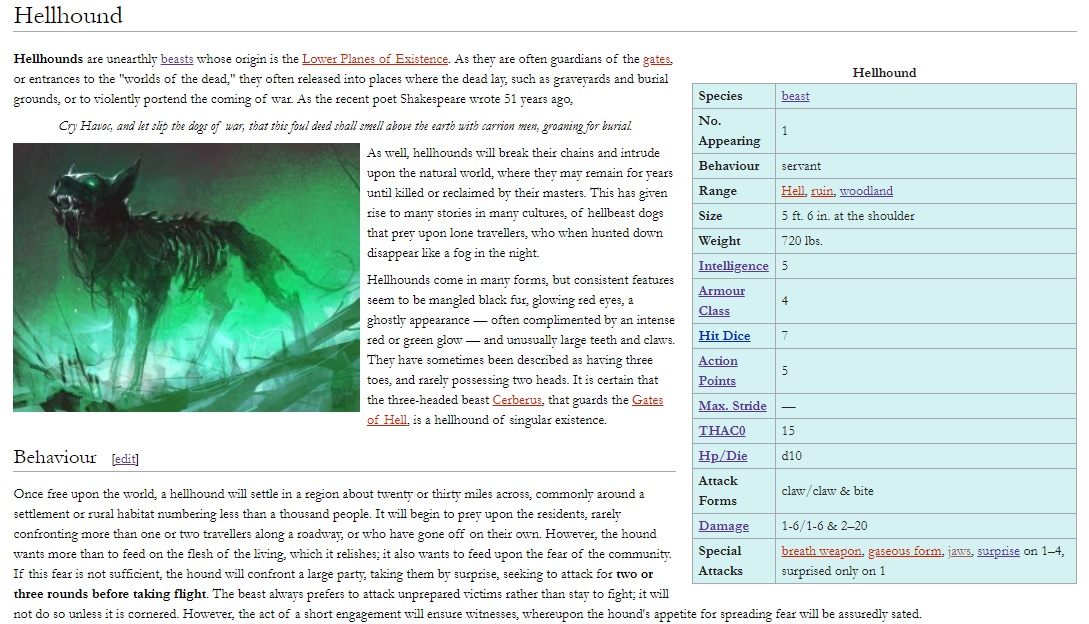
Sometimes, it feel there are too many dogs in D&D.  Big dogs, wild dogs, two-headed dogs, wolves, dogs that transfer from plane to plane ... and dogs that breathe fire.  And like most monsters in the lexicon, these are built as just another pile of things to be killed.  There is very little "adventure" in these things.  We're given six lines telling us where they're from, five lines that tell us they're monsters that kill things, five more lines that tell us they eat and how they puff up in smoke when they die (like none of us have ever seen Buffy the Vampire Slayer) ... and finally, seven lines telling us that hellhounds are evil.

It's not a bad description, if a bit purple and paint-by-numbers.  As I keep saying, with so many monsters in the offing, the publishers don't have much space.  And there is a perception that the purpose of monsters is to stand up like cardboard figures in front of the party to be knocked down.  The quality of each monster is designed so that each can hit the party with a variety of superpowers that have to be gotten past, as a means of providing novelty.

Only, as most of us know, we've fought just about every monster in the books, or run them.  Which lends itself to more and more monsters, slapping together different combinations of existing superpowers, until even this freshness wanes with repetition.  "Oh, what does this monster do?" the party begins to wonder, hardly taking the time to give the monster a name or care what will become of the monster once it has been successfully knocked down.

Those following the wiki will notice that I've stuck to the original, old old monster list, and that I'm not spending any time concocting new and complex power-bags to provide the "unusual" or "originality" of the time-honored habit of inventing a new monster each week.  That's because I don't buy into this process.  I don't think these "new" monsters are all that new.  They feel like hodgepodge kits with names randomly generated by rolling a die to find out what the next letter will be.  Rolling a D20 for consonants and a d6 for vowels, I get:  "Nawdae."  Very well, fear the nawdae; the nawdae are coming; there are many nawdae in this dungeon.  The experience for killing each nawdae is 420.  Etcetera.

When possible, the monster needs to be the adventure.  This needs clear motivations on behalf of the monster, and not just that it's evil to the core or malevolently hungry.  And incidently, it needs to be consistent; we can't describe a monster's motivation in 125 words and say that it is both "lawful and good and following orders," only to add two sentences later that if not fed, it will "quickly" abandon and turn on its master.  It's got to be one or the other.

I can indulge myself because I have space.  Moreover, I do not have a print deadline.  And I have run hellhounds before, exactly as knock-down stick figures, so I have every reason to be bored with that motif.  The goal, as I see it now, is to breathe (excuse me) new fire into these beasts, giving them a mixed set of motives while setting out to deliberately baffle the party as to how they can be killed.

This particular take only works because my experience system does not require for monsters to actually be killed.  If the monster is faced for a few rounds, with damage given and taken, the party still gets the benefit of having that short fight, even if they would probably need to be a higher level (and have access to certain spells) in order to actually defeat the beast.  A gaming system without that level of flexibility would find some aspects of the monster as I've written it to be unplayable.


Thursday, September 17, 2020

It's a Jungle Out There

Question: how many bad artists does it take to draw a hippocampus?

Answer: apparently, all of them.


I did not have much fun finding a good picture for the hippocampus entry below.  Nor was it easy to find good material.  The hippocampus has largely disappeared from D&D, and was never well covered back in the day.  There are almost no legends about the beast, except about it's shape; if you look it up on wikipedia, you get a litany about where it's been depicted and how, but nothing about the nature of the beast.  Ultimately, I had to dig up the Dragon Magazine #273, The Ecology of the Hippocampus, by Margaret and Ramsey Lundock (one of which is, or was, a terrible fiction writer), which gave some meaty information, most of which I disagreed with or ignored, but the structure of which gave me ideas to write.  As far as I know, this page on the Authentic Wiki is now the only extant, freely available description of hippocampi that is not mostly about what they look like or where they live (hint: in the water).  Enjoy.


This is not how I spent most of my day.  Creating monsters creates a need to discuss where those monsters live, pages which I am calling "ranges."  Today's page to be created was Jungle, which proved difficult because I like to include details about what sort of features one is likely to encounter in these landscapes.  Jungle is, unfortunately, rather devoid of these features.  I read through several book descriptions that waxed on about the unchangeableness of the jungle, and how this is one of the characteristics that drive people mad when they're forced to live in them for weeks or months at a time.  Much of the description of the jungle came from a book on "military geography" which was quite useful to steal from, because I'm a completely human without any compunctions or shame where it comes to good, solid plagiarism.  I'd feel a little worse about it, if it didn't come after searching for texts about jungles all day only to find source after source plagiarizing one another.  Why should I hold myself aloof?

The quest got so extensive that I learned there was an escape-from-the-worst-conditions-possible Australian movie made in 2017, called, sensibly enough, "Jungle."  With Daniel Radcliffe.  I watched it between other duties this afternoon, having plenty of time for some reason, and it follows the pattern of most such movies that have been made in the last ten years.  Person drops into environment, gets into trouble that really ought to mean their death, person survives when they absolutely should not.  The film is ... dark ... which should be expected.  It is a true life story, that apparently remains honest to the facts, if the internet is at all trustworthy.  Radcliffe clearly suffered to make it and the film deserves more attention than it received.

That said, with a strong desire to squeeze as much drama out of a jungle as a film can, the results were that jungles are devoid of features and are horrible because of their unchangeableness.  Oh well.  I managed to contrive a very short list of "interesting" stuff to see.  It would be hard to run a jungle effectively, with players sitting around comfortably drinking pop and coffee.


Each page is a hill to climb, but I feel good at the end of the day.


Monday, September 14, 2020

The Minds of Little Hobgoblins


Read the whole page here.


Sorry to go dark there for the weekend.  These pages about humanoid races are absolutely the worst; they wind up taking two or three days and I feel completely spent when I'm finished them.  I try to make each of them unique, and "human" in their motivations and understanding.  I understand that some gentle readers will contend that they ought not to be human, since they're not, but I hasten to point out that we have no idea how to express the actions of non-humans; we only know how to pick and choose from our vast and varied behaviours as a species ... which, in fact, narrows the collective opportunities offered by the creature's presence.  I know, I know: it sounds like we're stepping outside ourselves, but that's merely a delusion on our part.  We can't step outside ourselves in search of a motivation.  If you, o reader, can invent it, then guess what: it's a human concept.  No way of getting around that.

If you compare the hobgoblin to the kobald that I did a couple of weeks ago, you'll find they're very different from each other (which isn't the case in the source material).  Some will read the page and presuppose the hobgoblins are "lawful evil," like a little army of medieval nazis (see the 1977 movie, Wizards), which is another form of narrowing.  That's not really it at all, here.  Hobgoblins are agrarian.  They are extremely family oriented, on an unsettling human level (but, still a human thing in some human cultures, sorry), loyal, even welcoming of strangers.  Just don't face them on a battlefield, because they've anticipated Frederick II culturally.

I could write a post about how a significant number of people believe that creating structure is antithetical to creativity.  And how these same people believe that by eliminating the structure, eliminating order, is the pathway to individuality.  Odd, that all these "individuals" all make the same arguments, with the same vague quibbles, and none of these individuals ever seem to accomplish anything or demonstrate their expressiveness in a concrete way.

My take on the hobgoblin is not to put them in a two-dimensional, predictable box, but to give them guidelines in which they can act believably and rationally.  Hobgoblins are going to think first about their tribe, and then themselves. When they think about beating you in battle, they will think about it as their tribe beating you, not from the perspective of their own, personal accomplishment.  The worst thing that hobgoblins can imagine would be exile from their tribe; they would rather die; and if they were exiled, that is exactly what they would choose: to be dead, rather than endure it.

That characteristic makes them positively frightening; and yet, at the same time, for reasons that could be role-played and appreciated, if a group of hobgoblins accepted you as a member of their tribe, they could be the best friends you ever had.

Being able to flip this concept one way, then the other, shows how structure provides creativity, rather than the reverse.  But I wouldn't expect those who loathe structure to appreciate that.

Tuesday, September 8, 2020

Ki-rin and Bear It

There is some fascination with super high-powered monsters that has always been a part of D&D.  Since I start parties off at first level and make them work their way up, no exceptions, and since I am notoriously parsimonious with experience, I don't have a lot of use for these monsters.  I've run a straight-up no-holds barred beholder fight in a campaign just one time, and it was a serious pasting for the party.  I was young and dumb at the time, that being the 1980s.  I did not use the monster as sharply as I could now, so if that same 10th level party ran into one today, that would have been a TPK.

I've never thrown a lich at a party.  I've had them moving around in the background, but never actually had one come face to face; never engaged one in combat.  I can say that about a lot of monsters, particularly those in the books that were so obscure that I would forget they even existed for years at a stretch.  For example, the ki-rin.

This thing drifts onto two colums, but I've stacked the text to make a clean picture.  This thing is staggeringly overpowered; it has so many abilities that I doubt I'd use them all in a fight, even if a party were to take on the thing.  And psionics too ... gawd, to think I used to play with psionics.  But, as I said, I was young once.

This creature does have a precedent, but it's more properly called a "Qilin."  The wikipedia page discusses how the creature's "one horn" that's shown in the picture is actually quite wrong, and that western assumptions of that kind have produced identifications between the qilin and unicorns that isn't there in Chinese mythology.  Wikipedia spends a bunch of time talking about the association between the qilin and giraffes, which is interesting but more probably a case of certain scholars seeking desperately to write thesis papers.

I have dutifully maintained references to this creature for decades without ever using it.  Frankly, as written here, why would I?  The beast has no personality, no purpose for being other than to harass parties.  I think it was probably seen by one of the founding cronies as some kind of quest-giver.  What party is going to pitch themselves against this, what with the magic, the natural abilities and the psionics.  When this thing shows up and tells you to get the McGuffin, you go get it.

So much power, and so boring.

I've been making decisions about what monsters I want to keep and which I don't.  I had tried to create a form of kapoacinth, or sea-going gargoyle, but lately I decided I really didn't like my attempt and that I didn't like the idea at all.  So I burned it.  I could just as easily do the same with this creature.  And yet ...

Suppose we take the power down a notch or so, get rid of the single horn, give it more of an appearance like the Chinese legend fortold ... and see it as something disinterested in forcing players do quests.  No psionics, of course, and get rid of rules about creating illusions when, in fact, the original rules had no guidelines on how these illusions were supposed to function.  Leave it as having a lot of power, but get rid of any killer aspect the creature might have.  Keep the old D&D name, so I don't need to worry about someone telling me it isn't exactly like a traditional qilin.

Go with something like this:


Full description here.

I really like the picture.  It conveys the gentleness of the creature.  The lighting tempers the creature's golden colour, giving it more of a mystical feel and less of a garish cartoony feel.  The beast is simply enormous; and using my hit points per die rules, the number of hit points it has is virtually doubled.  The wiki page goes through a proper description of the powers, basing them on existing game elements.  And the one ability, that it can create any magic item at will, makes the ki-rin itself the quest, as players decide they want something specific and all they have to do is successfully find the beast and convince it that the player's need is worthy.

I also take a little humour in that, after decades of doing nothing with the beast, I happen to run across it now, as my daughter is just 4 weeks or so out from giving birth.  See?  Says it right in the description.  The beast is equated with the arrival of a baby to a family.

Nice.

Saturday, September 5, 2020

Captain America Never Fought This


Read the full page here.

I love the hydra, but it has been one of those monsters that seems like it's tough and scary, when in fact it has all the danger offered by a bunch of orcs.  And so, all the venom (which was a part of the original myth) and the immortal head (also sourced mythologically).  I've adjusted the experience so that if players do nothing more than nick and lightly damage the hydra's heads, they're effectively unhindered.  It isn't mentioned in the post above, but this also means the heads cannot be, in my system, "stunned" -- unless the body is.  Yum.

Hm.  I see I've misspelled Lernaean on the table.  I'll have to fix that.

Wednesday, September 2, 2020

Where, Jackal, where?

I don't know if I can take another humanoid race that's belligerent, that constantly fights among themselves, that has a god that urges them to fight, that acts with cruelty or any other thing that focuses the creature's entire mental capacity on war or battle or vicious backstabbing.  They're evil, they're evil, they're evil.

It is in just about every humanoid monster description.  It's meant to sound all demented and nifty, all this evil, this service of evil creatures, their associations wtih evil creatures, their making humanoins suffer "a lifetime of slavery" and "agonizing death," blah blah blah ... but it is repeated so ungodly often, it borders on a fetish.

The reason is quite clear: the worse the creature is, the less guilty we should be about killing them ... so we heap on the gore and hideousness and what not.  It's precisely the same tactic used in hateful propaganda, familiar as Donald Duck fighting the Nazis and the Japs.  Make the enemy look stupid, make them look like cowards, preach about how they stab babies and drink blood, anything that alleviates any possible guilt that anyone can ever have about killing these creatures.  Keeping in mind that this isn't propaganda from world war II, this is published in 2014.  When the anti-racists online carp about the questionable nature of slaughtering orcs and black elves in D&D, they can pick up a book published in the last year (every splat book from the company indulges in this) and see it right on the page.  Where you see Jackalwere, think Jap.  Think Jew.

These murderous sadists are not my jackalwere.  Admittedly, I have a race or two like this; the players just finished helping wipe out a frogling lair, and they were pretty bad.  But the average orc in my game is a farmer; the average kobald builds a village where they can raise meat for food; the average bugbear is a hunter gatherer.  True enough, some of them raid, and some of them kill.  But that's true of humans.  We humans invented this grilling-babies-on-pitchforks shit.  Not all of us, obviously.  Just enough of us who happened to be in charge of the war effort, who thought this was a good idea, and just enough people working for the company, who no doubt literally get off on the ooey-gooey magnificence of their writing prowess.  "Kewl, Mike!  But wait -- when I'm done writing the gnolls, the readers will barf!"

But of course, all the people in charge at the WOTC are adults.  They're not infantilized man-boys.  The repeated theme of the passage written above throughout all their splat books proves that!

I prefer humanoids that can change sides in a fight.   Humanoids who appear to have learned something through their mastery of large political sub-divisions.  Humanoids who love their children and their partners.  Humanoids that are, at least in some ways, like us ... in a way different from sociopaths.  With D&D, you're either all bad, incredibly so, or you're so squeaky clean you shit soap.  This polarization is boring.  Being good or evil is okay; but I'd prefer if we could stop being so two-dimensionally evil.  Or good.

I had more trouble with the Jackalwere than usual.  But there is no mythological "jackalwere;" and the Anubis warrior thing appears to have been an invention for the Scorpion King.  It doesn't fit Anubis, at all.  A little looking turned up cynocephaly, but the content here and elsewhere on the net is, well, meh.  I kept on looking and turned up this god, Wepwawet.  But yeah, no jackalwere here either.  At some point you just have to make things up.

I remember my creative writing instructor telling me in university, way back 30 years ago, not to make things up.  It's much better to write about what you "know," because then you will always write from the heart.  If you write about things you just make up, readers will be able to tell and it won't sound genuine and authentic.

One has to admire the obtuseness of this point of view, given the mountains of literature and religious influence on society that were clearly "made up" on truly gargantuan levels; and the purebred evidence of how many people cheerfully and violently believe it, to frightening degrees.  There's something so utterly navel-gazing about post modernistic writing, which yet finds a way to exist in a universe that has Poe, Scott and Shakespeare books aplenty.  I wonder; did my instructor suppose that Lew Wallace learned to drive a chariot before writing Ben Hur, or that Jules Verne actually built a submarine?  More likely, she just didn't "believe" it.  A rather idiotic standard to hold fiction to, if you ask me.

Anyway, you can read the whole wiki page for my Jackalwere here.  I made it all up.


Sunday, August 30, 2020

There is More 5e Content on Kobalds

First, a note.  5th edition's Volo's Guide to Monsters has more information about the kobald.  You can read the whole entry through this site.  Here's a screen shot of the first two pages; there are 8 pages in all:


I have to tell you, I'm still not very impressed.  The exhausting and annoying issue with all this content is the lack of details that would be of tremendous use.  Telling us that kobalds are skilled at tunnelling, and that they make small-diameter tunnels (I thought of that too) does not describe the exact size of tunnel or how much they can tunnel in the space of a day.  We're told it's "respectable." What the hell use is that?

There is this endless litany of where kobalds are and what little skills they have, but none of these produce a "feel" for a kobald's mentality.  Wikipedia does better!  Though, the wikipedia entry will disappoint, if D&D kobald is what you're looking for.  A problem I have with all of the 5e monsters is "splatter design."  We're told a dozen things in a short 260 word passage; and when we have eight pages, do we carefully investigate and expand those things?  No, we add a hundred other things: they're cowards, they loot, they're good with tools, they don't shun arcane magic, they're clever as crafters and strategists, they understand their actions contribute to the group, their plans always include an escape route, they are rarely affectionate, they don't have funerals, they're cautious, they get angry, they fear, they're this, they're that ... and this just goes on and on for eight pages.  Imagine reading a sociology textbook that just gives a long list of what humans sometimes do, believe or think.  It's tremendously boring, it keeps returning to the same theme over and over and when you're done reading it all, you know about as much about using kobalds in a game setting as when you started.

I mean seriously, take the bit about them being good with tools.  When are we going to use that, exactly, as a DM?  Have the party come along to find the kobalds fixing a cart, so we can say, "As you watch the kobalds, you're really amazed at how good they are with those tools."  Or maybe the party has caught some kobald prisoners, and now the wagon is broken, so we can tell the party, "You know what?  Get the kobald to fix it.  They're really good with tools."

You know who else is good with tools?  Humans who are trained to use tools.  Thank heaven that because those are so rare, we have murderous kobalds to help us.

Of course, more of this is to help out a player who is running a kobald, than it is a book about monsters.  The passages are really more to help the player know what to say, cookie-cutter like, when it comes time to "role-play" a kobald.  Make sure that you acknowledge that you're weak, that you're not that clever, and to get personally affronted easily ... and oh, don't forget about that ever-critical tool ability, plus a willingness to loot and find escape routes.  There, fleshing out the character, done.

It's like explaining the character of Willie Loman from Death of a Salesman thusly: you're a man, you're married, you've got a suit and tie, you carry a briefcase, you're a salesman, you have two sons, you talk out loud to people you used to know, that aren't there now.  Got it?  Great.  Start talking.

This is my favorite bit:


There are 20 names here.  20.  Arranged as an alphabetical list in two columns, with plenty of white space and numbered to save us the trouble of having to pick.  I've played this game a long time, I've never needed a name for a kobald; though I think, if I really needed one, I could randomly pick a consonant in my mind, randomly pick a vowel to follow it, then randomly pick another consonant.  Something like, I don't know, "Bob."  Bob the Kobald.  Fits fine.

Later on in the description, we find out that kobalds have cellars and sleeping areas, and mines, and mushroom farms.  Under "mushroom farms," we're told kobalds aren't good at agriculture.  It might interest people to know that underground mushroom farming is "simple" if you don't need to make money and you absolutely do not depend on them for food.  Otherwise, it is labour intensive and frustrating, since one small contamination can spread like wildfire and destroy the whole crop.  Ah, but maybe kobalds can eat anything.  We'll never know, because we spent at least a full page describing how kobalds make and use the same traps that every other humanoid in D&D uses.

I don't want to be petty, but eight pages of this content and there isn't one piece of information that isn't rehashed from books 35 years old, that I can use.  Back in the 90s, I could open a splat-book and at least steal some bits and pieces here and there, to fit into some table or redesign into a concept that would expand my system.  But with this 5e stuff, it's just old stuff rewritten, telling me that deadfalls are common traps, that kobalds attack light sources in combat, that they use poison, that tactics include ambushes ... it is just cliche after cliche for eight goddamned pagesIt's a little annoying.

Saturday, August 29, 2020

Don't Send Any More Men! It's a TRICK! There are TWO of them!

Shown here is the 5e version of the kobald, evidence that writing out rules in books, even books with 406 pages, can only bring disappointment.  As usual, 40 years of D&D design, and what we get is that kobalds dig tunnels, make traps, worship gods and ... omg, some of them can fly.

This is pretty sad.  But most of it, no doubt, is a lack of space on top of a lack of imagination.  And we should admit it ... kobalds are kind of a lacklustre monster.  They're not very strong, they look a little silly, they're even shorter now than they were in 1978 and they're not even able to come out in the daylight.

I've never liked that -1 penalty in the daylight, frankly.  Kick a weak monster in the gronknuts, why don't you?  And for the most part I don't care what gods the kobalds worship, if it doesn't directly affect how they act or organize themselves in the game world.  It's not much of a story and it takes up 12 lines in a 47-line descriptive text.  Flying kobalds takes up another 11 lines, leaving us with all of 24 lines.  Of these, 4 are used to tell us how a trip wire works; 1 is used to say they inhabit dragon lairs (no idea if the dragon is still there); and 2 are used to tell us that kobalds are weak.  No shit, Sherlock.

It is bad enough that the book format doesn't give much room to talk about any creature in it, or that we've used half the bottom of the page to basically repeat the exact same stats for the winged kobald that a kobald has.  It's the bloody crime of not using the actual space to tell us anything we didn't already know about kobalds.  Hey, guys ... you heard of the Internet?  It's this thing that your entire market of 9-year-olds use every single waking minute of every single day.  Here's a surprise: it was actually around in 2014!  Something you should look into.

I have no great genius to add.  I don't have space limitations, so it isn't really fair.  Additionally, I have a game world about which I can make references that my readers will get -- so again, not fair.  Still, I don't feel that 5th edition is much of a "competitor."  DMs need ... specifics.  Details.  Grit.

As ever, I do what I can.  Read the whole wiki entry here.


Thursday, August 27, 2020

That is So Lamia

Have you seen the wikipedia page on the lamia?  Going back to the source material for this monster, it is a kitchen sink of conflicting explanations for what the beast was, with sources weighing in for centuries to describe what it is.  And none of them are anything like the lamia as it's described in the 5e Monster Manual or Dragonix.  Viewing the source, "lamia nobles" and a "lamia queens" are obviously ridiculous, while the 5e lamia is no closer to the real thing than is the old lamia from the old 1979 Monster Manual.

The 5e version is a true punch-and-play monster, as shown.  Blah blah, desert cities, jackalwere guards, caravan plundering, tons of treasure, scrying, seeks out adventurers with "pure hearts" (I just threw up in my mouth).  Jeebus, we could pretty much scratch out "lamia" and insert half a dozen other monster names, or simply a 14th level mage, in its place.  There's not a shred of originality in this.

Notice in particular what's missing: Kills Children.  Parents using the name "lamia" for centuries to scare little children half to death to make them be good little boys and girls.  Not just another desert queen with a few powers, grotesque disney supervillain, but a voracious, sexualized monster that removes it's own eyes because it can't sleep at night.  But hey, D&D is a childrens' game, right?  We can't possibly include a monster in it that was used deliberately to scare children, can we?

Having run the lamia in the old manual a few times, I never liked it.  The wisdom drain wasn't particularly scary and apart from that the monster does not even do much damage.  The 5e lamia looks like a hodge-podge of desperate.  The source material is a scattered mess, engendering pictures of lamia online that are indistinguishable from medusae.  The lamia is a queen, a lover, a snake thing, a child killer, a succubus, even a dragon and a mother of dragons.  Shee-it.  I had to roll this around for awhile.  Whatever I came up with couldn't possibly be worse that what I've seen and frankly, the only thing that really interested me was the snatch-children-and-kill-them thing.  I've already got monsters that do all the other things.

So this is mostly independent of any other source, except for one artist who offered me a respite from a thousand pictures of women with breasts and snake bodies (sexually ambiguous, anyone?), identifying the image below as a "lamia."  Take this monster or leave it.  I tried to be dark.  D&D is a game for adults.


Wednesday, February 20, 2019

Gargoyles

Magical, statuesque monsters formed out of stone, these creatures may or may not have wings ~ though most do. They are found in ruins and caves; some are also known to attach themselves to cathedrals as goblins. They are very rarely found outside of Europe.

Created by magical experimentation during the development of the Abbey at Cluny, sometime in the 11th century, the method for sculpting gargoyles became widespread over the next 300 years. During the Papal Schism of 1378 to 1417, gargoyles fought for both sides, producing the consequence that many gargoyles ~ hardly intelligent to begin with ~ became self-aware and began to fight for themselves. The Council of Constance banned gargoyles in 1417 ... and since that time there have been efforts to exterminate the creatures. However, gargoyles are not especially malevolent or aggressive ~ but they have been easily used by malevolent forces, the consequences of which have soured empathy for these creatures.

Gargoyles are highly resistant to weapons and are enormously massive, being made of animated stone (the qualities of which are softer than stone but much, much harder than flesh). Their form can vary considerably, depending upon the sculptor, but draconic, serpentine, lion-like and bat-like features are the most common. The creatures cannot reproduce and are somewhat subject the same effects that would erode, break or shatter rocks. Except for their possible destruction, the length of a gargoyle's lifetime is unknown; they might conceivably survive for ten or twenty thousand years.

Because they are hunted, they will often hide in plain sight among ordinary, inanimate statuary, which they resemble. A gargoyle can remain absolutely still for as long as decades, so that an entire generation may presume that a gargoyle that they have observed since childhood is nothing more than a statue. Often, town fathers or church leaders will deliberately overlook the appearance of a gargoyle, adopting it rather than betraying its presence to gargoyle hunters.

Though indicated that as being found singly, that describes their common occurrence. Packs of gargoyles are sometimes organized by highly intelligent creatures who have made the effort to gather these creatures together. They are highly susceptible to obeying a strong, intelligent creature.

Advantages


Gargoyles are immune to normal weapons and also to magical weapons that do not bestow a +1 bonus to hit. Most are able to fly (if originally carved to possess wings), but these creatures are not especially agile in the air.

See Bestiary

Tuesday, January 22, 2019

Violet Fungus Rewrite

Violet fungi are a species of non-intelligent, carnivorous fungal growth. The creature is able to move slowly, able to sense spaces that are well-travelled, where they will tend to gather singly, in pairs or in very small groups.

Though easy to avoid (their prey is more likely creatures of animal intelligence who attempt to pick their way past the fungi), the process of exterminating the creatures is difficult and dangerous. Outdoors, they can be avoided; but when they block a tunnel underground, they are often closed in rather than contended with. A violet fungus might live for a year without sustenance.

Advantages

The body of violet fungus possesses four stiff tentacles that can snap reflexively at any creature that approaches up to a distance of ten feet (two hexes). The creature expends none of its own movement in this attack. As these tentacles are positioned equally around the body, each is able to attack only a 180° half circle ~ so that while the creature has up to four attacks, this relies on the creature being attacked by more than one creature to take advantage of the benefit.

In game terms, one creature approaching within the range of the creature will be attacked twice. Two creatures, attacking side by side can be attacked three times (maximum of two per defender). If two persons attack from opposite sides of the creature, each can be attacked twice. Finally, if three persons attack the fungus, distribute all four attacks among them ~ with each being attacked a minimum of once.

Hits will not cause ordinary damage, but necrotic damage. This is damage that cannot be healed with ordinary cure spells or with rest ... and in turn begins to consume the body each day.

Violet fungus must be thoroughly destroyed with acid to be permanently rid of the creature. Otherwise, a new fungus will grow from less than an ounce of its original body in 4 to 5 months. The creature is fire resistant and will not burn unless cast into a enclosed oven or kiln ~ even small pieces thrown into a open bonfire will leave enough to sprout a new fungus. A level of expertise is necessary when removing or cutting up a fungus, expertise is necessary as gas from the fungus as it is cut apart will cause 1 point of necrotic damage to the victim's lungs.

Once a violet fungi has killed a victim, it will step over the body and begin to feed on the victim, dessicating its remains. Violet fungi hardly ever move during combat.

See Bestiary

Tuesday, January 8, 2019

Monster Writings

This is sort of human.  Doesn't really need
it's own monster page.
About writing these monster descriptions.  I've been considering a series of guidelines that I've tried to follow throughout.  Some readers might get some value out of such a list, so here goes:

1. Create a simple chart with details that will largely matter when describing the combat ability, size, shape, intelligence and location of the monster.  The chart should be simple to read and should not skip information that will appear in the text ~ especially the special attacks!

2.  Explain the chart.  Some things do not need explanation; some things can be codified and then explained on another page expressly for that purpose, such as describing what a "scattered" distributiion is or what is a "wet/dry tropic" [it's coming, I swear].  It's most important to explain the special attacks, how the monster fights and the general shape of the monster (height and weight plus the picture are not enough!).

3.  Describe the monster's habits.  What is it doing when it is not eating player characters?  When is it out and about, how does it get along with friends and family, where does it hang on Saturday nights and what rings its bell?  The monster has a motivation; it needs describing past how it uses its body to kill things.

4.  When appropriate, skip details about things that the players ~ and even most people in the game world ~ simply won't know about the monster.  A lot of monsters are so rare, or so powerful, that what it is doing on vacation is way out of general knowledge.  Drop a hint or two about the missing information, but don't feel every detail has to be hammered down.

5. Avoid getting cute with the amount of detail.  It sounds fun to give the monster additional nick names or describe how a particular culture worships the monster as a god, or even to go into detail about how it gives birth to others of its kind, but in game terms this is just useless information that needs to be plowed through when the players are waiting.  Describe the monster in sharp detail; the extra details can be added later, during the adventure or if the players actually witness such a birth.  Those details don't need to be in the rules.

6. Make the description match the picture.

7. Your players read, so expect them to read your monster descriptions. which is one more reason not to add too much color to the description.  Remind your players that your monsters are a guideline, because ...

8. Monsters have species.  Just because this manticore happens to have a long tail with spikes doesn't mean every manticore does.  A manticore can have a scorpion's tail, too.  So when the players think they've got a monster pegged, remind them that size, body type, peculiar habits, intelligence and motivation can differ.  The description is a guideline.

9.  Add pertinent details once the players become familiar with a particular monster.  The next monster I mean to write up is the killer frogs, or froglings, the online.  Since the players already know the creature, this is a good time to include all the additional information that has come up ... but since it doesn't mean its the last time that they'll find these things, so I need to keep that monster universality in mind.

10.  Every monster is dangerous.  Perhaps in a very different way, perhaps obliquely, but nevertheless dangerous.  Some are dangerous because the players won't see them coming, some because of some annoying ability they have and some because they appear in frightening numbers.

Why is dangerous important?  Because they're monsters.  They're not paper targets.  They're the nasty, unpleasant, murderous side of nature and everything the players are supposed to be terrified of meeting in a dark, cold landscape.  For me, I don't believe in XP farming by killing, say, rats.  There are no "safe" monsters.

Giant Frog

This post includes significant contributions from Tim Alberdingk Thijm. Thank you Tim.

These terrifying, immense frogs are known to inhabit jungle and deciduous forests from central and southern India to southern China and Japan, as well as being known throughout Indochina and the East Indies. They possess claws upon their feet, making it possible for them to burrow into soft earth, which they will do with great alacrity. They have been known to create extensive underground tunnels, up to ten feet in diameter, in Burma, Kampuchea and in northern Borneo. They do not possess the long tongues that their smaller cousins have.

Giant frogs have leathery bodies and large muscular arms. When they attack, they will swing only one claw against enemies ~ but either claw might be used in a given round. As nocturnal meat-eaters, they possess and extremely good night-vision and are a terror in forested regions at night. They will often partly bury themselves in soft loam, laying in wait and attacking prey as it passes. They rarely hunt prey.

Advantages

In combat, the first time it is struck (whether or not it is stunned), the giant frog will produce an ear-splitting croak. This will stun-lock all creatures within four combat hexes of the brobdingnagian monster for one round; those who then do not make saving throw against paralyzation will be deafened for 2-8 rounds thereafter, during which time they will be -2 in all their attacks (both to hit and damage). Each giant frog is able to produce this croak but once per day.

The giant frog is able to move well and swing its mouth and claw, but it is most dangerous for its ability to hop a distance of 25 feet, or five combat hexes. It requires 1 action point to do this, and the frog can expend an AP at any time to hop. The giant frog will not hop away from a fight or retreat at all, but will always fight to the death. It can attack enemies in mid-hop if it uses its first AP.

See Bestiary

Wednesday, January 2, 2019

Cheetah

Sorry I haven't anything else to show today.  But this is a fair take on a first monster for 2019.  Many others to come.

A slender bodied large cat with spotted coat, small rounded head and a long spotted tail. Lightly built, the cheetah can outrun almost any other creature over short distances. They are active throughout the day and have adapted many natural ranges throughout Africa, Arabia, Persia and the Indian subcontinent. They are most common upon the savannas and veldts of east and southern Africa.

Carnivores, cheetah prefer to prey upon antelopes and other smaller horned animals ranging from between 51 and 123 lbs. in weight. They have been known to stalk elves and other small humanoids. Cheetahs can take down much larger prey, up to 290 lbs., if necessary.
They can be quite gregarious and can even be trained; pet cheetahs are a favorite companion throughout South Asia, though training them to accept a master means diminishing their aggression. Pet cheetahs do not make good guard animals.

Cheetahs will rarely stand and fight, unless cornered. They prefer to escape. When stalking prey, they will crouch and move slowly upon their intended prey, until getting within 40 hexes (200 feet). This is well out of the range to be detected by most creatures (see stealth). The cheetah will then put on a burst of speed.  The cheetah reaches a speed of 70 mph with less than two action points (about 3.2 seconds); this will effectively cover the distance between when it has hidden itself and its target in less than a round (the cheetah moves at 102 feet per second at its fastest).  The target will be surprised on a 5 in 6; it is entitled to an initiative roll ~ but a successful initiative roll will allow the target only one action point of movement before the cheetah attacks.  For most creatures, this is not enough to run very far or fight back, except with open hand, fist or if the defender has the ability to make a weapon attack with 1 AP.

If the target runs, when the cheetah gains on its target it will attack with its dewclaw first; a hit, regardless of the amount of damage done, will trip the target and dump it to the ground. Because of the cheetah's speed and agility, there is no saving throw. The cheetah's second attack will be its bite; if this hits a dumped target, the damage done by the speed of the strike will be double damage.

See Bestiary

Saturday, December 29, 2018

Ranges (monster habitats)

Well, I didn't get this done today, but I worked long and hard on it and I want to be sure people see it. So ... here's some of the work for Monster ranges, describing habitats for living creatures. This is something that can be perpetually expanded; eventually I'll create individual pages for each range, when there's enough detail sorted. This will do for today:

I organize the appearance of my monsters on the presence of vegetation and thus food supply, not upon terrain such as "hills" or "mountains." Some creatures do occupy alpine areas, but this is dependent upon the presence of alpine vegetation and not elevation.

The collection of ranges that I use are composites of Kuchler's vegetation classification, organized by climate type as often as not. This is augmented by some vegetation types not included by Kuchler, as monsters exist beneath the sea and Kuchler did not account for sea vegetation.

Please note: this formulation continues to be in a state of flux ~ many of the monster charts already posted on the wiki need adjustment in order to be in tune with the text below, while that text is being finalized. I hope to achieve parity across the Bestiary files in early 2019.


Monster Ranges include the following, with descriptions and images.

Aquatic Ranges


Lake

Includes ponds. These regions range in size from a hundred square yards to thousands of square miles. Several are remnants from glaciation. As they are isolated from one another, the residents of one body of water may be considerably different from another that is nearby. Temperatures vary in lakes and ponds seasonally in temperate and northern zones, so that much of the life associated with these bodies of water exists only during half the year.

The topmost zone of a lake near the shore, where it is shallow, is called the littoral zone. Able to absorb the sun's heat, the water is warmer and supports the most life: aquatic plants, insects, mollusks, fish and amphibians. Eggs and larvae are laid in this zone. Turtles, snakes and bird-life, as well as humanoids, are most likely to hunt here.

The near-surface open water in the middle of the lake is called the limnetic zone. Well-lit, it is dominated by plankton, fish and larger monsters that rise to feed.

The deep-water of a lake, below 30 feet, is called the profundal zone. The water is much colder and denser, little light penetrates and the main food supply is dead organisms. The main animal life is scavengers.

Ocean

These regions are divided into four separate zones, depending on temperature, the amount of light and access to land.

The intertidal zone is where the ocean meets the land. Sometimes the bottom is submerged and at other times exposed, due to waves and tides moving in and out. Mollusks like places where they can emerge from the water to hunt on the land; creatures that prefer to remain submerged include snails, crayfish, sea stars and fish. Larger creatures, exposed only during the very lowest tides, include worms and large predatory mollusks and beasts.

The benthic zone consists of ocean where the bottom is largely untouched by tides and yet enjoys the benefits of life. The zone consists of huge ocean plains, much of it consisting of sand, silt and dead organisms, with little plant life on the bottom. Seaweed forests do reach up to the surface from the bottom but most plant-life is free floating weeds. The water is comparatively warm and nutrient-rich, with fungi, sponges, anemones, worms, sea stars, fishes and the largest number of dwelling humanoid species.

The pelagic zone consists of the open ocean, where the bottom is deep enough to be considered another zone. With no land at all, the pelagic zone is relatively cold, with surface seaweed. Fish tends to congregate in large schools, whereas much larger mammals (whales and dolphins), large fish (sharks) and ocean-going monsters dwell. Most very large creatures feed on abundant plankton.

The abyssal zone is very cold, highly pressured and low is sustenance. A constant rain of detritus floats from above, but light is scant and there is no plant life. Many strange animals are found on the dark floor, or near underwater volcanic vents ~ the largest monsters on Earth dwell in the darkness of this layer, occasionally swimming upwards to prey on large creatures in the pelagic zone.

Reefs

These are widely distributed warm shallow waters fringing islands and atolls, or located upon great shallow barriers upon a continental shelf. The algae that makes up corals produces nutrients through photosynthesis, creating sustenance for invertebrates, fish, urchins, octopuses, sea stars and some humanoid residents.

Rivers

Includes streams. These bodies of flowing water change characteristics as they move from their headwaters towards their mouths. In high country, the temperature is cooler, clearer and has high oxygen levels, which are good for some fish and water scavengers. As width increases and the river slows, species diversity increases, as does vegetation. Towards the mouth, the water becomes murky, decreasing the amount of light. Without light, flora decreases and monsters that use the river as a retreat from which to attack prey on land increases.

Wetlands

Includes swamps, marshes and bogs. Wetlands are standing water that supports aquatic plants and a high diversity of animal life. Species of amphibians, reptiles, birds and furbearing animals, as well as monsters seeking isolation and shelter from humanoid outsiders. Some, such as salt marshes, have high salt concentrations, supporting sea life. Marshes can form along river estuaries or in wide areas where much of the land is near or below sea level.

Terrestrial Ranges


Alpine

The zone of vegetation between the tree line and the highest point of all vegetation, called the nival zone. Alpine growth typically consists of herb grasses and plants, with all woody vegetation disappearing towards higher elevations. The upper limit of alpine vegetations also gives way to bare rock and permanent snow. Winds are strong and continuous, while precipitation is mist or snow. Temperatures are cold and it usually freezes at night. Residents consist of hoofed animals, small mammals and beasts that roost in the high country and plunder lowlands below.

Desert

Barren areas where little precipitation occurs and living conditions are hostile for plant and animal life. The lack of vegetation exposes an unprotected surface subject to weathering, exposing much bare rock. Downpours can create flash floods, resulting in a desert bloom of flora and much needed sustenance for animals and monsters. Plant life will occur wherever there is water, such as seepages from aquifers, surviving on sea mist or minimal rainfall, or congregating around springs that produce oases.

Plants tend to be wiry and tough, with cuticles and spines to preserve water. Creatures and humanoids need to keep cool, use little precious water and be efficient at finding food and water in the desert. Many creatures are nocturnal. Nomads move flocks and herds from oasis to oasis. The largest deserts include the Sahara, Arabian, Gobi and Kalahari, with large expanses of desert on every continent.
Links: ant (giant black) ~ ant (giant bull)

Number Appearing & Distribution

With this and the one before, I'm working on a few side-pages for the Bestiary to explain the descriptions on the monster charts I put up last year.  I've been lax about doing this, but I get to everything eventually.  However, Pandred asking me to make some monsters earlier in the month whetted my appetite so I'm trying to get these things together.  This is a work in progress, but we have to start somewhere.

On any monster chart in the Bestiary, the number appearing indicates how many individuals of that monster will normally appear within a two-mile hex. Thus, in the example on the right, the number of camels that would be foraging in a hex of that size would number 3-12.

This number will be distributed in various patterns depending on the behaviour of the monster. These patterns include:
  • Tight group: in a cluster moving closely together, usually less than one body length apart, frequently touching one another.
  • Group: in a body moving one to three body lengths apart, usually in the same direction, highly conscious of one another.
  • Loose Group: in a collection moving four to seven body lengths apart, generally in the same direction with stragglers. Beta-male groups are sometimes distinct from the alpha-male with females group.
  • Scattered Group: creatures gather in groups of 2-4, often out of sight or unrelated to each other, foraging or hunting over a very wide area. Separate groups gather together seasonally for mating.
  • Scattered: creatures may appear singly or in family pairs, mating with other singles or remaining alone through their lives.
  • Widely scattered: nearly always encountered as individuals.
The chances of any camels being in such a hex (because often a hex should have no monsters of that type at all) is equal to the relative power of the monster. For that we use the following formula:

"SA" denotes special abilities, so the formula below the line for the wild camel would be 1 special ability (spit) plus the square root of 3 HD, a total of 2.73. Then, 2 to the power of 2.73, over 1, equals 0.151, or a 15.1% chance that the two-mile hex includes a herd of wild camels.

Desirably, once we could calculate all the creatures present in a given hex, a ranger with sufficient sage knowledge would be able to explore such a hex in a few days and identify the spoor of most of the natural animals present, even if they were not actually seen. Should a particular kind of monster with many appearing be indicated, obviously these would be quite easy to find. However, a single highly dangerous monster might take a long time to root out ~ if its presence could even be detected.

For what monsters appear in what environments, I need to make a page for Range (monster habitats), which I'll be working on this afternoon.

Friday, December 28, 2018

Monster & Animal Species

I don't have the lifetime I need to write up all
the monsters that don't exist in my world.
I hope you can forgive me posting content that I've recently put up on the wiki.  Truth be told, the wiki is getting far less attention than it used to get, so I begin to think the internet is tired of it.  If I leave it there and never print it here, I think very few people would know about it.

And what the heck, it is still work of mine one way or the other.

The following is a list in progress of species in my game world (which a reader asked about last week, I think it was Ozymandias).  This is a partial list, reliably including monsters up to the Ds taht I've added to the wiki.  I'll be updating this table as I add more monsters to the wiki.  Last year about this time I set a goal of 50 monsters for 2018.  I'll be matching that number this year.  If I keep up that pace, I'll finish my monster lists when I'm, what, 66 y.o.?  Heh.  Anyway, expect to see a lot of monsters on the blog during the next couple of months.

Some monsters are based on Earth terms for living animals and others are creations solely for fantasy role-play.  Animal species are relevant to various sage abilities and sometimes for the creation of magical potions, scrolls, wands and other like items, as the bodily fluids of species can sometimes be exchanged for another like creature.

List of Species

Bat: a species of flying mammal, often appearing in very large numbers.  Docile species are insectivores or fruit-eaters and will attack only if disturbed.  More aggressive species have been known to attack large mammals for blood or as a source for meat.
List: bat (giant)

Bear: omnivorous mammals found on every continent except Africa and Australia.  These creatures have large bodies with stocky legs, long snouts, small rounded ears, shaggy hair, paws with five claws and short tails.  Food usually depends upon what is available in the bear's environment.  Hunted for their meat and fur.  Caged bears of smaller species are often kept as a source for entertainment.
List: bear (black) ~ bear (brown) ~ bear (cave)

Beast: supernatural hybrids, sometimes part human, often destructive and malevolent in nature.  The existence of beasts has been the result of both magical experimentation and inter-planar contact, where some beasts have emerged on Earth through divine intervention.  Most beasts created in laboratories are born sterile ~ but the means of their creation has become known, so that the same beasts do tend to appear, having either escaped or been freed.  Some notable beasts, always originating on another plane of existence, are unique in form.  See Beasts (sage study).
Dragons: dragon huakinthos ~ dragonis malignans
Ordinary beasts: ankheg ~ basilisk ~ behemoth ~ beholder ~ bird of Tyaa ~ bulette ~ carrion crawler ~ catoblepas ~ centaur ~ chimera ~ cockatrice ~ couatl ~ displacer beast ~ dragonne ~ eye of the deep ~ gorgon ~ griffon ~ harpy ~ hell hound ~ hippocampus ~ hippogriff ~ hydra ~ invisible stalker ~ ki-rin ~ lamia ~ lammasu ~ leucrotta ~ leviathan ~ lurker above ~ manticore ~ medusa ~ minotaur ~ morkoth ~ nightmare ~ otyugh ~ owlbear ~ pegasus ~ peryton ~ remorhaz ~ roper ~ rust monster ~ salamander ~ satyr ~ sea lion ~ shambling mound ~ shedu ~ slithering tracker ~ sphinx ~ stirge ~ trapper ~ treant ~ turtle (dragon) ~ umber hulk ~ unicorn ~ wyvern ~ xorn

Unique beasts: Apep ~ Bahamut ~ Blodug-Hofi ~ Cerberus ~ Dahak ~ Fenris ~ Flame Snake ~ Freke & Gere ~ Garm ~ Gullin-Bursti ~ Hugin & Munin ~ Indra's Elephant ~ Jormungandr ~ Ma Yuan ~ Minions of Set ~ Pack of the Wild Hunt ~ Peacock of Karttikeya ~ Phoenix ~ Sleipner ~ Tanngrisner & Tanngjost ~ Thunder Bird ~ Tiamat ~ White Eagle of Zeus ~ Yama's Water Buffalo

Bovine: cloven-hoofed, ruminant mammals, with all males possessing two or more horns and in many species with females that possess horns also.  Bovids are typically diurnal, with social activity and feeding usually peak during dawn and dusk.  While small bovids forage in dense and closed habitat, larger species feed on high-fiber vegetation in open grasslands.  Many bovids have been domesticated, while their leather, meat and wool is sought after.
Links: antelope (sable) ~ buffalo ~ cattle (domestic) ~ cattle (wild)

Camelid: large, strictly herbivorous mammals with slender necks and long legs.  Due to their body structure, camelids have to lie down by resting on their knees with their legs tucked underneath their bodies.  Camelids do not have hooves, they have two-toed feet with toenail and soft, leathery foot pads.  When they walk, both legs on the same side of the body move simultaneously.  Camelids long enough for human beings to ride have a typical swaying motion.
Links: alpaca ~ camel (wild)

Chthonic: 
typically malevolent semi-divine beings whose origin tends towards the lower planes of existence, widely ranging in type and form.  Chthonic creatures are often associated with subterranean realms and places, but also with places that terrify and mortify the senses.
Demons: manes
Devils: lemure

Crocodile: large, solidly built reptiles that include alligators and caimans, with long flattened snouts and laterally compressed tails.  Their eyes, ears and nostrils are located on the tops of their heads.  They can swim well and can move on land in a "high walk" or "low walk," while smaller species can even gallop.  Their skins are thick and covered with non-overlapping scales.  They have peg-like teeth and a powerful bite.  They are hunted for skins and for meat.
Links: crocodile (common, deinosuchus & saltwater)

Faerie: enchanted humanoids usually with some natural magic ability dwelling in sylvan lands which exist largely through the caretaking and concern of powerful members of the species.  Similar but unrelated to Apollonian semi-divine beings, with a considerable presence throughout those outer planes associated with peace, happiness or contentment.  Often, faeries are concerned with the well-being of persons deemed worthy in their eyes.
Links: brownie ~ mite

Feline: 
also cats, carnivorous mammals with adaptations for stalking, ambush and short pursuit hunting.  With graceful and muscular bodies, strong forelimbs, a powerful bite and retractable claws, cats often have characteristic striped or spotted coat patterns for camouflage.  Some cats have been domesticated.  Often hunted for skins.
Links: cheetah

Fish: aquatic animals with gills and bound to a water environment, either salt-water or fresh.  Fish are usually non-intelligent and voracious eaters of creatures smaller than themselves.  They are abundant and often appear in very large groups, which can make them dangerous even against larger prey.  Common fish are sought after as an important food source.  There are numerous sub-species.
Ray-finned fish: barracuda

Flightless Bird:  these animals are birds that do not have the ability to fly.  Body shape tends towards long legs, necks and large heads, though exceptions ~ notably penguins ~ challenge this norm.  Flightless birds tend to attack with beaks and feet, the latter often including vicious claws.  Flightless birds are treasured for their decorative feathers, meat and skins; many species have been domesticated.
Links: axe beak ~ moa ~ ostrich ~ rhea

Hemitheioc: neutral to benevolent divine beings, less than demi-gods, whose origin tends towards the upper planes of existence, widely ranging in type and form.  Hemitheioc creatures are associated with aiding mortal beings, often with generosity and guidance.  Far less commonly seen than malevolent divine beings, hemitheioc beings take pains to work through emissaries, signs and other subtle means, preferring not to reveal themselves if not absolutely necessary.  As such, their measures are more difficult to identify and counteract.
Links: djinni

Humanoid: a highly disparate collection of normal-sized, intelligent, communal upright-walking beings typically with a head, two legs and two arms, though exceptions exist.  Includes both benevolent races seeking providence for the largest number and malicious, warlike races bent on world domination and control.  The most dangerous are those in control of large political regions.  Does not include giants.
Demi-human races: dwarf ~ elf
Goblin-associated races: bugbear

Insect: creatures with a chitinous exoskeleton, pairs of jointed legs, compound eyes and antennae.  Most insects that comprise monster forms are giant in form, a spontaneous evolutionary condition that predates the human discovery of magic and is therefore attributed to wild magic.  The effect produces a limited-levitation effect that lightens the weight of the insect so that it is able to support itself on legs or even fly.  Some giant insects can walk on water or swim.  Insects may be solitary or live in large organized colonies.  Some are known to swarm.  The diversity of insects precludes further generalizations.
Links: ant (giant black) ~ ant (giant bull) ~ ant (giant carpenter) ~ beetle (giant bombadier) ~ beetle (giant fire) ~ beetle (giant rhinocerous) ~ beetle (giant stag) ~ beetle (giant water) ~ centipede (giant)

Primate: a collection of primitive humanoids, possessed of low intelligence and related to humans.  While some larger species are earth-bound, all species possess adaptations for climbing trees.  Small species will leap from tree to tree or swing between branches.  Walking movement includes upright on two limbs or modified knuckle walking.  Highly social in family or larger groups. Most species live in tropical rainforests.
Links: ape (carnivorous) ~ ape (gorilla) ~ baboon (mandrill)

Pudding: a form of slime mold thats secrete acid from their tissues that is capable of dissolving flesh, cellulose or metal, depending on the species.  See Slime Molds (list).
Links: pudding (black)


Rhinocerous: herbivorous large mammals, some that can be counted as megafauna exceeding three tons in weight.  Rhinos typically have one or two horns, though exceptions exist.  Leafy material is preferred.  Horns have been sought after as a source of medicine and magic.  Rhinos have a reputation for being highly aggressive.
Links: baluchitherium

Rodent: mammals characterized by a single pair of incisors on the upper and lower jaws.  Found in vast numbers on all continents and in all habitats.  Rabid and often associated with disease, many rodent species are considered invasive pets, eating and spoiling stored food, destroying buildings and threatening crops and water sources.  Rodents also serve as a source of food, as pets and as attack animals.
Links: beaver (common & castoroides)

Swine: even-toed hoofed mammals noted for their intelligence as animals. Though usually feeding on vegetable matter, swine are ominivorous and can be highly aggressive as predators.  Some form prominent tusks that can be very dangerous.  Swine are hunted for their skins, meat and fat, which can be rendered to make lard or candles.
Links: boar (common wild & hylochloerus) ~ boar (warthog)

Therapod: bipedal reptiles characterized by hollow bones and three-toed limbs, usually carnivorous though some herbivores and omnivores are included in the species.  Distantly related to birds.  Therapods typically possess blade-like teeth with serrated edges.
Links: bonesnapper

Weasel: carnivorous mammals with short legs, short round ears and thick fur.  Weasels tend to be solitary, nocturnal and do eat vegetable matter.  Most can swim and are comfortable in the water.  Even the smallest species are noted for their viciousness.  Many species are sought after for their furs.  Some species have been domesticated.
Links: badger (common & chamitataxus)

See Bestiary