Showing posts with label Future. Show all posts

Saturday, May 10, 2025

Heretic

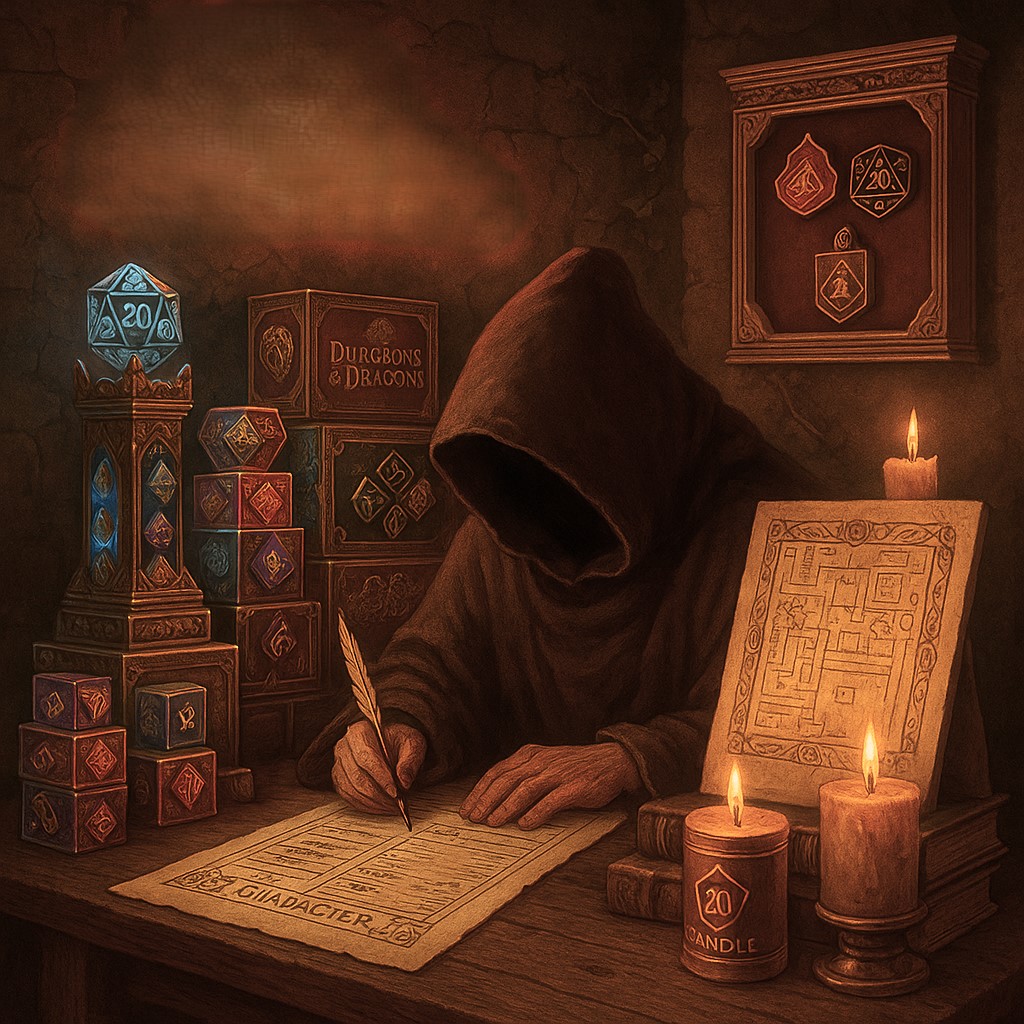
Slopware is low-effort, high-gloss product that mimics the shape of utility without providing it.  It's the repackaging of an aesthetic that arises as an inevitable commodification that surrounds any human activity: top shelf, branded, expensive crap that has more to do with signal than use.  Gold plated deluxe lightweight ski poles and LED-lit barbecue tongs, folding leather stools for camping, mason jars labelled "flour" and "sugar" in vinyl script, neon signs referencing drinks the bar doesn't serve.  The culture of buying shit surrounding the culture where the activity is actually pursued is intensively invested as far as the market will bear — there is nothing at all unique about D&D in this regard.

Except that, perhaps, it is actually possible to find content where people discuss actual skiing, actual camping, actual cooking and a host of other activities where slopware pervades overtop.  D&D, on the other hand, has evaporated within the cloud.  Miniatures, standees, tokens, dice and dice towers, plastic coins, item cards, lore snippets, holiday-themed packaging, artwork prints, miniatures, pins, stickers, mini-posters and even candles and soap, have eclipsed the old material contributions of maps, modules and splatbooks.  I have considered getting into it myself, as an act of desperation... but experiences with the menu, though I did better than break even, has soured me on it.

The literature that remains has devolved into "how to have fun" and "how to express yourself."  There's no tie to adjudication, risk, conflict, structure.  The aesthetic has become so dominant that the activity no longer needs to take place.  Buying slopware has replaced it.  That's the activity. How much can I get, how can I display it, look at my collection. The dice featured at the front of the video linked above are so obviously impractical for actual play as to be laughable, but this isn't addressed because it doesn't need to be.  We don't care how the dice land.  We don't care what they reveal.  We're just going to make it all up anyway.

The book, A Canticle for Leibowitz, is the perfect literary analogue for what's happening here: the ritual preservation of artifacts from a forgotten age, stripped of their original function, revered without comprehension. The monks in Canticle copy blueprints as sacred texts, illuminate circuit diagrams, recite fragments of technical manuals, all without any practical grasp of what they once meant. The act of preservation becomes an act of worship, disconnected from utility, divorced from context. D&D slopware mirrors this precisely. Dice that no longer need to resolve anything. Books that aren't read for mechanics but displayed for prestige. Rulebooks treated like lore-bibles, not instruction manuals. The game is lost but the relics remain, enshrined.  Slopware, then, is more than just kitsch and clutter... it's the liturgy of a secularised hobby — gestures repeated in the absence of meaning.  A die rolled to hear it clatter on the table, only to have the number "interpreted" out of existence.

Those who have been reading these brutal essays, one after another, will probably miss this next point; I've deliberately buried it in the fourth essay because at this point, only the bitter who remember the game will still be here.  Everyone else, who do not like their bullshit having been called out, will have left by now.  This fourth essay should be the nail in the coffin; a title, a diatribe about the last miserable performative element of what's left, so that such will be done and gone by the second paragraph.  So welcome, you made it here.

I love the game of D&D.  That's the tag line on this blog.  That's just performative, not a general reference to things related to the mystique of D&D... but the game itself.  The skill-set, the challenge, the problem solving, the fall of a bad die, the intensive complexity, the potential for high immersion on a massive, intellectual scale.  Those who have been here from the beginning know this is how I feel, because of the vociferousness and the ferocity with which I've argued it.

I personally no longer think the culture comes back from this.  Perhaps if I'd been asked last year, certainly three years ago, I would have said, "Yes, given the collapse of the official sector, the ceased flow of official materials, I think steadily we find our own way again."  As of these last few months, culminating in the clarity that has built these posts, I'm abandoning that perspective.  And I've just explained why.

But frankly, for myself, I was never in it for the "culture."  The culture has always been an annoyance.  I'm in it now, and always will be, for the concept, the meat and potatoes, not the glitz.  I continue to believe that the future of D&D is a computer-generated model, one in which a legitimate sandbox is obtained though an A.I. capable of processing and frankly killing player characters without batting an eye.  That isn't the first model we're going to get, if the ethical bullshit of chatGPT is an indicator.  But it doesn't need to be the "first" model or the tenth.  It just has to be a model, something that any small group of designers can put together, IF they have the substance and detail necessary to work with.

Some might say this is a bit pie-eyed of me... but I should hope that after all this slaughter, in which I've gratuitously called out every miserable shitty thing about this culture with razor-sharp finesse, that "naively hopeful or starry-eyed" is the last thing I can be reasonably called.  I'm not hopeful because the culture will save itself, but because someone like me, who can see the culture for what it is, would have the sufficient means and power to build a program that would strip all this crap away like so much mosquito netting.  It wouldn't be called D&D, of course, but it wouldn't have to be.  Stumbled upon by a generation that followed the last generation of those "role-playing farts" as immersive and brilliant wouldn't need or want the tarred, urine-soaked brand name of what D&D is going to be seen as in the next few years... because this isn't going to get better.  This is going to get a whole lot worse.  I think I've made that clear, too.

Fundamentally, it's never been the brand that mattered.  It's never been what the character classes are called or what monsters are included, it has always been the duality of the setting mixed with the potential of the possible... and that invention, utterly brilliant in the extreme, gets to stay, no matter what we slop over it for a time.  Look carefully at this a third time:

Arrange a series of events with which the players can engage in order to experience a verisimilitude with place and time. Provide a remuneration for effort that encourages more effort and less hedging or deviation from the game's functional aspect. Downplay participation behaviour that clutters up either the verisimilitude or the game's progressive design. Discourage the attendance of persons who resist the design.


Do you see the word "dungeon" or "adventure" here?  Do you see the inclusion of dice, role-playing or collaboration?  Does it invoke a facilitator at all?  No.  Because those things, for all the substance we assume they have, aren't actually necessary to the procedure of the game.  The procedure is obstacle, investigation, action, obstacle.  Everything else is dressing.

Obviously, I like the adventure, the character classes, the particular skill-set and the atmosphere of a medieval fantasy setting... but these things are, in essence, just a topology for arranging obstacles.  Adventure is just the narrative shell we've adapted ourselves to, but any procedural motion will suffice.  Dice are merely a way of resolving uncertainty mechanically; real life is full of uncertainty, none of which is resolved by dice, so it's reasonable to expect that any adaptive future mechanic need not depend upon 14th century technology.  No matter how popular it's become.  The die isn't sacred; it's not a holy relic before which all future generations must bow.  Future generations, those not habituated to the nostalgia of a childhood they never realised, will comprehend this.  In the end, it won't really matter what the genre is, or how the skill-set is devised, or what limitations we impose upon character action.  What will matter is that in some form we'll be able to functionally live an alternate life, fascinating and profoundly able to affect the real one we also have, devoid of all this constant crap and bullshit.

Well, okay.  We won't.  But our grandchildren will.

More importantly, because we must apply this now to the living, we should just go on doing what we're doing.  The future depends on this.  The less they have to do, the less skull-sweat they need expend on stuff we could be inventing now, the more ahead of the game they'll be.  The success of the process isn't getting to the finish line.  We're not in a single-competitor event, we're in a relay; it's our job to carry the baton from the year of our birth to that of our death, as well as we can, not for our own personal glory, but for the greater good.

Don't worry.  When it comes the time to reach your hand out with the baton, when you're on your last gasp, you'll find a hand waiting to take it.  This is the one fundamental truth that gets lost in all the performative personal glory that seems to pervade... but it's just air, it's just noise, it's not real.  Macbeth was a fool.  It's not about our hour upon the stage; its not our importance as the player; it's not about our being heard.  The idiot is he who thinks, after all this time, that what happens in our lifetime is what decides the game.  There is no decision yet; death is just a story that seems to end for us; it's not the real end of the story, else none of us would be here now.

It's the baton that matters.  The baton is free of marketing, it's free of ego, it's free of flattery and self-importance, because it's value rests only in how well it can serve to make the next baton.  Those of the past, those who past it onto us, they had their demons, they had their critics and their own self-puffery; they too did their wheezing about their time on the stage, as we do, as our children will, and their children also. Which comes to nothing at all, because in the end, even the sound and the future are silent.

Perhaps it "signifies" nothing... but all that is mere association, implication, shared ego.  But the amount is not nothing.  The amount is everything, since without the amount passed ahead from the first human that discovered how to spear fish and feed more kin to the one before me that built a cabin.  The amount is everything.

Damn all the rest of this, though know it for what it is.  Lift your head, mutter your curses, then put it all aside and pay attention to what matters.

This reversal, following these posts, breaks the rule.  A diatribe like this is supposed to end, after all the venom, after all the dismantling, in either collapse or self-immolation.  I'm supposed to conclude with saying, "As a consequence, I'm shuttering this blog and seeking another approach to life."

But this is what I mean when I say, I am not like other people.  I have not come to this commitment through nostalgia or happenstance or because it just happened to be popular.  I'm not capitalising on it, I'm not dependent on it and I'm not limited in my capacity to research and understand human behaviour by "what I have learned from role-playing."  

A running theme through these posts has also been the question, "Why am I different?"  Something happened to me in those formative years with wargame playing; almost at once, I took to D&D like a fish to water.  I didn't wallow around for 25 years before finally realising what the game was about or putting aside the rhetorical preaching of the official class.  I despised, hated and resented the bullshit I found in the Dragon Magazine from the first time I read the thing, though I'd been playing D&D all of two months.  It was so obvious to me, if not to others, that the slop parading as "helpful" in those pages was just filler: bad writers with bad ideas and limited writing skills without the least understanding of what they were screwing with.  My friends had to listen to my 15-year-old diatribes then, as you good readers do now, as I sliced into some awful bit about the "biology of the purple worm", which was utterly unhelpful and irrelevant to actual game play.

That nature of mine did not come from D&D.  It was firmly in place some six or seven years earlier, as I began to open textbooks about human anatomy, astronomy, geography, statistics and history that were sitting on the shelves of my school library, at a time when an elementary school had baldfaced books with rich, glossy plastic fold-over plates showing the circulatory, endocrine, nervous and hormonal systems, which I greedily drank with my eyes and explained to my friends — who did not understand and did not believe me, even as I turned the pages and read the words and proved it was so.  Something in me broke... perhaps in a good way, perhaps in a bad way.  It depends on one's point of view.  But by the time I came to D&D, I was well versed in the historical persecutions of knowledge and adaptation, along with the fundamentals of human ignorance and propaganda.  Hell, I read Mein Kampf in junior high school, two years before D&D, because it too was there on the shelf, for anyone who wanted to take it down.  Because in those days, when they said that sunlight was the best disinfectant, they really meant it.  Not like now when we say, "let's educate the kids about fascism," what we really mean is to soften it until it feels like a minor case of the mumps.

Coming from that, from seeing at 13 the unmasked face of evil, and how truly deep and pervasive the lies could get, the frivolous nonsense surrounding D&D when I began the game was child's play.  And so, I've never been "one of the number."  Never been a "true believer" in the Leibowitz sense of the word.  I am a born heretic.  One that got through the door, that shouldn't have, and now that he has the bone between his teeth, won't let go.

This is a great game.  No matter how many ways people find to piss on it.

Tuesday, February 28, 2023

Codexes

I wonder if Pathfinder is gleaning benefits from the OGL debacle last month.  Certainly the content creators surrounding TTRPGs have flocked to the Pathfinder standard.  Videos have proliferated this past month, competing with one another to explain what Pathfinder is, how to get started in it, how it works, why such-and-such is leaving D&D for Pathfinder and so on.  Hardly an essay about D&D ends without the writer wrapping up their point by admitting that they're thinking maybe it's time to leave D&D and try another game, "maybe Pathfinder."

I know very little about Pathfinder except that it sounds awful:

... Next is Lorian the ranger ... and the ranger has a feat called 'hunted shot,' which lets Lorien spend her first action to hunt prey, which will be this wight here; her second action to use hunted shot to make two attacks, and her third action to make a third attack.  And hunted shot can only be used once per turn, because it has the 'flourish' trait.  The player prepares to do this and expresses that they've been frustrated because they are doing this every turn, and because it's the most optimal thing they can do.  It does the most damage compared to their other options ... and thinks that the hunted shot feat, since they took it, is incentivising them to do this every turn.

The GM says, "Well, you can still walk up to the enemy and make a melee attack — why don't you?" ... and the player says that they've done some math and found out that they do a certain amount of damage while standing in place, hunting prey and using hunted shot, compared to if they were to walk up to the enemy and make strikes with their short sword.  The GM says, "Well first of all why would you use your short sword?  Your rapier does damage, but besides that, this is not necessarily because of hunted shot — the wight is standing outside your melee range.  If it were standing next to you, then you wouldn't be needing to spend an action to walk up to it, and you could go straight to hunt prey, which increases your damage, and then make those two strikes ... and there's other reasons you might want to be in melee; maybe you want to draw fire away from an ally who's in trouble, like right now; or maybe if you had a very high strength you might be doing even more damage, than your current strength bonus is currently giving you ..."


I'm not going to unpack this.  I did listen to all of it.  I find the rules comprehensible, and not that removed on their surface from similar examples I've watched with 3e, or even that I've had with my own AD&D Frankenstein campaign.  The creator's argument is worth making; I can't say for certain that he made it, because I don't know enough about Pathfinder to say.

The larger issue for me is the service the rules are performing here, as opposed to how they were intended to perform with earlier games, or indeed other, non-RPGs.  Take this from the Game of Life:

Play moves to red who will choose to start college.  A player receives $40,000 loans from the bank when choosing the college path.  Red spins the wheel and will move five spaces.  Red lands on a square that states, "Study for exams, miss next turn."  Red will miss her next turn.


Good game vocabulary is rendered to be (a) as self-explanatory as possible; and (b) to suggest context that fits the game's theme.  In the second case, the theme is "life," as the title states.  In life, skipping over childhood, the proposed first important decision people make is to choose whether or not to get a higher education (well, the modern game was released in 1960 with an intended white, middle class audience).  Game elements like the wheel, moving spaces, missing turns, etc., are elements we learn at a very young age, if we get a chance to play any game, from checkers to cards.  As a game, Life is boring, but it's clear.

Because D&D is vastly more complex, from the beginning it's been difficult for the game's vocabulary to be self-explanatory.  And as the game has gone through editions, the desire to add feats, spells, races and classes has saddled ordinary game play with spectacular levels of descriptively erroneous game elements that cannot be reconciled except when the words themselves are treated as an alternative-language codex and not as the words they are.

For example, linguistically, it isn't possible to "hunt" and "battle" at the same time.  The two verbs have vastly different meanings that cannot be reconciled.   This means when using the phrase "hunted shot," the player has to subordinate the meaning of the word hunt to the official codex of what it means in the game.  This isn't especially problematic with one word ... but there are literally thousands of these circumstances which have become canon over time, crippling the game's language and making it increasingly difficult to master the rules.  It's not so much that the rules themselves are all that complicated; it's that the need to provide rules that make everyone's actions individualistic, while also providing a choice of individualistic actions, heaps language on language until those without excellent knowledge have to have the game pedantically explained to them again and again.

This bogs down game time.  I've experienced this as well with my own rules, especially in the various tiers of sage elements I've advanced.  Players first get confused trying to keep "field" straight from "study," and study straight from "ability."  Then it's a matter of reconciling their understanding that of the knowledge they have, there's a difference between what's "in field" or "out of field."  And finally, there's the list of abilities being divided progressively into "amateur," "authority," "expert" and "sage."  Despite my efforts to be clear about these aspects, I find myself regularly having to remind the players what's what.  Which I do patiently, knowing these things will become second nature.

The arrangement had to exist in this fashion to keep players from acquiring all, or too many, sage abilities early in the game ... and to ensure that there could never be an instance when every player would gain all the abilities from any particular class.  The way it's set up, this just isn't possible.  A character, to have a perfectly average chance of getting every sage ability in studies outside their fields would need to reach 67th level.  This would take a lifetime of play, and in any case I use an arbitrary limit of 23 to 29 levels, depending on the character class.

As best I can, I struggle against codex-phrasing in game design.  A "field" corresponds to a "field of study," which any person in real life understands without explanation.  A "study," likewise corresponds to studying a given subject.  The two words may be used interchangeably in English, but the heirarchy is quite natural once explained.

Most of the time we understand what an amateur is, and I have very little trouble with players remembering this description for the lowest level of sage ability.  Trouble arises in placing "authority" vs. "expert" in the hierarchy.  My dictionary defines an authority as, a person with extensive or specialised knowledge about a subject: an expert.  It defines expert as, a person with comprehensive and authoritative knowledge of, or skill in a particular area.

So, interchangable.  I didn't want to use "specialist" because, in fact, the expert in the system has a wider range of knowledge as the player accumulates levels, not more specific knowledge.  I did not wish to use "pundit" for obvious political reasons, nor "oracle" because it has a religious aspect that did not fit, nor "maestro" nor "virtuouso" for their musical connotations.  "Master" is sexist, "professional" is anachronistic, "wizard" is a flat-no fail, "genius" can in fact apply to any level of knowledge, since knowledge is collected and a genius can start off ignorant and become knowledgeable.  Thereafter the remaining terms for expert become increasingly slang-oriented or utterly out of the player's ken regarding recognisable English words.  Which would just make the problem worse.

The result is a patient effort to stipulate that "authority" and "expert," both very familiar words, have in fact two weights for synonyms about knowing things.  At least that's what both words actually mean.  If I'd used maestro, I'd have an endless fight on my hands in arguing that no, it does not mean the geologist can play music.

A connection the reader should have made by now is that the decision to revert to Basic versions or AD&D seems right, initially, because the game's language becomes instantly more comprehensible.  An "attack," which is self explanatory, is done by every character in the same way.  The weapon can be changed, and that provides some choice, but the player cannot change the amount of damage done simply by changing the imaginative way in which the player chooses to attack.  Multiple attacks to occur, but never as many as three and never on account of skills, or feats, whatever we choose to call them.  There are adjustments to hit and damage, but these are limited to a relatively few number of possible game elements, most of which provide plain relevance in the game.  That relevance can be argued, and has been, for many decades ... but strength does suggest hitting harder and dexterity does suggest hitting faster.

The argument that dexterity ought to mean, "hitting more precisely," and therefore causing more damage, emerges from cinematic representations of combat.  It serves a plot to show a smart character who outmanuevers a bigger, stronger opponent by cleverly hitting in just the right place, like tapping a button that circumvents the enemy's advantages.  It is, in fact, the story of David from the Bible ... though if that story is true, the relative weakness of David has been debunked.

The "dexterity = higher damage" argument was underway when I started playing D&D.  I'd argue that it, and other arguments like it, were central to the many enhancement rules that emerged within the first two or three years of D&D.  The invention of the barbarian, for instance, which argues that a barbarian's strength ought to be greater than a civilised fighter's strength ... which, in fact, makes no sense at all, except "Conan."

An "acrobat" is a circus performer.  "Performance" and "skill" are distinct from one another; the acrobat character was given no rules of any kind to contribute to the character's public performance abilities, only aspects of the profession that could be applied to adventuring.  We could simply have given the skill to one of the existing classes, but that wasn't sufficient for the game designer or publisher.  "Acrobat" sounded cool.  Thus we progressed down a path towards the accumulation of codex-driven words whose definitions became absurd in game context.

The comprehensibility of early D&D was a plus ... but it wasn't comprehensible enough to sustain itself.  At too many points in the original versions were game elements perceived as either limiting or illogical ... within the scope of logic from people who felt the game needed to reflect their personal will rather than their personal will adapting to the game.  Thus, we are here.

I'm rather encouraged by the so-called rush of D&D players to other game forms.  Not because it means more non-D&D games will be played, or even that these people will get out of my game, so they can go whine and pout about some other game I'll never play.  But because it portents the collapse of corporate gaming.  As various game companies fight each other for participants, struggling to outdo one another with more and more choices, while "simplifying" actual game play so as to appeal to the widest possible audience, we should expect a boom period where dozens of games suddenly experience an exceptionally widespread popularity.  Journalists will rush in to cover the excitement of it all, while program-directors will push to have more and more video content made that sells to the desired viewer.

Then, bust.  The shallowness of what gaming becomes during the boom period will fail to sustain itself; something else is sure to wander along for the next generation and that'll be it.  Hasbro's film this month may or may not fail, but Hasbro surely will; that's another post for another day.  I'd rather just watch that one happen, to be honest.  But over all, rushed, cheap films produced by non-players, as they must be, since that's how corporations function, will crash and burn the hobby.

Whereupon they'll be a last spate of articles about how D&D is "dead," while I go on publishing books.  I'll go to cons and talk to the disillusioned, as I have in the past, blowing their minds with things they've never heard, showing them things they've never seen.  My wiki will get bigger.  I might even make a lot of money someday ... as I encourage those who really do love D&D.  And who will never leave it.  Not for all the Pathfinders in the world.

Monday, April 28, 2014

Little Visions

Give the automatic car a moment of thought.

I went on-line looking for the picture that the interior of the car ought to be, and couldn't find it.  All the photos I could find had the passengers sitting in the car exactly like they do now.

The car is automatic.  It drives itself.  You sit in the car, you lay back, you go to sleep, there's a ding, and you're at your destination.  Believe me, when someone finally engineers the computer that correctly drives this car, it will react faster than you can, and in an accident it will protect you faster and better than anything you can do for yourself.  If an automatic car you're in gets into an accident, you'll want to close your eyes and feel the bubble wrap encase you and keep you alive.  And it will be better able to do that because you will not be facing forward; you will be facing the center of the car.

All four seats will be.  Which means that you'll get into the car with your three friends and chat the way you would in your living room.

Which means when you get together to play D&D, you'll get into your car, you'll organize your game while it picks up the first player.  Then you'll cover some details with him while it picks up your second player, then while it picks up your third player.  Then you'll play while the car drives to a great restaurant three counties over for the next hour and a half.  You'll get out, you'll have a quick, light meal, and then you'll play D&D as the car drives you back home.  And that is going to be how you run your game 25 years from now.

And if you have more than three players, they'll be in another car behind you, connected on a private channel linked between the two cars.  If the party gets divided, you'll all pull over to the side of the road, the non-running party will get into the back car, and chat, and drink - because everyone can get drunk if they want, it's an automatic car - waiting while you deal with the front group.  Then you'll switch cars.  And everything about your world that was a finger touch away on the computer of the first car will be a finger touch away in the second car too, because it's all linked to your phone/personal computer anyway.

None of us will care that we are travelling. Covering distance won't be work, it will be time, and a little cost, and we spend that same time anyway.

Won't it be convenient when we won't have to spend it forcing ourselves to focus on something we've already seen everyday, afraid that if we don't, a moment of distraction will kill us or someone else.