Showing posts with label Ethics. Show all posts

Sunday, February 18, 2024

Blue Mud

"It’s worth noting that in medieval-Renaissance times animals were viewed as resources to be utilised for human needs, including food, clothing and labour. The practicalities of survival, as fur clothing was in many parts of the world essential for warmth and protection, superseded modern ethical ideals. Further, religion heavily influenced medieval attitudes towards animals and their treatment, stressing man’s dominion over animals while denying their moral significance. In no way is the use of fur in the present encouraged by the following material; it is here for the sake of interest, comprehension and the adding of material substance to the game world."

 — The Streetvendor's Guide


The things we must write so as to reflect the sentiments of present day attitudes.  There's really no way to keep some persons from feeling that the subject material is morally problematic.  Someone is going to be offended.  This is even dearer with the matter of slavery, and to a certain extent with indentured or prison labour, debtor prisoners and deportees, all of which were daily facts between the 12th and 18th centuries.  A large part of me wants to be honest to history, while another part asks, "Are you out of your bleeding mind?  Leave it alone!"  Chances are, I will.  But I don't like it — in part because its putting our heads in the sand to pretend that if we deny a problem, or refuse to acknowledge it, as if that solves everything.  Yet it's realistic to ask, seriously, if such belongs in a game.  Arguably, no.

I've tried to walk the line as much as possible in the manner of the above, when such things have arisen.  I consider myself an empathic, considerate person, one whose fully able to understand the desire to remake and rework society so that it becomes a more just, freer place to live for every kind of person, regardless of the labels we might attach.  On the other hand, I'm resistant in many cases to the temper and approach that's being taken in the present day to FORCE this behaviour from those who don't want to adhere.  Force isn't going to work; it never does.  In fact, it makes the problem worse; which is why it's so aggravating to have to couch ideas in language that avoids any sentiment of condoning a cruel, abusive thing, because of a tendency towards cruel, abusive language being directed against someone doing that.  It's all hypocrisy and it's not getting us anywhere.

Which leads me back to the finished module of Ternketh.  Much of the description is, um, unpleasant.  Part of the reason why I think my ideas for adventures and modules fails to produce any positive effect is that I insist on being an adult, and dealing with adult themes, according to the source material.  Harpies are not cute little beings who fly and sing a song.  The Greek origin of the creature is clearly awful, and of course ethically problematic because some Greeks were very definitely denegrating what they saw as women's nature and poisonousness in the mythology.  Essentially, "women ruin everything," as no doubt seen through the eyes of males who were themselves just awful.

In general, harpies are viewed with the same lens as, say, furs, because D&D is a fantasy setting where creatures like harpies exist as part of the game's lore and narrative.  They're adversaries for the characters; they behave as they do according to their alignment; therefore the considerations that apply to real-world beings do not necessarily apply to fictional beings.  Which is to say, most people are utterly ignorant with regards to the mythological symbolism invoked by the imaginary existence of harpies, therefore it's fine.  But as people are not ignorant as to the existence of fur-bearing animals, however fictional they might be in this context, they must be assuaged in their lack of ignorance.

It's all kind of stupid.  Inevitably, some group of people will cease to be ignorant about harpies, and what they stand for, and will suddenly and apparently without cause launch an attack against anyone who dares present the fictional creature, because obviously it's insulting and hurtful to ... well, to whomever launches the moral assault.  There's fertile ground here for some group to make a name for themselves, to paint signs and stand outside the WOTC's headquarters, or Paizo, or some video game company, with the result that harpies will be quietly removed from websites and whatever else for the sake of "the good of all."  War won, we can move onto sirens.

I'm not cynical.  I firmly believe that with a generation or two, there's going to be this terrific blossoming that embraces all the hunted down "immoral" ideas of the present, gleefully crushing the aging, helpless proponents of modern day rule-making, so that they raise their hands in the air and shout about the immorality of "children today."  Because force doesn't work.  It just invents a fetish.  And fetishes are extremely powerful, because it's wonderfully fun to SHOCK adults by refusing to acknowledge their ideals.

I always feel like I'm standing outside, looking in at this jazz.  Somewhat humorously.  I don't include the paragraph above because I believe it, but because like all the others rubbing blue mud into their belly buttons, I must do the same — soberly, religiously, because that's how it's done.  But I'd be just as happy to stop having to rub blue mud, as I suspect the majority feels.

Ah, but, c'est la vie.

Friday, January 4, 2019

Sidebar: Ethical Drift

Update: after much consideration, I am no longer considering this post to be part of the RPG 201 syllabus.  While I stand by all that's said here, I have come to consider it an opinion and not properly supported by earlier classes and conclusions.  Therefore I am leaving it on the blog but I am stepping back and reconsidering how the 22nd class should have been more properly based on earlier material.  I mean to go in a different direction from what's discussed below.
Alexis, Jan 10th 2019 


Quoting the last class, I ended by saying that the setting we create (and by extension, the game), must exist as something the players will want to play. That was perhaps too obscure a point; I should rather have said that in giving our setting meaning, we must enable the players to make meaning for themselves ~ just as we discussed in an earlier class. The players must be able to make sense of their situation, and of the relationships they have with NPCs. The players must be able, with experience and awareness, develop a consciousness of the setting that rivals their ready consciousness with the real world, the one they’ve occupied since becoming self-aware.

It is for that reason that we don’t want to become entangled with the mechanical structure of the campaign too early in our design process. The setting’s lay-out or appearance should not be our priority. Those things matter, of course; and they need to be addressed before the setting can be called ready. But first we must understand how our setting will function in terms of the purpose it serves – and that purpose is to provide an opportunity for the meaning players will ascribe to their characters, their goals and themselves.

We address this process according to those things that I listed at the end of our last class: the ethics, values and emotion the campaign possesses. It would be fair to expect, without examination, that the DM’s perception of these things will play a strong part. Where the game pays off the players for their actions, we would expect that if the players act according to the DM’s ethical code, they’ll be rewarded. If they value what the DM values, they’ll receive the DM’s endorsement. And if the players retain an instinctive mood that matches the DM’s, they’ll be made to feel welcome in the DM’s setting.

Yet it need not be so. The DM may not expect the players to be so aligned ~ but rather, create a setting that functions much more like the patterns of the actual world. For example, that allows both ethical and unethical behavior. That provides for the pursuit of values that reach far out of the DM’s interest. And the display of emotions and mood that challenges the DM’s equanimity. In such a setting, the players are not compelled to seek success through actively making meaning of the DM’s worldview … but rather, their own.

To have this, we are challenged as DM’s to step out of our personal meanings and into a potentially universal meaning. But while that seems well and good in theory, I would not be surprised to find that most of this class would be puzzled as to how to approach the problem.

We can start right immediately. Let’s talk about ethics ~ not the ethics of the participants, nor the ethics of proper game play … but the ethics expected of player characters in a setting that potentially treats their ethical behavior with relative indifference. Just as any of us right now might act without ethics, in small ways, and receive no consequences.

Ethics are commonly defined as the difference between right and wrong, good or ill, or as role-playing would have it, Law and Chaos. And while these have an esoteric function in our minds where meaning-making is concerned, I would propose a practical duality for ethics that will better describe a role-played character’s perception of their world: “Do no harm” versus the freedom to “inflict harm intentionally.”

This immediately invokes a common perception with role-playing games, that we touched upon earlier in our discussion of heroes. A hero, we perceive, sets out to defend justice, to distribute benefits fairly, to act with kindness and not malice, to do good, to vanquish evil and to sacrifice for the greater good. On the other hand, a “murder hobo,” as contrary players are often described, seek for themselves, care nothing for other values and beliefs, grab all they can, kill maliciously, benefit themselves and if they do good and kill something evil, it has less to do with goodness and all to do with removing the evil as an obstacle.

Suppose we graph these ideas.  Imagine a midpoint between two extremes, represented as a vertical line.  At the top of the line we have the ultimate forces for benevolence and justice: entities that wish only for the best of all things.  These forces are then in conflict with forces at the bottom of our imaginary line ~ forces of malicious intent, cruelty, sin, however we choose to label it.  This is easy enough.

Now let's expand that line out into a 2-dimensional graph, as shown on the right, by adding time.  The red line on the graph represents the player party's ethical drift, as time passes.  If the party acts with malice, they move upwards on the chart, against these labeled entities for responsibility and benevolence.  If the party acts to defend justice, they move downwards on the chart, against entities for self-interest and malevolence.

This seems counter-intuitive; we would normally suppose that moving into the green part of the graph would be "joining" those forces.  However, the game, and the party's movements, is driven by how the players conflict with the world's ideals.  Thus, as they move towards the lawful forces of the social system, they impugn upon those forces.  And vice versa.

So as they get started in a barfight, ignoring the bartender and creating a disturbance, they flee the patrol before it arrives.  The party loses a purse; they go after the pickpocket; get into a brawl with ruffians; continue to hunt into the darker areas of the city, learning from a gangmember that there are girl slaves at a brothel.  They rescue one girl and rush to find solace among law and order; to get there, they have to make a deal with a usurer, who hides them long enough to let them escape.  Then, safe, walking past a fruit cart, one of the party steals an apple.

These are mostly issues with locals ... the sort that might be in the bar with the party (10 meters), on a nearby street (100 meters) or somewhere in the town (1000 meters).  When they have the barfight, the patrol cares because it is nearby; but the guardhouse and vicar are quite a lot further away and aren't likely to be involved.  The captain of the guard or the judge that makes a circuit of local towns will probably never hear of the incident ... as long as the party flees the scene.

On the other hand, the owner of the brothel where the girl was saved might be across town ... and probably will hear about the theft, thus we draw the line down past the actual travel distance for the party.  The line represents the party's influence on the top and bottom of this graph.  We might suppose the news might reach the crime guildmaster overlooking all the brothels within 100 km ... but that is up to us.

Our goal here is to imagine for ourselves as setting creators how those distant forces are influenced by those forces close to the party.  How is the power structure of our world organized?  Is it static, where every being has its place except for the party, which wanders back and forth between different factions ... or is the state of the world's power forces in a state of flux.  We can easily see how the motion of these entities on both sides have the potential for moving on their own trajectories, towards the party or away from it.

Whichever we choose, we need to see not only how the world is structured, but how does that world function in real time, as those entities we define create their own ethical drift?

We will be discussing that with our next class, as we take up the subject of value, both that of the players and the non-players.

Wednesday, July 12, 2017

The Phony Gray Area

Readers that have spent time bored on the internet will have come across circumstances where a complex, difficult to understand principle has been co-opted in order to substantiate some utterly ridiculous philosophy desperate for validation.  Who hasn't seen Heisenberg's uncertainty principle used as "evidence" for the existence of god or as "proof" of some other soft belief?  We're well familiar with the often-misunderstood worlds of banking and finance used as a structure to endorse a belief in a Jewish conspiracy or the complicated world of politics to enhance some notion that the world is being run by Free Masons, Aliens or whatever other group can be called upon to spread fear and distrust among the ignorant.  This sort of thing has been going on a long time: the ancient Greeks identified practitioners as sophists, who charged money to dupes in order to give them an "education" that was something less than that.

Just now, gamers will have encountered a familiar argument that because role-play is complicated and full of humans speaking and "fostering a story," the actual process of role-playing can only be described as gray "flexibility," far too complicated to be understood and certainly defying a rule-set that can account for all the possible contingencies that will arise.  Therefore, a DM must, must absolutely, so much so that it cannot be disputed, be "occasionally" arbitrary.  That is to say, actually arbitrary, since only the arbitrary dictator can decide when arbitrariness is necessary.

This argument is mere sophistry.  Speech is an invention and humans have been systematically discovering ways to control the manner in which we speak to one another in situations far more complex than a role-playing game can ever hope to be.  Physicians and nurses intensively train six months to a year learning to communicate perfectly during operations.  Military personnel spend just as long learning to communicate in a wide variety of ways, with and without speech, to foster joint participation in extraordinary circumstances, as do police and fire-fighters.  Jazz musicians do not merely take off in a random direction when they jam together: there are rules.  In dozens and dozens of professions, the phrases, descriptives, interactions and methods of communication are measured, refined and codified in order to be exact, while dealing with situations that require levels of intuition and flexibility that far surpasses what a DM does at a game table.  Arguments that "flexibility" requires "arbitrary" decision-making is demonstrably specious, particularly when we consider that every expert dealing with a dangerous situation ~ medical, military and emergency services ~ are all constantly required to explain exactly why the decision they made in given situation was not arbitrary.

We often fail to recognize the importance of communication in role-playing and far-too-often we half-ass a player's contribution (not in my world, as I'm a hard-ass).  If a baseball umpire suddenly stopped calling balls "strikes" and began calling, "Swing and a miss, One!  Didn't bother to swing at all, Two!", the players would understandably stop and ask what the fuck was going on.  But if a player at a role-playing campaign suddenly started referring to "hit points" as "meat status," chances are the other players would laugh, then start using it themselves, then carry on with it every once in a while because "fun."  Because who gives a shit?  Means the same thing.

This is where the sophists jump in.  Because many games are run without the least effort towards creating structure or demanding consistency, and because many of these games are presented as "fun," a word that in no way describes a consistent, universal experience, this is argued as "proof" that the only way to control players is through arbitrary control and flexibility.

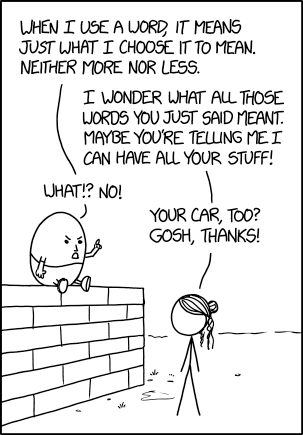
In keeping with the videos I've been relaying just recently, what is "flexibility"?  It sounds like an important word, something that a DM has to be, but it is often used as an extremely fluid term that could describe, well, anything.  How can one be both "flexible" and "arbitrary" at the same time? Like in the xkcd comic above, the word is being redefined for the sake of sounding like something positive, while utterly ignoring the word's actual meaning.

To be flexible [definition 1] is to be capable of bending without breaking.  In a game sense, to carry out the rules as written with some understanding that unheard precedents need to be ruled upon according to principles that support the sentiment and virtue of the game, not the individual.  If a ruling is made that breaks trust and causes others to question the legitimacy of the DM, then rules in place up to that ruling have been broken and flexibility has not been the result.

Again, to be flexible [definition 2] is to be easily modified to respond to altered circumstances and conditions.  In the game sense, this means to respond to outside circumstances, meaning that the player's actions and choices should be respected, enabling an open-ended, variable and adaptable experience for all concerned.  I've been describing this lately, where I've said the world has to have features that adjust as the players adjust, that respond to manipulation without commanding or stultifying that manipulation.  This does not mean that breaking the rules is suddenly okay ~ the first definition still holds ~ but it does mean that the DM's actions cannot arbitrarily counteract the player's behaviour.  This would be the equivalent of a car's steering wheel suddenly locking up without explanation ~ something that no driver wants, ever.

Finally, to be flexible [definition 3] is to be ready and able to change so as to adapt to different circumstances.  This sounds like definition 2, but in this case it applies to the person and not the situation.  It means that a flexible DM doesn't want to be arbitrary, doesn't want to be intractable or intolerant.  A DM needs to want the players to want the game to be plastic in its design.

Every time a DM sets out to be arbitrary, to make a random choice on a personal whim, rather than according to any reason or system, unrestrained and autocratic in the use of authority, the DM has specifically not been flexible.  Yet the sophist would have you believe that the "truth" about gaming is found in the "gray space" between flexibility and arbitrary decision-making.

This is like saying that the effectiveness of a car is in the "gray space" between the car working as desired and the car randomly breaking down.  There's nothing gray about it.  We know why cars break, though they may be complicated; and even the least little bit of investigation by a player will ascertain almost immediately why a campaign doesn't work.

Because the DM is a dick.  And thinks that's acceptable.  Because role-playing games are complicated, and arbitrarily is the only way they can be run in order to maintain momentum, story, interest, fun . . . you know.  Reasons.