Monday, March 6, 2023

Pricing Horses

Some readers paying attention to my patreon may be seeing a series of products steadily added day by day, with prices attached, while others who have seen the previews for my Streetvendor's Guide may be wondering where the numbers come from.  Long-time readers know that I have a pricing table — some have even seen the excel file of that from seven years ago.  This is what I'm using to define the cost of everything ... while upgrading the table as I go.

The table's purpose is to supply different prices for different parts of the world, computing these according to the scarcity of products based on how often such products were mentioned, in relationship to geography, in a 1952 set of encyclopedias.  Since the encyclopedia includes about 9,000 geography articles, about cities, provinces and whole countries, it's fair to assume that if horses are mentioned an awful lot in some specific part of France, then that reflects a probable good supply of horses there.  All it takes is the patience to steadily comb through the list of articles and make note of each reference to each thing as it's given.

I started doing this in 1986.

But ... if the point is to give different prices for different places, where are these prices coming from?  I have an answer: Venice.  While no longer the centre of finance in 1650, when my world takes place, it still has one of the best distance ratios of any city in the world ... remembering that nearly 5/6ths of all the market cities in my game world exist in Europe.  This is undoubtably because the encyclopedia is Eurocentric ... but then, so was trade in the 17th century.  So it works out.

I thought a tiny, tiny portion of readers would like to see some of the calculation work I've created towards the Streetvendor's Guide.  Everyone else, feel free to click over to JB's blog and see if he's changed his mind and broken his recent self-imposed fast.  That seems to take up a lot of my time.

This is my work-up for live horses:
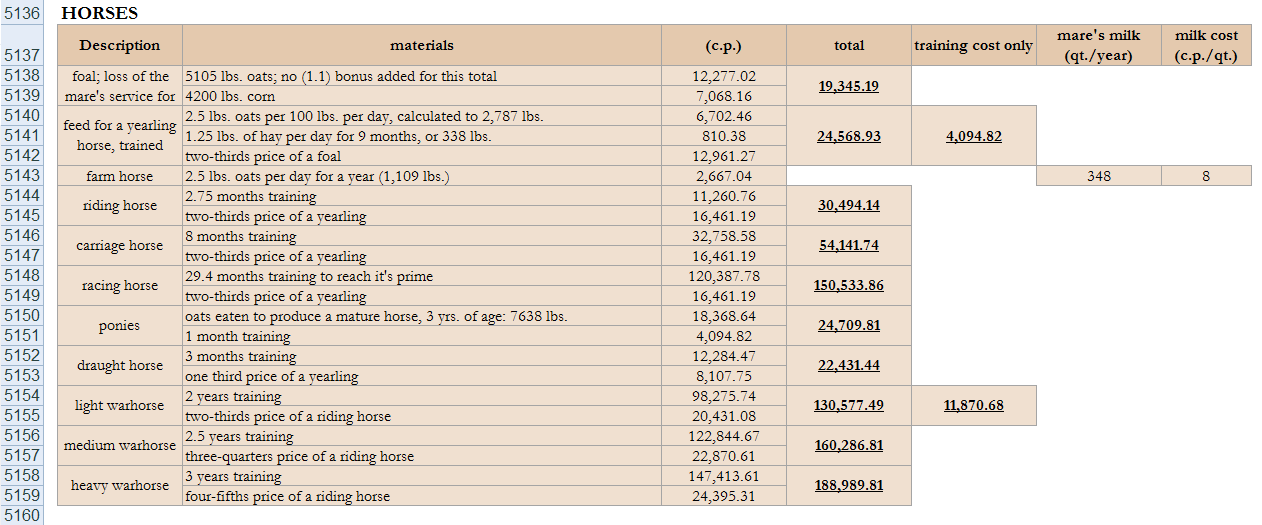


Now, I want to stress that first, this is intentionally a simplification of the problem at hand: to determine how much a horse that the players want to buy costs. And second, that I'm under no obligation to "accurately" represent anything. What I want are a series of calculations which make sense within a given framework, producing fairly rational prices that, above all, must be able to represent practical prices a hundreds of locations other than Venice.

It starts with the birth of the foal, or baby horse.  This costs a loss of the mare's service both before and after giving birth, which means she's eating oats and corn in grand amounts.  The foal is eating too.  The price of oats has been determined elsewhere, as has the price of corn.  These things, multiplied by amounts, gives us a total number of copper pieces: here, 19,345.  That's a little more than 100 g.p.

Where it says "no (1.1) bonus added for this total," this means that I'm not multiplying "19,345" by 1.1.  Normally, when some product in the pricing table is made of two source materials, I add 10% to the total; this accounts for the labour and troubles associated with supply.  That 10% figure is a great help in determining monthly wages for the person responsible for mixing the feed and giving it to the horse.  Only here, I'm suspending it, for no better reason than my trying to keep the horse's overall price down a little.

When there are three source materials, I add 20% to the cost; when there are four, I add 30%.  And so on.  This makes more complicated things and gadgets progressively more expensive, beyond the base price of their source materials — while at the same time ensuring that the labourer is paid better.  It works very well.

Look at lines 5140-5142 (so far, 5,800 lines in the whole document).  "Feed for a yearling horse, trained."  It includes a line that says, "two-thirds of a foal."  A "yearling" is one-year old, or thereabouts.  The amount of food calculates to what the yearling horse eats in 9 months, and then to that is added the younger horse, which the yearling was once.  Only, for no good reason, I'm cutting the value of the foal down by 2/3rds, arbitrarily, again to keep down the price.  I could probably invent some kind of excuse, but to be honest, I'm diddling with the numbers.  Once in awhile, some exception has to be made to some general rule, "because."  In a practical sense, there are too many disparate things in the world to permit consistency.  I want a high price for horses, but I don't want it to be too high.

As it is, the fabulous price for foals and yearlings reflects the potential for these animals to someday be magnificent beasts.  Most of us don't realise what a long-term effort many animals are with regards to training and feeding and housing, before all that investment finally pays off in a good riding horse.  There's a sense of attachment, too, in that you've seen your foal grow to be a yearling, and you have expectations of what the yearling will be someday.  But there's something else hidden in the price, which helps make sense of the very confusing price for farm horse in line 5143.

Not every horse is as healthy and virile as most of them are in the movies.  The value of a horse lies in what it can DO.  When a horse can no longer "do," yet continues to eat more than a thousand pounds of oats a year, the price falls precipitously.  Here's part of my description of the farm horse from my Guide:

Such horses have no breed, as they’re composed of mixed blood; their quality is inferior, for the most part having been raised on little other than grass and less than half the supportive nutrients that a more remarkable horse takes for granted.

They exist as the cast offs of stables, as horses not intelligent or vigorous enough ... by which time they’ve aged some years. Farm horses may also include horses older than 13 to 15 years, that have given good service in other roles but have come to the end of their use as other kinds of horse.

Even a warhorse, if it isn't worth being put out to stud, or is too old to breed, or hasn't been killed, may someday end up a farmhorse.  The low price is essentially the cost of "getting rid of the animal," because anyone who buys is going to get minimal value from the creature at great cost in feeding it.  The low cost of 2,667 c.p., about 10 g.p., is to beg someone to take it.  This understanding makes it possible for a common peasant to actually own a run-down horse; it may actually have been abandoned, perhaps because it was lame ... and the farmer, who perhaps knew something about horses, took it home and healed it sufficiently to do light work for the rest of its life.

This means that every "yearling" for sale is that virile beast from westerns and horse-racing.  It's not only a matter of age, but of breeding and class besides.

Farm horses are most likely to give milk on a regular basis, as for the most part a truly valuable mare breeding a thoroughbred foal will give most of its milk to the offspring.  If a farm horse gives birth, the foal is gotten rid of as soon as possible, since feeding two horses is out of question for most.  Thus the mare's milk, about 348 quarts until the mare stops lactating (estimated 17th century numbers, not modern numbers encouraged by all sorts of science).  The price of the mare, divided by 348, gives us a price of 8 c.p. per quart.  This compares well with cow's milk, which calculated to 12 c.p. per quart.

So, "training."  Add together the prices for the yearling, oats, hay and 2/3rds foal, and multiply that by 1.2, you get 24,569 c.p.  That extra 20% equals 4,095 c.p.  That's the future cost of 1 month's training applied to older horses.

Yes, it seems like a lot.  It's actually 21 g.p. per month.  Note that I've dropped the price of feed from further calculations, so "training" also takes that into account.

Now, suppose you have a yearling in your possession.  You've got to wait until it's nearly two-and-a-half years old before you can put a saddle on it, or use it for any real work, because it's knees have to strengthen over time.  In the meantime, you can give it a lot of attention, make sure it attaches itself to you, or someone on your estate, and give it a modicrum of training.

If you want a riding horse, that's just 2.75 months.  If it's a carriage horse, which actually walks differently, more "regally," that's 8 months.  A pony is quite meek, so it takes a single month.  A draught horse takes 3 months, but as it begins to train it's actually able to do work, so it pays for some of the price of it's younger self — thus it only costs one-third the price of a yearling, rather than two-thirds like riding horses, carriage horses or racing horses.  The pony is more or less the equivalent to a yearling; it eats less overall, so the price of a trained three-year_old pony is comparable to an untrained one year old horse.

You can train your horse to be a racer, but that doesn't make it a successful racer.  I have rules about what makes a successful racing horse on my wiki.

Finally, you can have a warhorse.  A warhorse has to be trained as a riding horse first.  Thus, it boosts the price a bit.  The kind of warhorse you can have, heavy, medium or light, depends on the weight of the horse.  Nonetheless, the heavier horses are more likely to be armoured, and forced to engage more brutally, acting less like a riding horse than a warhorse, so they cost more.  That cost is expressed in how many months of training they require.

Next to the light warhorse is a figure, 11,871.  This equals 10% of the base cost for a light warhorse, which is 98276 + 20431.  This number is used to determine the monthly cost for an "attendant," for whom 36 months of pay is equal to 10% the price of a light warhorse.  This attendant runs alongside the rider, or leads the rider's horse when travelling, and catches the horse when the mounted combatant dismounts to fight the enemy.  A good attendant can run so well that when the combatant gets off, the attendant is there within a round or two to grab the horse and hold it, in case the combatant wants to get on again ... which the attendant also helps with.

Having an attendant was perfectly normal.  Virtually every horse-soldier had one.  It was often the offspring of a trusted servant, or someone else's trusted servant, paid for and trained from the age of a boy.  The more familiar name is "squire," but that name changed it's meaning over 500 years, so that it ceased meaning a knight's attendant and started meaning a wealthy landowner.  Language is funny.

Anyway, there you have it.  All this silly pretense at pulling numbers out of my ass, eh?  Go ahead and say so, if that's what you think it is.  I need the book to do well; I need the numbers to make sense.  And though I have no intention of making the numbers available with the published copy, I do intend to do other things with the pricing table than this book.  I'll need to know how practical my methods are.


Friday, March 3, 2023

Making of Magic Weapons

Between work and the book, and normal routine, I've also been working on this for a patron supporting my $30 tier, "Wiki Request."  This is a bit of freelance writing, this month related to the creation of magical weapons:


Some have wondered at my method for doing this.  I've wondered myself, since I've never sat down to design the particulars, ever.  Obviously, throwing a lot of money at the problem is not included.  In fact, the rules describe exactly NO coins to be spent in any way, though obviously there would be costs involved, as characters must eat and pay staff, maintenance and taxes.  But those are other matters having nothing precisely to do with the making of weapons.

For those who haven't read the above, yes, it means virtually any weapon, though the examples given are all from the AD&D Dungeon Masters Guide.  There's two pages of special powers also listed in that book, any of which could be adapted for a weapon, and I'm an open minded fellow.  If someone wants to bring me a weapon idea from 5th edition, one that isn't plainly ridiculous, I'd certainly consider it.

Sorry to say the rules aren't cut-and-dried ... mainly because the powers aren't cut and dried.  It does explain what you'd need to make, say, a Holy Avenger, without answering the question in solid terms.  You need something else that possesses that power.  What would that be?  Not for me, the DM, to say.  I'd expect a player bent on creating a +5 Holy Avenger from scratch to explain just exactly how the sword ends up being "holy" ... and no, holy water alone ain't gonna cut it.  Still, there's got to be a way.  It takes some imagination, is all.

It does tell me that if and when I start writing out magic items in my wiki, I'll have to include passages on how that item comes into existence.

Thursday, March 2, 2023

Adult Fare

Last month, you may have seen this article about a Vegan D&D player demanding a cruelty-free campaign.  If so, you should see the follow-up, in which the DM explained that there was more to the matter than what the click-baity argument let on.

I have a high personal bar for this sort of thing, which arises from personal experience with cruel things and I think a greater knowledge of history than most.

Recently, poking about the net looking into the butcher's trade, I came across this from The Pictorial Handbook of London, dated 1854.  It speaks of Newmarket street, where there were many butcher's shops to be found:

“The slaughterhouses for sheep are almost exclusively in cellars underneath the shop, where the pices or joints are sold in retail. The access to these cellars is by steps, over which a board is occasionally placed, to act as an inclined plane for the animal to slide down. More frequently a much more summary process is had recourse to—the animal is seized by the butcher and pitched headlong into the cellar by main force, where, unable to rise from broken limbs, or other injuries sustained by the fall, they lie awaiting their turn to be slaughtered ...”


My first instinct is to include the above in the Streetvendor's Guide, as a visual, to set the scale on which a fantasy world has every right to operate.  Not every D&D game is My Little Pony.  There's plenty of real life human history wallowing in gore, slaughter, sadism and extreme cruelty to justify a group of murdering adventurers chewing up the landscape.  Moreover, such is the material that causes young children to gaze at in rapture, wide-eyed, realising for the first time how spectacularly dark is the reality of human history ... before, that is, growing up and coming to their senses, assuming they do.  I did.  Personally, I've felt no desire to walk in the footsteps of either the Huns or the Mongols, rounding up whole villages in order to massacre every living soul.

Well, there was that one time.  But never again.

Given the youth of participants, coupled with the sheltering from knowledge by helicopter parents, I'm not surprised by the stark reactions of some to the details of skinning and deboning a pig ... a perfectly ordinary operation to a rural-born child a hundred years ago, some five years after my grandfather had come home from the Great War.  Those readers who have dared to watch recent fare like All Quiet on the Western Front or 1917 have merely glimpsed a tiny bit of the day-to-day hellscape that formed a whole generation's perspective on "cruelty."  The truth is, the fact that individuals can feel so passionately about the description of a pig's slaughter only goes to show how very, very comfortable the world has become, for all of us.  The bar for trauma has been drastically lowered ... and that's a GOOD thing.  The last thing we need is a return to the standards of the last century.

It produces an interesting conundrum.  Nassim Taleb's 2014 book, Antifragile, Things that Gain from Disorder, makes the valid argument that bad things make us stronger and better able to handle and overcome other bad things.  There's no question of that.  That doesn't mean, however, that a DM — who may already be fragile — is ready to tackle the rampant fragility of one or more players.  For some groups, the game itself, with it's elements surrounding combat and killing, evil, intrigue, villainous characters and supernatural overtones, is a ticking time-bomb.

It's only a matter of time before the DM advances some idea that seemed "really cool" on the surface, only to find that it's tapped into someone's fragility in a way that ends the session or friendship, or perhaps several friendships and the whole campaign.  We shouldn't wonder that many young people, with little to no experience in dealing with life's most difficult themes, end up pussyfooting their way around every aspect of role-playing.

This is why, early on, I conceived of D&D as an adult game.  Remember, unlike a lot of people who have been around a long time, I began playing at 15, not 9.  By that time I'd played D&D a year, I'd had two grandparents die, I had a front-row seat watching an uncle spiral into alcoholism, I'd been beat up several times by groups larger than two and I'd experienced the dehumanising thrill of playing high school football.  Life was not, as they say, great.  Yet I think I was old enough not to see D&D as a form of escape, which would have been ridiculous ... instead, I saw it as a way to express my frustrations, my desire for having something I could control, and a way to interact socially with others whose lives and frustrations reflected my own.

Children should not play D&D.  They should, first, get some sense of how the world works ... meaning that their early activities should be athletic, competitive, confrontational in a healthy manner that teaches them that sometimes we lose, that we have to overcome loss, that effort itself is a form of success ... and that just because someone is on the opposite side in this game, it doesn't mean they hate us or they're an enemy.  Sometimes, we agree to take sides in order to experience the abilities and strengths of our friends in the cold light of reality.

Not that I could have thoroughly explained this when I was a child.  Obviously.  But playing D&D, especially this decade's form of D&D, is a disaster where it comes to a child's upbringing.  Participating in adventures where the players always succeed, where everything can be changed at a whim, where the losers are always pretend creatures we don't know ... and where the gloss of magic obliterates the day-to-day struggle for existence in a world without technology ... paints a rather debilitating strategy for, um, fragility.

That's because D&D has transformed from a game of attempt/fail to operative wish-fulfillment.  Too much of that cripples children by making a large part of their lives too easy, just as William Goldman warned.

Turns out that taking away all the trauma that a child might conceivably experience doesn't make them happier, or bring about an end to trauma.  Instead, the child to find trauma in whatever can be found among the trivial things that are left.  The end result is a zero-sum gain.  No matter how good or rosey we make the world, it's impossible for us not to find something horrific anyway ... even when that "horrific" is pretty damned silly.

I much prefer a D&D game among tough, resilient adults, who can take being killed as a part of the game, who don't expect things to go their own way, who don't need the game to fulfill some empty hole caused by their lack of a meaningful life.  The adventures are sharper, the stakes are higher, the ethics less black-and-white and the artistry in running and playing the game at it's peak.  Shouting matches are a sign of passion, of really caring, not a form of emotional tantrum.  Nothing is off the table.  Nothing is denied.  No one expects to have things their way.

It's how I think the game should be played.

Wednesday, March 1, 2023

Contents Thus Far

Sorry to do this, but as things become available, I'm going to tempt my reader.

Here's a content page of the headings I've added since beginning the Streetvendor's Guide, 45 days ago:


Pity I couldn't complete the page.  The page numbers are subject to change, as they've been collected prior to editing, and prior to the addition of any images that would move the pages forward.  The numbers also count the inclusion of title pages, not counting the outside or inside cover.

Oops, I'm sorry.  If anyone's confused, these are all subjects I've already written up.


Tuesday, February 28, 2023

Codexes

I wonder if Pathfinder is gleaning benefits from the OGL debacle last month.  Certainly the content creators surrounding TTRPGs have flocked to the Pathfinder standard.  Videos have proliferated this past month, competing with one another to explain what Pathfinder is, how to get started in it, how it works, why such-and-such is leaving D&D for Pathfinder and so on.  Hardly an essay about D&D ends without the writer wrapping up their point by admitting that they're thinking maybe it's time to leave D&D and try another game, "maybe Pathfinder."

I know very little about Pathfinder except that it sounds awful:

... Next is Lorian the ranger ... and the ranger has a feat called 'hunted shot,' which lets Lorien spend her first action to hunt prey, which will be this wight here; her second action to use hunted shot to make two attacks, and her third action to make a third attack.  And hunted shot can only be used once per turn, because it has the 'flourish' trait.  The player prepares to do this and expresses that they've been frustrated because they are doing this every turn, and because it's the most optimal thing they can do.  It does the most damage compared to their other options ... and thinks that the hunted shot feat, since they took it, is incentivising them to do this every turn.

The GM says, "Well, you can still walk up to the enemy and make a melee attack — why don't you?" ... and the player says that they've done some math and found out that they do a certain amount of damage while standing in place, hunting prey and using hunted shot, compared to if they were to walk up to the enemy and make strikes with their short sword.  The GM says, "Well first of all why would you use your short sword?  Your rapier does damage, but besides that, this is not necessarily because of hunted shot — the wight is standing outside your melee range.  If it were standing next to you, then you wouldn't be needing to spend an action to walk up to it, and you could go straight to hunt prey, which increases your damage, and then make those two strikes ... and there's other reasons you might want to be in melee; maybe you want to draw fire away from an ally who's in trouble, like right now; or maybe if you had a very high strength you might be doing even more damage, than your current strength bonus is currently giving you ..."


I'm not going to unpack this.  I did listen to all of it.  I find the rules comprehensible, and not that removed on their surface from similar examples I've watched with 3e, or even that I've had with my own AD&D Frankenstein campaign.  The creator's argument is worth making; I can't say for certain that he made it, because I don't know enough about Pathfinder to say.

The larger issue for me is the service the rules are performing here, as opposed to how they were intended to perform with earlier games, or indeed other, non-RPGs.  Take this from the Game of Life:

Play moves to red who will choose to start college.  A player receives $40,000 loans from the bank when choosing the college path.  Red spins the wheel and will move five spaces.  Red lands on a square that states, "Study for exams, miss next turn."  Red will miss her next turn.


Good game vocabulary is rendered to be (a) as self-explanatory as possible; and (b) to suggest context that fits the game's theme.  In the second case, the theme is "life," as the title states.  In life, skipping over childhood, the proposed first important decision people make is to choose whether or not to get a higher education (well, the modern game was released in 1960 with an intended white, middle class audience).  Game elements like the wheel, moving spaces, missing turns, etc., are elements we learn at a very young age, if we get a chance to play any game, from checkers to cards.  As a game, Life is boring, but it's clear.

Because D&D is vastly more complex, from the beginning it's been difficult for the game's vocabulary to be self-explanatory.  And as the game has gone through editions, the desire to add feats, spells, races and classes has saddled ordinary game play with spectacular levels of descriptively erroneous game elements that cannot be reconciled except when the words themselves are treated as an alternative-language codex and not as the words they are.

For example, linguistically, it isn't possible to "hunt" and "battle" at the same time.  The two verbs have vastly different meanings that cannot be reconciled.   This means when using the phrase "hunted shot," the player has to subordinate the meaning of the word hunt to the official codex of what it means in the game.  This isn't especially problematic with one word ... but there are literally thousands of these circumstances which have become canon over time, crippling the game's language and making it increasingly difficult to master the rules.  It's not so much that the rules themselves are all that complicated; it's that the need to provide rules that make everyone's actions individualistic, while also providing a choice of individualistic actions, heaps language on language until those without excellent knowledge have to have the game pedantically explained to them again and again.

This bogs down game time.  I've experienced this as well with my own rules, especially in the various tiers of sage elements I've advanced.  Players first get confused trying to keep "field" straight from "study," and study straight from "ability."  Then it's a matter of reconciling their understanding that of the knowledge they have, there's a difference between what's "in field" or "out of field."  And finally, there's the list of abilities being divided progressively into "amateur," "authority," "expert" and "sage."  Despite my efforts to be clear about these aspects, I find myself regularly having to remind the players what's what.  Which I do patiently, knowing these things will become second nature.

The arrangement had to exist in this fashion to keep players from acquiring all, or too many, sage abilities early in the game ... and to ensure that there could never be an instance when every player would gain all the abilities from any particular class.  The way it's set up, this just isn't possible.  A character, to have a perfectly average chance of getting every sage ability in studies outside their fields would need to reach 67th level.  This would take a lifetime of play, and in any case I use an arbitrary limit of 23 to 29 levels, depending on the character class.

As best I can, I struggle against codex-phrasing in game design.  A "field" corresponds to a "field of study," which any person in real life understands without explanation.  A "study," likewise corresponds to studying a given subject.  The two words may be used interchangeably in English, but the heirarchy is quite natural once explained.

Most of the time we understand what an amateur is, and I have very little trouble with players remembering this description for the lowest level of sage ability.  Trouble arises in placing "authority" vs. "expert" in the hierarchy.  My dictionary defines an authority as, a person with extensive or specialised knowledge about a subject: an expert.  It defines expert as, a person with comprehensive and authoritative knowledge of, or skill in a particular area.

So, interchangable.  I didn't want to use "specialist" because, in fact, the expert in the system has a wider range of knowledge as the player accumulates levels, not more specific knowledge.  I did not wish to use "pundit" for obvious political reasons, nor "oracle" because it has a religious aspect that did not fit, nor "maestro" nor "virtuouso" for their musical connotations.  "Master" is sexist, "professional" is anachronistic, "wizard" is a flat-no fail, "genius" can in fact apply to any level of knowledge, since knowledge is collected and a genius can start off ignorant and become knowledgeable.  Thereafter the remaining terms for expert become increasingly slang-oriented or utterly out of the player's ken regarding recognisable English words.  Which would just make the problem worse.

The result is a patient effort to stipulate that "authority" and "expert," both very familiar words, have in fact two weights for synonyms about knowing things.  At least that's what both words actually mean.  If I'd used maestro, I'd have an endless fight on my hands in arguing that no, it does not mean the geologist can play music.

A connection the reader should have made by now is that the decision to revert to Basic versions or AD&D seems right, initially, because the game's language becomes instantly more comprehensible.  An "attack," which is self explanatory, is done by every character in the same way.  The weapon can be changed, and that provides some choice, but the player cannot change the amount of damage done simply by changing the imaginative way in which the player chooses to attack.  Multiple attacks to occur, but never as many as three and never on account of skills, or feats, whatever we choose to call them.  There are adjustments to hit and damage, but these are limited to a relatively few number of possible game elements, most of which provide plain relevance in the game.  That relevance can be argued, and has been, for many decades ... but strength does suggest hitting harder and dexterity does suggest hitting faster.

The argument that dexterity ought to mean, "hitting more precisely," and therefore causing more damage, emerges from cinematic representations of combat.  It serves a plot to show a smart character who outmanuevers a bigger, stronger opponent by cleverly hitting in just the right place, like tapping a button that circumvents the enemy's advantages.  It is, in fact, the story of David from the Bible ... though if that story is true, the relative weakness of David has been debunked.

The "dexterity = higher damage" argument was underway when I started playing D&D.  I'd argue that it, and other arguments like it, were central to the many enhancement rules that emerged within the first two or three years of D&D.  The invention of the barbarian, for instance, which argues that a barbarian's strength ought to be greater than a civilised fighter's strength ... which, in fact, makes no sense at all, except "Conan."

An "acrobat" is a circus performer.  "Performance" and "skill" are distinct from one another; the acrobat character was given no rules of any kind to contribute to the character's public performance abilities, only aspects of the profession that could be applied to adventuring.  We could simply have given the skill to one of the existing classes, but that wasn't sufficient for the game designer or publisher.  "Acrobat" sounded cool.  Thus we progressed down a path towards the accumulation of codex-driven words whose definitions became absurd in game context.

The comprehensibility of early D&D was a plus ... but it wasn't comprehensible enough to sustain itself.  At too many points in the original versions were game elements perceived as either limiting or illogical ... within the scope of logic from people who felt the game needed to reflect their personal will rather than their personal will adapting to the game.  Thus, we are here.

I'm rather encouraged by the so-called rush of D&D players to other game forms.  Not because it means more non-D&D games will be played, or even that these people will get out of my game, so they can go whine and pout about some other game I'll never play.  But because it portents the collapse of corporate gaming.  As various game companies fight each other for participants, struggling to outdo one another with more and more choices, while "simplifying" actual game play so as to appeal to the widest possible audience, we should expect a boom period where dozens of games suddenly experience an exceptionally widespread popularity.  Journalists will rush in to cover the excitement of it all, while program-directors will push to have more and more video content made that sells to the desired viewer.

Then, bust.  The shallowness of what gaming becomes during the boom period will fail to sustain itself; something else is sure to wander along for the next generation and that'll be it.  Hasbro's film this month may or may not fail, but Hasbro surely will; that's another post for another day.  I'd rather just watch that one happen, to be honest.  But over all, rushed, cheap films produced by non-players, as they must be, since that's how corporations function, will crash and burn the hobby.

Whereupon they'll be a last spate of articles about how D&D is "dead," while I go on publishing books.  I'll go to cons and talk to the disillusioned, as I have in the past, blowing their minds with things they've never heard, showing them things they've never seen.  My wiki will get bigger.  I might even make a lot of money someday ... as I encourage those who really do love D&D.  And who will never leave it.  Not for all the Pathfinders in the world.

Saturday, February 25, 2023

Accounting Sessions

Running D&D last night, I caught myself doing something naturally that's built up over a lot of years; and I might never have noticed it, except that I'm running regularly for the first time in some years and different things are coming consciously to me.

The players, having enriched their main characters, had returned to their home in southern Transylvania, Kronstadt, with the last running.  They began sorting out where they wanted to spend their money, how they wanted to build up their holdings, and over the interim some decisions were made.  More importantly, they decided to take a group of their "tertiary" characters, or henchfolk, and set off to adventure with them instead.  Specifically, they agreed to pick a hench that was no higher than 5th level, who might in turn have one sub-hench (because one gains a hench at 5th, and henches can have henches).

This meant bringing a bunch of characters up to speed with regards to various rules I've made in the last seven years, including sage abilities and backgrounds.  This meant another night of "accounting," which I don't mind and the players don't mind.  They love their characters, even the tertiary ones; they're able to identify characteristics that please, and they're anxious to explore what they can do with the different classes.  The high level druid play a mage this time around; the high level fighter, a cleric; the high-level mage, an assassin.  We know the drill.  The difference is that the other characters, the ones they played under the sea, aren't retired.  They're building the game world around them, and are ready if the players want to restore their involvement.  This isn't up to me.  I don't start a game by saying, "I've built an adventure for 5th levels, so all of you have to play your lesser characters."  That'd be ridiculous.

I have no adventure planned, as yet, and I'm fine with that.  I don't even know where the players will go.  I know that wherever they go, my world is deep, complex and massively filled with inspiration ... for me and the players.  When I need to think of something, I will.

So, back to the accounting.  To DM is to be interrupted.  Answer a question about horses, about this sage ability, about how knowledge points work in this situation, about this or that spell, about the weapons, about results from die rolls made against the background generator, etcetera, etcetera.  I rather enjoy it.  I get to explain the different parts of my system, though I have before online and sometimes to these same people; I get to propose ideas and possibilities for the future.  We had the conversation about favourite foods and what sort of bonuses there'd be, that I had on the blog here, and the players gave the same responses that the readers did.  [very rarely do my players read this blog].

I unhesitatingly suggest where a character should put a newly rolled up stat (there were two henchfolk that needed creation last night), or what spell a character should take, or what weapon, or even which race or class.  I like to offer two or three viable choices, utterly certain the players ARE able to think for themselves.  For me, these are philosophical arguments: if this, then that, but if that, then this.  I've started hundreds of characters in my world with all sorts of stats.

Let's say you want a druid and you have two decent scores, a 15 and an 18 (which the player rolled).  Now, if you put the 15 under wisdom, you get 3 bonus spells, two 1st and a 2nd, but you get the 18 charisma which has ongoing effects to your appearance, background and your status in life, before you start the game.  And the responses to charisma the game setting produces.  On the other hand, a 15 charisma is still pretty high, and an 18 wisdom gives six bonus spells, an extra 2nd, a 3rd and a 4th above those named.  Those spells are going to come in handy.

And yet, from a different viewpoint, let's say, as the character did last night, you also have a 14, two 10s and a 9.  You only need a 12 wisdom to be a druid, so suppose you put the 14 under wisdom, the 15 under charisma and the 18 under, oh, say, strength.  Or constitution.  Or dexterity.  This cuts your spell bonus to just two 1st level spells, but the strength bonus gives your character a whole different balance.  This is AD&D-based, so there's no percentage roll for druids, but you're still +1 to hit and +2 damage.  Add a +1 spear and you're going to rock the house in battle, even with your average 1 less hit point per level.  That means more experience that's earned from combat, meaning you go up faster.  And you get the pleasure of dropping the killing blow more often.

People don't think about that.  They tend to think about the whole benefit; they forget those six bonus spells take six levels to materialise (for druids; longer for clerics).  The strength bonus, or the high charisma, those things are here today.  Truth is, however, there's no right answer.  The player went with the 15 charisma, 18 wisdom, and put the 14 under constitution.

I like these conversations ... and accounting runnings are full of them.  All the players are listening, and free to dive in with comments, so the practical discussion feeds around the table and everyone feels involved.  I'm not sure why accounting runnings fail in so many campaigns.  Is it that there's always one player whose so self involved they have zero interest in what other players want or are trying to do?  Is it that the DM polices the players so hard, demanding that no one's allowed to comment on what other players do?

I ran across some thread last month that argued a player, during play, wasn't allowed to give instructions to another player in a strategic way.  In other words, I'm not allowed to say, "You stand on that side of the door while I stand on this side, then we'll both holler loud."  Because that would be me running your character.

Can you imagine this applying to hockey?  Or doubles tennis?  What you do with your character when we're in a party together affects my character's survival.  Hell, it affects your character's survival.  A team communicates as a team, that's why teaming up is vastly superior to individual achievement.

I can imagine that a table where the social rule was, "You're not allowed to give advice about someone else's character," that accounting runnings would be death.  You'd have to sit there, grinding your tongue between your teeth, while the 1st level druid chose the spells purify waterdetect poison and invisibility to animals, before starting whatever adventure was to come.  The party may not even see an animal, or encounter poison ... but you're not allowed to say so.  That would be "running the druid's character."

Gah.

Anyway, getting to the thing.  People do talk to me at the same time, about different things.  And I have to pick someone to answer.  I try to pick the person who has said the least up to that time, in this session.  I try to give as complete an answer I can, in the shortest amount of time.  And while I'm doing that, I'm not forgetting the others.  Everyone gets automatically ranked in my head for who gets answered next ... and I remember to turn to them and say, "yes, you had a question."  I find myself automatically managing that ranking in my head for long periods, adding new people to the line as answers are given ... because person #4 is certain to ask something while I'm still answering person #1, but person #2 and #3 are still in the queue in my head.

This habit didn't come naturally.  It came after years of running.  It's the two-fold skill of not getting lost in giving an answer, and not forgetting there were other questions.  Not getting lost answering a question means not going too deep into it, right now.  I'm thinking, hitting the main points over two or three minutes, then moving onto #2 and doing the same.  Then, if there was still something to add to #1's question, it can be added later, when there's a lull, when I've got more time.

This keeps everything moving even during accounting runnings.  As a player, you've got a book open, or the wiki, or just the internet, and you've got a question.  You know you can interrupt me while I'm talking to #3, because I'll remember you did.  You just say, "I've got a question," so I can answer, "I'll be right with you," while going on with the point to #3.  Then you're on deck and so it goes, all night long.  Everyone has enough to keep working on their personal puzzle, there's other players to ask about some detail like how sage knowledge points accumulate, and I'm keeping the information flowing.

What's more, I've built tools the players can use.  A player whose been running a halfling now has a big burly human.  With regards to encumbrance, the halfling had to nitpick equipment, since even 15 lbs. was a burden.  Now the human can carry the halfling and the 15 lbs. without breaking a sweat.  How does it work?  Well, I have this slick excel table the player can play with ... that eats up ten minutes of the player's time, plus organising their gear.  That's 40 minutes I don't have to worry about that player.  Gives me time for others.

I would say that the real problem with accounting runnings in other campaigns is that there so little to account for.  Or rather, there's so little power the characters have over their world when they are accounting.  With so many possible choices of knowledge, spells and equipment in my game; and so many levels on which the "smart" game is played; and the freedom to talk among themselves and group think their way through future problems they might face, an accounting running is anything but dull.  In fact, it's a sort of slow burn, where the tension builds up as the characters take stock of what they have, what they can actually carry, what limitations they possess with regards to a lack of spells or character classes, in the face of an adventure they haven't even started yet.

It's a very different kind of campaign that I run.

Thursday, February 23, 2023

Thank Gawd Writing is Dying

This is also a blog about writing.

Rachel Shin writes,

"... the recent explosition of AI-generated writing, namely by ChatGPT, which can instantly produce extremely sophisticated and novel text on any topic, in any style.  If anyone can prompt a computer to produce college-level essays and poetry in perfect iambic pentameter, what's the point of a writing education."


The remainder of the article provides a competent discussion about the ramifications ChatGPT has for post-secondary schools, specifically in the way it might obliterate the present value for essay writing as an education.  The article expresses the stand-by cliches about who gets replaced and what gets replaced, and whether there should be concern.  What the article does not do is evaluate any of the precepts upon which universities have been founded, for hundreds of years, which ChatGPT demonstrably explodes.

Iambic pentameter is a bullshit, useless communication device that, while touted as an artform, has been wrung dry of nuance and relevance through overuse.  It has as much use as a writing device, or an artform, as Morris dancers.

Yet it appears as the poster child in Shin's article, of all the things she could have chosen to fret over, because trotting out this crap as "important" is what university does.  Turns out, writing in iambic pentameter is difficult because a human has to have a lot of words in his or her head, to be able to construct the meter involved and yet make sense.  But a computer has ALL the words, at it's fingertips.  And so, like slide rules, paper draughting and horse-drawn carts, the relevancy of iambic pentameter is ready to be thrown in the dustbin.  What's a university poetry professor to do?

Poetry in academia collapsed as a social dynamo decades ago ... yet still it shambles on, sustained endlessly by grants, government-funded resources and a cadre of elitist ivory tower dwellers who continue to embrace the idea that more than 0.01% of the real world gives a rat fuck who became Grand Poet Poobah of the world in 2022.  ChatGPT is killing university poetry?  Good.

Is it threatening popular song lyrics ... something millions of people do care about.  No.  Song lyrics are metre-friendly because tonality demands they must be so.  The emotive value of song lyrics, however, is not that they cause us to "reflect on our own emotions," but because we connect personally with what's been said and feel elated that someone understands the shit we go through.  The words themselves are less important than what they communicate.  University has whiffed on this ball for so long, it was old hat when I took writing and English courses.  Academia is concerned with HOW something is said, not WHAT is said.  ChatGPT stabs a knife into that thinking.

The purpose of writing is not to interpret the purpose of writing.  Professors of English and numerous cultural studies have sustained themselves on this recursiveness ... and now the emptiness of that motif is in the process of being exposed.  Take this quote:

"So how can educators preserve writing even as it is actively assailed? Rather than abandon the city under siege, teachers should defend it with renewed investment. High schools might find inspiration in a university-inspired intensive focus model, an approach I have found great value in. In “Reading and Writing the Modern Essay,” one of the most popular English courses at Yale, students participate in essay workshops in which they carefully explain their authorial decisions, from broad-stroke thesis analyses down to diction choices."


The preservation of writing is in having something to say, not how it's said.  Not what choices were made in workshops.  Not in structural templates of writing the modern essay.  The "modern essay" has just ceased to be what Yale pretends it is.  The version Yale wants to defend, that it wants to go on teaching, is a suffocating fish flopping on stones hundreds of feet from water ... pretending that how it flops matters.

I have no fears about ChatGPT.  It might well replace me in the job I'm doing now, which is writing boilerplate language for company quarterly reports.  It isn't Shakespeare.  With some improvements, I can definitely see the staff halved in 2-3 years.  We've discussed it between ourselves; none of us are pretending.

But this that I'm writing now?  Oh, probably.  I'm sure a computer can be taught to rant.  It has ALL the knowledge in the world too.  On the other hand, I did something a two paragraphs back that would be a neat trick for a non-thinking being.  I rewrote the quote from 1968's The Lion in Winter, a quote I despise, as a fish giving credence to its death flops.  The lines from the film go,

Geoffrey: Why you chivalric fool, as if the way one fell down mattered.

Richard: When the fall is all there is, it matters.


What a pile of shit.  Intoning the phrase deeply doesn't make it less ridiculous or mastubatory.  It's not the fall that matters, it's whether or not anyone ever gave a shit that the fall happened at all.  For your fall to matter, the killer has to care ... and why in fuck would a killer care, except in an overly romantised, ponderous, self-important screenplay?  The movie is trash, lauded by folk who think trash is clever ... but of course the greater society, that beyond the pretense of academics, has no idea the play even exists.  Most who know the line, saw it on West Wing.

Can a program connect the dots to build the parallel metaphor?  We'll see.

The marvelous thing about technology is how it washes away the long-accumulated detritus.  All the past dead things that old folks stubbornly embrace as something valuable end up in the trash bin.  Where it belongs.  Sheet music for folks on their home pianos, vinyl records, radio, television and so on served its purpose when such was all there was ... but we are well rid of it.  What education that remains in 20 years, as the masturbatory practices of writing are gutted from the process, is sure to be better than the dumbfuckery I experienced 30 years ago, and is certainly worse and less purposeful today.

Sunday, February 19, 2023

Inflation

Reflecting on the town market, and now on fish, of which things like fish livers, bladders (also called sounds) and eggs are special delicacies, I'm reminded once again of an idea I had years ago but never implemented.  I must have discussed it before on the blog, but it's been so long that I can't find it.

The notion would be to collect a massive list of things that can be consumed ... everything from ordinary fruits, vegetables and meats; then into various wines, ales, liquors and such; adding then more extraordinary things like truffles, duck eggs and burbot livers; and topping it all off with the manner in which an item is cooked, and make this a random roll for every player.  This is then the character's thing ... the specific bit of joy in the character's life that he or she craves.  Jim loves, for example, oranges.  Can't get enough of them.  More importantly, he's sad when he can't get them ... which unfortunately extends into certain times of the year, and certain parts of the globe, where oranges are frustratingly scarce.  On the other hand, Claire enjoys a good smoked whitefish, whereas Barnet is constantly on the search for an inn that will properly serve claret at the right temperature.  And so it goes.

The concept would be to provide a meta-level of satisfaction in game terms.  This could be done by increasing something to the characters' benefit — a +1 to any roll one time per day, an overall +3% to all the experience received — within a time frame after the character has feasted upon his or her orange, whitefish or claret.  Alternately, things could be adjusted into the negatives if such-and-such an amount of time has gone by in which the character hasn't enjoyed their cherished delight: a -1 to the first damage done to an enemy, a -3% to all experienced received ... you know, to convey the idea that the character's depressed, woeful for not having had that bit of something that makes all this hacking, slashing and loot worthwhile.

Now, the question arises, can a character with a "create food" spell specifically create that food the other character's crave?  And if so, is it an orange or a whitefish of equal value to one that picked or caught that morning?  Or is it just "food," a sort of matrix-like stew that'll keep the party alive but has no verve?

One reason I cling to the structure of AD&D, for all the changes I've made, is that the inflationary quality of the system gives meaning to tiny alterations in the player's ability.  As the world moved towards 2nd edition in the 1980s, it was plainly clear from the products being published wanted to give the players MORE strengths, skills, powers, influence and so on straight out of the gate.  Early developments like the Barbarian and the Archer were structured on constant, greater bonuses in combat ... a trend that expanded dramatically with the feats' functionalities in the 90s.  Step by step, the steady momentum of game design in D&D has been towards an inflation of the character's ability to hit, cause damage, heal damage, perform actions, break the bounds of reality and so on.  This has especially been so in the case of spellcasting, where more daily opportunities to cast were surmounted by duplications of spells, then reductions of time needed to cast, until finally the caster could blast away at the same rate as a combatant could swing a sword.

The effect of this inflation cheapens every adjustment that a designer makes to any part of the overall system.  It's similar in effect to the way we progressively view money.  My mother, in the 1940s, could see a movie for 8 cents.  As a child, a penny had a dramatic influence on her happiness.  When I was a child, in the early 1970s, I could see a movie for 75 cents.  I recall what it meant to have a quarter in my pocket.  Yet in the present era, and for quite some time now, I haven't touched a quarter, or even seen one.  Whereas once I could take five minutes and search the furniture and drawers for change, to head out and get a drink at the corner bar, I know right now there's no change at all in my domicile.  It's all been thrown away, because it has no value.

When I write something like giving a +3% bonus to a character's experience, this has merit because my game still functions on the meta-value of rules in 1980.  Whereas in the present, a +1 bonus one time a day is a ludicrous nothing in a 5e game.  And since the game has been inflated past all recognition, it's ended by destroying much of the game's functionality.  Combat, for example, is boring in 5e.  Players claim there's too much of it because, in fact, they're almost certain to win.  Their character powers have been inflated to the point where it's next to impossible to lose.  Further, because the DM's status has been deflated in the fact of character agenda-based backgrounding, players feel free to claim that they ought to win the combat, whether they do or not.  The combat, then, is a meaningless act, using up game time to produce a fully predictable result.  It might just as well not happen.

The natural solution to my proposal for the character's "favourite food" is to produce it on demand, through spellcasting or some other means, instantly handwaving the notion out of meaning.  But here we have an interesting departure from the human experience.

As humans we find passion in things that are emotive ... that is, contrary to analytic.  While D&D is a problem-solving game, it's also an activity that arouses intense feelings, defying dissection.  As things are made easier for the players, this behavioural quality is snuffed out.  Feelings in the inflationary game have to be artificial, because every feeling that might have been forced upon the players has been subverted.

And this is the reason people who "discover" AD&D get so excited about it, and cry the peon of "rules as written" ... because the rules do force the players to accept consequences they don't have to accept in the game that's been inflated out of meaning.

How did that happen?  The commercial need to satisfy the customer, of course.  This is not, in itself, bad.  I like that I can have a beer, that companies go on making enough beer that there's never any chance of it running out ... short of a dystopian collapse of civilisation, that is.  But the "more" that players asked for with regards to early D&D wasn't met by a creative community who might have forseen that more bonuses, more spells, more character classes with more abilities, was an inflationary self-destructive spiral.  We shouldn't be surprised.  This is the same mindset that continues to inflate Magic: The Gathering.  Inflation is the only tactic the creative community understands.

And here I do not only fault the company.  The recent OGL crises serves to express the deep, deep failing in RPGs as an art-form.  The strongest "solution" to the crisis was to "switch games."  Not to take a stand on D&D as is.  Not to claim the game as the "ours."  Those sentiments were expressed, but by far the overwhelming response organised itself around the declaration from Paizo, which offered to receive D&D players who wished to switch allegiances.

Not that this matters to me, or my players, or anyone who loves D&D.  If all the non-sailors want to jump into the sea, we'll get home just fine.  It's only worth noting here because it plainly demonstrates the sickness at the heart of the public RPG community just now.  It matters more, to more people, what game their choice celebrities are playing, than the game which they themselves play.

The long-term effects of inflation are not growth.  The long-term effects are a bust, followed by a shattering depression.  I've begun to wonder where we'll be in 5 years.  Part of my concern arises from the fact that I've three times in the past six months signed on to a table at a game con, only to be informed (and my money given back) that the game con has decided not to take place this year.  Hm.  Are we still adjusting?  Or is there a trend at work?  Has cosplay as a phenomenon run its course?  Has so much time outside the group-think of community events produced only a temporary fallout, or has it intrinsically caused a great number of people to re-evaluate their perspectives?  I don't know.  I'm not assuming it's anything at this point.  But I'm keeping an open mind, adjusting my expectations and taking a wait-and-see position.  I'm looking into game cons taking place in June to September, but webpages are NOT being updated for 2023 and my emails are NOT being answered.

There is something going on in the game community that doesn't bode well.  I'm interested to see how the movie does in March.  Is the internet going to wreck it?  That would certainly have an effect on Hasbro's motivations.  Have to wait and see.

Saturday, February 18, 2023

Town Market

I don't know how well the image will post, but here's a list of products available at the town market, according to the Streetvendor's Guide.  A copy can also be found on patreon.


Can't say the prices are final ... something always comes up.  Changes would be slight, in any case.  Nor is this the format the items would be published in.  I just wanted to throw the list together, so that it's organised when I actually make a page for this.

Book passed 30,000 words yesterday, after 33 days work.  For the next few days, it's all fish, fish, fish.  Then onto foodstuffs.

A large fruit box carries 25 lbs.  A burlap grain sack carries 40.  

Wednesday, February 15, 2023

Stock Raising

First, this bit that's also on my patreon:

Elephants

There exists contention that the Indian elephant is necessarily more sagacious or tractible than the African variety. Those animals first encountered by Alexander were no doubt the former—but we can assure that the elephants led by Hannibal and Jugurtha were undoubtedly African. The failure of the elephant’s popularity in the west, and its lack of effectiveness in war, more likely comes from an inexperienced and deficient training of African elephants, compare with the proficient tradition that existed in Asia, especially Thailand, for thousands of years. In any case, the details given below are for Indian elephants.

Domesticated elephants are not raised from infancy, as they become unmanageable in the intervening years before adulthood, a period that’s better managed by the herd rather than by trainers. It’s best to capture a young adult elephant from the wild, when it’s about the age of 8 to 12. It weighs about 3½ tons, between 8 and 9 ft. at the shoulder and 10 ft. at the back. As it matures to an age of 35 to 40, it can grow to be as much as a full fifth larger.


A quick run-down of where I am.  So far, about 15,000 words written on various animals, most of which have been referenced on past days on patreon.  As can be seen from the above, I'm making an effort to be all inclusive ... and just in case anyone wonders, I am including information on some unreal domesticated animals, specifically dire wolves, worgs, hippogriffs and oliphaunts.  I know, I know, I said that I wouldn't be including magic in the book, but these things won't be treated magically.  They'll be treated just as though they are real animals, with real problems in their training and maintenance.  I trust the reader is surprised at the depth and breadth of the subject material, far surpassing anything I've seen on these subjects.  Even at that, there are huge swaths of material I could add, that I'm not for the sake of space.

The pages also include 80+ things that can be bought, none of which are wools, hair, meats, skins, hides, bones, bristles, ivory and whatnot.  These are pushed to other parts of the book, where they can be compared and addressed according to another setting.  The products I've included thus far are specifically those that can be bought in a stockyard or a kennel.  There are 11 kinds of horse and 5 kinds of dog, to give an idea what I'm going for.

I apologise for being a one-trick pony at the moment.  Juggling the book and my job over the weekend was taxing; I'm finally back to a normal balance and it's likely to stay that way for a while (but there are always surprises).  The book continues to be on schedule nonetheless, with 31 eight-by-eleven two-column pages written in 31 days.  It's first draft of course and needs editing, though I've glanced over it and in general the work is about the same level as the previews I've provided (which were also first draft).  Nothing would please me better than to have the principle writing done by mid-July.  Though, to be honest, that seems hard to conceive.

If you find I've skipped a day putting up a patreon snippet, it's because I didn't write that day.  Anything I do put up will be something I did write that day, so you can see how far I'm going.  To finish animals, I just have the war elephant, oliphaunt and hippogriff to do ... and then it's fish before getting started on foodstuffs.

Lots and lots of fish.  But I need prices for fish before I can figure out prices for fish stores and dishes, as well as fish oil, just as I need prices for animals before I can calculate meat, leather and so on.

I'm here, I'm working, I'm showing that I'm working ... it's all I can do.  There'll be five more preview pages for those who donate $10 to my patreon each month.

Incidentally, I'm identified that there are 8 people who contribute that much every month who aren't included in the $10 tier list.  There must be something that has to be clicked on patreon for it to recognise you as a tier lister.  I don't know what that is, but you might be sure you're on that list.  I still don't know why some contributors have no problem while others cannot access material.


Monday, February 13, 2023

Dog Stories

Story time, as I'm deep into the creation of pages on dogs.

There's a story of a hound named Gelert, who belonged to Llewellen, son-in-law of King John ... yes, the one from Robin Hood.  The master going to hunt could not find his favourite greyhound, and was obliged to depart without him.

Returning from the chase, Llewellen found his dog in the front doorway, covered in blood.  Following the blood, Llewellen found it led to the chamber where his infant son lay in his cradle.  All about, the chamber showed signs of violence: the furniture turned over, scratches upon the crib, the clothes within were disturbed and bloody ... and when Llewellen called for his child, no response was heard in the house.  In a rage, Llewellen pulled his sword and plunged it into the hound ... which, as it lay dying, looked reproachfully into it's master's face.

A closer search found the infant sleeping quietly beneath the bloody clothing ... and a gaunt wolf laying dead nearby, showing that the faithful hound had remained a home to protect and save the life of the young heir of the Welsh principality.

Perhaps poetical, but yet believable enough to be true.

There were two magnificent dogs of fame, stag-hounds, that it's told Shakespeare wrote about in a Midsummer Night's Dream, act 4, scene 1:

    Theseus: My hounds are bred out of the Spartan kind,
So flewed, so sanded, and their heads are hung 
With ears that sweep away the morning dew, 
Crook-kneed, and dew-lapped like Thessalian bulls, 
Slow in pursuit, but matched in mouth like bells,
Each under each. A cry more tunable 
Was never hollaed to, nor cheered with horn.

It's related that these dogs, in a hunt, chased a dear from Kingfield park in Northumberland to Annan in Scotland and back, a distance of more than a hundred miles.  In returning, the deer leaped the wall of the park from which he'd started and died.  One of the hounds pursued to the wall and expired there, unable to leap the barrier ... and the other hound was found dead from exhaustion a short distance to the rear.

Not a very happy story, but I've read one other like it: in 1482, a deer was pursued fifty miles across the country in four hours, by a pack of stag-hounds without a break.  The severity of the pursuit may be understood from the fact that nearly 20 horses died in the chase.  But I'm sure that's a tall tale.

I'll add a happier tale to wrap this up.  Edward Jesse tells a story in his 1843 book, Gleanings in Natural History.  An old friend of his had a very wise pointer, which was kept in a kennel with several other dogs.  His gamekeeper, having gone one day into the kennel, dropped his watch by some accident.  On leaving the place, he fastened the gate as usual, but had not gone far from it when he heard it rattling.  On looking around, he saw his favourite pointer standing with her forepaws on the gate and shaking it, evidently to attract his attention.  On going up to the dog, he found her with his watch in her mouth, which she restored to him with much seeming delight.


It's been very busy; I've had extra work that drove me through the weekend, and every spare hour I've had has gone to the book and nothing else, not even maps.  I should return to my usual schedule Wednesday, or perhaps as late as Thursday ... and in the meantime I can at least add stories to the wiki that won't be published in the Streetvendor's Guide.  Nearly every day I found odd stuff like this, as I'm researching 19th century books to get the descriptions and details I want, as modern materials are that much further removed from what the 13th to 17th centuries might have been.

P.S.

Gotta add one more:

A number of pointers and setters have refused to work longer, when loaned to a person who proved an indifferent marksman.  Looking back in astonishment at the bird marksmanship, after a few ineffectual attempts to bring down the bird, the dogs trotted back home and no coaxings, blandishments or commands could call them back.  A case is reported in which a pointer became so incensed at his master's bad shooting, as several times to have attacked him in a manner not to be mistaken.

Friday, February 10, 2023

The Guide's Purpose

Day 25 and I have 26 pages of text on the Streetvendor's Guide, with about 900 words a page.  This doesn't count the contents page, title page and other content that's also being created as I go.  Here's today's contribution to the patreon previews:

"Llamas dwell in bleak, mountainous areas in small herds, bordering areas where the snow is perpetual. They are able to survive on far less natural forage than sheep. Females can be milked, but the amount produced is a mere 2 fluid ounces per day; as a very fatty product, this is used to make cheese but little else. Neither the cheese nor the milk is sold.

"Because these animals exist in only one small part of the world, and are only semi-domesticated, there is no market for their sale as animals. Their fleece, if obtained, can be sold by adventurers who have braved the mountains in a given season. However, the amount of fleece on the market at any one time is so scant that it cannot be bought."


The decision not to create a standard market price for these animals wasn't taken lightly.  In the Medieval-Renaissance world, which the Guide attempts to present, these animals weren't even known until the 16th century.  Even after that, being semi-domesticated, they weren't raised in barns or stalls, within a few miles of a market square.  Those who benefited followed them along the mountain slopes, living nomadic lives, taking them when meat or leather was needed for food or clothing, not as a commercial venture.

I could presuppose a world where llamas are raised on farms, like they are today ... but even my reading about that suggested many failed attempts in Australia and Scotland before transplantation succeeded.  This idea, that the players might try to move a herd of vicuna from the Andes to a place where they could be raised, perhaps with the help of speak with animals and innovations in food, feels like a better use for the animal, adventure-wise, than making them "another kind of goat."  So I chose to step back, perceive the animal as it naturally existed, and give prices for what their fleece would bring on the market (not included here) if obtained.  In essence, making it a kind of treasure ... but a more valuable one if the character's took the time to clean the fleece, turn it into cloth and make actual clothing items.  A guanaco shawl might fetch as much as a hundred gold pieces, even more.

I don't see the Guide as merely a price list.  The full title is "A Streetvendor's Guide to Worldbuilding" ... and that last word is all-important.  The world is made up of stuff we grow, transform and sell, and all the changes we make to our surroundings that enables that.  I'm not only interested in something where the DM might think, "Hm, that might be an interesting treasure" ... but also something that would cause the DM to better visualise what the people are doing in the world from day to day.  This could suggest motivations and directions to take the game beyond having something to spend one's money on.

It's also important to me that the book serves as a guide for writing fiction.  Every writer finds a moment where they need to describe a place, or give the character a profession, or motivate the character towards an object.  By having a better understanding of things, and how they're made, I'm hoping the Guide can also serve to provide inspiration for writers ... in both the sense of having more to write about and also as a jumping off point to doing more research on a given thing.  We can't google something if we don't know it exists.

Running D&D tonight.  If it goes as well as I hope, I'll have something to write about tomorrow.