Sunday, July 28, 2019

Goofy Game Gimmicks

A DM was recently telling me his woes about his players visiting towns and "not having any fun there."  He meant they they wouldn't buy drinks or food at a bar, even when they were encouraged to do so.  His plan was to provide a special incentive for them in the way of tokens that would be used for a lottery to see who would receive a game bonus ... but as I was listening, my own mind began to work out its own peculiar solution.

I don't suppose I'd ever put the things below into practice, but in some cases I do think it would create some absurd and funny situations.  Decide for yourselves if you'd ever implement these gimmicks.

My first thought was to suggest that if the actual players wanted to drink anything at the table ~ and of course half the experience of table-top is junk food and the like ~ then their characters would have to pay the cost in gold or silver.  The character, of course, would be buying ale and mead in the game world, but one game beer would allow the player to drink a comparable substitute: coke or mountain dew or what have you.  Specific comparisons could be imposed and prices arranged, so that if the player was fine with pop, then a purchase of ale would be sufficient.  But if the player wanted to drink something more posh, like an energy drink, oh, well, then obviously they're have to be a charge for brandy or some comparable addictive beverage.

Likewise, chips and cookies and whatever else at the game table would have to rely upon the character's purchase of staples, meats, vegetables, whatever seems a fair comparison.  And if the player doesn't want to spend character in-world money on their real world cheezies, they can do without, can't they?  We can fairly stipulate that players who won't have their characters pay for their drinks can have as much water as they like, for free ~ in both the game world and out of it.

Now, once I started thinking about this, a few other thoughts came to mind.  Obviously, the character would have to buy these vittles and drink in advance ... if it's not on the character's sheet to be marked off, well obviously the player can't drink it now, right?  This would certainly make the next trip to the town market a little more interesting.

Another matter that is bound to come up, for some tables, is the subject of tobacco.  I have players who regularly step out for a quick smoke whenever there's a break, so naturally it's only fair that the characters have also thought to buy some tobacco for this moment.  Of course, it would be a bit tense around the table if Jean and Jimmy weren't able to have a puff at all that night, because they had forgotten to pick up tobacco at the last village.  It might be a good time to have a wandering stranger passing by, calmly smoking, so the players can anxiously ask if the NPC can lend a bit from their pouch.  This, I think, would play out hilariously.

And, point in fact, we can carry this a little farther.  If you'll excuse the connection ~ and perhaps the lack of taste in mentioning the subject ~ it seems only fair that if the player goes to the bathroom during the session, we should assume the character does too.  Which brings up another point.  What if the character can't go to the bathroom, or smoke, or drink or eat, because there is a combat going on?  Wouldn't it be perfectly logical to demand that these things be put aside for the duration of the combat, to be happily imbibed afterwards, in the glow of a well-earned victory?  Wouldn't that put just a bit more inconvenience on Steve or Shiela, if they were uncomfortably shifting in their seats waiting for the battle to finally be done?

Though they could, reasonably enough, simply exit the battle for a few rounds (timed, of course), to deal with the situation.  That would be fair.

This does put me in mind of something, however.  If we're limiting the players actions by virtue of what the characters have the freedom to do, they why not insist that all players, for the course of every combat, remain standing?  Obviously, no one is performing a combat sitting down, are they?  Of course not.  Still, there's only so much that a party will stand for, isn't there?  Perhaps we can forego this little suggestion.

It did occur to me that rolling to hit could be made a bit more, erm, legitimate, if the player had to roll the die with something in their hand ... a weapon substitute, so to speak.  It doesn't have to be anything excessive.  A pencil, for instance, or any longish object that isn't going to put out a fellow player's eye.  I can see imposing this and then, unfortunately for the player, my having to remind them that they don't use their left hand to swing their sword (unless the character happens to be left-handed) ... which would necessitate throwing their attack die with their left hand, while their right gripped their pencil.  Hm.  That might be a bit cruel as well.

I do think there must be other parallels between character and player that could be imposed.  Many tables already use a simple premise that if the player's character isn't present for a given parley, that the player should keep silent.  This is essentially the same line of thought.  Whatever binds the character's actions could, in some manner, bind the player as well.

Which is not to say that we expect the players to settle into sleep, while one keeps watch.  We have to be reasonable on some points.

When we say "immersion," we don't mean we have to flood the apartment or anything.

Thursday, July 25, 2019

Shocking Events

Yesterday, while taking a shower in the evening, I began hearing some loud banging on the shower wall.  My shower shares the same wall as the outside corridor of the apartment ~ and my shower and bathroom is next to my front door.  As such, I came out of the shower soaking wet, asked my partner Tamara who was banging, and looked out the peephole of my front door.

At that point, the cops starting shouting.  I could see a woman cop, immediately in front of my door, gun drawn and held in both hands at a 70-degree angle from the floor; she was shouting, and her partner was shouting, for someone to get down on the floor.  I can see her clearly in my mind's eye as I write this.

They shouted this at least five times, by which point I ran into the living room and got Tamara and myself down on the floor ~ and everyone reading this knows why.  But no shots rang out.  The neighbor kittycorner from us, and someone else at his apartment, were arrested.  There were five cops altogether and one of these had a dog.  So, drugs.

In case someone worries that I live in a slum, this
is the view out front of my apartment building.
All was peaceful and quiet not long after.  It's been a nice calm day.  And I am surprisingly not overly bothered by this.  Yet it does encourage me to communicate what's happened.  I am a writer.

In any case, I guess it isn't clear enough on this blog to simply say, look at my Patreon.  So let me spell out the blog issue a little more clearly.

I am still blogging, on the same subjects I always have.  And every day.  On a blog called "The Higher Path."  This blog costs $3 a month to view, through Patreon.

I have supported you, the reader, through a thousand hours of getting up in the morning and looking for something to read on the internet.  You know there's almost always something here, and almost always something that will get your minds thrumming on the subject of role-playing and game play.  I know many of you read me on game day, specifically because I do that.

Well, I'm still doing that.  But now, I must insist you support me also.

Please do.

Sunday, July 21, 2019

Done, Not Finished

Breathe.

I am completed the principle writing of my book Fallow, formerly called the Fifth Man.

This doesn't mean I'm done.  But it does give me a tremendous certainty that it will be done, and soon, so much so that I'm putting together cover proposals.  I expect changes in the layout and text, but the image works just fine for me and I believe I'll go with that.  Only ... the image is 5000x1650 pixels, so the precise part of the image that will be used is still up in the air.

I have slightly more than 120,000 words to edit and pull together, to correct for continuity errors and to artistically enhance sections that don't meet the best possible criteria.  I have been doing this part of the task piecemeal for a year ... but now the book has to be melded into a unit.  For the first time, I feel I'm in a headspace to do that.

There have been great changes in my thinking in these last three weeks, since I last posted here ~ and these will affect my readers.  I'm going to considerably reduce the amount of posting that I will be doing on this blog, Tao of D&D, going forward from this time.  I have written more than 2,600 posts over 11 years, covering virtually every subject within role-playing games and D&D in particular.  I have not quite posted once per day, but I know from my stats that most readers do come here everyday, particularly weekday mornings ... so I know this will mean there isn't a thousand words waiting for you when you load up your work computer and want to put off starting your day.

It is only that I feel that much of the effort I have applied here has been in vain.  We talk about throwing things out into the void but ~ and this is the crux of it ~ I am throwing ideas and vision into this void that isn't to be found anywhere else on the internet.  I am not another DM preening on my amazing running ability.  I'm not another shill writing derivative reviews of company products.  I'm bored and done with flame wars and with pushing off those who are determined to treat the best game in the world as an ongoing exercise in Saturday night redundancy.  I'm not interested in being open to the same old dictates and the same old memes about what the game is "about" or why enough rules that empower players to predict results from strategies is "bad."  I cannot make any more headway with these people that I have already made.  If the arguments I've proposed thus far aren't enough to register a message, then ... so be it.

I will be continuing to write on this blog, and much the same material as I always have.  I'll just write less on the ol' Tao.  About the same as a typical D&D blogger.

But I am a writer.  I can't stop writing; it is my extraordinary pleasure.  So there's no reason why, just because I don't write here, that I should stop writing at the pace I enjoy.  And if the reader is interested in seeing that other writing, I won't deny the reader the pleasure of it.  Writing should be done for others and not only for oneself.

If the readers are interested in knowing where else I'll be writing, they should check out my patreon page.  The answers can be found there.

Later, gators.

Friday, July 5, 2019

Who's Doing the Appropriating Here?

Gawdammit.  I can't sleep.  Two days into a hiatus and now I have to break it to get this nonsense out of my head.

JB wrote a post about Appropriation on the 3rd; and Ozymandias wrote another yesterday ... and in his he quoted this benchmark on the subject by Lindsay Ellis.  Whereas I can't sleep because people are wrong on the internet.

Look, I get it.  Cultural appropriation is a relatively new bugaboo and people are scrambling around trying to define it according to what the appropriator of some other culture is doing ~ and this is particularly fed by anger surrounding sport teams like the Indians and the Redskins.  But ... this is a complete misreading of the social phenomenon, sorry.

Let me redefine the term for you, as a departure from definitions you're likely to hear.  Cultural appropriation happens when the people of that culture appropriate their OWN culture, draw a line around it, then argue politically that because its OURS, no one else is entitled to any part of it, nyeh!

For example, when white people decide that only white people are entitled to protection from the law, or the right to vote, or the freedom to live in what neighborhood they wish, or the right to bear arms, or any other right that white people casually decide that African, Oriental, Muslim, Hispanic or whatever people you choose to name are not entitled to that specific benefit.  Like when a Norwegian can arrive in America and expect to stay with their family in a hotel, while a Mexican is separated from their children and all other privileges of being treated as a human.

It is the white people appropriating whiteness, and calling that right of appropriation a matter of "cultural integrity" or "purity" or whatever other bullshit we care to name, as a justification for selfish, brutal, racist or otherwise crap behaviour.

And this is no different when a Native Canadian tells me I can't write a fiction novel with a Native Canadian in it, because I'm not Native Canadian, or when I'm told I can't possibly understand what it means to be a mother because I'm not a woman, or when a transsexual tells me I can't understand what it mean to be non-binary because I am, in fact, binary.  The appropriation is by the culture weaponizing that culture as a means to silence free speech and free access to the total human experience.

Every other argument is an extension of that weaponization, that pretends to decide that there is a "line" between neutral something and offensive something.  The line is obvious: you step over it when it's my motivation to control you ... and if no motivation to control you exists, then you're free to do as you like.

At least, until someone figures out a way to weaponize something you've been doing for decades, but is now suddenly offensive and unacceptable.

I am the first to argue, do no harm.  Blackface is mockery, pure and simple, and anything that is mockery or much like it is harm, and I'm opposed to that.  My writing a positive non-white character, or a woman for that matter, into a story as a protagonist is not mockery and I won't be held accountable for it.

And I am the first to argue that another person's notion of behaviour is deserving of respect, as long as it does no harm.  I won't defend the ritual mutilation of children supported by religion nor the abuse of animals ~ I don't give a shit how old the religion is or how deep the bias is.

Above all, I will not be silenced or coerced into silence by the guilt of someone weaponizing their culture as a means to stop me from enjoying the benefits of their culture.

That's a line I won't accept.

P.S.,

Sorry for this.  The post was writing itself again and again in my head, not letting me sleep, when I should at least have been trying to figure out the expositional patterns of chapter 26.  Hopefully, I can reobtain my focus on things that actually matter.

Tuesday, July 2, 2019

Surcease

I'm going to stop posting on the blog now.

No one should be concerned.  I'm anxious to stop dividing my attention between the book and most anything else, so I'm going to shelve posts for a time.  I am close to finishing the last rewrite of the book, to be followed by a period of editing and ~ I hope ~ workshopping the book with other people.

At this time, I ask that readers do not stop supporting me, especially now of all possible times.  I'm extremely anxious about my Patreon.

I've been five years at this brutal coffin I'm building and the last thing I have on it is perspective.  I want badly to finish it, to live up to my commitments to people online, to restore my dignity and to have the content live up to the admiration of at least a few people.

For that, I have to put down everything else.

I'll still be available on facebook or email, for anyone who wants to talk or find out how I'm doing.  You won't be interrupting me; probably, it will distract me long enough to rouse me out of some fit of depressed dementia I've driven myself into.  I always appreciate hearing from others.

I just won't be eliciting attention by writing posts here, is all.

Thank you.

Monday, July 1, 2019

New Hex Generator

If perchance you've seen the new link I added for "Groups" on the wiki, I've completed an updated (and simplified) version of my very old hex generator (which I think I first committed in 2011).  The new generator can be downloaded at this link.

The images below have been randomly generated, but the generation is primarily for distribution, not content.

These would be the placement of 6-mile hexes
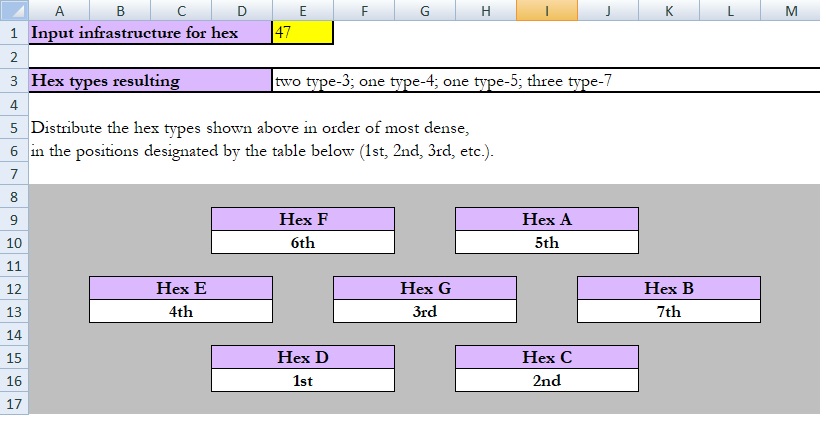
Under the "Input Infrastructure" tab on the excel file, you'll see the single point of inquiry, asking the user to insert a number.  It may be any number, but all numbers 448 and above produce the same results.

This will result in a group of designated "hex types" ~ in the example shown, two type-3, one type-4, one type-5 and three type-7.  The user is assumed to make note of these on a hex map matching the arrangement shown, in the positions designated.  In this example, the two type-3 hexes would be placed in the 1st (hex D) and 2nd (hex C) positions.  The type-4 would be placed in the 3rd position, the type-5 would be placed in the 4th position and the type-7 hexes would be placed in the 5th, 6th and 7th positions.

We would then go to the tab on the document named "type-3" ~ which, as we've already written down the positions of the hexes, we can now calculate as often as we wish.  We can quickly generate content for the two type-3 hexes:


By moving to the type-4 tab, we can generate this image:


And the type-5:


Then finally, the three type-7:


With these images generated, we don't even need a hex map.  We can simply put the images together into a single graphic (tightened up):


Of course, there are some holes:


What do we do about those?  Well, it's perfectly simple.  Just take the six adjacent hexes as a guideline and roll a random d6 to determine the center hex.  Doing this for each "hole" neatly fills in the map.

Final distribution of 2-mile hexes

And there you have it.  Not a satisfactory map, obviously, but a good template to work from, giving you interrelationships between the two manors at the bottom of the map, placement of roads, a river or two connecting farm and tilled lands together, etcetera.  Incidentally, there is a description for every one of these results that can be found on the linked hex generator.

Increase the number to produce a more civilized countryside; reduce the number to increase the amount of wilderland.  We used 47, which is a bit of a backwater.

I can see a way to expand the data above into "build hexes," but I'm pretty sure it is a lot of steadfast, painstaking work.  Hmf.  Sounds like fun.

Sunday, June 30, 2019

The Sword Teacher

I recently obtained a copy of 1977's The Duellists, directed by Ridley Scott.  Here is a taste:


While the fight shown goes against every Hollywood cliche about swordfighting, it is interesting to note that the fight director, William Hobbs, is also responsible for another favorite film of mine, featuring, again, some unusual swordfighting.  Alas, no decent fight example exists on youtube; I have to leave you with this, which is fair but doesn't begin to compare with the best scenes from the two films, 1973's The Three Musketeers and 1974's The Four Musketeers.


Some old timers might remember the Sean Connery and Robert Shaw film from 1976, Robin and Marian.  I wouldn't count the film as a good one, and the fight scene needed some work, but I know you D&D players.  The scene gives a good sense of fighting with heavy weapons.  And yes, it is William Hobbs again:


There's a reason why I'm not linking Hobbs' name to IMDb, and some of you will have leapt there already.  If so, you'll have found this standard for D&D players, the swordplay of which most of you will be very familiar:


And yes, this sword fight too:


This one too:


Gets a little freaky, doesn't it?  According to his bio, William Hobbs began as an actor in London and was told by Laurence Olivier, "Give it up."  He stayed with Olivier's company, however, as a fight director, and became ~ in my opinion, because he won no awards ~ the best.  His belief, quoting from IMDb, was that "the actors have to be working mentally on a conscious level of coolness, with complete body relaxation and control, so that their acted aggression can be performed with conviction and at the same time in absolute safety."

After Ladyhawke, Hobbs worked on Willow and Dangerous Liaisons (among other movies I won't mention).  The fight scene between John Malkovich and Keanu Reeves is highly reminiscent of scenes I've just watched in The Duellist. 

That brings us to another brilliant fighting film, and excellent throughout, 1990's Cyrano de Bergerac, directed by Jean-Paul Rappeneau.  If you haven't seen the version, shame on you; nothing else compares to this version of the story and no other version I've seen comes remotely close to the depth of the romance or characters.  But here's the highlighted sword fight for today's post:


Hobbs captures every nuance of the poetry and pacing, to perfection.  Sliced apart from the film, the viewer will fail to capture more than a quarter of the full emotion here; I saw it in the theatre in 1990 and was blown away.  If you can see this on a big screen, ever, treat yourself to it.

Hobbs was 50 when he did the work for Gibson's performance in Hamlet, which I've never seen (and won't) and for the obscure 1991 Robin Hood with Patrick Bergin and Uma Thurman, which I've never seen.  It's a bit sad to think he's the sword fight "arranger" for the Man in the Iron Mask, which is all flynning ... though I suppose there are some tight moments.  Interesting to think he was working with both Depardieu and Malkovich again.  That might explain an actual Frenchman's appearance in that movie.

After a series of so-so and meh films (and yes, I'm counting Shakespeare in Love in that number, a classic example of a Oscar Best Picture that retains absolutely no interest whatsoever for a modern audience), his last contribution was 2005's Casanova with Heath Ledger.  I saw that film; I cannot remember a sword fight in it.  But the film was pretty forgettable.

If you go looking up his IMDb listing, take note of his stunts, too.  Hobbs was a dedicated film artisan.

He passed away on July 10, 2018, just about a year ago.  The man brought me a lot of enjoyment over the years.

Last clip ... here's the man himself:


Friday, June 28, 2019

What I Learned about Running Estate Design

Between 1988 and 1992, I ran a name-level party with holdings in Viana do Castello in northern Portugal, Bissau on the Guinea coast and Barbuda in the Leeward Islands, all with the express support of the Portuguese king, to whom they rendered service in a peninsular war.  In establishing their holdings, the party fought drow elves living below the Cantabrian Mountains, as well as Spanish insurgents, and they fought various jungle beasts, as well as jackalwere interlopers from the Mali Sahel.  The party possessed two sailing vessels, which they used to work the golden triangle: tools and materials from Portugal to West Africa, labor from West Africa to Barbuda, sugar from Barbuda to Portugal.  They did not traffic slaves; but they bought them from the Futa, freeing them before offering them a new life in the New World.

The party had a good time.

For me, however, all of this was awful.  I had no trade system beyond a list of goods and futile attempts to make sense of the scant numbers I could find (I did not solve my trade system problem until 2003).  I had no map zooming system like I have now, only modern maps of the three areas that I redrew as rather simple representations of what the party was doing.  The maps I worked from were road maps, which had to be ordered special, as a 1:500,000 map of Guinea-Bissau is not the sort of thing one normally finds in a Canadian bookstore.  I had part-time use of a Macintosh 128K and full-time use of a Commodore 64.  And I did not have access to the internet ... what there was of it.

This meant that every question the players had, about hundreds of things, had to be hammered out of random books, guesses, logical proposals, my imagination and a lot of the time out of my ass.  The party would want to build a road inland into the jungle, upgrade the bullfighting arena in Viana, refit their ships for weapons, figure out how much labor they needed to produce so much sugar, have a price for goods bought and goods sold, which had to be different from place to place ~ and not only for the three places they semi-controlled, but for any other place along the way they might stop.  Ship repairs, stores, spoilage concerns, costs for men-at-arms, costs for fortifications, amount of food produced and used, crop yields, the occurrence and effect of storms, teaching religion to the natives, building a church in Africa, building a church in the Caribbean, hiring pirates not to attack their ships, prospecting, making rum, wine production in their vinyards, building schools, building hospitals, building houses, making treaties with other colonies, disease erupting among Europeans living in Africa, disease erupting among the natives in Barbuda ... the list went on and on and on.  Every session began with about twenty questions from the players, who thought of things while we weren't playing, half of which had to be put off until the next running; so that after the players' new questions, I had to give answers to the players' old questions ... and this was never ending.

Those people who argue they can run D&D "on the fly" have never had the kind of parties I've had.  It was not my idea to colonize Bissau ~ the party asked for the town as a gift from the Portuguese king and he was glad to give it to them, provided they kept it peaceful and his ships could rely on the port having supplies.  It was the party's ideas to find an island in the Caribbean without a European colony ~ and as it turned out the French and English didn't form a colony there until 1666, the party was totally free to do so first.  Running an agenda-free campaign, I was on the hook to answer all the questions they asked; and because I was willing to answer, and let them build up as they wished, they were encouraged to expand and expand.

Much of the various systems and rules and game designs I've put in place have emerged from the impotence I felt each week as I found myself with questions that no DM could reasonably answer using the game's books.  Quick, off the top of your head: how big is a bullfighting ring?  Now, how big is the one in Viana?  The map said there was one.  Now, without the internet, find out if it existed in 1650, how big it is, and how much wood and stone goes into it, then estimate a reasonable lack of maintenance so that you can guess how much it would be to make it new, then look at the plans the player has drawn up for you to show how more seats can be added.  Once you've got that, settle on a price per seat vs. the number of visitors, the cost of bulls and matadors, the balance sheet of the enterprise and expected profits for the party, plus status in giving great shows and how that status can be used to gain more favour at court.  Do that off the top of your head, with one player who works in the real world as an accountant and another who works in the real world as an engineer.  Go.

Players could build this.
I was surprised when I began this blog that most players don't ask questions like these, given that all my parties have.  I was surprised to discover that DMs don't seem to have players who are professionals in the real world, who know firm details about things, who are not to be fobbed off on a DM's nonsense demanding "simplicity" as proposed by the old school books.  If I'd attempted to collar my players with the original elementary-school versions of the game, they'd have scoffed and railed at me, and certainly wouldn't have considered me "the best DM they ever played with," which I used to get a lot.  99.9% of the time, I boggle at the willingness of the modern player in the modern game, to put up with the monopoly-level grittiness of the average D&D world ~ and this is what I mean when I say that RPGers are "robbing themselves" of an experience they should want to appreciate.

They claim they're having "fun."  They could be having the philosophical experience of their lives.

When I address the problem of an "estate system" now, I have to stress that we shouldn't be thinking only in terms of European farm country.  My players were hacking out roads and plantations in jungles; they were building docks in river estuaries; they were reworking urban landscapes; they were sawing trees out of the forests on the upper Lima River and using the logs to build towns and harbors thousands of miles away.  A proper estate system can't be measured by any one product; food cannot come from one kind of harvest; the materials produced cannot be limited to what's in the game book's equipment list.  The system has to be air-tight and yet flexible enough to handle a baffling array of possibilities, that might allow a player to send an email in the middle of the night asking, "If I want to capture and train oliphants to defend my settlement of Tarfaya from the hinterland of south Morocco, how would I start?"

Because hey, why not?

In the background, I'm doing some work in creating some proper wiki posts to describe the process of determining infrastructure, which in turn breaks the 20-mile hex into the 6-mile hex, that creates the pattern of settlement for the 2-mile hex, so that I can re-interpret that pattern in terms of the build hex, which I need to establish solid guidelines for the systemic design of estate land values.

So that when I get questions, I'll know how to answer them ... no matter where in the world the players settle.

The Bad High

I've heard from various sources this week about the compulsion to wage war against things we don't like, a compulsion that surely I possess and that others feel.  It has to be remembered that while we get a hit of hormonal comfort when we sense or think things that are good and beloved, there is a like hit that we get from a shared despising of something else.

We're built this way.  We're built to cheer when the primitive beast that is one of our clan caves in the skull of an enemy beast with a rock.  We're built to urge on our clan members to keep hitting with the rock again and again, getting that sweet, sweet oxytocin with every wet crack of the stone.  The body's chemical bonus kept us working as a team, it kept us watching out for each other.  Us, the great Us, and the very bad Them, is hormonal.  And natural.

But nature, Mr. Allnutt, is what we are put in this world to rise above.  It is well to remember this.  The temptation to give into hate, because it feels good, is a damnation ... one that we are all, all of us, guilty of pursuing.

My purpose in fixing a final word on 5e is not to promote hatred, but to promote indifference.  Not to say, "Don't play 5e," but to say, "I don't care what you do."  You understand?  We not playing 5e on the blog and I'm not talking about it.  It is immaterial to my existence.  I may hate it, but ranting endlessly about it is a waste of my time.  And by extension the same is true of hundreds of other subjects related to D&D that I just don't care about any more.

This has not been an easy place for me to reach.  I don't think I'm here yet.  But I want to be here.  I want to be only here, where the only talk is positive.  But that is damn fucking hard, not because this is the internet, but because I'm human, and I want to get my hate on just like anybody else, for the same chemical hormone as anybody else.

This has got me thinking about the late 1970s, that I experienced and I know a lot of readers didn't.  This isn't about D&D in the 1970s, this is about culture in general, and television in particular.  I was 10 to 16 years old between 1974 and 1980 ... and I don't know why it shames me to admit it, but I watched variety shows, and Fantasy Island, and the Love Boat, and a mess of other ensemble shows.  It's awful stuff now but I was young, and there wasn't much to compare it to.

But there was a condition of television back then that I really, really hated.  Specifically, there were people, very popular celebrities, that I just ... well, we'll just say hated.  If you'll forgive the example, I really hated Sammy Davis Jr.  He was such a phony, cheap, sordid, pandering black sambo insult to my early conceptions of anti-racism and equality.  Maybe it seems strange that I cared about those things when I was a pup, but I was indoctrinated in politics very young.  Debate club at 12, political clubs at 14, aggressive young communist by 15, with Marx in my pocket.

Now if you don't know who Davis was, this won't mean much to you.  His schtick was to be "Black," with a capital B ... every repulsive stereotype of being black, massaging it hardcore every time he opened his mouth.  People thought he was funny.  And cool.  I thought this public persona was a walking atrocity — and I thought of it as a persona, because I couldn't believe that the real Samuel George Davis would present like this.  Going back to his work in the '50s, he didn't; but by the late '70s, his voice was like a fucking dentist's drill.

And because he was popular, he'd turn up on some show I liked.  Some show I waited all week to see.  Only to find it ruined by his presence.  And that happened a lot, with different people.  Charo.  Zsa Zsa Gabor.  Steve Lawrence.  Liberace.  Phyllis fucking Diller.

Now that I've demonstrated myself to be a complete asshole ... again ... what's my point?  It's basically this.  Growing up in the 1970s, there was no way to express that hate.  We really did live in a bubble.  People talk about how we surround ourselves now with people who think alike, and that makes a "bubble," but seriously, I grew up in a time when there was no one to surround yourself with.  You got your hate on for a celebrity, maybe you could find a friend who also didn't like that guy, but friends always end up liking someone you don't like.  

It's like an itch you can't scratch.

The internet lets you scratch that itch all you want.  You can find mountains of hatred for anything or anyone you hate ... and if that doesn't do it for you, you can go stir shit up and find others who will write messages like, "Hey, yeah, I fucking hate that too."

What's more, if all you want is to stir shit up, if you don't even have a belief system you're pushing, it's just goddamn fun.  We piss on them, they bitch, we piss some more, we don't fucking care, we're not invested in what we're defending, we just want to see people get worked up.  It's hormonal.

And now 20, 22 years on the internet, I guess I'm just getting older.  It's harder having something positive to say.  It's way, way easier to rail on someone else's post and make that today's post ... and understand, I've goddamned done that, not long ago, but last week.  And the week before and the week before that.

I look at my blog, I'm trying to think of a post ... and when it doesn't present itself, there are all those other posts on the internet to open and feed off.  There's the 5e handbook, right there, just waiting to be chewed up.

Thing is, though ... I don't get much fun out of it.  I ... feel it too much.  I angst over it.  When people get pissed at me, I don't laugh and point and enjoy myself ... I get sore and defensive and borderline.  I want people to play a better game of D&D.  When they don't, I think they're stealing something from themselves.  I think, whatever fun they're having, what social aspect they appreciate, they're missing the real party.  And I think it's a fucking tragedy ... made worse, because they're so fucking obtuse.

In my mind, I think Sammy Davis could have had a serious career, one where he didn't have to monkey it up for the white folk.  When I was a kid, I hated him.  But as an old man, I don't think it was him at all.

I think those were the tracks laid down for him; by the '70s, whatever he'd had in the '50s was flanderized out of proportion.  And that at the time, riding the tracks seemed the safest bet.  He got to stay in the spotlight.  You weigh the costs against the gains.

I want to apply that to D&D.  I want to argue that Mentzer, Katz and the others of their ilk are just old men trying to stay in the game, and that the guys who work in the company that made 5e are just hanging on to their paycheques and thinking about their homes and retirement.  I want to see how, from their perspective, it just all seems to be working out great.  They don't see any damage.  They don't see any fault.  They made a game, people play it ... that's all it is.

They don't see what I see.  And if they do, they've made peace with their demons.  They've weighed the costs.

I've got to weigh costs too.  I've got to settle on what my boundaries are; and I know part of that is letting go of that hormone.


Post script,

It was hard finding just the right pictures for this.  The celebrities that Sammy Davis worked with, who were close to him, loved him ... which only proves that the version of person he was in the late 70s was all an act.  Going through the pictures of him on line now, that period between 1970 and 1985 has been scrubbed clean; the images are all late 50s and early 60s, when he was close to the Rat Pack, Martin Luther King, the gods of Jazz and so on.  In the '70s, though, his name was synonymous with "the Candy Man," a horrible ditty that went huge at the time but is all but forgotten now ... but anytime he appeared in public, he was expected to sing it.  I notice his footprint online has had the song removed from his popularly remembered persona in the present, who want to believe that he was never forced to go down that road ... the way people want to believe that Stevie Wonder didn't perform those songs in the '80s.

History is funny.

Wednesday, June 26, 2019

Forester's Perspective

"In the 1950s, Forester wrote only two novels about Horatio Hornblower, so the patience of his fans was severely tested.  And not just his fans; there's a story that whenever his American publishers found their profits threatened, they dispatched an envoy to California with orders to stay with Forester until he finally agreed, however reluctantly, to write another Hornblower.
"Writing was Forester's life.  And he was extremely successful at it.  But he never talks about writing without using words like, hard, exacting and exhausting.  'I would rather be in the dentist's chair,' he claimed in the Hornblower companion.  After completing his daily quota of words, he felt sick, weary, flat.  'There is no pleasure left in life,' he wrote.  'I am drained and empty.' "
historical note by Bernard Cornwall, describing C.S. Forester,
author of Hornblower and the Hotspur

Oh, how I relate.

It is easy to write a blog.  There is little fear of being held to account for what's written, partly because the media's legitimacy is so lowered by people writing about their cats having kittens or the latest rant about paying tolls on an empty highway on a Sunday.  And partly because another post can be smeared on top of the post before, and in good time the bad posts can be smothered out of consciousness in favour of what's new today.  Like they used to say, today's newspapers will be used to wrap fish tomorrow.

But published works have their own significance.  A writer is measured by a novel in much the same way that we are measured for a coffin.  It is impossible to unburden ourselves from that implication, as sentence by sentence we structure a work from beginning to end.  If I write a bad line in a series of blog posts, something that years later makes little sense, no one will judge me as a writer for that; but if I make a similar mistake in a published book, I will be damned for it for eternity.

It is well there is no afterlife.  If there was, I pity Shakespeare for the misery he has suffered in the butchery of his work, the criticism and the groans of undesirious children.  There is no heaven for a famous writer.

Not that I wouldn't want to be one.  Which, of course, is the center of the trouble.  This blog post will not make me famous, it will not cement my value or promote me to the stars.  But there's an idiotically slim chance that my novel might, a chance that can't be rooted from my mind no matter how indifferent I try to be.  And this makes every choice, every sentence, every scene resolution an abiding misery.  Writing is perhaps the only art where, the closer one comes to the completion of the goal, the less pleasant it becomes.

But.  Tasting it now.  I can fucking taste it.

Tuesday, June 25, 2019

The Determined Dullard

I'd like to take a moment and explain my present stance on 5th edition, calmly.

I've drawn a line.  I'm no longer interested in debating whether or not 5e has merits or content that is worth looking at.  It doesn't.  After nearly 40 years of playing and designing the game, anything "good" that 5e has to offer can be dismissed as not worth bothering about.  An auditorium of people interested in seeing Nickleback in concert may have one or two people with intelligence, but it isn't worth sorting through all the dreck to find them.  Think of it like a gold mine that isn't worth mining ... not because there isn't any gold in it, but because the process of eeking out that gold from a mountain's worth of dross would bankrupt us.

I enjoy a good discussion on virtually any subject, so long as there are factors involved that need further consideration and examination.  But with any subject there comes a point where the examination of the material fails to dredge up any new information or perspective, and further reaches an impasse where more talking and discussion won't change the individual's mind ... for reasons having nothing to do with the argument.

To be perfectly clear, I'm am not saying that we should, at that point, "agree to disagree."  This is one of the most toxic phrases ever invented by humans, because it presupposes that both sides of an argument have equal merit.  They don't.  One person is wrong, or both people are wrong; but there is no possible instance in reality where both people are "right."

We embrace the argument that persons in conflict can both be right because that sentiment makes it possible to work together towards common goals, while mitigating the likelihood of spontaneous violence between stubborn, mule-headed sociopaths.  Of course, spreading a doctrine that "When encountering someone who believes something with such vehemence that they're prepared to scream in my face, I should retreat from the situation and calmly self-inspect my position to see if it has flaws, because plainly there is a perspective that I don't understand," would also work, but it doesn't fit into three meter-friendly words.

My opinion about 5e results from that self-inspection.  I've read the books.  I've compared the books to other games, to other versions of D&D, to the way the English language works and to much material I've read about game theory and game design.  I've played 5e, I've watched others play 5e, I've watched live stream games of 5e and I've seen the way that 5e has affected game store play.  I have read company policy about 5e and I've read interviews about the designers talking about 5e.  And I've read hundreds of threads online in which people defend 5e.

5e is garbage.  Any rational, informed, game experienced person, that being someone who has played multiple RPGs and other non-RPG games, can see almost immediately that it is garbage, without further investigation.  But the kicker to that is, and this is the really important part, further investigation will not reveal that 5e is something other than garbage.

Before I'm going to believe in a thing, I need evidence of that thing.

If you believe that 5e is inherently, on its merits, better than other role-playing games, then you are wrong.  There's nothing to be debated.  Not because I can't explain why you're wrong, or argue the point ~ but rather, because I have argued the point.  And so have thousands of others.  And so, as things stand, further argument is wasted ... because you, the defender, are incapable of the self-inspection necessary to see why you're wrong.

Please address that shortcoming.

[but not here]

Monday, June 24, 2019

June Housekeeping

If I may, I'd like to draw the reader's attention to the sidebar, where I've added a list of links to the most recently completed pages on my wiki.  Going forward, I'll be updating this list as pages are added on the wiki, and cease to copy pages of the wiki here.  The double posting was causing extra work for me and my main point was to get the reader's interest going in the wiki.

It worked.  Page views have doubled there in the last four months, up to about 200 a day.  I think the point was made for some readers that if I wasn't posting here, I was likely posting there ... that's a trend that's bound to continue and just to be sure the reader doesn't miss anything, I'll keep the links updated.

Secondly, regarding my Patreon.

After much soul-searching and research, I'm going to have to bow to the will of the majority and start posting the names of my supporters.  I have the choice of keeping a permanent list on the sidebar or publishing the list of my supporters in a blog post monthly or bi-monthly.  If the reader has any opinions about this, now is the time.  I'm going to make up my mind about it with the 1st of July.

I don't want anyone to feel used, so please, PLEASE, email me at alexiss1@telus.net if you don't want me to post your name.  I don't want anyone killing their donation in order to protect their anonymity.  Above all, I consider your needs and your generosity more important than any decision I might make.

I do plan to provide a "special thanks" list apart from my other wonderful supporters, for those who frightening me with their donations, so please ~ if you're concerned about this ~ feel free to ask in private if you're on that list.

And of course, if anyone has anything to say in the comments about this that needs to be said now, such as a last ditch effort to change my mind or publically shame me, please take this last minute opportunity to say it.  'Course, I accept pats on my head and doggie treats too, if you have them.

Some of you will be glad to know that I got a taste of my own medicine over the weekend:  someone made me feel very stupid, and I would count it as completely lacking in empathy.  Held up a pretty harsh mirror to my face and I've been chewing it over since.  I know that the "feeling stupid" is my own fault, it's my own head fucking with me, and does not originate with the other fellow ... but it is a damn hard thing to shake.  Anyway, there's a little schaudenfreude for the peanut gallery.

I'm pleased about the weather pages on the wiki.  I plan more, but they're in a constructive phase.  I'm thinking of the next matter with players creating an estate and I'm considering rewriting some general history to reshape my world.

For those who may be interested in the online campaign, and who wonder if it is buried forever, I'm sorry: not until my book is finished.  It is progressing steadily.  I was up until 3 AM writing it last night, overcoming a rather delicate scene that I feel went well.  I can almost taste coming around to the last scene ... it is just over the hill.

That's good for now.  Going to work on some other stuff now; I'll keep an eye on the blog.