I'd like to say that I've accomplished something with these posts about game inefficiency, rigidity and agility, but the truth is we've come to the end of the track and I have to wonder what's different. Personally, I feel vindicated on a lot of fronts. I had begun making my world with an agile design idea decades before agility was even proposed (was talking with a business manager yesterday who made the same remark with regards to his own practices). I have always felt that the game world had to be rigid, with an understanding that the rigidity had to be improved or made more flexible, if it wasn't producing a good game. And why wouldn't we want an inefficient game?
The main change for me these last two months is that I now have design industry terms to describe things that I've always thought of in fuzzy dimensions. I can now use the term and point to the book and say, "Aha, evidence." Yet on the whole I'm not looking at my world design differently and thinking about things I have to change.
It was a good idea that I began sketching out the various details of the sage tables for all the classes, even if the work wasn't actually done. That was certain a more agile method: but I took that step to feed the needs of the online campaigns and I did it before starting this long series. However, I have to point to that as the last radical step I've made in my game design.
On the whole, however, I feel this has been more of an exercise than a reaching out. I think I could review all the research, now that I'm on the other side of it, and pull these posts together into a single book; I could go off on a number of side discussions that would flesh the book out to 40-45 thousand words.
What I can't do, though I've been trying, is to figure out a way to help others with the metaphorical blank piece of paper that faces them. I've just finished the last post by saying that a better adventure is not going to make your world better. Fact is, a quickly produced, well run adventure will be as good for your players as any long-term effort would produce. Arguably, long-term efforts encourage us to lose our focus about what makes the running good. The longer we spend making an adventure, the more we become attached to the plan and the less awareness we retain for the players: remember, plans are important but collaboration is more important.
If you approach your players with an adventure that consists of four straight up fights, with treasure, a little personality for the enemy combatants and a strange terrain to give the fights some verve, you will do better than if you created twenty or thirty well-described, mostly empty rooms, carefully crafted and laid out in extraordinary detail. That's because YOU, your brain, your capacity to make something interesting, is a hundred times more complicated and involving than any lines you can draw (or manufacture out of paper and styrofoam).
An elaborate dungeon drawn with the elegance of three dimensions, figures, shading and color, to scale or upon a scale that provides aesthetic, makes an interesting artwork and that has positive influence over how your players perceive you and your world. All that effort does produce a level of awe that can work for you. But very little of that effort actually applies to a game more profoundly enhanced through the imagination. Artworks help where matters of location, proximity and player planning applies; but it doesn't turn the monster to flesh: it is your heart and your ability to emote that makes that so.
That is so unfair. We've been sold on the ideal that having the materials and then putting them together in these shapes will make a great game. We've been duped into thinking an imaginary fantasy game can be plugged together with mechanical movements: read this paragraph, wave your hands, show the players this picture, throw this die and everything else will just be wonderful.
It isn't true. And we've all known it isn't true, from the beginning, when we first began running games with a pit in our stomach and a doubt that we really knew what we were doing. But we went on doing it in the way we were told because that was all we knew. That was what everyone else was doing. And anyway, a little more often than not the players seemed to be digging it. But we knew when we started DMing that it seemed like a false front, like we were faking it, hoping eventually that the feeling of faking it would go away and we'd know what we were doing.
But it didn't. And this last six weeks has been about why. The goal is to recognize that the effectiveness of play isn't in the tools or the modules. It isn't in the dice or the clever role-playing. It isn't in backstories or rules. It's in the fundamentals of game design.
Success is in understanding, yourself, how to find a way to make the players feel that they might not succeed but that they might succeed at the same time. To find that button and then to keep hammering that button until your thumb gets raw. Everything else is just gravy. Helps you find the button and helps you hammer it a little harder ... but it won't push the button for you. And in the final analysis, you don't actually need any of it. We could play, you and I, without any dice, without character sheets or maps, in the dark, trapped in a coal mine, if we had to.
Friday, August 11, 2017

Thursday, August 10, 2017
Sea Routes in the British Isles
Something light-hearted and simple, then. Back in 2014, I published a group of sea trade maps. I'd like to draw the reader's attention to this one that was posted then:


Since I finished creating the map of Britain, I've been working on an updated sea route map that would include the British Isles. It looks like this:

Frankly, I'm glad this is done. It is one more step towards adding England to the trade system, a long, involved process. I've updated the map on my Google Drive, for those who have donated $10 or more to my Patreon account. Thank you all again.
Wednesday, August 9, 2017
Change, Not Plans
This brings us to the last of four posts about the principles of agile design. Throughout this mini-series within my larger agenda of game building and game design, I have stressed at each point the need for the DM to be flexible and player friendly when running the game. This is actually the fourth tenet of agile: that it is more important to respond to change than it is to follow a plan.
This does not say that a plan is a bad idea, or that it is not useful to the campaign, but the plan must never, ever, take precedence of a DM's willingness to change the processes in order to improve the overall value of the game.
At the end of the last post, I talked about players making changes to plans and how we should just go with it, as much as we can. The only way this can be done is if you are prepared to Welcome Change. Change isn't something that must happen; change itself will not make a campaign better. But if change happens, or there is reason to believe that is should happen, then don't step around it or fear it. If your players are pushing for changes to be made in your style, it is because they believe those changes matter; if you dismiss that push for change, you are also dismissing the players. You're trying to go it alone. This will not help you keep players in your campaign.
Understand, however: welcoming change means that your campaign won't be what you expected it to be when you started running. As a community, we pay a lot of lip service to games being collaborative experiences, but we are well aware that DMs are rarely prepared for their precious campaigns to suffer change at the hands of a bunch of players. DMs have worked long and hard on their campaigns and they're just not prepared to let a gang of peasants with torches and pitchforks burn it all down. I don't deny that a DM's campaign matters ~ but I do resist the characterization that players have no idea how campaigns work or how they ought to work.
This sense of "what do players know?" is less a rational conclusion than it is an invented crutch that DMs use to impose themselves above others. Virtually every game I have ever run included two or three other DMs, at least; with the first games I played, in my youth, every player was a DM, because we were all trying. It is silly to claim that these DMs don't know anything about how RPGs work.
The problem with the campaign first, players second notion of game design is that it fails to comprehend the primary goal: a working game, in which unique experiences are made possible, followed by excitement and gratification. To obtain this, the campaign, whatever it is, has to take a second seat.
At no time does this say the planned campaign won't survive in some form! It may have most of the features that it possessed in the original planning stage. Those changes that are made can be rescinded if they don't work out, while other changes that are made will be appreciated and kept. If the party works together as a group, and if the DM shares power with that party, that together the whole will continue to look for new and better ways to work together.
Here is the hardest truth that every DM and Player has to come to grips with. Processes won't make your game better. No matter what the adventure, no matter what the game system, no matter what form of RPG we play or how hard we play it, we won't improve our game mastery through practices or procedures.
We can only improve our games by having principles and values that promote a strong and friendly collaborative process. People matter. Not adventures. If you wished for the best module in the world, it still wouldn't make your game any better ~ not unless you've learned how to believe in what you're doing.
This does not say that a plan is a bad idea, or that it is not useful to the campaign, but the plan must never, ever, take precedence of a DM's willingness to change the processes in order to improve the overall value of the game.
At the end of the last post, I talked about players making changes to plans and how we should just go with it, as much as we can. The only way this can be done is if you are prepared to Welcome Change. Change isn't something that must happen; change itself will not make a campaign better. But if change happens, or there is reason to believe that is should happen, then don't step around it or fear it. If your players are pushing for changes to be made in your style, it is because they believe those changes matter; if you dismiss that push for change, you are also dismissing the players. You're trying to go it alone. This will not help you keep players in your campaign.
Understand, however: welcoming change means that your campaign won't be what you expected it to be when you started running. As a community, we pay a lot of lip service to games being collaborative experiences, but we are well aware that DMs are rarely prepared for their precious campaigns to suffer change at the hands of a bunch of players. DMs have worked long and hard on their campaigns and they're just not prepared to let a gang of peasants with torches and pitchforks burn it all down. I don't deny that a DM's campaign matters ~ but I do resist the characterization that players have no idea how campaigns work or how they ought to work.
This sense of "what do players know?" is less a rational conclusion than it is an invented crutch that DMs use to impose themselves above others. Virtually every game I have ever run included two or three other DMs, at least; with the first games I played, in my youth, every player was a DM, because we were all trying. It is silly to claim that these DMs don't know anything about how RPGs work.
The problem with the campaign first, players second notion of game design is that it fails to comprehend the primary goal: a working game, in which unique experiences are made possible, followed by excitement and gratification. To obtain this, the campaign, whatever it is, has to take a second seat.
At no time does this say the planned campaign won't survive in some form! It may have most of the features that it possessed in the original planning stage. Those changes that are made can be rescinded if they don't work out, while other changes that are made will be appreciated and kept. If the party works together as a group, and if the DM shares power with that party, that together the whole will continue to look for new and better ways to work together.
Here is the hardest truth that every DM and Player has to come to grips with. Processes won't make your game better. No matter what the adventure, no matter what the game system, no matter what form of RPG we play or how hard we play it, we won't improve our game mastery through practices or procedures.
We can only improve our games by having principles and values that promote a strong and friendly collaborative process. People matter. Not adventures. If you wished for the best module in the world, it still wouldn't make your game any better ~ not unless you've learned how to believe in what you're doing.
Tuesday, August 8, 2017
Collaborate at Arm's Length
In the last post, I talked about "agile design." Some readers will be aware that two posts ago, I also talked about agile design. With this post, I'm going to talk about agile again.
I have just finished saying that as DMs, we need to communicate more with our players about what they want, in order to determine what can work and what won't work in a campaign. I spoke about recognizing that fog of war is a secondary consideration to addressing the greater issue of determining how players respond to ideas and experiences they have in our campaign.
For those of you willing to take the risk of letting players choose the nature and species of their next encounters, it will not be long before a series of problems will emerge. Players will not want the circumstances between themselves and success lengthened or frustrated by inefficiencies. They will want the path between themselves and total power to be completely efficiently; if they feel they're in a position to negotiate, they will argue for efficiency every time. And just so we're on the same page, understand that "efficiency" for a player will be: a) as little risk as possible; and b) as much reward as possible.
If we take a stroll through a casino anywhere, and issue a questionnaire among the casino's players, asking what the casino could do to increase their personal satisfaction, the players would answer: a) make us lose less often; and b) make the pots that we can win larger.
Yet strangely, though no casino does this, not even in tiny incremental degrees, players keep showing up to participate. What does this mean?
It means that what the player says and what the player does are largely unrelated concepts. Players always want the best possible results for their investment. That is why they are players, to get the best possible results! Of course they have to get them through game play; but if we think about it, "game play" is a question of finding the best possible path towards game success. Players see questionnaires and investigations as potential angles that can be played, just as the rules of the game can be played. The DM might show weakness; if the DM does, then I want to be first in line to exploit it.
So where it comes to managing our players and learning about them, we need to be wary. This is not a contract negotiation. This is a way of turning the players onto their backs like turtles, then seeing how long it takes to right themselves.
In the end, we're going to give the players what we want. We want inefficiency in the rules, requiring innovation. We want a sense of doubt where it comes to risk-taking. But we can't do that well unless we investigate what makes the players innovate or take risks.
However, though we don't want to negotiate, we do want to collaborate, and often. Collaboration is the key to the game universe.
I was recently watching a video on Dark Souls and The Stanley Parable, which some of you will have played. I'm not going to talk about that link (and, quite honestly, I could beat Mark to death with a hammer and feel nothing at all). Rather, I'll link this video instead, which talks about why circumventing the narrator is central to the value that we find in games that enable rather than deny:
With this sort of understanding, we are right through the looking glass. This describes the awfulness and poor game thinking of pre-writing a "story" that players need to pursue. In fact, anything that the players do has the potential to just create another story, which a fast-moving DM can manage by evaluating, changing plans in mid-stream and then moving forward to build a new adventure with agility, this being, agile design that interprets what the customer, er user . . . ah, I mean player, what the player wants. Sorry, sometimes I get confused when I realize that everything that designers are doing to satisfy people in the real world is exactly what we as DMs need to do in our game worlds.
That evaluation that I mentioned, along with the changing of plans (or iterations), can't be done without collaborating with the player. Take a very common situation, one that seems to aggravate story-DMs no end.
There. The story is ruined, right? And at this point, the DM usually shouts, "You can't do that!" or "Why did you do that?" To which the player answers, "Seemed like a good idea."
Is the story done? No. Is this even remotely a problem in a flexible, inefficient role-playing game? Absolutely not. The player has just stepped up to the tee and sliced the ball into the woods. In golf, that means taking a penalty. In an RPG, the penalty is simple:
Chances are, the munchkin is now happy. Fuck the story, fuck the old man, none of that matters. The player is getting what the player wants: a fight. But let's make it a hard, brutal fight, one that nearly ends in the player's death, but at the same time promises a chance that the player will win. We're not punishing the player, we're merely supplying a reasonable penalty that promotes a certain inefficiency to the player's survival. That's all.
We could ask, "Do you find stories and old men relating them boring?" If the answer is yes, we could move on other strategies and techniques to introduce adventures. We could stretch ourselves and be creative. We could give the players what they want.
Giving it the way we want to give it, obviously. This is a collaboration, not a service, not submission. As designers, we'll try to make the player happy; but we're still going to be the ones designing this thing. Players can be made to understand that.
I have just finished saying that as DMs, we need to communicate more with our players about what they want, in order to determine what can work and what won't work in a campaign. I spoke about recognizing that fog of war is a secondary consideration to addressing the greater issue of determining how players respond to ideas and experiences they have in our campaign.
For those of you willing to take the risk of letting players choose the nature and species of their next encounters, it will not be long before a series of problems will emerge. Players will not want the circumstances between themselves and success lengthened or frustrated by inefficiencies. They will want the path between themselves and total power to be completely efficiently; if they feel they're in a position to negotiate, they will argue for efficiency every time. And just so we're on the same page, understand that "efficiency" for a player will be: a) as little risk as possible; and b) as much reward as possible.
If we take a stroll through a casino anywhere, and issue a questionnaire among the casino's players, asking what the casino could do to increase their personal satisfaction, the players would answer: a) make us lose less often; and b) make the pots that we can win larger.
Yet strangely, though no casino does this, not even in tiny incremental degrees, players keep showing up to participate. What does this mean?
It means that what the player says and what the player does are largely unrelated concepts. Players always want the best possible results for their investment. That is why they are players, to get the best possible results! Of course they have to get them through game play; but if we think about it, "game play" is a question of finding the best possible path towards game success. Players see questionnaires and investigations as potential angles that can be played, just as the rules of the game can be played. The DM might show weakness; if the DM does, then I want to be first in line to exploit it.
So where it comes to managing our players and learning about them, we need to be wary. This is not a contract negotiation. This is a way of turning the players onto their backs like turtles, then seeing how long it takes to right themselves.
In the end, we're going to give the players what we want. We want inefficiency in the rules, requiring innovation. We want a sense of doubt where it comes to risk-taking. But we can't do that well unless we investigate what makes the players innovate or take risks.
However, though we don't want to negotiate, we do want to collaborate, and often. Collaboration is the key to the game universe.
I was recently watching a video on Dark Souls and The Stanley Parable, which some of you will have played. I'm not going to talk about that link (and, quite honestly, I could beat Mark to death with a hammer and feel nothing at all). Rather, I'll link this video instead, which talks about why circumventing the narrator is central to the value that we find in games that enable rather than deny:
"If you go on a rampage in Dark Souls and kill every last friendly NPC you will actually unlock whole new side stories and dungeons and bosses. This is not simply emergent or procedural, this is intended play. If there is crafted content on the other side of your misbehaviour, then it's not actually 'misbehaviour' ~ because it turns out that murdering everyone is also the correct way to behave. What a game intends for you to do includes not only the things the fiction of the game tells you to do, but also the broader things the game permits you to do."
With this sort of understanding, we are right through the looking glass. This describes the awfulness and poor game thinking of pre-writing a "story" that players need to pursue. In fact, anything that the players do has the potential to just create another story, which a fast-moving DM can manage by evaluating, changing plans in mid-stream and then moving forward to build a new adventure with agility, this being, agile design that interprets what the customer, er user . . . ah, I mean player, what the player wants. Sorry, sometimes I get confused when I realize that everything that designers are doing to satisfy people in the real world is exactly what we as DMs need to do in our game worlds.
That evaluation that I mentioned, along with the changing of plans (or iterations), can't be done without collaborating with the player. Take a very common situation, one that seems to aggravate story-DMs no end.
DM: an old man moves up to the party and begins to speak. "I have something very important to tell you," he begins.
Typical Munchkin Player: I kill the old man.
There. The story is ruined, right? And at this point, the DM usually shouts, "You can't do that!" or "Why did you do that?" To which the player answers, "Seemed like a good idea."
Is the story done? No. Is this even remotely a problem in a flexible, inefficient role-playing game? Absolutely not. The player has just stepped up to the tee and sliced the ball into the woods. In golf, that means taking a penalty. In an RPG, the penalty is simple:
DM: Three men hear the old man's shout as he dies and rush out of the nearby doorway. They see the player with the bloody sword and the old man dead on the ground. "He's a murderer!" they shout, immediately reaching for a group of ax-handles that happen to be collected in a nearby barrel. They approach the party intending to use them as clubs.
Chances are, the munchkin is now happy. Fuck the story, fuck the old man, none of that matters. The player is getting what the player wants: a fight. But let's make it a hard, brutal fight, one that nearly ends in the player's death, but at the same time promises a chance that the player will win. We're not punishing the player, we're merely supplying a reasonable penalty that promotes a certain inefficiency to the player's survival. That's all.
We could ask, "Do you find stories and old men relating them boring?" If the answer is yes, we could move on other strategies and techniques to introduce adventures. We could stretch ourselves and be creative. We could give the players what they want.
Giving it the way we want to give it, obviously. This is a collaboration, not a service, not submission. As designers, we'll try to make the player happy; but we're still going to be the ones designing this thing. Players can be made to understand that.
Sunday, August 6, 2017
Adventure Writing
The last post has established that we're looking for a certain type of structure, which ensures both inefficiency and success at the same time. But how do we identify the tolerance level that the party has for either. It's true that there isn't one tolerance level for every possible party, but that's no really helpful. We probably won't be running with a lot of different parties and, in any case, our presence is going to skew different parties towards the same median.
The strategy for everyone to find that median is the same, no matter who is running or who is being run. That strategy is experimentation ~ and those who won't employ it are bound to be weak or abusive DMs.
Unfortunately, most of us, the writer here included, were initially trained to think that an adventure design worked like writing a book. We write the whole book, every inch of it diagrammed and sorted, and only when the book is complete do we dare present it for our players to try out. Frankly, this is pretty stupid. We keep talking about how the game is supposed to be a collaboration between the DM and the players, but then we send the DM off to work in total isolation while we wait like an audience of critics waiting to tear pieces out of the DM's solo design.
We do this because this is how modules were designed. Modules have to be designed like this because they are products, in which all the collaboration takes place between the fabricators prior to handing them over to the manufacturer. There is NO collaboration between the maker of modules and the DM, and then no collaboration between the DM and the players. It is passed down the line with the message, "This is as good as it gets; if you don't like it, tough."
DMs then try to rewrite the module a little (still solo), to tailor it for the players, but we still don't have much recognition of the players tailoring the module for themselves. At best, we have this desperate ploy: a very old story describing what most DMs do when they're noobs and don't know better. It goes like this and it's familiar: the DM has nothing planned, or has something planned which doesn't seem very good. The players speculate about what might be up ahead; the DM hears this and thinks, "That's great! I'll do that!"
Is this what I mean by the players collaborating with the DM to make an adventure? No. But we'll come back to this.
We also pre-write adventures because we think this is the only way to make them complicated and detailed, as in what happens with room #4 is very important when the party gets to #7, which has the key they need for room #9, and so on. We can call this The Myst Method. The Myst Method sucks. DMs don't realize this, but they're very tiresome to play over and over and, in the end, the players will soon become savvy enough to recognize what's happening. The key in #4 might as well have a tag on it that says, "This is very important, test it out in every hole you come to going forward until it fits in something. Thank you, the Dungeon Master."
It's a bigger surprise if the key doesn't fit anything. Except that we're still going to spend an hour of game time trying the key a thousand times.
Finally, we pre-write adventures because we don't understand design. We think this is proper and correct. We think this is how stuff gets designed. It used to be, but now every company that still designs that way has been destroyed in the market place by competitors who employ what's called "agile design."
Let's not get into the particulars ~ there is plenty of stuff online to read if you're not familiar with the concept. You may realize the last post was about agile design. At present, I want to make a point about what agile design is supposed to accomplish.
Writing the module in one go is called "waterfall design" ~ the old way of doing things. Basically, the river goes along, goes along, goes along, then it falls off the cliff and there we are. All designers used to do this; there were no focus groups brought in to question the design, no testing of the product (and no requirement to test it) and sometimes, no assurance that the product would do what it's supposed to do. Movies and other artworks, for the most part, are still being made this way. That is why so many of them suck.
Agile design is what's called "iterative." This means that it is done frequently and repetitively, until what is desired is achieved. Agile was invented for the software industry, which absolutely died on the vine when attempts were made to design it in a waterfall fashion. Now, everything is released in bits in pieces, testing it and testing it, relying very heavily on the user to fix what's wrong and improve the experience. Video game designers release an alpha version of the game, sometimes updated once, then a beta version. The beta version is then repeatedly released as it is tweaked and fixed, relying on players to identify what must be fixed. Finally, all the problems have been supposedly identified and the game is released.
Games are much more complex now, with fewer bugs, because of agile design. Back in the day, when waterfall design was normal, programs were not only crippled by bugs (rather than a few annoying things, like now, it used to be impossible to use software without continuous work-arounds for bugs), there was nothing the company could do about it. There was no proper effort to account for what had to be changed; this meant that "fixing" a program meant bringing in a completely unfamiliar team, who would have to start on the code from scratch. It was easier to burn the code to the ground and start again.
When designing your adventure, you want to be agile about it. But this will immediately produce the response, "How am I supposed to keep stuff secret from my players if I'm sharing the design?"
Easy. Don't keep it secret. Have you not noticed how game are played now? Consider titles like Don't Starve, Oxygen Not Included and Subnautica. Knowing what the adventure IS won't change the doubt players have about the die, their ability to overcome known enemies or steadily explore vast realms. RPGs have vastly over-emphasized the importance of fog, as though this is the entire game, when in fact fog is a very small feature.
What is the best part of not knowing? It produces stress from uncertainty. But if you know you're equally matched with an enemy, does that reduce stress? If you know the enemy's intentions or the enemy's abilities, does that detract from the player's level of stress? No. It doesn't. Not in my experience (which I can prove with text from game campaigns, if necessary).
The only time knowledge removes stress is when it tells the players they are certain to win or that they are certain to lose. Once a player is convinced of either, the game is lost.
So come clean. Sit down and say to your NEW players in your NEW campaign, directly, that you're thinking of giving an encounter. Warn them that it is coming. Tell them, before it starts, before their characters see it, what the encounter is going to be. See how they react. Ask them how they are reacting. Test them. Then, after the encounter is run, find out how they felt about it. Ask them, was it too hard? Was it too easy? Don't take their word literally, as they will skew their responses with a desire for survival, but ask! You can't learn anything if you don't ask.
Tell your players that you're planning to put a small, deserted keep on the edge of the nearby forest. Don't wait for them to ask a bartender: just tell them, "You happen to know about this deserted keep." Ask them how big they want it to be. How much treasure. How many monsters they'd be willing to fight to get that much treasure. How many they think they'd have to fight. Make a joke that it would have to be a lot more and see how they respond. Tell them that if they can't handle that many monsters, maybe they're not tough enough for the treasure, and see how they respond. Assure them that there is a keep. Assure them that there is treasure there. What the hell. You think it's some big secret? You think they don't know you're going to put treasure everywhere they go to fight a monster?
Stop hacking off your left arm to spite your right. Stop doing this on your own. Get your players to tell you want they'd like to fight, give them a chance to do it, assess the effect and then start to adjust your plans with the knowledge you've gained. Obviously, you're always going to be the most creative one in the bunch. You have the least to lose and you're getting experience watching them. This isn't rocket science ~ but it is about being forthcoming. You're not going to make a good game by yourself, not yet. Someday, but not yet. You've got to learn first how to design before locking yourself in a room and designing.
Sufficient, Unsatisfying
Amid the crickets, I feel we're ready to start our campaign and bring the players into an adventure. We should have a structure in mind that describes the game's rigidity. We should have an idea of how we want that game to function, and what sort of user experience, or player behaviour, that we want. I have taken the time to explain some of the pratfalls that are bound to result, regardless of your game's rigidity, and I have suggested strategies to overcome those troubles. Finally, I have thoroughly argued that what we're seeking is a degree of inefficiency in our system that will encourage gameplay, through player/user efforts to overcome obstacles and achieve success. Going forward, we need to better understand how we want to make a game that, at that same time, blocks success and enables success. Good games are those that find the sweet spot between these two goals.
In starting the campaign, we have two hurdles to overcome: we need a structure that will enable the players to have characters, and we need some sort of interface with which the players can interact. This latter, we will call an "adventure."
Note, I did not say, "roll" characters. Rolling characters is a process, not a goal. We need characters; we don't actually need to roll them randomly. We could as easily assign every player the same value digits for all their characters, absolutely balancing the abilities of every player with every other player. We're not going to do that ~ but I want the opportunity to ask, why aren't we going to do that?
Rolling the character randomly produces a user experience; we need to ask ourselves, what is that user experience and what do we want it to accomplish? The players, naturally, want to roll high, because they feel that the desired user experience is to have high numbers. If we follow some proponents of user experience, those who have little understanding of human behaviour, they would tell us to ask the players what they want and then give them what they want.
That is 100% inconsistent with creating inefficiency. Where it comes to rolling up characters, and any other random die roll, we must make the players understand that there is no promise of any kind that they can have what they want. They must accept, we tell them, to take what they can get. This may be hard. Sometimes, we will slice the ball into the woods. It sucks. Everyone hates it. Golfers break clubs. Players swear. That's how it goes.
However, in making a random character-generation system, we want to ask ourselves, how hard do we want that system to be? We can, of course, make it harder and harder until one player in a thousand can produce the highest possible score in our character-making "mini-game." We can also, however, adjust the mini-game any way that we want, to produce the highest possible experience for both success and failure. That is in our power.
To take D&D as an example, we can force the players to roll 3d6 for every stat. We can force them to roll the stats in order. Or we can enable them to roll 4d6 and discard the lowest die. Or we can settle on a standard that the total die rolls must be higher than a certain average, or that the six rolls must include, at minimum, a 15 and a 16, or a single 17 or 18, or else all six dice must be thrown again from scratch. Whatever method we use, we must make it clear to ourselves that our goal is to be inefficient, not efficient! We don't want everyone to do super-well. But we don't want to be excessively inefficient. We don't want players participating with scores so poor they may as well turn their weapons on themselves.
As well, we want that inefficiency to be more or less consistent across all the participants. We want bell-curve results. At the end, all the players should possess results that make them feel sufficiently successful, without necessarily completely satisfying them. This is what most game-makers interested in creating user experience totally misunderstand. They presume that the goal is to satisfy wishes or to force excessive hardship. No. The goal is to compel the player to look at the final result and then do what humans do: find things that they can put a silver-lining around, to make them thankful that at least that stat came out all right, because this will make them identify with a character that isn't perfect.
Super-bad stats will be hated. Super-good stats will soon become tiresome. Both will create an experience that will bear little resemblance to a human person (and yes, elves and dwarves are still psychologically human) and will therefore fail at their purpose: to create a character that will meaningfully interact with our adventure. Meaningfully? In a manner that makes the time spent in the campaign worth the player's interest.
We have the same problem with every other facet of the character's creation. Appearance, special abilities, defenses and equipment must be managed in a fashion that produces enough, but not great, results. Appearance should correspond to abilities, but not in an extraordinarily fixed standard: just because someone is super-strong doesn't mean they always fit one stereotype of how we envision super-strong. Special abilities should be weak and insignificant in the beginning compared to upgrades that will come later. Defenses should be expensive to have, maintain or endure, until such time as the player acquires greater skill and actual in-game experience. The best equipment, on the whole, should be too expensive to buy; players should always wish for something they can't have easily, as this gives them direction. In short, we're looking to make disappointment a standard, in order to make achievement measurable and, again, meaningful.
If the character generation system we're using doesn't achieve this, get rid of it or fix it. Poor character generation will produce a bad, bad user experience and the game will fail. If we do have a good system, we must be very careful how we mess with that system. Any adjustment has the potential for moving out of the groove we want ~ with the understanding that, in a complex game like an RPG, it can take weeks or even months to see solid evidence of that fail.
Most often, as a DM, I will be the first to see it; often it will take much longer for the players to understand that it's happening. For a certain type of player who is enjoying the benefits of having too much power and not enough inefficiency, the resistance against adjusting the rule can be very high and can produce considerable resentment. Always, however, I can see that the given player is isolated in that resistance; the rest of the party, not having the benefit of the flawed rule, will support my decision. But it is always a difficulty to rein in the power, which I have to do by a series of clawbacks and adjustments, since full-on stops are hard on the player. I prefer to avoid getting myself into these situations, but as someone who tries new rules all the time, now and then problems arise.
Sometimes, the whole rule has to be thrown out, much to everyone's discontent. There's nothing for it, however. The game's integrity is compromised and, overall, that inefficiency is lost. Eventually, if the correction isn't made, the campaign will die. Often, the campaign is already dead, and there's nothing I can do. This has happened to me online several times now.
That is because, I believe, my standards for inefficiency in a r/l campaign don't work as well when applied online; and yet, I refuse to change, because I don't want to offset my groove. It is more important to me, at this point, that I keep with my principles than I make things easier for online players just because the campaign moves more slowly. That may be unfair and unreasonably inefficient. I am able to recognize that.
If I am wrong, it is because I am cherishing processes and game structure, whereas I should be more concerned with the player's needs and the dynamics of DM-player interaction. I should be flexible enough to tune my game to the difficulties of the online interface. Were I able to do so, I would experience less online troubles, my games would move faster, the campaigns would die with less frequency and I could probably streamline the amount of prep and work that I'm doing. For example, I could get rid of things like CLO, encumbrance, the daily temperature and wind conditions, tactical combat [indeed, all combat] and an excessively detailed world, substituting instead more interactive role-play and puzzle mechanics. That is what I see other DMs doing who play games with participation through chat or skype.
I see online games, however, as a way to increase the degree of my complexity, and online players as guinea pigs upon which to test new rules an ideas. My goal is not to create the best possible adventures for players, but to create the best possible game design for me. My online players understand this, and as such give me exactly as much interest as they care to, since they can't feel the visceral pleasure of truly playing in my game.
This cannot be your goal, if you want your campaign to be successful. I can get new online players; you, most likely, cannot replace the r/l players you have.
Therefore, you must find the sweet spot in your sufficient-yet-not-satisfying structure. Your players must be close enough to satisfaction to deal with being unsatisfied, while feeling sufficiently empowered to believe that one day they will be satisfied. If either of these are a fail, your campaign will fail.
Once you've built the characters, you must approach your first adventure in this same manner. What counts as the bare-minimum amount of equipment and abilities to count as "sufficient"? The closer we are to the bottom of the scale, that still enables the players to believe they can succeed, the better. What counts as the bare-minimum amount of achievement that will count as "satisfying"? We can always give huge amounts of satisfaction, but we have to always be thinking of the next adventure. If we pile on the amount of satisfying once this adventure is accomplished, then our next adventure won't meet the pre-requisite of sufficiency that we want.
We always want the players to be hungry. When they're not hungry, we want to be sure they will be hungry again, and soon. Not right away; they should enjoy their full bellies a little while. But soon, we want them to be feeling that maybe it's time to be off again.
These are the boundaries in which we are making characters and chasing adventures. The actual rules and processes we create must be slaves to this principle of individual experience and effective interaction between players and the campaign. Rules and processes are important; but they are NOT why we play the game.
In starting the campaign, we have two hurdles to overcome: we need a structure that will enable the players to have characters, and we need some sort of interface with which the players can interact. This latter, we will call an "adventure."
Note, I did not say, "roll" characters. Rolling characters is a process, not a goal. We need characters; we don't actually need to roll them randomly. We could as easily assign every player the same value digits for all their characters, absolutely balancing the abilities of every player with every other player. We're not going to do that ~ but I want the opportunity to ask, why aren't we going to do that?
Rolling the character randomly produces a user experience; we need to ask ourselves, what is that user experience and what do we want it to accomplish? The players, naturally, want to roll high, because they feel that the desired user experience is to have high numbers. If we follow some proponents of user experience, those who have little understanding of human behaviour, they would tell us to ask the players what they want and then give them what they want.
That is 100% inconsistent with creating inefficiency. Where it comes to rolling up characters, and any other random die roll, we must make the players understand that there is no promise of any kind that they can have what they want. They must accept, we tell them, to take what they can get. This may be hard. Sometimes, we will slice the ball into the woods. It sucks. Everyone hates it. Golfers break clubs. Players swear. That's how it goes.
However, in making a random character-generation system, we want to ask ourselves, how hard do we want that system to be? We can, of course, make it harder and harder until one player in a thousand can produce the highest possible score in our character-making "mini-game." We can also, however, adjust the mini-game any way that we want, to produce the highest possible experience for both success and failure. That is in our power.
To take D&D as an example, we can force the players to roll 3d6 for every stat. We can force them to roll the stats in order. Or we can enable them to roll 4d6 and discard the lowest die. Or we can settle on a standard that the total die rolls must be higher than a certain average, or that the six rolls must include, at minimum, a 15 and a 16, or a single 17 or 18, or else all six dice must be thrown again from scratch. Whatever method we use, we must make it clear to ourselves that our goal is to be inefficient, not efficient! We don't want everyone to do super-well. But we don't want to be excessively inefficient. We don't want players participating with scores so poor they may as well turn their weapons on themselves.
As well, we want that inefficiency to be more or less consistent across all the participants. We want bell-curve results. At the end, all the players should possess results that make them feel sufficiently successful, without necessarily completely satisfying them. This is what most game-makers interested in creating user experience totally misunderstand. They presume that the goal is to satisfy wishes or to force excessive hardship. No. The goal is to compel the player to look at the final result and then do what humans do: find things that they can put a silver-lining around, to make them thankful that at least that stat came out all right, because this will make them identify with a character that isn't perfect.
Super-bad stats will be hated. Super-good stats will soon become tiresome. Both will create an experience that will bear little resemblance to a human person (and yes, elves and dwarves are still psychologically human) and will therefore fail at their purpose: to create a character that will meaningfully interact with our adventure. Meaningfully? In a manner that makes the time spent in the campaign worth the player's interest.
We have the same problem with every other facet of the character's creation. Appearance, special abilities, defenses and equipment must be managed in a fashion that produces enough, but not great, results. Appearance should correspond to abilities, but not in an extraordinarily fixed standard: just because someone is super-strong doesn't mean they always fit one stereotype of how we envision super-strong. Special abilities should be weak and insignificant in the beginning compared to upgrades that will come later. Defenses should be expensive to have, maintain or endure, until such time as the player acquires greater skill and actual in-game experience. The best equipment, on the whole, should be too expensive to buy; players should always wish for something they can't have easily, as this gives them direction. In short, we're looking to make disappointment a standard, in order to make achievement measurable and, again, meaningful.
If the character generation system we're using doesn't achieve this, get rid of it or fix it. Poor character generation will produce a bad, bad user experience and the game will fail. If we do have a good system, we must be very careful how we mess with that system. Any adjustment has the potential for moving out of the groove we want ~ with the understanding that, in a complex game like an RPG, it can take weeks or even months to see solid evidence of that fail.
Most often, as a DM, I will be the first to see it; often it will take much longer for the players to understand that it's happening. For a certain type of player who is enjoying the benefits of having too much power and not enough inefficiency, the resistance against adjusting the rule can be very high and can produce considerable resentment. Always, however, I can see that the given player is isolated in that resistance; the rest of the party, not having the benefit of the flawed rule, will support my decision. But it is always a difficulty to rein in the power, which I have to do by a series of clawbacks and adjustments, since full-on stops are hard on the player. I prefer to avoid getting myself into these situations, but as someone who tries new rules all the time, now and then problems arise.
Sometimes, the whole rule has to be thrown out, much to everyone's discontent. There's nothing for it, however. The game's integrity is compromised and, overall, that inefficiency is lost. Eventually, if the correction isn't made, the campaign will die. Often, the campaign is already dead, and there's nothing I can do. This has happened to me online several times now.
That is because, I believe, my standards for inefficiency in a r/l campaign don't work as well when applied online; and yet, I refuse to change, because I don't want to offset my groove. It is more important to me, at this point, that I keep with my principles than I make things easier for online players just because the campaign moves more slowly. That may be unfair and unreasonably inefficient. I am able to recognize that.
If I am wrong, it is because I am cherishing processes and game structure, whereas I should be more concerned with the player's needs and the dynamics of DM-player interaction. I should be flexible enough to tune my game to the difficulties of the online interface. Were I able to do so, I would experience less online troubles, my games would move faster, the campaigns would die with less frequency and I could probably streamline the amount of prep and work that I'm doing. For example, I could get rid of things like CLO, encumbrance, the daily temperature and wind conditions, tactical combat [indeed, all combat] and an excessively detailed world, substituting instead more interactive role-play and puzzle mechanics. That is what I see other DMs doing who play games with participation through chat or skype.
I see online games, however, as a way to increase the degree of my complexity, and online players as guinea pigs upon which to test new rules an ideas. My goal is not to create the best possible adventures for players, but to create the best possible game design for me. My online players understand this, and as such give me exactly as much interest as they care to, since they can't feel the visceral pleasure of truly playing in my game.
This cannot be your goal, if you want your campaign to be successful. I can get new online players; you, most likely, cannot replace the r/l players you have.
Therefore, you must find the sweet spot in your sufficient-yet-not-satisfying structure. Your players must be close enough to satisfaction to deal with being unsatisfied, while feeling sufficiently empowered to believe that one day they will be satisfied. If either of these are a fail, your campaign will fail.
Once you've built the characters, you must approach your first adventure in this same manner. What counts as the bare-minimum amount of equipment and abilities to count as "sufficient"? The closer we are to the bottom of the scale, that still enables the players to believe they can succeed, the better. What counts as the bare-minimum amount of achievement that will count as "satisfying"? We can always give huge amounts of satisfaction, but we have to always be thinking of the next adventure. If we pile on the amount of satisfying once this adventure is accomplished, then our next adventure won't meet the pre-requisite of sufficiency that we want.
We always want the players to be hungry. When they're not hungry, we want to be sure they will be hungry again, and soon. Not right away; they should enjoy their full bellies a little while. But soon, we want them to be feeling that maybe it's time to be off again.
These are the boundaries in which we are making characters and chasing adventures. The actual rules and processes we create must be slaves to this principle of individual experience and effective interaction between players and the campaign. Rules and processes are important; but they are NOT why we play the game.
Thursday, August 3, 2017
7 Rules

Seven simple rules: #8 is the organizer's contact number. I'd like to go through these and explain their relationship to role-playing, as "types" of rules we want to be sure to include.
Let's start with Rule #2, what Angus had called a window dressing rule (see, I can change my mind!). He had mentioned perhaps there could be another name for it and I agree. Window dressing is a method of displaying items in order to attract customers; it is the front facade of a business, or the "face" of the concern. Therefore, we can see these as face-rules, rules that are there to ensure a sense of fairness and consideration for the participants, who in the case of the apple pie contest don't want to see a single pie sweeping multiple counties this season. Such a thing would be unattractive, and we want the face of the contest to be attractive for entrants and audience alike.
Face-rules in RPGs can plausibly include JB's calling out of the drawn character rule, it can include rules for player behaviour, it can include the mannerisms of the DM and the general feel the game has for the participants as it is being played. The rule has a meta-purpose, outside the particulars of making good apple pie. It can even include alignment and backstory. The pie contest includes the rule because it wants an audience; an RPG can include face rules because it serves as a fan service for players, because it bolsters the confidence of the DM, etcetera. I will just say that, if the strict desire it to determine what is the best pie, bar none, then rule #2 really serves no specific purpose.
Rule #1 addresses the participants, that all must be from Pennsylvania. I think this fits the mix between the face of the contest and the "gameplay" of the contest. Let's call it a "prescriptive" rule. It addresses a specific point: do we want to know what is the best pie produced by the field of entrants, or do we want to know what is the best pie in this county in Pennsylvania? Clearly, the goal is the latter. This is a contest, a comparison, so what we compare is important. But again, it does not apply to apple pie making. It has elements of a face-rule.
I'll suggest that an RPG equivalent would be no player-vs.-player. PvP is, technically, an application of the RPGs rules, but it fails to address what I would consider the point of role-playing ~ that being an exploration of the world and survival in that world. Some might feel that not being from Pennsylvania isn't fair; but given the intent of the contest, to promote Pennsylvania, for Pennsylvanians, I don't think it matters. Some players may feel that denying PvP is also not fair. But since the purpose is to promote good game-play and character creation and survival, PvP is unacceptable. It really depends on what sort of games we want.
(Angus' example was that a baseball player must slide towards the base and not the baseman; I think this is also a good comparison to PvP, or any other rule that encourages disrespect from one player to another, such as players who insist on heading off for solo-adventures while other players are expected to wait)
Rule #7 is a "protocol" rule: if you want to play, get your paperwork in oder by such-and-such a time, delivered in such-and-such a place. Participants who want to play RPGs need to come to the right place at the right time, have their characters, keep a readable character sheet, answer accurately and politely when asked about their ability stats, armor class, carried equipment, special abilities and so on, as much of this information can't be reasonably managed by the DM.
We could go one farther and argue that players have a responsibility to know what the rules are that apply specifically to their characters, so that they should have read the spell descriptions of the spells they want to use, know how much damage their weapons do, know the penalties for ranged weapons, know how much illumination a torch gives and how long a torch lasts, since these are all written down. There is absolutely no excuse for not knowing these things, though players usually rely on the DM to check the pages when the matter comes up.
It might be worthwhile coming up with some basis on which to hold players accountable: but the most meaningful consequence exists in the pie contest protocol: if you don't adhere to the rules, you can't play. Expressed that way to a person who simply refuses to get it together may be the only way to make it clear to that player that less is not tolerated. I have expressed as much when having a lot too many players, as carrying their baggage for them gets to be too much.
Rule #3 and Rule #4 can also be seen as protocol rules: to be judged an apple pie, it must BE an apple pie; and it must be presented in this manner so that it can be thoroughly examined and dealt with, without having to worry about the owner's plates (all of which are considered disposable). I'm going to make a distinction, however, and call these "descriptive" rules, in that they describe what sort of game we're playing. This is not a meat-pie contest. This is not about the participants having control of the pie once it has been handed over to the judges. Once it is given, it is the judges' pie, to be used in whatever way is necessary (admittedly, this could be spelled out more clearly in the rules, but it is traditionally understood that in pie judging contests the pie is going to be eaten).
The same applies, then, to the Dungeon Master. This will be at least a 60% game of Dungeons and Dragons, or Rifts, or Palladium, or whatever game we're playing. It does not need to be traditional but it does need to be recognizable as an RPG, with certain characteristics that would fit what an RPG is intended to be. Is it a game or is it an acting performance? That needs to be clear. Further, it needs to be clear than once the game is entered upon, all the participants, including the DM, must adhere to the rules of the contest, er, RPG, they have supposedly decided to play. Cheating is not permitted, nor is any notion that it isn't cheating if the cheating isn't known. We have to define the game we're playing and then play it!
Rule #6 is tricky. I presume the rule exists because participants became over-creative in their attempts at making apple pies and began to create a hazard for the judges, who obviously did not want to be forced to eat pies in which the little buggies were not properly killed. That is fair. In the same way, a DM should not be required to adhere to player behaviour that goes right outside the bounds of what the game expects. At some point, a player's creativity reaches a point where it has to be asked, "What game are you playing?" Let's call this the anti-"wtf" rule.
For example, I once had a player kill himself in a jail because he decided his "character" had let the fictional townspeople down, blaming himself for a conspiracy that was getting the upper hand, and that the only proper response was suicide. wtf. A player decides that wealth, experience and other game-driven goals are no longer important, and refuses to pursue any accumulation whatsoever, deciding that "the game" is to go from town to town and just talk to people, because character-to-NPC interaction is satisfying enough. wtf.
Anti-wtf rules may vary considerably from campaign to campaign; what I consider ridiculous or boring may work very well with another DM. Still, an RPG isn't about the player rewriting the game, however much they may strictly adhere to the rules as written. If a player begins to act in a manner that calls the DM's reasons for participation into question, the player needs to be corrected or booted from the campaign.
Finally, Rule #7. Here is the meat of the campaign. The player is submitting an entry, with recipe, being entirely open and above board about who they are and their willingness to participate. On the flip side (unstated in the pie contest rules but implied by the organizers' credentials), the DM is committing to running the game fairly, examining the ingredients, the quantity of the player's participation and the preparation of the pie, er, character.
This is, after all, a contest. And organization must happen. The DM, by demanding all this of the player, is responsible for providing a contest that the players want to win. A hard contest, with meaningful rewards, where most of the participants expect to be losers but which the prospect of winning is of sufficient magnificence that losing is not that important. To achieve that in an RPG, the actual process of playing the game (making the pie, with the scores of attempts that the pie-maker will employ at home before landing on a pie that they think might win) must be compelling, exciting, trustworthy and fulfilling, so that even the losers think on the way home, "That was great! I'm going to enter next year!"
We can call this a "game rule" ~ and it is the only rule I'm going to discuss moving forward. I'll concede and accept that there are other rules, but these other rules don't drive the contest or the game. They address periphery concepts, they help contain aberant behaviour, they contribute to focus and suggest a proper attitude, but they are NOT the game. They are the rules we make so that the game can actually be played.
P.S.
Thank you JB, for your fine examples, and thank you Charles, for suggesting the template. I had an idea of what I was going to say here but your idea was better. The idea for the pie contest came from this UX convention speech. And yes, I know I only created six categories, so the title of the post ought to be "6 rules," but I'm letting the pie contest dictate here.
Tuesday, August 1, 2017
The Frame in which Rules are Deconstructed
I ended the last post by saying the DM's role must be established clearly. By no means does this mean the same rules the players adhere to, but it does mean rules, standards from which the DM must not deviate when running the game.
Let's run through some of the excuses that DMs express when their intention is to adjust the game arbitrarily.
Let's run through some of the excuses that DMs express when their intention is to adjust the game arbitrarily.
- Because I am not arbitrary all the time. I am only arbitrary when I arbitrarily decide that being arbitrary is necessary.
- There is a very important "balance" when I run a game, between knowing when to play the game by the rules and when to ignore the rules ~ all I am doing is ensuring that balance is respected.
- The sign of being a truly great DM is understanding when the rules matter and when it is important that the DM not be used by the rules.
- This arbitrariness that I employ, this very important balance that I achieve, is never noticed by the players, and that is the most important part of my DMing.
- Achieving this balance is very difficult. I should be respected for being able to do it.
- My judgement of how much balance and fun the players need to be having justifies any moment I decide it is necessary to ignore the rules.
- It is up to me to judge when the rules need to be ignored. That is my job.
- Ignoring rules enables me to move past boring parts and get to a resolution more quickly, maintaining momentum.
- The game is not about overcoming the rules or die results, the game is about narrative and role-playing.
I'm not going to discuss the illegitimacy of any of these excuses. They are plainly outside any set of standards for one human's behaviour in the company of others. Arguments such as "things done in secret are acceptable" or "I am arbitrary only when I need to be" are red flags that indicate an individual has lost all perspective where it comes to dealing with others, on a scale that has nothing whatsoever to do with role-playing games. Such people should seek counselling.
What is of interest to us is the appearance of concepts that do matter a great deal to the intentional inefficiency of our system. When I say, as a DM, that I have to approach the game in a manner that ensures all the persons in the game are being treated the same, that I am making judgments fairly and retaining the trust of my players, it is to balance that I am referring. Not the sort of balance that is created arbitrarily, but the sort of balance that is created by a set of rules that everyone expects and is able to predict for future use against the interface. When Bogost describes play as an activity of freedom and possibility, he certainly expects that the play will be interesting and compelling and therefore possess momentum, which is possible by limiting our freedoms and choices in the game. Our game will certainly have role-playing. It will certainly result in a narrative from the interplay between the players and the DM. Resolutions are important and it is equally important that we move past the boring parts, as obviously we're not trying to be boring. Yet these things can absolutely be achieved through the rules, and are in fact made more interesting by the rules limiting our game.
It is merely that skipping past the rules is easier, since it: a) vastly reduces the amount of memory work we have to possess when DMing; and b) provides an alternative to our having to create better adventures, better consequences, better dilemmas and better exposition, all of which take time and brain sweat, and some of which are, frankly, beyond my capacity to manage.
In other words, I wanted to write a book, but that was hard and required my own words, so I cheated. Buy my book!
The whole point of binding our choices with rules that make most easy options unacceptable is to make a game that really pushes our creativity, our effort, our sense of accomplishment and our satisfaction to the wall. Golf, which Bogost and I keep bringing up, is a really great game with really difficult inefficiencies built into it, what with the size of the ball and the amount of grass and the ridiculous shape of the stick used, but let's be completely honest: golf is a kiddie game compared to D&D.
D&D is hard. And it should be hard. It's the hard that makes it great.
In making the functionality of our games, we are faced with a different sort of limitation than exists in traditional games or in the more massively appealing video games (which are reducing interest in every activity invented before 1975). The largest struggle with video game limitation has to do with how much can be reasonably programmed into a game, specifically given the amount of cost it takes to create that game. Good games take millions of hours of paid-for wages to create and are bound by the expectation that the amount of money being spent will, eventually, be regained. No one is making a game with an unlimited budget that is, say, attempting to recreate the entire city of London with all 12 million inhabitants, each with a completely different personality, so that you can pretend to go to London and hang out there. That could be a potentially interesting game. Ain't gonna happen.
But the process of creating the limitation we can afford to create in a video game makes the difficulty of that game more or less static, once the game is made. The rules can't be changed, not without somehow having access to the programming and then, again, having the money to pay for the untold number of man hours it would take to adjust the game from its initial parameters. Video games are wonderful and interesting, but for what they are, the rigidity of the game is fixed prior to play.
The rigidity of traditional games is less fixed. There are "official" rules for how large a baseball diamond has to be or the number of yards in a football field, but those are rules invented for money-focused competitive play. We can play football in an alley, we can play baseball in a living room (which I have done, not with traditional equipment), we can bend or manipulate the rules of cards or board games in any way that is agreed upon by the participants. But the capacity for these games to expand beyond their simple premise is obviously limited. The rigidity can be adjusted, but the actual game cannot be potentially expansive like an as-yet unmade video game can be. That is why video games are superior to traditional games and why, from the very first, they drew us away from those games our parents and grandparents played. Chances are, if you are younger than 30, you will live to see the disappearance of sports broadcasting for a wide variety of games that were super-important when you were ten. I have already lived long enough to see the disappearance of less-than-common sports that were once free to view. There isn't enough money in pure advertising anymore to support the small number of people who are still interested.
RPGs are unlike both sorts of games. We can literally do anything. We're not limited by any interface except our own brains. We can make rules, unmake rules, even adjusting and providing precedents for unexpected situations as we go along. The problem starts, however, in that misunderstanding RPG game-players have convinced themselves that this rule-changing, because it can be done on the fly, can be done arbitrarily if necessary. It is a short hop from there to people arguing that it should be done arbitrarily.
I can't speak for the reader. My personal experience with childhood play was a lot of boredom, mostly from growing sick of playing the same games, occasionally punctuated by our making up our own games and our own rules. Just as now, there were participants who misunderstood the rules, who deliberately misunderstood the rules, who steadfastly refused to play by rules they did not like, who pouted and went home because their version of the rules did not make them accepted and who took every opportunity to challenge rules because that was a way to get around them. With some games in our neighborhood, which were recalled and played again multiple times, particularly that game we called "guns," the rules became fixed and traditional, to the point where those who resisted the rules were not permitted to play.
Any system that appears to lack a firm and rigid set of rules will draw persons who will challenge those rules on the basis that, any rule that is not clearly understood can be gotten around by argument, outright resistance or passive aggressiveness. This is all we are seeing now, with ongoing conversations about the necessity of rules, which rules need to be followed, which need to adjusted, which should not have been adjusted and so on. The issue was made whole from the beginning, in that the breadth of the game was not considered in the initial creation. The issue was made worse by the endless litany of rule-making and unmaking that has gone on since. A litany to which I happily contribute.
Realistically, it is not possible for me or anyone else to tell any campaign what rules to employ and what rules to disregard. At best, we can make arguments for and against. My principle goal here, then, is to established two conditions for which to argue those two sides, existence vs. non-existence.
NO, a rule should not be included if it does not meaningfully contribute to the measure of play within the rigidity of the campaign being presented. If the rule is merely window dressing, primarily for the purpose of imprinting an emotional sensibility in the mind of the player, such as making a rule that all players must make or find a picture of their character if they wish to play, then it is clear the rule does not enable or fail to enable the actual game play of the participant, the movement within the more rigid system, and therefore that rule can be tossed out with no meaningful negative effect on the campaign. If the element of game "play" cannot actually be gamed, in the strict definition of the word, get rid of it.
YES, a rule should be included if it increases the inefficiency of the system, limiting our ability to accomplish something within the orbit of that rule, so long as the rule dynamically changes the way that the game is resolved. I recognize that "dynamic" is going to be misunderstood, so I will explain it: I mean that the rule creates situations which are characterized by change, activity and progress. In an RPG, that would mean the progress of the adventure, progress of the character's accumulation of stuff and status, progress of the game's novelty, a change in the player's sense of enlightenment and a contribution to the player's sense of purpose when participating.
It is possible to make arguments for any rule in any RPG that support either of these two sides. Good. Make them. But make them inside this framework. Because arguments made outside this framework don't mean anything. The frame is not defined by me, the frame is defined by what a game is, what makes it successful, why people play it and what it is meant to accomplish: all conditions which I have taken a month and more than 25,000 words explaining.
People will make arguments outside this framework. Constantly. I have set myself to begin ignoring them. That way, we can settle three things:
- That rules matter.
- That it is possible for anyone, once educated, to understand why a rule should or should not be included and how the rule is intended to work.
- That settings can be created that will excite players by steadfastly operating inside rules that apply to ALL the participants, players and DM alike.
With this argument in our pocket, we can effectively build a campaign.
7 Rewards for Gaming
For years, I've been setting players up with adventures and watching them lust after things. All games need a reward, a mechanic that will get the players interested in taking a risk and struggle to succeed. In common parlance, a carrot to wave in on their face if it will make them haul the cart.
Trouble is, game designers get stuck thinking there are only two or three varieties of carrot—and so we get the same payoffs again and again. What's needed is a good, firm ...

Trouble is, game designers get stuck thinking there are only two or three varieties of carrot—and so we get the same payoffs again and again. What's needed is a good, firm ...
This article is based on content that I included in those tutorials that I offered last year. I went far more in depth into the material than I do in the article, generally speaking for 40-45 minutes on the subject, answering questions and making clarifications. As well, in the tutorials, I balanced it more towards running as a DM than towards game design, which seemed like a better focus for the article.
Those who took part in the tutorial, I'm sure, can speak to the effectiveness of the content ~ but I'm not offering the tutorial anymore. I'll be creating content from my tutorials for some time to come.
Monday, July 31, 2017
Intentional Inefficiency
Oh, the blog has been a source of confusion lately, what with odd posts cropping up here and there on subjects like cats and garlic. Some might wonder if I'm done with this game design series I've been writing all July and I'll begin by saying, no, I'm not done.
I'll sum up the last four posts and we can move forward. I began with a disclaimer about setting, that it is something the designer has to sort from a personal perspective. Finding a good setting is something that cannot be taught. Nor can it be pulled out of a hat. Create a setting that you know, that you can carry forward with full understanding of that setting and be sure that the setting is yours and no one else's. Don't create a vision that can be compromised by another person's perception.
Then I took steps to establish some measurements that would define the campaign: starting with what sort of campaign would be potentially run, from casual forms to the sort of measured game I play. I made a point about the particular "game" the DM plays in running an RPG, how decisions create a smoothly running system, from which it is unwise to deviate. I talked about the rigidity of that system, and moved to establish a template in which we could compare the rigidity of one system from another, those systems having extraordinary, high, medium and low rigidity. I pointed out that it is easier for a DM to run a high rigidity system, but harder for a player to survive; whereas a low rigidity system increases player survival but multiplies the number of variables a DM has to control.
Next I talked about player confidence, from the standpoint that players are excessively confident that the worst case scenario will occur in a campaign, creating distrust and doubt, including a tendency of players to create answers to their concerns that support and validate their feelings of distrust. These self-created answers then influence the overall tenor of the campaign, causing players to drift together into greater and greater distrust, even in games of low rigidity where their probable survival is high.
Finally, I provided tactics to counteract this worst-case-scenario thinking, with a goal to improve player experiences and encourage a greater sense of control on the players part. I spoke of eliminating rules that aren't used or respected, increasing the use of rules that interest the players, ensuring that players understand what they're getting out of the campaign, not taking player feedback personally and making a decision to help the players with more info rather than letting them believe "facts" they make up themselves to feed their sense of distrust.
Good, let's move on. I'll stipulate that the reader has decided on a setting, on a form of campaign, on a degree of rigidity in that campaign and is prepared to coddle the players a little bit until they adjust to the amount of rigidity the DM wants to run. These things are all part of the basic structure of the campaign, along with giving the players a better lookout on what that structure is. What do we want to think about next?
Let's come back to a quote from Ian Bogost that I did not include in my original deconstruction of his discussion of fun (though I told the reader to finish the video):
Here is the function of our game. We can easily create a group of characters with perfect scores, with an unlimited number of hit points, with powers and abilities that make them invulnerable, then offer to them a series of goals that they can snap their fingers and accomplish, because as a DM we can make the full enactment of heroism and success an absolute certainty. Or we can seek to impose inefficiencies on the characters that will make success less and less certain . . . so long as we retain the absolute rule that remains possible for them to achieve the goals they choose or have chosen for them, depending on the sort of campaign we want to run.
From there, the only discussions that is relevant to the function of our game are, a) what sort of goals are imposed; and b) what level of possibility of success do we wish the players to have? All other discussions are either a question of structure (what exists) or irrelevancy. Unless we tie the discussion of game play to the matter of "How does this make the character's experience more or less difficult in obtaining the sort of goal the campaign has," the discussion is meaningless.
Naturally, there will be no agreement on how difficult the player's success needs to be. Consider: I used to play baseball. I hit several home runs on ball parks when playing in high school, because I have big meaty shoulders and I could get my whole body into the swing. I was able to compete at that game at the level of play that I was at, but certainly I turned no heads regarding moving up in level of play. I was a better player than some, was certainly a much worse player than others. The difficulty of the game, then, depended upon the level of participant with which I was allowed to play. The increase of difficulty was measurable because the rules contained ALL the participants within the closed system of the game.
In role-playing, good players will press a DM who runs a poor game and will end up running the table. We would hope that the DM could then increase the difficulty of their ideas and "game" in order to give good players a run for their money, but there is no mandate to do so and often we see players with great skills and poor attitudes given carte blanche at tables they run from the bleachers, and will continue to run for years so long as the DM in that campaign does not balk. Therefore, we cannot rely on the skill of the DM to set the standard for the difficulty of the campaign. All discussions regarding the skill of the DM, or the ability of the DM, or the habits of the DM, are therefore meaningless when considering the overall function of the game. DMs cannot be trusted, they cannot be measured, they cannot be adjusted or modified when not in working order, and therefore DMs, like any other participant, must be managed by a set of rules that offer no flexibility with regards to free play within the rigidity of the system.
If we are to propose a difficulty in the creation of our functional game, the DM's ability cannot be seen as a component of that functionality. The DMs role must be established as clearly and as certainly as the players', or else we accomplish nothing.
I will let the reader think on that. Then we can move on.
I'll sum up the last four posts and we can move forward. I began with a disclaimer about setting, that it is something the designer has to sort from a personal perspective. Finding a good setting is something that cannot be taught. Nor can it be pulled out of a hat. Create a setting that you know, that you can carry forward with full understanding of that setting and be sure that the setting is yours and no one else's. Don't create a vision that can be compromised by another person's perception.
Then I took steps to establish some measurements that would define the campaign: starting with what sort of campaign would be potentially run, from casual forms to the sort of measured game I play. I made a point about the particular "game" the DM plays in running an RPG, how decisions create a smoothly running system, from which it is unwise to deviate. I talked about the rigidity of that system, and moved to establish a template in which we could compare the rigidity of one system from another, those systems having extraordinary, high, medium and low rigidity. I pointed out that it is easier for a DM to run a high rigidity system, but harder for a player to survive; whereas a low rigidity system increases player survival but multiplies the number of variables a DM has to control.
Next I talked about player confidence, from the standpoint that players are excessively confident that the worst case scenario will occur in a campaign, creating distrust and doubt, including a tendency of players to create answers to their concerns that support and validate their feelings of distrust. These self-created answers then influence the overall tenor of the campaign, causing players to drift together into greater and greater distrust, even in games of low rigidity where their probable survival is high.
Finally, I provided tactics to counteract this worst-case-scenario thinking, with a goal to improve player experiences and encourage a greater sense of control on the players part. I spoke of eliminating rules that aren't used or respected, increasing the use of rules that interest the players, ensuring that players understand what they're getting out of the campaign, not taking player feedback personally and making a decision to help the players with more info rather than letting them believe "facts" they make up themselves to feed their sense of distrust.
Good, let's move on. I'll stipulate that the reader has decided on a setting, on a form of campaign, on a degree of rigidity in that campaign and is prepared to coddle the players a little bit until they adjust to the amount of rigidity the DM wants to run. These things are all part of the basic structure of the campaign, along with giving the players a better lookout on what that structure is. What do we want to think about next?
Let's come back to a quote from Ian Bogost that I did not include in my original deconstruction of his discussion of fun (though I told the reader to finish the video):
"Play is an activity of freedom and openness and possibility ~ but it's one that arises from limiting our freedoms rather than expanding them. And it's why golf isn't just a nice walk ruined. Rather, as [Bernhard] Sweets put it, it's like asking us to accomplish something using only the means that are permitted by the rules of the game, where those rules prohibit us from doing so in a sensible way. They prohibit us from doing something efficiently, in favor of less efficient means ~ and in fact, where those rules of inefficiency are accepted, just because they make the activity possible. Otherwise, you just walk up and drop the ball in the hole."
Here is the function of our game. We can easily create a group of characters with perfect scores, with an unlimited number of hit points, with powers and abilities that make them invulnerable, then offer to them a series of goals that they can snap their fingers and accomplish, because as a DM we can make the full enactment of heroism and success an absolute certainty. Or we can seek to impose inefficiencies on the characters that will make success less and less certain . . . so long as we retain the absolute rule that remains possible for them to achieve the goals they choose or have chosen for them, depending on the sort of campaign we want to run.
From there, the only discussions that is relevant to the function of our game are, a) what sort of goals are imposed; and b) what level of possibility of success do we wish the players to have? All other discussions are either a question of structure (what exists) or irrelevancy. Unless we tie the discussion of game play to the matter of "How does this make the character's experience more or less difficult in obtaining the sort of goal the campaign has," the discussion is meaningless.
Naturally, there will be no agreement on how difficult the player's success needs to be. Consider: I used to play baseball. I hit several home runs on ball parks when playing in high school, because I have big meaty shoulders and I could get my whole body into the swing. I was able to compete at that game at the level of play that I was at, but certainly I turned no heads regarding moving up in level of play. I was a better player than some, was certainly a much worse player than others. The difficulty of the game, then, depended upon the level of participant with which I was allowed to play. The increase of difficulty was measurable because the rules contained ALL the participants within the closed system of the game.
In role-playing, good players will press a DM who runs a poor game and will end up running the table. We would hope that the DM could then increase the difficulty of their ideas and "game" in order to give good players a run for their money, but there is no mandate to do so and often we see players with great skills and poor attitudes given carte blanche at tables they run from the bleachers, and will continue to run for years so long as the DM in that campaign does not balk. Therefore, we cannot rely on the skill of the DM to set the standard for the difficulty of the campaign. All discussions regarding the skill of the DM, or the ability of the DM, or the habits of the DM, are therefore meaningless when considering the overall function of the game. DMs cannot be trusted, they cannot be measured, they cannot be adjusted or modified when not in working order, and therefore DMs, like any other participant, must be managed by a set of rules that offer no flexibility with regards to free play within the rigidity of the system.
If we are to propose a difficulty in the creation of our functional game, the DM's ability cannot be seen as a component of that functionality. The DMs role must be established as clearly and as certainly as the players', or else we accomplish nothing.
I will let the reader think on that. Then we can move on.
Sunday, July 30, 2017
Legitimacy in DMing
You've known those Dungeon Masters. This is their campaign. They're in charge here. They've got their way of doing things and you better get used to it because that's how the game is played at this table. Want to run in their world? Get used to feeling their eye upon you; get used to a sharp rebuke for doing it wrong. Get ready to bend. Because if you want to play in this world, you're going to play the game their way.
Why do some DMs play like this? Is it that they like power? Are they bullies? That's an easy explanation. I have to question if it's right. A lot of these DMs play for years like this and a lot of them manage to retain regular players - though, from my experience, such players are rarely happy. So what's going on here?
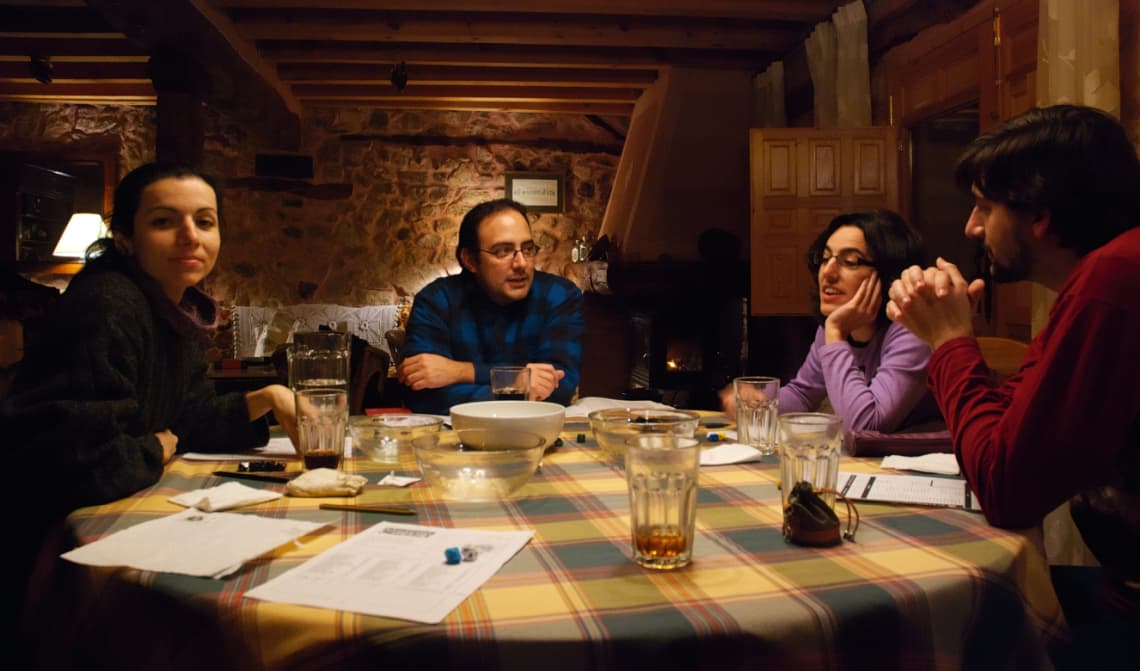
Why do some DMs play like this? Is it that they like power? Are they bullies? That's an easy explanation. I have to question if it's right. A lot of these DMs play for years like this and a lot of them manage to retain regular players - though, from my experience, such players are rarely happy. So what's going on here?
Saturday, July 29, 2017
Exchange
Hello All,
I was thinking. There ought to be some kind of service the reader can invent, that I can perform here on the blog, that would be worth $1 on my Patreon for the month of August. I won't ask for charity, not this time around; but the Patreon is going to be taken out in about 36 hours, so if someone wants to give me a dollar in that time, and suggest something I can give in return that's worth that much to you, maybe we can deal.
What'ya say? Answer a question? Explain something? I'm open to suggestions. Then you can donate a dollar to my Patreon for the month of August.
I was thinking. There ought to be some kind of service the reader can invent, that I can perform here on the blog, that would be worth $1 on my Patreon for the month of August. I won't ask for charity, not this time around; but the Patreon is going to be taken out in about 36 hours, so if someone wants to give me a dollar in that time, and suggest something I can give in return that's worth that much to you, maybe we can deal.
What'ya say? Answer a question? Explain something? I'm open to suggestions. Then you can donate a dollar to my Patreon for the month of August.
Subscribe to:
Posts (Atom)