What keeps the tech areas from bleeding into one another? How do two different tech areas exist alongside each other, or trade with each other? How does that work?
I'm quite sure that the reason this is a mystery is based upon the more dramatic instances of historical emigration. Europeans encountered primitive peoples living in Asia, Africa, the Americas and the Pacific and began a conquest that was greatly enabled by a superior technology. So it is assumed that if we have a superior technology, we will certainly rush in and take land away from those who have an inferior technology, yes?
Sort of. It is interesting to note that these indigent peoples who were eventually conquered were discovered three hundred years before most of the actual conquests took place. For a hundred years, the Dutch, English and Portuguese existed as nothing more than outposts in Africa, India and the Far East, even though they had vastly superior weapons and social organization. What they did not have were numbers. Therefore, until the industrial revolution made mass production possible, it was more practical to trade with backward regions than to attempt conquest. Most of the actual conquest of Africa and Asia did not begin until the early 19th century, post the Napoleonic wars.
There are exceptions, of course. India was greatly occupied by Britain in the mid-18th century, but only with the aid and benefit of the local Rajahs, who saw their own way to power by supporting the British. More than half the subcontinent was still under strict native control in the year 1800. South America is a better example, as the Spanish began smashing apart the native regions almost at once ~ but then, these regions were greatly under-populated compared to Africa and Asia. More to the point, South America had vast, unexploited resources, untapped by the natives, which served as an encouragement to conquest. Most of the resources in Africa and Asia were already exploited.
The same can be said of the United States, which had a motivation to take away the lands of lower tech societies because those lands were of great, unexploited value. Australia's conquest of the interior was quite different, given that most of the interior was uninhabitable and undesirable. Thus, while the American natives were exterminated or pushed out as soon as the higher tech Europeans arrived, the Australian natives experienced a longer period of co-existence because they did not have anything the Australians were inclined to take ~ whatever the disparity in tech levels.
Those parts of the world that did not have meaningful resources of any kind were left virtually untouched until the 20th century. Even though the British had gunboats, rifles and pistols, they did did not set out to exterminate the native Inuit in the 19th century because there was no reason to. In fact, there are no examples of acquisition or massacres by Europeans of Inuit in northern Canada and Greenland, as there are in southern Canada. Because the resources just aren't there.
As far as persons of different tech levels living side-by-side, I'm surprised that readers can't see the more obvious examples, those staring them right in the face. The depressed regions of West Virginia and Kentucky have existed right alongside Washington, D.C. and Philadelphia for two hundred years . . . yet the disparity between services in Maryland and southeastern Pennsylvania and West Virginia are still pronounced. Even the present day existence of computers and other technological innovations are sadly lacking in places like Tucker or Randolph counties, in the mountainous part of the state. How is it that the "invasion" of tech industry and social progressiveness hasn't caused these places to universally adopt ideas like free abortion, embraced homosexuality or social liberalism? Why are the hospitals of depressed areas not of a quality of hospitals in New York or San Francisco? How is it that these places of greatly different tech-level co-exist side by side without one bleeding into another?
If we remove the communication of instruments like the internet, television, radio and the telephone, taking us back to the 1870s, how much more backward is West Virginia compared with Washington? How is it that most people living in Washington city can read but most in Huntington West Virginia cannot? How can universities exist in Boston and New York but there are no great Universities in Morgantown or Charleston? And if we go back another century, to the time before the revolutionary war, how is it that there are Europeans living in Bucks County in Pennsylvania but there are none living in the Appalachians? How is it that these Europeans exist side-by-side with the vastly inferior tech people of the interior?
With the last post, I was asked about foreigners arriving in the fictional Jawanda interested in trading for slaves. I would ask in response, why would they go there? I've described the total population of the represented Jawanda being about 700 persons, scattered over an area the size of Rhode Island (about a fifth of Wales). How rational is that? It costs money to build boats and fund soldiers to go get slaves. Would it not make more sense to bypass Jawanda and go to another place with more food production and more people? There are no accounts of Europeans landing on Greenland's shores and seizing Inuit to be slaves on plantations in America. Certainly, it would have been easy to conquer the Inuit. Why did they not do so?
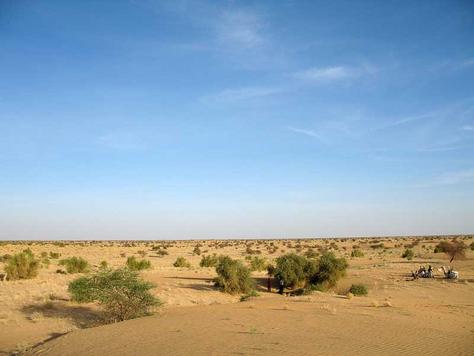
There are also parts of Africa ~ the depressed coastlines of Mauritania and Rio de Oro ~ that waited until the 19th century to be "conquered" by Europeans. Actually, the Europeans just showed up, pointed guns and were allowed to do whatever they wanted. But it took four centuries after the discovery of these lands for outsiders to bother. Until then, Rio de Oro was nominally under the authority of Morocco. And how did they interact with their overlords? They paid tribute in the shape of salt, skins and gums, in exchange for food. Just as I've described. And they did so for centuries, without the higher tech Morocco culture bleeding into Rio de Oro and Mauritania to any extent at all.
Because there were no meaningful resources! This is what readers just cannot understand. You cannot propose a motivation to conquest if there is nothing of value to take from the conquered region. Do you imagine that Europeans want to live the hard, unforgiving life I've described as the existence of Ai, Bodo or Cai, in the interior of Jawanda? Have we not already learned that white people in America do not want to take the jobs that illegal Mexicans are willing to perform?
Even if we handed Jawanda over to a higher tech region, lock, stock and barrel (though none of these things exist in Jawanda), the region would be abandoned within a year and the natives would move right back in. The higher tech skills of Europeans did not enable Jamestown, Port Royal or any of the other failed first colonial attempts on the American seaboard to survive ~ because Europeans just weren't strong enough or willing enough to survive in that kind of harsh, untouched wilderness. It took time and effort to remake even a golden land like America into a comfortable place to live: this still hasn't been done with the parts of the world that I am describing as tech-5.
This is what readers just won't get. These tech levels do not exist arbitrarily. They exist because the region itself, without the modern measure of information exchange, won't support a better tech level. Even if a better tech level is right next door.