Saturday, November 21, 2015

Technology 8

This is the fourth in a series of posts intended to provide a technological framework for my world.  The purpose of this framework is to create unique, regional settings for player interaction.  A realistic simulation of the actual world is not a goal of this system and will not be given credence when approving comments.

Regions with a technology of 8 will have an average population density of 756 to 1587 per 20-mile hex.  This includes the following regions, shown on this table:

one error: South Fjords should be 'halfling'

This technology accounts for 4,192.6 hexes of my world, occupied by 4,554,747 humanoids.

I've created/updated a similar table for tech 5, tech 6 and tech 7, that includes the general location of the region and which race dominates there, for those who would like to go back and look.

Available Technologies

See tech 7.  Picking which developments apply to which technologies is a tricky issue.  As a guideline, I'm attempting to include just enough new technologies to make a different world - but I can tell that in the upper levels that is going to take a lot of brain sweat to see fundamental changes in the culture.  At these early levels, a change like iron working can have big, obvious consequences - but with something like scientific method, that's been applied for about 58 years in my world by only a few individuals, those consequences are harder to see.

Nonetheless, we'll go with these for tech 8:

Agriculture develops a range of plant textile crops: cotton, jute, hemp, ramie, sisal, flax, etc., kicking off a whole artisan culture in the making of cloth goods.

Swords.  I meant to mention on the tech 7 page that swords were exempt from the tech, not because the weapon couldn't be made, but rather to make it wait for developments in sword mastery/balance that would make the sword more effective than an axe.  Plus it is nice to give one tech level where axes are common and swords are not.  With tech 8, however, swords become common.

Monotheism.  Significant tech areas adopt these alternative religions to polytheism or meditation, particularly in the west.  Regions in Asia, however, steadfastly retain their preferred religious forms - but the foundation of those religions become increasingly identified with one figure (Buddha) or a small collection of figures, giving them primacy over lesser gods (Shiva, Kali, Garuda), spawning cults that largely worship a single entity in the pantheon.

Monarchy.  Leadership of regional entities becomes profoundly hereditary, along with a rise in oligarchy that establishes a strong heirarchy of status within the culture.  Whereas previously the leader or an important person may have been accessible on the street by an ordinary person, common persons are now deliberately excised from the process of authority.  Laws begin to reflect the status of the defendant/property owner.

Fortifications.  Masonry is now increasingly applied to defense of the region, much more so to defend the existing upper classes from commoners.  There is, however, no significant castle building.  A 'keep' will be little more than a gatehouse and compound surrounded by an imposing stone wall, good for defense against riots but hardly sufficient for times of war.

Harbour.  For towns upon the water, significant efforts will be made to build stone quays, boat shelters, lighthouses and waterfronts for storage of goods.  Larger ships, cogs, develop to carry bulk trade goods such as grains, oils, ore and livestock.  Marines, soldiers expressly trained for fighting aboard ship and being able to swim, are commonly encountered, as are the pirates they defend against.

Horseback Riding.  Combat is carried out upon horseback, with the stirrup, not because this has been developed but because significant numbers of equestrian trainers exist in the region.  Camels become instruments of war as do elephants - but the elephant howdah and consequent fortified defense of elephant combat must wait for a higher tech level.  At this level, elephants are driven at the enemy and hope for the best.

Cantrips.  While magic spell use has not be created, the ability to use cantrips is possessed by a sub-mage class, or mage apprentices, which I'll call 'sibyls' for want of a word that describes a conjurer of very low power that creates rather than prophesies.  A 'sibyl,' I know, is an oracle - and the substance of most cantrips has little or nothing to do with mental abilities or effects, but are mostly modifications to the environment.  Unfortunately, I can't come up with a word that corresponds more to that than to possesing powers of divination; and some cantrips are person-affecting, so . . . sibyl it is.

That's a lot - but I'm satisfied all these should exist at about the same level.

Lifestyle - Rural

I've already said a lot about lifestyle in the above.  The individualism of culture will be much more pronounced than at lower tech levels, so it would take a long time to establish what every part of the culture would be doing - so I'll try to stick to sweeping definitions for generalized parts of the culture, changing my previous framework for headings (that's going to happen continuously as I go forward).

Clan leaders who have done well in resource management, who built larger houses, will acquire land, establish family names and allow inheritance of their offspring to continue their superior status.  Labor for these premiere families will take precedence over clan leadership, reducing many of the rural population to the status of wage slaves.  Those who distinguish themselves as trouble makers will be shut out and will become villeins or criminals (poachers, brigands, thieves, etc).

Inns will pop up along roads, attached to hamlets and villages within a mile or two of a major trade route.  Even tiny villages of a hundred persons will have a tavern, all of which will take coin in payment.  Coins are everywhere, now - for though no mint exists in the region, enough movement of money from outside has put a coin in everyone's pocket.  Virtually every rural denizen will seek ways to raise a bit extra of some product or accumulate some tiny amount of resource to collect a copper or two that will enable them a drink at the pub or pick up something useful that will make their homes more comfortable.

Rural homes will have pottery dishes, a real chair, a small instrument like a recorder, drum or box-lute for entertainment.  Beds will include feathers as well as straw.  The value of these will be a few dozen coppers, given that the pottery will be chipped, the chair well-worn and so on.

On the roads, caravans of wagons are starting to appear, bound for the largest cities, hauling primarily bulk goods (particularly food).

Lifestyle - Urban

Money will be everywhere and people will be moving about busily.  With the appearance of town walls and earthworks, the main center of town will be squeezed together and in some places passing through the narrow streets and lanes will be difficult.  Towns (3,000 to 9,999 humanoids) of this tech level will lack boulevards, as they have been built haphazardly by the people and not by administrative decisions (a higher tech level).  As such, congested is the order of the day for places where the artisans gather.

So far, guilds have not sprouted into being (also a higher tech level).  As such, competition is common but not fierce.  New goods are wanted so new makers, smiths and suppliers are free to begin in business as best they can.

On the edge of the town's center will be a number of inns and taverns, typically one of each for every 500 persons.  In cities (10,000+ humanoids), these will become defined by status, employment, ethnic background or whether they cater to outsiders/rural persons.  Persons will be asked to leave/denied lodging if they enter the wrong establishment.

In non-market towns, players will be able to find goods (when available) at the stockyards, the mason, the innkeeper, the chandler's and the carpenter's.  This includes the town market as well, shown below (random example):


In market towns, the selection is potentially anything.

I won't offer a breakdown of goods to be found in a typical home.  I'd like to write a long post about that sometime, but it's been in my head for years and I'm still not sure how I'd structure it.  But then, this tech thing has been in my head for years, too; everything gets addressed eventually.

Surrounding the town or city is an area of intensive agriculture.  Even at that, however, cities are beginning to challenge the potential for the surrounding hinterland - or indeed, the whole region - to supply it with enough food.  Thus the appearance of the cog and caravan, both noted above.

Despite being crowded, towns and cities are still relatively clean; most artisans continue to separate the unpleasant parts of their refining (animal slaughtering, oil distilling and the like) on the edge of town, so that the center is primarily employed for buying and selling of the finished goods.  Obviously, this will change.

Government

I don't want to say much about this, except to emphasize that it should not be a force that the players will have to reckon with.  At lower tech levels, it is probable that if a fight occurs, it will concern only a portion of the population that the players might annoy.  Now, however, we see the creation of a town guard, whose sole purpose is to keep fights from happening.  In the rural areas, fear of the leading families will cause most persons to tattle on players doing bad things in the country.

As such, there is now pressure on the players to behave themselves when under observation.  Problems, like starting bar fights, will probably be solved with summary executions (law courts and reasonable defense of self would be a higher tech level).  In many ways, therefore, a tech 8 town is more dangerous than a tech 12 town, as the players will probably not be given any chance to explain themselves.  This should be expressed very clearly to the players, outlining their character's ability to feel the 'mood' the region has towards strangers who don't play nice.

If the players won't listen, well, dogpile them with two or three hundred guards and kill their characters.

Admittedly, the guards shouldn't be treated as that bright.  And there will be a lot of things the guards won't bother to protect (the fields surrounding town, entry into the town, carrying weapons, hiring, buying land, etcetera), which can all be done without having to pay any tithes, tolls, fees or the like.  These things, too, are for a higher tech level.  Taxes exist, but these are usually obtained through pressure against the largest families and houses in the region.  The only tax the player character is likely to pay would be to have all goods seized following the character's summary execution.

Military

Along with the aforementioned marines and guards, we also have a small standing army, employed by the monarch (by whatever title is locally used).  This army exists for the monarch's personal use and is usually paid for by the monarch's resources (being a big landowner and probably an investor in a number of resource-oriented ventures).

However, this military carries the stamp of the state and as such its actions will be largely supported by the population.  When soldiers walk through the streets, the populace will melt back and struggle to be invisible.

As I saw, swords will supplant axes; daggers can be added to that.  Archery continues to hold its importance but now that accounts for perhaps a fifth of a troop's number.  Horses and cavalry will be at least half of any force (since the army and guard are still largely private in form), while ground troops will be those who cannot afford horses.  In effect, many soldiers will forsake training with a bow in favor of training with a horse and sword.  Lances will be popular.

Leather armor will be improved by studs, rings, small plates or whatever the reader likes that explains the apparent non-existence of 'studded leather armor.'  I'm content, personally, the pure leather covering can be and has been strengthened through many means that definitely fell short of scale and chain mail - so it, what ever it is, settles the AC 7 category satisfactorily.

A word or two about cantrips, I suppose.  Even with my changes, cantrips are not especially effective in combat.  Moreover, because the mage is a higher tech, it should be imagined that a single individual may possess one cantrip, possibly two - but no more, since a fundamental school of thaumaturgy doesn't exist in the region.  People, therefore, have learned what they might have a minor skill in picking up.  This is reflected in my character background generator, but that's not actually important just now.  For combat/military/encounters with the average enemy purposes, presume that 1 in 20 unusual persons (skilled, wealthy, stats averaging above 70) may possess a single random cantrip and that 1 in 20 of those might possess two.  Further magic use should be reserved for when actual mages appear.

Conclusion

I could write a lot more about this level of tech.  I've been working on this post three hours already, however.  I need to view this series in terms of giving a reasonable overview of the culture, not a detailed point by point account of the whole culture.  Though that would certainly be interesting to research and interesting to read, I think.

The quibbling seems to have settled down; I hope that is due to the clarification that this system is not meant to be a perfect representation of anything.  It's meant to help run the game.  Matt said it well the other day.  I'm not interested in 'realism,' I'm interested in results.  The detail is here so we're not wallowing around looking for an explanation for what the peasants and guards are trying to accomplish when talking to the party (get coins, defeat threats).  This does arm the players, for now they know what to expect when entering a pub or considering starting a fight there.  The world becomes less of a silly free-for-all where the players must make their own stupid entertainment and more of a mystery/thriller where every action has import and every success is contingent on skill and practice.

I think that most people who play don't believe there's room for skill in gaming because that would require a world where it was possible to fuck up.  Many players, I know, want to be consequence free in their play; or they have adapted mentally to the game where the only consequence - death - doesn't matter because every character they run is just another actor playing another interchangeable Dr. Who.

If my campaign has run for this long without becoming dull, it's because not fucking up is a huge element of the player's sense of purpose, ambition and motivation for victory - one that can't be dismissed so long as I provide endless possible ways that they can both fuck up and predictably avoid fucking up - allowing their skill at the game to supersede an innane quest for random fantasizing.


Friday, November 20, 2015

Technology 7

This is the third in a series of posts intended to provide a technological framework for my world.  The purpose of this framework is to create unique, regional settings for player interaction.  A realistic simulation of the actual world is not a goal of this system and will not be given credence when approving comments.

Regions with a technology of 7 will have an average population density of 360 to 755 per 20-mile hex.  This includes the following regions, shown on this table:


This technology accounts for 6,282.6 hexes of my world, occupied by 3,246,333 humanoids.

Available Technologies

See tech 5 and tech 6.  This gets more complicated as I go forward.  To keep it straight at this time, I'd like to address the new technologies in greater detail, starting with advancements on previous technologies.

Agriculture now includes irrigation in areas where water must be managed for crops (the deserts in particular).

Animal Husbandry expands to include elephants, mules, trained dogs and the breeding of menagerie-forms, such as birds, leopards, fur-bearing animals, D&D forms (worgs) and so on.  More sophisticated forms of leatherwork and other animal textile making develops among artisans.

Mining - I meant to make a note that tech 6 mining is largely the accumulation of placer deposits, silver, copper and gold.  Tech 7 mining would expand to include the four other most commonly identified metals, tin, iron, lead and mercury.  This enables the expansion of:

Bronze & Iron working, through the development of the charcoal furnace.  Since the tech system is not based upon historical development of learning how to work metals, but upon availability of knowledge, we skip right past bronze being the primary metal into iron.

Masonry, with quarrying, promotes the construction of permanent buildings, with consequent temples, palaces and public buildings (few in number, occasionally large in size but this would not be common).

Polytheism & Meditation are discussed below, under Religion.

Pottery promotes the storage of food, easier transport of goods, keeping accounts and greater security against drought (with consequently far fewer nomadic entities in the region).  Pottery and Agriculture together promote a greater population not involved in the matter of food production.

Sailing becomes common in regions adjacent to seas or large bodies of water.  This consists mostly of ketches or skiffs employing a lateen sail for short distances, typically less than 40 miles - however, denizens of the region begin to take their goods elsewhere by boat, now being less dependent upon outside merchants.  Sailors from these regions will begin appearing in foreign ports (in very small numbers).

Lifestyle

With larger and more permanent settlements and refined daily habits, the function of villages and towns orient more towards the artisan and administrator than towards herding and agriculture. While much of the village still moves outwards to fields during the day, the location of these fields is more stable from decade to decade as new soil and fertility is laid down by irrigation (silt) and natural fertilizers (cleaned manure by gong workers).  Hunting and gathering cease to be full-time occupations as the hinterland (and game) retreats from civilization, as timber is cut for kilns (pottery and smelting) or for building.

Clans and tribe associations have broken down in favor of status based on skills, occupation, talent/ability/chutzpah in the accumulation of friends or wealth (most often reflected in building larger homes or gathering larger flocks).  Resource acquisition/management defines much of what is important to the residents.  Even in the rural areas, there is a strong sense of developing one's life around gathering and trading in a village or town rather than living in perpetual isolation.

Money begins to appear (for even if currency is not part of the local technology, some leaks in), but by and large it is only accepted by persons who specifically deal with foreign matters (sailor/traders & administrators who must pay a tribute to more sophisticated entities).  Charity towards outsiders will disappear.

Theft will be minimum as there is very little to steal.  Most conflict will be violence-oriented, founded on feuds or possession of women.  Laws have been imposed to define ownership of property and personal rights, but taxes are unheard of.  When tribute is due, most of it is obtained through donation or social pressure against disliked persons.

Roads will be hard earth and beaten by wheels; traffic and foreigners along roads will be rare but familiar enough throughout the region to be ignored by locals.  Brigandage will exist but for the most part it exists to obtain food, animals or transport, all without the desire to murder.  Virtually no order or militia exists outside of towns, so brigands have very little to fear (they are starving for the most part, however, since traffic is minimal).

Children are everywhere.  A few are put to work as helpers or apprentices, depending on their age.  Street urchins are common, as there's enough charity towards youths to allow them to avoid the fields until age 8 to 10.  Beggars are rare unless there is a particularly genial individual who is well liked.  He or she is usually a drunk.  Villagers or townspeople will vigorously defend such a person or children if strangers are rude or abusive.

Settlements

Dwellings gather closely together and there grow specific streets organized for bartering (done mostly through agreed upon contracts).  Village buildings will be made of broken stone, mortar and timber (called 'half-timbered') when in long use.  In desert areas these buildings will be made of mud adobe (brick, timber and dried mud used as plaster).  Doors will be everywhere, promoting privacy.  Streets will be wide, open and buildings towards the edges of town will be scattered along pathways rather than lanes.

Gardens, small plots for pasturing animals, green spaces, fruit trees or ornamental shrubbery is a common feature, for population density in centers is very low compared to more urbanized tech levels.

Satellite homes, crude in construction, will appear outside of the village but nearby, owned by cotters and villeins, poor people who will find themselves pushed out of a developing social/status structure.  In desert areas these will still be tents.

In town, a watch has been imposed.  This is not ordered by authority but by artisans who are interested in protecting their shop stores and tools.  The watch has very little interest in defending the homes or property of farmers, who at any rate are safe for they have nothing to steal.

The range of activities increases.  A tavern appears that allows gathering for drink.  Common events associated with religion (weddings, burials) are complimented by monthly gatherings organized by occupations or authorities (for decision-making, announcements, spreading of news from outside, harvests, celebrating a new king, royal birth, etcetera), so that picnics and organized drinking fests gather large numbers upon green spaces or among the fields.

Authority

Decision-making manifests largely as a service industry to ensure good will between agriculturalists, herders, artisans, religionists and everyone else, promoting smooth interaction and protecting everyone against outsiders.  As this tech level suggests a region that is likely to receive steady attention from a distant emperor or king, some reporting is necessary (usually delivered by word of mouth) while word from above is passed down,  Opportunities are offered for young who want to go and become soldiers, as weapon use at this tech level is sophisticated enough (see below) to be of use to someone.

Usually, the leader is appointed by outsiders from among the most popular clan heads in the area (there are still clans, they are just less important), imposed upon the area or elected locally by agreement.  Rarely is this position hereditary.  Usurpation or public lynching is common when things don't work out. The leader protects himself with a private guard that receives lodging, good food, privileges throughout the region or territory and generally the freedom to seize or act as they will so long as this is not perpetrated against anyone important.  Outsiders are, by and large, fair game.

Religion

With the development of buildings and a population not dependent upon personal food production for survival, a religious class emerges.  These possess many of the sage abilities (up to and including authority level) which, I'm afraid, I haven't completed as a list.   The amateur level should give an idea of the wide range of abilities by such religious persons, denoting their importance to the community even though they are unable to use even 1st level cleric spells.

Gods and philosophy emerges as the locals embrace either Polytheism or Meditation as a belief-system.  Since these gods/practices are real, true enlightenment is developed about the will of the Gods, their desires, the general value of expanding the God's purpose, how the body and mind can find relevance in things like chi, atman and tantrism, etcetera.  The monk class appears (check it out, no mandatory minimum to intelligence in the original Player's Handbook).

Conflict

With the introduction of the battle axe and hand axe, along with the spear head (making the spear less likely to break in combat), there's a development in weapons that promotes a bilateral use of melee and archery when attacking the enemy.  Count on a half & half mix of either when meeting with a local enemy.  With this comes combat training and morale, so that the defenders will stand and fight rather than retreat . . . along with a host of fighter sage abilities that I also haven't written yet.  Just writing this here as a place holder.

Farmers will tend to use weapons based on tools - scythes, bo & jo sticks, quarterstaves and various clubs, rather than metal-based weapons.  Slings will continue to be traditional among the lower classes who do not have the time/wherewithal to train as archers. 

Leather armor appears but shields are considered impractical given weapon preferences.  While horsemanship (and other mounted combat) isn't part of the region's tech ability, a great emphasis will be placed on the importance of animals in the military - their treatment, the importance of using them for supplies, communication and so on.

Overall, a force can be gathered by the region of volunteers that will seriously challenge an enemy's potential for conquering the region - though not, obviously, an enemy of vastly superior technology.

Conclusion

My decision to advance through these particular technologies for this level (and every level) has been with a focus to how much is necessary to truly change the perspective environment the player would encounter upon entering the region.

I don't know what more I can say to emphasize that this system is designed to service players, not historical accuracy.


Stumbling Blocks II

Okay, back to brass tacks.

My second stumbling blog in the algorithm again puts me in the position of having to explain the presence of something not accounted for in the tech 5/tech 6 descriptions I've offered: market cities.

It says very clearly on the tech 6 page, quoted, "There will be no market, no money exchange, no services of any kind, nothing that can be bought . . ."  We can presume the same is true for the lower tech of 5, so what the hell.  How can there be markets?

Hm, yes, it is a puzzlement.

As with the first stumbling blocks post, the brand spanking new tech system has no direct relationship to the very old trade system - a trade system that established where market cities were located long before I remotely conceived of the present technological limitations.

So, as before, we have things to consider:

a)  Even though the tech in an area is very low, this doesn't keep outsiders from establishing trading posts within a given territory.  The Arabs did it along the coast of East Africa, the Chinese did it throughout the East Indies, Europeans did it in West Africa and the Caribbean, etc.  Other examples would be the Portuguese in Japan and Oman, the English trading post at Archangelsk and Venetian traders in the Crimean Tartar.  Many of these trade posts never developed as a political entity, so that they were under the suzerainty and legal system of the region with which they traded.  Some did develop political hegemonies (the English, Portuguese and French in India) but often after as much as a century of being at the mercy of the locals.  These foreigners did not freely share tech with the locals for damn good reasons; we shouldn't think that magic isn't treated with all the restrictions of chemistry and firearms (which didn't become widespread in native populations until the 18th century, a hundred years after my world takes place).'

b) Many of the low tech regions are part of larger political entities; it follows that trading posts would be established by higher tech masters in order to usefully exploit resources in low tech regions.

c) Players want to buy stuff.

All three of these, particularly the last, are reasons to maintain the presence of market cities.

Prior to this tech idea, I've allowed players to buy provisions and a limited number of artisan services (farrier work for horses, blacksmithing repairs, things an inn would sell or whatever local goods might be produced in an area) in any village, town or city, regardless of its trading status.  If, however, the players want something more sophisticated, they have to make a trip to a specific town designated as a market.  Not all markets are large cities and not all large cities are markets.  The encyclopedia I use must make specific reference to a city being a port, a junction, a commercial or economic centre, a trading center for the region's products and so on - which the encyclopedia describes readily as this is one of the chief ways in which to describe a city's value and importance.  If the encyclopedia makes no mention at all of a city's economy, I've chosen to read that as saying the city exists for some other reason than trade.

The change for a tech 5/tech 6 culture would be that NO products or services of any kind are available in ordinary settlements, period.  The markets, however, would still import and sell goods as they did previously.

Before an assumption is made about these markets, however, I must rush to assure the reader that these have never been market towns of great importance.  I had already designed my market/trade system to severely punish any town, even a market town, if it was out of the way - and most of these towns really are.

Garka, for instance, mentioned in the previous post, is a market town in the tech 5 region of Lungos Nad.  It is located on the Yenisey river and imports/exports with just two other market cities:  Yaxjasso, a city 18 days upriver, also on the Yenisey, and Dik'Don, an outpost on the Kara Sea some 140 miles beyond the Yenisey's mouth.  Dik'Don is 11.8 days away.

This may not seem far, but in terms of available products for purchase, it is crippling.  Dik'Don is literally in the middle of nowhere and connects to no other trading city except Garka.  Yaxjasso is a really big hobgoblin city, 49 000 people, with as many as 44 references (the world possesses more than 31 thousand total).  Yet Yaxjasso is 20+ days from any other trading city beyond it.  What actually reaches the market of Garka is not much. Mostly, Garka exists as a distribution point, gathering the goods of Lungos Nad (15 references) and pushing them up river.

So when I say the market towns in tech 5 regions are active, that's not saying much.

Some markets in tech 6 regions are more important.  One notable example is Tsaritsyn (modern day Volgograd, also Stalingrad), on the Volga river, a connecting link along the northern Silk Road from Astrakhan to the Black Sea.  Tsaritsyn cannot be described as off the beaten track - it is dead on the track as 'beaten' is defined.

Yet Tsaritsyn wasn't founded until 1589 (look it up).  The place where goods are transferred from the river to caravans heading west was used for centuries before anyone built a city there.  Thus, most of the trade going past Tsaritsyn bypasses the town - and no wonder, since it only has a population of 6,794.  It is a burg, hardly worth noticing, even though it does gather in 32 references from all over the territory it masters.  None of those other towns in the territory have as many as 650 residents; these are scattered over 94 hexes.  So while Tsaritsyn logically does have some trade, tech 6 perfectly defines the rest of the territory.

The question is, does the presence of a market make the town of Tsaritsyn itself better than tech 6?

I don't think so.  Even if there are goods that are available for purchase - a sword, say, which wasn't included in my tech 6 description - I would argue there's no one to teach a local resident how to use the sword.  If a local bought one, they'd pretty much use it as a club; and I'd define it as a club in a battle for combat rule purposes.  Only, given the cost of a sword vs the cost of a club, a sword would probably be kept as a decoration in this tech 6 province, not as a weapon.

But compare this argument (and this system) with actual history regarding the region of the Don Cossacks, which I've also defined as tech 6.  History, actual history, says that I'm wrong. That the cossacks did use swords, in fact they were famous for using swords.  And I've said so right on this blog.

Uh oh, what do I do now?  The algorithm has failed, hasn't it?

Bullshit.  I'm not running a simulation. Guess what - the details surrounding the lifestyle and practice of Don Cossacks has just been changed.  What a pity.  I guess all those sword details now apply to other cossacks, from other regions with a higher tech.

I don't feel a bit bad about that.  The algorithm, to me, is more important than maintaining historical accuracy.  I'm running a game here, not a history class.  I'm quite content to deviate from the world's reality if it means nailing down, at last, just what life for the Players will be like in a given part of that world.

Some people online will shake their heads and care about that.  But my players?  They won't feel a bit bad about it, either.  Plenty of places in the world will still exist that use swords.


Thursday, November 19, 2015

A Digression For the Sake of My Sanity

Many things were said today about the tech system I'm writing, some of it critical.  The criticism seems, in my limited ability to read English in a mind-reading fashion, to suggest that my tech system is unrealistic, imperfect, inflexible and - because it provides no room for DM fiat - incapable to representing various cultures in my universe, notably the Mayans.  Who, as it would happen, don't exist in humans in my world and wouldn't exist at all if my world were 'realistically presented,' since in 1650 the Spaniards had wiped them out.

It is worth noting that if I didn't run a game based on the real world, but upon places wholly from my imagination, all this criticism would look pretty stupid.

I don't think I've made any secret of the fact that this is MY world, not THE world - and that should be pretty clear, since the denizens in my example of a tech 5 culture are hobgoblins and that the name, 'Lungos Nad,' is 100% made up.  But never mind.  Please tell me again about the importance of deviating from the results I've obtained from an algorithm in favor of results I'm apparently expected to pull out of my ass.

I did describe Gilkask's existence as unexplained, once the mining of coal could no longer justify its existence.  In no way, however, does this challenge the validity of the algorithm that was meant to determine the tech of the region - except in the imaginations of people who are so short of imagination that they are limited to the equation, a higher population must equal higher tech.  No other explanation can be considered.  Period.  And my failure to accept that, well, that's because I'm ashamed to deviate, within two days of experimentation, of the algorithm I've proposed. 

Sigh.

None of this ranting accomplishes anything.  The thing about various gamers with a grudge to bear, they don't listen.  They don't change their minds.  They're so certain that the issue is that they haven't been perfectly understood in the argument that they're making, they'll just make the same argument all over again in different words.  If only I understood exactly what they're trying to tell me, I would agree immediately.  Because it is so obvious.  To them.

I'm looking at the words above and wondering why I don't just delete them and move onto the next point.  No, no, they can stay.  It's all part of what I'm trying to do here.

I did pretty well with explaining it to JB.  I am not concerned here that the tech levels are realistic or rational.  I am concerned with how the party will experience the adventure when moving through an area of this tech level.  That is it.  The value of the setting exists only in how it serves the party.  There is NO value in the setting presenting a simulation, if that in turn waters down the impact of "Nope, there is no technology here" in favor of the words, "Oh yes, there is one person in town who can get you what you want."

If the party can still get what they want from the place, the tech level is meaningless.  There might just as well not be a tech level.

It baffles me that this isn't obvious.

It suggests to me that many DMs out there are making worlds for their own sake, and NOT for the benefit of players running in those worlds.

That is a very sad revelation.

This is why a totally inflexible structure is the only one that makes sense: because the only culture that matters where it comes to my game is Player Culture.  I can't be concerned with what the hobgoblins or Mayans were 'really like' - I'm concerned that the players are going to be met with a very difficult situation, where the very, very best tech that's available in this huge region is that described under tech 5.  Because it's a long, hard crawl across that land before they finally stumble into a village with tended cattle and plowed fields.  Because that will ensure the players really understand, "Wow, what a dead little backwater that Lungos Nad was!"

Forgive this last attempt at an explanation.  I'm going to start killing comments based primarily around "what if you did this with the algorithm" made by people who actually don't understand what I'm doing with the one I'm using.

On the other hand, kimbo, if you're listening, you are my GOD today.


Rule: Never Compromise

It may be that I have a stubborn streak.  It may be my personal interpretation of science and the scientific method when I was young and imagined myself growing into Walter Reed or Charles Darwin.  Perhaps it is because I just want things to be harder than they have to be.

Nevertheless . . .

If we have it in our minds that we are going to build a structure that our game worlds will obey, we must first understand that the structure we design must be more important than our feelings about it.  For the structure to serve its purpose - that is, to provide a framework that the players will be able to predict as well as ourselves, we absolutely CANNOT change that framework, EVER, to suit a given circumstance or situation.  If we change any single entity or element of that structure, we must understand that the change must be to every other similar entity.  If we make specific exceptions for specific entities, we don't have a structure.  We have a collapsed pile of shit.

For example, let us say that the players move into an area where hobgoblins dwell.  After a session or two, the players learn that this is a hobgoblin kingdom, with hobgoblin cities and hobgoblin overlords - where everything non-hobgoblin is treated with disdain and with a will to cause the players certain death.  This can be good and scary, particularly as the players now find themselves having blundered sixty or eighty miles into hobgoblin territory.  We can now have a very powerful campaign where the players must rely upon their own strength and sense of direction to be safe again . . . so long as the hobgoblins live up to that expectation!

But if the DM decides to inject a hobgoblin family that shows kindness and compassion for the players, helping them get out of the country, whoops.  Probably, the DM figures, "Well, not all hobgoblins have to obey the norm.  And the players are safe."  Yes, they are.  No doubt, the DM feels very clever, putting in hobgoblins that aren't sadistic and cruel, blowing the stereotype.  Too bad, the players did not have to rely on their own resources.  The DM helped them.  Making the campaign a dud.  Hobgoblins?  Meh.  Not as nasty as their PR.

DMs everywhere wonder why campaign after campaign crashes and burns into player jokes, mockery, cheap bravado and ennui.  They do, because the DM's word is not the DM's bond - not only in the sense of the presentation from night to night, but in the world itself.  Because every time some structure in that world challenges the DM's preconceptions about what society ought to be or how people in a society ought to act, the DM immediately begins looking at the game from the perspective of someone socialized to interact in the present day, in a heterogeneous world where people aren't allowed to behave inflexibly or intolerantly.

Unfortunately for such DMs, much of the drama that makes tension is based upon characters, social systems, societies, cultures or philosophies that are incredibly inflexible.

Consider, for example, any horror movie of your choice.  Let's say, The Hills Have Eyes, that more or less describes the situation I've just described above.  The structure here is that the psychotic cannibals of this particular desert are ready to kill a party (family) that has just blundered into their territory.  There is no out except survival.  No remorse on the part of the killers, no rescuers, no survival except what the party attempts, no guarantees of survival, etcetera.  Plus lots and lots of tension.  So much tension that the DM (or director) gets uncomfortable with the situation - but unlike a DM, Wes Craven just doesn't give a shit.  He doesn't let his audience off the hook because that is the fucking point.

Most DMs do get uncomfortable with the structure, particularly as they watch their players shift from apparently comfortable fun times to oh my fucking gawd we're all going to die.  At that point, most DMs piss all over their own structure, help the players (fudging dice, injecting surprise allies, padding the treasure give) and destroy the tension.

When I say that I want a tech system that will limit an area's ability to provide resources (or contrariwise, with the higher techs, provide scary and aggressive authority figures with the power necessary to make life hard for the players), I mean that I want a tension-building structure that the players will have to accept and build their way past if they want to continue to accumulate treasure and power.  I'm not looking for a cutesy interesting fluff formula for painting the background.  I want a firm, stable and absolutely inviolable structure that says "NO, the tech level is this.  Live with it!"

This structure ideal cannot work if I am willing to circumvent it.  Damn, I don't know how clearly that has to be said.  I cannot - CANNOT - break my own structure.  When I do, I've compromised my players expectations, I've compromised their faith in me and my world, I've compromised the experience they could have had if I hadn't let myself off the proverbial hook. I have to strain myself, always, to go that much further in adjusting the structure within the boundaries I've created.  Otherwise, I need to trash the structure and replace it with one I will obey!  Otherwise, I'm only  compromising my principles, those based on my world living up to the game as it deserves to be played.

In the structure, sometimes, adjustments do have to be made.  Something is definitely going to have to be decided about the six market cities I now have in tech 5 regions.  I'll talk about that soon.  Those adjustments, however, cannot be decided on a whim.  The determination for how the structure is changed must be universal to all situations and they must not compromise the fundamental purpose of the technology level design - that is, to encourage a given behaviour in me and behaviour in my players.

Until the reader understands the principles of behavioural design, forget ever making anything that will invoke a useful, practical response in a user.

Stumbling Blocks

I'm coming across my first hurdle with the technology levels - the sort of hurdle that matters to me but which makes a lot of my readers pound their heads on desks wondering why in the hell I care.  Let's just remember I'm both crazy and a nerd.

It's my trade tables.  These are based on an encyclopedia, giving me a list of references for resources and services throughout my world.  The actual things that are connected to their geographical source are not determined by me, but by that encyclopedia - and as such, are in no way limited by the so-called tech system I'm developing.

I'll give an example.  There's a huge region that I've identified in my world as Lungos Nad.  This corresponds to the central part of a modern day massive Russian territory (krai) in Siberia, Krasnoyarsk.  It's the sort of world region that people in the west have never heard of.  In the 17th century, when my world takes place, it was mostly empty - so I filled it with gnolls (in the far north) and hobgoblins, just to give the region some flavor.

In the krai, in the far north, there is a city called Norilsk.  It was founded in the 1920s and quickly expanded into an important coal-mining centre, particularly during the World War II when Russia removed its industrial complex from the German front.  A host of valuable mineral deposits were also found there and are now exploited extensively.  At the time my encyclopedia was published, however (1952), the only thing worth mentioning - apparently - was the coal.  My encyclopedia mentions coal mining there on five different occasions, making it pretty important.

When I made the area into hobgoblin land (Vostoch), I naturally located a hobgoblin city where Norilsk is, presuming it would have been founded centuries earlier (after all, hobgoblin culture originates in central Siberia, right?).  I gave it a new name, Gilkask, something I think sounds more hobgoblinish.  In my world, it was founded in 746 AD and has a population of 6,780.  And in keeping with the spirit of the location, to give the city some dimension, I awarded the five references to coal mining in the region to 'Gilkask' that were given to Norilsk.  Only, these are now hobgoblin coal mines, for the hobgoblin ironmongering industry that is to be found in the environs of southern Vostoch.

Follow?  Well, even if the reader doesn't . . .

A couple of days ago, I've just designated that whole area as tech 5.  No mining.  Mining, I wrote yesterday, is tech 6.  Do I:

a) call Gilkask an exception, creating a precedent for endless exceptions whenever things get inconvenient, until the exceptions basically break the system and make it worthless?

b) remove the coal from Gilkask - and all mining references from any tech 5 region - in order to refine the previous trade system to reflect the new tech system, dovetailing the two systems together.

I'm inclined to do the latter; in fact, that is my desire.  There's just one problem.  As it happens, of all the areas defined as tech 5, Gilkask/Norilsk is the largest single habitation.  The next largest is a place called Garka (pop., 3035), also in Lungos Nad, based on a Russian city called 'Igarka.'  Gilkask is incredibly off the beaten track and surrounded by the Tunguska plateau - a huge mass of ancient, extruded volcanic rock that doesn't even get a Wikipedia entry, it is so remote - known chiefly for the event that occurred there in 1908.

If I take away the coal, Gilkask has no reason for being there.

I would normally argue that it is therefore some sort of religious site or institute of learning, but neither of those exist in a tech 5 region, either.

So why is it there?  Well, yes, because I'm shoehorning the real world into D&D, but buy into the fantasy, people!  For what reason could it exist, that far north, if not for economic, academic, political or religious reasons?  For my part, I can't embrace bullshit handwaving: "The Gods want it to be there" or some such crap.

My best argument is that the mammoth herds in the area are simply gigantic.  Hunting is a tech 5 technology, so Gilkask could be a central gathering place for scores of clans that gather there in tough times to hunt meat and skin mammoths.  However . . .

That should mean that Gilkask deserves a game meat or hides reference on the sources table, which would mean making one up and adding it, even though it isn't mentioned by the encyclopedia.  That sounds fine - except that it would be making an exception, creating a precedent for endless exceptions whenever things get inconvenient, until the exceptions basically break the system and make it worthless.

Yes, something I care about.

Ah well, no party player is ever going to go there, right?  And no player has the least understanding of any of these tables I post, or any concern about them, so if Gilkask is a big hobgoblin tent city in the middle of nowhere with no purpose at all, who is going to care - except me.

Sigh.  That's just poor, lazy thinking.  I'm sure I can do better.  I'm sure, if a player ever does go there, for whatever reason, I will have a damn good reason for Gilkask existing.  Maybe the hobgoblins just go there to pointlessly make tools.

Wednesday, November 18, 2015

The Busted Finger

There.  Life is okay.  I have my s-key finger back.  'Course, now I have to adjust to no longer using the middle finger on my left hand for that.  Adjustments, adjustments . . .

I've got my mind full of technology rates and geographical social structure at the moment, but I just wanted to stop long enough to journal about the finger and the improvement in my condition.  I saw the doctor today, he tells me it's all good - but two weeks of using the hand brace shown.  Hrm.  I want my a-key back.

Ah well.

Technology 6

This is the second in a series of posts intended to provide a technological framework for my world.  See this post for details.  I recommend reading that post before commenting here.  Here, a technology of 6 is meant to conform to the same degree of average intelligence of a given culture.

Regions with a technology of 6 will have a population density of 172 to 359 per 20-mile hex.  This includes the following regions, shown by this table:


This technology accounts for 2,432.3 hexes of my world, occupied by 651,209 humanoids.

Available Technologies

See tech 5.

Further technologies are dependent somewhat upon environment:

Boreal Forests: archery, mining; limited agriculture, animal husbandry and the wheel.
Desert:  animal husbandry, the wheel; limited agriculture and archery.
Steppe: agriculture, animal husbandry; limited archery and the wheel.
Steppe, Wooded: agriculture, animal husbandry, archery, mining, the wheel.
Tundra: animal husbandry, mining; limited agriculture and archery.

This breakdown has everything to do with the abundance of suitable land, potential animals for domestication, availability of timber, the presence of mineral deposits or the practicality of the wheel.

Whereas in the present day all of these technologies will have penetrated into all these areas, not so much in the 17th century.  Issykiang and Trakhan, for example, are mountain kingdoms above 8,000 feet in the Tien Shan and Himalaya mountains, high above the treeline and virtually impassible by road or cart; trade is accomplished by donkey and mule.  Comparatively, the boreal forests allow herding of reindeer, but not most traditionally domesticated animals.  For some of these, carts and wagons exist but not in high numbers and not generally used by the locals (outsiders, from more sophisticated cultures, would bring in carts but not in high numbers and only in very limited parts of the region).

Two technologies are not included in the above; both are also dependent upon the region, but on a case by case basis I don't wish to outline here.  These are animism and mantraism.  A description of both can be read below, under religion.

Note: neither of these appear in the Civ IV literature, which my tech system is trying to reflect.  I am struggling not to enable clericism (the spellcasting practice) until tech/intelligence of 9, since that is the wisdom that a character must have in order to be a cleric.  However, a primitive culture without a religion won't work and I want to acknowledge even at lower levels that some sort of magic exists in the religions that are practiced.  This will take some brain-sweat.

Lifestyle

As agriculture and herding become widespread, much of the population will collect as a sedentary mass.  This will not describe everyone, of course; many will continue to hunt and gather, exclusively or during given seasons (the population might abandon their fields for a week or two if it is known that the salmon are running, for example).

Still, farms will demand a more permanent form of settlement, with fixed wooden buildings where wood is available.  Tent villages in desert areas will fix around reliable oases and will incorporate low brick walls (3-4 feet in height) - these will be nothing like true masonry, however, not possessing doors, lintels, roofs, etcetera.  Where settlements occur, fertile soils will also exist - though in regions where agriculture is limited such soils will only exist where settlements have been established.

Rivers and trail routes will become important for communication and there will be small groups of three or four persons who will travel solely for spreading information.  Camels, donkeys and horses will be employed for this work.  There will be less nomadic movement and clans that are moving will tend to be refugees rather than habitual wanderers.  Clans will grow large and subdivide into bands, organized by family; multiple clans will begin to identify as tribes and will seek aid from one another in times of trouble.

Children will increase in number and populations will expand to the limitation of the food supply. Women will work alongside men and children will often be carried along and left on the edge of fields where they will be cared for by other children.  Finding a group of untended children will not be unusual, but such children will usually flee if approached.

Persons will raise crops in small gardens around their homes and keep animals in adjacent pens; however, fields will be distant from the home as shifting cultivation is the norm.  That is because a piece of land that is farmed will become devoid of nutrients entirely after five or six years, with yields declining.  Farmers will then abandon these lands, clear a new plot somewhere else and allow the forest to reestablish itself or the river to flood and reinvigorate the land (which may take 10-20 years) before it can be farmed again.  Thus, the actual plot a given family (band) cultivates may be a mile or more away from their home, requiring daily travel.

At certain times of the year, various clans with gather with the rest of their tribes for festivals.

Settlements

Villages will be scattered rather than tight in form.  A single village of 500 may cover an area up to a mile in diameter. Fortifications will not exist.  Villages will be quiet and unoccupied during the day, as most of the population will migrate outwards to the fields (or to herd their flocks) in the morning and back again at night.  There will be no market, no money exchange, no services of any kind, nothing that can be bought and for the most part no work to do for strangers; however, if food is abundant generosity will be in order, with players being offered three to five days of food freely if they are hard up.  In scarce times strangers will be threatened to go away.  During winters much of the population will largely hibernate until warmer months.  Desert peoples will loll during the hottest months.

Homes will be small, designed only for sleeping, as craft work is limited to fixing or repairing tools and equipment for animals and farming (done outside).  Most cooking and eating will be done outside.  No workshops will exist.

Authority

Decisions within clans (the size of the village) will be made among the eldest family leaders of each band, usually with the largest and strongest band carrying the power in the clan.  The term 'chief' will now apply to the tribe itself, who will choose advisors from the various clans.  Each advisor will be in communication with their clan but will largely give advice that is perceived as what the clan would want rather than directly asking the clan's decision.  This is due to limitations in communication, as chiefs must make decisions quickly.

Various tribes may have blood feuds against one another but continue to identify as part of a single whole.  Some regions, such as the Don Cossacks, the Zafara Beduoins or the Hat of the Issykiang will have no nominal leader above that of tribal chiefs - joint policy is determined by council.  Other regions may have a sultan, orkhan, subahdar, count, sheik and so on who is the leader of a very strong tribe that enforces tribute upon lesser tribes in the region.  Such leaders may then pay a similar tribute to the larger state on an annual basis.  Tribute always takes the form of luxuries (such as spices, incense, mined gems, etc) or provided soldiers (feudalism).

Religion

Both mantraism and animism are enlightened forms of shamanism (see tech 5) that offer greater control over wild magic.  While neither religion incorporates the use of spells by clerics, they do enable multiple members of a clan to work together through clans and ceremonies to more greatly influence the world around them (to locate lost animals, cure persons from illness or injury, succeed in competitive sport or battle, return safely from a journey and so on).

The effectiveness of this magic is extremely limited.  In game terms, it will mitigate the severity of disease, give a +1 to a saving throw, ensure a safe burial or allow some application of what in my world are clerical amateur sage abilities.  These are often obtained through chance enlightenment rather than individual skill (as a cleric would possess but a practitioner of mantras would not).

Conflict

The chief advancement is obviously archery.  Without an additional improvement in hand-held weapons over tech 5, combat by such persons will largely be defensive, with archers backing away or fleeing to another position rather than advancing into melee.  Most combats will be ranged and consist of brief sorties or ambushes, lasting three or four rounds before the attackers withdraw.  The best tactic will be to repeatedly try to catch the enemy in surprise, do damage and then move away, wearing down an enemy force over time (several days) before making demands (tribute) in order to end the harassment.

Animals will not be ridden into combat but will instead be used strictly for transport to the battle area or for withdrawing.  Note, as I said, all technologies in my world exist in the same period and are not tied to historical development - as such, no peoples anywhere in my world use chariots.  The link explains why.

Conclusion

This is already becoming more complicated.  I can really see this dragging out longer and longer as I go forward - so the reader shouldn't expect that I'm going to do one of these every day.  For one thing, my finger is still broken.  My typing is up to 40 wpm but it is a steady annoyance to write and write and write - to say nothing of the research this process is going to require to nail down things.

Believe me, I'm not arguing that research is perfect.  Please point out issues, ask questions, promote my need to elaborate on things and be forward with critical analysis of my points.  Don't just take my word for it.  I'd like these tech levels to be as precise as possible (while the real world isn't, obviously) so that a given region can be presented to characters in the game to give them a FEEL for the region's culture and personal interaction.


Tuesday, November 17, 2015

Technology 5

This is the first in a series of posts intended to provide a technological framework for my world.  See this post for details.  I recommend reading that post before commenting here.  Note that technologies 1-4 describe animal levels of awareness and intelligence; a technology of 5 (same level of intelligence) is necessary for complex society.

Regions with a technology limited to 5 will have a population density of 171 or less per 20-mile hex.  This includes the following regions, demonstrated by this table:


This technology accounts for 4,187.1 hexes of my world, occupied by 264,607 humanoids.

Available technologies

Fishing, hunting, foraging, mysticism and trapping.

Lifestyle

These are humanoids who survive in some of the harshest landscapes imaginable, too cold, too wet or too arid for farming.  They depend on a wide variety of naturally occurring seeds, nuts, fruits, roots, game and fish, each of which may be available in certain seasons and in particular places.  These people do not store food, though they may freeze some in the far north or accumulate seeds and nuts for some periods of the year.  As such, they are dependent on daily activity to find enough food to sustain them.  Hunters and gatherers must therefore spend much of their time in steady migration.  Even so, periods of abundance alternate with periods of scarcity.

In latter cases, any food source - including player characters - will do in a pinch.  Thus food is an excellent means of winning over these people if conflict is not desired.

Hunter gatherer groups will move in clans, typically not more than 100 in number and normally much fewer - around 30, including men, women and children.  Because of the difficulties of raising and carrying infants, various methods of population control - including spacing of children and even infanticide - are practiced in order to make sure that another child is not born before the previous offspring can walk.  Note that none of these humanoids will possess domestic animals for work (some may be friendly with dogs, but these will not be trained).

This means that even in desert climes, travel will be on foot.  Though camels and such may be available in nearby political entities, the skill at managing such animals does not exist among these peoples, who will remain stubbornly traditional (do remember, this is 1650, so that such regions off the beaten track may have no reason to encounter domesticated animals).

Settlements

Where sources of wild food are abundant - when the salmon are running or the trees full of nuts and fruits - groups may stay in one place for several months.  Some locations - river fords, sheltered areas, places of exchange - will become more or less permanently occupied, though not necessarily by the same clans from month to month, so that 'villages' are occupied by an ever-changing set of residents.

Most homes, especially during the nomadic existence of clans, will be temporary shelters - caves or shelters constructed of perishable materials such as wood, leaves and skins.  Desert tribes will dwell in tents.  Some of these shelters can be complex in form.  While these are gathered to make settlements, little or no effort is taken to alter the land around settlements once they form. There are typically no walls, even of brush, as there exists no continuous leader to both create such defenses and then maintain them (as clan chiefs move on with their people).

Authority

Individual clan chiefs, through the leading members of families, have absolute autocratic authority in most cases.  They have typically become chiefs through their ability to find food for the clan - and so their power is supported by lesser clan members who fear starvation if the chief is killed or forced into exile.

Virtually all outside authority (typically a higher tech level) will control tech-5 entities by random tribute, often seizing food or collected valuables (like furs, pearls and other valuable stones or other odd items) without offering any compensation.  Occasionally food is offered as compensation for trapping or animal skins.

Religion

Mysticism allows only one form of religious-magical practice, shamanism.  This allows for some limited communication (through signs) with the environment or with ancestors, increased fertility, the relieving or giving of curses and prediction through portents.  Shamanism does not, however, allow for the casting of spells; rather, it is merely an ability to tap into the wild magic that exists everywhere.

Shamans are typically a single person within a clan, with one apprentice.  Often the chief and the shaman are the same individual.  Take note that technology-five does not allow for the erecting of monuments or permanent physical markers of religion, though temporary markers made of carved wood will be found, when wood is available.  Tokens are commonly carried.

Conflict

Weapons are limited to what can be manufactured by hand, consisting of stone, flint and wooden materials, including spears, javelins, clubs, slings and the like.  Armor consists, at most, of shields only.  Most non-humans will not use shields, as they possess naturally tougher skins and shields are difficult to construct or carry.  Much of these humanoids' lives will be in complete isolation.

Fights over territory that is rich in food supplies will occur, particularly in scarce seasons, but the size of the land and continuous movement will mean most conflict occurs between the humanoid and the environment.

Conclusion

I'm sure there's a lot more to cover, but this includes my thinking so far.  I intend to do a post like this for each tech level.  As the levels become more complicated, I'm sure that there will be a lot more to say and describe.  Meanwhile, I'll certainly take ideas about headings to include as I go, adding content to these posts as it occurs to me (so consider the content to be fairly fluid for a time).  Particularly, I want to make the above more concrete for application in player-NPC relations.

The Size of Alexis' World

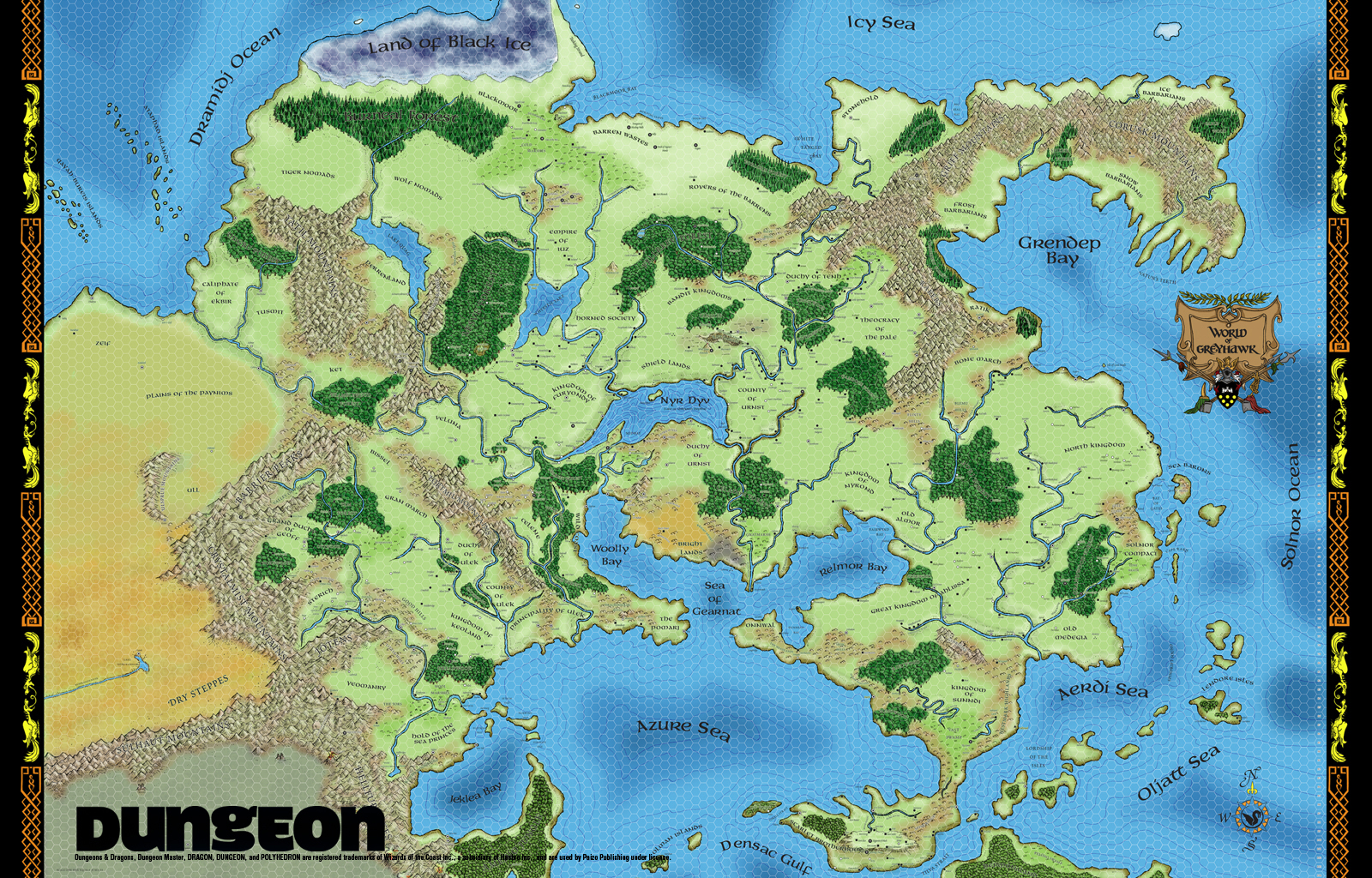
The size of my world thus far:

Blue area indicates portion of the world that has
been mapped with 20-mile hexes.

The above represents about 10 years work.  I began the present mapping scheme sometime in Oct-Nov 2005, after about a year of tweaking and information gathering.  Time was then wasted with formatting problems and then program changes (Publisher 2005 to Publisher 2010), so that much of the above was redrawn three times.

In the last 18 months I've added Spain, much of North Africa, Burma and - of late - Paraguay.  I have the method fairly hammered down now, so that I can add areas much more quickly.  As well, since most of Europe is done, the rest of the world is much less intense and complicated.  I have only three difficult areas left: China, Japan and the British Isles.

This past week, I've been updating my Cities list to reflect recently added areas (note, Paraguay isn't included, as that area is not part of the united system).  Even though there are large parts of the world I haven't done, I have enough information to play with it a bit.  The following, take note, only applies to regions under political control, limited to what I've mapped.  Also, I haven't done work to determine how much empty sea I've mapped or how much empty desert region.  That can wait, as I have a new project in mind.

First, however, some statistics:

Total Area:  33,459.3 hexes.  Each 20 mile hex is 346.41 sq.mi. in area, according to this calculator (measured along the d2 axis).  This tells me my civilized world equals 11,590,636 square miles, or a little more than 1/5th of the world's land surface.  In comparison, Greyhawk is a very respectable 16,700 hexes.

Total Population:  234,391,087.  I that seems a bit high, then I would point out that my world does take place later than the usual medieval period, in the year 1650.  Of course the number is the result of an algorithm based on the present size of cities measured against their age since being founded (in other words, a made up number).

Number of Independent Political Entities:  145.  This includes all the empires, kingdoms, duchies, principalities and so on.  The Holy Roman Empire is counted as one entity - though that includes 102 sub-entities, that in turn have sub-entities of their own.

Largest Independent Entity.  By area:  The Empire of the Ottomans, 4,774.8 hexes.  By population: The Moghul Empire, 69,321,795.

Smallest Independent Entity.  By area:  There are a number of independent free cities, all of which are counted as 1/10th of a hex - but the one with the smallest population is Obernai, a free city in Alsace (western France).  Obernai is also the smallest independent entity in terms of population.

Number of Subdivisions, including independent entities that have no subdivisions: 1,018.

Largest Subdivision.  By area:  Samoyadia, a gnoll-occupied region in north central Siberia, 730.7 hexes.  It corresponds to modern day Taymyr.  By population:  Hindustan, in the Moghul Empire, 14,144,861.  That population is considerably higher today.

Smallest Subdivision.  By area: again, it is still Obernai.  By population:  Zyria, part of the Ogreish khanate of Bulgrastan, 958.  Zyria is a part of the modern day Perm Krai.

Total average population density: 7,005 per hex.

It is in this last detail that I think I have something interesting to play with as regards my world.

At the moment, I tend to think while running in three conditions of 'civilization':  virtually none, backwards and advanced.  There are obviously more degrees than those, but in the moment of describing some peoples or environment, I tend to default to those.  What I really need is an established framework that breaks down regions technologically, so that I have a clear and established idea of the level of political interaction, military force and economic development - and to have this provide details that the players will care about: i.e, housing, available resources, services, purchasable goods, etcetera.

I think I can base a structure for these things from the population densities of the various regions in my world.  I'd like to hinge such a structure to the intelligence of monsters, so that I can determine the 'tech level' of more than just the civilized entities above, but to all communal entities in my world, relating their intelligence to the tools they'll be using.

As such, the lowest tech level will be five, not one - because the least intelligence that will allow a complex social structure is five (the lowest number listed as 'low' intelligence).  Tech levels will therefore reach from 5 to 25 (though of course anything higher than 18 would be reserved for other planes of existence).

I mean to write a series of posts that will break down this technological structure down into useful details, one technology at a time.  This series will not describe the final arbitration of said structure - I expect that changes will have to be made as I move forward, as I can't be absolutely sure what developments should apply to what specific tech levels.  For example, is 'agriculture' properly tech 5 (nearly stone age) or tech 6?

I won't be basing this tech level system on historical development, for one simple reason: all these technology levels must exist simultaneously in the same world, adjacent to one another.  Therefore, it must be noted that while one part of France, say, may be backward and less developed than another, the key to telling the difference isn't in what is known to the people (that is, invented) but in terms of what is available.  "Yes, we know what a crossbow is; but there are no crossbows around here, or anyone who knows how to use one or fix one."

That is the goal.  Wish me luck.


Sunday, November 15, 2015

The Deserving

Do I want to say anything about Paris?

No, not really.  I can't find the wherewithal to join the masses of people who choose to keenly feel these deaths of a 129 (or possibly more) victims while blithely overlooking for months the thousands dying in Syria, Iraq, Jordan, Burma, Zaire . . . but then, when these things happen, I always seem to be the only person with a memory of the world that actually reaches back before Friday.

I believe it is because many Westerners or First Worlders have an impression that when a woman and her children die in Syria because a French, American or Russian bomb hits the building across the street, that death is somehow deserved because those people are foolish enough to have been born in Syria . . . whereas the death of people in a football stadium in Paris are victims of a greater tragedy because they had the good sense to live in Paris.

In tragedy, geography is everything.  So is coverage and so is public relations.  Google did not create a black ribbon for all those poor little brown people dying in Gilead, L'Abba and Anbar.  But those are vague, unfamiliar names, so fuck those people.  These are people who died in Paris!  A center of civilization!

I don't see any difference between one violent death and another.  If we're going to gnash our teeth and cry for these people, let's take the next step and give a damn about everybody.  We haven't done that.  Instead, we've pissed on a large part of the world with our arms sales and colonial resource rape, our insistence on controlling every government run by people who have less resources than us and we have casually spent the lives of millions of people to make billions of dollars we toss into our coffers with the label, "Entrepreneurism."  We piss on these people and then we sell them guns, then we sell their neighbors guns, then we encourage neighbor to fight neighbor amid a chaos where their mothers, fathers, sisters, brothers and children die every day, then we throw more fuel on the fire by telling them they're dirty and ignorant, unwanted and unimportant, followed by press stories of how much we hate immigrants.  Which are run on global networks every day.

Then some of these sad, miserable, hated, ignorant people with guns sneak into our house and shoot some of our family and we cry out about the indecency of it all.

Yes, it is all indecent.  All of it.  All of us.

But we with the bigger voices and the greater resources will now bellow very loudly for several months (and then again for the next ten anniversaries) about OUR pain and OUR loss and fuck those other people, fuck them, fuck their losses, fuck their world, fuck their resistance to our will and their misery under the official justice wrought through our economic crapulence.

Fuck them.


Selby's Review of How to Run

It never hurts to find another review: from Preston Selby.

I'll refrain from commenting on this post or Selby's review, at all, so don't ask me questions.  The book itself is my best reply.  If anyone else wants to discuss, however, the comments section is there.