Of late, I have been having a crisis of conscience. Having my general view of the community, and watching the nonsense surrounding Raggi's latest venture, I am loathe myself to monetize my hobby, even if the concept of my Conflict! interactive system is worth real money. I am experiencing a fairly common artistic emotion at present, that emotion that comes with being uncertain of the value of one's work, or even the interest in one's work. Having conceived of the game system five months ago, I am now unconvinced that it is everything I believed it was when I first conceived of it.
In the first place, it did come together more or less as I imagined it would. I structured the rules, I worked out the cards, I printed the cards and I began play-testing. The play-tests went wonderfully and the few problems were resolved easily by simply eliminating things that were unnecessarily complicated. I sat down to write out the rules and to put together the art for the production.
Unfortunately, I have come across something unforeseen. The system was designed to resolve the mechanical problem of conflicts between players and non-player characters, so that the judgement call that usually fell on the DM's shoulders would be given defined limits. Yes, the DM would still have to make a call on how an opponent responded to a particular argument or proposal by a player, but that call could not have the opponent react negatively when the system clearly dictated that the response would have to be a positive one.
Strangely, however, I am not certain this was ever a problem that I really needed to be solved.
I have been playing the last two months without the cards - a sort of alternative gametesting - and I am not feeling that my game is lacking, now that I have played both with and without. Perhaps it is the players I play with ... they are not the sort who go out of their way to interact with others in my world, despite my attempts to instigate interactions. They will typically ignore anyone who isn't dangerous, and they will typically listen to anyone - respectfully - who is willing to parlay and who clearly is dangerous. It doesn't seem to occur to my party to attempt to bend anyone else's actions to the party's will by discourse, so if we don't play with the Conflict! system, we don't really miss the Conflict! system.
So I am out of sorts. On the one hand, I don't feel I want to spend the next three years organizing games using this system, attending various conventions talking to people I'm not going to like, selling something I don't feel I need to use myself, in order to have myself identified 'til gawd knows when with this system. And on the other hand, I'm not convinced any longer that the game really needs this system in the first place. Perhaps the arguments between DMs and Players don't need a system to define limits - perhaps it's only that DMs have to stop "playing" and Players have to stop trying to get more than they deserve by "DMing."
I don't know. My inclination at the moment is to talk to some people about this, hear some advice and quite probably just lay out the whole system here in the next couple of weeks. This would get the monkey off my back and I could go back to trying to sell my books (hopeless project that that has been) like I ought to. I am thinking I should make a quick edit of my latest novel and go the rounds again with publishers. Right now, that feels like a better career path that selling cards to squawking children who are offended at nasty pictures. Even if the latter is potentially worth a lot of money.
That's where I am at the moment. I suppose if I decide to go forward, I'll have to delete this post and pretend I never wrote it. But at least no one can accuse me of not being straightforward, open, vulnerable and self-explicit about my intentions, my commitment to this game and my life.
Monday, June 20, 2011

Friday, June 17, 2011
Fancy Gems
It has long baffled me that the list of gems in the DMG that are listed as being worth 50 g.p. are "semi-precious," while the next higher group are called "fancy." Surely this is a misprint. I have always treated it as such.
Ages ago I printed a list of ornamental gems, which continues to be the second most popular post ever on this blog. I have no idea why. For a long time I've meant to follow it up with the next group (I downloaded the pictures about six months ago) but I haven't been motivated. But since I have been working on gems this week, I guess I'll go ahead.
So here are the fancy stones (as I call them - fuck the book), with visual aids and links. The list only includes gems for which I have references. I no longer consider them to be 'worth the same amount,' though the biggest stones tend to fit into the 10 to 30 g.p. range. Not quite the same as the book, I know, but as I've said, the prices differ in my world for where you are. Included below is a price list for Kronstadt:


Ages ago I printed a list of ornamental gems, which continues to be the second most popular post ever on this blog. I have no idea why. For a long time I've meant to follow it up with the next group (I downloaded the pictures about six months ago) but I haven't been motivated. But since I have been working on gems this week, I guess I'll go ahead.
So here are the fancy stones (as I call them - fuck the book), with visual aids and links. The list only includes gems for which I have references. I no longer consider them to be 'worth the same amount,' though the biggest stones tend to fit into the 10 to 30 g.p. range. Not quite the same as the book, I know, but as I've said, the prices differ in my world for where you are. Included below is a price list for Kronstadt:

As before, I've tried to find pictures that show the gems in their polished state. Again, I've included the locations where they are found on Earth. The reader will notice, no doubt, that I've downgraded amethyst ... I have heard the rumors about it being rare and so on prior to the modern age, but I believe magic would have compensated for that, so I have reduced amethyst down one level in terms of value.
Also note that a lot of these tend to be the same gemstones. Amethyst is quartz, as is petrified wood in many cases (contaminated with carbon, cobalt, chromium, copper, iron or manganese). Bloodstone, chrysoprase and jasper are all forms of chalcedony.
Amethyst: America, Auvergne (France), Brazil, Ceylon, India, Madagascar, Meuglitz river basin (Czech Republic), Southwest Africa, Uruguay.

Bloodstone: America, Australia, Brazil, China, India.

Carnelian: Anatolia (Turkey), Brazil, India, Uruguay.

Chalcedony: Madagascar, Brazil, India, Uruguay.

Chrysoprase: Arizona, Brazil, California, India, Madagascar, Queensland (Australia), South Africa, Upper Silesia (Poland).

Citrine: Bahia (Brazil), Colorado, Cordoba (Spain), France, Goias (Brazil), Madagascar, Minas Gerais (Brazil), Salamanca (Spain), Scotland.

Corundum: Azerbaidzhan, Madagascar.

Jasper: America, Baden (Germany), Dauphine (France), Deccan Plateau (India), Egypt, Hunruck Mts. (Germany), North Carolina, Saxony (Germany).

Moonstone: America, Australia, Burma, Brazil, Canada, Ceylon, Colorado, India, Karelia (Russia), Madagascar, Southwest Africa, Tanzania.

Onyx: America, Argentina, Atlas Mts. (Algeria), Mexico.

Opal, common: Hungary, India, Mexico, Nevada, Western Australia.

Petrified Wood: Cairo (Egypt), Holbrook (Arizona), Patagonia (Argentina), Virgin Valley (Nevada).

Zircon: Australia, Burma, Cambodia, Ceylon, Haute-Loire (France), Madagascar, Tanzania, Thailand, Vietnam.

Wednesday, June 15, 2011
It Occurs to Me ...
Mucking about with my trade and equipment tables this last week, and I have a few questions that have come up. For example, how large, exactly, are gems?
I don’t doubt a lot of worlds would enjoy having these small cheap gems in great proliferation, and the players wouldn’t either, as long as they find three or four hundred of them in a good sized trove. The question is, how do you determine when the gem is pea-sized, and when it is the size of a walnut? Or, for that matter, when it’s the size of a marble, a cherry or an almond? And if you want to have a list for every size and kind of gem, how long is your equipment list going to get?
There’s another problem that I’ve always wondered about. If a garnet or an amethyst is 100 g.p. for a walnut-sized gem (letting that go for the moment), what about when the party stumbles across a geode? Does it just never happen? Because I have to tell you, for a geologist who is dedicated, these just aren’t that hard to come up with. My father found three, two ordinary quartz and one rose quartz) in the five years he was attending the Colorado School of Mines in Golden, back in the 1950’s when a lot of the back country of western Colorado was still unsurveyed. Just little ones, eight or nine inches across, but big enough to get one hell of a lot of stones out of them if the geode wasn’t too pretty to break up. I’ve seen hundreds of amethyst and garnet geodes out on display at various fairs, which seems awful common for something listed as ‘semi-precious’ in the books.
And as far as ornamental stones, I grew up swimming at a beach where we had to walk across a bed of stones to get to where the sand covered the lake bottom, and those stones were in large part either agate, quartz or quartzite. We used to pick out the pretty ones and tumble them, and they came out pretty much the same as the stones I’ve seen for sale in rock shops. My brother had one cut and set into a ring he wore for many years, and it looked as sharp as any agate ring I’ve seen. Seems to me, unless for some reason your world is remarkably short of quartz, the value of the ornemental stones listed is pretty high ... unless, of course, they all weigh half a pound, as gygaxian logic suggests.
Listen, these are just questions. If you’d like to tell me what I’m missing, I’d consider it a great help. I’m just thinking that if agate, which is common enough that the only value in the stone is the effort to tumble it (and it would have been harder in the medieval age, as we used an electrically-powered rock tumbler), how exactly does one decide where the rarity of the stone begins to outstrip the effort it takes to polish and prepare it?
Different subject, them. How much of the arrow, exactly, needs to be covered in silver in order to make it a ‘silver arrow’? Does the whole arrow need to be fashioned from silver? That doesn’t seem likely, since silver’s pretty inflexible and a fired silver arrow is going to fly about as straight as a frog. Can I still use goose feathers? Or is it only that the tip of the arrow needs to be covered in silver? It seems to me that if the shaft is made of wood and covered with silver, that silver is going to flake off when the wood flexes upon hitting anything solid, like bone. But if it’s only the head, which is expected to be metal anyway, that has to be silver, then I don’t see a problem.
Except, how then does one judge how much of any other weapon has to be covered in silver? If only the head of the arrow is necessary, can I just tip the points of my mace? If I tip the front edge of my sword for less money, do I have to roll every round to see if that part of the sword hit, or if I only struck the werebear with the iron part? What if I spackle my weapon with silver bits, or what if when it’s forged, silver is simply introduced into the general alloy? How much silver, exactly, has to be included in the alloy for this to work, and if it is 10% or some high number like that, won’t that make it more likely for the metal to give or break? Listen, it’s costing quite a sum of money to have this thing covered with silver. Surely its much more practical to use a silvered spear, where only the top inch (same size as the arrow which does the same amount of damage) than it would be to try and silver a sword. Right?
Okay, okay, how about this. If I have a suggestion spell, can I use it to suggest to one of my own players that they have nothing to worry about from me; and that if they lie on this table I’m just going to make a little break in their skin; and that they shouldn’t feel any pain as long as they don’t watch what I’m doing; so that if the spell is successful and they fail save, they can be blindfolded so that I can perform a heart-transplant surgery? I mean, if I have a couple of clerics standing by with cure serious wounds spells and a couple of cure light wounds and aid spells, and if I make all my dexterity checks, and I have another heart that a mage could maybe cast a change cantrip on to make it compatible with the player. It was, after all, usually the case that people died from surgery as a result of shock or infection ... obviously if the patient is calm and subject to the suggestion spell, I ought to be able to replace a bum ticker with a little experimentation on some local street urchins before trying the operation, right? Okay, the gentle reader is asking why, but I’m just suggesting that if every organ could be replaced from time to time, why not better organs and stronger organs and organs that were specially grown to increase blood capacity and so on in order to create a race of superbeings with nothing more than the spells I could get from 5th level or lesser characters?
I’m only asking.
The AD&D Dungeon Master’s Guide says that every gem is between 1 to 5 g.p. weight, which for that silly system is one-tenth to one-half a pound, which would mean the smallest diamond you found as a player would be 1.6 ounces, or 320 carats, or a scant less than three times the size of the Koh-i-noor. It would be more than seven times the size of the Hope Diamond. In other words, truly ridiculous. Of course, for fantasy, it’s wonderous to think that every diamond is the size of a walnut (specific gravity of 3.52 for a diamond would make 1.6 ounces equal to 14.09 cubic centimeters, or about the size of a small plum), along with every other gem ... except, of course, that gems with a lower specific gravity, like spinel or amber, would have to be the size of a kiwi.
 |
| Executive Director of Jewels de Paragon, Pavana Kishore, shows the Koh-i-noor diamond on display at a Bangladeshi exhibition in 2002. |
It would be a truly remarkable fantasy world if every gem that was ever found was automatically the size of a walnut or bigger. Unfortunately, it does make it difficult to make jewelry with walnut-sized gems ... often, something about the size of a pea is a little better for earrings and so on. A pea is still a pretty big diamond in this world, but yes, fantasy, blah blah, so let’s not go smaller than a pea, sweet mother of christ.
Unfortunately, a pea is only 0.27 cubic centimeters. This is fine for a diamond, which has a base price of 5,000 g.p. – as a pea-sized stone would be worth 95 g.p. – but it gets kinda sad for something like a zircon (base price 50 g.p.). A stone for a zircon earring would only be worth 19 s.p. Not exactly the sort of thing to make players excited. Ah, but then there’s a 1 in 10 chance the zircon could be worth 38 s.p.! Plus, a zircon necklace with sixty pea-sized stones would be worth 57 g.p. Oh, well, no worries, then.
I don’t doubt a lot of worlds would enjoy having these small cheap gems in great proliferation, and the players wouldn’t either, as long as they find three or four hundred of them in a good sized trove. The question is, how do you determine when the gem is pea-sized, and when it is the size of a walnut? Or, for that matter, when it’s the size of a marble, a cherry or an almond? And if you want to have a list for every size and kind of gem, how long is your equipment list going to get?
There’s another problem that I’ve always wondered about. If a garnet or an amethyst is 100 g.p. for a walnut-sized gem (letting that go for the moment), what about when the party stumbles across a geode? Does it just never happen? Because I have to tell you, for a geologist who is dedicated, these just aren’t that hard to come up with. My father found three, two ordinary quartz and one rose quartz) in the five years he was attending the Colorado School of Mines in Golden, back in the 1950’s when a lot of the back country of western Colorado was still unsurveyed. Just little ones, eight or nine inches across, but big enough to get one hell of a lot of stones out of them if the geode wasn’t too pretty to break up. I’ve seen hundreds of amethyst and garnet geodes out on display at various fairs, which seems awful common for something listed as ‘semi-precious’ in the books.
And as far as ornamental stones, I grew up swimming at a beach where we had to walk across a bed of stones to get to where the sand covered the lake bottom, and those stones were in large part either agate, quartz or quartzite. We used to pick out the pretty ones and tumble them, and they came out pretty much the same as the stones I’ve seen for sale in rock shops. My brother had one cut and set into a ring he wore for many years, and it looked as sharp as any agate ring I’ve seen. Seems to me, unless for some reason your world is remarkably short of quartz, the value of the ornemental stones listed is pretty high ... unless, of course, they all weigh half a pound, as gygaxian logic suggests.
Listen, these are just questions. If you’d like to tell me what I’m missing, I’d consider it a great help. I’m just thinking that if agate, which is common enough that the only value in the stone is the effort to tumble it (and it would have been harder in the medieval age, as we used an electrically-powered rock tumbler), how exactly does one decide where the rarity of the stone begins to outstrip the effort it takes to polish and prepare it?
Different subject, them. How much of the arrow, exactly, needs to be covered in silver in order to make it a ‘silver arrow’? Does the whole arrow need to be fashioned from silver? That doesn’t seem likely, since silver’s pretty inflexible and a fired silver arrow is going to fly about as straight as a frog. Can I still use goose feathers? Or is it only that the tip of the arrow needs to be covered in silver? It seems to me that if the shaft is made of wood and covered with silver, that silver is going to flake off when the wood flexes upon hitting anything solid, like bone. But if it’s only the head, which is expected to be metal anyway, that has to be silver, then I don’t see a problem.
Except, how then does one judge how much of any other weapon has to be covered in silver? If only the head of the arrow is necessary, can I just tip the points of my mace? If I tip the front edge of my sword for less money, do I have to roll every round to see if that part of the sword hit, or if I only struck the werebear with the iron part? What if I spackle my weapon with silver bits, or what if when it’s forged, silver is simply introduced into the general alloy? How much silver, exactly, has to be included in the alloy for this to work, and if it is 10% or some high number like that, won’t that make it more likely for the metal to give or break? Listen, it’s costing quite a sum of money to have this thing covered with silver. Surely its much more practical to use a silvered spear, where only the top inch (same size as the arrow which does the same amount of damage) than it would be to try and silver a sword. Right?
Okay, okay, how about this. If I have a suggestion spell, can I use it to suggest to one of my own players that they have nothing to worry about from me; and that if they lie on this table I’m just going to make a little break in their skin; and that they shouldn’t feel any pain as long as they don’t watch what I’m doing; so that if the spell is successful and they fail save, they can be blindfolded so that I can perform a heart-transplant surgery? I mean, if I have a couple of clerics standing by with cure serious wounds spells and a couple of cure light wounds and aid spells, and if I make all my dexterity checks, and I have another heart that a mage could maybe cast a change cantrip on to make it compatible with the player. It was, after all, usually the case that people died from surgery as a result of shock or infection ... obviously if the patient is calm and subject to the suggestion spell, I ought to be able to replace a bum ticker with a little experimentation on some local street urchins before trying the operation, right? Okay, the gentle reader is asking why, but I’m just suggesting that if every organ could be replaced from time to time, why not better organs and stronger organs and organs that were specially grown to increase blood capacity and so on in order to create a race of superbeings with nothing more than the spells I could get from 5th level or lesser characters?
I’m only asking.
This Is Me Not Ranting
It's just sad. Sad and pathetic.
I have been more focused on working on projects this last week than I have in more than a month, what with small personal tragedies and difficulties that have floated past like plague victims in a river. I've been posting deep material here, and feeling good that no one I've read lately has said anything to piss me off, meaning I haven't felt any need to go on a rant. And then I ran across a post on Hill Cantons site obliquely making reference to "the flavor-of-the-month club's recent mini-culture war", with a reference to Scott (no link), who I presume coined that phrase. A war I had not heard about.
Well, most of you know about it, and if you don't you can follow the phrases on Chris's site like I did, and proceed to shake your head almost immediately.
I'm not going to rant. It is too sad. It is too pathetic.
Mostly, it seems to be about the artwork that James Raggi has attached to his recent Grindhouse project (I'm not linking it), and how inappropriate it is to D&D. The straw argument of the year is advanced by Mr. Greg Christopher, one of the dumbest people who won't be commenting on this blog ever again, who claims that Raggi has broken the 'Social Contract' as defined by G.C., two seconds before deciding it was broken. I'm certain that having committed sins against Jean-Jacques Rousseau, Raggi will ultimately be accused of snubbing "human understanding" as proposed by Locke, raping Voltaire's Candide and sticking a fork into Hobbes' behemoth. Where it comes to a straw man argument, no social philosopher is safe.
But it's all pretty sad and pathetic to think that two seconds should be spent on anyone's questionable artwork on an internet where blood and gore drips from every page. People in this argument have made statements about the importance of recognizing the children, whom I presume live in the same world with youtube clips from the Saw series or pirated copies of Hostel just as I do. It's not like maimed, hacked or otherwise vivisected violence porn is difficult to find ... mixed in with said maimed and hacked representatives fucking a goat, the next presidential candidate and North Korea's all-male cast of Gilbert & Sullivan's Mikado - at the same time. Rule 34 is in full effect.
I understand that some people play D&D with their children. I am not sorry to say that this does NOT make the creation of D&D products or playing support responsible to children. In fact, what you do with your children really has no privilege whatsoever with regards to things adults are legally allowed to buy. It is just pathetic and sad to think that somehow, your playing the game with your children provides some weird entitlement regarding what some adult creates for the purpose of being enjoyed by others legally permitted to buy said product. It is equally pathetic and sad that, as a parent surrounded by a world that drips violence and porn from every advertising billboard plastering the American subcontinent, this one small product has the ability to tip your radar. This makes you pretty blind, pretty stupid, pretty misdirected and pretty inadequate to the task of thought policing you've taken upon yourself. From this, I don't have much hope for your kids anyway, unless per chance they might grow up and realize how stupid you are.
Damn. I wasn't going to rant. It's just really, really pathetic, and it's really, really sad.
I wasn't going to write about D&D today anyway. I'm in the middle of projects and until something is done, I haven't anything to post. I could have written about education, I suppose, but given this, I doubt I'm in the right headspace for writing about people getting the sort of full-bodied instruction that would give rise to social philosophy like the 'social contract' in the first place. I am no fan of Jean-Jacques Rousseau, but given that that book in particular is full of sex porn stories that Rousseau tells all the way through, which was the primary reason for that book flying off the shelves in the 18th century, it seems kind of sad and pathetic to accuse Raggi of making sales in the same way as though that were a bad thing.
Hum. I'm sure most people at this time are fuming about the "kids growing up and realizing they're stupid" part, and can't really see this that I'm writing. Always amazes me about that. I remember being in the school yard, even in grades 5 and 6, and I don't remember any kids having nice things to say about their parents. I remember even clearer how in high school we would talk a blue streak about how completely fucked up our parents were. That was the conversation we had because we couldn't talk about how much we wanted to have sex. But somehow, the populace turns thirty, has kids, and mysteriously loses all memory of having any of these conversations. My daughter has argued that at 28, someone comes around, grabs you off the street, takes you out in the country and drops an anvil on your head. You don't remember this, of course, but afterwards you start thinking like an 'adult.'
They missed me, I guess. I didn't spend much time on the street. I was jammed in my room working on D&D.
I have been more focused on working on projects this last week than I have in more than a month, what with small personal tragedies and difficulties that have floated past like plague victims in a river. I've been posting deep material here, and feeling good that no one I've read lately has said anything to piss me off, meaning I haven't felt any need to go on a rant. And then I ran across a post on Hill Cantons site obliquely making reference to "the flavor-of-the-month club's recent mini-culture war", with a reference to Scott (no link), who I presume coined that phrase. A war I had not heard about.
Well, most of you know about it, and if you don't you can follow the phrases on Chris's site like I did, and proceed to shake your head almost immediately.
I'm not going to rant. It is too sad. It is too pathetic.
Mostly, it seems to be about the artwork that James Raggi has attached to his recent Grindhouse project (I'm not linking it), and how inappropriate it is to D&D. The straw argument of the year is advanced by Mr. Greg Christopher, one of the dumbest people who won't be commenting on this blog ever again, who claims that Raggi has broken the 'Social Contract' as defined by G.C., two seconds before deciding it was broken. I'm certain that having committed sins against Jean-Jacques Rousseau, Raggi will ultimately be accused of snubbing "human understanding" as proposed by Locke, raping Voltaire's Candide and sticking a fork into Hobbes' behemoth. Where it comes to a straw man argument, no social philosopher is safe.
But it's all pretty sad and pathetic to think that two seconds should be spent on anyone's questionable artwork on an internet where blood and gore drips from every page. People in this argument have made statements about the importance of recognizing the children, whom I presume live in the same world with youtube clips from the Saw series or pirated copies of Hostel just as I do. It's not like maimed, hacked or otherwise vivisected violence porn is difficult to find ... mixed in with said maimed and hacked representatives fucking a goat, the next presidential candidate and North Korea's all-male cast of Gilbert & Sullivan's Mikado - at the same time. Rule 34 is in full effect.
I understand that some people play D&D with their children. I am not sorry to say that this does NOT make the creation of D&D products or playing support responsible to children. In fact, what you do with your children really has no privilege whatsoever with regards to things adults are legally allowed to buy. It is just pathetic and sad to think that somehow, your playing the game with your children provides some weird entitlement regarding what some adult creates for the purpose of being enjoyed by others legally permitted to buy said product. It is equally pathetic and sad that, as a parent surrounded by a world that drips violence and porn from every advertising billboard plastering the American subcontinent, this one small product has the ability to tip your radar. This makes you pretty blind, pretty stupid, pretty misdirected and pretty inadequate to the task of thought policing you've taken upon yourself. From this, I don't have much hope for your kids anyway, unless per chance they might grow up and realize how stupid you are.
Damn. I wasn't going to rant. It's just really, really pathetic, and it's really, really sad.
I wasn't going to write about D&D today anyway. I'm in the middle of projects and until something is done, I haven't anything to post. I could have written about education, I suppose, but given this, I doubt I'm in the right headspace for writing about people getting the sort of full-bodied instruction that would give rise to social philosophy like the 'social contract' in the first place. I am no fan of Jean-Jacques Rousseau, but given that that book in particular is full of sex porn stories that Rousseau tells all the way through, which was the primary reason for that book flying off the shelves in the 18th century, it seems kind of sad and pathetic to accuse Raggi of making sales in the same way as though that were a bad thing.
Hum. I'm sure most people at this time are fuming about the "kids growing up and realizing they're stupid" part, and can't really see this that I'm writing. Always amazes me about that. I remember being in the school yard, even in grades 5 and 6, and I don't remember any kids having nice things to say about their parents. I remember even clearer how in high school we would talk a blue streak about how completely fucked up our parents were. That was the conversation we had because we couldn't talk about how much we wanted to have sex. But somehow, the populace turns thirty, has kids, and mysteriously loses all memory of having any of these conversations. My daughter has argued that at 28, someone comes around, grabs you off the street, takes you out in the country and drops an anvil on your head. You don't remember this, of course, but afterwards you start thinking like an 'adult.'
They missed me, I guess. I didn't spend much time on the street. I was jammed in my room working on D&D.
Monday, June 13, 2011
Please Don't Say Storytelling
I just wish you wouldn't call it 'storytelling.'
Hill Cantons writes a personal, satisfying tale about describing in depth the visuals in an RPG, which I recommend. But like most posts that tackle the subject material, Chris falls into the same old habit of equating 'exposition' with 'storytelling.'
Falling back on Wikipedia, I find the following for Storytelling: "... the conveying of events in words, images and sounds, often by improvisation or embellishment. Crucial elements of stories and storytelling include plot, characters and narrative points of view." The boldface is my own, to emphasize that the central element in storytelling is not the description of the character's surroundings, but the description of the character's actions ... which should not be the purvue of the DM.
I am dead certain this was not Chris of Hill Cantons's meaning. That is clear from the context. And I don't think that most of the people who refer to DMing the expositional elements of the game as 'narrating' the character actions and railroading the campaign. But I am the sort of person who believes that semantics are important in the conveying of information or advice, since a casual attitude towards language results in misunderstandings, miscommunication and misinformation about any important matter.
So I want to write a gentle, non-abusive post that encourages people not to use the word storytelling when describing their ejudication of the game. Because, as the gentle reader knows, I do not mind shouting at the wind.
'Exposition' is the relaying of crucial information in a story that brings the reader up to speed regarding the motivations behind the characters in the story, or the elements of the setting, or the causal relationships between a particular event and a particular action. Exposition is not, however, intended to betray the plot. It may include foreshadowing, the suggestion of something that may happen, but it does not offer a resolution to the story, which is the purpose of narrating the plot.
The DM therefore reveals the situation. There is a stool in the corner, the room is cold because a window has been broken, the gaping wounds of the body are steaming, indicating the person has been struck only moments before, etc. This is not storytelling. This is exposition. The party may work out that the death occurred by a bolt fired through the window, but the DM should resist telling this part of the story directly. And the DM should definitely not tell the whole story behind the bolt, that it was fired by Amud, assassin of the Silver Blades, in repayment for a wrong done to his sister. These are elements the players may learn later on, in a conversation with Amud or someone else, but Amud's motivation cannot be deciphered from the steaming body and the broken window. Describing Amud's motivation at this time circumvents the purpose of roleplaying. It tells the story, which shouldn't be told.
If the information is something that a real person operating in the real world couldn't possibly know, but which you feel you must tell the players because you can't restrain yourself, it is evidence that you are falling in love with your own narration. You are so excited about the coolness of the later story that is going to come up between Amud and his sister and whatever you've got planned, that you have to start revealing it before its time. And that kind of excitement is a trap. It presupposes that the characters WILL talk to Amud. It puts pressure on your players to go ahead with the adventure that you've got planned. It is railroading them.
Now, the reader may think, what's the harm in a little fore information, just to get them on track, but this is just the sort of information they wouldn't possibly know without having a direct link to GOD. And as everyone knows, if GOD is talking, you're going to listen. You will change your priorities. You will tend to move in the direction that GOD wants, even if you don't particularly like that direction. In fact, you'll do it even if you hate that direction, because, well, GOD is scary.
The DM is obviously not god. But he or she does hold the power that dictates the distribution of coin and experience, and it is natural that if you want to survive and win, you are going to move generally in that direction. The very act of resisting coin and experience where it is presented thusly by the DM is a resistance against authority for some players - which itself proves that the DM is the authority that must be resisted against. And this resistance or acceptance of the DM's voice can ruin a game. It can rip a game apart. It can cause friends never to speak to one another again.
The solution is to never, ever reveal more information than is absolutely, strictly inherent in the exact details the players can see, hear, taste, feel or smell. These must be the DM's boundaries about saying anything to the players. They are the limitations we experience as people ... the characters in the game need the SAME limitations.
It is almost impossible to not to break those limits. DMs are human. They get excited about their own stuff. They want to talk about it. It is hard, very hard, to resist that. But a good DM must resist with whatever resolve they can pull together to remain silent as much as possible. If they weaken, they should still strive to let as little water past the dam as possible. Even if the DM must stop in mid-sentence and push a towel into his or her own mouth to stop the patter, then he or she should do that.
A little word like 'storytelling' puts out subconscious waves of permissiveness that a DM really ought not to foster. We need to emphasize that description, not meaning, should be ascribed to those moments of the game where important 'seen' or 'heard' elements of the game are conveyed. The less casual we are about that, the better.
Hill Cantons writes a personal, satisfying tale about describing in depth the visuals in an RPG, which I recommend. But like most posts that tackle the subject material, Chris falls into the same old habit of equating 'exposition' with 'storytelling.'
Falling back on Wikipedia, I find the following for Storytelling: "... the conveying of events in words, images and sounds, often by improvisation or embellishment. Crucial elements of stories and storytelling include plot, characters and narrative points of view." The boldface is my own, to emphasize that the central element in storytelling is not the description of the character's surroundings, but the description of the character's actions ... which should not be the purvue of the DM.
I am dead certain this was not Chris of Hill Cantons's meaning. That is clear from the context. And I don't think that most of the people who refer to DMing the expositional elements of the game as 'narrating' the character actions and railroading the campaign. But I am the sort of person who believes that semantics are important in the conveying of information or advice, since a casual attitude towards language results in misunderstandings, miscommunication and misinformation about any important matter.
So I want to write a gentle, non-abusive post that encourages people not to use the word storytelling when describing their ejudication of the game. Because, as the gentle reader knows, I do not mind shouting at the wind.
'Exposition' is the relaying of crucial information in a story that brings the reader up to speed regarding the motivations behind the characters in the story, or the elements of the setting, or the causal relationships between a particular event and a particular action. Exposition is not, however, intended to betray the plot. It may include foreshadowing, the suggestion of something that may happen, but it does not offer a resolution to the story, which is the purpose of narrating the plot.
The DM therefore reveals the situation. There is a stool in the corner, the room is cold because a window has been broken, the gaping wounds of the body are steaming, indicating the person has been struck only moments before, etc. This is not storytelling. This is exposition. The party may work out that the death occurred by a bolt fired through the window, but the DM should resist telling this part of the story directly. And the DM should definitely not tell the whole story behind the bolt, that it was fired by Amud, assassin of the Silver Blades, in repayment for a wrong done to his sister. These are elements the players may learn later on, in a conversation with Amud or someone else, but Amud's motivation cannot be deciphered from the steaming body and the broken window. Describing Amud's motivation at this time circumvents the purpose of roleplaying. It tells the story, which shouldn't be told.
If the information is something that a real person operating in the real world couldn't possibly know, but which you feel you must tell the players because you can't restrain yourself, it is evidence that you are falling in love with your own narration. You are so excited about the coolness of the later story that is going to come up between Amud and his sister and whatever you've got planned, that you have to start revealing it before its time. And that kind of excitement is a trap. It presupposes that the characters WILL talk to Amud. It puts pressure on your players to go ahead with the adventure that you've got planned. It is railroading them.
Now, the reader may think, what's the harm in a little fore information, just to get them on track, but this is just the sort of information they wouldn't possibly know without having a direct link to GOD. And as everyone knows, if GOD is talking, you're going to listen. You will change your priorities. You will tend to move in the direction that GOD wants, even if you don't particularly like that direction. In fact, you'll do it even if you hate that direction, because, well, GOD is scary.
The DM is obviously not god. But he or she does hold the power that dictates the distribution of coin and experience, and it is natural that if you want to survive and win, you are going to move generally in that direction. The very act of resisting coin and experience where it is presented thusly by the DM is a resistance against authority for some players - which itself proves that the DM is the authority that must be resisted against. And this resistance or acceptance of the DM's voice can ruin a game. It can rip a game apart. It can cause friends never to speak to one another again.
The solution is to never, ever reveal more information than is absolutely, strictly inherent in the exact details the players can see, hear, taste, feel or smell. These must be the DM's boundaries about saying anything to the players. They are the limitations we experience as people ... the characters in the game need the SAME limitations.
It is almost impossible to not to break those limits. DMs are human. They get excited about their own stuff. They want to talk about it. It is hard, very hard, to resist that. But a good DM must resist with whatever resolve they can pull together to remain silent as much as possible. If they weaken, they should still strive to let as little water past the dam as possible. Even if the DM must stop in mid-sentence and push a towel into his or her own mouth to stop the patter, then he or she should do that.
A little word like 'storytelling' puts out subconscious waves of permissiveness that a DM really ought not to foster. We need to emphasize that description, not meaning, should be ascribed to those moments of the game where important 'seen' or 'heard' elements of the game are conveyed. The less casual we are about that, the better.
Friday, June 10, 2011
Printing Press
I might just as well write another. It's been only three days since writing about paper, and thus the subject is still there in my head.
The printing press did not represent an invention so much as a conglomeration of existing tools that had been around for several centuries. The press itself was used to press olives and grapes; the lettering was casted metal; paper had been manufactured industrially in mills for a hundred and fifty years; and the book format for reading predated Christ. Even the idea of reusuable type had been first invented by the Koreans four hundred years ago, and printing with blocks by the Chinese before that.
Yet the innovation of pulling these things together merely changed everything.
There had been a great deal of knowledge recorded on very few books translated into Latin from Greek for a few hundred years, describing Medicine, Astronomy, Engineering, Mathematics and so on, whose availability to the ordinary person was about nil. In a population of tens of millions of persons, books numbered only in the thousands. The knowledge itself is best thought of as a wild horse kept restrained in a stall behind heavy wooden doors. The printing press let the horse out.
Printing presses started in Mainz, in Germany, as a business venture, and printers thought at first that their biggest customer would be the church, with the expectation of printing sermons and various books. Mainz was an Archbishopric, with lands and relations scattered in a hundred states throughout middle Europe, and the church was big business in that town. But it did not take long for people to perceive that printing single pages in a very short time would allow individuals to scatter information throughout the surrounding counties by runner, organizing or motivating hundreds, even thousands of persons towards a particular action in a comparatively short period of time.
As well, a few charlatans associated with the church saw the opportunity to expand a little money earning scheme that had been around for ages but which had never been big business. An indulgence was a little piece of paper by which you paid to have your former dead relatives released from an invented place called Purgatory, where one cleaned up somewhat before entering heaven. As a church-created piece of flim-flammery, it is just a bit worse than the 700 Club. Writing indulgences by hand had proven to be a slow task, so the appalling nature of the scheme was easily overlooked ... but then the printing press allowed the easy and quick manufacture of as much phony nonsense as you could ever hope to have, and the pressure to buy indulgences was ramped up by the local churches. What had been mildly taxing was now unforgiveably annoying - as if the 700 Club were to suddenly appear on every station, all day long.
A remarkable friar, Martin Luther, nailed a few comments upon a church about that and other things in 1517, and this began the first full-scale propaganda war between the church and those protesting against it - the 'protestants' (it is generally forgotten that Lutherans and the forerunners of the Presbyterians, the Calvinists, were essentially the 16th century equivalent to Berkeley Campus). Printing presses which had already proliferated throughout central Europe became, at a stroke, the fiercest weapon against the established powers everywhere, as they were able to rouse people to arms against ... well, whatever the writers could come up with. Peasant rebellions and a series of wars followed, culminating in the 30 Years War that settled - more or less - the dividing line along which Christians would be free to worship as they liked.
In between the questionable benefits of an incensed populace, the scattered knowledge that had been there prior to Gutenberg's invention slowly made its way into the hands of scientifically and creatively inventive persons, though it took 80 years and more for books to make their mark. The various powers of Europe did all they could to stand in the way of independent thought, having recognized in Luther that knowledge was a dangerous thing, and that the spread of knowledge could lead to the toppling of power. Nevertheless, books written by the ancients and the new scholars (such as Copernicus and Erasmus) began to take root in the consciousness of intellectual Europe. By the 1600s the Church had lost all power to influence the spread of knowledge, which doesn't mean they didn't try, vis a vis Galileo, who's biggest mistake was not fleeing Italy as hundreds of others did. The only true success the Church had was to destroy learning in Italy by the 1700s and further encourage the success of Northern Europe, that did allow the free spread of ideas.
And now, D&D. It seems a little strange to talk about the staggering changes that were going on with knowledge and development in the age of the printing press when books have so little value - magical tomes aside - in the D&D universe. The flow of knowledge about the world that comes to the players comes only from the tight-fisted DM, who distributes knowledge about cities, distant regions, magic or technology with an eye-dropper. The principles of a D&D world, subject to the amount of fantasy the DM holds dear, demands that parties be restrained from implementing the sort of changes found in Mark Twain's A Connecticut Yankee in King Arthur's Court. If there is anything in the game that is to be constructed from a book's descriptions, it will surely be something huge and expensive, or in the very least magical: a castle or a golem. A player is unlikely to find a book describing how to smelt metal and make weapons and armor, or how to set up a fish trap to catch food, or how to use two ten foot poles to lever dungeon doors open. All knowledge is presumed to be something the character has gained prior to entering the milieu, and as something that takes years to acquire ... where, in fact, books were proliferated in the 15th century that quickly undermined a great many guild 'secrets' and made them available for the common populace - just as books continue to do today. The technological innovations of Europe prior to 1400 were not so complicated that an intelligent person could not take the instructions from a book and apply them. That is, in fact, the very purpose towards which books were written at that time. The most common books were 'how to' books, ranging upon every subject from how to recognize plants to how to manufacture your own astrolabe.
It is the modern mysticism that we place behind technological innovation that prevails in descriptions of impossible-to-make Japanese swords that were really only as 'complicated' as the making of biscuits. The innovation is in the patience and the application; a katana sword takes a great deal of time and must be made in a very specific way with specific components ... but it is not the equivalent of quantum physics, where only a very few people could possibly comprehend how it is accomplished. There were very few katana sword makers because they were expensive to make, the demand was rather limited in that they were expensive to buy, and most peasants of Japan did not have the means or the opportunity. At present, the notion is proliferated that to make a katana sword one must be somehow special or blessed or even chosen, when in fact all that is really needed is an instruction book, patience and money.
But of course we wouldn't want everyone to know that, would we? It would somewhat diminish the romance behind such swords ... along with the romance behind everything from good soup making to palm reading. Advertising, not a lack of knowledge, dictates that these things MUST be impossible for the ordinary person, or else everyone would do it.
Naturally this fanciful presentation is extended into the fantasy propositions behind D&D, I think probably because most of the creators and writers of the game ignorantly believed in this sort of hokum. They were, after all, merely college students, with little conception of the greater world beyond their mother's apron strings and their paid-for dormitary rooms. The D&D world was manufactured from the half-education they had yet received, and betrays all the limitations of an imagination fed on a popular 1960's mythology. These were not historians or philosophers or even experienced engineers, and their sense of how the world was constructed was very limited indeed. They had had little time in their lives to find themselves pushed to the wall and forced to re-examine their assumptions or their training. They did not yet know how to further the half-life of their education through books.
The printing press did not represent an invention so much as a conglomeration of existing tools that had been around for several centuries. The press itself was used to press olives and grapes; the lettering was casted metal; paper had been manufactured industrially in mills for a hundred and fifty years; and the book format for reading predated Christ. Even the idea of reusuable type had been first invented by the Koreans four hundred years ago, and printing with blocks by the Chinese before that.
Yet the innovation of pulling these things together merely changed everything.
There had been a great deal of knowledge recorded on very few books translated into Latin from Greek for a few hundred years, describing Medicine, Astronomy, Engineering, Mathematics and so on, whose availability to the ordinary person was about nil. In a population of tens of millions of persons, books numbered only in the thousands. The knowledge itself is best thought of as a wild horse kept restrained in a stall behind heavy wooden doors. The printing press let the horse out.
Printing presses started in Mainz, in Germany, as a business venture, and printers thought at first that their biggest customer would be the church, with the expectation of printing sermons and various books. Mainz was an Archbishopric, with lands and relations scattered in a hundred states throughout middle Europe, and the church was big business in that town. But it did not take long for people to perceive that printing single pages in a very short time would allow individuals to scatter information throughout the surrounding counties by runner, organizing or motivating hundreds, even thousands of persons towards a particular action in a comparatively short period of time.
As well, a few charlatans associated with the church saw the opportunity to expand a little money earning scheme that had been around for ages but which had never been big business. An indulgence was a little piece of paper by which you paid to have your former dead relatives released from an invented place called Purgatory, where one cleaned up somewhat before entering heaven. As a church-created piece of flim-flammery, it is just a bit worse than the 700 Club. Writing indulgences by hand had proven to be a slow task, so the appalling nature of the scheme was easily overlooked ... but then the printing press allowed the easy and quick manufacture of as much phony nonsense as you could ever hope to have, and the pressure to buy indulgences was ramped up by the local churches. What had been mildly taxing was now unforgiveably annoying - as if the 700 Club were to suddenly appear on every station, all day long.
A remarkable friar, Martin Luther, nailed a few comments upon a church about that and other things in 1517, and this began the first full-scale propaganda war between the church and those protesting against it - the 'protestants' (it is generally forgotten that Lutherans and the forerunners of the Presbyterians, the Calvinists, were essentially the 16th century equivalent to Berkeley Campus). Printing presses which had already proliferated throughout central Europe became, at a stroke, the fiercest weapon against the established powers everywhere, as they were able to rouse people to arms against ... well, whatever the writers could come up with. Peasant rebellions and a series of wars followed, culminating in the 30 Years War that settled - more or less - the dividing line along which Christians would be free to worship as they liked.
In between the questionable benefits of an incensed populace, the scattered knowledge that had been there prior to Gutenberg's invention slowly made its way into the hands of scientifically and creatively inventive persons, though it took 80 years and more for books to make their mark. The various powers of Europe did all they could to stand in the way of independent thought, having recognized in Luther that knowledge was a dangerous thing, and that the spread of knowledge could lead to the toppling of power. Nevertheless, books written by the ancients and the new scholars (such as Copernicus and Erasmus) began to take root in the consciousness of intellectual Europe. By the 1600s the Church had lost all power to influence the spread of knowledge, which doesn't mean they didn't try, vis a vis Galileo, who's biggest mistake was not fleeing Italy as hundreds of others did. The only true success the Church had was to destroy learning in Italy by the 1700s and further encourage the success of Northern Europe, that did allow the free spread of ideas.
And now, D&D. It seems a little strange to talk about the staggering changes that were going on with knowledge and development in the age of the printing press when books have so little value - magical tomes aside - in the D&D universe. The flow of knowledge about the world that comes to the players comes only from the tight-fisted DM, who distributes knowledge about cities, distant regions, magic or technology with an eye-dropper. The principles of a D&D world, subject to the amount of fantasy the DM holds dear, demands that parties be restrained from implementing the sort of changes found in Mark Twain's A Connecticut Yankee in King Arthur's Court. If there is anything in the game that is to be constructed from a book's descriptions, it will surely be something huge and expensive, or in the very least magical: a castle or a golem. A player is unlikely to find a book describing how to smelt metal and make weapons and armor, or how to set up a fish trap to catch food, or how to use two ten foot poles to lever dungeon doors open. All knowledge is presumed to be something the character has gained prior to entering the milieu, and as something that takes years to acquire ... where, in fact, books were proliferated in the 15th century that quickly undermined a great many guild 'secrets' and made them available for the common populace - just as books continue to do today. The technological innovations of Europe prior to 1400 were not so complicated that an intelligent person could not take the instructions from a book and apply them. That is, in fact, the very purpose towards which books were written at that time. The most common books were 'how to' books, ranging upon every subject from how to recognize plants to how to manufacture your own astrolabe.
It is the modern mysticism that we place behind technological innovation that prevails in descriptions of impossible-to-make Japanese swords that were really only as 'complicated' as the making of biscuits. The innovation is in the patience and the application; a katana sword takes a great deal of time and must be made in a very specific way with specific components ... but it is not the equivalent of quantum physics, where only a very few people could possibly comprehend how it is accomplished. There were very few katana sword makers because they were expensive to make, the demand was rather limited in that they were expensive to buy, and most peasants of Japan did not have the means or the opportunity. At present, the notion is proliferated that to make a katana sword one must be somehow special or blessed or even chosen, when in fact all that is really needed is an instruction book, patience and money.
But of course we wouldn't want everyone to know that, would we? It would somewhat diminish the romance behind such swords ... along with the romance behind everything from good soup making to palm reading. Advertising, not a lack of knowledge, dictates that these things MUST be impossible for the ordinary person, or else everyone would do it.
Naturally this fanciful presentation is extended into the fantasy propositions behind D&D, I think probably because most of the creators and writers of the game ignorantly believed in this sort of hokum. They were, after all, merely college students, with little conception of the greater world beyond their mother's apron strings and their paid-for dormitary rooms. The D&D world was manufactured from the half-education they had yet received, and betrays all the limitations of an imagination fed on a popular 1960's mythology. These were not historians or philosophers or even experienced engineers, and their sense of how the world was constructed was very limited indeed. They had had little time in their lives to find themselves pushed to the wall and forced to re-examine their assumptions or their training. They did not yet know how to further the half-life of their education through books.
Thursday, June 9, 2011
Nationalism
"This royal throne of kings, this scepter'd isle,
This earth of majesty, this seat of Mars,
This other Eden, demi-paradise,
This fortress built by Nature for herself
Against infection and the hand of war,
This happy breed of men, this little world,
This precious stone set in the silver sea,
Which serves it in the office of a wall,
Or as a moat defensive to a house,
Against the envy of less happier lands,
This blessed plot, this earth, this realm, this England,
This nurse, this teeming womb of royal kings,
Fear'd by their breed and famous by their birth,
Renowned for their deeds as far from home,
For Christian service and true chivalry,
As is the sepulchre in stubborn Jewry,
Of the world's ransom, blessed Mary's Son,
This land of such dear souls, this dear dear land,
Dear for her reputation through the world,
Is now leased out, I die pronouncing it,
Like to a tenement or pelting farm:
England, bound in with the triumphant sea
Whose rocky shore beats back the envious siege
Of watery Neptune, is now bound in with shame,
With inky blots and rotten parchment bonds:
That England, that was wont to conquer others,
Hath made a shameful conquest of itself.
Ah, would the scandal vanish with my life,
How happy then were my ensuing death!"
as spoken by John of Gaunt in Richard II
Strictly speaking, the philosophy of nationalism does not take root until the late 18th century. Prior to that, residents of geographical regions certainly identified with their birthplaces. In addition to the above example, written circa 1595, Shakespeare is filled with the discussion of national identities, notably the discussions about Ireland and then later, Wales, in Henry V. Certainly the rest of France looked down upon the Gascons, Prussians viewed the Poles with considerable distaste, Russians and Kievans observed each other with less than perfect respect and the Milanese did not identify with the Napolese.
But nationalism, or the civic identity that individuals possessed with relation to the government in charge of a country, that is another matter entirely. A Gascon did not cease to be a Gascon whether the region were managed by the English or the French. A Pomeranian did not modify his or her identity with the land when it came under the management of the Teutons, Swedes, Brandenburgers or Prussians. A Lith was always a Lith, a Tuscan was always a Tuscan and a Cretan always a Cretan. The occupation of the Middle East by the Ottoman Turks did not make everyone in the empire a Turk, nor was there any rhetoric demanding that a viewpoint of that nature should be adopted.
But with the push for reunifying of Germany and Italy began in the 18th century, there was a call that all 'Germans,' whether they be Saxons, Westphalians, Bavarians or Swabians, identify themselves as German; just as Friulians, Sardinians, Romans and Sicilians should suddenly identify themselves as Italians. On some level, the general ethnic identity had always been there, or else such rhetoric would never have succeeded, but in the 17th century it was but an afterthought - in the manner of Americans recognizing that they are part of the Western world, but hardly thinking that meant they should unify with France and Spain in a struggle against the Orient.
The average individual from the standpoint of Medieval 'nationalism' had little or no concern for the dealings of the European powers - and beyond taxes were rarely harassed into personal involvement. During the Crusades, while the King of France and the King of England might decide to foray into the Holy Land, they took with them only their personal retainers and hirelings. They did not conscript persons from throughout the kingdom and force them to join. The baron of a particular fiefdom in central England was not required to join along with the king on the king's insane foreign mission - in fact, the Magna Carta stated quite clearly that he was independent of the king on such matters. The various serfs and freeholders under that particular baron were therefore exempt as well. They would not have seen Richard's adventure as something that mattered to them, or even as something that mattered to England. It mattered to Richard, certainly, and Richard was to some degree synonomous with England, but that was as far as it went.
Steeped in the nationalistic philosophy as we are, and being raised on it from the age of being little children, it is virtually impossible for us to comprehend a mindset which would enable individuals to care nothing for the governmental decisions made by people ostensibly in control of the government. It is a little bit like people who speak of 'saving the Earth' in terms of environmentalism. The Earth, obviously, has little or no concern for the death of every creature on it, the removal of its atmosphere or any process that destroy most of the species on the planet - or indeed life altogether. The Earth is a large impersonal ball of stone and liquid metal that will exist as it is regardless of what happens to us. The ordinary medieval person would have viewed the Holy Land or Europe or the whole world in a similar manner ... that it did not matter what the petty creatures hacking and burning cities did, the Holy Land would remain the Holy Land because that is what it was. It did not require an act of government to declare it so.
How different is that from our own perception, in which America or Canada or the state of Russia exists because a mandate from the people has declared it to be so. In America in particular there is a real sense that without the paper, and without the laws incorporating the nation, America would somehow cease to exist. The land itself is almost meaningless. By virtue of the document, if every person in the whole world were somehow conquered or persuaded to join together under the one universal flag of the American state, the American states in Africa and Asia and so on would somehow still be identified thusly, as Puerto Rico, Guam and every base under military jurisdiction is at the present time.
This dichotomy in our perception causes us to redefine the ancient past as though those people thought as we think. Spartacus gives speeches that only an American would give, Nicholas Cage speaks absurd lines defending civil rights in Medieval Europe, King Arthur defends his people as only a 20th century politician would and so on and so forth. Meanwhile, every attempt to create a film that depicts matters as they actually were is vilified and despised, unless somehow the work is twisted at the end to emphasize how much closer the characters have grown towards the modern ideal.
Power in the present world depends upon nationalistic philosophy, to motivate its citizens towards being good taxpayers and global conflict participators, so it's only natural that any other depiction of morality and correct behavior be firmly stamped out. How interesting it is that D&D and every fantasy game predates questions like sexism, racism, freedom or Victorian morality, and yet these concepts are so firmly fought over and debated among D&D players as things that ought to matter even when they never could have. And how interesting it is that D&D also predates the formulation of most governments, or dispenses with Earthly comparisons altogether, as though somehow the fantasy world we would like to invest ourselves in doesn't have an American or a European philosophy that insists we view this or that in any particular way. The replacement of the negro with the orc allows the comfortable butchery of non-humans in a world where genocide needs not be a matter for discussion. The replacement of the old European inflexible class structure can be replaced with something allowing for personal mobility in the character-reaching-name-level framework that gets rid of bloodlines and so on that would stand in the way of players becoming the kings of countries.
It does not take long to realize that the changeover in fantasy is not so much the pursuit of a medieval world, but rather the pursuit of a mocked-up existence in which one's life isn't impressed upon by a lot of things that we're not all that fond of. Fantasy suggests a perfect world, and a perfect world does not include inconveniences such as rape, racism and genocide. After all, this is why the world did modernize, that governments could take steps to steadily get in hand the unrestrained butchery of tax-paying inhabitants. Nationalism was born from the coffers, and the coffers are not filled by roaming, irresponsible louts tearing down all that money has built. Better to take the louts and make them citizens, organize them and direct them at other louts in other nations, so that the coffers held by others can be directed into our nation's pockets.
That is, after all, nationalism. It is a strong sense that the individual's desire for personal importance is subjugated to the general welfare - the general good of all the people. We live and work by this policy continuously in our society, right down to the fellow at the D&D table who is making it hard for everyone to have a good time. We don't want to sacrifice this 'forward' thinking just for the sake of playing in a medieval world. Let the world bend to our philosophy, and not our philosophy to the world.
The appreciation of reality has its limitations, after all.
Wednesday, June 8, 2011
Alden, Algardi & Amati
As a lark, I decided upon starting a series which, unquestionably, will take me a lifetime to complete. Notwithstanding, it would be an interesting lifetime, however pale a comparison it would have with Plutarch. The idea is to present some NPC's, specifically NPC's who would be alive and active in my world in the year 1650, when my world takes place. And since my world is the earth itself, the gentle reader might recognize some of the names.
I have a long alphabetical list to work from, and so I will produce the series alphabetically. This means I must start off with a whimper:
 Future Sultan of the Ottoman Empire, Ahmed is just a little boy living at the Topkapi Palace. There is, therefore, very little to say about him ... but if the party should ever chance to go there, the boy's presence should be noted. The stats for little Ahmed are based upon the children's stats generation system I posted about here. The NPC Status can be read about here. Calculation for experience in this article can be read about here. That should clear up the necessary links if you want background into how I determined some of the stats.


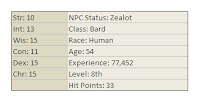
Known as the great Teacher of the Stradivari, Nicolo was the greatest of the violin making Amati family. During his life he has produced many fine instruments of the highest quality imaginable, instruments that are extremely graceful in tone and in their superb workmanship. Nicolo Amati has taken many apprentices into his workshop, including Andrea Guarneri, at present a 24 year old genius working alongside Francesco Ruggieri and Antonio Stradivari in the same shop (the latter a mere boy of 6 years). Nicolo Amati was late blessed with one son of his own, Girolamo, who is but 12 months old.
And there you have it. I've tried to have the various stats reflect the class and character of the NPC's. They are all human, and that is likely to be the pattern, though I can see some room for certain persons being from areas that have elven, dwarven or orcish backgrounds in my world. None so far, though.
My decision to give Nicolo Amati only a 15 dexterity was meant to reflect his comparative importance to the later Stradivari - the gentle reader should fairly admit most have not heard of the man. Algardi's high charisma reflects his being continually employed by popes who were notably difficult to live with, and John Alden's low strength due to little references to his fighting anyone in his lifetime. Obviously, the reader may not concur with my choices. I only hope that the reader can appreciate the idea of these persons living alongside the players, and being met or adventured with, as food for fantasy.
I have a long alphabetical list to work from, and so I will produce the series alphabetically. This means I must start off with a whimper:
 Future Sultan of the Ottoman Empire, Ahmed is just a little boy living at the Topkapi Palace. There is, therefore, very little to say about him ... but if the party should ever chance to go there, the boy's presence should be noted. The stats for little Ahmed are based upon the children's stats generation system I posted about here. The NPC Status can be read about here. Calculation for experience in this article can be read about here. That should clear up the necessary links if you want background into how I determined some of the stats.
More interestingly:

A Mayflower pilgrim, born in England, and said to be the first of that company to set foot upon America. Before sailing he apprenticed as a cooper in Southhampton, and was hired to work upon the Mayflower before sailing. He seized the opportunity to sail, with an eye for adventuring in the New World. It was also true that he was in love with Priscilla Mullens, who would become Alden's wife in 1623 following a love triangle that included Myles Standish. Upon arriving in America and encountering the native Elves who dwelt there, Alden succeeded in carving out a life in the wilderness, becoming a steady and respected colonist in Massachusetts. In 1627 he became one of eight bondsmen for the colony, and in 1631 helped found the town of Duxbury, where he continues to dwell. He remains a neighbor of Myles Standish, and together they have fought and arbitrated disputed lands with the native elves. Alden became assistant to the Massachusetts colony governor in 1633, and continues to serve in that capacity.

Another boy who is of little note, the future king of Portugal, young Alfonso at the age of three suffered an illness that has left him paralyzed on the left side of his body, as well as leaving him mentally unstable. Despite this, he has been named the 10th Duke of Braganza.
This alone suggests an interesting adventure. But there is really little else to say about poor young Alfonso, so we shall move on.

Born at Bologna, Algardi studied with Lodovico Caracci and Giulio Conventi. In 1622 he worked at the court of Mantua, and at Rome in 1625 he served Cardinal Ludovisi, for whom he restored several important sculptures, including Hercules Killing the Hydra and Torchbearer. In 1630 Algardi executed stucco sculptures, La Maddalena and The Baptist, for San Silvestro at Quirinale, Rome. In 1641 he produced the group Beheading of St. Paul for the Church of St. Paul, Bologna. During the pontificate of Pope Innocent X after 1644, Algardi's activity was much intensified. In 1650 he has finished the tomb of Pope Leo XI and the great marble relief, The Expulsion of Attila, behind the altar of St. Leo, both in St. Peter's, Rome. He is at present working on a bronze statue of Pope Innocent X which is to stand in the Palazzo dei Conservatorei, Rome.
How one accounts for a fellow like Algardi in terms of D&D is difficult. Certainly there is more to his life than is described in his works and his successes. One can surmise that like any other individual, he was involved in bar fights, he went hunting, he observed battles and travelled, being attacked and assaulted by monsters just like any player who travels, and so on. Much of his wealth could have been accumulated through prizes won in competitions, and that too could be ascribed as experience that would push him to eighth level.
Finally,
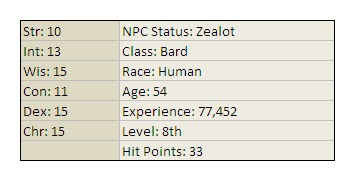
Known as the great Teacher of the Stradivari, Nicolo was the greatest of the violin making Amati family. During his life he has produced many fine instruments of the highest quality imaginable, instruments that are extremely graceful in tone and in their superb workmanship. Nicolo Amati has taken many apprentices into his workshop, including Andrea Guarneri, at present a 24 year old genius working alongside Francesco Ruggieri and Antonio Stradivari in the same shop (the latter a mere boy of 6 years). Nicolo Amati was late blessed with one son of his own, Girolamo, who is but 12 months old.
And there you have it. I've tried to have the various stats reflect the class and character of the NPC's. They are all human, and that is likely to be the pattern, though I can see some room for certain persons being from areas that have elven, dwarven or orcish backgrounds in my world. None so far, though.
My decision to give Nicolo Amati only a 15 dexterity was meant to reflect his comparative importance to the later Stradivari - the gentle reader should fairly admit most have not heard of the man. Algardi's high charisma reflects his being continually employed by popes who were notably difficult to live with, and John Alden's low strength due to little references to his fighting anyone in his lifetime. Obviously, the reader may not concur with my choices. I only hope that the reader can appreciate the idea of these persons living alongside the players, and being met or adventured with, as food for fantasy.
Tuesday, June 7, 2011
Paper
The paper that we use daily did not originate with the manufacture of papyrus in ancient Egypt nor with parchment made from animal hides. It was first invented in China in the second century AD and from there "spread slowly to the west via Samarkand and Baghdad." These cities were pivotal as part of the great Silk Road, which passed overland through the heart of Asia, through Sinkiang and and the Dzungarian Gate, down through Turkestan and eastern Iran, whence it split in two. The northern route reached to ports upon the Caspian Sea, and from there overland to the Black Sea or into the heart of Russia through Astrakhan on the mouth of the Volga. The southern route passed through Baghdad and from there to Alexandretta on the Mediterranean.
All the cultures along these routes benefited as they were reached by the technology of cheap paper, supplanting the much more expensive parchment which was made from animal hides. Paper, more than wealth or conquest, served to raise power for those kingdoms along the Silk Road, as widespread knowledge applied as education made for a more capable, cultured and obedient civilization. Widespread and available paper ensured one set of laws, one set of beliefs, an accurate tallying of money and thus taxes and the education of an elite populace. Prior to the eleventh century in the mid-east, and the 15th century in Europe, the expense of paper considerably limited its use to those isolated social constructs who could make their own paper, or who could afford to pay for it. Every monastery full of books was filled with sheep from which the manuscript pages could be made. There was no reason to teach reading to even small numbers of persons for whom no books could be provided.
It is not generally understood that prior to the invention of the printing press (which is another post), the margin for available paper in Europe is a narrow one indeed - perhaps only 50 to 70 years. A printing press invented in the 11th century would have been no good to anyone, since the expense of parchment would have precluded the proliferation of books. We don't know who might have had the idea for a press prior to Gutenberg (the Koreans had invented something like it centuries earlier), but it would not have been exploited.
Paper can be made from any sort of fiber, but prior to the 19th century is was primarily made from cloth or those fibres from which cloth was made: cotton, hemp, sisal, kapok, wool and so on. Most of the time, since old clothes or other rags were as suitable for the manufacture of paper as new fibre, it was eminently practical to recycle torn or damaged articles, or from waste cuttings. The cloth would be cleaned with water and chemicals, pounded incessantly and eventually pressed to remove the water and make paper.
The 'rag man' was an institution in late medieval societies, as someone who collected old rags, paying for them by the pound, sorting out that which could be cleaned and distributed back to tailors, or which could be in turn sold to paper makers who tended to dwell in the country where water or wind power was available. A representation of a rag man (an increasingly poorer profession) can be seen in the 1951 film Scrooge, where the housekeeper, the laundress and the undertaker sell their loot to a rather scrupulous character people might take to be a pawn shop owner. All around them in the scene young children can be seen tearing apart rags while coughing - preparing the old cloth for paper, and suffering from the rags being full of typhus and other happy buggies.
Paper in the 16th century was an expensive commodity and highly in demand, and the raw material needed was considerable. It would be practical for D&D players to strip orcs of even moldy and rancid clothing, including broken pieces and strips of leather, and sell it in town to the rag man for a profit. There would be no bits and pieces anywhere to be found on the floors of a dungeon, for even if it isn't worth its weight in gold, it would be worth nearly its weight in copper.
Of course, we live in a clean world where clothes are no longer used for paper, but wood. This was made possible by the hammering machines of the technological revolution, the development of certain chemicals, the ease with which trees could be chopped down and the scale of demand for paper as it grew in the 1900s.
To get a real sense for the value and usefulness of paper, trying playing D&D an evening without it, relying only upon your memory to keep track of everything - for every player, the DM included. It would be impractical - or, at the very least, extraordinarily difficult.
And yet consider, if your world takes place prior to Europe in the 1400s, virtually every bit of knowledge possessed by most people was exploited without having any book to turn to. People would live their entire lives and see only one book - the priest's copy of the bible, which was for them unreadable. Yet it didn't seem to matter very much. They themselves, their lieges, their masters and even the occasional performers who drifted through their villages felt no need to have books in order to remember all the details about life they needed to know. They relied on memory, which was stronger for them than it is for us. We've been weakened by our dependence on books.
And strengthened, too. But that is for the discussion on Printing Presses, when that time comes.
All the cultures along these routes benefited as they were reached by the technology of cheap paper, supplanting the much more expensive parchment which was made from animal hides. Paper, more than wealth or conquest, served to raise power for those kingdoms along the Silk Road, as widespread knowledge applied as education made for a more capable, cultured and obedient civilization. Widespread and available paper ensured one set of laws, one set of beliefs, an accurate tallying of money and thus taxes and the education of an elite populace. Prior to the eleventh century in the mid-east, and the 15th century in Europe, the expense of paper considerably limited its use to those isolated social constructs who could make their own paper, or who could afford to pay for it. Every monastery full of books was filled with sheep from which the manuscript pages could be made. There was no reason to teach reading to even small numbers of persons for whom no books could be provided.
It is not generally understood that prior to the invention of the printing press (which is another post), the margin for available paper in Europe is a narrow one indeed - perhaps only 50 to 70 years. A printing press invented in the 11th century would have been no good to anyone, since the expense of parchment would have precluded the proliferation of books. We don't know who might have had the idea for a press prior to Gutenberg (the Koreans had invented something like it centuries earlier), but it would not have been exploited.
Paper can be made from any sort of fiber, but prior to the 19th century is was primarily made from cloth or those fibres from which cloth was made: cotton, hemp, sisal, kapok, wool and so on. Most of the time, since old clothes or other rags were as suitable for the manufacture of paper as new fibre, it was eminently practical to recycle torn or damaged articles, or from waste cuttings. The cloth would be cleaned with water and chemicals, pounded incessantly and eventually pressed to remove the water and make paper.
The 'rag man' was an institution in late medieval societies, as someone who collected old rags, paying for them by the pound, sorting out that which could be cleaned and distributed back to tailors, or which could be in turn sold to paper makers who tended to dwell in the country where water or wind power was available. A representation of a rag man (an increasingly poorer profession) can be seen in the 1951 film Scrooge, where the housekeeper, the laundress and the undertaker sell their loot to a rather scrupulous character people might take to be a pawn shop owner. All around them in the scene young children can be seen tearing apart rags while coughing - preparing the old cloth for paper, and suffering from the rags being full of typhus and other happy buggies.
Paper in the 16th century was an expensive commodity and highly in demand, and the raw material needed was considerable. It would be practical for D&D players to strip orcs of even moldy and rancid clothing, including broken pieces and strips of leather, and sell it in town to the rag man for a profit. There would be no bits and pieces anywhere to be found on the floors of a dungeon, for even if it isn't worth its weight in gold, it would be worth nearly its weight in copper.
Of course, we live in a clean world where clothes are no longer used for paper, but wood. This was made possible by the hammering machines of the technological revolution, the development of certain chemicals, the ease with which trees could be chopped down and the scale of demand for paper as it grew in the 1900s.
To get a real sense for the value and usefulness of paper, trying playing D&D an evening without it, relying only upon your memory to keep track of everything - for every player, the DM included. It would be impractical - or, at the very least, extraordinarily difficult.
And yet consider, if your world takes place prior to Europe in the 1400s, virtually every bit of knowledge possessed by most people was exploited without having any book to turn to. People would live their entire lives and see only one book - the priest's copy of the bible, which was for them unreadable. Yet it didn't seem to matter very much. They themselves, their lieges, their masters and even the occasional performers who drifted through their villages felt no need to have books in order to remember all the details about life they needed to know. They relied on memory, which was stronger for them than it is for us. We've been weakened by our dependence on books.
And strengthened, too. But that is for the discussion on Printing Presses, when that time comes.
Monday, June 6, 2011
'Gifts'
There is nothing wrong with fudging with the odds in the player's favor. I think some people might believe I stand against that sort of thing, but I like to make my players happy just like the next fellow. I had some great fun the other night, all in the favor of one player who's been behind the eight ball for literally years.
The player who plays the cleric henchman of the monk has coincidentally missed a number of 'big treasure days,' so that he's dragging about 35,000 experience behind the main party group. And having the opportunity (through a story line) to give an artifact to the party, I took it. The party has made some powerful enemies, and in order to tackle the issue they were sent to recover an artifact from inside a castle. It wasn't a big quest or anything, just something they had to go into the castle to get. Past five skeleton warriors, four hellcats and a death knight. No big deal.
After two days of bloody battle experience, in which the players were forced to drain themselves of some long-hoarded magic items, and managing to not lose any party members (though one did have to be brought back from death's door, and another was within one hit point of buying it), they were successful. The overall experience divided by six players was a bit better than 10,000 apiece. And so they recovered the Nail of the Left Hand.
The gentle reader may not guess, but the party did the moment I gave the name of the artifact before their entering the castle. They did not need a clue, but immediately identified it as the spike driven in the left hand of Christ on the cross. I was surprised. For a bunch of athiests, that was pretty good.
What they did not realize, even upon recovering and seeing the nail, was understanding that it was meant to be driven into a club, creating a godentag, which the 7th level cleric is proficient in. And once that was done, discovering that the Nail is sentient, the cleric is now in possession of a +4 weapon. For a player who has missed a lot of the past treasure, he is happy to find himself possessed of the most powerful weapon in my game.
One thing, with my experience system, I'm giving the player 40 experience every time he hits with the weapon. It's the gift that keeps on giving.
But I see nothing wrong with giving 'gifts' to players. I made the players earn it, and now that he's got the new toy, I'll soon put him into a position against his new enemies where he'll get to use it. I don't want to make things too easy, yes, but I want the game to be something the players keep coming back for.
I only have one problem now. I'm going to have to come up with something to give the druid. He's lowest on the totem pole for magic, and something has to be done about that.
The player who plays the cleric henchman of the monk has coincidentally missed a number of 'big treasure days,' so that he's dragging about 35,000 experience behind the main party group. And having the opportunity (through a story line) to give an artifact to the party, I took it. The party has made some powerful enemies, and in order to tackle the issue they were sent to recover an artifact from inside a castle. It wasn't a big quest or anything, just something they had to go into the castle to get. Past five skeleton warriors, four hellcats and a death knight. No big deal.
After two days of bloody battle experience, in which the players were forced to drain themselves of some long-hoarded magic items, and managing to not lose any party members (though one did have to be brought back from death's door, and another was within one hit point of buying it), they were successful. The overall experience divided by six players was a bit better than 10,000 apiece. And so they recovered the Nail of the Left Hand.
The gentle reader may not guess, but the party did the moment I gave the name of the artifact before their entering the castle. They did not need a clue, but immediately identified it as the spike driven in the left hand of Christ on the cross. I was surprised. For a bunch of athiests, that was pretty good.
What they did not realize, even upon recovering and seeing the nail, was understanding that it was meant to be driven into a club, creating a godentag, which the 7th level cleric is proficient in. And once that was done, discovering that the Nail is sentient, the cleric is now in possession of a +4 weapon. For a player who has missed a lot of the past treasure, he is happy to find himself possessed of the most powerful weapon in my game.
One thing, with my experience system, I'm giving the player 40 experience every time he hits with the weapon. It's the gift that keeps on giving.
But I see nothing wrong with giving 'gifts' to players. I made the players earn it, and now that he's got the new toy, I'll soon put him into a position against his new enemies where he'll get to use it. I don't want to make things too easy, yes, but I want the game to be something the players keep coming back for.
I only have one problem now. I'm going to have to come up with something to give the druid. He's lowest on the totem pole for magic, and something has to be done about that.
Friday, June 3, 2011
Spoilage Drift & The Trickle Down Theory
An engineer, a chemist and an economist are stranded on a desert island with nothing to eat except coconuts and a crate of tomato soup. Unfortunately, they have no way to open the cans. Experiments with rocks show they don't have the strength to bash open the cans. But the engineer believes he can construct a framework that will drop one of the island's boulders on the cans and break them open. Unfortunately, the soup will run all over. The chemist argues they could store the cans in the lagoon, where the salt water will weaken the metal after a number of years. Then, suddenly, the economist brightens. "I've got it!" he says. "What is it, what do we do?" asks the others. "Okay," says the economist, quite excited. "First of all, let's assume that we have a can opener ..."
I include this joke to indicate my awareness that what is about to follow will be true silliness of the first order. Nevertheless, I think there may be some value in it, even as a mental exercise. It hit me as I was in the tub last night - this being the third significant mental jump I've had on a Thursday night while in the bathtub. It's gettin' kinda creepy. Anyway, let's assume we have a can opener and see where it takes us.
If we consider the economy of a civilized location, a set amount of wealth is created by the civilization on a yearly basis. This is value created by raising livestock, growing crops, mining, fishing and so on. A certain amount of this value is consumed, naturally, but certain valuables - durables, we can call them - are not destroyed as a condition of their existence. These would be items such as gold, gems, marble statuary, constructed assets and so on.
However, these items still experience a certain degree of 'spoilage' ... even gold. Construction crumbles, objects break or are smashed; and coins and gems are dropped or lost. No matter what the item, a certain percentage of it will be lost to civilization, even if that means it was taken aboard ship and the ship lost at sea.
In D&D, it is presumed that a certain amount of this makes its way into the hands of the 'alternate civilization,' that which is operated and maintained by humanoids, supernatural villains or any creature able to identify a given object and horde it for its value (birds swallowing brightly colored gems included). From an economists point of view, the question to be posed is how much, exactly, of this 'spoilage drift' slips out of the hands of the human/demi-human world and into the hands of this alternate civilization?
Of course, the alternate civilization too is wrapped up with the creation of wealth, so the measure of a civilization's capita income is not dependent upon spoilage drift alone. Nevertheless, we can isolate this one circumstance of our fantasy economy and see how much impact it has.
I have long been a fan of the 1% maintenance cost per month rule of the DM's guide, and have mentioned it on my blog before. I see no reason why spoilage drift shouldn't be measured in the same amount. Call it the can opener we started the post with. Some percentage is called for, and surely this is a simple enough one to apply. To keep things simple, we'll call it 12% per year, and presume that a little less than an eighth of all transportable durables are being plundered, moved or lost in the alternate civilization's lands. Some of it, obviously, would be adventurers going into those lands to plunder and dying there.
Now, suppose we imagine a series of ... oh, I don't know, let's call them 'levels' ... that describe the alternate civilization's 'distance' from the prime civilization (ours). Think of distance as being a measure of the alternate civilization's remoteness, the difficulty with which it is reached or the general strength and power of the monsters overseeing that part of the world. Let's presume that the prime civilization is buffered by a circle of 1st level alternate civilization - which may be of any thickness - and that in turn is buffered by a 2nd level circle, then a 3rd level circle and so on. It can be presumed that while the 1st circle gains from the prime civilization, the 2nd Circle gains from the 1st and the 3rd from the 2nd. Think of it as a dungeon, where the gold trickles down steadily from the upper levels to the lower. Such as in this figure here:
 Thus, as you move through the levels, durables are flowing downwards. I have modified the amount of change from level to level to incorporate more fluidity in the process, so that as you go deeper the monsters from those levels take more from the levels above them - 24% from the 1st level to the 2nd, 30% from the 2nd level to the 3rd, 34% from the 3rd level to the 4th and so on. I'm adding 12 divided by the Fibonacci Sequence for each level, so the reader can determine the changes at deeper levels as they like ... though the change will not be much after the 4th level.
The reader will take note that a certain amount of the wealth accumulated in the alternate civilization is restored by adventurers who enter into the wilderness and plunder, bringing back a portion of the money therefrom less and less frequently. The number of years of accumulation before half of it is plundered is the square of the level.
We can do a little calculation, then, to see how much wealth is drifting from level to level. If we postulate that the prime civilization is producing 10,000 g.p. of wealth every year, how much of this wealth is distributed into the various levels? For simplicity, let's assume a period of one year passing before the gold from the prime civilization spoil drifts into the 1st circle/level, another year before a percentage of the 1st circle/level spoil drifts into the second circle/level and so on. And of course, let's incorporate the 50% return to civilization that I've postulated.
This produces the following table:
 I have thoughtfully highlighted those years for the 2nd level and below where half the wealth has been returned to the prime civilization's economy. This happens every year on the 1st level. While the total gold remains unchanged, more and more of it steadily drifts out of the prime and into the alternate.
However, note that the amount of gold still declines with each commensurate level. The 4th level may seem to jump up, but in fact that is only because I have not accounted for how much of the 4th level drifts into the 5th and so on. Overally, there is more shifted money to be found in the circle immediately adjacent to the civilized world, and NOT in the deepest darkest tomb of the deepest darkest dungeon. There may be more overall in the levels fourth and down, but this greater accumulation is divided and subdivided again and again by what creatures occupy each deepening level.
In other words, you will do better to slaughter the whole goblin army posted on the fringes of civilization than their equivalent-power opposites on the fourth level of the dungeon. What's more, those goblins are more likely to dwell in lands where wealth is something they create, as well. Rock dungeons only yield minerals, and rarely in great amounts. (If you're arguing that its a fantasy world and you can put any amount of wealth anywhere you like, you should have stopped reading this post ten paragraphs ago).
And this brings up an interesting question, the one that occurred to me as I steeped myself in hot water last night.
Instead of assigning the amount of gold and valuables based upon the presence of monsters, perhaps a treasure table might to better to assign the number of monsters based upon the prevalence of wealth. After all, things progress towards and congregate where wealth is abundant, and venture away from where wealth is hard to come by.
Would it be true that the deeper the party went into the dungeon, the last and bottom level of that monstrous pit would be, in fact ... empty?
I include this joke to indicate my awareness that what is about to follow will be true silliness of the first order. Nevertheless, I think there may be some value in it, even as a mental exercise. It hit me as I was in the tub last night - this being the third significant mental jump I've had on a Thursday night while in the bathtub. It's gettin' kinda creepy. Anyway, let's assume we have a can opener and see where it takes us.
If we consider the economy of a civilized location, a set amount of wealth is created by the civilization on a yearly basis. This is value created by raising livestock, growing crops, mining, fishing and so on. A certain amount of this value is consumed, naturally, but certain valuables - durables, we can call them - are not destroyed as a condition of their existence. These would be items such as gold, gems, marble statuary, constructed assets and so on.
However, these items still experience a certain degree of 'spoilage' ... even gold. Construction crumbles, objects break or are smashed; and coins and gems are dropped or lost. No matter what the item, a certain percentage of it will be lost to civilization, even if that means it was taken aboard ship and the ship lost at sea.
In D&D, it is presumed that a certain amount of this makes its way into the hands of the 'alternate civilization,' that which is operated and maintained by humanoids, supernatural villains or any creature able to identify a given object and horde it for its value (birds swallowing brightly colored gems included). From an economists point of view, the question to be posed is how much, exactly, of this 'spoilage drift' slips out of the hands of the human/demi-human world and into the hands of this alternate civilization?
Of course, the alternate civilization too is wrapped up with the creation of wealth, so the measure of a civilization's capita income is not dependent upon spoilage drift alone. Nevertheless, we can isolate this one circumstance of our fantasy economy and see how much impact it has.
I have long been a fan of the 1% maintenance cost per month rule of the DM's guide, and have mentioned it on my blog before. I see no reason why spoilage drift shouldn't be measured in the same amount. Call it the can opener we started the post with. Some percentage is called for, and surely this is a simple enough one to apply. To keep things simple, we'll call it 12% per year, and presume that a little less than an eighth of all transportable durables are being plundered, moved or lost in the alternate civilization's lands. Some of it, obviously, would be adventurers going into those lands to plunder and dying there.
Now, suppose we imagine a series of ... oh, I don't know, let's call them 'levels' ... that describe the alternate civilization's 'distance' from the prime civilization (ours). Think of distance as being a measure of the alternate civilization's remoteness, the difficulty with which it is reached or the general strength and power of the monsters overseeing that part of the world. Let's presume that the prime civilization is buffered by a circle of 1st level alternate civilization - which may be of any thickness - and that in turn is buffered by a 2nd level circle, then a 3rd level circle and so on. It can be presumed that while the 1st circle gains from the prime civilization, the 2nd Circle gains from the 1st and the 3rd from the 2nd. Think of it as a dungeon, where the gold trickles down steadily from the upper levels to the lower. Such as in this figure here:

The reader will take note that a certain amount of the wealth accumulated in the alternate civilization is restored by adventurers who enter into the wilderness and plunder, bringing back a portion of the money therefrom less and less frequently. The number of years of accumulation before half of it is plundered is the square of the level.
We can do a little calculation, then, to see how much wealth is drifting from level to level. If we postulate that the prime civilization is producing 10,000 g.p. of wealth every year, how much of this wealth is distributed into the various levels? For simplicity, let's assume a period of one year passing before the gold from the prime civilization spoil drifts into the 1st circle/level, another year before a percentage of the 1st circle/level spoil drifts into the second circle/level and so on. And of course, let's incorporate the 50% return to civilization that I've postulated.
This produces the following table:

However, note that the amount of gold still declines with each commensurate level. The 4th level may seem to jump up, but in fact that is only because I have not accounted for how much of the 4th level drifts into the 5th and so on. Overally, there is more shifted money to be found in the circle immediately adjacent to the civilized world, and NOT in the deepest darkest tomb of the deepest darkest dungeon. There may be more overall in the levels fourth and down, but this greater accumulation is divided and subdivided again and again by what creatures occupy each deepening level.
In other words, you will do better to slaughter the whole goblin army posted on the fringes of civilization than their equivalent-power opposites on the fourth level of the dungeon. What's more, those goblins are more likely to dwell in lands where wealth is something they create, as well. Rock dungeons only yield minerals, and rarely in great amounts. (If you're arguing that its a fantasy world and you can put any amount of wealth anywhere you like, you should have stopped reading this post ten paragraphs ago).
And this brings up an interesting question, the one that occurred to me as I steeped myself in hot water last night.
Instead of assigning the amount of gold and valuables based upon the presence of monsters, perhaps a treasure table might to better to assign the number of monsters based upon the prevalence of wealth. After all, things progress towards and congregate where wealth is abundant, and venture away from where wealth is hard to come by.
Would it be true that the deeper the party went into the dungeon, the last and bottom level of that monstrous pit would be, in fact ... empty?
Thursday, June 2, 2011
When You Drop
UPDATE: This post has been updated and included in the recently released book, How to Play a Character & Other Essays, available for purchase from the Lulu marketplace.
I've been challenged for a topic to write about this week, and it has much to do with my habits of late. The Conflict! cards have run into a snag, and I'm just getting on the other side of it. No, I'm not going to describe the snag. The less anyone knows, the better. But I see the solution, I am applying the solution and I do not think there will be any troubles with it.
But the snag itself has trumped ever other bit of work I might have done on D&D for the last couple of weeks, and as such I have very little new material to post, here. It is convenient to have some project hit a certain stage of fruition at least once a week, so that I present it here on a given day and have the post be about that. But this week, nada. I have nothing. Oh, I'm digging at a few things, a table here or there that I'm moving forward, but nothing that has reached that glorious stage of being trotted out for viewing.
Last year at this time, I wouldn't have worried about it. I would have not posted at all, and to hell with the gentle reader and all that, they can do without having something to read this week. Only, I am doing my best now to hold to a schedule where I am publishing every weekday (in case people haven't noticed), producing as much interest as I possibly can. So I feel ... guilty.
This got me to thinking about energy. The energy that you work up before playing, and the energy you must have while playing. Sometimes it isn't there, and aren't those the worst sessions ever? I wrote about one of those sessions a few weeks ago, so I won't again here. I have an idea of something else to say about energy, though, and it comes after the session.
Small digression, though - it occurred to me as I was setting up the link in the above paragraph that there's something I don't see in blogs. Why is it that no one seems to write the equivalent of a television clip show? I could waste probably six or seven hundred words doing nothing other that digging up old posts, commenting on how I feel now, and my posting problem would be solved.
Oh well. We'll put that in the brain bank.
Let's instead put together that last fifteen minutes of a D&D session. I can't speak for every DM, obviously, but perhaps there are enough of you out there who share my experience.
You have just handed out the last experience for the night, and it is late. Probably later than you'd intended to play ... so if your players are people who might be working the next morning, or are used to nine-to-five hours, there's very little incentive for them to sit around chatting for an hour or two. Most times, I announce its over, give out the last experience, and people begin packing up immediately. The packing is a lengthy task, so there's a little time for feedback, but not much. And you want feedback, don't you? You've put on a performance, and in spite of your wish that everyone just had a good time, a little applause wouldn't hurt.
Chances are you're not going to get much of that. People are tired, they're making sure they don't forget anything and they haven't really ingested the running themselves. I insist people clean up the garbage they've created from things they've brought to chow on, and there is furniture to be moved around and tables to be folded and put away. Since its easier to do this when the boys are still around - the girls take longer to gather their shit together - I don't let anyone leave until my living room has gone back to normal.
Inevitably, someone can't find their cellphone, i-pad, keys or what have you, and there's a period of general searching through sofa cushions, in the kitchen and around shelves and the computer desk. People make jokes, laugh, and tromp down the hallway to the door where they put on their shoes. Its a loud, raucous time, and now that you - the DM, remember - have concluded that you're not going to get anything more out of them until next session, you're ready for them to be gone and thus bring blessed silence. This doesn't take long. Someone might look at the huge wall-sized map on your wall by the front door and make a comment about where they'd like their players to go next, and that might make for five or ten minutes of discussion as you answer a few more questions, but mostly people are heading out for their cars now. You hug the girls as they go, and shake hands with the guys, and then you are closing the door on them.
Silence. You drink it in for a moment and return to the living room.
And for some reason, you feel absolutely awful.
You may think its because you didn't get any feedback, or you may connect it with being exhausted or tired ... except that you don't feel exhausted. You feel ramped up. You've been drinking coffee and energy drinks all night to stay as wired as possible for the game, and now you're wide awake with nothing whatsoever to do. And there is still this nagging, sudden depression. There's no reason for it, but there it is.
I can say from experience that the exact same feeling occurs after giving a performance of any kind - a long business presentation, a two-hour play, a day spent making a movie, working as a mascot ... anything. It is your natural body response to no longer having seratonins and dopamine pumped steadily into your brain. it is not really that you are feeling depressed. It is that you are no longer feeling high, and the comparative difference feels like depression.
I have a number of suggested remedies for you. The most common that people will try is to get on their computers and play video games, which will restore your dopamine levels moderately and reduce the sense of depression. Problem is, that will only sustain the high and you'll find it's five, six in the morning and you're only now getting to bed. This is fine if you don't need a Sunday in your life - it really doesn't work if you're getting older or you have things to do the next day.
I can tell you honestly, you don't know it but you are considerably dehydrated. Your brain has been using energy at the same level you'd be experiencing if you had just finished playing football ... but since your muscles aren't tired, and your bloodstream is loaded with caffeine, you're unaware that in fact your body needs water. Try and make yourself drink a glass or two before settling down.
Accept the depression. The water will help mitigate your caffeine-rich system, starting to flush it out in the next half an hour or so. In the meantime, try to pick an activity that does not depend upon concentration, but instead stimulates your senses. Play lyric-free music, make yourself a protein-rich meal (remember, you're replacing energy loss), get a massage if your partner is awake and willing, take a shower and let the water stream over you for fifteen or twenty minutes, sit out on your deck and close your eyes, listening to the city or the crickets ... in short, unplug. Just do it completely.
As you do, and as your body begins to clean itself, your brain will start shutting down systems and in an hour or so, you'll sleep. Generally, you'll wake up feeling better the next day and you'll be more in a mood to work on your world. I'm guessing that usually the last thing in the world you want to think about the next day is D&D ... but you'll find if you learn to unplug yourself more completely after a session, you'll be more creative and put together when you wake up. Remember, for actors who feel what you do, they still end up performing the next day or the next night.
Of course, one way to deal with that depression is to drink or drug yourself into a stupor. Which is what a lot of actors and other performers do. There are repercussions. Gets to be a habit. But if you want to know why Charlie Sheen is strung out all the time, you only have to closely examine the ten minutes of emotion you experience after you close that door. And multiply it by about a million.
I've been challenged for a topic to write about this week, and it has much to do with my habits of late. The Conflict! cards have run into a snag, and I'm just getting on the other side of it. No, I'm not going to describe the snag. The less anyone knows, the better. But I see the solution, I am applying the solution and I do not think there will be any troubles with it.
But the snag itself has trumped ever other bit of work I might have done on D&D for the last couple of weeks, and as such I have very little new material to post, here. It is convenient to have some project hit a certain stage of fruition at least once a week, so that I present it here on a given day and have the post be about that. But this week, nada. I have nothing. Oh, I'm digging at a few things, a table here or there that I'm moving forward, but nothing that has reached that glorious stage of being trotted out for viewing.
Last year at this time, I wouldn't have worried about it. I would have not posted at all, and to hell with the gentle reader and all that, they can do without having something to read this week. Only, I am doing my best now to hold to a schedule where I am publishing every weekday (in case people haven't noticed), producing as much interest as I possibly can. So I feel ... guilty.
This got me to thinking about energy. The energy that you work up before playing, and the energy you must have while playing. Sometimes it isn't there, and aren't those the worst sessions ever? I wrote about one of those sessions a few weeks ago, so I won't again here. I have an idea of something else to say about energy, though, and it comes after the session.
Small digression, though - it occurred to me as I was setting up the link in the above paragraph that there's something I don't see in blogs. Why is it that no one seems to write the equivalent of a television clip show? I could waste probably six or seven hundred words doing nothing other that digging up old posts, commenting on how I feel now, and my posting problem would be solved.
Oh well. We'll put that in the brain bank.
Let's instead put together that last fifteen minutes of a D&D session. I can't speak for every DM, obviously, but perhaps there are enough of you out there who share my experience.
You have just handed out the last experience for the night, and it is late. Probably later than you'd intended to play ... so if your players are people who might be working the next morning, or are used to nine-to-five hours, there's very little incentive for them to sit around chatting for an hour or two. Most times, I announce its over, give out the last experience, and people begin packing up immediately. The packing is a lengthy task, so there's a little time for feedback, but not much. And you want feedback, don't you? You've put on a performance, and in spite of your wish that everyone just had a good time, a little applause wouldn't hurt.
Chances are you're not going to get much of that. People are tired, they're making sure they don't forget anything and they haven't really ingested the running themselves. I insist people clean up the garbage they've created from things they've brought to chow on, and there is furniture to be moved around and tables to be folded and put away. Since its easier to do this when the boys are still around - the girls take longer to gather their shit together - I don't let anyone leave until my living room has gone back to normal.
Inevitably, someone can't find their cellphone, i-pad, keys or what have you, and there's a period of general searching through sofa cushions, in the kitchen and around shelves and the computer desk. People make jokes, laugh, and tromp down the hallway to the door where they put on their shoes. Its a loud, raucous time, and now that you - the DM, remember - have concluded that you're not going to get anything more out of them until next session, you're ready for them to be gone and thus bring blessed silence. This doesn't take long. Someone might look at the huge wall-sized map on your wall by the front door and make a comment about where they'd like their players to go next, and that might make for five or ten minutes of discussion as you answer a few more questions, but mostly people are heading out for their cars now. You hug the girls as they go, and shake hands with the guys, and then you are closing the door on them.
Silence. You drink it in for a moment and return to the living room.
And for some reason, you feel absolutely awful.
You may think its because you didn't get any feedback, or you may connect it with being exhausted or tired ... except that you don't feel exhausted. You feel ramped up. You've been drinking coffee and energy drinks all night to stay as wired as possible for the game, and now you're wide awake with nothing whatsoever to do. And there is still this nagging, sudden depression. There's no reason for it, but there it is.
I can say from experience that the exact same feeling occurs after giving a performance of any kind - a long business presentation, a two-hour play, a day spent making a movie, working as a mascot ... anything. It is your natural body response to no longer having seratonins and dopamine pumped steadily into your brain. it is not really that you are feeling depressed. It is that you are no longer feeling high, and the comparative difference feels like depression.
I have a number of suggested remedies for you. The most common that people will try is to get on their computers and play video games, which will restore your dopamine levels moderately and reduce the sense of depression. Problem is, that will only sustain the high and you'll find it's five, six in the morning and you're only now getting to bed. This is fine if you don't need a Sunday in your life - it really doesn't work if you're getting older or you have things to do the next day.
I can tell you honestly, you don't know it but you are considerably dehydrated. Your brain has been using energy at the same level you'd be experiencing if you had just finished playing football ... but since your muscles aren't tired, and your bloodstream is loaded with caffeine, you're unaware that in fact your body needs water. Try and make yourself drink a glass or two before settling down.
Accept the depression. The water will help mitigate your caffeine-rich system, starting to flush it out in the next half an hour or so. In the meantime, try to pick an activity that does not depend upon concentration, but instead stimulates your senses. Play lyric-free music, make yourself a protein-rich meal (remember, you're replacing energy loss), get a massage if your partner is awake and willing, take a shower and let the water stream over you for fifteen or twenty minutes, sit out on your deck and close your eyes, listening to the city or the crickets ... in short, unplug. Just do it completely.
As you do, and as your body begins to clean itself, your brain will start shutting down systems and in an hour or so, you'll sleep. Generally, you'll wake up feeling better the next day and you'll be more in a mood to work on your world. I'm guessing that usually the last thing in the world you want to think about the next day is D&D ... but you'll find if you learn to unplug yourself more completely after a session, you'll be more creative and put together when you wake up. Remember, for actors who feel what you do, they still end up performing the next day or the next night.
Of course, one way to deal with that depression is to drink or drug yourself into a stupor. Which is what a lot of actors and other performers do. There are repercussions. Gets to be a habit. But if you want to know why Charlie Sheen is strung out all the time, you only have to closely examine the ten minutes of emotion you experience after you close that door. And multiply it by about a million.
Subscribe to:
Posts (Atom)