There was something else I wanted to say about currency, that I didn’t have time for this morning. It is somewhat in consideration of the trade system for my world.
One of the calculations that makes possible the determination of price in my system designates the amount of foreign goods coming into a given trade region, along with the origin of those goods. Thus I can give a number for the total of foreigners travelling through a given city in the course of a year or the course of a single day. I can also, if I choose, determine the quantity – and origin – of minted coins in a given place.
It is referenced in the GM’s guide that there are multiple types of currencies in the world; we’re very familiar with this, and the complications involved, whenever we travel. What we’re not quite so familiar with is that in the medieval world, many political divisions did not have an exclusive monetary unit ... rather, they depended upon the availability of monetary units minted in other regions. Like the present American dollar, or the British pound of the 19th century, the Italian ducat reigned supreme in many parts of Europe ... as did the guilder, the florin, the taler and the dubloon.
About 18 months ago I experimented in a small fashion with the following scenario: the party raids a hobgoblin fortress, devastates the inhabitants and plunders heartily an extensive treasure of coins, amassed over two decades of successful raiding. Rather than divide the coins into merely gold, silver and copper, I instead also grouped the coins according to the geographic prevalence of four different varieties of coinage. When I say ‘experimented,’ I mean I limited the varieties to only four types. I could have easily included twenty types of coins, with everything from Portuguese, Persian and even a certain smattering of Chinese coinage ... since the party’s location upon plundering this horde was at the edge of the extensive Ottoman empire (it can be assumed the hobgoblins were raiding foreign merchants of all types).
The result? One huge, massive headache. My poor players were not prepared for gold coins that were worth differing amounts of silver, or huge silver coins worth more than a gold coin, or even ‘pieces of eight,’ one of the four types I included. Very quickly they sought out a means of getting rid of the alternative coinage, even at a very poor exchange rate – they’d rather be poorer than have to handle the bookkeeping.
And so I abandoned the experiment ... though I think about it from time to time. At some stage I may feel it’s worth it to ME to do the various calculations (it was a headache for me also, after all), but not quite yet. I am conjecturing a treasure table based on universal availability of valuables, but I’m not at the point where I can instigate said table (still thinking of how the table would be designed!). So the idea is shelved.
But I thought I might mention here that mixed coinage is a worthy prospect for a DM interested in upgrading their economics tables ... not merely in terms of having people make exchanges at the border, but also in terms of certain coins being of greater value because of the more reliable political force backing their value (devaluation of coins is on my horizon), because smugglers and other entities might prefer a foreign coin, and because losing that 10% is just wrong.
I’d like a party that considers keeping a store of differing coins when they travel, paying talers here and ducats there, as they move back and forth across a border. Unlike the DMG, kingdoms in the medieval setting did not outlaw foreign coinage regularly (exceptions always exist), since local minted coins were rarely enough. In regions like the pirate coasts of Africa, or the crossroads of Turkestan, it simply wouldn’t be practical to have a limited acceptance policy where it comes to money.
Something to consider.
Tuesday, March 16, 2010

Currency

The coin showing here is a bronze Corinthian coin (stater), circa 5th century B.C., weight approximately 8 grams. It is fairly typical of a coin that was minted between 600 and 330 B.C., but I was assured upon getting this image that this particular coin had been dated to approximately the rein of Pericles in Athens.
The obverse side shows a winged pegasus; the reverse, an image of Athena in a Corinthian helmet. The offset pegasus shows just how imprecise a hand tool could be, and suggests the coin was punched very quickly, along with a great many other coins (no time to get prissy about centering the image). Note also the detail on either image, particularly the Athena ... quite astounding.
These coins were made early enough that an additional ridge had not been added to the outer edge of the coin – something that became very common in Roman times. The ridge here is almost certainly caused by the punch alone. It was a common practice (right up into the late middle ages) to ‘shave’ coins, gaining the precious metal and retaining the value of the coin. It wouldn’t be possible to say if the upper left side of the pegasus had been shaved ... the coin is more than 2000 years old and could simply have worn down with use.
While precious metals had begun to show their bartering superiority sometime about 2,000 B.C., the actual coin bearing the stamp or shape as issued by a given state did not begin to appear until the 8th century B.C. Thus these two coins are an example of the technological development of numismatics after four hundred years. Clearly, the importance of a distinct image, something that would be difficult to duplicate, has asserted itself.
This particular coin, as minted for almost three centuries, was quite common in the ancient world – Corinth straddled an important shipping point, where goods and passengers were disembarked off ships on one side of the Corinthian Isthmus, hauled two miles, and re-embarked. The coin would have been carried everywhere, from Italy and Carthage to Egypt and Colchis (the far end of the Black Sea). It would have helped set the standard for coinage for centuries afterwards. I’ve had the opportunity of examining an extensive coin collection, right to the end of the Roman Empire, and I assure you the size of the coin depicted here is very usual.
In D&D, the thought of a coin weighing 1/10th of a pound is laughable. At 8 grams, there would be almost four of these coins per ounce, and 56 coins per pound. Allowing for space between coins, there would be about 15 coins per cubic inch (remembering that bronze has a specific gravity ranging between 7 and 8), enabling as many as 80 coins to fit easily into quite a small belt pouch.
A thousand coins would weigh a bit more than 17 and a half pounds, which is hardly the great encumbering weight designed to load down parties. A box one foot square would be large enough to hold more than 25,000 coins – granted, weighing 457 lbs. But that’s the weight of metal for you.
My point is, the whole encumberance methodology as shown in the DMG is highly suspect. I don’t use it, obviously. I’m sure that others would, even while being aware that no society would comfortably consider carrying around ten coins that weighed a pound. An American quarter weighs 5 grams – go purchase 89 of them and spend the day with that in one of your pockets ... this is the equivalent of carrying around just ten original D&D gold coins.
Monday, March 15, 2010
Strange Loves
Clearly, no one is particularly thrilled that I occasionally post statistics on this site. I understand, I suppose, but for me personally I see nothing but world design in numbers like those appearing on the previous post. I see evidence that the general population should be dirt poor; that food and clothes should be a much heavier cost compared to the present, while housing should be much cheaper. I see evidence for how tightly packed a city should be, where a room is no larger than 14 by 12.
I find here the basis on how much of an individual’s wealth should be invested in housewares, art, furniture, clothing and jewelry, as compared to pure coin. In what the cost should be for servants, and in what foods were eaten by people. I have evidence for the weight of a gold coin (much less than the Gygaxian universe), and what goods would be laden upon a caravan.
In short, I get a sense for how the world works, how the tens of thousands of elements begin to fit together, to make sense of what a party is doing in a particular place and time. Who has something to gain by paying pirates to sink not-so-random shipping? How much should it cost to build a castle, what labor is available, and how might their morale be improved? For me, these things are world building.
But yes, boring for most people. Or not particularly worth commentary. Statistics do speak for themselves, I know. But since I’m in love with them, I thought I’d drop a note about how they affect me.
The response to my saying I love them would be, I should think, to assume that I am as boring and staid as statistics are. I must argue, however, that statistics are not staid ... they are pure life rendered comprehensible. They are descriptions of the great mechanism of existence, captured so that they might be applied, to raise monoliths of civilization, to send migrations of peoples hither and thither, or to define the simple daily existence of one small peasant toiling along the edge of a road.
It is in what you can see within the statistics that creativity is born.
I find here the basis on how much of an individual’s wealth should be invested in housewares, art, furniture, clothing and jewelry, as compared to pure coin. In what the cost should be for servants, and in what foods were eaten by people. I have evidence for the weight of a gold coin (much less than the Gygaxian universe), and what goods would be laden upon a caravan.
In short, I get a sense for how the world works, how the tens of thousands of elements begin to fit together, to make sense of what a party is doing in a particular place and time. Who has something to gain by paying pirates to sink not-so-random shipping? How much should it cost to build a castle, what labor is available, and how might their morale be improved? For me, these things are world building.
But yes, boring for most people. Or not particularly worth commentary. Statistics do speak for themselves, I know. But since I’m in love with them, I thought I’d drop a note about how they affect me.
The response to my saying I love them would be, I should think, to assume that I am as boring and staid as statistics are. I must argue, however, that statistics are not staid ... they are pure life rendered comprehensible. They are descriptions of the great mechanism of existence, captured so that they might be applied, to raise monoliths of civilization, to send migrations of peoples hither and thither, or to define the simple daily existence of one small peasant toiling along the edge of a road.
It is in what you can see within the statistics that creativity is born.
Thursday, March 11, 2010
City Economics
Who knows why I was working on this the day before Christmas? But that's the date this file was last modified. These notes were compiled from a book (not the book I'm reading now ... note the date on this file); but I can't actually say which book, since that could get me into loads of trouble. C'est la vie.
This file is quite old and I've only just noticed it solves a problem I myself have had in designing a different table.
From Dec. 24, 1998
∙ An average birth rate is 30 per 1,000.
∙ The quantity and quality of a society’s needs depend on: a) the size of the population; b) the structure of the population by age, sex, and occupation; c) geophysical factors; d) sociocultural factors. Fruits and vegetables for most societies are in comparatively low demand as they are often seen as disease causing; milk is not commonly drunk; fish is in high demand in catholic countries; wine in very low demand for moslem countries. Needs may be considered as less important to economics than are wants.
∙ The level and structure of effective demand are determined by: a) the level of income; b) distribution of income; and c) the level and structure of prices. The mass of income can be divided into: a) wages; b) profits; and c) interest and rents. For the mass of people, wages are their only source of income; real wages for labor done are very low.
∙ In 1698 Vauban classified the French population as follows: rich, 10%; very poor, 50%; near beggars (cotters), 30%; and beggars, 10%.
∙ At the end of the 17th century, in Alsace in the region of Alencon, out of 410,000 inhabitants, 12% were beggars. In Brittany, out of a population of 1.655 million, 9% were beggars.
∙ In England, out of a total population of 5.5 million, it was estimated that 1.3 million were cottagers or paupers. Another 30,000 were vagrants, gypsies, thieves, beggars, etc.
∙ In Venice, in 1565, 13,027 ducats were the equivalent of 70,290 days wages of a worker.
∙ Types of demand include: a) a demand for consumable goods; b) a demand for services; and c) a demand for capital goods. Demand may also be divided into a) private, internal demand; b) public, internal demand; and c) foreign demand.
∙ 60-80% of the expenditure of the masses went to food. Fertilizers and most materials which were meant to improve the life of the poor, or the produce of the field, were scarce or nonexistent.
∙ New apparel could cost a professional person as much as 15 ducats. A skilled worker in Venice could expect to pay as much as 12% of his wages for two rooms.
∙ In Milan, in 1576, in an area of 1,563 houses containing 8,956 rooms lived 4,066 families. In Genoa, as many as 10 to 12 families could occupy a single house. In small towns, more often it was only 3 to 4 persons per house.
∙ The rich generally spent 15-35% of their income on food, and the well-to-do about 35-50%. Clothes and jewelry consumed 10-30% of the income of the rich and well-to-do; the King of France at the end of the fifteenth century spent as much as 5-10% of all royal revenues on clothing and jewelry alone.
∙ In addition to those in Table 1-8, there were also household expenditures upon heating, candles, furniture, gardening, and so on. Household expenditure, food, and clothing together amounted to 60-80% in most cases.
∙ Servants pay didn’t generally represent more than 1-2% of the expenditure, but could reach 10%. In addition to wages, food, lodgeing, heating, and other items were provided for servants. Clothing for a servant cost as much as 40 florins per year, plus 17 florins for meat, 18 for meat, and more for drink, heating, accomodation, etc. Wages were generally about 70 florins per year.
∙ Also in demand by the families were lawyers, notaries, teachers (for children), persons performing religious ministrations, patronage of workers and artists, musicians, poets, dwarfs, jesters, falconers, stable boys and doctors.
∙ Instead of the usual expenditure, often money was saved.
∙ Of the highest earning group, 13% of income was an average saving per family. Savings amounted to a total of 5% of England’s national income.
∙ the golden ducat weighed 3.53 grams of gold.
∙ The level and structure of the public demand for goods depends upon: a) the income of the public power; b) the “wants” of those in power and of the community they control; and c) the price structure
∙ In England, the revenues of the crown were about £860,000 pounds in 1640.
∙ Taxes were generally not charged to the clergy, the nobility, or foreigners (except in times of war and crisis). In Ravenna, 1659, these three groups held 35, 42, and 15% of the land respectively. University professors and doctors were also exempt in France. In any event, the public power generally drew no more than about 5-8% of the national income.
∙ Milan surgeons on the public payroll were only 3 for a population of 60,000.
∙ Venice, with 100,000 people, had only 13 physicians on the public payroll, and 18 surgeons. Total surgeons for the Florence-Pisa region was 62 (24 on the public payroll), and the total physicians were 55 (30 public).
∙ Towns stored grain for future needs, and made loans to artisans, provided labor to create city works and the like, all to improve the economy.
∙ Other expenditures included repair of damages done by storms and other disasters; interest on public loans, and military expenditure. 16th century Venice spent 25-30% of revenues on their fleet, not counting the money spent upon the land army. A war could demand up to 60% of expenditure and loans, of course. Henry V of England spent two thirds of the state expenditure, Elizabeth I as much as three quarters.
∙ In 1530 there were about 825 monasteries in England with about 9,300 monks and nuns. Net income of the religious orders amounted to about 175,000£. By 1550 their furniture, silver, libraries, jewels and other holdings had been siezed and dispersed.
∙ Of church lands, 70% of the lands of Ravenna (17th century) were held by 4 wealthy abbeys, and 30% was divided among parishes, chapters, and secular clergy.
∙ The bulk of foreign trade was in foodstuffs and textiles, and in easily transportable valuables.
∙ In any society, once population totals have been established, it is important to identify: a) the economically active population (those who produce and consume); b) the dependent population (those who consume but do not produce); and c) the relationship between the two (dependency ratio).


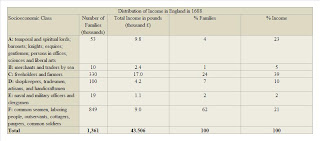


This file is quite old and I've only just noticed it solves a problem I myself have had in designing a different table.
From Dec. 24, 1998
∙ An average birth rate is 30 per 1,000.
∙ The quantity and quality of a society’s needs depend on: a) the size of the population; b) the structure of the population by age, sex, and occupation; c) geophysical factors; d) sociocultural factors. Fruits and vegetables for most societies are in comparatively low demand as they are often seen as disease causing; milk is not commonly drunk; fish is in high demand in catholic countries; wine in very low demand for moslem countries. Needs may be considered as less important to economics than are wants.
∙ The level and structure of effective demand are determined by: a) the level of income; b) distribution of income; and c) the level and structure of prices. The mass of income can be divided into: a) wages; b) profits; and c) interest and rents. For the mass of people, wages are their only source of income; real wages for labor done are very low.
∙ In 1698 Vauban classified the French population as follows: rich, 10%; very poor, 50%; near beggars (cotters), 30%; and beggars, 10%.
∙ At the end of the 17th century, in Alsace in the region of Alencon, out of 410,000 inhabitants, 12% were beggars. In Brittany, out of a population of 1.655 million, 9% were beggars.
∙ In England, out of a total population of 5.5 million, it was estimated that 1.3 million were cottagers or paupers. Another 30,000 were vagrants, gypsies, thieves, beggars, etc.
∙ In Venice, in 1565, 13,027 ducats were the equivalent of 70,290 days wages of a worker.
∙ Types of demand include: a) a demand for consumable goods; b) a demand for services; and c) a demand for capital goods. Demand may also be divided into a) private, internal demand; b) public, internal demand; and c) foreign demand.
∙ 60-80% of the expenditure of the masses went to food. Fertilizers and most materials which were meant to improve the life of the poor, or the produce of the field, were scarce or nonexistent.
∙ New apparel could cost a professional person as much as 15 ducats. A skilled worker in Venice could expect to pay as much as 12% of his wages for two rooms.
∙ In Milan, in 1576, in an area of 1,563 houses containing 8,956 rooms lived 4,066 families. In Genoa, as many as 10 to 12 families could occupy a single house. In small towns, more often it was only 3 to 4 persons per house.
∙ The rich generally spent 15-35% of their income on food, and the well-to-do about 35-50%. Clothes and jewelry consumed 10-30% of the income of the rich and well-to-do; the King of France at the end of the fifteenth century spent as much as 5-10% of all royal revenues on clothing and jewelry alone.
∙ In addition to those in Table 1-8, there were also household expenditures upon heating, candles, furniture, gardening, and so on. Household expenditure, food, and clothing together amounted to 60-80% in most cases.
∙ Servants pay didn’t generally represent more than 1-2% of the expenditure, but could reach 10%. In addition to wages, food, lodgeing, heating, and other items were provided for servants. Clothing for a servant cost as much as 40 florins per year, plus 17 florins for meat, 18 for meat, and more for drink, heating, accomodation, etc. Wages were generally about 70 florins per year.
∙ Also in demand by the families were lawyers, notaries, teachers (for children), persons performing religious ministrations, patronage of workers and artists, musicians, poets, dwarfs, jesters, falconers, stable boys and doctors.
∙ Instead of the usual expenditure, often money was saved.
∙ Of the highest earning group, 13% of income was an average saving per family. Savings amounted to a total of 5% of England’s national income.
∙ the golden ducat weighed 3.53 grams of gold.
∙ The level and structure of the public demand for goods depends upon: a) the income of the public power; b) the “wants” of those in power and of the community they control; and c) the price structure
∙ In England, the revenues of the crown were about £860,000 pounds in 1640.
∙ Taxes were generally not charged to the clergy, the nobility, or foreigners (except in times of war and crisis). In Ravenna, 1659, these three groups held 35, 42, and 15% of the land respectively. University professors and doctors were also exempt in France. In any event, the public power generally drew no more than about 5-8% of the national income.
∙ Milan surgeons on the public payroll were only 3 for a population of 60,000.
∙ Venice, with 100,000 people, had only 13 physicians on the public payroll, and 18 surgeons. Total surgeons for the Florence-Pisa region was 62 (24 on the public payroll), and the total physicians were 55 (30 public).
∙ Towns stored grain for future needs, and made loans to artisans, provided labor to create city works and the like, all to improve the economy.
∙ Other expenditures included repair of damages done by storms and other disasters; interest on public loans, and military expenditure. 16th century Venice spent 25-30% of revenues on their fleet, not counting the money spent upon the land army. A war could demand up to 60% of expenditure and loans, of course. Henry V of England spent two thirds of the state expenditure, Elizabeth I as much as three quarters.
∙ In 1530 there were about 825 monasteries in England with about 9,300 monks and nuns. Net income of the religious orders amounted to about 175,000£. By 1550 their furniture, silver, libraries, jewels and other holdings had been siezed and dispersed.
∙ Of church lands, 70% of the lands of Ravenna (17th century) were held by 4 wealthy abbeys, and 30% was divided among parishes, chapters, and secular clergy.
∙ The bulk of foreign trade was in foodstuffs and textiles, and in easily transportable valuables.
∙ In any society, once population totals have been established, it is important to identify: a) the economically active population (those who produce and consume); b) the dependent population (those who consume but do not produce); and c) the relationship between the two (dependency ratio).


Wednesday, March 10, 2010
Fragments - Encounters, Towns
I've gone through a few of my files and I'm convinced I have scattered junk that I can post on this site, that might be of some use to people. I'm going to label all of it 'design fragments,' and I want to specify that such pieces are ideas that got started and ran out of steam. I don't expect them to work for people, they didn't work for me. I have seen some interest shown, however, so I'll throw out the things I can find. I've chosen to make no changes, no clarifications ... seems more fun that way (less work for me, too).
I think I will mark these files according to their last modification:
From Mar. 25, 2002:
RANDOM MONSTER ENCOUNTERS
The procedures and tables for determining random monster encounters during the course of a campaign are given here.
Signs
Before actually encountering a monster, rangers and assassins will sometimes receive first warning of the monster’s existence by a sign, or trace that the monster has left behind. Signs will tend to be simple – such as tracks or spoor – among animal intelligence creatures, and more complicated as the monster’s intelligence rises. An intelligent creature may leave signs such as a mark of two slashes across a treebark, or the remains of some wood cut in a special way to show the making of a nearby lair. Even a stylus found on a city street may have serious implications for an assassin, who suddenly breaks out in a sweat because he knows what it means.
A quarter of all encounters will be nothing more than the found sign, with the creature never actually materializing. 90% of reamining encounters will begin with the seeing of the sign, and the encounter happening thereafter. If a 91-00 is indicated, there is a fifty percent chance that the wrong sign will be seen prior to the encounter, misleading the ranger.
CITY / TOWN ENCOUNTERS
The prime city or cities/town or towns in a campaign will usually have pre-determined denizens and many encounters will be set according to facts thus developed. However, urban areas have distinctive characters, just as quarters of a city will differ according to wealth, ethnic background, or purpose.
Tension. City encounters may be determined according to the cities tension level, which is an indication of any particular area’s potential for concern to those who move within it. Increased tension may mean racial or cultural violence, potential malevolence, mortal danger, or a simple threat to purse or person.
Cities are separated by street type (plazas, avenues, lanes, alleys, or courts); the wealth of a region (rich, mercantile, poor, or destitute); and authority (public, business, or private). All Plazas will have a public nature, and these will lead into Avenues; from Avenues extend Lanes, which will in turn give way to Alleys or Courts.
Plazas are a wide, open areas, characterized by gardens and available access to public buildings, markets, and monuments. They have a base tension level (T-level) of 1 (T-1); and except in periods of upheavel, will not increase during the day. Plazas are the show places of the city, are heavily patrolled, and quite safe. Generally, a city will have one plaza for every 5,000 inhabitants, with a minimum of one per city over 1,000 people. The first square of a city will be the market square; a city of 10,000 will also have a Palatial Plaza, surrounding which will be the citadel, palace, and law courts. A city of 15,000 will have a Plaze dedicated either to a university if one is present, or a military Plaza if not. The next Plaza will certainly be military, or a rural market, which will be now separate from the artisan’s market. Following Plazas could be any of the following: a roundabout, or walking park, for wealthy citizens; an area adjacent to a track or coliseum, part of some sort of public spectacle; temple or cathedral grounds; public wharves; or academies. Additional squares will repeat those already listed; if the city is a port, then market squares will juxtapose with the docks, and dock markets will separate from the artisan’s market as a place for raw and imported materials. Squares will have from 3-5 Avenues which lead outward from them.
Avenues are wide throughfares, generally 25-40’ in width, which are continuations of roads which lead out of town or pathways from one Plaza to another. They will have a base T-level of 1, or possibly 2 (1 in 6). Lining them are artisan’s shops, taverns, inns, and private habitations, usually comprising expensive flats, mansions, or estates. 1-2 avenues will exist per two thousand persons. Branching from the Avenues will be Lanes. A city will have a maximum of one Lane connected to an Avenue somewhere in the city per 500 people.
Lanes are narrower public streets, generally 12-20’ in width, providing access to the largest portion of the mercantile and working classes. The T-level of a Lane is always that of the Avenue which it connects, +1. Lanes will only lead from one Avenue to another if the T-levels of both Avenues is the same. Lanes are used for cartage from one portion of the city to another, are lined with flats, the shops of lesser artisans, seedier pubs and hostels, and warehouses. Lanes lead to other Lanes, Alleys, or Courts. Lanes may dead end (1 in 12 chance). If a primary Lane leads to another Lane, then the secondary Lane will have a one higher T-level 2 in 6 rolls. Secondary Lanes may lead to third class Lanes, and thence to fourth class Lanes … there are no lower Lanes than fourth class. Each lower class of Lane has the same chance of increasing the T-level. There will be one secondary Lane per 1,000 people; a third-class Lane per 2,000 persons; and a fourth-class Lane for every 4,000 persons. Thus a city of 5,000 would have 18 lanes. Finally, a Lane will have from 2-5 Alleys leading from it. One in 6 Lanes will lead to a Court.
Alleys are walkways leading which are usually impassable for vehicles, being usually only 5-8’ wide. They are often twisted stairways leading up hills, narrow bridges between gaps in the city, or tunnels. Primary Alleys will have have a T-level of one greater than the lane they adjoin. Alleys lead from Lanes to Lanes, or more often to Courts, or they may dead end (1 in 6 chance).
Courts are open spaces between 100-300 square feet, surrounded by very poor accomodations (5 in 6) or by warehouses. The T-level of a court, regardless of the adjoining lanes or alleys, will be a base of 3. On a roll of d10, it may be higher: 1-4 (unchanged); 5-7 (add 1 point); 8-9 (add 2 points); 10 (reroll, adding 2 points plus the next roll). Courts are often lairs for the most dangerous members of the citizenry. There will be one court per 200 residents in the city, and they are generally nasty places to be.
Sometimes higher T-levels will present “fronts” to hide their true nature to the denizens of the city. For example, an assassin, capable of detecting T-levels (qv), knows of one Lane called Vanity Street. When he was a lower level, he classified it as T-3, as he was unable to detect a higher level of occupation. However, as the assassin has gained levels, he has been able to ascertain higher T-levels; upon turning 7th level, he suddenly starts to see things on Vanity Street that were never apparent before – a spot of blood, a doorway that he realizes has never been opened, a “feeling” that the residents are actually more ill at ease than he ever guessed. Why are so many of the windows shuttered? Isn’t that a whiff of … garlic? And at once he realizes that the street is actually T-9! A shudder passes through him. What is lurking behind closed doors?
TENSION MATRIX
1: Patrols ever-present; pickpocketing (1% chance per day), general rudeness towards outsiders.
2: Common patrols will generally harrass citizens to “keep them straight”; foreigners will number 2-5% of the population. Pickpocketing (2% per day). 4% chance of encountering a beggar.
3: Rare patrols, never in groups of less than 9 and none younger than 30. Guards will not harrass citizens. Pickpocketing (4% per day); beggars (8%). Thieves travel in pairs and beggars in twos and threes. Foreigners number 4-10% of the population in Lanes; 1 in 4 Alleys or Courts will be 92-98% foreign (100 – 2d8). Random violence (1% per day), most unlikely in the direction of the party. Bawds will accost the party, informing them of hookers, selling opium, having info about illegal activities*. Bards, jugglers, actors, street performers will be common in Lanes, but not in Alleys or Courts.
4: No patrols. Crime will flourish. Pickpocketing (80% per day), and thieves will backstab persons travelling alone. Beggars will be replaced with poor gangs who are indolent or aggressive. Random violence (3% per day).
5: The area is under the control of some criminal element or cult, though the area will appear little different on the surface than T-4. Persons who are not familiar to the residents will be queried and told to move on – if they refuse, they will be sandbagged by 2-3 “mugs” of 4-5th level and a thief of 5-7th level. If they cannot provide an adequate explanation for their actions, they will be killed. Persons familiar to the residents will be asked to pay “dues,” do favors, and generally expected to comply with any request. Persons who do not will be “taught” a lesson, most likely the breaking of an arm, or a leg. No thieves will pickpocket, as they will generally demand what they want openly. Random violence (6% per day); evidence that violence has occurred (hollowed out buildings, splashes of blood, burned remains) will be obvious to the trained eye.
6: Abandoned by organized human settlement, this is an area used for dumping (8 in 10) or a graveyard. No person will be in evidence; destitute persons, madmen, or unaccountably evil persons may be in residence. Rats, centipedes, and other small monsters of less than 1 HD will be common. Such areas will almost invariably be Courts. Buildings will not be upkept. Dead storage for some businesses is common. Contracting Disease (4% per visit).
7: Area chronically subject to plague. Contracting Disease (8% per visit). Human or demi-human habitation is zero, but skulks, doppelgangers, rakshasa, vampires, and the like will portray themselves as humans. Rats and other vermin will increase in number, but more deadly creatures such as otyugh, mimics, trappers, lurkers, slimes, and molds may be encountered.
8: Some powerful creature’s lair exists here. If the creature is of the undead, then elements of a graveyard will be present. The creature will have retainers/followers appropriate to its character.
* Assassins have a 5% per level chance of locating a bawd regarding a particular activity in this area, and a 25% chance of that bawd having personal or financial info, ie., about a fence, job, movement of a particular person, etc; a 15% chance of knowledge about a recent crime; a 10% chance of having the name of the assassin who did the job; and a 5% chance of knowing the employer. These go up at the rate of 1% per level of the assassin. Thieves have an equal chance of locating a bawd, but only with regards to information about the movement of money; which will come with a 25% chance +1% per level of getting the info wanted. Assassins or Thieves can always find info about harlots, a gambling venture, drugs, or put themselves in an position to give rumors. Other characters have a flat 5% chance of finding the bawd wanted, with a flat 15% chance of that bawd having the info desired. They have a flat 70% chance of finding a harlot, a 40% chance of locating drugs, and a 10% chance of locating a gambling venture. Rumors given out by characters other than assassins and thieves will not be believed.
There are modifiers to the T-levels listed above, as follows:
+1 if estate or mansion is temporarily unoccupied. -1 guardhouse present. +2 house or quarter, burned out. +1 at night. -1 rich quarter. +2 sewer beneath surface level.
Note that unnoccupied estates or mansions in the rich quarter will also benefit from the negative modifier.
Guardhouses will sometimes exist at an intersection of Lanes, thus dissuading the criminal element from thriving in that area.
Areas which are burned out will need to be cleared before rebuilding can occur; in the meantime unwanted groups, cults, or creatures may have moved in.
Night will encourage numerous persons or creatures to venture into areas outside of their normal haunts … and so the entire city will become more dangerous or lively once the sun has gone down.
Sewers will exist only in some cities, which are large enough to justify them; they will be filthy, filled with muck and sometimes running water, depending on the quantity of rain. Sewers will lead to other sewers, which will in turn have their T-level determined by the city overhead.
I think I will mark these files according to their last modification:
From Mar. 25, 2002:
RANDOM MONSTER ENCOUNTERS
The procedures and tables for determining random monster encounters during the course of a campaign are given here.
Signs
Before actually encountering a monster, rangers and assassins will sometimes receive first warning of the monster’s existence by a sign, or trace that the monster has left behind. Signs will tend to be simple – such as tracks or spoor – among animal intelligence creatures, and more complicated as the monster’s intelligence rises. An intelligent creature may leave signs such as a mark of two slashes across a treebark, or the remains of some wood cut in a special way to show the making of a nearby lair. Even a stylus found on a city street may have serious implications for an assassin, who suddenly breaks out in a sweat because he knows what it means.
A quarter of all encounters will be nothing more than the found sign, with the creature never actually materializing. 90% of reamining encounters will begin with the seeing of the sign, and the encounter happening thereafter. If a 91-00 is indicated, there is a fifty percent chance that the wrong sign will be seen prior to the encounter, misleading the ranger.
CITY / TOWN ENCOUNTERS
The prime city or cities/town or towns in a campaign will usually have pre-determined denizens and many encounters will be set according to facts thus developed. However, urban areas have distinctive characters, just as quarters of a city will differ according to wealth, ethnic background, or purpose.
Tension. City encounters may be determined according to the cities tension level, which is an indication of any particular area’s potential for concern to those who move within it. Increased tension may mean racial or cultural violence, potential malevolence, mortal danger, or a simple threat to purse or person.
Cities are separated by street type (plazas, avenues, lanes, alleys, or courts); the wealth of a region (rich, mercantile, poor, or destitute); and authority (public, business, or private). All Plazas will have a public nature, and these will lead into Avenues; from Avenues extend Lanes, which will in turn give way to Alleys or Courts.
Plazas are a wide, open areas, characterized by gardens and available access to public buildings, markets, and monuments. They have a base tension level (T-level) of 1 (T-1); and except in periods of upheavel, will not increase during the day. Plazas are the show places of the city, are heavily patrolled, and quite safe. Generally, a city will have one plaza for every 5,000 inhabitants, with a minimum of one per city over 1,000 people. The first square of a city will be the market square; a city of 10,000 will also have a Palatial Plaza, surrounding which will be the citadel, palace, and law courts. A city of 15,000 will have a Plaze dedicated either to a university if one is present, or a military Plaza if not. The next Plaza will certainly be military, or a rural market, which will be now separate from the artisan’s market. Following Plazas could be any of the following: a roundabout, or walking park, for wealthy citizens; an area adjacent to a track or coliseum, part of some sort of public spectacle; temple or cathedral grounds; public wharves; or academies. Additional squares will repeat those already listed; if the city is a port, then market squares will juxtapose with the docks, and dock markets will separate from the artisan’s market as a place for raw and imported materials. Squares will have from 3-5 Avenues which lead outward from them.
Avenues are wide throughfares, generally 25-40’ in width, which are continuations of roads which lead out of town or pathways from one Plaza to another. They will have a base T-level of 1, or possibly 2 (1 in 6). Lining them are artisan’s shops, taverns, inns, and private habitations, usually comprising expensive flats, mansions, or estates. 1-2 avenues will exist per two thousand persons. Branching from the Avenues will be Lanes. A city will have a maximum of one Lane connected to an Avenue somewhere in the city per 500 people.
Lanes are narrower public streets, generally 12-20’ in width, providing access to the largest portion of the mercantile and working classes. The T-level of a Lane is always that of the Avenue which it connects, +1. Lanes will only lead from one Avenue to another if the T-levels of both Avenues is the same. Lanes are used for cartage from one portion of the city to another, are lined with flats, the shops of lesser artisans, seedier pubs and hostels, and warehouses. Lanes lead to other Lanes, Alleys, or Courts. Lanes may dead end (1 in 12 chance). If a primary Lane leads to another Lane, then the secondary Lane will have a one higher T-level 2 in 6 rolls. Secondary Lanes may lead to third class Lanes, and thence to fourth class Lanes … there are no lower Lanes than fourth class. Each lower class of Lane has the same chance of increasing the T-level. There will be one secondary Lane per 1,000 people; a third-class Lane per 2,000 persons; and a fourth-class Lane for every 4,000 persons. Thus a city of 5,000 would have 18 lanes. Finally, a Lane will have from 2-5 Alleys leading from it. One in 6 Lanes will lead to a Court.
Alleys are walkways leading which are usually impassable for vehicles, being usually only 5-8’ wide. They are often twisted stairways leading up hills, narrow bridges between gaps in the city, or tunnels. Primary Alleys will have have a T-level of one greater than the lane they adjoin. Alleys lead from Lanes to Lanes, or more often to Courts, or they may dead end (1 in 6 chance).
Courts are open spaces between 100-300 square feet, surrounded by very poor accomodations (5 in 6) or by warehouses. The T-level of a court, regardless of the adjoining lanes or alleys, will be a base of 3. On a roll of d10, it may be higher: 1-4 (unchanged); 5-7 (add 1 point); 8-9 (add 2 points); 10 (reroll, adding 2 points plus the next roll). Courts are often lairs for the most dangerous members of the citizenry. There will be one court per 200 residents in the city, and they are generally nasty places to be.
Sometimes higher T-levels will present “fronts” to hide their true nature to the denizens of the city. For example, an assassin, capable of detecting T-levels (qv), knows of one Lane called Vanity Street. When he was a lower level, he classified it as T-3, as he was unable to detect a higher level of occupation. However, as the assassin has gained levels, he has been able to ascertain higher T-levels; upon turning 7th level, he suddenly starts to see things on Vanity Street that were never apparent before – a spot of blood, a doorway that he realizes has never been opened, a “feeling” that the residents are actually more ill at ease than he ever guessed. Why are so many of the windows shuttered? Isn’t that a whiff of … garlic? And at once he realizes that the street is actually T-9! A shudder passes through him. What is lurking behind closed doors?
TENSION MATRIX
1: Patrols ever-present; pickpocketing (1% chance per day), general rudeness towards outsiders.
2: Common patrols will generally harrass citizens to “keep them straight”; foreigners will number 2-5% of the population. Pickpocketing (2% per day). 4% chance of encountering a beggar.
3: Rare patrols, never in groups of less than 9 and none younger than 30. Guards will not harrass citizens. Pickpocketing (4% per day); beggars (8%). Thieves travel in pairs and beggars in twos and threes. Foreigners number 4-10% of the population in Lanes; 1 in 4 Alleys or Courts will be 92-98% foreign (100 – 2d8). Random violence (1% per day), most unlikely in the direction of the party. Bawds will accost the party, informing them of hookers, selling opium, having info about illegal activities*. Bards, jugglers, actors, street performers will be common in Lanes, but not in Alleys or Courts.
4: No patrols. Crime will flourish. Pickpocketing (80% per day), and thieves will backstab persons travelling alone. Beggars will be replaced with poor gangs who are indolent or aggressive. Random violence (3% per day).
5: The area is under the control of some criminal element or cult, though the area will appear little different on the surface than T-4. Persons who are not familiar to the residents will be queried and told to move on – if they refuse, they will be sandbagged by 2-3 “mugs” of 4-5th level and a thief of 5-7th level. If they cannot provide an adequate explanation for their actions, they will be killed. Persons familiar to the residents will be asked to pay “dues,” do favors, and generally expected to comply with any request. Persons who do not will be “taught” a lesson, most likely the breaking of an arm, or a leg. No thieves will pickpocket, as they will generally demand what they want openly. Random violence (6% per day); evidence that violence has occurred (hollowed out buildings, splashes of blood, burned remains) will be obvious to the trained eye.
6: Abandoned by organized human settlement, this is an area used for dumping (8 in 10) or a graveyard. No person will be in evidence; destitute persons, madmen, or unaccountably evil persons may be in residence. Rats, centipedes, and other small monsters of less than 1 HD will be common. Such areas will almost invariably be Courts. Buildings will not be upkept. Dead storage for some businesses is common. Contracting Disease (4% per visit).
7: Area chronically subject to plague. Contracting Disease (8% per visit). Human or demi-human habitation is zero, but skulks, doppelgangers, rakshasa, vampires, and the like will portray themselves as humans. Rats and other vermin will increase in number, but more deadly creatures such as otyugh, mimics, trappers, lurkers, slimes, and molds may be encountered.
8: Some powerful creature’s lair exists here. If the creature is of the undead, then elements of a graveyard will be present. The creature will have retainers/followers appropriate to its character.
* Assassins have a 5% per level chance of locating a bawd regarding a particular activity in this area, and a 25% chance of that bawd having personal or financial info, ie., about a fence, job, movement of a particular person, etc; a 15% chance of knowledge about a recent crime; a 10% chance of having the name of the assassin who did the job; and a 5% chance of knowing the employer. These go up at the rate of 1% per level of the assassin. Thieves have an equal chance of locating a bawd, but only with regards to information about the movement of money; which will come with a 25% chance +1% per level of getting the info wanted. Assassins or Thieves can always find info about harlots, a gambling venture, drugs, or put themselves in an position to give rumors. Other characters have a flat 5% chance of finding the bawd wanted, with a flat 15% chance of that bawd having the info desired. They have a flat 70% chance of finding a harlot, a 40% chance of locating drugs, and a 10% chance of locating a gambling venture. Rumors given out by characters other than assassins and thieves will not be believed.
There are modifiers to the T-levels listed above, as follows:
+1 if estate or mansion is temporarily unoccupied. -1 guardhouse present. +2 house or quarter, burned out. +1 at night. -1 rich quarter. +2 sewer beneath surface level.
Note that unnoccupied estates or mansions in the rich quarter will also benefit from the negative modifier.
Guardhouses will sometimes exist at an intersection of Lanes, thus dissuading the criminal element from thriving in that area.
Areas which are burned out will need to be cleared before rebuilding can occur; in the meantime unwanted groups, cults, or creatures may have moved in.
Night will encourage numerous persons or creatures to venture into areas outside of their normal haunts … and so the entire city will become more dangerous or lively once the sun has gone down.
Sewers will exist only in some cities, which are large enough to justify them; they will be filthy, filled with muck and sometimes running water, depending on the quantity of rain. Sewers will lead to other sewers, which will in turn have their T-level determined by the city overhead.
Databasing
Something I love about the online campaign ... I do tend to create my campaign as I go along, describing the interior of a particular inn, giving it a name, the moment it is found. I don't have a list for those things ahead of time, but they come dribbling out of me constantly in every running.
But with the online runnings, there is a record ... so that if the party ever goes back to the town, I can look up to see what features I gave that town on the spur of the moment.
It's a shame this is impractical do to during a normal D&D running - it's too fast moving, and even if I videotaped myself, it wouldn't be something I'd want to spend hours combing through.
Another reason I need tons of money for a secretary.
But with the online runnings, there is a record ... so that if the party ever goes back to the town, I can look up to see what features I gave that town on the spur of the moment.
It's a shame this is impractical do to during a normal D&D running - it's too fast moving, and even if I videotaped myself, it wouldn't be something I'd want to spend hours combing through.
Another reason I need tons of money for a secretary.
Tuesday, March 9, 2010
Misplaced Efforts
Questioned about failures. That’s a bit more difficult that writing about what has worked, since I’ve long ago trashed the tables and most of the material. A lot of what I do have that was never tried (because I couldn’t complete it) is scratched out on paper, which at present is stacked in boxes I probably never need to open.
In those days when the computer I designed my world on was a Commodore 64 (the glorious 80s), my study was stacked to the gills with paper – maps, ideas, tables, notes, descriptions ... in those days I did design complicated dungeons which never really got used, and town maps and encounter tables. Always, encounter tables. At least a third of every failed attempt I could point my finger at would be some kind of attempted encounter table.
But let’s see what I can remember.
Melee
I did start with the old school combat system, back when I first began in 1979. My first real world was spring of 1980, and by then I and everyone I played with had graduated to AD&D (as I remember, no one argued to remain with OD&D), so I ran its combat system traditionally for years. We played without battle maps, though sometimes I used paper with X’s and O’s (like a football diagram) for reference.
By 1984 everyone was changing their combat system over to hit determination, as Rolemaster was having a tremendous influence (I’m remembering all the conventions were pushing that system), and for months I tried it. Then I tried one of my own. It slowed the game down brutally, no one liked it, so I dumped it.
Later we tried a system where the fastest weapon won initiative, and everyone invested in scimitars; maces and morning stars disappeared. Clerics would use a club before a mace. We had long since gotten rid of the hit determination bonuses against armour, but for some months we tried using the modifiers for damage instead of ‘to hit.’ That went by the wayside too.
Then I read about the combat system I use now, and we played around with it for a couple of months, trying different things. The first time they killed a giant lizard without the lizard getting a chance to hit they fell in love with the system. Of course, that can go the other way, too ... but people seem to accept that.
Money
For a long, long time, maybe four years, I used a system that gave one X.P. for every 2 s.p. treasure, when I determined that gold was really too rare to use as a base for experience. Those were the first days of my long time search for an economic system that worked. My poor players, between ’89 and ’95, went through about twelve different manifestations of trade tables, equipment tables, monetary changes and so on ... each one requiring exchanges on their existing coinage and new price lists. They toughed it out, which was much appreciated by me because most things that I tried were dismal failures.
I tried a supply and demand system, which invariably made some things so expensive as to be ridiculous, and other things so cheap as to be ... ridiculous. I twisted numbers in combinations which, frankly, I can’t remember now, trying to solve the problem of too much or too little. I would debase coinage and it would become plentiful in this incarnation; then I would inflate coinage and it would become rare. I tried systems that would be based primarily on bartering. The nearer the system got to being reasonable, the less flexible it would be ... to the point that a working system might just as well be the static prices in the book, where everything cost the same amount of money everywhere. That always bothered me about the original game, and the whole point of this system was to create rarity and abundance ... neither of which I could do without making a mess of the pricing system.
I know there are a few people out there who have tried to follow my footsteps, reading my blog posts about economics, and have found themselves in the same dead ends I wound up in.
Sadly, for that first campaign, I never did solve the problem. I remember I would, when I found myself with time to think – travel, waiting during rehearsals (lot of that in the theatre and in films), at some dull job – I would do nothing but mentally piece together the system and think of a solution. I finally did, in 2001, and it is the system I use now. What’s funny is that it took another year after my mental breakthrough to prove that the logic worked. Sometimes I think I’ve been wasted on D&D. Heh.
Of course, I’ve still never created a working treasure table.
Mass Combat
Yeah, this has been a total disaster. I wrote about this in my blog post prior to the huge mass combat my offline party was facing (which is still ongoing, and which the party is adamant about continuing ... they apparently love the tactical aspects). I didn’t give any particulars, however.
It is easy enough to add together the total hit points of, say, twenty heavy footmen, then divide by whatever number you want to give a ‘unit hp total’ ... and it is easy enough to give some sort of damage capability to the unit. Following that, the defensive quality of the unit can be modified according to the unit’s formation (and its offensive power also), and morale can be ascribed. Time can then be stretched to accommodate the distances units must travel to combat. Anyone can sit down in an hour or so and calculate how this might work.
Where it falls down is the incorporation of levelled characters. If we inject a 10th level Lord into a group of 20 zero levels, it has to be recognized that a D&D fighter of that calibre should be able to take out, personally, another unit of 20 individuals who are without leaders. The vulnerability of a high level fighter against 20 zero levels is that they could normally dog-pile him – but if that fighter has shield men, he’s safe from being dog piled and he can devastate at will.
But how do you calculate out his ability to do damage, or to be damaged, when his AC, his hit points and his combat frequency are all so much more than his peers. And how does this affect an enemy mass unit when it has, say, four third level fighters, none of which can be hit ten times a round like a zero level. And under what circumstances does the Lord, within his entourage, die? Is he automatically the last to go? How does that work when the enemy is supported by a seventh level mage, who will absolutely target the lord, and who uses spells (such as hold person) that will necessarily have no general effect on the entourage?
At some point, you have to start throwing out rules from the game that don’t correspond to the needs of mass combat. And this is not preferential to player characters, who are not happy when you tell them the unit they are with was just wiped out by an artillery unit. But then, most times you might make a rule that says the player can’t be killed as part of a general assault – making them uniquely special, since you are probably willing to let the enemy seventh level mage die in a general assault.
However you slice it, players must get preferential treatment; if you give them preferential treatment, it destroys the tension and terror of a mass combat. People die horribly and indecently in war ... but the game is not friendly towards that practice. Players feel cheated when they lose. And from my experience, they feel fairly bored when they win, since they personally are not responsible for the win.
I’ve never seen a mass combat system that takes into account this personal factor. I’ve not been able to invent one. At present, no one in my party wants me to.
Wilderness
I have attempted to divide up the ‘wilderness depth’ of my world, so that the farther a party travels from a civilized center, the more deadly are the monsters. Considering a hex containing a town to be have a depth of 1, each hex moving outwards would increase that depth by 1. As well, a change in elevation of 400 ft would also increase the wilderness depth by 1. Thus, if a town at 1500 ft above sea level was rated at 1, the adjacent hex at 4700 feet would have a depth of 9 (1 for the distance to the next hex, and 8 for the 3200 ft difference). Climbing into this adjacent hex would thus be as dangerous as travelling 180 miles from the nearest town in a flat wilderness.
This makes sense, but I’ve never been able to satisfactorily create a set of tables that would appropriately distribute weak monsters into low depth areas and powerful monsters into high depth areas. That’s because once you subdivide the monsters from the books into the climatic and environmental conditions (sub-arctic, temperate, tropical, desert, plain, jungle), and then subdivide them into their wilderness depth categories, you get like three possible monsters in many parts of the world that could exist in this particular range of mountains. There just aren’t enough monsters to make this work. And sadly, the last thing I need for monsters is another bloody humanoid race ... which is most of what you see.
Towns
In an attempt to organize my town encounters, I’ve reasoned that a population center is divided according to its social status – that is, rich to poor. Thinking on it geographically, I’ve divided a town into these parts: avenues and squares, where the rich move about; streets, where artisans and the middle class move about; and lanes, where the relatively poor move about (including gangs, whores, and so on). The rich/nobles live in palaces, the middle class live in row houses, the artisan class live in storefront houses and the poor live in ‘courts’, which are primarily tenements and flats encircling central pits used for sewage. This, too, makes sense to me, as a player could steadfastly resist travelling from streets to lanes at will (and I wouldn’t have to draft out every town). But again, when I’ve sat down to create encounter tables for each of these town parts ... it doesn’t actually seem to help in running my world.
NPCs
I sat down and designed a system that would regulate player associations with random NPCs ... the sort of people a party might generally encounter, such as guards at a gate that the party passed through, shopkeepers, bartenders, innkeepers, local garrisons and so on. By creating a point system to measure the appeal the party might have towards such people, I imagined the possibility of a party creating ‘allies’ or ‘foes’ by specific actions, chatting, bribery, performing favours and so on. Thus, individual commonly met NPCs would become more or less agreeable with time, depending on how they were treated, the party being capable of creating lifelong friends or lifelong enemies.
I couldn’t make it simple, so I never tried it in my world.
There have been other things, but I can’t think of them at the moment. I may do another post like this sometime.
UPDATE:
Having given it some thought, I might go dig through some of those boxes and post a few bits and pieces of rules that utterly failed or did not come to fruition. Maybe they'll be of use to someone.
In those days when the computer I designed my world on was a Commodore 64 (the glorious 80s), my study was stacked to the gills with paper – maps, ideas, tables, notes, descriptions ... in those days I did design complicated dungeons which never really got used, and town maps and encounter tables. Always, encounter tables. At least a third of every failed attempt I could point my finger at would be some kind of attempted encounter table.
But let’s see what I can remember.
Melee
I did start with the old school combat system, back when I first began in 1979. My first real world was spring of 1980, and by then I and everyone I played with had graduated to AD&D (as I remember, no one argued to remain with OD&D), so I ran its combat system traditionally for years. We played without battle maps, though sometimes I used paper with X’s and O’s (like a football diagram) for reference.
By 1984 everyone was changing their combat system over to hit determination, as Rolemaster was having a tremendous influence (I’m remembering all the conventions were pushing that system), and for months I tried it. Then I tried one of my own. It slowed the game down brutally, no one liked it, so I dumped it.
Later we tried a system where the fastest weapon won initiative, and everyone invested in scimitars; maces and morning stars disappeared. Clerics would use a club before a mace. We had long since gotten rid of the hit determination bonuses against armour, but for some months we tried using the modifiers for damage instead of ‘to hit.’ That went by the wayside too.
Then I read about the combat system I use now, and we played around with it for a couple of months, trying different things. The first time they killed a giant lizard without the lizard getting a chance to hit they fell in love with the system. Of course, that can go the other way, too ... but people seem to accept that.
Money
For a long, long time, maybe four years, I used a system that gave one X.P. for every 2 s.p. treasure, when I determined that gold was really too rare to use as a base for experience. Those were the first days of my long time search for an economic system that worked. My poor players, between ’89 and ’95, went through about twelve different manifestations of trade tables, equipment tables, monetary changes and so on ... each one requiring exchanges on their existing coinage and new price lists. They toughed it out, which was much appreciated by me because most things that I tried were dismal failures.
I tried a supply and demand system, which invariably made some things so expensive as to be ridiculous, and other things so cheap as to be ... ridiculous. I twisted numbers in combinations which, frankly, I can’t remember now, trying to solve the problem of too much or too little. I would debase coinage and it would become plentiful in this incarnation; then I would inflate coinage and it would become rare. I tried systems that would be based primarily on bartering. The nearer the system got to being reasonable, the less flexible it would be ... to the point that a working system might just as well be the static prices in the book, where everything cost the same amount of money everywhere. That always bothered me about the original game, and the whole point of this system was to create rarity and abundance ... neither of which I could do without making a mess of the pricing system.
I know there are a few people out there who have tried to follow my footsteps, reading my blog posts about economics, and have found themselves in the same dead ends I wound up in.
Sadly, for that first campaign, I never did solve the problem. I remember I would, when I found myself with time to think – travel, waiting during rehearsals (lot of that in the theatre and in films), at some dull job – I would do nothing but mentally piece together the system and think of a solution. I finally did, in 2001, and it is the system I use now. What’s funny is that it took another year after my mental breakthrough to prove that the logic worked. Sometimes I think I’ve been wasted on D&D. Heh.
Of course, I’ve still never created a working treasure table.
Mass Combat
Yeah, this has been a total disaster. I wrote about this in my blog post prior to the huge mass combat my offline party was facing (which is still ongoing, and which the party is adamant about continuing ... they apparently love the tactical aspects). I didn’t give any particulars, however.
It is easy enough to add together the total hit points of, say, twenty heavy footmen, then divide by whatever number you want to give a ‘unit hp total’ ... and it is easy enough to give some sort of damage capability to the unit. Following that, the defensive quality of the unit can be modified according to the unit’s formation (and its offensive power also), and morale can be ascribed. Time can then be stretched to accommodate the distances units must travel to combat. Anyone can sit down in an hour or so and calculate how this might work.
Where it falls down is the incorporation of levelled characters. If we inject a 10th level Lord into a group of 20 zero levels, it has to be recognized that a D&D fighter of that calibre should be able to take out, personally, another unit of 20 individuals who are without leaders. The vulnerability of a high level fighter against 20 zero levels is that they could normally dog-pile him – but if that fighter has shield men, he’s safe from being dog piled and he can devastate at will.
But how do you calculate out his ability to do damage, or to be damaged, when his AC, his hit points and his combat frequency are all so much more than his peers. And how does this affect an enemy mass unit when it has, say, four third level fighters, none of which can be hit ten times a round like a zero level. And under what circumstances does the Lord, within his entourage, die? Is he automatically the last to go? How does that work when the enemy is supported by a seventh level mage, who will absolutely target the lord, and who uses spells (such as hold person) that will necessarily have no general effect on the entourage?
At some point, you have to start throwing out rules from the game that don’t correspond to the needs of mass combat. And this is not preferential to player characters, who are not happy when you tell them the unit they are with was just wiped out by an artillery unit. But then, most times you might make a rule that says the player can’t be killed as part of a general assault – making them uniquely special, since you are probably willing to let the enemy seventh level mage die in a general assault.
However you slice it, players must get preferential treatment; if you give them preferential treatment, it destroys the tension and terror of a mass combat. People die horribly and indecently in war ... but the game is not friendly towards that practice. Players feel cheated when they lose. And from my experience, they feel fairly bored when they win, since they personally are not responsible for the win.
I’ve never seen a mass combat system that takes into account this personal factor. I’ve not been able to invent one. At present, no one in my party wants me to.
Wilderness
I have attempted to divide up the ‘wilderness depth’ of my world, so that the farther a party travels from a civilized center, the more deadly are the monsters. Considering a hex containing a town to be have a depth of 1, each hex moving outwards would increase that depth by 1. As well, a change in elevation of 400 ft would also increase the wilderness depth by 1. Thus, if a town at 1500 ft above sea level was rated at 1, the adjacent hex at 4700 feet would have a depth of 9 (1 for the distance to the next hex, and 8 for the 3200 ft difference). Climbing into this adjacent hex would thus be as dangerous as travelling 180 miles from the nearest town in a flat wilderness.
This makes sense, but I’ve never been able to satisfactorily create a set of tables that would appropriately distribute weak monsters into low depth areas and powerful monsters into high depth areas. That’s because once you subdivide the monsters from the books into the climatic and environmental conditions (sub-arctic, temperate, tropical, desert, plain, jungle), and then subdivide them into their wilderness depth categories, you get like three possible monsters in many parts of the world that could exist in this particular range of mountains. There just aren’t enough monsters to make this work. And sadly, the last thing I need for monsters is another bloody humanoid race ... which is most of what you see.
Towns
In an attempt to organize my town encounters, I’ve reasoned that a population center is divided according to its social status – that is, rich to poor. Thinking on it geographically, I’ve divided a town into these parts: avenues and squares, where the rich move about; streets, where artisans and the middle class move about; and lanes, where the relatively poor move about (including gangs, whores, and so on). The rich/nobles live in palaces, the middle class live in row houses, the artisan class live in storefront houses and the poor live in ‘courts’, which are primarily tenements and flats encircling central pits used for sewage. This, too, makes sense to me, as a player could steadfastly resist travelling from streets to lanes at will (and I wouldn’t have to draft out every town). But again, when I’ve sat down to create encounter tables for each of these town parts ... it doesn’t actually seem to help in running my world.
NPCs
I sat down and designed a system that would regulate player associations with random NPCs ... the sort of people a party might generally encounter, such as guards at a gate that the party passed through, shopkeepers, bartenders, innkeepers, local garrisons and so on. By creating a point system to measure the appeal the party might have towards such people, I imagined the possibility of a party creating ‘allies’ or ‘foes’ by specific actions, chatting, bribery, performing favours and so on. Thus, individual commonly met NPCs would become more or less agreeable with time, depending on how they were treated, the party being capable of creating lifelong friends or lifelong enemies.
I couldn’t make it simple, so I never tried it in my world.
There have been other things, but I can’t think of them at the moment. I may do another post like this sometime.
UPDATE:
Having given it some thought, I might go dig through some of those boxes and post a few bits and pieces of rules that utterly failed or did not come to fruition. Maybe they'll be of use to someone.
Monday, March 8, 2010
The Next Thing
This past week I have recognized a distinct backlash against the amount of work that I put into my campaign. Not to disparage those people who praise me for it, there are also those who see it as a sign of my lunacy or perhaps of my lacking perspective (the “it’s only a game” argument).
I believe there is a lack of understanding here. I have ‘begun’ three campaigns in the last twenty-five years. My present offline campaign, my recent online campaign, and the regular campaign I ran between 1985 and 1996. All three of these campaigns took place in the same world, a world I began using because it required considerably less work in order to make believable. It has to be understood that I have not created this environment in an explosive effort of work over six to eighteen months. The overall picture has been the result of steady thinking, from beginning to end – and believe me, there were many, many times when I went down roads that were positive failures. All this complexity is the result of many errors, many redesigns, many fixes ... over an immense period of time.
How was that possible? I just liked this one game. When people got all excited about other RPGs, I kept playing this one. When the 2nd edition came out, I ignored it and just kept at my campaign. When the 3rd edition came out, I ignored it. And so it was with every new feature, every new design, every new concept. I liked my concept. I stayed working at my concept.
In the beginning, I played the game entirely from the hip. At best, I had a few very general maps, and very little understanding of the places in Europe I ran players through. I remember I started the very first party on the outskirts of Vienna ... with little more than a few pictures, a few encyclopaedia descriptions and no more awareness of how the country looked than what I’d gotten from Sound of Music (which isn’t Vienna anyway, it’s Austria). The campaign, as regards detail, royally sucked. I mean, I’ve never been to Europe ... so my running Austria was about as realistic as my running Middle Earth. It had to come out of my imagination.
But I had a plan, and I doggedly searched for better, more detailed maps; I read extensively through the local university library, on anything and everything I could find ... about medieval Europe, about clothes, about places and history and economics and so on and so forth. When I took a degree, I took it in Ancient History, with as many additional History Department courses as I could take focusing on my D&D world. I amassed knowledge, people, and I did it with a conscious, all-consuming effort. I didn’t quit when the world sucked (which it did) or when I took the players into stupid, impractical adventures (which I did) ... I apologized for those adventures and kept at it.
Sorry, but I wince a little with the development of new worlds I see online. More often than not, the DM is biting off more than can be reasonably chewed by a fresh party. If the world has been ongoing for years, it isn’t so much trouble to take any party and walk them through an extensive environment – because you, as DM, know that environment very well. But if the campaign is as new to the DM as it is to the player, there you have a recipe for disaster. If the DM is too far-reaching in their plans, it is somewhat like a new director being given tens of millions of dollars for their first picture – it will flop, no question.
But I don’t say this from the point of view of someone who created a vast world and who now runs a vast world. I say this from someone who started with a small village and a few valleys (in Austria), who kept his party in that closed place until all got their bearings. It is the very advice to be found in the DMG.
Thinking on that first campaign in my present world, I didn’t add economics, wide ranging rule changes and so on until years after the campaign started. This was after weekly runnings, 4-5 hours a week. Calculating it out, we had run 400 hours together, at least, before I incorporated my new combat system. We had been 800 hours together before I first tried my early economic designs. We ran more than 2000 hours together before the campaign came to an end.
The present offline campaign is run every other week, typically for 6-7 hours a session ... this since 2002. Thus, my present offline party and I have run together, again, more than 2000 hours. When I introduce something, we all have a vast collective memory of things that haven’t worked, and how to trouble-shoot those problems. I also have their trust, as they know if I introduce something that isn’t working, I will get rid of it – since I have done that before.
It is well to keep in mind that I have been posting on this blog for less than two years. I have 25 years of failure and success to pick and choose from where it comes to “the persistence and rigor” within those rules I pick out to write about here. The whole system hinges together, for me alone, because I am enormously familiar with all of it ... and it works for my players because THEY are enormously familiar with it.
Naturally, it is going to be a total bomb with most people online, because they aren’t playing in it and they can’t see the whole system. What’s more, they can’t see that I don’t beat my party to death will all the detail that I write about here. This detail is for MY use ... I’ve said it before, repeatedly, but it clearly needs to be emphasized ad nauseum: my players are not inflicted with the dedicated intrinsicality of my world design. They know where this road goes. They know how to keep themselves alive. They muddle through with how to make themselves happier. That is all they need to know.
Feel free to fault the system, if you must. Add into your perspective the time. From my point of view, all I was doing was the next thing. All things get complex if they are given enough time.
I believe there is a lack of understanding here. I have ‘begun’ three campaigns in the last twenty-five years. My present offline campaign, my recent online campaign, and the regular campaign I ran between 1985 and 1996. All three of these campaigns took place in the same world, a world I began using because it required considerably less work in order to make believable. It has to be understood that I have not created this environment in an explosive effort of work over six to eighteen months. The overall picture has been the result of steady thinking, from beginning to end – and believe me, there were many, many times when I went down roads that were positive failures. All this complexity is the result of many errors, many redesigns, many fixes ... over an immense period of time.
How was that possible? I just liked this one game. When people got all excited about other RPGs, I kept playing this one. When the 2nd edition came out, I ignored it and just kept at my campaign. When the 3rd edition came out, I ignored it. And so it was with every new feature, every new design, every new concept. I liked my concept. I stayed working at my concept.
In the beginning, I played the game entirely from the hip. At best, I had a few very general maps, and very little understanding of the places in Europe I ran players through. I remember I started the very first party on the outskirts of Vienna ... with little more than a few pictures, a few encyclopaedia descriptions and no more awareness of how the country looked than what I’d gotten from Sound of Music (which isn’t Vienna anyway, it’s Austria). The campaign, as regards detail, royally sucked. I mean, I’ve never been to Europe ... so my running Austria was about as realistic as my running Middle Earth. It had to come out of my imagination.
But I had a plan, and I doggedly searched for better, more detailed maps; I read extensively through the local university library, on anything and everything I could find ... about medieval Europe, about clothes, about places and history and economics and so on and so forth. When I took a degree, I took it in Ancient History, with as many additional History Department courses as I could take focusing on my D&D world. I amassed knowledge, people, and I did it with a conscious, all-consuming effort. I didn’t quit when the world sucked (which it did) or when I took the players into stupid, impractical adventures (which I did) ... I apologized for those adventures and kept at it.
Sorry, but I wince a little with the development of new worlds I see online. More often than not, the DM is biting off more than can be reasonably chewed by a fresh party. If the world has been ongoing for years, it isn’t so much trouble to take any party and walk them through an extensive environment – because you, as DM, know that environment very well. But if the campaign is as new to the DM as it is to the player, there you have a recipe for disaster. If the DM is too far-reaching in their plans, it is somewhat like a new director being given tens of millions of dollars for their first picture – it will flop, no question.
But I don’t say this from the point of view of someone who created a vast world and who now runs a vast world. I say this from someone who started with a small village and a few valleys (in Austria), who kept his party in that closed place until all got their bearings. It is the very advice to be found in the DMG.
Thinking on that first campaign in my present world, I didn’t add economics, wide ranging rule changes and so on until years after the campaign started. This was after weekly runnings, 4-5 hours a week. Calculating it out, we had run 400 hours together, at least, before I incorporated my new combat system. We had been 800 hours together before I first tried my early economic designs. We ran more than 2000 hours together before the campaign came to an end.
The present offline campaign is run every other week, typically for 6-7 hours a session ... this since 2002. Thus, my present offline party and I have run together, again, more than 2000 hours. When I introduce something, we all have a vast collective memory of things that haven’t worked, and how to trouble-shoot those problems. I also have their trust, as they know if I introduce something that isn’t working, I will get rid of it – since I have done that before.
It is well to keep in mind that I have been posting on this blog for less than two years. I have 25 years of failure and success to pick and choose from where it comes to “the persistence and rigor” within those rules I pick out to write about here. The whole system hinges together, for me alone, because I am enormously familiar with all of it ... and it works for my players because THEY are enormously familiar with it.
Naturally, it is going to be a total bomb with most people online, because they aren’t playing in it and they can’t see the whole system. What’s more, they can’t see that I don’t beat my party to death will all the detail that I write about here. This detail is for MY use ... I’ve said it before, repeatedly, but it clearly needs to be emphasized ad nauseum: my players are not inflicted with the dedicated intrinsicality of my world design. They know where this road goes. They know how to keep themselves alive. They muddle through with how to make themselves happier. That is all they need to know.
Feel free to fault the system, if you must. Add into your perspective the time. From my point of view, all I was doing was the next thing. All things get complex if they are given enough time.
Saturday, March 6, 2010
Dull, Plodding Am I
Hah.
I am told haven’t got a fantastical bone in my body (just an opinion). I may have overdone it on the intrinsic world design. But honestly, world design makes a more practical subject matter – throw up a few maps, a few charts, describe how to organize an economic system, and the blog writes itself. I’ve been coasting on that these last two years, and I apologize. I just haven’t taken the time to write about unreal things.
Of course, a year ago for my online campaign I did have two dopplegangers gate in a demon using bard’s blood, devastating a German town in the process. But shit, that was a year ago. What have I done lately?
Nothing, really. I haven’t invented forty-five monsters for DMs to use. I haven’t invented forty-six spells to add to the various spellcasters’ canons. I haven’t written in detail the social customs of vampire-salamander halflings dwelling on the fringes of the Habertslinger Dynasty’s Eighth Kingdom. I have not drafted out a single dungeon level. I have not invented and blogged about a single complicated party-killing trap. I have produced no lengthy list of NPCs, no scale maps of Inns or Keeps, and not a single new magic item. I am amiss. I apologize for these glaring oversights.
How do I expect to keep gentle readers if I don’t make an effort? Obviously these are things I will apply myself towards immediately.
But ...
A fantastical imagination has a pedigree that is difficult to establish. How does anyone ‘prove’ the quality of their imagination? In life, I wouldn’t hesitate to tell someone at a party who asked if I had a good imagination that, ‘Hey, I’m a writer.’ Since it is something I do as a profession, I feel justified in pulling it out and presenting my work as credentials ... I invent stuff all the time. Nothing I publish professionally makes it to this blog however ... because, well, other people have paid for it and I don’t have the legal right to print it here. Obviously, I’m not anxious to give the name that is published under, certainly not on the Net. The gentle reader should understand that.
The fiction I write doesn’t happen to be fantasy fiction. That seems odd for a D&D fanboy, I know ... but I don’t actually read fantasy fiction, as I find most of it fits the quality of that jerkass Eddings. In a word, bleh. I once read Howard, Leiber, Anthony and Asprin ravenously, but now I find it all quite juvenile and unprovoking. The stuff I write tends to be either humour or violent (thrillers or erotic). At any rate, anything I do write that’s fiction I would hold back from this blog because I would hope to be paid for it. No one will buy if its already here. The only stuff I print on line is the stuff I’m sure will never get published.
Besides, fiction in a blog is deadly, deadly dull, is it not? I usually think so.
So tossing out the writer argument, what can I present here to prove that I have a ‘fantastical’ imagination? Well, hell. How is a fantastical DM supposed to play?
I play a sandbox campaign. To me, arguments that my campaign should be more fantastical suggests that it should be filled with creatures or elements that have astounding – that is, flat out unbelievable – qualities. The party should be walking along and suddenly have to hide because some Stephen King’s Mist-sized creature goes marching past and into the distance. Rivers should spontaneously flood or rise up to talk to the party, to obstruct or give precious clues about such and such a magical castle. The universe should be filled with magic mouths and clever pipe-smoking caterpillars, or possessed of weather where the rain falls upwards from the ground or where little girls in petticoats fall from the sky with witch-crushing frequency. Oh, yes, none of these are from my imagination. I don’t have any, remember?
To be honest, now and then I throw out such efforts. The last in my offline party occurred several months ago, where the party was convinced to leap from a high height by logic, to find themselves plunging, then transported into The One Tree - that in turn led to every geographical point on the Earth simultaneously. They then met a very old version of one party member (proving he couldn't die) in the process. Of course, that party member had once been trapped on an upper level of hell ... but that's another story. The proof is suspect, naturally. This is D&D.
My party speaks of this late adventure often, and I am happy that the way they speak of it suggests I ran the incident rather well. More than often, as any DM can tell you, getting that gonzo in a campaign can wind up being a very embarrassing experience ... as in, “Shit, this whole sequence is ridiculous – can we just go to an inn now?”
Thing is, anything extraordinarily fantastical will either be fluff in the extreme, or the representation of something so powerful that the party will be forced to adopt the only behavior that will enable them to live ... that is, agree with whatever the huge fantastical thing says. Basically, railroading. (Please don't argue the Star Trek V gambit).
But then there is this whole other fantastical thing that just pisses me off. That being what Asimov would call the Class A effect resulting from the Class F stimulus (not to disparage a brilliant story). An example would be the party tossing a jar of firewater at an enemy mook - and burning down the entire city in the process. Just because it was really, really cool that way. You know, the firewater just happened to be thrown at a really flammable building, just just happened to be full of lamp oil, that then exploded ...
Insert head banging here.
Now this is really what I hear when I’m accused of not being fantastical enough. That is, I don’t allow parties to spontaneously reorganize the whole fabric of my world just by existing and being player characters. Another example? The third-level party enters an alley to find three mooks beating a guy up. They destroy the mooks, and the guy turns out to be the King of France. What’s more, he is SO grateful that he gives the party five thousand square miles of personal fief and a thousand man army to guard it ... including twenty 9th level lords to order about. Yep. That’s pretty fantastical.
Like I say, I have no imagination. In my trite, vapid, grey, odourless, numbing, flacid and robotic way, I insist on parties living like people in a believable world. It’s a weakness.
I am told haven’t got a fantastical bone in my body (just an opinion). I may have overdone it on the intrinsic world design. But honestly, world design makes a more practical subject matter – throw up a few maps, a few charts, describe how to organize an economic system, and the blog writes itself. I’ve been coasting on that these last two years, and I apologize. I just haven’t taken the time to write about unreal things.
Of course, a year ago for my online campaign I did have two dopplegangers gate in a demon using bard’s blood, devastating a German town in the process. But shit, that was a year ago. What have I done lately?
Nothing, really. I haven’t invented forty-five monsters for DMs to use. I haven’t invented forty-six spells to add to the various spellcasters’ canons. I haven’t written in detail the social customs of vampire-salamander halflings dwelling on the fringes of the Habertslinger Dynasty’s Eighth Kingdom. I have not drafted out a single dungeon level. I have not invented and blogged about a single complicated party-killing trap. I have produced no lengthy list of NPCs, no scale maps of Inns or Keeps, and not a single new magic item. I am amiss. I apologize for these glaring oversights.
How do I expect to keep gentle readers if I don’t make an effort? Obviously these are things I will apply myself towards immediately.
But ...
A fantastical imagination has a pedigree that is difficult to establish. How does anyone ‘prove’ the quality of their imagination? In life, I wouldn’t hesitate to tell someone at a party who asked if I had a good imagination that, ‘Hey, I’m a writer.’ Since it is something I do as a profession, I feel justified in pulling it out and presenting my work as credentials ... I invent stuff all the time. Nothing I publish professionally makes it to this blog however ... because, well, other people have paid for it and I don’t have the legal right to print it here. Obviously, I’m not anxious to give the name that is published under, certainly not on the Net. The gentle reader should understand that.
The fiction I write doesn’t happen to be fantasy fiction. That seems odd for a D&D fanboy, I know ... but I don’t actually read fantasy fiction, as I find most of it fits the quality of that jerkass Eddings. In a word, bleh. I once read Howard, Leiber, Anthony and Asprin ravenously, but now I find it all quite juvenile and unprovoking. The stuff I write tends to be either humour or violent (thrillers or erotic). At any rate, anything I do write that’s fiction I would hold back from this blog because I would hope to be paid for it. No one will buy if its already here. The only stuff I print on line is the stuff I’m sure will never get published.
Besides, fiction in a blog is deadly, deadly dull, is it not? I usually think so.
So tossing out the writer argument, what can I present here to prove that I have a ‘fantastical’ imagination? Well, hell. How is a fantastical DM supposed to play?
I play a sandbox campaign. To me, arguments that my campaign should be more fantastical suggests that it should be filled with creatures or elements that have astounding – that is, flat out unbelievable – qualities. The party should be walking along and suddenly have to hide because some Stephen King’s Mist-sized creature goes marching past and into the distance. Rivers should spontaneously flood or rise up to talk to the party, to obstruct or give precious clues about such and such a magical castle. The universe should be filled with magic mouths and clever pipe-smoking caterpillars, or possessed of weather where the rain falls upwards from the ground or where little girls in petticoats fall from the sky with witch-crushing frequency. Oh, yes, none of these are from my imagination. I don’t have any, remember?
To be honest, now and then I throw out such efforts. The last in my offline party occurred several months ago, where the party was convinced to leap from a high height by logic, to find themselves plunging, then transported into The One Tree - that in turn led to every geographical point on the Earth simultaneously. They then met a very old version of one party member (proving he couldn't die) in the process. Of course, that party member had once been trapped on an upper level of hell ... but that's another story. The proof is suspect, naturally. This is D&D.
My party speaks of this late adventure often, and I am happy that the way they speak of it suggests I ran the incident rather well. More than often, as any DM can tell you, getting that gonzo in a campaign can wind up being a very embarrassing experience ... as in, “Shit, this whole sequence is ridiculous – can we just go to an inn now?”
Thing is, anything extraordinarily fantastical will either be fluff in the extreme, or the representation of something so powerful that the party will be forced to adopt the only behavior that will enable them to live ... that is, agree with whatever the huge fantastical thing says. Basically, railroading. (Please don't argue the Star Trek V gambit).
But then there is this whole other fantastical thing that just pisses me off. That being what Asimov would call the Class A effect resulting from the Class F stimulus (not to disparage a brilliant story). An example would be the party tossing a jar of firewater at an enemy mook - and burning down the entire city in the process. Just because it was really, really cool that way. You know, the firewater just happened to be thrown at a really flammable building, just just happened to be full of lamp oil, that then exploded ...
Insert head banging here.
Now this is really what I hear when I’m accused of not being fantastical enough. That is, I don’t allow parties to spontaneously reorganize the whole fabric of my world just by existing and being player characters. Another example? The third-level party enters an alley to find three mooks beating a guy up. They destroy the mooks, and the guy turns out to be the King of France. What’s more, he is SO grateful that he gives the party five thousand square miles of personal fief and a thousand man army to guard it ... including twenty 9th level lords to order about. Yep. That’s pretty fantastical.
Like I say, I have no imagination. In my trite, vapid, grey, odourless, numbing, flacid and robotic way, I insist on parties living like people in a believable world. It’s a weakness.
Friday, March 5, 2010
I'm Not Nice
I am such an asshole. I have to wonder why anyone comments on this blog, as I am fitfully likely to go off on them regarding the tiniest thing, in the most gonzo-grumpiest way possible, generally in the mode of righteous indignation. Call it my fanboy-style if you will; there’s no doubt I’ve gathered the reputation for thinking this game was designed for me, personally, and that I, personally, will judge what is right and wrong in how the game is played.
Sometimes, it’s a bit funny.
This is my way. I am a fanboy. If the gentle reader feels I am being too hard here, I’m every bit as nasty when it comes to the non-believer. I get into everyone’s hostile little face. Yes, these are 20-sided dice. Yes, I’m comfortable with that. I am enlightened.
It is not so much that I think that the reader might be playing the game wrong, it is just that, well ... you’re playing it wrong. Probably. If you comfortably feel that I have gone off my rocker and I don’t know what the fuck I’m talking about, then I probably AM wrong and you likely ARE playing the game correctly. But there are hundreds in the blogosphere, and tens of thousands out there, who are frustrated, out of ideas, creatively bankrupt and lacking in a game to play ... many more than are sitting around tables playing worlds that work. Please give that some thought. After thirty years, the greater majority of people try this game, fail this game and discard this game, than ever play it regularly ... and among those who DO play it regularly, it is played intermittently, inconsistently, irresolutely and generally towards a lack of satisfaction. Most people who have played this game, or who are playing it now, either failed to understand that it could have been better, or worse, are trapped in the dim periphery that it MUST be better, but right now it I’SNT. And it may never have been.
Prior to the invention of this blogosphere of D&D writers, this dissatisfaction was deliberated chiefly between players and shop vendors – the latter standing around rather bored, or perhaps with the insidious intent of selling one more piece of crap to a drowning RPG’er. Apart from the vendor, in a large city a school age player was limited to those living in the neighbourhood, or going to their school. In a small city or town, this might be no one at all. An adult could try the local university, if there was one, and expect to find a small, elitist sect of cultish followers to whatever RPG god was prevalent at the time. This game has not existed in an environment of choice or competition. You took what you could get.
As small as this paltry sample of the population was, it was subdivided further – criminally, I would argue – by the (there is no polite word) fuckness of the distributor, ubermaster of the vendor, insisting on subdividing this narrow market not one or twice, but repeatedly, to a degree that can only be described as rabid. But right or wrong, however, we are stuck with it.
However ... now that this community has been finally brought together in the last five years, it would be nice to think that we could get along. But we can’t. We’ve been living in the wilderness these past twenty-five years and let’s face it, we HATE each other’s way of playing. We were brought up in this system, or that system, or the old system, or the new system, or we’ve been working in our basement apart from everybody or we spent five years inside WOTC and we have the Word of God to back us up. The distributors are still trying to cut this game up piecemeal and there’s little incentive among anyone to agree steadfastly on any sort of solid state system for the game.
That may seem a little confrontational to you. If you have a blog, however, you must underestimate the number who sneer at the work you’re trying to do, but who never bother to comment. Why should they? Why would anyone comment here, who didn’t feel compelled to stick their head into a bear trap? Why would I comment on certain blogs whose mundane or insipid material compels me to feel a cloying lethargy I can’t adequately describe? This is human nature. We don’t admit human nature because it’s wrong; if you can’t say anything nice and all that.
Problem is, tripping all over ourselves to be polite and kind to other people whose games strike us as an evening in hell with rabbit turd pizza on the side doesn’t move anyone playing this game towards a viable conclusion on how it should be played. The so-called original D&D Renaissance is an attempt to do that, but so far all it has managed to do is create countless protesting/divisive blog posts on how to DEFINE original D&D. As if that were the principal issue. The argument has all the clarity of a congressional (parliamentary) fact-finding study.
It is for these reasons that I behave like such a shit on this blog. Look, please understand. Half the time I wouldn’t play in most of the campaigns described on a fucking bet, no matter how hard up I was for play. I’d rather play WoW. I won’t pay lip service to someone else’s campaign; it’s all I can do not to scream like a feral panther on other people’s blogs when I see things that disturb me down to my core. I don’t like the way these people play. I want to say so, and I want to say it often, in between offering other ways to play, other things to think about, and other solutions to problems that distributors seem to deliberately ignore. I dedicate thousands and thousands of words to both these mandates.
People out there are fucked. I want that on record.
Sometimes, it’s a bit funny.
This is my way. I am a fanboy. If the gentle reader feels I am being too hard here, I’m every bit as nasty when it comes to the non-believer. I get into everyone’s hostile little face. Yes, these are 20-sided dice. Yes, I’m comfortable with that. I am enlightened.
It is not so much that I think that the reader might be playing the game wrong, it is just that, well ... you’re playing it wrong. Probably. If you comfortably feel that I have gone off my rocker and I don’t know what the fuck I’m talking about, then I probably AM wrong and you likely ARE playing the game correctly. But there are hundreds in the blogosphere, and tens of thousands out there, who are frustrated, out of ideas, creatively bankrupt and lacking in a game to play ... many more than are sitting around tables playing worlds that work. Please give that some thought. After thirty years, the greater majority of people try this game, fail this game and discard this game, than ever play it regularly ... and among those who DO play it regularly, it is played intermittently, inconsistently, irresolutely and generally towards a lack of satisfaction. Most people who have played this game, or who are playing it now, either failed to understand that it could have been better, or worse, are trapped in the dim periphery that it MUST be better, but right now it I’SNT. And it may never have been.
Prior to the invention of this blogosphere of D&D writers, this dissatisfaction was deliberated chiefly between players and shop vendors – the latter standing around rather bored, or perhaps with the insidious intent of selling one more piece of crap to a drowning RPG’er. Apart from the vendor, in a large city a school age player was limited to those living in the neighbourhood, or going to their school. In a small city or town, this might be no one at all. An adult could try the local university, if there was one, and expect to find a small, elitist sect of cultish followers to whatever RPG god was prevalent at the time. This game has not existed in an environment of choice or competition. You took what you could get.
As small as this paltry sample of the population was, it was subdivided further – criminally, I would argue – by the (there is no polite word) fuckness of the distributor, ubermaster of the vendor, insisting on subdividing this narrow market not one or twice, but repeatedly, to a degree that can only be described as rabid. But right or wrong, however, we are stuck with it.
However ... now that this community has been finally brought together in the last five years, it would be nice to think that we could get along. But we can’t. We’ve been living in the wilderness these past twenty-five years and let’s face it, we HATE each other’s way of playing. We were brought up in this system, or that system, or the old system, or the new system, or we’ve been working in our basement apart from everybody or we spent five years inside WOTC and we have the Word of God to back us up. The distributors are still trying to cut this game up piecemeal and there’s little incentive among anyone to agree steadfastly on any sort of solid state system for the game.
That may seem a little confrontational to you. If you have a blog, however, you must underestimate the number who sneer at the work you’re trying to do, but who never bother to comment. Why should they? Why would anyone comment here, who didn’t feel compelled to stick their head into a bear trap? Why would I comment on certain blogs whose mundane or insipid material compels me to feel a cloying lethargy I can’t adequately describe? This is human nature. We don’t admit human nature because it’s wrong; if you can’t say anything nice and all that.
Problem is, tripping all over ourselves to be polite and kind to other people whose games strike us as an evening in hell with rabbit turd pizza on the side doesn’t move anyone playing this game towards a viable conclusion on how it should be played. The so-called original D&D Renaissance is an attempt to do that, but so far all it has managed to do is create countless protesting/divisive blog posts on how to DEFINE original D&D. As if that were the principal issue. The argument has all the clarity of a congressional (parliamentary) fact-finding study.
It is for these reasons that I behave like such a shit on this blog. Look, please understand. Half the time I wouldn’t play in most of the campaigns described on a fucking bet, no matter how hard up I was for play. I’d rather play WoW. I won’t pay lip service to someone else’s campaign; it’s all I can do not to scream like a feral panther on other people’s blogs when I see things that disturb me down to my core. I don’t like the way these people play. I want to say so, and I want to say it often, in between offering other ways to play, other things to think about, and other solutions to problems that distributors seem to deliberately ignore. I dedicate thousands and thousands of words to both these mandates.
People out there are fucked. I want that on record.
Thursday, March 4, 2010
Wallbanging Moments
I really don’t like riddles or puzzles when I run. They never work out as I plan, they never seem to get solved (unless I make them pathetically easy), and parties don’t like them.
Yet, stupidly, I keep putting them in. Half the time, I’m not even aware I’ve gone and created one, until I’ve got a party standing around, scratching their collective heads.
Which I wouldn’t mind, except that ‘finding a solution’ steadily degrades into the ‘try anything’ approach.
For example. Let’s say that the party is wandering through a dungeon, and on level one they find an attractive, engraved sword with an ornate handle. On level two they find a statue, the hand of which is open, as though it should have a sword in it.
As the DM, you’re thinking, “Put the sword in the hand and it will point at the wall where there is a secret door.” This doesn’t seem very complicated. However, the party is thinking, “Put the sword in the hand and some mechanism will be put into motion.”
You’ve never said a word about a mechanism, but the certainty of its presence will now proceed to waste an hour and a half of running time. Observe:
- I put the sword in the hand. What happens? Nothing happens.
- I move the sword around. Does anything click? No.
- I take the sword out and put my mace there instead. Anything? No.
- The thief looks for any secret catches or possible catches in the statue. (rolls dice). Nothing.
- What is the statue made of? Marble.
- We should try a non-metal weapon. The mage tries his staff. Does that work? No, nothing happens.
- I closely examine the statue’s face. Is it anyone we recognize? No.
- How long ago was it carved? You’re not sure; perhaps two or three hundred years ago.
- I examine the sword. Are there any catches or buttons? No, it’s a sword.
- I turn the sword around so that the blade is in the statue’s handle. How about now? Nothing happens.
- How tall is the statue? It’s life-sized.
- Is it taller than a typical human? No.
- How much taller is the ceiling above the statue? About three feet.
- I climb up on the statue and check the ceiling above it. Okay.
- While the thief does that, I look at the base of the statue and all around. What do I see? You see the floor. There’s nothing special about the ceiling.
- How far is the statue from the door? Ten feet
- How many sword lengths is the statue from the door? (stupefied expression on my part). Two and a half.
- I’ve got it! How heavy is the statue? About 2,600 lbs.
- Hm. Jake has a ten-foot pole; I take my pick axe and I start to make a hole at the base of the statue so that Jake can get his pole underneath it. My backpack is full of gold – if we use it for a fulcrum, will we be able to use the ten-foot pole as a lever to turn the statue over? I don’t think the pole would be strong enough.
- What if we lashed the sword to the 10’ pole? I have three hundred feet of twine.
- I have an ‘adhere’ cantrip.
- Would that work? Uh, maybe. If it makes a saving throw against ... say, crushing blow.
- (Looking around at agreeable compatriots) Worth a try, huh? (All agree). Good, we start to move the statue.
And at this point the DM pounds head on desk, saying, “Guys. Have you considered ...”
This is how it always seems to go for me. In the effort to do something, three quarters of the time the party doesn’t just fail to guess the puzzle, they actively go about destroying any future chance of solving the puzzle.
I have played with a lot of different people over the last thirty years, and it always the same. It is good that D&D players are generally social misfits, living an underground fandom existence. I fear that any of these people should ever be put in charge of something that truly matters.
Yet, stupidly, I keep putting them in. Half the time, I’m not even aware I’ve gone and created one, until I’ve got a party standing around, scratching their collective heads.
Which I wouldn’t mind, except that ‘finding a solution’ steadily degrades into the ‘try anything’ approach.
For example. Let’s say that the party is wandering through a dungeon, and on level one they find an attractive, engraved sword with an ornate handle. On level two they find a statue, the hand of which is open, as though it should have a sword in it.
As the DM, you’re thinking, “Put the sword in the hand and it will point at the wall where there is a secret door.” This doesn’t seem very complicated. However, the party is thinking, “Put the sword in the hand and some mechanism will be put into motion.”
You’ve never said a word about a mechanism, but the certainty of its presence will now proceed to waste an hour and a half of running time. Observe:
- I put the sword in the hand. What happens? Nothing happens.
- I move the sword around. Does anything click? No.
- I take the sword out and put my mace there instead. Anything? No.
- The thief looks for any secret catches or possible catches in the statue. (rolls dice). Nothing.
- What is the statue made of? Marble.
- We should try a non-metal weapon. The mage tries his staff. Does that work? No, nothing happens.
- I closely examine the statue’s face. Is it anyone we recognize? No.
- How long ago was it carved? You’re not sure; perhaps two or three hundred years ago.
- I examine the sword. Are there any catches or buttons? No, it’s a sword.
- I turn the sword around so that the blade is in the statue’s handle. How about now? Nothing happens.
- How tall is the statue? It’s life-sized.
- Is it taller than a typical human? No.
- How much taller is the ceiling above the statue? About three feet.
- I climb up on the statue and check the ceiling above it. Okay.
- While the thief does that, I look at the base of the statue and all around. What do I see? You see the floor. There’s nothing special about the ceiling.
- How far is the statue from the door? Ten feet
- How many sword lengths is the statue from the door? (stupefied expression on my part). Two and a half.
- I’ve got it! How heavy is the statue? About 2,600 lbs.
- Hm. Jake has a ten-foot pole; I take my pick axe and I start to make a hole at the base of the statue so that Jake can get his pole underneath it. My backpack is full of gold – if we use it for a fulcrum, will we be able to use the ten-foot pole as a lever to turn the statue over? I don’t think the pole would be strong enough.
- What if we lashed the sword to the 10’ pole? I have three hundred feet of twine.
- I have an ‘adhere’ cantrip.
- Would that work? Uh, maybe. If it makes a saving throw against ... say, crushing blow.
- (Looking around at agreeable compatriots) Worth a try, huh? (All agree). Good, we start to move the statue.
And at this point the DM pounds head on desk, saying, “Guys. Have you considered ...”
This is how it always seems to go for me. In the effort to do something, three quarters of the time the party doesn’t just fail to guess the puzzle, they actively go about destroying any future chance of solving the puzzle.
I have played with a lot of different people over the last thirty years, and it always the same. It is good that D&D players are generally social misfits, living an underground fandom existence. I fear that any of these people should ever be put in charge of something that truly matters.
Monday, March 1, 2010
Car Wars
Without a doubt a different game, and in our opinion as players, a suspect one. I remember one long session in which it was argued passionately at what speed a car could ‘roll over’ from drifting and making a 30 degree turn at speeds like 30 -40 miles an hour. This resulted in four of us, at three in the morning, getting into a car and driving around the vast parking lot of a local mall, doing tests.
I’m surprised were weren’t questioned by a cop. This testing involved speed of acceleration, attempting to make sharp turns at the highest speed we dared (in an Audi, as it turned out), and experimenting with a high-pressure super-soaker out the window while ‘drifting’, to see if it did indeed reduce the likelihood of hitting. Turned out, driving straight or drifting proved one thing very clearly ... it is pretty-nigh impossible to concentrate on anything while driving except straight ahead.
Don’t know if anyone remembers that Car Wars ‘rounds’ were based on periods of 1 second. This was necessary in order to reconcile the movement of the vehicle physically over the ground ... longer rounds would have meant the cars moving much further per turn, which would have disrupted the micromanagement of the vehicle. Since the cars were designed to fire just as quickly (once per round), the game easily allowed the possibility of six to ten car maneuvers and as many as 10 to 15 combat attacks in a ten-second period. Intense driving or combat could increase the number of both maneuvers and attacks.
While we convinced ourselves in the parking lot that you could indeed roll a car at 40 mph, we also realized how ridiculous the attack/manuever principle was in the game. We acknowledged that we weren’t profoundly excellent drivers ... but it wasn’t rational that anyone could make two 30 degree opposite turns at 60+ mph, check a panel for firing both forward and backwards at the same time, all in a two-second period, and convincingly expect to a) hit anything and b) NOT crash. There just isn’t time to do the checking necessary. If you don’t believe it, I invite you to find a big asphalt tarmac and give it a try.
Not that it stopped us from playing the game, as it was and without changes (where would you start?) I think the height of this absurdity came when we played an 8-person game on Car Wars’ Offroad Track in an all-nighter that lasted from 7 p.m. until 8:30 a.m. the next morning. Ah, youth.
For those who don’t know the track, it consisted of two jumps, a water ford, several bumpy places in the road and so on. We designed a variety of cars, off-road worthy, from large SUVs to trikes, and gave it a try. The result? Crash, crash, crash.
We each started with two people in each car, which allowed for one of the two people to die and still allow for play. It was an interesting game. We played to finish three laps. Three people were successful. No ‘team’ survived ... only individuals. No one finished the game in the same vehicle in which they started. Either the cars were wrecked beyond use, or the drivers were killed – enabling those drivers who survived wrecks to crawl out, cross the highly dangerous terrain in order to find a working vehicle, only to get in and get going. There was a lovely pile up of working and non-working vehicles at the end of each jump, and by the second round we realized the trick was pretty much to make the jump, survive, abandon your mostly-wrecked vehicle and take your pick of what was there. The winner of this profound race crossed the finish line in a vehicle that had been driven by four players during the course of the race. I came in second.
At some point we began to calculate the total time the race had taken. It worked out to less than three minutes. For the fans watching, it must have been the most profound three minutes of their lives.
I’m surprised were weren’t questioned by a cop. This testing involved speed of acceleration, attempting to make sharp turns at the highest speed we dared (in an Audi, as it turned out), and experimenting with a high-pressure super-soaker out the window while ‘drifting’, to see if it did indeed reduce the likelihood of hitting. Turned out, driving straight or drifting proved one thing very clearly ... it is pretty-nigh impossible to concentrate on anything while driving except straight ahead.
Don’t know if anyone remembers that Car Wars ‘rounds’ were based on periods of 1 second. This was necessary in order to reconcile the movement of the vehicle physically over the ground ... longer rounds would have meant the cars moving much further per turn, which would have disrupted the micromanagement of the vehicle. Since the cars were designed to fire just as quickly (once per round), the game easily allowed the possibility of six to ten car maneuvers and as many as 10 to 15 combat attacks in a ten-second period. Intense driving or combat could increase the number of both maneuvers and attacks.
While we convinced ourselves in the parking lot that you could indeed roll a car at 40 mph, we also realized how ridiculous the attack/manuever principle was in the game. We acknowledged that we weren’t profoundly excellent drivers ... but it wasn’t rational that anyone could make two 30 degree opposite turns at 60+ mph, check a panel for firing both forward and backwards at the same time, all in a two-second period, and convincingly expect to a) hit anything and b) NOT crash. There just isn’t time to do the checking necessary. If you don’t believe it, I invite you to find a big asphalt tarmac and give it a try.
Not that it stopped us from playing the game, as it was and without changes (where would you start?) I think the height of this absurdity came when we played an 8-person game on Car Wars’ Offroad Track in an all-nighter that lasted from 7 p.m. until 8:30 a.m. the next morning. Ah, youth.
For those who don’t know the track, it consisted of two jumps, a water ford, several bumpy places in the road and so on. We designed a variety of cars, off-road worthy, from large SUVs to trikes, and gave it a try. The result? Crash, crash, crash.
We each started with two people in each car, which allowed for one of the two people to die and still allow for play. It was an interesting game. We played to finish three laps. Three people were successful. No ‘team’ survived ... only individuals. No one finished the game in the same vehicle in which they started. Either the cars were wrecked beyond use, or the drivers were killed – enabling those drivers who survived wrecks to crawl out, cross the highly dangerous terrain in order to find a working vehicle, only to get in and get going. There was a lovely pile up of working and non-working vehicles at the end of each jump, and by the second round we realized the trick was pretty much to make the jump, survive, abandon your mostly-wrecked vehicle and take your pick of what was there. The winner of this profound race crossed the finish line in a vehicle that had been driven by four players during the course of the race. I came in second.
At some point we began to calculate the total time the race had taken. It worked out to less than three minutes. For the fans watching, it must have been the most profound three minutes of their lives.
Subscribe to:
Posts (Atom)